
Aug 7, 2026
Water Reuse Funding Models Compared
Sustainability Strategy
In This Article
Compare grants, SRF, WIFIA, bonds, rates, and PPPs to find the best blended finance for water reuse projects by size, risk, and cash flow.
Water Reuse Funding Models Compared
Most U.S. water reuse projects are paid for with a mix of grants, low-rate public loans, bonds, customer rates, and sometimes private money. If I had to sum up the article in one line, it’s this: small projects usually start with grants and SRF loans, while large projects often need a layered funding stack with WIFIA, bonds, and rate-backed repayment.
If you’re weighing options, the choice usually comes down to three questions:
How big is the project? A $10 million local reuse system is financed very differently from a $500 million regional DPR program.
How much project risk can you carry? Early-stage design, demand uncertainty, and treatment complexity change which funding tools fit.
What will repay the money? Most capital sources still depend on utility revenue, taxes, or long-term service payments.
Here’s the short version:
Grants are the lowest-cost source, but they rarely cover the full job and usually do not pay for O&M.
SRF loans and WIFIA are often the lowest-cost debt options for public reuse infrastructure.
Municipal and green bonds work best when repayment is steady and the project is large enough to justify issuance costs.
Utility rates are the cash-flow backbone for O&M and debt service.
Private capital and PPPs can fill gaps, but they often cost more over time and lock in payment duties.
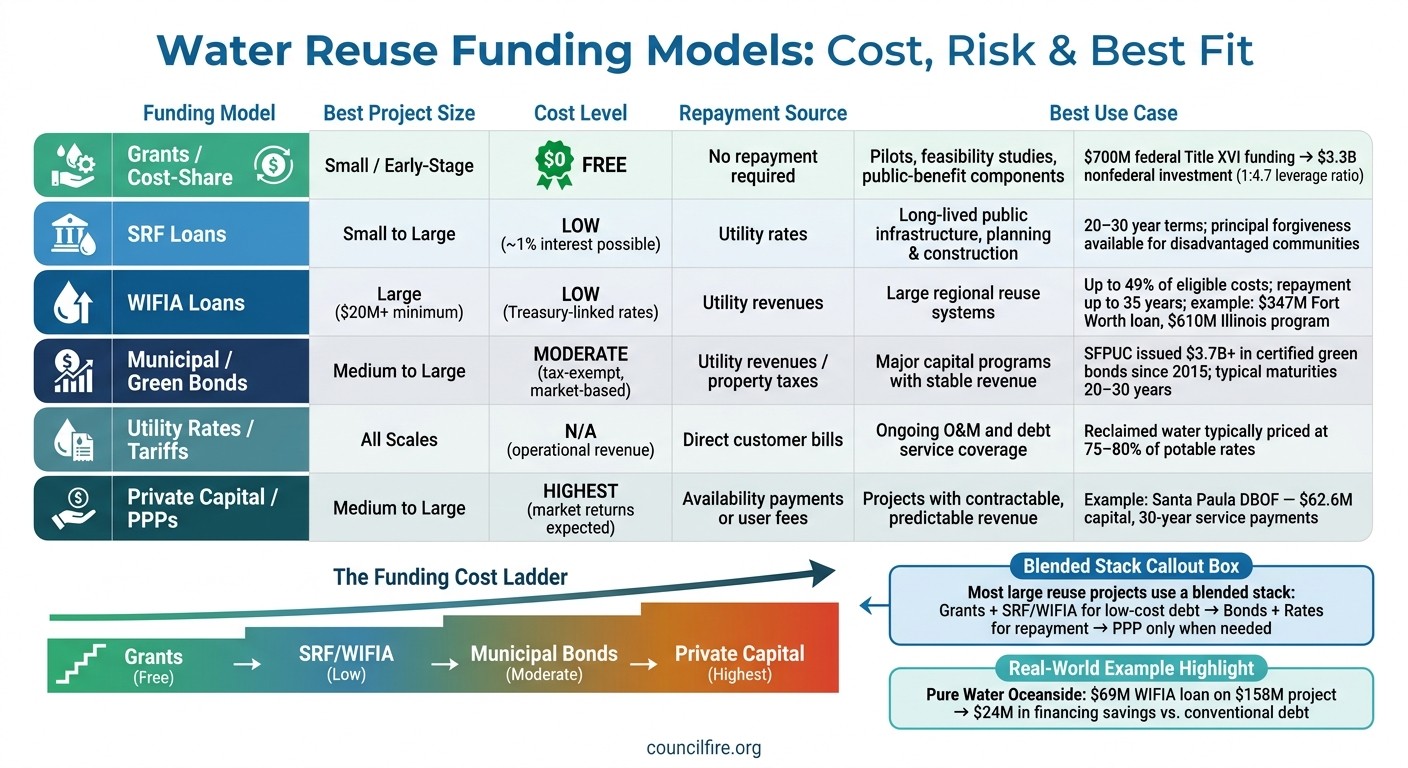
Water Reuse Funding Models Compared: Cost, Risk & Best Fit
Waco gets another $1M in federal funds for wastewater reuse project
Quick Comparison
Funding model | Best fit | Main limit | Usual repayment source | Cost level |
|---|---|---|---|---|
Grants / cost-share | Early-stage, pilot, public-purpose pieces | Competitive awards, match rules, reimbursement timing | No repayment | Lowest |
SRF loans | Small to large public projects | State rules, credit review, reporting | Utility rates | Low |
WIFIA loans | Large projects, usually $20 million+ | Long review and closing process | Utility revenues | Low |
Municipal / green bonds | Medium to large capital programs | Market access, coverage ratios, issuance costs | Rates or taxes | Mid |
Utility rates / tariffs | All project sizes | Political pushback, affordability limits | Customer bills | N/A |
Private capital / PPPs | Medium to large deals with contracted payments | Higher financing cost, long contracts | Availability payments or user fees | Highest |
What stands out most is the cost ladder: grants first, then SRF/WIFIA, then bonds, then private capital. That’s why many reuse projects use blended financing instead of one funding source alone.
If I were screening a reuse project fast, I’d ask: Can grant money cut early cost? Can SRF or WIFIA cover the debt-heavy share? Are rates strong enough to repay the rest? That simple filter gets to the core of the article.
1. Grants and Cost-Share Programs
Grants are best used as seed capital for early-stage work and the parts of a project that serve a public good. Since they do not have to be repaid, they are the lowest-cost capital available. The catch is familiar: applications are competitive, compliance can be heavy, and funding caps almost never pay for an entire project by themselves.
Project Scale Fit
These programs line up pretty neatly with project size. WaterSMART tends to fit pilots and smaller upgrades, with awards often capped between $500,000 and $5 million depending on the program, and it usually requires a 50% nonfederal match [13][17][19]. Title XVI is a better fit for mid-scale municipal systems and generally limits the federal share to 25% of total project costs [18][19][20]. At the far end, the Large-Scale Water Recycling Program under the Bipartisan Infrastructure Law is aimed at mega-projects with total costs of at least $500 million. It can provide up to a 25% federal cost share, has no per-project dollar cap, and is funded at $450 million over five years [22][23].
That pattern matters. The bigger the project gets, the more grants tend to act as a catalyst rather than a full funding answer.
Risk Tolerance
Grants usually favor proven reuse applications with clear public benefits, including water recycling and stormwater reuse. They also support feasibility studies, pilot testing, and advanced design work. In many cases, scoring gives an edge to projects with strong stakeholder engagement, measurable water savings, and climate resilience co-benefits [13][15][19].
Put simply, grants are a good way to lower technical risk before debt financing or rate recovery carries the rest of the load.
Cash Flow Demands
Grants can cut down the amount of debt or rate recovery needed at the start, but there is a timing issue. Many programs reimburse costs only after they have been spent, so utilities often need bridge financing to keep work moving. After that, long-term debt or customer rates usually cover the remaining capital needs as well as all ongoing operations.
There is another hard limit here: grants do not pay for operations and maintenance. That shortfall still has to come from rates or another steady revenue source [18][20].
Cost of Capital
The direct cost of grant capital is zero [14][18][20]. Still, "free money" is never quite free. Agencies have to put in staff time for applications, reporting, labor compliance, and environmental review. There can also be limits on project scope or timing, and those demands are often easier for larger utilities with grant administration teams than for smaller agencies [13][17][19][20].
Even with those tradeoffs, the numbers usually support going after grants. Historically, about $700 million in federal Title XVI funding has leveraged more than $3.3 billion in nonfederal investment, which works out to a leverage ratio of about 1:4.7 [21]. In plain terms, that mix can lower financing costs and ease pressure on customer rates. Since grants rarely cover the full capital stack, they usually sit alongside debt, rates, or private capital.
2. State Revolving Funds and WIFIA Loans
When grants only cover part of the capital stack, SRFs and WIFIA usually take over as the main public debt tools for reuse projects. Grants often help knock down early-stage risk. After that, SRFs and WIFIA tend to fund the debt-heavy share of the work.
Project Scale Fit
SRFs tend to work best for small to mid-sized reuse projects, though some states also use them for large regional efforts. The Clean Water State Revolving Fund (CWSRF) can finance planning, design, and construction for reclamation plants, distribution pipelines, injection wells, and reuse-related green infrastructure [24][7][25][28][30]. The Drinking Water SRF (DWSRF) can also support projects tied to recycled water sources when they help meet drinking water needs [12].
WIFIA is aimed at large projects. The minimum eligible cost is usually $20 million, or $5 million for communities with fewer than 25,000 people. Recent reuse loans show the scale: a $347 million loan for Fort Worth and a $610 million regional program in Illinois [5][32][8][29].
Risk Tolerance
SRFs are generally the lower-risk option. States review creditworthiness, repayment capacity, and regulatory compliance before they approve loans, and some borrowers may also qualify for principal forgiveness if they serve disadvantaged communities [1][7][25].
WIFIA asks for more up-front proof. Borrowers need to show revenue support, construction planning, environmental review status, and repayment capacity [16][26][27]. That makes WIFIA a good fit for more complex projects, but it also means more due diligence before closing.
Cash Flow Demands
SRF loans often run 20 to 30 years, and some states allow principal deferral during construction [7][25]. That can help a project get moving before full repayment kicks in.
WIFIA gives borrowers even more runway. Repayment can stretch up to 35 years after project completion, and payment schedules can be shaped around future rate increases, new customer connections, or wholesale reuse contracts [16][26][27]. For large reuse systems, that extra room can ease near-term pressure on rates and make gradual increases easier to manage.
Cost of Capital
SRF interest rates can fall to around 1% for recycled water projects or disadvantaged communities [1][7][30]. WIFIA rates are tied to U.S. Treasury rates with similar maturities, which keeps them well below typical market rates [16][2][26].
The best financing math often comes from mixing WIFIA with SRFs or other low-cost capital. WIFIA can fund up to 49% of eligible project costs [2][31], while the rest can come from SRFs, bonds, or local funds. On a large reuse project, that blended approach can lower total financing costs by 1 to 2 percentage points or more [16][2][7][26][27][31].
When SRFs and WIFIA still leave a funding gap, municipalities usually close it with bonds, rate revenue, or private capital.
3. Municipal Bonds and Green Bonds
When grants and revolving funds don’t cover the full bill, bonds often supply the rest of the capital stack. In the U.S., municipal bonds remain one of the main long-term funding tools for water infrastructure. For water reuse projects, the two structures used most often are general obligation (GO) bonds and revenue bonds. GO bonds are backed by a municipality’s taxing power. Revenue bonds, by contrast, depend on system rates and user charges.
Project Scale Fit
Bonds make the most sense when grants and low-cost federal loans still leave a gap. There’s a simple reason: legal, underwriting, rating, and disclosure costs don’t shrink much for small deals. That means transactions under about $10 million to $20 million can be inefficient. Larger utilities are in a better position here, and some issue hundreds of millions of dollars in water or sewer revenue bonds to pay for reuse plants, pipelines, and storage.[34][36]
Green bonds follow the same basic scale logic. They are municipal or revenue bonds whose proceeds are set aside for environmental projects, but they also come with spending rules and reporting needs. The San Francisco Public Utilities Commission (SFPUC) has issued more than $3.7 billion in certified green bonds since 2015 for water and wastewater capital projects, including enhanced water recycling and recycled water systems used to irrigate public spaces. That has made SFPUC one of the largest municipal green bond issuers in the U.S. water sector.[10] Smaller issuers, though, don’t often lean on bonds by themselves.
Risk Tolerance
With revenue bonds, the central issue is repayment capacity: can rate revenues cover debt service year after year across a 20- to 30-year period?[34][36] Water reuse adds another layer. If recycled water sales come in below forecast, the debt still has to be paid. That’s why rate covenants that require minimum debt service coverage ratios are a standard backstop.[34][36]
Green bonds bring a different kind of pressure. Along with repayment, issuers take on reputational and compliance risk. They need to make sure the funded projects match the stated environmental criteria and that allocation and impact reporting stay up to date.[33][11] The green label may help market recycled water assets, but it doesn’t change the fact that repayment duties stay the same.
Cash Flow Demands
Municipal and green bonds line up well with the long life of reuse infrastructure. Maturities often run 20 to 30 years, and sometimes longer.[34][36] That gives utilities room to spread capital costs across the same period in which customers receive the supply and water quality gains.
To ease short-term rate pressure, utilities may stage bond issuances around construction schedules. They may also use capitalized interest or interest-only construction periods while the project is being built.[9][36] In plain terms, that can help smooth the early cash burden before the full system is online.
Cost of Capital
Tax-exempt municipal bonds usually offer low borrowing costs. Green bonds, however, don’t tend to produce much of an interest-rate discount. Their main upside is often on the demand side: they can draw in more investors and support demand when the bonds are issued.[9][35]
In most cases, bond financing covers the share left after grants and low-cost debt are applied. Even then, repayment still rests on stable revenue, usually from rates or taxes.
4. Utility Rates and Tariff-Based Funding
Utility rates pay for reuse systems through customer bills over time. In practice, that makes rates the main source for operations, maintenance, reserves, and often debt service. They usually sit underneath SRF loans, WIFIA, or bonds as the repayment source. Put simply, rates do not usually replace debt. They make debt repayable by creating the cash flow behind it.
Project Scale Fit
Rates work best when a utility has a steady customer base and enough users to spread fixed reuse costs across the system. Denver Water offers a clear example. It allocated raw water supply costs across its full customer base, while charging reclaimed water customers for treatment and distribution based on cost of service, with reclaimed rates set to cover system O&M.[38]
That setup is harder for small systems. They often need blended funding before rates can support the full cost burden. If customer growth is shaky, the math gets tighter fast. In those cases, grants or loans usually help close the gap.
Risk Tolerance
Rate funding pushes much of the financial risk onto the utility and its ratepayers. The money may pencil out on paper, but politics can still get in the way. Rate increases often face public pushback, even when the project itself makes sense.
The pressure is usually strongest in places dealing with affordability strain, declining customer counts, or other major capital demands. In those settings, rate-only funding is seldom enough.
Cash Flow Demands
Rates seldom pay for reuse capital upfront. Utilities usually need reserves, interim financing, or phased construction to cover the gap at the start. That is why rates are so often paired with debt for capital-heavy projects. The rate base gives lenders a steady repayment stream, which helps line up cost recovery with the useful life of the asset.
Cost of Capital
Rate-backed financing often comes in below private equity or private concession structures on cost because broad customer payments reduce lender risk. Reclaimed water is also often priced below potable water to help drive adoption, usually at about 75% to 80% of potable rates.[39][40]
That price signal helps demand, but it seldom pays the full bill. Utilities usually make up the difference through the broader rate base, grants, or low-cost loans.[41][38] If rate support is not strong enough to carry the full capital stack, private capital is usually the next path.
5. Private Capital and Public-Private Partnerships
When grants, SRFs, and bonds don't cover the full cost, private capital can help move water reuse projects ahead. In a public-private partnership, or PPP, the public agency still controls service standards and rates. The private partner takes on financing, design, construction, and in some cases operations. That's a shared-delivery model, not privatization. The tradeoff is pretty straightforward: PPPs can get projects built without major upfront public borrowing, but they also commit the utility to future payments. Put simply, they swap lower near-term public spending for higher long-term payment obligations.
Project Scale Fit
Private capital tends to fit medium to large projects that have a steady, long-term payment stream. The Santa Paula Water Recycling Facility in California shows how this works in practice. The city entered a Design-Build-Operate-Finance (DBOF) agreement with a private consortium that financed and built the facility at an initial capital cost of about $62.6 million, and the city committed to service payments for up to 30 years if performance standards were met.[44]
Small, one-off projects usually don't pencil out under a PPP. Transaction costs are higher, and many projects at that size simply won't draw private capital.[42]
Risk Tolerance
One of the main reasons agencies look at PPPs is risk transfer. Fixed-price, performance-based contracts can shift construction risk, design risk, and much of the operations and maintenance risk to the private partner.[42][44] The public side usually still carries demand risk and regulatory risk, since it continues to set tariffs and meet service duties.[42]
That makes PPPs a better match for utilities that can live with long-term payment commitments but want less exposure to delivery problems. If a utility wants more certainty around buildout and day-to-day plant performance, this model can be a good fit.
Cash Flow Demands
PPPs replace upfront capital spending with long-term service payments. Common deal structures include:
Availability payments
Minimum-payment contracts
Usage fees paired with a minimum payment to support financing[42][44]
This can ease pressure on the near-term budget and help a project move faster. But there's no free lunch. Those payment duties can become rigid over time, especially if demand shifts or rate growth falls short. Utilities should stress-test cash flow under different demand and rate scenarios before signing any agreement.[42][45]
Cost of Capital
Private financing usually costs more than tax-exempt municipal debt. Private investors don't receive the municipal tax exemption, and they expect returns that reflect project risk and counterparty risk.[42][43] Even so, total lifecycle cost can still compare well when the contract bakes in faster delivery, fewer cost overruns, and stronger operations.[42]
Blended finance can help close the gap if grants or concessional loans reduce how much private capital is needed. That's why PPPs tend to make the most sense when the project is large, speed matters, and the utility's cash flow can carry long-term service payments.
Tradeoffs by Scale, Risk, and Cash Flow
No single funding model fits every water reuse project. The right pick comes down to three things: project size, how much risk the utility can carry, and how cash comes in over time. Put side by side, these models differ most in size, risk, and who pays the bill.
Funding Model | Best Fit by Size | Key Risks | Who Repays | Cost Level | Best Use Case |
|---|---|---|---|---|---|
Grants / Cost-Share | Small / early-stage | High competition; compliance clawbacks | No repayment | Free | Early-stage work and public-benefit components |
SRF Loans | Small to large | Regulatory delays; reporting burden | Utility rates | Low | Long-lived public infrastructure |
WIFIA Loans | Large | Long lead times; multi-stage approvals | Utility revenues | Low; Treasury-linked and usually below municipal bond rates [4][9] | Large regional systems |
Municipal / Green Bonds | Medium to large | Market timing; rate-setting risk | Utility revenues / property taxes | Moderate; market-based, tax-exempt [9] | Big capital programs with stable repayment |
Utility Rates / Tariffs | All scales | Political opposition; lower demand and weaker revenue | Direct user fees | N/A | Ongoing O&M and debt service |
Private Capital / P3 | Medium to large | Partner default risk; hard-to-exit contracts | Availability payments or user fees | Projects with contractable revenue |
The cost ladder is pretty straightforward. Grants are free, but hard to win. SRF and WIFIA loans are usually the lowest-cost debt options. Municipal bonds sit higher, and private capital comes in at the top.
Blended Capital Stacks
Once the fit is clear, the next move is combining tools to close the funding gap. Most large reuse projects don't rely on one source alone. They use a blended stack, mixing tools to bring down total capital cost and cover gaps that one source can't handle on its own.
A few combinations show up again and again:
Grant + SRF: Grants take on early-stage risk, planning, or the local match. SRF then covers construction at a lower borrowing cost.
Bond + rates: Bonds fund major capital needs when a utility has steady cash flow. Rates then support debt service over time.
Private capital + availability payments: The utility passes delivery risk to a private partner and pays over time.
WIFIA and SRF can also be co-financed on the same project, with WIFIA layered alongside other debt to cover eligible costs. [3] The aim is simple: keep funding costs lower while keeping cash flow workable.
In practice, that stack often starts with grants or low-cost debt, then adds bonds, rates, or private capital to round out the package.
Pros and Cons of Each Funding Model
This summary shows where each funding model wins on cost, risk, and cash flow.
Once the mix is clear, the next step is simpler: pick the model with the lowest cost and the least strain on project cash flow. The comparison below helps line up funding with project size, risk, and repayment strength.
Funding Model | Pros | Cons | Best For |
|---|---|---|---|
Grants / Cost-Share | No repayment; can reduce debt needs and rate impacts; supports equity goals | Highly competitive; slow to award; heavy compliance and reporting burden | Early-stage pilots; disadvantaged communities |
SRF Loans | Below-market rates; principal forgiveness options; can finance water reuse capital and planning/design costs [37][50] | State-specific eligibility rules; reporting obligations tied to capitalization grants; scope changes may require state review [48][1] | Mid-to-large reuse infrastructure |
WIFIA Loans | Long-term, low-cost federal financing; can cover up to 49% of eligible project costs; can be paired with other financing [2][4] | Best suited to large projects; intensive credit review; long lead time from Letter of Interest to closing [2][48][6] | Large, regionally significant reuse systems |
Municipal / Green Bonds | Access to large tax-exempt capital markets; useful for major capital programs; best when revenue is stable and forecastable | Certification and reporting burden for green bonds; tends to favor large issuers | Large capital programs with stable, predictable revenue streams |
Utility Rates / Tariffs | Reliable ongoing revenue; set through utility rate policy; supports debt service and O&M | Politically sensitive; rate increases can trigger public opposition; affordability concerns for low-income customers | Ongoing O&M costs and debt service coverage |
Private Capital / P3 | Transfers construction and performance risk; can accelerate delivery; brings technical expertise | Complex procurement and long-term contracts; potential long-term payment obligations; limited flexibility once signed | Projects with contractable, predictable revenue streams |
The table gives the short version. In practice, the tradeoffs show up fast once money is on the line.
The Pure Water Oceanside project in California is a good example. It used a $69 million WIFIA loan for a $158 million total project and is expected to save $24 million in financing costs compared with conventional market debt. [49] That kind of spread matters. For a big reuse project, cheaper long-term federal debt can ease pressure on rates and leave more room in the budget for delivery and operations.
Green bonds tell a different story. They can work well, but scale matters. The San Francisco Public Utilities Commission has issued more than $3.7 billion in certified green bonds for water and wastewater capital projects through FY2023, showing that regional utilities can handle the certification and reporting load in ways smaller issuers often cannot. [10] For a large issuer, that overhead is part of doing business. For a smaller system, it can feel like a lot of extra weight for the same dollars.
A simple way to think about the risk profile:
Grants and WIFIA tend to lock in project scope early.
PPPs tend to lock in long-term payment obligations.
That distinction matters more than it may seem at first glance. If the project may change shape, early scope lock can be a problem. If cash flow is uncertain, a long contract with fixed payment duties can become the bigger risk.
Conclusion
No single funding model works for every water reuse project. The right mix depends on project scale, risk, and the borrower’s ability to repay.
When you line funding up against project size, a clear pattern shows up. Small projects often lean on grants and SRF loans. Mid-sized projects usually bring in revenue bonds and rate-backed funding. Large regional systems often need a blended stack that includes WIFIA, SRFs, bonds, and, in some cases, PPPs.
Before choosing that stack, do the hard math first. Stress-test repayment. Confirm grant and principal-forgiveness eligibility. Then look closely at how rate changes could affect low-income households.
The strongest projects pair funding sources to scale, risk, and cash flow. For larger reuse efforts, blended finance is usually the starting point, not the backup plan. Council Fire helps turn water reuse strategies into fundable infrastructure plans.
FAQs
How do I choose the right funding mix for my project?
Match funding tools to your project’s stage, scale, risk, and cash flow.
For early planning, federal grants and technical assistance often make the most sense. They can help you shape the project, test ideas, and cover upfront work before you’re ready to take on debt.
When a project moves into large-scale construction, SRF loans or municipal bonds are often a better fit. These tools are built for bigger capital needs and longer payback periods.
For day-to-day operations, utility fees or impact investment may be the right path. They can support recurring costs and give projects a steadier source of funds over time.
If risk is high or future revenue is still unclear, blended finance or PPPs can help reduce uncertainty and draw in private capital. That kind of structure can make a hard-to-fund project look far less risky to outside investors.
When does WIFIA make more sense than an SRF loan?
WIFIA can be a better fit than a State Revolving Fund (SRF) loan when a project needs long-term, low-cost supplemental financing and repayment terms that match uneven or project-specific cash flow.
It tends to work especially well for large-scale projects and public-private partnerships. In those cases, added flexibility in debt structuring and more varied revenue timelines can offer an edge over the more standardized loan structures often found in SRF programs.
Can utility rates alone support a water reuse project?
Usually not. Utility rates cover more than 85% of community water infrastructure investment, but that still often isn’t enough to pay for water reuse projects by themselves.
Leaning only on rate hikes can put real pressure on residents, especially in low-income or rural communities where every dollar matters. That’s why many municipalities turn to blended finance. They combine utility revenue with grants, green bonds, and private capital to fill funding gaps, lower risk, and help keep costs more manageable for the people who ultimately pay the bill.
Related Blog Posts
Latest Articles
©2025

Narrative Change and Power Building: The Missing Half of Advocacy
Narrative change is the process of disrupting dominant narratives that normalize inequity and advancing new narratives from historically marginalized communities.

Funding Resilience Without Federal Grants
BRIC is unreliable and FEMA is shrinking. Here's how cities fund climate resilience with dedicated revenue, blended finance, and a coordinating authority.

The ESG Blind Spot: How AI Is Finding Risks in Companies Nobody Else Is Watching
Norway's sovereign wealth fund uses AI to screen 7,200 portfolio companies for forced labor and corruption within 24 hours. The real story is the emerging-market coverage gap that traditional ESG data vendors miss — and what it means for any company with a global supply chain.
Narrative Change and Power Building: The Missing Half of Advocacy
Narrative change is the process of disrupting dominant narratives that normalize inequity and advancing new narratives from historically marginalized communities.
Funding Resilience Without Federal Grants
BRIC is unreliable and FEMA is shrinking. Here's how cities fund climate resilience with dedicated revenue, blended finance, and a coordinating authority.
The ESG Blind Spot: How AI Is Finding Risks in Companies Nobody Else Is Watching
Norway's sovereign wealth fund uses AI to screen 7,200 portfolio companies for forced labor and corruption within 24 hours. The real story is the emerging-market coverage gap that traditional ESG data vendors miss — and what it means for any company with a global supply chain.
FAQ
01
What does it really mean to “redefine profit”?
02
What makes Council Fire different?
03
Who does Council Fire work with?
04
What does working with Council Fire actually look like?
05
How does Council Fire help organizations turn big goals into action?
06
How does Council Fire define and measure success?
Aug 7, 2026
Water Reuse Funding Models Compared
Sustainability Strategy
In This Article
Compare grants, SRF, WIFIA, bonds, rates, and PPPs to find the best blended finance for water reuse projects by size, risk, and cash flow.
Water Reuse Funding Models Compared
Most U.S. water reuse projects are paid for with a mix of grants, low-rate public loans, bonds, customer rates, and sometimes private money. If I had to sum up the article in one line, it’s this: small projects usually start with grants and SRF loans, while large projects often need a layered funding stack with WIFIA, bonds, and rate-backed repayment.
If you’re weighing options, the choice usually comes down to three questions:
How big is the project? A $10 million local reuse system is financed very differently from a $500 million regional DPR program.
How much project risk can you carry? Early-stage design, demand uncertainty, and treatment complexity change which funding tools fit.
What will repay the money? Most capital sources still depend on utility revenue, taxes, or long-term service payments.
Here’s the short version:
Grants are the lowest-cost source, but they rarely cover the full job and usually do not pay for O&M.
SRF loans and WIFIA are often the lowest-cost debt options for public reuse infrastructure.
Municipal and green bonds work best when repayment is steady and the project is large enough to justify issuance costs.
Utility rates are the cash-flow backbone for O&M and debt service.
Private capital and PPPs can fill gaps, but they often cost more over time and lock in payment duties.
Water Reuse Funding Models Compared: Cost, Risk & Best Fit
Waco gets another $1M in federal funds for wastewater reuse project
Quick Comparison
Funding model | Best fit | Main limit | Usual repayment source | Cost level |
|---|---|---|---|---|
Grants / cost-share | Early-stage, pilot, public-purpose pieces | Competitive awards, match rules, reimbursement timing | No repayment | Lowest |
SRF loans | Small to large public projects | State rules, credit review, reporting | Utility rates | Low |
WIFIA loans | Large projects, usually $20 million+ | Long review and closing process | Utility revenues | Low |
Municipal / green bonds | Medium to large capital programs | Market access, coverage ratios, issuance costs | Rates or taxes | Mid |
Utility rates / tariffs | All project sizes | Political pushback, affordability limits | Customer bills | N/A |
Private capital / PPPs | Medium to large deals with contracted payments | Higher financing cost, long contracts | Availability payments or user fees | Highest |
What stands out most is the cost ladder: grants first, then SRF/WIFIA, then bonds, then private capital. That’s why many reuse projects use blended financing instead of one funding source alone.
If I were screening a reuse project fast, I’d ask: Can grant money cut early cost? Can SRF or WIFIA cover the debt-heavy share? Are rates strong enough to repay the rest? That simple filter gets to the core of the article.
1. Grants and Cost-Share Programs
Grants are best used as seed capital for early-stage work and the parts of a project that serve a public good. Since they do not have to be repaid, they are the lowest-cost capital available. The catch is familiar: applications are competitive, compliance can be heavy, and funding caps almost never pay for an entire project by themselves.
Project Scale Fit
These programs line up pretty neatly with project size. WaterSMART tends to fit pilots and smaller upgrades, with awards often capped between $500,000 and $5 million depending on the program, and it usually requires a 50% nonfederal match [13][17][19]. Title XVI is a better fit for mid-scale municipal systems and generally limits the federal share to 25% of total project costs [18][19][20]. At the far end, the Large-Scale Water Recycling Program under the Bipartisan Infrastructure Law is aimed at mega-projects with total costs of at least $500 million. It can provide up to a 25% federal cost share, has no per-project dollar cap, and is funded at $450 million over five years [22][23].
That pattern matters. The bigger the project gets, the more grants tend to act as a catalyst rather than a full funding answer.
Risk Tolerance
Grants usually favor proven reuse applications with clear public benefits, including water recycling and stormwater reuse. They also support feasibility studies, pilot testing, and advanced design work. In many cases, scoring gives an edge to projects with strong stakeholder engagement, measurable water savings, and climate resilience co-benefits [13][15][19].
Put simply, grants are a good way to lower technical risk before debt financing or rate recovery carries the rest of the load.
Cash Flow Demands
Grants can cut down the amount of debt or rate recovery needed at the start, but there is a timing issue. Many programs reimburse costs only after they have been spent, so utilities often need bridge financing to keep work moving. After that, long-term debt or customer rates usually cover the remaining capital needs as well as all ongoing operations.
There is another hard limit here: grants do not pay for operations and maintenance. That shortfall still has to come from rates or another steady revenue source [18][20].
Cost of Capital
The direct cost of grant capital is zero [14][18][20]. Still, "free money" is never quite free. Agencies have to put in staff time for applications, reporting, labor compliance, and environmental review. There can also be limits on project scope or timing, and those demands are often easier for larger utilities with grant administration teams than for smaller agencies [13][17][19][20].
Even with those tradeoffs, the numbers usually support going after grants. Historically, about $700 million in federal Title XVI funding has leveraged more than $3.3 billion in nonfederal investment, which works out to a leverage ratio of about 1:4.7 [21]. In plain terms, that mix can lower financing costs and ease pressure on customer rates. Since grants rarely cover the full capital stack, they usually sit alongside debt, rates, or private capital.
2. State Revolving Funds and WIFIA Loans
When grants only cover part of the capital stack, SRFs and WIFIA usually take over as the main public debt tools for reuse projects. Grants often help knock down early-stage risk. After that, SRFs and WIFIA tend to fund the debt-heavy share of the work.
Project Scale Fit
SRFs tend to work best for small to mid-sized reuse projects, though some states also use them for large regional efforts. The Clean Water State Revolving Fund (CWSRF) can finance planning, design, and construction for reclamation plants, distribution pipelines, injection wells, and reuse-related green infrastructure [24][7][25][28][30]. The Drinking Water SRF (DWSRF) can also support projects tied to recycled water sources when they help meet drinking water needs [12].
WIFIA is aimed at large projects. The minimum eligible cost is usually $20 million, or $5 million for communities with fewer than 25,000 people. Recent reuse loans show the scale: a $347 million loan for Fort Worth and a $610 million regional program in Illinois [5][32][8][29].
Risk Tolerance
SRFs are generally the lower-risk option. States review creditworthiness, repayment capacity, and regulatory compliance before they approve loans, and some borrowers may also qualify for principal forgiveness if they serve disadvantaged communities [1][7][25].
WIFIA asks for more up-front proof. Borrowers need to show revenue support, construction planning, environmental review status, and repayment capacity [16][26][27]. That makes WIFIA a good fit for more complex projects, but it also means more due diligence before closing.
Cash Flow Demands
SRF loans often run 20 to 30 years, and some states allow principal deferral during construction [7][25]. That can help a project get moving before full repayment kicks in.
WIFIA gives borrowers even more runway. Repayment can stretch up to 35 years after project completion, and payment schedules can be shaped around future rate increases, new customer connections, or wholesale reuse contracts [16][26][27]. For large reuse systems, that extra room can ease near-term pressure on rates and make gradual increases easier to manage.
Cost of Capital
SRF interest rates can fall to around 1% for recycled water projects or disadvantaged communities [1][7][30]. WIFIA rates are tied to U.S. Treasury rates with similar maturities, which keeps them well below typical market rates [16][2][26].
The best financing math often comes from mixing WIFIA with SRFs or other low-cost capital. WIFIA can fund up to 49% of eligible project costs [2][31], while the rest can come from SRFs, bonds, or local funds. On a large reuse project, that blended approach can lower total financing costs by 1 to 2 percentage points or more [16][2][7][26][27][31].
When SRFs and WIFIA still leave a funding gap, municipalities usually close it with bonds, rate revenue, or private capital.
3. Municipal Bonds and Green Bonds
When grants and revolving funds don’t cover the full bill, bonds often supply the rest of the capital stack. In the U.S., municipal bonds remain one of the main long-term funding tools for water infrastructure. For water reuse projects, the two structures used most often are general obligation (GO) bonds and revenue bonds. GO bonds are backed by a municipality’s taxing power. Revenue bonds, by contrast, depend on system rates and user charges.
Project Scale Fit
Bonds make the most sense when grants and low-cost federal loans still leave a gap. There’s a simple reason: legal, underwriting, rating, and disclosure costs don’t shrink much for small deals. That means transactions under about $10 million to $20 million can be inefficient. Larger utilities are in a better position here, and some issue hundreds of millions of dollars in water or sewer revenue bonds to pay for reuse plants, pipelines, and storage.[34][36]
Green bonds follow the same basic scale logic. They are municipal or revenue bonds whose proceeds are set aside for environmental projects, but they also come with spending rules and reporting needs. The San Francisco Public Utilities Commission (SFPUC) has issued more than $3.7 billion in certified green bonds since 2015 for water and wastewater capital projects, including enhanced water recycling and recycled water systems used to irrigate public spaces. That has made SFPUC one of the largest municipal green bond issuers in the U.S. water sector.[10] Smaller issuers, though, don’t often lean on bonds by themselves.
Risk Tolerance
With revenue bonds, the central issue is repayment capacity: can rate revenues cover debt service year after year across a 20- to 30-year period?[34][36] Water reuse adds another layer. If recycled water sales come in below forecast, the debt still has to be paid. That’s why rate covenants that require minimum debt service coverage ratios are a standard backstop.[34][36]
Green bonds bring a different kind of pressure. Along with repayment, issuers take on reputational and compliance risk. They need to make sure the funded projects match the stated environmental criteria and that allocation and impact reporting stay up to date.[33][11] The green label may help market recycled water assets, but it doesn’t change the fact that repayment duties stay the same.
Cash Flow Demands
Municipal and green bonds line up well with the long life of reuse infrastructure. Maturities often run 20 to 30 years, and sometimes longer.[34][36] That gives utilities room to spread capital costs across the same period in which customers receive the supply and water quality gains.
To ease short-term rate pressure, utilities may stage bond issuances around construction schedules. They may also use capitalized interest or interest-only construction periods while the project is being built.[9][36] In plain terms, that can help smooth the early cash burden before the full system is online.
Cost of Capital
Tax-exempt municipal bonds usually offer low borrowing costs. Green bonds, however, don’t tend to produce much of an interest-rate discount. Their main upside is often on the demand side: they can draw in more investors and support demand when the bonds are issued.[9][35]
In most cases, bond financing covers the share left after grants and low-cost debt are applied. Even then, repayment still rests on stable revenue, usually from rates or taxes.
4. Utility Rates and Tariff-Based Funding
Utility rates pay for reuse systems through customer bills over time. In practice, that makes rates the main source for operations, maintenance, reserves, and often debt service. They usually sit underneath SRF loans, WIFIA, or bonds as the repayment source. Put simply, rates do not usually replace debt. They make debt repayable by creating the cash flow behind it.
Project Scale Fit
Rates work best when a utility has a steady customer base and enough users to spread fixed reuse costs across the system. Denver Water offers a clear example. It allocated raw water supply costs across its full customer base, while charging reclaimed water customers for treatment and distribution based on cost of service, with reclaimed rates set to cover system O&M.[38]
That setup is harder for small systems. They often need blended funding before rates can support the full cost burden. If customer growth is shaky, the math gets tighter fast. In those cases, grants or loans usually help close the gap.
Risk Tolerance
Rate funding pushes much of the financial risk onto the utility and its ratepayers. The money may pencil out on paper, but politics can still get in the way. Rate increases often face public pushback, even when the project itself makes sense.
The pressure is usually strongest in places dealing with affordability strain, declining customer counts, or other major capital demands. In those settings, rate-only funding is seldom enough.
Cash Flow Demands
Rates seldom pay for reuse capital upfront. Utilities usually need reserves, interim financing, or phased construction to cover the gap at the start. That is why rates are so often paired with debt for capital-heavy projects. The rate base gives lenders a steady repayment stream, which helps line up cost recovery with the useful life of the asset.
Cost of Capital
Rate-backed financing often comes in below private equity or private concession structures on cost because broad customer payments reduce lender risk. Reclaimed water is also often priced below potable water to help drive adoption, usually at about 75% to 80% of potable rates.[39][40]
That price signal helps demand, but it seldom pays the full bill. Utilities usually make up the difference through the broader rate base, grants, or low-cost loans.[41][38] If rate support is not strong enough to carry the full capital stack, private capital is usually the next path.
5. Private Capital and Public-Private Partnerships
When grants, SRFs, and bonds don't cover the full cost, private capital can help move water reuse projects ahead. In a public-private partnership, or PPP, the public agency still controls service standards and rates. The private partner takes on financing, design, construction, and in some cases operations. That's a shared-delivery model, not privatization. The tradeoff is pretty straightforward: PPPs can get projects built without major upfront public borrowing, but they also commit the utility to future payments. Put simply, they swap lower near-term public spending for higher long-term payment obligations.
Project Scale Fit
Private capital tends to fit medium to large projects that have a steady, long-term payment stream. The Santa Paula Water Recycling Facility in California shows how this works in practice. The city entered a Design-Build-Operate-Finance (DBOF) agreement with a private consortium that financed and built the facility at an initial capital cost of about $62.6 million, and the city committed to service payments for up to 30 years if performance standards were met.[44]
Small, one-off projects usually don't pencil out under a PPP. Transaction costs are higher, and many projects at that size simply won't draw private capital.[42]
Risk Tolerance
One of the main reasons agencies look at PPPs is risk transfer. Fixed-price, performance-based contracts can shift construction risk, design risk, and much of the operations and maintenance risk to the private partner.[42][44] The public side usually still carries demand risk and regulatory risk, since it continues to set tariffs and meet service duties.[42]
That makes PPPs a better match for utilities that can live with long-term payment commitments but want less exposure to delivery problems. If a utility wants more certainty around buildout and day-to-day plant performance, this model can be a good fit.
Cash Flow Demands
PPPs replace upfront capital spending with long-term service payments. Common deal structures include:
Availability payments
Minimum-payment contracts
Usage fees paired with a minimum payment to support financing[42][44]
This can ease pressure on the near-term budget and help a project move faster. But there's no free lunch. Those payment duties can become rigid over time, especially if demand shifts or rate growth falls short. Utilities should stress-test cash flow under different demand and rate scenarios before signing any agreement.[42][45]
Cost of Capital
Private financing usually costs more than tax-exempt municipal debt. Private investors don't receive the municipal tax exemption, and they expect returns that reflect project risk and counterparty risk.[42][43] Even so, total lifecycle cost can still compare well when the contract bakes in faster delivery, fewer cost overruns, and stronger operations.[42]
Blended finance can help close the gap if grants or concessional loans reduce how much private capital is needed. That's why PPPs tend to make the most sense when the project is large, speed matters, and the utility's cash flow can carry long-term service payments.
Tradeoffs by Scale, Risk, and Cash Flow
No single funding model fits every water reuse project. The right pick comes down to three things: project size, how much risk the utility can carry, and how cash comes in over time. Put side by side, these models differ most in size, risk, and who pays the bill.
Funding Model | Best Fit by Size | Key Risks | Who Repays | Cost Level | Best Use Case |
|---|---|---|---|---|---|
Grants / Cost-Share | Small / early-stage | High competition; compliance clawbacks | No repayment | Free | Early-stage work and public-benefit components |
SRF Loans | Small to large | Regulatory delays; reporting burden | Utility rates | Low | Long-lived public infrastructure |
WIFIA Loans | Large | Long lead times; multi-stage approvals | Utility revenues | Low; Treasury-linked and usually below municipal bond rates [4][9] | Large regional systems |
Municipal / Green Bonds | Medium to large | Market timing; rate-setting risk | Utility revenues / property taxes | Moderate; market-based, tax-exempt [9] | Big capital programs with stable repayment |
Utility Rates / Tariffs | All scales | Political opposition; lower demand and weaker revenue | Direct user fees | N/A | Ongoing O&M and debt service |
Private Capital / P3 | Medium to large | Partner default risk; hard-to-exit contracts | Availability payments or user fees | Projects with contractable revenue |
The cost ladder is pretty straightforward. Grants are free, but hard to win. SRF and WIFIA loans are usually the lowest-cost debt options. Municipal bonds sit higher, and private capital comes in at the top.
Blended Capital Stacks
Once the fit is clear, the next move is combining tools to close the funding gap. Most large reuse projects don't rely on one source alone. They use a blended stack, mixing tools to bring down total capital cost and cover gaps that one source can't handle on its own.
A few combinations show up again and again:
Grant + SRF: Grants take on early-stage risk, planning, or the local match. SRF then covers construction at a lower borrowing cost.
Bond + rates: Bonds fund major capital needs when a utility has steady cash flow. Rates then support debt service over time.
Private capital + availability payments: The utility passes delivery risk to a private partner and pays over time.
WIFIA and SRF can also be co-financed on the same project, with WIFIA layered alongside other debt to cover eligible costs. [3] The aim is simple: keep funding costs lower while keeping cash flow workable.
In practice, that stack often starts with grants or low-cost debt, then adds bonds, rates, or private capital to round out the package.
Pros and Cons of Each Funding Model
This summary shows where each funding model wins on cost, risk, and cash flow.
Once the mix is clear, the next step is simpler: pick the model with the lowest cost and the least strain on project cash flow. The comparison below helps line up funding with project size, risk, and repayment strength.
Funding Model | Pros | Cons | Best For |
|---|---|---|---|
Grants / Cost-Share | No repayment; can reduce debt needs and rate impacts; supports equity goals | Highly competitive; slow to award; heavy compliance and reporting burden | Early-stage pilots; disadvantaged communities |
SRF Loans | Below-market rates; principal forgiveness options; can finance water reuse capital and planning/design costs [37][50] | State-specific eligibility rules; reporting obligations tied to capitalization grants; scope changes may require state review [48][1] | Mid-to-large reuse infrastructure |
WIFIA Loans | Long-term, low-cost federal financing; can cover up to 49% of eligible project costs; can be paired with other financing [2][4] | Best suited to large projects; intensive credit review; long lead time from Letter of Interest to closing [2][48][6] | Large, regionally significant reuse systems |
Municipal / Green Bonds | Access to large tax-exempt capital markets; useful for major capital programs; best when revenue is stable and forecastable | Certification and reporting burden for green bonds; tends to favor large issuers | Large capital programs with stable, predictable revenue streams |
Utility Rates / Tariffs | Reliable ongoing revenue; set through utility rate policy; supports debt service and O&M | Politically sensitive; rate increases can trigger public opposition; affordability concerns for low-income customers | Ongoing O&M costs and debt service coverage |
Private Capital / P3 | Transfers construction and performance risk; can accelerate delivery; brings technical expertise | Complex procurement and long-term contracts; potential long-term payment obligations; limited flexibility once signed | Projects with contractable, predictable revenue streams |
The table gives the short version. In practice, the tradeoffs show up fast once money is on the line.
The Pure Water Oceanside project in California is a good example. It used a $69 million WIFIA loan for a $158 million total project and is expected to save $24 million in financing costs compared with conventional market debt. [49] That kind of spread matters. For a big reuse project, cheaper long-term federal debt can ease pressure on rates and leave more room in the budget for delivery and operations.
Green bonds tell a different story. They can work well, but scale matters. The San Francisco Public Utilities Commission has issued more than $3.7 billion in certified green bonds for water and wastewater capital projects through FY2023, showing that regional utilities can handle the certification and reporting load in ways smaller issuers often cannot. [10] For a large issuer, that overhead is part of doing business. For a smaller system, it can feel like a lot of extra weight for the same dollars.
A simple way to think about the risk profile:
Grants and WIFIA tend to lock in project scope early.
PPPs tend to lock in long-term payment obligations.
That distinction matters more than it may seem at first glance. If the project may change shape, early scope lock can be a problem. If cash flow is uncertain, a long contract with fixed payment duties can become the bigger risk.
Conclusion
No single funding model works for every water reuse project. The right mix depends on project scale, risk, and the borrower’s ability to repay.
When you line funding up against project size, a clear pattern shows up. Small projects often lean on grants and SRF loans. Mid-sized projects usually bring in revenue bonds and rate-backed funding. Large regional systems often need a blended stack that includes WIFIA, SRFs, bonds, and, in some cases, PPPs.
Before choosing that stack, do the hard math first. Stress-test repayment. Confirm grant and principal-forgiveness eligibility. Then look closely at how rate changes could affect low-income households.
The strongest projects pair funding sources to scale, risk, and cash flow. For larger reuse efforts, blended finance is usually the starting point, not the backup plan. Council Fire helps turn water reuse strategies into fundable infrastructure plans.
FAQs
How do I choose the right funding mix for my project?
Match funding tools to your project’s stage, scale, risk, and cash flow.
For early planning, federal grants and technical assistance often make the most sense. They can help you shape the project, test ideas, and cover upfront work before you’re ready to take on debt.
When a project moves into large-scale construction, SRF loans or municipal bonds are often a better fit. These tools are built for bigger capital needs and longer payback periods.
For day-to-day operations, utility fees or impact investment may be the right path. They can support recurring costs and give projects a steadier source of funds over time.
If risk is high or future revenue is still unclear, blended finance or PPPs can help reduce uncertainty and draw in private capital. That kind of structure can make a hard-to-fund project look far less risky to outside investors.
When does WIFIA make more sense than an SRF loan?
WIFIA can be a better fit than a State Revolving Fund (SRF) loan when a project needs long-term, low-cost supplemental financing and repayment terms that match uneven or project-specific cash flow.
It tends to work especially well for large-scale projects and public-private partnerships. In those cases, added flexibility in debt structuring and more varied revenue timelines can offer an edge over the more standardized loan structures often found in SRF programs.
Can utility rates alone support a water reuse project?
Usually not. Utility rates cover more than 85% of community water infrastructure investment, but that still often isn’t enough to pay for water reuse projects by themselves.
Leaning only on rate hikes can put real pressure on residents, especially in low-income or rural communities where every dollar matters. That’s why many municipalities turn to blended finance. They combine utility revenue with grants, green bonds, and private capital to fill funding gaps, lower risk, and help keep costs more manageable for the people who ultimately pay the bill.
Related Blog Posts
Latest Articles
©2025
Narrative Change and Power Building: The Missing Half of Advocacy
Narrative change is the process of disrupting dominant narratives that normalize inequity and advancing new narratives from historically marginalized communities.
Funding Resilience Without Federal Grants
BRIC is unreliable and FEMA is shrinking. Here's how cities fund climate resilience with dedicated revenue, blended finance, and a coordinating authority.
The ESG Blind Spot: How AI Is Finding Risks in Companies Nobody Else Is Watching
Norway's sovereign wealth fund uses AI to screen 7,200 portfolio companies for forced labor and corruption within 24 hours. The real story is the emerging-market coverage gap that traditional ESG data vendors miss — and what it means for any company with a global supply chain.
FAQ
01
What does it really mean to “redefine profit”?
02
What makes Council Fire different?
03
Who does Council Fire work with?
04
What does working with Council Fire actually look like?
05
How does Council Fire help organizations turn big goals into action?
06
How does Council Fire define and measure success?
Aug 7, 2026
Water Reuse Funding Models Compared
Sustainability Strategy
In This Article
Compare grants, SRF, WIFIA, bonds, rates, and PPPs to find the best blended finance for water reuse projects by size, risk, and cash flow.
Water Reuse Funding Models Compared
Most U.S. water reuse projects are paid for with a mix of grants, low-rate public loans, bonds, customer rates, and sometimes private money. If I had to sum up the article in one line, it’s this: small projects usually start with grants and SRF loans, while large projects often need a layered funding stack with WIFIA, bonds, and rate-backed repayment.
If you’re weighing options, the choice usually comes down to three questions:
How big is the project? A $10 million local reuse system is financed very differently from a $500 million regional DPR program.
How much project risk can you carry? Early-stage design, demand uncertainty, and treatment complexity change which funding tools fit.
What will repay the money? Most capital sources still depend on utility revenue, taxes, or long-term service payments.
Here’s the short version:
Grants are the lowest-cost source, but they rarely cover the full job and usually do not pay for O&M.
SRF loans and WIFIA are often the lowest-cost debt options for public reuse infrastructure.
Municipal and green bonds work best when repayment is steady and the project is large enough to justify issuance costs.
Utility rates are the cash-flow backbone for O&M and debt service.
Private capital and PPPs can fill gaps, but they often cost more over time and lock in payment duties.
Water Reuse Funding Models Compared: Cost, Risk & Best Fit
Waco gets another $1M in federal funds for wastewater reuse project
Quick Comparison
Funding model | Best fit | Main limit | Usual repayment source | Cost level |
|---|---|---|---|---|
Grants / cost-share | Early-stage, pilot, public-purpose pieces | Competitive awards, match rules, reimbursement timing | No repayment | Lowest |
SRF loans | Small to large public projects | State rules, credit review, reporting | Utility rates | Low |
WIFIA loans | Large projects, usually $20 million+ | Long review and closing process | Utility revenues | Low |
Municipal / green bonds | Medium to large capital programs | Market access, coverage ratios, issuance costs | Rates or taxes | Mid |
Utility rates / tariffs | All project sizes | Political pushback, affordability limits | Customer bills | N/A |
Private capital / PPPs | Medium to large deals with contracted payments | Higher financing cost, long contracts | Availability payments or user fees | Highest |
What stands out most is the cost ladder: grants first, then SRF/WIFIA, then bonds, then private capital. That’s why many reuse projects use blended financing instead of one funding source alone.
If I were screening a reuse project fast, I’d ask: Can grant money cut early cost? Can SRF or WIFIA cover the debt-heavy share? Are rates strong enough to repay the rest? That simple filter gets to the core of the article.
1. Grants and Cost-Share Programs
Grants are best used as seed capital for early-stage work and the parts of a project that serve a public good. Since they do not have to be repaid, they are the lowest-cost capital available. The catch is familiar: applications are competitive, compliance can be heavy, and funding caps almost never pay for an entire project by themselves.
Project Scale Fit
These programs line up pretty neatly with project size. WaterSMART tends to fit pilots and smaller upgrades, with awards often capped between $500,000 and $5 million depending on the program, and it usually requires a 50% nonfederal match [13][17][19]. Title XVI is a better fit for mid-scale municipal systems and generally limits the federal share to 25% of total project costs [18][19][20]. At the far end, the Large-Scale Water Recycling Program under the Bipartisan Infrastructure Law is aimed at mega-projects with total costs of at least $500 million. It can provide up to a 25% federal cost share, has no per-project dollar cap, and is funded at $450 million over five years [22][23].
That pattern matters. The bigger the project gets, the more grants tend to act as a catalyst rather than a full funding answer.
Risk Tolerance
Grants usually favor proven reuse applications with clear public benefits, including water recycling and stormwater reuse. They also support feasibility studies, pilot testing, and advanced design work. In many cases, scoring gives an edge to projects with strong stakeholder engagement, measurable water savings, and climate resilience co-benefits [13][15][19].
Put simply, grants are a good way to lower technical risk before debt financing or rate recovery carries the rest of the load.
Cash Flow Demands
Grants can cut down the amount of debt or rate recovery needed at the start, but there is a timing issue. Many programs reimburse costs only after they have been spent, so utilities often need bridge financing to keep work moving. After that, long-term debt or customer rates usually cover the remaining capital needs as well as all ongoing operations.
There is another hard limit here: grants do not pay for operations and maintenance. That shortfall still has to come from rates or another steady revenue source [18][20].
Cost of Capital
The direct cost of grant capital is zero [14][18][20]. Still, "free money" is never quite free. Agencies have to put in staff time for applications, reporting, labor compliance, and environmental review. There can also be limits on project scope or timing, and those demands are often easier for larger utilities with grant administration teams than for smaller agencies [13][17][19][20].
Even with those tradeoffs, the numbers usually support going after grants. Historically, about $700 million in federal Title XVI funding has leveraged more than $3.3 billion in nonfederal investment, which works out to a leverage ratio of about 1:4.7 [21]. In plain terms, that mix can lower financing costs and ease pressure on customer rates. Since grants rarely cover the full capital stack, they usually sit alongside debt, rates, or private capital.
2. State Revolving Funds and WIFIA Loans
When grants only cover part of the capital stack, SRFs and WIFIA usually take over as the main public debt tools for reuse projects. Grants often help knock down early-stage risk. After that, SRFs and WIFIA tend to fund the debt-heavy share of the work.
Project Scale Fit
SRFs tend to work best for small to mid-sized reuse projects, though some states also use them for large regional efforts. The Clean Water State Revolving Fund (CWSRF) can finance planning, design, and construction for reclamation plants, distribution pipelines, injection wells, and reuse-related green infrastructure [24][7][25][28][30]. The Drinking Water SRF (DWSRF) can also support projects tied to recycled water sources when they help meet drinking water needs [12].
WIFIA is aimed at large projects. The minimum eligible cost is usually $20 million, or $5 million for communities with fewer than 25,000 people. Recent reuse loans show the scale: a $347 million loan for Fort Worth and a $610 million regional program in Illinois [5][32][8][29].
Risk Tolerance
SRFs are generally the lower-risk option. States review creditworthiness, repayment capacity, and regulatory compliance before they approve loans, and some borrowers may also qualify for principal forgiveness if they serve disadvantaged communities [1][7][25].
WIFIA asks for more up-front proof. Borrowers need to show revenue support, construction planning, environmental review status, and repayment capacity [16][26][27]. That makes WIFIA a good fit for more complex projects, but it also means more due diligence before closing.
Cash Flow Demands
SRF loans often run 20 to 30 years, and some states allow principal deferral during construction [7][25]. That can help a project get moving before full repayment kicks in.
WIFIA gives borrowers even more runway. Repayment can stretch up to 35 years after project completion, and payment schedules can be shaped around future rate increases, new customer connections, or wholesale reuse contracts [16][26][27]. For large reuse systems, that extra room can ease near-term pressure on rates and make gradual increases easier to manage.
Cost of Capital
SRF interest rates can fall to around 1% for recycled water projects or disadvantaged communities [1][7][30]. WIFIA rates are tied to U.S. Treasury rates with similar maturities, which keeps them well below typical market rates [16][2][26].
The best financing math often comes from mixing WIFIA with SRFs or other low-cost capital. WIFIA can fund up to 49% of eligible project costs [2][31], while the rest can come from SRFs, bonds, or local funds. On a large reuse project, that blended approach can lower total financing costs by 1 to 2 percentage points or more [16][2][7][26][27][31].
When SRFs and WIFIA still leave a funding gap, municipalities usually close it with bonds, rate revenue, or private capital.
3. Municipal Bonds and Green Bonds
When grants and revolving funds don’t cover the full bill, bonds often supply the rest of the capital stack. In the U.S., municipal bonds remain one of the main long-term funding tools for water infrastructure. For water reuse projects, the two structures used most often are general obligation (GO) bonds and revenue bonds. GO bonds are backed by a municipality’s taxing power. Revenue bonds, by contrast, depend on system rates and user charges.
Project Scale Fit
Bonds make the most sense when grants and low-cost federal loans still leave a gap. There’s a simple reason: legal, underwriting, rating, and disclosure costs don’t shrink much for small deals. That means transactions under about $10 million to $20 million can be inefficient. Larger utilities are in a better position here, and some issue hundreds of millions of dollars in water or sewer revenue bonds to pay for reuse plants, pipelines, and storage.[34][36]
Green bonds follow the same basic scale logic. They are municipal or revenue bonds whose proceeds are set aside for environmental projects, but they also come with spending rules and reporting needs. The San Francisco Public Utilities Commission (SFPUC) has issued more than $3.7 billion in certified green bonds since 2015 for water and wastewater capital projects, including enhanced water recycling and recycled water systems used to irrigate public spaces. That has made SFPUC one of the largest municipal green bond issuers in the U.S. water sector.[10] Smaller issuers, though, don’t often lean on bonds by themselves.
Risk Tolerance
With revenue bonds, the central issue is repayment capacity: can rate revenues cover debt service year after year across a 20- to 30-year period?[34][36] Water reuse adds another layer. If recycled water sales come in below forecast, the debt still has to be paid. That’s why rate covenants that require minimum debt service coverage ratios are a standard backstop.[34][36]
Green bonds bring a different kind of pressure. Along with repayment, issuers take on reputational and compliance risk. They need to make sure the funded projects match the stated environmental criteria and that allocation and impact reporting stay up to date.[33][11] The green label may help market recycled water assets, but it doesn’t change the fact that repayment duties stay the same.
Cash Flow Demands
Municipal and green bonds line up well with the long life of reuse infrastructure. Maturities often run 20 to 30 years, and sometimes longer.[34][36] That gives utilities room to spread capital costs across the same period in which customers receive the supply and water quality gains.
To ease short-term rate pressure, utilities may stage bond issuances around construction schedules. They may also use capitalized interest or interest-only construction periods while the project is being built.[9][36] In plain terms, that can help smooth the early cash burden before the full system is online.
Cost of Capital
Tax-exempt municipal bonds usually offer low borrowing costs. Green bonds, however, don’t tend to produce much of an interest-rate discount. Their main upside is often on the demand side: they can draw in more investors and support demand when the bonds are issued.[9][35]
In most cases, bond financing covers the share left after grants and low-cost debt are applied. Even then, repayment still rests on stable revenue, usually from rates or taxes.
4. Utility Rates and Tariff-Based Funding
Utility rates pay for reuse systems through customer bills over time. In practice, that makes rates the main source for operations, maintenance, reserves, and often debt service. They usually sit underneath SRF loans, WIFIA, or bonds as the repayment source. Put simply, rates do not usually replace debt. They make debt repayable by creating the cash flow behind it.
Project Scale Fit
Rates work best when a utility has a steady customer base and enough users to spread fixed reuse costs across the system. Denver Water offers a clear example. It allocated raw water supply costs across its full customer base, while charging reclaimed water customers for treatment and distribution based on cost of service, with reclaimed rates set to cover system O&M.[38]
That setup is harder for small systems. They often need blended funding before rates can support the full cost burden. If customer growth is shaky, the math gets tighter fast. In those cases, grants or loans usually help close the gap.
Risk Tolerance
Rate funding pushes much of the financial risk onto the utility and its ratepayers. The money may pencil out on paper, but politics can still get in the way. Rate increases often face public pushback, even when the project itself makes sense.
The pressure is usually strongest in places dealing with affordability strain, declining customer counts, or other major capital demands. In those settings, rate-only funding is seldom enough.
Cash Flow Demands
Rates seldom pay for reuse capital upfront. Utilities usually need reserves, interim financing, or phased construction to cover the gap at the start. That is why rates are so often paired with debt for capital-heavy projects. The rate base gives lenders a steady repayment stream, which helps line up cost recovery with the useful life of the asset.
Cost of Capital
Rate-backed financing often comes in below private equity or private concession structures on cost because broad customer payments reduce lender risk. Reclaimed water is also often priced below potable water to help drive adoption, usually at about 75% to 80% of potable rates.[39][40]
That price signal helps demand, but it seldom pays the full bill. Utilities usually make up the difference through the broader rate base, grants, or low-cost loans.[41][38] If rate support is not strong enough to carry the full capital stack, private capital is usually the next path.
5. Private Capital and Public-Private Partnerships
When grants, SRFs, and bonds don't cover the full cost, private capital can help move water reuse projects ahead. In a public-private partnership, or PPP, the public agency still controls service standards and rates. The private partner takes on financing, design, construction, and in some cases operations. That's a shared-delivery model, not privatization. The tradeoff is pretty straightforward: PPPs can get projects built without major upfront public borrowing, but they also commit the utility to future payments. Put simply, they swap lower near-term public spending for higher long-term payment obligations.
Project Scale Fit
Private capital tends to fit medium to large projects that have a steady, long-term payment stream. The Santa Paula Water Recycling Facility in California shows how this works in practice. The city entered a Design-Build-Operate-Finance (DBOF) agreement with a private consortium that financed and built the facility at an initial capital cost of about $62.6 million, and the city committed to service payments for up to 30 years if performance standards were met.[44]
Small, one-off projects usually don't pencil out under a PPP. Transaction costs are higher, and many projects at that size simply won't draw private capital.[42]
Risk Tolerance
One of the main reasons agencies look at PPPs is risk transfer. Fixed-price, performance-based contracts can shift construction risk, design risk, and much of the operations and maintenance risk to the private partner.[42][44] The public side usually still carries demand risk and regulatory risk, since it continues to set tariffs and meet service duties.[42]
That makes PPPs a better match for utilities that can live with long-term payment commitments but want less exposure to delivery problems. If a utility wants more certainty around buildout and day-to-day plant performance, this model can be a good fit.
Cash Flow Demands
PPPs replace upfront capital spending with long-term service payments. Common deal structures include:
Availability payments
Minimum-payment contracts
Usage fees paired with a minimum payment to support financing[42][44]
This can ease pressure on the near-term budget and help a project move faster. But there's no free lunch. Those payment duties can become rigid over time, especially if demand shifts or rate growth falls short. Utilities should stress-test cash flow under different demand and rate scenarios before signing any agreement.[42][45]
Cost of Capital
Private financing usually costs more than tax-exempt municipal debt. Private investors don't receive the municipal tax exemption, and they expect returns that reflect project risk and counterparty risk.[42][43] Even so, total lifecycle cost can still compare well when the contract bakes in faster delivery, fewer cost overruns, and stronger operations.[42]
Blended finance can help close the gap if grants or concessional loans reduce how much private capital is needed. That's why PPPs tend to make the most sense when the project is large, speed matters, and the utility's cash flow can carry long-term service payments.
Tradeoffs by Scale, Risk, and Cash Flow
No single funding model fits every water reuse project. The right pick comes down to three things: project size, how much risk the utility can carry, and how cash comes in over time. Put side by side, these models differ most in size, risk, and who pays the bill.
Funding Model | Best Fit by Size | Key Risks | Who Repays | Cost Level | Best Use Case |
|---|---|---|---|---|---|
Grants / Cost-Share | Small / early-stage | High competition; compliance clawbacks | No repayment | Free | Early-stage work and public-benefit components |
SRF Loans | Small to large | Regulatory delays; reporting burden | Utility rates | Low | Long-lived public infrastructure |
WIFIA Loans | Large | Long lead times; multi-stage approvals | Utility revenues | Low; Treasury-linked and usually below municipal bond rates [4][9] | Large regional systems |
Municipal / Green Bonds | Medium to large | Market timing; rate-setting risk | Utility revenues / property taxes | Moderate; market-based, tax-exempt [9] | Big capital programs with stable repayment |
Utility Rates / Tariffs | All scales | Political opposition; lower demand and weaker revenue | Direct user fees | N/A | Ongoing O&M and debt service |
Private Capital / P3 | Medium to large | Partner default risk; hard-to-exit contracts | Availability payments or user fees | Projects with contractable revenue |
The cost ladder is pretty straightforward. Grants are free, but hard to win. SRF and WIFIA loans are usually the lowest-cost debt options. Municipal bonds sit higher, and private capital comes in at the top.
Blended Capital Stacks
Once the fit is clear, the next move is combining tools to close the funding gap. Most large reuse projects don't rely on one source alone. They use a blended stack, mixing tools to bring down total capital cost and cover gaps that one source can't handle on its own.
A few combinations show up again and again:
Grant + SRF: Grants take on early-stage risk, planning, or the local match. SRF then covers construction at a lower borrowing cost.
Bond + rates: Bonds fund major capital needs when a utility has steady cash flow. Rates then support debt service over time.
Private capital + availability payments: The utility passes delivery risk to a private partner and pays over time.
WIFIA and SRF can also be co-financed on the same project, with WIFIA layered alongside other debt to cover eligible costs. [3] The aim is simple: keep funding costs lower while keeping cash flow workable.
In practice, that stack often starts with grants or low-cost debt, then adds bonds, rates, or private capital to round out the package.
Pros and Cons of Each Funding Model
This summary shows where each funding model wins on cost, risk, and cash flow.
Once the mix is clear, the next step is simpler: pick the model with the lowest cost and the least strain on project cash flow. The comparison below helps line up funding with project size, risk, and repayment strength.
Funding Model | Pros | Cons | Best For |
|---|---|---|---|
Grants / Cost-Share | No repayment; can reduce debt needs and rate impacts; supports equity goals | Highly competitive; slow to award; heavy compliance and reporting burden | Early-stage pilots; disadvantaged communities |
SRF Loans | Below-market rates; principal forgiveness options; can finance water reuse capital and planning/design costs [37][50] | State-specific eligibility rules; reporting obligations tied to capitalization grants; scope changes may require state review [48][1] | Mid-to-large reuse infrastructure |
WIFIA Loans | Long-term, low-cost federal financing; can cover up to 49% of eligible project costs; can be paired with other financing [2][4] | Best suited to large projects; intensive credit review; long lead time from Letter of Interest to closing [2][48][6] | Large, regionally significant reuse systems |
Municipal / Green Bonds | Access to large tax-exempt capital markets; useful for major capital programs; best when revenue is stable and forecastable | Certification and reporting burden for green bonds; tends to favor large issuers | Large capital programs with stable, predictable revenue streams |
Utility Rates / Tariffs | Reliable ongoing revenue; set through utility rate policy; supports debt service and O&M | Politically sensitive; rate increases can trigger public opposition; affordability concerns for low-income customers | Ongoing O&M costs and debt service coverage |
Private Capital / P3 | Transfers construction and performance risk; can accelerate delivery; brings technical expertise | Complex procurement and long-term contracts; potential long-term payment obligations; limited flexibility once signed | Projects with contractable, predictable revenue streams |
The table gives the short version. In practice, the tradeoffs show up fast once money is on the line.
The Pure Water Oceanside project in California is a good example. It used a $69 million WIFIA loan for a $158 million total project and is expected to save $24 million in financing costs compared with conventional market debt. [49] That kind of spread matters. For a big reuse project, cheaper long-term federal debt can ease pressure on rates and leave more room in the budget for delivery and operations.
Green bonds tell a different story. They can work well, but scale matters. The San Francisco Public Utilities Commission has issued more than $3.7 billion in certified green bonds for water and wastewater capital projects through FY2023, showing that regional utilities can handle the certification and reporting load in ways smaller issuers often cannot. [10] For a large issuer, that overhead is part of doing business. For a smaller system, it can feel like a lot of extra weight for the same dollars.
A simple way to think about the risk profile:
Grants and WIFIA tend to lock in project scope early.
PPPs tend to lock in long-term payment obligations.
That distinction matters more than it may seem at first glance. If the project may change shape, early scope lock can be a problem. If cash flow is uncertain, a long contract with fixed payment duties can become the bigger risk.
Conclusion
No single funding model works for every water reuse project. The right mix depends on project scale, risk, and the borrower’s ability to repay.
When you line funding up against project size, a clear pattern shows up. Small projects often lean on grants and SRF loans. Mid-sized projects usually bring in revenue bonds and rate-backed funding. Large regional systems often need a blended stack that includes WIFIA, SRFs, bonds, and, in some cases, PPPs.
Before choosing that stack, do the hard math first. Stress-test repayment. Confirm grant and principal-forgiveness eligibility. Then look closely at how rate changes could affect low-income households.
The strongest projects pair funding sources to scale, risk, and cash flow. For larger reuse efforts, blended finance is usually the starting point, not the backup plan. Council Fire helps turn water reuse strategies into fundable infrastructure plans.
FAQs
How do I choose the right funding mix for my project?
Match funding tools to your project’s stage, scale, risk, and cash flow.
For early planning, federal grants and technical assistance often make the most sense. They can help you shape the project, test ideas, and cover upfront work before you’re ready to take on debt.
When a project moves into large-scale construction, SRF loans or municipal bonds are often a better fit. These tools are built for bigger capital needs and longer payback periods.
For day-to-day operations, utility fees or impact investment may be the right path. They can support recurring costs and give projects a steadier source of funds over time.
If risk is high or future revenue is still unclear, blended finance or PPPs can help reduce uncertainty and draw in private capital. That kind of structure can make a hard-to-fund project look far less risky to outside investors.
When does WIFIA make more sense than an SRF loan?
WIFIA can be a better fit than a State Revolving Fund (SRF) loan when a project needs long-term, low-cost supplemental financing and repayment terms that match uneven or project-specific cash flow.
It tends to work especially well for large-scale projects and public-private partnerships. In those cases, added flexibility in debt structuring and more varied revenue timelines can offer an edge over the more standardized loan structures often found in SRF programs.
Can utility rates alone support a water reuse project?
Usually not. Utility rates cover more than 85% of community water infrastructure investment, but that still often isn’t enough to pay for water reuse projects by themselves.
Leaning only on rate hikes can put real pressure on residents, especially in low-income or rural communities where every dollar matters. That’s why many municipalities turn to blended finance. They combine utility revenue with grants, green bonds, and private capital to fill funding gaps, lower risk, and help keep costs more manageable for the people who ultimately pay the bill.
Related Blog Posts
Latest Articles
©2025
Narrative Change and Power Building: The Missing Half of Advocacy
Narrative change is the process of disrupting dominant narratives that normalize inequity and advancing new narratives from historically marginalized communities.
Funding Resilience Without Federal Grants
BRIC is unreliable and FEMA is shrinking. Here's how cities fund climate resilience with dedicated revenue, blended finance, and a coordinating authority.
The ESG Blind Spot: How AI Is Finding Risks in Companies Nobody Else Is Watching
Norway's sovereign wealth fund uses AI to screen 7,200 portfolio companies for forced labor and corruption within 24 hours. The real story is the emerging-market coverage gap that traditional ESG data vendors miss — and what it means for any company with a global supply chain.
FAQ
What does it really mean to “redefine profit”?
What makes Council Fire different?
Who does Council Fire work with?
What does working with Council Fire actually look like?
How does Council Fire help organizations turn big goals into action?
How does Council Fire define and measure success?