Apr 29, 2026
How to Integrate Water Management and Climate Resilience Strategies for Universities & Research Institutions
Sustainability Strategy
In This Article
Guide for universities to integrate water audits, smart systems, alternative sources, and curricula into climate resilience planning.
How to Integrate Water Management and Climate Resilience Strategies for Universities & Research Institutions
Universities face growing risks from climate change, including rising temperatures, extreme weather, and water challenges like flooding and shortages. These risks threaten campus operations, safety, and financial stability, especially for tuition-dependent institutions. To address these issues, universities must prioritize water management as part of broader climate resilience efforts. Key strategies include:
Water Audits and Risk Assessments: Establish baselines, identify inefficiencies, and assess vulnerabilities using tools like GIS mapping and hazard frameworks.
Smart Water Technologies: Implement systems for real-time monitoring, wastewater treatment, and non-potable water reuse, such as Emory University's WaterHub, which saves 146 million gallons annually.
Alternative Water Sources: Use rain gardens, permeable pavements, and underground storage to manage stormwater and reduce reliance on external supplies.
Climate Resilience Plans: Integrate water management with infrastructure upgrades, land use planning, and predictive modeling for future risks.
Collaborative Partnerships: Work with local governments, private sector experts, and students to align resources and expertise.
Education and Training: Offer workshops, degree programs, and student-led projects to build skills and create hands-on learning opportunities.
Proactive planning and collaboration can help institutions safeguard their communities, reduce costs, and prepare for future climate impacts.
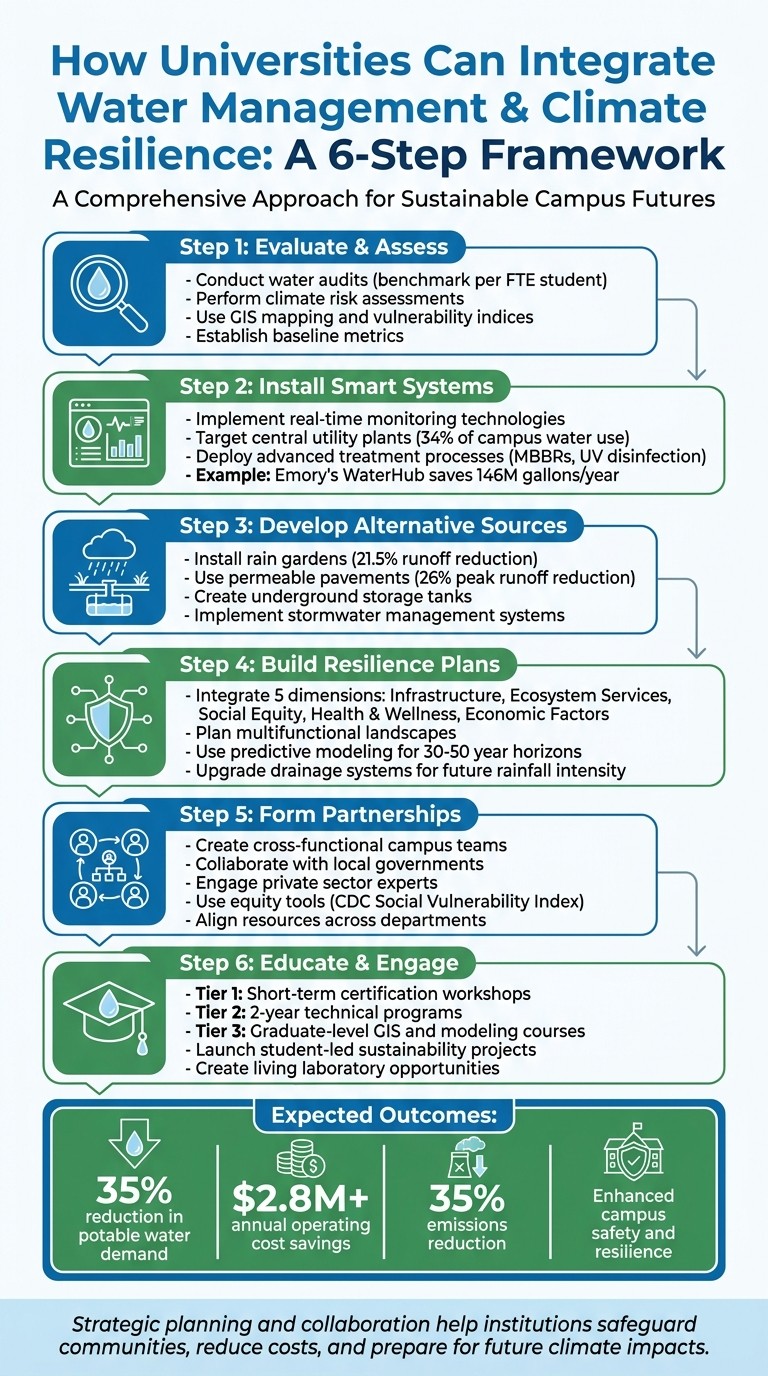
6-Step Framework for University Water Management and Climate Resilience Integration
Climate Academy 2025: Climate resilience and local water management - Day 2
Evaluating Water Use and Climate Risks
Before diving into water management or climate resilience strategies, universities need a clear understanding of their current position. Establishing a baseline for water use and identifying climate-related vulnerabilities are critical first steps. Below, we outline methods for measuring water consumption and assessing climate risks to help guide effective interventions.
Performing Water Audits and Risk Assessments
A thorough water audit involves more than just reviewing monthly utility bills. By benchmarking water use per full-time equivalent (FTE) student, campuses can identify irregularities and establish performance metrics. This enables institutions to track trends over time and spot unusual spikes in usage[4]. One effective approach is the Natural Water Balance Methodology, which compares total campus water consumption to factors like average precipitation, potential evapotranspiration, and the size of the local watershed. This analysis helps determine whether a campus is staying within its natural water budget or relying excessively on external water sources[3].
Climate risk assessments, on the other hand, demand a more specialized approach. In June 2023, the University of California system's Emergency Management Council introduced a new Hazard Vulnerability Assessment (HVA) framework for its 10 campuses and six health facilities. This updated method incorporates climate and equity factors into existing scales, creating a tailored social vulnerability index that rates hazards from "lowest" to "highest" for both the present and the year 2050. A University of California representative explained:
We had to find some statistics that support the climate hazards of the future. We didn't want opinions; we wanted data-based predictions to anticipate future effects and forecast their impact.
Another critical component of these assessments is asset tiering, which involves classifying infrastructure based on security, operational importance, and usage. This prioritization ensures that essential buildings and systems remain functional during crises. Additionally, assessments must account for overlapping emergencies, such as a power outage coinciding with extreme heat, to create robust resilience plans[1].
Using Data Tools for Climate Risk Analysis
Specialized data tools play a key role in campus climate risk assessments. For instance, the Texas A&M U.S. Climate Vulnerability Index uses 184 datasets to rank over 70,000 U.S. Census tracts, while the CDC/ATSDR Social Vulnerability Index leverages 16 Census data sources to pinpoint vulnerable campus populations. GIS mapping offers precise, location-specific insights, helping institutions refine their risk assessments[1].
To address flood and drought risks, campuses can integrate GIS mapping with climate exposure data, such as annual maximum precipitation, sub-hourly rainfall intensity, and changes in seasonal patterns (e.g., wetter springs, drier summers)[5][6]. Combining these tools with water audit findings allows universities to develop site-specific, actionable resilience strategies tailored to their unique challenges.
Installing Water Management Systems
Start by conducting a thorough water audit and risk assessment to identify areas where water management systems can make the greatest impact. Universities often find that central utility plants - like chiller and steam facilities - are prime targets, as they can account for about 34% of total campus water use [7]. These facilities present an opportunity to achieve meaningful water savings quickly.
Installing Smart Water Technologies
Smart water systems merge real-time monitoring with advanced treatment processes to optimize water use and maintain quality. For instance, online instruments that continuously measure factors like turbidity and UV transmissivity can alert operators immediately if conditions fall outside acceptable ranges. A comprehensive treatment setup might include MBBRs (Moving Bed Biofilm Reactors) for primary treatment, hydroponic reactors for nitrification, and disc filters followed by UV disinfection to reclaim the maximum amount of water [7].
A great example of this approach is Emory University's WaterHub, operational since May 2016. Developed in partnership with Sustainable Water and Reeves Young, this system treats up to 400,000 gallons of wastewater daily. It reduces the university’s potable water demand by 35%, saving approximately 146 million gallons annually. Additionally, the WaterHub includes a 50,000-gallon emergency reserve, providing about seven hours of backup water for essential heating and cooling operations [7].
Before moving forward with installation, it's essential to carry out engineering and economic feasibility studies to determine which non-potable water needs can be met with reclaimed water. Present these findings to institutional leaders and collaborate with local municipal agencies to address wastewater pretreatment permits and state-specific reclamation requirements [7]. By building on smart water monitoring systems, campuses can further strengthen their water resilience by exploring diverse sources.
Identifying Alternative Water Sources
In addition to smart technologies, alternative water sources provide a practical and cost-effective way to enhance sustainability. Nature-based solutions, such as stormwater management systems, can play a vital role. A study from Pokhara City, Nepal, in December 2025, found that installing rain gardens on just 3% of impervious surfaces reduced peak runoff by 21.5%. Adding permeable pavements to 5% of the area decreased peak runoff by 26% and total runoff by 11% [6].
Strategic planning is key to minimizing costs and maximizing efficiency. For example, placing reclamation facilities near large sewer collectors and utility plants can reduce the need for extensive distribution infrastructure. Underground storage tanks can also be integrated to provide operational capacity and emergency reserves during disruptions. Some universities have opted for water purchase agreements, where a third party builds and operates the reclamation facility, and the institution buys the reclaimed water. This approach lowers upfront costs while still meeting water needs [7].
Finally, these systems can serve as "living laboratories", offering opportunities for research and hands-on learning while addressing operational requirements [7].
Building Climate Resilience Plans
To effectively address climate challenges, universities should integrate water management into comprehensive climate resilience plans. These strategies must consider how climate change will impact campuses over the next 30 to 50 years, moving beyond historical weather patterns to adopt forward-looking models that account for anticipated hazards.
For instance, the University of California system incorporates climate and equity factors into its hazard vulnerability assessments, using predictive data to foresee future challenges [1]. By combining detailed water management insights with risk assessments, institutions can embed these findings into broader climate resilience strategies.
Developing such plans requires evaluating five critical dimensions: Infrastructure (e.g., energy grids, water systems, HVAC setups), Ecosystem Services (such as green rooftops and sustainable land use), Social Equity (addressing resource access and outdoor worker impacts), Health & Wellness (including air quality and mental health), and Economic Factors (like insurance costs and capital expenditures). This comprehensive perspective ensures water conservation efforts align with broader goals for climate adaptation.
Planning Land Use and Infrastructure Upgrades
Campus design plays a pivotal role in managing water resources and mitigating climate risks. Embracing Integrated Urban Water Management (IUWM) allows universities to break down traditional silos, integrating water supply planning with flood control. Instead of treating stormwater as waste, campuses can adopt designs that capture, filter, and reuse it.
Nature-based solutions, like rain gardens and permeable pavements, have already shown their ability to reduce runoff [6]. These interventions can be woven into campus land-use plans to create multifunctional landscapes that serve dual purposes.
"A truly sustainable, resilient urban water paradigm must dissolve these silos and forge a coherent, robust framework in which every drop of water is valued and every flood hazard is mitigated." - Springer Nature [6]
Multifunctional landscapes are a key innovation in campus design. Features like water plazas can double as recreational spaces during dry periods and temporary flood storage during storms. Bioswales and urban wetlands not only manage stormwater but also provide green spaces that combat urban heat island effects. Hydraulic modeling of drainage systems can pinpoint areas needing upgrades to handle the more intense rainfall events expected in the future [6].
Groundwater management is another critical consideration. Aquifers can act as buffers during water shortages, but understanding subsurface water movement is essential for effective mitigation. In areas with porous bedrock, building foundations must be sealed to withstand uplift pressures from rising groundwater. Tony Sauder, Senior Advisor at Penn's Water Center, highlights the importance of this:
"Understanding how water moves in the subsurface is critical to developing effective mitigation measures" [9].
These infrastructure improvements establish a solid foundation for building resilience through collaboration.
Strengthening Resilience Through Partnerships
No institution can tackle climate resilience in isolation. Universities that succeed in this area form cross-functional teams, bringing together experts in safety, risk management, sustainability, and compliance. But these efforts must also extend beyond the campus.
Stanford University exemplifies this approach. In April 2026, it launched a Climate Action Plan that included specialized working groups for areas like "Grounds Operations" and "Water Systems." Led by the Office of Sustainability, this centralized governance model aligns resources across departments to focus on impactful solutions. Thanks to these efforts, Stanford achieved an 82% reduction in Scope 1 and 2 emissions from its 2011 peak by implementing a Central Energy Facility and renewable energy programs [8].
Collaboration with local governments is equally important. The University of Minnesota Twin Cities, for example, published its first Climate Resilience Plan in June 2024. This plan was the result of a joint effort involving students, faculty, staff, and local government bodies to address hazards like flooding and heat waves [2]. Kate Nelson, Director of Sustainability at the university, emphasized:
"Adding resilience to our Climate Action Plan is one step of many the University will take to fulfill our commitment to build a fully sustainable future and position Minnesota as a leader in climate action" [2].
Engaging with the private sector adds another dimension of expertise. In December 2023, the Disaster Resilient Universities Network and the University of Oregon's Institute for Resilient Organizations, Communities, and Environments hosted a roundtable in Oakland, California. This event brought together university leaders, Deloitte & Touche LLP, and a commercial property insurer to share best practices for vulnerability assessments and community engagement [1]. Such partnerships help institutions understand the financial trade-offs of resilience investments, particularly as rising property insurance rates underscore the importance of proactive adaptation.
Equity must remain central to these partnerships. Identifying vulnerable populations early and involving them in the planning process is key. Tools like the CDC Social Vulnerability Index provide a shared, data-driven foundation for all stakeholders. When presenting resilience plans to university leadership, framing the discussion in terms of "tuition dependency" or "service interruptions" can help secure the necessary funding and support [1].
Teaching Water and Climate Resilience
Universities can’t address water and climate challenges through infrastructure alone. Education plays a transformative role, equipping students and staff with the skills and mindset needed to rethink resource management. By making climate resilience a core part of academic programs, institutions prepare a future workforce ready to tackle these pressing issues for years to come.
Developing Climate Resilience Curricula
An effective climate resilience curriculum can be structured across three levels. Tier 1 focuses on short-term workshops, often lasting just a couple of days, aimed at specific certifications like "Maintenance and Inspection of Stormwater Control Measures." Tier 2 reshapes two-year community college programs to prioritize technical competencies such as hydrology, water quality, and data analytics. Tier 3 incorporates advanced tools, like Geographic Information Systems (GIS), into graduate-level engineering and environmental science programs.
A prime example of this approach is the initiative launched in the summer of 2025 by The Ohio State University’s Department of Food, Agricultural, and Biological Engineering. With $4.8 million in funding from a NOAA Climate Ready Workforce grant, the program implemented a three-tiered system. This included a two-day certification workshop that trained 35 participants in stormwater control measures. Graduate students Jalen Smith and Alessandra Bertucci gained hands-on experience in stream restoration, while the university collaborated with organizations like the Junction Coalition and the Northeast Ohio Regional Sewage District to align the curriculum with employer needs, particularly in safeguarding Lake Erie coastal communities [10].
The success of such programs hinges on identifying employer needs. Surveys of regional employers can pinpoint specific skill gaps, such as wetland taxonomy, stormwater infrastructure management, or water quality analysis. This market-driven approach ensures students graduate with expertise that’s immediately applicable. By integrating structured curricula with practical projects, universities create opportunities for students to address real-world challenges.
Involving Students in Sustainability Projects
When students apply classroom knowledge to real campus issues, they gain invaluable practical experience while advancing institutional resilience efforts. Hands-on projects bridge theory and practice, allowing students to conduct resilience assessments, measure stream erosion, and design nature-based solutions like rain gardens.
For example, Rob Fetell, a student at the University of Pennsylvania, founded the Resilience Youth Network (RYN), a 501(c)(3) nonprofit that engages young professionals in creating climate solutions. With guidance from academic advisor Tony Sauder through the university’s Masters of Applied Geosciences program, this student-led initiative highlights how universities can cultivate long-term leadership in resilience efforts [9].
Mentorship plays a crucial role in these projects. Tony Sauder, a professional engineer at Penn, has supported student-led Engineers Without Borders (EWB) projects for over 15 years. These initiatives have delivered sustainable water supply systems and stream restoration in countries like Honduras, Guatemala, and Cameroon, giving students firsthand experience with global water management challenges. As Sauder explains:
"Students are engaged and want to be prepared to develop solutions to these pressing challenges" [9].
Digital tools also enhance learning. For instance, the Storm Water Management Model (SWMM) allows students to simulate real-world scenarios. A study in Pokhara, Nepal, demonstrated that implementing rain gardens in just 3% of impervious areas reduced peak runoff by 21.5%, while using permeable pavements in 5% of the area cut peak runoff by 26% [6]. When students apply these tools to campus projects, they gain the ability to evaluate the potential impact of their designs before implementation, sharpening both their technical and problem-solving skills.
Working with Consultants for Custom Solutions
Universities often turn to external experts to navigate the complexities of water management, climate resilience, and financial planning. While internal audits and risk assessments lay the groundwork, consultants bring the specialized knowledge needed to turn ambitious goals into practical, budget-conscious strategies. Their experience helps institutions bridge the gap between vision and implementation.
Planning and Stakeholder Collaboration
The best consulting projects follow a clear, structured timeline that ensures institutional support at every step. Typically, the process begins with technical assessments, which span the first four months and involve detailed evaluations of water and energy use across campus buildings. From months three to seven, consultants conduct scenario modeling, presenting multiple pathways - such as conservative versus accelerated timelines - complete with cost breakdowns and savings projections. Throughout this process, forums led by consultants bring stakeholders together to ensure the plans are both technically sound and financially viable [11].
A notable example took place in February 2026, when Council Fire collaborated with a public research university hosting 35,000 students on a 450-acre campus. The goal was to move the university's carbon neutrality target from 2040 to 2035. The project involved a deep assessment of a 25-year-old central plant and proposed an 800-well ground-source heat pump field to serve 22 campus buildings. By identifying federal incentives through the Inflation Reduction Act and state green bonds, the consulting team demonstrated that the $340 million investment would not only reduce emissions by 35% but also cut operating costs by $2.8 million annually, making it a financially sound decision [11].
"The central plant is the whole ballgame. For most universities, the central heating system is 30–50% of total emissions."
Council Fire [11]
This methodical approach ensures that sustainability efforts align with earlier water and climate assessments, creating a cohesive institutional strategy. Such planning lays the groundwork for projects that deliver both immediate savings and long-term benefits.
Turning Plans into Action
Once the planning phase is complete, the focus shifts to execution. However, moving from strategy to implementation can be challenging, as delays or missteps can stall progress. Consultants play a vital role in overcoming these hurdles by sequencing projects to create self-sustaining funding cycles. Early efficiency measures generate immediate cost savings, which can then be reinvested into larger capital projects. These quick wins build confidence and momentum while addressing potential disruptions to campus life during construction [11].
Financial strategy is another critical element. Consultants help uncover hidden funding opportunities and assess current incentives to maximize financial returns. They emphasize operational improvements over reliance on offsets, typically recommending that carbon or water offsets remain below 10%. Over a 25-year period, a well-designed plan can yield impressive results. For instance, the aforementioned university project is projected to save $410 million in energy costs and avoided maintenance expenses, proving that environmental goals and financial responsibility can go hand in hand [11].
Conclusion
Universities and research institutions are at a critical juncture as they confront escalating climate challenges. With historical warming trends and future projections signaling the need for immediate action, the path forward demands focused and strategic efforts [1].
A sensible starting point involves conducting data-driven audits and thorough risk assessments. Central plant upgrades should take precedence, as these facilities often account for 30–50% of campus emissions [11]. Savings generated from these upgrades can then be reinvested into transformative projects, such as ground-source heat pumps or wastewater reuse systems, which offer both environmental and economic benefits.
Collaboration is key. Engaging students, faculty, facilities staff, and local communities from the outset ensures that solutions are inclusive and effective. Organizations like Council Fire provide invaluable support by leveraging federal incentives, conducting technical modeling, and identifying cost-efficient, sustainable strategies. As one resilience expert from the Disaster Resilient Universities Network emphasized:
For climate change, it's very hard to forecast the effects. We live in complex systems that are inherently unstable... We have to morph the capability of the organization to handle these crises.
– Roundtable Participant, Disaster Resilient Universities Network [1]
To achieve meaningful progress, institutions should focus on operational improvements, limit reliance on carbon offsets to under 10%, and establish clear accountability measures [11]. Strategic investments not only reduce emissions but also yield long-term financial savings.
FAQs
What’s the first step to combine water management with climate resilience on campus?
To effectively tackle water resource challenges alongside climate impacts, the initial focus should be on developing a cohesive strategy. Begin by assessing existing practices and pinpointing areas for improvement, integrating approaches like circular economy principles or comprehensive water management techniques. Academic institutions should weave water resilience objectives into their Climate Action Plans, fostering partnerships among stakeholders to introduce adaptable policies and technologies that align with the specific requirements of their campuses.
How do we decide if wastewater reuse or non-potable water systems are worth it?
Deciding whether to invest in wastewater reuse or non-potable water systems requires a careful look at several key factors, such as potential water savings, cost efficiency, environmental impact, and the specific needs of your institution. Success stories, such as those at Emory University and UC Irvine, highlight how these systems can significantly cut down on potable water usage while conserving resources. To make an informed decision, consider local water scarcity, the expense of infrastructure, applicable regulations, and the broader environmental implications. Balancing these elements will help determine if the advantages justify the challenges for your organization.
What funding sources can help pay for campus water and resilience upgrades?
Funding for campus water and resilience projects can be accessed through several avenues. One key source is the EPA's State Revolving Funds, including the Drinking Water State Revolving Fund (DWSRF), which offers low-interest loans for infrastructure improvements and projects aimed at enhancing resilience. Additionally, the U.S. Climate Resilience Toolkit provides valuable resources to help institutions identify funding opportunities and build the capacity needed to implement resilience-focused initiatives.
Related Blog Posts
Latest Articles
©2025

Narrative Change and Power Building: The Missing Half of Advocacy
Narrative change is the process of disrupting dominant narratives that normalize inequity and advancing new narratives from historically marginalized communities.

Funding Resilience Without Federal Grants
BRIC is unreliable and FEMA is shrinking. Here's how cities fund climate resilience with dedicated revenue, blended finance, and a coordinating authority.

The ESG Blind Spot: How AI Is Finding Risks in Companies Nobody Else Is Watching
Norway's sovereign wealth fund uses AI to screen 7,200 portfolio companies for forced labor and corruption within 24 hours. The real story is the emerging-market coverage gap that traditional ESG data vendors miss — and what it means for any company with a global supply chain.
Narrative Change and Power Building: The Missing Half of Advocacy
Narrative change is the process of disrupting dominant narratives that normalize inequity and advancing new narratives from historically marginalized communities.
Funding Resilience Without Federal Grants
BRIC is unreliable and FEMA is shrinking. Here's how cities fund climate resilience with dedicated revenue, blended finance, and a coordinating authority.
The ESG Blind Spot: How AI Is Finding Risks in Companies Nobody Else Is Watching
Norway's sovereign wealth fund uses AI to screen 7,200 portfolio companies for forced labor and corruption within 24 hours. The real story is the emerging-market coverage gap that traditional ESG data vendors miss — and what it means for any company with a global supply chain.
FAQ
01
What does it really mean to “redefine profit”?
02
What makes Council Fire different?
03
Who does Council Fire work with?
04
What does working with Council Fire actually look like?
05
How does Council Fire help organizations turn big goals into action?
06
How does Council Fire define and measure success?
Apr 29, 2026
How to Integrate Water Management and Climate Resilience Strategies for Universities & Research Institutions
Sustainability Strategy
In This Article
Guide for universities to integrate water audits, smart systems, alternative sources, and curricula into climate resilience planning.
How to Integrate Water Management and Climate Resilience Strategies for Universities & Research Institutions
Universities face growing risks from climate change, including rising temperatures, extreme weather, and water challenges like flooding and shortages. These risks threaten campus operations, safety, and financial stability, especially for tuition-dependent institutions. To address these issues, universities must prioritize water management as part of broader climate resilience efforts. Key strategies include:
Water Audits and Risk Assessments: Establish baselines, identify inefficiencies, and assess vulnerabilities using tools like GIS mapping and hazard frameworks.
Smart Water Technologies: Implement systems for real-time monitoring, wastewater treatment, and non-potable water reuse, such as Emory University's WaterHub, which saves 146 million gallons annually.
Alternative Water Sources: Use rain gardens, permeable pavements, and underground storage to manage stormwater and reduce reliance on external supplies.
Climate Resilience Plans: Integrate water management with infrastructure upgrades, land use planning, and predictive modeling for future risks.
Collaborative Partnerships: Work with local governments, private sector experts, and students to align resources and expertise.
Education and Training: Offer workshops, degree programs, and student-led projects to build skills and create hands-on learning opportunities.
Proactive planning and collaboration can help institutions safeguard their communities, reduce costs, and prepare for future climate impacts.
6-Step Framework for University Water Management and Climate Resilience Integration
Climate Academy 2025: Climate resilience and local water management - Day 2
Evaluating Water Use and Climate Risks
Before diving into water management or climate resilience strategies, universities need a clear understanding of their current position. Establishing a baseline for water use and identifying climate-related vulnerabilities are critical first steps. Below, we outline methods for measuring water consumption and assessing climate risks to help guide effective interventions.
Performing Water Audits and Risk Assessments
A thorough water audit involves more than just reviewing monthly utility bills. By benchmarking water use per full-time equivalent (FTE) student, campuses can identify irregularities and establish performance metrics. This enables institutions to track trends over time and spot unusual spikes in usage[4]. One effective approach is the Natural Water Balance Methodology, which compares total campus water consumption to factors like average precipitation, potential evapotranspiration, and the size of the local watershed. This analysis helps determine whether a campus is staying within its natural water budget or relying excessively on external water sources[3].
Climate risk assessments, on the other hand, demand a more specialized approach. In June 2023, the University of California system's Emergency Management Council introduced a new Hazard Vulnerability Assessment (HVA) framework for its 10 campuses and six health facilities. This updated method incorporates climate and equity factors into existing scales, creating a tailored social vulnerability index that rates hazards from "lowest" to "highest" for both the present and the year 2050. A University of California representative explained:
We had to find some statistics that support the climate hazards of the future. We didn't want opinions; we wanted data-based predictions to anticipate future effects and forecast their impact.
Another critical component of these assessments is asset tiering, which involves classifying infrastructure based on security, operational importance, and usage. This prioritization ensures that essential buildings and systems remain functional during crises. Additionally, assessments must account for overlapping emergencies, such as a power outage coinciding with extreme heat, to create robust resilience plans[1].
Using Data Tools for Climate Risk Analysis
Specialized data tools play a key role in campus climate risk assessments. For instance, the Texas A&M U.S. Climate Vulnerability Index uses 184 datasets to rank over 70,000 U.S. Census tracts, while the CDC/ATSDR Social Vulnerability Index leverages 16 Census data sources to pinpoint vulnerable campus populations. GIS mapping offers precise, location-specific insights, helping institutions refine their risk assessments[1].
To address flood and drought risks, campuses can integrate GIS mapping with climate exposure data, such as annual maximum precipitation, sub-hourly rainfall intensity, and changes in seasonal patterns (e.g., wetter springs, drier summers)[5][6]. Combining these tools with water audit findings allows universities to develop site-specific, actionable resilience strategies tailored to their unique challenges.
Installing Water Management Systems
Start by conducting a thorough water audit and risk assessment to identify areas where water management systems can make the greatest impact. Universities often find that central utility plants - like chiller and steam facilities - are prime targets, as they can account for about 34% of total campus water use [7]. These facilities present an opportunity to achieve meaningful water savings quickly.
Installing Smart Water Technologies
Smart water systems merge real-time monitoring with advanced treatment processes to optimize water use and maintain quality. For instance, online instruments that continuously measure factors like turbidity and UV transmissivity can alert operators immediately if conditions fall outside acceptable ranges. A comprehensive treatment setup might include MBBRs (Moving Bed Biofilm Reactors) for primary treatment, hydroponic reactors for nitrification, and disc filters followed by UV disinfection to reclaim the maximum amount of water [7].
A great example of this approach is Emory University's WaterHub, operational since May 2016. Developed in partnership with Sustainable Water and Reeves Young, this system treats up to 400,000 gallons of wastewater daily. It reduces the university’s potable water demand by 35%, saving approximately 146 million gallons annually. Additionally, the WaterHub includes a 50,000-gallon emergency reserve, providing about seven hours of backup water for essential heating and cooling operations [7].
Before moving forward with installation, it's essential to carry out engineering and economic feasibility studies to determine which non-potable water needs can be met with reclaimed water. Present these findings to institutional leaders and collaborate with local municipal agencies to address wastewater pretreatment permits and state-specific reclamation requirements [7]. By building on smart water monitoring systems, campuses can further strengthen their water resilience by exploring diverse sources.
Identifying Alternative Water Sources
In addition to smart technologies, alternative water sources provide a practical and cost-effective way to enhance sustainability. Nature-based solutions, such as stormwater management systems, can play a vital role. A study from Pokhara City, Nepal, in December 2025, found that installing rain gardens on just 3% of impervious surfaces reduced peak runoff by 21.5%. Adding permeable pavements to 5% of the area decreased peak runoff by 26% and total runoff by 11% [6].
Strategic planning is key to minimizing costs and maximizing efficiency. For example, placing reclamation facilities near large sewer collectors and utility plants can reduce the need for extensive distribution infrastructure. Underground storage tanks can also be integrated to provide operational capacity and emergency reserves during disruptions. Some universities have opted for water purchase agreements, where a third party builds and operates the reclamation facility, and the institution buys the reclaimed water. This approach lowers upfront costs while still meeting water needs [7].
Finally, these systems can serve as "living laboratories", offering opportunities for research and hands-on learning while addressing operational requirements [7].
Building Climate Resilience Plans
To effectively address climate challenges, universities should integrate water management into comprehensive climate resilience plans. These strategies must consider how climate change will impact campuses over the next 30 to 50 years, moving beyond historical weather patterns to adopt forward-looking models that account for anticipated hazards.
For instance, the University of California system incorporates climate and equity factors into its hazard vulnerability assessments, using predictive data to foresee future challenges [1]. By combining detailed water management insights with risk assessments, institutions can embed these findings into broader climate resilience strategies.
Developing such plans requires evaluating five critical dimensions: Infrastructure (e.g., energy grids, water systems, HVAC setups), Ecosystem Services (such as green rooftops and sustainable land use), Social Equity (addressing resource access and outdoor worker impacts), Health & Wellness (including air quality and mental health), and Economic Factors (like insurance costs and capital expenditures). This comprehensive perspective ensures water conservation efforts align with broader goals for climate adaptation.
Planning Land Use and Infrastructure Upgrades
Campus design plays a pivotal role in managing water resources and mitigating climate risks. Embracing Integrated Urban Water Management (IUWM) allows universities to break down traditional silos, integrating water supply planning with flood control. Instead of treating stormwater as waste, campuses can adopt designs that capture, filter, and reuse it.
Nature-based solutions, like rain gardens and permeable pavements, have already shown their ability to reduce runoff [6]. These interventions can be woven into campus land-use plans to create multifunctional landscapes that serve dual purposes.
"A truly sustainable, resilient urban water paradigm must dissolve these silos and forge a coherent, robust framework in which every drop of water is valued and every flood hazard is mitigated." - Springer Nature [6]
Multifunctional landscapes are a key innovation in campus design. Features like water plazas can double as recreational spaces during dry periods and temporary flood storage during storms. Bioswales and urban wetlands not only manage stormwater but also provide green spaces that combat urban heat island effects. Hydraulic modeling of drainage systems can pinpoint areas needing upgrades to handle the more intense rainfall events expected in the future [6].
Groundwater management is another critical consideration. Aquifers can act as buffers during water shortages, but understanding subsurface water movement is essential for effective mitigation. In areas with porous bedrock, building foundations must be sealed to withstand uplift pressures from rising groundwater. Tony Sauder, Senior Advisor at Penn's Water Center, highlights the importance of this:
"Understanding how water moves in the subsurface is critical to developing effective mitigation measures" [9].
These infrastructure improvements establish a solid foundation for building resilience through collaboration.
Strengthening Resilience Through Partnerships
No institution can tackle climate resilience in isolation. Universities that succeed in this area form cross-functional teams, bringing together experts in safety, risk management, sustainability, and compliance. But these efforts must also extend beyond the campus.
Stanford University exemplifies this approach. In April 2026, it launched a Climate Action Plan that included specialized working groups for areas like "Grounds Operations" and "Water Systems." Led by the Office of Sustainability, this centralized governance model aligns resources across departments to focus on impactful solutions. Thanks to these efforts, Stanford achieved an 82% reduction in Scope 1 and 2 emissions from its 2011 peak by implementing a Central Energy Facility and renewable energy programs [8].
Collaboration with local governments is equally important. The University of Minnesota Twin Cities, for example, published its first Climate Resilience Plan in June 2024. This plan was the result of a joint effort involving students, faculty, staff, and local government bodies to address hazards like flooding and heat waves [2]. Kate Nelson, Director of Sustainability at the university, emphasized:
"Adding resilience to our Climate Action Plan is one step of many the University will take to fulfill our commitment to build a fully sustainable future and position Minnesota as a leader in climate action" [2].
Engaging with the private sector adds another dimension of expertise. In December 2023, the Disaster Resilient Universities Network and the University of Oregon's Institute for Resilient Organizations, Communities, and Environments hosted a roundtable in Oakland, California. This event brought together university leaders, Deloitte & Touche LLP, and a commercial property insurer to share best practices for vulnerability assessments and community engagement [1]. Such partnerships help institutions understand the financial trade-offs of resilience investments, particularly as rising property insurance rates underscore the importance of proactive adaptation.
Equity must remain central to these partnerships. Identifying vulnerable populations early and involving them in the planning process is key. Tools like the CDC Social Vulnerability Index provide a shared, data-driven foundation for all stakeholders. When presenting resilience plans to university leadership, framing the discussion in terms of "tuition dependency" or "service interruptions" can help secure the necessary funding and support [1].
Teaching Water and Climate Resilience
Universities can’t address water and climate challenges through infrastructure alone. Education plays a transformative role, equipping students and staff with the skills and mindset needed to rethink resource management. By making climate resilience a core part of academic programs, institutions prepare a future workforce ready to tackle these pressing issues for years to come.
Developing Climate Resilience Curricula
An effective climate resilience curriculum can be structured across three levels. Tier 1 focuses on short-term workshops, often lasting just a couple of days, aimed at specific certifications like "Maintenance and Inspection of Stormwater Control Measures." Tier 2 reshapes two-year community college programs to prioritize technical competencies such as hydrology, water quality, and data analytics. Tier 3 incorporates advanced tools, like Geographic Information Systems (GIS), into graduate-level engineering and environmental science programs.
A prime example of this approach is the initiative launched in the summer of 2025 by The Ohio State University’s Department of Food, Agricultural, and Biological Engineering. With $4.8 million in funding from a NOAA Climate Ready Workforce grant, the program implemented a three-tiered system. This included a two-day certification workshop that trained 35 participants in stormwater control measures. Graduate students Jalen Smith and Alessandra Bertucci gained hands-on experience in stream restoration, while the university collaborated with organizations like the Junction Coalition and the Northeast Ohio Regional Sewage District to align the curriculum with employer needs, particularly in safeguarding Lake Erie coastal communities [10].
The success of such programs hinges on identifying employer needs. Surveys of regional employers can pinpoint specific skill gaps, such as wetland taxonomy, stormwater infrastructure management, or water quality analysis. This market-driven approach ensures students graduate with expertise that’s immediately applicable. By integrating structured curricula with practical projects, universities create opportunities for students to address real-world challenges.
Involving Students in Sustainability Projects
When students apply classroom knowledge to real campus issues, they gain invaluable practical experience while advancing institutional resilience efforts. Hands-on projects bridge theory and practice, allowing students to conduct resilience assessments, measure stream erosion, and design nature-based solutions like rain gardens.
For example, Rob Fetell, a student at the University of Pennsylvania, founded the Resilience Youth Network (RYN), a 501(c)(3) nonprofit that engages young professionals in creating climate solutions. With guidance from academic advisor Tony Sauder through the university’s Masters of Applied Geosciences program, this student-led initiative highlights how universities can cultivate long-term leadership in resilience efforts [9].
Mentorship plays a crucial role in these projects. Tony Sauder, a professional engineer at Penn, has supported student-led Engineers Without Borders (EWB) projects for over 15 years. These initiatives have delivered sustainable water supply systems and stream restoration in countries like Honduras, Guatemala, and Cameroon, giving students firsthand experience with global water management challenges. As Sauder explains:
"Students are engaged and want to be prepared to develop solutions to these pressing challenges" [9].
Digital tools also enhance learning. For instance, the Storm Water Management Model (SWMM) allows students to simulate real-world scenarios. A study in Pokhara, Nepal, demonstrated that implementing rain gardens in just 3% of impervious areas reduced peak runoff by 21.5%, while using permeable pavements in 5% of the area cut peak runoff by 26% [6]. When students apply these tools to campus projects, they gain the ability to evaluate the potential impact of their designs before implementation, sharpening both their technical and problem-solving skills.
Working with Consultants for Custom Solutions
Universities often turn to external experts to navigate the complexities of water management, climate resilience, and financial planning. While internal audits and risk assessments lay the groundwork, consultants bring the specialized knowledge needed to turn ambitious goals into practical, budget-conscious strategies. Their experience helps institutions bridge the gap between vision and implementation.
Planning and Stakeholder Collaboration
The best consulting projects follow a clear, structured timeline that ensures institutional support at every step. Typically, the process begins with technical assessments, which span the first four months and involve detailed evaluations of water and energy use across campus buildings. From months three to seven, consultants conduct scenario modeling, presenting multiple pathways - such as conservative versus accelerated timelines - complete with cost breakdowns and savings projections. Throughout this process, forums led by consultants bring stakeholders together to ensure the plans are both technically sound and financially viable [11].
A notable example took place in February 2026, when Council Fire collaborated with a public research university hosting 35,000 students on a 450-acre campus. The goal was to move the university's carbon neutrality target from 2040 to 2035. The project involved a deep assessment of a 25-year-old central plant and proposed an 800-well ground-source heat pump field to serve 22 campus buildings. By identifying federal incentives through the Inflation Reduction Act and state green bonds, the consulting team demonstrated that the $340 million investment would not only reduce emissions by 35% but also cut operating costs by $2.8 million annually, making it a financially sound decision [11].
"The central plant is the whole ballgame. For most universities, the central heating system is 30–50% of total emissions."
Council Fire [11]
This methodical approach ensures that sustainability efforts align with earlier water and climate assessments, creating a cohesive institutional strategy. Such planning lays the groundwork for projects that deliver both immediate savings and long-term benefits.
Turning Plans into Action
Once the planning phase is complete, the focus shifts to execution. However, moving from strategy to implementation can be challenging, as delays or missteps can stall progress. Consultants play a vital role in overcoming these hurdles by sequencing projects to create self-sustaining funding cycles. Early efficiency measures generate immediate cost savings, which can then be reinvested into larger capital projects. These quick wins build confidence and momentum while addressing potential disruptions to campus life during construction [11].
Financial strategy is another critical element. Consultants help uncover hidden funding opportunities and assess current incentives to maximize financial returns. They emphasize operational improvements over reliance on offsets, typically recommending that carbon or water offsets remain below 10%. Over a 25-year period, a well-designed plan can yield impressive results. For instance, the aforementioned university project is projected to save $410 million in energy costs and avoided maintenance expenses, proving that environmental goals and financial responsibility can go hand in hand [11].
Conclusion
Universities and research institutions are at a critical juncture as they confront escalating climate challenges. With historical warming trends and future projections signaling the need for immediate action, the path forward demands focused and strategic efforts [1].
A sensible starting point involves conducting data-driven audits and thorough risk assessments. Central plant upgrades should take precedence, as these facilities often account for 30–50% of campus emissions [11]. Savings generated from these upgrades can then be reinvested into transformative projects, such as ground-source heat pumps or wastewater reuse systems, which offer both environmental and economic benefits.
Collaboration is key. Engaging students, faculty, facilities staff, and local communities from the outset ensures that solutions are inclusive and effective. Organizations like Council Fire provide invaluable support by leveraging federal incentives, conducting technical modeling, and identifying cost-efficient, sustainable strategies. As one resilience expert from the Disaster Resilient Universities Network emphasized:
For climate change, it's very hard to forecast the effects. We live in complex systems that are inherently unstable... We have to morph the capability of the organization to handle these crises.
– Roundtable Participant, Disaster Resilient Universities Network [1]
To achieve meaningful progress, institutions should focus on operational improvements, limit reliance on carbon offsets to under 10%, and establish clear accountability measures [11]. Strategic investments not only reduce emissions but also yield long-term financial savings.
FAQs
What’s the first step to combine water management with climate resilience on campus?
To effectively tackle water resource challenges alongside climate impacts, the initial focus should be on developing a cohesive strategy. Begin by assessing existing practices and pinpointing areas for improvement, integrating approaches like circular economy principles or comprehensive water management techniques. Academic institutions should weave water resilience objectives into their Climate Action Plans, fostering partnerships among stakeholders to introduce adaptable policies and technologies that align with the specific requirements of their campuses.
How do we decide if wastewater reuse or non-potable water systems are worth it?
Deciding whether to invest in wastewater reuse or non-potable water systems requires a careful look at several key factors, such as potential water savings, cost efficiency, environmental impact, and the specific needs of your institution. Success stories, such as those at Emory University and UC Irvine, highlight how these systems can significantly cut down on potable water usage while conserving resources. To make an informed decision, consider local water scarcity, the expense of infrastructure, applicable regulations, and the broader environmental implications. Balancing these elements will help determine if the advantages justify the challenges for your organization.
What funding sources can help pay for campus water and resilience upgrades?
Funding for campus water and resilience projects can be accessed through several avenues. One key source is the EPA's State Revolving Funds, including the Drinking Water State Revolving Fund (DWSRF), which offers low-interest loans for infrastructure improvements and projects aimed at enhancing resilience. Additionally, the U.S. Climate Resilience Toolkit provides valuable resources to help institutions identify funding opportunities and build the capacity needed to implement resilience-focused initiatives.
Related Blog Posts
Latest Articles
©2025
Narrative Change and Power Building: The Missing Half of Advocacy
Narrative change is the process of disrupting dominant narratives that normalize inequity and advancing new narratives from historically marginalized communities.
Funding Resilience Without Federal Grants
BRIC is unreliable and FEMA is shrinking. Here's how cities fund climate resilience with dedicated revenue, blended finance, and a coordinating authority.
The ESG Blind Spot: How AI Is Finding Risks in Companies Nobody Else Is Watching
Norway's sovereign wealth fund uses AI to screen 7,200 portfolio companies for forced labor and corruption within 24 hours. The real story is the emerging-market coverage gap that traditional ESG data vendors miss — and what it means for any company with a global supply chain.
FAQ
01
What does it really mean to “redefine profit”?
02
What makes Council Fire different?
03
Who does Council Fire work with?
04
What does working with Council Fire actually look like?
05
How does Council Fire help organizations turn big goals into action?
06
How does Council Fire define and measure success?
Apr 29, 2026
How to Integrate Water Management and Climate Resilience Strategies for Universities & Research Institutions
Sustainability Strategy
In This Article
Guide for universities to integrate water audits, smart systems, alternative sources, and curricula into climate resilience planning.
How to Integrate Water Management and Climate Resilience Strategies for Universities & Research Institutions
Universities face growing risks from climate change, including rising temperatures, extreme weather, and water challenges like flooding and shortages. These risks threaten campus operations, safety, and financial stability, especially for tuition-dependent institutions. To address these issues, universities must prioritize water management as part of broader climate resilience efforts. Key strategies include:
Water Audits and Risk Assessments: Establish baselines, identify inefficiencies, and assess vulnerabilities using tools like GIS mapping and hazard frameworks.
Smart Water Technologies: Implement systems for real-time monitoring, wastewater treatment, and non-potable water reuse, such as Emory University's WaterHub, which saves 146 million gallons annually.
Alternative Water Sources: Use rain gardens, permeable pavements, and underground storage to manage stormwater and reduce reliance on external supplies.
Climate Resilience Plans: Integrate water management with infrastructure upgrades, land use planning, and predictive modeling for future risks.
Collaborative Partnerships: Work with local governments, private sector experts, and students to align resources and expertise.
Education and Training: Offer workshops, degree programs, and student-led projects to build skills and create hands-on learning opportunities.
Proactive planning and collaboration can help institutions safeguard their communities, reduce costs, and prepare for future climate impacts.
6-Step Framework for University Water Management and Climate Resilience Integration
Climate Academy 2025: Climate resilience and local water management - Day 2
Evaluating Water Use and Climate Risks
Before diving into water management or climate resilience strategies, universities need a clear understanding of their current position. Establishing a baseline for water use and identifying climate-related vulnerabilities are critical first steps. Below, we outline methods for measuring water consumption and assessing climate risks to help guide effective interventions.
Performing Water Audits and Risk Assessments
A thorough water audit involves more than just reviewing monthly utility bills. By benchmarking water use per full-time equivalent (FTE) student, campuses can identify irregularities and establish performance metrics. This enables institutions to track trends over time and spot unusual spikes in usage[4]. One effective approach is the Natural Water Balance Methodology, which compares total campus water consumption to factors like average precipitation, potential evapotranspiration, and the size of the local watershed. This analysis helps determine whether a campus is staying within its natural water budget or relying excessively on external water sources[3].
Climate risk assessments, on the other hand, demand a more specialized approach. In June 2023, the University of California system's Emergency Management Council introduced a new Hazard Vulnerability Assessment (HVA) framework for its 10 campuses and six health facilities. This updated method incorporates climate and equity factors into existing scales, creating a tailored social vulnerability index that rates hazards from "lowest" to "highest" for both the present and the year 2050. A University of California representative explained:
We had to find some statistics that support the climate hazards of the future. We didn't want opinions; we wanted data-based predictions to anticipate future effects and forecast their impact.
Another critical component of these assessments is asset tiering, which involves classifying infrastructure based on security, operational importance, and usage. This prioritization ensures that essential buildings and systems remain functional during crises. Additionally, assessments must account for overlapping emergencies, such as a power outage coinciding with extreme heat, to create robust resilience plans[1].
Using Data Tools for Climate Risk Analysis
Specialized data tools play a key role in campus climate risk assessments. For instance, the Texas A&M U.S. Climate Vulnerability Index uses 184 datasets to rank over 70,000 U.S. Census tracts, while the CDC/ATSDR Social Vulnerability Index leverages 16 Census data sources to pinpoint vulnerable campus populations. GIS mapping offers precise, location-specific insights, helping institutions refine their risk assessments[1].
To address flood and drought risks, campuses can integrate GIS mapping with climate exposure data, such as annual maximum precipitation, sub-hourly rainfall intensity, and changes in seasonal patterns (e.g., wetter springs, drier summers)[5][6]. Combining these tools with water audit findings allows universities to develop site-specific, actionable resilience strategies tailored to their unique challenges.
Installing Water Management Systems
Start by conducting a thorough water audit and risk assessment to identify areas where water management systems can make the greatest impact. Universities often find that central utility plants - like chiller and steam facilities - are prime targets, as they can account for about 34% of total campus water use [7]. These facilities present an opportunity to achieve meaningful water savings quickly.
Installing Smart Water Technologies
Smart water systems merge real-time monitoring with advanced treatment processes to optimize water use and maintain quality. For instance, online instruments that continuously measure factors like turbidity and UV transmissivity can alert operators immediately if conditions fall outside acceptable ranges. A comprehensive treatment setup might include MBBRs (Moving Bed Biofilm Reactors) for primary treatment, hydroponic reactors for nitrification, and disc filters followed by UV disinfection to reclaim the maximum amount of water [7].
A great example of this approach is Emory University's WaterHub, operational since May 2016. Developed in partnership with Sustainable Water and Reeves Young, this system treats up to 400,000 gallons of wastewater daily. It reduces the university’s potable water demand by 35%, saving approximately 146 million gallons annually. Additionally, the WaterHub includes a 50,000-gallon emergency reserve, providing about seven hours of backup water for essential heating and cooling operations [7].
Before moving forward with installation, it's essential to carry out engineering and economic feasibility studies to determine which non-potable water needs can be met with reclaimed water. Present these findings to institutional leaders and collaborate with local municipal agencies to address wastewater pretreatment permits and state-specific reclamation requirements [7]. By building on smart water monitoring systems, campuses can further strengthen their water resilience by exploring diverse sources.
Identifying Alternative Water Sources
In addition to smart technologies, alternative water sources provide a practical and cost-effective way to enhance sustainability. Nature-based solutions, such as stormwater management systems, can play a vital role. A study from Pokhara City, Nepal, in December 2025, found that installing rain gardens on just 3% of impervious surfaces reduced peak runoff by 21.5%. Adding permeable pavements to 5% of the area decreased peak runoff by 26% and total runoff by 11% [6].
Strategic planning is key to minimizing costs and maximizing efficiency. For example, placing reclamation facilities near large sewer collectors and utility plants can reduce the need for extensive distribution infrastructure. Underground storage tanks can also be integrated to provide operational capacity and emergency reserves during disruptions. Some universities have opted for water purchase agreements, where a third party builds and operates the reclamation facility, and the institution buys the reclaimed water. This approach lowers upfront costs while still meeting water needs [7].
Finally, these systems can serve as "living laboratories", offering opportunities for research and hands-on learning while addressing operational requirements [7].
Building Climate Resilience Plans
To effectively address climate challenges, universities should integrate water management into comprehensive climate resilience plans. These strategies must consider how climate change will impact campuses over the next 30 to 50 years, moving beyond historical weather patterns to adopt forward-looking models that account for anticipated hazards.
For instance, the University of California system incorporates climate and equity factors into its hazard vulnerability assessments, using predictive data to foresee future challenges [1]. By combining detailed water management insights with risk assessments, institutions can embed these findings into broader climate resilience strategies.
Developing such plans requires evaluating five critical dimensions: Infrastructure (e.g., energy grids, water systems, HVAC setups), Ecosystem Services (such as green rooftops and sustainable land use), Social Equity (addressing resource access and outdoor worker impacts), Health & Wellness (including air quality and mental health), and Economic Factors (like insurance costs and capital expenditures). This comprehensive perspective ensures water conservation efforts align with broader goals for climate adaptation.
Planning Land Use and Infrastructure Upgrades
Campus design plays a pivotal role in managing water resources and mitigating climate risks. Embracing Integrated Urban Water Management (IUWM) allows universities to break down traditional silos, integrating water supply planning with flood control. Instead of treating stormwater as waste, campuses can adopt designs that capture, filter, and reuse it.
Nature-based solutions, like rain gardens and permeable pavements, have already shown their ability to reduce runoff [6]. These interventions can be woven into campus land-use plans to create multifunctional landscapes that serve dual purposes.
"A truly sustainable, resilient urban water paradigm must dissolve these silos and forge a coherent, robust framework in which every drop of water is valued and every flood hazard is mitigated." - Springer Nature [6]
Multifunctional landscapes are a key innovation in campus design. Features like water plazas can double as recreational spaces during dry periods and temporary flood storage during storms. Bioswales and urban wetlands not only manage stormwater but also provide green spaces that combat urban heat island effects. Hydraulic modeling of drainage systems can pinpoint areas needing upgrades to handle the more intense rainfall events expected in the future [6].
Groundwater management is another critical consideration. Aquifers can act as buffers during water shortages, but understanding subsurface water movement is essential for effective mitigation. In areas with porous bedrock, building foundations must be sealed to withstand uplift pressures from rising groundwater. Tony Sauder, Senior Advisor at Penn's Water Center, highlights the importance of this:
"Understanding how water moves in the subsurface is critical to developing effective mitigation measures" [9].
These infrastructure improvements establish a solid foundation for building resilience through collaboration.
Strengthening Resilience Through Partnerships
No institution can tackle climate resilience in isolation. Universities that succeed in this area form cross-functional teams, bringing together experts in safety, risk management, sustainability, and compliance. But these efforts must also extend beyond the campus.
Stanford University exemplifies this approach. In April 2026, it launched a Climate Action Plan that included specialized working groups for areas like "Grounds Operations" and "Water Systems." Led by the Office of Sustainability, this centralized governance model aligns resources across departments to focus on impactful solutions. Thanks to these efforts, Stanford achieved an 82% reduction in Scope 1 and 2 emissions from its 2011 peak by implementing a Central Energy Facility and renewable energy programs [8].
Collaboration with local governments is equally important. The University of Minnesota Twin Cities, for example, published its first Climate Resilience Plan in June 2024. This plan was the result of a joint effort involving students, faculty, staff, and local government bodies to address hazards like flooding and heat waves [2]. Kate Nelson, Director of Sustainability at the university, emphasized:
"Adding resilience to our Climate Action Plan is one step of many the University will take to fulfill our commitment to build a fully sustainable future and position Minnesota as a leader in climate action" [2].
Engaging with the private sector adds another dimension of expertise. In December 2023, the Disaster Resilient Universities Network and the University of Oregon's Institute for Resilient Organizations, Communities, and Environments hosted a roundtable in Oakland, California. This event brought together university leaders, Deloitte & Touche LLP, and a commercial property insurer to share best practices for vulnerability assessments and community engagement [1]. Such partnerships help institutions understand the financial trade-offs of resilience investments, particularly as rising property insurance rates underscore the importance of proactive adaptation.
Equity must remain central to these partnerships. Identifying vulnerable populations early and involving them in the planning process is key. Tools like the CDC Social Vulnerability Index provide a shared, data-driven foundation for all stakeholders. When presenting resilience plans to university leadership, framing the discussion in terms of "tuition dependency" or "service interruptions" can help secure the necessary funding and support [1].
Teaching Water and Climate Resilience
Universities can’t address water and climate challenges through infrastructure alone. Education plays a transformative role, equipping students and staff with the skills and mindset needed to rethink resource management. By making climate resilience a core part of academic programs, institutions prepare a future workforce ready to tackle these pressing issues for years to come.
Developing Climate Resilience Curricula
An effective climate resilience curriculum can be structured across three levels. Tier 1 focuses on short-term workshops, often lasting just a couple of days, aimed at specific certifications like "Maintenance and Inspection of Stormwater Control Measures." Tier 2 reshapes two-year community college programs to prioritize technical competencies such as hydrology, water quality, and data analytics. Tier 3 incorporates advanced tools, like Geographic Information Systems (GIS), into graduate-level engineering and environmental science programs.
A prime example of this approach is the initiative launched in the summer of 2025 by The Ohio State University’s Department of Food, Agricultural, and Biological Engineering. With $4.8 million in funding from a NOAA Climate Ready Workforce grant, the program implemented a three-tiered system. This included a two-day certification workshop that trained 35 participants in stormwater control measures. Graduate students Jalen Smith and Alessandra Bertucci gained hands-on experience in stream restoration, while the university collaborated with organizations like the Junction Coalition and the Northeast Ohio Regional Sewage District to align the curriculum with employer needs, particularly in safeguarding Lake Erie coastal communities [10].
The success of such programs hinges on identifying employer needs. Surveys of regional employers can pinpoint specific skill gaps, such as wetland taxonomy, stormwater infrastructure management, or water quality analysis. This market-driven approach ensures students graduate with expertise that’s immediately applicable. By integrating structured curricula with practical projects, universities create opportunities for students to address real-world challenges.
Involving Students in Sustainability Projects
When students apply classroom knowledge to real campus issues, they gain invaluable practical experience while advancing institutional resilience efforts. Hands-on projects bridge theory and practice, allowing students to conduct resilience assessments, measure stream erosion, and design nature-based solutions like rain gardens.
For example, Rob Fetell, a student at the University of Pennsylvania, founded the Resilience Youth Network (RYN), a 501(c)(3) nonprofit that engages young professionals in creating climate solutions. With guidance from academic advisor Tony Sauder through the university’s Masters of Applied Geosciences program, this student-led initiative highlights how universities can cultivate long-term leadership in resilience efforts [9].
Mentorship plays a crucial role in these projects. Tony Sauder, a professional engineer at Penn, has supported student-led Engineers Without Borders (EWB) projects for over 15 years. These initiatives have delivered sustainable water supply systems and stream restoration in countries like Honduras, Guatemala, and Cameroon, giving students firsthand experience with global water management challenges. As Sauder explains:
"Students are engaged and want to be prepared to develop solutions to these pressing challenges" [9].
Digital tools also enhance learning. For instance, the Storm Water Management Model (SWMM) allows students to simulate real-world scenarios. A study in Pokhara, Nepal, demonstrated that implementing rain gardens in just 3% of impervious areas reduced peak runoff by 21.5%, while using permeable pavements in 5% of the area cut peak runoff by 26% [6]. When students apply these tools to campus projects, they gain the ability to evaluate the potential impact of their designs before implementation, sharpening both their technical and problem-solving skills.
Working with Consultants for Custom Solutions
Universities often turn to external experts to navigate the complexities of water management, climate resilience, and financial planning. While internal audits and risk assessments lay the groundwork, consultants bring the specialized knowledge needed to turn ambitious goals into practical, budget-conscious strategies. Their experience helps institutions bridge the gap between vision and implementation.
Planning and Stakeholder Collaboration
The best consulting projects follow a clear, structured timeline that ensures institutional support at every step. Typically, the process begins with technical assessments, which span the first four months and involve detailed evaluations of water and energy use across campus buildings. From months three to seven, consultants conduct scenario modeling, presenting multiple pathways - such as conservative versus accelerated timelines - complete with cost breakdowns and savings projections. Throughout this process, forums led by consultants bring stakeholders together to ensure the plans are both technically sound and financially viable [11].
A notable example took place in February 2026, when Council Fire collaborated with a public research university hosting 35,000 students on a 450-acre campus. The goal was to move the university's carbon neutrality target from 2040 to 2035. The project involved a deep assessment of a 25-year-old central plant and proposed an 800-well ground-source heat pump field to serve 22 campus buildings. By identifying federal incentives through the Inflation Reduction Act and state green bonds, the consulting team demonstrated that the $340 million investment would not only reduce emissions by 35% but also cut operating costs by $2.8 million annually, making it a financially sound decision [11].
"The central plant is the whole ballgame. For most universities, the central heating system is 30–50% of total emissions."
Council Fire [11]
This methodical approach ensures that sustainability efforts align with earlier water and climate assessments, creating a cohesive institutional strategy. Such planning lays the groundwork for projects that deliver both immediate savings and long-term benefits.
Turning Plans into Action
Once the planning phase is complete, the focus shifts to execution. However, moving from strategy to implementation can be challenging, as delays or missteps can stall progress. Consultants play a vital role in overcoming these hurdles by sequencing projects to create self-sustaining funding cycles. Early efficiency measures generate immediate cost savings, which can then be reinvested into larger capital projects. These quick wins build confidence and momentum while addressing potential disruptions to campus life during construction [11].
Financial strategy is another critical element. Consultants help uncover hidden funding opportunities and assess current incentives to maximize financial returns. They emphasize operational improvements over reliance on offsets, typically recommending that carbon or water offsets remain below 10%. Over a 25-year period, a well-designed plan can yield impressive results. For instance, the aforementioned university project is projected to save $410 million in energy costs and avoided maintenance expenses, proving that environmental goals and financial responsibility can go hand in hand [11].
Conclusion
Universities and research institutions are at a critical juncture as they confront escalating climate challenges. With historical warming trends and future projections signaling the need for immediate action, the path forward demands focused and strategic efforts [1].
A sensible starting point involves conducting data-driven audits and thorough risk assessments. Central plant upgrades should take precedence, as these facilities often account for 30–50% of campus emissions [11]. Savings generated from these upgrades can then be reinvested into transformative projects, such as ground-source heat pumps or wastewater reuse systems, which offer both environmental and economic benefits.
Collaboration is key. Engaging students, faculty, facilities staff, and local communities from the outset ensures that solutions are inclusive and effective. Organizations like Council Fire provide invaluable support by leveraging federal incentives, conducting technical modeling, and identifying cost-efficient, sustainable strategies. As one resilience expert from the Disaster Resilient Universities Network emphasized:
For climate change, it's very hard to forecast the effects. We live in complex systems that are inherently unstable... We have to morph the capability of the organization to handle these crises.
– Roundtable Participant, Disaster Resilient Universities Network [1]
To achieve meaningful progress, institutions should focus on operational improvements, limit reliance on carbon offsets to under 10%, and establish clear accountability measures [11]. Strategic investments not only reduce emissions but also yield long-term financial savings.
FAQs
What’s the first step to combine water management with climate resilience on campus?
To effectively tackle water resource challenges alongside climate impacts, the initial focus should be on developing a cohesive strategy. Begin by assessing existing practices and pinpointing areas for improvement, integrating approaches like circular economy principles or comprehensive water management techniques. Academic institutions should weave water resilience objectives into their Climate Action Plans, fostering partnerships among stakeholders to introduce adaptable policies and technologies that align with the specific requirements of their campuses.
How do we decide if wastewater reuse or non-potable water systems are worth it?
Deciding whether to invest in wastewater reuse or non-potable water systems requires a careful look at several key factors, such as potential water savings, cost efficiency, environmental impact, and the specific needs of your institution. Success stories, such as those at Emory University and UC Irvine, highlight how these systems can significantly cut down on potable water usage while conserving resources. To make an informed decision, consider local water scarcity, the expense of infrastructure, applicable regulations, and the broader environmental implications. Balancing these elements will help determine if the advantages justify the challenges for your organization.
What funding sources can help pay for campus water and resilience upgrades?
Funding for campus water and resilience projects can be accessed through several avenues. One key source is the EPA's State Revolving Funds, including the Drinking Water State Revolving Fund (DWSRF), which offers low-interest loans for infrastructure improvements and projects aimed at enhancing resilience. Additionally, the U.S. Climate Resilience Toolkit provides valuable resources to help institutions identify funding opportunities and build the capacity needed to implement resilience-focused initiatives.
Related Blog Posts
Latest Articles
©2025
Narrative Change and Power Building: The Missing Half of Advocacy
Narrative change is the process of disrupting dominant narratives that normalize inequity and advancing new narratives from historically marginalized communities.
Funding Resilience Without Federal Grants
BRIC is unreliable and FEMA is shrinking. Here's how cities fund climate resilience with dedicated revenue, blended finance, and a coordinating authority.
The ESG Blind Spot: How AI Is Finding Risks in Companies Nobody Else Is Watching
Norway's sovereign wealth fund uses AI to screen 7,200 portfolio companies for forced labor and corruption within 24 hours. The real story is the emerging-market coverage gap that traditional ESG data vendors miss — and what it means for any company with a global supply chain.
FAQ
What does it really mean to “redefine profit”?
What makes Council Fire different?
Who does Council Fire work with?
What does working with Council Fire actually look like?
How does Council Fire help organizations turn big goals into action?
How does Council Fire define and measure success?