In This Article
Guide to testing B2B circular offers: run a focused pilot, set success metrics, verify procurement fit, and confirm purchase intent.
Testing Circular Value Propositions With B2B Buyers
A circular offer passes a B2B pilot when it meets the buyer’s needs and clears a defined path to purchase - not just when users like it. Start with one site or workflow, agree on two or three main success measures, and name the budget owner and approval steps before deployment.
For reuse, repair, take-back, or pay-per-use offers, the test should cover:
Buyer fit: Check user needs, procurement rules, safety, and compatibility.
Terms and delivery: Set pricing, ownership, service levels, and return duties. Count labor, transport, downtime, and recovery costs.
Results: Compare cost, reliability, adoption, and resource use against a baseline. A target such as 10% lower cost per use is an example, not an industry standard.
Purchase intent: Gather user and procurement feedback separately, then seek a budget commitment and an agreed next buying step.
Use the results to proceed, revise, retest, narrow the customer segment, or stop. Keep measured outcomes separate from forecasts, and record who must approve what before a larger order.
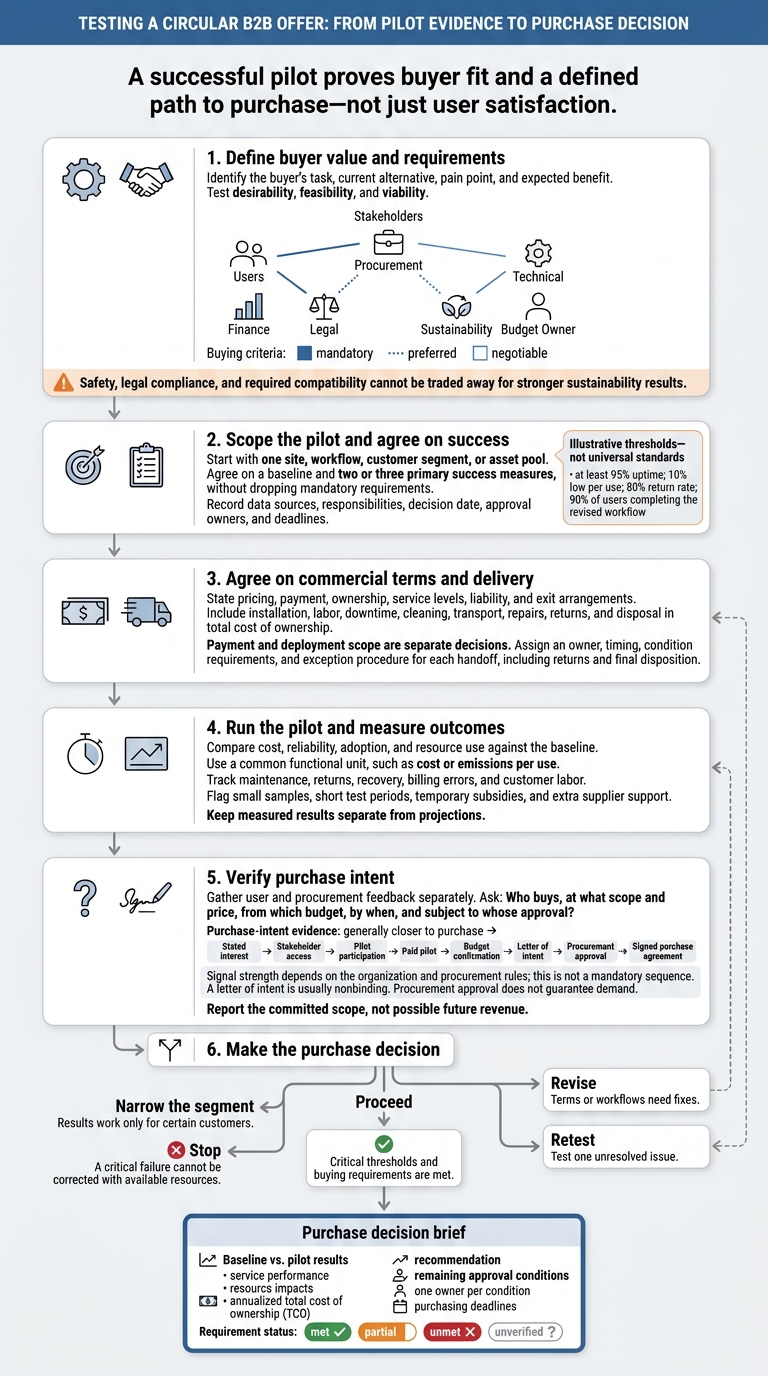
B2B Circular Pilot: From Buyer Fit to Purchase
1. Define the Offer and Buyer Requirements
Build a buyer-specific case for the circular concept before setting pilot terms.
Define Customer Value and Test Assumptions
Start with the buyer’s task, current alternative, pain point, and expected benefit. Show how repair, reuse, remanufacturing, take-back, or product-as-a-service delivers that benefit. Specify whether the buyer owns the asset or pays to use it: ownership determines maintenance and return obligations.[1][2]
Separate assumptions into three groups: desirability - whether buyers want the offer; feasibility - whether you can deliver it; and viability - whether the economics work. For each hypothesis, record the evidence needed, test method, owner, deadline, and pass/fail threshold.
Test cost claims against total cost of ownership and performance claims against uptime and repair turnaround. For resource claims, choose a metric that directly measures the claimed result. Agree on thresholds with the buyer; suggested targets are not industry standards.
Map Users, Approvers, and Buying Steps
Identify who uses, recommends, reviews, pays for, approves, and can veto the offer. Map when users and operations check fit, procurement coordinates reviews, and the budget owner or executive sponsor authorizes spending. Include technical, finance, legal, and sustainability lead reviews where required.
Write separate value statements for users and decision-makers. Each should name the task, measurable benefit, delivery mechanism, and supporting evidence.
Ask users about maintenance effort, failures, and returns. Ask procurement about vendor qualification, budget ownership, insurance, required documents, and approval timing. Have finance confirm payment and accounting requirements, technical reviewers define compatibility needs, and legal identify ownership and liability concerns.
Record the approval path and each reviewer’s deadline before assigning pilot resources. Use this map to give every buying criterion a decision owner.
Create a Buying-Criteria Matrix
Label each criterion mandatory, preferred, or negotiable, and have its decision owner confirm the label. Safety, legal compliance, and required compatibility cannot be traded away for stronger sustainability results.
Keep requirement type separate from approval status. Track progress as open, evidence received, approved, or blocked.
| Stakeholder | Criterion | Evidence required | Pilot metric | Approval risk | Decision status |
|---|---|---|---|---|---|
| Procurement | Total cost | Itemized comparison with the current solution | Total cost per unit or month versus baseline | High if savings are unproven | Open |
| Operations | Reliability | Warranty terms, service process, failure history | Uptime, failures, repair turnaround | High if downtime affects production | Open |
| Procurement | Supply reliability | Capacity plan and replacement inventory | Fill rate and on-time delivery | High if returns create shortages | Open |
| Technical reviewer | Compatibility | Specifications, test results, certifications | Installation success and defect rate | High if integration fails | Open |
| Finance | Payment and ownership | Treatment of lease, service, deposit, and residual value | Invoice accuracy and budget variance | Medium to high | Open |
| Legal and risk | Compliance and liability | Contracts, insurance, safety records, data controls | Incidents, audit findings, contract exceptions | High if requirements are unmet | Open |
| Sustainability | Resource and emissions | Methodology, baseline, activity data, chain-of-custody evidence | Material recovery, waste avoided, emissions per functional unit | High if claims cannot be verified | Open |
| End user | Usability and returns | Training plan and return instructions | Task time, adoption, return compliance | Medium | Open |
sbb-itb-8baf5f1
2. Set Pilot Scope and Terms
Turn the buying criteria into clear pilot terms the buyer can approve.
Set Scope, Baselines, and Success Criteria
Keep the pilot to one site, workflow, customer segment, or asset pool. Write a brief covering the location, dates, users, assets, responsibilities, deliverables, data sources, and decision date. Build in enough time to observe maintenance, returns, and billing.
Compare results with historical or control data on cost, uptime, labor, material use, waste, recovery, and adoption. Select two or three primary success measures from the buying-criteria matrix without dropping mandatory requirements.
Illustrative thresholds include at least 95% uptime, 10% lower cost per use, 80% return rate, or 90% of users completing the revised workflow; these are examples, not universal standards.
Keep measured results separate from projections. Record any limits caused by small samples, short test periods, unusual demand, or extra supplier support.[3][4][6][8]
With the test scope set, decide whether the pilot also needs to prove budget commitment.
Choose Pilot Payment and Scope
Payment and deployment scope are separate decisions. A paid pilot tests whether the buyer will commit budget without requiring a full-site rollout. State whether the fee is refundable, credited toward rollout, or separate from future charges.
Agree on the next buying step if the pilot meets its thresholds. That gives the payment terms a clear purpose: testing whether the buyer will move from trial to rollout. Free access alone does not prove purchase intent.[5]
| Option | Buyer exposure | Proof strength | Procurement complexity | Provider cost | Purchase-intent evidence |
|---|---|---|---|---|---|
| Free, limited scope | Lowest financial exposure; requires staff time | Moderate; narrow operating context | Low to moderate | Highest subsidy per customer | Weak unless conversion terms are agreed |
| Paid, limited scope | Requires budget commitment | Strong for service delivery and payment behavior | Moderate | Partially recovered | Stronger with a written expansion trigger |
| Free, full site | Low price exposure; high disruption to operations | Broad but difficult to isolate | High | Very high | Ambiguous because free access can inflate demand |
| Paid, full site | Highest initial commitment | Broadest evidence from operations | Highest | Better cost recovery | Strongest, but often too large for first validation |
Agree on Pricing, Ownership, and Service Levels
Test purchase, lease, subscription, or usage-based pricing against the buyer’s budget and total cost of ownership. Include installation, labor, downtime, cleaning, transport, repairs, returns, and disposal. Spell out included quantities, extra-use charges, taxes, invoicing, and renewal terms.
Set measurable service levels for uptime or availability, support hours, response time, repair turnaround, replacement availability, collection frequency, and recovery targets. Define how to calculate each measure and what happens if a threshold is missed.
Document installation duties, asset ownership, liability, insurance, loss, contamination, confidentiality, data access, cybersecurity, and intellectual-property rights. Include termination rights, return logistics, and the end-of-pilot options: purchase, lease continuation, extension, return, refurbishment, recycling, or destruction. Set exit arrangements before equipment arrives on-site.
Once the contract terms are set, test the full operating loop from start to finish.
Plan Logistics and Measure Resource Use and Recovery
Test every step from delivery through reporting. For each handoff - including returns and final disposition - assign an owner, timing, condition requirements, and an exception procedure. Track missed pickups, contamination, recovery turnaround, billing errors, and customer labor.
For impact reporting, agree on the baseline, calculation method, system boundary, reporting owner, and a common functional unit.
Use a common functional unit, such as cost or emissions per use.
Include transport distance and load, cleaning inputs, and processing losses where relevant. Keep tracking records, invoices, and weigh tickets. Separate measured outcomes from projected benefits, and log temporary subsidies or extra support so they do not hide the cost of normal service.[3][6][7]
3. Gather Feedback and Verify Purchase Intent
Gather User and Procurement Feedback Separately
After the pilot, check which criteria in the buying-criteria matrix users, procurement, and budget holders accept. Watch users complete the full workflow. Compare task time, training hours, service calls, return completion rate, and missed pickups against the baseline. Use short surveys and scheduled check-ins to learn whether sorting, cleaning, storage, tracking, or returns create extra work.
Ask procurement about vendor qualification, pricing, delivery, and buying rules. Ask legal about liability, warranties, data rights, and termination. Ask budget owners about payback, cost predictability, and budget timing. For each finding, log the supporting evidence, stakeholder, change needed, owner, priority, and follow-up date.[9]
Use pricing feedback to test willingness to pay by segment, rather than assuming every segment will pay the same premium. These findings should separate workflow fit from intent to buy.
Distinguish Interest From Purchase Commitments
Ask for the buying path: who buys, at what scope and price, from which budget, by when, and subject to whose approval? Record the evidence in a purchase-intent scorecard.[10][11]
Rank each signal by how close it is to a purchase decision.
| Signal | What it shows | Limit | Next evidence needed |
|---|---|---|---|
| Stated interest | The problem appears relevant | No proof of budget, urgency, or authority | Identify the budget holder and buying timeline |
| Stakeholder access | Willingness to involve decision-makers | Meetings may still be exploratory | Confirm requirements and approval steps |
| Pilot participation | The customer will commit staff time and access to workflows | The pilot may be free and low-risk | Ask for a defined post-pilot decision |
| Paid pilot | The customer accepts a real price and limited commercial risk | Scope may not represent a full rollout | Confirm conversion criteria and expansion budget |
| Budget confirmation | Funding may be available | Budget can be reallocated or expire | Obtain approval owner and spending date |
| Letter of intent | The buyer records conditional intent, ideally with scope, price, timeline, and conditions | Usually nonbinding and may not survive internal review | Complete vendor qualification and contract review |
| Procurement approval | The supplier and offer can proceed through the purchasing process | It may authorize buying without guaranteeing demand | Secure a purchase order or signed agreement |
| Signed purchase agreement | Commercial commitment exists for the stated scope | It may cover only a limited deployment | Verify renewal, expansion, and delivery obligations |
Signal strength depends on the organization and its procurement rules. Report the committed scope, not possible future revenue.[10][12]
Once interest is documented, test whether the pilot clears the threshold for action.
Decide Whether to Proceed, Revise, or Stop
Compare results against the original thresholds for service, cost, circular outcomes, adoption, and contract readiness. Separate barriers to adoption from preferences. Meeting a recovery target does not justify scaling if it requires excessive customer labor.[9]
Record the decision in a short memo: proceed when critical thresholds and buying requirements are met; revise when terms or workflows still need fixes; narrow the segment when results work only for certain customers; retest one unresolved issue; or stop when a critical failure cannot be corrected with available resources.
For each remaining risk or evidence gap, record its probability, consequence, mitigation, owner, deadline, and the proof required before the next purchase decision.[9]
Conclusion: Use Pilot Results to Make a Purchase Decision
Bring the pilot’s value assumptions, buying requirements, commercial terms, delivery performance, user feedback, and purchase intent into one concise purchase decision brief.
Compare baseline and pilot results side by side, covering service performance, resource impacts, and annualized total cost of ownership (TCO). Mark each requirement as met, partial, unmet, or unverified. Keep measured results separate from projections and unverified claims.
State the recommendation, any remaining approval conditions, one owner for each condition, and purchasing deadlines. Include agreed KPIs, reporting duties, and corrective actions in the contract so performance stays measurable after the pilot.
FAQs
How long should my circular pilot run?
Corporate circular supply chain pilots typically run 3–9 months, giving teams time to test ideas and learn. Broader organizational projects often set 6- to 12-month milestones to assess performance and identify gaps in supplier commitments.
For material streams or complex supply inputs, plan for at least 12 months of measurement. This timeframe accounts for seasonal changes, maintenance shutdowns, and peak flow variations, giving teams a sound data set to justify scaling.
How can I resolve conflicting user and procurement feedback?
Bring procurement, operations, and sustainability teams together to review feedback, spot recurring themes, and agree on priorities. Compare feedback using shared measures, such as total cost of ownership (TCO) or maintenance frequency.
When teams still disagree, sort feedback by urgency and how closely it supports business goals. Test proposed solutions through small pilots to collect objective data before making final procurement decisions.
What if my pilot succeeds but rollout funding stalls?
Build your case for rollout funding around documented pilot results. Metrics tracked from day one - service life, maintenance frequency, and total cost of ownership - give decision-makers evidence to support future capital commitments.
Show how the circular model cuts long-term operating costs and waste. Position the transition as a way to avoid future financial risk, not just another expense.




FAQ