
Sep 19, 2026
SMEs and Circular Economy: 6 Partner Cases
Sustainability Strategy
In This Article
Six SME cases show circular success depends on partner systems, shared KPIs, traceability, and multi-year offtake.
SMEs and Circular Economy: 6 Partner Cases
Most SMEs do not fail at circular work because the idea is weak. They fail because the partner system is missing.
I see the same pattern across all 6 cases in this article: circular models last when small firms do 3 simple things well - pick one material flow, assign clear partner roles, and track results with shared data. The cases cover textiles, electronics, food and beverage, manufacturing, digital matching platforms, and Finnish SME networks. Different sectors, same pattern.
If you want the short version, here it is:
Textiles need resale, repair, and take-back partners.
Electronics need durable product design, repair service networks, and reverse logistics.
Food and beverage need fast by-product handling, quality rules, and buyer agreements.
Manufacturing needs shared infrastructure, metering, and a local coordinator.
Digital platforms help firms match waste streams with buyers and service providers.
Regenerative SME networks depend on municipalities, research groups, and local reuse systems.
What kept these systems running over time?
A clear coordinator
Shared KPIs
Simple contracts
Volume and quality rules
Traceability
Local public support
Pilot funding in the $25,000 to $100,000 range in some U.S. settings
Multi-year agreements, often 3 to 5 years
The article’s core point is simple: SME circular work is not a solo job. It is a partner job. If you are building one, start small, measure from day one, and make sure someone owns collection, transport, processing, sales, and reporting.
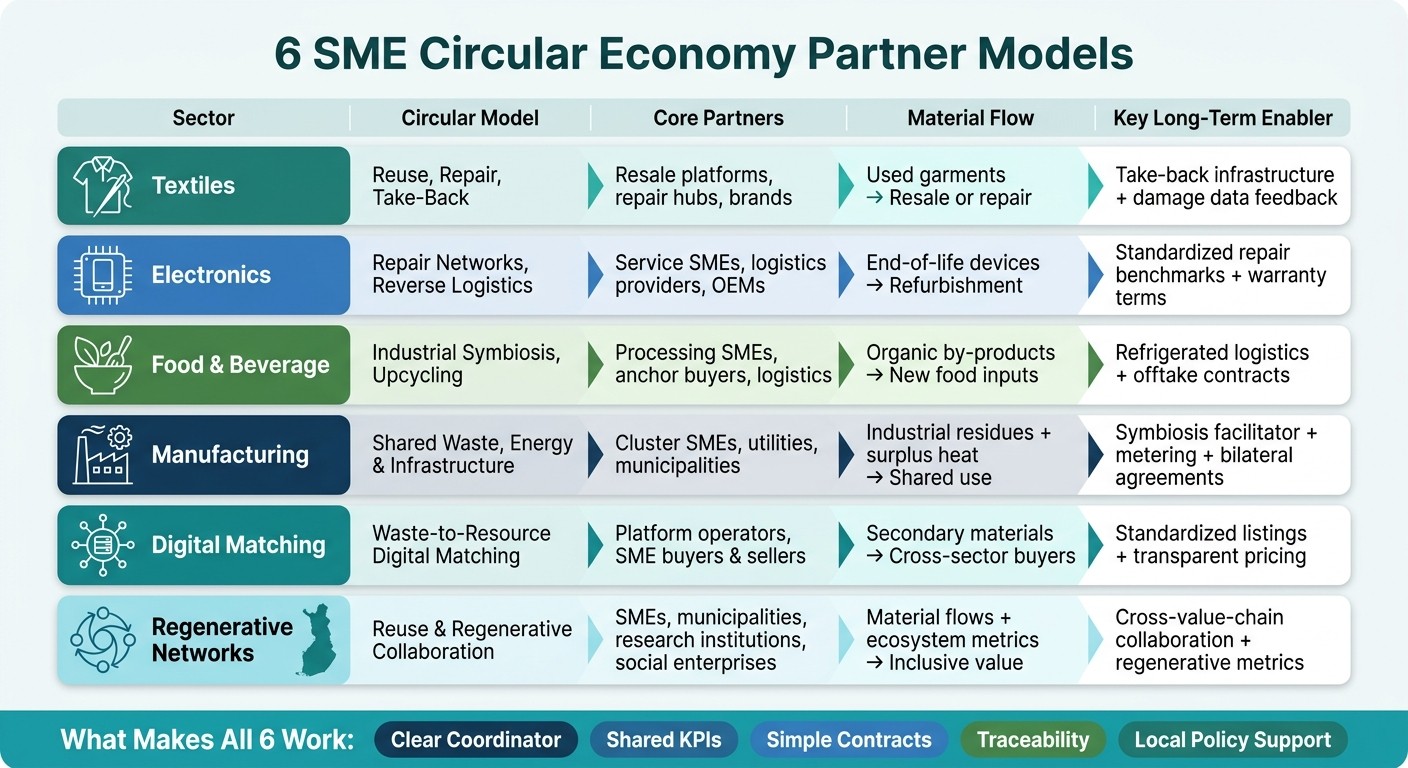
6 SME Circular Economy Partner Models: Sectors, Flows & Enablers
SME Sustainability Webinar Series: Designing For the Circular Economy
Quick Comparison
Case | Main model | Key partners | What makes it work |
|---|---|---|---|
Textiles | Reuse, repair, take-back | Brands, repair hubs, resale platforms | Reverse flows, repair capacity, take-back incentives |
Electronics | Repair and take-back | OEMs, service SMEs, logistics firms | Durable products, service design, repair benchmarks |
Food & beverage | By-product upcycling | Processors, buyers, logistics providers | Fast handling, quality specs, offtake terms |
Manufacturing | Industrial symbiosis | SMEs, utilities, municipalities | Shared infrastructure, metering, local coordination |
Digital matching | Waste-to-resource exchange | Platform operators, buyers, sellers | Standardized listings, pricing rules, compliance checks |
Finnish SME networks | Reuse and shared-use models | SMEs, municipalities, research groups, social enterprises | Policy support, local hubs, cross-sector coordination |
Below, the article shows how these partner setups work in practice and what small firms can copy first.
Six SME Circular Economy Partner Cases
The first three cases show a simple pattern: reuse, repair, and by-product exchange only work when the right partners are in place.
1. Textile Reuse and Repair: Resale Platforms, Repair Hubs, and Take-Back Flows
Prato, Italy, stands out as one of the strongest SME textile circularity cases. There, small firms and local partners turn rags back into new fiber streams [2].
Inside that network, Rifò links yarn producers with consumers through recycled-fiber products. Since 2017, Rifò has worked with the Italian yarn producers Pinori Filati S.p.A. and Filpucci S.p.A. Recycled fibers account for 79% of its total yarn input. By 2024, 97% of Rifò's garments were made from mono-materials, and the brand was selling in more than 400 stores [2]. That partner setup now supports both circular output and local value.
The Renewal Workshop (TRW), an Oregon-based B-Corp, built a cleaning, repair, and resale service for brands such as Patagonia and prAna. In March 2022, Bleckmann acquired TRW, giving the model the infrastructure to scale those services [5].
Take-back programs also depend on plain, well-set incentives. Pact Circle routes returns into resale, donation, or full-price inventory based on product condition and customer choice [3].
The lesson travels well beyond apparel. Textile circularity runs on the same basics seen elsewhere: service capacity, partner trust, and clear reverse flows.
2. Electronics Repair and Take-Back: SME Service Networks in Reverse Logistics
Electronics circularity leans on repair technicians, service logistics, and products built to last. Gorenje's leasing model works because the product is designed for repeated service cycles rather than a one-time sale. Its washing machine is rated for 15,000 washing cycles, compared with about 4,000 cycles for standard consumer models [4].
As Tea Dovšak, Project Manager R&D at Gorenje, put it:
"If we have a great idea which is not economically feasible, then we will stop here." - Tea Dovšak, Project Manager R&D, Gorenje [4]
That line gets to the point. Lease models only hold up when products are durable and serviceable from day one.
The same partner logic shows up again when SMEs turn organic by-products into inputs for another business.
3. Food and Beverage Upcycling: SME Industrial Symbiosis with Organic By-Products
Food and beverage upcycling works when nearby processors can take in by-products fast, under agreed quality standards and offtake terms. When that happens, the result is a repeatable material flow rather than a one-off waste deal.
The next cases widen the model to shared infrastructure, digital matching, and regenerative networks.
Three More Cases: Manufacturing, Digital Matching, and Regenerative SME Networks
4. Manufacturing Symbiosis: Shared Waste, Energy, and Infrastructure Among SMEs
At a larger scale, the same circular logic turns into shared industrial infrastructure. The best-known model for manufacturing symbiosis is Kalundborg, Denmark - widely recognized as the first large-scale industrial symbiosis system, with exchanges starting in the 1960s.[19][20][24][25] Today, 11 company and municipal facilities take part in more than 30 exchanges of energy, water, and materials.[19][24][25]
One of the most cited loops is simple and striking: surplus heat from the Asnæs power plant warms around 3,500 homes through the district heating network and also supports a fish farm, whose sludge is then used as fertilizer.[22][24][25] That kind of system does not run on goodwill alone. A dedicated facilitator keeps it moving. Symbiosis Center Denmark, housed in Kalundborg Municipality, coordinates exchanges, while municipal utilities, zoning, district heating, and shared water systems provide the backbone.[18][21][22][23][24][26] Contracts tie payments for heat and by-products to the buyer's avoided cost of virgin energy or raw materials, and metering and performance tracking confirm delivery.[22][23][24][26]
For SMEs, the starting point is usually much smaller: one anchor tenant with a steady waste stream, then one exchange at a time. In the United States, regional manufacturing extension partnerships and utility collaborations can help SMEs begin with a single exchange and build from there. If firms are too spread out for direct exchange, digital matching can step in.
5. Digital Waste-to-Resource Matching: Platforms That Connect SME Material Flows
Several digital platforms now let SMEs list secondary materials, find buyers, and coordinate transport. Platforms like SECONTRADE and LIFE M3P work as coordination hubs, linking waste producers, resource users, and service providers under clear rules for access, fees, data use, and conflict management.[27][28][29][30][31][32][33][34]
The LIFE M3P platform is free at the basic level. Any company can register, list a waste stream, and search for materials. Automated matching then flags links between offers and demand, which matters a lot for SMEs and industrial clusters that often lack clear information about local waste availability.[1][30] Good platforms also do the unglamorous but necessary work: they standardize material data, check compliance, and spell out pricing, transport, liability, and dispute rules.[7][8]
For U.S. SMEs, listings should use customary units such as pounds or short tons, gallons, and miles, with pricing in $/ton, so the data fits procurement and compliance workflows. Where local institutions are stronger, these exchanges can grow into broader regenerative networks.
6. Regenerative SME Ecosystems: Finnish Cases Moving Beyond Simple Recycling
Finnish SME research points to three sectors that show what regenerative practice looks like on the ground: secondhand apparel, metal recycling, and electric boats.[6][9] The pattern is clear. These ecosystems depend on coordinated roles, not stand-alone SMEs.
In secondhand apparel, SMEs use resale, repair, consignment, and rental to extend garment life, sending underused clothing back into circulation instead of into waste streams.[10][11][13][14][16][17] The national Telaketju program has documented multiple trials of these models, including branded take-back schemes and clothing rental services that build repair into the model from the start.[11][13][14] In metal recycling, Finnish SMEs manage working capital under reverse VAT treatment, a reminder that these firms are deeply tied to the regulatory setup of circular metal flows.[15] In boating, Skipperi replaces individual boat ownership with a shared-use model, increasing asset use without expanding the fleet.[12]
What keeps these ecosystems together is support at more than one level. Municipalities provide zoning, collection hubs, and procurement preferences for circular products. Research institutions run case studies and work directly with SMEs on innovation projects. Social enterprises in northern Finland operate reuse centers with inclusive employment, which makes the network socially rooted rather than purely commercial.[6][9][16][17] Policy, research, and community infrastructure keep the network in motion.
Cross-Case Findings: What Kept These Ecosystems Working Over Time
Across all six cases, the pattern was plain: circular ecosystems lasted when someone owned coordination, risk was spread across the group, and data stayed in view. Good intentions helped, but they were never enough on their own. Every case relied on a clear coordinator - a resale platform, logistics firm, processor, cluster manager, platform owner, or convener - paired with simple contracts, shared KPIs, and dispute rules that kept materials moving even when staff changed or a partner dropped out. When that anchor was missing, things unraveled fast.
Aligned incentives mattered just as much. The ecosystems that stayed in place the longest did not dump risk on one player. They split it through revenue-sharing deals, avoided-disposal savings, and volume floors built into multi-year contracts. Day-to-day gains also kept firms engaged: steadier access to secondary materials, better use of facilities, and brand lift from repair and return programs. Shared measures - cost savings per ton, revenue shares, and impact reporting - gave everyone the same scoreboard. Once those incentives slipped out of sync, participation started to fade.
Sector | Circular Model | Core Partners | Material Flow | Value Created | Long-Term Enablers |
|---|---|---|---|---|---|
Textiles | Reuse, repair, take-back | Resale platforms, repair hubs, brands | Used garments → resale or repair | Extended product life, reduced disposal | Take-back infrastructure, damage data feedback to manufacturers |
Electronics | Repair networks, reverse logistics | Service SMEs, logistics providers, OEMs | End-of-life devices → refurbishment | Asset recovery value, reduced e-waste | Standardized repair benchmarks, warranty terms, mail-back schemes |
Food & Beverage | Industrial symbiosis, upcycling | Processing SMEs, anchor buyers, logistics | Organic by-products → new food inputs | Reduced raw material costs, new revenue | Refrigerated logistics, batch quality standards, offtake contracts |
Manufacturing | Shared waste, energy, infrastructure | Cluster SMEs, utilities, municipalities | Industrial residues, surplus heat | Lower input costs, reduced landfill fees | Symbiosis facilitator, metering, long-term bilateral agreements |
Digital Matching | Digital matching, waste-to-resource | Platform operators, SME buyers/sellers | Secondary materials across sectors | Reduced virgin material use, new supply channels | Standardized listings, verification steps, transparent pricing |
Regenerative Networks | Reuse and regenerative collaboration | SMEs, municipalities, research institutions, social enterprises | Material flows and ecosystem metrics | Ecological gains and inclusive employment | Explicit regenerative goals, cross-value-chain collaboration, regenerative metrics |
The through line was not the sector. It was the way the system ran. Traceability - batch specs, serial numbers, and standardized listings - cut friction and helped partners trust what they were buying, selling, or processing. Regional conveners and municipal agencies often played a quiet but central role. They helped SMEs find partners, sort through rules, and pool money or assets. In the U.S., city and regional agencies can back this work with feasibility grants and pilot support in the $25,000 to $100,000 range. These ecosystems also held up better when policy and funding pushed in the same direction, especially when disposal became more costly and public rules supported repair, reuse, and upcycled outputs.
Design Rules for SME Circular Partnerships
Five design rules came through clearly from these cases.
Start with one measurable material flow. Track pounds diverted, dollars saved, and quality measures from day one. That gives you a hard business case before you try to scale.
Set roles early. Collection, transport, processing, sales, and reporting should all have an owner up front. Clear roles head off conflict and make it easier to bring in new partners later.
Use quality and traceability standards. Visual grading, simple repair checklists, and batch-level tracking can lift resale value, cut returns, and help with compliance.
Lock in a dependable offtake path. Know who will buy or use the recovered output before spending big on staff or equipment. Multi-year contracts of three to five years, with volume floors and price-adjustment clauses, give SMEs enough confidence to invest [35][36].
Keep governance light. Partner charters, shared KPIs, and quarterly check-ins gave these systems continuity without burying small firms in process. The strongest ecosystems also adjusted those rules as markets changed.
Conclusion: Six Cases, One Clear Lesson for Circular Strategy
Look across all six cases, and one pattern stands out: SME circularity is an ecosystem challenge, not a product challenge. A pilot can look great on paper and still stall in the field. The hard part is building a system that keeps working when demand dips, a partner drops out, or costs start creeping up.
That’s why the last test isn’t the pilot itself. It’s system readiness. Are the right partners in place? Is the tracking data shared? Do the rules still hold when the market shifts? Those questions matter more than a slick early launch. In that context, support from regional agencies, municipal programs, and seasoned implementation partners can make a real difference.
Five Takeaways
The lessons are pretty direct:
Partnerships create circular capacity. None of the SMEs in these cases built a working circular loop alone. They needed other firms, service providers, public bodies, or channel partners to make the model run.
Reverse flows need physical collection and shared tracking data. Take-back, repair, and reuse don’t scale through good intentions. They need collection points, sorting, transport, and item-level tracking that everyone can use.
Trust and contracts are operational. Long-term agreements with volume floors, quality specs, and clear dispute processes helped keep materials moving when pressure hit the system.
Policy and local institutions often unlock scale. Extended producer responsibility rules, landfill fees, and municipal coordination often marked the line between a pilot that faded out and one that grew.
Track results, not claims. The ecosystems that lasted measured collection rates, repair turnaround times, resale conversion, and material diversion. Then they used those numbers to adjust the model and hold partners to account.
FAQs
How do I choose the first material flow to pilot?
Start with a material flow analysis that follows inputs from procurement through production to waste. This gives you a clear view of where materials go, where losses happen, and where waste streams may still hold value instead of being discarded or downcycled.
From there, pick one high-volume or high-value waste stream with a clear business case. Run a small, focused pilot first. It’s a smart way to test the idea, learn what works, and fix problems before you scale.
What should be included in a circular partnership agreement?
A circular partnership agreement needs to spell out expectations from the start. That means clear roles, shared performance metrics, and regular check-ins so everyone stays aligned over time.
It should also lay out governance in plain terms, with a fair split of risks, costs, and revenue. Just as important, the agreement should reward efficiency rather than disposal volume. And because markets shift, it should leave room for routine reviews, so partners can adjust - or end - exchanges that no longer make economic sense.
Which KPIs matter most for SME circular projects?
For SMEs, the best circular project KPIs do two jobs at once: they show business value and track environmental impact. That balance matters. If a metric looks good on paper but doesn’t help the business, it won’t last. If it only tracks dollars and ignores waste, reuse, and materials, it misses the point.
Some of the most useful metrics are material recovery rates, waste diversion, revenue from circular models, cost savings from waste reduction, and material recovery value. Together, they show whether a project is cutting waste, keeping materials in use, and creating financial return.
It also helps to track take-back rates, product longevity, and the share of recycled or renewable inputs. These measures give a clearer picture of circularity progress over time. Council Fire helps organizations turn these metrics into measurable, system-level results.
Related Blog Posts
The Circular Supply Chain: A Roadmap for Manufacturers Navigating ESG Pressures
How to Design a Circular Supply Chain Roadmap for Municipalities & Government Agencies
How to Design a Circular Supply Chain Roadmap for Corporations
How to Design a Circular Supply Chain Roadmap for Foundations & Philanthropic Organizations
Latest Articles
©2025

Narrative Change and Power Building: The Missing Half of Advocacy
Narrative change is the process of disrupting dominant narratives that normalize inequity and advancing new narratives from historically marginalized communities.

Funding Resilience Without Federal Grants
BRIC is unreliable and FEMA is shrinking. Here's how cities fund climate resilience with dedicated revenue, blended finance, and a coordinating authority.

The ESG Blind Spot: How AI Is Finding Risks in Companies Nobody Else Is Watching
Norway's sovereign wealth fund uses AI to screen 7,200 portfolio companies for forced labor and corruption within 24 hours. The real story is the emerging-market coverage gap that traditional ESG data vendors miss — and what it means for any company with a global supply chain.
Narrative Change and Power Building: The Missing Half of Advocacy
Narrative change is the process of disrupting dominant narratives that normalize inequity and advancing new narratives from historically marginalized communities.
Funding Resilience Without Federal Grants
BRIC is unreliable and FEMA is shrinking. Here's how cities fund climate resilience with dedicated revenue, blended finance, and a coordinating authority.
The ESG Blind Spot: How AI Is Finding Risks in Companies Nobody Else Is Watching
Norway's sovereign wealth fund uses AI to screen 7,200 portfolio companies for forced labor and corruption within 24 hours. The real story is the emerging-market coverage gap that traditional ESG data vendors miss — and what it means for any company with a global supply chain.
FAQ
01
What does it really mean to “redefine profit”?
02
What makes Council Fire different?
03
Who does Council Fire work with?
04
What does working with Council Fire actually look like?
05
How does Council Fire help organizations turn big goals into action?
06
How does Council Fire define and measure success?
Sep 19, 2026
SMEs and Circular Economy: 6 Partner Cases
Sustainability Strategy
In This Article
Six SME cases show circular success depends on partner systems, shared KPIs, traceability, and multi-year offtake.
SMEs and Circular Economy: 6 Partner Cases
Most SMEs do not fail at circular work because the idea is weak. They fail because the partner system is missing.
I see the same pattern across all 6 cases in this article: circular models last when small firms do 3 simple things well - pick one material flow, assign clear partner roles, and track results with shared data. The cases cover textiles, electronics, food and beverage, manufacturing, digital matching platforms, and Finnish SME networks. Different sectors, same pattern.
If you want the short version, here it is:
Textiles need resale, repair, and take-back partners.
Electronics need durable product design, repair service networks, and reverse logistics.
Food and beverage need fast by-product handling, quality rules, and buyer agreements.
Manufacturing needs shared infrastructure, metering, and a local coordinator.
Digital platforms help firms match waste streams with buyers and service providers.
Regenerative SME networks depend on municipalities, research groups, and local reuse systems.
What kept these systems running over time?
A clear coordinator
Shared KPIs
Simple contracts
Volume and quality rules
Traceability
Local public support
Pilot funding in the $25,000 to $100,000 range in some U.S. settings
Multi-year agreements, often 3 to 5 years
The article’s core point is simple: SME circular work is not a solo job. It is a partner job. If you are building one, start small, measure from day one, and make sure someone owns collection, transport, processing, sales, and reporting.
6 SME Circular Economy Partner Models: Sectors, Flows & Enablers
SME Sustainability Webinar Series: Designing For the Circular Economy
Quick Comparison
Case | Main model | Key partners | What makes it work |
|---|---|---|---|
Textiles | Reuse, repair, take-back | Brands, repair hubs, resale platforms | Reverse flows, repair capacity, take-back incentives |
Electronics | Repair and take-back | OEMs, service SMEs, logistics firms | Durable products, service design, repair benchmarks |
Food & beverage | By-product upcycling | Processors, buyers, logistics providers | Fast handling, quality specs, offtake terms |
Manufacturing | Industrial symbiosis | SMEs, utilities, municipalities | Shared infrastructure, metering, local coordination |
Digital matching | Waste-to-resource exchange | Platform operators, buyers, sellers | Standardized listings, pricing rules, compliance checks |
Finnish SME networks | Reuse and shared-use models | SMEs, municipalities, research groups, social enterprises | Policy support, local hubs, cross-sector coordination |
Below, the article shows how these partner setups work in practice and what small firms can copy first.
Six SME Circular Economy Partner Cases
The first three cases show a simple pattern: reuse, repair, and by-product exchange only work when the right partners are in place.
1. Textile Reuse and Repair: Resale Platforms, Repair Hubs, and Take-Back Flows
Prato, Italy, stands out as one of the strongest SME textile circularity cases. There, small firms and local partners turn rags back into new fiber streams [2].
Inside that network, Rifò links yarn producers with consumers through recycled-fiber products. Since 2017, Rifò has worked with the Italian yarn producers Pinori Filati S.p.A. and Filpucci S.p.A. Recycled fibers account for 79% of its total yarn input. By 2024, 97% of Rifò's garments were made from mono-materials, and the brand was selling in more than 400 stores [2]. That partner setup now supports both circular output and local value.
The Renewal Workshop (TRW), an Oregon-based B-Corp, built a cleaning, repair, and resale service for brands such as Patagonia and prAna. In March 2022, Bleckmann acquired TRW, giving the model the infrastructure to scale those services [5].
Take-back programs also depend on plain, well-set incentives. Pact Circle routes returns into resale, donation, or full-price inventory based on product condition and customer choice [3].
The lesson travels well beyond apparel. Textile circularity runs on the same basics seen elsewhere: service capacity, partner trust, and clear reverse flows.
2. Electronics Repair and Take-Back: SME Service Networks in Reverse Logistics
Electronics circularity leans on repair technicians, service logistics, and products built to last. Gorenje's leasing model works because the product is designed for repeated service cycles rather than a one-time sale. Its washing machine is rated for 15,000 washing cycles, compared with about 4,000 cycles for standard consumer models [4].
As Tea Dovšak, Project Manager R&D at Gorenje, put it:
"If we have a great idea which is not economically feasible, then we will stop here." - Tea Dovšak, Project Manager R&D, Gorenje [4]
That line gets to the point. Lease models only hold up when products are durable and serviceable from day one.
The same partner logic shows up again when SMEs turn organic by-products into inputs for another business.
3. Food and Beverage Upcycling: SME Industrial Symbiosis with Organic By-Products
Food and beverage upcycling works when nearby processors can take in by-products fast, under agreed quality standards and offtake terms. When that happens, the result is a repeatable material flow rather than a one-off waste deal.
The next cases widen the model to shared infrastructure, digital matching, and regenerative networks.
Three More Cases: Manufacturing, Digital Matching, and Regenerative SME Networks
4. Manufacturing Symbiosis: Shared Waste, Energy, and Infrastructure Among SMEs
At a larger scale, the same circular logic turns into shared industrial infrastructure. The best-known model for manufacturing symbiosis is Kalundborg, Denmark - widely recognized as the first large-scale industrial symbiosis system, with exchanges starting in the 1960s.[19][20][24][25] Today, 11 company and municipal facilities take part in more than 30 exchanges of energy, water, and materials.[19][24][25]
One of the most cited loops is simple and striking: surplus heat from the Asnæs power plant warms around 3,500 homes through the district heating network and also supports a fish farm, whose sludge is then used as fertilizer.[22][24][25] That kind of system does not run on goodwill alone. A dedicated facilitator keeps it moving. Symbiosis Center Denmark, housed in Kalundborg Municipality, coordinates exchanges, while municipal utilities, zoning, district heating, and shared water systems provide the backbone.[18][21][22][23][24][26] Contracts tie payments for heat and by-products to the buyer's avoided cost of virgin energy or raw materials, and metering and performance tracking confirm delivery.[22][23][24][26]
For SMEs, the starting point is usually much smaller: one anchor tenant with a steady waste stream, then one exchange at a time. In the United States, regional manufacturing extension partnerships and utility collaborations can help SMEs begin with a single exchange and build from there. If firms are too spread out for direct exchange, digital matching can step in.
5. Digital Waste-to-Resource Matching: Platforms That Connect SME Material Flows
Several digital platforms now let SMEs list secondary materials, find buyers, and coordinate transport. Platforms like SECONTRADE and LIFE M3P work as coordination hubs, linking waste producers, resource users, and service providers under clear rules for access, fees, data use, and conflict management.[27][28][29][30][31][32][33][34]
The LIFE M3P platform is free at the basic level. Any company can register, list a waste stream, and search for materials. Automated matching then flags links between offers and demand, which matters a lot for SMEs and industrial clusters that often lack clear information about local waste availability.[1][30] Good platforms also do the unglamorous but necessary work: they standardize material data, check compliance, and spell out pricing, transport, liability, and dispute rules.[7][8]
For U.S. SMEs, listings should use customary units such as pounds or short tons, gallons, and miles, with pricing in $/ton, so the data fits procurement and compliance workflows. Where local institutions are stronger, these exchanges can grow into broader regenerative networks.
6. Regenerative SME Ecosystems: Finnish Cases Moving Beyond Simple Recycling
Finnish SME research points to three sectors that show what regenerative practice looks like on the ground: secondhand apparel, metal recycling, and electric boats.[6][9] The pattern is clear. These ecosystems depend on coordinated roles, not stand-alone SMEs.
In secondhand apparel, SMEs use resale, repair, consignment, and rental to extend garment life, sending underused clothing back into circulation instead of into waste streams.[10][11][13][14][16][17] The national Telaketju program has documented multiple trials of these models, including branded take-back schemes and clothing rental services that build repair into the model from the start.[11][13][14] In metal recycling, Finnish SMEs manage working capital under reverse VAT treatment, a reminder that these firms are deeply tied to the regulatory setup of circular metal flows.[15] In boating, Skipperi replaces individual boat ownership with a shared-use model, increasing asset use without expanding the fleet.[12]
What keeps these ecosystems together is support at more than one level. Municipalities provide zoning, collection hubs, and procurement preferences for circular products. Research institutions run case studies and work directly with SMEs on innovation projects. Social enterprises in northern Finland operate reuse centers with inclusive employment, which makes the network socially rooted rather than purely commercial.[6][9][16][17] Policy, research, and community infrastructure keep the network in motion.
Cross-Case Findings: What Kept These Ecosystems Working Over Time
Across all six cases, the pattern was plain: circular ecosystems lasted when someone owned coordination, risk was spread across the group, and data stayed in view. Good intentions helped, but they were never enough on their own. Every case relied on a clear coordinator - a resale platform, logistics firm, processor, cluster manager, platform owner, or convener - paired with simple contracts, shared KPIs, and dispute rules that kept materials moving even when staff changed or a partner dropped out. When that anchor was missing, things unraveled fast.
Aligned incentives mattered just as much. The ecosystems that stayed in place the longest did not dump risk on one player. They split it through revenue-sharing deals, avoided-disposal savings, and volume floors built into multi-year contracts. Day-to-day gains also kept firms engaged: steadier access to secondary materials, better use of facilities, and brand lift from repair and return programs. Shared measures - cost savings per ton, revenue shares, and impact reporting - gave everyone the same scoreboard. Once those incentives slipped out of sync, participation started to fade.
Sector | Circular Model | Core Partners | Material Flow | Value Created | Long-Term Enablers |
|---|---|---|---|---|---|
Textiles | Reuse, repair, take-back | Resale platforms, repair hubs, brands | Used garments → resale or repair | Extended product life, reduced disposal | Take-back infrastructure, damage data feedback to manufacturers |
Electronics | Repair networks, reverse logistics | Service SMEs, logistics providers, OEMs | End-of-life devices → refurbishment | Asset recovery value, reduced e-waste | Standardized repair benchmarks, warranty terms, mail-back schemes |
Food & Beverage | Industrial symbiosis, upcycling | Processing SMEs, anchor buyers, logistics | Organic by-products → new food inputs | Reduced raw material costs, new revenue | Refrigerated logistics, batch quality standards, offtake contracts |
Manufacturing | Shared waste, energy, infrastructure | Cluster SMEs, utilities, municipalities | Industrial residues, surplus heat | Lower input costs, reduced landfill fees | Symbiosis facilitator, metering, long-term bilateral agreements |
Digital Matching | Digital matching, waste-to-resource | Platform operators, SME buyers/sellers | Secondary materials across sectors | Reduced virgin material use, new supply channels | Standardized listings, verification steps, transparent pricing |
Regenerative Networks | Reuse and regenerative collaboration | SMEs, municipalities, research institutions, social enterprises | Material flows and ecosystem metrics | Ecological gains and inclusive employment | Explicit regenerative goals, cross-value-chain collaboration, regenerative metrics |
The through line was not the sector. It was the way the system ran. Traceability - batch specs, serial numbers, and standardized listings - cut friction and helped partners trust what they were buying, selling, or processing. Regional conveners and municipal agencies often played a quiet but central role. They helped SMEs find partners, sort through rules, and pool money or assets. In the U.S., city and regional agencies can back this work with feasibility grants and pilot support in the $25,000 to $100,000 range. These ecosystems also held up better when policy and funding pushed in the same direction, especially when disposal became more costly and public rules supported repair, reuse, and upcycled outputs.
Design Rules for SME Circular Partnerships
Five design rules came through clearly from these cases.
Start with one measurable material flow. Track pounds diverted, dollars saved, and quality measures from day one. That gives you a hard business case before you try to scale.
Set roles early. Collection, transport, processing, sales, and reporting should all have an owner up front. Clear roles head off conflict and make it easier to bring in new partners later.
Use quality and traceability standards. Visual grading, simple repair checklists, and batch-level tracking can lift resale value, cut returns, and help with compliance.
Lock in a dependable offtake path. Know who will buy or use the recovered output before spending big on staff or equipment. Multi-year contracts of three to five years, with volume floors and price-adjustment clauses, give SMEs enough confidence to invest [35][36].
Keep governance light. Partner charters, shared KPIs, and quarterly check-ins gave these systems continuity without burying small firms in process. The strongest ecosystems also adjusted those rules as markets changed.
Conclusion: Six Cases, One Clear Lesson for Circular Strategy
Look across all six cases, and one pattern stands out: SME circularity is an ecosystem challenge, not a product challenge. A pilot can look great on paper and still stall in the field. The hard part is building a system that keeps working when demand dips, a partner drops out, or costs start creeping up.
That’s why the last test isn’t the pilot itself. It’s system readiness. Are the right partners in place? Is the tracking data shared? Do the rules still hold when the market shifts? Those questions matter more than a slick early launch. In that context, support from regional agencies, municipal programs, and seasoned implementation partners can make a real difference.
Five Takeaways
The lessons are pretty direct:
Partnerships create circular capacity. None of the SMEs in these cases built a working circular loop alone. They needed other firms, service providers, public bodies, or channel partners to make the model run.
Reverse flows need physical collection and shared tracking data. Take-back, repair, and reuse don’t scale through good intentions. They need collection points, sorting, transport, and item-level tracking that everyone can use.
Trust and contracts are operational. Long-term agreements with volume floors, quality specs, and clear dispute processes helped keep materials moving when pressure hit the system.
Policy and local institutions often unlock scale. Extended producer responsibility rules, landfill fees, and municipal coordination often marked the line between a pilot that faded out and one that grew.
Track results, not claims. The ecosystems that lasted measured collection rates, repair turnaround times, resale conversion, and material diversion. Then they used those numbers to adjust the model and hold partners to account.
FAQs
How do I choose the first material flow to pilot?
Start with a material flow analysis that follows inputs from procurement through production to waste. This gives you a clear view of where materials go, where losses happen, and where waste streams may still hold value instead of being discarded or downcycled.
From there, pick one high-volume or high-value waste stream with a clear business case. Run a small, focused pilot first. It’s a smart way to test the idea, learn what works, and fix problems before you scale.
What should be included in a circular partnership agreement?
A circular partnership agreement needs to spell out expectations from the start. That means clear roles, shared performance metrics, and regular check-ins so everyone stays aligned over time.
It should also lay out governance in plain terms, with a fair split of risks, costs, and revenue. Just as important, the agreement should reward efficiency rather than disposal volume. And because markets shift, it should leave room for routine reviews, so partners can adjust - or end - exchanges that no longer make economic sense.
Which KPIs matter most for SME circular projects?
For SMEs, the best circular project KPIs do two jobs at once: they show business value and track environmental impact. That balance matters. If a metric looks good on paper but doesn’t help the business, it won’t last. If it only tracks dollars and ignores waste, reuse, and materials, it misses the point.
Some of the most useful metrics are material recovery rates, waste diversion, revenue from circular models, cost savings from waste reduction, and material recovery value. Together, they show whether a project is cutting waste, keeping materials in use, and creating financial return.
It also helps to track take-back rates, product longevity, and the share of recycled or renewable inputs. These measures give a clearer picture of circularity progress over time. Council Fire helps organizations turn these metrics into measurable, system-level results.
Related Blog Posts
The Circular Supply Chain: A Roadmap for Manufacturers Navigating ESG Pressures
How to Design a Circular Supply Chain Roadmap for Municipalities & Government Agencies
How to Design a Circular Supply Chain Roadmap for Corporations
How to Design a Circular Supply Chain Roadmap for Foundations & Philanthropic Organizations
Latest Articles
©2025
Narrative Change and Power Building: The Missing Half of Advocacy
Narrative change is the process of disrupting dominant narratives that normalize inequity and advancing new narratives from historically marginalized communities.
Funding Resilience Without Federal Grants
BRIC is unreliable and FEMA is shrinking. Here's how cities fund climate resilience with dedicated revenue, blended finance, and a coordinating authority.
The ESG Blind Spot: How AI Is Finding Risks in Companies Nobody Else Is Watching
Norway's sovereign wealth fund uses AI to screen 7,200 portfolio companies for forced labor and corruption within 24 hours. The real story is the emerging-market coverage gap that traditional ESG data vendors miss — and what it means for any company with a global supply chain.
FAQ
01
What does it really mean to “redefine profit”?
02
What makes Council Fire different?
03
Who does Council Fire work with?
04
What does working with Council Fire actually look like?
05
How does Council Fire help organizations turn big goals into action?
06
How does Council Fire define and measure success?
Sep 19, 2026
SMEs and Circular Economy: 6 Partner Cases
Sustainability Strategy
In This Article
Six SME cases show circular success depends on partner systems, shared KPIs, traceability, and multi-year offtake.
SMEs and Circular Economy: 6 Partner Cases
Most SMEs do not fail at circular work because the idea is weak. They fail because the partner system is missing.
I see the same pattern across all 6 cases in this article: circular models last when small firms do 3 simple things well - pick one material flow, assign clear partner roles, and track results with shared data. The cases cover textiles, electronics, food and beverage, manufacturing, digital matching platforms, and Finnish SME networks. Different sectors, same pattern.
If you want the short version, here it is:
Textiles need resale, repair, and take-back partners.
Electronics need durable product design, repair service networks, and reverse logistics.
Food and beverage need fast by-product handling, quality rules, and buyer agreements.
Manufacturing needs shared infrastructure, metering, and a local coordinator.
Digital platforms help firms match waste streams with buyers and service providers.
Regenerative SME networks depend on municipalities, research groups, and local reuse systems.
What kept these systems running over time?
A clear coordinator
Shared KPIs
Simple contracts
Volume and quality rules
Traceability
Local public support
Pilot funding in the $25,000 to $100,000 range in some U.S. settings
Multi-year agreements, often 3 to 5 years
The article’s core point is simple: SME circular work is not a solo job. It is a partner job. If you are building one, start small, measure from day one, and make sure someone owns collection, transport, processing, sales, and reporting.
6 SME Circular Economy Partner Models: Sectors, Flows & Enablers
SME Sustainability Webinar Series: Designing For the Circular Economy
Quick Comparison
Case | Main model | Key partners | What makes it work |
|---|---|---|---|
Textiles | Reuse, repair, take-back | Brands, repair hubs, resale platforms | Reverse flows, repair capacity, take-back incentives |
Electronics | Repair and take-back | OEMs, service SMEs, logistics firms | Durable products, service design, repair benchmarks |
Food & beverage | By-product upcycling | Processors, buyers, logistics providers | Fast handling, quality specs, offtake terms |
Manufacturing | Industrial symbiosis | SMEs, utilities, municipalities | Shared infrastructure, metering, local coordination |
Digital matching | Waste-to-resource exchange | Platform operators, buyers, sellers | Standardized listings, pricing rules, compliance checks |
Finnish SME networks | Reuse and shared-use models | SMEs, municipalities, research groups, social enterprises | Policy support, local hubs, cross-sector coordination |
Below, the article shows how these partner setups work in practice and what small firms can copy first.
Six SME Circular Economy Partner Cases
The first three cases show a simple pattern: reuse, repair, and by-product exchange only work when the right partners are in place.
1. Textile Reuse and Repair: Resale Platforms, Repair Hubs, and Take-Back Flows
Prato, Italy, stands out as one of the strongest SME textile circularity cases. There, small firms and local partners turn rags back into new fiber streams [2].
Inside that network, Rifò links yarn producers with consumers through recycled-fiber products. Since 2017, Rifò has worked with the Italian yarn producers Pinori Filati S.p.A. and Filpucci S.p.A. Recycled fibers account for 79% of its total yarn input. By 2024, 97% of Rifò's garments were made from mono-materials, and the brand was selling in more than 400 stores [2]. That partner setup now supports both circular output and local value.
The Renewal Workshop (TRW), an Oregon-based B-Corp, built a cleaning, repair, and resale service for brands such as Patagonia and prAna. In March 2022, Bleckmann acquired TRW, giving the model the infrastructure to scale those services [5].
Take-back programs also depend on plain, well-set incentives. Pact Circle routes returns into resale, donation, or full-price inventory based on product condition and customer choice [3].
The lesson travels well beyond apparel. Textile circularity runs on the same basics seen elsewhere: service capacity, partner trust, and clear reverse flows.
2. Electronics Repair and Take-Back: SME Service Networks in Reverse Logistics
Electronics circularity leans on repair technicians, service logistics, and products built to last. Gorenje's leasing model works because the product is designed for repeated service cycles rather than a one-time sale. Its washing machine is rated for 15,000 washing cycles, compared with about 4,000 cycles for standard consumer models [4].
As Tea Dovšak, Project Manager R&D at Gorenje, put it:
"If we have a great idea which is not economically feasible, then we will stop here." - Tea Dovšak, Project Manager R&D, Gorenje [4]
That line gets to the point. Lease models only hold up when products are durable and serviceable from day one.
The same partner logic shows up again when SMEs turn organic by-products into inputs for another business.
3. Food and Beverage Upcycling: SME Industrial Symbiosis with Organic By-Products
Food and beverage upcycling works when nearby processors can take in by-products fast, under agreed quality standards and offtake terms. When that happens, the result is a repeatable material flow rather than a one-off waste deal.
The next cases widen the model to shared infrastructure, digital matching, and regenerative networks.
Three More Cases: Manufacturing, Digital Matching, and Regenerative SME Networks
4. Manufacturing Symbiosis: Shared Waste, Energy, and Infrastructure Among SMEs
At a larger scale, the same circular logic turns into shared industrial infrastructure. The best-known model for manufacturing symbiosis is Kalundborg, Denmark - widely recognized as the first large-scale industrial symbiosis system, with exchanges starting in the 1960s.[19][20][24][25] Today, 11 company and municipal facilities take part in more than 30 exchanges of energy, water, and materials.[19][24][25]
One of the most cited loops is simple and striking: surplus heat from the Asnæs power plant warms around 3,500 homes through the district heating network and also supports a fish farm, whose sludge is then used as fertilizer.[22][24][25] That kind of system does not run on goodwill alone. A dedicated facilitator keeps it moving. Symbiosis Center Denmark, housed in Kalundborg Municipality, coordinates exchanges, while municipal utilities, zoning, district heating, and shared water systems provide the backbone.[18][21][22][23][24][26] Contracts tie payments for heat and by-products to the buyer's avoided cost of virgin energy or raw materials, and metering and performance tracking confirm delivery.[22][23][24][26]
For SMEs, the starting point is usually much smaller: one anchor tenant with a steady waste stream, then one exchange at a time. In the United States, regional manufacturing extension partnerships and utility collaborations can help SMEs begin with a single exchange and build from there. If firms are too spread out for direct exchange, digital matching can step in.
5. Digital Waste-to-Resource Matching: Platforms That Connect SME Material Flows
Several digital platforms now let SMEs list secondary materials, find buyers, and coordinate transport. Platforms like SECONTRADE and LIFE M3P work as coordination hubs, linking waste producers, resource users, and service providers under clear rules for access, fees, data use, and conflict management.[27][28][29][30][31][32][33][34]
The LIFE M3P platform is free at the basic level. Any company can register, list a waste stream, and search for materials. Automated matching then flags links between offers and demand, which matters a lot for SMEs and industrial clusters that often lack clear information about local waste availability.[1][30] Good platforms also do the unglamorous but necessary work: they standardize material data, check compliance, and spell out pricing, transport, liability, and dispute rules.[7][8]
For U.S. SMEs, listings should use customary units such as pounds or short tons, gallons, and miles, with pricing in $/ton, so the data fits procurement and compliance workflows. Where local institutions are stronger, these exchanges can grow into broader regenerative networks.
6. Regenerative SME Ecosystems: Finnish Cases Moving Beyond Simple Recycling
Finnish SME research points to three sectors that show what regenerative practice looks like on the ground: secondhand apparel, metal recycling, and electric boats.[6][9] The pattern is clear. These ecosystems depend on coordinated roles, not stand-alone SMEs.
In secondhand apparel, SMEs use resale, repair, consignment, and rental to extend garment life, sending underused clothing back into circulation instead of into waste streams.[10][11][13][14][16][17] The national Telaketju program has documented multiple trials of these models, including branded take-back schemes and clothing rental services that build repair into the model from the start.[11][13][14] In metal recycling, Finnish SMEs manage working capital under reverse VAT treatment, a reminder that these firms are deeply tied to the regulatory setup of circular metal flows.[15] In boating, Skipperi replaces individual boat ownership with a shared-use model, increasing asset use without expanding the fleet.[12]
What keeps these ecosystems together is support at more than one level. Municipalities provide zoning, collection hubs, and procurement preferences for circular products. Research institutions run case studies and work directly with SMEs on innovation projects. Social enterprises in northern Finland operate reuse centers with inclusive employment, which makes the network socially rooted rather than purely commercial.[6][9][16][17] Policy, research, and community infrastructure keep the network in motion.
Cross-Case Findings: What Kept These Ecosystems Working Over Time
Across all six cases, the pattern was plain: circular ecosystems lasted when someone owned coordination, risk was spread across the group, and data stayed in view. Good intentions helped, but they were never enough on their own. Every case relied on a clear coordinator - a resale platform, logistics firm, processor, cluster manager, platform owner, or convener - paired with simple contracts, shared KPIs, and dispute rules that kept materials moving even when staff changed or a partner dropped out. When that anchor was missing, things unraveled fast.
Aligned incentives mattered just as much. The ecosystems that stayed in place the longest did not dump risk on one player. They split it through revenue-sharing deals, avoided-disposal savings, and volume floors built into multi-year contracts. Day-to-day gains also kept firms engaged: steadier access to secondary materials, better use of facilities, and brand lift from repair and return programs. Shared measures - cost savings per ton, revenue shares, and impact reporting - gave everyone the same scoreboard. Once those incentives slipped out of sync, participation started to fade.
Sector | Circular Model | Core Partners | Material Flow | Value Created | Long-Term Enablers |
|---|---|---|---|---|---|
Textiles | Reuse, repair, take-back | Resale platforms, repair hubs, brands | Used garments → resale or repair | Extended product life, reduced disposal | Take-back infrastructure, damage data feedback to manufacturers |
Electronics | Repair networks, reverse logistics | Service SMEs, logistics providers, OEMs | End-of-life devices → refurbishment | Asset recovery value, reduced e-waste | Standardized repair benchmarks, warranty terms, mail-back schemes |
Food & Beverage | Industrial symbiosis, upcycling | Processing SMEs, anchor buyers, logistics | Organic by-products → new food inputs | Reduced raw material costs, new revenue | Refrigerated logistics, batch quality standards, offtake contracts |
Manufacturing | Shared waste, energy, infrastructure | Cluster SMEs, utilities, municipalities | Industrial residues, surplus heat | Lower input costs, reduced landfill fees | Symbiosis facilitator, metering, long-term bilateral agreements |
Digital Matching | Digital matching, waste-to-resource | Platform operators, SME buyers/sellers | Secondary materials across sectors | Reduced virgin material use, new supply channels | Standardized listings, verification steps, transparent pricing |
Regenerative Networks | Reuse and regenerative collaboration | SMEs, municipalities, research institutions, social enterprises | Material flows and ecosystem metrics | Ecological gains and inclusive employment | Explicit regenerative goals, cross-value-chain collaboration, regenerative metrics |
The through line was not the sector. It was the way the system ran. Traceability - batch specs, serial numbers, and standardized listings - cut friction and helped partners trust what they were buying, selling, or processing. Regional conveners and municipal agencies often played a quiet but central role. They helped SMEs find partners, sort through rules, and pool money or assets. In the U.S., city and regional agencies can back this work with feasibility grants and pilot support in the $25,000 to $100,000 range. These ecosystems also held up better when policy and funding pushed in the same direction, especially when disposal became more costly and public rules supported repair, reuse, and upcycled outputs.
Design Rules for SME Circular Partnerships
Five design rules came through clearly from these cases.
Start with one measurable material flow. Track pounds diverted, dollars saved, and quality measures from day one. That gives you a hard business case before you try to scale.
Set roles early. Collection, transport, processing, sales, and reporting should all have an owner up front. Clear roles head off conflict and make it easier to bring in new partners later.
Use quality and traceability standards. Visual grading, simple repair checklists, and batch-level tracking can lift resale value, cut returns, and help with compliance.
Lock in a dependable offtake path. Know who will buy or use the recovered output before spending big on staff or equipment. Multi-year contracts of three to five years, with volume floors and price-adjustment clauses, give SMEs enough confidence to invest [35][36].
Keep governance light. Partner charters, shared KPIs, and quarterly check-ins gave these systems continuity without burying small firms in process. The strongest ecosystems also adjusted those rules as markets changed.
Conclusion: Six Cases, One Clear Lesson for Circular Strategy
Look across all six cases, and one pattern stands out: SME circularity is an ecosystem challenge, not a product challenge. A pilot can look great on paper and still stall in the field. The hard part is building a system that keeps working when demand dips, a partner drops out, or costs start creeping up.
That’s why the last test isn’t the pilot itself. It’s system readiness. Are the right partners in place? Is the tracking data shared? Do the rules still hold when the market shifts? Those questions matter more than a slick early launch. In that context, support from regional agencies, municipal programs, and seasoned implementation partners can make a real difference.
Five Takeaways
The lessons are pretty direct:
Partnerships create circular capacity. None of the SMEs in these cases built a working circular loop alone. They needed other firms, service providers, public bodies, or channel partners to make the model run.
Reverse flows need physical collection and shared tracking data. Take-back, repair, and reuse don’t scale through good intentions. They need collection points, sorting, transport, and item-level tracking that everyone can use.
Trust and contracts are operational. Long-term agreements with volume floors, quality specs, and clear dispute processes helped keep materials moving when pressure hit the system.
Policy and local institutions often unlock scale. Extended producer responsibility rules, landfill fees, and municipal coordination often marked the line between a pilot that faded out and one that grew.
Track results, not claims. The ecosystems that lasted measured collection rates, repair turnaround times, resale conversion, and material diversion. Then they used those numbers to adjust the model and hold partners to account.
FAQs
How do I choose the first material flow to pilot?
Start with a material flow analysis that follows inputs from procurement through production to waste. This gives you a clear view of where materials go, where losses happen, and where waste streams may still hold value instead of being discarded or downcycled.
From there, pick one high-volume or high-value waste stream with a clear business case. Run a small, focused pilot first. It’s a smart way to test the idea, learn what works, and fix problems before you scale.
What should be included in a circular partnership agreement?
A circular partnership agreement needs to spell out expectations from the start. That means clear roles, shared performance metrics, and regular check-ins so everyone stays aligned over time.
It should also lay out governance in plain terms, with a fair split of risks, costs, and revenue. Just as important, the agreement should reward efficiency rather than disposal volume. And because markets shift, it should leave room for routine reviews, so partners can adjust - or end - exchanges that no longer make economic sense.
Which KPIs matter most for SME circular projects?
For SMEs, the best circular project KPIs do two jobs at once: they show business value and track environmental impact. That balance matters. If a metric looks good on paper but doesn’t help the business, it won’t last. If it only tracks dollars and ignores waste, reuse, and materials, it misses the point.
Some of the most useful metrics are material recovery rates, waste diversion, revenue from circular models, cost savings from waste reduction, and material recovery value. Together, they show whether a project is cutting waste, keeping materials in use, and creating financial return.
It also helps to track take-back rates, product longevity, and the share of recycled or renewable inputs. These measures give a clearer picture of circularity progress over time. Council Fire helps organizations turn these metrics into measurable, system-level results.
Related Blog Posts
The Circular Supply Chain: A Roadmap for Manufacturers Navigating ESG Pressures
How to Design a Circular Supply Chain Roadmap for Municipalities & Government Agencies
How to Design a Circular Supply Chain Roadmap for Corporations
How to Design a Circular Supply Chain Roadmap for Foundations & Philanthropic Organizations
Latest Articles
©2025
Narrative Change and Power Building: The Missing Half of Advocacy
Narrative change is the process of disrupting dominant narratives that normalize inequity and advancing new narratives from historically marginalized communities.
Funding Resilience Without Federal Grants
BRIC is unreliable and FEMA is shrinking. Here's how cities fund climate resilience with dedicated revenue, blended finance, and a coordinating authority.
The ESG Blind Spot: How AI Is Finding Risks in Companies Nobody Else Is Watching
Norway's sovereign wealth fund uses AI to screen 7,200 portfolio companies for forced labor and corruption within 24 hours. The real story is the emerging-market coverage gap that traditional ESG data vendors miss — and what it means for any company with a global supply chain.
FAQ
What does it really mean to “redefine profit”?
What makes Council Fire different?
Who does Council Fire work with?
What does working with Council Fire actually look like?
How does Council Fire help organizations turn big goals into action?
How does Council Fire define and measure success?