
May 19, 2026
How to Tell Impact Stories That Inspire Action for Corporations
ESG Strategy
In This Article
Combine verified data with human-centered narratives to show measurable outcomes and inspire stakeholders to act.
How to Tell Impact Stories That Inspire Action for Corporations
Corporations often struggle to communicate the true impact of their sustainability efforts. While data and metrics are essential, they rarely inspire action on their own. The solution lies in combining verified data with human-centered stories that connect emotionally and demonstrate measurable outcomes. This approach builds trust, aligns with corporate goals, and resonates with diverse stakeholders like investors, employees, and customers.
Key Takeaways:
Focus on Outcomes: Highlight real-world changes, not just activities or outputs.
Blend Data and Stories: Use statistics to build trust and personal narratives to create emotional connections.
Align with Goals: Ensure impact stories reflect corporate priorities and values.
Tailor for Audiences: Adjust the message for different stakeholders (e.g., investors, employees, customers).
Verify and Be Transparent: Back claims with validated data and acknowledge challenges for credibility.
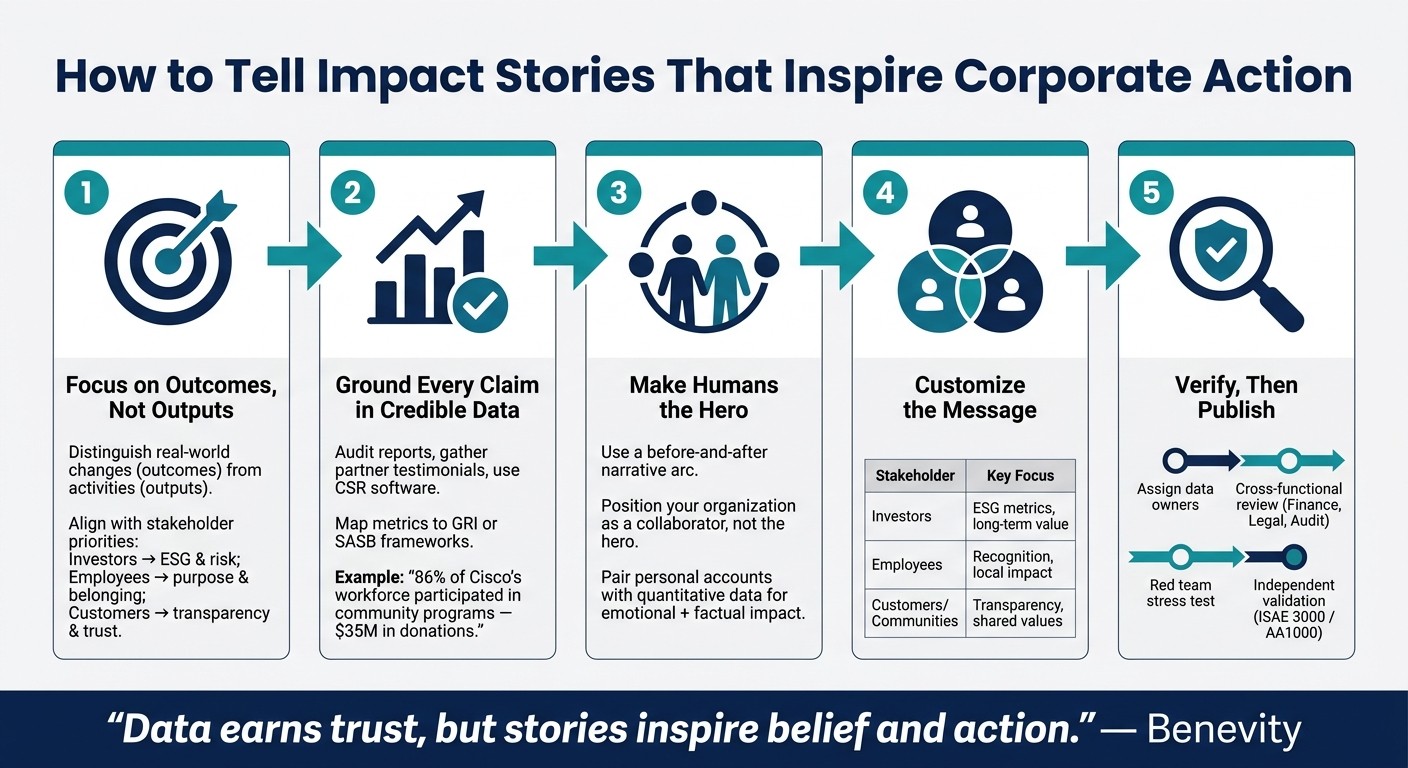
How to Tell Impact Stories That Inspire Corporate Action
What Makes an Impact Story Work
What Impact Storytelling Means in a Corporate Context
Impact storytelling in a corporate environment goes beyond promoting your brand. It's about translating your organization's efforts into stories that resonate with stakeholders - stories they can understand, feel, and act upon.
As Benevity explains:
"CSR storytelling is the practice of transforming data and metrics into authentic, human-centered stories that demonstrate both purpose and measurable impact." [1]
This approach shifts the focus from simple compliance reporting to showcasing how your values create tangible benefits, whether that's through a cleaner supply chain, stronger communities, or a more inclusive workplace. The next step is understanding the essential ingredients that make these stories effective.
Core Elements of a Strong Impact Story
At its core, a strong impact story needs three elements: a clear narrative arc, a human-centered focus, and measurable outcomes. The narrative arc should be straightforward - outline the problem, describe the actions taken, and highlight the results. The human element is equally critical, as Lori Young, Offer Strategist, notes:
"People connect with people. Featuring real individuals or groups who have benefited from your efforts brings a human element to your story." [2]
For instance, Airbnb’s 2021 social impact report showcased how women hosts have collectively earned over $70 billion since 2010, accounting for more than half of all host revenue [4]. This combination of real-world data and personal stories underscores authenticity while making the impact tangible. By focusing on these fundamentals, you can effectively bridge the gap between metrics and narrative, creating stories that feel both credible and meaningful.
How Metrics, Narrative, and Proof Work Together
Metrics and storytelling complement each other beautifully - data provides the foundation of trust, while stories give it heart and inspire action. Benevity captures this balance perfectly:
"Data earns trust, but stories inspire belief and action." [1]
Adidas offers a great example of this in practice. By merging its ESG and financial reports into an interactive online platform, the company allowed stakeholders to explore financial results alongside social impact metrics [4]. This integration presents a cohesive picture of both business success and social contributions.
The shift in impact storytelling lies in focusing on outcomes rather than just outputs. Instead of merely listing activities, emphasize the meaningful changes your initiatives have achieved. Stakeholders care most about outcomes because they provide clear evidence that your efforts are driving real, measurable progress.
Impact Video Storytelling for CSR Teams: Avoid These Common Mistakes
Start With Business and Sustainability Outcomes
Creating effective impact stories begins by aligning business achievements with sustainability goals. This approach sets the foundation for meaningful narratives. Before diving into storytelling, it’s essential to define clear, outcome-based results. Without this clarity, stories can feel vague and disconnected from your company’s actual efforts.
How to Identify the Right Outcomes
One common pitfall is mistaking outputs for outcomes. Outputs represent activities - like hours volunteered, dollars donated, or trees planted. Outcomes, on the other hand, reflect the real-world changes brought about by these actions. Stakeholders care far more about the latter.
Sara Ansell, Director of Analytics and Innovation at True Impact, emphasizes the importance of this distinction:
"Impact measurement isn't just a way to put numbers behind your CSR efforts - it's a powerful tool for crafting stories that showcase the value corporate philanthropy creates." [5]
To pinpoint the right outcomes, start by reviewing your current narratives. Do they highlight meaningful change, or are they focused solely on actions? Work closely with partners to gather credible data and testimonials that showcase tangible shifts in communities or the environment. [1]
It’s also helpful to consider outcomes through the lens of your stakeholder groups. For example:
Investors are interested in ESG performance and risk mitigation.
Employees value stories that reflect shared purpose and visible local impacts.
Customers seek transparency and evidence that their loyalty supports positive change.
By selecting outcomes that resonate with these groups, you can turn raw data into compelling, relatable stories.
Once you’ve defined these outcomes, the next step is to connect them directly to your broader corporate strategy.
Connecting Outcomes to Corporate Goals
Identifying the right outcomes is only part of the equation. To ensure your impact story resonates, it must align with your company’s overarching goals. This is where storytelling becomes more than just a communication tool - it becomes a leadership strategy.
"CSR storytelling is a strategic leadership tool - not just a communications tactic." - Benevity [1]
To achieve this alignment, link your outcomes to specific corporate objectives. Use real-life examples to demonstrate how particular actions have driven measurable change. This dual focus - on outcomes and strategy - builds trust and credibility with stakeholders.
The key is strategic selection. Highlight outcomes that reflect your company’s stated goals and commitments. For instance, a company prioritizing environmental sustainability should focus on carbon reduction outcomes rather than unrelated social initiatives. Jim Galligan, Director of Strategy at JK Design, underscores this point:
"If your sustainability story could come from anyone, it won't resonate with anyone." [6]
A generic narrative risks losing impact and may even invite skepticism. Your outcomes should feel uniquely tied to your organization’s identity and direction, ensuring they stand out and truly resonate with your audience.
Build Your Story on Verified Data
Once your outcomes align with corporate goals, ensure every claim is backed by validated data. A narrative, no matter how well-crafted, loses its power the moment stakeholders question its accuracy. Verified data doesn’t just protect credibility - it transforms your story into something stakeholders can trust. With a solid data foundation, you can shape metrics into a narrative that resonates.
How to Gather Credible Inputs
Start by auditing existing reports and partner records to identify reliable data and any gaps. Collaborate with nonprofit partners and community organizations to gather testimonials and outcome data that provide deeper context to your numbers. These inputs should directly reflect the outcomes you’ve prioritized.
A survey conducted by the Association of Corporate Citizenship Practitioners (ACCP) highlights that 76% of corporate social impact practitioners from global and national companies request impact measurement data from the C-suite [8]. This statistic underscores a growing expectation for documented proof at all organizational levels - not just polished messaging.
To streamline the process, consider using CSR software and social impact reporting tools. These platforms allow you to pull clean, structured data from multiple sources, including HRIS integrations, so you’re not solely dependent on annual reports. By preparing credible inputs early, you ensure your narrative is trustworthy from the outset.
Choosing the Right Metrics
With credible inputs in hand, focus on selecting metrics that will resonate with your stakeholders. Choose metrics that are specific, meaningful, and tied to clearly defined outcomes. For example, a 20% reduction in energy consumption is a strong data point, but it becomes more impactful when paired with a story about the transition to renewable energy sources that made it possible [3].
David Solo, CEO of Special Olympics Northern California, emphasizes the importance of balancing data with storytelling:
"We use quantitative data a lot in presentations, but ultimately, what does it mean? We need to go beyond the numbers. I think when you couple qualitative stories with your quantitative metrics you begin to see the whole picture." [10]
Tailor metrics to your audience. Regulators and institutional investors may value technical depth and detailed disclosures, while employees and customers often prefer accessible formats like infographics, personal stories, and before-and-after comparisons. Including metrics that acknowledge challenges - such as difficulties scaling a supply chain initiative - can also enhance credibility by showing transparency rather than just highlighting successes [3].
Aligning With Reporting Standards
After identifying your metrics, map them to established reporting frameworks like GRI or SASB. These frameworks add an extra layer of credibility that internal data alone can’t provide. They also offer a structure that stakeholders such as investors, regulators, and ESG-focused partners are already familiar with and trust.
Cisco’s FY24 Purpose Report offers a practical example of this approach. The company reported that 86% of its global workforce participated in community impact programs, contributing $35 million in donations and matching gifts. Beyond these numbers, Cisco included case studies of employees leading pro bono initiatives, turning verified data into relatable evidence of their impact [9].
Using recognized frameworks not only bolsters credibility but also mitigates the risk of data bias, such as cherry-picking favorable figures. By documenting your methodology and aligning metrics with trusted standards, your narrative becomes both compelling and defensible, ensuring it withstands scrutiny and builds trust with your audience.
Frame Your Story Around People and Change
Once you've established measurable outcomes backed by verified data, it's time to shift the focus to the human side of the story. While data builds trust, a compelling narrative shows how change unfolded and who experienced it. This step connects the numbers to the real-world journeys behind them.
How to Build a Before-and-After Arc
A strong impact story thrives on a clear narrative arc: a beginning that outlines the problem, a middle that highlights the struggle, and an ending that showcases the transformation. The "before" stage should spotlight the systemic challenge - whether it's hiring discrimination, environmental harm, or limited educational opportunities.
Conflict is the heartbeat of any engaging story. Without it, your narrative risks feeling flat, like a generic announcement. By framing the systemic challenge as the obstacle your stakeholders and partners collectively faced, you create the emotional depth that turns passive readers into invested participants.
"Impact stories should show complex characters engaging in collective action against an unjust system." - Annie Neimand, PhD [11]
Specific details are what make stories resonate. As Jacqueline Woodson explains:
"The more specific we are, the more universal something can become. Life is in the details. If you generalize, it doesn't resonate." [11]
Describe the community, the individuals, and the visible changes. It's these vivid details that stick with your audience and make your story memorable.
Putting People at the Center of the Story
Once you've laid out the narrative arc, shift the spotlight to the people driving the change. Resist the temptation to cast your organization as the hero. Doing so can make the story feel self-congratulatory and less authentic. Instead, position your organization as a collaborator - a partner in a larger movement involving employees, nonprofits, and community members working toward a common goal [11].
Human-centered stories achieve what data alone cannot: they make outcomes emotionally significant to your audience. Highlight the individuals who lived through the change - employees spearheading initiatives, community members experiencing a shift in their lives, or partners scaling the effort. Pair their personal accounts with your quantitative data to illustrate both the scope of the impact and the human experience behind it [12]. This combination transforms a standard compliance report into something people want to read and share.
One important note: treat the individuals whose stories you tell as collaborators, not subjects. Give them control over their narratives, ensure their comfort with how their stories are used, and, when appropriate, compensate them for their time [11]. Ethical storytelling not only builds trust but also results in more genuine and credible content.
Tailor Your Story for Different Stakeholder Groups
Once you've crafted a data-driven, people-focused narrative, the next step is adapting it to resonate with different audiences.
A single impact story won't connect with everyone. While the core message - your company's mission and achievements - should remain consistent, the way you frame it must align with each audience's priorities. As Bark Media wisely notes:
"If we don't frame our communications through the lens of 'why you should care' for the other person, it becomes much harder to capture and keep someone's attention." [13]
Picture a Venn diagram: one circle represents your organization's values, and the other reflects your stakeholders' specific concerns. The most compelling narratives emerge where these two circles overlap.
Presenting Impact Stories to Internal Leaders
When speaking to executives or the C-suite, focus on the business case. These leaders are interested in how social initiatives contribute to reducing risks, safeguarding the company's reputation, and driving strategic goals. Start with a powerful insight tied to measurable business outcomes - like reduced employee turnover, improved brand trust, or minimized regulatory risks. Follow up by explaining the broader implications of the data and conclude with actionable recommendations.
Recognizing individual employees by name can make a big difference when sharing stories internally. Highlighting their contributions fosters a sense of community and shows that leadership values their efforts.
While internal leaders prioritize business outcomes, external stakeholders need a transparent, relatable approach.
Reaching External Stakeholders
External audiences - such as investors, partners, and community members - value openness. Investors are looking for ESG performance metrics, evidence of long-term value creation, and alignment between your social initiatives and financial goals. Community members, on the other hand, want to see tangible benefits for their neighborhoods or causes, not just polished marketing.
Stakeholder Group | Primary Motivation | Recommended Narrative Focus |
|---|---|---|
Investors | ESG performance, resilience | Long-term value, data-backed proof, alignment [1] |
Employees | Purpose & belonging | Personal contributions, peer recognition, local impact [1][7] |
Customers/Communities | Trust & authenticity |
For community-focused audiences, stories sourced directly from nonprofit partners can be especially impactful. These firsthand accounts carry a level of credibility that internal communications often can't match [7]. Across all external messaging, it's essential to provide a complete picture - acknowledging challenges and lessons learned alongside successes. Modern audiences are increasingly wary of narratives that only highlight victories [1].
Review Your Story for Accuracy and Trust
Ensuring the accuracy of your impact story is essential for building trust. A well-verified narrative, grounded in reliable data and open communication, strengthens the credibility of your sustainability efforts. Establishing a thorough review process helps eliminate errors, address inconsistencies, and support your claims with confidence.
How to Verify Claims and Data
Start by assigning a responsible data owner for each metric. This person should verify the data at least eight weeks before publication. Following this, conduct a cross-functional review where:
Finance checks the accuracy of quantitative claims.
Legal ensures forward-looking statements comply with regulations.
Internal audit evaluates the methodology behind your data.
For added credibility, consider seeking independent validation. Standards like ISAE 3000 or AA1000 align with investor expectations and meet regulatory benchmarks like the CSRD [14]. This external review demonstrates that your data isn’t just self-reported but has been rigorously vetted.
Another useful approach is a "red team review." Assign a small, critical group to act as skeptical analysts, identifying contradictions and testing the strength of your narrative [14]. Once the data is verified, focus on communicating your results clearly and honestly.
Replace ambiguous statements with precise data. For instance, instead of saying, "we made progress on emissions", state, "we reduced Scope 1 emissions by 12% compared to a 2019 baseline" [14]. If certain data - such as Scope 3 emissions - is unavailable, acknowledge the gap and provide a plan to address it.
Promoting Transparency and Accountability
Transparency goes beyond showcasing achievements; it also involves being upfront about challenges. As Benevity aptly states:
"Authenticity builds trust and transparency is what sustains it." [9]
This means reporting shortcomings alongside successes. For example, audit for gaps between outputs and outcomes. Stakeholders are more interested in knowing what tangible changes occurred rather than just the activities undertaken. Provide qualitative context to explain the reasons behind the results [3][9].
Verification Step | Who's Responsible | Timing |
|---|---|---|
Assign data owners per metric | Department leads | 8+ weeks before publication |
Internal cross-functional review | Finance, Legal, Internal Audit | 4–6 weeks before publication |
Red team stress test | Designated review group | 2–3 weeks before publication |
Independent validation | External auditor | Before final sign-off |
Conclusion: How to Tell Stories That Drive Action
The most impactful stories seamlessly connect verified data with the human element of change. A recurring theme throughout this guide is that measurable outcomes, transparent reporting, and alignment with stakeholders set a memorable story apart from one that fades into obscurity.
It’s outcomes - not just outputs - that create meaningful impact. Today’s stakeholders, whether they are investors, employees, customers, or communities, are digging deeper, demanding clearer explanations, and expecting accountability. As Jim Galligan, Director of Strategy at JK Design, aptly states:
"The gap between 'what we say' and 'what we've done' is where skepticism grows." [6]
Take Cisco’s FY24 Purpose Report as an example: by blending compelling metrics with personal narratives, they’ve demonstrated how to transform raw data into a story that resonates on both an emotional and intellectual level.
To craft an impact story that truly inspires action, it’s essential to build on a solid foundation. Start by identifying the right outcomes to highlight. Ground your narrative in verified data, center it around real people, and tailor your message to the specific needs of your audience. Every claim must be rigorously reviewed to ensure accuracy. Skipping any of these steps risks undermining the credibility of your story. When measurable outcomes, genuine narratives, and stakeholder priorities align, the result is a story that sparks meaningful engagement.
Finally, every impactful story should end with a purpose. Conclude with a clear call to action - whether it’s an invitation to participate, contribute, or engage further. This final step transforms a story from a passive account into a catalyst for change.
FAQs
How can I prove our impact story is real?
To make your impact story resonate, blend clear data with heartfelt, personal narratives. Highlight specific metrics - such as hours spent volunteering or measurable environmental improvements - to showcase tangible progress. Complement these figures with real-life stories of individuals or communities affected by your efforts. This combination of hard numbers and emotional storytelling not only strengthens credibility but also fosters a deeper connection with your audience.
What outcomes should we measure (not just outputs)?
Organizations should prioritize tracking outcomes that demonstrate real progress toward social or environmental objectives, rather than merely counting activities or outputs. For instance, instead of focusing solely on the number of programs implemented, measure how those efforts have improved community well-being, enhanced environmental quality, or positively impacted stakeholders' lives. Metrics such as reduced energy consumption can be paired with compelling narratives about job creation or lowered dependency on fossil fuels. These concrete and relatable results help foster trust and motivate stakeholders to take meaningful action.
How do I tailor one story for investors, employees, and customers?
To create a story that resonates with investors, employees, and customers, focus on what matters most to each group. For investors, emphasize measurable results and efforts in sustainability to showcase long-term value. For employees, share genuine, purpose-driven stories that foster trust and inspire engagement. For customers, highlight how your products or services align with their values and contribute to positive societal change. By addressing the distinct priorities of each audience, you can build stronger connections and inspire meaningful action.
Related Blog Posts
Latest Articles
©2025

Narrative Change and Power Building: The Missing Half of Advocacy
Narrative change is the process of disrupting dominant narratives that normalize inequity and advancing new narratives from historically marginalized communities.

Funding Resilience Without Federal Grants
BRIC is unreliable and FEMA is shrinking. Here's how cities fund climate resilience with dedicated revenue, blended finance, and a coordinating authority.

The ESG Blind Spot: How AI Is Finding Risks in Companies Nobody Else Is Watching
Norway's sovereign wealth fund uses AI to screen 7,200 portfolio companies for forced labor and corruption within 24 hours. The real story is the emerging-market coverage gap that traditional ESG data vendors miss — and what it means for any company with a global supply chain.
Narrative Change and Power Building: The Missing Half of Advocacy
Narrative change is the process of disrupting dominant narratives that normalize inequity and advancing new narratives from historically marginalized communities.
Funding Resilience Without Federal Grants
BRIC is unreliable and FEMA is shrinking. Here's how cities fund climate resilience with dedicated revenue, blended finance, and a coordinating authority.
The ESG Blind Spot: How AI Is Finding Risks in Companies Nobody Else Is Watching
Norway's sovereign wealth fund uses AI to screen 7,200 portfolio companies for forced labor and corruption within 24 hours. The real story is the emerging-market coverage gap that traditional ESG data vendors miss — and what it means for any company with a global supply chain.
FAQ
01
What does it really mean to “redefine profit”?
02
What makes Council Fire different?
03
Who does Council Fire work with?
04
What does working with Council Fire actually look like?
05
How does Council Fire help organizations turn big goals into action?
06
How does Council Fire define and measure success?
May 19, 2026
How to Tell Impact Stories That Inspire Action for Corporations
ESG Strategy
In This Article
Combine verified data with human-centered narratives to show measurable outcomes and inspire stakeholders to act.
How to Tell Impact Stories That Inspire Action for Corporations
Corporations often struggle to communicate the true impact of their sustainability efforts. While data and metrics are essential, they rarely inspire action on their own. The solution lies in combining verified data with human-centered stories that connect emotionally and demonstrate measurable outcomes. This approach builds trust, aligns with corporate goals, and resonates with diverse stakeholders like investors, employees, and customers.
Key Takeaways:
Focus on Outcomes: Highlight real-world changes, not just activities or outputs.
Blend Data and Stories: Use statistics to build trust and personal narratives to create emotional connections.
Align with Goals: Ensure impact stories reflect corporate priorities and values.
Tailor for Audiences: Adjust the message for different stakeholders (e.g., investors, employees, customers).
Verify and Be Transparent: Back claims with validated data and acknowledge challenges for credibility.
How to Tell Impact Stories That Inspire Corporate Action
What Makes an Impact Story Work
What Impact Storytelling Means in a Corporate Context
Impact storytelling in a corporate environment goes beyond promoting your brand. It's about translating your organization's efforts into stories that resonate with stakeholders - stories they can understand, feel, and act upon.
As Benevity explains:
"CSR storytelling is the practice of transforming data and metrics into authentic, human-centered stories that demonstrate both purpose and measurable impact." [1]
This approach shifts the focus from simple compliance reporting to showcasing how your values create tangible benefits, whether that's through a cleaner supply chain, stronger communities, or a more inclusive workplace. The next step is understanding the essential ingredients that make these stories effective.
Core Elements of a Strong Impact Story
At its core, a strong impact story needs three elements: a clear narrative arc, a human-centered focus, and measurable outcomes. The narrative arc should be straightforward - outline the problem, describe the actions taken, and highlight the results. The human element is equally critical, as Lori Young, Offer Strategist, notes:
"People connect with people. Featuring real individuals or groups who have benefited from your efforts brings a human element to your story." [2]
For instance, Airbnb’s 2021 social impact report showcased how women hosts have collectively earned over $70 billion since 2010, accounting for more than half of all host revenue [4]. This combination of real-world data and personal stories underscores authenticity while making the impact tangible. By focusing on these fundamentals, you can effectively bridge the gap between metrics and narrative, creating stories that feel both credible and meaningful.
How Metrics, Narrative, and Proof Work Together
Metrics and storytelling complement each other beautifully - data provides the foundation of trust, while stories give it heart and inspire action. Benevity captures this balance perfectly:
"Data earns trust, but stories inspire belief and action." [1]
Adidas offers a great example of this in practice. By merging its ESG and financial reports into an interactive online platform, the company allowed stakeholders to explore financial results alongside social impact metrics [4]. This integration presents a cohesive picture of both business success and social contributions.
The shift in impact storytelling lies in focusing on outcomes rather than just outputs. Instead of merely listing activities, emphasize the meaningful changes your initiatives have achieved. Stakeholders care most about outcomes because they provide clear evidence that your efforts are driving real, measurable progress.
Impact Video Storytelling for CSR Teams: Avoid These Common Mistakes
Start With Business and Sustainability Outcomes
Creating effective impact stories begins by aligning business achievements with sustainability goals. This approach sets the foundation for meaningful narratives. Before diving into storytelling, it’s essential to define clear, outcome-based results. Without this clarity, stories can feel vague and disconnected from your company’s actual efforts.
How to Identify the Right Outcomes
One common pitfall is mistaking outputs for outcomes. Outputs represent activities - like hours volunteered, dollars donated, or trees planted. Outcomes, on the other hand, reflect the real-world changes brought about by these actions. Stakeholders care far more about the latter.
Sara Ansell, Director of Analytics and Innovation at True Impact, emphasizes the importance of this distinction:
"Impact measurement isn't just a way to put numbers behind your CSR efforts - it's a powerful tool for crafting stories that showcase the value corporate philanthropy creates." [5]
To pinpoint the right outcomes, start by reviewing your current narratives. Do they highlight meaningful change, or are they focused solely on actions? Work closely with partners to gather credible data and testimonials that showcase tangible shifts in communities or the environment. [1]
It’s also helpful to consider outcomes through the lens of your stakeholder groups. For example:
Investors are interested in ESG performance and risk mitigation.
Employees value stories that reflect shared purpose and visible local impacts.
Customers seek transparency and evidence that their loyalty supports positive change.
By selecting outcomes that resonate with these groups, you can turn raw data into compelling, relatable stories.
Once you’ve defined these outcomes, the next step is to connect them directly to your broader corporate strategy.
Connecting Outcomes to Corporate Goals
Identifying the right outcomes is only part of the equation. To ensure your impact story resonates, it must align with your company’s overarching goals. This is where storytelling becomes more than just a communication tool - it becomes a leadership strategy.
"CSR storytelling is a strategic leadership tool - not just a communications tactic." - Benevity [1]
To achieve this alignment, link your outcomes to specific corporate objectives. Use real-life examples to demonstrate how particular actions have driven measurable change. This dual focus - on outcomes and strategy - builds trust and credibility with stakeholders.
The key is strategic selection. Highlight outcomes that reflect your company’s stated goals and commitments. For instance, a company prioritizing environmental sustainability should focus on carbon reduction outcomes rather than unrelated social initiatives. Jim Galligan, Director of Strategy at JK Design, underscores this point:
"If your sustainability story could come from anyone, it won't resonate with anyone." [6]
A generic narrative risks losing impact and may even invite skepticism. Your outcomes should feel uniquely tied to your organization’s identity and direction, ensuring they stand out and truly resonate with your audience.
Build Your Story on Verified Data
Once your outcomes align with corporate goals, ensure every claim is backed by validated data. A narrative, no matter how well-crafted, loses its power the moment stakeholders question its accuracy. Verified data doesn’t just protect credibility - it transforms your story into something stakeholders can trust. With a solid data foundation, you can shape metrics into a narrative that resonates.
How to Gather Credible Inputs
Start by auditing existing reports and partner records to identify reliable data and any gaps. Collaborate with nonprofit partners and community organizations to gather testimonials and outcome data that provide deeper context to your numbers. These inputs should directly reflect the outcomes you’ve prioritized.
A survey conducted by the Association of Corporate Citizenship Practitioners (ACCP) highlights that 76% of corporate social impact practitioners from global and national companies request impact measurement data from the C-suite [8]. This statistic underscores a growing expectation for documented proof at all organizational levels - not just polished messaging.
To streamline the process, consider using CSR software and social impact reporting tools. These platforms allow you to pull clean, structured data from multiple sources, including HRIS integrations, so you’re not solely dependent on annual reports. By preparing credible inputs early, you ensure your narrative is trustworthy from the outset.
Choosing the Right Metrics
With credible inputs in hand, focus on selecting metrics that will resonate with your stakeholders. Choose metrics that are specific, meaningful, and tied to clearly defined outcomes. For example, a 20% reduction in energy consumption is a strong data point, but it becomes more impactful when paired with a story about the transition to renewable energy sources that made it possible [3].
David Solo, CEO of Special Olympics Northern California, emphasizes the importance of balancing data with storytelling:
"We use quantitative data a lot in presentations, but ultimately, what does it mean? We need to go beyond the numbers. I think when you couple qualitative stories with your quantitative metrics you begin to see the whole picture." [10]
Tailor metrics to your audience. Regulators and institutional investors may value technical depth and detailed disclosures, while employees and customers often prefer accessible formats like infographics, personal stories, and before-and-after comparisons. Including metrics that acknowledge challenges - such as difficulties scaling a supply chain initiative - can also enhance credibility by showing transparency rather than just highlighting successes [3].
Aligning With Reporting Standards
After identifying your metrics, map them to established reporting frameworks like GRI or SASB. These frameworks add an extra layer of credibility that internal data alone can’t provide. They also offer a structure that stakeholders such as investors, regulators, and ESG-focused partners are already familiar with and trust.
Cisco’s FY24 Purpose Report offers a practical example of this approach. The company reported that 86% of its global workforce participated in community impact programs, contributing $35 million in donations and matching gifts. Beyond these numbers, Cisco included case studies of employees leading pro bono initiatives, turning verified data into relatable evidence of their impact [9].
Using recognized frameworks not only bolsters credibility but also mitigates the risk of data bias, such as cherry-picking favorable figures. By documenting your methodology and aligning metrics with trusted standards, your narrative becomes both compelling and defensible, ensuring it withstands scrutiny and builds trust with your audience.
Frame Your Story Around People and Change
Once you've established measurable outcomes backed by verified data, it's time to shift the focus to the human side of the story. While data builds trust, a compelling narrative shows how change unfolded and who experienced it. This step connects the numbers to the real-world journeys behind them.
How to Build a Before-and-After Arc
A strong impact story thrives on a clear narrative arc: a beginning that outlines the problem, a middle that highlights the struggle, and an ending that showcases the transformation. The "before" stage should spotlight the systemic challenge - whether it's hiring discrimination, environmental harm, or limited educational opportunities.
Conflict is the heartbeat of any engaging story. Without it, your narrative risks feeling flat, like a generic announcement. By framing the systemic challenge as the obstacle your stakeholders and partners collectively faced, you create the emotional depth that turns passive readers into invested participants.
"Impact stories should show complex characters engaging in collective action against an unjust system." - Annie Neimand, PhD [11]
Specific details are what make stories resonate. As Jacqueline Woodson explains:
"The more specific we are, the more universal something can become. Life is in the details. If you generalize, it doesn't resonate." [11]
Describe the community, the individuals, and the visible changes. It's these vivid details that stick with your audience and make your story memorable.
Putting People at the Center of the Story
Once you've laid out the narrative arc, shift the spotlight to the people driving the change. Resist the temptation to cast your organization as the hero. Doing so can make the story feel self-congratulatory and less authentic. Instead, position your organization as a collaborator - a partner in a larger movement involving employees, nonprofits, and community members working toward a common goal [11].
Human-centered stories achieve what data alone cannot: they make outcomes emotionally significant to your audience. Highlight the individuals who lived through the change - employees spearheading initiatives, community members experiencing a shift in their lives, or partners scaling the effort. Pair their personal accounts with your quantitative data to illustrate both the scope of the impact and the human experience behind it [12]. This combination transforms a standard compliance report into something people want to read and share.
One important note: treat the individuals whose stories you tell as collaborators, not subjects. Give them control over their narratives, ensure their comfort with how their stories are used, and, when appropriate, compensate them for their time [11]. Ethical storytelling not only builds trust but also results in more genuine and credible content.
Tailor Your Story for Different Stakeholder Groups
Once you've crafted a data-driven, people-focused narrative, the next step is adapting it to resonate with different audiences.
A single impact story won't connect with everyone. While the core message - your company's mission and achievements - should remain consistent, the way you frame it must align with each audience's priorities. As Bark Media wisely notes:
"If we don't frame our communications through the lens of 'why you should care' for the other person, it becomes much harder to capture and keep someone's attention." [13]
Picture a Venn diagram: one circle represents your organization's values, and the other reflects your stakeholders' specific concerns. The most compelling narratives emerge where these two circles overlap.
Presenting Impact Stories to Internal Leaders
When speaking to executives or the C-suite, focus on the business case. These leaders are interested in how social initiatives contribute to reducing risks, safeguarding the company's reputation, and driving strategic goals. Start with a powerful insight tied to measurable business outcomes - like reduced employee turnover, improved brand trust, or minimized regulatory risks. Follow up by explaining the broader implications of the data and conclude with actionable recommendations.
Recognizing individual employees by name can make a big difference when sharing stories internally. Highlighting their contributions fosters a sense of community and shows that leadership values their efforts.
While internal leaders prioritize business outcomes, external stakeholders need a transparent, relatable approach.
Reaching External Stakeholders
External audiences - such as investors, partners, and community members - value openness. Investors are looking for ESG performance metrics, evidence of long-term value creation, and alignment between your social initiatives and financial goals. Community members, on the other hand, want to see tangible benefits for their neighborhoods or causes, not just polished marketing.
Stakeholder Group | Primary Motivation | Recommended Narrative Focus |
|---|---|---|
Investors | ESG performance, resilience | Long-term value, data-backed proof, alignment [1] |
Employees | Purpose & belonging | Personal contributions, peer recognition, local impact [1][7] |
Customers/Communities | Trust & authenticity |
For community-focused audiences, stories sourced directly from nonprofit partners can be especially impactful. These firsthand accounts carry a level of credibility that internal communications often can't match [7]. Across all external messaging, it's essential to provide a complete picture - acknowledging challenges and lessons learned alongside successes. Modern audiences are increasingly wary of narratives that only highlight victories [1].
Review Your Story for Accuracy and Trust
Ensuring the accuracy of your impact story is essential for building trust. A well-verified narrative, grounded in reliable data and open communication, strengthens the credibility of your sustainability efforts. Establishing a thorough review process helps eliminate errors, address inconsistencies, and support your claims with confidence.
How to Verify Claims and Data
Start by assigning a responsible data owner for each metric. This person should verify the data at least eight weeks before publication. Following this, conduct a cross-functional review where:
Finance checks the accuracy of quantitative claims.
Legal ensures forward-looking statements comply with regulations.
Internal audit evaluates the methodology behind your data.
For added credibility, consider seeking independent validation. Standards like ISAE 3000 or AA1000 align with investor expectations and meet regulatory benchmarks like the CSRD [14]. This external review demonstrates that your data isn’t just self-reported but has been rigorously vetted.
Another useful approach is a "red team review." Assign a small, critical group to act as skeptical analysts, identifying contradictions and testing the strength of your narrative [14]. Once the data is verified, focus on communicating your results clearly and honestly.
Replace ambiguous statements with precise data. For instance, instead of saying, "we made progress on emissions", state, "we reduced Scope 1 emissions by 12% compared to a 2019 baseline" [14]. If certain data - such as Scope 3 emissions - is unavailable, acknowledge the gap and provide a plan to address it.
Promoting Transparency and Accountability
Transparency goes beyond showcasing achievements; it also involves being upfront about challenges. As Benevity aptly states:
"Authenticity builds trust and transparency is what sustains it." [9]
This means reporting shortcomings alongside successes. For example, audit for gaps between outputs and outcomes. Stakeholders are more interested in knowing what tangible changes occurred rather than just the activities undertaken. Provide qualitative context to explain the reasons behind the results [3][9].
Verification Step | Who's Responsible | Timing |
|---|---|---|
Assign data owners per metric | Department leads | 8+ weeks before publication |
Internal cross-functional review | Finance, Legal, Internal Audit | 4–6 weeks before publication |
Red team stress test | Designated review group | 2–3 weeks before publication |
Independent validation | External auditor | Before final sign-off |
Conclusion: How to Tell Stories That Drive Action
The most impactful stories seamlessly connect verified data with the human element of change. A recurring theme throughout this guide is that measurable outcomes, transparent reporting, and alignment with stakeholders set a memorable story apart from one that fades into obscurity.
It’s outcomes - not just outputs - that create meaningful impact. Today’s stakeholders, whether they are investors, employees, customers, or communities, are digging deeper, demanding clearer explanations, and expecting accountability. As Jim Galligan, Director of Strategy at JK Design, aptly states:
"The gap between 'what we say' and 'what we've done' is where skepticism grows." [6]
Take Cisco’s FY24 Purpose Report as an example: by blending compelling metrics with personal narratives, they’ve demonstrated how to transform raw data into a story that resonates on both an emotional and intellectual level.
To craft an impact story that truly inspires action, it’s essential to build on a solid foundation. Start by identifying the right outcomes to highlight. Ground your narrative in verified data, center it around real people, and tailor your message to the specific needs of your audience. Every claim must be rigorously reviewed to ensure accuracy. Skipping any of these steps risks undermining the credibility of your story. When measurable outcomes, genuine narratives, and stakeholder priorities align, the result is a story that sparks meaningful engagement.
Finally, every impactful story should end with a purpose. Conclude with a clear call to action - whether it’s an invitation to participate, contribute, or engage further. This final step transforms a story from a passive account into a catalyst for change.
FAQs
How can I prove our impact story is real?
To make your impact story resonate, blend clear data with heartfelt, personal narratives. Highlight specific metrics - such as hours spent volunteering or measurable environmental improvements - to showcase tangible progress. Complement these figures with real-life stories of individuals or communities affected by your efforts. This combination of hard numbers and emotional storytelling not only strengthens credibility but also fosters a deeper connection with your audience.
What outcomes should we measure (not just outputs)?
Organizations should prioritize tracking outcomes that demonstrate real progress toward social or environmental objectives, rather than merely counting activities or outputs. For instance, instead of focusing solely on the number of programs implemented, measure how those efforts have improved community well-being, enhanced environmental quality, or positively impacted stakeholders' lives. Metrics such as reduced energy consumption can be paired with compelling narratives about job creation or lowered dependency on fossil fuels. These concrete and relatable results help foster trust and motivate stakeholders to take meaningful action.
How do I tailor one story for investors, employees, and customers?
To create a story that resonates with investors, employees, and customers, focus on what matters most to each group. For investors, emphasize measurable results and efforts in sustainability to showcase long-term value. For employees, share genuine, purpose-driven stories that foster trust and inspire engagement. For customers, highlight how your products or services align with their values and contribute to positive societal change. By addressing the distinct priorities of each audience, you can build stronger connections and inspire meaningful action.
Related Blog Posts
Latest Articles
©2025
Narrative Change and Power Building: The Missing Half of Advocacy
Narrative change is the process of disrupting dominant narratives that normalize inequity and advancing new narratives from historically marginalized communities.
Funding Resilience Without Federal Grants
BRIC is unreliable and FEMA is shrinking. Here's how cities fund climate resilience with dedicated revenue, blended finance, and a coordinating authority.
The ESG Blind Spot: How AI Is Finding Risks in Companies Nobody Else Is Watching
Norway's sovereign wealth fund uses AI to screen 7,200 portfolio companies for forced labor and corruption within 24 hours. The real story is the emerging-market coverage gap that traditional ESG data vendors miss — and what it means for any company with a global supply chain.
FAQ
01
What does it really mean to “redefine profit”?
02
What makes Council Fire different?
03
Who does Council Fire work with?
04
What does working with Council Fire actually look like?
05
How does Council Fire help organizations turn big goals into action?
06
How does Council Fire define and measure success?
May 19, 2026
How to Tell Impact Stories That Inspire Action for Corporations
ESG Strategy
In This Article
Combine verified data with human-centered narratives to show measurable outcomes and inspire stakeholders to act.
How to Tell Impact Stories That Inspire Action for Corporations
Corporations often struggle to communicate the true impact of their sustainability efforts. While data and metrics are essential, they rarely inspire action on their own. The solution lies in combining verified data with human-centered stories that connect emotionally and demonstrate measurable outcomes. This approach builds trust, aligns with corporate goals, and resonates with diverse stakeholders like investors, employees, and customers.
Key Takeaways:
Focus on Outcomes: Highlight real-world changes, not just activities or outputs.
Blend Data and Stories: Use statistics to build trust and personal narratives to create emotional connections.
Align with Goals: Ensure impact stories reflect corporate priorities and values.
Tailor for Audiences: Adjust the message for different stakeholders (e.g., investors, employees, customers).
Verify and Be Transparent: Back claims with validated data and acknowledge challenges for credibility.
How to Tell Impact Stories That Inspire Corporate Action
What Makes an Impact Story Work
What Impact Storytelling Means in a Corporate Context
Impact storytelling in a corporate environment goes beyond promoting your brand. It's about translating your organization's efforts into stories that resonate with stakeholders - stories they can understand, feel, and act upon.
As Benevity explains:
"CSR storytelling is the practice of transforming data and metrics into authentic, human-centered stories that demonstrate both purpose and measurable impact." [1]
This approach shifts the focus from simple compliance reporting to showcasing how your values create tangible benefits, whether that's through a cleaner supply chain, stronger communities, or a more inclusive workplace. The next step is understanding the essential ingredients that make these stories effective.
Core Elements of a Strong Impact Story
At its core, a strong impact story needs three elements: a clear narrative arc, a human-centered focus, and measurable outcomes. The narrative arc should be straightforward - outline the problem, describe the actions taken, and highlight the results. The human element is equally critical, as Lori Young, Offer Strategist, notes:
"People connect with people. Featuring real individuals or groups who have benefited from your efforts brings a human element to your story." [2]
For instance, Airbnb’s 2021 social impact report showcased how women hosts have collectively earned over $70 billion since 2010, accounting for more than half of all host revenue [4]. This combination of real-world data and personal stories underscores authenticity while making the impact tangible. By focusing on these fundamentals, you can effectively bridge the gap between metrics and narrative, creating stories that feel both credible and meaningful.
How Metrics, Narrative, and Proof Work Together
Metrics and storytelling complement each other beautifully - data provides the foundation of trust, while stories give it heart and inspire action. Benevity captures this balance perfectly:
"Data earns trust, but stories inspire belief and action." [1]
Adidas offers a great example of this in practice. By merging its ESG and financial reports into an interactive online platform, the company allowed stakeholders to explore financial results alongside social impact metrics [4]. This integration presents a cohesive picture of both business success and social contributions.
The shift in impact storytelling lies in focusing on outcomes rather than just outputs. Instead of merely listing activities, emphasize the meaningful changes your initiatives have achieved. Stakeholders care most about outcomes because they provide clear evidence that your efforts are driving real, measurable progress.
Impact Video Storytelling for CSR Teams: Avoid These Common Mistakes
Start With Business and Sustainability Outcomes
Creating effective impact stories begins by aligning business achievements with sustainability goals. This approach sets the foundation for meaningful narratives. Before diving into storytelling, it’s essential to define clear, outcome-based results. Without this clarity, stories can feel vague and disconnected from your company’s actual efforts.
How to Identify the Right Outcomes
One common pitfall is mistaking outputs for outcomes. Outputs represent activities - like hours volunteered, dollars donated, or trees planted. Outcomes, on the other hand, reflect the real-world changes brought about by these actions. Stakeholders care far more about the latter.
Sara Ansell, Director of Analytics and Innovation at True Impact, emphasizes the importance of this distinction:
"Impact measurement isn't just a way to put numbers behind your CSR efforts - it's a powerful tool for crafting stories that showcase the value corporate philanthropy creates." [5]
To pinpoint the right outcomes, start by reviewing your current narratives. Do they highlight meaningful change, or are they focused solely on actions? Work closely with partners to gather credible data and testimonials that showcase tangible shifts in communities or the environment. [1]
It’s also helpful to consider outcomes through the lens of your stakeholder groups. For example:
Investors are interested in ESG performance and risk mitigation.
Employees value stories that reflect shared purpose and visible local impacts.
Customers seek transparency and evidence that their loyalty supports positive change.
By selecting outcomes that resonate with these groups, you can turn raw data into compelling, relatable stories.
Once you’ve defined these outcomes, the next step is to connect them directly to your broader corporate strategy.
Connecting Outcomes to Corporate Goals
Identifying the right outcomes is only part of the equation. To ensure your impact story resonates, it must align with your company’s overarching goals. This is where storytelling becomes more than just a communication tool - it becomes a leadership strategy.
"CSR storytelling is a strategic leadership tool - not just a communications tactic." - Benevity [1]
To achieve this alignment, link your outcomes to specific corporate objectives. Use real-life examples to demonstrate how particular actions have driven measurable change. This dual focus - on outcomes and strategy - builds trust and credibility with stakeholders.
The key is strategic selection. Highlight outcomes that reflect your company’s stated goals and commitments. For instance, a company prioritizing environmental sustainability should focus on carbon reduction outcomes rather than unrelated social initiatives. Jim Galligan, Director of Strategy at JK Design, underscores this point:
"If your sustainability story could come from anyone, it won't resonate with anyone." [6]
A generic narrative risks losing impact and may even invite skepticism. Your outcomes should feel uniquely tied to your organization’s identity and direction, ensuring they stand out and truly resonate with your audience.
Build Your Story on Verified Data
Once your outcomes align with corporate goals, ensure every claim is backed by validated data. A narrative, no matter how well-crafted, loses its power the moment stakeholders question its accuracy. Verified data doesn’t just protect credibility - it transforms your story into something stakeholders can trust. With a solid data foundation, you can shape metrics into a narrative that resonates.
How to Gather Credible Inputs
Start by auditing existing reports and partner records to identify reliable data and any gaps. Collaborate with nonprofit partners and community organizations to gather testimonials and outcome data that provide deeper context to your numbers. These inputs should directly reflect the outcomes you’ve prioritized.
A survey conducted by the Association of Corporate Citizenship Practitioners (ACCP) highlights that 76% of corporate social impact practitioners from global and national companies request impact measurement data from the C-suite [8]. This statistic underscores a growing expectation for documented proof at all organizational levels - not just polished messaging.
To streamline the process, consider using CSR software and social impact reporting tools. These platforms allow you to pull clean, structured data from multiple sources, including HRIS integrations, so you’re not solely dependent on annual reports. By preparing credible inputs early, you ensure your narrative is trustworthy from the outset.
Choosing the Right Metrics
With credible inputs in hand, focus on selecting metrics that will resonate with your stakeholders. Choose metrics that are specific, meaningful, and tied to clearly defined outcomes. For example, a 20% reduction in energy consumption is a strong data point, but it becomes more impactful when paired with a story about the transition to renewable energy sources that made it possible [3].
David Solo, CEO of Special Olympics Northern California, emphasizes the importance of balancing data with storytelling:
"We use quantitative data a lot in presentations, but ultimately, what does it mean? We need to go beyond the numbers. I think when you couple qualitative stories with your quantitative metrics you begin to see the whole picture." [10]
Tailor metrics to your audience. Regulators and institutional investors may value technical depth and detailed disclosures, while employees and customers often prefer accessible formats like infographics, personal stories, and before-and-after comparisons. Including metrics that acknowledge challenges - such as difficulties scaling a supply chain initiative - can also enhance credibility by showing transparency rather than just highlighting successes [3].
Aligning With Reporting Standards
After identifying your metrics, map them to established reporting frameworks like GRI or SASB. These frameworks add an extra layer of credibility that internal data alone can’t provide. They also offer a structure that stakeholders such as investors, regulators, and ESG-focused partners are already familiar with and trust.
Cisco’s FY24 Purpose Report offers a practical example of this approach. The company reported that 86% of its global workforce participated in community impact programs, contributing $35 million in donations and matching gifts. Beyond these numbers, Cisco included case studies of employees leading pro bono initiatives, turning verified data into relatable evidence of their impact [9].
Using recognized frameworks not only bolsters credibility but also mitigates the risk of data bias, such as cherry-picking favorable figures. By documenting your methodology and aligning metrics with trusted standards, your narrative becomes both compelling and defensible, ensuring it withstands scrutiny and builds trust with your audience.
Frame Your Story Around People and Change
Once you've established measurable outcomes backed by verified data, it's time to shift the focus to the human side of the story. While data builds trust, a compelling narrative shows how change unfolded and who experienced it. This step connects the numbers to the real-world journeys behind them.
How to Build a Before-and-After Arc
A strong impact story thrives on a clear narrative arc: a beginning that outlines the problem, a middle that highlights the struggle, and an ending that showcases the transformation. The "before" stage should spotlight the systemic challenge - whether it's hiring discrimination, environmental harm, or limited educational opportunities.
Conflict is the heartbeat of any engaging story. Without it, your narrative risks feeling flat, like a generic announcement. By framing the systemic challenge as the obstacle your stakeholders and partners collectively faced, you create the emotional depth that turns passive readers into invested participants.
"Impact stories should show complex characters engaging in collective action against an unjust system." - Annie Neimand, PhD [11]
Specific details are what make stories resonate. As Jacqueline Woodson explains:
"The more specific we are, the more universal something can become. Life is in the details. If you generalize, it doesn't resonate." [11]
Describe the community, the individuals, and the visible changes. It's these vivid details that stick with your audience and make your story memorable.
Putting People at the Center of the Story
Once you've laid out the narrative arc, shift the spotlight to the people driving the change. Resist the temptation to cast your organization as the hero. Doing so can make the story feel self-congratulatory and less authentic. Instead, position your organization as a collaborator - a partner in a larger movement involving employees, nonprofits, and community members working toward a common goal [11].
Human-centered stories achieve what data alone cannot: they make outcomes emotionally significant to your audience. Highlight the individuals who lived through the change - employees spearheading initiatives, community members experiencing a shift in their lives, or partners scaling the effort. Pair their personal accounts with your quantitative data to illustrate both the scope of the impact and the human experience behind it [12]. This combination transforms a standard compliance report into something people want to read and share.
One important note: treat the individuals whose stories you tell as collaborators, not subjects. Give them control over their narratives, ensure their comfort with how their stories are used, and, when appropriate, compensate them for their time [11]. Ethical storytelling not only builds trust but also results in more genuine and credible content.
Tailor Your Story for Different Stakeholder Groups
Once you've crafted a data-driven, people-focused narrative, the next step is adapting it to resonate with different audiences.
A single impact story won't connect with everyone. While the core message - your company's mission and achievements - should remain consistent, the way you frame it must align with each audience's priorities. As Bark Media wisely notes:
"If we don't frame our communications through the lens of 'why you should care' for the other person, it becomes much harder to capture and keep someone's attention." [13]
Picture a Venn diagram: one circle represents your organization's values, and the other reflects your stakeholders' specific concerns. The most compelling narratives emerge where these two circles overlap.
Presenting Impact Stories to Internal Leaders
When speaking to executives or the C-suite, focus on the business case. These leaders are interested in how social initiatives contribute to reducing risks, safeguarding the company's reputation, and driving strategic goals. Start with a powerful insight tied to measurable business outcomes - like reduced employee turnover, improved brand trust, or minimized regulatory risks. Follow up by explaining the broader implications of the data and conclude with actionable recommendations.
Recognizing individual employees by name can make a big difference when sharing stories internally. Highlighting their contributions fosters a sense of community and shows that leadership values their efforts.
While internal leaders prioritize business outcomes, external stakeholders need a transparent, relatable approach.
Reaching External Stakeholders
External audiences - such as investors, partners, and community members - value openness. Investors are looking for ESG performance metrics, evidence of long-term value creation, and alignment between your social initiatives and financial goals. Community members, on the other hand, want to see tangible benefits for their neighborhoods or causes, not just polished marketing.
Stakeholder Group | Primary Motivation | Recommended Narrative Focus |
|---|---|---|
Investors | ESG performance, resilience | Long-term value, data-backed proof, alignment [1] |
Employees | Purpose & belonging | Personal contributions, peer recognition, local impact [1][7] |
Customers/Communities | Trust & authenticity |
For community-focused audiences, stories sourced directly from nonprofit partners can be especially impactful. These firsthand accounts carry a level of credibility that internal communications often can't match [7]. Across all external messaging, it's essential to provide a complete picture - acknowledging challenges and lessons learned alongside successes. Modern audiences are increasingly wary of narratives that only highlight victories [1].
Review Your Story for Accuracy and Trust
Ensuring the accuracy of your impact story is essential for building trust. A well-verified narrative, grounded in reliable data and open communication, strengthens the credibility of your sustainability efforts. Establishing a thorough review process helps eliminate errors, address inconsistencies, and support your claims with confidence.
How to Verify Claims and Data
Start by assigning a responsible data owner for each metric. This person should verify the data at least eight weeks before publication. Following this, conduct a cross-functional review where:
Finance checks the accuracy of quantitative claims.
Legal ensures forward-looking statements comply with regulations.
Internal audit evaluates the methodology behind your data.
For added credibility, consider seeking independent validation. Standards like ISAE 3000 or AA1000 align with investor expectations and meet regulatory benchmarks like the CSRD [14]. This external review demonstrates that your data isn’t just self-reported but has been rigorously vetted.
Another useful approach is a "red team review." Assign a small, critical group to act as skeptical analysts, identifying contradictions and testing the strength of your narrative [14]. Once the data is verified, focus on communicating your results clearly and honestly.
Replace ambiguous statements with precise data. For instance, instead of saying, "we made progress on emissions", state, "we reduced Scope 1 emissions by 12% compared to a 2019 baseline" [14]. If certain data - such as Scope 3 emissions - is unavailable, acknowledge the gap and provide a plan to address it.
Promoting Transparency and Accountability
Transparency goes beyond showcasing achievements; it also involves being upfront about challenges. As Benevity aptly states:
"Authenticity builds trust and transparency is what sustains it." [9]
This means reporting shortcomings alongside successes. For example, audit for gaps between outputs and outcomes. Stakeholders are more interested in knowing what tangible changes occurred rather than just the activities undertaken. Provide qualitative context to explain the reasons behind the results [3][9].
Verification Step | Who's Responsible | Timing |
|---|---|---|
Assign data owners per metric | Department leads | 8+ weeks before publication |
Internal cross-functional review | Finance, Legal, Internal Audit | 4–6 weeks before publication |
Red team stress test | Designated review group | 2–3 weeks before publication |
Independent validation | External auditor | Before final sign-off |
Conclusion: How to Tell Stories That Drive Action
The most impactful stories seamlessly connect verified data with the human element of change. A recurring theme throughout this guide is that measurable outcomes, transparent reporting, and alignment with stakeholders set a memorable story apart from one that fades into obscurity.
It’s outcomes - not just outputs - that create meaningful impact. Today’s stakeholders, whether they are investors, employees, customers, or communities, are digging deeper, demanding clearer explanations, and expecting accountability. As Jim Galligan, Director of Strategy at JK Design, aptly states:
"The gap between 'what we say' and 'what we've done' is where skepticism grows." [6]
Take Cisco’s FY24 Purpose Report as an example: by blending compelling metrics with personal narratives, they’ve demonstrated how to transform raw data into a story that resonates on both an emotional and intellectual level.
To craft an impact story that truly inspires action, it’s essential to build on a solid foundation. Start by identifying the right outcomes to highlight. Ground your narrative in verified data, center it around real people, and tailor your message to the specific needs of your audience. Every claim must be rigorously reviewed to ensure accuracy. Skipping any of these steps risks undermining the credibility of your story. When measurable outcomes, genuine narratives, and stakeholder priorities align, the result is a story that sparks meaningful engagement.
Finally, every impactful story should end with a purpose. Conclude with a clear call to action - whether it’s an invitation to participate, contribute, or engage further. This final step transforms a story from a passive account into a catalyst for change.
FAQs
How can I prove our impact story is real?
To make your impact story resonate, blend clear data with heartfelt, personal narratives. Highlight specific metrics - such as hours spent volunteering or measurable environmental improvements - to showcase tangible progress. Complement these figures with real-life stories of individuals or communities affected by your efforts. This combination of hard numbers and emotional storytelling not only strengthens credibility but also fosters a deeper connection with your audience.
What outcomes should we measure (not just outputs)?
Organizations should prioritize tracking outcomes that demonstrate real progress toward social or environmental objectives, rather than merely counting activities or outputs. For instance, instead of focusing solely on the number of programs implemented, measure how those efforts have improved community well-being, enhanced environmental quality, or positively impacted stakeholders' lives. Metrics such as reduced energy consumption can be paired with compelling narratives about job creation or lowered dependency on fossil fuels. These concrete and relatable results help foster trust and motivate stakeholders to take meaningful action.
How do I tailor one story for investors, employees, and customers?
To create a story that resonates with investors, employees, and customers, focus on what matters most to each group. For investors, emphasize measurable results and efforts in sustainability to showcase long-term value. For employees, share genuine, purpose-driven stories that foster trust and inspire engagement. For customers, highlight how your products or services align with their values and contribute to positive societal change. By addressing the distinct priorities of each audience, you can build stronger connections and inspire meaningful action.
Related Blog Posts
Latest Articles
©2025
Narrative Change and Power Building: The Missing Half of Advocacy
Narrative change is the process of disrupting dominant narratives that normalize inequity and advancing new narratives from historically marginalized communities.
Funding Resilience Without Federal Grants
BRIC is unreliable and FEMA is shrinking. Here's how cities fund climate resilience with dedicated revenue, blended finance, and a coordinating authority.
The ESG Blind Spot: How AI Is Finding Risks in Companies Nobody Else Is Watching
Norway's sovereign wealth fund uses AI to screen 7,200 portfolio companies for forced labor and corruption within 24 hours. The real story is the emerging-market coverage gap that traditional ESG data vendors miss — and what it means for any company with a global supply chain.
FAQ
What does it really mean to “redefine profit”?
What makes Council Fire different?
Who does Council Fire work with?
What does working with Council Fire actually look like?
How does Council Fire help organizations turn big goals into action?
How does Council Fire define and measure success?