
Sep 5, 2026
Supply Chain Transparency: Supplier Communication Guide
Governance
In This Article
Treat supplier communication as the control point for traceability: clear goals, minimal data, right channels, contracts, and owners.
Supply Chain Transparency: Supplier Communication Guide
Most companies say traceability matters, but only 6% have visibility past Tier 1. To fix that, I’d keep supplier communication focused on six moves: set the disclosure goal, limit scope, ask for specific fields, choose a channel suppliers can use, put data rules in contracts, and assign clear owners for follow-up.
If I wanted this article boiled down to the parts that matter most, it would be this:
Start with the decision you need to make before asking for data.
Separate traceability from transparency so suppliers know what kind of data to send.
Match the request to supplier maturity, from email and spreadsheets to portals and APIs.
Write down the minimum data set, deadlines, fix process, and record rules.
Set a reporting rhythm based on risk, shipment activity, and supplier changes.
Give procurement, legal, quality, IT, and sustainability clear jobs so missing data does not sit in inboxes.
A few facts stand out. 93% of supply chain leaders say traceability is a priority, yet only 24% of global companies have verified visibility past Tier 1. That gap is not just a systems issue. It is often a communication issue: unclear requests, mixed formats, weak follow-up, and no owner.
Here’s the article in one quick view:
Area | What I’d focus on |
|---|---|
Goal | Facility mapping, material traceability, certifications, origin, incident reporting |
Scope | Spend, risk, geography, and rule exposure |
Format | Clear field list, examples, due date, contact, review steps, resubmission rules |
Channel | Email + spreadsheet for smaller suppliers; portals or APIs for more data-heavy programs |
Terms | Mandatory fields, quality checks, retention, audit rights, change notice |
Governance | Named owners, escalation path, sector-specific rules, system compatibility |
The main point is simple: if suppliers do not get a plain request with clear rules and deadlines, the data will come back late, incomplete, or unusable. I’d treat communication as the control point, not an afterthought.
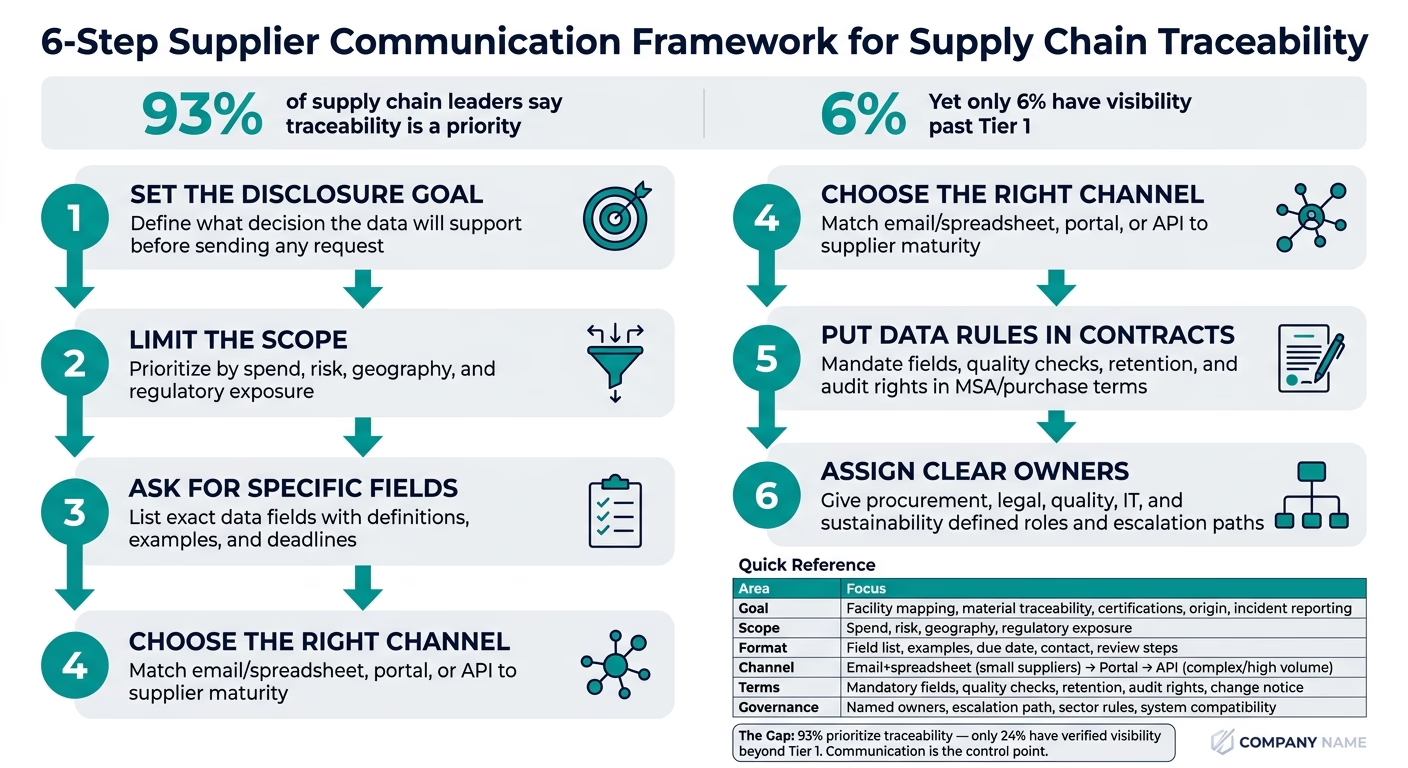
6-Step Supplier Communication Framework for Supply Chain Traceability
Using Digital Traceability to Drive Supply Chain Transparency
Set disclosure goals and scope before requesting supplier data
Start with clarity, then build the request around it. Vague goals lead to vague data. If your team can't say, in plain language, what a supplier disclosure will help you decide, the request isn't ready to send.
Define the disclosure objective
A traceability program usually needs four disclosure outputs, plus incident reporting. Each one supports a different day-to-day need. Facility mapping shows who is in your supply chain and where they operate. That gives you the base layer for risk screening and regulatory compliance. Material-level traceability connects specific inputs to finished products through batch or lot numbers. This helps support sourcing claims and shows how materials move across the chain. Certification visibility records which facilities hold recognized credentials and when those credentials expire. That supports ESG reporting and customer disclosure. Origin disclosure traces raw materials back to the farm, mine, or primary producer. This is often required for U.S. customs rules and forced labor compliance. Incident reporting gives suppliers a way to flag labor rights violations, environmental incidents, or other issues as they occur.
Each objective should tie to a specific supplier request. If the goal is unclear, the form usually gets bloated, and suppliers either guess or send half-usable data.
Goal Type | Typical Supplier Data Required | Key References |
|---|---|---|
Facility-level mapping | Facility name, address, facility type, production role, contact details | GRI General Disclosures, UN Guiding Principles |
Material-level traceability | Material name and ID, batch/lot numbers, volumes, key transformation steps | |
Certification visibility | Certification scheme, certificate number, scope, validity dates, issuing body | |
Origin disclosure | Country of origin, primary production site ID, supply chain route, aggregation level | FSMA Food Traceability Rule, OECD Due Diligence Guidance |
Incident reporting | Incident type, date, location, affected parties, corrective action taken | UN Guiding Principles, OECD Due Diligence Guidance |
Once the objective is fixed, use it to narrow the scope by risk, geography, and regulation.
Decide who and what is in scope
Scope decisions usually come down to four things: spend, risk, geography, and regulatory exposure. Start with Tier 1 facility mapping for all major direct suppliers. That's your baseline. After that, go deeper only where the risk makes it worth the extra work.
In practice, the highest-risk nodes vary by sector. For food commodities, that often means farm-level origin. For electronics and batteries, the focus is usually on smelters, refiners, and component manufacturers. For solar, the pressure point is often polysilicon producers and cell manufacturers.
A simple risk matrix can keep this grounded. Score each supplier relationship by commodity risk, country risk, and past audit findings, then group suppliers into tiers. High-risk relationships should face deeper disclosure requests first. Lower-risk suppliers can begin with facility mapping only. That kind of prioritization matters because only about 24% of global companies have verified visibility beyond Tier 1 suppliers [1].
The narrower the scope, the easier it is to write a request that suppliers can answer without a lot of back-and-forth.
Explain the reason for the request
Suppliers are more likely to respond when the reason is plain. Skip the compliance-heavy language. Tell them why you need the data: to meet legal requirements, respond to customer questions, and cut supply risk. Name the trigger, whether it's regulation, customer demand, or an internal risk review. Then set a phased timeline so suppliers know what is due now and what can wait until later.
Don't ask for perfect data on day one.
Choose message formats and data-sharing channels suppliers can actually use
Once your scope is set, the next step is practical: how will traceability data move from suppliers into a system your team can use? Start with the simplest channel suppliers can handle.
Build a clear supplier request
Every supplier request - whether it’s a letter, onboarding packet, or portal form - should include seven things up front. Suppliers shouldn’t have to dig through attachments or chase your team for missing details.
State the disclosure goal in one sentence.
List the exact fields you need, with definitions and examples, such as "Product ID (SKU), Lot Number, Production Date (MM/DD/YYYY), Facility ID, Certificate Number".
Name the format and channel, such as an Excel template, portal form, CSV, or API.
Set a clear deadline, such as "09/30/2026 (September 30, 2026), 5:00 p.m. ET".
Provide a named contact with email, phone, and office hours.
Explain what happens after submission: automated checks, manual review, a confirmation, or an error report.
Describe the fix process, the resubmission window, and any effect on order placement or qualification status.
Keep the request matched to the supplier. A one-page request works well for small suppliers. A short FAQ fits many mid-sized suppliers. Technical specs should be reserved for suppliers with stronger digital systems.
Once the request is clear, the next job is picking a channel suppliers can use without extra hassle.
Match the channel to supplier maturity
For small and medium-sized suppliers with limited IT support, email plus spreadsheet is often the best place to start. It fits manageable transaction volumes and simpler traceability needs, like baseline lot tracking or single-tier origin data.
A supplier portal starts to make sense when the supplier base gets large enough that email attachments become messy, or when you need monthly or quarterly reporting with an audit trail. Portals bring submissions into one place, enforce required fields, and support role-based access.
Use system-to-system exchange when volumes are high, the data is more complex, or tracking needs to happen close to real time. Fresh-food suppliers, for example, can send traceability data through a GS1 standards-based API (EPCIS), a B2B mobile app, a web app, or file upload, with incoming data normalized into EPCIS format on the back end [3]. That setup offers a useful lesson: let suppliers submit through more than one intake channel, then standardize the data inside your own system.
The table below shows where each channel tends to fit in traceability work.
Channel or Format | Best Use Cases in Traceability | Strengths | Limitations |
|---|---|---|---|
Request letter or onboarding packet | First-time outreach, scope setting, supplier education | Clear purpose; easy to localize; works for all supplier sizes | Not a data collection tool on its own; needs follow-up |
Questionnaire | Supplier due diligence, policy and capability intake | Structured and consistent; easy to compare across suppliers | Can become burdensome; limited for event-level data |
Spreadsheet or CSV by email | Small suppliers, pilot programs, exception handling | Low barrier to entry; familiar; quick to deploy | Error-prone; poor version control; hard to scale |
Supplier portal | Ongoing reporting, large supplier bases, document uploads | Centralized workflow; audit trail; configurable validation | Requires supplier training and internet access |
EDI | High-volume commercial transactions with standardized partners | Efficient; automated; proven at scale | Less flexible for rich traceability context or exceptions |
EPCIS (XML or JSON-LD) | Event-level chain-of-custody, interoperable traceability networks | Standardized events; supports multi-tier visibility | High implementation effort; suppliers need technical capacity |
JSON or JSON-LD | Modern EPCIS implementations, API-based exchange | Lightweight; API-friendly; easier integration | Requires schema governance to avoid fragmentation |
API feeds | Near real-time or scheduled system-to-system exchange | Scalable; automatable; handles complex, evolving data sets | Higher upfront cost; requires stable systems and governance |
Protect sensitive information while improving transparency
Suppliers are more willing to share data when the rules around use and access are plain. Two worries come up again and again: that sensitive pricing or sourcing details might leak, and that sub-tier data could be used to go around them.
Address both head-on. Collect only the data tied to the stated goal, and limit sub-tier supplier identities to authorized users. Use role-based access so only people who need certain data can view it. When suppliers can see that access is controlled, they’re often far more open to sharing sub-tier data. Put those rules in writing next.
Put traceability data terms, contract clauses, and reporting cadence in writing
Once you’ve chosen the channel, spell out exactly what suppliers must share and when. Verbal expectations tend to fall apart the moment a supplier switches sources or a buyer asks for backup records. Written rules turn a loose request into a traceability duty the supplier is expected to meet.
Define the minimum data set and quality rules
Start with the same fields you use in the supplier request, then make those fields mandatory in contracts and reporting templates. At a minimum, the data set should cover five points: who (supplier and facility identity), what (product ID or GTIN), which lot (batch or lot number), how much (quantity and unit of measure), and when and where (event timestamp and location). [9] Use GS1 identifiers such as GTIN, SSCC, GLN, lot code, and serial number where they fit. [8][7]
For higher-risk or regulated categories, those five fields usually aren’t enough on their own. Add shipment date, country of origin, sub-tier supplier name, and references to support documents like certificates, test reports, or chain-of-custody records. Keep secondary certifications, internal IDs, and voluntary sustainability attributes in the optional bucket. If those items are missing, they should not hold up onboarding.
Data quality needs to be defined in plain terms: completeness, consistency, and timeliness. Check completeness and consistency at the time of submission, not weeks later when someone is already chasing a missing file. It also helps to standardize file names, for example: YYYYMMDD_SupplierName_DocumentType_BatchID.
Use contract clauses to reduce ambiguity
Put traceability terms in the MSA or purchase terms so they can be enforced. If the request sits outside the contract, it’s much easier for it to be ignored. The table below shows the clause categories that matter most, along with the language elements and the standards tied to them.
Clause Category | Typical Language Elements | Linked Standards or Guidance |
|---|---|---|
Disclosure Obligations | Supplier shall disclose the name, location, and certification status of all Tier 2 facilities involved in production within the agreed data fields and timeframes. | GS1 Global Traceability Standard; GRI 308 |
Audit & Verification Rights | Buyer reserves the right to inspect facilities, review records, and audit sub-suppliers with reasonable notice; for-cause audits may be unannounced. | |
Record Retention | All traceability records must be retained in retrievable digital form for the required period under applicable law and contract. | EUDR; FSMA 204; OECD Due Diligence Guidance |
Change Notification | Supplier must notify Buyer at least 60 days in advance of any change in sub-tier sourcing, facility location, or material specification that could affect traceability or compliance status. | ISO 9001:2015 Change Management |
Escalation & Remediation | Supplier must notify Buyer within 24–72 hours of identifying missing, inconsistent, or unverifiable traceability data and provide a corrective action plan. | OECD Due Diligence Guidance |
Routine and for-cause audits should not be stopped by notice periods or cost caps when regulators or customers need access. [5][6] The clause should also state what evidence must be on hand, how fast it must be produced, and what happens if the supplier cannot back up the traceability claim.
Set a reporting rhythm suppliers can follow
Use a layered cadence that lines up reporting frequency with risk and change. The point is to get current, usable event-level data, not to pile on admin work for no reason.
Governance Element | Typical Frequency | Key Traceability Metrics or Artifacts |
|---|---|---|
Onboarding Baseline | Once, before first PO release | Full value chain map; supplier self-assessment; facility list with GLNs |
High-Risk Category Updates | Quarterly or semiannually | Updated facility lists; valid ESG certificates (e.g., RSPO, RMI); percent of volume traced to required tier |
Transactional Reporting | Per shipment or batch | Batch/lot IDs; bill of lading; certificate of origin; quantity and unit of measure |
Event-Driven Reporting | Within 24–72 hours of incident or change | Corrective action plan; non-conformance report; sourcing change notification |
Annual Disclosure | Annually, tied to management review | Aggregated traceability coverage rate; open audit findings; exceptions closed; management review outcomes |
A reporting rhythm only works if you track the numbers that show where things are breaking down. Focus on baseline mapping completeness, average response time, on-time change reporting, and the share of records that include supporting evidence. That makes the cadence useful instead of turning it into just another compliance checkbox. [4][2]
Once the cadence is set, assign owners for intake, review, and escalation.
Govern supplier communication through cross-functional ownership and sector protocols
Written requirements don't do much on their own. They need owners. When no one is clearly in charge, supplier traceability requests sit in inboxes, missing data stays missing, and teams lose any clean path for follow-up or escalation.
Assign ownership and escalation paths
Good governance starts with one plain question: who owns what? Each team has a separate job, and the handoffs need to be clear.
Procurement handles day-to-day supplier communication. That includes outreach, requests, contract coordination, and making sure traceability requirements show up in sourcing decisions. Legal writes and reviews contract language covering data sharing, confidentiality, intellectual property, and compliance with rules such as U.S. customs requirements, SEC disclosure duties, and state supply chain transparency laws. Sustainability sets the traceability and ESG goals, turns those goals into data requirements teams can use, and coordinates with outside stakeholders. Quality checks supplier data at the product and process level, flags mismatches, and leads incident reviews. IT designs and connects the digital systems, sets data architecture and interoperability rules, and manages cybersecurity for sensitive supplier information. Operations makes sure traceability steps fit actual material flows, capacity limits, and production timing so they don't throw off fulfillment or lead times.
Escalation should follow a tiered path rather than a scramble. Procurement manages routine follow-ups, including missing fields, late submissions, and small inconsistencies. If a supplier still hasn't responded after three contact attempts within 30 days, the issue should move to a cross-functional review involving sustainability, quality, and legal. More serious risks, such as suspected human rights abuses, illegal deforestation, certification fraud, or errors that could affect public reporting, should move to senior leadership within five business days. At that stage, leadership should receive a standard incident report that sums up the supplier, the issue, the regulatory exposure, the reputational risk, and the recommended next steps.
Adapt communication to sector rules and digital systems
Once ownership is set, supplier communication needs to line up with the rules that shape the data itself. Internal governance has to fit external reporting demands. In practice, sector protocols and digital frameworks determine what suppliers must submit, how often they must submit it, and the format they must use.
EU DPP rules require machine-readable, structured data linked to a persistent unique product identifier, usually through a QR code or barcode, and that data must work with other DPPs. The rules also limit reuse or resale of passport data beyond what is needed for agreed services unless the responsible company has specifically authorized it [10]. GS1 EPCIS and other event-based standards set the rules for how supply chain partners record and share events like shipped, received, and transformed. That event-level structure supports multi-tier traceability.
Governance needs shift by sector and protocol:
Sector or Protocol | Core Supplier Data Requirements | Communication Cadence | Key Governance or Interoperability Features |
|---|---|---|---|
Apparel & Footwear | Facility IDs by tier, material origin, certifications (organic, fair trade), social audit results | Typically semiannual or annual; more frequent for high-risk regions or new product lines | Tier mapping, social compliance oversight, standardized facility identifiers, shared audit platforms |
Food & Agriculture | Farm or fishery origin, batch/lot numbers, processing records, food safety certifications | Event-based or monthly, aligned with harvest cycles | Recall readiness, lot ID integration with ERP and quality systems, regulatory portal compatibility |
Electronics & Critical Minerals | Smelter/refiner IDs, mine-of-origin, conflict-free certifications, environmental data on extraction and processing | Quarterly or aligned with audit cycles | Responsible minerals sourcing, standardized smelter lists, certification databases, secure multi-tier data sharing |
Digital Product Passports (DPP) | Product identifiers, material composition, recyclability, origin, lifecycle emissions | Event-based as products move through manufacturing, distribution, and end-of-life | Role-based access, API compatibility, regulatory DPP schema alignment, data correction procedures |
In sectors covered by digital product passport rules, suppliers must submit structured, machine-readable data tied to a persistent product identifier. That means format decisions and governance decisions are tightly linked. You can't treat the communication plan as separate from the data model.
Those sector rules also depend on one less glamorous point: systems have to talk to each other cleanly. If they don't, even well-written supplier requests fall apart. IT and data governance teams should own system-compatibility decisions so internal tools can connect with outside platforms and databases while still limiting access to sensitive supplier data. IT also owns how supplier data is received, checked, and protected, not just where it sits. That keeps governance tied to the full communication process rather than storage alone.
Conclusion: the core elements of a workable supplier communication model
With ownership and sector rules in place, the model starts to work in day-to-day operations. A workable supplier communication model comes down to six consistent moves:
Define the traceability goal before asking for any data
Ask only for information that will shape a decision
Use formats suppliers can actually complete
Put data-sharing terms into contracts
Set a reporting cadence that fits risk and operating conditions
Back the process with cross-functional governance and a clear escalation path
It's also worth reviewing supplier response rates, data quality scores, and escalation logs on a regular basis. Those signals tend to show repeating weak spots before they turn into bigger system gaps. Organizations that want to move faster, or need help turning traceability commitments into day-to-day governance, can work with Council Fire, a global change agency that designs cross-functional governance models, stakeholder feedback loops, and implementation plans that put sustainability and traceability goals into practice at scale.
FAQs
How do I start a traceability request?
Start by mapping your supply chain past Tier 1 so you can see where risk sits. That gives you a clearer picture of which suppliers matter most and where to act first. From there, bring suppliers in by waves, starting with the top 50 to 100 based on spend or emissions.
For data collection, use existing industry platforms or send standardized questionnaires to key suppliers. Frame the request as a partnership, not a box-checking exercise. Offer help with data calculation, give plain instructions, and set deadlines that are clear and reasonable.
What data should suppliers provide first?
Start with a small core data set. Focus on total energy use and a few basic policy questions first. That keeps the ask manageable and gives suppliers a clear place to begin.
Early on, simple qualitative questions often work best. Ask whether the supplier is measuring emissions, for example, instead of sending a dense request on day one. It’s a lighter lift, and it helps you see who already has the basics in place.
As supplier capacity grows, you can ask for more detailed quantitative data. That may include primary emissions data such as Scope 1 and 2 or product-level carbon footprints. At that stage, it makes sense to focus first on suppliers that account for the largest share of procurement spend or emissions.
How often should suppliers report updates?
Suppliers should share updates on a set schedule as part of a defined operating calendar, not as a one-off project.
Line up supplier data collection, validation, and review with annual public disclosure cycles, such as CSRD reporting. A steady rhythm makes it easier to track performance over time and supports risk management, capital planning, and procurement decisions.
Related Blog Posts
Latest Articles
©2026

Narrative Change and Power Building: The Missing Half of Advocacy
Narrative change is the process of disrupting dominant narratives that normalize inequity and advancing new narratives from historically marginalized communities.

Funding Resilience Without Federal Grants
BRIC is unreliable and FEMA is shrinking. Here's how cities fund climate resilience with dedicated revenue, blended finance, and a coordinating authority.

The ESG Blind Spot: How AI Is Finding Risks in Companies Nobody Else Is Watching
Norway's sovereign wealth fund uses AI to screen 7,200 portfolio companies for forced labor and corruption within 24 hours. The real story is the emerging-market coverage gap that traditional ESG data vendors miss — and what it means for any company with a global supply chain.
Narrative Change and Power Building: The Missing Half of Advocacy
Narrative change is the process of disrupting dominant narratives that normalize inequity and advancing new narratives from historically marginalized communities.
Funding Resilience Without Federal Grants
BRIC is unreliable and FEMA is shrinking. Here's how cities fund climate resilience with dedicated revenue, blended finance, and a coordinating authority.
The ESG Blind Spot: How AI Is Finding Risks in Companies Nobody Else Is Watching
Norway's sovereign wealth fund uses AI to screen 7,200 portfolio companies for forced labor and corruption within 24 hours. The real story is the emerging-market coverage gap that traditional ESG data vendors miss — and what it means for any company with a global supply chain.
FAQ
01
What does it really mean to “redefine profit”?
02
What makes Council Fire different?
03
Who does Council Fire work with?
04
What does working with Council Fire actually look like?
05
How does Council Fire help organizations turn big goals into action?
06
How does Council Fire define and measure success?
07
How does technology fit into Council Fire’s work?
Sep 5, 2026
Supply Chain Transparency: Supplier Communication Guide
Governance
In This Article
Treat supplier communication as the control point for traceability: clear goals, minimal data, right channels, contracts, and owners.
Supply Chain Transparency: Supplier Communication Guide
Most companies say traceability matters, but only 6% have visibility past Tier 1. To fix that, I’d keep supplier communication focused on six moves: set the disclosure goal, limit scope, ask for specific fields, choose a channel suppliers can use, put data rules in contracts, and assign clear owners for follow-up.
If I wanted this article boiled down to the parts that matter most, it would be this:
Start with the decision you need to make before asking for data.
Separate traceability from transparency so suppliers know what kind of data to send.
Match the request to supplier maturity, from email and spreadsheets to portals and APIs.
Write down the minimum data set, deadlines, fix process, and record rules.
Set a reporting rhythm based on risk, shipment activity, and supplier changes.
Give procurement, legal, quality, IT, and sustainability clear jobs so missing data does not sit in inboxes.
A few facts stand out. 93% of supply chain leaders say traceability is a priority, yet only 24% of global companies have verified visibility past Tier 1. That gap is not just a systems issue. It is often a communication issue: unclear requests, mixed formats, weak follow-up, and no owner.
Here’s the article in one quick view:
Area | What I’d focus on |
|---|---|
Goal | Facility mapping, material traceability, certifications, origin, incident reporting |
Scope | Spend, risk, geography, and rule exposure |
Format | Clear field list, examples, due date, contact, review steps, resubmission rules |
Channel | Email + spreadsheet for smaller suppliers; portals or APIs for more data-heavy programs |
Terms | Mandatory fields, quality checks, retention, audit rights, change notice |
Governance | Named owners, escalation path, sector-specific rules, system compatibility |
The main point is simple: if suppliers do not get a plain request with clear rules and deadlines, the data will come back late, incomplete, or unusable. I’d treat communication as the control point, not an afterthought.
6-Step Supplier Communication Framework for Supply Chain Traceability
Using Digital Traceability to Drive Supply Chain Transparency
Set disclosure goals and scope before requesting supplier data
Start with clarity, then build the request around it. Vague goals lead to vague data. If your team can't say, in plain language, what a supplier disclosure will help you decide, the request isn't ready to send.
Define the disclosure objective
A traceability program usually needs four disclosure outputs, plus incident reporting. Each one supports a different day-to-day need. Facility mapping shows who is in your supply chain and where they operate. That gives you the base layer for risk screening and regulatory compliance. Material-level traceability connects specific inputs to finished products through batch or lot numbers. This helps support sourcing claims and shows how materials move across the chain. Certification visibility records which facilities hold recognized credentials and when those credentials expire. That supports ESG reporting and customer disclosure. Origin disclosure traces raw materials back to the farm, mine, or primary producer. This is often required for U.S. customs rules and forced labor compliance. Incident reporting gives suppliers a way to flag labor rights violations, environmental incidents, or other issues as they occur.
Each objective should tie to a specific supplier request. If the goal is unclear, the form usually gets bloated, and suppliers either guess or send half-usable data.
Goal Type | Typical Supplier Data Required | Key References |
|---|---|---|
Facility-level mapping | Facility name, address, facility type, production role, contact details | GRI General Disclosures, UN Guiding Principles |
Material-level traceability | Material name and ID, batch/lot numbers, volumes, key transformation steps | |
Certification visibility | Certification scheme, certificate number, scope, validity dates, issuing body | |
Origin disclosure | Country of origin, primary production site ID, supply chain route, aggregation level | FSMA Food Traceability Rule, OECD Due Diligence Guidance |
Incident reporting | Incident type, date, location, affected parties, corrective action taken | UN Guiding Principles, OECD Due Diligence Guidance |
Once the objective is fixed, use it to narrow the scope by risk, geography, and regulation.
Decide who and what is in scope
Scope decisions usually come down to four things: spend, risk, geography, and regulatory exposure. Start with Tier 1 facility mapping for all major direct suppliers. That's your baseline. After that, go deeper only where the risk makes it worth the extra work.
In practice, the highest-risk nodes vary by sector. For food commodities, that often means farm-level origin. For electronics and batteries, the focus is usually on smelters, refiners, and component manufacturers. For solar, the pressure point is often polysilicon producers and cell manufacturers.
A simple risk matrix can keep this grounded. Score each supplier relationship by commodity risk, country risk, and past audit findings, then group suppliers into tiers. High-risk relationships should face deeper disclosure requests first. Lower-risk suppliers can begin with facility mapping only. That kind of prioritization matters because only about 24% of global companies have verified visibility beyond Tier 1 suppliers [1].
The narrower the scope, the easier it is to write a request that suppliers can answer without a lot of back-and-forth.
Explain the reason for the request
Suppliers are more likely to respond when the reason is plain. Skip the compliance-heavy language. Tell them why you need the data: to meet legal requirements, respond to customer questions, and cut supply risk. Name the trigger, whether it's regulation, customer demand, or an internal risk review. Then set a phased timeline so suppliers know what is due now and what can wait until later.
Don't ask for perfect data on day one.
Choose message formats and data-sharing channels suppliers can actually use
Once your scope is set, the next step is practical: how will traceability data move from suppliers into a system your team can use? Start with the simplest channel suppliers can handle.
Build a clear supplier request
Every supplier request - whether it’s a letter, onboarding packet, or portal form - should include seven things up front. Suppliers shouldn’t have to dig through attachments or chase your team for missing details.
State the disclosure goal in one sentence.
List the exact fields you need, with definitions and examples, such as "Product ID (SKU), Lot Number, Production Date (MM/DD/YYYY), Facility ID, Certificate Number".
Name the format and channel, such as an Excel template, portal form, CSV, or API.
Set a clear deadline, such as "09/30/2026 (September 30, 2026), 5:00 p.m. ET".
Provide a named contact with email, phone, and office hours.
Explain what happens after submission: automated checks, manual review, a confirmation, or an error report.
Describe the fix process, the resubmission window, and any effect on order placement or qualification status.
Keep the request matched to the supplier. A one-page request works well for small suppliers. A short FAQ fits many mid-sized suppliers. Technical specs should be reserved for suppliers with stronger digital systems.
Once the request is clear, the next job is picking a channel suppliers can use without extra hassle.
Match the channel to supplier maturity
For small and medium-sized suppliers with limited IT support, email plus spreadsheet is often the best place to start. It fits manageable transaction volumes and simpler traceability needs, like baseline lot tracking or single-tier origin data.
A supplier portal starts to make sense when the supplier base gets large enough that email attachments become messy, or when you need monthly or quarterly reporting with an audit trail. Portals bring submissions into one place, enforce required fields, and support role-based access.
Use system-to-system exchange when volumes are high, the data is more complex, or tracking needs to happen close to real time. Fresh-food suppliers, for example, can send traceability data through a GS1 standards-based API (EPCIS), a B2B mobile app, a web app, or file upload, with incoming data normalized into EPCIS format on the back end [3]. That setup offers a useful lesson: let suppliers submit through more than one intake channel, then standardize the data inside your own system.
The table below shows where each channel tends to fit in traceability work.
Channel or Format | Best Use Cases in Traceability | Strengths | Limitations |
|---|---|---|---|
Request letter or onboarding packet | First-time outreach, scope setting, supplier education | Clear purpose; easy to localize; works for all supplier sizes | Not a data collection tool on its own; needs follow-up |
Questionnaire | Supplier due diligence, policy and capability intake | Structured and consistent; easy to compare across suppliers | Can become burdensome; limited for event-level data |
Spreadsheet or CSV by email | Small suppliers, pilot programs, exception handling | Low barrier to entry; familiar; quick to deploy | Error-prone; poor version control; hard to scale |
Supplier portal | Ongoing reporting, large supplier bases, document uploads | Centralized workflow; audit trail; configurable validation | Requires supplier training and internet access |
EDI | High-volume commercial transactions with standardized partners | Efficient; automated; proven at scale | Less flexible for rich traceability context or exceptions |
EPCIS (XML or JSON-LD) | Event-level chain-of-custody, interoperable traceability networks | Standardized events; supports multi-tier visibility | High implementation effort; suppliers need technical capacity |
JSON or JSON-LD | Modern EPCIS implementations, API-based exchange | Lightweight; API-friendly; easier integration | Requires schema governance to avoid fragmentation |
API feeds | Near real-time or scheduled system-to-system exchange | Scalable; automatable; handles complex, evolving data sets | Higher upfront cost; requires stable systems and governance |
Protect sensitive information while improving transparency
Suppliers are more willing to share data when the rules around use and access are plain. Two worries come up again and again: that sensitive pricing or sourcing details might leak, and that sub-tier data could be used to go around them.
Address both head-on. Collect only the data tied to the stated goal, and limit sub-tier supplier identities to authorized users. Use role-based access so only people who need certain data can view it. When suppliers can see that access is controlled, they’re often far more open to sharing sub-tier data. Put those rules in writing next.
Put traceability data terms, contract clauses, and reporting cadence in writing
Once you’ve chosen the channel, spell out exactly what suppliers must share and when. Verbal expectations tend to fall apart the moment a supplier switches sources or a buyer asks for backup records. Written rules turn a loose request into a traceability duty the supplier is expected to meet.
Define the minimum data set and quality rules
Start with the same fields you use in the supplier request, then make those fields mandatory in contracts and reporting templates. At a minimum, the data set should cover five points: who (supplier and facility identity), what (product ID or GTIN), which lot (batch or lot number), how much (quantity and unit of measure), and when and where (event timestamp and location). [9] Use GS1 identifiers such as GTIN, SSCC, GLN, lot code, and serial number where they fit. [8][7]
For higher-risk or regulated categories, those five fields usually aren’t enough on their own. Add shipment date, country of origin, sub-tier supplier name, and references to support documents like certificates, test reports, or chain-of-custody records. Keep secondary certifications, internal IDs, and voluntary sustainability attributes in the optional bucket. If those items are missing, they should not hold up onboarding.
Data quality needs to be defined in plain terms: completeness, consistency, and timeliness. Check completeness and consistency at the time of submission, not weeks later when someone is already chasing a missing file. It also helps to standardize file names, for example: YYYYMMDD_SupplierName_DocumentType_BatchID.
Use contract clauses to reduce ambiguity
Put traceability terms in the MSA or purchase terms so they can be enforced. If the request sits outside the contract, it’s much easier for it to be ignored. The table below shows the clause categories that matter most, along with the language elements and the standards tied to them.
Clause Category | Typical Language Elements | Linked Standards or Guidance |
|---|---|---|
Disclosure Obligations | Supplier shall disclose the name, location, and certification status of all Tier 2 facilities involved in production within the agreed data fields and timeframes. | GS1 Global Traceability Standard; GRI 308 |
Audit & Verification Rights | Buyer reserves the right to inspect facilities, review records, and audit sub-suppliers with reasonable notice; for-cause audits may be unannounced. | |
Record Retention | All traceability records must be retained in retrievable digital form for the required period under applicable law and contract. | EUDR; FSMA 204; OECD Due Diligence Guidance |
Change Notification | Supplier must notify Buyer at least 60 days in advance of any change in sub-tier sourcing, facility location, or material specification that could affect traceability or compliance status. | ISO 9001:2015 Change Management |
Escalation & Remediation | Supplier must notify Buyer within 24–72 hours of identifying missing, inconsistent, or unverifiable traceability data and provide a corrective action plan. | OECD Due Diligence Guidance |
Routine and for-cause audits should not be stopped by notice periods or cost caps when regulators or customers need access. [5][6] The clause should also state what evidence must be on hand, how fast it must be produced, and what happens if the supplier cannot back up the traceability claim.
Set a reporting rhythm suppliers can follow
Use a layered cadence that lines up reporting frequency with risk and change. The point is to get current, usable event-level data, not to pile on admin work for no reason.
Governance Element | Typical Frequency | Key Traceability Metrics or Artifacts |
|---|---|---|
Onboarding Baseline | Once, before first PO release | Full value chain map; supplier self-assessment; facility list with GLNs |
High-Risk Category Updates | Quarterly or semiannually | Updated facility lists; valid ESG certificates (e.g., RSPO, RMI); percent of volume traced to required tier |
Transactional Reporting | Per shipment or batch | Batch/lot IDs; bill of lading; certificate of origin; quantity and unit of measure |
Event-Driven Reporting | Within 24–72 hours of incident or change | Corrective action plan; non-conformance report; sourcing change notification |
Annual Disclosure | Annually, tied to management review | Aggregated traceability coverage rate; open audit findings; exceptions closed; management review outcomes |
A reporting rhythm only works if you track the numbers that show where things are breaking down. Focus on baseline mapping completeness, average response time, on-time change reporting, and the share of records that include supporting evidence. That makes the cadence useful instead of turning it into just another compliance checkbox. [4][2]
Once the cadence is set, assign owners for intake, review, and escalation.
Govern supplier communication through cross-functional ownership and sector protocols
Written requirements don't do much on their own. They need owners. When no one is clearly in charge, supplier traceability requests sit in inboxes, missing data stays missing, and teams lose any clean path for follow-up or escalation.
Assign ownership and escalation paths
Good governance starts with one plain question: who owns what? Each team has a separate job, and the handoffs need to be clear.
Procurement handles day-to-day supplier communication. That includes outreach, requests, contract coordination, and making sure traceability requirements show up in sourcing decisions. Legal writes and reviews contract language covering data sharing, confidentiality, intellectual property, and compliance with rules such as U.S. customs requirements, SEC disclosure duties, and state supply chain transparency laws. Sustainability sets the traceability and ESG goals, turns those goals into data requirements teams can use, and coordinates with outside stakeholders. Quality checks supplier data at the product and process level, flags mismatches, and leads incident reviews. IT designs and connects the digital systems, sets data architecture and interoperability rules, and manages cybersecurity for sensitive supplier information. Operations makes sure traceability steps fit actual material flows, capacity limits, and production timing so they don't throw off fulfillment or lead times.
Escalation should follow a tiered path rather than a scramble. Procurement manages routine follow-ups, including missing fields, late submissions, and small inconsistencies. If a supplier still hasn't responded after three contact attempts within 30 days, the issue should move to a cross-functional review involving sustainability, quality, and legal. More serious risks, such as suspected human rights abuses, illegal deforestation, certification fraud, or errors that could affect public reporting, should move to senior leadership within five business days. At that stage, leadership should receive a standard incident report that sums up the supplier, the issue, the regulatory exposure, the reputational risk, and the recommended next steps.
Adapt communication to sector rules and digital systems
Once ownership is set, supplier communication needs to line up with the rules that shape the data itself. Internal governance has to fit external reporting demands. In practice, sector protocols and digital frameworks determine what suppliers must submit, how often they must submit it, and the format they must use.
EU DPP rules require machine-readable, structured data linked to a persistent unique product identifier, usually through a QR code or barcode, and that data must work with other DPPs. The rules also limit reuse or resale of passport data beyond what is needed for agreed services unless the responsible company has specifically authorized it [10]. GS1 EPCIS and other event-based standards set the rules for how supply chain partners record and share events like shipped, received, and transformed. That event-level structure supports multi-tier traceability.
Governance needs shift by sector and protocol:
Sector or Protocol | Core Supplier Data Requirements | Communication Cadence | Key Governance or Interoperability Features |
|---|---|---|---|
Apparel & Footwear | Facility IDs by tier, material origin, certifications (organic, fair trade), social audit results | Typically semiannual or annual; more frequent for high-risk regions or new product lines | Tier mapping, social compliance oversight, standardized facility identifiers, shared audit platforms |
Food & Agriculture | Farm or fishery origin, batch/lot numbers, processing records, food safety certifications | Event-based or monthly, aligned with harvest cycles | Recall readiness, lot ID integration with ERP and quality systems, regulatory portal compatibility |
Electronics & Critical Minerals | Smelter/refiner IDs, mine-of-origin, conflict-free certifications, environmental data on extraction and processing | Quarterly or aligned with audit cycles | Responsible minerals sourcing, standardized smelter lists, certification databases, secure multi-tier data sharing |
Digital Product Passports (DPP) | Product identifiers, material composition, recyclability, origin, lifecycle emissions | Event-based as products move through manufacturing, distribution, and end-of-life | Role-based access, API compatibility, regulatory DPP schema alignment, data correction procedures |
In sectors covered by digital product passport rules, suppliers must submit structured, machine-readable data tied to a persistent product identifier. That means format decisions and governance decisions are tightly linked. You can't treat the communication plan as separate from the data model.
Those sector rules also depend on one less glamorous point: systems have to talk to each other cleanly. If they don't, even well-written supplier requests fall apart. IT and data governance teams should own system-compatibility decisions so internal tools can connect with outside platforms and databases while still limiting access to sensitive supplier data. IT also owns how supplier data is received, checked, and protected, not just where it sits. That keeps governance tied to the full communication process rather than storage alone.
Conclusion: the core elements of a workable supplier communication model
With ownership and sector rules in place, the model starts to work in day-to-day operations. A workable supplier communication model comes down to six consistent moves:
Define the traceability goal before asking for any data
Ask only for information that will shape a decision
Use formats suppliers can actually complete
Put data-sharing terms into contracts
Set a reporting cadence that fits risk and operating conditions
Back the process with cross-functional governance and a clear escalation path
It's also worth reviewing supplier response rates, data quality scores, and escalation logs on a regular basis. Those signals tend to show repeating weak spots before they turn into bigger system gaps. Organizations that want to move faster, or need help turning traceability commitments into day-to-day governance, can work with Council Fire, a global change agency that designs cross-functional governance models, stakeholder feedback loops, and implementation plans that put sustainability and traceability goals into practice at scale.
FAQs
How do I start a traceability request?
Start by mapping your supply chain past Tier 1 so you can see where risk sits. That gives you a clearer picture of which suppliers matter most and where to act first. From there, bring suppliers in by waves, starting with the top 50 to 100 based on spend or emissions.
For data collection, use existing industry platforms or send standardized questionnaires to key suppliers. Frame the request as a partnership, not a box-checking exercise. Offer help with data calculation, give plain instructions, and set deadlines that are clear and reasonable.
What data should suppliers provide first?
Start with a small core data set. Focus on total energy use and a few basic policy questions first. That keeps the ask manageable and gives suppliers a clear place to begin.
Early on, simple qualitative questions often work best. Ask whether the supplier is measuring emissions, for example, instead of sending a dense request on day one. It’s a lighter lift, and it helps you see who already has the basics in place.
As supplier capacity grows, you can ask for more detailed quantitative data. That may include primary emissions data such as Scope 1 and 2 or product-level carbon footprints. At that stage, it makes sense to focus first on suppliers that account for the largest share of procurement spend or emissions.
How often should suppliers report updates?
Suppliers should share updates on a set schedule as part of a defined operating calendar, not as a one-off project.
Line up supplier data collection, validation, and review with annual public disclosure cycles, such as CSRD reporting. A steady rhythm makes it easier to track performance over time and supports risk management, capital planning, and procurement decisions.
Related Blog Posts
Latest Articles
©2026
Narrative Change and Power Building: The Missing Half of Advocacy
Narrative change is the process of disrupting dominant narratives that normalize inequity and advancing new narratives from historically marginalized communities.
Funding Resilience Without Federal Grants
BRIC is unreliable and FEMA is shrinking. Here's how cities fund climate resilience with dedicated revenue, blended finance, and a coordinating authority.
The ESG Blind Spot: How AI Is Finding Risks in Companies Nobody Else Is Watching
Norway's sovereign wealth fund uses AI to screen 7,200 portfolio companies for forced labor and corruption within 24 hours. The real story is the emerging-market coverage gap that traditional ESG data vendors miss — and what it means for any company with a global supply chain.
FAQ
What does it really mean to “redefine profit”?
What makes Council Fire different?
Who does Council Fire work with?
What does working with Council Fire actually look like?
How does Council Fire help organizations turn big goals into action?
How does Council Fire define and measure success?
How does technology fit into Council Fire’s work?