In This Article
Supplier decarbonization launch checklist: set owners, scope and data rules; fund training, collect baselines, run 30/60/90-day reviews.
Supplier Decarbonization Programs: Launch Checklist
Before contacting suppliers, approve the owners, supplier list, emissions data rules, budget, and reporting deadlines. Use the first 90 days to train teams, collect baseline data, and check submissions - not to claim verified emissions reductions.
The launch checklist covers four steps:
Assign ownership: Set decision rights, select suppliers, and define procurement requirements and escalation rules.
Set the baseline: Define reporting boundaries, request supporting records, and document estimates and data gaps.
Prepare outreach: Fund training and support, train buyers, and explain supplier duties and deadlines.
Review progress: Set 30-, 60-, and 90-day checkpoints, resolve issues, and expand only after data checks and supplier progress support the decision.
Track participation separately from climate results. A completed questionnaire shows engagement; an emissions-reduction claim needs validated data and a sound basis for comparison.
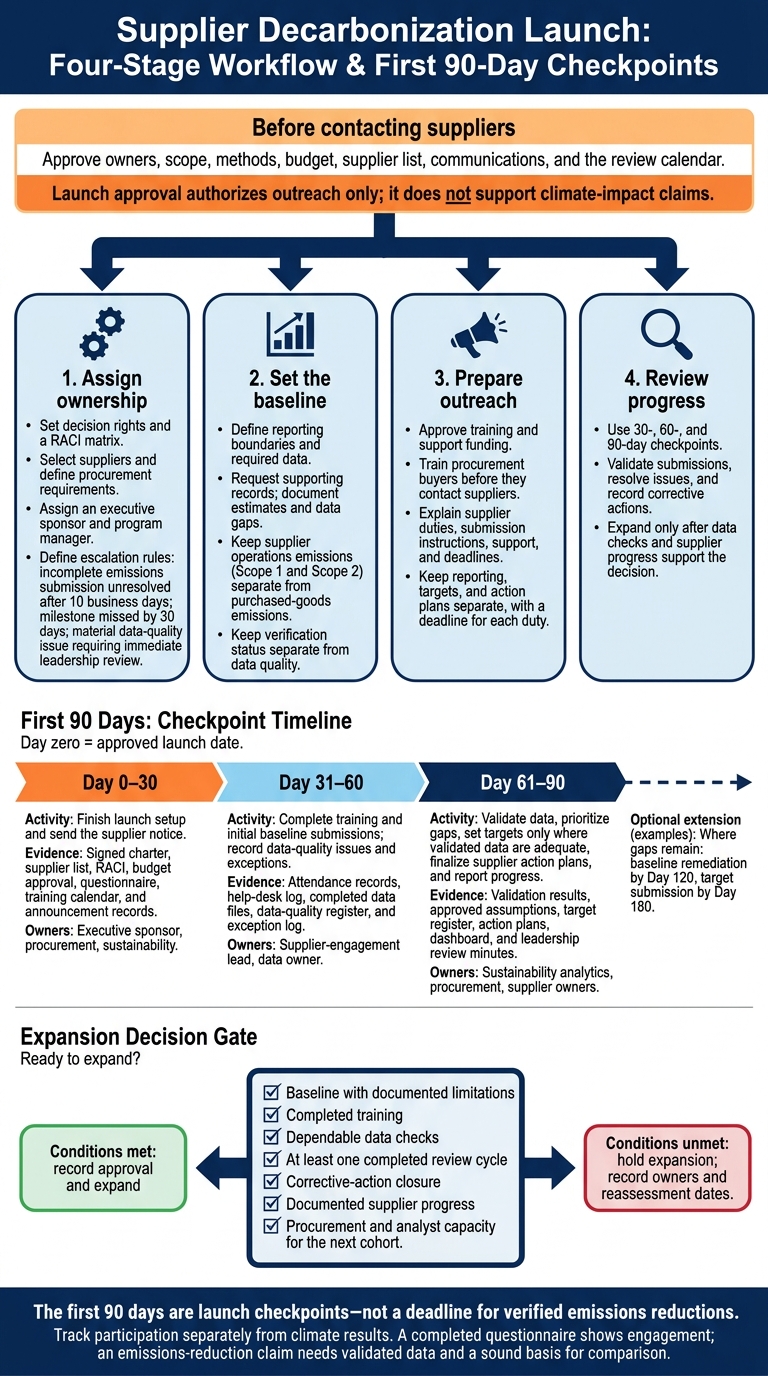
Supplier Decarbonization Launch Checklist
1. Assign Program Owners and Choose Suppliers
Define Roles and Escalation Rules
Give the executive sponsor authority over scope, budget, noncompliance remedies, and expansion. Put the program manager in charge of the supplier register, milestone tracking, and reporting.
Build a RACI matrix that names people from procurement, sustainability, finance, legal, engineering, operations, supplier quality, and supplier-facing account management. Procurement can take accountability for supplier selection and sourcing execution. Sustainability can own emissions methodology and target quality, while finance approves incentives and legal reviews contract language. Engineering and operations can validate technical abatement plans, and supplier quality can track corrective actions.[4]
Set written escalation triggers before outreach: an incomplete emissions submission still unresolved after 10 business days, a milestone missed by 30 days, or a material data-quality issue that needs immediate leadership review. Start with a clarification request, then move through technical assistance, a corrective-action plan, executive review, and - where contracts allow - commercial remedies. Record who can approve extensions, exceptions, and supplier removal. Treat limited capability differently from refusal to cooperate.
Set Program Scope and Supplier Selection Criteria
Define the first phase by geography, procurement category, facility, product family, supplier tier, reporting year, and emissions boundary. Rank suppliers with a documented scoring model that weighs estimated emissions, annual spend or purchase volume, business importance, buyer influence, geographic or regulatory exposure, existing climate commitments, and readiness.[10]
Organize supplier records by entity/location, category/products, spend/volume in U.S. dollars and relevant units, contract dates, emissions/targets, reporting capability, and key contacts.[9] Keep facility-level records separate from corporate commitments when a supplier operates multiple plants. Record excluded suppliers and the reasons for reconsidering them later.
| Supplier segment | Selection criteria | Required data | Engagement level | Support | Escalation path |
|---|---|---|---|---|---|
| Strategic, high-emissions | Large estimated emissions, high spend, or critical materials | Facility Scope 1 and 2 emissions, energy use, production volume, product carbon data, targets, reduction projects, and assurance status | Executive-backed; quarterly working sessions | Technical workshops, methodology review, joint abatement planning, and possible commercial incentives | Program manager → procurement and sustainability leadership → executive sponsor |
| Strategic, lower-readiness | High business importance but limited data or staff capacity | Basic fuel, electricity, production, facility, and activity data; documented estimates accepted initially | Monthly implementation support during the pilot | Templates, office hours, training, and phased deadlines | Program manager → supplier quality → procurement owner |
| Capable innovation suppliers | Demonstrated technical capacity and feasible low-carbon solutions | Verified product footprint, abatement cost, technology assumptions, volume availability, and implementation timeline | Collaborative pilots and design reviews | Long-term volume commitments, preferred-supplier consideration, or project support | Engineering and sustainability → procurement leadership |
| Standard suppliers | Moderate emissions, spend, or influence | Annual questionnaire, emissions estimate, targets, and relevant certifications | Annual review with targeted follow-up | Guidance materials and group training | Procurement owner → program manager |
Build Requirements into Procurement
Separate disclosure from performance. State whether each requirement is a qualification condition, weighted bid criterion, development requirement, or contractual obligation. Add emissions questions and evidence requests to sourcing documents. At onboarding and renewal, use scorecards to track completeness, timeliness, emissions intensity, target progress, and corrective-action closure. Completing a questionnaire should not earn the same credit as demonstrating emissions reductions.
Before changing contracts, have legal review reporting deadlines, confidentiality, data rights, audit cooperation, remedy periods, and consequences.[11] Prepare buyer guidance so category managers apply the requirements consistently.
With procurement rules in place, lock the baseline scope and data controls before outreach.
sbb-itb-8baf5f1
#10 - WSPD 2026 - Supplier Decarbonization: From target setting to real world impact
2. Set the Emissions Baseline and Data Controls
Once supplier scope is set, define the data request and validation rules for the baseline.
Define Reporting Scope and Required Data
Use the GHG Protocol Corporate Value Chain (Scope 3) Standard to define the reporting year, boundaries, included activities, gases, GWP basis, emission-factor hierarchy, and submission deadline. Specify the consolidation approach, facilities covered, and applicable Scope 1, Scope 2, and Scope 3 categories. Where practical, align calendar-year, fiscal-year, or other 12-month reporting periods with the company’s Scope 3 inventory. Document approved exceptions and record these requirements in the baseline register below.[8][3]
Request supplier operations emissions and purchased-goods emissions separately. Supplier operations emissions cover Scope 1 and Scope 2. Purchased-goods emissions cover purchased products or services, preferably cradle-to-gate. Ask for product-specific data where practical. If data are allocated, record the basis - for example, mass, production volume, energy use, revenue, or machine hours. Do not use total supplier emissions as purchased-goods emissions without a documented and justified allocation method.[8][3]
Use one template to standardize submissions and reduce estimation errors. Attach supplier and facility IDs to every record.
| Field | What to capture | Required unit or format |
|---|---|---|
| Supplier and facility | Supplier name and facility ID; check for duplicates | Distinct identifiers |
| Reporting year / period | Exact start and end dates; flag periods that do not match the baseline year | Calendar year, fiscal year, or another 12-month period |
| Boundary | Whether data cover the supplier, facility, product, business unit, or transaction | Written boundary statement |
| Emissions | Scope 1, Scope 2, relevant Scope 3, and product or service emissions | mtCO2e |
| Activity data | Fuel, electricity, heat, production volume, material quantity, freight, or spend, as applicable | kWh, MWh, MJ, metric tons, kilograms, product units, or U.S. gallons |
| Emission factors and GWP | Factor name, source, year, geography, gas coverage, and GWP basis | Factor metadata |
| Allocation basis | Mass, revenue, energy, machine hours, or production time | Allocation method |
| Evidence | Utility bills, fuel invoices, meter data, renewable-energy certificates or equivalent contractual instruments, product LCAs, or assurance statements | File references |
| Data-quality tier | Supplier-specific measured data, supplier-specific calculated data, secondary data, spend-based estimates, or company-derived estimates | Quality tier |
| Verification status | Unverified, internally reviewed, limited assurance, or reasonable assurance | Status label |
| Gap notes | Reason, interim method, affected supplier or product, estimated emissions, materiality, owner, and replacement deadline | Written notes |
| Review owner | Named procurement, sustainability, finance, or supplier-quality reviewer | Named owner |
Check Data Quality and Document Estimates
Issue one reporting template with definitions, examples, formulas, unit conversions, confidentiality terms, submission instructions, and a support contact. For converted units, require the original quantities, conversion factors, and sources. Record calculation methods, emission-factor sources, vintage, geography, and assumptions. Assess how well the data represent the technology, time period, and geography, along with completeness and reliability. Keep verification status separate from data quality.[3][12]
Before approval, check reporting periods, unit conversions, duplicate facilities, unexplained zeros, intensity changes, renewable-energy evidence, and boundary changes. Reconcile emissions with energy and production records. Check for double counting across purchased goods, transportation, waste, and other Scope 3 categories.
Maintain a data-gap register for every missing or estimated field. Record the reason, interim method, affected supplier or product, estimated emissions, quality tier, materiality, owner, and replacement deadline. Document how allocated supplier data feed into Scope 3 totals.
Before assigning targets, set baseline-recalculation triggers, a materiality threshold, approval authority, and version controls. Retain original submissions and revisions, and track the share of Scope 3 emissions calculated using supplier or other value-chain-partner data.[3][13][14]
3. Fund Training and Prepare Supplier Outreach
With scope and data controls in place, prepare internal teams and suppliers for their first submissions.
Approve the Training and Support Budget
Build an annual budget in U.S. dollars. Name an executive sponsor to oversee funding, a program manager to manage routine spending, and owners in procurement, sustainability, finance, and IT. Set tiered spending approval limits and hold a contingency reserve.[5]
Explain Supplier Requirements and Deadlines
Train procurement buyers before they contact suppliers. Cover what to send, what proof to request, how to protect confidential information, and when to escalate issues. Explain the differences between disclosure, targets, and emissions-reduction commitments. Require buyers to pass a brief knowledge check before outreach.
Give suppliers a short briefing deck, written requirements, a completed sample questionnaire, calculation templates, unit-conversion guidance, a recording, and office hours. Plan sessions around sourcing events and production calendars, with options across multiple U.S. time zones. Track attendance, completion, questions, and recurring errors. During launch, review errors weekly and adjust guidance or templates as needed.[6][16]
Match support to each supplier’s emissions impact, business importance, reporting maturity, geography, language, and internal capacity. Reserve intensive technical help for high-impact suppliers with major capability gaps. Reassess support tiers after the first submission.[5][17]
Send one announcement that explains the business purpose, which suppliers and facilities are covered, the data requested, how to submit it, privacy and data-use protections, deadlines, available support, and consequences of nonresponse. Require each supplier to name a climate or sustainability lead and a data owner, complete assigned training, and submit either a baseline or a documented gap statement. Keep reporting, targets, and action plans separate, with a deadline for each duty. Use U.S. date formats and include time zones for meetings.[7][15]
Send reminders at launch, 30 days before submission, 14 days before submission, and three business days before submission. Provide a shared mailbox, a named program manager, a technical-support contact, and a procurement escalation contact. Start escalation with clarification, then move to formal notice, corrective action, withholding preferred-supplier status, and renewal review. Allow documented extensions for genuine capacity or language barriers.
Record communications, training status, submission status, extensions, and follow-up actions in a launch engagement register.[16] Use that register to inform the 30-, 60-, and 90-day review cycle.
4. Conclusion: Check Launch Readiness and Plan Reviews
Track the first 90 days in the launch engagement register.
Set 30-, 60-, and 90-Day Milestones
Define day zero as the approved launch date. The first 90 days are launch checkpoints - not a deadline for verified emissions reductions.
| Timing | Key activities | Deliverables and completion evidence | Primary owners |
|---|---|---|---|
| Day 0–30 | Finish launch setup and send the supplier notice. | Signed charter, supplier list, RACI, budget approval, questionnaire, training calendar, and announcement records | Executive sponsor, procurement, sustainability |
| Day 31–60 | Complete training and initial baseline submissions; record data-quality issues and exceptions. | Attendance records, help-desk log, completed data files, data-quality register, and exception log | Supplier-engagement lead, data owner |
| Day 61–90 | Validate data, prioritize gaps, set targets only where validated data are adequate, finalize supplier action plans, and report progress. | Validation results, approved assumptions, target register, action plans, dashboard, and leadership review minutes | Sustainability analytics, procurement, supplier owners |
Allow more time where gaps remain:
Set later deadlines where gaps remain, such as baseline remediation by Day 120 and target submission by Day 180.
Each target needs a metric, base year, boundary, owner, and deadline. Each action needs a budget, expected reduction, dependencies, and evidence requirement.
Set Review Schedules and Corrective Actions
Use the launch engagement register to guide reviews, linking each review to the register and corrective-action log.
| Review cadence | Owner | Inputs | Decisions and follow-up records |
|---|---|---|---|
| Monthly implementation review | Program owner | Response rates, completeness, training, exceptions, overdue actions | Assign support, correct data, revise deadlines, and escalate nonresponse |
| Quarterly leadership review | Executive sponsor | Coverage, emissions trends, target progress, budget, supplier risks | Approve resources, resolve escalations, and authorize corrective measures |
| Quarterly supplier business review | Supplier account team | Submitted data, progress, barriers, action evidence | Agree on support, commitments, and next steps |
| Annual reset | Executive sponsor and cross-functional owners | Results, methodology changes, supplier performance, business priorities | Revisit cohort, thresholds, budget, engagement model, and targets |
Track supplier response rate, data completeness, training completion, target coverage, action completion, overdue actions, and escalation age. Include emissions, emissions intensity, product footprints, and renewable-energy share only where methods and boundaries allow comparison. Show coverage and data-quality tiers alongside totals. Use independent assurance where materiality or claims risk warrants it.
Corrective-action records must document more than a supplier promise. Record the issue, affected supplier or data set, root cause, materiality, required remedy, support offered, accountable owner, due date, escalation path, and closure evidence.
Use the first review cycle to assess whether the program is ready to scale.
Approve Launch and Define Expansion Criteria
Launch approval authorizes outreach only; it does not support climate-impact claims. Before outreach begins, confirm owners, scope, methods, budget, supplier list, communications, and the review calendar.
Expansion requires evidence that the process works. Require a baseline with documented limitations, completed training, dependable data checks, at least one completed review cycle, corrective-action closure, and documented supplier progress. Confirm that procurement and analyst teams have enough capacity for the next cohort.
Record each go/no-go decision, approver, unresolved conditions, owners, and reassessment dates. Keep expansion on hold until those conditions are met.
FAQs
How can we estimate emissions for suppliers with no data?
Use a hybrid approach: multiply supplier spend by suitable emission factors, such as EPA factors, to identify high-emission categories. Fill data gaps with sector-specific averages and proxy data. Mark estimates as low-confidence and document how you calculated them.
As your program matures, focus primary data collection on suppliers with the greatest emissions impact. Gradually replace estimates with verified site- or product-level figures to improve accuracy.
How much should we budget for supplier training?
Budget for hands-on support that pairs training with financial incentives to help suppliers overcome decarbonization barriers. Suppliers receiving both are 52% more likely to reduce annual emissions [1]. Focus funding on co-funded energy audits or help accessing federal and state incentive programs - support smaller suppliers often struggle to secure on their own [1]. Link training and diagnostic support to closing documented corrective action plan items or meeting defined sustainability milestones [2].
How do we distinguish real reductions from production declines?
Measure emissions relative to output, such as kilograms of CO₂e per finished unit, to account for production fluctuations. Report shifts in purchasing volume, product mix, and emissions factors separately from decarbonization results.
Keep physical emissions cuts separate from accounting changes. Better data can change reported totals without reducing actual emissions. Document methodology changes clearly so a lower emissions inventory isn’t mistaken for a real reduction.




FAQ