
Aug 12, 2026
How Manufacturers Cut Scope 3 Across Suppliers
Sustainability Strategy
In This Article
Build a supplier baseline, target high‑impact suppliers, collect better data, and use contracts and incentives to cut Scope 3 emissions.
How Manufacturers Cut Scope 3 Across Suppliers
Most manufacturers won’t cut carbon in a serious way unless they work on suppliers first. In many cases, 70%–90% of total emissions sit in Scope 3, and Purchased Goods and Services is often the biggest share.
If I had to reduce this article to the few points that matter most, I’d put it this way:
Start with a supplier baseline, not a broad theory
Focus on the suppliers and materials driving most emissions
Use spend-based data first, then replace it with supplier data where impact is high
Group suppliers by impact and business risk
Turn targets into contract terms, scorecards, and review rules
Use incentives like longer contracts, preferred status, and co-funding
Track progress each year with data-quality checks and baseline updates
A few numbers set the context fast:
Scope 3 often makes up 70%–90% of a manufacturer’s footprint
A small supplier group can drive 65%–95% of supply-chain emissions
If Scope 3 is more than 40% of total emissions, SBTi requires a target that covers at least 67% of Scope 3
Buyers can use an internal carbon cost of $50–$100 per metric ton CO2e to compare sourcing choices
What I take from the article is simple: don’t try to fix every supplier at once. Build the baseline, rank suppliers, collect better data where it matters, and make emissions part of buying decisions. That is what turns Scope 3 from a reporting task into a supply-chain work plan.
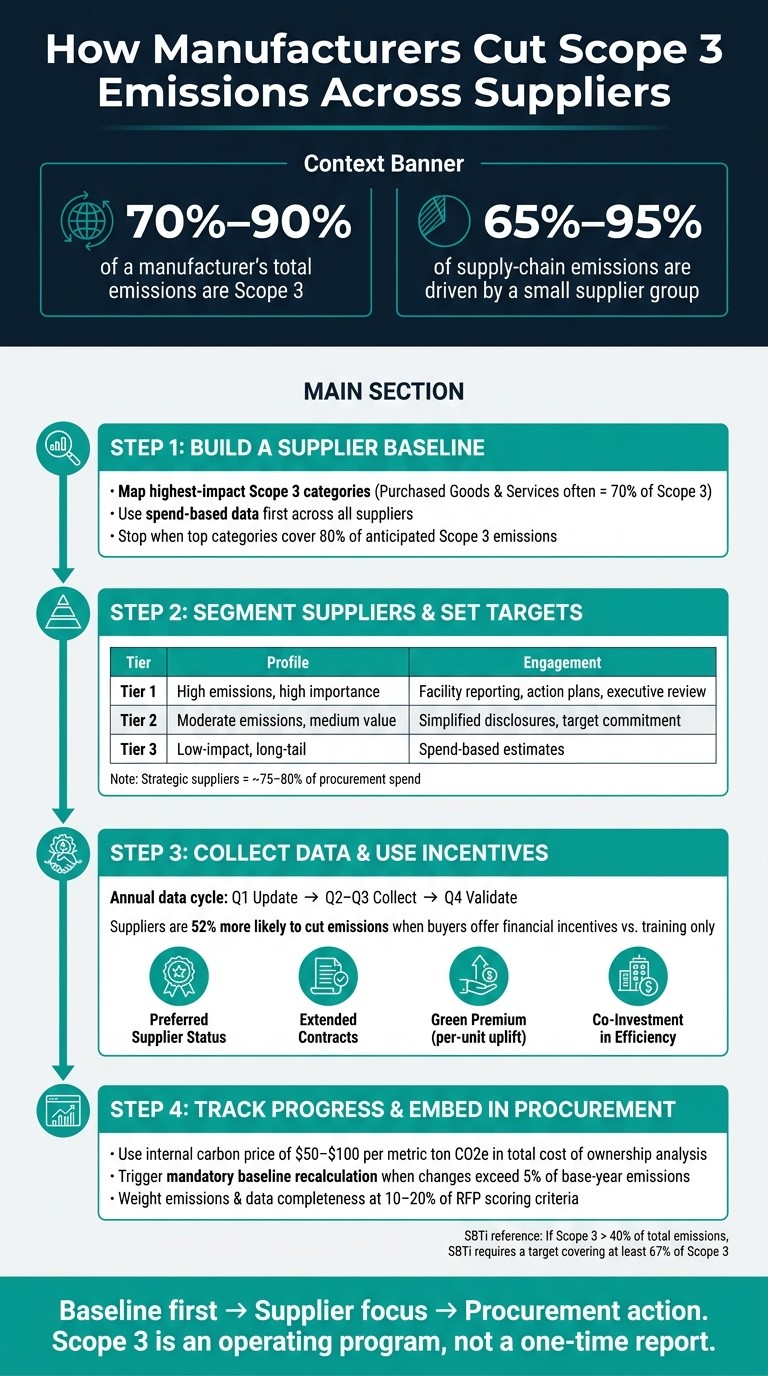
How Manufacturers Reduce Scope 3 Emissions Across Their Supply Chain
Mastering Scope 3 Emissions – From Strategy to Supply Chain Action Webinar
1. Build a supplier-focused Scope 3 baseline
Build a baseline that shows where supplier emissions are concentrated and which numbers you can rely on. In practice, that means pulling together a cross-functional team - procurement, finance, operations, and sustainability - so the work covers the right categories and clearly separates modeled estimates from supplier-provided data.
Start with the suppliers and materials that account for the biggest share of emissions.
Map the highest-impact Scope 3 categories
Purchased Goods and Services is often the biggest source. In some cases, it represents 70% of total Scope 3 emissions.[2] Materials such as steel, aluminum, chemicals, plastics, and electronics often drive the largest share because they require a lot of energy to produce and usually move through multi-tier supply chains. Upstream transportation and distribution, capital goods, and waste generated in operations should also be part of the first pass, especially for manufacturers with complex inbound logistics.
A practical way to begin is with a spend-and-materiality screen. Rank purchased-goods categories by estimated emissions, then check that list against known process hotspots. Stop when the largest categories cover at least 80% of anticipated Scope 3 emissions.[3] That short list becomes the base for supplier tiers and target-setting. It also gives procurement a clear place to focus first instead of trying to tackle everything at once.
Use a practical data hierarchy
Once the priority list is in place, collect the lowest-cost data first, then add precision where emissions are highest. A simple data ladder works well:
Data level | What it uses | Use for |
|---|---|---|
Spend-based estimates | Financial spend × emission factors | Initial screening across all suppliers |
Supplier activity data | Material weights, kWh, ton-miles, or supplier-reported emissions | Priority suppliers and high-impact categories |
Product-level life cycle data | LCA data tied to a specific product | Strategic materials in mature supplier programs |
Spend-based methods are fast and give broad coverage, but they can miss the mark when prices swing a lot or when a supplier sells both low- and high-carbon products. Moving to supplier activity data - actual kilograms of steel purchased, kilowatt-hours consumed, or ton-miles moved - shows what is driving the emissions. That shift matters because it turns a rough estimate into something procurement and operations can act on.
Use EPA, IPCC, or industry emission factors that match the supplier’s geography and material type. Document each factor and source so the inventory can stand up to review later.
Set baseline quality rules from the start
Set three rules at the beginning:
Define how completeness will be measured
Label data by verification status
Track how much of the inventory comes from primary data versus modeled estimates
This helps keep year-over-year change tied to actual emissions cuts, not just better math. Clear quality rules also keep procurement decisions tied to emissions performance that holds up under scrutiny.
Once the baseline is in good shape, segment suppliers by impact and readiness.
2. Group suppliers and set targets that drive action
Segment suppliers into clear engagement tiers
Start with the baseline, then rank suppliers using three factors: estimated emissions contribution, business criticality, and supplier readiness. This helps you focus time where it will matter most. Strategic suppliers often account for 65% to 95% of Scope 3 emissions while representing about 75% to 80% of total procurement spend [4]. In plain terms, a fairly small supplier group can shape most of the outcome.
A three-tier model keeps the work practical. Tier 1 includes high-emission, strategically important suppliers, such as major steel mills or aluminum smelters that are hard to replace and emissions-heavy. Tier 2 covers mid-volume suppliers with moderate emissions and some ability to move. Tier 3 is the long tail: lower-impact, often smaller suppliers where spend-based estimates are enough for now.
Tier placement should not rely on absolute emissions alone. A supplier with only moderate emissions may still belong in Tier 1 if it is sole-source or otherwise critical to the business. That’s the difference between a neat spreadsheet and a plan that holds up in the real world.
Tier | Supplier Profile | Engagement Approach |
|---|---|---|
Tier 1 | High emissions, high business importance | Facility reporting, action plans, executive review |
Tier 2 | Moderate emissions, medium strategic value | Simplified disclosures, training, target commitment within a set timeframe |
Tier 3 | Low-impact, long-tail suppliers | Spend-based estimates until a hotspot appears |
Use this structure to decide who gets reporting requests, target-setting, and executive attention first.
Set SBTi-aligned supplier and Scope 3 targets
With tiers in place, the next step is setting targets that are ambitious but still usable. Focus near-term targets on the suppliers driving most Scope 3 emissions. Tier 1 suppliers should commit to absolute reductions and renewable electricity adoption. Tier 2 suppliers should put formal targets in place within a defined timeframe. Tier 3 suppliers can start with standardized templates and spend-based estimates.
Many manufacturers don’t rely on just one target type. A common approach combines an absolute Scope 3 reduction goal with a supplier engagement target, such as growing the share of procurement spend covered by suppliers with validated science-based targets within a set period. Intensity targets can also help when production volumes are expected to grow, since they track emissions per unit of output rather than total emissions.
Turn company goals into supplier requirements
A corporate Scope 3 target only changes anything when it turns into clear supplier-level asks. For Tier 1 suppliers, that usually means annual facility reporting, a renewable electricity plan, product footprint data, and a dated roadmap for major facilities or product lines. For Tier 2 suppliers, a solid starting point is simplified emissions disclosure plus a commitment to set a formal target within a defined timeframe. Tier 3 suppliers can begin with a standardized reporting template and spend-based estimates.
The line between a target that shifts behavior and one that just sits in a sustainability report often comes down to contract terms. Requirements should spell out the exact data format, reporting cadence, and the owner on the supplier side. Put those expectations into contracts, sourcing scorecards, and quarterly business reviews if you want them to stick. Tie supplier requirements to incentives suppliers already care about.
Once requirements are set, move to standardized data collection and supplier incentives.
3. Collect supplier data and use incentives to cut emissions
Create a standard supplier data collection process
Once supplier requirements are set, the next step is a fixed reporting cycle that turns requests into data you can actually use. A simple annual cadence works well: update questionnaires and supplier lists in Q1, collect responses in Q2 and Q3, then validate and analyze the results in Q4. Tell suppliers what you need, why you need it, and when it’s due. Set one response deadline and use automated reminders to cut down on back-and-forth.
Inside the company, spell out roles in a RACI chart so nobody is guessing. Sustainability owns questionnaire design and methodology. Procurement handles supplier outreach and follow-up. Finance checks that emissions data lines up with spend. New strategic suppliers should be added to the reporting process within 90 days of contract signature.
Questionnaires should line up with GHG Protocol and CDP Supply Chain fields. Core data points include annual electricity and fuel use (kWh, MMBtu, or gallons), production volumes in units or tons, renewable energy share, and basic details on reduction targets. For allocation, stick to one rule per category - production volume, units delivered, or revenue share - and document it so the same method is used year after year.
The point isn’t just to complete an inventory. It’s to use the data to spot reduction projects and move on them.
Match reporting requirements to supplier tier
Your data request should match the supplier’s emissions impact. For Tier 1, ask for product-level life cycle footprints for major components or materials, detailed facility Scope 1 and 2 emissions data, and proof of reduction plans or science-based targets. For Tier 2, facility-level energy and emissions data plus basic reduction goals is enough. For Tier 3, simple activity data - annual electricity use and production volumes - works as a starting point, along with a roadmap to improve data quality over three to five years.
A clear maturity ladder helps suppliers see what’s coming instead of getting surprised later. By year two, Tier 1 suppliers should use recognized emission factors and disclose renewable electricity contracts. By year three, they should hold an SBTi-aligned Scope 1 and 2 target and provide product-level emission factors for top-selling components.
Use incentives that make decarbonization worth doing
Incentives are what move suppliers from reporting numbers to cutting emissions. According to CDP analysis, suppliers are 52% more likely to reduce their annual emissions when buyers offer financial incentives, compared with buyers that only provide training.[1] That’s a big enough gap to make incentive design a core part of the program, not something you tack on later.
The best programs pair business upside with hands-on support. In U.S. industrial supply chains, longer-term contracts often match equipment depreciation periods, which gives suppliers more confidence to finance high-efficiency machinery or on-site solar. Green premiums - a modest per-unit uplift for verified lower-carbon inputs - can help move projects from borderline to workable, especially for mid-sized suppliers. Co-funded energy audits and help with federal or state incentive programs add support that many smaller suppliers would struggle to get by themselves.
Incentive Type | Manufacturer Benefit | Supplier Benefit | Implementation Complexity | Typical Use Case |
|---|---|---|---|---|
Preferred supplier status | Reliable access to lower-carbon materials; reduced future carbon cost risk | Increased share of wallet; longer planning horizon | Low | Packaging, metals, logistics |
Extended contracts | Locked-in supply with improving emissions profile | Capital investment confidence; equipment financing feasibility | Low–Medium | Castings, forgings, resin suppliers |
Green premium (per-unit uplift) | Access to low-carbon materials; verified Scope 3 reductions | Revenue uplift tied to performance; market edge | Medium–High | Aluminum, steel, specialty chemicals |
Co-investment in efficiency or renewables | Clear value chain reductions; supply chain resilience | Lower operating costs; improved assets | High | Strategic Tier 1 suppliers with large energy footprints |
Tie these incentives to measurable KPIs, such as a 20% cut in emissions intensity over five years or hitting 100% renewable electricity for a contracted product line, and put those thresholds into contracts and RFP scoring criteria.[1] A good starting point is to weight emissions and data completeness at 10%–20% of the RFP score, then increase that share over time as regulatory pressure and customer expectations build.[1]
Once reporting and incentives are in place, track year-over-year results and feed them into procurement decisions.
4. Track progress, manage risk, and improve the program each year
Once supplier data is in place, the job changes. You’re no longer just gathering numbers. You’re watching movement, linking results to sourcing choices, and updating the baseline each year so the program stays grounded in current conditions.
Build a dashboard that shows actionable change
A Scope 3 dashboard earns its keep only if it helps someone decide what to do next. Total emissions alone won’t do that. The dashboard needs to show what changed, where it changed, and where action is needed.
A useful setup tracks emissions by supplier tier, material category - such as steel, plastics, and electronics - and geography. It should also show data-quality flags, including how much of the footprint comes from primary supplier data versus generic emission factors or spend-based estimates. That split matters. If most of the inventory still leans on rough estimates, the headline number may look precise while hiding weak inputs.
It also helps to track supplier engagement milestones. That includes the share of Tier 1 suppliers disclosing to CDP, setting SBTi-aligned targets, or committing to renewable energy procurement. Those markers show whether suppliers are changing behavior rather than simply filling out forms. Year-over-year emissions intensity is another key view, since growth in purchasing volume can mask progress if you look only at absolute emissions.
Different teams need different cuts of the same data. Executives usually need a footprint-and-risk summary. Procurement teams need a supplier scorecard that combines emissions, data quality, and engagement status.
That view should shape quarterly sourcing decisions, not gather dust in a reporting deck.
Tie emissions performance to procurement decisions
The next move is simple in theory and tougher in practice: make emissions metrics affect supplier access and buying decisions.
Review supplier performance every quarter across sustainability, procurement, finance, and risk. In those meetings, clear decision rules matter. For instance, strategic suppliers above a set annual spend threshold can be required to disclose GHG emissions and provide product-level emission factors within two years, or risk losing preferred supplier status. Another practical tool is an internal carbon price of $50–$100 per metric ton CO₂e in total cost of ownership analysis. That often changes the math. A low-carbon option with a slightly higher upfront price can look far more attractive once carbon risk is included.[5][6]
You’ll also need an annual recalculation process to keep the inventory believable. Update emission factors using current databases and supplier-provided data. Restate baselines when major structural shifts - acquisitions, divestitures, or big changes in product mix - make old comparisons misleading. A formal policy that triggers a mandatory recalculation when changes exceed 5% of total base-year emissions gives the team a clear rule to follow. Just as important, document methodology changes so trend lines stay comparable as disclosure rules change.
Choose the right tracking structure for your organization
The right tracking system depends on where the program stands today. Some teams can still manage with basic tools. Others need a system that links supplier data, sourcing, and risk in one place.
Tracking Structure | Data Granularity | Multi-Tier Visibility | Risk Integration | Best Fit |
|---|---|---|---|---|
Spreadsheet-based | Low; prone to manual error | Very difficult; manual outreach required | Minimal; data siloed from risk systems | Early-stage or smaller manufacturers with simple supplier networks and limited reporting requirements |
Enterprise systems (SaaS) | High; supports SKU-level and activity-based data | Automated; includes supplier network mapping | Integrated; links carbon costs to sourcing decisions | Large manufacturers with complex global sourcing and regulatory obligations |
Consulting-supported frameworks | Custom; tailored to high-impact materials | Expert-led; deep tracing of critical supply chains | Strategic; ties emissions to long-term resilience | Mid-sized manufacturers scaling their program |
In plain terms, spreadsheets can work at the start, but they get shaky fast once supplier networks grow. Enterprise platforms help when reporting, sourcing, and risk need to work from the same numbers. Consulting-supported models can bridge the gap for mid-sized manufacturers that need a more focused setup without a full system overhaul.
Conclusion: Start with the baseline, focus on priority suppliers, and scale what works
Cutting Scope 3 across suppliers is a repeatable operating program, not a one-time report. The manufacturers that make real progress tend to follow the same path: start with a solid baseline, put time and money where emissions are highest, and build systems that get better year after year. The order matters. Baseline first, then supplier focus, then procurement action.
Start with the highest-impact categories and build a baseline procurement can use, even if the early numbers include estimates. Waiting for perfect data is a good way to stall. A usable baseline gives teams something they can act on now.
Then go deep with the small group of suppliers driving most emissions, and use lighter rules for the long tail. That keeps the program grounded in where the biggest gains are most likely to come from. Once those priorities are set, procurement has to turn them into clear requirements.
Targets only matter when they change sourcing decisions. Put emissions performance into scorecards, contracts, and supplier reviews so those targets affect what gets bought, who gets picked, and how suppliers are managed. That’s how a Scope 3 program stays current, credible, and operational.
Over time, data quality gets better, supplier engagement gets deeper, and governance keeps the whole system tied to real outcomes.
FAQs
How do we start if supplier data is incomplete?
Start with spend-based estimates from EEIO models, such as EPA supply chain emission factors. They give you a practical baseline when supplier data is thin or scattered. Then use a hybrid approach: collect primary data from the suppliers that drive the most impact, and use sector-specific averages for the rest.
Don’t let imperfect data stall the work. Treat your baseline as something you improve over time, not something that has to be perfect on day one. As supplier relationships deepen and data collection gets better, swap out estimates for primary data piece by piece.
Which suppliers should we engage first?
Start with the few suppliers that matter most to your Scope 3 footprint. In most cases, that means your top 20 to 100 suppliers by spend or by emissions contribution. Those suppliers often account for 60% to 80% of procurement emissions, so this is where the work tends to pay off first.
Put your attention on strategic partners that can share primary data. That gives you a stronger view of actual emissions instead of relying only on estimates. It also helps to offer technical support along the way, so the process feels like a joint effort - not just another compliance task dropped on their desk.
How can procurement help reduce Scope 3?
Procurement can cut Scope 3 emissions by baking sustainability into purchasing decisions and supplier management. The best place to start is a baseline built from spend data. From there, zero in on your top 50–100 suppliers, where most of the impact usually sits, and slowly swap rough estimates for primary supplier data as reporting gets better.
Once that foundation is in place, bring sustainability into supplier selection and scorecards. That means these factors aren't treated as a side note; they become part of how suppliers are assessed from the start.
Results tend to improve when companies work with suppliers instead of just pushing demands downstream. In practice, that often includes:
supplier engagement that sets clear expectations and keeps the conversation active
data support to help suppliers report better numbers
incentives such as early payment terms, lower-cost capital, and co-investment in decarbonization projects
This approach gives procurement a direct role in moving Scope 3 from rough estimates to supplier-backed action.
Related Blog Posts
Latest Articles
©2025

Narrative Change and Power Building: The Missing Half of Advocacy
Narrative change is the process of disrupting dominant narratives that normalize inequity and advancing new narratives from historically marginalized communities.

Funding Resilience Without Federal Grants
BRIC is unreliable and FEMA is shrinking. Here's how cities fund climate resilience with dedicated revenue, blended finance, and a coordinating authority.

The ESG Blind Spot: How AI Is Finding Risks in Companies Nobody Else Is Watching
Norway's sovereign wealth fund uses AI to screen 7,200 portfolio companies for forced labor and corruption within 24 hours. The real story is the emerging-market coverage gap that traditional ESG data vendors miss — and what it means for any company with a global supply chain.
Narrative Change and Power Building: The Missing Half of Advocacy
Narrative change is the process of disrupting dominant narratives that normalize inequity and advancing new narratives from historically marginalized communities.
Funding Resilience Without Federal Grants
BRIC is unreliable and FEMA is shrinking. Here's how cities fund climate resilience with dedicated revenue, blended finance, and a coordinating authority.
The ESG Blind Spot: How AI Is Finding Risks in Companies Nobody Else Is Watching
Norway's sovereign wealth fund uses AI to screen 7,200 portfolio companies for forced labor and corruption within 24 hours. The real story is the emerging-market coverage gap that traditional ESG data vendors miss — and what it means for any company with a global supply chain.
FAQ
01
What does it really mean to “redefine profit”?
02
What makes Council Fire different?
03
Who does Council Fire work with?
04
What does working with Council Fire actually look like?
05
How does Council Fire help organizations turn big goals into action?
06
How does Council Fire define and measure success?
Aug 12, 2026
How Manufacturers Cut Scope 3 Across Suppliers
Sustainability Strategy
In This Article
Build a supplier baseline, target high‑impact suppliers, collect better data, and use contracts and incentives to cut Scope 3 emissions.
How Manufacturers Cut Scope 3 Across Suppliers
Most manufacturers won’t cut carbon in a serious way unless they work on suppliers first. In many cases, 70%–90% of total emissions sit in Scope 3, and Purchased Goods and Services is often the biggest share.
If I had to reduce this article to the few points that matter most, I’d put it this way:
Start with a supplier baseline, not a broad theory
Focus on the suppliers and materials driving most emissions
Use spend-based data first, then replace it with supplier data where impact is high
Group suppliers by impact and business risk
Turn targets into contract terms, scorecards, and review rules
Use incentives like longer contracts, preferred status, and co-funding
Track progress each year with data-quality checks and baseline updates
A few numbers set the context fast:
Scope 3 often makes up 70%–90% of a manufacturer’s footprint
A small supplier group can drive 65%–95% of supply-chain emissions
If Scope 3 is more than 40% of total emissions, SBTi requires a target that covers at least 67% of Scope 3
Buyers can use an internal carbon cost of $50–$100 per metric ton CO2e to compare sourcing choices
What I take from the article is simple: don’t try to fix every supplier at once. Build the baseline, rank suppliers, collect better data where it matters, and make emissions part of buying decisions. That is what turns Scope 3 from a reporting task into a supply-chain work plan.
How Manufacturers Reduce Scope 3 Emissions Across Their Supply Chain
Mastering Scope 3 Emissions – From Strategy to Supply Chain Action Webinar
1. Build a supplier-focused Scope 3 baseline
Build a baseline that shows where supplier emissions are concentrated and which numbers you can rely on. In practice, that means pulling together a cross-functional team - procurement, finance, operations, and sustainability - so the work covers the right categories and clearly separates modeled estimates from supplier-provided data.
Start with the suppliers and materials that account for the biggest share of emissions.
Map the highest-impact Scope 3 categories
Purchased Goods and Services is often the biggest source. In some cases, it represents 70% of total Scope 3 emissions.[2] Materials such as steel, aluminum, chemicals, plastics, and electronics often drive the largest share because they require a lot of energy to produce and usually move through multi-tier supply chains. Upstream transportation and distribution, capital goods, and waste generated in operations should also be part of the first pass, especially for manufacturers with complex inbound logistics.
A practical way to begin is with a spend-and-materiality screen. Rank purchased-goods categories by estimated emissions, then check that list against known process hotspots. Stop when the largest categories cover at least 80% of anticipated Scope 3 emissions.[3] That short list becomes the base for supplier tiers and target-setting. It also gives procurement a clear place to focus first instead of trying to tackle everything at once.
Use a practical data hierarchy
Once the priority list is in place, collect the lowest-cost data first, then add precision where emissions are highest. A simple data ladder works well:
Data level | What it uses | Use for |
|---|---|---|
Spend-based estimates | Financial spend × emission factors | Initial screening across all suppliers |
Supplier activity data | Material weights, kWh, ton-miles, or supplier-reported emissions | Priority suppliers and high-impact categories |
Product-level life cycle data | LCA data tied to a specific product | Strategic materials in mature supplier programs |
Spend-based methods are fast and give broad coverage, but they can miss the mark when prices swing a lot or when a supplier sells both low- and high-carbon products. Moving to supplier activity data - actual kilograms of steel purchased, kilowatt-hours consumed, or ton-miles moved - shows what is driving the emissions. That shift matters because it turns a rough estimate into something procurement and operations can act on.
Use EPA, IPCC, or industry emission factors that match the supplier’s geography and material type. Document each factor and source so the inventory can stand up to review later.
Set baseline quality rules from the start
Set three rules at the beginning:
Define how completeness will be measured
Label data by verification status
Track how much of the inventory comes from primary data versus modeled estimates
This helps keep year-over-year change tied to actual emissions cuts, not just better math. Clear quality rules also keep procurement decisions tied to emissions performance that holds up under scrutiny.
Once the baseline is in good shape, segment suppliers by impact and readiness.
2. Group suppliers and set targets that drive action
Segment suppliers into clear engagement tiers
Start with the baseline, then rank suppliers using three factors: estimated emissions contribution, business criticality, and supplier readiness. This helps you focus time where it will matter most. Strategic suppliers often account for 65% to 95% of Scope 3 emissions while representing about 75% to 80% of total procurement spend [4]. In plain terms, a fairly small supplier group can shape most of the outcome.
A three-tier model keeps the work practical. Tier 1 includes high-emission, strategically important suppliers, such as major steel mills or aluminum smelters that are hard to replace and emissions-heavy. Tier 2 covers mid-volume suppliers with moderate emissions and some ability to move. Tier 3 is the long tail: lower-impact, often smaller suppliers where spend-based estimates are enough for now.
Tier placement should not rely on absolute emissions alone. A supplier with only moderate emissions may still belong in Tier 1 if it is sole-source or otherwise critical to the business. That’s the difference between a neat spreadsheet and a plan that holds up in the real world.
Tier | Supplier Profile | Engagement Approach |
|---|---|---|
Tier 1 | High emissions, high business importance | Facility reporting, action plans, executive review |
Tier 2 | Moderate emissions, medium strategic value | Simplified disclosures, training, target commitment within a set timeframe |
Tier 3 | Low-impact, long-tail suppliers | Spend-based estimates until a hotspot appears |
Use this structure to decide who gets reporting requests, target-setting, and executive attention first.
Set SBTi-aligned supplier and Scope 3 targets
With tiers in place, the next step is setting targets that are ambitious but still usable. Focus near-term targets on the suppliers driving most Scope 3 emissions. Tier 1 suppliers should commit to absolute reductions and renewable electricity adoption. Tier 2 suppliers should put formal targets in place within a defined timeframe. Tier 3 suppliers can start with standardized templates and spend-based estimates.
Many manufacturers don’t rely on just one target type. A common approach combines an absolute Scope 3 reduction goal with a supplier engagement target, such as growing the share of procurement spend covered by suppliers with validated science-based targets within a set period. Intensity targets can also help when production volumes are expected to grow, since they track emissions per unit of output rather than total emissions.
Turn company goals into supplier requirements
A corporate Scope 3 target only changes anything when it turns into clear supplier-level asks. For Tier 1 suppliers, that usually means annual facility reporting, a renewable electricity plan, product footprint data, and a dated roadmap for major facilities or product lines. For Tier 2 suppliers, a solid starting point is simplified emissions disclosure plus a commitment to set a formal target within a defined timeframe. Tier 3 suppliers can begin with a standardized reporting template and spend-based estimates.
The line between a target that shifts behavior and one that just sits in a sustainability report often comes down to contract terms. Requirements should spell out the exact data format, reporting cadence, and the owner on the supplier side. Put those expectations into contracts, sourcing scorecards, and quarterly business reviews if you want them to stick. Tie supplier requirements to incentives suppliers already care about.
Once requirements are set, move to standardized data collection and supplier incentives.
3. Collect supplier data and use incentives to cut emissions
Create a standard supplier data collection process
Once supplier requirements are set, the next step is a fixed reporting cycle that turns requests into data you can actually use. A simple annual cadence works well: update questionnaires and supplier lists in Q1, collect responses in Q2 and Q3, then validate and analyze the results in Q4. Tell suppliers what you need, why you need it, and when it’s due. Set one response deadline and use automated reminders to cut down on back-and-forth.
Inside the company, spell out roles in a RACI chart so nobody is guessing. Sustainability owns questionnaire design and methodology. Procurement handles supplier outreach and follow-up. Finance checks that emissions data lines up with spend. New strategic suppliers should be added to the reporting process within 90 days of contract signature.
Questionnaires should line up with GHG Protocol and CDP Supply Chain fields. Core data points include annual electricity and fuel use (kWh, MMBtu, or gallons), production volumes in units or tons, renewable energy share, and basic details on reduction targets. For allocation, stick to one rule per category - production volume, units delivered, or revenue share - and document it so the same method is used year after year.
The point isn’t just to complete an inventory. It’s to use the data to spot reduction projects and move on them.
Match reporting requirements to supplier tier
Your data request should match the supplier’s emissions impact. For Tier 1, ask for product-level life cycle footprints for major components or materials, detailed facility Scope 1 and 2 emissions data, and proof of reduction plans or science-based targets. For Tier 2, facility-level energy and emissions data plus basic reduction goals is enough. For Tier 3, simple activity data - annual electricity use and production volumes - works as a starting point, along with a roadmap to improve data quality over three to five years.
A clear maturity ladder helps suppliers see what’s coming instead of getting surprised later. By year two, Tier 1 suppliers should use recognized emission factors and disclose renewable electricity contracts. By year three, they should hold an SBTi-aligned Scope 1 and 2 target and provide product-level emission factors for top-selling components.
Use incentives that make decarbonization worth doing
Incentives are what move suppliers from reporting numbers to cutting emissions. According to CDP analysis, suppliers are 52% more likely to reduce their annual emissions when buyers offer financial incentives, compared with buyers that only provide training.[1] That’s a big enough gap to make incentive design a core part of the program, not something you tack on later.
The best programs pair business upside with hands-on support. In U.S. industrial supply chains, longer-term contracts often match equipment depreciation periods, which gives suppliers more confidence to finance high-efficiency machinery or on-site solar. Green premiums - a modest per-unit uplift for verified lower-carbon inputs - can help move projects from borderline to workable, especially for mid-sized suppliers. Co-funded energy audits and help with federal or state incentive programs add support that many smaller suppliers would struggle to get by themselves.
Incentive Type | Manufacturer Benefit | Supplier Benefit | Implementation Complexity | Typical Use Case |
|---|---|---|---|---|
Preferred supplier status | Reliable access to lower-carbon materials; reduced future carbon cost risk | Increased share of wallet; longer planning horizon | Low | Packaging, metals, logistics |
Extended contracts | Locked-in supply with improving emissions profile | Capital investment confidence; equipment financing feasibility | Low–Medium | Castings, forgings, resin suppliers |
Green premium (per-unit uplift) | Access to low-carbon materials; verified Scope 3 reductions | Revenue uplift tied to performance; market edge | Medium–High | Aluminum, steel, specialty chemicals |
Co-investment in efficiency or renewables | Clear value chain reductions; supply chain resilience | Lower operating costs; improved assets | High | Strategic Tier 1 suppliers with large energy footprints |
Tie these incentives to measurable KPIs, such as a 20% cut in emissions intensity over five years or hitting 100% renewable electricity for a contracted product line, and put those thresholds into contracts and RFP scoring criteria.[1] A good starting point is to weight emissions and data completeness at 10%–20% of the RFP score, then increase that share over time as regulatory pressure and customer expectations build.[1]
Once reporting and incentives are in place, track year-over-year results and feed them into procurement decisions.
4. Track progress, manage risk, and improve the program each year
Once supplier data is in place, the job changes. You’re no longer just gathering numbers. You’re watching movement, linking results to sourcing choices, and updating the baseline each year so the program stays grounded in current conditions.
Build a dashboard that shows actionable change
A Scope 3 dashboard earns its keep only if it helps someone decide what to do next. Total emissions alone won’t do that. The dashboard needs to show what changed, where it changed, and where action is needed.
A useful setup tracks emissions by supplier tier, material category - such as steel, plastics, and electronics - and geography. It should also show data-quality flags, including how much of the footprint comes from primary supplier data versus generic emission factors or spend-based estimates. That split matters. If most of the inventory still leans on rough estimates, the headline number may look precise while hiding weak inputs.
It also helps to track supplier engagement milestones. That includes the share of Tier 1 suppliers disclosing to CDP, setting SBTi-aligned targets, or committing to renewable energy procurement. Those markers show whether suppliers are changing behavior rather than simply filling out forms. Year-over-year emissions intensity is another key view, since growth in purchasing volume can mask progress if you look only at absolute emissions.
Different teams need different cuts of the same data. Executives usually need a footprint-and-risk summary. Procurement teams need a supplier scorecard that combines emissions, data quality, and engagement status.
That view should shape quarterly sourcing decisions, not gather dust in a reporting deck.
Tie emissions performance to procurement decisions
The next move is simple in theory and tougher in practice: make emissions metrics affect supplier access and buying decisions.
Review supplier performance every quarter across sustainability, procurement, finance, and risk. In those meetings, clear decision rules matter. For instance, strategic suppliers above a set annual spend threshold can be required to disclose GHG emissions and provide product-level emission factors within two years, or risk losing preferred supplier status. Another practical tool is an internal carbon price of $50–$100 per metric ton CO₂e in total cost of ownership analysis. That often changes the math. A low-carbon option with a slightly higher upfront price can look far more attractive once carbon risk is included.[5][6]
You’ll also need an annual recalculation process to keep the inventory believable. Update emission factors using current databases and supplier-provided data. Restate baselines when major structural shifts - acquisitions, divestitures, or big changes in product mix - make old comparisons misleading. A formal policy that triggers a mandatory recalculation when changes exceed 5% of total base-year emissions gives the team a clear rule to follow. Just as important, document methodology changes so trend lines stay comparable as disclosure rules change.
Choose the right tracking structure for your organization
The right tracking system depends on where the program stands today. Some teams can still manage with basic tools. Others need a system that links supplier data, sourcing, and risk in one place.
Tracking Structure | Data Granularity | Multi-Tier Visibility | Risk Integration | Best Fit |
|---|---|---|---|---|
Spreadsheet-based | Low; prone to manual error | Very difficult; manual outreach required | Minimal; data siloed from risk systems | Early-stage or smaller manufacturers with simple supplier networks and limited reporting requirements |
Enterprise systems (SaaS) | High; supports SKU-level and activity-based data | Automated; includes supplier network mapping | Integrated; links carbon costs to sourcing decisions | Large manufacturers with complex global sourcing and regulatory obligations |
Consulting-supported frameworks | Custom; tailored to high-impact materials | Expert-led; deep tracing of critical supply chains | Strategic; ties emissions to long-term resilience | Mid-sized manufacturers scaling their program |
In plain terms, spreadsheets can work at the start, but they get shaky fast once supplier networks grow. Enterprise platforms help when reporting, sourcing, and risk need to work from the same numbers. Consulting-supported models can bridge the gap for mid-sized manufacturers that need a more focused setup without a full system overhaul.
Conclusion: Start with the baseline, focus on priority suppliers, and scale what works
Cutting Scope 3 across suppliers is a repeatable operating program, not a one-time report. The manufacturers that make real progress tend to follow the same path: start with a solid baseline, put time and money where emissions are highest, and build systems that get better year after year. The order matters. Baseline first, then supplier focus, then procurement action.
Start with the highest-impact categories and build a baseline procurement can use, even if the early numbers include estimates. Waiting for perfect data is a good way to stall. A usable baseline gives teams something they can act on now.
Then go deep with the small group of suppliers driving most emissions, and use lighter rules for the long tail. That keeps the program grounded in where the biggest gains are most likely to come from. Once those priorities are set, procurement has to turn them into clear requirements.
Targets only matter when they change sourcing decisions. Put emissions performance into scorecards, contracts, and supplier reviews so those targets affect what gets bought, who gets picked, and how suppliers are managed. That’s how a Scope 3 program stays current, credible, and operational.
Over time, data quality gets better, supplier engagement gets deeper, and governance keeps the whole system tied to real outcomes.
FAQs
How do we start if supplier data is incomplete?
Start with spend-based estimates from EEIO models, such as EPA supply chain emission factors. They give you a practical baseline when supplier data is thin or scattered. Then use a hybrid approach: collect primary data from the suppliers that drive the most impact, and use sector-specific averages for the rest.
Don’t let imperfect data stall the work. Treat your baseline as something you improve over time, not something that has to be perfect on day one. As supplier relationships deepen and data collection gets better, swap out estimates for primary data piece by piece.
Which suppliers should we engage first?
Start with the few suppliers that matter most to your Scope 3 footprint. In most cases, that means your top 20 to 100 suppliers by spend or by emissions contribution. Those suppliers often account for 60% to 80% of procurement emissions, so this is where the work tends to pay off first.
Put your attention on strategic partners that can share primary data. That gives you a stronger view of actual emissions instead of relying only on estimates. It also helps to offer technical support along the way, so the process feels like a joint effort - not just another compliance task dropped on their desk.
How can procurement help reduce Scope 3?
Procurement can cut Scope 3 emissions by baking sustainability into purchasing decisions and supplier management. The best place to start is a baseline built from spend data. From there, zero in on your top 50–100 suppliers, where most of the impact usually sits, and slowly swap rough estimates for primary supplier data as reporting gets better.
Once that foundation is in place, bring sustainability into supplier selection and scorecards. That means these factors aren't treated as a side note; they become part of how suppliers are assessed from the start.
Results tend to improve when companies work with suppliers instead of just pushing demands downstream. In practice, that often includes:
supplier engagement that sets clear expectations and keeps the conversation active
data support to help suppliers report better numbers
incentives such as early payment terms, lower-cost capital, and co-investment in decarbonization projects
This approach gives procurement a direct role in moving Scope 3 from rough estimates to supplier-backed action.
Related Blog Posts
Latest Articles
©2025
Narrative Change and Power Building: The Missing Half of Advocacy
Narrative change is the process of disrupting dominant narratives that normalize inequity and advancing new narratives from historically marginalized communities.
Funding Resilience Without Federal Grants
BRIC is unreliable and FEMA is shrinking. Here's how cities fund climate resilience with dedicated revenue, blended finance, and a coordinating authority.
The ESG Blind Spot: How AI Is Finding Risks in Companies Nobody Else Is Watching
Norway's sovereign wealth fund uses AI to screen 7,200 portfolio companies for forced labor and corruption within 24 hours. The real story is the emerging-market coverage gap that traditional ESG data vendors miss — and what it means for any company with a global supply chain.
FAQ
01
What does it really mean to “redefine profit”?
02
What makes Council Fire different?
03
Who does Council Fire work with?
04
What does working with Council Fire actually look like?
05
How does Council Fire help organizations turn big goals into action?
06
How does Council Fire define and measure success?
Aug 12, 2026
How Manufacturers Cut Scope 3 Across Suppliers
Sustainability Strategy
In This Article
Build a supplier baseline, target high‑impact suppliers, collect better data, and use contracts and incentives to cut Scope 3 emissions.
How Manufacturers Cut Scope 3 Across Suppliers
Most manufacturers won’t cut carbon in a serious way unless they work on suppliers first. In many cases, 70%–90% of total emissions sit in Scope 3, and Purchased Goods and Services is often the biggest share.
If I had to reduce this article to the few points that matter most, I’d put it this way:
Start with a supplier baseline, not a broad theory
Focus on the suppliers and materials driving most emissions
Use spend-based data first, then replace it with supplier data where impact is high
Group suppliers by impact and business risk
Turn targets into contract terms, scorecards, and review rules
Use incentives like longer contracts, preferred status, and co-funding
Track progress each year with data-quality checks and baseline updates
A few numbers set the context fast:
Scope 3 often makes up 70%–90% of a manufacturer’s footprint
A small supplier group can drive 65%–95% of supply-chain emissions
If Scope 3 is more than 40% of total emissions, SBTi requires a target that covers at least 67% of Scope 3
Buyers can use an internal carbon cost of $50–$100 per metric ton CO2e to compare sourcing choices
What I take from the article is simple: don’t try to fix every supplier at once. Build the baseline, rank suppliers, collect better data where it matters, and make emissions part of buying decisions. That is what turns Scope 3 from a reporting task into a supply-chain work plan.
How Manufacturers Reduce Scope 3 Emissions Across Their Supply Chain
Mastering Scope 3 Emissions – From Strategy to Supply Chain Action Webinar
1. Build a supplier-focused Scope 3 baseline
Build a baseline that shows where supplier emissions are concentrated and which numbers you can rely on. In practice, that means pulling together a cross-functional team - procurement, finance, operations, and sustainability - so the work covers the right categories and clearly separates modeled estimates from supplier-provided data.
Start with the suppliers and materials that account for the biggest share of emissions.
Map the highest-impact Scope 3 categories
Purchased Goods and Services is often the biggest source. In some cases, it represents 70% of total Scope 3 emissions.[2] Materials such as steel, aluminum, chemicals, plastics, and electronics often drive the largest share because they require a lot of energy to produce and usually move through multi-tier supply chains. Upstream transportation and distribution, capital goods, and waste generated in operations should also be part of the first pass, especially for manufacturers with complex inbound logistics.
A practical way to begin is with a spend-and-materiality screen. Rank purchased-goods categories by estimated emissions, then check that list against known process hotspots. Stop when the largest categories cover at least 80% of anticipated Scope 3 emissions.[3] That short list becomes the base for supplier tiers and target-setting. It also gives procurement a clear place to focus first instead of trying to tackle everything at once.
Use a practical data hierarchy
Once the priority list is in place, collect the lowest-cost data first, then add precision where emissions are highest. A simple data ladder works well:
Data level | What it uses | Use for |
|---|---|---|
Spend-based estimates | Financial spend × emission factors | Initial screening across all suppliers |
Supplier activity data | Material weights, kWh, ton-miles, or supplier-reported emissions | Priority suppliers and high-impact categories |
Product-level life cycle data | LCA data tied to a specific product | Strategic materials in mature supplier programs |
Spend-based methods are fast and give broad coverage, but they can miss the mark when prices swing a lot or when a supplier sells both low- and high-carbon products. Moving to supplier activity data - actual kilograms of steel purchased, kilowatt-hours consumed, or ton-miles moved - shows what is driving the emissions. That shift matters because it turns a rough estimate into something procurement and operations can act on.
Use EPA, IPCC, or industry emission factors that match the supplier’s geography and material type. Document each factor and source so the inventory can stand up to review later.
Set baseline quality rules from the start
Set three rules at the beginning:
Define how completeness will be measured
Label data by verification status
Track how much of the inventory comes from primary data versus modeled estimates
This helps keep year-over-year change tied to actual emissions cuts, not just better math. Clear quality rules also keep procurement decisions tied to emissions performance that holds up under scrutiny.
Once the baseline is in good shape, segment suppliers by impact and readiness.
2. Group suppliers and set targets that drive action
Segment suppliers into clear engagement tiers
Start with the baseline, then rank suppliers using three factors: estimated emissions contribution, business criticality, and supplier readiness. This helps you focus time where it will matter most. Strategic suppliers often account for 65% to 95% of Scope 3 emissions while representing about 75% to 80% of total procurement spend [4]. In plain terms, a fairly small supplier group can shape most of the outcome.
A three-tier model keeps the work practical. Tier 1 includes high-emission, strategically important suppliers, such as major steel mills or aluminum smelters that are hard to replace and emissions-heavy. Tier 2 covers mid-volume suppliers with moderate emissions and some ability to move. Tier 3 is the long tail: lower-impact, often smaller suppliers where spend-based estimates are enough for now.
Tier placement should not rely on absolute emissions alone. A supplier with only moderate emissions may still belong in Tier 1 if it is sole-source or otherwise critical to the business. That’s the difference between a neat spreadsheet and a plan that holds up in the real world.
Tier | Supplier Profile | Engagement Approach |
|---|---|---|
Tier 1 | High emissions, high business importance | Facility reporting, action plans, executive review |
Tier 2 | Moderate emissions, medium strategic value | Simplified disclosures, training, target commitment within a set timeframe |
Tier 3 | Low-impact, long-tail suppliers | Spend-based estimates until a hotspot appears |
Use this structure to decide who gets reporting requests, target-setting, and executive attention first.
Set SBTi-aligned supplier and Scope 3 targets
With tiers in place, the next step is setting targets that are ambitious but still usable. Focus near-term targets on the suppliers driving most Scope 3 emissions. Tier 1 suppliers should commit to absolute reductions and renewable electricity adoption. Tier 2 suppliers should put formal targets in place within a defined timeframe. Tier 3 suppliers can start with standardized templates and spend-based estimates.
Many manufacturers don’t rely on just one target type. A common approach combines an absolute Scope 3 reduction goal with a supplier engagement target, such as growing the share of procurement spend covered by suppliers with validated science-based targets within a set period. Intensity targets can also help when production volumes are expected to grow, since they track emissions per unit of output rather than total emissions.
Turn company goals into supplier requirements
A corporate Scope 3 target only changes anything when it turns into clear supplier-level asks. For Tier 1 suppliers, that usually means annual facility reporting, a renewable electricity plan, product footprint data, and a dated roadmap for major facilities or product lines. For Tier 2 suppliers, a solid starting point is simplified emissions disclosure plus a commitment to set a formal target within a defined timeframe. Tier 3 suppliers can begin with a standardized reporting template and spend-based estimates.
The line between a target that shifts behavior and one that just sits in a sustainability report often comes down to contract terms. Requirements should spell out the exact data format, reporting cadence, and the owner on the supplier side. Put those expectations into contracts, sourcing scorecards, and quarterly business reviews if you want them to stick. Tie supplier requirements to incentives suppliers already care about.
Once requirements are set, move to standardized data collection and supplier incentives.
3. Collect supplier data and use incentives to cut emissions
Create a standard supplier data collection process
Once supplier requirements are set, the next step is a fixed reporting cycle that turns requests into data you can actually use. A simple annual cadence works well: update questionnaires and supplier lists in Q1, collect responses in Q2 and Q3, then validate and analyze the results in Q4. Tell suppliers what you need, why you need it, and when it’s due. Set one response deadline and use automated reminders to cut down on back-and-forth.
Inside the company, spell out roles in a RACI chart so nobody is guessing. Sustainability owns questionnaire design and methodology. Procurement handles supplier outreach and follow-up. Finance checks that emissions data lines up with spend. New strategic suppliers should be added to the reporting process within 90 days of contract signature.
Questionnaires should line up with GHG Protocol and CDP Supply Chain fields. Core data points include annual electricity and fuel use (kWh, MMBtu, or gallons), production volumes in units or tons, renewable energy share, and basic details on reduction targets. For allocation, stick to one rule per category - production volume, units delivered, or revenue share - and document it so the same method is used year after year.
The point isn’t just to complete an inventory. It’s to use the data to spot reduction projects and move on them.
Match reporting requirements to supplier tier
Your data request should match the supplier’s emissions impact. For Tier 1, ask for product-level life cycle footprints for major components or materials, detailed facility Scope 1 and 2 emissions data, and proof of reduction plans or science-based targets. For Tier 2, facility-level energy and emissions data plus basic reduction goals is enough. For Tier 3, simple activity data - annual electricity use and production volumes - works as a starting point, along with a roadmap to improve data quality over three to five years.
A clear maturity ladder helps suppliers see what’s coming instead of getting surprised later. By year two, Tier 1 suppliers should use recognized emission factors and disclose renewable electricity contracts. By year three, they should hold an SBTi-aligned Scope 1 and 2 target and provide product-level emission factors for top-selling components.
Use incentives that make decarbonization worth doing
Incentives are what move suppliers from reporting numbers to cutting emissions. According to CDP analysis, suppliers are 52% more likely to reduce their annual emissions when buyers offer financial incentives, compared with buyers that only provide training.[1] That’s a big enough gap to make incentive design a core part of the program, not something you tack on later.
The best programs pair business upside with hands-on support. In U.S. industrial supply chains, longer-term contracts often match equipment depreciation periods, which gives suppliers more confidence to finance high-efficiency machinery or on-site solar. Green premiums - a modest per-unit uplift for verified lower-carbon inputs - can help move projects from borderline to workable, especially for mid-sized suppliers. Co-funded energy audits and help with federal or state incentive programs add support that many smaller suppliers would struggle to get by themselves.
Incentive Type | Manufacturer Benefit | Supplier Benefit | Implementation Complexity | Typical Use Case |
|---|---|---|---|---|
Preferred supplier status | Reliable access to lower-carbon materials; reduced future carbon cost risk | Increased share of wallet; longer planning horizon | Low | Packaging, metals, logistics |
Extended contracts | Locked-in supply with improving emissions profile | Capital investment confidence; equipment financing feasibility | Low–Medium | Castings, forgings, resin suppliers |
Green premium (per-unit uplift) | Access to low-carbon materials; verified Scope 3 reductions | Revenue uplift tied to performance; market edge | Medium–High | Aluminum, steel, specialty chemicals |
Co-investment in efficiency or renewables | Clear value chain reductions; supply chain resilience | Lower operating costs; improved assets | High | Strategic Tier 1 suppliers with large energy footprints |
Tie these incentives to measurable KPIs, such as a 20% cut in emissions intensity over five years or hitting 100% renewable electricity for a contracted product line, and put those thresholds into contracts and RFP scoring criteria.[1] A good starting point is to weight emissions and data completeness at 10%–20% of the RFP score, then increase that share over time as regulatory pressure and customer expectations build.[1]
Once reporting and incentives are in place, track year-over-year results and feed them into procurement decisions.
4. Track progress, manage risk, and improve the program each year
Once supplier data is in place, the job changes. You’re no longer just gathering numbers. You’re watching movement, linking results to sourcing choices, and updating the baseline each year so the program stays grounded in current conditions.
Build a dashboard that shows actionable change
A Scope 3 dashboard earns its keep only if it helps someone decide what to do next. Total emissions alone won’t do that. The dashboard needs to show what changed, where it changed, and where action is needed.
A useful setup tracks emissions by supplier tier, material category - such as steel, plastics, and electronics - and geography. It should also show data-quality flags, including how much of the footprint comes from primary supplier data versus generic emission factors or spend-based estimates. That split matters. If most of the inventory still leans on rough estimates, the headline number may look precise while hiding weak inputs.
It also helps to track supplier engagement milestones. That includes the share of Tier 1 suppliers disclosing to CDP, setting SBTi-aligned targets, or committing to renewable energy procurement. Those markers show whether suppliers are changing behavior rather than simply filling out forms. Year-over-year emissions intensity is another key view, since growth in purchasing volume can mask progress if you look only at absolute emissions.
Different teams need different cuts of the same data. Executives usually need a footprint-and-risk summary. Procurement teams need a supplier scorecard that combines emissions, data quality, and engagement status.
That view should shape quarterly sourcing decisions, not gather dust in a reporting deck.
Tie emissions performance to procurement decisions
The next move is simple in theory and tougher in practice: make emissions metrics affect supplier access and buying decisions.
Review supplier performance every quarter across sustainability, procurement, finance, and risk. In those meetings, clear decision rules matter. For instance, strategic suppliers above a set annual spend threshold can be required to disclose GHG emissions and provide product-level emission factors within two years, or risk losing preferred supplier status. Another practical tool is an internal carbon price of $50–$100 per metric ton CO₂e in total cost of ownership analysis. That often changes the math. A low-carbon option with a slightly higher upfront price can look far more attractive once carbon risk is included.[5][6]
You’ll also need an annual recalculation process to keep the inventory believable. Update emission factors using current databases and supplier-provided data. Restate baselines when major structural shifts - acquisitions, divestitures, or big changes in product mix - make old comparisons misleading. A formal policy that triggers a mandatory recalculation when changes exceed 5% of total base-year emissions gives the team a clear rule to follow. Just as important, document methodology changes so trend lines stay comparable as disclosure rules change.
Choose the right tracking structure for your organization
The right tracking system depends on where the program stands today. Some teams can still manage with basic tools. Others need a system that links supplier data, sourcing, and risk in one place.
Tracking Structure | Data Granularity | Multi-Tier Visibility | Risk Integration | Best Fit |
|---|---|---|---|---|
Spreadsheet-based | Low; prone to manual error | Very difficult; manual outreach required | Minimal; data siloed from risk systems | Early-stage or smaller manufacturers with simple supplier networks and limited reporting requirements |
Enterprise systems (SaaS) | High; supports SKU-level and activity-based data | Automated; includes supplier network mapping | Integrated; links carbon costs to sourcing decisions | Large manufacturers with complex global sourcing and regulatory obligations |
Consulting-supported frameworks | Custom; tailored to high-impact materials | Expert-led; deep tracing of critical supply chains | Strategic; ties emissions to long-term resilience | Mid-sized manufacturers scaling their program |
In plain terms, spreadsheets can work at the start, but they get shaky fast once supplier networks grow. Enterprise platforms help when reporting, sourcing, and risk need to work from the same numbers. Consulting-supported models can bridge the gap for mid-sized manufacturers that need a more focused setup without a full system overhaul.
Conclusion: Start with the baseline, focus on priority suppliers, and scale what works
Cutting Scope 3 across suppliers is a repeatable operating program, not a one-time report. The manufacturers that make real progress tend to follow the same path: start with a solid baseline, put time and money where emissions are highest, and build systems that get better year after year. The order matters. Baseline first, then supplier focus, then procurement action.
Start with the highest-impact categories and build a baseline procurement can use, even if the early numbers include estimates. Waiting for perfect data is a good way to stall. A usable baseline gives teams something they can act on now.
Then go deep with the small group of suppliers driving most emissions, and use lighter rules for the long tail. That keeps the program grounded in where the biggest gains are most likely to come from. Once those priorities are set, procurement has to turn them into clear requirements.
Targets only matter when they change sourcing decisions. Put emissions performance into scorecards, contracts, and supplier reviews so those targets affect what gets bought, who gets picked, and how suppliers are managed. That’s how a Scope 3 program stays current, credible, and operational.
Over time, data quality gets better, supplier engagement gets deeper, and governance keeps the whole system tied to real outcomes.
FAQs
How do we start if supplier data is incomplete?
Start with spend-based estimates from EEIO models, such as EPA supply chain emission factors. They give you a practical baseline when supplier data is thin or scattered. Then use a hybrid approach: collect primary data from the suppliers that drive the most impact, and use sector-specific averages for the rest.
Don’t let imperfect data stall the work. Treat your baseline as something you improve over time, not something that has to be perfect on day one. As supplier relationships deepen and data collection gets better, swap out estimates for primary data piece by piece.
Which suppliers should we engage first?
Start with the few suppliers that matter most to your Scope 3 footprint. In most cases, that means your top 20 to 100 suppliers by spend or by emissions contribution. Those suppliers often account for 60% to 80% of procurement emissions, so this is where the work tends to pay off first.
Put your attention on strategic partners that can share primary data. That gives you a stronger view of actual emissions instead of relying only on estimates. It also helps to offer technical support along the way, so the process feels like a joint effort - not just another compliance task dropped on their desk.
How can procurement help reduce Scope 3?
Procurement can cut Scope 3 emissions by baking sustainability into purchasing decisions and supplier management. The best place to start is a baseline built from spend data. From there, zero in on your top 50–100 suppliers, where most of the impact usually sits, and slowly swap rough estimates for primary supplier data as reporting gets better.
Once that foundation is in place, bring sustainability into supplier selection and scorecards. That means these factors aren't treated as a side note; they become part of how suppliers are assessed from the start.
Results tend to improve when companies work with suppliers instead of just pushing demands downstream. In practice, that often includes:
supplier engagement that sets clear expectations and keeps the conversation active
data support to help suppliers report better numbers
incentives such as early payment terms, lower-cost capital, and co-investment in decarbonization projects
This approach gives procurement a direct role in moving Scope 3 from rough estimates to supplier-backed action.
Related Blog Posts
Latest Articles
©2025
Narrative Change and Power Building: The Missing Half of Advocacy
Narrative change is the process of disrupting dominant narratives that normalize inequity and advancing new narratives from historically marginalized communities.
Funding Resilience Without Federal Grants
BRIC is unreliable and FEMA is shrinking. Here's how cities fund climate resilience with dedicated revenue, blended finance, and a coordinating authority.
The ESG Blind Spot: How AI Is Finding Risks in Companies Nobody Else Is Watching
Norway's sovereign wealth fund uses AI to screen 7,200 portfolio companies for forced labor and corruption within 24 hours. The real story is the emerging-market coverage gap that traditional ESG data vendors miss — and what it means for any company with a global supply chain.
FAQ
What does it really mean to “redefine profit”?
What makes Council Fire different?
Who does Council Fire work with?
What does working with Council Fire actually look like?
How does Council Fire help organizations turn big goals into action?
How does Council Fire define and measure success?