
Aug 20, 2026
Study Summary: Cross-Sector Collaboration and Communication
Governance
In This Article
How trust, shared goals, plain language, neutral facilitation, and governance routines improve cross-sector coordination and outcomes.
Study Summary: Cross-Sector Collaboration and Communication
If I want cross-sector work to hold up, I need to treat communication as part of how the partnership runs - not as a side task. The research points to a clear pattern: trust, shared goals, plain language, and clear rules help groups coordinate, stick with the work, and win support or funding.
Here’s the short version:
Trust grows through repeated contact like check-ins, open questions, and shared decisions.
Shared goals cut conflict when partners have different timelines, pressures, and incentives.
Jargon slows progress and can push quieter partners out of the conversation.
Neutral facilitation helps when power gaps, tense issues, or mixed sector language get in the way.
Structure and relationships both matter: rules alone are not enough, and talk alone is not enough.
Results improve when partners co-shape the work. In one Los Angeles coalition, that approach helped secure $1 million in county funding. In another case, more than 80% said the process improved impact, and 75% said it made them more open to future collaboration.
What I take from this research is simple: better communication leads to better coordination. And when government, nonprofits, businesses, and funders need to act together, that can make the difference between a stalled partnership and one that gets results.
The main lesson: if I want people to stay aligned, I need to build communication into trust-building, goal-setting, framing, meetings, and decision rules from the start.
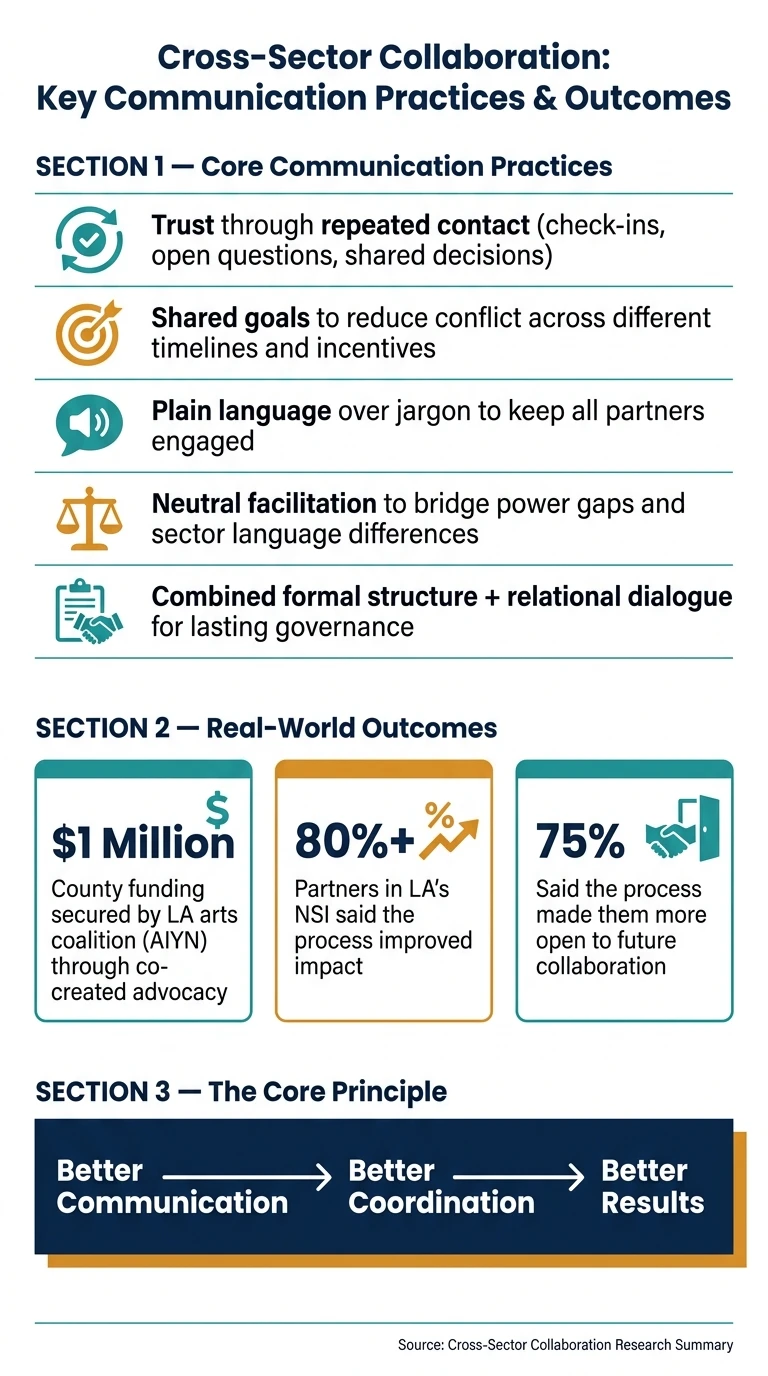
Cross-Sector Collaboration: Key Communication Practices & Outcomes
Trust, Shared Goals, and the Conditions for Working Together
How Trust Is Built and Maintained
Research points to three practices that help trust take root: perspective seeking, perspective taking, and inclusive decision-making. In plain terms, that means partners ask questions, listen with care, and respond to each other's limits and pressures. That kind of exchange cuts down on misreading and makes coordination steadier and more deliberate [3].
A third-party manager can help here too. In tense or high-stakes settings, that outside role can make discussions feel safer, especially when people need to talk through sensitive issues. In one initiative, most exploration grants moved on to formal partnership agreements [4]. Small wins matter as well. So do regular check-ins. They help people see progress, keep energy up, and stop minor friction from turning into bigger problems [3] [1].
Once trust is in place, communication can move away from repairing relationships and toward lining up around results.
Why Shared Goals Reduce Conflict and Improve Coordination
After trust is built, shared goals matter just as much as coordination itself, especially when conditions are uncertain [5]. Clear shared outcomes give partners something steady to work toward, even when their motives, timelines, or methods don't match perfectly.
That shared mission can do more than tidy up communication. It can turn separate organizations into a coordinated network with enough reach to secure new funding [4]. That matters because many partnerships run into the same wall: organizations slip into self-protection and hold back from full commitment. Shared goals give people a reason to act beyond their own lane and stay with the group effort.
What Breaks Trust and Alignment
Even when alignment looks strong, it can weaken fast if decision power is uneven. Structural power imbalances are one of the clearest ways trust starts to break down. They can skew participation, tilt decisions toward stronger partners, and undercut fair outcomes [1] [2].
Another common fault line is exclusion. If the people most affected by a decision are left out, conflict often stays unresolved instead of getting worked through [1]. Alignment also frays when partners lean too hard into short-term organizational needs and lose sight of longer-term shared goals [1] [4]. It's a bit like trying to row a boat with each person pulling in a different direction - you still move, but not well, and not for long.
Language, Framing, and Participation Across Sectors
How Sector-Specific Language Creates Friction
Even when people trust each other, work can still bog down when each group speaks its own language. A term that feels normal in one sector may land with confusion in another. That slows coordination, not just understanding. It can also deepen power gaps, with sector-specific language pushing less powerful partners to the edges of the conversation [2].
This is where neutral facilitators matter. They can translate terms, slow the pace, and help people meet on common ground. Psychological safety matters too. If people feel safe asking, “What do you mean by that?” they’re far more likely to stay engaged instead of going quiet [6]. Shared language opens the door. Shared framing is what gets people moving in the same direction.
How Framing Shapes Coalition Support
The way a coalition describes the problem can change who shows up and who stays. Shared-benefit framing tends to bring in more partners than blame-based framing. In Seattle, one coalition moved away from a disparity-based frame and toward a “story of us.” That shift helped bring employers and hospitals back into the work and helped the group secure state grants for health-disparity efforts [3].
You can see a similar pattern in Los Angeles’ NSI. More than 80% said the process improved impact, and 75% said it made them more open to future collaboration, even without a final agreement [4]. That says a lot. People don’t need perfect consensus to stay at the table. They do need a frame that feels fair, useful, and shaped with them rather than handed to them.
Why Participatory Communication Builds Legitimacy
Once partners line up around a shared frame, participatory communication helps turn agreement into buy-in. Co-created language matters because people are more likely to follow through when they help shape the goals and framing of the work [1]. Put simply, people support what they help build.
A strong example is the Arts for Incarcerated Youth Network (AIYN), a coalition of six Los Angeles nonprofits formed through the NSI. With a neutral structure guiding advocacy, the network secured $1 million in new Los Angeles County funding for arts programs in detention facilities - money none of the individual groups could have reached on their own [4].
That result points to something bigger. Co-creation doesn’t just make the process smoother. It builds ownership, strengthens commitment, and gives shared decisions more weight, which makes follow-through much more likely [1].
Governance, Coordination, and Partner Outcomes
What Studies Show About Formal and Relational Governance
Once trust and shared goals are in place, governance decides whether communication holds up when things get hard. Formal tools - charters, decision rules, and shared reporting - tend to work best when they sit alongside relational governance: trust-based problem-solving and reciprocity [1][6]. Studies on network governance describe this as shared decision-making, where partners lean on communication, knowledge exchange, and shared norms, not just legal enforcement, to stay aligned [6].
Clear roles matter as well. Research shows that a person’s understanding of expectations and processes has more impact on team effectiveness than raw individual talent [6]. That point is easy to miss, but it matters. A group can have smart, committed people and still stall if no one is sure who owns what.
Which Communication Practices Lead to Better Outcomes
Once roles are clear, communication routines shape whether coordination works in practice. Across studies, the same habits show up again and again: regular joint meetings, transparent data use, and neutral facilitation. Together, these practices support mutual learning, help partners spot shared priorities and leading indicators, and make room for private problem-solving and early-stage conversations [1][3][4].
In Prepare LA, the Red Cross used CDC mapping data to target vulnerable Los Angeles neighborhoods, convene 10 community coalitions, and train 20 local leaders in search and rescue capacity [3].
That example shows what good coordination looks like on the ground. Data gave the effort direction, but communication turned that direction into action.
How Communication Affects Joint Advocacy Success
In advocacy coalitions, communication tends to work best when the frame connects each partner’s interests to the shared goal [3]. Framing is not just about messaging. It helps partners see why acting together serves their own aims as well as the group’s.
The Reinvent South Stockton Coalition (2013–2016) shows this clearly. Led by Michael Tubbs - then a city council member, later Mayor of Stockton, California - the initiative brought together faith-based organizations, government entities, and residents in a community where 38% of residents lived below the poverty line. By serving as a neutral convener and listening to community concerns, Tubbs built enough trust for the group to apply for grants as one coalition and secure major funding [3].
GHN Learning Collaborative: Cross-Sector Communication
Conclusion: Practical Lessons for Better Cross-Sector Communication
Across these studies, communication shows up as core operating infrastructure, not side work. That’s the big takeaway. Trust, framing, and governance don’t sit in separate boxes; they work together as one system.
Key Points for Decision-Makers to Carry Forward
Trust grows through repeated transparency and direct questioning, not one good meeting or a single polished update. People stay in the work when they can see what’s happening, ask hard questions, and get straight answers.
Partners also need a clear stake in the shared outcome. When the story shifts toward a shared purpose, stakeholders are more likely to stay engaged and advocate together [3]. That shared purpose gives people a reason to keep showing up, especially when the work gets messy or slow.
Jargon gets in the way. Each sector brings its own shorthand, but that kind of language can slow coordination and wear down trust. A better move is to translate shared intent into plain language that fits each partner’s priorities without losing the point.
Governance works the same way. Formal structures and day-to-day relational practices have to move together. Structure without dialogue becomes rigid. Dialogue without structure tends to drift. In cross-sector sustainability work, that balance matters even more because timelines are long and political conditions can change midstream.
For decision-makers, the job is to build these practices into the partnership itself. The practical lesson is simple: treat communication as a shared system for governance, learning, and accountability.
FAQs
How do we build trust fast?
Trust in cross-sector collaborations doesn’t appear overnight. It builds bit by bit. Still, teams can speed that process up with small, deliberate moves that lead to early wins people can see and point to.
What helps most is simple, human stuff done well: real personal connection, open two-way communication, shared goals, and steady follow-through. When people say what they mean, listen to each other, and do what they promised, trust starts to take root.
Just as important, those early actions need to show that each partner can deliver. Competence matters. So does credibility. In practice, that means being clear, being consistent, and giving others a reason to believe the partnership will hold up when the work gets hard.
When should we use a neutral facilitator?
Use a neutral facilitator when collaboration includes power imbalances, high conflict, or clashing incentives that make honest participation and trust hard to build.
It also makes sense when gaps in technical knowledge or position could let one side overpower the other, or when people need an independent, safe space for early talks, private discussion, or balanced decision-making.
How formal should our governance be?
Governance needs enough structure to be seen as legitimate, inclusive, and accountable. But if it gets too tight, it can chip away at trust and weaken equitable participation.
Research points to a simple pattern: clear rules, defined decision roles, and government involvement - when enforcement or a formal mandate is needed - can help a group last longer and work better. In advocacy coalitions, that usually means putting a formal agreement in place, using transparent peer accountability, and reserving seats for underrepresented groups.
Related Blog Posts
Latest Articles
©2026

Narrative Change and Power Building: The Missing Half of Advocacy
Narrative change is the process of disrupting dominant narratives that normalize inequity and advancing new narratives from historically marginalized communities.

Funding Resilience Without Federal Grants
BRIC is unreliable and FEMA is shrinking. Here's how cities fund climate resilience with dedicated revenue, blended finance, and a coordinating authority.

The ESG Blind Spot: How AI Is Finding Risks in Companies Nobody Else Is Watching
Norway's sovereign wealth fund uses AI to screen 7,200 portfolio companies for forced labor and corruption within 24 hours. The real story is the emerging-market coverage gap that traditional ESG data vendors miss — and what it means for any company with a global supply chain.
Narrative Change and Power Building: The Missing Half of Advocacy
Narrative change is the process of disrupting dominant narratives that normalize inequity and advancing new narratives from historically marginalized communities.
Funding Resilience Without Federal Grants
BRIC is unreliable and FEMA is shrinking. Here's how cities fund climate resilience with dedicated revenue, blended finance, and a coordinating authority.
The ESG Blind Spot: How AI Is Finding Risks in Companies Nobody Else Is Watching
Norway's sovereign wealth fund uses AI to screen 7,200 portfolio companies for forced labor and corruption within 24 hours. The real story is the emerging-market coverage gap that traditional ESG data vendors miss — and what it means for any company with a global supply chain.
FAQ
01
What does it really mean to “redefine profit”?
02
What makes Council Fire different?
03
Who does Council Fire work with?
04
What does working with Council Fire actually look like?
05
How does Council Fire help organizations turn big goals into action?
06
How does Council Fire define and measure success?
07
How does technology fit into Council Fire’s work?
Aug 20, 2026
Study Summary: Cross-Sector Collaboration and Communication
Governance
In This Article
How trust, shared goals, plain language, neutral facilitation, and governance routines improve cross-sector coordination and outcomes.
Study Summary: Cross-Sector Collaboration and Communication
If I want cross-sector work to hold up, I need to treat communication as part of how the partnership runs - not as a side task. The research points to a clear pattern: trust, shared goals, plain language, and clear rules help groups coordinate, stick with the work, and win support or funding.
Here’s the short version:
Trust grows through repeated contact like check-ins, open questions, and shared decisions.
Shared goals cut conflict when partners have different timelines, pressures, and incentives.
Jargon slows progress and can push quieter partners out of the conversation.
Neutral facilitation helps when power gaps, tense issues, or mixed sector language get in the way.
Structure and relationships both matter: rules alone are not enough, and talk alone is not enough.
Results improve when partners co-shape the work. In one Los Angeles coalition, that approach helped secure $1 million in county funding. In another case, more than 80% said the process improved impact, and 75% said it made them more open to future collaboration.
What I take from this research is simple: better communication leads to better coordination. And when government, nonprofits, businesses, and funders need to act together, that can make the difference between a stalled partnership and one that gets results.
The main lesson: if I want people to stay aligned, I need to build communication into trust-building, goal-setting, framing, meetings, and decision rules from the start.
Cross-Sector Collaboration: Key Communication Practices & Outcomes
Trust, Shared Goals, and the Conditions for Working Together
How Trust Is Built and Maintained
Research points to three practices that help trust take root: perspective seeking, perspective taking, and inclusive decision-making. In plain terms, that means partners ask questions, listen with care, and respond to each other's limits and pressures. That kind of exchange cuts down on misreading and makes coordination steadier and more deliberate [3].
A third-party manager can help here too. In tense or high-stakes settings, that outside role can make discussions feel safer, especially when people need to talk through sensitive issues. In one initiative, most exploration grants moved on to formal partnership agreements [4]. Small wins matter as well. So do regular check-ins. They help people see progress, keep energy up, and stop minor friction from turning into bigger problems [3] [1].
Once trust is in place, communication can move away from repairing relationships and toward lining up around results.
Why Shared Goals Reduce Conflict and Improve Coordination
After trust is built, shared goals matter just as much as coordination itself, especially when conditions are uncertain [5]. Clear shared outcomes give partners something steady to work toward, even when their motives, timelines, or methods don't match perfectly.
That shared mission can do more than tidy up communication. It can turn separate organizations into a coordinated network with enough reach to secure new funding [4]. That matters because many partnerships run into the same wall: organizations slip into self-protection and hold back from full commitment. Shared goals give people a reason to act beyond their own lane and stay with the group effort.
What Breaks Trust and Alignment
Even when alignment looks strong, it can weaken fast if decision power is uneven. Structural power imbalances are one of the clearest ways trust starts to break down. They can skew participation, tilt decisions toward stronger partners, and undercut fair outcomes [1] [2].
Another common fault line is exclusion. If the people most affected by a decision are left out, conflict often stays unresolved instead of getting worked through [1]. Alignment also frays when partners lean too hard into short-term organizational needs and lose sight of longer-term shared goals [1] [4]. It's a bit like trying to row a boat with each person pulling in a different direction - you still move, but not well, and not for long.
Language, Framing, and Participation Across Sectors
How Sector-Specific Language Creates Friction
Even when people trust each other, work can still bog down when each group speaks its own language. A term that feels normal in one sector may land with confusion in another. That slows coordination, not just understanding. It can also deepen power gaps, with sector-specific language pushing less powerful partners to the edges of the conversation [2].
This is where neutral facilitators matter. They can translate terms, slow the pace, and help people meet on common ground. Psychological safety matters too. If people feel safe asking, “What do you mean by that?” they’re far more likely to stay engaged instead of going quiet [6]. Shared language opens the door. Shared framing is what gets people moving in the same direction.
How Framing Shapes Coalition Support
The way a coalition describes the problem can change who shows up and who stays. Shared-benefit framing tends to bring in more partners than blame-based framing. In Seattle, one coalition moved away from a disparity-based frame and toward a “story of us.” That shift helped bring employers and hospitals back into the work and helped the group secure state grants for health-disparity efforts [3].
You can see a similar pattern in Los Angeles’ NSI. More than 80% said the process improved impact, and 75% said it made them more open to future collaboration, even without a final agreement [4]. That says a lot. People don’t need perfect consensus to stay at the table. They do need a frame that feels fair, useful, and shaped with them rather than handed to them.
Why Participatory Communication Builds Legitimacy
Once partners line up around a shared frame, participatory communication helps turn agreement into buy-in. Co-created language matters because people are more likely to follow through when they help shape the goals and framing of the work [1]. Put simply, people support what they help build.
A strong example is the Arts for Incarcerated Youth Network (AIYN), a coalition of six Los Angeles nonprofits formed through the NSI. With a neutral structure guiding advocacy, the network secured $1 million in new Los Angeles County funding for arts programs in detention facilities - money none of the individual groups could have reached on their own [4].
That result points to something bigger. Co-creation doesn’t just make the process smoother. It builds ownership, strengthens commitment, and gives shared decisions more weight, which makes follow-through much more likely [1].
Governance, Coordination, and Partner Outcomes
What Studies Show About Formal and Relational Governance
Once trust and shared goals are in place, governance decides whether communication holds up when things get hard. Formal tools - charters, decision rules, and shared reporting - tend to work best when they sit alongside relational governance: trust-based problem-solving and reciprocity [1][6]. Studies on network governance describe this as shared decision-making, where partners lean on communication, knowledge exchange, and shared norms, not just legal enforcement, to stay aligned [6].
Clear roles matter as well. Research shows that a person’s understanding of expectations and processes has more impact on team effectiveness than raw individual talent [6]. That point is easy to miss, but it matters. A group can have smart, committed people and still stall if no one is sure who owns what.
Which Communication Practices Lead to Better Outcomes
Once roles are clear, communication routines shape whether coordination works in practice. Across studies, the same habits show up again and again: regular joint meetings, transparent data use, and neutral facilitation. Together, these practices support mutual learning, help partners spot shared priorities and leading indicators, and make room for private problem-solving and early-stage conversations [1][3][4].
In Prepare LA, the Red Cross used CDC mapping data to target vulnerable Los Angeles neighborhoods, convene 10 community coalitions, and train 20 local leaders in search and rescue capacity [3].
That example shows what good coordination looks like on the ground. Data gave the effort direction, but communication turned that direction into action.
How Communication Affects Joint Advocacy Success
In advocacy coalitions, communication tends to work best when the frame connects each partner’s interests to the shared goal [3]. Framing is not just about messaging. It helps partners see why acting together serves their own aims as well as the group’s.
The Reinvent South Stockton Coalition (2013–2016) shows this clearly. Led by Michael Tubbs - then a city council member, later Mayor of Stockton, California - the initiative brought together faith-based organizations, government entities, and residents in a community where 38% of residents lived below the poverty line. By serving as a neutral convener and listening to community concerns, Tubbs built enough trust for the group to apply for grants as one coalition and secure major funding [3].
GHN Learning Collaborative: Cross-Sector Communication
Conclusion: Practical Lessons for Better Cross-Sector Communication
Across these studies, communication shows up as core operating infrastructure, not side work. That’s the big takeaway. Trust, framing, and governance don’t sit in separate boxes; they work together as one system.
Key Points for Decision-Makers to Carry Forward
Trust grows through repeated transparency and direct questioning, not one good meeting or a single polished update. People stay in the work when they can see what’s happening, ask hard questions, and get straight answers.
Partners also need a clear stake in the shared outcome. When the story shifts toward a shared purpose, stakeholders are more likely to stay engaged and advocate together [3]. That shared purpose gives people a reason to keep showing up, especially when the work gets messy or slow.
Jargon gets in the way. Each sector brings its own shorthand, but that kind of language can slow coordination and wear down trust. A better move is to translate shared intent into plain language that fits each partner’s priorities without losing the point.
Governance works the same way. Formal structures and day-to-day relational practices have to move together. Structure without dialogue becomes rigid. Dialogue without structure tends to drift. In cross-sector sustainability work, that balance matters even more because timelines are long and political conditions can change midstream.
For decision-makers, the job is to build these practices into the partnership itself. The practical lesson is simple: treat communication as a shared system for governance, learning, and accountability.
FAQs
How do we build trust fast?
Trust in cross-sector collaborations doesn’t appear overnight. It builds bit by bit. Still, teams can speed that process up with small, deliberate moves that lead to early wins people can see and point to.
What helps most is simple, human stuff done well: real personal connection, open two-way communication, shared goals, and steady follow-through. When people say what they mean, listen to each other, and do what they promised, trust starts to take root.
Just as important, those early actions need to show that each partner can deliver. Competence matters. So does credibility. In practice, that means being clear, being consistent, and giving others a reason to believe the partnership will hold up when the work gets hard.
When should we use a neutral facilitator?
Use a neutral facilitator when collaboration includes power imbalances, high conflict, or clashing incentives that make honest participation and trust hard to build.
It also makes sense when gaps in technical knowledge or position could let one side overpower the other, or when people need an independent, safe space for early talks, private discussion, or balanced decision-making.
How formal should our governance be?
Governance needs enough structure to be seen as legitimate, inclusive, and accountable. But if it gets too tight, it can chip away at trust and weaken equitable participation.
Research points to a simple pattern: clear rules, defined decision roles, and government involvement - when enforcement or a formal mandate is needed - can help a group last longer and work better. In advocacy coalitions, that usually means putting a formal agreement in place, using transparent peer accountability, and reserving seats for underrepresented groups.
Related Blog Posts
Latest Articles
©2026
Narrative Change and Power Building: The Missing Half of Advocacy
Narrative change is the process of disrupting dominant narratives that normalize inequity and advancing new narratives from historically marginalized communities.
Funding Resilience Without Federal Grants
BRIC is unreliable and FEMA is shrinking. Here's how cities fund climate resilience with dedicated revenue, blended finance, and a coordinating authority.
The ESG Blind Spot: How AI Is Finding Risks in Companies Nobody Else Is Watching
Norway's sovereign wealth fund uses AI to screen 7,200 portfolio companies for forced labor and corruption within 24 hours. The real story is the emerging-market coverage gap that traditional ESG data vendors miss — and what it means for any company with a global supply chain.
FAQ
01
What does it really mean to “redefine profit”?
02
What makes Council Fire different?
03
Who does Council Fire work with?
04
What does working with Council Fire actually look like?
05
How does Council Fire help organizations turn big goals into action?
06
How does Council Fire define and measure success?
07
How does technology fit into Council Fire’s work?
Aug 20, 2026
Study Summary: Cross-Sector Collaboration and Communication
Governance
In This Article
How trust, shared goals, plain language, neutral facilitation, and governance routines improve cross-sector coordination and outcomes.
Study Summary: Cross-Sector Collaboration and Communication
If I want cross-sector work to hold up, I need to treat communication as part of how the partnership runs - not as a side task. The research points to a clear pattern: trust, shared goals, plain language, and clear rules help groups coordinate, stick with the work, and win support or funding.
Here’s the short version:
Trust grows through repeated contact like check-ins, open questions, and shared decisions.
Shared goals cut conflict when partners have different timelines, pressures, and incentives.
Jargon slows progress and can push quieter partners out of the conversation.
Neutral facilitation helps when power gaps, tense issues, or mixed sector language get in the way.
Structure and relationships both matter: rules alone are not enough, and talk alone is not enough.
Results improve when partners co-shape the work. In one Los Angeles coalition, that approach helped secure $1 million in county funding. In another case, more than 80% said the process improved impact, and 75% said it made them more open to future collaboration.
What I take from this research is simple: better communication leads to better coordination. And when government, nonprofits, businesses, and funders need to act together, that can make the difference between a stalled partnership and one that gets results.
The main lesson: if I want people to stay aligned, I need to build communication into trust-building, goal-setting, framing, meetings, and decision rules from the start.
Cross-Sector Collaboration: Key Communication Practices & Outcomes
Trust, Shared Goals, and the Conditions for Working Together
How Trust Is Built and Maintained
Research points to three practices that help trust take root: perspective seeking, perspective taking, and inclusive decision-making. In plain terms, that means partners ask questions, listen with care, and respond to each other's limits and pressures. That kind of exchange cuts down on misreading and makes coordination steadier and more deliberate [3].
A third-party manager can help here too. In tense or high-stakes settings, that outside role can make discussions feel safer, especially when people need to talk through sensitive issues. In one initiative, most exploration grants moved on to formal partnership agreements [4]. Small wins matter as well. So do regular check-ins. They help people see progress, keep energy up, and stop minor friction from turning into bigger problems [3] [1].
Once trust is in place, communication can move away from repairing relationships and toward lining up around results.
Why Shared Goals Reduce Conflict and Improve Coordination
After trust is built, shared goals matter just as much as coordination itself, especially when conditions are uncertain [5]. Clear shared outcomes give partners something steady to work toward, even when their motives, timelines, or methods don't match perfectly.
That shared mission can do more than tidy up communication. It can turn separate organizations into a coordinated network with enough reach to secure new funding [4]. That matters because many partnerships run into the same wall: organizations slip into self-protection and hold back from full commitment. Shared goals give people a reason to act beyond their own lane and stay with the group effort.
What Breaks Trust and Alignment
Even when alignment looks strong, it can weaken fast if decision power is uneven. Structural power imbalances are one of the clearest ways trust starts to break down. They can skew participation, tilt decisions toward stronger partners, and undercut fair outcomes [1] [2].
Another common fault line is exclusion. If the people most affected by a decision are left out, conflict often stays unresolved instead of getting worked through [1]. Alignment also frays when partners lean too hard into short-term organizational needs and lose sight of longer-term shared goals [1] [4]. It's a bit like trying to row a boat with each person pulling in a different direction - you still move, but not well, and not for long.
Language, Framing, and Participation Across Sectors
How Sector-Specific Language Creates Friction
Even when people trust each other, work can still bog down when each group speaks its own language. A term that feels normal in one sector may land with confusion in another. That slows coordination, not just understanding. It can also deepen power gaps, with sector-specific language pushing less powerful partners to the edges of the conversation [2].
This is where neutral facilitators matter. They can translate terms, slow the pace, and help people meet on common ground. Psychological safety matters too. If people feel safe asking, “What do you mean by that?” they’re far more likely to stay engaged instead of going quiet [6]. Shared language opens the door. Shared framing is what gets people moving in the same direction.
How Framing Shapes Coalition Support
The way a coalition describes the problem can change who shows up and who stays. Shared-benefit framing tends to bring in more partners than blame-based framing. In Seattle, one coalition moved away from a disparity-based frame and toward a “story of us.” That shift helped bring employers and hospitals back into the work and helped the group secure state grants for health-disparity efforts [3].
You can see a similar pattern in Los Angeles’ NSI. More than 80% said the process improved impact, and 75% said it made them more open to future collaboration, even without a final agreement [4]. That says a lot. People don’t need perfect consensus to stay at the table. They do need a frame that feels fair, useful, and shaped with them rather than handed to them.
Why Participatory Communication Builds Legitimacy
Once partners line up around a shared frame, participatory communication helps turn agreement into buy-in. Co-created language matters because people are more likely to follow through when they help shape the goals and framing of the work [1]. Put simply, people support what they help build.
A strong example is the Arts for Incarcerated Youth Network (AIYN), a coalition of six Los Angeles nonprofits formed through the NSI. With a neutral structure guiding advocacy, the network secured $1 million in new Los Angeles County funding for arts programs in detention facilities - money none of the individual groups could have reached on their own [4].
That result points to something bigger. Co-creation doesn’t just make the process smoother. It builds ownership, strengthens commitment, and gives shared decisions more weight, which makes follow-through much more likely [1].
Governance, Coordination, and Partner Outcomes
What Studies Show About Formal and Relational Governance
Once trust and shared goals are in place, governance decides whether communication holds up when things get hard. Formal tools - charters, decision rules, and shared reporting - tend to work best when they sit alongside relational governance: trust-based problem-solving and reciprocity [1][6]. Studies on network governance describe this as shared decision-making, where partners lean on communication, knowledge exchange, and shared norms, not just legal enforcement, to stay aligned [6].
Clear roles matter as well. Research shows that a person’s understanding of expectations and processes has more impact on team effectiveness than raw individual talent [6]. That point is easy to miss, but it matters. A group can have smart, committed people and still stall if no one is sure who owns what.
Which Communication Practices Lead to Better Outcomes
Once roles are clear, communication routines shape whether coordination works in practice. Across studies, the same habits show up again and again: regular joint meetings, transparent data use, and neutral facilitation. Together, these practices support mutual learning, help partners spot shared priorities and leading indicators, and make room for private problem-solving and early-stage conversations [1][3][4].
In Prepare LA, the Red Cross used CDC mapping data to target vulnerable Los Angeles neighborhoods, convene 10 community coalitions, and train 20 local leaders in search and rescue capacity [3].
That example shows what good coordination looks like on the ground. Data gave the effort direction, but communication turned that direction into action.
How Communication Affects Joint Advocacy Success
In advocacy coalitions, communication tends to work best when the frame connects each partner’s interests to the shared goal [3]. Framing is not just about messaging. It helps partners see why acting together serves their own aims as well as the group’s.
The Reinvent South Stockton Coalition (2013–2016) shows this clearly. Led by Michael Tubbs - then a city council member, later Mayor of Stockton, California - the initiative brought together faith-based organizations, government entities, and residents in a community where 38% of residents lived below the poverty line. By serving as a neutral convener and listening to community concerns, Tubbs built enough trust for the group to apply for grants as one coalition and secure major funding [3].
GHN Learning Collaborative: Cross-Sector Communication
Conclusion: Practical Lessons for Better Cross-Sector Communication
Across these studies, communication shows up as core operating infrastructure, not side work. That’s the big takeaway. Trust, framing, and governance don’t sit in separate boxes; they work together as one system.
Key Points for Decision-Makers to Carry Forward
Trust grows through repeated transparency and direct questioning, not one good meeting or a single polished update. People stay in the work when they can see what’s happening, ask hard questions, and get straight answers.
Partners also need a clear stake in the shared outcome. When the story shifts toward a shared purpose, stakeholders are more likely to stay engaged and advocate together [3]. That shared purpose gives people a reason to keep showing up, especially when the work gets messy or slow.
Jargon gets in the way. Each sector brings its own shorthand, but that kind of language can slow coordination and wear down trust. A better move is to translate shared intent into plain language that fits each partner’s priorities without losing the point.
Governance works the same way. Formal structures and day-to-day relational practices have to move together. Structure without dialogue becomes rigid. Dialogue without structure tends to drift. In cross-sector sustainability work, that balance matters even more because timelines are long and political conditions can change midstream.
For decision-makers, the job is to build these practices into the partnership itself. The practical lesson is simple: treat communication as a shared system for governance, learning, and accountability.
FAQs
How do we build trust fast?
Trust in cross-sector collaborations doesn’t appear overnight. It builds bit by bit. Still, teams can speed that process up with small, deliberate moves that lead to early wins people can see and point to.
What helps most is simple, human stuff done well: real personal connection, open two-way communication, shared goals, and steady follow-through. When people say what they mean, listen to each other, and do what they promised, trust starts to take root.
Just as important, those early actions need to show that each partner can deliver. Competence matters. So does credibility. In practice, that means being clear, being consistent, and giving others a reason to believe the partnership will hold up when the work gets hard.
When should we use a neutral facilitator?
Use a neutral facilitator when collaboration includes power imbalances, high conflict, or clashing incentives that make honest participation and trust hard to build.
It also makes sense when gaps in technical knowledge or position could let one side overpower the other, or when people need an independent, safe space for early talks, private discussion, or balanced decision-making.
How formal should our governance be?
Governance needs enough structure to be seen as legitimate, inclusive, and accountable. But if it gets too tight, it can chip away at trust and weaken equitable participation.
Research points to a simple pattern: clear rules, defined decision roles, and government involvement - when enforcement or a formal mandate is needed - can help a group last longer and work better. In advocacy coalitions, that usually means putting a formal agreement in place, using transparent peer accountability, and reserving seats for underrepresented groups.
Related Blog Posts
Latest Articles
©2026
Narrative Change and Power Building: The Missing Half of Advocacy
Narrative change is the process of disrupting dominant narratives that normalize inequity and advancing new narratives from historically marginalized communities.
Funding Resilience Without Federal Grants
BRIC is unreliable and FEMA is shrinking. Here's how cities fund climate resilience with dedicated revenue, blended finance, and a coordinating authority.
The ESG Blind Spot: How AI Is Finding Risks in Companies Nobody Else Is Watching
Norway's sovereign wealth fund uses AI to screen 7,200 portfolio companies for forced labor and corruption within 24 hours. The real story is the emerging-market coverage gap that traditional ESG data vendors miss — and what it means for any company with a global supply chain.
FAQ
What does it really mean to “redefine profit”?
What makes Council Fire different?
Who does Council Fire work with?
What does working with Council Fire actually look like?
How does Council Fire help organizations turn big goals into action?
How does Council Fire define and measure success?
How does technology fit into Council Fire’s work?