
Apr 9, 2026
Case Studies: Governance in Impact Investments
ESG Strategy
In This Article
Governance models—authority, stakeholder compacts, and ESG integration—enable measurable impact, data-driven decisions, and accountability.
Case Studies: Governance in Impact Investments
Key Takeaways:
Governance in impact investments ensures that financial and environmental goals are seamlessly incorporated into decision-making processes. This article highlights three governance models - PGGM’s climate resilience strategy, McKnight Foundation’s endowment management, and Social Impact Bonds’ collaborative frameworks.
Highlights:
PGGM: Utilizes a multi-layered governance approach, integrating ESG metrics and a Theory of Change framework to monitor investments, achieving a CO2 reduction tracking error of 0.36%.
McKnight Foundation: Aligns a $3 billion endowment with climate and equity goals through structured committees and a net-zero commitment, resulting in $500 million allocated to decarbonization.
Social Impact Bonds: Promotes collaboration among governments, investors, and communities, streamlining regional projects with shared accountability and efficiency.
These examples underline the importance of embedding impact criteria into existing systems, robust data infrastructure, and stakeholder accountability to achieve measurable outcomes.
Case Studies of Governance Models in Impact Investments
PGGM: Governance for Climate Resilience
PGGM, a Dutch pension fund asset manager, has embedded sustainability into every layer of its investment process. In 2016, PGGM and APG co-developed the Sustainable Development Investments (SDI) taxonomy, a standardized framework that allows climate and social investments to be compared across portfolios. This innovation has streamlined the measurement of companies' impact contributions [6].
Their governance model operates through three interconnected layers: investment teams manage ESG integration daily, risk departments conduct parallel ESG risk assessments, and a specialized Responsible Investment team oversees the entire process [7]. According to Rui Chang, an Advisor on the Responsible Investment Team:
"The RI team is the centre of sustainability within PGGM Investments. Our work covers multiple aspects, including ESG integration, stewardship, and impact investing" [7].
PGGM requires that every impact investment demonstrate its potential through a Theory of Change, ensuring measurable outcomes are identified upfront [6]. Active monitoring plays a key role in enforcement. For instance, PGGM responded decisively when satellite data revealed that Brazilian agricultural producer SLC Agricola SA was involved in illegal deforestation, promptly adding the company to its non-inclusion list [7].
The firm’s CO2 reduction strategy, which maintains a tracking error of just 0.36%, shows that strong climate governance can go hand-in-hand with financial stability. Across all ESG integration policies, PGGM maintains a total tracking error of only 0.52%, proving that impact-driven investments don’t have to compromise returns [7].
McKnight Foundation: Embedding Governance in Endowment Management
The McKnight Foundation, managing a $3 billion endowment, uses a structured governance approach to align its investments with its mission [8]. Two key committees lead this effort: the Investment Committee oversees the entire portfolio, while the Mission Investing Committee focuses on ensuring investments support the Foundation's climate and equity goals. Importantly, these committees hold decision-making authority over capital allocation.
In 2021, McKnight updated its Investment Policy Statement to formalize its net-zero commitment. The policy includes a four-part governance plan with interim 2030 targets, investments in climate solutions, engagement requirements for fund managers, and regular progress reviews [8]. To operationalize these goals, the Foundation has worked with its 75+ fund managers to decarbonize holdings and, since 2019, has required all real asset investments to present a "credible sustainability thesis" [8].
This governance framework has delivered significant results. In 2014, McKnight collaborated with Mellon to create a $100 million Carbon Efficiency Strategy fund, which reduced exposure to high-emitting companies while increasing investments in low-emitting ones. By 2017, the Foundation had eliminated coal and oil sands investments from its separately managed accounts [8]. As of 2021, over 40% of the endowment aligns with its mission, with $500 million allocated specifically to decarbonizing the economy [8]. Ted Staryk, Chair of the Mission Investing Committee, highlights the benefits:
"We have seen how bold, market-rate investments in climate solutions have spurred innovation, grown our endowment, and allowed us to increase our grantmaking" [8].
Social Impact Bonds: Governance Enabling Collaboration
Social Impact Bonds (SIBs) introduce a multi-stakeholder governance model that emphasizes collaboration and accountability. These frameworks bring together governments, investors, service providers, and beneficiaries, creating a structure where all parties share responsibility for outcomes. The most effective SIB models establish an independent public entity with its own board and bonding authority, enabling it to implement projects with greater efficiency than traditional government offices [3].
For regional projects, representative boards are particularly effective. For instance, when 12 municipalities collaborate on infrastructure, a governance board with representatives from each jurisdiction, along with independent experts, ensures regional alignment while respecting local autonomy [3]. These boards often rely on interlocal agreements, legal tools that allow a central authority to manage projects and distribute funds across jurisdictions without requiring each municipality to duplicate administrative functions [3]. This approach balances community-level decision-making with the scale required for impactful outcomes.
Lessons from Governance Practices
Common Elements of Successful Governance
The case studies highlight a recurring theme: the most effective governance models weave impact criteria seamlessly into existing processes rather than treating sustainability as an isolated initiative. For example, many REITs have embraced this approach by embedding ESG metrics into their standard investment workflows. This shift redefines sustainability from a compliance checkbox to a core component of operational management.
A robust data infrastructure is essential for governance success. Organizations that adopt standardized measurement systems - such as GRESB benchmarking and automated utility feeds - transform reporting from a regulatory obligation into a practical tool for management and decision-making.
Accountability is another cornerstone of effective governance, often achieved through representative stakeholder structures rather than legal mandates. One example is a regional climate compact that brought together 35 organizations across three counties. A 12-person steering committee facilitated collaboration between passionate advocates and cautious participants, resulting in $280 million in coordinated investments. This initiative also led to the creation of a clean energy procurement program, saving participants $12 million annually [5].
Dedicated funding mechanisms ensure governance initiatives aren't sidelined during budget cycles. For instance, a coastal county with 12 municipalities established an independent resilience authority with taxing powers. This authority generated $14 million annually through a dedicated fee and secured $340 million in infrastructure funding over three years [3]. However, even the most well-designed governance systems must navigate challenges like stakeholder complexity and data gaps.
Overcoming Governance Challenges
While successful governance models offer valuable lessons, they also face persistent challenges that require thoughtful strategies. One major hurdle is aligning diverse stakeholder interests. As Council Fire's research advises: "Start with trust, not targets" [5]. In one regional climate compact, relationship-building took precedence over formal commitments. Through one-on-one interviews, shared goals emerged, fostering collaboration. Leah Black of the Regenerative Futures Fund aptly noted:
"Moving faster can damage relationships. You need to hold your nerve" [10].
Addressing data gaps early is another critical step to avoid decision-making bottlenecks. For example, real estate investors often encounter a "split incentive" issue where landlords lack access to tenant energy consumption data. Green lease provisions requiring data sharing and automated utility feeds helped one REIT overcome this obstacle, resulting in a 14% reduction in portfolio energy intensity [1]. This underscores the importance of operational design in effective governance.
Timing also plays a role in overcoming challenges. An East Coast port authority synchronized equipment electrification with natural asset replacement cycles, cutting per-unit energy costs by 65% compared to diesel alternatives and saving $48 million in diesel fuel costs over five years [4].
Structural equity is another critical element, ensuring underserved communities have a voice in governance. One port authority tackled this by creating a Community Advisory Panel with representatives from nearby neighborhoods and labor unions. This group supported a community benefits agreement that allocated $8 million for workforce development and health monitoring while reducing PM2.5 pollution by 31% [4].
Finally, combining value streams can overcome resistance and build economic incentives for sustainability. A Midwestern farming cooperative achieved 63% member participation (285 of 450 members) within 18 months by offering multiple revenue sources - premium payments of $0.15–$0.25 per bushel and $12–$18 per acre in ecosystem service payments. By delivering tangible financial returns, the cooperative fostered lasting organizational commitment to sustainability [9][4].
These strategies demonstrate how aligning financial incentives, operational design, and stakeholder engagement can create governance systems that drive meaningful, long-term outcomes.
Impact Investing is Growing Up: New Guidance for Asset Allocators
Comparison of Governance Frameworks
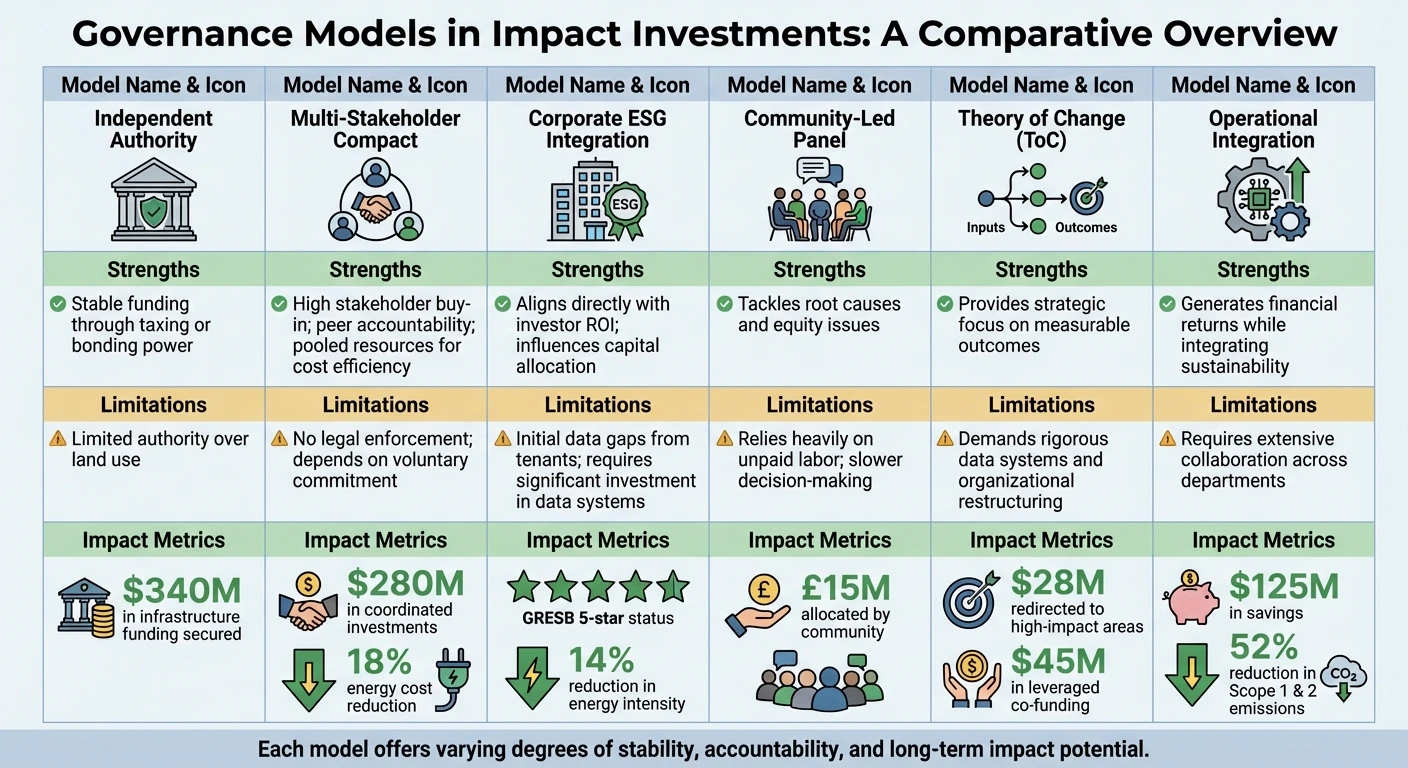
Comparison of Six Governance Models in Impact Investments
Governance Models Comparison Table
Drawing from earlier case studies, the table below highlights key aspects of various governance frameworks in impact investments. These distinctions help organizations identify the governance model that aligns best with their goals.
Governance Model | Strengths | Limitations | Impact Metrics |
|---|---|---|---|
Independent Authority | Stable funding through taxing or bonding power | Limited authority over land use | $340M in infrastructure funding secured [3] |
Multi-Stakeholder Compact | High stakeholder buy-in; peer accountability; pooled resources for cost efficiency | No legal enforcement; depends on voluntary commitment | $280M in coordinated investments; 18% energy cost reduction [5] |
Corporate ESG Integration | Aligns directly with investor ROI; influences capital allocation | Initial data gaps from tenants; requires significant investment in data systems | GRESB 5-star status; 14% reduction in energy intensity [1] |
Community-Led Panel | Tackles root causes and equity issues | Relies heavily on unpaid labor; slower decision-making | £15M allocated by community [10] |
Theory of Change (ToC) | Provides strategic focus on measurable outcomes | Demands rigorous data systems and organizational restructuring | $28M redirected to high-impact areas; $45M in leveraged co-funding [2] |
Operational Integration | Generates financial returns while integrating sustainability | Requires extensive collaboration across departments | $125M in savings; 52% reduction in Scope 1 & 2 emissions [4] |
A recurring theme among the most effective models is their ability to embed impact considerations into existing processes rather than treating them as separate initiatives. For instance, a Commercial REIT managed to boost property data coverage from 38% to 88% within 18 months by incorporating green lease provisions into its operations [1].
These frameworks also diverge in how they distribute power and secure funding, which directly influence their effectiveness. For example, board-led oversight is common in foundations and REITs, while models like the Regenerative Futures Fund prioritize community empowerment [10]. Similarly, regional entities such as the Municipal Resilience Authority use representative boards composed of municipal and county members to ensure a balance of interests [3].
Funding mechanisms further distinguish these models. Independent authorities rely on dedicated fees and bonds for stability [3], whereas multi-stakeholder compacts pool voluntary contributions for shared goals [5]. Corporate models connect sustainability efforts to investor returns and compliance requirements [1]. Each governance style offers varying degrees of stability, accountability, and long-term impact potential, making the choice of framework a critical decision for organizations.
Conclusion: Designing Governance for Long-Term Impact
The case studies make it clear: effective governance isn’t about finding a single “perfect” structure - it’s about embedding impact into daily decision-making processes. For instance, a leading REIT and a major port authority demonstrated that when sustainability becomes a core part of decision-making rather than a separate initiative, it results in measurable financial and environmental benefits [1][4].
These examples highlight the importance of integrated, regionally coordinated governance. The combination of regional coordination and local autonomy consistently outperforms isolated efforts. A coastal county resilience authority, established in February 2026, exemplifies this. By forming a 15-member board representing 12 municipalities, the authority secured $340 million in infrastructure funding within three years. This included $120 million from authority bonds and $85 million in FEMA BRIC grants. Their success lay in addressing watershed-scale challenges while ensuring municipalities retained control over land use [3]. As Council Fire aptly puts it, “Regional problems need regional governance. Municipal-level resilience planning in a shared watershed is inherently incomplete” [3].
The concept of power-shifting and structural equity also drives meaningful outcomes. In Edinburgh, the Regenerative Futures Fund allocated £15 million to a Residents Panel composed of individuals with firsthand experience of poverty and racism. Using the "Three Horizons" framework, the panel made funding decisions that directly addressed systemic inequities [10]. Leah Black, the fund’s lead, explained:
"We're never going to change systems if the people who hold resources, power and influence aren't committed to enabling change themselves" [10].
For those designing governance frameworks, the key lies in starting with tangible wins and addressing gaps in data. One example is a commercial REIT that increased its property-level environmental data coverage from 38% to 88% in just 18 months by introducing green lease provisions requiring tenant data sharing [1]. Early successes - whether through pilot projects or cost savings - help build momentum and long-term organizational commitment. As Council Fire notes, when sustainability delivers measurable financial returns, “it builds organizational commitment that outlasts any individual champion” [4]. The path to lasting success lies in integrating impact into existing processes rather than treating it as an add-on.
FAQs
How do you embed impact goals into everyday investment decisions?
Integrating impact goals into investment strategies means weaving sustainability metrics into key areas like portfolio management, property oversight, and risk evaluation. Real-world examples demonstrate tactics such as aligning with frameworks like the Task Force on Climate-related Financial Disclosures (TCFD), adopting science-based targets, and incorporating ESG factors into governance practices. These steps ensure that impact goals are not just theoretical but actionable, promoting accountability, addressing climate risks, and aligning with investor priorities to drive long-term value.
What impact metrics should governance teams track first?
Governance teams should prioritize tracking metrics that directly connect to tangible outcomes. These include areas like environmental impact, social benefits, and advancements toward sustainability objectives. Focusing on key indicators such as climate risk disclosures, emissions reductions, ecosystem health, and community well-being ensures efforts contribute to broader system-level improvements and foster long-term value.
How can you align stakeholders without slowing decisions?
To bring stakeholders together without slowing down decision-making, it's crucial to set up governance structures that promote transparency and shared objectives. This approach helps minimize conflicts and avoids overlapping efforts. Adopting systems thinking and building partnerships encourages cooperation and leads to broader, system-wide outcomes. By using inclusive frameworks, clearly defining roles, and establishing firm timelines, processes can become more efficient. A good example of this is seen in regional coalitions and resilience authorities, which have successfully coordinated efforts across a variety of groups to achieve their goals.
Related Blog Posts
Latest Articles
©2026

Narrative Change and Power Building: The Missing Half of Advocacy
Narrative change is the process of disrupting dominant narratives that normalize inequity and advancing new narratives from historically marginalized communities.

Funding Resilience Without Federal Grants
BRIC is unreliable and FEMA is shrinking. Here's how cities fund climate resilience with dedicated revenue, blended finance, and a coordinating authority.

The ESG Blind Spot: How AI Is Finding Risks in Companies Nobody Else Is Watching
Norway's sovereign wealth fund uses AI to screen 7,200 portfolio companies for forced labor and corruption within 24 hours. The real story is the emerging-market coverage gap that traditional ESG data vendors miss — and what it means for any company with a global supply chain.
Narrative Change and Power Building: The Missing Half of Advocacy
Narrative change is the process of disrupting dominant narratives that normalize inequity and advancing new narratives from historically marginalized communities.
Funding Resilience Without Federal Grants
BRIC is unreliable and FEMA is shrinking. Here's how cities fund climate resilience with dedicated revenue, blended finance, and a coordinating authority.
The ESG Blind Spot: How AI Is Finding Risks in Companies Nobody Else Is Watching
Norway's sovereign wealth fund uses AI to screen 7,200 portfolio companies for forced labor and corruption within 24 hours. The real story is the emerging-market coverage gap that traditional ESG data vendors miss — and what it means for any company with a global supply chain.
FAQ
01
What does it really mean to “redefine profit”?
02
What makes Council Fire different?
03
Who does Council Fire work with?
04
What does working with Council Fire actually look like?
05
How does Council Fire help organizations turn big goals into action?
06
How does Council Fire define and measure success?
07
How does technology fit into Council Fire’s work?
Apr 9, 2026
Case Studies: Governance in Impact Investments
ESG Strategy
In This Article
Governance models—authority, stakeholder compacts, and ESG integration—enable measurable impact, data-driven decisions, and accountability.
Case Studies: Governance in Impact Investments
Key Takeaways:
Governance in impact investments ensures that financial and environmental goals are seamlessly incorporated into decision-making processes. This article highlights three governance models - PGGM’s climate resilience strategy, McKnight Foundation’s endowment management, and Social Impact Bonds’ collaborative frameworks.
Highlights:
PGGM: Utilizes a multi-layered governance approach, integrating ESG metrics and a Theory of Change framework to monitor investments, achieving a CO2 reduction tracking error of 0.36%.
McKnight Foundation: Aligns a $3 billion endowment with climate and equity goals through structured committees and a net-zero commitment, resulting in $500 million allocated to decarbonization.
Social Impact Bonds: Promotes collaboration among governments, investors, and communities, streamlining regional projects with shared accountability and efficiency.
These examples underline the importance of embedding impact criteria into existing systems, robust data infrastructure, and stakeholder accountability to achieve measurable outcomes.
Case Studies of Governance Models in Impact Investments
PGGM: Governance for Climate Resilience
PGGM, a Dutch pension fund asset manager, has embedded sustainability into every layer of its investment process. In 2016, PGGM and APG co-developed the Sustainable Development Investments (SDI) taxonomy, a standardized framework that allows climate and social investments to be compared across portfolios. This innovation has streamlined the measurement of companies' impact contributions [6].
Their governance model operates through three interconnected layers: investment teams manage ESG integration daily, risk departments conduct parallel ESG risk assessments, and a specialized Responsible Investment team oversees the entire process [7]. According to Rui Chang, an Advisor on the Responsible Investment Team:
"The RI team is the centre of sustainability within PGGM Investments. Our work covers multiple aspects, including ESG integration, stewardship, and impact investing" [7].
PGGM requires that every impact investment demonstrate its potential through a Theory of Change, ensuring measurable outcomes are identified upfront [6]. Active monitoring plays a key role in enforcement. For instance, PGGM responded decisively when satellite data revealed that Brazilian agricultural producer SLC Agricola SA was involved in illegal deforestation, promptly adding the company to its non-inclusion list [7].
The firm’s CO2 reduction strategy, which maintains a tracking error of just 0.36%, shows that strong climate governance can go hand-in-hand with financial stability. Across all ESG integration policies, PGGM maintains a total tracking error of only 0.52%, proving that impact-driven investments don’t have to compromise returns [7].
McKnight Foundation: Embedding Governance in Endowment Management
The McKnight Foundation, managing a $3 billion endowment, uses a structured governance approach to align its investments with its mission [8]. Two key committees lead this effort: the Investment Committee oversees the entire portfolio, while the Mission Investing Committee focuses on ensuring investments support the Foundation's climate and equity goals. Importantly, these committees hold decision-making authority over capital allocation.
In 2021, McKnight updated its Investment Policy Statement to formalize its net-zero commitment. The policy includes a four-part governance plan with interim 2030 targets, investments in climate solutions, engagement requirements for fund managers, and regular progress reviews [8]. To operationalize these goals, the Foundation has worked with its 75+ fund managers to decarbonize holdings and, since 2019, has required all real asset investments to present a "credible sustainability thesis" [8].
This governance framework has delivered significant results. In 2014, McKnight collaborated with Mellon to create a $100 million Carbon Efficiency Strategy fund, which reduced exposure to high-emitting companies while increasing investments in low-emitting ones. By 2017, the Foundation had eliminated coal and oil sands investments from its separately managed accounts [8]. As of 2021, over 40% of the endowment aligns with its mission, with $500 million allocated specifically to decarbonizing the economy [8]. Ted Staryk, Chair of the Mission Investing Committee, highlights the benefits:
"We have seen how bold, market-rate investments in climate solutions have spurred innovation, grown our endowment, and allowed us to increase our grantmaking" [8].
Social Impact Bonds: Governance Enabling Collaboration
Social Impact Bonds (SIBs) introduce a multi-stakeholder governance model that emphasizes collaboration and accountability. These frameworks bring together governments, investors, service providers, and beneficiaries, creating a structure where all parties share responsibility for outcomes. The most effective SIB models establish an independent public entity with its own board and bonding authority, enabling it to implement projects with greater efficiency than traditional government offices [3].
For regional projects, representative boards are particularly effective. For instance, when 12 municipalities collaborate on infrastructure, a governance board with representatives from each jurisdiction, along with independent experts, ensures regional alignment while respecting local autonomy [3]. These boards often rely on interlocal agreements, legal tools that allow a central authority to manage projects and distribute funds across jurisdictions without requiring each municipality to duplicate administrative functions [3]. This approach balances community-level decision-making with the scale required for impactful outcomes.
Lessons from Governance Practices
Common Elements of Successful Governance
The case studies highlight a recurring theme: the most effective governance models weave impact criteria seamlessly into existing processes rather than treating sustainability as an isolated initiative. For example, many REITs have embraced this approach by embedding ESG metrics into their standard investment workflows. This shift redefines sustainability from a compliance checkbox to a core component of operational management.
A robust data infrastructure is essential for governance success. Organizations that adopt standardized measurement systems - such as GRESB benchmarking and automated utility feeds - transform reporting from a regulatory obligation into a practical tool for management and decision-making.
Accountability is another cornerstone of effective governance, often achieved through representative stakeholder structures rather than legal mandates. One example is a regional climate compact that brought together 35 organizations across three counties. A 12-person steering committee facilitated collaboration between passionate advocates and cautious participants, resulting in $280 million in coordinated investments. This initiative also led to the creation of a clean energy procurement program, saving participants $12 million annually [5].
Dedicated funding mechanisms ensure governance initiatives aren't sidelined during budget cycles. For instance, a coastal county with 12 municipalities established an independent resilience authority with taxing powers. This authority generated $14 million annually through a dedicated fee and secured $340 million in infrastructure funding over three years [3]. However, even the most well-designed governance systems must navigate challenges like stakeholder complexity and data gaps.
Overcoming Governance Challenges
While successful governance models offer valuable lessons, they also face persistent challenges that require thoughtful strategies. One major hurdle is aligning diverse stakeholder interests. As Council Fire's research advises: "Start with trust, not targets" [5]. In one regional climate compact, relationship-building took precedence over formal commitments. Through one-on-one interviews, shared goals emerged, fostering collaboration. Leah Black of the Regenerative Futures Fund aptly noted:
"Moving faster can damage relationships. You need to hold your nerve" [10].
Addressing data gaps early is another critical step to avoid decision-making bottlenecks. For example, real estate investors often encounter a "split incentive" issue where landlords lack access to tenant energy consumption data. Green lease provisions requiring data sharing and automated utility feeds helped one REIT overcome this obstacle, resulting in a 14% reduction in portfolio energy intensity [1]. This underscores the importance of operational design in effective governance.
Timing also plays a role in overcoming challenges. An East Coast port authority synchronized equipment electrification with natural asset replacement cycles, cutting per-unit energy costs by 65% compared to diesel alternatives and saving $48 million in diesel fuel costs over five years [4].
Structural equity is another critical element, ensuring underserved communities have a voice in governance. One port authority tackled this by creating a Community Advisory Panel with representatives from nearby neighborhoods and labor unions. This group supported a community benefits agreement that allocated $8 million for workforce development and health monitoring while reducing PM2.5 pollution by 31% [4].
Finally, combining value streams can overcome resistance and build economic incentives for sustainability. A Midwestern farming cooperative achieved 63% member participation (285 of 450 members) within 18 months by offering multiple revenue sources - premium payments of $0.15–$0.25 per bushel and $12–$18 per acre in ecosystem service payments. By delivering tangible financial returns, the cooperative fostered lasting organizational commitment to sustainability [9][4].
These strategies demonstrate how aligning financial incentives, operational design, and stakeholder engagement can create governance systems that drive meaningful, long-term outcomes.
Impact Investing is Growing Up: New Guidance for Asset Allocators
Comparison of Governance Frameworks
Comparison of Six Governance Models in Impact Investments
Governance Models Comparison Table
Drawing from earlier case studies, the table below highlights key aspects of various governance frameworks in impact investments. These distinctions help organizations identify the governance model that aligns best with their goals.
Governance Model | Strengths | Limitations | Impact Metrics |
|---|---|---|---|
Independent Authority | Stable funding through taxing or bonding power | Limited authority over land use | $340M in infrastructure funding secured [3] |
Multi-Stakeholder Compact | High stakeholder buy-in; peer accountability; pooled resources for cost efficiency | No legal enforcement; depends on voluntary commitment | $280M in coordinated investments; 18% energy cost reduction [5] |
Corporate ESG Integration | Aligns directly with investor ROI; influences capital allocation | Initial data gaps from tenants; requires significant investment in data systems | GRESB 5-star status; 14% reduction in energy intensity [1] |
Community-Led Panel | Tackles root causes and equity issues | Relies heavily on unpaid labor; slower decision-making | £15M allocated by community [10] |
Theory of Change (ToC) | Provides strategic focus on measurable outcomes | Demands rigorous data systems and organizational restructuring | $28M redirected to high-impact areas; $45M in leveraged co-funding [2] |
Operational Integration | Generates financial returns while integrating sustainability | Requires extensive collaboration across departments | $125M in savings; 52% reduction in Scope 1 & 2 emissions [4] |
A recurring theme among the most effective models is their ability to embed impact considerations into existing processes rather than treating them as separate initiatives. For instance, a Commercial REIT managed to boost property data coverage from 38% to 88% within 18 months by incorporating green lease provisions into its operations [1].
These frameworks also diverge in how they distribute power and secure funding, which directly influence their effectiveness. For example, board-led oversight is common in foundations and REITs, while models like the Regenerative Futures Fund prioritize community empowerment [10]. Similarly, regional entities such as the Municipal Resilience Authority use representative boards composed of municipal and county members to ensure a balance of interests [3].
Funding mechanisms further distinguish these models. Independent authorities rely on dedicated fees and bonds for stability [3], whereas multi-stakeholder compacts pool voluntary contributions for shared goals [5]. Corporate models connect sustainability efforts to investor returns and compliance requirements [1]. Each governance style offers varying degrees of stability, accountability, and long-term impact potential, making the choice of framework a critical decision for organizations.
Conclusion: Designing Governance for Long-Term Impact
The case studies make it clear: effective governance isn’t about finding a single “perfect” structure - it’s about embedding impact into daily decision-making processes. For instance, a leading REIT and a major port authority demonstrated that when sustainability becomes a core part of decision-making rather than a separate initiative, it results in measurable financial and environmental benefits [1][4].
These examples highlight the importance of integrated, regionally coordinated governance. The combination of regional coordination and local autonomy consistently outperforms isolated efforts. A coastal county resilience authority, established in February 2026, exemplifies this. By forming a 15-member board representing 12 municipalities, the authority secured $340 million in infrastructure funding within three years. This included $120 million from authority bonds and $85 million in FEMA BRIC grants. Their success lay in addressing watershed-scale challenges while ensuring municipalities retained control over land use [3]. As Council Fire aptly puts it, “Regional problems need regional governance. Municipal-level resilience planning in a shared watershed is inherently incomplete” [3].
The concept of power-shifting and structural equity also drives meaningful outcomes. In Edinburgh, the Regenerative Futures Fund allocated £15 million to a Residents Panel composed of individuals with firsthand experience of poverty and racism. Using the "Three Horizons" framework, the panel made funding decisions that directly addressed systemic inequities [10]. Leah Black, the fund’s lead, explained:
"We're never going to change systems if the people who hold resources, power and influence aren't committed to enabling change themselves" [10].
For those designing governance frameworks, the key lies in starting with tangible wins and addressing gaps in data. One example is a commercial REIT that increased its property-level environmental data coverage from 38% to 88% in just 18 months by introducing green lease provisions requiring tenant data sharing [1]. Early successes - whether through pilot projects or cost savings - help build momentum and long-term organizational commitment. As Council Fire notes, when sustainability delivers measurable financial returns, “it builds organizational commitment that outlasts any individual champion” [4]. The path to lasting success lies in integrating impact into existing processes rather than treating it as an add-on.
FAQs
How do you embed impact goals into everyday investment decisions?
Integrating impact goals into investment strategies means weaving sustainability metrics into key areas like portfolio management, property oversight, and risk evaluation. Real-world examples demonstrate tactics such as aligning with frameworks like the Task Force on Climate-related Financial Disclosures (TCFD), adopting science-based targets, and incorporating ESG factors into governance practices. These steps ensure that impact goals are not just theoretical but actionable, promoting accountability, addressing climate risks, and aligning with investor priorities to drive long-term value.
What impact metrics should governance teams track first?
Governance teams should prioritize tracking metrics that directly connect to tangible outcomes. These include areas like environmental impact, social benefits, and advancements toward sustainability objectives. Focusing on key indicators such as climate risk disclosures, emissions reductions, ecosystem health, and community well-being ensures efforts contribute to broader system-level improvements and foster long-term value.
How can you align stakeholders without slowing decisions?
To bring stakeholders together without slowing down decision-making, it's crucial to set up governance structures that promote transparency and shared objectives. This approach helps minimize conflicts and avoids overlapping efforts. Adopting systems thinking and building partnerships encourages cooperation and leads to broader, system-wide outcomes. By using inclusive frameworks, clearly defining roles, and establishing firm timelines, processes can become more efficient. A good example of this is seen in regional coalitions and resilience authorities, which have successfully coordinated efforts across a variety of groups to achieve their goals.
Related Blog Posts
Latest Articles
©2026
Narrative Change and Power Building: The Missing Half of Advocacy
Narrative change is the process of disrupting dominant narratives that normalize inequity and advancing new narratives from historically marginalized communities.
Funding Resilience Without Federal Grants
BRIC is unreliable and FEMA is shrinking. Here's how cities fund climate resilience with dedicated revenue, blended finance, and a coordinating authority.
The ESG Blind Spot: How AI Is Finding Risks in Companies Nobody Else Is Watching
Norway's sovereign wealth fund uses AI to screen 7,200 portfolio companies for forced labor and corruption within 24 hours. The real story is the emerging-market coverage gap that traditional ESG data vendors miss — and what it means for any company with a global supply chain.
FAQ
01
What does it really mean to “redefine profit”?
02
What makes Council Fire different?
03
Who does Council Fire work with?
04
What does working with Council Fire actually look like?
05
How does Council Fire help organizations turn big goals into action?
06
How does Council Fire define and measure success?
07
How does technology fit into Council Fire’s work?
Apr 9, 2026
Case Studies: Governance in Impact Investments
ESG Strategy
In This Article
Governance models—authority, stakeholder compacts, and ESG integration—enable measurable impact, data-driven decisions, and accountability.
Case Studies: Governance in Impact Investments
Key Takeaways:
Governance in impact investments ensures that financial and environmental goals are seamlessly incorporated into decision-making processes. This article highlights three governance models - PGGM’s climate resilience strategy, McKnight Foundation’s endowment management, and Social Impact Bonds’ collaborative frameworks.
Highlights:
PGGM: Utilizes a multi-layered governance approach, integrating ESG metrics and a Theory of Change framework to monitor investments, achieving a CO2 reduction tracking error of 0.36%.
McKnight Foundation: Aligns a $3 billion endowment with climate and equity goals through structured committees and a net-zero commitment, resulting in $500 million allocated to decarbonization.
Social Impact Bonds: Promotes collaboration among governments, investors, and communities, streamlining regional projects with shared accountability and efficiency.
These examples underline the importance of embedding impact criteria into existing systems, robust data infrastructure, and stakeholder accountability to achieve measurable outcomes.
Case Studies of Governance Models in Impact Investments
PGGM: Governance for Climate Resilience
PGGM, a Dutch pension fund asset manager, has embedded sustainability into every layer of its investment process. In 2016, PGGM and APG co-developed the Sustainable Development Investments (SDI) taxonomy, a standardized framework that allows climate and social investments to be compared across portfolios. This innovation has streamlined the measurement of companies' impact contributions [6].
Their governance model operates through three interconnected layers: investment teams manage ESG integration daily, risk departments conduct parallel ESG risk assessments, and a specialized Responsible Investment team oversees the entire process [7]. According to Rui Chang, an Advisor on the Responsible Investment Team:
"The RI team is the centre of sustainability within PGGM Investments. Our work covers multiple aspects, including ESG integration, stewardship, and impact investing" [7].
PGGM requires that every impact investment demonstrate its potential through a Theory of Change, ensuring measurable outcomes are identified upfront [6]. Active monitoring plays a key role in enforcement. For instance, PGGM responded decisively when satellite data revealed that Brazilian agricultural producer SLC Agricola SA was involved in illegal deforestation, promptly adding the company to its non-inclusion list [7].
The firm’s CO2 reduction strategy, which maintains a tracking error of just 0.36%, shows that strong climate governance can go hand-in-hand with financial stability. Across all ESG integration policies, PGGM maintains a total tracking error of only 0.52%, proving that impact-driven investments don’t have to compromise returns [7].
McKnight Foundation: Embedding Governance in Endowment Management
The McKnight Foundation, managing a $3 billion endowment, uses a structured governance approach to align its investments with its mission [8]. Two key committees lead this effort: the Investment Committee oversees the entire portfolio, while the Mission Investing Committee focuses on ensuring investments support the Foundation's climate and equity goals. Importantly, these committees hold decision-making authority over capital allocation.
In 2021, McKnight updated its Investment Policy Statement to formalize its net-zero commitment. The policy includes a four-part governance plan with interim 2030 targets, investments in climate solutions, engagement requirements for fund managers, and regular progress reviews [8]. To operationalize these goals, the Foundation has worked with its 75+ fund managers to decarbonize holdings and, since 2019, has required all real asset investments to present a "credible sustainability thesis" [8].
This governance framework has delivered significant results. In 2014, McKnight collaborated with Mellon to create a $100 million Carbon Efficiency Strategy fund, which reduced exposure to high-emitting companies while increasing investments in low-emitting ones. By 2017, the Foundation had eliminated coal and oil sands investments from its separately managed accounts [8]. As of 2021, over 40% of the endowment aligns with its mission, with $500 million allocated specifically to decarbonizing the economy [8]. Ted Staryk, Chair of the Mission Investing Committee, highlights the benefits:
"We have seen how bold, market-rate investments in climate solutions have spurred innovation, grown our endowment, and allowed us to increase our grantmaking" [8].
Social Impact Bonds: Governance Enabling Collaboration
Social Impact Bonds (SIBs) introduce a multi-stakeholder governance model that emphasizes collaboration and accountability. These frameworks bring together governments, investors, service providers, and beneficiaries, creating a structure where all parties share responsibility for outcomes. The most effective SIB models establish an independent public entity with its own board and bonding authority, enabling it to implement projects with greater efficiency than traditional government offices [3].
For regional projects, representative boards are particularly effective. For instance, when 12 municipalities collaborate on infrastructure, a governance board with representatives from each jurisdiction, along with independent experts, ensures regional alignment while respecting local autonomy [3]. These boards often rely on interlocal agreements, legal tools that allow a central authority to manage projects and distribute funds across jurisdictions without requiring each municipality to duplicate administrative functions [3]. This approach balances community-level decision-making with the scale required for impactful outcomes.
Lessons from Governance Practices
Common Elements of Successful Governance
The case studies highlight a recurring theme: the most effective governance models weave impact criteria seamlessly into existing processes rather than treating sustainability as an isolated initiative. For example, many REITs have embraced this approach by embedding ESG metrics into their standard investment workflows. This shift redefines sustainability from a compliance checkbox to a core component of operational management.
A robust data infrastructure is essential for governance success. Organizations that adopt standardized measurement systems - such as GRESB benchmarking and automated utility feeds - transform reporting from a regulatory obligation into a practical tool for management and decision-making.
Accountability is another cornerstone of effective governance, often achieved through representative stakeholder structures rather than legal mandates. One example is a regional climate compact that brought together 35 organizations across three counties. A 12-person steering committee facilitated collaboration between passionate advocates and cautious participants, resulting in $280 million in coordinated investments. This initiative also led to the creation of a clean energy procurement program, saving participants $12 million annually [5].
Dedicated funding mechanisms ensure governance initiatives aren't sidelined during budget cycles. For instance, a coastal county with 12 municipalities established an independent resilience authority with taxing powers. This authority generated $14 million annually through a dedicated fee and secured $340 million in infrastructure funding over three years [3]. However, even the most well-designed governance systems must navigate challenges like stakeholder complexity and data gaps.
Overcoming Governance Challenges
While successful governance models offer valuable lessons, they also face persistent challenges that require thoughtful strategies. One major hurdle is aligning diverse stakeholder interests. As Council Fire's research advises: "Start with trust, not targets" [5]. In one regional climate compact, relationship-building took precedence over formal commitments. Through one-on-one interviews, shared goals emerged, fostering collaboration. Leah Black of the Regenerative Futures Fund aptly noted:
"Moving faster can damage relationships. You need to hold your nerve" [10].
Addressing data gaps early is another critical step to avoid decision-making bottlenecks. For example, real estate investors often encounter a "split incentive" issue where landlords lack access to tenant energy consumption data. Green lease provisions requiring data sharing and automated utility feeds helped one REIT overcome this obstacle, resulting in a 14% reduction in portfolio energy intensity [1]. This underscores the importance of operational design in effective governance.
Timing also plays a role in overcoming challenges. An East Coast port authority synchronized equipment electrification with natural asset replacement cycles, cutting per-unit energy costs by 65% compared to diesel alternatives and saving $48 million in diesel fuel costs over five years [4].
Structural equity is another critical element, ensuring underserved communities have a voice in governance. One port authority tackled this by creating a Community Advisory Panel with representatives from nearby neighborhoods and labor unions. This group supported a community benefits agreement that allocated $8 million for workforce development and health monitoring while reducing PM2.5 pollution by 31% [4].
Finally, combining value streams can overcome resistance and build economic incentives for sustainability. A Midwestern farming cooperative achieved 63% member participation (285 of 450 members) within 18 months by offering multiple revenue sources - premium payments of $0.15–$0.25 per bushel and $12–$18 per acre in ecosystem service payments. By delivering tangible financial returns, the cooperative fostered lasting organizational commitment to sustainability [9][4].
These strategies demonstrate how aligning financial incentives, operational design, and stakeholder engagement can create governance systems that drive meaningful, long-term outcomes.
Impact Investing is Growing Up: New Guidance for Asset Allocators
Comparison of Governance Frameworks
Comparison of Six Governance Models in Impact Investments
Governance Models Comparison Table
Drawing from earlier case studies, the table below highlights key aspects of various governance frameworks in impact investments. These distinctions help organizations identify the governance model that aligns best with their goals.
Governance Model | Strengths | Limitations | Impact Metrics |
|---|---|---|---|
Independent Authority | Stable funding through taxing or bonding power | Limited authority over land use | $340M in infrastructure funding secured [3] |
Multi-Stakeholder Compact | High stakeholder buy-in; peer accountability; pooled resources for cost efficiency | No legal enforcement; depends on voluntary commitment | $280M in coordinated investments; 18% energy cost reduction [5] |
Corporate ESG Integration | Aligns directly with investor ROI; influences capital allocation | Initial data gaps from tenants; requires significant investment in data systems | GRESB 5-star status; 14% reduction in energy intensity [1] |
Community-Led Panel | Tackles root causes and equity issues | Relies heavily on unpaid labor; slower decision-making | £15M allocated by community [10] |
Theory of Change (ToC) | Provides strategic focus on measurable outcomes | Demands rigorous data systems and organizational restructuring | $28M redirected to high-impact areas; $45M in leveraged co-funding [2] |
Operational Integration | Generates financial returns while integrating sustainability | Requires extensive collaboration across departments | $125M in savings; 52% reduction in Scope 1 & 2 emissions [4] |
A recurring theme among the most effective models is their ability to embed impact considerations into existing processes rather than treating them as separate initiatives. For instance, a Commercial REIT managed to boost property data coverage from 38% to 88% within 18 months by incorporating green lease provisions into its operations [1].
These frameworks also diverge in how they distribute power and secure funding, which directly influence their effectiveness. For example, board-led oversight is common in foundations and REITs, while models like the Regenerative Futures Fund prioritize community empowerment [10]. Similarly, regional entities such as the Municipal Resilience Authority use representative boards composed of municipal and county members to ensure a balance of interests [3].
Funding mechanisms further distinguish these models. Independent authorities rely on dedicated fees and bonds for stability [3], whereas multi-stakeholder compacts pool voluntary contributions for shared goals [5]. Corporate models connect sustainability efforts to investor returns and compliance requirements [1]. Each governance style offers varying degrees of stability, accountability, and long-term impact potential, making the choice of framework a critical decision for organizations.
Conclusion: Designing Governance for Long-Term Impact
The case studies make it clear: effective governance isn’t about finding a single “perfect” structure - it’s about embedding impact into daily decision-making processes. For instance, a leading REIT and a major port authority demonstrated that when sustainability becomes a core part of decision-making rather than a separate initiative, it results in measurable financial and environmental benefits [1][4].
These examples highlight the importance of integrated, regionally coordinated governance. The combination of regional coordination and local autonomy consistently outperforms isolated efforts. A coastal county resilience authority, established in February 2026, exemplifies this. By forming a 15-member board representing 12 municipalities, the authority secured $340 million in infrastructure funding within three years. This included $120 million from authority bonds and $85 million in FEMA BRIC grants. Their success lay in addressing watershed-scale challenges while ensuring municipalities retained control over land use [3]. As Council Fire aptly puts it, “Regional problems need regional governance. Municipal-level resilience planning in a shared watershed is inherently incomplete” [3].
The concept of power-shifting and structural equity also drives meaningful outcomes. In Edinburgh, the Regenerative Futures Fund allocated £15 million to a Residents Panel composed of individuals with firsthand experience of poverty and racism. Using the "Three Horizons" framework, the panel made funding decisions that directly addressed systemic inequities [10]. Leah Black, the fund’s lead, explained:
"We're never going to change systems if the people who hold resources, power and influence aren't committed to enabling change themselves" [10].
For those designing governance frameworks, the key lies in starting with tangible wins and addressing gaps in data. One example is a commercial REIT that increased its property-level environmental data coverage from 38% to 88% in just 18 months by introducing green lease provisions requiring tenant data sharing [1]. Early successes - whether through pilot projects or cost savings - help build momentum and long-term organizational commitment. As Council Fire notes, when sustainability delivers measurable financial returns, “it builds organizational commitment that outlasts any individual champion” [4]. The path to lasting success lies in integrating impact into existing processes rather than treating it as an add-on.
FAQs
How do you embed impact goals into everyday investment decisions?
Integrating impact goals into investment strategies means weaving sustainability metrics into key areas like portfolio management, property oversight, and risk evaluation. Real-world examples demonstrate tactics such as aligning with frameworks like the Task Force on Climate-related Financial Disclosures (TCFD), adopting science-based targets, and incorporating ESG factors into governance practices. These steps ensure that impact goals are not just theoretical but actionable, promoting accountability, addressing climate risks, and aligning with investor priorities to drive long-term value.
What impact metrics should governance teams track first?
Governance teams should prioritize tracking metrics that directly connect to tangible outcomes. These include areas like environmental impact, social benefits, and advancements toward sustainability objectives. Focusing on key indicators such as climate risk disclosures, emissions reductions, ecosystem health, and community well-being ensures efforts contribute to broader system-level improvements and foster long-term value.
How can you align stakeholders without slowing decisions?
To bring stakeholders together without slowing down decision-making, it's crucial to set up governance structures that promote transparency and shared objectives. This approach helps minimize conflicts and avoids overlapping efforts. Adopting systems thinking and building partnerships encourages cooperation and leads to broader, system-wide outcomes. By using inclusive frameworks, clearly defining roles, and establishing firm timelines, processes can become more efficient. A good example of this is seen in regional coalitions and resilience authorities, which have successfully coordinated efforts across a variety of groups to achieve their goals.
Related Blog Posts
Latest Articles
©2026
Narrative Change and Power Building: The Missing Half of Advocacy
Narrative change is the process of disrupting dominant narratives that normalize inequity and advancing new narratives from historically marginalized communities.
Funding Resilience Without Federal Grants
BRIC is unreliable and FEMA is shrinking. Here's how cities fund climate resilience with dedicated revenue, blended finance, and a coordinating authority.
The ESG Blind Spot: How AI Is Finding Risks in Companies Nobody Else Is Watching
Norway's sovereign wealth fund uses AI to screen 7,200 portfolio companies for forced labor and corruption within 24 hours. The real story is the emerging-market coverage gap that traditional ESG data vendors miss — and what it means for any company with a global supply chain.
FAQ
What does it really mean to “redefine profit”?
What makes Council Fire different?
Who does Council Fire work with?
What does working with Council Fire actually look like?
How does Council Fire help organizations turn big goals into action?
How does Council Fire define and measure success?
How does technology fit into Council Fire’s work?