
May 31, 2026
How to Turn a Strategic Plan into Fundable, Shovel-Ready Projects for NGOs & Nonprofits
Capacity Building
In This Article
Convert strategy into fundable, shovel-ready NGO projects with SMART goals, detailed budgets, M&E, and donor-fit scoring.
How to Turn a Strategic Plan into Fundable, Shovel-Ready Projects for NGOs & Nonprofits
Most nonprofits struggle to turn plans into real, fundable projects. Over 60% of strategic plans fail in execution - not due to bad ideas but because organizations don’t bridge the gap between vision and action. The solution? Build "shovel-ready" projects: fully planned initiatives ready to launch once funding is secured. These projects reduce funder risk, improve proposal success rates (10–30%), and ensure your resources are aligned with measurable outcomes.
Key Steps to Success:
Define Clear Goals: Use SMART criteria (Specific, Measurable, Achievable, Relevant, Time-bound) to set precise objectives.
Prioritize Projects: Evaluate ideas using scoring systems to focus on high-impact, fundable initiatives.
Prepare Documentation: Create detailed budgets, risk plans, and project charters to show readiness.
Align with Funders: Research donors’ past actions and priorities to match your project with the right funding opportunity.
Strengthen Governance: Ensure roles, systems, and partnerships are in place for immediate execution.
Why It Matters: Funders prioritize readiness, alignment with community needs, and measurable results. By focusing on these areas, nonprofits can increase funding chances and create lasting impact.
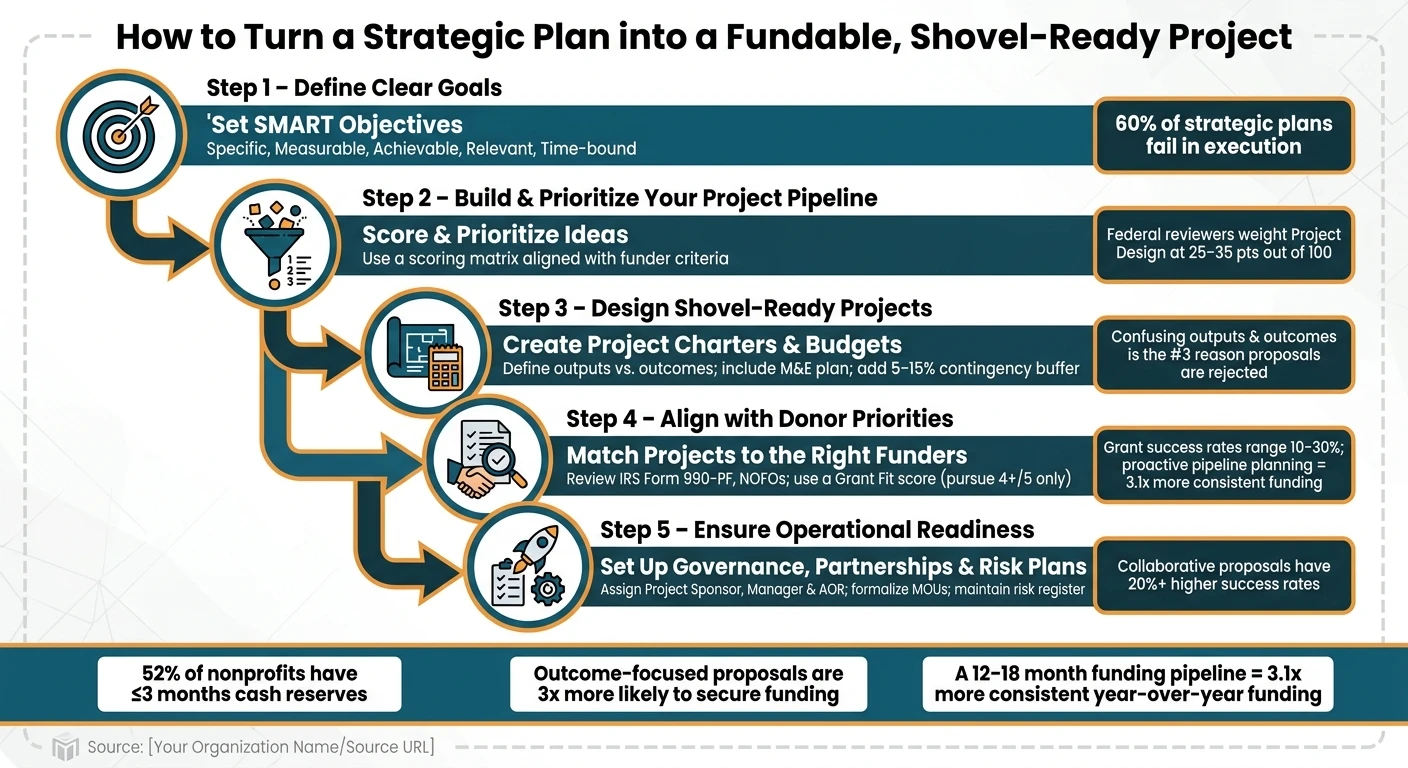
How to Build a Shovel-Ready Nonprofit Project: 5 Key Steps
Translating Strategic Plans into Actionable Project Concepts
Clarifying Goals, Outcomes, and Constraints
To turn a strategic vision into reality, start by defining success with clear, measurable objectives. Vague goals like "improve community health outcomes" provide direction but lack the precision needed for effective planning. Instead, use SMART criteria - Specific, Measurable, Achievable, Relevant, and Time-bound. For instance, a goal like "increase reading proficiency by 25% among 200 students by June 2026" gives your team a concrete target to aim for [9]. This clarity not only streamlines internal planning but also strengthens your proposals when seeking funding.
It's equally important to factor in practical constraints. Consider that 52% of nonprofits operate with just three months or less of cash reserves [5]. An ambitious project requiring extensive upfront staffing might not be realistic if your organization lacks the financial cushion to support it. Balancing ambition with current resources - like staffing, funding, and operational capacity - sets the stage for feasible project development [8].
With well-defined goals and a clear understanding of limitations, you can begin shaping project ideas using structured frameworks.
Building a Structured Project Pipeline
Once you've clarified your objectives, develop project concepts with focus and precision. Start with the 1-1-1 framework, which helps anchor ideas by identifying 1 target group, 1 main problem, and 1 main solution [7]. This approach keeps your early-stage ideas from ballooning in scope before the project is fully designed. Complement this with the P.E.A.R. framework, which emphasizes:
Population served
Evidence supporting the need
Area where the problem exists
Reality of the problem on the ground [7]
Together, these tools transform abstract strategies into concrete, evidence-based project proposals. They provide the foundation for turning broad intentions into detailed funding cases that resonate with stakeholders.
Once your project ideas are well-structured, the next step is to evaluate and prioritize them effectively.
Prioritizing High-Impact, Fundable Projects
With multiple project concepts on the table, focus on identifying those with the highest potential impact. A scoring matrix can help you assess each idea before committing resources to full proposals. Federal funding reviewers, for example, often use criteria weighted as follows [6]:
Criterion | Typical Points (Federal) | What Reviewers Look For |
|---|---|---|
Need/Problem Statement | 20–30 | Data quality, severity, and local specificity |
Project Design | 25–35 | Evidence base, specificity, and logic model |
Evaluation Plan | 15–20 | Measurability, rigor, and data plan |
Organizational Capacity | 15–20 | Track record, staff qualifications, and systems |
Budget | 10–15 | Accuracy, allowability, and justification |
Apply a similar evaluation process internally. For example, if a project scores poorly on "organizational capacity" because your team lacks the expertise or systems to execute it, this signals a need to either build capacity first or prioritize other projects. As Tulip MC highlights:
"The donor's question is... 'Given everything I have to consider... is this the project I should fund?' The merit of the mission is necessary but not sufficient." [12]
Organizations that plan proactively by creating a 12–18 month funding pipeline - instead of chasing grants reactively - are 3.1 times more likely to achieve consistent year-over-year funding compared to those relying on ad-hoc applications [10]. This structured approach ensures you're not only prepared but also strategically positioned to secure the resources needed for impactful projects.
Designing Shovel-Ready Projects
Defining Scope and Implementation Plans
To turn your prioritized ideas into actionable projects, start with a clear, detailed project charter. This document should outline your objectives, define the geographic area of focus, describe the specific activities to be undertaken, and create a phased timeline that aligns with your organization's capacity to deliver.
It's essential to distinguish between outputs and outcomes in your plan. Outputs document the activities performed, while outcomes represent the measurable changes resulting from those activities - something funders prioritize. For instance, "held 50 workshops" is an output, but "85% of participants gained stable housing" is an outcome. Mixing these up is the #3 most common reason proposals are rejected [2].
"A clear project document is essential for project success, and is the best entry point for fundraising and partnership building." - ITCILO [16]
Once the scope and activities are clear, the next critical step is developing a transparent and detailed financial plan.
Budgeting and Resource Planning
A well-constructed budget serves as a narrative for your project, linking every cost to specific activities. Break down expenses into units, quantities, and rates to ensure clarity for auditors and reviewers [13][14]. This level of detail demonstrates that your project is ready for funding.
Organize your budget according to federal cost categories: Personnel, Fringe Benefits, Travel, Equipment, Supplies, Contractual, Other Direct Costs, and Indirect Costs. Note that the 2024 Uniform Guidance revision increased the equipment threshold to $10,000 per unit [14]. For travel, use GSA.gov per diem rates for lodging and meals [14]. If your organization doesn’t have a Negotiated Indirect Cost Rate Agreement (NICRA), you can apply the 15% de minimis indirect cost rate [14].
"A grant budget should be reviewed as a work plan in dollars, not as a spreadsheet exercise." - Grantsights [14]
Include a contingency buffer: 5–10% for stable environments and 10–15% for higher-risk situations [13]. Additionally, align your spending plan with donor payment schedules to avoid cash flow issues:
"Cash does not arrive because you need it; it arrives because you hit a milestone." - CFO Bridge [13]
With a solid budget in place, the next step is integrating monitoring and evaluation to validate the project's impact.
Embedding Monitoring and Evaluation
A strong monitoring and evaluation (M&E) plan can make or break your funding chances. Federal reviewers often allocate 15–20 points out of 100 to the evaluation plan [6], and agencies like HHS and DOJ consistently penalize budgets that allocate $0 for evaluation [6].
M&E doesn’t have to be costly. By using tools like structured spreadsheets and basic survey platforms, evaluation costs can be kept under 0.05% of the total program budget while still yielding credible results [2]. During the design phase, establish your indicators, baselines, and data collection methods. This preparation ensures you're ready to report results promptly when new funding opportunities arise. Aim for quarterly check-ins to keep your data current and actionable [3].
"Funders aren't just buying your story. They're buying confidence that your organization can manage the money, deliver the program, and report the impact." - Flanagan Samoine, GrantSmarts [3]
Nonprofit Grant Strategy 2026: From Preparation to Winning Approval
Aligning Projects with Donor Priorities
Once your project is prioritized, the next step is ensuring it aligns with donor priorities.
Researching Donor Priorities and Criteria
A project’s success often depends on presenting it to the right funder. Before drafting a proposal, take the time to thoroughly research potential donors.
The best indicator of a funder’s priorities isn’t their website - it’s their past actions. For private foundations, examining their IRS Form 990-PF can reveal key details about their funding history, including the recipients, amounts, and purposes of their grants. This giving history often speaks louder than stated priorities [18].
"A well-matched proposal to the right funder will almost always outperform a beautifully written proposal sent to the wrong one. Fit isn't a nice-to-have. It's the precondition for everything else." - The Grantsmanship Center [18]
For federal grants, carefully review the Notice of Funding Opportunity (NOFO). This document outlines how proposals are scored, with points typically allocated as follows: 20–30 points for the needs statement and 25–35 points for project design [6]. Use this scoring system to guide how you allocate space in your narrative. If possible, schedule a brief call with a program officer to confirm your project’s alignment with the funder’s priorities, especially regarding geography or scope [6].
To streamline the process, consider implementing a "Grant Fit" scoring system. Rate each opportunity from 1 to 5 based on criteria like mission alignment, legal eligibility, delivery capacity, data availability, and budget feasibility. Pursue only those opportunities that score an average of 4 or higher [19][20]. This method helps conserve your team’s energy, which is critical given that grant success rates often range between 10% and 30% [11].
This groundwork lays the foundation for matching your project to the right funding mechanism.
Matching Projects to Funding Mechanisms
Once you’ve identified a potential funder, it’s important to select the appropriate funding mechanism for your project.
Here’s a comparison of two common mechanisms:
Feature | Multilateral Grants | Procurement Contracts |
|---|---|---|
Primary Goal | Support NGO's independent project | Purchase specific goods/services for donor |
Flexibility | Higher; NGO defines methodology | Low; donor sets exact specifications |
Evaluation | Narrative fit and programmatic quality | Often "lowest substantive bid" |
Payment | Often advanced or milestone-based | Typically in arrears (invoice-based) |
Beyond choosing the right mechanism, confirm your legal eligibility. Even if a project aligns thematically, it may still be disqualified if your organization’s type, registration country, or project location doesn’t meet the donor’s requirements [20]. Ask yourself: Are we legally eligible? Can we score competitively? Do we have the resources to deliver? [20]
Building a Strong Case for Support
Once you’ve aligned your project with donor priorities and selected the right mechanism, the next step is crafting a compelling proposal. A strong proposal follows a clear structure: an engaging executive summary, a needs statement based on local data, a project description with SMART objectives, an evaluation plan, and a budget tied directly to the narrative [22][6].
"The difference between proposals that win and those that don't usually isn't writing quality. It's proposal architecture: understanding what information belongs where, how sections connect, and what the reviewer needs." - GrantSights [6]
Start with the community problem - not your organization. Use specific, localized data and, when possible, include an individual’s story to make the needs statement resonate. Reviewers are often more moved by a vivid, relatable example than by abstract statistics alone [19][11]. Then, back this story with hard evidence to create a lasting impression.
Your organization’s credibility is just as important as the project itself. Highlight your staff’s qualifications, your board’s governance, and your track record with similar grants [23][17]. Multilateral donors, in particular, value audit readiness and prefer organizations that can withstand fiduciary reviews [21]. Finally, conclude your proposal with a sustainability plan that explains how the project will continue after the grant period ends. This could involve earned income, individual donors, or additional funding sources [23][17].
Getting Projects Ready to Launch
Once you’ve nailed down your project design and aligned it with donor priorities, the next step is ensuring everything is in place to hit the ground running. With a strong proposal and donor support secured, the focus shifts to operational readiness. Funding can come through quickly, and having internal systems prepared in advance can prevent unnecessary delays.
Setting Up Governance and Decision-Making Structures
Clear governance structures are essential to avoid delays during launch. Before starting implementation, assign key roles to ensure smooth oversight and execution. These include a Project Sponsor for executive oversight, a Project Manager for day-to-day operations, and, for federal grants, an Authorized Organizational Representative with active SAM.gov and Grants.gov credentials. Expired or missing credentials are among the most common reasons federal projects face launch delays [15].
Your Board of Directors, ideally consisting of 5–7 members, should formally approve the project budget and review any audit requirements before any work begins. For organizations that spend $1 million or more in federal awards during a fiscal year, a Single Audit under 2 CFR Part 200 is mandatory. This requires financial systems to be in place well before funds are spent [15].
Establishing a regular communication schedule is also critical to keeping stakeholders informed and engaged. Below is an example of a communication cadence:
Stakeholder | Frequency | Format |
|---|---|---|
Funder | Per grant agreement | Progress report + financial report |
Executive Director | Monthly | Summary dashboard (1 page) |
Program Staff | Bi-weekly | Working meeting + updated task tracker |
Finance Team | Monthly | Budget vs. actuals review |
Board | Quarterly | Program update in board packet |
Once internal leadership is in place, it’s time to formalize external partnerships to ensure the project is fully supported.
Securing Partnerships and Stakeholder Buy-In
Informal agreements won’t cut it - formalizing partnerships through fiscal sponsorships or joint ventures is key to ensuring accountability. Collaborative grant proposals have been shown to have a success rate more than 20% higher than solo applications, making well-structured partnerships a smart move [25].
Engage stakeholders early in the process to build trust and gain support. People who are included in the decision-making process are far more likely to back the project during implementation. Allow 4–6 weeks for community engagement activities and schedule interviews with potential partners 3–4 weeks in advance. Use Memorandums of Understanding (MOUs) to clearly define roles, resource allocation, intellectual property rights, and exit clauses. These agreements ensure that if one partner withdraws, the project can continue without major disruptions [24].
With both internal teams and external partnerships in place, the final step is ensuring all compliance and risk management details are addressed before launch.
Preparing Launch Checklists and Risk Plans
A comprehensive launch checklist can help your team avoid compliance oversights and ensure everything is in order before funding is released. Below are key components to verify:
Checklist Component | Critical Elements to Verify |
|---|---|
Legal & Registration Status | 501(c)(3) status, EIN, UEI number, active SAM.gov registration [15] |
Financial Systems | Audited statements, chart of accounts, cost allocation plan, internal controls [15][26] |
Governance | Board-approved budget, conflict of interest policy, alignment with strategic plan [15][26] |
Operational Readiness | Established logic model, operational data systems, defined baselines [15][26] |
In addition to the checklist, maintaining a risk register is essential. This document should outline potential risks, such as staff turnover, partner delays, or data collection issues. For each risk, include its likelihood, impact, mitigation strategies, and ownership. Nonprofit staff turnover rates, which average 19% compared to 12% in other sectors, make dependency on key individuals a significant risk to address [26].
Review the risk register monthly and track budget-versus-actual reports to catch any discrepancies early. To avoid last-minute scrambles, build in a two-week buffer before every reporting deadline to allow time for data collection and internal review [26].
Conclusion: Key Takeaways for NGOs and Nonprofits
Turning a strategic plan into a fundable, actionable project requires discipline and a clear connection between vision and execution. Statistics show that over 60% of strategic plans falter during implementation, but organizations that prioritize accountability from the outset consistently achieve better results [5]. This structured approach not only strengthens implementation but also secures funding more effectively.
At the core of every successful project lies strong financial management. With 52% of nonprofits operating with three months or less of cash reserves, projects that lack a realistic financial assessment risk becoming unattainable aspirations [5]. Aligning project goals with financial capacity is critical before seeking donor support. A solid financial foundation reinforces overall organizational stability.
Donors don’t just evaluate projects - they assess the organization as a whole. Elements like strong governance, audited financial records, a board-approved strategic plan, and a defined theory of change demonstrate readiness to achieve results. Proposals focused on measurable outcomes are three times more likely to secure funding compared to traditional need-based requests [27].
"Sustainable funding follows strong programs. It doesn't precede them." - The Grantsmanship Center [4]
Readiness extends beyond planning; it requires systems, partnerships, and governance capable of launching immediately upon receiving funding. As Russ Robertson from Cap Ex Advisory Group emphasizes:
"The goal isn't just to start a capital project. It's to start it ready." [1]
Approach capital projects with full preparedness. Align initiatives with your mission and donor expectations, treating each funded project as a step toward building your organization’s long-term credibility. By combining clear strategic vision with rigorous financial and operational planning, you lay the groundwork for sustained success.
FAQs
What makes a project “shovel-ready” to funders?
A project earns the label "shovel-ready" when all necessary preparations are complete, allowing work to start without delay. This status indicates that risks have been minimized and the project's technical, financial, and operational plans are solidly in place. Funders typically assess several critical factors, including:
Completed planning: This includes finalized engineering designs and feasibility studies.
Strategic alignment: The project must align with the organization's mission and goals.
Realistic cost estimates: Accurate and achievable budget projections are essential.
Regulatory compliance: Meeting all legal and regulatory requirements is non-negotiable.
Formal approvals: Necessary permits and official endorsements must be secured.
When these elements are in order, a project demonstrates its readiness for funding and significantly lowers the risks for all involved parties.
How do we choose which project ideas to fundraise for first?
To rank project ideas for fundraising, apply a clear and organized evaluation method. Assign scores (e.g., 1–5) based on feasibility, impact, strategic alignment, donor appeal, and financial need. Concentrate on projects that closely align with your mission and are prepared to move forward with funding. Steer clear of prioritizing projects merely to match available grants, and ensure leadership chooses initiatives that are both relevant and well-timed.
What documents should we have ready before applying for grants?
To position yourself as grant-ready, maintain a well-organized collection of essential documents. Key items to have on hand include your IRS 501(c)(3) determination letter, Employer Identification Number (EIN), Unique Entity Identifier (UEI), and proof of active registration on SAM.gov. Additionally, compile the following:
A current board of directors list
The most recent audited financial statements
Your organization's annual budget
A clear strategic plan
Mission and vision statements
Detailed program descriptions with measurable outcomes
Signed letters of support from partner organizations
Having these materials readily accessible ensures you're prepared to meet grant application requirements efficiently and with confidence.
Related Blog Posts
Latest Articles
©2026

Narrative Change and Power Building: The Missing Half of Advocacy
Narrative change is the process of disrupting dominant narratives that normalize inequity and advancing new narratives from historically marginalized communities.

Funding Resilience Without Federal Grants
BRIC is unreliable and FEMA is shrinking. Here's how cities fund climate resilience with dedicated revenue, blended finance, and a coordinating authority.

The ESG Blind Spot: How AI Is Finding Risks in Companies Nobody Else Is Watching
Norway's sovereign wealth fund uses AI to screen 7,200 portfolio companies for forced labor and corruption within 24 hours. The real story is the emerging-market coverage gap that traditional ESG data vendors miss — and what it means for any company with a global supply chain.
Narrative Change and Power Building: The Missing Half of Advocacy
Narrative change is the process of disrupting dominant narratives that normalize inequity and advancing new narratives from historically marginalized communities.
Funding Resilience Without Federal Grants
BRIC is unreliable and FEMA is shrinking. Here's how cities fund climate resilience with dedicated revenue, blended finance, and a coordinating authority.
The ESG Blind Spot: How AI Is Finding Risks in Companies Nobody Else Is Watching
Norway's sovereign wealth fund uses AI to screen 7,200 portfolio companies for forced labor and corruption within 24 hours. The real story is the emerging-market coverage gap that traditional ESG data vendors miss — and what it means for any company with a global supply chain.
FAQ
01
What does it really mean to “redefine profit”?
02
What makes Council Fire different?
03
Who does Council Fire work with?
04
What does working with Council Fire actually look like?
05
How does Council Fire help organizations turn big goals into action?
06
How does Council Fire define and measure success?
07
How does technology fit into Council Fire’s work?
May 31, 2026
How to Turn a Strategic Plan into Fundable, Shovel-Ready Projects for NGOs & Nonprofits
Capacity Building
In This Article
Convert strategy into fundable, shovel-ready NGO projects with SMART goals, detailed budgets, M&E, and donor-fit scoring.
How to Turn a Strategic Plan into Fundable, Shovel-Ready Projects for NGOs & Nonprofits
Most nonprofits struggle to turn plans into real, fundable projects. Over 60% of strategic plans fail in execution - not due to bad ideas but because organizations don’t bridge the gap between vision and action. The solution? Build "shovel-ready" projects: fully planned initiatives ready to launch once funding is secured. These projects reduce funder risk, improve proposal success rates (10–30%), and ensure your resources are aligned with measurable outcomes.
Key Steps to Success:
Define Clear Goals: Use SMART criteria (Specific, Measurable, Achievable, Relevant, Time-bound) to set precise objectives.
Prioritize Projects: Evaluate ideas using scoring systems to focus on high-impact, fundable initiatives.
Prepare Documentation: Create detailed budgets, risk plans, and project charters to show readiness.
Align with Funders: Research donors’ past actions and priorities to match your project with the right funding opportunity.
Strengthen Governance: Ensure roles, systems, and partnerships are in place for immediate execution.
Why It Matters: Funders prioritize readiness, alignment with community needs, and measurable results. By focusing on these areas, nonprofits can increase funding chances and create lasting impact.
How to Build a Shovel-Ready Nonprofit Project: 5 Key Steps
Translating Strategic Plans into Actionable Project Concepts
Clarifying Goals, Outcomes, and Constraints
To turn a strategic vision into reality, start by defining success with clear, measurable objectives. Vague goals like "improve community health outcomes" provide direction but lack the precision needed for effective planning. Instead, use SMART criteria - Specific, Measurable, Achievable, Relevant, and Time-bound. For instance, a goal like "increase reading proficiency by 25% among 200 students by June 2026" gives your team a concrete target to aim for [9]. This clarity not only streamlines internal planning but also strengthens your proposals when seeking funding.
It's equally important to factor in practical constraints. Consider that 52% of nonprofits operate with just three months or less of cash reserves [5]. An ambitious project requiring extensive upfront staffing might not be realistic if your organization lacks the financial cushion to support it. Balancing ambition with current resources - like staffing, funding, and operational capacity - sets the stage for feasible project development [8].
With well-defined goals and a clear understanding of limitations, you can begin shaping project ideas using structured frameworks.
Building a Structured Project Pipeline
Once you've clarified your objectives, develop project concepts with focus and precision. Start with the 1-1-1 framework, which helps anchor ideas by identifying 1 target group, 1 main problem, and 1 main solution [7]. This approach keeps your early-stage ideas from ballooning in scope before the project is fully designed. Complement this with the P.E.A.R. framework, which emphasizes:
Population served
Evidence supporting the need
Area where the problem exists
Reality of the problem on the ground [7]
Together, these tools transform abstract strategies into concrete, evidence-based project proposals. They provide the foundation for turning broad intentions into detailed funding cases that resonate with stakeholders.
Once your project ideas are well-structured, the next step is to evaluate and prioritize them effectively.
Prioritizing High-Impact, Fundable Projects
With multiple project concepts on the table, focus on identifying those with the highest potential impact. A scoring matrix can help you assess each idea before committing resources to full proposals. Federal funding reviewers, for example, often use criteria weighted as follows [6]:
Criterion | Typical Points (Federal) | What Reviewers Look For |
|---|---|---|
Need/Problem Statement | 20–30 | Data quality, severity, and local specificity |
Project Design | 25–35 | Evidence base, specificity, and logic model |
Evaluation Plan | 15–20 | Measurability, rigor, and data plan |
Organizational Capacity | 15–20 | Track record, staff qualifications, and systems |
Budget | 10–15 | Accuracy, allowability, and justification |
Apply a similar evaluation process internally. For example, if a project scores poorly on "organizational capacity" because your team lacks the expertise or systems to execute it, this signals a need to either build capacity first or prioritize other projects. As Tulip MC highlights:
"The donor's question is... 'Given everything I have to consider... is this the project I should fund?' The merit of the mission is necessary but not sufficient." [12]
Organizations that plan proactively by creating a 12–18 month funding pipeline - instead of chasing grants reactively - are 3.1 times more likely to achieve consistent year-over-year funding compared to those relying on ad-hoc applications [10]. This structured approach ensures you're not only prepared but also strategically positioned to secure the resources needed for impactful projects.
Designing Shovel-Ready Projects
Defining Scope and Implementation Plans
To turn your prioritized ideas into actionable projects, start with a clear, detailed project charter. This document should outline your objectives, define the geographic area of focus, describe the specific activities to be undertaken, and create a phased timeline that aligns with your organization's capacity to deliver.
It's essential to distinguish between outputs and outcomes in your plan. Outputs document the activities performed, while outcomes represent the measurable changes resulting from those activities - something funders prioritize. For instance, "held 50 workshops" is an output, but "85% of participants gained stable housing" is an outcome. Mixing these up is the #3 most common reason proposals are rejected [2].
"A clear project document is essential for project success, and is the best entry point for fundraising and partnership building." - ITCILO [16]
Once the scope and activities are clear, the next critical step is developing a transparent and detailed financial plan.
Budgeting and Resource Planning
A well-constructed budget serves as a narrative for your project, linking every cost to specific activities. Break down expenses into units, quantities, and rates to ensure clarity for auditors and reviewers [13][14]. This level of detail demonstrates that your project is ready for funding.
Organize your budget according to federal cost categories: Personnel, Fringe Benefits, Travel, Equipment, Supplies, Contractual, Other Direct Costs, and Indirect Costs. Note that the 2024 Uniform Guidance revision increased the equipment threshold to $10,000 per unit [14]. For travel, use GSA.gov per diem rates for lodging and meals [14]. If your organization doesn’t have a Negotiated Indirect Cost Rate Agreement (NICRA), you can apply the 15% de minimis indirect cost rate [14].
"A grant budget should be reviewed as a work plan in dollars, not as a spreadsheet exercise." - Grantsights [14]
Include a contingency buffer: 5–10% for stable environments and 10–15% for higher-risk situations [13]. Additionally, align your spending plan with donor payment schedules to avoid cash flow issues:
"Cash does not arrive because you need it; it arrives because you hit a milestone." - CFO Bridge [13]
With a solid budget in place, the next step is integrating monitoring and evaluation to validate the project's impact.
Embedding Monitoring and Evaluation
A strong monitoring and evaluation (M&E) plan can make or break your funding chances. Federal reviewers often allocate 15–20 points out of 100 to the evaluation plan [6], and agencies like HHS and DOJ consistently penalize budgets that allocate $0 for evaluation [6].
M&E doesn’t have to be costly. By using tools like structured spreadsheets and basic survey platforms, evaluation costs can be kept under 0.05% of the total program budget while still yielding credible results [2]. During the design phase, establish your indicators, baselines, and data collection methods. This preparation ensures you're ready to report results promptly when new funding opportunities arise. Aim for quarterly check-ins to keep your data current and actionable [3].
"Funders aren't just buying your story. They're buying confidence that your organization can manage the money, deliver the program, and report the impact." - Flanagan Samoine, GrantSmarts [3]
Nonprofit Grant Strategy 2026: From Preparation to Winning Approval
Aligning Projects with Donor Priorities
Once your project is prioritized, the next step is ensuring it aligns with donor priorities.
Researching Donor Priorities and Criteria
A project’s success often depends on presenting it to the right funder. Before drafting a proposal, take the time to thoroughly research potential donors.
The best indicator of a funder’s priorities isn’t their website - it’s their past actions. For private foundations, examining their IRS Form 990-PF can reveal key details about their funding history, including the recipients, amounts, and purposes of their grants. This giving history often speaks louder than stated priorities [18].
"A well-matched proposal to the right funder will almost always outperform a beautifully written proposal sent to the wrong one. Fit isn't a nice-to-have. It's the precondition for everything else." - The Grantsmanship Center [18]
For federal grants, carefully review the Notice of Funding Opportunity (NOFO). This document outlines how proposals are scored, with points typically allocated as follows: 20–30 points for the needs statement and 25–35 points for project design [6]. Use this scoring system to guide how you allocate space in your narrative. If possible, schedule a brief call with a program officer to confirm your project’s alignment with the funder’s priorities, especially regarding geography or scope [6].
To streamline the process, consider implementing a "Grant Fit" scoring system. Rate each opportunity from 1 to 5 based on criteria like mission alignment, legal eligibility, delivery capacity, data availability, and budget feasibility. Pursue only those opportunities that score an average of 4 or higher [19][20]. This method helps conserve your team’s energy, which is critical given that grant success rates often range between 10% and 30% [11].
This groundwork lays the foundation for matching your project to the right funding mechanism.
Matching Projects to Funding Mechanisms
Once you’ve identified a potential funder, it’s important to select the appropriate funding mechanism for your project.
Here’s a comparison of two common mechanisms:
Feature | Multilateral Grants | Procurement Contracts |
|---|---|---|
Primary Goal | Support NGO's independent project | Purchase specific goods/services for donor |
Flexibility | Higher; NGO defines methodology | Low; donor sets exact specifications |
Evaluation | Narrative fit and programmatic quality | Often "lowest substantive bid" |
Payment | Often advanced or milestone-based | Typically in arrears (invoice-based) |
Beyond choosing the right mechanism, confirm your legal eligibility. Even if a project aligns thematically, it may still be disqualified if your organization’s type, registration country, or project location doesn’t meet the donor’s requirements [20]. Ask yourself: Are we legally eligible? Can we score competitively? Do we have the resources to deliver? [20]
Building a Strong Case for Support
Once you’ve aligned your project with donor priorities and selected the right mechanism, the next step is crafting a compelling proposal. A strong proposal follows a clear structure: an engaging executive summary, a needs statement based on local data, a project description with SMART objectives, an evaluation plan, and a budget tied directly to the narrative [22][6].
"The difference between proposals that win and those that don't usually isn't writing quality. It's proposal architecture: understanding what information belongs where, how sections connect, and what the reviewer needs." - GrantSights [6]
Start with the community problem - not your organization. Use specific, localized data and, when possible, include an individual’s story to make the needs statement resonate. Reviewers are often more moved by a vivid, relatable example than by abstract statistics alone [19][11]. Then, back this story with hard evidence to create a lasting impression.
Your organization’s credibility is just as important as the project itself. Highlight your staff’s qualifications, your board’s governance, and your track record with similar grants [23][17]. Multilateral donors, in particular, value audit readiness and prefer organizations that can withstand fiduciary reviews [21]. Finally, conclude your proposal with a sustainability plan that explains how the project will continue after the grant period ends. This could involve earned income, individual donors, or additional funding sources [23][17].
Getting Projects Ready to Launch
Once you’ve nailed down your project design and aligned it with donor priorities, the next step is ensuring everything is in place to hit the ground running. With a strong proposal and donor support secured, the focus shifts to operational readiness. Funding can come through quickly, and having internal systems prepared in advance can prevent unnecessary delays.
Setting Up Governance and Decision-Making Structures
Clear governance structures are essential to avoid delays during launch. Before starting implementation, assign key roles to ensure smooth oversight and execution. These include a Project Sponsor for executive oversight, a Project Manager for day-to-day operations, and, for federal grants, an Authorized Organizational Representative with active SAM.gov and Grants.gov credentials. Expired or missing credentials are among the most common reasons federal projects face launch delays [15].
Your Board of Directors, ideally consisting of 5–7 members, should formally approve the project budget and review any audit requirements before any work begins. For organizations that spend $1 million or more in federal awards during a fiscal year, a Single Audit under 2 CFR Part 200 is mandatory. This requires financial systems to be in place well before funds are spent [15].
Establishing a regular communication schedule is also critical to keeping stakeholders informed and engaged. Below is an example of a communication cadence:
Stakeholder | Frequency | Format |
|---|---|---|
Funder | Per grant agreement | Progress report + financial report |
Executive Director | Monthly | Summary dashboard (1 page) |
Program Staff | Bi-weekly | Working meeting + updated task tracker |
Finance Team | Monthly | Budget vs. actuals review |
Board | Quarterly | Program update in board packet |
Once internal leadership is in place, it’s time to formalize external partnerships to ensure the project is fully supported.
Securing Partnerships and Stakeholder Buy-In
Informal agreements won’t cut it - formalizing partnerships through fiscal sponsorships or joint ventures is key to ensuring accountability. Collaborative grant proposals have been shown to have a success rate more than 20% higher than solo applications, making well-structured partnerships a smart move [25].
Engage stakeholders early in the process to build trust and gain support. People who are included in the decision-making process are far more likely to back the project during implementation. Allow 4–6 weeks for community engagement activities and schedule interviews with potential partners 3–4 weeks in advance. Use Memorandums of Understanding (MOUs) to clearly define roles, resource allocation, intellectual property rights, and exit clauses. These agreements ensure that if one partner withdraws, the project can continue without major disruptions [24].
With both internal teams and external partnerships in place, the final step is ensuring all compliance and risk management details are addressed before launch.
Preparing Launch Checklists and Risk Plans
A comprehensive launch checklist can help your team avoid compliance oversights and ensure everything is in order before funding is released. Below are key components to verify:
Checklist Component | Critical Elements to Verify |
|---|---|
Legal & Registration Status | 501(c)(3) status, EIN, UEI number, active SAM.gov registration [15] |
Financial Systems | Audited statements, chart of accounts, cost allocation plan, internal controls [15][26] |
Governance | Board-approved budget, conflict of interest policy, alignment with strategic plan [15][26] |
Operational Readiness | Established logic model, operational data systems, defined baselines [15][26] |
In addition to the checklist, maintaining a risk register is essential. This document should outline potential risks, such as staff turnover, partner delays, or data collection issues. For each risk, include its likelihood, impact, mitigation strategies, and ownership. Nonprofit staff turnover rates, which average 19% compared to 12% in other sectors, make dependency on key individuals a significant risk to address [26].
Review the risk register monthly and track budget-versus-actual reports to catch any discrepancies early. To avoid last-minute scrambles, build in a two-week buffer before every reporting deadline to allow time for data collection and internal review [26].
Conclusion: Key Takeaways for NGOs and Nonprofits
Turning a strategic plan into a fundable, actionable project requires discipline and a clear connection between vision and execution. Statistics show that over 60% of strategic plans falter during implementation, but organizations that prioritize accountability from the outset consistently achieve better results [5]. This structured approach not only strengthens implementation but also secures funding more effectively.
At the core of every successful project lies strong financial management. With 52% of nonprofits operating with three months or less of cash reserves, projects that lack a realistic financial assessment risk becoming unattainable aspirations [5]. Aligning project goals with financial capacity is critical before seeking donor support. A solid financial foundation reinforces overall organizational stability.
Donors don’t just evaluate projects - they assess the organization as a whole. Elements like strong governance, audited financial records, a board-approved strategic plan, and a defined theory of change demonstrate readiness to achieve results. Proposals focused on measurable outcomes are three times more likely to secure funding compared to traditional need-based requests [27].
"Sustainable funding follows strong programs. It doesn't precede them." - The Grantsmanship Center [4]
Readiness extends beyond planning; it requires systems, partnerships, and governance capable of launching immediately upon receiving funding. As Russ Robertson from Cap Ex Advisory Group emphasizes:
"The goal isn't just to start a capital project. It's to start it ready." [1]
Approach capital projects with full preparedness. Align initiatives with your mission and donor expectations, treating each funded project as a step toward building your organization’s long-term credibility. By combining clear strategic vision with rigorous financial and operational planning, you lay the groundwork for sustained success.
FAQs
What makes a project “shovel-ready” to funders?
A project earns the label "shovel-ready" when all necessary preparations are complete, allowing work to start without delay. This status indicates that risks have been minimized and the project's technical, financial, and operational plans are solidly in place. Funders typically assess several critical factors, including:
Completed planning: This includes finalized engineering designs and feasibility studies.
Strategic alignment: The project must align with the organization's mission and goals.
Realistic cost estimates: Accurate and achievable budget projections are essential.
Regulatory compliance: Meeting all legal and regulatory requirements is non-negotiable.
Formal approvals: Necessary permits and official endorsements must be secured.
When these elements are in order, a project demonstrates its readiness for funding and significantly lowers the risks for all involved parties.
How do we choose which project ideas to fundraise for first?
To rank project ideas for fundraising, apply a clear and organized evaluation method. Assign scores (e.g., 1–5) based on feasibility, impact, strategic alignment, donor appeal, and financial need. Concentrate on projects that closely align with your mission and are prepared to move forward with funding. Steer clear of prioritizing projects merely to match available grants, and ensure leadership chooses initiatives that are both relevant and well-timed.
What documents should we have ready before applying for grants?
To position yourself as grant-ready, maintain a well-organized collection of essential documents. Key items to have on hand include your IRS 501(c)(3) determination letter, Employer Identification Number (EIN), Unique Entity Identifier (UEI), and proof of active registration on SAM.gov. Additionally, compile the following:
A current board of directors list
The most recent audited financial statements
Your organization's annual budget
A clear strategic plan
Mission and vision statements
Detailed program descriptions with measurable outcomes
Signed letters of support from partner organizations
Having these materials readily accessible ensures you're prepared to meet grant application requirements efficiently and with confidence.
Related Blog Posts
Latest Articles
©2026
Narrative Change and Power Building: The Missing Half of Advocacy
Narrative change is the process of disrupting dominant narratives that normalize inequity and advancing new narratives from historically marginalized communities.
Funding Resilience Without Federal Grants
BRIC is unreliable and FEMA is shrinking. Here's how cities fund climate resilience with dedicated revenue, blended finance, and a coordinating authority.
The ESG Blind Spot: How AI Is Finding Risks in Companies Nobody Else Is Watching
Norway's sovereign wealth fund uses AI to screen 7,200 portfolio companies for forced labor and corruption within 24 hours. The real story is the emerging-market coverage gap that traditional ESG data vendors miss — and what it means for any company with a global supply chain.
FAQ
01
What does it really mean to “redefine profit”?
02
What makes Council Fire different?
03
Who does Council Fire work with?
04
What does working with Council Fire actually look like?
05
How does Council Fire help organizations turn big goals into action?
06
How does Council Fire define and measure success?
07
How does technology fit into Council Fire’s work?
May 31, 2026
How to Turn a Strategic Plan into Fundable, Shovel-Ready Projects for NGOs & Nonprofits
Capacity Building
In This Article
Convert strategy into fundable, shovel-ready NGO projects with SMART goals, detailed budgets, M&E, and donor-fit scoring.
How to Turn a Strategic Plan into Fundable, Shovel-Ready Projects for NGOs & Nonprofits
Most nonprofits struggle to turn plans into real, fundable projects. Over 60% of strategic plans fail in execution - not due to bad ideas but because organizations don’t bridge the gap between vision and action. The solution? Build "shovel-ready" projects: fully planned initiatives ready to launch once funding is secured. These projects reduce funder risk, improve proposal success rates (10–30%), and ensure your resources are aligned with measurable outcomes.
Key Steps to Success:
Define Clear Goals: Use SMART criteria (Specific, Measurable, Achievable, Relevant, Time-bound) to set precise objectives.
Prioritize Projects: Evaluate ideas using scoring systems to focus on high-impact, fundable initiatives.
Prepare Documentation: Create detailed budgets, risk plans, and project charters to show readiness.
Align with Funders: Research donors’ past actions and priorities to match your project with the right funding opportunity.
Strengthen Governance: Ensure roles, systems, and partnerships are in place for immediate execution.
Why It Matters: Funders prioritize readiness, alignment with community needs, and measurable results. By focusing on these areas, nonprofits can increase funding chances and create lasting impact.
How to Build a Shovel-Ready Nonprofit Project: 5 Key Steps
Translating Strategic Plans into Actionable Project Concepts
Clarifying Goals, Outcomes, and Constraints
To turn a strategic vision into reality, start by defining success with clear, measurable objectives. Vague goals like "improve community health outcomes" provide direction but lack the precision needed for effective planning. Instead, use SMART criteria - Specific, Measurable, Achievable, Relevant, and Time-bound. For instance, a goal like "increase reading proficiency by 25% among 200 students by June 2026" gives your team a concrete target to aim for [9]. This clarity not only streamlines internal planning but also strengthens your proposals when seeking funding.
It's equally important to factor in practical constraints. Consider that 52% of nonprofits operate with just three months or less of cash reserves [5]. An ambitious project requiring extensive upfront staffing might not be realistic if your organization lacks the financial cushion to support it. Balancing ambition with current resources - like staffing, funding, and operational capacity - sets the stage for feasible project development [8].
With well-defined goals and a clear understanding of limitations, you can begin shaping project ideas using structured frameworks.
Building a Structured Project Pipeline
Once you've clarified your objectives, develop project concepts with focus and precision. Start with the 1-1-1 framework, which helps anchor ideas by identifying 1 target group, 1 main problem, and 1 main solution [7]. This approach keeps your early-stage ideas from ballooning in scope before the project is fully designed. Complement this with the P.E.A.R. framework, which emphasizes:
Population served
Evidence supporting the need
Area where the problem exists
Reality of the problem on the ground [7]
Together, these tools transform abstract strategies into concrete, evidence-based project proposals. They provide the foundation for turning broad intentions into detailed funding cases that resonate with stakeholders.
Once your project ideas are well-structured, the next step is to evaluate and prioritize them effectively.
Prioritizing High-Impact, Fundable Projects
With multiple project concepts on the table, focus on identifying those with the highest potential impact. A scoring matrix can help you assess each idea before committing resources to full proposals. Federal funding reviewers, for example, often use criteria weighted as follows [6]:
Criterion | Typical Points (Federal) | What Reviewers Look For |
|---|---|---|
Need/Problem Statement | 20–30 | Data quality, severity, and local specificity |
Project Design | 25–35 | Evidence base, specificity, and logic model |
Evaluation Plan | 15–20 | Measurability, rigor, and data plan |
Organizational Capacity | 15–20 | Track record, staff qualifications, and systems |
Budget | 10–15 | Accuracy, allowability, and justification |
Apply a similar evaluation process internally. For example, if a project scores poorly on "organizational capacity" because your team lacks the expertise or systems to execute it, this signals a need to either build capacity first or prioritize other projects. As Tulip MC highlights:
"The donor's question is... 'Given everything I have to consider... is this the project I should fund?' The merit of the mission is necessary but not sufficient." [12]
Organizations that plan proactively by creating a 12–18 month funding pipeline - instead of chasing grants reactively - are 3.1 times more likely to achieve consistent year-over-year funding compared to those relying on ad-hoc applications [10]. This structured approach ensures you're not only prepared but also strategically positioned to secure the resources needed for impactful projects.
Designing Shovel-Ready Projects
Defining Scope and Implementation Plans
To turn your prioritized ideas into actionable projects, start with a clear, detailed project charter. This document should outline your objectives, define the geographic area of focus, describe the specific activities to be undertaken, and create a phased timeline that aligns with your organization's capacity to deliver.
It's essential to distinguish between outputs and outcomes in your plan. Outputs document the activities performed, while outcomes represent the measurable changes resulting from those activities - something funders prioritize. For instance, "held 50 workshops" is an output, but "85% of participants gained stable housing" is an outcome. Mixing these up is the #3 most common reason proposals are rejected [2].
"A clear project document is essential for project success, and is the best entry point for fundraising and partnership building." - ITCILO [16]
Once the scope and activities are clear, the next critical step is developing a transparent and detailed financial plan.
Budgeting and Resource Planning
A well-constructed budget serves as a narrative for your project, linking every cost to specific activities. Break down expenses into units, quantities, and rates to ensure clarity for auditors and reviewers [13][14]. This level of detail demonstrates that your project is ready for funding.
Organize your budget according to federal cost categories: Personnel, Fringe Benefits, Travel, Equipment, Supplies, Contractual, Other Direct Costs, and Indirect Costs. Note that the 2024 Uniform Guidance revision increased the equipment threshold to $10,000 per unit [14]. For travel, use GSA.gov per diem rates for lodging and meals [14]. If your organization doesn’t have a Negotiated Indirect Cost Rate Agreement (NICRA), you can apply the 15% de minimis indirect cost rate [14].
"A grant budget should be reviewed as a work plan in dollars, not as a spreadsheet exercise." - Grantsights [14]
Include a contingency buffer: 5–10% for stable environments and 10–15% for higher-risk situations [13]. Additionally, align your spending plan with donor payment schedules to avoid cash flow issues:
"Cash does not arrive because you need it; it arrives because you hit a milestone." - CFO Bridge [13]
With a solid budget in place, the next step is integrating monitoring and evaluation to validate the project's impact.
Embedding Monitoring and Evaluation
A strong monitoring and evaluation (M&E) plan can make or break your funding chances. Federal reviewers often allocate 15–20 points out of 100 to the evaluation plan [6], and agencies like HHS and DOJ consistently penalize budgets that allocate $0 for evaluation [6].
M&E doesn’t have to be costly. By using tools like structured spreadsheets and basic survey platforms, evaluation costs can be kept under 0.05% of the total program budget while still yielding credible results [2]. During the design phase, establish your indicators, baselines, and data collection methods. This preparation ensures you're ready to report results promptly when new funding opportunities arise. Aim for quarterly check-ins to keep your data current and actionable [3].
"Funders aren't just buying your story. They're buying confidence that your organization can manage the money, deliver the program, and report the impact." - Flanagan Samoine, GrantSmarts [3]
Nonprofit Grant Strategy 2026: From Preparation to Winning Approval
Aligning Projects with Donor Priorities
Once your project is prioritized, the next step is ensuring it aligns with donor priorities.
Researching Donor Priorities and Criteria
A project’s success often depends on presenting it to the right funder. Before drafting a proposal, take the time to thoroughly research potential donors.
The best indicator of a funder’s priorities isn’t their website - it’s their past actions. For private foundations, examining their IRS Form 990-PF can reveal key details about their funding history, including the recipients, amounts, and purposes of their grants. This giving history often speaks louder than stated priorities [18].
"A well-matched proposal to the right funder will almost always outperform a beautifully written proposal sent to the wrong one. Fit isn't a nice-to-have. It's the precondition for everything else." - The Grantsmanship Center [18]
For federal grants, carefully review the Notice of Funding Opportunity (NOFO). This document outlines how proposals are scored, with points typically allocated as follows: 20–30 points for the needs statement and 25–35 points for project design [6]. Use this scoring system to guide how you allocate space in your narrative. If possible, schedule a brief call with a program officer to confirm your project’s alignment with the funder’s priorities, especially regarding geography or scope [6].
To streamline the process, consider implementing a "Grant Fit" scoring system. Rate each opportunity from 1 to 5 based on criteria like mission alignment, legal eligibility, delivery capacity, data availability, and budget feasibility. Pursue only those opportunities that score an average of 4 or higher [19][20]. This method helps conserve your team’s energy, which is critical given that grant success rates often range between 10% and 30% [11].
This groundwork lays the foundation for matching your project to the right funding mechanism.
Matching Projects to Funding Mechanisms
Once you’ve identified a potential funder, it’s important to select the appropriate funding mechanism for your project.
Here’s a comparison of two common mechanisms:
Feature | Multilateral Grants | Procurement Contracts |
|---|---|---|
Primary Goal | Support NGO's independent project | Purchase specific goods/services for donor |
Flexibility | Higher; NGO defines methodology | Low; donor sets exact specifications |
Evaluation | Narrative fit and programmatic quality | Often "lowest substantive bid" |
Payment | Often advanced or milestone-based | Typically in arrears (invoice-based) |
Beyond choosing the right mechanism, confirm your legal eligibility. Even if a project aligns thematically, it may still be disqualified if your organization’s type, registration country, or project location doesn’t meet the donor’s requirements [20]. Ask yourself: Are we legally eligible? Can we score competitively? Do we have the resources to deliver? [20]
Building a Strong Case for Support
Once you’ve aligned your project with donor priorities and selected the right mechanism, the next step is crafting a compelling proposal. A strong proposal follows a clear structure: an engaging executive summary, a needs statement based on local data, a project description with SMART objectives, an evaluation plan, and a budget tied directly to the narrative [22][6].
"The difference between proposals that win and those that don't usually isn't writing quality. It's proposal architecture: understanding what information belongs where, how sections connect, and what the reviewer needs." - GrantSights [6]
Start with the community problem - not your organization. Use specific, localized data and, when possible, include an individual’s story to make the needs statement resonate. Reviewers are often more moved by a vivid, relatable example than by abstract statistics alone [19][11]. Then, back this story with hard evidence to create a lasting impression.
Your organization’s credibility is just as important as the project itself. Highlight your staff’s qualifications, your board’s governance, and your track record with similar grants [23][17]. Multilateral donors, in particular, value audit readiness and prefer organizations that can withstand fiduciary reviews [21]. Finally, conclude your proposal with a sustainability plan that explains how the project will continue after the grant period ends. This could involve earned income, individual donors, or additional funding sources [23][17].
Getting Projects Ready to Launch
Once you’ve nailed down your project design and aligned it with donor priorities, the next step is ensuring everything is in place to hit the ground running. With a strong proposal and donor support secured, the focus shifts to operational readiness. Funding can come through quickly, and having internal systems prepared in advance can prevent unnecessary delays.
Setting Up Governance and Decision-Making Structures
Clear governance structures are essential to avoid delays during launch. Before starting implementation, assign key roles to ensure smooth oversight and execution. These include a Project Sponsor for executive oversight, a Project Manager for day-to-day operations, and, for federal grants, an Authorized Organizational Representative with active SAM.gov and Grants.gov credentials. Expired or missing credentials are among the most common reasons federal projects face launch delays [15].
Your Board of Directors, ideally consisting of 5–7 members, should formally approve the project budget and review any audit requirements before any work begins. For organizations that spend $1 million or more in federal awards during a fiscal year, a Single Audit under 2 CFR Part 200 is mandatory. This requires financial systems to be in place well before funds are spent [15].
Establishing a regular communication schedule is also critical to keeping stakeholders informed and engaged. Below is an example of a communication cadence:
Stakeholder | Frequency | Format |
|---|---|---|
Funder | Per grant agreement | Progress report + financial report |
Executive Director | Monthly | Summary dashboard (1 page) |
Program Staff | Bi-weekly | Working meeting + updated task tracker |
Finance Team | Monthly | Budget vs. actuals review |
Board | Quarterly | Program update in board packet |
Once internal leadership is in place, it’s time to formalize external partnerships to ensure the project is fully supported.
Securing Partnerships and Stakeholder Buy-In
Informal agreements won’t cut it - formalizing partnerships through fiscal sponsorships or joint ventures is key to ensuring accountability. Collaborative grant proposals have been shown to have a success rate more than 20% higher than solo applications, making well-structured partnerships a smart move [25].
Engage stakeholders early in the process to build trust and gain support. People who are included in the decision-making process are far more likely to back the project during implementation. Allow 4–6 weeks for community engagement activities and schedule interviews with potential partners 3–4 weeks in advance. Use Memorandums of Understanding (MOUs) to clearly define roles, resource allocation, intellectual property rights, and exit clauses. These agreements ensure that if one partner withdraws, the project can continue without major disruptions [24].
With both internal teams and external partnerships in place, the final step is ensuring all compliance and risk management details are addressed before launch.
Preparing Launch Checklists and Risk Plans
A comprehensive launch checklist can help your team avoid compliance oversights and ensure everything is in order before funding is released. Below are key components to verify:
Checklist Component | Critical Elements to Verify |
|---|---|
Legal & Registration Status | 501(c)(3) status, EIN, UEI number, active SAM.gov registration [15] |
Financial Systems | Audited statements, chart of accounts, cost allocation plan, internal controls [15][26] |
Governance | Board-approved budget, conflict of interest policy, alignment with strategic plan [15][26] |
Operational Readiness | Established logic model, operational data systems, defined baselines [15][26] |
In addition to the checklist, maintaining a risk register is essential. This document should outline potential risks, such as staff turnover, partner delays, or data collection issues. For each risk, include its likelihood, impact, mitigation strategies, and ownership. Nonprofit staff turnover rates, which average 19% compared to 12% in other sectors, make dependency on key individuals a significant risk to address [26].
Review the risk register monthly and track budget-versus-actual reports to catch any discrepancies early. To avoid last-minute scrambles, build in a two-week buffer before every reporting deadline to allow time for data collection and internal review [26].
Conclusion: Key Takeaways for NGOs and Nonprofits
Turning a strategic plan into a fundable, actionable project requires discipline and a clear connection between vision and execution. Statistics show that over 60% of strategic plans falter during implementation, but organizations that prioritize accountability from the outset consistently achieve better results [5]. This structured approach not only strengthens implementation but also secures funding more effectively.
At the core of every successful project lies strong financial management. With 52% of nonprofits operating with three months or less of cash reserves, projects that lack a realistic financial assessment risk becoming unattainable aspirations [5]. Aligning project goals with financial capacity is critical before seeking donor support. A solid financial foundation reinforces overall organizational stability.
Donors don’t just evaluate projects - they assess the organization as a whole. Elements like strong governance, audited financial records, a board-approved strategic plan, and a defined theory of change demonstrate readiness to achieve results. Proposals focused on measurable outcomes are three times more likely to secure funding compared to traditional need-based requests [27].
"Sustainable funding follows strong programs. It doesn't precede them." - The Grantsmanship Center [4]
Readiness extends beyond planning; it requires systems, partnerships, and governance capable of launching immediately upon receiving funding. As Russ Robertson from Cap Ex Advisory Group emphasizes:
"The goal isn't just to start a capital project. It's to start it ready." [1]
Approach capital projects with full preparedness. Align initiatives with your mission and donor expectations, treating each funded project as a step toward building your organization’s long-term credibility. By combining clear strategic vision with rigorous financial and operational planning, you lay the groundwork for sustained success.
FAQs
What makes a project “shovel-ready” to funders?
A project earns the label "shovel-ready" when all necessary preparations are complete, allowing work to start without delay. This status indicates that risks have been minimized and the project's technical, financial, and operational plans are solidly in place. Funders typically assess several critical factors, including:
Completed planning: This includes finalized engineering designs and feasibility studies.
Strategic alignment: The project must align with the organization's mission and goals.
Realistic cost estimates: Accurate and achievable budget projections are essential.
Regulatory compliance: Meeting all legal and regulatory requirements is non-negotiable.
Formal approvals: Necessary permits and official endorsements must be secured.
When these elements are in order, a project demonstrates its readiness for funding and significantly lowers the risks for all involved parties.
How do we choose which project ideas to fundraise for first?
To rank project ideas for fundraising, apply a clear and organized evaluation method. Assign scores (e.g., 1–5) based on feasibility, impact, strategic alignment, donor appeal, and financial need. Concentrate on projects that closely align with your mission and are prepared to move forward with funding. Steer clear of prioritizing projects merely to match available grants, and ensure leadership chooses initiatives that are both relevant and well-timed.
What documents should we have ready before applying for grants?
To position yourself as grant-ready, maintain a well-organized collection of essential documents. Key items to have on hand include your IRS 501(c)(3) determination letter, Employer Identification Number (EIN), Unique Entity Identifier (UEI), and proof of active registration on SAM.gov. Additionally, compile the following:
A current board of directors list
The most recent audited financial statements
Your organization's annual budget
A clear strategic plan
Mission and vision statements
Detailed program descriptions with measurable outcomes
Signed letters of support from partner organizations
Having these materials readily accessible ensures you're prepared to meet grant application requirements efficiently and with confidence.
Related Blog Posts
Latest Articles
©2026
Narrative Change and Power Building: The Missing Half of Advocacy
Narrative change is the process of disrupting dominant narratives that normalize inequity and advancing new narratives from historically marginalized communities.
Funding Resilience Without Federal Grants
BRIC is unreliable and FEMA is shrinking. Here's how cities fund climate resilience with dedicated revenue, blended finance, and a coordinating authority.
The ESG Blind Spot: How AI Is Finding Risks in Companies Nobody Else Is Watching
Norway's sovereign wealth fund uses AI to screen 7,200 portfolio companies for forced labor and corruption within 24 hours. The real story is the emerging-market coverage gap that traditional ESG data vendors miss — and what it means for any company with a global supply chain.
FAQ
What does it really mean to “redefine profit”?
What makes Council Fire different?
Who does Council Fire work with?
What does working with Council Fire actually look like?
How does Council Fire help organizations turn big goals into action?
How does Council Fire define and measure success?
How does technology fit into Council Fire’s work?