
May 23, 2026
How to Identify and Secure Funding for Climate Resilience Projects for NGOs & Nonprofits
Capacity Building
In This Article
Practical steps for NGOs to plan, design, and secure diverse funding for climate resilience projects—grants, partnerships, budgets, and equity.
How to Identify and Secure Funding for Climate Resilience Projects for NGOs & Nonprofits
Securing funding for climate resilience projects can be challenging but achievable with the right approach. NGOs and nonprofits must focus on clear project goals, realistic budgets, and strategic partnerships to navigate an evolving funding landscape. By diversifying funding sources - federal programs, state grants, philanthropic contributions, and local financing - you can create sustainable solutions for climate challenges like flooding, wildfires, and extreme heat. Here's a quick overview of the key steps:
Define Goals & Budget: Use vulnerability assessments to identify risks (e.g., flooding, heat waves) and create specific, measurable goals. Develop a detailed budget with direct costs, staff time, and contingency buffers.
Explore Funding Sources: Federal agencies like FEMA, NOAA, and EPA offer grants, but recent rescissions (e.g., FEMA BRIC funds) highlight the need for diverse funding streams. Philanthropic programs, like the Climate Smart Communities Initiative, also provide opportunities for smaller-scale projects.
Design Fundable Projects: Funders prioritize measurable outcomes, equity-focused initiatives, and strong partnerships between technical experts, community organizations, and local governments.
Write Effective Proposals: Align with funder priorities, emphasize data-backed outcomes, and secure match commitments early.
Plan for Long-Term Stability: Create a multi-year funding strategy, track progress with robust systems, and build coalitions to access larger funding pools.
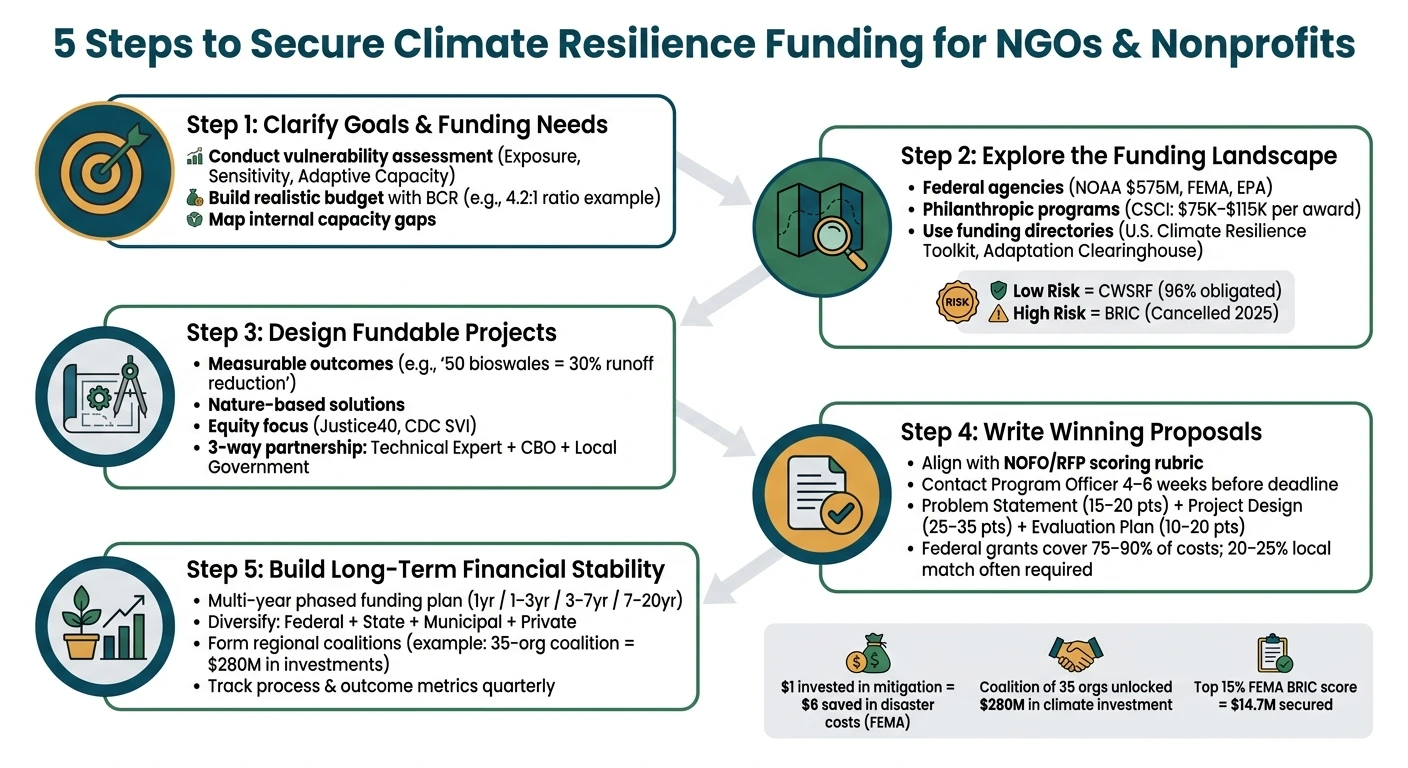
5 Steps to Secure Climate Resilience Funding for NGOs
Climate Change Grants & Funding Opportunities 2025 | Grant Calls
Step 1: Clarify Your Climate Resilience Goals and Funding Needs
Before diving into the funding process, it’s crucial to define your objectives and understand your financial requirements. Funders are not simply offering money - they’re looking to invest in projects with clear, measurable outcomes. By outlining your challenges, desired results, and specific funding needs, you can better align your project with the right funding opportunities.
Define the Climate Resilience Challenge and Expected Outcomes
Start by conducting a structured vulnerability assessment that examines three key factors:
Exposure: Identify the climate hazards your community faces, such as flooding, extreme heat, or wildfires.
Sensitivity: Evaluate how vulnerable your infrastructure, populations, and ecosystems are to these hazards.
Adaptive Capacity: Assess the resources and systems already in place to respond effectively.
Leverage tools like NOAA’s Climate Explorer, FEMA flood maps, and the CDC’s Social Vulnerability Index (SVI) to gather credible data and model potential risks. However, data alone isn’t enough. Engaging directly with the community is essential. Hosting workshops, conducting surveys, and organizing storytelling sessions can uncover "compound hazards" - overlapping risks like flooding combined with industrial contamination - that raw data might miss.
"Resilience plans that skip meaningful engagement produce technically sound documents that sit on shelves." - Council Fire Case Study [5]
Once you’ve mapped out the risks, translate them into specific, actionable goals. These goals should be categorized to reflect priorities like infrastructure upgrades, emergency social networks, economic stability, and ecosystem restoration. This structured approach will make it easier to align your objectives with funder priorities later.
With goals in place, the next step is to develop a detailed and realistic financial plan.
Build a Realistic Project Budget
A strong budget is built on precise cost estimates and a clear understanding of the benefits. Use engineering-level estimates to calculate a benefit-cost ratio (BCR), which compares the costs of implementation to the value of damages avoided. For example, a Mid-Atlantic coastal city of 28,000 residents worked with Council Fire in early 2026 to create a resilience plan. The plan covered $4.2 billion in assessed property value within the 100-year floodplain. By using rigorous cost modeling and a multi-criteria scoring system, the city secured $14.7 million in federal and state grants with a BCR of 4.2:1 [5].
When creating your budget, include the following:
Direct project costs: Materials, labor, and infrastructure expenses.
Staff time: Salaries and wages for those directly involved.
Overhead: Administrative costs, keeping in mind that some programs, like the Climate Smart Communities Initiative (CSCI), cap overhead at 10% of direct expenses.
Contingency buffer: A reserve for unexpected costs.
Grant timelines often range from 12 to 36 months. For larger projects, consider breaking them into phases: near-term (1–3 years), medium-term (3–7 years), and long-term (7–20 years). This phased approach ensures your project remains achievable within typical funding cycles.
After finalizing your budget, evaluate whether your team has the capacity to execute the plan or if external expertise is needed.
Map Internal Capacity and Identify Gaps
A successful project requires a capable team. Assess your internal capacity to handle key tasks like technical modeling, grant writing, financial oversight, and community engagement. If gaps exist, identify them early. This will help you shape your partnership strategy and allocate resources effectively.
Bringing in external expertise can be a practical solution when internal resources are limited. Organizations like Council Fire and the Registry of Adaptation Practitioners provide specialized support in resilience planning and grant preparation [5][6]. If you need external help, engage consultants who can assist with tasks like conducting benefit-cost analyses, equity scoring, and preparing project descriptions.
Having a ready-to-go grant toolkit - including pre-prepared analyses and project details - can save valuable time. This proactive approach ensures you’re prepared to act quickly when funding opportunities arise, rather than scrambling to pull materials together at the last minute.
Step 2: Explore the Climate Resilience Funding Landscape
Once you've established clear goals and a budget in Step 1, the next move is identifying funding sources that align with your climate resilience project. The U.S. funding landscape for these initiatives offers a variety of options, but understanding where to search - and what each source supports - can save you considerable time and effort.
Identify Key Funders and Programs
Federal agencies represent the largest pool of climate resilience funding in the U.S. Major players include NOAA, FEMA, and the EPA, each offering significant programs, though their stability can vary. For instance, NOAA's Climate Resilience Regional Challenge is a $575 million investment aimed at bolstering coastal community resilience [7]. However, not all programs remain consistent. FEMA's BRIC program was canceled in April 2025, and applications for the Hazard Mitigation Grant Program (HMGP) were suspended during the same period. Before committing to any program, confirm whether funds are obligated (secured for projects) or merely appropriated, as appropriated funds can be rescinded.
In addition to federal funding, philanthropic programs provide valuable opportunities. The Climate Smart Communities Initiative (CSCI) is one such example. During its 2026 grant cycle, CSCI distributed between $1.5 million and $2 million across 16–20 projects, with individual awards ranging from $75,000 to $115,000. However, CSCI requires a unique three-way partnership: an adaptation specialist, a community-based nonprofit, and a local government entity [4]. If you can assemble this team, these grants are within reach.
The table below highlights the current risk levels for key federal programs as of 2026:
Program | Status (as of 2026) | Risk Level |
|---|---|---|
Clean Water State Revolving Fund (CWSRF) | 96% obligated, 49% expended | Low |
EPA IRA Climate Grants | 98% obligated | Low (risk of project cancellations) |
STORM RLF (Safeguarding Tomorrow) | $500M appropriated through FY2026 | Moderate |
BRIC (Building Resilient Infrastructure) | Cancelled April 2025 | High |
HMGP (Hazard Mitigation Grant Program) | Suspended April 2025 | High |
Once you've identified potential funders, leverage specialized tools to refine your search.
Use Funding Directories and Search Tools
No single resource covers all funding opportunities, so using multiple tools is key. The U.S. Climate Resilience Toolkit is a great starting point, offering a searchable database of funding links from federal agencies, nonprofits, and private organizations. For grants specific to climate adaptation, the Adaptation Clearinghouse Funding Library provides more focused resources tailored to practitioners and planners.
For niche needs, consider these options:
Flood Funding Finder: Ideal for flood-related projects.
National Wildlife Federation's Nature-based Solutions Funding Database: Focused on green infrastructure like wetlands and living shorelines.
Coastal Resilience Dashboard (by NFWF): Tracks real-time investments in coastal conservation and protection.
Local Infrastructure Hub: Designed to help smaller communities access federal infrastructure funds, developed in collaboration with Bloomberg Philanthropies and Cornell Tech.
Registry of Adaptation Practitioners: Connects NGOs with vetted experts, useful for programs like CSCI that require technical co-applicants [4].
These tools help you zero in on funding opportunities that suit your project's specific needs and stage.
Match Funding Opportunities to Your Project Type
To improve your chances of securing funding, align your project's current phase with the priorities of potential funders. Grants often target specific stages of work, such as:
Planning: Activities like needs assessments, community engagement, and capacity building.
Project Development: Tasks such as site assessments, permitting, and pre-construction work.
Implementation: Physical construction, retrofits, or facility upgrades [8].
Additionally, consider integrating your resilience goals into broader initiatives, such as water utility upgrades or transportation improvement plans. This approach can unlock additional funding streams and make your proposal more appealing. Funders often favor projects that demonstrate collaboration across sectors, as these are seen as more sustainable and impactful [2].
Step 3: Design Projects That Funders Want to Support
Once you have a clear understanding of available funding, the next step is to craft a project that stands out. Funders are looking for more than just good intentions - they want proposals that demonstrate measurable impact, strong partnerships, and a focus on helping vulnerable communities. This section explores how to align your project design with what funders expect, building on the funding landscape you've already mapped out.
Focus on What Funders Value
Funders prioritize projects that deliver clear, measurable outcomes. This means your project must address a specific climate hazard, ideally one identified in a local adaptation plan or risk assessment, and show exactly how it will reduce that risk. The more precise and actionable your goals, the stronger your proposal will be.
Nature-based solutions (NbS) like wetlands restoration, bioswales, and living shorelines often perform well because they are effective and come with added benefits, such as creating local jobs. To strengthen your case, quantify these benefits - for example, highlight potential insurance savings or the number of jobs the project will generate. Pair measurable targets with clear risk reduction goals, such as: "Install 50 bioswales across three flood-prone neighborhoods to reduce peak stormwater runoff by 30%." Be mindful not to shift risks elsewhere, such as redirecting floodwater to downstream areas.
Program | Max Award | Key Focus |
|---|---|---|
GMF Adaptation in Action | $1,000,000 | Municipal infrastructure and nature-positive solutions |
CSCI Grants | $115,000 | Capacity building and technical assistance for underserved areas |
DMAF | No set max | Large-scale public and natural infrastructure (min. $1M cost) |
STORM RLF | Varies | Low-interest loans for hazard mitigation and zoning changes |
Build Strong Partnerships and Governance
Once your goals and budget are defined, forming solid partnerships is crucial to gaining funder confidence. Many funders now require - or strongly prefer - collaborative, multi-sector partnerships. The most competitive proposals often include three key types of partners: a technical adaptation expert, a community-based organization (CBO), and a local government entity. Programs like CSCI explicitly require this type of collaboration, and others reward it with higher scores.
Formalizing these partnerships early is essential. Use Memorandums of Understanding (MOUs) or letters of support to outline each partner’s role, responsibilities, and financial contributions. Verbal agreements won’t suffice. A clear governance structure also demonstrates your coalition’s ability to manage funds and remain accountable over time. A helpful model is the Collaborative Stakeholder Structure (CSS), described by the California Strategic Growth Council as:
"The intent of [a Collaborative Stakeholder Structure] is to form localized, place-based partnerships to ensure consistent buy-in and support; shared values and governance; and alleviation of existing power imbalances." [8]
The benefits of strong coalition-building can be substantial. Between 2024 and 2026, a regional coalition of 35 organizations - including 14 municipalities, 12 businesses, and 5 NGOs - formed a compact with a 12-person steering committee. This approach led to $280 million in climate-related investments and $48 million in FEMA and DOE funding through joint applications that avoided competition between jurisdictions. [9]
Prioritize Equity and Community Engagement
Equity is no longer just an add-on; it’s often a core criterion for funding. Programs like CSCI explicitly emphasize its importance:
"Equity is a core value of the program and an important component in any effort aimed at increasing the effectiveness and sustainability of a climate resilience plan or project." [4]
Start by using tools like the CDC’s Social Vulnerability Index (SVI) or the Justice40 framework to identify areas where climate risks overlap with socioeconomic challenges. Then, go beyond traditional town hall meetings. Host gatherings in accessible locations like community centers, churches, or schools, and provide services such as childcare, food, and translation. Compensate community members for their time to ensure meaningful participation.
A three-tier engagement model can be particularly effective. Tier 1 involves broad community surveys to gather baseline input. Tier 2 focuses on workshops in neighborhoods with high vulnerability. Tier 3 establishes a Stakeholder Advisory Committee that includes residents, local advocates, and groups like the NAACP to play active roles in decision-making. For example, in February 2026, a coastal city of 28,000 residents worked with its local NAACP chapter and a fishing cooperative to identify contamination risks at a Superfund site that technical data had overlooked. This equity-centered approach placed the city’s proposal in the top 15% of FEMA BRIC applications nationwide, securing $14.7 million in federal and state grants. [5]
Step 4: Write Funding Proposals That Get Results
After developing a solid project design, the next task is to create a proposal that aligns closely with funder priorities. A successful proposal isn’t just about polished writing - it’s about structuring your content to meet the exact criteria funders are looking for.
Read and Respond to Funder Priorities
Carefully review the NOFO (Notice of Funding Opportunity) or RFP (Request for Proposals). Use the scoring criteria as a guide to structure your proposal, ensuring that every requirement is addressed in the order reviewers expect [10]. While this may sound straightforward, many proposals fall short because they fail to align with the rubric, instead presenting the project in a way that suits the applicant rather than the funder.
Reach out to the Program Officer 4–6 weeks before the deadline. This conversation can help confirm whether your project is a good match and may also provide insights into common weaknesses in past submissions [10]. These insights can be invaluable and are often difficult to obtain elsewhere.
Write a Clear and Persuasive Project Narrative
Your project narrative should be built around three key elements: exposure, sensitivity, and adaptive capacity [3]. Incorporating all three into your problem statement makes the need for your project feel specific and pressing, rather than generic.
Use localized data to strengthen your argument. For example, rely on downscaled climate models like the NOAA Climate Explorer and local historical records instead of broad national statistics [3][10]. Reviewers want to see a clear causal chain linking your activities to the expected outcomes. This means explaining not just what you plan to do, but why your approach will work.
Your evaluation plan should include both process metrics (such as the number of residents engaged or projects completed) and outcome metrics (like reductions in flood damage claims or trends in heat-related illnesses) [3]. According to grant-writing experts, the combination of a strong problem statement, logical intervention design, and a clear evaluation plan typically accounts for 80% of a proposal’s score [10]. By creating a narrative rooted in evidence, you’ll also set the stage for an accurate budget and well-defined match commitments.
Narrative Section | Typical Review Weight | Key Focus |
|---|---|---|
Problem Statement | High (15–20 pts) | Local needs and vulnerabilities, clearly documented [10] |
Project Design | Highest (25–35 pts) | Logical intervention with evidence-based methods [10] |
Evaluation Plan | Moderate (10–20 pts) | Measurable outputs and outcomes [10] |
Capacity/Personnel | Moderate (10–15 pts) | Infrastructure and team expertise [10] |
Prepare Accurate Budgets and Address Match Requirements
Your budget should directly reflect the resilience outcomes outlined in your planning. Collaborate with all project partners - such as adaptation practitioners, community organizations, and local governments - to ensure every resource need is accounted for [4]. Each budget line item should correspond to specific project phases, whether it’s vulnerability analysis, community engagement, or implementation.
When justifying costs, emphasize the financial benefits of proactive action. For instance, FEMA estimates that every $1 invested in hazard mitigation saves $6 in avoided disaster costs [3]. Framing costs in this way shifts the focus from expense to smart investment.
It’s also critical to secure match commitments early in the proposal process, not after submission [3]. Federal grants often require a 20%–25% local match, though some state programs may reduce or waive this requirement for disadvantaged communities. Be sure to review any program-specific guidelines on costs and match requirements before finalizing your budget.
Step 5: Build Long-Term Financial Stability for Climate Work
Securing initial funding is a big step, but it’s only the beginning of creating lasting financial stability for climate resilience efforts. The real challenge lies in maintaining momentum over the years. Organizations that succeed in this regard approach funding as an ongoing process, not a one-time achievement.
Create a Multi-Year Funding Plan
A multi-year funding strategy helps break down climate resilience efforts into manageable phases: immediate actions (within the first year), priorities for the next 1–3 years, and long-term investments for the years beyond. Assigning clear responsibilities to specific team members for each phase ensures continuity and accountability [3].
To reduce financial risks, mix funding sources from federal, state, municipal, and private sectors. Federal grants can often cover 75%–90% of total project costs [3]. Including local match commitments in your funding plan further strengthens financial sustainability. By embedding these initiatives into your capital improvement plans, you avoid treating them as isolated projects, ensuring they remain integrated into broader organizational goals.
This phased approach not only aids in effective grant management but also supports collaborative funding efforts, providing a structured path for long-term success.
Implement Robust Grant Management Systems
An example of effective grant management comes from a Mid-Atlantic coastal city with a population of 28,000. They secured $14.7 million in grants by incorporating a "grant application toolkit" into their resilience plan. This toolkit used a multi-criteria scoring framework to evaluate 84 projects based on benefit-cost ratios and equity impacts, earning a FEMA BRIC score in the top 15% nationally [5].
To replicate such success, establish quarterly progress reviews, implement strong financial controls, and standardize reporting metrics. Track both process metrics (e.g., dollars spent, projects completed, community engagement) and outcome metrics (e.g., reduced flood damage claims, trends in heat-related illnesses). These measures build a strong performance record, reassuring future funders.
Keep in mind that many climate grants, such as CSCI awards, cap overhead rates at 10% of total direct expenses. Budget accordingly to avoid complications [4].
"Grant applications backed by dedicated local match perform dramatically better than those depending on annual appropriations." - Council Fire Resources [11]
Use Partnerships to Access Larger Funding Pools
Collaborating with local governments can open doors to substantial federal funding opportunities. For instance, FEMA’s Building Resilient Infrastructure and Communities (BRIC) program requires a government lead applicant, but nonprofits can participate as subapplicants or implementation partners for projects ranging from $1 million to $50 million [1]. Similarly, NOAA’s Regional Challenge offers $25 million–$100 million per region to teams of organizations working together [1].
Regional coalitions also shift the competitive dynamic. Instead of competing for the same grants, local entities can present a unified front, showcasing large-scale impact. In February 2026, a coalition of 35 organizations - including 14 municipalities, 12 businesses, and 5 NGOs - formed a regional climate compact. Together, they unlocked $280 million in coordinated investment, including $48 million in FEMA and DOE funding from joint proposals [9].
When forming coalitions, it’s crucial to strike a balance in leadership. Overly ambitious leaders can alienate cautious participants, while overly cautious leaders may set goals that lack impact. By centering pragmatic leaders - those who combine ambition with a focus on actionable outcomes - you can build credibility with funders while achieving meaningful targets.
"Coalitions led by the most ambitious voices alienate pragmatists... Coalitions led by cautious participants set targets too low to matter. Centering pragmatic leaders... produced both ambition and buy-in." - Council Fire [9]
Conclusion: Key Steps to Securing Climate Resilience Funding
Achieving climate resilience funding requires a thoughtful and strategic approach. Organizations that succeed begin with well-defined goals and realistic budgets, ensuring their objectives are clear from the outset. They invest time in researching the right funders and programs, focusing on those that align with their mission and values. By designing projects that emphasize equity, foster community engagement, and deliver measurable results, they create initiatives that resonate with funders.
A strong proposal, backed by data and clear outcomes, can set your organization apart. Long-term financial stability often depends on diversifying funding sources, managing grants effectively, and forming coalitions that open doors to opportunities beyond the reach of a single entity. When resilience measures are seen as strategic investments rather than mere expenses, organizations position themselves for lasting influence and success.
For those ready to turn plans into action, Council Fire offers tailored support to NGOs, nonprofits, and governments. Their expertise spans vulnerability assessments, funding identification, proposal development, and stakeholder engagement. With decades of experience, they help organizations transform ambitious climate goals into actionable, well-funded projects [3].
The time to act is now - partner with experienced professionals and apply these strategies to secure the resources needed for impactful climate resilience initiatives.
FAQs
How do we find grants that fit our project stage?
To identify grants suited to your project's current stage, start by clearly outlining your objectives, scope, and timeline. Use resources like Grants.gov or specific agency websites to search for opportunities that align with your phase, whether it's planning or implementation. Carefully review the Notice of Funding Opportunity (NOFO) to ensure your project meets the eligibility criteria and aligns with the funding priorities.
For projects in the early stages, explore options such as planning grants or technical assistance programs. Additionally, reaching out to program officers can be invaluable - they can help confirm whether your project aligns with the grant's goals and offer insights to strengthen your application.
What counts as a strong local match for federal grants?
A robust local match often involves reduced or even waived requirements for underserved communities, including Tribal governments or low-income areas. For instance, certain programs may lower the match requirement to just 5% or eliminate it entirely. Additionally, state-funded initiatives, like Colorado's $10 million fund, play a key role in helping under-resourced jurisdictions meet federal match obligations, ensuring funding becomes more attainable for those who need it most.
How can we prove equity and measurable impact in our proposal?
To show fairness and real results, focus on how your project supports marginalized communities, including low-to-moderate income (LMI) groups and BIPOC populations. Emphasize inclusive decision-making processes and deliberate resource distribution aimed at these groups. Use specific metrics such as reductions in community vulnerabilities, greater access to essential resources, and tangible examples of collaboration with affected communities. Share success stories and consistently track measurable outcomes to demonstrate progress and strengthen the case for continued support.
Related Blog Posts
How to Build a Climate Resilience Plan for NGOs & Nonprofits
How to Integrate Climate Risk into Infrastructure Planning for Municipalities & Government Agencies
How to Integrate Climate Risk into Infrastructure Planning for NGOs & Nonprofits
How to Build a Climate-Ready Energy & Water Infrastructure Plan for NGOs & Nonprofits
Latest Articles
©2026

Narrative Change and Power Building: The Missing Half of Advocacy
Narrative change is the process of disrupting dominant narratives that normalize inequity and advancing new narratives from historically marginalized communities.

Funding Resilience Without Federal Grants
BRIC is unreliable and FEMA is shrinking. Here's how cities fund climate resilience with dedicated revenue, blended finance, and a coordinating authority.

The ESG Blind Spot: How AI Is Finding Risks in Companies Nobody Else Is Watching
Norway's sovereign wealth fund uses AI to screen 7,200 portfolio companies for forced labor and corruption within 24 hours. The real story is the emerging-market coverage gap that traditional ESG data vendors miss — and what it means for any company with a global supply chain.
Narrative Change and Power Building: The Missing Half of Advocacy
Narrative change is the process of disrupting dominant narratives that normalize inequity and advancing new narratives from historically marginalized communities.
Funding Resilience Without Federal Grants
BRIC is unreliable and FEMA is shrinking. Here's how cities fund climate resilience with dedicated revenue, blended finance, and a coordinating authority.
The ESG Blind Spot: How AI Is Finding Risks in Companies Nobody Else Is Watching
Norway's sovereign wealth fund uses AI to screen 7,200 portfolio companies for forced labor and corruption within 24 hours. The real story is the emerging-market coverage gap that traditional ESG data vendors miss — and what it means for any company with a global supply chain.
FAQ
01
What does it really mean to “redefine profit”?
02
What makes Council Fire different?
03
Who does Council Fire work with?
04
What does working with Council Fire actually look like?
05
How does Council Fire help organizations turn big goals into action?
06
How does Council Fire define and measure success?
07
How does technology fit into Council Fire’s work?
May 23, 2026
How to Identify and Secure Funding for Climate Resilience Projects for NGOs & Nonprofits
Capacity Building
In This Article
Practical steps for NGOs to plan, design, and secure diverse funding for climate resilience projects—grants, partnerships, budgets, and equity.
How to Identify and Secure Funding for Climate Resilience Projects for NGOs & Nonprofits
Securing funding for climate resilience projects can be challenging but achievable with the right approach. NGOs and nonprofits must focus on clear project goals, realistic budgets, and strategic partnerships to navigate an evolving funding landscape. By diversifying funding sources - federal programs, state grants, philanthropic contributions, and local financing - you can create sustainable solutions for climate challenges like flooding, wildfires, and extreme heat. Here's a quick overview of the key steps:
Define Goals & Budget: Use vulnerability assessments to identify risks (e.g., flooding, heat waves) and create specific, measurable goals. Develop a detailed budget with direct costs, staff time, and contingency buffers.
Explore Funding Sources: Federal agencies like FEMA, NOAA, and EPA offer grants, but recent rescissions (e.g., FEMA BRIC funds) highlight the need for diverse funding streams. Philanthropic programs, like the Climate Smart Communities Initiative, also provide opportunities for smaller-scale projects.
Design Fundable Projects: Funders prioritize measurable outcomes, equity-focused initiatives, and strong partnerships between technical experts, community organizations, and local governments.
Write Effective Proposals: Align with funder priorities, emphasize data-backed outcomes, and secure match commitments early.
Plan for Long-Term Stability: Create a multi-year funding strategy, track progress with robust systems, and build coalitions to access larger funding pools.
5 Steps to Secure Climate Resilience Funding for NGOs
Climate Change Grants & Funding Opportunities 2025 | Grant Calls
Step 1: Clarify Your Climate Resilience Goals and Funding Needs
Before diving into the funding process, it’s crucial to define your objectives and understand your financial requirements. Funders are not simply offering money - they’re looking to invest in projects with clear, measurable outcomes. By outlining your challenges, desired results, and specific funding needs, you can better align your project with the right funding opportunities.
Define the Climate Resilience Challenge and Expected Outcomes
Start by conducting a structured vulnerability assessment that examines three key factors:
Exposure: Identify the climate hazards your community faces, such as flooding, extreme heat, or wildfires.
Sensitivity: Evaluate how vulnerable your infrastructure, populations, and ecosystems are to these hazards.
Adaptive Capacity: Assess the resources and systems already in place to respond effectively.
Leverage tools like NOAA’s Climate Explorer, FEMA flood maps, and the CDC’s Social Vulnerability Index (SVI) to gather credible data and model potential risks. However, data alone isn’t enough. Engaging directly with the community is essential. Hosting workshops, conducting surveys, and organizing storytelling sessions can uncover "compound hazards" - overlapping risks like flooding combined with industrial contamination - that raw data might miss.
"Resilience plans that skip meaningful engagement produce technically sound documents that sit on shelves." - Council Fire Case Study [5]
Once you’ve mapped out the risks, translate them into specific, actionable goals. These goals should be categorized to reflect priorities like infrastructure upgrades, emergency social networks, economic stability, and ecosystem restoration. This structured approach will make it easier to align your objectives with funder priorities later.
With goals in place, the next step is to develop a detailed and realistic financial plan.
Build a Realistic Project Budget
A strong budget is built on precise cost estimates and a clear understanding of the benefits. Use engineering-level estimates to calculate a benefit-cost ratio (BCR), which compares the costs of implementation to the value of damages avoided. For example, a Mid-Atlantic coastal city of 28,000 residents worked with Council Fire in early 2026 to create a resilience plan. The plan covered $4.2 billion in assessed property value within the 100-year floodplain. By using rigorous cost modeling and a multi-criteria scoring system, the city secured $14.7 million in federal and state grants with a BCR of 4.2:1 [5].
When creating your budget, include the following:
Direct project costs: Materials, labor, and infrastructure expenses.
Staff time: Salaries and wages for those directly involved.
Overhead: Administrative costs, keeping in mind that some programs, like the Climate Smart Communities Initiative (CSCI), cap overhead at 10% of direct expenses.
Contingency buffer: A reserve for unexpected costs.
Grant timelines often range from 12 to 36 months. For larger projects, consider breaking them into phases: near-term (1–3 years), medium-term (3–7 years), and long-term (7–20 years). This phased approach ensures your project remains achievable within typical funding cycles.
After finalizing your budget, evaluate whether your team has the capacity to execute the plan or if external expertise is needed.
Map Internal Capacity and Identify Gaps
A successful project requires a capable team. Assess your internal capacity to handle key tasks like technical modeling, grant writing, financial oversight, and community engagement. If gaps exist, identify them early. This will help you shape your partnership strategy and allocate resources effectively.
Bringing in external expertise can be a practical solution when internal resources are limited. Organizations like Council Fire and the Registry of Adaptation Practitioners provide specialized support in resilience planning and grant preparation [5][6]. If you need external help, engage consultants who can assist with tasks like conducting benefit-cost analyses, equity scoring, and preparing project descriptions.
Having a ready-to-go grant toolkit - including pre-prepared analyses and project details - can save valuable time. This proactive approach ensures you’re prepared to act quickly when funding opportunities arise, rather than scrambling to pull materials together at the last minute.
Step 2: Explore the Climate Resilience Funding Landscape
Once you've established clear goals and a budget in Step 1, the next move is identifying funding sources that align with your climate resilience project. The U.S. funding landscape for these initiatives offers a variety of options, but understanding where to search - and what each source supports - can save you considerable time and effort.
Identify Key Funders and Programs
Federal agencies represent the largest pool of climate resilience funding in the U.S. Major players include NOAA, FEMA, and the EPA, each offering significant programs, though their stability can vary. For instance, NOAA's Climate Resilience Regional Challenge is a $575 million investment aimed at bolstering coastal community resilience [7]. However, not all programs remain consistent. FEMA's BRIC program was canceled in April 2025, and applications for the Hazard Mitigation Grant Program (HMGP) were suspended during the same period. Before committing to any program, confirm whether funds are obligated (secured for projects) or merely appropriated, as appropriated funds can be rescinded.
In addition to federal funding, philanthropic programs provide valuable opportunities. The Climate Smart Communities Initiative (CSCI) is one such example. During its 2026 grant cycle, CSCI distributed between $1.5 million and $2 million across 16–20 projects, with individual awards ranging from $75,000 to $115,000. However, CSCI requires a unique three-way partnership: an adaptation specialist, a community-based nonprofit, and a local government entity [4]. If you can assemble this team, these grants are within reach.
The table below highlights the current risk levels for key federal programs as of 2026:
Program | Status (as of 2026) | Risk Level |
|---|---|---|
Clean Water State Revolving Fund (CWSRF) | 96% obligated, 49% expended | Low |
EPA IRA Climate Grants | 98% obligated | Low (risk of project cancellations) |
STORM RLF (Safeguarding Tomorrow) | $500M appropriated through FY2026 | Moderate |
BRIC (Building Resilient Infrastructure) | Cancelled April 2025 | High |
HMGP (Hazard Mitigation Grant Program) | Suspended April 2025 | High |
Once you've identified potential funders, leverage specialized tools to refine your search.
Use Funding Directories and Search Tools
No single resource covers all funding opportunities, so using multiple tools is key. The U.S. Climate Resilience Toolkit is a great starting point, offering a searchable database of funding links from federal agencies, nonprofits, and private organizations. For grants specific to climate adaptation, the Adaptation Clearinghouse Funding Library provides more focused resources tailored to practitioners and planners.
For niche needs, consider these options:
Flood Funding Finder: Ideal for flood-related projects.
National Wildlife Federation's Nature-based Solutions Funding Database: Focused on green infrastructure like wetlands and living shorelines.
Coastal Resilience Dashboard (by NFWF): Tracks real-time investments in coastal conservation and protection.
Local Infrastructure Hub: Designed to help smaller communities access federal infrastructure funds, developed in collaboration with Bloomberg Philanthropies and Cornell Tech.
Registry of Adaptation Practitioners: Connects NGOs with vetted experts, useful for programs like CSCI that require technical co-applicants [4].
These tools help you zero in on funding opportunities that suit your project's specific needs and stage.
Match Funding Opportunities to Your Project Type
To improve your chances of securing funding, align your project's current phase with the priorities of potential funders. Grants often target specific stages of work, such as:
Planning: Activities like needs assessments, community engagement, and capacity building.
Project Development: Tasks such as site assessments, permitting, and pre-construction work.
Implementation: Physical construction, retrofits, or facility upgrades [8].
Additionally, consider integrating your resilience goals into broader initiatives, such as water utility upgrades or transportation improvement plans. This approach can unlock additional funding streams and make your proposal more appealing. Funders often favor projects that demonstrate collaboration across sectors, as these are seen as more sustainable and impactful [2].
Step 3: Design Projects That Funders Want to Support
Once you have a clear understanding of available funding, the next step is to craft a project that stands out. Funders are looking for more than just good intentions - they want proposals that demonstrate measurable impact, strong partnerships, and a focus on helping vulnerable communities. This section explores how to align your project design with what funders expect, building on the funding landscape you've already mapped out.
Focus on What Funders Value
Funders prioritize projects that deliver clear, measurable outcomes. This means your project must address a specific climate hazard, ideally one identified in a local adaptation plan or risk assessment, and show exactly how it will reduce that risk. The more precise and actionable your goals, the stronger your proposal will be.
Nature-based solutions (NbS) like wetlands restoration, bioswales, and living shorelines often perform well because they are effective and come with added benefits, such as creating local jobs. To strengthen your case, quantify these benefits - for example, highlight potential insurance savings or the number of jobs the project will generate. Pair measurable targets with clear risk reduction goals, such as: "Install 50 bioswales across three flood-prone neighborhoods to reduce peak stormwater runoff by 30%." Be mindful not to shift risks elsewhere, such as redirecting floodwater to downstream areas.
Program | Max Award | Key Focus |
|---|---|---|
GMF Adaptation in Action | $1,000,000 | Municipal infrastructure and nature-positive solutions |
CSCI Grants | $115,000 | Capacity building and technical assistance for underserved areas |
DMAF | No set max | Large-scale public and natural infrastructure (min. $1M cost) |
STORM RLF | Varies | Low-interest loans for hazard mitigation and zoning changes |
Build Strong Partnerships and Governance
Once your goals and budget are defined, forming solid partnerships is crucial to gaining funder confidence. Many funders now require - or strongly prefer - collaborative, multi-sector partnerships. The most competitive proposals often include three key types of partners: a technical adaptation expert, a community-based organization (CBO), and a local government entity. Programs like CSCI explicitly require this type of collaboration, and others reward it with higher scores.
Formalizing these partnerships early is essential. Use Memorandums of Understanding (MOUs) or letters of support to outline each partner’s role, responsibilities, and financial contributions. Verbal agreements won’t suffice. A clear governance structure also demonstrates your coalition’s ability to manage funds and remain accountable over time. A helpful model is the Collaborative Stakeholder Structure (CSS), described by the California Strategic Growth Council as:
"The intent of [a Collaborative Stakeholder Structure] is to form localized, place-based partnerships to ensure consistent buy-in and support; shared values and governance; and alleviation of existing power imbalances." [8]
The benefits of strong coalition-building can be substantial. Between 2024 and 2026, a regional coalition of 35 organizations - including 14 municipalities, 12 businesses, and 5 NGOs - formed a compact with a 12-person steering committee. This approach led to $280 million in climate-related investments and $48 million in FEMA and DOE funding through joint applications that avoided competition between jurisdictions. [9]
Prioritize Equity and Community Engagement
Equity is no longer just an add-on; it’s often a core criterion for funding. Programs like CSCI explicitly emphasize its importance:
"Equity is a core value of the program and an important component in any effort aimed at increasing the effectiveness and sustainability of a climate resilience plan or project." [4]
Start by using tools like the CDC’s Social Vulnerability Index (SVI) or the Justice40 framework to identify areas where climate risks overlap with socioeconomic challenges. Then, go beyond traditional town hall meetings. Host gatherings in accessible locations like community centers, churches, or schools, and provide services such as childcare, food, and translation. Compensate community members for their time to ensure meaningful participation.
A three-tier engagement model can be particularly effective. Tier 1 involves broad community surveys to gather baseline input. Tier 2 focuses on workshops in neighborhoods with high vulnerability. Tier 3 establishes a Stakeholder Advisory Committee that includes residents, local advocates, and groups like the NAACP to play active roles in decision-making. For example, in February 2026, a coastal city of 28,000 residents worked with its local NAACP chapter and a fishing cooperative to identify contamination risks at a Superfund site that technical data had overlooked. This equity-centered approach placed the city’s proposal in the top 15% of FEMA BRIC applications nationwide, securing $14.7 million in federal and state grants. [5]
Step 4: Write Funding Proposals That Get Results
After developing a solid project design, the next task is to create a proposal that aligns closely with funder priorities. A successful proposal isn’t just about polished writing - it’s about structuring your content to meet the exact criteria funders are looking for.
Read and Respond to Funder Priorities
Carefully review the NOFO (Notice of Funding Opportunity) or RFP (Request for Proposals). Use the scoring criteria as a guide to structure your proposal, ensuring that every requirement is addressed in the order reviewers expect [10]. While this may sound straightforward, many proposals fall short because they fail to align with the rubric, instead presenting the project in a way that suits the applicant rather than the funder.
Reach out to the Program Officer 4–6 weeks before the deadline. This conversation can help confirm whether your project is a good match and may also provide insights into common weaknesses in past submissions [10]. These insights can be invaluable and are often difficult to obtain elsewhere.
Write a Clear and Persuasive Project Narrative
Your project narrative should be built around three key elements: exposure, sensitivity, and adaptive capacity [3]. Incorporating all three into your problem statement makes the need for your project feel specific and pressing, rather than generic.
Use localized data to strengthen your argument. For example, rely on downscaled climate models like the NOAA Climate Explorer and local historical records instead of broad national statistics [3][10]. Reviewers want to see a clear causal chain linking your activities to the expected outcomes. This means explaining not just what you plan to do, but why your approach will work.
Your evaluation plan should include both process metrics (such as the number of residents engaged or projects completed) and outcome metrics (like reductions in flood damage claims or trends in heat-related illnesses) [3]. According to grant-writing experts, the combination of a strong problem statement, logical intervention design, and a clear evaluation plan typically accounts for 80% of a proposal’s score [10]. By creating a narrative rooted in evidence, you’ll also set the stage for an accurate budget and well-defined match commitments.
Narrative Section | Typical Review Weight | Key Focus |
|---|---|---|
Problem Statement | High (15–20 pts) | Local needs and vulnerabilities, clearly documented [10] |
Project Design | Highest (25–35 pts) | Logical intervention with evidence-based methods [10] |
Evaluation Plan | Moderate (10–20 pts) | Measurable outputs and outcomes [10] |
Capacity/Personnel | Moderate (10–15 pts) | Infrastructure and team expertise [10] |
Prepare Accurate Budgets and Address Match Requirements
Your budget should directly reflect the resilience outcomes outlined in your planning. Collaborate with all project partners - such as adaptation practitioners, community organizations, and local governments - to ensure every resource need is accounted for [4]. Each budget line item should correspond to specific project phases, whether it’s vulnerability analysis, community engagement, or implementation.
When justifying costs, emphasize the financial benefits of proactive action. For instance, FEMA estimates that every $1 invested in hazard mitigation saves $6 in avoided disaster costs [3]. Framing costs in this way shifts the focus from expense to smart investment.
It’s also critical to secure match commitments early in the proposal process, not after submission [3]. Federal grants often require a 20%–25% local match, though some state programs may reduce or waive this requirement for disadvantaged communities. Be sure to review any program-specific guidelines on costs and match requirements before finalizing your budget.
Step 5: Build Long-Term Financial Stability for Climate Work
Securing initial funding is a big step, but it’s only the beginning of creating lasting financial stability for climate resilience efforts. The real challenge lies in maintaining momentum over the years. Organizations that succeed in this regard approach funding as an ongoing process, not a one-time achievement.
Create a Multi-Year Funding Plan
A multi-year funding strategy helps break down climate resilience efforts into manageable phases: immediate actions (within the first year), priorities for the next 1–3 years, and long-term investments for the years beyond. Assigning clear responsibilities to specific team members for each phase ensures continuity and accountability [3].
To reduce financial risks, mix funding sources from federal, state, municipal, and private sectors. Federal grants can often cover 75%–90% of total project costs [3]. Including local match commitments in your funding plan further strengthens financial sustainability. By embedding these initiatives into your capital improvement plans, you avoid treating them as isolated projects, ensuring they remain integrated into broader organizational goals.
This phased approach not only aids in effective grant management but also supports collaborative funding efforts, providing a structured path for long-term success.
Implement Robust Grant Management Systems
An example of effective grant management comes from a Mid-Atlantic coastal city with a population of 28,000. They secured $14.7 million in grants by incorporating a "grant application toolkit" into their resilience plan. This toolkit used a multi-criteria scoring framework to evaluate 84 projects based on benefit-cost ratios and equity impacts, earning a FEMA BRIC score in the top 15% nationally [5].
To replicate such success, establish quarterly progress reviews, implement strong financial controls, and standardize reporting metrics. Track both process metrics (e.g., dollars spent, projects completed, community engagement) and outcome metrics (e.g., reduced flood damage claims, trends in heat-related illnesses). These measures build a strong performance record, reassuring future funders.
Keep in mind that many climate grants, such as CSCI awards, cap overhead rates at 10% of total direct expenses. Budget accordingly to avoid complications [4].
"Grant applications backed by dedicated local match perform dramatically better than those depending on annual appropriations." - Council Fire Resources [11]
Use Partnerships to Access Larger Funding Pools
Collaborating with local governments can open doors to substantial federal funding opportunities. For instance, FEMA’s Building Resilient Infrastructure and Communities (BRIC) program requires a government lead applicant, but nonprofits can participate as subapplicants or implementation partners for projects ranging from $1 million to $50 million [1]. Similarly, NOAA’s Regional Challenge offers $25 million–$100 million per region to teams of organizations working together [1].
Regional coalitions also shift the competitive dynamic. Instead of competing for the same grants, local entities can present a unified front, showcasing large-scale impact. In February 2026, a coalition of 35 organizations - including 14 municipalities, 12 businesses, and 5 NGOs - formed a regional climate compact. Together, they unlocked $280 million in coordinated investment, including $48 million in FEMA and DOE funding from joint proposals [9].
When forming coalitions, it’s crucial to strike a balance in leadership. Overly ambitious leaders can alienate cautious participants, while overly cautious leaders may set goals that lack impact. By centering pragmatic leaders - those who combine ambition with a focus on actionable outcomes - you can build credibility with funders while achieving meaningful targets.
"Coalitions led by the most ambitious voices alienate pragmatists... Coalitions led by cautious participants set targets too low to matter. Centering pragmatic leaders... produced both ambition and buy-in." - Council Fire [9]
Conclusion: Key Steps to Securing Climate Resilience Funding
Achieving climate resilience funding requires a thoughtful and strategic approach. Organizations that succeed begin with well-defined goals and realistic budgets, ensuring their objectives are clear from the outset. They invest time in researching the right funders and programs, focusing on those that align with their mission and values. By designing projects that emphasize equity, foster community engagement, and deliver measurable results, they create initiatives that resonate with funders.
A strong proposal, backed by data and clear outcomes, can set your organization apart. Long-term financial stability often depends on diversifying funding sources, managing grants effectively, and forming coalitions that open doors to opportunities beyond the reach of a single entity. When resilience measures are seen as strategic investments rather than mere expenses, organizations position themselves for lasting influence and success.
For those ready to turn plans into action, Council Fire offers tailored support to NGOs, nonprofits, and governments. Their expertise spans vulnerability assessments, funding identification, proposal development, and stakeholder engagement. With decades of experience, they help organizations transform ambitious climate goals into actionable, well-funded projects [3].
The time to act is now - partner with experienced professionals and apply these strategies to secure the resources needed for impactful climate resilience initiatives.
FAQs
How do we find grants that fit our project stage?
To identify grants suited to your project's current stage, start by clearly outlining your objectives, scope, and timeline. Use resources like Grants.gov or specific agency websites to search for opportunities that align with your phase, whether it's planning or implementation. Carefully review the Notice of Funding Opportunity (NOFO) to ensure your project meets the eligibility criteria and aligns with the funding priorities.
For projects in the early stages, explore options such as planning grants or technical assistance programs. Additionally, reaching out to program officers can be invaluable - they can help confirm whether your project aligns with the grant's goals and offer insights to strengthen your application.
What counts as a strong local match for federal grants?
A robust local match often involves reduced or even waived requirements for underserved communities, including Tribal governments or low-income areas. For instance, certain programs may lower the match requirement to just 5% or eliminate it entirely. Additionally, state-funded initiatives, like Colorado's $10 million fund, play a key role in helping under-resourced jurisdictions meet federal match obligations, ensuring funding becomes more attainable for those who need it most.
How can we prove equity and measurable impact in our proposal?
To show fairness and real results, focus on how your project supports marginalized communities, including low-to-moderate income (LMI) groups and BIPOC populations. Emphasize inclusive decision-making processes and deliberate resource distribution aimed at these groups. Use specific metrics such as reductions in community vulnerabilities, greater access to essential resources, and tangible examples of collaboration with affected communities. Share success stories and consistently track measurable outcomes to demonstrate progress and strengthen the case for continued support.
Related Blog Posts
How to Build a Climate Resilience Plan for NGOs & Nonprofits
How to Integrate Climate Risk into Infrastructure Planning for Municipalities & Government Agencies
How to Integrate Climate Risk into Infrastructure Planning for NGOs & Nonprofits
How to Build a Climate-Ready Energy & Water Infrastructure Plan for NGOs & Nonprofits
Latest Articles
©2026
Narrative Change and Power Building: The Missing Half of Advocacy
Narrative change is the process of disrupting dominant narratives that normalize inequity and advancing new narratives from historically marginalized communities.
Funding Resilience Without Federal Grants
BRIC is unreliable and FEMA is shrinking. Here's how cities fund climate resilience with dedicated revenue, blended finance, and a coordinating authority.
The ESG Blind Spot: How AI Is Finding Risks in Companies Nobody Else Is Watching
Norway's sovereign wealth fund uses AI to screen 7,200 portfolio companies for forced labor and corruption within 24 hours. The real story is the emerging-market coverage gap that traditional ESG data vendors miss — and what it means for any company with a global supply chain.
FAQ
01
What does it really mean to “redefine profit”?
02
What makes Council Fire different?
03
Who does Council Fire work with?
04
What does working with Council Fire actually look like?
05
How does Council Fire help organizations turn big goals into action?
06
How does Council Fire define and measure success?
07
How does technology fit into Council Fire’s work?
May 23, 2026
How to Identify and Secure Funding for Climate Resilience Projects for NGOs & Nonprofits
Capacity Building
In This Article
Practical steps for NGOs to plan, design, and secure diverse funding for climate resilience projects—grants, partnerships, budgets, and equity.
How to Identify and Secure Funding for Climate Resilience Projects for NGOs & Nonprofits
Securing funding for climate resilience projects can be challenging but achievable with the right approach. NGOs and nonprofits must focus on clear project goals, realistic budgets, and strategic partnerships to navigate an evolving funding landscape. By diversifying funding sources - federal programs, state grants, philanthropic contributions, and local financing - you can create sustainable solutions for climate challenges like flooding, wildfires, and extreme heat. Here's a quick overview of the key steps:
Define Goals & Budget: Use vulnerability assessments to identify risks (e.g., flooding, heat waves) and create specific, measurable goals. Develop a detailed budget with direct costs, staff time, and contingency buffers.
Explore Funding Sources: Federal agencies like FEMA, NOAA, and EPA offer grants, but recent rescissions (e.g., FEMA BRIC funds) highlight the need for diverse funding streams. Philanthropic programs, like the Climate Smart Communities Initiative, also provide opportunities for smaller-scale projects.
Design Fundable Projects: Funders prioritize measurable outcomes, equity-focused initiatives, and strong partnerships between technical experts, community organizations, and local governments.
Write Effective Proposals: Align with funder priorities, emphasize data-backed outcomes, and secure match commitments early.
Plan for Long-Term Stability: Create a multi-year funding strategy, track progress with robust systems, and build coalitions to access larger funding pools.
5 Steps to Secure Climate Resilience Funding for NGOs
Climate Change Grants & Funding Opportunities 2025 | Grant Calls
Step 1: Clarify Your Climate Resilience Goals and Funding Needs
Before diving into the funding process, it’s crucial to define your objectives and understand your financial requirements. Funders are not simply offering money - they’re looking to invest in projects with clear, measurable outcomes. By outlining your challenges, desired results, and specific funding needs, you can better align your project with the right funding opportunities.
Define the Climate Resilience Challenge and Expected Outcomes
Start by conducting a structured vulnerability assessment that examines three key factors:
Exposure: Identify the climate hazards your community faces, such as flooding, extreme heat, or wildfires.
Sensitivity: Evaluate how vulnerable your infrastructure, populations, and ecosystems are to these hazards.
Adaptive Capacity: Assess the resources and systems already in place to respond effectively.
Leverage tools like NOAA’s Climate Explorer, FEMA flood maps, and the CDC’s Social Vulnerability Index (SVI) to gather credible data and model potential risks. However, data alone isn’t enough. Engaging directly with the community is essential. Hosting workshops, conducting surveys, and organizing storytelling sessions can uncover "compound hazards" - overlapping risks like flooding combined with industrial contamination - that raw data might miss.
"Resilience plans that skip meaningful engagement produce technically sound documents that sit on shelves." - Council Fire Case Study [5]
Once you’ve mapped out the risks, translate them into specific, actionable goals. These goals should be categorized to reflect priorities like infrastructure upgrades, emergency social networks, economic stability, and ecosystem restoration. This structured approach will make it easier to align your objectives with funder priorities later.
With goals in place, the next step is to develop a detailed and realistic financial plan.
Build a Realistic Project Budget
A strong budget is built on precise cost estimates and a clear understanding of the benefits. Use engineering-level estimates to calculate a benefit-cost ratio (BCR), which compares the costs of implementation to the value of damages avoided. For example, a Mid-Atlantic coastal city of 28,000 residents worked with Council Fire in early 2026 to create a resilience plan. The plan covered $4.2 billion in assessed property value within the 100-year floodplain. By using rigorous cost modeling and a multi-criteria scoring system, the city secured $14.7 million in federal and state grants with a BCR of 4.2:1 [5].
When creating your budget, include the following:
Direct project costs: Materials, labor, and infrastructure expenses.
Staff time: Salaries and wages for those directly involved.
Overhead: Administrative costs, keeping in mind that some programs, like the Climate Smart Communities Initiative (CSCI), cap overhead at 10% of direct expenses.
Contingency buffer: A reserve for unexpected costs.
Grant timelines often range from 12 to 36 months. For larger projects, consider breaking them into phases: near-term (1–3 years), medium-term (3–7 years), and long-term (7–20 years). This phased approach ensures your project remains achievable within typical funding cycles.
After finalizing your budget, evaluate whether your team has the capacity to execute the plan or if external expertise is needed.
Map Internal Capacity and Identify Gaps
A successful project requires a capable team. Assess your internal capacity to handle key tasks like technical modeling, grant writing, financial oversight, and community engagement. If gaps exist, identify them early. This will help you shape your partnership strategy and allocate resources effectively.
Bringing in external expertise can be a practical solution when internal resources are limited. Organizations like Council Fire and the Registry of Adaptation Practitioners provide specialized support in resilience planning and grant preparation [5][6]. If you need external help, engage consultants who can assist with tasks like conducting benefit-cost analyses, equity scoring, and preparing project descriptions.
Having a ready-to-go grant toolkit - including pre-prepared analyses and project details - can save valuable time. This proactive approach ensures you’re prepared to act quickly when funding opportunities arise, rather than scrambling to pull materials together at the last minute.
Step 2: Explore the Climate Resilience Funding Landscape
Once you've established clear goals and a budget in Step 1, the next move is identifying funding sources that align with your climate resilience project. The U.S. funding landscape for these initiatives offers a variety of options, but understanding where to search - and what each source supports - can save you considerable time and effort.
Identify Key Funders and Programs
Federal agencies represent the largest pool of climate resilience funding in the U.S. Major players include NOAA, FEMA, and the EPA, each offering significant programs, though their stability can vary. For instance, NOAA's Climate Resilience Regional Challenge is a $575 million investment aimed at bolstering coastal community resilience [7]. However, not all programs remain consistent. FEMA's BRIC program was canceled in April 2025, and applications for the Hazard Mitigation Grant Program (HMGP) were suspended during the same period. Before committing to any program, confirm whether funds are obligated (secured for projects) or merely appropriated, as appropriated funds can be rescinded.
In addition to federal funding, philanthropic programs provide valuable opportunities. The Climate Smart Communities Initiative (CSCI) is one such example. During its 2026 grant cycle, CSCI distributed between $1.5 million and $2 million across 16–20 projects, with individual awards ranging from $75,000 to $115,000. However, CSCI requires a unique three-way partnership: an adaptation specialist, a community-based nonprofit, and a local government entity [4]. If you can assemble this team, these grants are within reach.
The table below highlights the current risk levels for key federal programs as of 2026:
Program | Status (as of 2026) | Risk Level |
|---|---|---|
Clean Water State Revolving Fund (CWSRF) | 96% obligated, 49% expended | Low |
EPA IRA Climate Grants | 98% obligated | Low (risk of project cancellations) |
STORM RLF (Safeguarding Tomorrow) | $500M appropriated through FY2026 | Moderate |
BRIC (Building Resilient Infrastructure) | Cancelled April 2025 | High |
HMGP (Hazard Mitigation Grant Program) | Suspended April 2025 | High |
Once you've identified potential funders, leverage specialized tools to refine your search.
Use Funding Directories and Search Tools
No single resource covers all funding opportunities, so using multiple tools is key. The U.S. Climate Resilience Toolkit is a great starting point, offering a searchable database of funding links from federal agencies, nonprofits, and private organizations. For grants specific to climate adaptation, the Adaptation Clearinghouse Funding Library provides more focused resources tailored to practitioners and planners.
For niche needs, consider these options:
Flood Funding Finder: Ideal for flood-related projects.
National Wildlife Federation's Nature-based Solutions Funding Database: Focused on green infrastructure like wetlands and living shorelines.
Coastal Resilience Dashboard (by NFWF): Tracks real-time investments in coastal conservation and protection.
Local Infrastructure Hub: Designed to help smaller communities access federal infrastructure funds, developed in collaboration with Bloomberg Philanthropies and Cornell Tech.
Registry of Adaptation Practitioners: Connects NGOs with vetted experts, useful for programs like CSCI that require technical co-applicants [4].
These tools help you zero in on funding opportunities that suit your project's specific needs and stage.
Match Funding Opportunities to Your Project Type
To improve your chances of securing funding, align your project's current phase with the priorities of potential funders. Grants often target specific stages of work, such as:
Planning: Activities like needs assessments, community engagement, and capacity building.
Project Development: Tasks such as site assessments, permitting, and pre-construction work.
Implementation: Physical construction, retrofits, or facility upgrades [8].
Additionally, consider integrating your resilience goals into broader initiatives, such as water utility upgrades or transportation improvement plans. This approach can unlock additional funding streams and make your proposal more appealing. Funders often favor projects that demonstrate collaboration across sectors, as these are seen as more sustainable and impactful [2].
Step 3: Design Projects That Funders Want to Support
Once you have a clear understanding of available funding, the next step is to craft a project that stands out. Funders are looking for more than just good intentions - they want proposals that demonstrate measurable impact, strong partnerships, and a focus on helping vulnerable communities. This section explores how to align your project design with what funders expect, building on the funding landscape you've already mapped out.
Focus on What Funders Value
Funders prioritize projects that deliver clear, measurable outcomes. This means your project must address a specific climate hazard, ideally one identified in a local adaptation plan or risk assessment, and show exactly how it will reduce that risk. The more precise and actionable your goals, the stronger your proposal will be.
Nature-based solutions (NbS) like wetlands restoration, bioswales, and living shorelines often perform well because they are effective and come with added benefits, such as creating local jobs. To strengthen your case, quantify these benefits - for example, highlight potential insurance savings or the number of jobs the project will generate. Pair measurable targets with clear risk reduction goals, such as: "Install 50 bioswales across three flood-prone neighborhoods to reduce peak stormwater runoff by 30%." Be mindful not to shift risks elsewhere, such as redirecting floodwater to downstream areas.
Program | Max Award | Key Focus |
|---|---|---|
GMF Adaptation in Action | $1,000,000 | Municipal infrastructure and nature-positive solutions |
CSCI Grants | $115,000 | Capacity building and technical assistance for underserved areas |
DMAF | No set max | Large-scale public and natural infrastructure (min. $1M cost) |
STORM RLF | Varies | Low-interest loans for hazard mitigation and zoning changes |
Build Strong Partnerships and Governance
Once your goals and budget are defined, forming solid partnerships is crucial to gaining funder confidence. Many funders now require - or strongly prefer - collaborative, multi-sector partnerships. The most competitive proposals often include three key types of partners: a technical adaptation expert, a community-based organization (CBO), and a local government entity. Programs like CSCI explicitly require this type of collaboration, and others reward it with higher scores.
Formalizing these partnerships early is essential. Use Memorandums of Understanding (MOUs) or letters of support to outline each partner’s role, responsibilities, and financial contributions. Verbal agreements won’t suffice. A clear governance structure also demonstrates your coalition’s ability to manage funds and remain accountable over time. A helpful model is the Collaborative Stakeholder Structure (CSS), described by the California Strategic Growth Council as:
"The intent of [a Collaborative Stakeholder Structure] is to form localized, place-based partnerships to ensure consistent buy-in and support; shared values and governance; and alleviation of existing power imbalances." [8]
The benefits of strong coalition-building can be substantial. Between 2024 and 2026, a regional coalition of 35 organizations - including 14 municipalities, 12 businesses, and 5 NGOs - formed a compact with a 12-person steering committee. This approach led to $280 million in climate-related investments and $48 million in FEMA and DOE funding through joint applications that avoided competition between jurisdictions. [9]
Prioritize Equity and Community Engagement
Equity is no longer just an add-on; it’s often a core criterion for funding. Programs like CSCI explicitly emphasize its importance:
"Equity is a core value of the program and an important component in any effort aimed at increasing the effectiveness and sustainability of a climate resilience plan or project." [4]
Start by using tools like the CDC’s Social Vulnerability Index (SVI) or the Justice40 framework to identify areas where climate risks overlap with socioeconomic challenges. Then, go beyond traditional town hall meetings. Host gatherings in accessible locations like community centers, churches, or schools, and provide services such as childcare, food, and translation. Compensate community members for their time to ensure meaningful participation.
A three-tier engagement model can be particularly effective. Tier 1 involves broad community surveys to gather baseline input. Tier 2 focuses on workshops in neighborhoods with high vulnerability. Tier 3 establishes a Stakeholder Advisory Committee that includes residents, local advocates, and groups like the NAACP to play active roles in decision-making. For example, in February 2026, a coastal city of 28,000 residents worked with its local NAACP chapter and a fishing cooperative to identify contamination risks at a Superfund site that technical data had overlooked. This equity-centered approach placed the city’s proposal in the top 15% of FEMA BRIC applications nationwide, securing $14.7 million in federal and state grants. [5]
Step 4: Write Funding Proposals That Get Results
After developing a solid project design, the next task is to create a proposal that aligns closely with funder priorities. A successful proposal isn’t just about polished writing - it’s about structuring your content to meet the exact criteria funders are looking for.
Read and Respond to Funder Priorities
Carefully review the NOFO (Notice of Funding Opportunity) or RFP (Request for Proposals). Use the scoring criteria as a guide to structure your proposal, ensuring that every requirement is addressed in the order reviewers expect [10]. While this may sound straightforward, many proposals fall short because they fail to align with the rubric, instead presenting the project in a way that suits the applicant rather than the funder.
Reach out to the Program Officer 4–6 weeks before the deadline. This conversation can help confirm whether your project is a good match and may also provide insights into common weaknesses in past submissions [10]. These insights can be invaluable and are often difficult to obtain elsewhere.
Write a Clear and Persuasive Project Narrative
Your project narrative should be built around three key elements: exposure, sensitivity, and adaptive capacity [3]. Incorporating all three into your problem statement makes the need for your project feel specific and pressing, rather than generic.
Use localized data to strengthen your argument. For example, rely on downscaled climate models like the NOAA Climate Explorer and local historical records instead of broad national statistics [3][10]. Reviewers want to see a clear causal chain linking your activities to the expected outcomes. This means explaining not just what you plan to do, but why your approach will work.
Your evaluation plan should include both process metrics (such as the number of residents engaged or projects completed) and outcome metrics (like reductions in flood damage claims or trends in heat-related illnesses) [3]. According to grant-writing experts, the combination of a strong problem statement, logical intervention design, and a clear evaluation plan typically accounts for 80% of a proposal’s score [10]. By creating a narrative rooted in evidence, you’ll also set the stage for an accurate budget and well-defined match commitments.
Narrative Section | Typical Review Weight | Key Focus |
|---|---|---|
Problem Statement | High (15–20 pts) | Local needs and vulnerabilities, clearly documented [10] |
Project Design | Highest (25–35 pts) | Logical intervention with evidence-based methods [10] |
Evaluation Plan | Moderate (10–20 pts) | Measurable outputs and outcomes [10] |
Capacity/Personnel | Moderate (10–15 pts) | Infrastructure and team expertise [10] |
Prepare Accurate Budgets and Address Match Requirements
Your budget should directly reflect the resilience outcomes outlined in your planning. Collaborate with all project partners - such as adaptation practitioners, community organizations, and local governments - to ensure every resource need is accounted for [4]. Each budget line item should correspond to specific project phases, whether it’s vulnerability analysis, community engagement, or implementation.
When justifying costs, emphasize the financial benefits of proactive action. For instance, FEMA estimates that every $1 invested in hazard mitigation saves $6 in avoided disaster costs [3]. Framing costs in this way shifts the focus from expense to smart investment.
It’s also critical to secure match commitments early in the proposal process, not after submission [3]. Federal grants often require a 20%–25% local match, though some state programs may reduce or waive this requirement for disadvantaged communities. Be sure to review any program-specific guidelines on costs and match requirements before finalizing your budget.
Step 5: Build Long-Term Financial Stability for Climate Work
Securing initial funding is a big step, but it’s only the beginning of creating lasting financial stability for climate resilience efforts. The real challenge lies in maintaining momentum over the years. Organizations that succeed in this regard approach funding as an ongoing process, not a one-time achievement.
Create a Multi-Year Funding Plan
A multi-year funding strategy helps break down climate resilience efforts into manageable phases: immediate actions (within the first year), priorities for the next 1–3 years, and long-term investments for the years beyond. Assigning clear responsibilities to specific team members for each phase ensures continuity and accountability [3].
To reduce financial risks, mix funding sources from federal, state, municipal, and private sectors. Federal grants can often cover 75%–90% of total project costs [3]. Including local match commitments in your funding plan further strengthens financial sustainability. By embedding these initiatives into your capital improvement plans, you avoid treating them as isolated projects, ensuring they remain integrated into broader organizational goals.
This phased approach not only aids in effective grant management but also supports collaborative funding efforts, providing a structured path for long-term success.
Implement Robust Grant Management Systems
An example of effective grant management comes from a Mid-Atlantic coastal city with a population of 28,000. They secured $14.7 million in grants by incorporating a "grant application toolkit" into their resilience plan. This toolkit used a multi-criteria scoring framework to evaluate 84 projects based on benefit-cost ratios and equity impacts, earning a FEMA BRIC score in the top 15% nationally [5].
To replicate such success, establish quarterly progress reviews, implement strong financial controls, and standardize reporting metrics. Track both process metrics (e.g., dollars spent, projects completed, community engagement) and outcome metrics (e.g., reduced flood damage claims, trends in heat-related illnesses). These measures build a strong performance record, reassuring future funders.
Keep in mind that many climate grants, such as CSCI awards, cap overhead rates at 10% of total direct expenses. Budget accordingly to avoid complications [4].
"Grant applications backed by dedicated local match perform dramatically better than those depending on annual appropriations." - Council Fire Resources [11]
Use Partnerships to Access Larger Funding Pools
Collaborating with local governments can open doors to substantial federal funding opportunities. For instance, FEMA’s Building Resilient Infrastructure and Communities (BRIC) program requires a government lead applicant, but nonprofits can participate as subapplicants or implementation partners for projects ranging from $1 million to $50 million [1]. Similarly, NOAA’s Regional Challenge offers $25 million–$100 million per region to teams of organizations working together [1].
Regional coalitions also shift the competitive dynamic. Instead of competing for the same grants, local entities can present a unified front, showcasing large-scale impact. In February 2026, a coalition of 35 organizations - including 14 municipalities, 12 businesses, and 5 NGOs - formed a regional climate compact. Together, they unlocked $280 million in coordinated investment, including $48 million in FEMA and DOE funding from joint proposals [9].
When forming coalitions, it’s crucial to strike a balance in leadership. Overly ambitious leaders can alienate cautious participants, while overly cautious leaders may set goals that lack impact. By centering pragmatic leaders - those who combine ambition with a focus on actionable outcomes - you can build credibility with funders while achieving meaningful targets.
"Coalitions led by the most ambitious voices alienate pragmatists... Coalitions led by cautious participants set targets too low to matter. Centering pragmatic leaders... produced both ambition and buy-in." - Council Fire [9]
Conclusion: Key Steps to Securing Climate Resilience Funding
Achieving climate resilience funding requires a thoughtful and strategic approach. Organizations that succeed begin with well-defined goals and realistic budgets, ensuring their objectives are clear from the outset. They invest time in researching the right funders and programs, focusing on those that align with their mission and values. By designing projects that emphasize equity, foster community engagement, and deliver measurable results, they create initiatives that resonate with funders.
A strong proposal, backed by data and clear outcomes, can set your organization apart. Long-term financial stability often depends on diversifying funding sources, managing grants effectively, and forming coalitions that open doors to opportunities beyond the reach of a single entity. When resilience measures are seen as strategic investments rather than mere expenses, organizations position themselves for lasting influence and success.
For those ready to turn plans into action, Council Fire offers tailored support to NGOs, nonprofits, and governments. Their expertise spans vulnerability assessments, funding identification, proposal development, and stakeholder engagement. With decades of experience, they help organizations transform ambitious climate goals into actionable, well-funded projects [3].
The time to act is now - partner with experienced professionals and apply these strategies to secure the resources needed for impactful climate resilience initiatives.
FAQs
How do we find grants that fit our project stage?
To identify grants suited to your project's current stage, start by clearly outlining your objectives, scope, and timeline. Use resources like Grants.gov or specific agency websites to search for opportunities that align with your phase, whether it's planning or implementation. Carefully review the Notice of Funding Opportunity (NOFO) to ensure your project meets the eligibility criteria and aligns with the funding priorities.
For projects in the early stages, explore options such as planning grants or technical assistance programs. Additionally, reaching out to program officers can be invaluable - they can help confirm whether your project aligns with the grant's goals and offer insights to strengthen your application.
What counts as a strong local match for federal grants?
A robust local match often involves reduced or even waived requirements for underserved communities, including Tribal governments or low-income areas. For instance, certain programs may lower the match requirement to just 5% or eliminate it entirely. Additionally, state-funded initiatives, like Colorado's $10 million fund, play a key role in helping under-resourced jurisdictions meet federal match obligations, ensuring funding becomes more attainable for those who need it most.
How can we prove equity and measurable impact in our proposal?
To show fairness and real results, focus on how your project supports marginalized communities, including low-to-moderate income (LMI) groups and BIPOC populations. Emphasize inclusive decision-making processes and deliberate resource distribution aimed at these groups. Use specific metrics such as reductions in community vulnerabilities, greater access to essential resources, and tangible examples of collaboration with affected communities. Share success stories and consistently track measurable outcomes to demonstrate progress and strengthen the case for continued support.
Related Blog Posts
How to Build a Climate Resilience Plan for NGOs & Nonprofits
How to Integrate Climate Risk into Infrastructure Planning for Municipalities & Government Agencies
How to Integrate Climate Risk into Infrastructure Planning for NGOs & Nonprofits
How to Build a Climate-Ready Energy & Water Infrastructure Plan for NGOs & Nonprofits
Latest Articles
©2026
Narrative Change and Power Building: The Missing Half of Advocacy
Narrative change is the process of disrupting dominant narratives that normalize inequity and advancing new narratives from historically marginalized communities.
Funding Resilience Without Federal Grants
BRIC is unreliable and FEMA is shrinking. Here's how cities fund climate resilience with dedicated revenue, blended finance, and a coordinating authority.
The ESG Blind Spot: How AI Is Finding Risks in Companies Nobody Else Is Watching
Norway's sovereign wealth fund uses AI to screen 7,200 portfolio companies for forced labor and corruption within 24 hours. The real story is the emerging-market coverage gap that traditional ESG data vendors miss — and what it means for any company with a global supply chain.
FAQ
What does it really mean to “redefine profit”?
What makes Council Fire different?
Who does Council Fire work with?
What does working with Council Fire actually look like?
How does Council Fire help organizations turn big goals into action?
How does Council Fire define and measure success?
How does technology fit into Council Fire’s work?