
May 30, 2026
How to Turn a Strategic Plan into Fundable, Shovel-Ready Projects for Corporations
Sustainability Strategy
In This Article
Translate strategic goals into measurable, fundable projects with investment cases, prioritization, financing, and governance for execution.
How to Turn a Strategic Plan into Fundable, Shovel-Ready Projects for Corporations
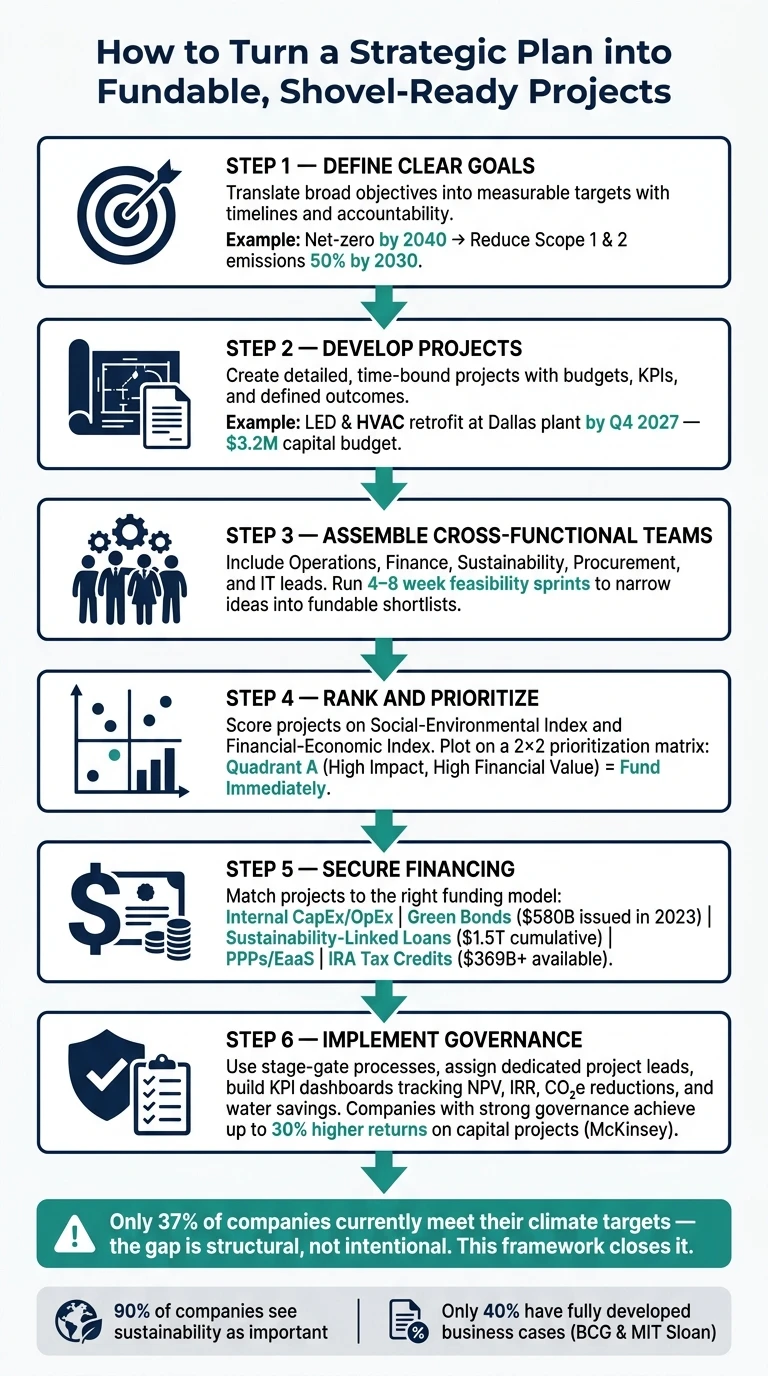
Strategic plans often fail to deliver results because they remain theoretical. To succeed, corporations must transform these plans into actionable, fundable projects. This involves breaking down long-term goals into smaller, measurable initiatives, building strong investment cases, and prioritizing projects based on impact and feasibility. Key steps include:
Define Clear Goals: Translate broad objectives (e.g., "net-zero by 2040") into measurable targets with timelines and accountability.
Develop Projects: Create detailed, time-bound projects with budgets, KPIs, and defined outcomes.
Assemble Teams: Use cross-functional teams to assess technical, financial, and operational feasibility.
Rank and Prioritize: Score projects on financial and social impact, then use tools like prioritization matrices to determine funding priorities.
Secure Financing: Align projects with appropriate funding models, such as internal budgets, green bonds, or public-private partnerships.
Implement Governance: Establish clear oversight, stage-gate processes, and performance tracking to ensure execution.
This process ensures that sustainability strategies evolve from plans into projects that deliver measurable results, aligning corporate goals with actionable outcomes.
How to Turn a Strategic Plan into Fundable, Shovel-Ready Projects
Breaking Down Goals into a Project Pipeline
From Goals to Initiatives to Projects
Turning an ambitious goal like "net-zero by 2040" into actionable steps requires breaking it down into measurable goals, initiatives, and specific projects.
Start by translating the overarching goal into operational terms that can be tracked. For instance, "net-zero by 2040" could be redefined as "reduce Scope 1 and 2 GHG emissions by 50% from a 2022 baseline by 2030 (in metric tons of CO₂e)." Break this target further by assigning specific reductions to individual business units or facilities. Next, identify initiatives - long-term programs designed to achieve these measurable goals. Examples might include "energy efficiency retrofits for North American manufacturing sites" or "fleet electrification for U.S. sales and service operations." Each initiative should have a clear target, timeline, and an executive sponsor to oversee progress.
At the most detailed level are projects - time-bound, budgeted, and clearly scoped tasks. For example, a project might involve "completing an LED and HVAC retrofit at the Dallas plant by Q4 2027 with a $3.2 million capital budget." Each project must have a designated owner, a cross-functional team, and measurable KPIs such as reduced CO₂e emissions, gallons of water saved, waste diverted, or financial metrics like payback period and internal rate of return (IRR). Projects lacking these details are not ready for funding.
Here’s how this hierarchy translates into practice:
Goal Level | Timeline | Purpose | Example |
|---|---|---|---|
Vision | 10+ years | Long-term aspiration | Become a net-positive company by 2040 |
Commitment | 5–10 years | Public science-based pledge | Reduce Scope 1 & 2 emissions by 50% by 2030 |
Target | 1–5 years | Specific, measurable goal | Achieve 75% renewable electricity by 2027 |
Annual Goal | Under 1 year | Immediate deliverable | Complete Scope 3 inventory for top 100 suppliers |
This structured approach lays the groundwork for assembling teams to assess project feasibility.
Building Cross-Functional Teams for Feasibility
Assessing a project's feasibility requires the expertise of a cross-functional team. Each member brings a unique perspective to ensure the project is technically viable, financially sound, and environmentally impactful.
A strong feasibility team includes:
Operations or engineering lead: Confirms the technical feasibility of the project.
Finance partner: Models cash flows in U.S. dollars and evaluates the project against financial benchmarks like hurdle rates.
Sustainability lead: Quantifies environmental benefits using recognized frameworks like the GHG Protocol.
Procurement representative: Analyzes vendor options and total cost of ownership.
IT representative (for digital projects): Ensures compatibility with existing systems and infrastructure.
The team should follow a stage-gate process, advancing projects through phases like concept, pre-feasibility, and full business case development. At each stage, cross-functional reviews help refine the project. Running 4–8 week feasibility sprints for major focus areas - such as fleet electrification or building retrofits - helps narrow down a long list of ideas into a manageable shortlist of fundable projects. This approach avoids the common pitfall of spreading resources too thin by advancing too many complex projects at once.
With a well-rounded team in place, the next step is to explore how these projects interact across the value chain.
Applying Council Fire's Systems Thinking Framework
To maximize impact, integrate validated projects using a systems thinking approach that identifies interdependencies and enhances overall value.
One common mistake in project planning is tunnel vision - treating each project as an isolated effort without considering how it affects or is affected by other initiatives. A systems thinking approach maps these interdependencies across the value chain, ensuring that solving one challenge doesn’t inadvertently create another.
Council Fire's framework emphasizes stakeholder engagement and interconnected planning to help organizations align sustainability goals with actionable projects. Instead of viewing projects as independent tasks, this approach highlights high-leverage interventions - projects that deliver multiple benefits simultaneously. For example, an energy efficiency retrofit might reduce Scope 2 emissions, lower utility costs, and increase asset resilience. This framework also helps prioritize projects, starting with quick wins like LED lighting upgrades or building automation. These early successes create savings and build momentum, paving the way for more complex efforts like fuel switching or supply chain overhauls.
Building a Strong Investment Case for Each Project
Key Components of a Project Case
Every viable project needs a well-structured investment memo to justify funding. This memo should address eight essential elements: a problem statement, the business and sustainability opportunity, project scope, an accurate budget estimate, anticipated benefits, key assumptions, major risks, and the specific decision being requested from leadership [5][6].
A strong problem statement is critical and should connect directly to a tangible business challenge. For instance, instead of vaguely stating "reduce emissions", a better approach would be: "reduce electricity-related emissions across three manufacturing sites by upgrading outdated equipment that is driving up utility costs and increasing exposure to future carbon regulations" [5][6].
Budgets must be credible and detailed. Break down costs into categories such as engineering, equipment, labor, permitting, and contingency, while also specifying confidence levels (e.g., rough estimate, vendor quote, or finalized design). Including a contingency allowance signals a realistic understanding of execution risks rather than avoiding them [6].
Measuring and Presenting Project Benefits
When presenting benefits, go beyond sustainability metrics and incorporate operational and financial impacts. For example, energy savings should be quantified in both kilowatt-hours and dollars saved annually. Similarly, emissions reductions should be expressed in metric tons of CO₂e, alongside their implied value based on an internal carbon price. Many leading organizations use shadow prices of $50–$100 per metric ton of CO₂e to make low-carbon projects more competitive [1].
Water savings gain more weight when paired with avoided utility costs and potential regulatory advantages. For example, a healthcare system consisting of 12 hospitals used a TCFD-aligned climate risk assessment to justify a $180 million resilience investment plan. This strategy helped limit a projected 22% increase in property insurance premiums to just 8% during renewal [4].
When direct financial benefits are challenging to calculate, rely on proxy measures and scenario analyses. Ensure that assumptions are well-documented and conservative. The aim is to provide enough evidence for decision-makers to evaluate the reliability of your projections without overstating unverified outcomes [6].
Council Fire builds on these quantified benefits by leveraging data to strengthen the investment case for each project.
How Council Fire Supports Data-Driven Project Development
To enhance the credibility of project cases, Council Fire applies rigorous data analysis. Their impact analysis services provide the quantitative backbone needed to make proposals defensible. By using tools such as GHG Protocol inventories, ENERGY STAR benchmarking, and facility-level engineering assessments, Council Fire translates operational data into financial and environmental metrics that resonate with funders [3][4].
For instance, this data-driven methodology helped a major research university create a roadmap that justified a $340 million investment. The plan demonstrated $410 million in projected energy savings and avoided maintenance costs over 25 years, resulting in a positive net present value and accelerating the university’s carbon neutrality goal from 2040 to 2035 [3].
Additionally, Council Fire employs a multi-criteria scoring framework and marginal abatement cost curve (MACC) analysis to rank reduction opportunities based on cost per metric ton of CO₂e avoided. This prioritization approach allows leadership to focus on projects with the highest impact. Starting with quick-win efficiency measures that deliver immediate savings, organizations can generate the momentum and funding needed for larger capital projects. This systematic sequencing transforms project proposals into actionable, fundable plans [1][2][3].
Ranking Projects for Funding and Execution
Once credible project cases are established, the next step is deciding which ones to fund. Without a structured approach, decisions may lean on subjective preferences instead of measurable impact.
Using Multi-Criteria Scoring to Evaluate Projects
To rank projects effectively, apply a consistent scoring system that evaluates factors like financial return, strategic alignment, risk, and sustainability impact. A two-dimensional approach works particularly well: assess each project on both a social-environmental index and a financial-economic index [8]. This method ensures high-impact initiatives aren't overlooked in favor of cheaper, low-impact alternatives.
For the social-environmental index, evaluate projects based on:
Scale: How many people or ecosystems are affected.
Scope: The depth of the impact.
Irremediability: How difficult it would be to reverse the effects [7].
For the financial-economic index, consider:
The potential impact on revenues, costs, and assets.
The likelihood of these impacts materializing across short-, medium-, and long-term timeframes [7].
"A materiality assessment determines which sustainability topics deserve attention in your strategy and reporting. It separates the signal from the noise - identifying the ESG issues that matter most to your business and your stakeholders." - Council Fire [7]
Involve cross-functional teams from departments like Sustainability, Finance, Risk, Operations, and Legal to ensure a well-rounded evaluation and to avoid blind spots [7]. Once all projects are scored, set a clear threshold - such as a score of 3 or higher out of 5 - to determine which ones qualify for funding [7].
These scores provide the foundation for visualizing project priorities using a prioritization matrix.
Building a Prioritization Matrix
After scoring, plot each project on a two-axis matrix with social-environmental scores on one axis and financial-economic scores on the other [8]. This visual tool highlights trade-offs and creates a shared framework for discussions among decision-makers.
Quadrant | Position on Matrix | Priority Level | Recommended Action |
|---|---|---|---|
A | High Impact, High Financial Value | Highest | Fund immediately |
B | High Impact, Low Financial Value | Medium | Consider strategic or social-impact financing |
C | Low Impact, High Financial Value | Medium | Assess for efficiency or cost-reduction funding |
D | Low Impact, Low Financial Value | Lowest | Reject or redesign |
Breaking large initiatives into smaller phases before scoring can prevent a single massive project from overshadowing multiple smaller, high-value ones [10]. Additionally, mandatory projects, such as those related to safety or compliance, should be evaluated separately for cash flow modeling [9].
"Clear criteria transform prioritization from 'Which initiative do we like best?' to 'Which initiative best advances our strategy within our constraints?'" - Michelle Wong, Content Strategist, Planview [11]
Aligning Project Priorities with Capital Planning Cycles
Once projects are ranked, align these priorities with your capital planning cycle to secure timely funding. A common pitfall is completing prioritization too late in the year, missing critical budget submission deadlines.
From the outset, align your project pipeline with a multi-year capital planning cycle. Many organizations are moving away from static annual budgets toward continuous, data-driven reforecasting [12]. Incorporate quarterly reviews to update scores, refine cost estimates, and adjust funding based on actual spending [14].
For projects spanning multiple budget years, adopt a fractional allocation strategy. This method draws funding from diverse sources, such as internal capital, federal grants, and state incentives [13]. By doing so, more high-priority projects can progress simultaneously, rather than being forced into a rigid, sequential queue. The aim is to maintain a dynamic portfolio that evolves with changing conditions, rather than a static list that risks being sidelined until the next planning cycle.
Securing Financing and Setting Up Governance
A solid investment plan is the backbone of securing funding, but effective governance ensures that projects are executed as intended. With priorities set and aligned to funding cycles, the next step involves choosing the right financing model and establishing a governance framework that keeps everything on track.
Choosing the Right Financing Model
Every project requires a financing approach tailored to its size, risk, and ownership goals. Here's a breakdown of the most common options:
Internal CapEx or OpEx funding: Ideal for smaller, quick-return projects like lighting upgrades or building efficiency improvements. These projects often pay for themselves in under five years and can be approved through standard internal processes.
Green bonds: A strong choice for large-scale environmental projects, especially if your company has an investment-grade credit rating and a project pipeline exceeding $100 million. In 2023, green bond issuance hit $580 billion, with over 60% coming from corporations and financial institutions. However, these bonds require robust reporting systems to track how funds are used and measure their impact.
Sustainability-linked loans: These loans tie interest rates to meeting specific sustainability goals, such as reducing emissions or boosting renewable energy usage. By 2023, these loans reached $1.5 trillion in cumulative issuance, reflecting their appeal among U.S. and European companies. They offer flexibility but require measurable and credible KPIs.
Public-private partnerships (PPPs) or energy-as-a-service (EaaS): These models are perfect for infrastructure projects your company doesn't intend to own, such as solar installations or EV charging networks. A notable success story is the Prince George's County Clean Water Partnership, which retrofitted 2,000 acres of impervious surfaces and achieved a 10:1 leverage ratio - mobilizing $10 in private funding for every $1 in public investment.
Federal and state incentives: U.S. companies should thoroughly explore programs like the Inflation Reduction Act (IRA), which offers over $369 billion in clean energy incentives via tax credits, grants, and loan guarantees. Factoring these incentives into your financial models from the outset can significantly improve project economics.
Financing Model | Best Fit | Key Consideration |
|---|---|---|
Internal CapEx/OpEx | Small, fast-payback projects | Standard ROI approval process |
Green Bonds | Large environmental assets | Requires detailed use-of-proceeds reporting |
Sustainability-Linked Loans | Company-wide ESG transitions | KPI targets must be measurable |
PPPs / EaaS | Infrastructure without ownership | Long-term service agreements |
IRA Tax Credits & Grants | U.S. clean energy projects | Integrate incentives into financial models |
Once the financing strategy is in place, the focus shifts to governance to ensure projects stay on track.
Governance Steps to Reach Execution Readiness
Securing funds is only half the battle. A strong governance framework ensures projects are executed with discipline and efficiency. Research from McKinsey shows that companies with effective governance achieve up to 30% higher returns on capital projects through better decision-making and execution.
A stage-gate framework is a proven method for managing governance. Each project moves through a series of checkpoints, starting with a basic intake process. A cross-functional committee - including representatives from Sustainability, Finance, Risk, Operations, and Procurement - evaluates proposals for strategic alignment and feasibility. Approved projects advance to pre-feasibility, where detailed engineering estimates and refined financial models are developed. Treasury then helps select the best financing option. Before execution, a final review ensures permits, contracts, staffing, and monitoring plans are all in place.
"Without governance, plans stall. Embed accountability at every level." - Council Fire
Key governance practices include assigning a dedicated project lead with clear authority and budget, documenting decision-making rights to avoid delays, and creating KPI dashboards to track progress. Metrics should cover both financial performance (e.g., NPV, IRR, payback period) and impact measures (e.g., CO₂e reductions, water savings, energy efficiency). Regular reviews and feedback loops keep stakeholders engaged and ensure their input shapes project priorities, fostering trust over time.
How Council Fire Supports Governance Design
Council Fire brings a systems-based approach to governance, recognizing that sustainability projects often span financial, environmental, and social dimensions. This complexity requires governance structures that operate across corporate, community, and ecosystem boundaries.
To address this, Council Fire clarifies roles at every level - board oversight, executive sponsorship, sustainability leadership, and operational management - and translates them into decision matrices like RACI charts. They also integrate sustainability initiatives into enterprise portfolio management, ensuring these projects compete equally with other investments rather than being siloed. Additionally, they help companies meet the rising demand for third-party-verified impact reporting, which is increasingly required by external lenders.
Conclusion: Turning Vision into Action
A sustainability strategy only delivers when it transitions from ambitious ideas to a pipeline of prioritized, well-funded, and ready-to-execute projects. Despite bold goals, just 37% of companies currently meet their climate targets - not because they lack intention, but due to weak structural support. This article has laid out a clear roadmap: breaking down strategic goals into actionable projects, crafting solid investment cases, ranking initiatives with data, and securing financing under strong governance. Every step plays a vital role in achieving success.
Collaboration across departments is key to making this work. Sustainability efforts thrive on teamwork, and involving cross-functional teams early - before plans are finalized - helps identify potential roadblocks, avoids costly delays, and fosters shared ownership that drives internal approval.
A data-driven approach is essential. Decisions must be based on evidence, answering critical questions about costs, returns, risks, and timelines. A survey by BCG and MIT Sloan revealed that while 90% of companies see sustainability as important, only 40% have fully developed business cases for their initiatives. This gap is where most plans falter, and it’s precisely where the structured steps outlined here can make the greatest impact. Now is the moment to apply these principles and turn your strategy into actionable results.
Think of your strategic plan as a dynamic project pipeline, not a static document. High-priority initiatives need to evolve into detailed proposals with clear accountability, defined deadlines, and secured funding. This approach is how ambitious visions turn into real, measurable outcomes.
FAQs
What makes a project “shovel-ready” for funding approval?
A project earns the status of "shovel-ready" when it has successfully navigated through all required predevelopment and planning phases, positioning it for immediate execution. This involves key steps like securing agreement from stakeholders, finalizing both financial and operational frameworks, and completing critical tasks such as design work, permitting, environmental assessments, and developing a schedule that accounts for potential risks. Additionally, showing market feasibility - such as having a committed buyer or off-taker - is crucial to demonstrate the project's readiness for investment.
How do we score and prioritize projects when ROI and impact conflict?
When facing a clash between ROI and overall impact, employing structured frameworks can help balance these priorities effectively. Begin with a materiality assessment to pinpoint critical risks and opportunities, ensuring you're focusing on what matters most. Tools like the Return on Sustainability Investment (ROSI) and marginal abatement cost curves (MACC) are particularly useful. These tools allow you to rank projects based on both financial returns and environmental benefits, enabling a data-driven approach that considers emissions reduction, profitability, and long-term strategic value.
Which financing option fits our project best (CapEx, green bonds, loans, PPPs, or incentives)?
The right financing option hinges on your project's size, risk profile, and objectives. Green bonds are ideal for extensive initiatives such as renewable energy projects, offering a structured way to fund large-scale efforts. For projects focused on measurable environmental, social, and governance (ESG) outcomes, sustainability-linked loans are a smart choice, as they adjust interest rates based on achieving specific ESG targets.
For projects requiring shared responsibility and long-term collaboration, public-private partnerships (PPPs) provide a balanced approach by dividing risks and benefits between public and private entities. Additionally, federal tax incentives, like the 30% Investment Tax Credit, can significantly reduce initial expenses, making projects more financially viable.
To mitigate risk further, consider blended finance, which combines multiple funding sources - such as grants, loans, and private investments - to create a well-rounded financial strategy. This approach allows you to tailor funding to your project's unique needs while spreading potential risks.
Related Blog Posts
Latest Articles
©2026

Narrative Change and Power Building: The Missing Half of Advocacy
Narrative change is the process of disrupting dominant narratives that normalize inequity and advancing new narratives from historically marginalized communities.

Funding Resilience Without Federal Grants
BRIC is unreliable and FEMA is shrinking. Here's how cities fund climate resilience with dedicated revenue, blended finance, and a coordinating authority.

The ESG Blind Spot: How AI Is Finding Risks in Companies Nobody Else Is Watching
Norway's sovereign wealth fund uses AI to screen 7,200 portfolio companies for forced labor and corruption within 24 hours. The real story is the emerging-market coverage gap that traditional ESG data vendors miss — and what it means for any company with a global supply chain.
Narrative Change and Power Building: The Missing Half of Advocacy
Narrative change is the process of disrupting dominant narratives that normalize inequity and advancing new narratives from historically marginalized communities.
Funding Resilience Without Federal Grants
BRIC is unreliable and FEMA is shrinking. Here's how cities fund climate resilience with dedicated revenue, blended finance, and a coordinating authority.
The ESG Blind Spot: How AI Is Finding Risks in Companies Nobody Else Is Watching
Norway's sovereign wealth fund uses AI to screen 7,200 portfolio companies for forced labor and corruption within 24 hours. The real story is the emerging-market coverage gap that traditional ESG data vendors miss — and what it means for any company with a global supply chain.
FAQ
01
What does it really mean to “redefine profit”?
02
What makes Council Fire different?
03
Who does Council Fire work with?
04
What does working with Council Fire actually look like?
05
How does Council Fire help organizations turn big goals into action?
06
How does Council Fire define and measure success?
07
How does technology fit into Council Fire’s work?
May 30, 2026
How to Turn a Strategic Plan into Fundable, Shovel-Ready Projects for Corporations
Sustainability Strategy
In This Article
Translate strategic goals into measurable, fundable projects with investment cases, prioritization, financing, and governance for execution.
How to Turn a Strategic Plan into Fundable, Shovel-Ready Projects for Corporations
Strategic plans often fail to deliver results because they remain theoretical. To succeed, corporations must transform these plans into actionable, fundable projects. This involves breaking down long-term goals into smaller, measurable initiatives, building strong investment cases, and prioritizing projects based on impact and feasibility. Key steps include:
Define Clear Goals: Translate broad objectives (e.g., "net-zero by 2040") into measurable targets with timelines and accountability.
Develop Projects: Create detailed, time-bound projects with budgets, KPIs, and defined outcomes.
Assemble Teams: Use cross-functional teams to assess technical, financial, and operational feasibility.
Rank and Prioritize: Score projects on financial and social impact, then use tools like prioritization matrices to determine funding priorities.
Secure Financing: Align projects with appropriate funding models, such as internal budgets, green bonds, or public-private partnerships.
Implement Governance: Establish clear oversight, stage-gate processes, and performance tracking to ensure execution.
This process ensures that sustainability strategies evolve from plans into projects that deliver measurable results, aligning corporate goals with actionable outcomes.
How to Turn a Strategic Plan into Fundable, Shovel-Ready Projects
Breaking Down Goals into a Project Pipeline
From Goals to Initiatives to Projects
Turning an ambitious goal like "net-zero by 2040" into actionable steps requires breaking it down into measurable goals, initiatives, and specific projects.
Start by translating the overarching goal into operational terms that can be tracked. For instance, "net-zero by 2040" could be redefined as "reduce Scope 1 and 2 GHG emissions by 50% from a 2022 baseline by 2030 (in metric tons of CO₂e)." Break this target further by assigning specific reductions to individual business units or facilities. Next, identify initiatives - long-term programs designed to achieve these measurable goals. Examples might include "energy efficiency retrofits for North American manufacturing sites" or "fleet electrification for U.S. sales and service operations." Each initiative should have a clear target, timeline, and an executive sponsor to oversee progress.
At the most detailed level are projects - time-bound, budgeted, and clearly scoped tasks. For example, a project might involve "completing an LED and HVAC retrofit at the Dallas plant by Q4 2027 with a $3.2 million capital budget." Each project must have a designated owner, a cross-functional team, and measurable KPIs such as reduced CO₂e emissions, gallons of water saved, waste diverted, or financial metrics like payback period and internal rate of return (IRR). Projects lacking these details are not ready for funding.
Here’s how this hierarchy translates into practice:
Goal Level | Timeline | Purpose | Example |
|---|---|---|---|
Vision | 10+ years | Long-term aspiration | Become a net-positive company by 2040 |
Commitment | 5–10 years | Public science-based pledge | Reduce Scope 1 & 2 emissions by 50% by 2030 |
Target | 1–5 years | Specific, measurable goal | Achieve 75% renewable electricity by 2027 |
Annual Goal | Under 1 year | Immediate deliverable | Complete Scope 3 inventory for top 100 suppliers |
This structured approach lays the groundwork for assembling teams to assess project feasibility.
Building Cross-Functional Teams for Feasibility
Assessing a project's feasibility requires the expertise of a cross-functional team. Each member brings a unique perspective to ensure the project is technically viable, financially sound, and environmentally impactful.
A strong feasibility team includes:
Operations or engineering lead: Confirms the technical feasibility of the project.
Finance partner: Models cash flows in U.S. dollars and evaluates the project against financial benchmarks like hurdle rates.
Sustainability lead: Quantifies environmental benefits using recognized frameworks like the GHG Protocol.
Procurement representative: Analyzes vendor options and total cost of ownership.
IT representative (for digital projects): Ensures compatibility with existing systems and infrastructure.
The team should follow a stage-gate process, advancing projects through phases like concept, pre-feasibility, and full business case development. At each stage, cross-functional reviews help refine the project. Running 4–8 week feasibility sprints for major focus areas - such as fleet electrification or building retrofits - helps narrow down a long list of ideas into a manageable shortlist of fundable projects. This approach avoids the common pitfall of spreading resources too thin by advancing too many complex projects at once.
With a well-rounded team in place, the next step is to explore how these projects interact across the value chain.
Applying Council Fire's Systems Thinking Framework
To maximize impact, integrate validated projects using a systems thinking approach that identifies interdependencies and enhances overall value.
One common mistake in project planning is tunnel vision - treating each project as an isolated effort without considering how it affects or is affected by other initiatives. A systems thinking approach maps these interdependencies across the value chain, ensuring that solving one challenge doesn’t inadvertently create another.
Council Fire's framework emphasizes stakeholder engagement and interconnected planning to help organizations align sustainability goals with actionable projects. Instead of viewing projects as independent tasks, this approach highlights high-leverage interventions - projects that deliver multiple benefits simultaneously. For example, an energy efficiency retrofit might reduce Scope 2 emissions, lower utility costs, and increase asset resilience. This framework also helps prioritize projects, starting with quick wins like LED lighting upgrades or building automation. These early successes create savings and build momentum, paving the way for more complex efforts like fuel switching or supply chain overhauls.
Building a Strong Investment Case for Each Project
Key Components of a Project Case
Every viable project needs a well-structured investment memo to justify funding. This memo should address eight essential elements: a problem statement, the business and sustainability opportunity, project scope, an accurate budget estimate, anticipated benefits, key assumptions, major risks, and the specific decision being requested from leadership [5][6].
A strong problem statement is critical and should connect directly to a tangible business challenge. For instance, instead of vaguely stating "reduce emissions", a better approach would be: "reduce electricity-related emissions across three manufacturing sites by upgrading outdated equipment that is driving up utility costs and increasing exposure to future carbon regulations" [5][6].
Budgets must be credible and detailed. Break down costs into categories such as engineering, equipment, labor, permitting, and contingency, while also specifying confidence levels (e.g., rough estimate, vendor quote, or finalized design). Including a contingency allowance signals a realistic understanding of execution risks rather than avoiding them [6].
Measuring and Presenting Project Benefits
When presenting benefits, go beyond sustainability metrics and incorporate operational and financial impacts. For example, energy savings should be quantified in both kilowatt-hours and dollars saved annually. Similarly, emissions reductions should be expressed in metric tons of CO₂e, alongside their implied value based on an internal carbon price. Many leading organizations use shadow prices of $50–$100 per metric ton of CO₂e to make low-carbon projects more competitive [1].
Water savings gain more weight when paired with avoided utility costs and potential regulatory advantages. For example, a healthcare system consisting of 12 hospitals used a TCFD-aligned climate risk assessment to justify a $180 million resilience investment plan. This strategy helped limit a projected 22% increase in property insurance premiums to just 8% during renewal [4].
When direct financial benefits are challenging to calculate, rely on proxy measures and scenario analyses. Ensure that assumptions are well-documented and conservative. The aim is to provide enough evidence for decision-makers to evaluate the reliability of your projections without overstating unverified outcomes [6].
Council Fire builds on these quantified benefits by leveraging data to strengthen the investment case for each project.
How Council Fire Supports Data-Driven Project Development
To enhance the credibility of project cases, Council Fire applies rigorous data analysis. Their impact analysis services provide the quantitative backbone needed to make proposals defensible. By using tools such as GHG Protocol inventories, ENERGY STAR benchmarking, and facility-level engineering assessments, Council Fire translates operational data into financial and environmental metrics that resonate with funders [3][4].
For instance, this data-driven methodology helped a major research university create a roadmap that justified a $340 million investment. The plan demonstrated $410 million in projected energy savings and avoided maintenance costs over 25 years, resulting in a positive net present value and accelerating the university’s carbon neutrality goal from 2040 to 2035 [3].
Additionally, Council Fire employs a multi-criteria scoring framework and marginal abatement cost curve (MACC) analysis to rank reduction opportunities based on cost per metric ton of CO₂e avoided. This prioritization approach allows leadership to focus on projects with the highest impact. Starting with quick-win efficiency measures that deliver immediate savings, organizations can generate the momentum and funding needed for larger capital projects. This systematic sequencing transforms project proposals into actionable, fundable plans [1][2][3].
Ranking Projects for Funding and Execution
Once credible project cases are established, the next step is deciding which ones to fund. Without a structured approach, decisions may lean on subjective preferences instead of measurable impact.
Using Multi-Criteria Scoring to Evaluate Projects
To rank projects effectively, apply a consistent scoring system that evaluates factors like financial return, strategic alignment, risk, and sustainability impact. A two-dimensional approach works particularly well: assess each project on both a social-environmental index and a financial-economic index [8]. This method ensures high-impact initiatives aren't overlooked in favor of cheaper, low-impact alternatives.
For the social-environmental index, evaluate projects based on:
Scale: How many people or ecosystems are affected.
Scope: The depth of the impact.
Irremediability: How difficult it would be to reverse the effects [7].
For the financial-economic index, consider:
The potential impact on revenues, costs, and assets.
The likelihood of these impacts materializing across short-, medium-, and long-term timeframes [7].
"A materiality assessment determines which sustainability topics deserve attention in your strategy and reporting. It separates the signal from the noise - identifying the ESG issues that matter most to your business and your stakeholders." - Council Fire [7]
Involve cross-functional teams from departments like Sustainability, Finance, Risk, Operations, and Legal to ensure a well-rounded evaluation and to avoid blind spots [7]. Once all projects are scored, set a clear threshold - such as a score of 3 or higher out of 5 - to determine which ones qualify for funding [7].
These scores provide the foundation for visualizing project priorities using a prioritization matrix.
Building a Prioritization Matrix
After scoring, plot each project on a two-axis matrix with social-environmental scores on one axis and financial-economic scores on the other [8]. This visual tool highlights trade-offs and creates a shared framework for discussions among decision-makers.
Quadrant | Position on Matrix | Priority Level | Recommended Action |
|---|---|---|---|
A | High Impact, High Financial Value | Highest | Fund immediately |
B | High Impact, Low Financial Value | Medium | Consider strategic or social-impact financing |
C | Low Impact, High Financial Value | Medium | Assess for efficiency or cost-reduction funding |
D | Low Impact, Low Financial Value | Lowest | Reject or redesign |
Breaking large initiatives into smaller phases before scoring can prevent a single massive project from overshadowing multiple smaller, high-value ones [10]. Additionally, mandatory projects, such as those related to safety or compliance, should be evaluated separately for cash flow modeling [9].
"Clear criteria transform prioritization from 'Which initiative do we like best?' to 'Which initiative best advances our strategy within our constraints?'" - Michelle Wong, Content Strategist, Planview [11]
Aligning Project Priorities with Capital Planning Cycles
Once projects are ranked, align these priorities with your capital planning cycle to secure timely funding. A common pitfall is completing prioritization too late in the year, missing critical budget submission deadlines.
From the outset, align your project pipeline with a multi-year capital planning cycle. Many organizations are moving away from static annual budgets toward continuous, data-driven reforecasting [12]. Incorporate quarterly reviews to update scores, refine cost estimates, and adjust funding based on actual spending [14].
For projects spanning multiple budget years, adopt a fractional allocation strategy. This method draws funding from diverse sources, such as internal capital, federal grants, and state incentives [13]. By doing so, more high-priority projects can progress simultaneously, rather than being forced into a rigid, sequential queue. The aim is to maintain a dynamic portfolio that evolves with changing conditions, rather than a static list that risks being sidelined until the next planning cycle.
Securing Financing and Setting Up Governance
A solid investment plan is the backbone of securing funding, but effective governance ensures that projects are executed as intended. With priorities set and aligned to funding cycles, the next step involves choosing the right financing model and establishing a governance framework that keeps everything on track.
Choosing the Right Financing Model
Every project requires a financing approach tailored to its size, risk, and ownership goals. Here's a breakdown of the most common options:
Internal CapEx or OpEx funding: Ideal for smaller, quick-return projects like lighting upgrades or building efficiency improvements. These projects often pay for themselves in under five years and can be approved through standard internal processes.
Green bonds: A strong choice for large-scale environmental projects, especially if your company has an investment-grade credit rating and a project pipeline exceeding $100 million. In 2023, green bond issuance hit $580 billion, with over 60% coming from corporations and financial institutions. However, these bonds require robust reporting systems to track how funds are used and measure their impact.
Sustainability-linked loans: These loans tie interest rates to meeting specific sustainability goals, such as reducing emissions or boosting renewable energy usage. By 2023, these loans reached $1.5 trillion in cumulative issuance, reflecting their appeal among U.S. and European companies. They offer flexibility but require measurable and credible KPIs.
Public-private partnerships (PPPs) or energy-as-a-service (EaaS): These models are perfect for infrastructure projects your company doesn't intend to own, such as solar installations or EV charging networks. A notable success story is the Prince George's County Clean Water Partnership, which retrofitted 2,000 acres of impervious surfaces and achieved a 10:1 leverage ratio - mobilizing $10 in private funding for every $1 in public investment.
Federal and state incentives: U.S. companies should thoroughly explore programs like the Inflation Reduction Act (IRA), which offers over $369 billion in clean energy incentives via tax credits, grants, and loan guarantees. Factoring these incentives into your financial models from the outset can significantly improve project economics.
Financing Model | Best Fit | Key Consideration |
|---|---|---|
Internal CapEx/OpEx | Small, fast-payback projects | Standard ROI approval process |
Green Bonds | Large environmental assets | Requires detailed use-of-proceeds reporting |
Sustainability-Linked Loans | Company-wide ESG transitions | KPI targets must be measurable |
PPPs / EaaS | Infrastructure without ownership | Long-term service agreements |
IRA Tax Credits & Grants | U.S. clean energy projects | Integrate incentives into financial models |
Once the financing strategy is in place, the focus shifts to governance to ensure projects stay on track.
Governance Steps to Reach Execution Readiness
Securing funds is only half the battle. A strong governance framework ensures projects are executed with discipline and efficiency. Research from McKinsey shows that companies with effective governance achieve up to 30% higher returns on capital projects through better decision-making and execution.
A stage-gate framework is a proven method for managing governance. Each project moves through a series of checkpoints, starting with a basic intake process. A cross-functional committee - including representatives from Sustainability, Finance, Risk, Operations, and Procurement - evaluates proposals for strategic alignment and feasibility. Approved projects advance to pre-feasibility, where detailed engineering estimates and refined financial models are developed. Treasury then helps select the best financing option. Before execution, a final review ensures permits, contracts, staffing, and monitoring plans are all in place.
"Without governance, plans stall. Embed accountability at every level." - Council Fire
Key governance practices include assigning a dedicated project lead with clear authority and budget, documenting decision-making rights to avoid delays, and creating KPI dashboards to track progress. Metrics should cover both financial performance (e.g., NPV, IRR, payback period) and impact measures (e.g., CO₂e reductions, water savings, energy efficiency). Regular reviews and feedback loops keep stakeholders engaged and ensure their input shapes project priorities, fostering trust over time.
How Council Fire Supports Governance Design
Council Fire brings a systems-based approach to governance, recognizing that sustainability projects often span financial, environmental, and social dimensions. This complexity requires governance structures that operate across corporate, community, and ecosystem boundaries.
To address this, Council Fire clarifies roles at every level - board oversight, executive sponsorship, sustainability leadership, and operational management - and translates them into decision matrices like RACI charts. They also integrate sustainability initiatives into enterprise portfolio management, ensuring these projects compete equally with other investments rather than being siloed. Additionally, they help companies meet the rising demand for third-party-verified impact reporting, which is increasingly required by external lenders.
Conclusion: Turning Vision into Action
A sustainability strategy only delivers when it transitions from ambitious ideas to a pipeline of prioritized, well-funded, and ready-to-execute projects. Despite bold goals, just 37% of companies currently meet their climate targets - not because they lack intention, but due to weak structural support. This article has laid out a clear roadmap: breaking down strategic goals into actionable projects, crafting solid investment cases, ranking initiatives with data, and securing financing under strong governance. Every step plays a vital role in achieving success.
Collaboration across departments is key to making this work. Sustainability efforts thrive on teamwork, and involving cross-functional teams early - before plans are finalized - helps identify potential roadblocks, avoids costly delays, and fosters shared ownership that drives internal approval.
A data-driven approach is essential. Decisions must be based on evidence, answering critical questions about costs, returns, risks, and timelines. A survey by BCG and MIT Sloan revealed that while 90% of companies see sustainability as important, only 40% have fully developed business cases for their initiatives. This gap is where most plans falter, and it’s precisely where the structured steps outlined here can make the greatest impact. Now is the moment to apply these principles and turn your strategy into actionable results.
Think of your strategic plan as a dynamic project pipeline, not a static document. High-priority initiatives need to evolve into detailed proposals with clear accountability, defined deadlines, and secured funding. This approach is how ambitious visions turn into real, measurable outcomes.
FAQs
What makes a project “shovel-ready” for funding approval?
A project earns the status of "shovel-ready" when it has successfully navigated through all required predevelopment and planning phases, positioning it for immediate execution. This involves key steps like securing agreement from stakeholders, finalizing both financial and operational frameworks, and completing critical tasks such as design work, permitting, environmental assessments, and developing a schedule that accounts for potential risks. Additionally, showing market feasibility - such as having a committed buyer or off-taker - is crucial to demonstrate the project's readiness for investment.
How do we score and prioritize projects when ROI and impact conflict?
When facing a clash between ROI and overall impact, employing structured frameworks can help balance these priorities effectively. Begin with a materiality assessment to pinpoint critical risks and opportunities, ensuring you're focusing on what matters most. Tools like the Return on Sustainability Investment (ROSI) and marginal abatement cost curves (MACC) are particularly useful. These tools allow you to rank projects based on both financial returns and environmental benefits, enabling a data-driven approach that considers emissions reduction, profitability, and long-term strategic value.
Which financing option fits our project best (CapEx, green bonds, loans, PPPs, or incentives)?
The right financing option hinges on your project's size, risk profile, and objectives. Green bonds are ideal for extensive initiatives such as renewable energy projects, offering a structured way to fund large-scale efforts. For projects focused on measurable environmental, social, and governance (ESG) outcomes, sustainability-linked loans are a smart choice, as they adjust interest rates based on achieving specific ESG targets.
For projects requiring shared responsibility and long-term collaboration, public-private partnerships (PPPs) provide a balanced approach by dividing risks and benefits between public and private entities. Additionally, federal tax incentives, like the 30% Investment Tax Credit, can significantly reduce initial expenses, making projects more financially viable.
To mitigate risk further, consider blended finance, which combines multiple funding sources - such as grants, loans, and private investments - to create a well-rounded financial strategy. This approach allows you to tailor funding to your project's unique needs while spreading potential risks.
Related Blog Posts
Latest Articles
©2026
Narrative Change and Power Building: The Missing Half of Advocacy
Narrative change is the process of disrupting dominant narratives that normalize inequity and advancing new narratives from historically marginalized communities.
Funding Resilience Without Federal Grants
BRIC is unreliable and FEMA is shrinking. Here's how cities fund climate resilience with dedicated revenue, blended finance, and a coordinating authority.
The ESG Blind Spot: How AI Is Finding Risks in Companies Nobody Else Is Watching
Norway's sovereign wealth fund uses AI to screen 7,200 portfolio companies for forced labor and corruption within 24 hours. The real story is the emerging-market coverage gap that traditional ESG data vendors miss — and what it means for any company with a global supply chain.
FAQ
01
What does it really mean to “redefine profit”?
02
What makes Council Fire different?
03
Who does Council Fire work with?
04
What does working with Council Fire actually look like?
05
How does Council Fire help organizations turn big goals into action?
06
How does Council Fire define and measure success?
07
How does technology fit into Council Fire’s work?
May 30, 2026
How to Turn a Strategic Plan into Fundable, Shovel-Ready Projects for Corporations
Sustainability Strategy
In This Article
Translate strategic goals into measurable, fundable projects with investment cases, prioritization, financing, and governance for execution.
How to Turn a Strategic Plan into Fundable, Shovel-Ready Projects for Corporations
Strategic plans often fail to deliver results because they remain theoretical. To succeed, corporations must transform these plans into actionable, fundable projects. This involves breaking down long-term goals into smaller, measurable initiatives, building strong investment cases, and prioritizing projects based on impact and feasibility. Key steps include:
Define Clear Goals: Translate broad objectives (e.g., "net-zero by 2040") into measurable targets with timelines and accountability.
Develop Projects: Create detailed, time-bound projects with budgets, KPIs, and defined outcomes.
Assemble Teams: Use cross-functional teams to assess technical, financial, and operational feasibility.
Rank and Prioritize: Score projects on financial and social impact, then use tools like prioritization matrices to determine funding priorities.
Secure Financing: Align projects with appropriate funding models, such as internal budgets, green bonds, or public-private partnerships.
Implement Governance: Establish clear oversight, stage-gate processes, and performance tracking to ensure execution.
This process ensures that sustainability strategies evolve from plans into projects that deliver measurable results, aligning corporate goals with actionable outcomes.
How to Turn a Strategic Plan into Fundable, Shovel-Ready Projects
Breaking Down Goals into a Project Pipeline
From Goals to Initiatives to Projects
Turning an ambitious goal like "net-zero by 2040" into actionable steps requires breaking it down into measurable goals, initiatives, and specific projects.
Start by translating the overarching goal into operational terms that can be tracked. For instance, "net-zero by 2040" could be redefined as "reduce Scope 1 and 2 GHG emissions by 50% from a 2022 baseline by 2030 (in metric tons of CO₂e)." Break this target further by assigning specific reductions to individual business units or facilities. Next, identify initiatives - long-term programs designed to achieve these measurable goals. Examples might include "energy efficiency retrofits for North American manufacturing sites" or "fleet electrification for U.S. sales and service operations." Each initiative should have a clear target, timeline, and an executive sponsor to oversee progress.
At the most detailed level are projects - time-bound, budgeted, and clearly scoped tasks. For example, a project might involve "completing an LED and HVAC retrofit at the Dallas plant by Q4 2027 with a $3.2 million capital budget." Each project must have a designated owner, a cross-functional team, and measurable KPIs such as reduced CO₂e emissions, gallons of water saved, waste diverted, or financial metrics like payback period and internal rate of return (IRR). Projects lacking these details are not ready for funding.
Here’s how this hierarchy translates into practice:
Goal Level | Timeline | Purpose | Example |
|---|---|---|---|
Vision | 10+ years | Long-term aspiration | Become a net-positive company by 2040 |
Commitment | 5–10 years | Public science-based pledge | Reduce Scope 1 & 2 emissions by 50% by 2030 |
Target | 1–5 years | Specific, measurable goal | Achieve 75% renewable electricity by 2027 |
Annual Goal | Under 1 year | Immediate deliverable | Complete Scope 3 inventory for top 100 suppliers |
This structured approach lays the groundwork for assembling teams to assess project feasibility.
Building Cross-Functional Teams for Feasibility
Assessing a project's feasibility requires the expertise of a cross-functional team. Each member brings a unique perspective to ensure the project is technically viable, financially sound, and environmentally impactful.
A strong feasibility team includes:
Operations or engineering lead: Confirms the technical feasibility of the project.
Finance partner: Models cash flows in U.S. dollars and evaluates the project against financial benchmarks like hurdle rates.
Sustainability lead: Quantifies environmental benefits using recognized frameworks like the GHG Protocol.
Procurement representative: Analyzes vendor options and total cost of ownership.
IT representative (for digital projects): Ensures compatibility with existing systems and infrastructure.
The team should follow a stage-gate process, advancing projects through phases like concept, pre-feasibility, and full business case development. At each stage, cross-functional reviews help refine the project. Running 4–8 week feasibility sprints for major focus areas - such as fleet electrification or building retrofits - helps narrow down a long list of ideas into a manageable shortlist of fundable projects. This approach avoids the common pitfall of spreading resources too thin by advancing too many complex projects at once.
With a well-rounded team in place, the next step is to explore how these projects interact across the value chain.
Applying Council Fire's Systems Thinking Framework
To maximize impact, integrate validated projects using a systems thinking approach that identifies interdependencies and enhances overall value.
One common mistake in project planning is tunnel vision - treating each project as an isolated effort without considering how it affects or is affected by other initiatives. A systems thinking approach maps these interdependencies across the value chain, ensuring that solving one challenge doesn’t inadvertently create another.
Council Fire's framework emphasizes stakeholder engagement and interconnected planning to help organizations align sustainability goals with actionable projects. Instead of viewing projects as independent tasks, this approach highlights high-leverage interventions - projects that deliver multiple benefits simultaneously. For example, an energy efficiency retrofit might reduce Scope 2 emissions, lower utility costs, and increase asset resilience. This framework also helps prioritize projects, starting with quick wins like LED lighting upgrades or building automation. These early successes create savings and build momentum, paving the way for more complex efforts like fuel switching or supply chain overhauls.
Building a Strong Investment Case for Each Project
Key Components of a Project Case
Every viable project needs a well-structured investment memo to justify funding. This memo should address eight essential elements: a problem statement, the business and sustainability opportunity, project scope, an accurate budget estimate, anticipated benefits, key assumptions, major risks, and the specific decision being requested from leadership [5][6].
A strong problem statement is critical and should connect directly to a tangible business challenge. For instance, instead of vaguely stating "reduce emissions", a better approach would be: "reduce electricity-related emissions across three manufacturing sites by upgrading outdated equipment that is driving up utility costs and increasing exposure to future carbon regulations" [5][6].
Budgets must be credible and detailed. Break down costs into categories such as engineering, equipment, labor, permitting, and contingency, while also specifying confidence levels (e.g., rough estimate, vendor quote, or finalized design). Including a contingency allowance signals a realistic understanding of execution risks rather than avoiding them [6].
Measuring and Presenting Project Benefits
When presenting benefits, go beyond sustainability metrics and incorporate operational and financial impacts. For example, energy savings should be quantified in both kilowatt-hours and dollars saved annually. Similarly, emissions reductions should be expressed in metric tons of CO₂e, alongside their implied value based on an internal carbon price. Many leading organizations use shadow prices of $50–$100 per metric ton of CO₂e to make low-carbon projects more competitive [1].
Water savings gain more weight when paired with avoided utility costs and potential regulatory advantages. For example, a healthcare system consisting of 12 hospitals used a TCFD-aligned climate risk assessment to justify a $180 million resilience investment plan. This strategy helped limit a projected 22% increase in property insurance premiums to just 8% during renewal [4].
When direct financial benefits are challenging to calculate, rely on proxy measures and scenario analyses. Ensure that assumptions are well-documented and conservative. The aim is to provide enough evidence for decision-makers to evaluate the reliability of your projections without overstating unverified outcomes [6].
Council Fire builds on these quantified benefits by leveraging data to strengthen the investment case for each project.
How Council Fire Supports Data-Driven Project Development
To enhance the credibility of project cases, Council Fire applies rigorous data analysis. Their impact analysis services provide the quantitative backbone needed to make proposals defensible. By using tools such as GHG Protocol inventories, ENERGY STAR benchmarking, and facility-level engineering assessments, Council Fire translates operational data into financial and environmental metrics that resonate with funders [3][4].
For instance, this data-driven methodology helped a major research university create a roadmap that justified a $340 million investment. The plan demonstrated $410 million in projected energy savings and avoided maintenance costs over 25 years, resulting in a positive net present value and accelerating the university’s carbon neutrality goal from 2040 to 2035 [3].
Additionally, Council Fire employs a multi-criteria scoring framework and marginal abatement cost curve (MACC) analysis to rank reduction opportunities based on cost per metric ton of CO₂e avoided. This prioritization approach allows leadership to focus on projects with the highest impact. Starting with quick-win efficiency measures that deliver immediate savings, organizations can generate the momentum and funding needed for larger capital projects. This systematic sequencing transforms project proposals into actionable, fundable plans [1][2][3].
Ranking Projects for Funding and Execution
Once credible project cases are established, the next step is deciding which ones to fund. Without a structured approach, decisions may lean on subjective preferences instead of measurable impact.
Using Multi-Criteria Scoring to Evaluate Projects
To rank projects effectively, apply a consistent scoring system that evaluates factors like financial return, strategic alignment, risk, and sustainability impact. A two-dimensional approach works particularly well: assess each project on both a social-environmental index and a financial-economic index [8]. This method ensures high-impact initiatives aren't overlooked in favor of cheaper, low-impact alternatives.
For the social-environmental index, evaluate projects based on:
Scale: How many people or ecosystems are affected.
Scope: The depth of the impact.
Irremediability: How difficult it would be to reverse the effects [7].
For the financial-economic index, consider:
The potential impact on revenues, costs, and assets.
The likelihood of these impacts materializing across short-, medium-, and long-term timeframes [7].
"A materiality assessment determines which sustainability topics deserve attention in your strategy and reporting. It separates the signal from the noise - identifying the ESG issues that matter most to your business and your stakeholders." - Council Fire [7]
Involve cross-functional teams from departments like Sustainability, Finance, Risk, Operations, and Legal to ensure a well-rounded evaluation and to avoid blind spots [7]. Once all projects are scored, set a clear threshold - such as a score of 3 or higher out of 5 - to determine which ones qualify for funding [7].
These scores provide the foundation for visualizing project priorities using a prioritization matrix.
Building a Prioritization Matrix
After scoring, plot each project on a two-axis matrix with social-environmental scores on one axis and financial-economic scores on the other [8]. This visual tool highlights trade-offs and creates a shared framework for discussions among decision-makers.
Quadrant | Position on Matrix | Priority Level | Recommended Action |
|---|---|---|---|
A | High Impact, High Financial Value | Highest | Fund immediately |
B | High Impact, Low Financial Value | Medium | Consider strategic or social-impact financing |
C | Low Impact, High Financial Value | Medium | Assess for efficiency or cost-reduction funding |
D | Low Impact, Low Financial Value | Lowest | Reject or redesign |
Breaking large initiatives into smaller phases before scoring can prevent a single massive project from overshadowing multiple smaller, high-value ones [10]. Additionally, mandatory projects, such as those related to safety or compliance, should be evaluated separately for cash flow modeling [9].
"Clear criteria transform prioritization from 'Which initiative do we like best?' to 'Which initiative best advances our strategy within our constraints?'" - Michelle Wong, Content Strategist, Planview [11]
Aligning Project Priorities with Capital Planning Cycles
Once projects are ranked, align these priorities with your capital planning cycle to secure timely funding. A common pitfall is completing prioritization too late in the year, missing critical budget submission deadlines.
From the outset, align your project pipeline with a multi-year capital planning cycle. Many organizations are moving away from static annual budgets toward continuous, data-driven reforecasting [12]. Incorporate quarterly reviews to update scores, refine cost estimates, and adjust funding based on actual spending [14].
For projects spanning multiple budget years, adopt a fractional allocation strategy. This method draws funding from diverse sources, such as internal capital, federal grants, and state incentives [13]. By doing so, more high-priority projects can progress simultaneously, rather than being forced into a rigid, sequential queue. The aim is to maintain a dynamic portfolio that evolves with changing conditions, rather than a static list that risks being sidelined until the next planning cycle.
Securing Financing and Setting Up Governance
A solid investment plan is the backbone of securing funding, but effective governance ensures that projects are executed as intended. With priorities set and aligned to funding cycles, the next step involves choosing the right financing model and establishing a governance framework that keeps everything on track.
Choosing the Right Financing Model
Every project requires a financing approach tailored to its size, risk, and ownership goals. Here's a breakdown of the most common options:
Internal CapEx or OpEx funding: Ideal for smaller, quick-return projects like lighting upgrades or building efficiency improvements. These projects often pay for themselves in under five years and can be approved through standard internal processes.
Green bonds: A strong choice for large-scale environmental projects, especially if your company has an investment-grade credit rating and a project pipeline exceeding $100 million. In 2023, green bond issuance hit $580 billion, with over 60% coming from corporations and financial institutions. However, these bonds require robust reporting systems to track how funds are used and measure their impact.
Sustainability-linked loans: These loans tie interest rates to meeting specific sustainability goals, such as reducing emissions or boosting renewable energy usage. By 2023, these loans reached $1.5 trillion in cumulative issuance, reflecting their appeal among U.S. and European companies. They offer flexibility but require measurable and credible KPIs.
Public-private partnerships (PPPs) or energy-as-a-service (EaaS): These models are perfect for infrastructure projects your company doesn't intend to own, such as solar installations or EV charging networks. A notable success story is the Prince George's County Clean Water Partnership, which retrofitted 2,000 acres of impervious surfaces and achieved a 10:1 leverage ratio - mobilizing $10 in private funding for every $1 in public investment.
Federal and state incentives: U.S. companies should thoroughly explore programs like the Inflation Reduction Act (IRA), which offers over $369 billion in clean energy incentives via tax credits, grants, and loan guarantees. Factoring these incentives into your financial models from the outset can significantly improve project economics.
Financing Model | Best Fit | Key Consideration |
|---|---|---|
Internal CapEx/OpEx | Small, fast-payback projects | Standard ROI approval process |
Green Bonds | Large environmental assets | Requires detailed use-of-proceeds reporting |
Sustainability-Linked Loans | Company-wide ESG transitions | KPI targets must be measurable |
PPPs / EaaS | Infrastructure without ownership | Long-term service agreements |
IRA Tax Credits & Grants | U.S. clean energy projects | Integrate incentives into financial models |
Once the financing strategy is in place, the focus shifts to governance to ensure projects stay on track.
Governance Steps to Reach Execution Readiness
Securing funds is only half the battle. A strong governance framework ensures projects are executed with discipline and efficiency. Research from McKinsey shows that companies with effective governance achieve up to 30% higher returns on capital projects through better decision-making and execution.
A stage-gate framework is a proven method for managing governance. Each project moves through a series of checkpoints, starting with a basic intake process. A cross-functional committee - including representatives from Sustainability, Finance, Risk, Operations, and Procurement - evaluates proposals for strategic alignment and feasibility. Approved projects advance to pre-feasibility, where detailed engineering estimates and refined financial models are developed. Treasury then helps select the best financing option. Before execution, a final review ensures permits, contracts, staffing, and monitoring plans are all in place.
"Without governance, plans stall. Embed accountability at every level." - Council Fire
Key governance practices include assigning a dedicated project lead with clear authority and budget, documenting decision-making rights to avoid delays, and creating KPI dashboards to track progress. Metrics should cover both financial performance (e.g., NPV, IRR, payback period) and impact measures (e.g., CO₂e reductions, water savings, energy efficiency). Regular reviews and feedback loops keep stakeholders engaged and ensure their input shapes project priorities, fostering trust over time.
How Council Fire Supports Governance Design
Council Fire brings a systems-based approach to governance, recognizing that sustainability projects often span financial, environmental, and social dimensions. This complexity requires governance structures that operate across corporate, community, and ecosystem boundaries.
To address this, Council Fire clarifies roles at every level - board oversight, executive sponsorship, sustainability leadership, and operational management - and translates them into decision matrices like RACI charts. They also integrate sustainability initiatives into enterprise portfolio management, ensuring these projects compete equally with other investments rather than being siloed. Additionally, they help companies meet the rising demand for third-party-verified impact reporting, which is increasingly required by external lenders.
Conclusion: Turning Vision into Action
A sustainability strategy only delivers when it transitions from ambitious ideas to a pipeline of prioritized, well-funded, and ready-to-execute projects. Despite bold goals, just 37% of companies currently meet their climate targets - not because they lack intention, but due to weak structural support. This article has laid out a clear roadmap: breaking down strategic goals into actionable projects, crafting solid investment cases, ranking initiatives with data, and securing financing under strong governance. Every step plays a vital role in achieving success.
Collaboration across departments is key to making this work. Sustainability efforts thrive on teamwork, and involving cross-functional teams early - before plans are finalized - helps identify potential roadblocks, avoids costly delays, and fosters shared ownership that drives internal approval.
A data-driven approach is essential. Decisions must be based on evidence, answering critical questions about costs, returns, risks, and timelines. A survey by BCG and MIT Sloan revealed that while 90% of companies see sustainability as important, only 40% have fully developed business cases for their initiatives. This gap is where most plans falter, and it’s precisely where the structured steps outlined here can make the greatest impact. Now is the moment to apply these principles and turn your strategy into actionable results.
Think of your strategic plan as a dynamic project pipeline, not a static document. High-priority initiatives need to evolve into detailed proposals with clear accountability, defined deadlines, and secured funding. This approach is how ambitious visions turn into real, measurable outcomes.
FAQs
What makes a project “shovel-ready” for funding approval?
A project earns the status of "shovel-ready" when it has successfully navigated through all required predevelopment and planning phases, positioning it for immediate execution. This involves key steps like securing agreement from stakeholders, finalizing both financial and operational frameworks, and completing critical tasks such as design work, permitting, environmental assessments, and developing a schedule that accounts for potential risks. Additionally, showing market feasibility - such as having a committed buyer or off-taker - is crucial to demonstrate the project's readiness for investment.
How do we score and prioritize projects when ROI and impact conflict?
When facing a clash between ROI and overall impact, employing structured frameworks can help balance these priorities effectively. Begin with a materiality assessment to pinpoint critical risks and opportunities, ensuring you're focusing on what matters most. Tools like the Return on Sustainability Investment (ROSI) and marginal abatement cost curves (MACC) are particularly useful. These tools allow you to rank projects based on both financial returns and environmental benefits, enabling a data-driven approach that considers emissions reduction, profitability, and long-term strategic value.
Which financing option fits our project best (CapEx, green bonds, loans, PPPs, or incentives)?
The right financing option hinges on your project's size, risk profile, and objectives. Green bonds are ideal for extensive initiatives such as renewable energy projects, offering a structured way to fund large-scale efforts. For projects focused on measurable environmental, social, and governance (ESG) outcomes, sustainability-linked loans are a smart choice, as they adjust interest rates based on achieving specific ESG targets.
For projects requiring shared responsibility and long-term collaboration, public-private partnerships (PPPs) provide a balanced approach by dividing risks and benefits between public and private entities. Additionally, federal tax incentives, like the 30% Investment Tax Credit, can significantly reduce initial expenses, making projects more financially viable.
To mitigate risk further, consider blended finance, which combines multiple funding sources - such as grants, loans, and private investments - to create a well-rounded financial strategy. This approach allows you to tailor funding to your project's unique needs while spreading potential risks.
Related Blog Posts
Latest Articles
©2026
Narrative Change and Power Building: The Missing Half of Advocacy
Narrative change is the process of disrupting dominant narratives that normalize inequity and advancing new narratives from historically marginalized communities.
Funding Resilience Without Federal Grants
BRIC is unreliable and FEMA is shrinking. Here's how cities fund climate resilience with dedicated revenue, blended finance, and a coordinating authority.
The ESG Blind Spot: How AI Is Finding Risks in Companies Nobody Else Is Watching
Norway's sovereign wealth fund uses AI to screen 7,200 portfolio companies for forced labor and corruption within 24 hours. The real story is the emerging-market coverage gap that traditional ESG data vendors miss — and what it means for any company with a global supply chain.
FAQ
What does it really mean to “redefine profit”?
What makes Council Fire different?
Who does Council Fire work with?
What does working with Council Fire actually look like?
How does Council Fire help organizations turn big goals into action?
How does Council Fire define and measure success?
How does technology fit into Council Fire’s work?