Oct 3, 2026 · 12 min read
Sustainability Strategy
In This Article
Practical guide to mapping, inspecting, prioritizing, repairing, and budgeting stormwater BMPs with ratings, work orders, and verification.
Stormwater BMP Inspection and Maintenance Guide
I treat a stormwater repair as finished only when checks show that the BMP works as designed - not when the invoice arrives. Start with your site’s permit and maintenance plan, assign an owner to each asset, and set inspection dates and repair deadlines.
In this guide, I explain how to:
Map and assign: Record each BMP, its drainage connections, access routes, and maintenance duties.
Inspect and prioritize: Check drainage, sediment, vegetation, structures, and safety; rate defects by condition and urgency.
Repair and verify: Set work orders, contractor duties, safety controls, and tests that confirm restored function.
Fund and track: Build annual and five-year budgets, report costs and overdue work, and review repeat failures.
Site requirements control. The guide’s 7–30-day target for Poor findings is a planning range, not a universal deadline. Critical findings call for immediate escalation and protective action. My focus throughout is <u>clear responsibility, measured results, and documented follow-through</u>.
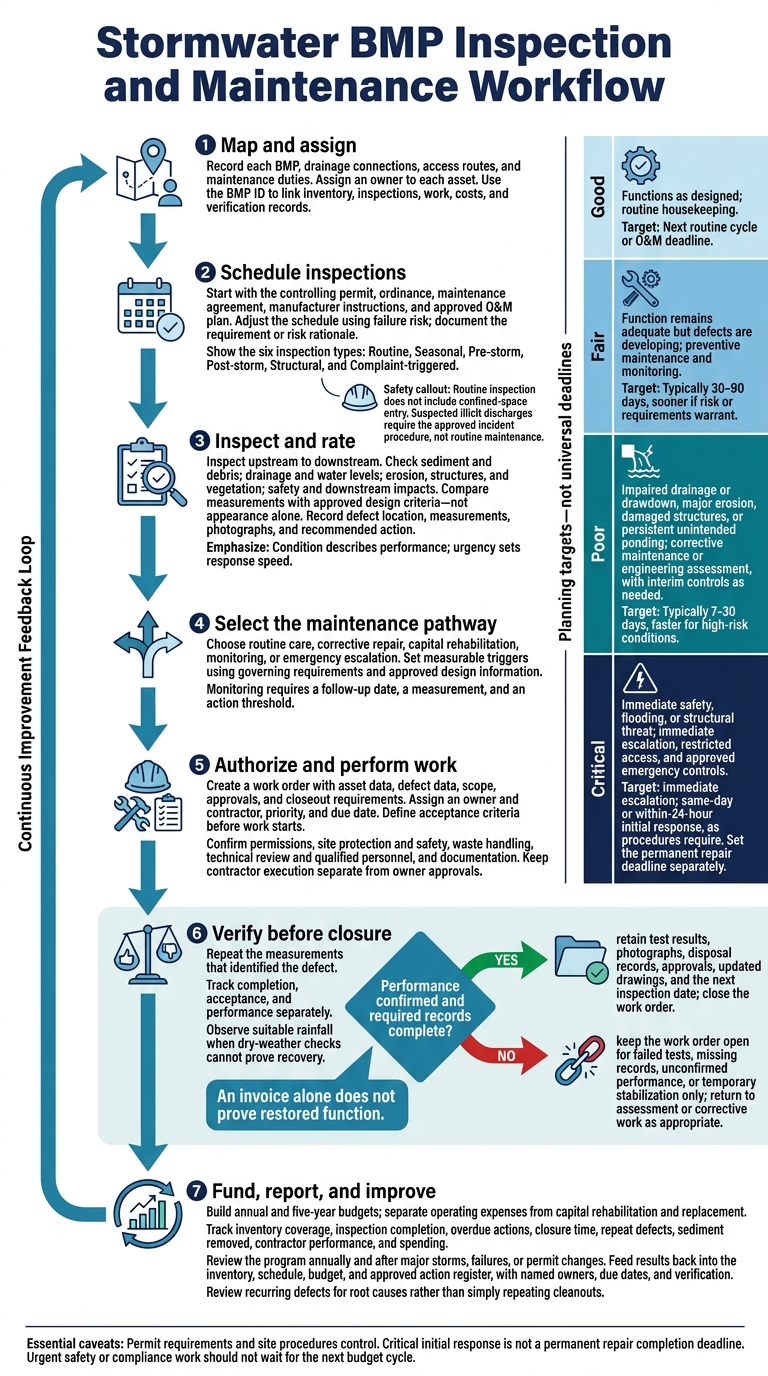
Stormwater BMP Inspection and Maintenance Workflow
Stormwater Best Management Practice (BMP) Maintenance Guidebook: Lunch & Learn
sbb-itb-8baf5f1
Schedule Inspections and Rate Defects
Set each BMP’s inspection frequency using the controlling permit, ordinance, maintenance agreement, manufacturer instructions, and approved O&M plan. Start with the legal minimum, then use the failure-risk ranking to adjust the schedule. Document the requirement or risk rationale behind each frequency.[9]
Plan Routine, Seasonal, and Storm Inspections
Build a calendar that covers six inspection types:
Routine: Visual checks.
Seasonal: Visits around leaf fall, freezing, snowmelt, or the wet season.
Pre-storm: Checks required by the permit or prompted by known failure risks.
Post-storm: Checks after specified rainfall or flooding events.
Structural: Assessments of embankments, outlet structures, underdrains, and concealed components.
Complaint-triggered: Visits following complaints or failures.
For each inspection, record the asset ID, inspection type, due date, inspector, controlling requirement, storm trigger, and escalation contact. Follow the calendar on a predictable cycle, with additional inspections after known storm triggers.
Before heading into the field, review recent rainfall, complaints, active work orders, and upstream construction or landscaping activity. Prepare measuring tools, equipment for time-stamped photographs, personal protective equipment, and traffic controls. Postpone fieldwork during lightning, flooding, unstable slope conditions, or dangerous water levels.
Routine inspection does not include confined-space entry. Entry into a vault, manhole, or tank requires separate approval, trained personnel, atmospheric testing, and rescue planning.
Inspect Drainage, Vegetation, and Safety
Work from upstream to downstream to identify defects that affect function, safety, or compliance. Compare findings with approved design criteria - not appearance alone.
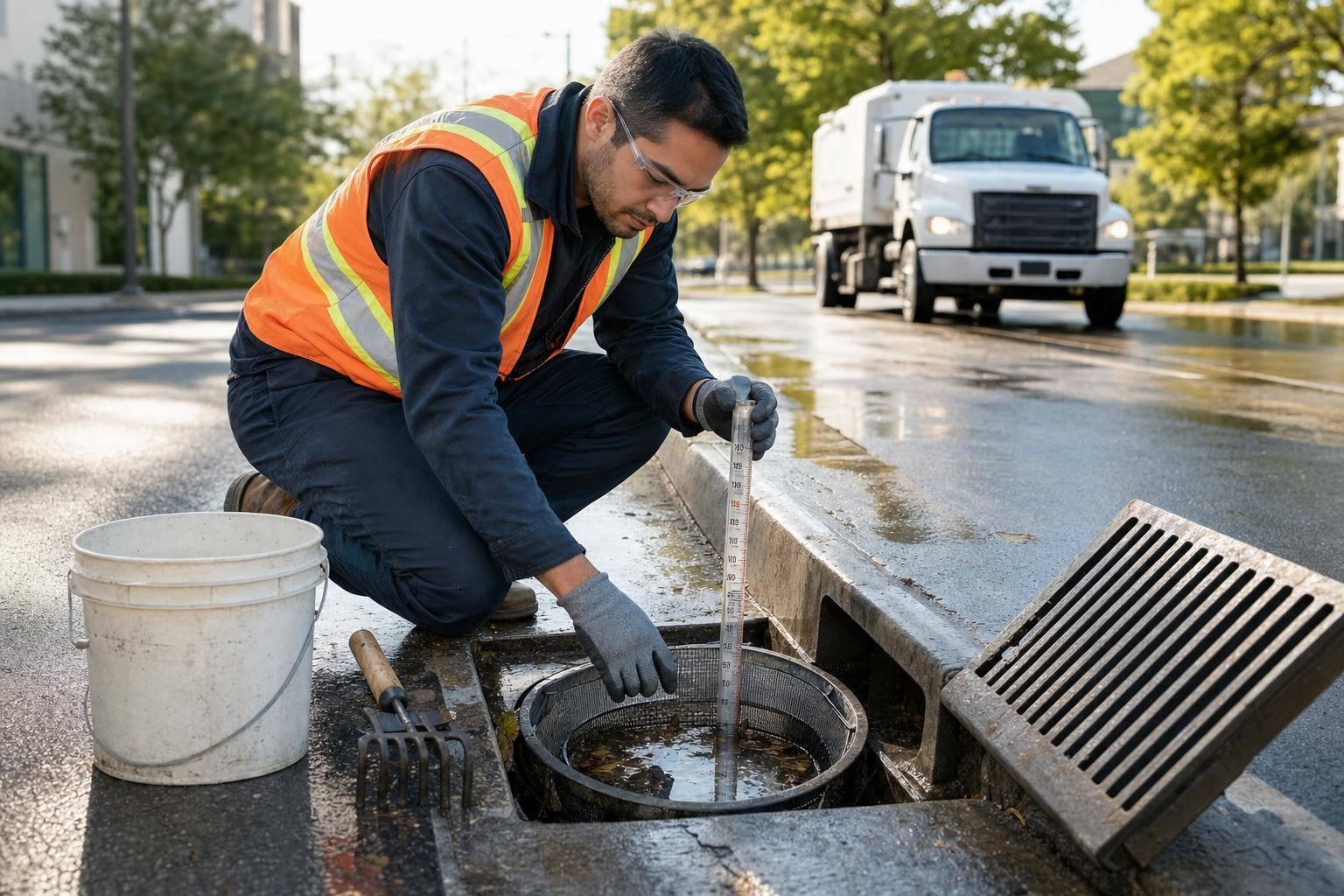
Sediment and debris: Measure accumulation in inlets, forebays, flow paths, filter media, channels, and outlets. Compare those measurements with the documented cleanout trigger.
Drainage and water levels: Check grates, pipes, risers, overflow routes, and accessible underdrain cleanouts. An underdrain carries water beneath filtration or bioretention media. Record drawdown time and compare it with the design requirement. Note blockage, bypassing, unexpected ponding, and overtopping.
Erosion, structures, and vegetation: Check for scour, settlement, cracks, sinkholes, displaced stone, bare soil, dead plants, invasive growth, and vegetation that blocks flow or hides defects.
Safety and downstream impacts: Check covers, fences, gates, access routes, and unstable slopes. Look for downstream flooding, sediment, erosion, or pollution in the receiving water - the stream, lake, wetland, or other waterbody receiving discharge.
Record the inspection date, inspector, weather, exact defect location, measurements, photographs, and recommended action.[8]
Treat dry-weather flow, sewage-like odors, gray water, or oil sheen as a suspected illicit discharge, not a maintenance defect.[4][10] Document what you observe and notify the designated MS4 or spill-response contact under the approved incident procedure. Do not touch or sample potentially hazardous substances without the required training and controls.
Rate Defects and Assign Response Times
Condition describes performance; urgency sets response speed. Use shared rating criteria and photographs, and align inspectors’ ratings through joint visits. Assign urgency separately based on asset risk, exposure, consequence, and confidence in the finding. Uncertain structural damage calls for further assessment - not a lower rating.
The periods below are planning targets only; permit requirements and site procedures control.[11] For Critical findings, the immediate goal is protective action and escalation, not necessarily a completed permanent repair.
| Rating | Observable condition | Potential consequences | Response | Target completion period | Escalation authority |
|---|---|---|---|---|---|
| Good | Functions as designed; minor debris or vegetation issues do not affect performance or safety. | Little immediate effect. | Record condition; complete routine housekeeping. | Next routine cycle or O&M deadline. | Inspector or maintenance supervisor. |
| Fair | Developing blockage, sediment buildup, localized erosion, or declining vegetation; function remains adequate. | Capacity or treatment may decline. | Open a preventive maintenance work order; monitor and verify correction. | Typically 30–90 days, sooner if risk or requirements warrant. | Maintenance supervisor; asset manager if worsening. |
| Poor | Impaired drainage or drawdown, major erosion, damaged structures, or persistent unintended ponding. | Flooding, pollutant release, or loss of treatment. | Arrange corrective maintenance or engineering assessment; add interim controls as needed. | Typically 7–30 days, faster for high-risk conditions. | Asset manager or stormwater program manager. |
| Critical | Structural instability, failed outlet, uncontrolled bypass, or immediate safety or flooding threat. | Immediate risk to people, property, or receiving waters. | Escalate immediately; restrict access and implement approved emergency controls. | Immediate escalation; same-day or within-24-hour initial response, as procedures require. Set the permanent repair deadline separately. | Program manager, emergency manager, responsible engineer, or regulator, as applicable. |
Use these ratings to trigger maintenance actions and open work orders in the next step.
Complete and Verify Maintenance
Use the inspection rating and response time to select the maintenance pathway and due date.
Set Maintenance Triggers for Each BMP Type
Classify each finding as routine care, corrective repair, capital rehabilitation, monitoring, or emergency escalation. Set a measurable trigger using the approved design, O&M plan, permit, and manufacturer instructions. Monitoring must include a follow-up date, a measurement, and an action threshold - not an indefinite watch status.
Record suspected causes as hypotheses to test, not diagnoses. Use the 72-hour ponding benchmark only when the approved design or local requirement does not specify a different drawdown period.[12][5]
| BMP type | Observed defect | Suspected cause | Maintenance action | Verification method |
|---|---|---|---|---|
| Bioretention or rain garden | Ponding beyond design drawdown, commonly 24–72 hours | Surface sealing, clogged media, blocked underdrain, or high groundwater | Remove sediment, restore infiltration, repair the underdrain, or replace media if tests confirm failure. | Measure post-rainfall drawdown and check underdrain outlets against design requirements. |
| Vegetated swale | Bare areas, rills, gullies, or bypass | Excessive velocity, poor grading, concentrated inflow, or inadequate vegetation | Regrade, stabilize erosion, repair inflow protection, and replant. | Check flow paths after runoff and confirm vegetation establishment. |
| Wet pond or wetland | Excess sediment, unhealthy vegetation, outlet damage, or abnormal water level | Sediment buildup, invasive species, outlet blockage, liner damage, or altered inflow | Remove sediment, manage vegetation, repair outlets, or refer major dredging and liner work for capital review. | Survey sediment and water levels; check outlets and disposal records. |
| Permeable pavement | Ponding, clogged joints, sediment film, or reduced infiltration | Sediment-clogged voids, improper sweeping, or subbase failure | Vacuum sweep, restore joints, repair pavement, or investigate subbase failure. | Test infiltration and confirm design drawdown. |
| Inlet, catch basin, or pretreatment device | Sediment or trash enters treatment area; reduced inlet capacity | Infrequent cleaning, damaged grate, or upstream erosion | Remove sediment and debris, repair the grate, and address upstream erosion. | Photograph repairs, measure remaining capacity, and check runoff flow. |
| Sand filter or media filter | Clogged filter, standing water, or poor effluent quality | Excess sediment, compacted media, or blocked underdrain | Remove sediment, clean or replace media, and repair the underdrain. | Compare drawdown or flow tests with design specifications. |
| Green roof | Dead vegetation, exposed membrane, blocked drains, or excessive ponding | Irrigation failure, wind damage, drain blockage, or membrane damage | Restore vegetation, clear drains, repair protective layers, or refer membrane work to specialists. | Confirm drainage, vegetation coverage, and leak-test results; retain specialist records. |
| Detention or retention basin | Erosion, blockage, unsafe embankment, or reduced storage | Concentrated flow, poor stabilization, structural deterioration, or sediment buildup | Remove debris, stabilize slopes, repair structures, or dredge confirmed storage loss. | Survey storage, check outlets, and document post-storm performance. |
| Proprietary manufactured BMP | Alarm, bypass, component damage, or exhausted media | Component failure, excessive loading, or missed service interval | Follow manufacturer procedures using approved parts or service providers. | Record model, serial number, service, parts, tests, and return-to-service approval. |
Match the pathway to the assigned urgency, then open the work order.
Create Work Orders and Set Contractor Duties
Transfer the inspection record into the work order, organizing the repair details into five categories:
Asset data: Work-order number, BMP ID, location, and affected component.
Defect data: Linked inspection record, rating, suspected cause, and performance or safety consequence.
Scope: Maintenance action, quantities, approved materials, priority, and due date.
Approvals: Budget, assigned owner and contractor, change authority, and escalation contact.
Closeout: Acceptance criteria, required tests and records, and designated approver.
Define acceptance criteria before work starts. These may include sediment removed to a specified elevation or allowable accumulation, restored conveyance, approved replacement materials, stable grades, or required vegetation coverage.
Set contractor deadlines to match the assigned urgency, with milestones for notification, stabilization, repair, and documentation. Require written approval for scope changes, notice before work is covered, and owner inspection rights. Keep contractor execution duties separate from owner approvals. Tie payment to accepted deliverables - not an invoice alone.
Before authorizing work, complete this checklist:
[ ] Permissions: Confirm access, easements, right-of-entry, utility locates, traffic approvals, environmental permits, dewatering approvals, and agency notifications.
[ ] Site protection and safety: Review erosion controls, spill prevention, habitat and vegetation protection, weather shutdown criteria, and the job hazard analysis. Confirm PPE, fall and excavation protection, confined-space procedures, lockout/tagout, traffic separation, emergency contacts, and rescue arrangements.
[ ] Waste: Determine sampling and handling requirements. Confirm approved containers, transporters, disposal or reuse facilities, manifests, and receipts.
[ ] Technical review and qualified personnel: Confirm plans, as-builts, design elevations, hydraulic assumptions, manufacturer instructions, materials, tests, and acceptance criteria. Verify qualifications for structural, electrical, confined-space, hazardous-material, tree-removal, sampling, surveying, and specialized equipment work.
[ ] Documentation: Establish photo points, field forms, measurement units, naming conventions, submission deadlines, and owner review procedures.
Verify Repairs and Close Work Orders
After repairs, repeat the measurements used to identify the defect. Track completion, acceptance, and performance separately. Observe suitable rainfall when dry-weather checks cannot prove recovery.[5][6] Keep the work order open if performance remains unconfirmed, records are missing, tests fail, or only temporary stabilization is complete.
Retain repair quantities, photographs, test results, disposal records, approved changes, updated drawings, reviewer approval, and the next inspection date. For recurring defects, review prior repairs, rainfall history, sediment loading, and design assumptions to identify the root cause and prevent recurrence - not simply repeat the cleanout.
Budget, Report, and Review Results
Budget for Maintenance and Major Repairs
Turn defined maintenance needs into annual and five-year budgets. Base the annual budget on the asset register and expected workload - not a fixed percentage of construction cost. Allow for expected inspection findings, repair volume, and disposal loads.
Use local quotes and recent invoices to price inspections, upkeep, repairs, disposal, testing, administration, and emergency response. Include fully loaded labor rates, equipment, mobilization, access limits, and traffic control. State the price year, update rates annually, and list inflation and contingency assumptions separately.[14]
Separate operating expenses from capital rehabilitation and replacement, following finance rules and permit categories.[13] Keep a five-year capital plan and reserve fund for major work. Rank unfunded needs by compliance, safety, flooding, pollutant risk, repeat failures, and the cost of delay. For each item, record its estimated cost, interim control, responsible party, and target date. Urgent safety or compliance work should not wait for the next budget cycle. Use these budget lines as the basis for recordkeeping and reporting.
Keep Records and Report Performance
Track costs against verified work and performance. Use the BMP ID to link inventory, inspections, work, costs, and verification records into one continuous reporting record. Keep inspection dates and times, inspector names, photos, measurements, ratings, invoices, disposal records, and approvals. Record sediment quantities and removal dates as well.[7]
Before reporting, validate records, update the register, reconcile spending, and flag overdue or unverified actions. Missing records do not prove that work is complete.
Follow this reporting schedule unless governing requirements specify otherwise.
| Indicator | Calculation | Data source | Reporting frequency | Owner | Decision |
|---|---|---|---|---|---|
| Inventory coverage | BMPs with complete records ÷ BMPs believed to exist × 100 | Asset register, GIS | Quarterly | Asset manager | Inventory verification |
| Inspection completion | On-time inspections ÷ inspections due × 100 | Schedule, field records | Monthly | Inspection supervisor | Staffing and schedule changes |
| Overdue actions | Open actions past due, by risk | Work orders | Weekly | Maintenance manager | Escalation |
| Closure time | Median days from defect identification to verified closure | Inspection and work-order dates | Monthly | Maintenance manager | Response-time improvements |
| Repeat defects | Assets with a recurring defect within a defined period ÷ assets repaired × 100 | Defect history | Quarterly | Program manager | Root-cause review and replacement |
| Sediment removed | Cubic yards or tons removed; keep units separate | Logs, haul tickets | Quarterly | Field operations | Disposal funding |
| Contractor performance | Work orders completed on time and accepted without rework ÷ assigned work orders × 100 | Contract and acceptance records | Monthly | Contract administrator | Corrective action |
| Spending | Actual O&M spending ÷ approved O&M budget × 100; track capital separately | Ledger, work orders | Monthly | Finance manager | Forecasts and funding adjustments |
Keep metric definitions consistent across reporting periods. Submit required reports according to the governing NPDES permit and local instructions, and obtain required certifications.[15] Keep submitted files and submission receipts. Follow the longest applicable retention period required by the permit, state or local rules, contracts, or public-records requirements. Management reports should call attention to unresolved risks and unfunded work.
Conclusion: Update the Maintenance Program
Use budget and performance data to update the maintenance program each year. Review it annually and after major storms, failures, or permit changes. Feed actual results back into the inventory, schedule, budget, and approved action register, with named owners, due dates, verification, and program review.
FAQs
How do I inventory BMPs without site plans?
If site plans aren’t available, inventory Best Management Practices (BMPs) through an on-site assessment. Use Geographic Information Systems (GIS) and remote sensing to map drainage basin dimensions and locate existing infrastructure.
Conduct a water audit to assess water points, flow rates, and fixture efficiency. Inspect the site for surface green infrastructure, and record each asset’s location and type. Use this inventory as the baseline for maintenance and inspection schedules.
How can I distinguish clogging from a design flaw?
Compare performance against the system’s intended capacity and maintenance history. Clogging happens when sediment, debris, or vegetation blocks flow. Cleaning and vegetation management usually resolve it [1][2][3].
A design flaw or limitation is likely if problems continue after proper maintenance, storms exceed the original design capacity, or sizing used outdated rainfall data instead of current climate projections [3][4].
What if repairs need verification before rain arrives?
Before rain arrives, check that systems work as intended through on-site evaluations and automated monitoring [1]. Use variance analyses and visual inspections to confirm that repairs meet design specifications [2]. Record these checks to keep a clear audit trail and show that systems are ready to handle incoming runoff [2][1].
Council Fire helps organizations put these maintenance and verification processes into practice, turning sustainability strategies into reliable, system-level performance [3][4].
FAQ