
Mar 3, 2026
Stakeholder Role in Triple Bottom Line Reporting
ESG Strategy
In This Article
Stakeholder engagement shapes TBL reporting by aligning people, planet, and profit metrics through mapping, workshops, and feedback.
Stakeholder Role in Triple Bottom Line Reporting
Organizations are shifting from focusing solely on profit to evaluating their impact on people, the planet, and profit using the Triple Bottom Line (TBL) framework. Stakeholders - employees, customers, communities, investors, and regulators - play a vital role in shaping these efforts.
TBL Framework: Measures success across three areas:
People: Social impacts like workplace safety and community well-being.
Planet: Environmental impacts such as carbon emissions and resource use.
Profit: Financial performance and long-term economic health.
Stakeholder Contributions:
Employees highlight workplace and safety concerns.
Customers demand transparency in sourcing and sustainability.
Communities focus on local impacts like jobs and air quality.
Investors and regulators push for compliance and measurable outcomes.
Why Stakeholder Engagement Matters:
Ensures TBL metrics reflect actual impacts.
Builds trust through transparency and accountability.
Drives collaboration for better decision-making and alignment with global goals like the UN's SDGs.
Effective Engagement Strategies:
Stakeholder Mapping: Identifies and prioritizes key groups using tools like the Power-Interest Grid.
Workshops and Advisory Groups: Facilitate ongoing dialogue and input on sustainability goals.
Feedback Integration: Incorporates stakeholder insights into TBL metrics for meaningful reporting.
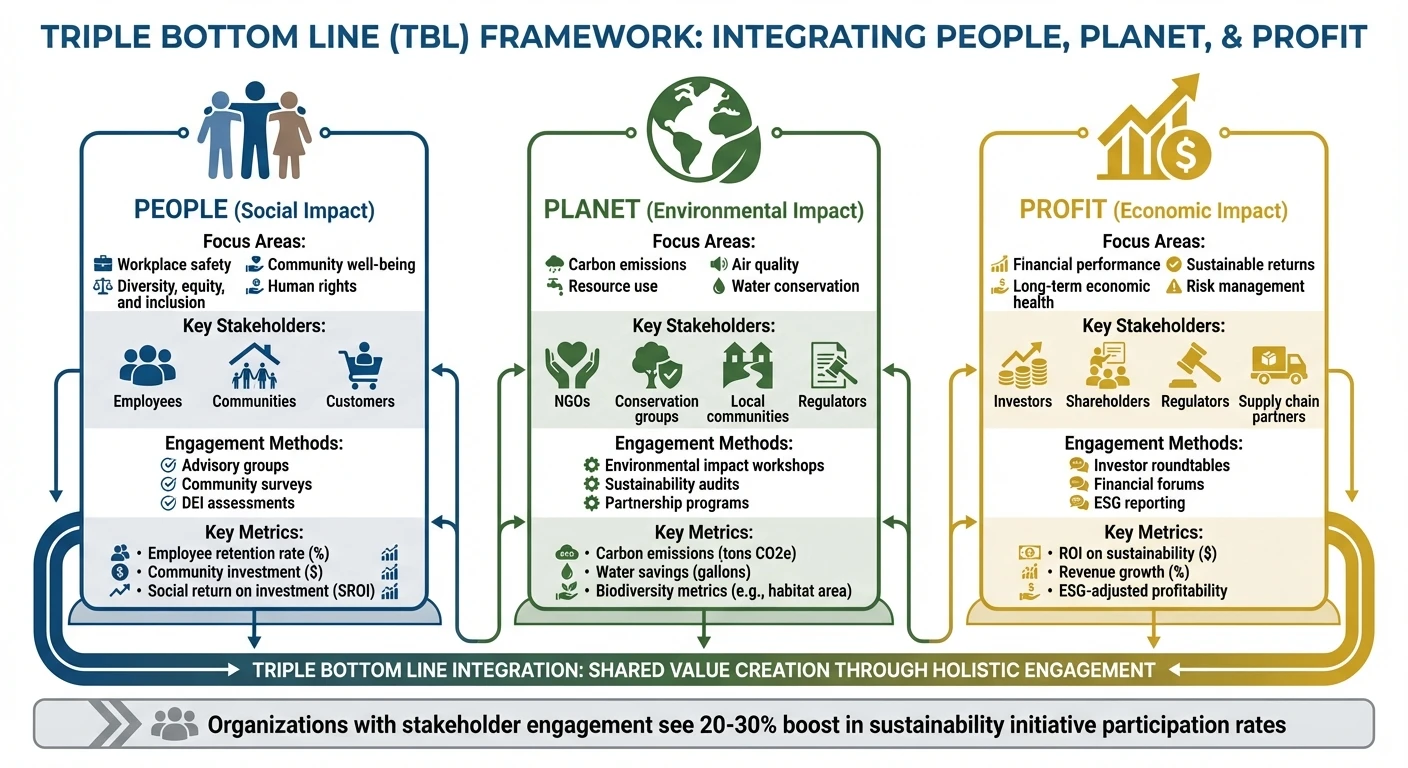
Triple Bottom Line Framework: People, Planet, and Profit Pillars
Key Stakeholders in Triple Bottom Line Reporting
Who Are the Stakeholders?
Triple Bottom Line (TBL) reporting involves a wide range of stakeholders, extending far beyond executives and shareholders. These include employees who experience workplace conditions daily, customers whose purchasing decisions are increasingly influenced by corporate values, community members impacted by business operations, suppliers integral to the supply chain, investors focused on sustainable returns, and regulators ensuring compliance with laws and standards. Each group offers distinct perspectives that help shape how organizations measure and report their social, environmental, and financial impacts.
This diverse input ensures that TBL metrics reflect actual outcomes. For instance, employees may highlight workplace safety issues or opportunities for skill development, while communities can draw attention to environmental concerns like air quality and local job creation. Customers, on the other hand, increasingly demand transparency about sourcing practices and carbon footprints. By incorporating such varied insights, TBL reporting goes beyond abstract figures to address tangible, real-world effects. This approach contrasts with the narrower focus of traditional shareholder-centered models.
Stakeholders vs. Shareholders
While stakeholders and shareholders may seem similar, their roles and priorities differ significantly. Shareholders are individuals or entities that own shares in a company, making them partial owners primarily concerned with financial outcomes such as dividends, stock performance, and risk management [3]. Stakeholders, however, include not only shareholders but also anyone affected by the organization’s activities - employees, customers, suppliers, communities, and even the environment.
Traditional business models often focus on maximizing shareholder value, emphasizing short-term financial gains. In contrast, TBL reporting prioritizes broader accountability, assessing success through contributions to social equity, environmental well-being, and long-term economic health. This shift acknowledges that sustainable success depends on balancing the needs of all stakeholders, not just those with financial investments. By adopting this inclusive approach, organizations position themselves for long-term stability and a more meaningful impact on society and the planet.
Why Stakeholder Engagement Matters for TBL Reporting
Driving Sustainability Through Collaboration
Stakeholder collaboration plays a crucial role in transforming triple bottom line (TBL) reporting into a meaningful process that rethinks profit to reflect actual impacts on people, the planet, and profit. By involving a wide range of voices - such as customers, employees, local communities, and supply chain partners - organizations can uncover insights that go beyond internal assessments. For instance, a community partnering with an entrepreneurial development program might prioritize tracking the growth of woman-owned businesses over five years, a metric that aligns with its specific values and priorities [2][4][5]. This kind of external input ensures that TBL metrics stay relevant and aligned with the needs of those directly affected.
This inclusive approach enhances all three pillars of TBL reporting. On the social side, stakeholder feedback can guide initiatives in areas like human rights, diversity, equity, inclusion, and community engagement. From an environmental perspective, stakeholders can highlight pressing concerns such as carbon emissions or operational inefficiencies. Economically, their input supports strategies like adopting renewable energy, cutting costs, and improving risk management [2][4].
Building Trust and Accountability
Beyond collaboration, meaningful stakeholder engagement fosters transparency and a sense of shared responsibility. This shifts accountability from being solely shareholder-focused to encompassing everyone impacted by an organization’s activities. By openly sharing TBL data through ESG metrics and regular reporting, companies enable stakeholders to verify claims about social and environmental performance. Such transparency is increasingly vital in today’s world, where social media amplifies public scrutiny [2][5].
The trust generated through genuine engagement delivers tangible benefits, particularly in advancing social and environmental goals. Certified B Corporations offer a great example - they are legally required to consider the impact of their decisions on all stakeholders, including employees, communities, and the environment. Companies like Patagonia have gained widespread trust through initiatives like their 1% for the Planet program, which underscores their commitment to environmental responsibility [5]. Additionally, organizations with credible sustainability plans often attract highly motivated employees, giving them a distinct advantage in competitive talent markets.
The Triple Bottom Line
Strategies for Engaging Stakeholders in TBL Reporting
Effectively engaging stakeholders is crucial for meaningful Triple Bottom Line (TBL) reporting. By involving stakeholders in the process, organizations can ensure diverse perspectives are captured across the dimensions of people, planet, and profit, while maintaining a sense of accountability and openness.
Stakeholder Mapping and Prioritization
The first step in engagement is identifying and prioritizing stakeholders. Stakeholder mapping provides a structured way to categorize groups that are either impacted by or have an interest in the organization’s operations. This process evaluates stakeholders based on their level of influence and how business decisions affect them.
A helpful tool for this is the Power-Interest Grid, which organizes stakeholders into four categories:
Key players: High power and high interest - require close management.
Context setters: High power but lower interest - need to be kept satisfied.
Subjects: Low power but high interest - should be kept informed.
Crowd: Low power and low interest - require minimal attention.
This method ensures resources are focused on the stakeholders who are most critical to evaluating performance across TBL dimensions [2]. Once stakeholders are identified, organizations can engage them in discussions that foster deeper involvement.
Collaborative Workshops and Advisory Groups
After mapping stakeholders, the next step is fostering dialogue through structured forums. Collaborative workshops are an effective way to gather input, brainstorm solutions, and explore trade-offs. Formats like World Cafes are ideal for tackling complex sustainability challenges, while Design Charrettes work well for planning projects that address all three TBL pillars [6].
Advisory groups can take this engagement further by offering ongoing input rather than one-time feedback. These groups, made up of representatives from various stakeholder categories, meet regularly to:
Monitor progress on sustainability goals.
Oversee risk management efforts.
Verify the accuracy of social and environmental data.
Neutral facilitation, supported by small group discussions and written contributions, ensures every voice is included in the process.
Integrating Feedback into TBL Metrics
The real value of stakeholder engagement lies in integrating their input into TBL measurement frameworks. Organizations can use surveys to identify stakeholder priorities, host focus groups to address measurement challenges, and establish feedback loops that show how stakeholder insights shape the final metrics [2].
This process ensures:
The people dimension reflects the values of employees and communities.
The planet dimension addresses environmental concerns important to stakeholders.
The profit dimension highlights financial sustainability in ways stakeholders understand.
Closing the feedback loop is essential. Organizations should document stakeholder input, adopt key recommendations, and communicate the resulting changes [6]. When stakeholders see their contributions influencing future reporting cycles, it builds trust and transforms them from passive participants into active collaborators in sustainability efforts.
How Council Fire Supports Stakeholder Roles in TBL Reporting
Council Fire demonstrates how effective stakeholder engagement can strengthen Triple Bottom Line (TBL) reporting by using a structured, systems-based approach. Their strategy integrates diverse stakeholder perspectives into sustainability initiatives, ensuring alignment and measurable outcomes.
Planning and Stakeholder Collaboration
Council Fire begins by facilitating stakeholder mapping and prioritization workshops to identify and rank key participants across the three TBL pillars. These sessions employ tools like decision matrices to evaluate stakeholders' influence and interest in sustainability goals. For instance, in a U.S. energy project, Council Fire brought together community groups, regulators, and investors to establish shared TBL metrics. This collaboration resulted in a 15% reduction in water usage and improved local employment opportunities. Their approach to early stakeholder involvement typically boosts engagement rates by 20-30% in sustainability initiatives [4][5].
Communication and Reporting Strategies
Council Fire has a knack for transforming TBL data into accessible, visually engaging formats. Their "living reports" combine ESG metrics with visuals, providing transparency and clarity for all stakeholders. These reports are tailored to stakeholder priorities, featuring metrics like social impact scores and environmental KPIs to ensure accountability. Additionally, they utilize multi-channel communication strategies to cater to various audiences, such as investor dashboards for financial stakeholders and community forums for local groups. This customized approach helps address challenges like data complexity and accessibility [4].
Stakeholder Engagement Across TBL Pillars
Council Fire customizes its stakeholder engagement methods for each TBL pillar, ensuring targeted and effective collaboration:
People Pillar: They organize community advisory groups and conduct diversity, equity, and inclusion surveys to enhance social equity and trust.
Planet Pillar: They partner with NGOs and conservation groups to perform environmental impact assessments and workshops.
Profit Pillar: They host investor roundtables to demonstrate the financial advantages of sustainability initiatives.
TBL Pillar | Benefits | Engagement Methods | Key Metrics |
|---|---|---|---|
People | Builds social equity, trust | Advisory groups, surveys | Employee retention rate, community investment ($) [4] |
Planet | Reduces environmental impact | Impact workshops, audits | Carbon emissions (tons), water savings (gallons) [1] |
Profit | Strengthens financial health | Investor forums | ROI on sustainability ($), revenue growth (%) [8] |
Council Fire evaluates success using engagement scores, aiming for participation rates above 80%, and tracks pillar-specific KPIs like social return on investment, biodiversity metrics, and ESG-adjusted profitability. Their phased roadmaps include training and feedback loops, starting with high-impact stakeholder groups and gradually broadening the scope to ensure comprehensive engagement [8][9].
Challenges in Stakeholder-Driven TBL Reporting and Solutions
Measuring Social and Environmental Impacts
Quantifying outcomes beyond financial metrics presents a unique set of hurdles. Social and environmental impacts - like employee well-being, community development, or ecosystem health - don’t fit neatly into traditional accounting systems. This makes it hard for organizations to measure aspects that stakeholders genuinely care about, as these areas often extend beyond standard financial frameworks[2].
The difficulty is compounded when internal metrics fail to align with external expectations. For instance, a company may report carbon emissions reductions in tons per year, but local communities might prioritize job creation or improvements in air quality. This mismatch can create friction, as organizations attempt to balance their internal reporting standards with the diverse priorities of their stakeholders.
To address these challenges, ESG reporting frameworks and automation tools can help translate abstract social and environmental concerns into measurable goals that resonate with stakeholders[2]. Additionally, organizations can adopt stakeholder ranking systems, allowing community members to prioritize elements of a sustainability framework based on what matters most to them[4]. This approach bridges the gap between abstract concerns and tangible, measurable objectives.
Even with these tools, the task of managing the varied interests of stakeholders remains a significant challenge.
Managing Complex Stakeholder Relationships
Navigating the competing interests of diverse stakeholder groups - ranging from employees and customers to community organizations, regulators, and environmental advocates - requires a thoughtful and strategic approach[7]. Each group brings its own set of concerns across the three TBL dimensions, and these priorities often clash. For example, while investors may focus on cost efficiency, environmental advocates might push for increased spending on sustainability initiatives. Balancing these conflicting demands calls for careful coordination.
One effective strategy involves using decision matrices and narrative formats to collect and incorporate stakeholder feedback into TBL metrics[4]. This qualitative input provides essential context to complement quantitative data, ensuring that technical performance metrics don’t overshadow human concerns. Transparency is also key - regular communication and stakeholder mapping can help organizations determine which groups need immediate attention versus those requiring periodic updates. By integrating these perspectives, organizations can create actionable and meaningful TBL reporting that addresses the needs of all stakeholders.
Conclusion
Triple Bottom Line (TBL) reporting shifts the focus of success by evaluating an organization's impact on people, the planet, and profit. At the heart of this transformation lies stakeholder engagement. By involving employees, customers, community members, regulators, and environmental advocates, organizations can create reports that address pressing societal and environmental concerns.
A compelling example of this approach comes from the San Francisco Public Utilities Commission. They adopted a TBL framework based on ISO 26000 standards and conducted structured interviews with 20 stakeholders. This process resulted in leadership-endorsed metrics and stakeholder-informed reporting for their infrastructure projects. The outcome? Increased public participation and tangible social improvements[10].
Effective stakeholder engagement relies on deliberate strategies like targeted mapping, advisory groups, and iterative feedback loops. These practices not only foster trust but also enhance the credibility and effectiveness of TBL reporting. Companies that embrace these methods go beyond mere compliance; they build stronger relationships, improve accountability, and create business models resilient to today’s sustainability challenges.
Moving from a shareholder-centric model to one that includes all stakeholders unlocks long-term success. Certified B Corporations exemplify this by balancing their responsibilities to all stakeholders while still achieving financial goals[4][5]. As public opinion, consumer behavior, and social media continue to amplify accountability, organizations are increasingly rewarded for their positive contributions and challenged for their shortcomings[5].
To harness these benefits, organizations can take immediate steps toward stakeholder-driven practices. This includes starting with stakeholder mapping, establishing engagement benchmarks, and working with consultancies like Council Fire for expert guidance. These steps not only lead to cost savings and risk management but also pave the way for more effective sustainability outcomes.
Related Blog Posts
Latest Articles
©2026

Narrative Change and Power Building: The Missing Half of Advocacy
Narrative change is the process of disrupting dominant narratives that normalize inequity and advancing new narratives from historically marginalized communities.

Funding Resilience Without Federal Grants
BRIC is unreliable and FEMA is shrinking. Here's how cities fund climate resilience with dedicated revenue, blended finance, and a coordinating authority.

The ESG Blind Spot: How AI Is Finding Risks in Companies Nobody Else Is Watching
Norway's sovereign wealth fund uses AI to screen 7,200 portfolio companies for forced labor and corruption within 24 hours. The real story is the emerging-market coverage gap that traditional ESG data vendors miss — and what it means for any company with a global supply chain.
Narrative Change and Power Building: The Missing Half of Advocacy
Narrative change is the process of disrupting dominant narratives that normalize inequity and advancing new narratives from historically marginalized communities.
Funding Resilience Without Federal Grants
BRIC is unreliable and FEMA is shrinking. Here's how cities fund climate resilience with dedicated revenue, blended finance, and a coordinating authority.
The ESG Blind Spot: How AI Is Finding Risks in Companies Nobody Else Is Watching
Norway's sovereign wealth fund uses AI to screen 7,200 portfolio companies for forced labor and corruption within 24 hours. The real story is the emerging-market coverage gap that traditional ESG data vendors miss — and what it means for any company with a global supply chain.
FAQ
01
What does it really mean to “redefine profit”?
02
What makes Council Fire different?
03
Who does Council Fire work with?
04
What does working with Council Fire actually look like?
05
How does Council Fire help organizations turn big goals into action?
06
How does Council Fire define and measure success?
07
How does technology fit into Council Fire’s work?
Mar 3, 2026
Stakeholder Role in Triple Bottom Line Reporting
ESG Strategy
In This Article
Stakeholder engagement shapes TBL reporting by aligning people, planet, and profit metrics through mapping, workshops, and feedback.
Stakeholder Role in Triple Bottom Line Reporting
Organizations are shifting from focusing solely on profit to evaluating their impact on people, the planet, and profit using the Triple Bottom Line (TBL) framework. Stakeholders - employees, customers, communities, investors, and regulators - play a vital role in shaping these efforts.
TBL Framework: Measures success across three areas:
People: Social impacts like workplace safety and community well-being.
Planet: Environmental impacts such as carbon emissions and resource use.
Profit: Financial performance and long-term economic health.
Stakeholder Contributions:
Employees highlight workplace and safety concerns.
Customers demand transparency in sourcing and sustainability.
Communities focus on local impacts like jobs and air quality.
Investors and regulators push for compliance and measurable outcomes.
Why Stakeholder Engagement Matters:
Ensures TBL metrics reflect actual impacts.
Builds trust through transparency and accountability.
Drives collaboration for better decision-making and alignment with global goals like the UN's SDGs.
Effective Engagement Strategies:
Stakeholder Mapping: Identifies and prioritizes key groups using tools like the Power-Interest Grid.
Workshops and Advisory Groups: Facilitate ongoing dialogue and input on sustainability goals.
Feedback Integration: Incorporates stakeholder insights into TBL metrics for meaningful reporting.
Triple Bottom Line Framework: People, Planet, and Profit Pillars
Key Stakeholders in Triple Bottom Line Reporting
Who Are the Stakeholders?
Triple Bottom Line (TBL) reporting involves a wide range of stakeholders, extending far beyond executives and shareholders. These include employees who experience workplace conditions daily, customers whose purchasing decisions are increasingly influenced by corporate values, community members impacted by business operations, suppliers integral to the supply chain, investors focused on sustainable returns, and regulators ensuring compliance with laws and standards. Each group offers distinct perspectives that help shape how organizations measure and report their social, environmental, and financial impacts.
This diverse input ensures that TBL metrics reflect actual outcomes. For instance, employees may highlight workplace safety issues or opportunities for skill development, while communities can draw attention to environmental concerns like air quality and local job creation. Customers, on the other hand, increasingly demand transparency about sourcing practices and carbon footprints. By incorporating such varied insights, TBL reporting goes beyond abstract figures to address tangible, real-world effects. This approach contrasts with the narrower focus of traditional shareholder-centered models.
Stakeholders vs. Shareholders
While stakeholders and shareholders may seem similar, their roles and priorities differ significantly. Shareholders are individuals or entities that own shares in a company, making them partial owners primarily concerned with financial outcomes such as dividends, stock performance, and risk management [3]. Stakeholders, however, include not only shareholders but also anyone affected by the organization’s activities - employees, customers, suppliers, communities, and even the environment.
Traditional business models often focus on maximizing shareholder value, emphasizing short-term financial gains. In contrast, TBL reporting prioritizes broader accountability, assessing success through contributions to social equity, environmental well-being, and long-term economic health. This shift acknowledges that sustainable success depends on balancing the needs of all stakeholders, not just those with financial investments. By adopting this inclusive approach, organizations position themselves for long-term stability and a more meaningful impact on society and the planet.
Why Stakeholder Engagement Matters for TBL Reporting
Driving Sustainability Through Collaboration
Stakeholder collaboration plays a crucial role in transforming triple bottom line (TBL) reporting into a meaningful process that rethinks profit to reflect actual impacts on people, the planet, and profit. By involving a wide range of voices - such as customers, employees, local communities, and supply chain partners - organizations can uncover insights that go beyond internal assessments. For instance, a community partnering with an entrepreneurial development program might prioritize tracking the growth of woman-owned businesses over five years, a metric that aligns with its specific values and priorities [2][4][5]. This kind of external input ensures that TBL metrics stay relevant and aligned with the needs of those directly affected.
This inclusive approach enhances all three pillars of TBL reporting. On the social side, stakeholder feedback can guide initiatives in areas like human rights, diversity, equity, inclusion, and community engagement. From an environmental perspective, stakeholders can highlight pressing concerns such as carbon emissions or operational inefficiencies. Economically, their input supports strategies like adopting renewable energy, cutting costs, and improving risk management [2][4].
Building Trust and Accountability
Beyond collaboration, meaningful stakeholder engagement fosters transparency and a sense of shared responsibility. This shifts accountability from being solely shareholder-focused to encompassing everyone impacted by an organization’s activities. By openly sharing TBL data through ESG metrics and regular reporting, companies enable stakeholders to verify claims about social and environmental performance. Such transparency is increasingly vital in today’s world, where social media amplifies public scrutiny [2][5].
The trust generated through genuine engagement delivers tangible benefits, particularly in advancing social and environmental goals. Certified B Corporations offer a great example - they are legally required to consider the impact of their decisions on all stakeholders, including employees, communities, and the environment. Companies like Patagonia have gained widespread trust through initiatives like their 1% for the Planet program, which underscores their commitment to environmental responsibility [5]. Additionally, organizations with credible sustainability plans often attract highly motivated employees, giving them a distinct advantage in competitive talent markets.
The Triple Bottom Line
Strategies for Engaging Stakeholders in TBL Reporting
Effectively engaging stakeholders is crucial for meaningful Triple Bottom Line (TBL) reporting. By involving stakeholders in the process, organizations can ensure diverse perspectives are captured across the dimensions of people, planet, and profit, while maintaining a sense of accountability and openness.
Stakeholder Mapping and Prioritization
The first step in engagement is identifying and prioritizing stakeholders. Stakeholder mapping provides a structured way to categorize groups that are either impacted by or have an interest in the organization’s operations. This process evaluates stakeholders based on their level of influence and how business decisions affect them.
A helpful tool for this is the Power-Interest Grid, which organizes stakeholders into four categories:
Key players: High power and high interest - require close management.
Context setters: High power but lower interest - need to be kept satisfied.
Subjects: Low power but high interest - should be kept informed.
Crowd: Low power and low interest - require minimal attention.
This method ensures resources are focused on the stakeholders who are most critical to evaluating performance across TBL dimensions [2]. Once stakeholders are identified, organizations can engage them in discussions that foster deeper involvement.
Collaborative Workshops and Advisory Groups
After mapping stakeholders, the next step is fostering dialogue through structured forums. Collaborative workshops are an effective way to gather input, brainstorm solutions, and explore trade-offs. Formats like World Cafes are ideal for tackling complex sustainability challenges, while Design Charrettes work well for planning projects that address all three TBL pillars [6].
Advisory groups can take this engagement further by offering ongoing input rather than one-time feedback. These groups, made up of representatives from various stakeholder categories, meet regularly to:
Monitor progress on sustainability goals.
Oversee risk management efforts.
Verify the accuracy of social and environmental data.
Neutral facilitation, supported by small group discussions and written contributions, ensures every voice is included in the process.
Integrating Feedback into TBL Metrics
The real value of stakeholder engagement lies in integrating their input into TBL measurement frameworks. Organizations can use surveys to identify stakeholder priorities, host focus groups to address measurement challenges, and establish feedback loops that show how stakeholder insights shape the final metrics [2].
This process ensures:
The people dimension reflects the values of employees and communities.
The planet dimension addresses environmental concerns important to stakeholders.
The profit dimension highlights financial sustainability in ways stakeholders understand.
Closing the feedback loop is essential. Organizations should document stakeholder input, adopt key recommendations, and communicate the resulting changes [6]. When stakeholders see their contributions influencing future reporting cycles, it builds trust and transforms them from passive participants into active collaborators in sustainability efforts.
How Council Fire Supports Stakeholder Roles in TBL Reporting
Council Fire demonstrates how effective stakeholder engagement can strengthen Triple Bottom Line (TBL) reporting by using a structured, systems-based approach. Their strategy integrates diverse stakeholder perspectives into sustainability initiatives, ensuring alignment and measurable outcomes.
Planning and Stakeholder Collaboration
Council Fire begins by facilitating stakeholder mapping and prioritization workshops to identify and rank key participants across the three TBL pillars. These sessions employ tools like decision matrices to evaluate stakeholders' influence and interest in sustainability goals. For instance, in a U.S. energy project, Council Fire brought together community groups, regulators, and investors to establish shared TBL metrics. This collaboration resulted in a 15% reduction in water usage and improved local employment opportunities. Their approach to early stakeholder involvement typically boosts engagement rates by 20-30% in sustainability initiatives [4][5].
Communication and Reporting Strategies
Council Fire has a knack for transforming TBL data into accessible, visually engaging formats. Their "living reports" combine ESG metrics with visuals, providing transparency and clarity for all stakeholders. These reports are tailored to stakeholder priorities, featuring metrics like social impact scores and environmental KPIs to ensure accountability. Additionally, they utilize multi-channel communication strategies to cater to various audiences, such as investor dashboards for financial stakeholders and community forums for local groups. This customized approach helps address challenges like data complexity and accessibility [4].
Stakeholder Engagement Across TBL Pillars
Council Fire customizes its stakeholder engagement methods for each TBL pillar, ensuring targeted and effective collaboration:
People Pillar: They organize community advisory groups and conduct diversity, equity, and inclusion surveys to enhance social equity and trust.
Planet Pillar: They partner with NGOs and conservation groups to perform environmental impact assessments and workshops.
Profit Pillar: They host investor roundtables to demonstrate the financial advantages of sustainability initiatives.
TBL Pillar | Benefits | Engagement Methods | Key Metrics |
|---|---|---|---|
People | Builds social equity, trust | Advisory groups, surveys | Employee retention rate, community investment ($) [4] |
Planet | Reduces environmental impact | Impact workshops, audits | Carbon emissions (tons), water savings (gallons) [1] |
Profit | Strengthens financial health | Investor forums | ROI on sustainability ($), revenue growth (%) [8] |
Council Fire evaluates success using engagement scores, aiming for participation rates above 80%, and tracks pillar-specific KPIs like social return on investment, biodiversity metrics, and ESG-adjusted profitability. Their phased roadmaps include training and feedback loops, starting with high-impact stakeholder groups and gradually broadening the scope to ensure comprehensive engagement [8][9].
Challenges in Stakeholder-Driven TBL Reporting and Solutions
Measuring Social and Environmental Impacts
Quantifying outcomes beyond financial metrics presents a unique set of hurdles. Social and environmental impacts - like employee well-being, community development, or ecosystem health - don’t fit neatly into traditional accounting systems. This makes it hard for organizations to measure aspects that stakeholders genuinely care about, as these areas often extend beyond standard financial frameworks[2].
The difficulty is compounded when internal metrics fail to align with external expectations. For instance, a company may report carbon emissions reductions in tons per year, but local communities might prioritize job creation or improvements in air quality. This mismatch can create friction, as organizations attempt to balance their internal reporting standards with the diverse priorities of their stakeholders.
To address these challenges, ESG reporting frameworks and automation tools can help translate abstract social and environmental concerns into measurable goals that resonate with stakeholders[2]. Additionally, organizations can adopt stakeholder ranking systems, allowing community members to prioritize elements of a sustainability framework based on what matters most to them[4]. This approach bridges the gap between abstract concerns and tangible, measurable objectives.
Even with these tools, the task of managing the varied interests of stakeholders remains a significant challenge.
Managing Complex Stakeholder Relationships
Navigating the competing interests of diverse stakeholder groups - ranging from employees and customers to community organizations, regulators, and environmental advocates - requires a thoughtful and strategic approach[7]. Each group brings its own set of concerns across the three TBL dimensions, and these priorities often clash. For example, while investors may focus on cost efficiency, environmental advocates might push for increased spending on sustainability initiatives. Balancing these conflicting demands calls for careful coordination.
One effective strategy involves using decision matrices and narrative formats to collect and incorporate stakeholder feedback into TBL metrics[4]. This qualitative input provides essential context to complement quantitative data, ensuring that technical performance metrics don’t overshadow human concerns. Transparency is also key - regular communication and stakeholder mapping can help organizations determine which groups need immediate attention versus those requiring periodic updates. By integrating these perspectives, organizations can create actionable and meaningful TBL reporting that addresses the needs of all stakeholders.
Conclusion
Triple Bottom Line (TBL) reporting shifts the focus of success by evaluating an organization's impact on people, the planet, and profit. At the heart of this transformation lies stakeholder engagement. By involving employees, customers, community members, regulators, and environmental advocates, organizations can create reports that address pressing societal and environmental concerns.
A compelling example of this approach comes from the San Francisco Public Utilities Commission. They adopted a TBL framework based on ISO 26000 standards and conducted structured interviews with 20 stakeholders. This process resulted in leadership-endorsed metrics and stakeholder-informed reporting for their infrastructure projects. The outcome? Increased public participation and tangible social improvements[10].
Effective stakeholder engagement relies on deliberate strategies like targeted mapping, advisory groups, and iterative feedback loops. These practices not only foster trust but also enhance the credibility and effectiveness of TBL reporting. Companies that embrace these methods go beyond mere compliance; they build stronger relationships, improve accountability, and create business models resilient to today’s sustainability challenges.
Moving from a shareholder-centric model to one that includes all stakeholders unlocks long-term success. Certified B Corporations exemplify this by balancing their responsibilities to all stakeholders while still achieving financial goals[4][5]. As public opinion, consumer behavior, and social media continue to amplify accountability, organizations are increasingly rewarded for their positive contributions and challenged for their shortcomings[5].
To harness these benefits, organizations can take immediate steps toward stakeholder-driven practices. This includes starting with stakeholder mapping, establishing engagement benchmarks, and working with consultancies like Council Fire for expert guidance. These steps not only lead to cost savings and risk management but also pave the way for more effective sustainability outcomes.
Related Blog Posts
Latest Articles
©2026
Narrative Change and Power Building: The Missing Half of Advocacy
Narrative change is the process of disrupting dominant narratives that normalize inequity and advancing new narratives from historically marginalized communities.
Funding Resilience Without Federal Grants
BRIC is unreliable and FEMA is shrinking. Here's how cities fund climate resilience with dedicated revenue, blended finance, and a coordinating authority.
The ESG Blind Spot: How AI Is Finding Risks in Companies Nobody Else Is Watching
Norway's sovereign wealth fund uses AI to screen 7,200 portfolio companies for forced labor and corruption within 24 hours. The real story is the emerging-market coverage gap that traditional ESG data vendors miss — and what it means for any company with a global supply chain.
FAQ
01
What does it really mean to “redefine profit”?
02
What makes Council Fire different?
03
Who does Council Fire work with?
04
What does working with Council Fire actually look like?
05
How does Council Fire help organizations turn big goals into action?
06
How does Council Fire define and measure success?
07
How does technology fit into Council Fire’s work?
Mar 3, 2026
Stakeholder Role in Triple Bottom Line Reporting
ESG Strategy
In This Article
Stakeholder engagement shapes TBL reporting by aligning people, planet, and profit metrics through mapping, workshops, and feedback.
Stakeholder Role in Triple Bottom Line Reporting
Organizations are shifting from focusing solely on profit to evaluating their impact on people, the planet, and profit using the Triple Bottom Line (TBL) framework. Stakeholders - employees, customers, communities, investors, and regulators - play a vital role in shaping these efforts.
TBL Framework: Measures success across three areas:
People: Social impacts like workplace safety and community well-being.
Planet: Environmental impacts such as carbon emissions and resource use.
Profit: Financial performance and long-term economic health.
Stakeholder Contributions:
Employees highlight workplace and safety concerns.
Customers demand transparency in sourcing and sustainability.
Communities focus on local impacts like jobs and air quality.
Investors and regulators push for compliance and measurable outcomes.
Why Stakeholder Engagement Matters:
Ensures TBL metrics reflect actual impacts.
Builds trust through transparency and accountability.
Drives collaboration for better decision-making and alignment with global goals like the UN's SDGs.
Effective Engagement Strategies:
Stakeholder Mapping: Identifies and prioritizes key groups using tools like the Power-Interest Grid.
Workshops and Advisory Groups: Facilitate ongoing dialogue and input on sustainability goals.
Feedback Integration: Incorporates stakeholder insights into TBL metrics for meaningful reporting.
Triple Bottom Line Framework: People, Planet, and Profit Pillars
Key Stakeholders in Triple Bottom Line Reporting
Who Are the Stakeholders?
Triple Bottom Line (TBL) reporting involves a wide range of stakeholders, extending far beyond executives and shareholders. These include employees who experience workplace conditions daily, customers whose purchasing decisions are increasingly influenced by corporate values, community members impacted by business operations, suppliers integral to the supply chain, investors focused on sustainable returns, and regulators ensuring compliance with laws and standards. Each group offers distinct perspectives that help shape how organizations measure and report their social, environmental, and financial impacts.
This diverse input ensures that TBL metrics reflect actual outcomes. For instance, employees may highlight workplace safety issues or opportunities for skill development, while communities can draw attention to environmental concerns like air quality and local job creation. Customers, on the other hand, increasingly demand transparency about sourcing practices and carbon footprints. By incorporating such varied insights, TBL reporting goes beyond abstract figures to address tangible, real-world effects. This approach contrasts with the narrower focus of traditional shareholder-centered models.
Stakeholders vs. Shareholders
While stakeholders and shareholders may seem similar, their roles and priorities differ significantly. Shareholders are individuals or entities that own shares in a company, making them partial owners primarily concerned with financial outcomes such as dividends, stock performance, and risk management [3]. Stakeholders, however, include not only shareholders but also anyone affected by the organization’s activities - employees, customers, suppliers, communities, and even the environment.
Traditional business models often focus on maximizing shareholder value, emphasizing short-term financial gains. In contrast, TBL reporting prioritizes broader accountability, assessing success through contributions to social equity, environmental well-being, and long-term economic health. This shift acknowledges that sustainable success depends on balancing the needs of all stakeholders, not just those with financial investments. By adopting this inclusive approach, organizations position themselves for long-term stability and a more meaningful impact on society and the planet.
Why Stakeholder Engagement Matters for TBL Reporting
Driving Sustainability Through Collaboration
Stakeholder collaboration plays a crucial role in transforming triple bottom line (TBL) reporting into a meaningful process that rethinks profit to reflect actual impacts on people, the planet, and profit. By involving a wide range of voices - such as customers, employees, local communities, and supply chain partners - organizations can uncover insights that go beyond internal assessments. For instance, a community partnering with an entrepreneurial development program might prioritize tracking the growth of woman-owned businesses over five years, a metric that aligns with its specific values and priorities [2][4][5]. This kind of external input ensures that TBL metrics stay relevant and aligned with the needs of those directly affected.
This inclusive approach enhances all three pillars of TBL reporting. On the social side, stakeholder feedback can guide initiatives in areas like human rights, diversity, equity, inclusion, and community engagement. From an environmental perspective, stakeholders can highlight pressing concerns such as carbon emissions or operational inefficiencies. Economically, their input supports strategies like adopting renewable energy, cutting costs, and improving risk management [2][4].
Building Trust and Accountability
Beyond collaboration, meaningful stakeholder engagement fosters transparency and a sense of shared responsibility. This shifts accountability from being solely shareholder-focused to encompassing everyone impacted by an organization’s activities. By openly sharing TBL data through ESG metrics and regular reporting, companies enable stakeholders to verify claims about social and environmental performance. Such transparency is increasingly vital in today’s world, where social media amplifies public scrutiny [2][5].
The trust generated through genuine engagement delivers tangible benefits, particularly in advancing social and environmental goals. Certified B Corporations offer a great example - they are legally required to consider the impact of their decisions on all stakeholders, including employees, communities, and the environment. Companies like Patagonia have gained widespread trust through initiatives like their 1% for the Planet program, which underscores their commitment to environmental responsibility [5]. Additionally, organizations with credible sustainability plans often attract highly motivated employees, giving them a distinct advantage in competitive talent markets.
The Triple Bottom Line
Strategies for Engaging Stakeholders in TBL Reporting
Effectively engaging stakeholders is crucial for meaningful Triple Bottom Line (TBL) reporting. By involving stakeholders in the process, organizations can ensure diverse perspectives are captured across the dimensions of people, planet, and profit, while maintaining a sense of accountability and openness.
Stakeholder Mapping and Prioritization
The first step in engagement is identifying and prioritizing stakeholders. Stakeholder mapping provides a structured way to categorize groups that are either impacted by or have an interest in the organization’s operations. This process evaluates stakeholders based on their level of influence and how business decisions affect them.
A helpful tool for this is the Power-Interest Grid, which organizes stakeholders into four categories:
Key players: High power and high interest - require close management.
Context setters: High power but lower interest - need to be kept satisfied.
Subjects: Low power but high interest - should be kept informed.
Crowd: Low power and low interest - require minimal attention.
This method ensures resources are focused on the stakeholders who are most critical to evaluating performance across TBL dimensions [2]. Once stakeholders are identified, organizations can engage them in discussions that foster deeper involvement.
Collaborative Workshops and Advisory Groups
After mapping stakeholders, the next step is fostering dialogue through structured forums. Collaborative workshops are an effective way to gather input, brainstorm solutions, and explore trade-offs. Formats like World Cafes are ideal for tackling complex sustainability challenges, while Design Charrettes work well for planning projects that address all three TBL pillars [6].
Advisory groups can take this engagement further by offering ongoing input rather than one-time feedback. These groups, made up of representatives from various stakeholder categories, meet regularly to:
Monitor progress on sustainability goals.
Oversee risk management efforts.
Verify the accuracy of social and environmental data.
Neutral facilitation, supported by small group discussions and written contributions, ensures every voice is included in the process.
Integrating Feedback into TBL Metrics
The real value of stakeholder engagement lies in integrating their input into TBL measurement frameworks. Organizations can use surveys to identify stakeholder priorities, host focus groups to address measurement challenges, and establish feedback loops that show how stakeholder insights shape the final metrics [2].
This process ensures:
The people dimension reflects the values of employees and communities.
The planet dimension addresses environmental concerns important to stakeholders.
The profit dimension highlights financial sustainability in ways stakeholders understand.
Closing the feedback loop is essential. Organizations should document stakeholder input, adopt key recommendations, and communicate the resulting changes [6]. When stakeholders see their contributions influencing future reporting cycles, it builds trust and transforms them from passive participants into active collaborators in sustainability efforts.
How Council Fire Supports Stakeholder Roles in TBL Reporting
Council Fire demonstrates how effective stakeholder engagement can strengthen Triple Bottom Line (TBL) reporting by using a structured, systems-based approach. Their strategy integrates diverse stakeholder perspectives into sustainability initiatives, ensuring alignment and measurable outcomes.
Planning and Stakeholder Collaboration
Council Fire begins by facilitating stakeholder mapping and prioritization workshops to identify and rank key participants across the three TBL pillars. These sessions employ tools like decision matrices to evaluate stakeholders' influence and interest in sustainability goals. For instance, in a U.S. energy project, Council Fire brought together community groups, regulators, and investors to establish shared TBL metrics. This collaboration resulted in a 15% reduction in water usage and improved local employment opportunities. Their approach to early stakeholder involvement typically boosts engagement rates by 20-30% in sustainability initiatives [4][5].
Communication and Reporting Strategies
Council Fire has a knack for transforming TBL data into accessible, visually engaging formats. Their "living reports" combine ESG metrics with visuals, providing transparency and clarity for all stakeholders. These reports are tailored to stakeholder priorities, featuring metrics like social impact scores and environmental KPIs to ensure accountability. Additionally, they utilize multi-channel communication strategies to cater to various audiences, such as investor dashboards for financial stakeholders and community forums for local groups. This customized approach helps address challenges like data complexity and accessibility [4].
Stakeholder Engagement Across TBL Pillars
Council Fire customizes its stakeholder engagement methods for each TBL pillar, ensuring targeted and effective collaboration:
People Pillar: They organize community advisory groups and conduct diversity, equity, and inclusion surveys to enhance social equity and trust.
Planet Pillar: They partner with NGOs and conservation groups to perform environmental impact assessments and workshops.
Profit Pillar: They host investor roundtables to demonstrate the financial advantages of sustainability initiatives.
TBL Pillar | Benefits | Engagement Methods | Key Metrics |
|---|---|---|---|
People | Builds social equity, trust | Advisory groups, surveys | Employee retention rate, community investment ($) [4] |
Planet | Reduces environmental impact | Impact workshops, audits | Carbon emissions (tons), water savings (gallons) [1] |
Profit | Strengthens financial health | Investor forums | ROI on sustainability ($), revenue growth (%) [8] |
Council Fire evaluates success using engagement scores, aiming for participation rates above 80%, and tracks pillar-specific KPIs like social return on investment, biodiversity metrics, and ESG-adjusted profitability. Their phased roadmaps include training and feedback loops, starting with high-impact stakeholder groups and gradually broadening the scope to ensure comprehensive engagement [8][9].
Challenges in Stakeholder-Driven TBL Reporting and Solutions
Measuring Social and Environmental Impacts
Quantifying outcomes beyond financial metrics presents a unique set of hurdles. Social and environmental impacts - like employee well-being, community development, or ecosystem health - don’t fit neatly into traditional accounting systems. This makes it hard for organizations to measure aspects that stakeholders genuinely care about, as these areas often extend beyond standard financial frameworks[2].
The difficulty is compounded when internal metrics fail to align with external expectations. For instance, a company may report carbon emissions reductions in tons per year, but local communities might prioritize job creation or improvements in air quality. This mismatch can create friction, as organizations attempt to balance their internal reporting standards with the diverse priorities of their stakeholders.
To address these challenges, ESG reporting frameworks and automation tools can help translate abstract social and environmental concerns into measurable goals that resonate with stakeholders[2]. Additionally, organizations can adopt stakeholder ranking systems, allowing community members to prioritize elements of a sustainability framework based on what matters most to them[4]. This approach bridges the gap between abstract concerns and tangible, measurable objectives.
Even with these tools, the task of managing the varied interests of stakeholders remains a significant challenge.
Managing Complex Stakeholder Relationships
Navigating the competing interests of diverse stakeholder groups - ranging from employees and customers to community organizations, regulators, and environmental advocates - requires a thoughtful and strategic approach[7]. Each group brings its own set of concerns across the three TBL dimensions, and these priorities often clash. For example, while investors may focus on cost efficiency, environmental advocates might push for increased spending on sustainability initiatives. Balancing these conflicting demands calls for careful coordination.
One effective strategy involves using decision matrices and narrative formats to collect and incorporate stakeholder feedback into TBL metrics[4]. This qualitative input provides essential context to complement quantitative data, ensuring that technical performance metrics don’t overshadow human concerns. Transparency is also key - regular communication and stakeholder mapping can help organizations determine which groups need immediate attention versus those requiring periodic updates. By integrating these perspectives, organizations can create actionable and meaningful TBL reporting that addresses the needs of all stakeholders.
Conclusion
Triple Bottom Line (TBL) reporting shifts the focus of success by evaluating an organization's impact on people, the planet, and profit. At the heart of this transformation lies stakeholder engagement. By involving employees, customers, community members, regulators, and environmental advocates, organizations can create reports that address pressing societal and environmental concerns.
A compelling example of this approach comes from the San Francisco Public Utilities Commission. They adopted a TBL framework based on ISO 26000 standards and conducted structured interviews with 20 stakeholders. This process resulted in leadership-endorsed metrics and stakeholder-informed reporting for their infrastructure projects. The outcome? Increased public participation and tangible social improvements[10].
Effective stakeholder engagement relies on deliberate strategies like targeted mapping, advisory groups, and iterative feedback loops. These practices not only foster trust but also enhance the credibility and effectiveness of TBL reporting. Companies that embrace these methods go beyond mere compliance; they build stronger relationships, improve accountability, and create business models resilient to today’s sustainability challenges.
Moving from a shareholder-centric model to one that includes all stakeholders unlocks long-term success. Certified B Corporations exemplify this by balancing their responsibilities to all stakeholders while still achieving financial goals[4][5]. As public opinion, consumer behavior, and social media continue to amplify accountability, organizations are increasingly rewarded for their positive contributions and challenged for their shortcomings[5].
To harness these benefits, organizations can take immediate steps toward stakeholder-driven practices. This includes starting with stakeholder mapping, establishing engagement benchmarks, and working with consultancies like Council Fire for expert guidance. These steps not only lead to cost savings and risk management but also pave the way for more effective sustainability outcomes.
Related Blog Posts
Latest Articles
©2026
Narrative Change and Power Building: The Missing Half of Advocacy
Narrative change is the process of disrupting dominant narratives that normalize inequity and advancing new narratives from historically marginalized communities.
Funding Resilience Without Federal Grants
BRIC is unreliable and FEMA is shrinking. Here's how cities fund climate resilience with dedicated revenue, blended finance, and a coordinating authority.
The ESG Blind Spot: How AI Is Finding Risks in Companies Nobody Else Is Watching
Norway's sovereign wealth fund uses AI to screen 7,200 portfolio companies for forced labor and corruption within 24 hours. The real story is the emerging-market coverage gap that traditional ESG data vendors miss — and what it means for any company with a global supply chain.
FAQ
What does it really mean to “redefine profit”?
What makes Council Fire different?
Who does Council Fire work with?
What does working with Council Fire actually look like?
How does Council Fire help organizations turn big goals into action?
How does Council Fire define and measure success?
How does technology fit into Council Fire’s work?