Oct 6, 2026 · 8 min read
Sustainability Strategy
In This Article
Use sand for sediment-heavy runoff; specify tested biochar only for targeted dissolved pollutants after hydraulic, leaching, and flow checks.
Sand vs Biochar for Stormwater Filtration
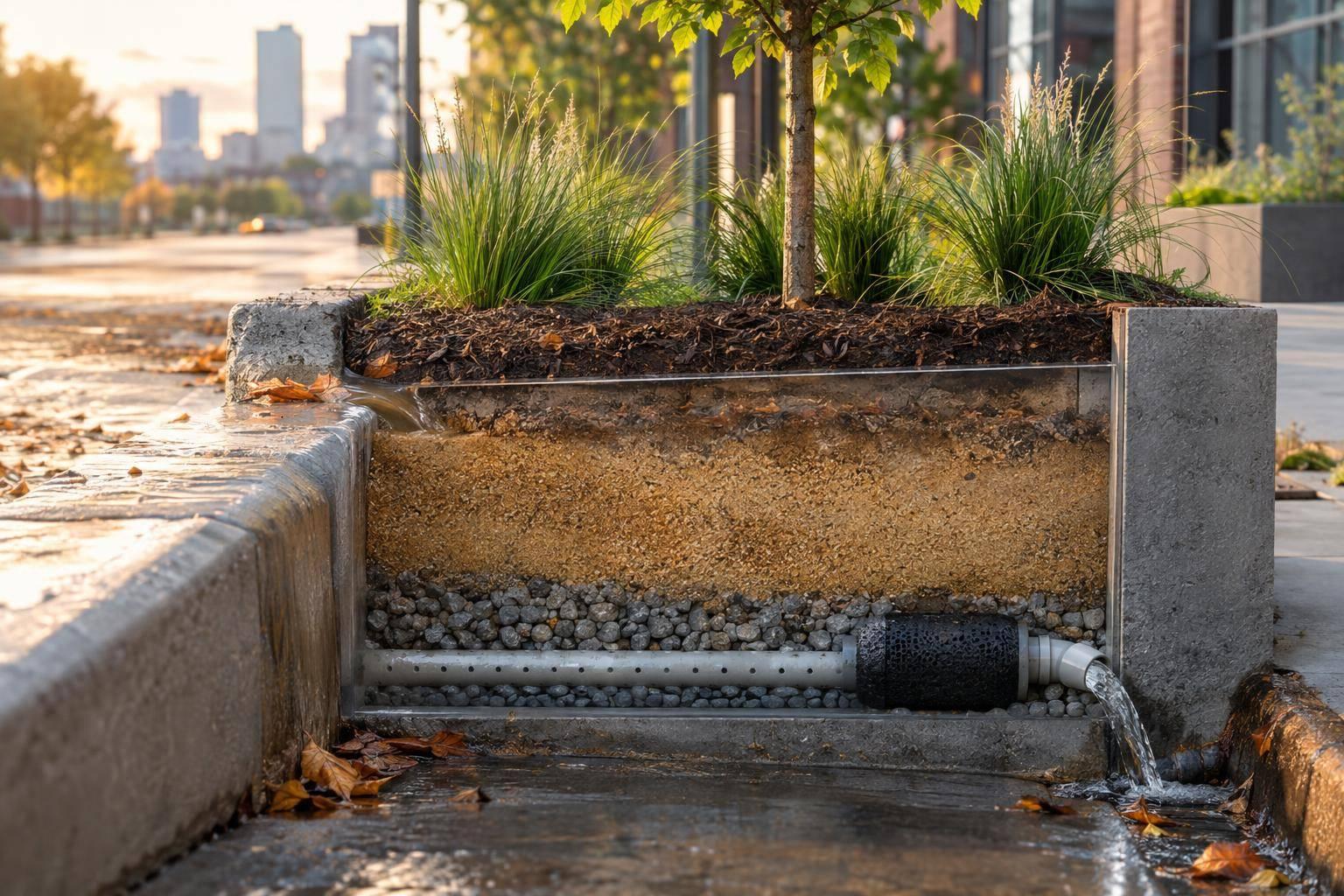
I’d start with sand for sediment-heavy runoff and consider tested biochar for selected dissolved pollutants. Before choosing either, I’d measure both total and dissolved pollutant levels, then check whether the proposed media meets treatment and drainage targets.
Here’s what I’d weigh for your site:
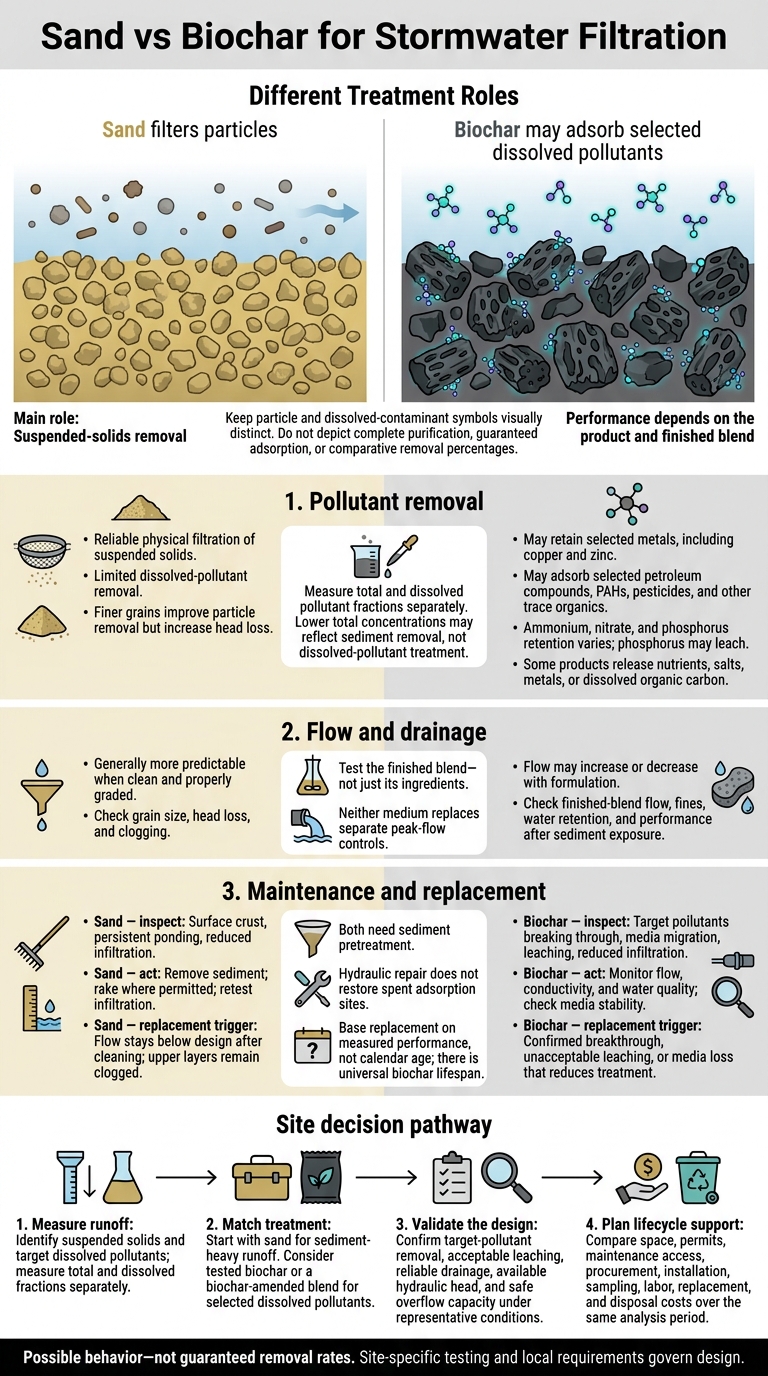
Removal: Sand filters particles; biochar may adsorb selected metals and organic compounds. Nutrient removal varies, and some biochar can release pollutants.
Flow: Sand is generally more predictable when clean. Biochar’s flow depends on the product and blend. Neither replaces separate peak-flow controls.
Maintenance: Both need sediment pretreatment. I’d clean clogged sand and use flow and water-quality tests to decide when biochar needs replacement.
Site fit and cost: I’d compare available space, hydraulic head, permit requirements, maintenance access, and costs over the same period.
Quick Comparison
| Criterion | Sand | Biochar |
|---|---|---|
| Main role | Suspended-solids removal | Selected dissolved-pollutant treatment |
| Main limit | Limited dissolved-pollutant removal | Product-dependent adsorption and possible leaching |
| Flow check | Grain size, head loss, and clogging | Finished-blend flow, fines, and water retention |
| Replacement check | Drainage remains poor after cleaning | Pollutant removal fails, leaching occurs, or media is lost |
<u>I’d test the finished blend - not just its ingredients.</u> For scale, one EPA sand-filter configuration specifies 18 inches of sand over 4–6 inches of gravel, but those dimensions are not a universal design rule.[4] The deciding factors are measured treatment, reliable drainage, and maintenance you can fund.
Sand vs Biochar for Stormwater Filtration
Biochar Filters: Challenges in Translating Success From the Lab to the Field | Mar 2023
sbb-itb-8baf5f1
Sand vs Biochar: Pollutant Removal and Water Flow
Separate particle removal from dissolved-pollutant treatment. Lower total metals or total phosphorus may reflect sediment removal rather than removal of dissolved pollutants. Before choosing media, request separate measurements for total and dissolved fractions. Weigh removal performance alongside drawdown and maintenance needs.
The table shows what each medium can do, its limits, and what to check before design.
| Property | Sand | Biochar | Design qualifications |
|---|---|---|---|
| Suspended solids (TSS) | Reliable physical filtration | Can trap solids; fines may migrate or increase head loss | Verify grain size, bed depth, and loading |
| Dissolved metals | Limited adsorption | May retain selected metals, including copper and zinc | Account for pH and competing ions |
| Dissolved nutrients | Limited removal without reactive or biological treatment | Ammonium, nitrate, and phosphorus retention varies; phosphorus may leach | Assess each nutrient species, not just totals |
| Dissolved organics | Generally limited adsorption | May adsorb selected petroleum compounds, PAHs, pesticides, and other trace organics | Assess breakthrough and competing organic matter |
| Hydraulic conductivity | More predictable when clean and properly graded | May increase or decrease with formulation | Measure the actual blend after sediment exposure |
| Flow predictability | Generally predictable before clogging | Varies with fines, blend ratio, and water retention | Verify drawdown and provide safe overflow capacity |
Test the proposed biochar product and blend for target contaminants and leaching before installation.
These comparisons describe possible behavior, not guaranteed removal rates.
Sand offers predictable particle removal; biochar offers selective adsorption.
Sand: Strengths and Limits of Physical Filtration
Washed, graded sand traps particles through straining and interception. Finer grains improve particle removal but increase head loss. Follow local requirements for loading, bed depth, and underdrains.
EPA guidance for one configuration specifies at least 18 inches of sand over 4–6 inches of gravel - configuration-specific dimensions, not a universal specification.[4]
| Consideration | Advantage or limitation | Practical action |
|---|---|---|
| Availability | Readily available and familiar to contractors | Specify washed filter sand, not generic fill |
| Maintenance access | Surface deposits can often be removed from above | Leave access for cleaning and upper-layer replacement |
| Surface clogging | Sediment can seal the bed | Protect it with pretreatment |
| Dissolved pollutants | Limited general-purpose adsorption | Add a validated reactive layer when dissolved treatment is required |
Biochar: Adsorption and Product Differences
Biochar is a porous, carbon-rich material made by heating biomass with limited oxygen. Its behavior depends on feedstock, production temperature, and blend ratio. Selected dissolved pollutants may bind to its surfaces, but some products release nutrients, salts, metals, or dissolved organic carbon. Gains in trace-organic removal seen in laboratory tests have not consistently carried over to field use.[5][6]
Judge biochar in the finished blend, where its effects on flow, contact time, and leaching determine how well it works.
Filter Throughput vs Peak-Flow Control
Fast drainage reduces contact time. Meanwhile, pH affects adsorption, and dissolved organic matter and other contaminants compete for available adsorption sites. Biochar’s throughput and water retention also vary with the blend.
Test the final mix through repeated loading and wetting–drying cycles. Then size detention, outlet controls, conveyance, and bypass separately: throughput is not the same as peak-flow control.
Clogging, Maintenance, and Media Replacement
Sand and biochar fail in different ways, so each needs its own maintenance approach. Once the bed is sized, maintenance helps preserve flow and treatment capacity. Identify the failure mode before replacing media: surface crusting, internal pore blockage, channeling, or biochar breakthrough.[1][3]
| Medium | Inspection indicators | Routine actions | Replacement triggers |
|---|---|---|---|
| Sand | Surface crust, persistent ponding, reduced infiltration | Remove sediment; rake where permitted; retest infiltration | Flow stays below design after cleaning; upper layers remain clogged |
| Biochar | Target pollutants breaking through, media migration, leaching, reduced infiltration | Monitor flow, conductivity, and water quality; check media stability | Confirmed breakthrough, unacceptable leaching, or media loss that reduces treatment |
| Either medium: channeling | Uneven flow, localized erosion, rapid bypass | Inspect flow controls and media integrity; level the media and restore flow distribution | Bypass persists after flow distribution is corrected |
Limit Sediment Loads and Inspect Flow
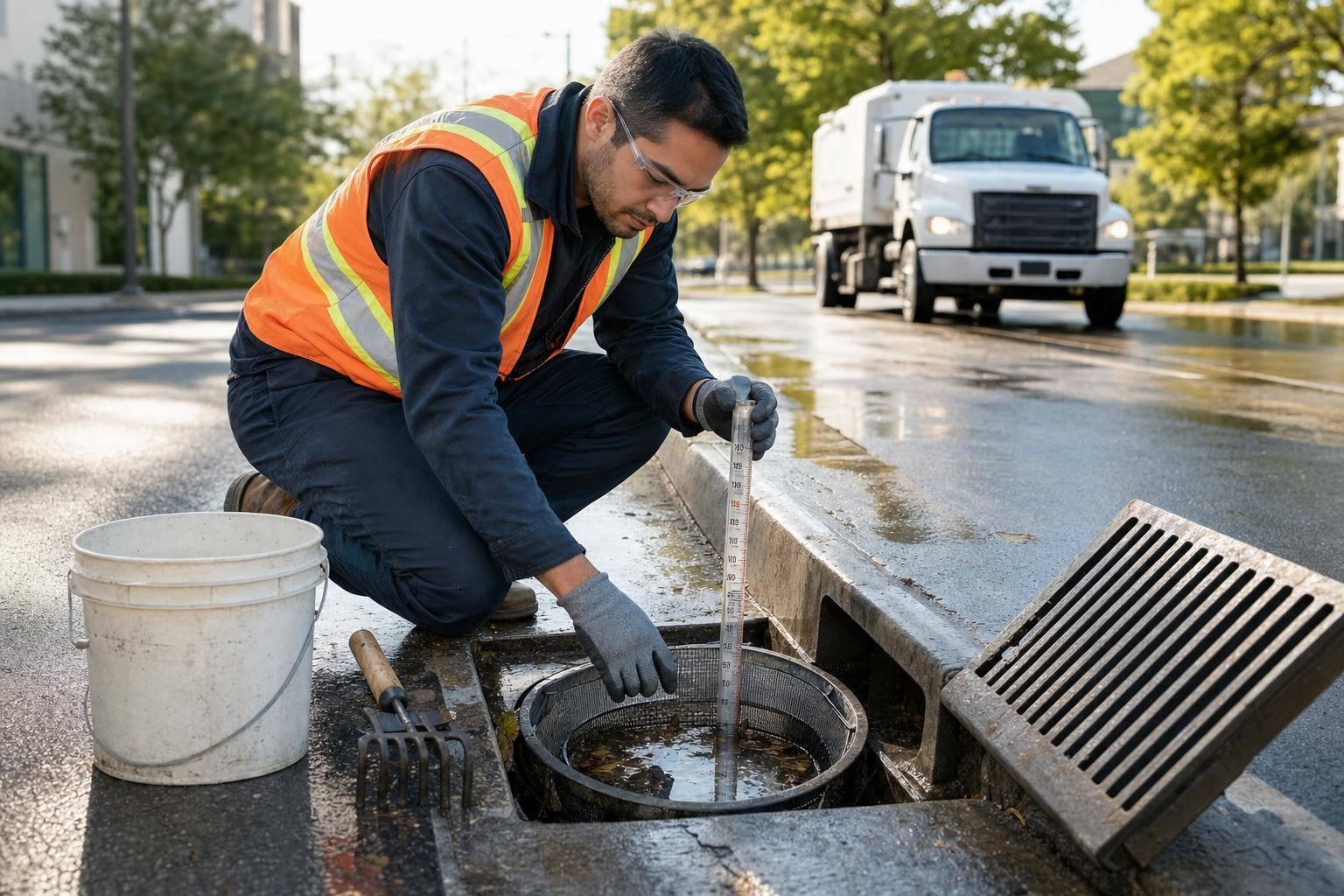
Pretreatment protects both media by keeping sediment out of the filter bed. Keep forebays or sedimentation chambers accessible so sediment can be removed. Inspect at locally required intervals and after large storms. Look for persistent ponding, bypassing, erosion, uneven flow, and exposed underdrains. Use flow gauging and infiltration tests to check whether these visible problems are reducing hydraulic performance.[1][3]
Clean Sand and Monitor Biochar Performance
For sand, remove surface deposits and rake only where permitted. If cleaning does not restore infiltration, replace clogged upper layers. Follow the system specifications.[1][3]
Biochar needs the same hydraulic checks, along with water-quality monitoring for breakthrough and leaching. Track conductivity and media migration, too. Hydraulic repair does not restore spent adsorption sites, so test water quality after maintenance.[1][3]
Set Replacement Timing by Performance
Base replacement on cumulative rainfall, sediment load, influent concentration, media depth, measured flow, and treatment targets - not calendar age. Separate surface-layer renewal from full-bed replacement. Persistent internal blockage or confirmed treatment failure calls for further assessment, not repeated surface cleaning. There is no universal biochar lifespan.[3]
Choosing Media for Urban Sites
Match Media to Runoff and Site Space
Once maintenance and replacement needs are defined, choose media that fits the site.
Match the media to pollutant loads and hydraulic limits. Sand may suit a sediment-heavy retail parking lot. A commercial drainage area with dissolved contaminants may call for biochar-amended filter media, subject to target-pollutant testing. Any blend must meet both pollutant-removal and hydraulic targets. [1][2][3]
| Site condition | Sand suitability | Biochar suitability | Blended-media suitability | What to verify on site |
|---|---|---|---|---|
| Sediment-heavy parking lot | Best for sediment load | Moderate; may clog quickly | Moderate | Sieve analysis; pretreatment |
| Confirmed dissolved contaminants | Low | Best for dissolved contaminants | High | Adsorption under representative runoff conditions; leaching tests |
| Compact vault or planter; limited hydraulic head | High (compact vaults) | Moderate | Moderate | Head loss calculations; bulk density |
| Sensitive receiving water | Moderate | High (nutrient and metal removal) | High | Effluent pH; nutrient and metal leaching |
Space requirements depend on the whole system - not just the filter bed. Account for pretreatment, flow controls, and maintenance access. Receiving-water requirements should guide which treatment claims you test.
With the media matched to the runoff, check the design numbers.
Check Hydraulics and Water Quality
Use a design checklist to record drainage area in acres, impervious cover as a percentage, runoff volume in cubic feet, and peak flow in cubic feet per second - not cubic feet. Specify hydraulic conductivity in inches per hour, particle size, bulk density in lb/ft³, and porosity as a percentage. Compare available hydraulic head with expected head loss, and document influent concentrations and required effluent targets in mg/L or µg/L, as appropriate.
For biochar, test pH effects, ash, metals, leaching, and adsorption of target pollutants under representative runoff conditions. Test the proposed blend, not just its ingredients. The design should also address pretreatment, inspection and replacement access, field monitoring, disposal or reuse arrangements, and state and local permits and approvals. Lab adsorption results are a screening tool, not proof of field performance. [7]
Next, compare lifecycle costs alongside performance and hydraulics.
Compare Lifecycle Costs and Reuse Options
Compare procurement, installation, sampling, labor, replacement, and disposal costs over the same analysis period. Include pretreatment and access-related work in installation costs. Review the biochar feedstock, but do not assume spent media can be reused without testing. [1][2][3]
Conclusion: Choose Media for Treatment and Maintenance
After comparing performance, hydraulics, and lifecycle cost, match treatment needs to the site’s maintenance capacity. Use sand for suspended solids and biochar for targeted dissolved contaminants.[1] Specify biochar only when site tests confirm removal of the target pollutants and acceptable leaching.
Before specifying media, define target pollutants, permit requirements, pretreatment, and hydraulic criteria. Include maintenance access in the design.[1][2] Before construction, assign responsibility and funding for inspections, sediment removal, and media replacement. Base replacement triggers on measured flow, infiltration, and effluent quality, rather than calendar age.[1][3] The selected media must meet treatment targets and allow reliable on-site maintenance.
FAQs
Can I add biochar to an existing sand filter?
The right choice depends on your system’s design and maintenance needs. Adding biochar can change how water moves through the filter and how flow is controlled. Before making changes, assess how it could affect peak-flow management and the risk of clogging over time.
Council Fire emphasizes systems thinking and measurable action. After any modification, monitor performance to confirm that the filter still meets your stormwater management goals.
How often should I test filtered runoff?
Testing intervals depend on site conditions and regulatory requirements. Set a consistent schedule for inspections and water quality sampling during initial planning, and build monitoring into the project design and budget [1][2][3].
Review system health and performance data regularly to check that the system works as designed, guide adjustments, and determine when to remove sediment or replace media [1][3].
How should I dispose of spent filter media?
The provided search results don’t specify how to dispose of spent sand or biochar. Waste disposal requirements vary by jurisdiction, so consult local environmental authorities or your project’s operations and maintenance plan for guidance on your site and media type.
Budget for long-term maintenance from the start, including sediment removal and system inspections [1][2][3].
FAQ