
Sep 11, 2026
How Regions Finance Large-Scale Renewable Projects
Sustainability Strategy
In This Article
Regions that align policy, grid access, revenue contracts, and capital close large renewable projects; misalignment stalls the pipeline.
How Regions Finance Large-Scale Renewable Projects
Most large renewable projects do not fail on paper economics alone - they stall on grid access, contract shape, and financing order. I’d sum it up this way: if a region wants more solar, wind, storage, or transmission built, it needs to line up policy, interconnection, revenue contracts, and capital at the same time.
By the end of 2025, U.S. interconnection queues held 2,061 GW of generation and storage seeking grid connection, and projects built in 2025 took a reported median of more than five years from interconnection request to commercial operation. That tells me the hard part is often not demand for clean power. It’s getting from pipeline to financial close without delay.
If I were boiling the article down for a reader in a hurry, I’d say regions need to do five things:
Stack capital by risk and stage, with sponsor equity first, senior debt later, and mezzanine or tax equity where needed
Use public money to fix a specific gap, such as early development costs, interconnection expense, or lender risk
Lock in revenue that lenders can underwrite, usually through long-term PPAs, tolling deals, or tariff-backed structures
Prepare for lender diligence early, including permits, studies, EPC terms, site control, and insurance
Run governance and delivery work in parallel, so permits, community issues, and utility coordination do not slow closing
A few numbers frame the financing picture:
Senior secured debt often covers about 60%–75% of total project cost
Mezzanine debt often fills about 5%–15%
Tax equity can account for about one-third to two-thirds of total financing, depending on structure
Utility-scale solar and wind often take 3–7 years from early site work to commercial operation
The last push from advanced development to financial close often takes about 6–15 months
What matters most is simple: projects close when each risk has a matching source of capital and a clear owner. Public entities, utilities, grid operators, regulators, and developers all shape that outcome.
Area | What regions need to line up | Why lenders care |
|---|---|---|
Grid access | Interconnection progress, transmission plan, deliverability | Delays can tie up capital and slow debt approval |
Revenue | Utility PPA, government-backed PPA, corporate PPA, tolling, or tariff support | Debt depends on stable cash flow |
Capital stack | Equity, debt, tax credit monetization, public support | Each source covers a different risk |
Public support | Grants, concessional loans, guarantees, first-loss capital | Helps move deals private lenders would not fund alone |
Closing work | Permits, EPC/O&M contracts, studies, insurance, CPs | Missing documents can stop funding |
In short, I’d treat regional coordination as a financing issue, not just a policy issue. When the region gets the sequence right, projects move. When it does not, capital sits idle and timelines slip.
How are you using blended finance to support renewable energy companies?
How to Build a Regional Capital Stack
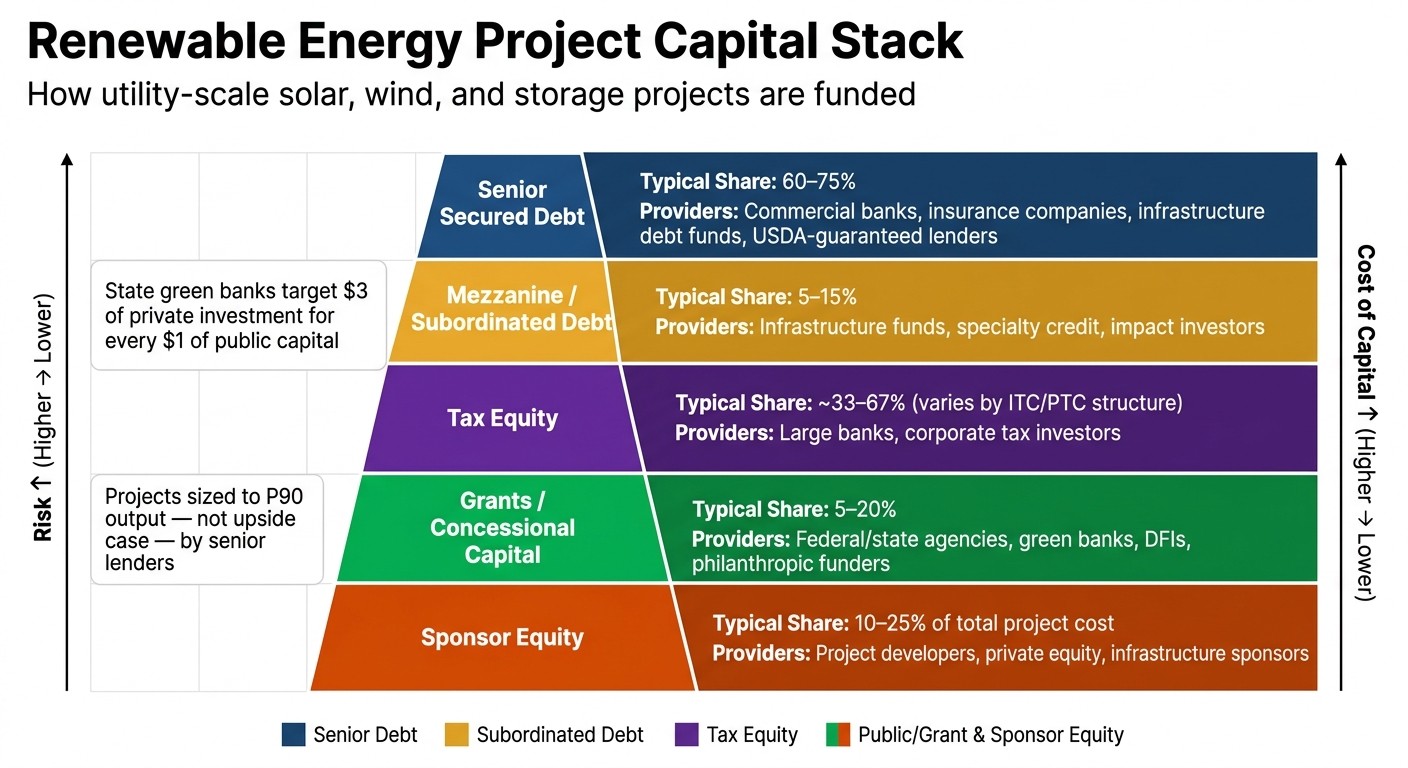
Renewable Energy Project Capital Stack: Financing Layers Explained
A capital stack is the lineup of funding sources in order of who gets paid back first. In utility-scale renewables, that usually means senior secured debt, mezzanine or subordinated debt, tax equity, sponsor equity, and grants or concessional capital. Getting that mix right is a big part of what makes a project bankable.
Match Each Capital Layer to Risk, Return, and Project Stage
Sponsor equity usually comes in first. It covers site control, permitting, interconnection studies, and early engineering before lenders are ready to commit. This is the riskiest money in the deal, so it also looks for the highest returns.
Once a project has contracted revenue and a clear path to construction, senior secured debt can cover about 60–75% of total project cost for bankable projects with solid off-take agreements.[1] These lenders take first-ranking security over project assets and size debt based on contracted cash flows.
Tax equity is a major financing layer in the U.S. Under ITC or PTC structures, banks or corporates put in capital in exchange for federal tax benefits. Tax equity can provide roughly one-third to two-thirds of total project financing, depending on the deal structure.[2] Sponsors can also monetize transferable tax credits without setting up a full tax equity partnership.
Mezzanine debt fills the space between senior debt and equity, often at 5–15% of the stack.[1] It sits behind senior lenders but ahead of equity, so it carries a higher price. Common providers include infrastructure funds, specialty credit investors, and impact investors.
This structure works because each layer takes a different kind of risk. Senior lenders want stable, contracted cash flow. Equity takes more uncertainty but wants more upside. Tax equity focuses on the tax attributes. Mezzanine capital steps in where the numbers almost work, but not quite.
Once the stack is sized, the next move is to use public capital to close whatever gap is left.
Use Public and Regional Institutions to Close Financing Gaps
Commercial lenders won't fund every project. Early-stage development, community-scale assets, and grid upgrades often need a public or mission-driven layer in the stack. That's where green banks, public power entities, and DFIs come in.
These groups use grants, low-interest loans, loan guarantees, and subordinated debt to improve the project's risk profile. The goal is simple: de-risk the deal enough that private lenders are willing to step in. State green banks often target leverage ratios of $3 of private investment for every $1 of public capital.[3] Public power entities can issue revenue bonds backed by ratepayer revenues to fund grid upgrades or new generation assets.[5] DFIs can offer subordinated tranches that take first losses, which can help senior lenders increase exposure and bring down the blended cost of capital.[4]
Public money works best when it is aimed at a clear financing barrier. Maybe the issue is early development risk. Maybe it's interconnection cost, a weak balance sheet, or a part of the project that commercial lenders see as too thin. The public layer should solve that exact problem, not just sit in the stack because funding is available.
Capital Stack Comparison Table
Capital Layer | Typical Share of Total Cost | Risk Seniority | Cost of Capital | Common U.S. Providers |
|---|---|---|---|---|
Senior Secured Debt | 60–75% | Highest (paid first) | Lowest | Commercial banks, insurance companies, infrastructure debt funds, USDA-guaranteed lenders |
Mezzanine / Subordinated Debt | 5–15% | Middle | Higher than senior | Infrastructure funds, specialty credit, impact investors |
Tax Equity | ~33–67% (varies by credit type and structure) | Varies by structure | Moderate | Large banks, corporate tax investors |
Sponsor Equity | 10–25% | Lowest (paid last) | Highest | Project developers, private equity, infrastructure sponsors |
Grants / Concessional Capital | 5–20% | First-loss or non-repayable | Lowest or zero | Federal and state agencies, green banks, DFIs, philanthropic funders |
These ranges shift based on project type, policy, and tax structure.
One distinction matters a lot here: non-recourse project finance keeps the debt tied to the project's assets and cash flow. That's the standard setup for standalone wind, solar, storage, and grid deals. It also drives the level of lender diligence and the off-take terms needed to get to close.
How Public Funding and Policy Support Improve Bankability
Once the capital stack is in place, public money should target the gap that still blocks the deal. Its main job is simple: cut a specific risk enough that private lenders and equity investors feel comfortable moving in.
Pick the Right Public Instrument for Each Barrier
Projects hit different roadblocks at different points, so the tool has to fit the risk. Grants or technical assistance work best when the problem is early development risk. Concessional loans or capital subsidies make more sense when a project is technically sound but still can’t get financed on market terms.
Loan guarantees and partial risk guarantees help by cutting lender exposure to default and payment risk. That can bring in commercial debt that might otherwise stay on the sidelines. DOE's Loan Programs Office finalized an $861.3 million loan guarantee for Project Marahu in Puerto Rico in October 2024, enabling 200 MW of solar and up to 285 MW / 1,140 MWh of standalone battery storage.[6][7]
Auctions and long-term tariffs serve a different purpose. They lock in revenue, which gives lenders something concrete to underwrite. That matters because these contracts can lower curtailment risk, change-in-law risk, and payment-delay risk. Even so, the revenue terms still have to survive lender due diligence.
That same reasoning applies to grid access and storage. If power can’t reliably reach load, the contract on paper only tells part of the story.
Finance Grid and Storage as Part of the Regional Package
Transmission upgrades, substation spending, and interconnection queue reform are shared assets that shape deliverability. They belong in the project package because a single developer usually can’t fund them well on its own.
Standalone storage can be tough to finance when market rules don’t pay for the full set of services storage provides. Pairing storage with generation can help. So can adding capacity payments, ancillary-service payments, or firming payments. Those features make the revenue stack easier for lenders and investors to accept.
Use the tool that fits the barrier, then pressure-test it against the table below.
Public Finance Instruments Table
Instrument | Best For | Typical Provider | Project Stage | Effect on Private Capital |
|---|---|---|---|---|
Grants | Site studies, permitting, early development work | Federal/state agencies, climate funds | Pre-development | Lowers early-stage risk and makes later financing easier |
Concessional Loans / Capital Subsidies | Projects that are technically sound but still not financeable on market terms | DOE, green banks, public development banks | Development to construction | Improves project economics and lowers the cost of capital |
Loan Guarantees / Partial Risk Guarantees | Offtaker default, termination risk, debt mobilization | DOE Loan Programs Office, multilateral banks | Procurement to financial close | Reduces lender risk and enables commercial debt |
Auctions / Tariff Support | Long-term revenue certainty, merchant risk reduction | Federal/state regulators, utilities | Procurement through COD | Improves revenue visibility and supports lender underwriting |
Blended Finance Facilities | Complex multi-layer deals, first-loss coverage | MDBs, public investment banks, climate funds | Development through close | Crowds in private debt and equity by absorbing initial losses |
How to Secure Revenue and Meet Lender Requirements
Lenders underwrite two things: steady cash flow and clear risk allocation. Miss either one, and the deal can stall or close on weaker terms. Even after public capital improves the risk profile, lenders still want proof that the remaining project cash flow can carry debt on its own.
Prepare the Project for Lender Due Diligence
Before committing capital, lenders usually run three due diligence tracks at the same time: legal, insurance, and technical. They’re checking whether the project’s risks are known, assigned, and backed by documentation that holds up under scrutiny.
That means third-party P50/P90 studies, battery degradation and dispatch modeling, site control, permits, interconnection status, fixed-price EPC terms, and O&M warranties all need to line up in a version-controlled data room. Each item answers a lender concern, whether that’s resource risk, construction risk, operating risk, or revenue security. Lenders often size debt to P90 output, not the upside case.
Technology choice matters just as much. Tier-1 solar modules, proven turbine models, and proven storage technologies with manufacturer-backed warranties are the baseline. It helps to package the full set of materials in a version-controlled data room with short risk memos so lenders can move through the file without hunting for gaps.
Choose an Off-Take Structure That Supports Debt
Once the project inputs clear diligence, the next issue is simple: can the revenue contract support the debt? The off-take structure shapes how much project revenue a lender will count, and utility rules, public procurement, and regional market design all affect what lenders see as financeable.
Utility PPAs with regulated or large investor-owned utilities are still the strongest option for debt support. They usually come with long terms, fixed or formula-based pricing, and strong counterparty credit. Roughly 70% of utility PPAs carry tenors beyond 15 years.[10] That kind of stability usually supports higher leverage and tighter DSCRs.
Government-backed PPAs can offer equal or stronger credit quality. Even so, lenders look closely at legal enforceability and appropriation risk. Good credit on paper isn’t enough if payment support can shift with budget rules or public process.
Corporate PPAs have expanded fast in the U.S., with cumulative contracted capacity surpassing 70 GW by October 2023.[12] But term length is a sticking point. About 69% of corporate PPAs signed since 2015 have tenors shorter than 15 years.[11][13] For lenders, that leaves an uncontracted tail, and they usually discount that tail hard. A high-credit corporate buyer can get close to utility-level treatment. A weaker buyer often leads to shorter loan tenors, lower leverage, or added credit support such as letters of credit.
For storage, tolling agreements with fixed or indexed capacity payments are usually the cleanest route to bankable cash flow. If tolling isn’t available, lenders tend to count only contracted revenue and treat merchant and ancillary upside as extra cash rather than support for debt service.
Regional tariff rules and queue outcomes also matter. A contract may look solid at first glance, but if tariff treatment or interconnection results weaken deliverability, lenders will adjust their view fast. Transmission projects often rely on regulated tariff frameworks or long-term shipping contracts, which can support long-tenor debt when the regulatory framework is stable.
Off-Take Structure Comparison Table
Off-Take Structure | Typical Tenor | Off-Taker Credit Quality | Revenue Predictability | Debt Sizing Implication | Best-Fit Project Type |
|---|---|---|---|---|---|
Utility PPA | Long-term | High | Fixed or formula-based | Supports higher leverage and tighter DSCRs | Utility-scale wind and solar |
Government-Backed PPA | Long-term | Very high | Stable; policy-dependent | Favorable leverage and longer tenors possible | Municipal or regional renewables |
Corporate PPA | Often shorter term | Varies | Fixed, but often shorter than utility contracts | Moderate leverage; more conservative structures for weaker credits | Commercial and industrial projects |
Tolling Agreement | Long-term | Depends on counterparty | Fixed or indexed capacity payment | Highly bankable when counterparty is investment grade | Storage |
Merchant + Hedge | Hedge term varies | Market counterparty | Partial price protection | Lower leverage; higher DSCR required | Mature markets with partial contracted revenue |
How to Move From Pipeline to Financial Close
Sequence the Work From Site Control to Signed Financing Documents
Once revenue and underwriting are bankable, the job changes. Now it’s about getting the rest of the work done in the right order. Financial close is not one big moment. It’s a chain of milestones, and each one opens the door to the next.
In the United States, utility-scale solar and wind projects usually take 3–7 years from initial site identification to commercial operation, and the last stretch from advanced development to financial close often takes 6–15 months once the main milestones are in place.[15][19] The usual path looks like this: site control → resource assessment → permits → interconnection studies and agreements → EPC/O&M contracts → revenue contract → capital stack assembly → lender diligence → term sheets → CPs → financial close and notice to proceed.[14][15][17][18][16]
Interconnection is usually the long pole in the tent. Projects can spend 12–24+ months in interconnection studies alone.[15][18] That’s why teams need to lock the point of interconnection early and avoid repeat restudies. Even then, the pace still turns on permits, stakeholder alignment, and utility coordination.
Conditions precedent to close usually include fully executed project contracts - EPC, O&M, PPA, and the interconnection agreement - along with all required permits in force, an independent engineer's report, environmental site assessments, proof of insurance, land surveys, and evidence of contributed equity.[16][9][8] If even one item is missing, funds may not be drawn on time.
Align Regional Governance, Stakeholders, and Delivery Partners
Technical readiness on its own won’t get a project over the line. Governance has to move alongside development. When governance slips, CP delays tend to follow. A contested permit, an open community dispute, or poor utility coordination can stall a project that looks ready on paper. The smart move is to treat governance as a parallel workstream, not a box to check at the end.
Regions that move projects with less friction usually have a clear regional energy and transmission plan. That plan sets out preferred development zones and grid expansion priorities. Cross-agency steering committees, open pipeline reviews, and early community engagement - including written agreements with host communities and community benefit plans - help create the records lenders want for environmental and social due diligence. When those materials are ready before lenders request them, closing timelines often shrink.
Conclusion: Key Steps Regions Should Follow
The regional playbook is straightforward. Regions that close projects early tend to do five things well:
Build the right capital stack early
Use public de-risking tools with care
Secure durable revenue through predictable procurement programs and standardized contracts
Satisfy lender diligence before it becomes a bottleneck
Coordinate governance early so energy plans, transmission plans, and community priorities stay aligned with the project pipeline
The fastest regions run these workstreams in parallel, assign clear ownership, and pay for early-stage work before commercial lenders commit.
FAQs
Why do renewable projects stall after entering the queue?
Renewable projects often get stuck in the interconnection queue for a simple reason: the grid may not have enough capacity, or the right equipment, to take on new power generation without major upgrades.
That’s only part of the slowdown. Projects also run into backlogs in the interconnection process, uneven permitting rules from one jurisdiction to the next, and hard-to-navigate regulatory and technical cost-allocation rules as they move closer to financial close.
Which funding source fits each project risk?
Developers line up funding based on risk, building a layered capital stack that puts each dollar where it fits best. Public, philanthropic, or concessional capital - such as grants, first-loss equity, or subordinated loans - usually goes into the highest-risk stages, including development and early feasibility.
Once the project moves into its core phase, commercial senior debt and equity back assets with steadier cash flows, often supported by 15- to 25-year PPAs. IRA tax credits and guarantees help cut risk further and make the project more attractive to private capital.
What makes a power contract bankable?
A power contract, or Power Purchase Agreement (PPA), is bankable when it gives developers the revenue and price certainty they need to line up debt financing on good terms.
In plain English, lenders want to see a deal that makes cash flow easier to count on. That usually means a contract with a 10- to 25-year term, a creditworthy offtaker, and predictable cash flows over time.
It also means the agreement needs guardrails for things that can throw a project off course. Common protections include curtailment provisions, change-of-law clauses, and clear credit support requirements. These terms help manage both market risk and project risk, which matters a lot when financing is on the line.
Related Blog Posts
Latest Articles
©2025

Narrative Change and Power Building: The Missing Half of Advocacy
Narrative change is the process of disrupting dominant narratives that normalize inequity and advancing new narratives from historically marginalized communities.

Funding Resilience Without Federal Grants
BRIC is unreliable and FEMA is shrinking. Here's how cities fund climate resilience with dedicated revenue, blended finance, and a coordinating authority.

The ESG Blind Spot: How AI Is Finding Risks in Companies Nobody Else Is Watching
Norway's sovereign wealth fund uses AI to screen 7,200 portfolio companies for forced labor and corruption within 24 hours. The real story is the emerging-market coverage gap that traditional ESG data vendors miss — and what it means for any company with a global supply chain.
Narrative Change and Power Building: The Missing Half of Advocacy
Narrative change is the process of disrupting dominant narratives that normalize inequity and advancing new narratives from historically marginalized communities.
Funding Resilience Without Federal Grants
BRIC is unreliable and FEMA is shrinking. Here's how cities fund climate resilience with dedicated revenue, blended finance, and a coordinating authority.
The ESG Blind Spot: How AI Is Finding Risks in Companies Nobody Else Is Watching
Norway's sovereign wealth fund uses AI to screen 7,200 portfolio companies for forced labor and corruption within 24 hours. The real story is the emerging-market coverage gap that traditional ESG data vendors miss — and what it means for any company with a global supply chain.
FAQ
01
What does it really mean to “redefine profit”?
02
What makes Council Fire different?
03
Who does Council Fire work with?
04
What does working with Council Fire actually look like?
05
How does Council Fire help organizations turn big goals into action?
06
How does Council Fire define and measure success?
Sep 11, 2026
How Regions Finance Large-Scale Renewable Projects
Sustainability Strategy
In This Article
Regions that align policy, grid access, revenue contracts, and capital close large renewable projects; misalignment stalls the pipeline.
How Regions Finance Large-Scale Renewable Projects
Most large renewable projects do not fail on paper economics alone - they stall on grid access, contract shape, and financing order. I’d sum it up this way: if a region wants more solar, wind, storage, or transmission built, it needs to line up policy, interconnection, revenue contracts, and capital at the same time.
By the end of 2025, U.S. interconnection queues held 2,061 GW of generation and storage seeking grid connection, and projects built in 2025 took a reported median of more than five years from interconnection request to commercial operation. That tells me the hard part is often not demand for clean power. It’s getting from pipeline to financial close without delay.
If I were boiling the article down for a reader in a hurry, I’d say regions need to do five things:
Stack capital by risk and stage, with sponsor equity first, senior debt later, and mezzanine or tax equity where needed
Use public money to fix a specific gap, such as early development costs, interconnection expense, or lender risk
Lock in revenue that lenders can underwrite, usually through long-term PPAs, tolling deals, or tariff-backed structures
Prepare for lender diligence early, including permits, studies, EPC terms, site control, and insurance
Run governance and delivery work in parallel, so permits, community issues, and utility coordination do not slow closing
A few numbers frame the financing picture:
Senior secured debt often covers about 60%–75% of total project cost
Mezzanine debt often fills about 5%–15%
Tax equity can account for about one-third to two-thirds of total financing, depending on structure
Utility-scale solar and wind often take 3–7 years from early site work to commercial operation
The last push from advanced development to financial close often takes about 6–15 months
What matters most is simple: projects close when each risk has a matching source of capital and a clear owner. Public entities, utilities, grid operators, regulators, and developers all shape that outcome.
Area | What regions need to line up | Why lenders care |
|---|---|---|
Grid access | Interconnection progress, transmission plan, deliverability | Delays can tie up capital and slow debt approval |
Revenue | Utility PPA, government-backed PPA, corporate PPA, tolling, or tariff support | Debt depends on stable cash flow |
Capital stack | Equity, debt, tax credit monetization, public support | Each source covers a different risk |
Public support | Grants, concessional loans, guarantees, first-loss capital | Helps move deals private lenders would not fund alone |
Closing work | Permits, EPC/O&M contracts, studies, insurance, CPs | Missing documents can stop funding |
In short, I’d treat regional coordination as a financing issue, not just a policy issue. When the region gets the sequence right, projects move. When it does not, capital sits idle and timelines slip.
How are you using blended finance to support renewable energy companies?
How to Build a Regional Capital Stack
Renewable Energy Project Capital Stack: Financing Layers Explained
A capital stack is the lineup of funding sources in order of who gets paid back first. In utility-scale renewables, that usually means senior secured debt, mezzanine or subordinated debt, tax equity, sponsor equity, and grants or concessional capital. Getting that mix right is a big part of what makes a project bankable.
Match Each Capital Layer to Risk, Return, and Project Stage
Sponsor equity usually comes in first. It covers site control, permitting, interconnection studies, and early engineering before lenders are ready to commit. This is the riskiest money in the deal, so it also looks for the highest returns.
Once a project has contracted revenue and a clear path to construction, senior secured debt can cover about 60–75% of total project cost for bankable projects with solid off-take agreements.[1] These lenders take first-ranking security over project assets and size debt based on contracted cash flows.
Tax equity is a major financing layer in the U.S. Under ITC or PTC structures, banks or corporates put in capital in exchange for federal tax benefits. Tax equity can provide roughly one-third to two-thirds of total project financing, depending on the deal structure.[2] Sponsors can also monetize transferable tax credits without setting up a full tax equity partnership.
Mezzanine debt fills the space between senior debt and equity, often at 5–15% of the stack.[1] It sits behind senior lenders but ahead of equity, so it carries a higher price. Common providers include infrastructure funds, specialty credit investors, and impact investors.
This structure works because each layer takes a different kind of risk. Senior lenders want stable, contracted cash flow. Equity takes more uncertainty but wants more upside. Tax equity focuses on the tax attributes. Mezzanine capital steps in where the numbers almost work, but not quite.
Once the stack is sized, the next move is to use public capital to close whatever gap is left.
Use Public and Regional Institutions to Close Financing Gaps
Commercial lenders won't fund every project. Early-stage development, community-scale assets, and grid upgrades often need a public or mission-driven layer in the stack. That's where green banks, public power entities, and DFIs come in.
These groups use grants, low-interest loans, loan guarantees, and subordinated debt to improve the project's risk profile. The goal is simple: de-risk the deal enough that private lenders are willing to step in. State green banks often target leverage ratios of $3 of private investment for every $1 of public capital.[3] Public power entities can issue revenue bonds backed by ratepayer revenues to fund grid upgrades or new generation assets.[5] DFIs can offer subordinated tranches that take first losses, which can help senior lenders increase exposure and bring down the blended cost of capital.[4]
Public money works best when it is aimed at a clear financing barrier. Maybe the issue is early development risk. Maybe it's interconnection cost, a weak balance sheet, or a part of the project that commercial lenders see as too thin. The public layer should solve that exact problem, not just sit in the stack because funding is available.
Capital Stack Comparison Table
Capital Layer | Typical Share of Total Cost | Risk Seniority | Cost of Capital | Common U.S. Providers |
|---|---|---|---|---|
Senior Secured Debt | 60–75% | Highest (paid first) | Lowest | Commercial banks, insurance companies, infrastructure debt funds, USDA-guaranteed lenders |
Mezzanine / Subordinated Debt | 5–15% | Middle | Higher than senior | Infrastructure funds, specialty credit, impact investors |
Tax Equity | ~33–67% (varies by credit type and structure) | Varies by structure | Moderate | Large banks, corporate tax investors |
Sponsor Equity | 10–25% | Lowest (paid last) | Highest | Project developers, private equity, infrastructure sponsors |
Grants / Concessional Capital | 5–20% | First-loss or non-repayable | Lowest or zero | Federal and state agencies, green banks, DFIs, philanthropic funders |
These ranges shift based on project type, policy, and tax structure.
One distinction matters a lot here: non-recourse project finance keeps the debt tied to the project's assets and cash flow. That's the standard setup for standalone wind, solar, storage, and grid deals. It also drives the level of lender diligence and the off-take terms needed to get to close.
How Public Funding and Policy Support Improve Bankability
Once the capital stack is in place, public money should target the gap that still blocks the deal. Its main job is simple: cut a specific risk enough that private lenders and equity investors feel comfortable moving in.
Pick the Right Public Instrument for Each Barrier
Projects hit different roadblocks at different points, so the tool has to fit the risk. Grants or technical assistance work best when the problem is early development risk. Concessional loans or capital subsidies make more sense when a project is technically sound but still can’t get financed on market terms.
Loan guarantees and partial risk guarantees help by cutting lender exposure to default and payment risk. That can bring in commercial debt that might otherwise stay on the sidelines. DOE's Loan Programs Office finalized an $861.3 million loan guarantee for Project Marahu in Puerto Rico in October 2024, enabling 200 MW of solar and up to 285 MW / 1,140 MWh of standalone battery storage.[6][7]
Auctions and long-term tariffs serve a different purpose. They lock in revenue, which gives lenders something concrete to underwrite. That matters because these contracts can lower curtailment risk, change-in-law risk, and payment-delay risk. Even so, the revenue terms still have to survive lender due diligence.
That same reasoning applies to grid access and storage. If power can’t reliably reach load, the contract on paper only tells part of the story.
Finance Grid and Storage as Part of the Regional Package
Transmission upgrades, substation spending, and interconnection queue reform are shared assets that shape deliverability. They belong in the project package because a single developer usually can’t fund them well on its own.
Standalone storage can be tough to finance when market rules don’t pay for the full set of services storage provides. Pairing storage with generation can help. So can adding capacity payments, ancillary-service payments, or firming payments. Those features make the revenue stack easier for lenders and investors to accept.
Use the tool that fits the barrier, then pressure-test it against the table below.
Public Finance Instruments Table
Instrument | Best For | Typical Provider | Project Stage | Effect on Private Capital |
|---|---|---|---|---|
Grants | Site studies, permitting, early development work | Federal/state agencies, climate funds | Pre-development | Lowers early-stage risk and makes later financing easier |
Concessional Loans / Capital Subsidies | Projects that are technically sound but still not financeable on market terms | DOE, green banks, public development banks | Development to construction | Improves project economics and lowers the cost of capital |
Loan Guarantees / Partial Risk Guarantees | Offtaker default, termination risk, debt mobilization | DOE Loan Programs Office, multilateral banks | Procurement to financial close | Reduces lender risk and enables commercial debt |
Auctions / Tariff Support | Long-term revenue certainty, merchant risk reduction | Federal/state regulators, utilities | Procurement through COD | Improves revenue visibility and supports lender underwriting |
Blended Finance Facilities | Complex multi-layer deals, first-loss coverage | MDBs, public investment banks, climate funds | Development through close | Crowds in private debt and equity by absorbing initial losses |
How to Secure Revenue and Meet Lender Requirements
Lenders underwrite two things: steady cash flow and clear risk allocation. Miss either one, and the deal can stall or close on weaker terms. Even after public capital improves the risk profile, lenders still want proof that the remaining project cash flow can carry debt on its own.
Prepare the Project for Lender Due Diligence
Before committing capital, lenders usually run three due diligence tracks at the same time: legal, insurance, and technical. They’re checking whether the project’s risks are known, assigned, and backed by documentation that holds up under scrutiny.
That means third-party P50/P90 studies, battery degradation and dispatch modeling, site control, permits, interconnection status, fixed-price EPC terms, and O&M warranties all need to line up in a version-controlled data room. Each item answers a lender concern, whether that’s resource risk, construction risk, operating risk, or revenue security. Lenders often size debt to P90 output, not the upside case.
Technology choice matters just as much. Tier-1 solar modules, proven turbine models, and proven storage technologies with manufacturer-backed warranties are the baseline. It helps to package the full set of materials in a version-controlled data room with short risk memos so lenders can move through the file without hunting for gaps.
Choose an Off-Take Structure That Supports Debt
Once the project inputs clear diligence, the next issue is simple: can the revenue contract support the debt? The off-take structure shapes how much project revenue a lender will count, and utility rules, public procurement, and regional market design all affect what lenders see as financeable.
Utility PPAs with regulated or large investor-owned utilities are still the strongest option for debt support. They usually come with long terms, fixed or formula-based pricing, and strong counterparty credit. Roughly 70% of utility PPAs carry tenors beyond 15 years.[10] That kind of stability usually supports higher leverage and tighter DSCRs.
Government-backed PPAs can offer equal or stronger credit quality. Even so, lenders look closely at legal enforceability and appropriation risk. Good credit on paper isn’t enough if payment support can shift with budget rules or public process.
Corporate PPAs have expanded fast in the U.S., with cumulative contracted capacity surpassing 70 GW by October 2023.[12] But term length is a sticking point. About 69% of corporate PPAs signed since 2015 have tenors shorter than 15 years.[11][13] For lenders, that leaves an uncontracted tail, and they usually discount that tail hard. A high-credit corporate buyer can get close to utility-level treatment. A weaker buyer often leads to shorter loan tenors, lower leverage, or added credit support such as letters of credit.
For storage, tolling agreements with fixed or indexed capacity payments are usually the cleanest route to bankable cash flow. If tolling isn’t available, lenders tend to count only contracted revenue and treat merchant and ancillary upside as extra cash rather than support for debt service.
Regional tariff rules and queue outcomes also matter. A contract may look solid at first glance, but if tariff treatment or interconnection results weaken deliverability, lenders will adjust their view fast. Transmission projects often rely on regulated tariff frameworks or long-term shipping contracts, which can support long-tenor debt when the regulatory framework is stable.
Off-Take Structure Comparison Table
Off-Take Structure | Typical Tenor | Off-Taker Credit Quality | Revenue Predictability | Debt Sizing Implication | Best-Fit Project Type |
|---|---|---|---|---|---|
Utility PPA | Long-term | High | Fixed or formula-based | Supports higher leverage and tighter DSCRs | Utility-scale wind and solar |
Government-Backed PPA | Long-term | Very high | Stable; policy-dependent | Favorable leverage and longer tenors possible | Municipal or regional renewables |
Corporate PPA | Often shorter term | Varies | Fixed, but often shorter than utility contracts | Moderate leverage; more conservative structures for weaker credits | Commercial and industrial projects |
Tolling Agreement | Long-term | Depends on counterparty | Fixed or indexed capacity payment | Highly bankable when counterparty is investment grade | Storage |
Merchant + Hedge | Hedge term varies | Market counterparty | Partial price protection | Lower leverage; higher DSCR required | Mature markets with partial contracted revenue |
How to Move From Pipeline to Financial Close
Sequence the Work From Site Control to Signed Financing Documents
Once revenue and underwriting are bankable, the job changes. Now it’s about getting the rest of the work done in the right order. Financial close is not one big moment. It’s a chain of milestones, and each one opens the door to the next.
In the United States, utility-scale solar and wind projects usually take 3–7 years from initial site identification to commercial operation, and the last stretch from advanced development to financial close often takes 6–15 months once the main milestones are in place.[15][19] The usual path looks like this: site control → resource assessment → permits → interconnection studies and agreements → EPC/O&M contracts → revenue contract → capital stack assembly → lender diligence → term sheets → CPs → financial close and notice to proceed.[14][15][17][18][16]
Interconnection is usually the long pole in the tent. Projects can spend 12–24+ months in interconnection studies alone.[15][18] That’s why teams need to lock the point of interconnection early and avoid repeat restudies. Even then, the pace still turns on permits, stakeholder alignment, and utility coordination.
Conditions precedent to close usually include fully executed project contracts - EPC, O&M, PPA, and the interconnection agreement - along with all required permits in force, an independent engineer's report, environmental site assessments, proof of insurance, land surveys, and evidence of contributed equity.[16][9][8] If even one item is missing, funds may not be drawn on time.
Align Regional Governance, Stakeholders, and Delivery Partners
Technical readiness on its own won’t get a project over the line. Governance has to move alongside development. When governance slips, CP delays tend to follow. A contested permit, an open community dispute, or poor utility coordination can stall a project that looks ready on paper. The smart move is to treat governance as a parallel workstream, not a box to check at the end.
Regions that move projects with less friction usually have a clear regional energy and transmission plan. That plan sets out preferred development zones and grid expansion priorities. Cross-agency steering committees, open pipeline reviews, and early community engagement - including written agreements with host communities and community benefit plans - help create the records lenders want for environmental and social due diligence. When those materials are ready before lenders request them, closing timelines often shrink.
Conclusion: Key Steps Regions Should Follow
The regional playbook is straightforward. Regions that close projects early tend to do five things well:
Build the right capital stack early
Use public de-risking tools with care
Secure durable revenue through predictable procurement programs and standardized contracts
Satisfy lender diligence before it becomes a bottleneck
Coordinate governance early so energy plans, transmission plans, and community priorities stay aligned with the project pipeline
The fastest regions run these workstreams in parallel, assign clear ownership, and pay for early-stage work before commercial lenders commit.
FAQs
Why do renewable projects stall after entering the queue?
Renewable projects often get stuck in the interconnection queue for a simple reason: the grid may not have enough capacity, or the right equipment, to take on new power generation without major upgrades.
That’s only part of the slowdown. Projects also run into backlogs in the interconnection process, uneven permitting rules from one jurisdiction to the next, and hard-to-navigate regulatory and technical cost-allocation rules as they move closer to financial close.
Which funding source fits each project risk?
Developers line up funding based on risk, building a layered capital stack that puts each dollar where it fits best. Public, philanthropic, or concessional capital - such as grants, first-loss equity, or subordinated loans - usually goes into the highest-risk stages, including development and early feasibility.
Once the project moves into its core phase, commercial senior debt and equity back assets with steadier cash flows, often supported by 15- to 25-year PPAs. IRA tax credits and guarantees help cut risk further and make the project more attractive to private capital.
What makes a power contract bankable?
A power contract, or Power Purchase Agreement (PPA), is bankable when it gives developers the revenue and price certainty they need to line up debt financing on good terms.
In plain English, lenders want to see a deal that makes cash flow easier to count on. That usually means a contract with a 10- to 25-year term, a creditworthy offtaker, and predictable cash flows over time.
It also means the agreement needs guardrails for things that can throw a project off course. Common protections include curtailment provisions, change-of-law clauses, and clear credit support requirements. These terms help manage both market risk and project risk, which matters a lot when financing is on the line.
Related Blog Posts
Latest Articles
©2025
Narrative Change and Power Building: The Missing Half of Advocacy
Narrative change is the process of disrupting dominant narratives that normalize inequity and advancing new narratives from historically marginalized communities.
Funding Resilience Without Federal Grants
BRIC is unreliable and FEMA is shrinking. Here's how cities fund climate resilience with dedicated revenue, blended finance, and a coordinating authority.
The ESG Blind Spot: How AI Is Finding Risks in Companies Nobody Else Is Watching
Norway's sovereign wealth fund uses AI to screen 7,200 portfolio companies for forced labor and corruption within 24 hours. The real story is the emerging-market coverage gap that traditional ESG data vendors miss — and what it means for any company with a global supply chain.
FAQ
01
What does it really mean to “redefine profit”?
02
What makes Council Fire different?
03
Who does Council Fire work with?
04
What does working with Council Fire actually look like?
05
How does Council Fire help organizations turn big goals into action?
06
How does Council Fire define and measure success?
Sep 11, 2026
How Regions Finance Large-Scale Renewable Projects
Sustainability Strategy
In This Article
Regions that align policy, grid access, revenue contracts, and capital close large renewable projects; misalignment stalls the pipeline.
How Regions Finance Large-Scale Renewable Projects
Most large renewable projects do not fail on paper economics alone - they stall on grid access, contract shape, and financing order. I’d sum it up this way: if a region wants more solar, wind, storage, or transmission built, it needs to line up policy, interconnection, revenue contracts, and capital at the same time.
By the end of 2025, U.S. interconnection queues held 2,061 GW of generation and storage seeking grid connection, and projects built in 2025 took a reported median of more than five years from interconnection request to commercial operation. That tells me the hard part is often not demand for clean power. It’s getting from pipeline to financial close without delay.
If I were boiling the article down for a reader in a hurry, I’d say regions need to do five things:
Stack capital by risk and stage, with sponsor equity first, senior debt later, and mezzanine or tax equity where needed
Use public money to fix a specific gap, such as early development costs, interconnection expense, or lender risk
Lock in revenue that lenders can underwrite, usually through long-term PPAs, tolling deals, or tariff-backed structures
Prepare for lender diligence early, including permits, studies, EPC terms, site control, and insurance
Run governance and delivery work in parallel, so permits, community issues, and utility coordination do not slow closing
A few numbers frame the financing picture:
Senior secured debt often covers about 60%–75% of total project cost
Mezzanine debt often fills about 5%–15%
Tax equity can account for about one-third to two-thirds of total financing, depending on structure
Utility-scale solar and wind often take 3–7 years from early site work to commercial operation
The last push from advanced development to financial close often takes about 6–15 months
What matters most is simple: projects close when each risk has a matching source of capital and a clear owner. Public entities, utilities, grid operators, regulators, and developers all shape that outcome.
Area | What regions need to line up | Why lenders care |
|---|---|---|
Grid access | Interconnection progress, transmission plan, deliverability | Delays can tie up capital and slow debt approval |
Revenue | Utility PPA, government-backed PPA, corporate PPA, tolling, or tariff support | Debt depends on stable cash flow |
Capital stack | Equity, debt, tax credit monetization, public support | Each source covers a different risk |
Public support | Grants, concessional loans, guarantees, first-loss capital | Helps move deals private lenders would not fund alone |
Closing work | Permits, EPC/O&M contracts, studies, insurance, CPs | Missing documents can stop funding |
In short, I’d treat regional coordination as a financing issue, not just a policy issue. When the region gets the sequence right, projects move. When it does not, capital sits idle and timelines slip.
How are you using blended finance to support renewable energy companies?
How to Build a Regional Capital Stack
Renewable Energy Project Capital Stack: Financing Layers Explained
A capital stack is the lineup of funding sources in order of who gets paid back first. In utility-scale renewables, that usually means senior secured debt, mezzanine or subordinated debt, tax equity, sponsor equity, and grants or concessional capital. Getting that mix right is a big part of what makes a project bankable.
Match Each Capital Layer to Risk, Return, and Project Stage
Sponsor equity usually comes in first. It covers site control, permitting, interconnection studies, and early engineering before lenders are ready to commit. This is the riskiest money in the deal, so it also looks for the highest returns.
Once a project has contracted revenue and a clear path to construction, senior secured debt can cover about 60–75% of total project cost for bankable projects with solid off-take agreements.[1] These lenders take first-ranking security over project assets and size debt based on contracted cash flows.
Tax equity is a major financing layer in the U.S. Under ITC or PTC structures, banks or corporates put in capital in exchange for federal tax benefits. Tax equity can provide roughly one-third to two-thirds of total project financing, depending on the deal structure.[2] Sponsors can also monetize transferable tax credits without setting up a full tax equity partnership.
Mezzanine debt fills the space between senior debt and equity, often at 5–15% of the stack.[1] It sits behind senior lenders but ahead of equity, so it carries a higher price. Common providers include infrastructure funds, specialty credit investors, and impact investors.
This structure works because each layer takes a different kind of risk. Senior lenders want stable, contracted cash flow. Equity takes more uncertainty but wants more upside. Tax equity focuses on the tax attributes. Mezzanine capital steps in where the numbers almost work, but not quite.
Once the stack is sized, the next move is to use public capital to close whatever gap is left.
Use Public and Regional Institutions to Close Financing Gaps
Commercial lenders won't fund every project. Early-stage development, community-scale assets, and grid upgrades often need a public or mission-driven layer in the stack. That's where green banks, public power entities, and DFIs come in.
These groups use grants, low-interest loans, loan guarantees, and subordinated debt to improve the project's risk profile. The goal is simple: de-risk the deal enough that private lenders are willing to step in. State green banks often target leverage ratios of $3 of private investment for every $1 of public capital.[3] Public power entities can issue revenue bonds backed by ratepayer revenues to fund grid upgrades or new generation assets.[5] DFIs can offer subordinated tranches that take first losses, which can help senior lenders increase exposure and bring down the blended cost of capital.[4]
Public money works best when it is aimed at a clear financing barrier. Maybe the issue is early development risk. Maybe it's interconnection cost, a weak balance sheet, or a part of the project that commercial lenders see as too thin. The public layer should solve that exact problem, not just sit in the stack because funding is available.
Capital Stack Comparison Table
Capital Layer | Typical Share of Total Cost | Risk Seniority | Cost of Capital | Common U.S. Providers |
|---|---|---|---|---|
Senior Secured Debt | 60–75% | Highest (paid first) | Lowest | Commercial banks, insurance companies, infrastructure debt funds, USDA-guaranteed lenders |
Mezzanine / Subordinated Debt | 5–15% | Middle | Higher than senior | Infrastructure funds, specialty credit, impact investors |
Tax Equity | ~33–67% (varies by credit type and structure) | Varies by structure | Moderate | Large banks, corporate tax investors |
Sponsor Equity | 10–25% | Lowest (paid last) | Highest | Project developers, private equity, infrastructure sponsors |
Grants / Concessional Capital | 5–20% | First-loss or non-repayable | Lowest or zero | Federal and state agencies, green banks, DFIs, philanthropic funders |
These ranges shift based on project type, policy, and tax structure.
One distinction matters a lot here: non-recourse project finance keeps the debt tied to the project's assets and cash flow. That's the standard setup for standalone wind, solar, storage, and grid deals. It also drives the level of lender diligence and the off-take terms needed to get to close.
How Public Funding and Policy Support Improve Bankability
Once the capital stack is in place, public money should target the gap that still blocks the deal. Its main job is simple: cut a specific risk enough that private lenders and equity investors feel comfortable moving in.
Pick the Right Public Instrument for Each Barrier
Projects hit different roadblocks at different points, so the tool has to fit the risk. Grants or technical assistance work best when the problem is early development risk. Concessional loans or capital subsidies make more sense when a project is technically sound but still can’t get financed on market terms.
Loan guarantees and partial risk guarantees help by cutting lender exposure to default and payment risk. That can bring in commercial debt that might otherwise stay on the sidelines. DOE's Loan Programs Office finalized an $861.3 million loan guarantee for Project Marahu in Puerto Rico in October 2024, enabling 200 MW of solar and up to 285 MW / 1,140 MWh of standalone battery storage.[6][7]
Auctions and long-term tariffs serve a different purpose. They lock in revenue, which gives lenders something concrete to underwrite. That matters because these contracts can lower curtailment risk, change-in-law risk, and payment-delay risk. Even so, the revenue terms still have to survive lender due diligence.
That same reasoning applies to grid access and storage. If power can’t reliably reach load, the contract on paper only tells part of the story.
Finance Grid and Storage as Part of the Regional Package
Transmission upgrades, substation spending, and interconnection queue reform are shared assets that shape deliverability. They belong in the project package because a single developer usually can’t fund them well on its own.
Standalone storage can be tough to finance when market rules don’t pay for the full set of services storage provides. Pairing storage with generation can help. So can adding capacity payments, ancillary-service payments, or firming payments. Those features make the revenue stack easier for lenders and investors to accept.
Use the tool that fits the barrier, then pressure-test it against the table below.
Public Finance Instruments Table
Instrument | Best For | Typical Provider | Project Stage | Effect on Private Capital |
|---|---|---|---|---|
Grants | Site studies, permitting, early development work | Federal/state agencies, climate funds | Pre-development | Lowers early-stage risk and makes later financing easier |
Concessional Loans / Capital Subsidies | Projects that are technically sound but still not financeable on market terms | DOE, green banks, public development banks | Development to construction | Improves project economics and lowers the cost of capital |
Loan Guarantees / Partial Risk Guarantees | Offtaker default, termination risk, debt mobilization | DOE Loan Programs Office, multilateral banks | Procurement to financial close | Reduces lender risk and enables commercial debt |
Auctions / Tariff Support | Long-term revenue certainty, merchant risk reduction | Federal/state regulators, utilities | Procurement through COD | Improves revenue visibility and supports lender underwriting |
Blended Finance Facilities | Complex multi-layer deals, first-loss coverage | MDBs, public investment banks, climate funds | Development through close | Crowds in private debt and equity by absorbing initial losses |
How to Secure Revenue and Meet Lender Requirements
Lenders underwrite two things: steady cash flow and clear risk allocation. Miss either one, and the deal can stall or close on weaker terms. Even after public capital improves the risk profile, lenders still want proof that the remaining project cash flow can carry debt on its own.
Prepare the Project for Lender Due Diligence
Before committing capital, lenders usually run three due diligence tracks at the same time: legal, insurance, and technical. They’re checking whether the project’s risks are known, assigned, and backed by documentation that holds up under scrutiny.
That means third-party P50/P90 studies, battery degradation and dispatch modeling, site control, permits, interconnection status, fixed-price EPC terms, and O&M warranties all need to line up in a version-controlled data room. Each item answers a lender concern, whether that’s resource risk, construction risk, operating risk, or revenue security. Lenders often size debt to P90 output, not the upside case.
Technology choice matters just as much. Tier-1 solar modules, proven turbine models, and proven storage technologies with manufacturer-backed warranties are the baseline. It helps to package the full set of materials in a version-controlled data room with short risk memos so lenders can move through the file without hunting for gaps.
Choose an Off-Take Structure That Supports Debt
Once the project inputs clear diligence, the next issue is simple: can the revenue contract support the debt? The off-take structure shapes how much project revenue a lender will count, and utility rules, public procurement, and regional market design all affect what lenders see as financeable.
Utility PPAs with regulated or large investor-owned utilities are still the strongest option for debt support. They usually come with long terms, fixed or formula-based pricing, and strong counterparty credit. Roughly 70% of utility PPAs carry tenors beyond 15 years.[10] That kind of stability usually supports higher leverage and tighter DSCRs.
Government-backed PPAs can offer equal or stronger credit quality. Even so, lenders look closely at legal enforceability and appropriation risk. Good credit on paper isn’t enough if payment support can shift with budget rules or public process.
Corporate PPAs have expanded fast in the U.S., with cumulative contracted capacity surpassing 70 GW by October 2023.[12] But term length is a sticking point. About 69% of corporate PPAs signed since 2015 have tenors shorter than 15 years.[11][13] For lenders, that leaves an uncontracted tail, and they usually discount that tail hard. A high-credit corporate buyer can get close to utility-level treatment. A weaker buyer often leads to shorter loan tenors, lower leverage, or added credit support such as letters of credit.
For storage, tolling agreements with fixed or indexed capacity payments are usually the cleanest route to bankable cash flow. If tolling isn’t available, lenders tend to count only contracted revenue and treat merchant and ancillary upside as extra cash rather than support for debt service.
Regional tariff rules and queue outcomes also matter. A contract may look solid at first glance, but if tariff treatment or interconnection results weaken deliverability, lenders will adjust their view fast. Transmission projects often rely on regulated tariff frameworks or long-term shipping contracts, which can support long-tenor debt when the regulatory framework is stable.
Off-Take Structure Comparison Table
Off-Take Structure | Typical Tenor | Off-Taker Credit Quality | Revenue Predictability | Debt Sizing Implication | Best-Fit Project Type |
|---|---|---|---|---|---|
Utility PPA | Long-term | High | Fixed or formula-based | Supports higher leverage and tighter DSCRs | Utility-scale wind and solar |
Government-Backed PPA | Long-term | Very high | Stable; policy-dependent | Favorable leverage and longer tenors possible | Municipal or regional renewables |
Corporate PPA | Often shorter term | Varies | Fixed, but often shorter than utility contracts | Moderate leverage; more conservative structures for weaker credits | Commercial and industrial projects |
Tolling Agreement | Long-term | Depends on counterparty | Fixed or indexed capacity payment | Highly bankable when counterparty is investment grade | Storage |
Merchant + Hedge | Hedge term varies | Market counterparty | Partial price protection | Lower leverage; higher DSCR required | Mature markets with partial contracted revenue |
How to Move From Pipeline to Financial Close
Sequence the Work From Site Control to Signed Financing Documents
Once revenue and underwriting are bankable, the job changes. Now it’s about getting the rest of the work done in the right order. Financial close is not one big moment. It’s a chain of milestones, and each one opens the door to the next.
In the United States, utility-scale solar and wind projects usually take 3–7 years from initial site identification to commercial operation, and the last stretch from advanced development to financial close often takes 6–15 months once the main milestones are in place.[15][19] The usual path looks like this: site control → resource assessment → permits → interconnection studies and agreements → EPC/O&M contracts → revenue contract → capital stack assembly → lender diligence → term sheets → CPs → financial close and notice to proceed.[14][15][17][18][16]
Interconnection is usually the long pole in the tent. Projects can spend 12–24+ months in interconnection studies alone.[15][18] That’s why teams need to lock the point of interconnection early and avoid repeat restudies. Even then, the pace still turns on permits, stakeholder alignment, and utility coordination.
Conditions precedent to close usually include fully executed project contracts - EPC, O&M, PPA, and the interconnection agreement - along with all required permits in force, an independent engineer's report, environmental site assessments, proof of insurance, land surveys, and evidence of contributed equity.[16][9][8] If even one item is missing, funds may not be drawn on time.
Align Regional Governance, Stakeholders, and Delivery Partners
Technical readiness on its own won’t get a project over the line. Governance has to move alongside development. When governance slips, CP delays tend to follow. A contested permit, an open community dispute, or poor utility coordination can stall a project that looks ready on paper. The smart move is to treat governance as a parallel workstream, not a box to check at the end.
Regions that move projects with less friction usually have a clear regional energy and transmission plan. That plan sets out preferred development zones and grid expansion priorities. Cross-agency steering committees, open pipeline reviews, and early community engagement - including written agreements with host communities and community benefit plans - help create the records lenders want for environmental and social due diligence. When those materials are ready before lenders request them, closing timelines often shrink.
Conclusion: Key Steps Regions Should Follow
The regional playbook is straightforward. Regions that close projects early tend to do five things well:
Build the right capital stack early
Use public de-risking tools with care
Secure durable revenue through predictable procurement programs and standardized contracts
Satisfy lender diligence before it becomes a bottleneck
Coordinate governance early so energy plans, transmission plans, and community priorities stay aligned with the project pipeline
The fastest regions run these workstreams in parallel, assign clear ownership, and pay for early-stage work before commercial lenders commit.
FAQs
Why do renewable projects stall after entering the queue?
Renewable projects often get stuck in the interconnection queue for a simple reason: the grid may not have enough capacity, or the right equipment, to take on new power generation without major upgrades.
That’s only part of the slowdown. Projects also run into backlogs in the interconnection process, uneven permitting rules from one jurisdiction to the next, and hard-to-navigate regulatory and technical cost-allocation rules as they move closer to financial close.
Which funding source fits each project risk?
Developers line up funding based on risk, building a layered capital stack that puts each dollar where it fits best. Public, philanthropic, or concessional capital - such as grants, first-loss equity, or subordinated loans - usually goes into the highest-risk stages, including development and early feasibility.
Once the project moves into its core phase, commercial senior debt and equity back assets with steadier cash flows, often supported by 15- to 25-year PPAs. IRA tax credits and guarantees help cut risk further and make the project more attractive to private capital.
What makes a power contract bankable?
A power contract, or Power Purchase Agreement (PPA), is bankable when it gives developers the revenue and price certainty they need to line up debt financing on good terms.
In plain English, lenders want to see a deal that makes cash flow easier to count on. That usually means a contract with a 10- to 25-year term, a creditworthy offtaker, and predictable cash flows over time.
It also means the agreement needs guardrails for things that can throw a project off course. Common protections include curtailment provisions, change-of-law clauses, and clear credit support requirements. These terms help manage both market risk and project risk, which matters a lot when financing is on the line.
Related Blog Posts
Latest Articles
©2025
Narrative Change and Power Building: The Missing Half of Advocacy
Narrative change is the process of disrupting dominant narratives that normalize inequity and advancing new narratives from historically marginalized communities.
Funding Resilience Without Federal Grants
BRIC is unreliable and FEMA is shrinking. Here's how cities fund climate resilience with dedicated revenue, blended finance, and a coordinating authority.
The ESG Blind Spot: How AI Is Finding Risks in Companies Nobody Else Is Watching
Norway's sovereign wealth fund uses AI to screen 7,200 portfolio companies for forced labor and corruption within 24 hours. The real story is the emerging-market coverage gap that traditional ESG data vendors miss — and what it means for any company with a global supply chain.
FAQ
What does it really mean to “redefine profit”?
What makes Council Fire different?
Who does Council Fire work with?
What does working with Council Fire actually look like?
How does Council Fire help organizations turn big goals into action?
How does Council Fire define and measure success?