
Aug 1, 2026
PPAs vs RECs for Supply Chain Energy Plans
Sustainability Strategy
In This Article
Use RECs to cover many suppliers and PPAs for large, steady loads—balance control vs. flexibility in supply chain energy plans.
PPAs vs RECs for Supply Chain Energy Plans
If I need one simple answer, it’s this: I’d use RECs for broad supplier coverage and PPAs for large, steady loads where a long contract and project tie make sense.
Both tools can support market-based Scope 2 reporting when the renewable attributes are transferred and retired the right way. The split is simple: PPAs buy power from a named project, usually with the RECs attached; RECs buy the claim only. That choice affects cost, contract length, accounting, risk, supplier access, and how strong the clean power claim looks.
Here’s the short version:
PPAs
Usually run 10–20 years
Fit large, creditworthy suppliers
Offer more project control
Bring more price, basis, volume, and accounting risk
Can make a stronger case that the deal helped new wind or solar get built
RECs
Can be bought annually or spot
Fit small and midsize suppliers
Are easier to budget and roll out
Work for market-based Scope 2 if matched and retired correctly
Do less to shape new project build-out, especially when bought short term from existing projects
What I’d do in a supply chain plan
Start with REC rules for broad participation
Add PPAs for anchor sites like plants, data centers, and large distribution hubs
Set clear rules for vintage, geography, certification, and chain of custody
The main trade-off is clear: PPAs give more control, while RECs give more flexibility.
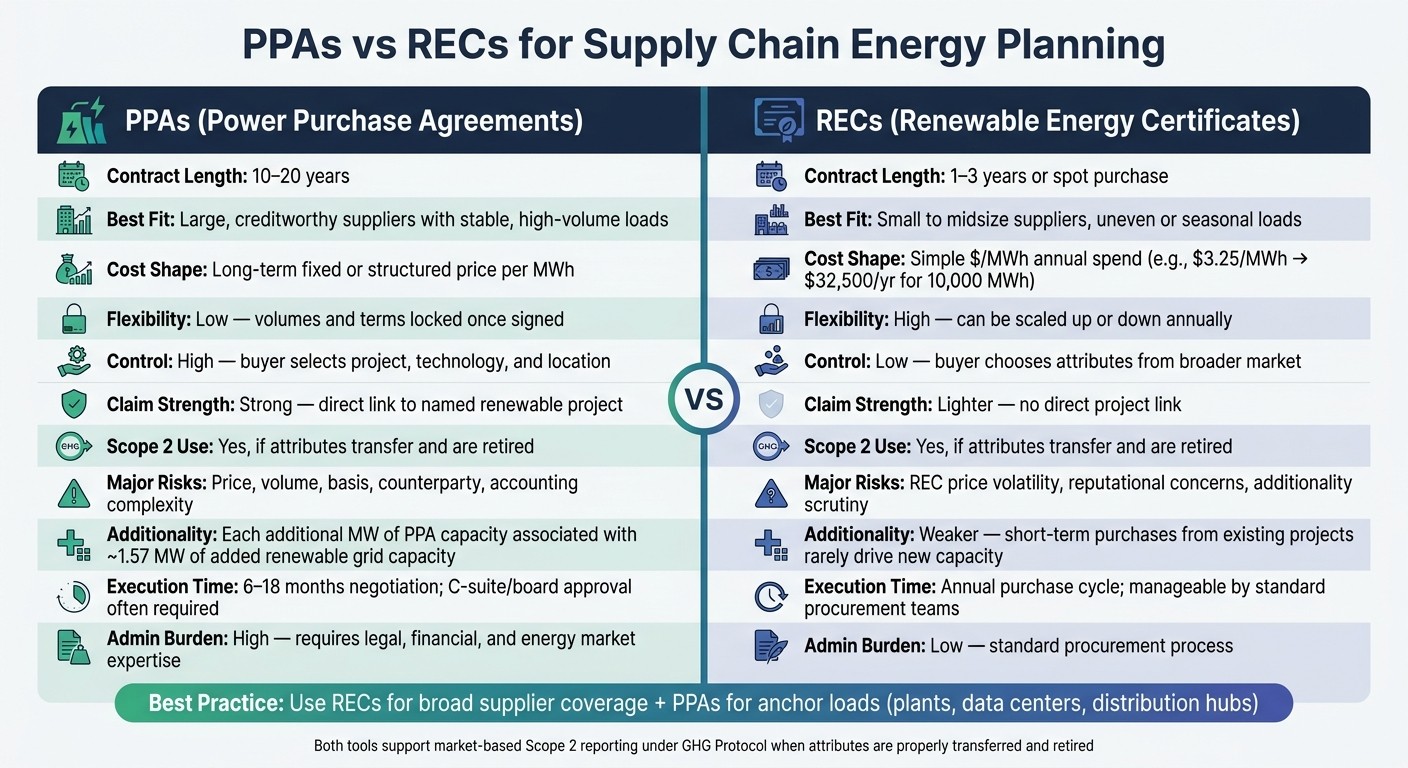
PPAs vs RECs for Supply Chain Energy Planning: Side-by-Side Comparison
What are long-term energy purchase contracts (PPAs)? | ACCIONA

Quick Comparison
Criteria | PPAs | RECs |
|---|---|---|
What I’m buying | Power from a named renewable project, usually with RECs | Renewable attributes only |
Typical term | 10–20 years | 1–3 years or spot |
Best fit | Large suppliers with steady demand | Smaller suppliers or uneven loads |
Scope 2 use | Yes, if attributes transfer and are retired | Yes, if attributes transfer and are retired |
Cost shape | Long-term fixed or structured price | Simple $/MWh yearly spend |
Main risks | Price, basis, volume, counterparty, accounting | Price swings and claim quality concerns |
Claim strength | Stronger project link | Lighter project link |
Ease of rollout | Lower | Higher |
A simple example shows the budget gap fast: at $3.25/MWh, 10,000 MWh of unbundled RECs costs about $32,500 per year. A PPA can do more than that on claim strength and project linkage, but it also asks for much more time, approval, and risk tolerance.
So if I’m building a supply chain energy plan, I would not force one tool on every supplier. I’d match the tool to the supplier’s load, credit, contract horizon, and reporting needs.
PPAs in supply chains: cost, control, accounting, and risk
For supply chains, the first PPA choice comes down to structure: physical or virtual.
PPAs come in two main forms. In a physical PPA, the buyer takes title to electricity from a specific renewable project at a set delivery point on the grid, and sometimes at the buyer's own facilities. In a VPPA, no physical electricity changes hands. Instead, the deal works as a financial contract: the renewable project sells electricity into the wholesale market, and the buyer settles the gap between a fixed strike price and the floating market price. The buyer usually receives the project's RECs on a separate track to support renewable claims.
That difference matters a lot for supply chains. Because VPPAs settle financially rather than through physical delivery, they tend to fit distributed supplier networks better. Both structures often last 10 to 20 years because developers need long-term revenue certainty to secure debt for new wind or solar projects. Still, direct access is limited. Only about 14% to 16% of industrial and commercial demand can take part in PPAs directly, mostly because credit and size thresholds are steep.[7]
For supply chains made up of dozens of smaller suppliers, that's a tough hurdle. It's one big reason aggregated PPA models have gained traction. In these setups, a lead corporate buyer anchors the contract, while smaller suppliers join through back-to-back deals or allocated shares. The structure shapes who gets in, how settlement works, and how much risk stays on the table.
Long-term pricing and project-level control
A PPA can lock in long-term price certainty, which helps reduce budget swings across a supply chain. But there’s no free lunch. If wholesale prices stay below the strike price for a long stretch, the buyer may end up making steady settlement payments to the project.
VPPAs bring another layer of exposure through basis risk. Put simply, the price at the project's physical location may not match the hub price used for settlement. Some contracts use floors, caps, or collars to limit that exposure, but they don't erase it.
Where PPAs stand apart from plain certificate buying is their direct tie to a specific project: its location, technology, capacity, and expected commercial operation date. That project-level link matters. When a buyer signs a long-term contract that helps make a project financeable, the additionality argument is much stronger. And that same structure shapes how the deal gets booked and disclosed.
Accounting treatment and execution requirements
Accounting can matter just as much as price, because the structure of a PPA changes how the contract shows up financially.
When RECs are properly conveyed and retired under a PPA, the covered electricity load can be reported with a zero emission factor for market-based Scope 2 accounting under the GHG Protocol.[2][5] The contract has to clearly transfer the environmental attributes to the buyer. If the developer sells the RECs to someone else, the buyer loses the right to make that claim.[4]
VPPAs often count as derivatives under ASC 815, which can trigger balance-sheet recognition and earnings volatility.[7] That’s a very different path from buying RECs, which are usually booked as a simple period expense.
Then there’s the execution load. PPA negotiations often take 6 to 18 months and call for specialized counsel.[7] On top of that, the long-term liability often means C-suite or board-level approval. For many suppliers, that burden alone can shut the door on direct participation. In a supply chain program trying to line up multiple suppliers with different risk appetites and credit profiles, the complexity stacks up fast.[7]
RECs in supply chains: flexibility, simplicity, and limits
If PPAs sit at the high-commitment end of the spectrum, RECs sit at the easier end. They come in two forms: bundled, sold with renewable electricity, and unbundled, sold apart from the power. When RECs are transferred and retired the right way, they support market-based Scope 2 reporting, and the covered load can be reported with a zero market-based emission factor.[9][10]
Lower commitment and easier supplier adoption
For small and midsize suppliers, unbundled RECs cut through many of the hurdles that make PPAs hard to pull off. There’s no long-term contract to sign, and buyers avoid most of the collateral and risk controls that usually come with a PPA. The pricing is also simple. It’s quoted as a cost per MWh, so a supplier can estimate added spend without much effort. At $3.25 per MWh, 10,000 MWh of unbundled RECs costs about $32,500 per year.[14]
That buying flexibility is a big part of the appeal. Suppliers can purchase on an annual basis, true up volumes at year-end, and reset the next year without going back to the table. For contract manufacturers, seasonal businesses, or any supplier whose electricity use moves with customer demand, that structure fits planning cycles of one to three years. Just as important, it avoids locking them into obligations that might outlast a customer relationship or a product line.
Claims quality, accounting, and weaker project influence
That ease can help with adoption, but the strength of the claim still depends on where and how the REC was sourced. Using RECs the right way for market-based Scope 2 reporting means paying attention to three quality factors:
Vintage: the year the renewable electricity was generated. Leading standards like Green-e Energy usually require RECs to match the reporting year or fall within a limited surrounding window.[11]
Geography: claims tend to be stronger when RECs come from the same market region as the load, such as the same NERC region or eGRID subregion.[15][16]
Certification: Green-e certification adds a check that RECs are tracked, retired, and not double-counted.[11]
Where RECs lose ground is project influence. Unbundled RECs bought on the voluntary market are mainly accounting instruments - they shift environmental attributes, but they rarely decide whether a new renewable project gets built.[1][9] A short-term REC purchase from an existing wind farm does not give a developer the long-term revenue needed to finance new capacity.[8][1][12][13] That’s the main gap compared with PPAs. It sets up the side-by-side comparison next.
PPAs vs. RECs: a direct comparison for supply chain decisions
The difference between PPAs and RECs comes down to one main trade-off: control versus flexibility. PPAs give buyers a direct link to a named renewable project, but they ask for a long commitment and stronger financial backing. RECs are much easier to use, but the claim is lighter and the effect on new project build-out is weaker.
For supply chain planning, that split matters in a very practical way. One path offers a tighter grip on where the clean power claim comes from. The other makes it far easier to bring more suppliers into the program without adding a lot of friction.
Dimension | PPAs | RECs |
|---|---|---|
Cost profile | Fixed or structured price per MWh over 10–25 years; can hedge against power price swings | Transactional cost per MWh certificate; annual operating expense on top of utility bills |
Contract length | Typically 10–20 years | Usually 1–3 years; can also be bought spot |
Flexibility | Low; volumes and terms are largely locked once signed | High; can be scaled up or down annually |
Control | High; buyer selects project, technology, and location | Low; buyer chooses attributes from the broader market |
Accounting use | Supports market-based Scope 2 via bundled RECs; may trigger derivative or hedge accounting | Primary tool for market-based Scope 2; generally treated as a procurement expense |
Supplier fit | Large, creditworthy tier-1 suppliers with stable, high-volume loads | Small to midsize suppliers across the supply chain |
Major risks | Price, volume, basis, counterparty, and hedge accounting risk | REC price volatility, reputational concerns, and additionality scrutiny |
Cost, contract length, and financial exposure
A PPA works a lot like a long-term fixed-price power deal. The buyer locks in a renewable power price for 10 to 20 years, which can steady part of its electricity cost base. That can look attractive when power markets swing. But there’s a catch: if wholesale prices drop below the strike price, the buyer can end up paying above market. That’s why finance teams usually need to think through mark-to-market effects, stress testing, and credit review before signing.[17][20][23]
RECs are much simpler on the budget side. A supplier keeps buying electricity from its local utility, then buys certificates to match some or all of that power use. In practice, that makes RECs feel more like an annual operating expense than a long-dated financial commitment. The main exposure is the REC price itself, and that yearly buying cycle lines up neatly with how many U.S. companies set budgets.[18][19]
Control, emissions reporting, and supplier fit
Under the GHG Protocol’s market-based method, both PPAs and RECs can bring Scope 2 emissions close to zero when the certificates are properly matched to electricity use and retired.[19][8] That part is often missed in day-to-day discussions: both tools can work for reporting. The bigger issue is how strong the claim feels once someone asks, What did this purchase actually support?
A PPA gives a much tighter answer. It ties the buyer to a named project and can spell out the technology, location, and in some cases whether the contract likely helped make new capacity pencil out.[17][22] Research also points to PPAs having more measurable influence on total U.S. renewable generation capacity than unbundled RECs.[3]
Standalone RECs transfer the environmental attributes on paper, but short-term purchases from existing projects usually do less to support added capacity. That still makes them useful for market-based reporting. It just makes them less convincing for stakeholders who want to see a clearer line between the purchase and physical project build-out.
In many cases, supplier size and geography settle the issue before the team even gets deep into the numbers. PPAs often call for investment-grade credit or a parent guarantee, so they fit best with large, creditworthy tier-1 suppliers that have stable and heavy electricity demand. RECs are easier for small and midsize suppliers to adopt, which is why they remain the more workable option for broad supply chain participation.[18][22][12]
Risk profile and execution complexity
PPAs bring more moving parts, and that means more ways things can go sideways. Price risk is usually the first issue people spot: if market prices fall below the agreed strike price, the buyer covers the gap. Then there’s volume risk, since renewable output changes with weather and facility demand can move over time. Basis risk also matters because the project-node price may not line up with the buyer’s consumption market. On top of that, both sides carry counterparty risk, and the long contract term can create accounting headaches.[17][20][21][23]
Risk Dimension | PPAs | RECs |
|---|---|---|
Price risk | High; exposed to long-term power price and basis movements | Moderate; REC prices can fluctuate |
Volume/load risk | Significant; mismatch between project output and facility load | Low; purchases can be adjusted as needed |
Counterparty/credit risk | High; long-term exposure to project developer and buyer solvency | Low; transactional nature limits long-term exposure |
Accounting complexity | High; potential derivative and hedge accounting treatment | Low; standard procurement expense |
Admin burden | High; requires legal, financial, and energy market expertise | Low; manageable by standard procurement teams |
RECs carry a much lighter risk profile. The big issues are REC price swings - which can get sharp in compliance markets or when policy changes hit - and reputational or additionality concerns if buyers are seen as choosing low-impact certificates.[6][8] They do not call for the same standing risk-management setup that a PPA usually does. For most supply chain players, that ease of use is exactly why RECs stay in the mix.
When each option fits and how to build a hybrid plan
Use the comparison above to group suppliers by load, credit, and execution capacity. That keeps the plan grounded in what each supplier can actually handle, instead of forcing one tool across the whole network.
When PPAs are the better fit
PPAs work best for anchor loads such as major distribution centers, data centers, and high-volume plants with strong credit and the ability to carry a more involved contract. They also make more sense when project-level additionality is a priority. If that matters to your program, PPAs do a better job of supporting new renewable build-out. Research shows that each additional megawatt of non-utility corporate PPA capacity is associated with roughly 1.57 MW of added renewable capacity on the grid.[3]
When RECs are the better fit
RECs make more sense for smaller suppliers, uneven loads, and regions where PPAs just aren't workable. In many cases, RECs are the only near-term path available. They can also serve as a practical bridge while longer-horizon options, such as aggregated PPAs and on-site generation, are still being put in place.[24][25]
Conclusion: a practical framework for supply chain energy planning
Most supply chains should not rely on one instrument for every supplier. A more workable approach is to use RECs first for broad coverage, then layer in PPAs for anchor loads.
What makes the difference isn't just the instrument. It's governance. Plans tend to stall when ownership is fuzzy or rules change from team to team. A cross-functional steering group with clear decision rights helps keep the work moving. Standardized policies on REC quality - vintage, geographic matching, and registry requirements - set a common bar. A chain-of-custody process helps prevent double-counting between the company and its suppliers.[26][27]
FAQs
How do I choose between a PPA and RECs for each supplier?
Choose based on each supplier’s energy use, market access, and impact goals.
For large suppliers using more than 50 GWh each year, PPAs tend to be the better fit. They offer price stability, support long-term hedging, and can help finance new renewable power capacity. For smaller suppliers, or for those in regions where PPA access is limited, unbundled RECs are usually the more practical path for market-based Scope 2 claims.
Many organizations use both, matching the tool to the supplier and the market rather than forcing a one-size-fits-all approach.
Can PPAs and RECs both count toward Scope 2 reporting?
Yes. Both power purchase agreements and renewable energy certificates can count toward Scope 2 reporting under the Greenhouse Gas Protocol.
They support market-based accounting, which reflects a company’s electricity buying choices rather than average grid emissions. In plain terms, this method looks at what a company chose to buy, not just what came from the local grid. PPAs include the transfer of RECs, and companies still need to report both location-based and market-based Scope 2 figures.
What makes a hybrid PPA and REC strategy work?
A strong hybrid strategy puts PPAs at the center and uses RECs to close the gaps. In most cases, PPAs cover 60% to 80% of electricity use. That gives organizations long-term price stability, backs new-build projects, and supports strong market-based Scope 2 claims.
RECs play a different role. They can cover smaller sites, regions where PPA access is limited, or periods when PPA generation doesn’t line up with demand. Over time, the goal should be clear: move toward more PPAs and rely less on unbundled RECs.
Related Blog Posts
Latest Articles
©2025

Narrative Change and Power Building: The Missing Half of Advocacy
Narrative change is the process of disrupting dominant narratives that normalize inequity and advancing new narratives from historically marginalized communities.

Funding Resilience Without Federal Grants
BRIC is unreliable and FEMA is shrinking. Here's how cities fund climate resilience with dedicated revenue, blended finance, and a coordinating authority.

The ESG Blind Spot: How AI Is Finding Risks in Companies Nobody Else Is Watching
Norway's sovereign wealth fund uses AI to screen 7,200 portfolio companies for forced labor and corruption within 24 hours. The real story is the emerging-market coverage gap that traditional ESG data vendors miss — and what it means for any company with a global supply chain.
Narrative Change and Power Building: The Missing Half of Advocacy
Narrative change is the process of disrupting dominant narratives that normalize inequity and advancing new narratives from historically marginalized communities.
Funding Resilience Without Federal Grants
BRIC is unreliable and FEMA is shrinking. Here's how cities fund climate resilience with dedicated revenue, blended finance, and a coordinating authority.
The ESG Blind Spot: How AI Is Finding Risks in Companies Nobody Else Is Watching
Norway's sovereign wealth fund uses AI to screen 7,200 portfolio companies for forced labor and corruption within 24 hours. The real story is the emerging-market coverage gap that traditional ESG data vendors miss — and what it means for any company with a global supply chain.
FAQ
01
What does it really mean to “redefine profit”?
02
What makes Council Fire different?
03
Who does Council Fire work with?
04
What does working with Council Fire actually look like?
05
How does Council Fire help organizations turn big goals into action?
06
How does Council Fire define and measure success?
Aug 1, 2026
PPAs vs RECs for Supply Chain Energy Plans
Sustainability Strategy
In This Article
Use RECs to cover many suppliers and PPAs for large, steady loads—balance control vs. flexibility in supply chain energy plans.
PPAs vs RECs for Supply Chain Energy Plans
If I need one simple answer, it’s this: I’d use RECs for broad supplier coverage and PPAs for large, steady loads where a long contract and project tie make sense.
Both tools can support market-based Scope 2 reporting when the renewable attributes are transferred and retired the right way. The split is simple: PPAs buy power from a named project, usually with the RECs attached; RECs buy the claim only. That choice affects cost, contract length, accounting, risk, supplier access, and how strong the clean power claim looks.
Here’s the short version:
PPAs
Usually run 10–20 years
Fit large, creditworthy suppliers
Offer more project control
Bring more price, basis, volume, and accounting risk
Can make a stronger case that the deal helped new wind or solar get built
RECs
Can be bought annually or spot
Fit small and midsize suppliers
Are easier to budget and roll out
Work for market-based Scope 2 if matched and retired correctly
Do less to shape new project build-out, especially when bought short term from existing projects
What I’d do in a supply chain plan
Start with REC rules for broad participation
Add PPAs for anchor sites like plants, data centers, and large distribution hubs
Set clear rules for vintage, geography, certification, and chain of custody
The main trade-off is clear: PPAs give more control, while RECs give more flexibility.
PPAs vs RECs for Supply Chain Energy Planning: Side-by-Side Comparison
What are long-term energy purchase contracts (PPAs)? | ACCIONA
Quick Comparison
Criteria | PPAs | RECs |
|---|---|---|
What I’m buying | Power from a named renewable project, usually with RECs | Renewable attributes only |
Typical term | 10–20 years | 1–3 years or spot |
Best fit | Large suppliers with steady demand | Smaller suppliers or uneven loads |
Scope 2 use | Yes, if attributes transfer and are retired | Yes, if attributes transfer and are retired |
Cost shape | Long-term fixed or structured price | Simple $/MWh yearly spend |
Main risks | Price, basis, volume, counterparty, accounting | Price swings and claim quality concerns |
Claim strength | Stronger project link | Lighter project link |
Ease of rollout | Lower | Higher |
A simple example shows the budget gap fast: at $3.25/MWh, 10,000 MWh of unbundled RECs costs about $32,500 per year. A PPA can do more than that on claim strength and project linkage, but it also asks for much more time, approval, and risk tolerance.
So if I’m building a supply chain energy plan, I would not force one tool on every supplier. I’d match the tool to the supplier’s load, credit, contract horizon, and reporting needs.
PPAs in supply chains: cost, control, accounting, and risk
For supply chains, the first PPA choice comes down to structure: physical or virtual.
PPAs come in two main forms. In a physical PPA, the buyer takes title to electricity from a specific renewable project at a set delivery point on the grid, and sometimes at the buyer's own facilities. In a VPPA, no physical electricity changes hands. Instead, the deal works as a financial contract: the renewable project sells electricity into the wholesale market, and the buyer settles the gap between a fixed strike price and the floating market price. The buyer usually receives the project's RECs on a separate track to support renewable claims.
That difference matters a lot for supply chains. Because VPPAs settle financially rather than through physical delivery, they tend to fit distributed supplier networks better. Both structures often last 10 to 20 years because developers need long-term revenue certainty to secure debt for new wind or solar projects. Still, direct access is limited. Only about 14% to 16% of industrial and commercial demand can take part in PPAs directly, mostly because credit and size thresholds are steep.[7]
For supply chains made up of dozens of smaller suppliers, that's a tough hurdle. It's one big reason aggregated PPA models have gained traction. In these setups, a lead corporate buyer anchors the contract, while smaller suppliers join through back-to-back deals or allocated shares. The structure shapes who gets in, how settlement works, and how much risk stays on the table.
Long-term pricing and project-level control
A PPA can lock in long-term price certainty, which helps reduce budget swings across a supply chain. But there’s no free lunch. If wholesale prices stay below the strike price for a long stretch, the buyer may end up making steady settlement payments to the project.
VPPAs bring another layer of exposure through basis risk. Put simply, the price at the project's physical location may not match the hub price used for settlement. Some contracts use floors, caps, or collars to limit that exposure, but they don't erase it.
Where PPAs stand apart from plain certificate buying is their direct tie to a specific project: its location, technology, capacity, and expected commercial operation date. That project-level link matters. When a buyer signs a long-term contract that helps make a project financeable, the additionality argument is much stronger. And that same structure shapes how the deal gets booked and disclosed.
Accounting treatment and execution requirements
Accounting can matter just as much as price, because the structure of a PPA changes how the contract shows up financially.
When RECs are properly conveyed and retired under a PPA, the covered electricity load can be reported with a zero emission factor for market-based Scope 2 accounting under the GHG Protocol.[2][5] The contract has to clearly transfer the environmental attributes to the buyer. If the developer sells the RECs to someone else, the buyer loses the right to make that claim.[4]
VPPAs often count as derivatives under ASC 815, which can trigger balance-sheet recognition and earnings volatility.[7] That’s a very different path from buying RECs, which are usually booked as a simple period expense.
Then there’s the execution load. PPA negotiations often take 6 to 18 months and call for specialized counsel.[7] On top of that, the long-term liability often means C-suite or board-level approval. For many suppliers, that burden alone can shut the door on direct participation. In a supply chain program trying to line up multiple suppliers with different risk appetites and credit profiles, the complexity stacks up fast.[7]
RECs in supply chains: flexibility, simplicity, and limits
If PPAs sit at the high-commitment end of the spectrum, RECs sit at the easier end. They come in two forms: bundled, sold with renewable electricity, and unbundled, sold apart from the power. When RECs are transferred and retired the right way, they support market-based Scope 2 reporting, and the covered load can be reported with a zero market-based emission factor.[9][10]
Lower commitment and easier supplier adoption
For small and midsize suppliers, unbundled RECs cut through many of the hurdles that make PPAs hard to pull off. There’s no long-term contract to sign, and buyers avoid most of the collateral and risk controls that usually come with a PPA. The pricing is also simple. It’s quoted as a cost per MWh, so a supplier can estimate added spend without much effort. At $3.25 per MWh, 10,000 MWh of unbundled RECs costs about $32,500 per year.[14]
That buying flexibility is a big part of the appeal. Suppliers can purchase on an annual basis, true up volumes at year-end, and reset the next year without going back to the table. For contract manufacturers, seasonal businesses, or any supplier whose electricity use moves with customer demand, that structure fits planning cycles of one to three years. Just as important, it avoids locking them into obligations that might outlast a customer relationship or a product line.
Claims quality, accounting, and weaker project influence
That ease can help with adoption, but the strength of the claim still depends on where and how the REC was sourced. Using RECs the right way for market-based Scope 2 reporting means paying attention to three quality factors:
Vintage: the year the renewable electricity was generated. Leading standards like Green-e Energy usually require RECs to match the reporting year or fall within a limited surrounding window.[11]
Geography: claims tend to be stronger when RECs come from the same market region as the load, such as the same NERC region or eGRID subregion.[15][16]
Certification: Green-e certification adds a check that RECs are tracked, retired, and not double-counted.[11]
Where RECs lose ground is project influence. Unbundled RECs bought on the voluntary market are mainly accounting instruments - they shift environmental attributes, but they rarely decide whether a new renewable project gets built.[1][9] A short-term REC purchase from an existing wind farm does not give a developer the long-term revenue needed to finance new capacity.[8][1][12][13] That’s the main gap compared with PPAs. It sets up the side-by-side comparison next.
PPAs vs. RECs: a direct comparison for supply chain decisions
The difference between PPAs and RECs comes down to one main trade-off: control versus flexibility. PPAs give buyers a direct link to a named renewable project, but they ask for a long commitment and stronger financial backing. RECs are much easier to use, but the claim is lighter and the effect on new project build-out is weaker.
For supply chain planning, that split matters in a very practical way. One path offers a tighter grip on where the clean power claim comes from. The other makes it far easier to bring more suppliers into the program without adding a lot of friction.
Dimension | PPAs | RECs |
|---|---|---|
Cost profile | Fixed or structured price per MWh over 10–25 years; can hedge against power price swings | Transactional cost per MWh certificate; annual operating expense on top of utility bills |
Contract length | Typically 10–20 years | Usually 1–3 years; can also be bought spot |
Flexibility | Low; volumes and terms are largely locked once signed | High; can be scaled up or down annually |
Control | High; buyer selects project, technology, and location | Low; buyer chooses attributes from the broader market |
Accounting use | Supports market-based Scope 2 via bundled RECs; may trigger derivative or hedge accounting | Primary tool for market-based Scope 2; generally treated as a procurement expense |
Supplier fit | Large, creditworthy tier-1 suppliers with stable, high-volume loads | Small to midsize suppliers across the supply chain |
Major risks | Price, volume, basis, counterparty, and hedge accounting risk | REC price volatility, reputational concerns, and additionality scrutiny |
Cost, contract length, and financial exposure
A PPA works a lot like a long-term fixed-price power deal. The buyer locks in a renewable power price for 10 to 20 years, which can steady part of its electricity cost base. That can look attractive when power markets swing. But there’s a catch: if wholesale prices drop below the strike price, the buyer can end up paying above market. That’s why finance teams usually need to think through mark-to-market effects, stress testing, and credit review before signing.[17][20][23]
RECs are much simpler on the budget side. A supplier keeps buying electricity from its local utility, then buys certificates to match some or all of that power use. In practice, that makes RECs feel more like an annual operating expense than a long-dated financial commitment. The main exposure is the REC price itself, and that yearly buying cycle lines up neatly with how many U.S. companies set budgets.[18][19]
Control, emissions reporting, and supplier fit
Under the GHG Protocol’s market-based method, both PPAs and RECs can bring Scope 2 emissions close to zero when the certificates are properly matched to electricity use and retired.[19][8] That part is often missed in day-to-day discussions: both tools can work for reporting. The bigger issue is how strong the claim feels once someone asks, What did this purchase actually support?
A PPA gives a much tighter answer. It ties the buyer to a named project and can spell out the technology, location, and in some cases whether the contract likely helped make new capacity pencil out.[17][22] Research also points to PPAs having more measurable influence on total U.S. renewable generation capacity than unbundled RECs.[3]
Standalone RECs transfer the environmental attributes on paper, but short-term purchases from existing projects usually do less to support added capacity. That still makes them useful for market-based reporting. It just makes them less convincing for stakeholders who want to see a clearer line between the purchase and physical project build-out.
In many cases, supplier size and geography settle the issue before the team even gets deep into the numbers. PPAs often call for investment-grade credit or a parent guarantee, so they fit best with large, creditworthy tier-1 suppliers that have stable and heavy electricity demand. RECs are easier for small and midsize suppliers to adopt, which is why they remain the more workable option for broad supply chain participation.[18][22][12]
Risk profile and execution complexity
PPAs bring more moving parts, and that means more ways things can go sideways. Price risk is usually the first issue people spot: if market prices fall below the agreed strike price, the buyer covers the gap. Then there’s volume risk, since renewable output changes with weather and facility demand can move over time. Basis risk also matters because the project-node price may not line up with the buyer’s consumption market. On top of that, both sides carry counterparty risk, and the long contract term can create accounting headaches.[17][20][21][23]
Risk Dimension | PPAs | RECs |
|---|---|---|
Price risk | High; exposed to long-term power price and basis movements | Moderate; REC prices can fluctuate |
Volume/load risk | Significant; mismatch between project output and facility load | Low; purchases can be adjusted as needed |
Counterparty/credit risk | High; long-term exposure to project developer and buyer solvency | Low; transactional nature limits long-term exposure |
Accounting complexity | High; potential derivative and hedge accounting treatment | Low; standard procurement expense |
Admin burden | High; requires legal, financial, and energy market expertise | Low; manageable by standard procurement teams |
RECs carry a much lighter risk profile. The big issues are REC price swings - which can get sharp in compliance markets or when policy changes hit - and reputational or additionality concerns if buyers are seen as choosing low-impact certificates.[6][8] They do not call for the same standing risk-management setup that a PPA usually does. For most supply chain players, that ease of use is exactly why RECs stay in the mix.
When each option fits and how to build a hybrid plan
Use the comparison above to group suppliers by load, credit, and execution capacity. That keeps the plan grounded in what each supplier can actually handle, instead of forcing one tool across the whole network.
When PPAs are the better fit
PPAs work best for anchor loads such as major distribution centers, data centers, and high-volume plants with strong credit and the ability to carry a more involved contract. They also make more sense when project-level additionality is a priority. If that matters to your program, PPAs do a better job of supporting new renewable build-out. Research shows that each additional megawatt of non-utility corporate PPA capacity is associated with roughly 1.57 MW of added renewable capacity on the grid.[3]
When RECs are the better fit
RECs make more sense for smaller suppliers, uneven loads, and regions where PPAs just aren't workable. In many cases, RECs are the only near-term path available. They can also serve as a practical bridge while longer-horizon options, such as aggregated PPAs and on-site generation, are still being put in place.[24][25]
Conclusion: a practical framework for supply chain energy planning
Most supply chains should not rely on one instrument for every supplier. A more workable approach is to use RECs first for broad coverage, then layer in PPAs for anchor loads.
What makes the difference isn't just the instrument. It's governance. Plans tend to stall when ownership is fuzzy or rules change from team to team. A cross-functional steering group with clear decision rights helps keep the work moving. Standardized policies on REC quality - vintage, geographic matching, and registry requirements - set a common bar. A chain-of-custody process helps prevent double-counting between the company and its suppliers.[26][27]
FAQs
How do I choose between a PPA and RECs for each supplier?
Choose based on each supplier’s energy use, market access, and impact goals.
For large suppliers using more than 50 GWh each year, PPAs tend to be the better fit. They offer price stability, support long-term hedging, and can help finance new renewable power capacity. For smaller suppliers, or for those in regions where PPA access is limited, unbundled RECs are usually the more practical path for market-based Scope 2 claims.
Many organizations use both, matching the tool to the supplier and the market rather than forcing a one-size-fits-all approach.
Can PPAs and RECs both count toward Scope 2 reporting?
Yes. Both power purchase agreements and renewable energy certificates can count toward Scope 2 reporting under the Greenhouse Gas Protocol.
They support market-based accounting, which reflects a company’s electricity buying choices rather than average grid emissions. In plain terms, this method looks at what a company chose to buy, not just what came from the local grid. PPAs include the transfer of RECs, and companies still need to report both location-based and market-based Scope 2 figures.
What makes a hybrid PPA and REC strategy work?
A strong hybrid strategy puts PPAs at the center and uses RECs to close the gaps. In most cases, PPAs cover 60% to 80% of electricity use. That gives organizations long-term price stability, backs new-build projects, and supports strong market-based Scope 2 claims.
RECs play a different role. They can cover smaller sites, regions where PPA access is limited, or periods when PPA generation doesn’t line up with demand. Over time, the goal should be clear: move toward more PPAs and rely less on unbundled RECs.
Related Blog Posts
Latest Articles
©2025
Narrative Change and Power Building: The Missing Half of Advocacy
Narrative change is the process of disrupting dominant narratives that normalize inequity and advancing new narratives from historically marginalized communities.
Funding Resilience Without Federal Grants
BRIC is unreliable and FEMA is shrinking. Here's how cities fund climate resilience with dedicated revenue, blended finance, and a coordinating authority.
The ESG Blind Spot: How AI Is Finding Risks in Companies Nobody Else Is Watching
Norway's sovereign wealth fund uses AI to screen 7,200 portfolio companies for forced labor and corruption within 24 hours. The real story is the emerging-market coverage gap that traditional ESG data vendors miss — and what it means for any company with a global supply chain.
FAQ
01
What does it really mean to “redefine profit”?
02
What makes Council Fire different?
03
Who does Council Fire work with?
04
What does working with Council Fire actually look like?
05
How does Council Fire help organizations turn big goals into action?
06
How does Council Fire define and measure success?
Aug 1, 2026
PPAs vs RECs for Supply Chain Energy Plans
Sustainability Strategy
In This Article
Use RECs to cover many suppliers and PPAs for large, steady loads—balance control vs. flexibility in supply chain energy plans.
PPAs vs RECs for Supply Chain Energy Plans
If I need one simple answer, it’s this: I’d use RECs for broad supplier coverage and PPAs for large, steady loads where a long contract and project tie make sense.
Both tools can support market-based Scope 2 reporting when the renewable attributes are transferred and retired the right way. The split is simple: PPAs buy power from a named project, usually with the RECs attached; RECs buy the claim only. That choice affects cost, contract length, accounting, risk, supplier access, and how strong the clean power claim looks.
Here’s the short version:
PPAs
Usually run 10–20 years
Fit large, creditworthy suppliers
Offer more project control
Bring more price, basis, volume, and accounting risk
Can make a stronger case that the deal helped new wind or solar get built
RECs
Can be bought annually or spot
Fit small and midsize suppliers
Are easier to budget and roll out
Work for market-based Scope 2 if matched and retired correctly
Do less to shape new project build-out, especially when bought short term from existing projects
What I’d do in a supply chain plan
Start with REC rules for broad participation
Add PPAs for anchor sites like plants, data centers, and large distribution hubs
Set clear rules for vintage, geography, certification, and chain of custody
The main trade-off is clear: PPAs give more control, while RECs give more flexibility.
PPAs vs RECs for Supply Chain Energy Planning: Side-by-Side Comparison
What are long-term energy purchase contracts (PPAs)? | ACCIONA
Quick Comparison
Criteria | PPAs | RECs |
|---|---|---|
What I’m buying | Power from a named renewable project, usually with RECs | Renewable attributes only |
Typical term | 10–20 years | 1–3 years or spot |
Best fit | Large suppliers with steady demand | Smaller suppliers or uneven loads |
Scope 2 use | Yes, if attributes transfer and are retired | Yes, if attributes transfer and are retired |
Cost shape | Long-term fixed or structured price | Simple $/MWh yearly spend |
Main risks | Price, basis, volume, counterparty, accounting | Price swings and claim quality concerns |
Claim strength | Stronger project link | Lighter project link |
Ease of rollout | Lower | Higher |
A simple example shows the budget gap fast: at $3.25/MWh, 10,000 MWh of unbundled RECs costs about $32,500 per year. A PPA can do more than that on claim strength and project linkage, but it also asks for much more time, approval, and risk tolerance.
So if I’m building a supply chain energy plan, I would not force one tool on every supplier. I’d match the tool to the supplier’s load, credit, contract horizon, and reporting needs.
PPAs in supply chains: cost, control, accounting, and risk
For supply chains, the first PPA choice comes down to structure: physical or virtual.
PPAs come in two main forms. In a physical PPA, the buyer takes title to electricity from a specific renewable project at a set delivery point on the grid, and sometimes at the buyer's own facilities. In a VPPA, no physical electricity changes hands. Instead, the deal works as a financial contract: the renewable project sells electricity into the wholesale market, and the buyer settles the gap between a fixed strike price and the floating market price. The buyer usually receives the project's RECs on a separate track to support renewable claims.
That difference matters a lot for supply chains. Because VPPAs settle financially rather than through physical delivery, they tend to fit distributed supplier networks better. Both structures often last 10 to 20 years because developers need long-term revenue certainty to secure debt for new wind or solar projects. Still, direct access is limited. Only about 14% to 16% of industrial and commercial demand can take part in PPAs directly, mostly because credit and size thresholds are steep.[7]
For supply chains made up of dozens of smaller suppliers, that's a tough hurdle. It's one big reason aggregated PPA models have gained traction. In these setups, a lead corporate buyer anchors the contract, while smaller suppliers join through back-to-back deals or allocated shares. The structure shapes who gets in, how settlement works, and how much risk stays on the table.
Long-term pricing and project-level control
A PPA can lock in long-term price certainty, which helps reduce budget swings across a supply chain. But there’s no free lunch. If wholesale prices stay below the strike price for a long stretch, the buyer may end up making steady settlement payments to the project.
VPPAs bring another layer of exposure through basis risk. Put simply, the price at the project's physical location may not match the hub price used for settlement. Some contracts use floors, caps, or collars to limit that exposure, but they don't erase it.
Where PPAs stand apart from plain certificate buying is their direct tie to a specific project: its location, technology, capacity, and expected commercial operation date. That project-level link matters. When a buyer signs a long-term contract that helps make a project financeable, the additionality argument is much stronger. And that same structure shapes how the deal gets booked and disclosed.
Accounting treatment and execution requirements
Accounting can matter just as much as price, because the structure of a PPA changes how the contract shows up financially.
When RECs are properly conveyed and retired under a PPA, the covered electricity load can be reported with a zero emission factor for market-based Scope 2 accounting under the GHG Protocol.[2][5] The contract has to clearly transfer the environmental attributes to the buyer. If the developer sells the RECs to someone else, the buyer loses the right to make that claim.[4]
VPPAs often count as derivatives under ASC 815, which can trigger balance-sheet recognition and earnings volatility.[7] That’s a very different path from buying RECs, which are usually booked as a simple period expense.
Then there’s the execution load. PPA negotiations often take 6 to 18 months and call for specialized counsel.[7] On top of that, the long-term liability often means C-suite or board-level approval. For many suppliers, that burden alone can shut the door on direct participation. In a supply chain program trying to line up multiple suppliers with different risk appetites and credit profiles, the complexity stacks up fast.[7]
RECs in supply chains: flexibility, simplicity, and limits
If PPAs sit at the high-commitment end of the spectrum, RECs sit at the easier end. They come in two forms: bundled, sold with renewable electricity, and unbundled, sold apart from the power. When RECs are transferred and retired the right way, they support market-based Scope 2 reporting, and the covered load can be reported with a zero market-based emission factor.[9][10]
Lower commitment and easier supplier adoption
For small and midsize suppliers, unbundled RECs cut through many of the hurdles that make PPAs hard to pull off. There’s no long-term contract to sign, and buyers avoid most of the collateral and risk controls that usually come with a PPA. The pricing is also simple. It’s quoted as a cost per MWh, so a supplier can estimate added spend without much effort. At $3.25 per MWh, 10,000 MWh of unbundled RECs costs about $32,500 per year.[14]
That buying flexibility is a big part of the appeal. Suppliers can purchase on an annual basis, true up volumes at year-end, and reset the next year without going back to the table. For contract manufacturers, seasonal businesses, or any supplier whose electricity use moves with customer demand, that structure fits planning cycles of one to three years. Just as important, it avoids locking them into obligations that might outlast a customer relationship or a product line.
Claims quality, accounting, and weaker project influence
That ease can help with adoption, but the strength of the claim still depends on where and how the REC was sourced. Using RECs the right way for market-based Scope 2 reporting means paying attention to three quality factors:
Vintage: the year the renewable electricity was generated. Leading standards like Green-e Energy usually require RECs to match the reporting year or fall within a limited surrounding window.[11]
Geography: claims tend to be stronger when RECs come from the same market region as the load, such as the same NERC region or eGRID subregion.[15][16]
Certification: Green-e certification adds a check that RECs are tracked, retired, and not double-counted.[11]
Where RECs lose ground is project influence. Unbundled RECs bought on the voluntary market are mainly accounting instruments - they shift environmental attributes, but they rarely decide whether a new renewable project gets built.[1][9] A short-term REC purchase from an existing wind farm does not give a developer the long-term revenue needed to finance new capacity.[8][1][12][13] That’s the main gap compared with PPAs. It sets up the side-by-side comparison next.
PPAs vs. RECs: a direct comparison for supply chain decisions
The difference between PPAs and RECs comes down to one main trade-off: control versus flexibility. PPAs give buyers a direct link to a named renewable project, but they ask for a long commitment and stronger financial backing. RECs are much easier to use, but the claim is lighter and the effect on new project build-out is weaker.
For supply chain planning, that split matters in a very practical way. One path offers a tighter grip on where the clean power claim comes from. The other makes it far easier to bring more suppliers into the program without adding a lot of friction.
Dimension | PPAs | RECs |
|---|---|---|
Cost profile | Fixed or structured price per MWh over 10–25 years; can hedge against power price swings | Transactional cost per MWh certificate; annual operating expense on top of utility bills |
Contract length | Typically 10–20 years | Usually 1–3 years; can also be bought spot |
Flexibility | Low; volumes and terms are largely locked once signed | High; can be scaled up or down annually |
Control | High; buyer selects project, technology, and location | Low; buyer chooses attributes from the broader market |
Accounting use | Supports market-based Scope 2 via bundled RECs; may trigger derivative or hedge accounting | Primary tool for market-based Scope 2; generally treated as a procurement expense |
Supplier fit | Large, creditworthy tier-1 suppliers with stable, high-volume loads | Small to midsize suppliers across the supply chain |
Major risks | Price, volume, basis, counterparty, and hedge accounting risk | REC price volatility, reputational concerns, and additionality scrutiny |
Cost, contract length, and financial exposure
A PPA works a lot like a long-term fixed-price power deal. The buyer locks in a renewable power price for 10 to 20 years, which can steady part of its electricity cost base. That can look attractive when power markets swing. But there’s a catch: if wholesale prices drop below the strike price, the buyer can end up paying above market. That’s why finance teams usually need to think through mark-to-market effects, stress testing, and credit review before signing.[17][20][23]
RECs are much simpler on the budget side. A supplier keeps buying electricity from its local utility, then buys certificates to match some or all of that power use. In practice, that makes RECs feel more like an annual operating expense than a long-dated financial commitment. The main exposure is the REC price itself, and that yearly buying cycle lines up neatly with how many U.S. companies set budgets.[18][19]
Control, emissions reporting, and supplier fit
Under the GHG Protocol’s market-based method, both PPAs and RECs can bring Scope 2 emissions close to zero when the certificates are properly matched to electricity use and retired.[19][8] That part is often missed in day-to-day discussions: both tools can work for reporting. The bigger issue is how strong the claim feels once someone asks, What did this purchase actually support?
A PPA gives a much tighter answer. It ties the buyer to a named project and can spell out the technology, location, and in some cases whether the contract likely helped make new capacity pencil out.[17][22] Research also points to PPAs having more measurable influence on total U.S. renewable generation capacity than unbundled RECs.[3]
Standalone RECs transfer the environmental attributes on paper, but short-term purchases from existing projects usually do less to support added capacity. That still makes them useful for market-based reporting. It just makes them less convincing for stakeholders who want to see a clearer line between the purchase and physical project build-out.
In many cases, supplier size and geography settle the issue before the team even gets deep into the numbers. PPAs often call for investment-grade credit or a parent guarantee, so they fit best with large, creditworthy tier-1 suppliers that have stable and heavy electricity demand. RECs are easier for small and midsize suppliers to adopt, which is why they remain the more workable option for broad supply chain participation.[18][22][12]
Risk profile and execution complexity
PPAs bring more moving parts, and that means more ways things can go sideways. Price risk is usually the first issue people spot: if market prices fall below the agreed strike price, the buyer covers the gap. Then there’s volume risk, since renewable output changes with weather and facility demand can move over time. Basis risk also matters because the project-node price may not line up with the buyer’s consumption market. On top of that, both sides carry counterparty risk, and the long contract term can create accounting headaches.[17][20][21][23]
Risk Dimension | PPAs | RECs |
|---|---|---|
Price risk | High; exposed to long-term power price and basis movements | Moderate; REC prices can fluctuate |
Volume/load risk | Significant; mismatch between project output and facility load | Low; purchases can be adjusted as needed |
Counterparty/credit risk | High; long-term exposure to project developer and buyer solvency | Low; transactional nature limits long-term exposure |
Accounting complexity | High; potential derivative and hedge accounting treatment | Low; standard procurement expense |
Admin burden | High; requires legal, financial, and energy market expertise | Low; manageable by standard procurement teams |
RECs carry a much lighter risk profile. The big issues are REC price swings - which can get sharp in compliance markets or when policy changes hit - and reputational or additionality concerns if buyers are seen as choosing low-impact certificates.[6][8] They do not call for the same standing risk-management setup that a PPA usually does. For most supply chain players, that ease of use is exactly why RECs stay in the mix.
When each option fits and how to build a hybrid plan
Use the comparison above to group suppliers by load, credit, and execution capacity. That keeps the plan grounded in what each supplier can actually handle, instead of forcing one tool across the whole network.
When PPAs are the better fit
PPAs work best for anchor loads such as major distribution centers, data centers, and high-volume plants with strong credit and the ability to carry a more involved contract. They also make more sense when project-level additionality is a priority. If that matters to your program, PPAs do a better job of supporting new renewable build-out. Research shows that each additional megawatt of non-utility corporate PPA capacity is associated with roughly 1.57 MW of added renewable capacity on the grid.[3]
When RECs are the better fit
RECs make more sense for smaller suppliers, uneven loads, and regions where PPAs just aren't workable. In many cases, RECs are the only near-term path available. They can also serve as a practical bridge while longer-horizon options, such as aggregated PPAs and on-site generation, are still being put in place.[24][25]
Conclusion: a practical framework for supply chain energy planning
Most supply chains should not rely on one instrument for every supplier. A more workable approach is to use RECs first for broad coverage, then layer in PPAs for anchor loads.
What makes the difference isn't just the instrument. It's governance. Plans tend to stall when ownership is fuzzy or rules change from team to team. A cross-functional steering group with clear decision rights helps keep the work moving. Standardized policies on REC quality - vintage, geographic matching, and registry requirements - set a common bar. A chain-of-custody process helps prevent double-counting between the company and its suppliers.[26][27]
FAQs
How do I choose between a PPA and RECs for each supplier?
Choose based on each supplier’s energy use, market access, and impact goals.
For large suppliers using more than 50 GWh each year, PPAs tend to be the better fit. They offer price stability, support long-term hedging, and can help finance new renewable power capacity. For smaller suppliers, or for those in regions where PPA access is limited, unbundled RECs are usually the more practical path for market-based Scope 2 claims.
Many organizations use both, matching the tool to the supplier and the market rather than forcing a one-size-fits-all approach.
Can PPAs and RECs both count toward Scope 2 reporting?
Yes. Both power purchase agreements and renewable energy certificates can count toward Scope 2 reporting under the Greenhouse Gas Protocol.
They support market-based accounting, which reflects a company’s electricity buying choices rather than average grid emissions. In plain terms, this method looks at what a company chose to buy, not just what came from the local grid. PPAs include the transfer of RECs, and companies still need to report both location-based and market-based Scope 2 figures.
What makes a hybrid PPA and REC strategy work?
A strong hybrid strategy puts PPAs at the center and uses RECs to close the gaps. In most cases, PPAs cover 60% to 80% of electricity use. That gives organizations long-term price stability, backs new-build projects, and supports strong market-based Scope 2 claims.
RECs play a different role. They can cover smaller sites, regions where PPA access is limited, or periods when PPA generation doesn’t line up with demand. Over time, the goal should be clear: move toward more PPAs and rely less on unbundled RECs.
Related Blog Posts
Latest Articles
©2025
Narrative Change and Power Building: The Missing Half of Advocacy
Narrative change is the process of disrupting dominant narratives that normalize inequity and advancing new narratives from historically marginalized communities.
Funding Resilience Without Federal Grants
BRIC is unreliable and FEMA is shrinking. Here's how cities fund climate resilience with dedicated revenue, blended finance, and a coordinating authority.
The ESG Blind Spot: How AI Is Finding Risks in Companies Nobody Else Is Watching
Norway's sovereign wealth fund uses AI to screen 7,200 portfolio companies for forced labor and corruption within 24 hours. The real story is the emerging-market coverage gap that traditional ESG data vendors miss — and what it means for any company with a global supply chain.
FAQ
What does it really mean to “redefine profit”?
What makes Council Fire different?
Who does Council Fire work with?
What does working with Council Fire actually look like?
How does Council Fire help organizations turn big goals into action?
How does Council Fire define and measure success?