
Oct 18, 2026 · 9 min read
Governance
In This Article
Track pay gap remediation with baselines, payroll-verified corrections, adjusted/unadjusted metrics, and role-level reviews.
Advancing pay gap remediation metrics
I measure pay gap progress by verified pay changes - not approved budgets. My starting point is a dated baseline, clear targets, and named owners. I check payroll monthly, review unresolved cases quarterly, and repeat the full pay analysis annually.
To see whether corrections hold, I track:
Remaining gaps: Compare adjusted and unadjusted pay gaps across similar roles, levels, and locations.
Completed corrections: Confirm who received payments, dollars paid, and how long unresolved cases have waited.
Reasons for change: Separate pay corrections from hiring, promotions, departures, and changes in analysis.
Decisions needed: Report funding shortfalls, missed deadlines, and repeat gaps while protecting employee data.
A smaller gap alone does not prove the problem is fixed. I use <u>consistent measures and payroll checks</u> to test whether corrections worked - and whether new pay decisions are creating gaps again.
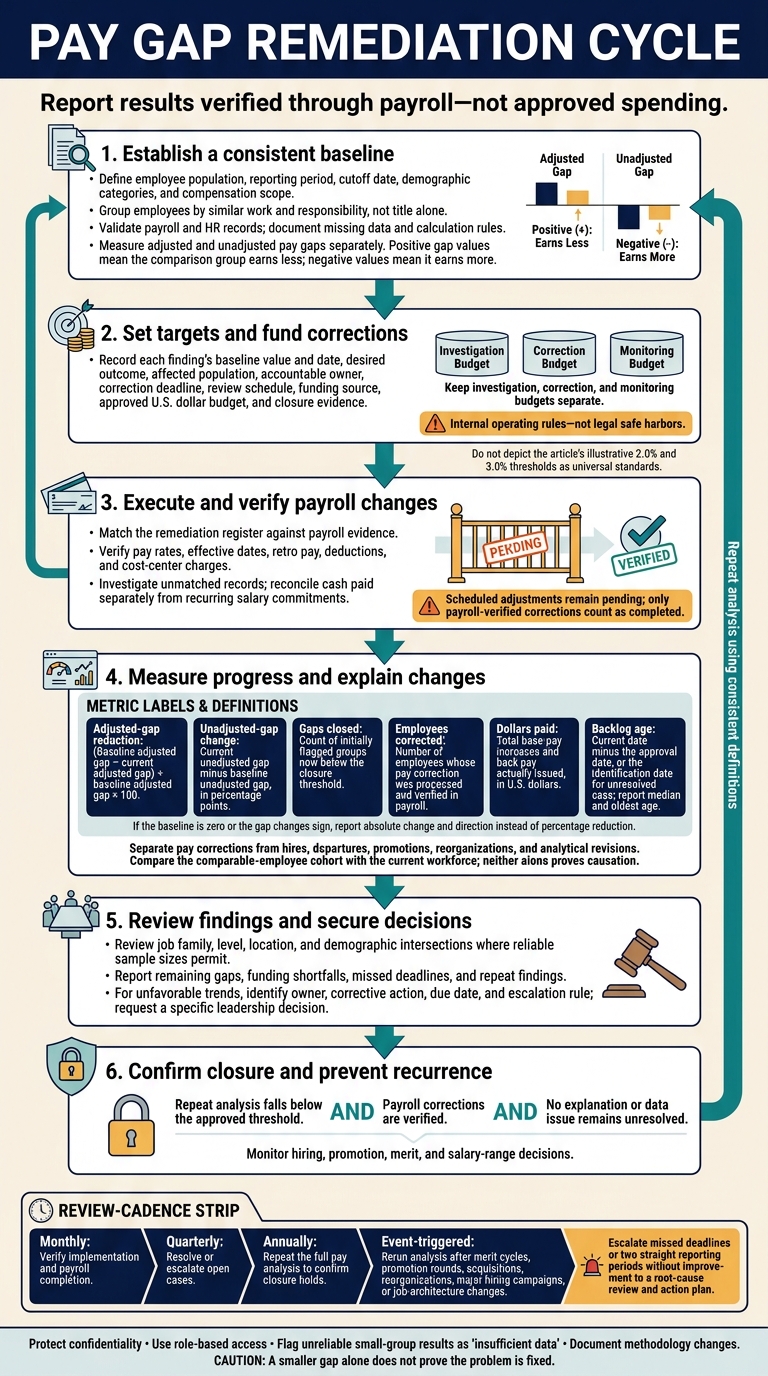
Pay Gap Remediation: From Baseline to Verified Results
July 2025 HR Webinar Series: Internal Pay Equity - Adapting to a Changing World
sbb-itb-8baf5f1
Set Pay Gap Baselines and Targets
Define the baseline before pulling data. Specify the employee population, reporting period, cutoff date, and treatment of part-time workers, leave, new hires, exits, and role changes. Set demographic categories - including “unknown” and “not disclosed” - and identify the compensation components covered.
Keep annualized base pay separate from bonuses, commissions, overtime, and equity. State how you value each component and which earning period it covers.
Define Employee Groups and Check Data
Join employee-level payroll and HR records using employee IDs. Retain only the documented job-related controls used in the model. Group employees by similar work and responsibility, not title alone. Keep original titles alongside standardized groups so reviewers can trace each grouping.
Reconcile payroll totals, remove duplicate records, verify annualization rules, and check effective dates for pay increases and promotions. Report missing values as counts and percentages, and document how each field is handled.
Limit access to identifiable data to approved reviewers. Label unreliable small-group results “insufficient data” and send them for legal and analytical review. Do not merge unrelated jobs to increase group size.
Measure Adjusted and Unadjusted Pay Gaps
Name the reference and comparison groups for every result, and calculate each measure for a clearly defined compensation component. Under the formulas below, positive values mean the comparison group earns less; negative values mean it earns more.
For adjusted results, disclose model controls, sample size, and uncertainty. Check whether performance ratings, promotion history, or prior salary carry past bias into the model. An adjustment does not prove legality.[2][3]
| Measure | Calculation | Purpose | Main limitation |
|---|---|---|---|
| Mean unadjusted gap | (Reference-group mean − comparison-group mean) ÷ reference-group mean × 100 | Shows the overall average difference | Sensitive to high earners and workforce composition |
| Median unadjusted gap | (Reference-group median − comparison-group median) ÷ reference-group median × 100 | Compares the middle pay value in each group | Can conceal differences within roles or pay levels |
| Adjusted gap | Estimated pay difference after controlling for documented job-related factors | Identifies remaining differences among comparable employees | Depends on model design, data quality, and potentially biased controls |
Keep salary-range penetration separate. Calculate (pay − range minimum) ÷ (range maximum − range minimum) × 100 within the same level, location, and range. This measures placement within a pay range - not pay equity.
Store the following in the baseline data dictionary: range versions, effective dates, population rules, compensation scope, demographic definitions, reference groups, formulas, controls, missing-data rules, privacy rules, calculation version, and approvals. Apply the same definitions at every review so measured progress reflects corrections, not shifting metrics.
Set Targets, Budgets, and Escalation Rules
Maintain a target register with one entry per finding. Include the baseline value and date, desired outcome, affected population, accountable owner, correction deadline, review schedule, funding source, approved U.S. dollar budget, and closure evidence.
Keep investigation, correction, and monitoring budgets separate. State whether costs cover salary, bonus, equity, payroll taxes, and retroactive payments. Have HR, compensation, legal, finance, and leadership approve the methodology, funding, and escalation rules.
Set an investigation threshold to trigger review, a correction threshold to prioritize action, and an escalation threshold for leadership or legal review. These are internal operating rules, not legal safe harbors.
For example, investigate any reliable role-level gap above 2.0%, require a documented correction plan when the adjusted gap exceeds 3.0% or a similarly situated employee appears underpaid, and escalate unresolved material findings to leadership.
Require the owner to escalate whenever deadlines slip or funding falls short. Use the recorded baselines and thresholds as the reference point for each progress review.
Measure Progress and Review Role-Level Gaps
Once baselines and targets are set, track whether approved pay corrections reach payroll and narrow the gap.
Define Progress Metrics and Review Dates
Use the baseline and target register to measure progress. Scheduled adjustments remain pending; only payroll-verified corrections count as completed. Track each metric using the definitions below:
| Metric | Calculation and denominator | Source | Owner | Action trigger |
|---|---|---|---|---|
| Adjusted-gap reduction | (Baseline adjusted gap − current adjusted gap) ÷ baseline adjusted gap × 100 | Compensation analysis and payroll data | People analytics | Investigate if the gap does not decline by the scheduled review |
| Unadjusted-gap change | Current unadjusted gap minus baseline unadjusted gap, in percentage points | Payroll and workforce-demographic data | People analytics | Escalate if the gap widens or stays above the approved threshold |
| Gaps closed | Count of initially flagged groups now below the closure threshold | Audit findings and current analysis | Compensation or legal team | Reopen groups that cross the threshold again |
| Employees corrected | Number of employees whose pay correction was processed and verified in payroll | HRIS, payroll, and remediation log | Payroll and HR operations | Reconcile any approved correction missing from payroll |
| Dollars paid | Total base-pay increases and back pay actually issued, in U.S. dollars | Payroll transactions and general ledger | Finance and payroll | Investigate differences between approved and paid amounts |
| Backlog age | Current date minus the approval date, or the identification date for unresolved cases; report median and oldest age | Remediation case log | HR operations | Escalate cases exceeding the service-level target |
A case is closed only when repeat analysis falls below the approved threshold, payroll corrections are verified, and no explanation or data issue remains unresolved.
Review implementation monthly to verify completion, exceptions quarterly to resolve or escalate open cases, and the full analysis annually to confirm that closure holds. If the baseline is zero or the gap changes sign, report the absolute change and direction instead of percentage reduction. Keep approved or scheduled amounts separate from cash actually paid.
Separate Pay Corrections From Workforce Changes
Use the baseline’s role groups and controls so trend comparisons stay consistent. Maintain two views: a comparable-employee cohort and the current workforce. Document who qualifies for the cohort and how transfers, promotions, and departures are handled.
The cohort shows changes among retained, comparable employees but leaves out parts of the workforce. The current-workforce view includes everyone, but its results shift as workforce composition changes. Neither view alone proves that pay corrections caused the gap to change.
Tag pay corrections, hires, departures, promotions, reorganizations, and analytical revisions separately. When methods change, label the break in the trend and show a restated comparison separately.
Review Gaps by Role and Pay Decision
Review gaps by job family, level, location, and demographic intersections where sample sizes support reliable analysis. Look beyond current salary: examine starting pay, salary-range placement, merit and promotion increases, bonuses, commissions, equity, and performance ratings.
For each flag, use consistent categories to record the evidence, explanation, decision-maker, corrective action, effective date, and verification result. Track recurring flags across reviews to check whether remediation addresses the underlying process. Repeated flags should trigger a structural review of pay ranges, hiring approvals, promotion criteria, performance calibration, manager discretion, work allocation, and data definitions.[1]
Report Results and Maintain Pay Equity Controls
Build a Leadership Remediation Scorecard
After each review, turn the progress log into a scorecard that helps leaders make decisions. Use fixed status labels so planned corrections don’t count as closed. For every unfavorable trend, identify the owner, corrective action, due date, and escalation rule. Then ask leadership for a specific decision.
| Audience | Reporting needs | Detail level | Decision type |
|---|---|---|---|
| Executive leadership or compensation committee | Overall gaps, budget use, forecast cost, unresolved groups, deadlines | Companywide and major-group totals; no individual salaries or identities | Approve funding, set accountability, resolve policy or resource barriers |
| HR, compensation, and legal teams | Role-level findings, correction status, causes, data limitations | Controlled access to smaller-group results and, where justified, limited employee-level records | Validate methodology, approve corrections, investigate causes, update pay practices |
| Business-unit leaders | Unit trends, affected job groups, action owners, deadlines, process indicators | Aggregated results meeting minimum-cell thresholds; avoid identifying individuals | Improve hiring, promotion, and merit decisions |
Explain Data Limits and Protect Confidentiality
Give readers enough detail to act without exposing information they don’t need. Attach a short methodology note with the analysis date, employees covered, exclusions, missing-data rates, and changes since the prior analysis. Flag small samples and any changes to compensation definitions or models that could make progress look different from what it is. Where possible, show results under the old and new methods side by side.
Match access to decision-making needs. Use role-based access and least-privilege permissions, backed by audit logs, secure delivery, and documented retention rules. Suppress small cells or combine only comparable groups. Also check whether overlapping reports could reveal an employee’s identity.
Verify Pay Corrections and Prevent Repeat Gaps
Confirm that approved corrections reached payroll, then watch for recurring patterns. An independent reviewer should match the remediation register against payroll evidence, checking pay rates, effective dates, retro pay, deductions, and cost-center charges. Investigate unmatched records and keep verification evidence so corrections aren’t closed prematurely. Reconcile cash paid separately from recurring salary commitments.
Don’t wait for the annual reporting cycle to repeat the analysis. Run it after merit cycles, promotion rounds, acquisitions, reorganizations, major hiring campaigns, or changes to job architecture. Before decisions are final, monitor offer placement within salary ranges, starting-pay exceptions, promotion rates, and merit-increase percentages.
Assign recruiting to offer exceptions, compensation to salary-range issues, and business leaders to promotion and merit patterns. Escalate missed deadlines or two straight reporting periods without improvement to a root-cause review and action plan.
Conclusion: Repeat the Pay Gap Remediation Cycle
Follow the same cycle each time: use one baseline, fund approved targets, track the same metrics at set intervals, and review role-level gaps. Report results verified through payroll - not approved spending.
Commit to three actions:
Approve a metric dictionary that defines formulas, employee populations, pay elements, comparator rules, data cutoffs, and reporting frequency.
Assign accountable owners for data quality, funding, analysis, payroll execution, and reporting. Put one executive in charge of escalation.
Schedule the next review after payroll closes. Publish the cutoff date, evidence, and decision agenda so leaders can address delayed corrections and remaining gaps.
FAQs
How should we prioritize pay corrections when funding is limited?
Prioritize the most serious pay gaps in your equity baseline data. Use a risk-based approach, such as a 3×3 probability-and-severity matrix, to address High-High and High-Medium categories first.
Complete reviews before annual budgets are finalized so funding matches your equity commitments. Direct limited resources toward corrections that close large, measurable pay gaps and support long-term progress - not efforts that fail to deliver results.
What if adjusted and unadjusted pay gaps move in opposite directions?
When adjusted and unadjusted pay gaps move in opposite directions, overall figures don’t tell the whole story. Changes in workforce demographics - including hiring and turnover at different job levels - can hide or worsen pay disparities.
Break down the data by job type, level, gender, and race. Reviewing these trends alongside the factors behind workforce changes helps leaders address root causes instead of relying on potentially misleading totals.
How can we set realistic pay gap remediation deadlines?
Start with a baseline pay gap, then set SMART, time-bound targets to close it, with milestones along the way. Record the baseline date and value, calculation formulas, owners, and reporting schedule.
Set deadlines for each job level and use dashboards to track leadership’s progress. Hold monthly steering and action check-ins, plus quarterly steering committee reviews, to adjust course before budgets and plans are finalized.



FAQ