
Oct 5, 2026 · 9 min read
ESG Strategy
In This Article
Explain CSRD disclosure rules vs ESG 'S' management: which pay-equity metrics to report, diagnose, and fix.
CSRD vs ESG 'S': Pay Equity Metric Priorities
I separate pay equity reporting from pay equity action: CSRD sets disclosure duties; ESG “S” helps you decide what to fix. Start by checking whether CSRD applies to your company, then build separate reporting and management views from the same payroll data.
When ESRS S1-16 applies, it centers on 2 measures: the unadjusted gender pay gap, expressed as a percentage, and the highest-paid-to-median annual remuneration ratio. Neither measure alone proves equal pay for equal work.
My approach connects those disclosures to action:
Check the rules: Confirm scope, materiality, reporting dates, and the applicable ESRS version.
Define the data: Separate employees from other workers, align payroll terms across countries, and document calculation rules.
Find what needs review: Examine adjusted gaps, starting pay, promotions, and pay components - not just company-wide averages.
Protect and verify: Limit access to demographic records, reconcile totals, and retain calculation and approval records.
Assign corrections: Set owners, budgets, and deadlines, then check whether pay and promotion outcomes changed.
<u>Quick Comparison</u>
| Criterion | CSRD/ESRS disclosure | ESG “S” pay equity management |
|---|---|---|
| Goal | Report applicable workforce matters | Identify and correct pay differences |
| Audience | Regulators, investors, assurance providers, and workers | HR, compensation, legal, finance, and managers |
| Metrics | Unadjusted gender pay gap and remuneration ratio | Adjusted gaps, hiring pay, promotions, and correction outcomes |
| Data | Defined employee population and auditable calculations | Detailed job, level, location, and pay-component analysis |
| Timing and output | Annual disclosures | Periodic reviews, correction plans, and outcome tracking |
I judge progress by corrected pay and lasting results - not a lower reported gap alone.
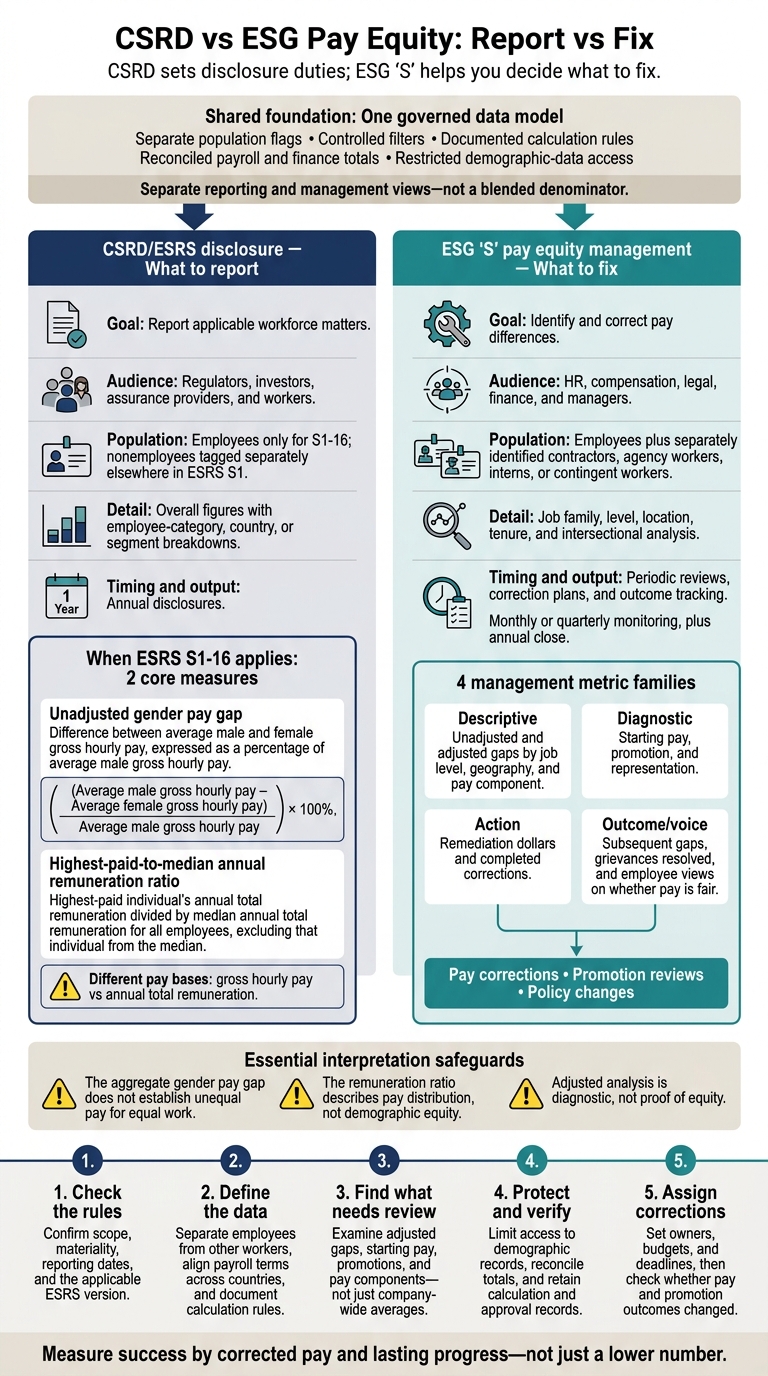
CSRD vs ESG Pay Equity: Report vs Fix
Pay Equity Metrics for Disclosure and Management
Once the framework’s scope is clear, separate metrics into those needed for disclosure and those used for internal analysis. CSRD requires auditable disclosure; ESG “S” uses more detailed internal analysis to identify and address pay gaps.[4][8]
For CSRD, the main pay-equity disclosures focus on the gender pay gap and the pay ratio.
ESRS S1-16: Gender Pay Gap and Remuneration Ratio
When S1-16 applies, its two core measures use different pay bases: gross hourly pay for the unadjusted gender pay gap and annual total remuneration for the ratio of the highest-paid individual’s pay to median employee pay.[4][8]
| Element | Unadjusted gender pay gap | Annual total-remuneration ratio |
|---|---|---|
| Basis | Difference between average male and female gross hourly pay, expressed as a percentage of average male gross hourly pay. | Highest-paid individual’s annual total remuneration divided by median annual total remuneration for all employees, excluding that individual from the median. |
| Population | Applicable employee population. Document inclusions, exclusions, employment status, and, where relevant, treatment of employees who do not identify as male or female. | Highest-paid individual and remaining employees. |
| Period | Applicable annual reporting period, with prior-period comparisons where required. | Annual remuneration for the applicable reporting period. |
| Methodology | Document how calculations treat working hours, part-time work, leave, variable pay, currency conversion, new hires, leavers, and incomplete-year employment. | Document salary, bonus, equity, benefits, other applicable components, and any purchasing-power treatment. |
| Breakdowns | Employee category, country or segment, and base pay versus variable pay. | Overall ratio. Internal analysis can also examine geography, employee category, and remuneration components. |
The aggregate gender pay gap does not establish unequal pay for equal work. Workforce composition and pay structures can affect the result.[7][9] The remuneration ratio describes pay distribution, not demographic equity. Keep calculations reproducible and approvals documented so they can be checked during assurance.[4][8]
Internal ESG analysis goes beyond required disclosures to identify the sources of gaps and track which actions reduce them.
ESG Social Metrics: Analyze Gaps and Track Results
Track four metric families:
Descriptive: Unadjusted and adjusted gaps by job level, geography, and pay component.
Diagnostic: Starting pay, promotion, and representation.
Action: Remediation dollars and completed corrections.
Outcome/voice: Subsequent gaps, grievances resolved, and employee views on whether pay is fair.
Use these findings to prioritize pay corrections, promotion reviews, and policy changes.
Adjusted models help explain pay variation, but they cannot determine on their own whether pay is fair. Adjusted analysis is diagnostic, not proof of equity. Results depend on model choice, data quality, sample size, and reference groups. Controlling for job level may hide barriers to advancement, while performance ratings may carry bias.
Document assumptions, uncertainty, minimum-cell thresholds, excluded variables, and sensitivity tests. Review adjusted results alongside unadjusted gaps and promotion outcomes before deciding what to correct.[4][7][9]
sbb-itb-8baf5f1
Data Boundaries and Workforce Detail
Those disclosures depend on clearly defined workforce boundaries and payroll terms.
Use one governed data model with separate population flags for CSRD disclosures and ESG management. ESRS S1 covers employees and certain nonemployees, including self-employed workers contracted to provide labor and workers supplied by employment agencies.[4][7] For ESRS S1-16, use an employee-only group to calculate the gender pay gap and annual total-remuneration ratio. Value-chain workers fall under ESRS S2, not S1.[4][11] Restrict access to worker-level records, and create disclosure and management views through controlled filters - not a blended denominator.
| Dimension | CSRD disclosure view | ESG management view |
|---|---|---|
| Workforce boundary | Employees only for S1-16; nonemployees tagged separately elsewhere in ESRS S1 | Employees plus separately identified contractors, agency workers, interns, or contingent workers |
| Aggregation | Overall figures with employee-category, country, or segment breakdowns | Job family, level, location, tenure, and intersectional analysis |
| Pay components | Gross hourly pay and annual total remuneration | Salary, bonus, equity, benefits, and other component analyses |
| Reporting frequency | Annual reporting period | Monthly or quarterly monitoring, plus annual close |
| Decision use | Repeatable external reporting | Pay corrections, salary-range design, and workforce planning |
With the workforce boundary set, normalize payroll codes country by country while preserving their local meaning.
Align Payroll Definitions Across Countries
Build a data dictionary covering legal employer, country, payroll system, contract type, hours status, job level, job family, location, hire and termination dates, and reporting entity. Keep local definitions: classifications such as “permanent,” “temporary,” “full-time,” and “part-time” differ across jurisdictions.[4][7] Map local payroll codes to a shared remuneration taxonomy, but retain each original code, description, currency, and legal definition. Keep nonemployee records in a separate workforce category.
Document normalization rules rather than applying one global rule. Specify whether each metric uses headcount, FTE, or an average workforce. Retain actual pay, hours, and full-time-equivalent fields so every calculation uses its approved basis. Store source currency and reporting currency in separate fields.
The ESRS framework mapping should record filters, pay components, reporting period, currency treatment, FTE treatment, source systems, and owners. Reconcile employee records to payroll, then payroll remuneration totals to finance records. Document differences caused by leave, transfers, retroactive pay, acquisitions, divestitures, or missing records.
After normalization, protect demographic data so analysis stays lawful and ready for audit.
Protect Demographic Data and Audit Records
Collect demographic fields only for a documented, lawful purpose that meets local requirements for pay equity analysis and reporting. Apply role-based access, pseudonymization, encryption, and retention limits. Keep “unknown,” “not collected,” “not applicable,” and “declined to answer” as separate categories.
Set small-cell thresholds before analysis. Suppress or combine tiny groups before publication, and use broader segments when intersectional groups are too small to support reliable interpretation.
Maintain a version-controlled audit trail of source extracts, calculation code, reconciliation workpapers, and approvals. Assign HR responsibility for workforce definitions, payroll for remuneration inputs, finance for ledger reconciliation, legal/privacy for lawful data use, and reporting for framework mapping. Keep diagnostic findings separate from publication-ready disclosures. Archive the calculation for each reporting period.
Turn Pay Equity Findings Into Action
With the metrics defined, move from reporting to pay corrections. Disclose the unadjusted gap, use adjusted analysis to identify unexplained differences, and track fixes through management metrics. The remuneration ratio measures pay dispersion at the top - not gender equity across the workforce.
Map Reporting Frameworks and Assign Owners
Use the crosswalk below to link each metric to an owner, deadline, and required action. Keep each metric’s definition and covered population separate.
| Metric and purpose | Framework connection | Accountable owner | Calculation and review | Related policy, action, or target |
|---|---|---|---|---|
| Unadjusted gender pay gap | ESRS S1-16; GRI 405-2 uses category-level ratios | HR/payroll; sustainability aligns disclosures | Annual; retain auditable records for CSRD assurance [10] | Review recruitment and promotion policies |
| Adjusted pay gap | Internal diagnostic used to direct remediation | HR/compensation; legal as needed | Annual; review after corrections | Correct confirmed unexplained differences; track recurrence |
| Highest-paid-to-median ratio | ESRS S1-16; GRI 2-21 | HR/compensation and finance | Annual; validate each framework’s calculation separately | Review compensation policy |
| Basic pay ratios by gender and employee category | GRI 405-2; internal ESG analysis | HR/payroll | Annual disclosure; periodic management review | Review salary bands and category-level disparities |
Framework alignment does not replace legal review. Keep disclosure governance and choices separate from legal exposure and pay-remediation duties. Set privilege rules with counsel.
Plan Analysis, Pay Corrections, and Review
Start by setting the boundary and baseline. Then validate definitions and reconcile totals before breaking down results by group. For each material finding, assign an action owner, deadline, measurable target, and approved budget. Use double materiality to prioritize workforce harm and business risk [10][12].
Put the findings to work in salary-band reviews, hiring and promotion controls, and correction budgets. Preserve the evidence chain from payroll to disclosure, and verify that each fix changes the workforce outcome. Track implementation, recurrence, and outcome changes through every review cycle.
Conclusion: Align Reporting With Pay Equity Progress
CSRD disclosure metrics tell you what to report; ESG management metrics tell you what to fix. Draw from shared source data, but keep disclosure outputs separate from remediation outputs.
Check filing readiness by confirming CSRD scope, the ESRS version, transition rules, and national implementation.[6][5]
Assign one executive owner, then route approvals through reporting, HR, compensation, payroll, finance, legal, privacy, and internal audit.
Test whether pay-gap metrics shifted because pay changed. Use promotion, retention, and employee feedback to check remediation outcomes. When a lower gap reflects workforce mix rather than pay corrections, say so. Measure success by corrected pay and lasting progress - not just a lower number.
FAQs
Can CSRD pay equity rules apply to U.S. companies?
Yes. Starting in fiscal year 2028, CSRD pay equity rules can apply to U.S. companies with more than €150 million in EU net turnover and at least one EU subsidiary or branch [1][2].
These companies must follow the European Sustainability Reporting Standards (ESRS) for workforce disclosures, including pay gap reporting and policies on equal treatment and opportunities [3].
How do we prioritize pay corrections with a limited budget?
Use a double materiality assessment to prioritize pay gaps that pose the greatest financial, operational, or regulatory risk. Direct limited resources toward gaps that matter most to workforce stability and ESG disclosures.
Position pay corrections as investments in human capital and risk management within your ESG social strategy. Document how you set priorities for CSRD assurance, and link corrections to measurable outcomes - such as better retention and productivity - to show their long-term value.
How can we tell if a lower pay gap reflects real progress?
Look beyond the headline number. Verify that the data is detailed, complete, and controllable, rather than partial or relabeled. It should be backed by documented internal controls and evidence trails suitable for assurance testing.
Check that targets and changes link to material workforce equity policies and outcomes. Confirm that improvements hold across relevant groups and the broader social context - and don’t hide other social risks within the ESG 'S' agenda [1][2].



FAQ