In This Article
Five partnership models to secure native seed, nursery space, costs, and risk so planting-ready stock is delivered on schedule.
On this page
- 1. Agency-Led Supply Planning
- Oregon Native Seed Partnerships: Lessons Learned & Next Steps (Symposium)
- 2. Regional Seed Partnerships
- 3. Nonprofit-Led Supply Networks
- 4. Grower-Led Production Networks
- 5. Project-Specific Purchasing
- Compare Seed Supply and Plant Delivery
- Compare Agreements, Costs, and Risk
- Conclusion: Choose a Model for Your Restoration Needs
- FAQs
Native Plant Partnerships Expand Restoration Supply
Secure seed access, nursery space, and purchase commitments before setting planting dates. Five partnership models divide that work differently. The right choice depends on who can manage seed sources, reserve growing space, commit funding, and cover losses if production falls short.
For U.S. agencies, nonprofits, growers, and landowners, the comparison comes down to seed suitability, plant readiness, agreements, total delivered cost, and risk.
Quick Comparison
| Model | Who leads and controls supply | Main planning need | Cost and risk to address |
|---|---|---|---|
| Agency-led planning | Agencies set demand and collection terms; growers manage production. | Align permits, forecasts, and nursery schedules. | Staff time and responsibility for crop shortfalls. |
| Regional seed partnerships | Partners share seed stewardship, growing space, and orders. | Keep provenance records and handoffs consistent. | Shared costs and losses across partners. |
| Nonprofit-led networks | Nonprofits coordinate seed access, training, and orders; nurseries provide space. | Use common handling and plant-quality standards. | Staffing, funding gaps, and partner duties. |
| Grower-led networks | Growers reserve production space; buyers provide seed access and advance orders. | Commit quantities before propagation starts. | Deposits, cancellations, and unsold stock. |
| Project-specific purchasing | Buyers set requirements; contracts assign seed ownership and production duties. | Confirm suitable stock or book contract growing early. | Per-order costs, delivery gaps, and crop-failure terms. |
Timing narrows the options: projects due within 0–1 year may need existing stock, aligned demand over 1–3 years can support shared production, and 3–10+ years allows for regional supply growth. Across all five models, success means suitable seed and accepted plants delivered on time - not just orders placed.
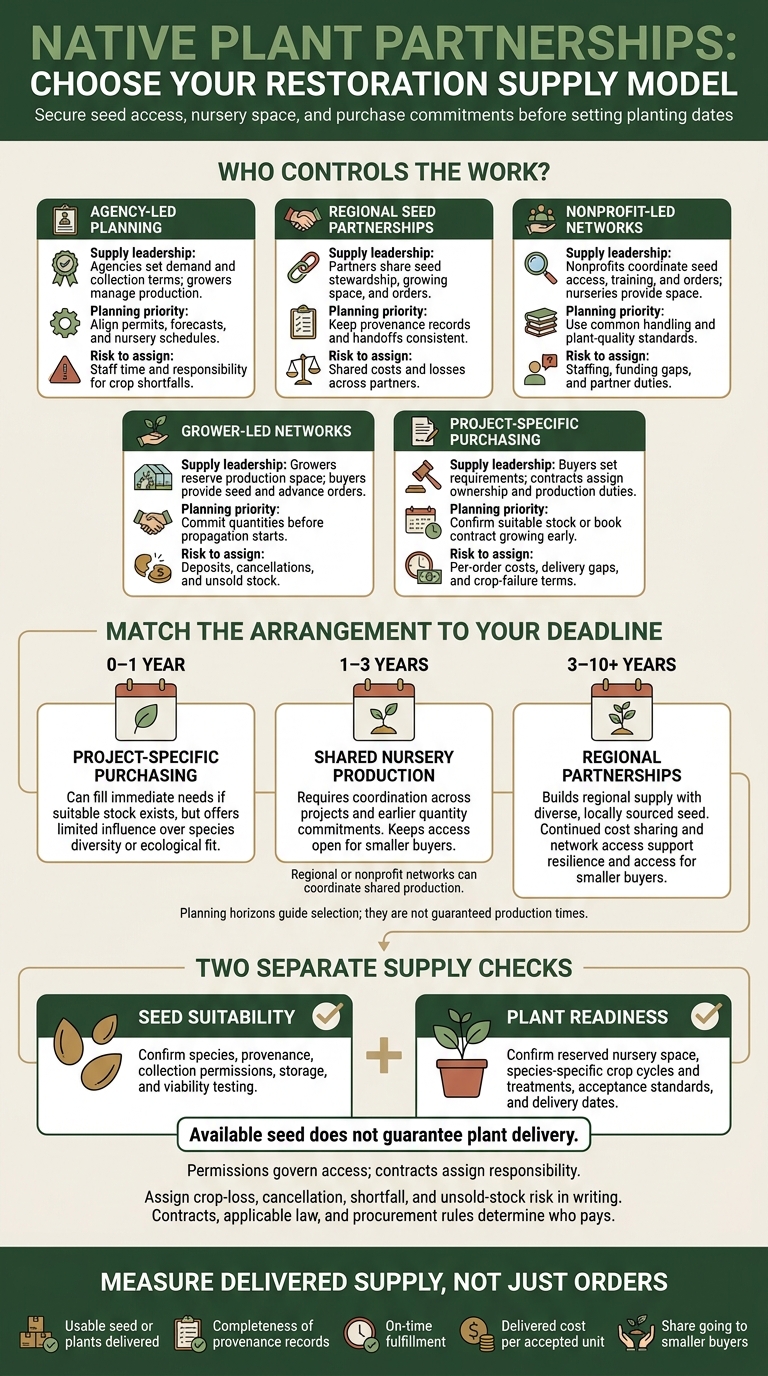
Native Plant Partnerships: Choose Your Restoration Supply Model
1. Agency-Led Supply Planning
Seed Supply and Genetic Stewardship
In an agency-led model, public managers set collection rules and supply chain schedules. Public-land collection permits define access terms and require species confirmation before collection[2]. Agencies should work with nursery partners to align collection windows, storage standards, and target species lists[1][2].
Nursery Capacity and Order Reliability
Turn restoration forecasts into nursery production plans before setting planting dates. Agencies must confirm nursery space, germination needs, and delivery windows. Viability testing, proper storage, and species-appropriate treatments - such as scarification or smoke water - can improve germination[1][2].
Agreements and Accountability
Use formal collection permits and production agreements to clarify who is responsible for access and plant quality[2].
Coordination Costs and Risk
Budget for staff time spent on permits, nursery scheduling, and order changes - not just plants. Agencies control permits and demand forecasts, while growers control propagation capacity and timing. Pooling demand through agency-led planning requires firm commitments, with collection and propagation risks factored into schedules and budgets.
The next model shifts more control to shared regional seed networks.
sbb-itb-8baf5f1
Oregon Native Seed Partnerships: Lessons Learned & Next Steps (Symposium)
2. Regional Seed Partnerships
Rather than relying on agency-led planning, this model shares seed stewardship and production across local partners.
Seed Supply and Genetic Stewardship
Regional partnerships move seed stewardship from a central agency to a network of agencies, nonprofits, growers, and landowners. Record provenance for every seed lot transferred between partners.[2] Matching seed sources to local conditions and reference ecosystems strengthens genetic stewardship.[3] Shared nursery networks also support genetic diversity in revegetation.[1]
Nursery Capacity and Order Reliability
Shared nursery networks exchange knowledge about collection, storage, and viability testing, helping partners grow more hard-to-grow species.[1] Partners divide production work by allocating nursery space and coordinating plant orders. For this shared capacity to work, schedules and handoffs must line up.
Agreements and Accountability
Before collection begins, partners should establish shared custody records and transfer rules for native seed and plant material. These agreements should assign responsibility for confirming species and maintaining provenance records.[2]
Coordination Costs and Risk
Pooling resources expands regional capacity, but it also adds scheduling and documentation work at every stage: collection, storage, viability testing, propagation, and handoffs between partners.[1][2]
3. Nonprofit-Led Supply Networks
Regional partnerships share seed across institutions. Nonprofits often coordinate the training, documentation, and volunteer labor that keep those networks working.
Seed Stewardship and Training
Nonprofits can organize community nursery networks to share seed collection, storage, and viability testing while supporting genetic diversity.[1] They train volunteers, standardize collection and seed-handling methods, and support small nurseries when no single grower can meet demand.[1][2] Landowners can grant access, host seed sources, or provide planting sites under nonprofit coordination.
Consistent propagation methods help small nurseries expand supply. Shared training gives partners a common approach to growing plants.
Nursery Capacity and Order Reliability
Nonprofit networks spread propagation methods across small nurseries, improving success with difficult species.[1] The nonprofit coordinates seed access and order timing, while partner nurseries supply growing space and plants.
Agreements and Accountability
Use access permits and one protocol for species confirmation and transfer records.[2] Across partner nurseries, standardize hygiene, mix handling, and seed treatments.[2] Put collection, hygiene, storage, and plant-quality standards in writing, and make clear who is responsible when something fails.
Coordination Costs and Risk
Nonprofits lower coordination costs by standardizing metrics and combining grants, donations, and agency funds.[3] When nonprofits cannot scale production themselves, growers take on more of the nursery workload.
4. Grower-Led Production Networks
Growers reserve nursery space, while agencies, nonprofits, and landowners provide seed access and place advance orders.
Seed Inputs and Genetic Stewardship
Grower-led networks use standard collection, storage, and viability testing methods to increase supply and match seed sources to project sites [1][2][3]. Order timing becomes the main constraint.
Nursery Space and Delivery
Place advance orders to reserve nursery space before propagation begins. Include scarification, soaking, smoke-water treatment, and delivery windows in the production schedule from the start [2].
Agreements and Accountability
Make seed collection permits and species confirmation part of training and production planning [2]. Shared collection, storage, and propagation protocols help keep records, orders, and plant quality consistent [4].
Coordination Costs and Risk
Track weather, seed yield, and germination results, and adjust schedules as conditions change [3]. These scheduling risks frame the next comparison of seed supply and plant delivery.
5. Project-Specific Purchasing
Match Supply to the Planting Plan
Direct purchasing is the fallback when shared networks cannot meet a project’s schedule or species list. It suits projects that need precise control over species, sources, and delivery dates, placing that control in the project brief rather than the network. Before collection or production begins, document species, provenance, permits, and genetic-diversity targets in one purchase order or production brief.[1][2]
Seed Stewardship and Nursery Capacity
Use viability testing to determine collection quantities and storage needs. Assign responsibility for seed storage from collection through sowing.[1][2] Reserve enough nursery space for the required quantities, and set production dates that account for each species’ dormancy and pretreatment needs.[2]
Agreements and Accountability
Use one project contract to name who owns the seed, books nursery space, and accepts delivery risk. Document permissions, grower duties, acceptance standards, delivery dates, allowed substitutions, and remedies for shortfalls. Set clear milestones and name who can approve changes.
Coordination Costs and Risk
Budget for testing, status checks, and coordination. The buyer carries more risk under this model unless the contract assigns it elsewhere. Before production starts, assign liability for failed propagation, order changes, seed shortages, and planting delays. Those decisions shape delivery timing and the handoff of plants.
Compare Seed Supply and Plant Delivery
Check seed suitability and plant readiness separately. A partnership may provide one without the other. The first table compares seed stewardship; the second tracks the steps from nursery reservation to delivery.
Seed Collection, Provenance, and Reserves
Assess seed by its fit for the site and its provenance.[1][2][3]
| Model | Collection planning and labor | Provenance and suitability | Reserves and testing | Control of seed, nursery space, and orders |
|---|---|---|---|---|
| Regional seed | Partners share collection, storage, and viability-testing duties.[1] | Keep provenance records intact across transfers.[2] | Store and test seed to support future supply.[1] | Partners share seed stewardship, allocate nursery space, and coordinate orders. |
| Nonprofit-led | Coordinate permits, species checks, and treatment protocols.[2] | Base seed selection on confirmed species.[2] | Follow shared storage and testing protocols.[1][2] | The nonprofit coordinates seed access and orders; nurseries control growing space. |
| Grower-led | Deliver finished stock under contract.[4] | Match production to site-specific provenance requirements.[3][4] | Plan around planting windows. | Partners provide seed access and place orders; growers reserve nursery space. |
| Project-specific | Align collection and planting plans with the project schedule.[3] | Choose sources and species that fit site conditions.[3] | Schedule reserves and testing around the project. | The buyer specifies seed and orders; the contract assigns seed ownership and nursery reservations. |
Seed reserves support future supply, but nursery capacity turns seed into planting-ready stock. In every model, collection needs to account for permissions, storage, and viability testing. Before counting on supply, confirm both collection access and propagation capacity.
Nursery Space, Advance Orders, and Delivery
Available seed does not guarantee plant delivery. Compare what each arrangement provides, then check that reserved nursery space and the crop cycle fit the planting window.[1][2][3]
| Arrangement and model fit | What it delivers | Planning and capacity | Early commitment and timing risk | Best use case |
|---|---|---|---|---|
| Seed-only supply | Seed only. | Depends on collection, storage, and viability testing.[1][2] | The buyer must secure propagation capacity and carries the downstream timing risk. | Works when separate propagation capacity is available. |
| Contract-grown plants: grower-led or project-specific | Planting-ready stock. | Requires early nursery reservations and a planting window that fits the crop cycle. | The buyer commits quantities early; the contract assigns delay risk. | Fits projects that can commit quantities in advance. |
| Shared nursery production: regional or nonprofit networks | Plants grown across more than one nursery. | Requires coordinated schedules and consistent hygiene and potting mix practices.[2][3] | Partners commit nursery space early; agreements assign responsibility for delayed handoffs. | Works when partners must share limited nursery space. |
Match nursery reservations to the crop cycle, delivery window, and hygiene requirements.[2][3]
Compare Agreements, Costs, and Risk
Once you’ve compared supply models, clarify who carries the legal and financial risk. Partnership structure shapes who controls seed, nursery space, and orders. Contracts, applicable law, and procurement rules determine who pays when things go wrong.
Use the matrix below to distinguish control over the work from payment duties and exposure to losses.
| Model | Agreement types and parties | Decision authority | Coordination costs | Payment obligations | Crop-loss and unsold-inventory risk |
|---|---|---|---|---|---|
| Agency-led | Federal grants; interagency MOUs among public agencies | Lead agency | High administrative overhead | Budget allocations, grant funding | Public agency, subject to contract |
| Regional seed | Partnership agreements; collection permits involving nonprofits, nurseries, and Tribes | Steering committee | Moderate systems overhead | Cost sharing, membership dues | Allocated among partners |
| Nonprofit-led | Grant agreements; service contracts involving NGO staff and volunteers | Project manager | Moderate staffing costs | Performance payments, donor funding | Nonprofit or funder, subject to agreement |
| Grower-led | Production contracts; purchase orders involving growers and contractors | Nursery owner | Low transaction overhead | Deposits, unit-price payments | Grower inventory risk, unless reassigned |
| Project-specific | Purchase orders; permits involving contractors or landowners | Project lead | High per-order costs | Lump-sum or milestone payments | High; buyer absorbs delivery gaps unless reassigned |
Collection Permissions and Production Contracts
Permissions govern access; contracts assign responsibility. Collection permissions should identify who may collect, require species confirmation before harvest, and spell out permit terms.[2] Production contracts should assign liability and set firm requirements for provenance, diversity targets, and quality standards, including viability, hygiene, and treatment protocols.[1][2]
Coordination Costs and Financial Risk
Compare total delivered cost, not just the plant price. Include facilitation, shared records, transportation, and contract administration in the budget. Agree on deposits, cost sharing, and purchase commitments before production begins. Set cancellation terms and crop-failure provisions that assign liability for production shortfalls, buyer cancellations, and unsold stock.
Outside Help With Partnership Governance
Council Fire can help with stakeholder coordination and partnership governance. That support does not replace ecological expertise, nursery management, legal review, or procurement authority.
Conclusion: Choose a Model for Your Restoration Needs
Match the model to your planting deadline and supply gap. Use the comparisons above to weigh project timing, control, and risk. Each model divides control over seed, nursery space, and plant orders differently.
| Your need | Best-fit model or arrangement | Trade-offs |
|---|---|---|
| Project due in 0–1 year | Project-specific purchasing | Can fill immediate needs if suitable stock exists, but offers limited influence over species diversity or ecological fit. |
| Projects with aligned demand over 1–3 years | Shared nursery production | Requires coordination across projects and earlier quantity commitments. Keeps access open for smaller buyers. |
| Long-term supply growth over 3–10+ years | Regional partnerships | Builds regional supply with diverse, locally sourced seed.[1][2] Continued cost sharing and network access support resilience and access for smaller buyers. |
Your choice depends on who can commit early and who can carry the risks of collection, production, and delivery.
Before committing funding, assign responsibility for permits, species confirmation, provenance records, nursery production, and ordering. Set delivery dates as well.
Measure delivered supply, not just orders. Track usable seed or plants delivered, completeness of provenance records, on-time fulfillment, delivered cost per accepted unit, and the share going to smaller buyers.
FAQs
How do we verify that native seed suits our site?
Match species selection to the reference plant community, current site conditions, and recovery targets [1]. Check soil health, moisture, and existing vegetation in the field rather than relying only on desktop reviews [2].
Before buying seed, verify species identity and compliance with collection permits. Confirm seed condition through viability testing [1]. If needed, use professional agronomic guidelines or consult local extension services to calculate pure live seed (PLS) rates for your acreage [1].
Can small restoration projects pool plant orders?
Yes. Pooling plant orders helps small restoration projects build scale, draw institutional interest, and make complex restoration work easier to coordinate and less costly.
Council Fire helps organizations put these strategies to work, linking fieldwork with clear targets and partnerships so small-scale initiatives can turn sustainability goals into measurable, system-level results.
What should we do if a nursery crop fails?
Don’t judge a crop too soon. Dormant seeds may germinate slowly or unevenly, so a bare patch doesn’t always mean failure. Compare what you see with your established milestones and recovery thresholds.
Check for browsing, competition, weed pressure, and soil or water-related issues. Address the root cause before reseeding or replanting.
FAQ