Oct 10, 2026 · 9 min read
Sustainability Strategy
In This Article
Assess sites, remove barriers, and use passive, assisted, or active natural regeneration to restore native habitats effectively.
Natural Regeneration Guide for Habitat Recovery
I start habitat recovery by checking what can grow back naturally - and what is stopping it. Before planting, I assess native seedlings, seed sources, soil, and water, then choose among 3 recovery approaches: passive recovery, assistance that removes barriers, or planting where natural growth cannot meet the goal.
My plan connects fieldwork to clear targets, people, and funding:
Assess and set goals: Map the site in acres and define success using a comparable native habitat.
Match the work to each area: Protect healthy regrowth, control problem plants and browsing, and repair soil or water problems.
Assign responsibility: Confirm permits, access, land-use limits, and roles with landowners, Tribal governments, agencies, and funders.
Measure and adjust: Track native cover as a percentage, seedlings per acre, survival, and wildlife use. Budget for repeat surveys and follow-up work.
Early growth may appear within one growing season; mature habitat can take decades. I treat <u>more plant cover - not necessarily better habitat</u> as a reason to check results, not declare success. Lower planting costs are possible, but recovery still needs clear checkpoints and help when progress falls short.
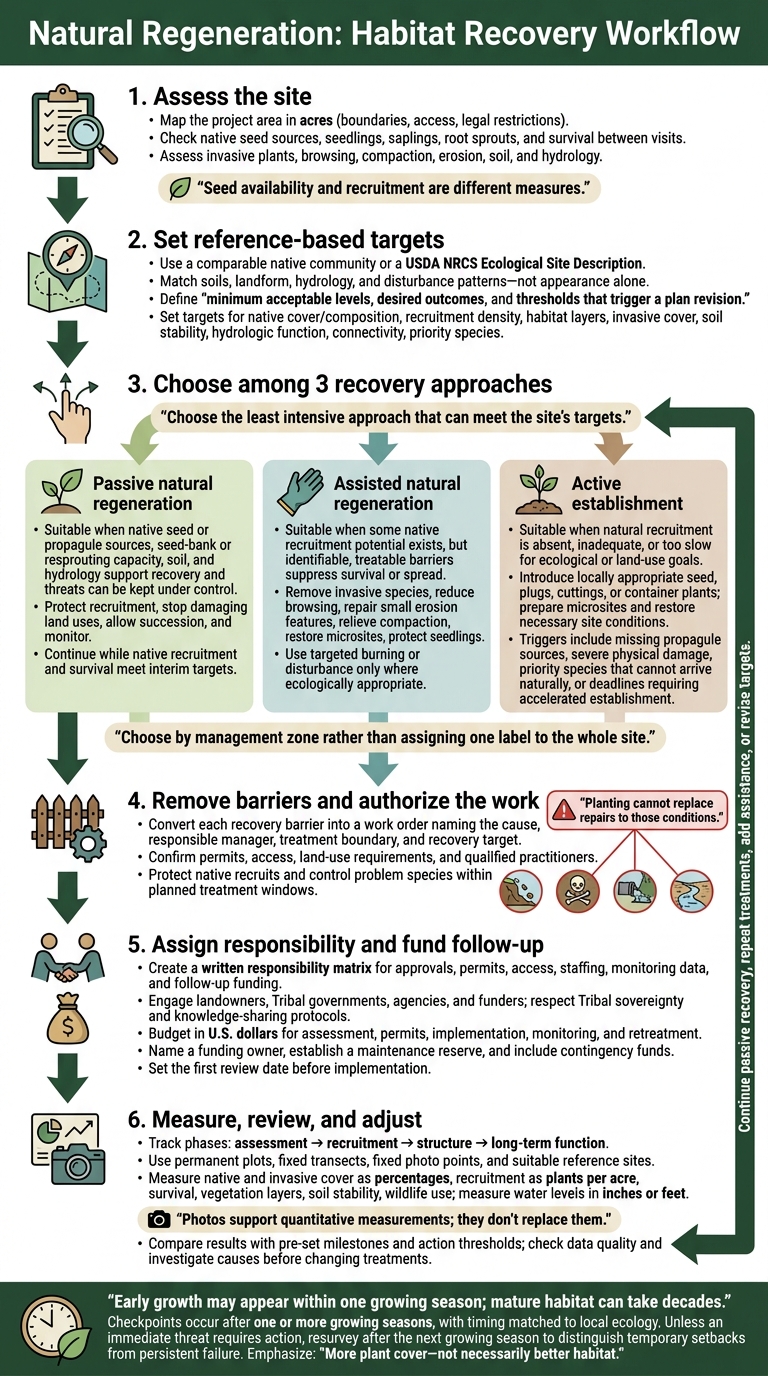
Natural Regeneration: Habitat Recovery Workflow
Assess the Site and Choose a Recovery Approach
Survey Seed Sources and Site Conditions
Seed availability and recruitment are different measures. Record mature native plants, flowering and fruiting periods, distances to habitat patches, and the presence of seedlings, saplings, and root sprouts. Between visits, check whether young plants survive and whether recruitment extends across the site or stays in patches. Survey a representative mix of soil, moisture, and disturbance zones - not just easy-to-reach areas. Test seed-bank potential when needed; seeds in the soil do not necessarily mean new plants will establish.
Map the project area in acres, showing property boundaries, access, utilities, planned development, easements, rights-of-way, protected areas, and legal restrictions. Record wildlife use, browsing, invasive plant cover, compaction, erosion, drainage, and disturbance history. For wetlands, identify water sources, seasonal flooding, outflows, ditches, tile drains, berms, and fill.
Bring in qualified specialists for contamination, regulated waters, unstable slopes, or listed species. Document each survey’s date, method, weather, and limits. Use seed-source distance, recruitment survival, hydrology, compaction, and disturbance history to guide recovery decisions and set realistic targets.
Define Reference Conditions and Recovery Targets
Use a native community with comparable site conditions or a USDA NRCS Ecological Site Description to define what recovery can look like. Match soils, landform, hydrology, and disturbance patterns - not appearance alone. Set measurable targets for native cover and composition, recruitment density, habitat layers, invasive plant cover, soil stability, hydrologic function, connectivity, and priority species.
Define minimum acceptable levels, desired outcomes, and thresholds that trigger a plan revision. Targets must account for legal limits, hydrologic constraints, and future climate stress, including heat, drought, flooding, and permanent hydrologic change. Retain functions such as soil retention and wildlife movement, even when historical species composition is no longer achievable.
Assign indicators and monitoring responsibilities before treatment starts. These targets will help determine whether passive recovery can do the job or whether the site needs assistance or planting.
Choose Passive, Assisted, or Active Recovery
Choose the least intensive approach that can meet the site’s targets.
| Approach | Prerequisites | Main interventions | Strengths | Limitations and risks | Decision triggers |
|---|---|---|---|---|---|
| Passive natural regeneration | Adequate native seed or propagule sources; viable seed bank or resprouting capacity; threats that can be kept under control; suitable soil and hydrology | Protect existing recruitment; stop damaging land uses; allow natural succession; monitor | Lowest implementation cost and disturbance; preserves local genetic material; useful where natural processes still function | Recovery may be slow or unpredictable; invasive species may dominate; recruitment may be too sparse or uneven; severe soil or hydrologic damage may persist | Continue while native recruitment and survival meet interim targets |
| Assisted natural regeneration | Some native recruitment potential, but one or more correctable barriers limit survival or spread | Remove invasive species; reduce browsing; repair small erosion features; relieve compaction; restore microsites; protect seedlings; use targeted burning or disturbance where ecologically appropriate | Often improves natural recovery without full planting; directs resources toward limiting factors | Requires repeated maintenance; poorly timed disturbance can damage recruits; removing barriers may not supply missing species | Use when native regeneration exists but identifiable, treatable barriers suppress it |
| Active establishment | Natural recruitment is absent, inadequate, or too slow for ecological or land-use goals; suitable species and materials are available | Introduce locally appropriate seed, plugs, cuttings, or container plants; prepare microsites; install erosion controls; restore hydrology; establish nurse or structural species | Greater control over composition, spatial pattern, and schedule; appropriate for isolated or severely degraded sites | Higher cost and disturbance; plant material may fail; risks include poor genetic matching, disease introduction, and uniform stands | Use when propagule sources are missing, physical damage is severe, priority species cannot arrive naturally, or deadlines require accelerated establishment |
Choose by management zone rather than assigning one label to the whole site. Compare labor, equipment, budget, recurring maintenance, legal limits, and habitat deadlines. Protect areas with strong recruitment, remove barriers where recovery is suppressed, and plant gaps that persist.
Set checkpoints after one or more growing seasons, with timing matched to local ecology. Under every approach, address unstable erosion, contaminated soil, failed drainage, or major hydrologic damage. Planting cannot replace repairs to those conditions.
sbb-itb-8baf5f1
Remove Recovery Barriers and Organize the Work
Repair Site Conditions and Manage Disturbance
Turn each recovery barrier into a work order that names the cause, responsible manager, treatment boundary, and recovery target. Address only the constraint holding recovery back. Treat traffic-compacted soil rather than grading the entire site. Have qualified specialists assess how drain modifications, floodplain reconnection, and culvert replacement could affect neighboring land.
Keep safe snags, downed wood, leaf litter, and nurse plants. Assess fire, flooding, grazing, and canopy openings based on their timing, intensity, frequency, and ecological purpose.
Before work starts, confirm federal, state, Tribal, and local requirements for water, wildlife, cultural resources, smoke, and safety. Assign prescribed fire and hydrologic work to qualified practitioners, and record the approvals. With site work defined, schedule species control and protection measures within the same treatment windows.
Control Problem Species and Protect Native Growth
Treat invasive patches first when they suppress recruitment, change water or fire patterns, or threaten nearby habitat. Before crews arrive, set treatment windows, methods, repeat inspections, and decision thresholds.
Mark native recruits and retain fruiting adults. Clean equipment and check imported mulch and plants to prevent renewed spread. Follow herbicide labels and applicable rules, and document application rates, weather, buffers, and applicator qualifications.
Use temporary browse protection where needed and keep seed-dispersal corridors open. Add native material only where natural recolonization will miss the deadline. Secure access, staffing, and funding agreements for these actions before crews begin.
Coordinate Land Use, Partners, and Funding
Connect each field action to its governing plan, easement, zoning condition, or mitigation requirement. Verify required mitigation with the responsible authority; habitat improvements do not automatically earn credits.
Engage Tribal governments early as sovereign governments. Respect treaty rights and knowledge-sharing protocols, including limits on disclosure or reuse. Use easements, mowing limits, fencing, and recorded maintenance duties to protect recovery through ownership changes.
Create a written responsibility matrix that assigns work approvals, permits, access, staffing, monitoring data, and follow-up funding in support of the recovery target. Budget in U.S. dollars for assessment, permits, implementation, monitoring, and retreatment. Name a funding owner, establish a maintenance reserve, and set aside contingency funds for storms and renewed invasion. Release funds only after documented milestones are met.
Pair planning with licensed local practitioners for engineering, burning, pesticide application, surveys, and other specialized work. Use the assigned roles and budgets to set phase milestones and monitoring dates.
Rewilding for A Sustainable Future
Set Recovery Timelines and Track Progress
Once barriers are addressed and responsibilities assigned, track recovery against the targets set earlier. Budget for monitoring during project design, covering baseline surveys, seasonal revisits, data review, reporting, and checks after major disturbances. Assign roles for data collection, QA/QC, interpretation, and management decisions. Fund monitoring beyond the initial grant period.[9]
Set Milestones for Each Recovery Phase
Set phased milestones - assessment, recruitment, structure, and long-term function - for passive, assisted, or active zones. Each milestone should specify a measurable condition tied to the site’s targets and a follow-up decision.
Native recruitment may begin within several growing seasons, but mature habitat features can take decades. Use milestone results to decide whether to continue passive recovery, repeat treatments, add assistance, or revise targets.[10][8][9] Let these milestones guide the choice of plots, photo points, and reference sites in the monitoring plan.
Create a Consistent Monitoring Plan
Establish permanent plots, fixed transects, fixed photo points, and suitable reference sites. Measure native species richness and cover, recruitment density and survival, invasive cover, vegetation layers, soil stability, water levels, and priority wildlife or pollinator use against site targets. Report cover as percentages, recruitment as plants per acre, and water levels in inches or feet. Photos support quantitative measurements; they don’t replace them.[7][9]
Document sampling locations, methods, seasonal timing, frequency, benchmarks, and staff duties. Survey plants within the same growing-season window and measure water levels during comparable hydrologic periods. Store raw records and photos with plot IDs, dates, observers, and weather conditions. Verify species that are difficult to identify and review unusual values. Track maintenance hours, access conflicts, and partner participation separately from ecological outcomes.[7][9]
Use Results to Adjust Management
Compare results directly with the milestones and thresholds for each recovery phase. Set action thresholds before surveys begin, matching them to the habitat and reference conditions. Before changing treatments, check data quality and investigate seed supply, browsing, competition, or hydrology.
Base management changes on failed milestones rather than short-term fluctuations. Record droughts and floods. Unless an immediate threat calls for action, resurvey after the next growing season to separate temporary setbacks from persistent failure.[8][9] Report methods, findings, costs, uncertainty, decisions, and reassessment dates.[6] Use recovery rating tools to communicate progress, not to replace field judgment.[5]
Conclusion: Put the Recovery Plan Into Action
Natural regeneration is active habitat management: assess the site, set targets based on reference conditions, remove barriers to recovery, and add help only where needed.[12][14]
Use this checklist to move from planning to fieldwork.
Approve the baseline and targets: Confirm site boundaries, ownership, access, baseline condition, seed sources, and targets based on reference conditions.[12][11]
Authorize the work: Document actions to remove barriers, and secure permits and access agreements.
Name accountable partners: Assign one project lead and put responsibilities for implementation, monitoring, reporting, data management, and maintenance in writing.
Fund multiyear follow-up and contingency work: Ensure funding covers follow-up care and contingency work after initial funding ends.
Set the first review date before implementation: Base it on the first meaningful recovery interval and agreed monitoring rules.[12][13]
Beyond the project boundary, make recovery part of watershed and land-use planning. Map the recovery area, seed sources, and habitat corridors in relevant watershed or comprehensive plans.[8] Align access and stewardship with community and Tribal priorities.[15] Protect these commitments beyond the initial funding period, then begin work under the assigned lead and monitoring schedule.
FAQs
How can I tell if my land’s seed bank is viable?
Assess your site on the ground, not just through desktop reviews. Check existing vegetation, soil conditions, and past land use - all affect whether dormant seeds are present and healthy. Evaluate soil health indicators, and compare the site with reference ecosystems.
Nearby sources of natural recruitment, combined with favorable soil conditions, may support passive regeneration. But if the site is severely degraded or isolated, its seed bank may not contain enough viable seeds to support recovery.
How do I set realistic recovery thresholds?
Establish the ecosystem’s reference condition before degradation, then address the causes of damage, such as upstream drainage or overgrazing [1]. Align restoration targets with SBTN or IFC Performance Standard 6, which provide quantitative thresholds based on species and ecosystem importance [2][3].
Set interim milestones to keep stakeholders engaged, since full recovery can take decades [1]. Track vegetation cover, soil health, and biodiversity, and adjust your approach as conditions change [1][4].
What if recovery stalls after funding ends?
Recovery often stalls when pollution, drainage, or overgrazing go unaddressed [1][2]. Maintenance - including invasive species control, dam repairs, and monitoring - can cost $1,000–$5,000 per year [2].
Council Fire stresses lasting partnerships and making long-term maintenance part of broader sustainability plans, rather than relying on short-term funding cycles [3]. Regular monitoring supports adaptive management, helping teams adjust their work when unexpected challenges arise [1].

FAQ