In This Article
Pick conservation tools by planning goals: file-based stochastic reserve design versus scripted solver-based constrained optimization.
Marxan vs. prioritizr: Conservation Planning Tools
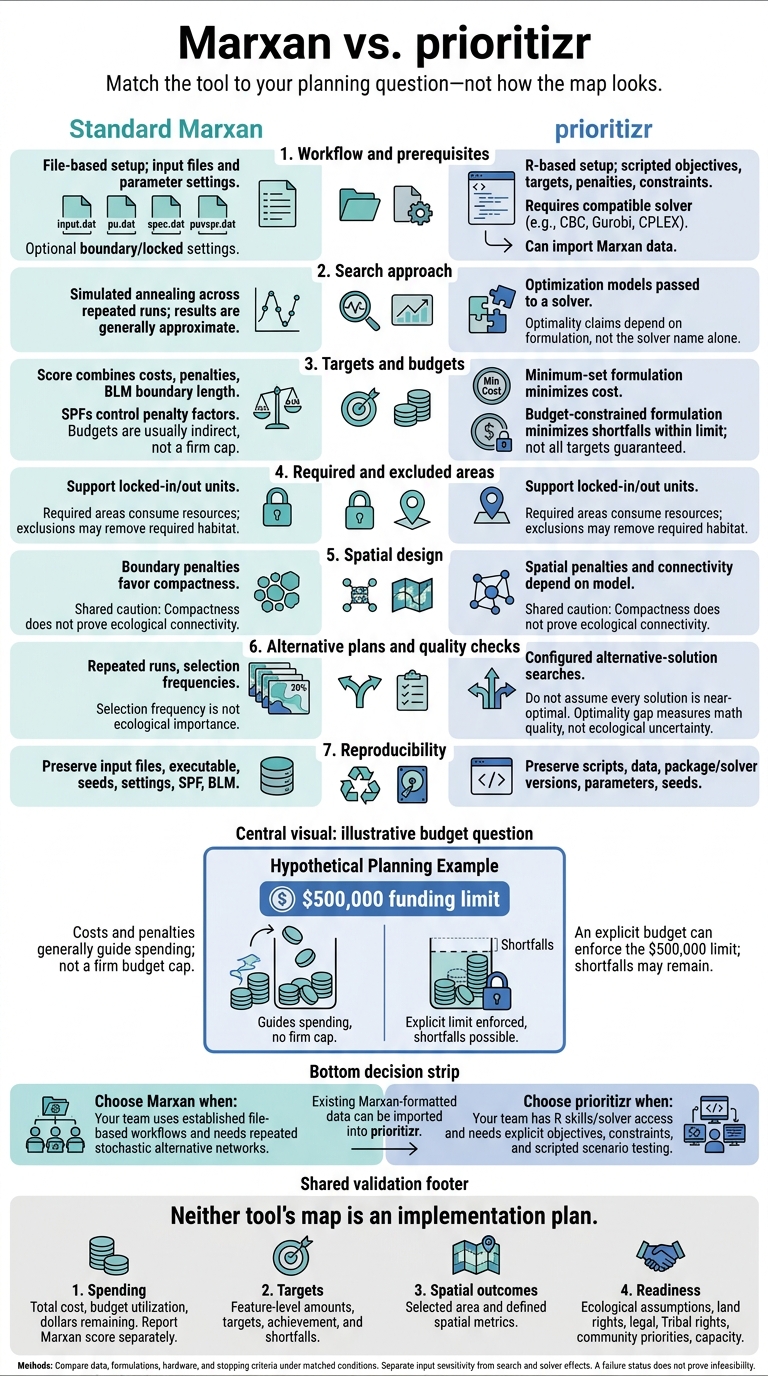
Marxan fits file-based planning with repeated alternative reserve designs; prioritizr fits R-based planning with explicit constraints and solver-based optimization. For a $500,000 funding limit, prioritizr can enforce a hard budget; standard Marxan generally uses costs and penalties rather than a firm cap.
Both tools select conservation areas using targets, costs, and spatial rules. The main differences are how they handle target shortfalls, budgets, connectivity, alternative solutions, and proof of optimality.
Quick Comparison
| Criterion | Standard Marxan | prioritizr |
|---|---|---|
| Setup | Input files and parameter settings | R scripts and a compatible solver |
| Search method | Usually simulated annealing across repeated runs | Optimization models passed to a solver |
| Targets and budgets | Penalizes missed targets; budgets are usually indirect | Can enforce targets or minimize shortfalls within a budget |
| Required or excluded areas | Supports both | Supports both |
| Spatial design | Boundary penalties favor compactness | Spatial penalties and connectivity constraints depend on the model |
| Alternative plans | Repeated runs and selection frequencies | Configured alternative-solution searches |
| Quality checks | Scores, costs, and feature-level shortfalls | Solver status, target results, and optimality gap |
| Repeatability and runtime | Preserve files, seeds, and search settings | Preserve scripts, data, and solver settings |
Neither tool’s map is an implementation plan. Compare spending, target achievement, selected area, spatial measures, and runtime under matched conditions. Test changes to inputs separately from search settings, then check ecological assumptions, land rights, legal requirements, and community priorities before action.
Marxan vs. prioritizr: Choosing a Conservation Planning Tool
prioritizr: Systematic conservation prioritization in R
sbb-itb-8baf5f1
Marxan vs. prioritizr: Setup, Solvers, and Workflow
Setup shapes how each tool handles targets, costs, constraints, and repeatability.
| Workflow element | Standard Marxan | prioritizr |
|---|---|---|
| Input preparation | Prepare input.dat, pu.dat, spec.dat, and puvspr.dat; add optional boundary data and lock or exclusion files. |
Prepare spatial data and costs in R, or import Marxan-formatted data. |
| Configuration | Set targets, feature penalty factors, the boundary length modifier, and repeated-run settings. | Define objectives, targets, penalties, constraints, decisions, and a solver in code. |
| Solver needs | Uses its own search; normally needs no external solver. | Requires a compatible installed solver; commercial options need the appropriate license. |
| Outputs | Best solution, run outputs, summaries, and selection frequencies. | Selected units and spatial outputs, plus solver status, objective value, and optimality gap when available. |
| Reproducibility | Archive inputs, executable version, and run configuration. | Archive scripts, data, and package and solver versions. |
Marxan: Input Files and Repeated Runs
Marxan uses four core files: input.dat holds configuration settings, pu.dat contains planning units and costs, spec.dat defines conservation features and targets, and puvspr.dat records feature amounts within each unit. Optional boundary data describe shared edges, while unit-status settings identify locked or excluded areas. Before running, check IDs, raster alignment, feature summaries, and cost units.
Marxan’s score combines planning-unit costs, target-shortfall penalties, and boundary length weighted by the boundary length modifier (BLM). Species penalty factors (SPFs), also called feature penalty factors, control penalties for missed targets. Calibrate these settings before interpreting results.
The lowest-score run is one candidate solution. Selection frequency shows how often a unit appears across runs - not its ecological importance or probability. Standard Marxan selects units; zoning requires an extension such as Marxan with Zones.
prioritizr: R Setup and Solver Options
In R, build a problem(), add the objective, targets, penalties, constraints, decision type, and solver, then call solve(). A minimum-set formulation minimizes cost while meeting targets. A minimum-shortfall formulation minimizes unmet targets within a budget but does not guarantee that every target will be met. Binary decisions select whole units; proportional decisions allow partial allocation where appropriate.
CBC is open source. Gurobi and IBM CPLEX are commercial options that require separate installation and licenses. Some versions also list HiGHS, Rsymphony, and lpsymphony. An optimality claim must match the formulation, termination status, and stopping tolerances - the solver’s name alone is not enough.
Reproducibility and Runtime
Neither workflow is reproducible by default. For Marxan, preserve inputs, boundary files, seeds, repeat counts, annealing settings, SPF values, and BLM. For prioritizr, preserve scripts, preprocessing steps, package versions, solver parameters, and seeds.
Keep a machine-readable run log that records hardware, runtime, objective value, target shortfalls, output filenames, and termination status or optimality gap. Compare runtime only when data, formulations, hardware, and stopping criteria match. Planning-unit count, feature count, and spatial complexity can affect both speed and solution quality.
The next question is how each tool handles targets, costs, and feasibility constraints.
Targets, Costs, and Constraints
Once setup and solver choice are settled, the next step is to understand how each tool turns goals into feasible plans. The key distinction: a hard constraint cannot be violated; a penalty makes a violation costly but still possible.
| Planning requirement | Marxan treatment | prioritizr treatment | What it means |
|---|---|---|---|
| Representation targets | Feature shortfalls increase the objective. | Targets are enforced in minimum-set problems; shortfalls are minimized in minimum-shortfall problems. | Define targets before interpreting results.[4][8] |
| Planning-unit costs | Combined with boundary and shortfall penalties. | Enter the objective or an explicit constraint. | Report spending separately from the combined score.[4][13] |
| Budgets | Usually indirect, through costs, penalties, or scenario design rather than a hard cap. | An explicit budget limits feasible spending. | A preference for lower costs is not a funding limit.[4][8][12] |
| Locked-in units | Fixed-in status requires selection. | Locked-in constraints require selection. | Required areas use resources and leave fewer choices.[4][12] |
| Locked-out units | Fixed-out status prevents selection. | Locked-out constraints prevent selection. | Exclusions can remove habitat needed to meet targets.[4][12] |
| Compactness and connectivity | Boundary penalties favor compactness. | Spatial penalties or connectivity constraints apply, depending on the formulation. | Compactness does not prove ecological connectivity.[4][13] |
| Unmet targets | Penalized and reported as feature shortfalls. | Not allowed in feasible minimum-set solutions; optimized in minimum-shortfall problems. | Check every feature, not just the overall score.[4][8][13] |
Representation Targets and Shortfalls
Marxan penalizes target shortfalls. By contrast, prioritizr’s minimum-set formulation requires targets to be met. Set those targets before interpreting either tool’s results.
For each feature, record its measurement unit, total available amount, and amount remaining after exclusions. Keep percentage targets separate from absolute quantities, and distinguish existing habitat from restoration potential. After solving, report selected amount, target amount, percentage achieved, and residual shortfall for every feature. A low objective value does not mean every target was met.[4][13]
Costs, Budgets, and Locked Units
Marxan combines costs with penalties; prioritizr can impose an explicit budget. Both tools enforce locked-in selections and locked-out exclusions. These rules can determine whether a plan is feasible.
Specify whether costs include acquisition, management, restoration, opportunity costs, or a combined present value estimate. Use consistent U.S. dollar values and time horizons - annual and one-time costs should not be mixed. For locked units, report their count, area, cost, and conservation value.[4][12][13]
Compactness and Connectivity
Marxan generally handles spatial structure through boundary penalties weighted by its boundary-length modifier. prioritizr supports spatial penalties or constraints. These choices affect both the shape of a solution and its ecological function.
Choose a connectivity metric that fits the planning question, then validate it separately. Shared edges alone do not account for movement barriers, habitat permeability, or species-specific dispersal.[4][13]
Unmet targets may point to a mismatch among habitat supply, exclusions, budget, or penalties. Check habitat availability, locked-unit conflicts, and budget limits. In Marxan, inspect feature shortfalls, cost and boundary contributions, and penalty settings. In prioritizr, read the solver’s termination status: a failure status does not prove infeasibility. Relax constraints one at a time to identify the cause, and document any changes to budgets, exclusions, or targets.[4][7][11]
Planning Scenarios and Results
Once targets, costs, and constraints are set, test how each formulation answers different planning questions.
| Scenario | Tool comparison | Compare outputs | Interpretation warning |
|---|---|---|---|
| Minimum cost | Marxan: run repeated searches with targets and spatial penalties. prioritizr: minimize cost while meeting all targets. | Total cost, target achievement, selected area, and boundary length. | Soft target penalties and hard targets are different formulations. |
| Minimum shortfall | Marxan: compare shortfalls from cost-and-penalty searches. prioritizr: minimize shortfall within a budget. | Feature-level shortfalls, spending, target coverage, and selected units. | Marxan’s combined score does not automatically minimize the same shortfall measure. |
| Fixed budget | Use a hard budget in prioritizr; calibrate Marxan to approximate the cap. | Spending, budget remaining, unmet targets, and feasibility. | Budget-limited shortfalls do not prove targets are generally impossible. |
| Locked areas | Compare how much area must be included, how much flexibility remains, and how costs change. | Required area, added cost, and target contribution. | Match treatment of existing protection carefully. |
| Connectivity emphasis | Compare boundary length, fragmentation, clumping, and connectivity trade-offs. | Spatial metrics alongside cost and target achievement. | Similar spatial goals can require different formulations and calibration. |
| Sensitivity analysis | Marxan: vary scenario inputs and summarize selection frequency. prioritizr: vary the same inputs, solver tolerance, and alternative-solution settings. | Solution similarity, cost ranges, target outcomes, and solution-quality diagnostics. | Separate input sensitivity from search and solver effects. |
Clearly label comparisons that need different formulations; don’t present them as one-to-one implementations.[4][16] Keep inputs the same, then change only the optimization question.
Minimum-Cost and Fixed-Budget Scenarios
For a $500,000 land-protection budget, minimum cost asks what it takes to meet every target; fixed budget asks what can be achieved within available funds. In prioritizr, a budget-constrained minimum-shortfall formulation answers the latter question. Compare achieved spending, budget utilization, dollars remaining, feature-level achievement and shortfalls, selected area in acres, and locked-area costs.[4][16][17]
Sensitivity Tests and Alternative Solutions
First, compare alternative solutions with inputs held constant. Then change targets, costs, locked areas, and spatial preferences one at a time before testing combined changes.
Marxan selection frequencies describe selection across repeated runs - not the probability of ecological success. In prioritizr, report alternative-solution settings and diversity, solver status, and the achieved optimality gap. Don’t assume every returned solution is near-optimal. The gap measures mathematical solution quality, not ecological uncertainty. Repeating runs with unchanged inputs does not test uncertainty in habitat or cost data.[5][6][7][14][15]
Results Metrics and Stakeholder Review
After solving, compare outputs that matter for implementation, not just model fit. Group results from the same-data scenarios into four categories:
Spending: Total cost in U.S. dollars, budget utilization, and dollars remaining. Report Marxan’s combined score separately from spending.
Target achievement: Feature-level achievement and shortfalls.
Spatial form: Selected planning units and area in acres, with hectares in parentheses where useful. Include boundary length, compactness, or another defined spatial metric.
Implementation readiness: Locked-area inclusion, implementation restrictions, and whether results have been validated in the field or with stakeholders. Record runtime, solver status, mathematical feasibility, and whether prioritizr proved optimality within the stated solver tolerances.[4][7][18]
Review several feasible portfolios with ecological experts, landowners, Tribal governments, and affected communities. Test habitat assumptions, landowner willingness, Tribal rights and interests, legal requirements, community acceptance, and stewardship capacity. Selected by the model does not mean ready for implementation. Projected conservation benefits remain potential benefits until validated.[9][10]
Conclusion: Choose the Tool That Fits Your Project
Choose based on your planning question, team capacity, and solver access - not how the map looks. Marxan suits established reserve-design workflows, while prioritizr suits scripted optimization with many constraints.[12][19][5]
| Tool | Best fit | Main strengths | Prerequisites | Limitations | Likely workflow |
|---|---|---|---|---|---|
| Marxan | Projects familiar with reserve-design conventions that need many stochastic alternative networks | Established input/output structure; simulated annealing; repeated runs | Correctly formatted planning-unit, feature, cost, boundary, and scenario files; parameter tuning; multiple runs | Results are stochastic and generally approximate; interpretation requires checking run quality, target achievement, and parameter sensitivity | File-based setup and repeated stochastic searches |
| prioritizr | Projects that need transparent, scripted optimization with many constraints | R-based reproducibility; explicit objectives and constraints; locked-in and locked-out units; configurable solvers | R skills, clean spatial data, and a compatible solver | Solver installation or licensing can pose barriers; model formulation can be technically demanding | Scripted model building and solver-based scenario testing |
Both tools require technical capacity and independent validation before action. Existing Marxan projects don't need to start over: prioritizr can read Marxan-formatted input data, providing a way to test a solver-based formulation.[5]
Validate Results and Plan Implementation
Once you've chosen a tool that fits your targets, constraints, and solver needs, use this handoff check before implementation:
Package validated inputs: Include geometry, projections, identifiers, and consistent feature units.
Document assumptions: Preserve costs, targets, budgets, penalties, locked units, input versions, and software settings.
Record approvals and conditions: Document ecological and stakeholder review outcomes, land-tenure and legal requirements, Tribal sovereignty and data governance, and community priorities.
Assign delivery: Set phased actions, budgets, responsible parties, monitoring indicators, and update cycles.
FAQs
How can I tell if my conservation targets are realistic?
Define clear, testable outcomes - not broad actions. State the target year, population or geographic area, measurable benefit, indicator used to track it, and possible tradeoffs [1]. Factor in legal limits, hydrologic constraints, and future climate stresses [2].
Use scenario modeling to test targets against best-case, worst-case, and most-likely conditions [3]. Set interim milestones to track progress and flag when the plan needs adjustment [2].
How should I account for uncertain land costs?
Use scenario modeling and sensitivity analysis to test best-case, worst-case, and most-likely land costs [1]. Monte Carlo simulations can model probability distributions for financial metrics such as net present value, showing a range of possible outcomes [1].
Compare project portfolios across funding and development scenarios in tables, rather than reducing results to a single number [2]. Include lifecycle operations and maintenance costs in land acquisition planning estimates so long-term costs aren't underestimated [2].
When should I update my conservation plan?
Update your conservation plan when you reach set thresholds or project milestones, or when regulatory cycles call for a review. If FEMA requirements apply, update the plan every five years. Document the status of previous actions and how the plan connects with other mechanisms, such as capital improvement plans [1][2].
For habitat recovery, set revision triggers during planning - for example, missed targets for native cover or recruitment. Schedule reviews around ecological timing, such as after a growing season or a major disturbance [3].




FAQ