In This Article
Practical guide for banks to measure and disclose financed emissions under IFRS S2: attribution, coverage, data gaps, controls.
IFRS S2 for Banks: Financed Emissions Reporting
Under IFRS S2, banks report financed emissions under Scope 3, Category 15 - but the total alone does not show climate progress. Banks must explain portfolio coverage, data gaps, and calculation methods, then check which requirements apply under local rules.
This guide covers how banks can:
Define reporting boundaries and break down emissions by counterparty scope, industry, and asset class.
Calculate attributed emissions, report undrawn commitments separately, and treat missing data as a gap - not zero.
Build checks and assign owners so published figures trace back to source data and approved calculations.
Track borrower progress separately from changes caused by asset sales, valuations, exchange rates, or revised estimates.
IFRS S2 took effect for annual periods beginning on or after January 1, 2024. December 2025 amendments take effect on January 1, 2027, with early application permitted, subject to local adoption. U.S. banks should verify their applicable reporting, filing, and assurance rules rather than assume IFRS S2 is mandatory.
Webcast: What you need to know about the ISSB’s proposed targeted amendments to IFRS S2
sbb-itb-8baf5f1
IFRS S2 Requirements and Local Rules
Start with the IFRS S2 baseline, then apply the adoption rules for the relevant jurisdiction.
Required Financed Emissions Disclosures
For commercial banking activities, disclose absolute gross financed emissions by counterparty Scope 1, Scope 2, and Scope 3 emissions, broken down by industry and asset class. Explain the methodology, key assumptions, data sources, percentage of gross exposure covered, and portfolios excluded. Report gross exposure in the financial statement presentation currency, and measure funded exposure before loss allowances. [1][3][8]
Report undrawn commitments separately. Include the full undrawn amount, the share included in the calculation, the attribution method, and any utilization assumptions. [1][4]
Reporting Boundaries and Portfolio Classifications
Identify the reporting entity and reconcile lending, investment, and commitment balances to the financial statements. Treat the reporting entity, emissions boundary, and portfolio exposure boundary as separate boundaries. [1]
If the applicable version allows a classification system other than GICS, name the system used and apply it consistently. [4][9]
Use the IFRS Foundation industry guidance to identify relevant metrics and topics - not as a replacement for IFRS S2. [6]
Local Adoption, Effective Dates, and Reliefs
Before claiming compliance, state the version applied, jurisdictional adoption instrument, reporting period, early-application status, reliefs, assurance requirements, and filing destination.
IFRS S2 baseline: Effective for annual periods beginning on or after January 1, 2024, with early application permitted. It includes first-year Scope 3 and prior measurement-method reliefs. Local rules determine mandatory assurance and filing obligations. [1]
December 2025 amendments: Effective for annual periods beginning on or after January 1, 2027, with early application permitted. They introduce targeted greenhouse gas measurement reliefs, alternative classification systems in specified circumstances, and jurisdictional global warming potential relief. Check local adoption before applying them. [4][9][10]
United States: Follow the applicable rule or regulator. Verify the effective date, scope, reliefs, assurance, and filing treatment under that regime. Do not describe U.S. adoption or filing details as universal requirements.
With the applicable rules established, move to measuring financed emissions, coverage, and data limits.
Measuring Emissions, Coverage, and Data Limits
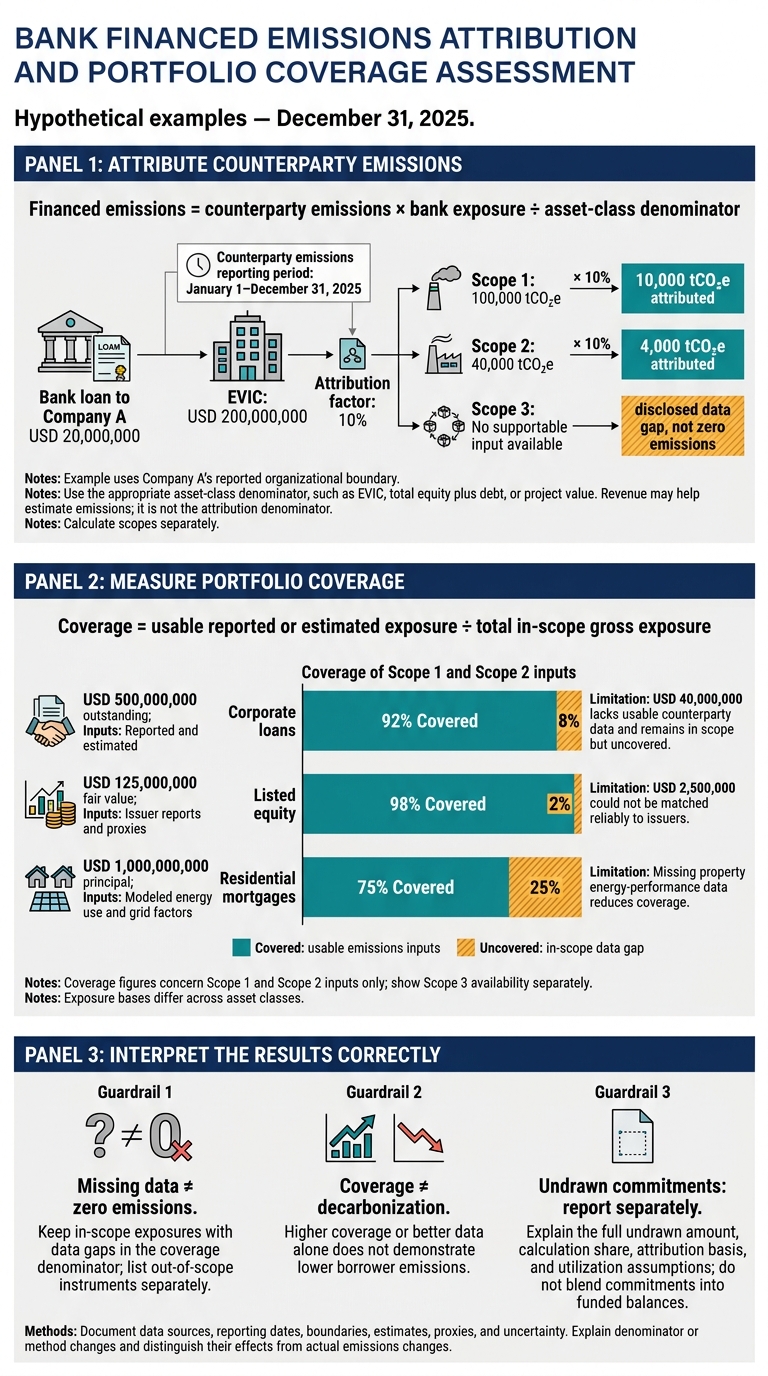
Bank Financed Emissions: Attribution and Coverage
Attribution Methods and Data Sources
Once the boundary is set, calculate financed emissions as counterparty emissions × bank exposure ÷ the asset-class denominator. Calculate Scope 1, Scope 2, and relevant Scope 3 separately. Use the denominator for the asset class, such as EVIC, total equity plus debt, or project value. Revenue can help estimate emissions, but it is not the attribution denominator. Apply methods consistently across portfolios and reporting periods while accounting for asset-class differences. PCAF is common, but IFRS S2 permits other documented methods. State the version used.[1][2]
| Input type | Typical source | Checks before use |
|---|---|---|
| Reported data | Audited or publicly disclosed borrower emissions, verified facility data, regulatory filings | Use the counterparty’s reported Scope 1 and Scope 2 emissions for the relevant reporting period after checking organizational and operational boundaries |
| Estimated data | Modeled emissions based on energy use, production, revenue, physical activity, or sector intensity | Estimate emissions when borrower data are unavailable; document the model, inputs, assumptions, and estimation year |
| Proxy data | Sector-average intensity, regional grid factors, peer emissions, or other substitute indicators | Use only when more specific information is unavailable; identify the proxy and prioritize replacement with counterparty-specific information |
Hypothetical calculation: At December 31, 2025, a bank has a USD 20,000,000 loan to Company A and uses its USD 200,000,000 EVIC as the denominator. The attribution factor is 10%. Company A reports 100,000 tCO2e of Scope 1 and 40,000 tCO2e of Scope 2 emissions for January 1–December 31, 2025. Within Company A’s reported organizational boundary, the bank attributes 10,000 tCO2e and 4,000 tCO2e, respectively. Scope 3 remains a disclosed gap because no supportable input is available, not zero emissions. If the denominator later changes, explain why, quantify the effect where practicable, and revise comparatives when required.[1][2]
After attribution, measure how much of the portfolio has usable emissions inputs.
Portfolio Coverage, Exclusions, and Commitments
Coverage = usable reported or estimated exposure ÷ total in-scope gross exposure. Define both parts of the calculation and disclose the exposure basis, reporting date, and asset class. Break down results by industry and asset class, showing Scope 3 availability separately from Scope 1 and Scope 2 coverage. Coverage measures reporting completeness - not decarbonization performance.[1][2]
Keep in-scope exposures with data gaps in the denominator, and list out-of-scope instruments separately. For undrawn commitments, explain the calculation share, attribution basis, and utilization assumptions. Do not blend them into funded balances.[1][2]
Hypothetical portfolio figures at December 31, 2025; coverage below concerns Scope 1 and Scope 2 inputs.
Asset class Exposure measure Emissions inputs Coverage Limitation Corporate loans USD 500,000,000 outstanding Reported and estimated 92% USD 40,000,000 lacks usable counterparty data and remains in scope but uncovered Listed equity USD 125,000,000 fair value Issuer reports and proxies 98% USD 2,500,000 could not be matched reliably to issuers Residential mortgages USD 1,000,000,000 principal Modeled energy use and grid factors 75% Missing property energy-performance data reduces coverage
Data Gaps, Estimates, and Uncertainty
Document the information hierarchy and disclose where proxies are used. Record emissions periods, exposure dates, organizational boundaries, estimation methods, emission factors, and any mismatch between borrower and bank reporting periods. Treat missing data as a gap, not zero emissions. Identify Scope 3 gaps separately because Scope 3 can be more material than Scope 1 and Scope 2 in some industries. Reasonable-and-supportable information still requires measurement.[1][2][7]
Explain methods, significant assumptions, inputs, and measurement uncertainty. Metrics such as reported-data share, proxy share, and data-quality scores can help readers assess totals, but they do not replace these disclosures. When replacing proxies, separate the effect of the method change from actual emissions changes, and revise comparatives when required. Better data alone does not demonstrate decarbonization.[1][2]
These inputs feed the controls, review, and sign-off steps in the reporting workflow.
Reporting Workflow and Controls
Set Up the Reporting Process
Assign one accountable owner for each stage, and have material judgments reviewed separately. Align the reporting calendar with financial reporting processes. Keep evidence that links every published figure to its source, calculation version, and approval. Treat this workflow as a control map - not an IFRS S2 template.[5]
| Stage | Accountable function | Required evidence | Main control |
|---|---|---|---|
| Applicability and local-rule review | Regulatory reporting and legal/compliance | IFRS S2 applicability memo; local obligations register; effective-date analysis | Independent legal and regulatory review |
| Boundary and portfolio definition | Finance, sustainability, and risk | Approved reporting-boundary paper; asset-class inventory; policy on exclusions | Sign-off against the financial-consolidation and risk perimeters |
| Portfolio mapping | Credit, investment, and data management | Exposure-level population; counterparty identifiers; industry classifications | Checks for duplicate, unmapped, and unclassified exposures |
| Data collection | Sustainability and data management | Source files; reporting year; emissions scopes; verification status; emissions factors | Review of source hierarchy, completeness, timeliness, and data quality |
| Calculation | Sustainability, finance, and model risk | Version-controlled calculation model; allocation methodology; assumptions register | Independent recalculation and mathematical aggregation checks |
| Coverage and exclusions | Sustainability and regulatory reporting | Coverage schedule; excluded balances and reasons | Reconciliation of covered and excluded populations to total exposure |
| Financial reconciliation | Finance and risk | Reconciliation of funded exposure, gross carrying amounts, AUM, and undrawn commitments | Tie-out to the general ledger, exposure systems, and approved currency/date basis |
| Disclosure drafting | Regulatory reporting and sustainability | IFRS S2 cross-reference; disclosure checklist; draft tables and narrative | Disclosure-to-source and comparative-period review |
| Final approval and assurance | CFO, CRO, sustainability leadership, internal audit, and external assurer where applicable | Review minutes; control certifications; assurance evidence; remediation log | Formal management approval and closure of exceptions |
Once roles and evidence requirements are set, check calculations before drafting disclosures.
Check Calculations and Disclosures
Reconcile exposures before calculation and again before publication. Test classifications, denominator values, emission-factor versions, reporting dates, and aggregation. Archive dated source files rather than relying on live links.
Lock the approved calculation version. For every override, record the reason, preparer, approver, date, and quantified effect. Check that estimates, exclusions, uncertainty, and methods are consistent across tables and narrative.
Maintain two linked records: an IFRS S2 disclosure cross-reference that maps requirements to disclosures and evidence, and a local obligations register covering jurisdiction-specific scope, deadlines, reliefs, filing formats, and assurance. Keep reviewer sign-offs and supporting files for internal review and any locally required assurance. A local filing alone does not prove IFRS S2 compliance.[11][12]
Turn Reporting Findings Into Action
After disclosure, use the same data to guide portfolio decisions. Let the findings set priorities for borrower engagement, sector-policy reviews, and transition-plan milestones. Credit teams should own follow-up, with clear deadlines and escalation routes.
Request verified emissions data, transition plans, and progress evidence from material, higher-risk counterparties. For smaller exposures, use proportionate questionnaires or supportable estimates. Track whether borrowers deliver agreed actions - not simply whether they answer a questionnaire.
Separate portfolio effects from counterparty progress. Distinguish emissions changes from the effects of sales, repayments, attribution changes, FX, and revised estimates. This keeps portfolio changes from being mistaken for emissions progress.
Conclusion: Next Steps for Banks
Beyond calculations and controls, a sound financed-emissions disclosure depends on consistent methods and clear limits. It should not imply that the portfolio has decarbonized.[3][4]
IFRS S2 and local adoption rules differ. Before finalizing disclosures, confirm the applicable version, reporting period, and local filing obligations, including reliefs.[13]
To move from reporting to portfolio management, take three actions:
Assign one executive owner.
Quantify data gaps.
Approve a prioritized improvement plan with accountable teams, deadlines, and measurable milestones.
Rank gaps by exposure materiality, data quality, and regulatory impact. Use those priorities to turn disclosure findings into a measurable agenda for reporting and portfolio management.
FAQs
How do I assess which financed emissions data gaps matter most?
Prioritize data gaps based on business materiality and their effect on decisions. Start with your largest financial exposures and highest-emitting sectors.
IFRS S2 permits estimates when primary data is unavailable. Document your methods, assumptions, and limitations, and apply internal controls to those assumptions. Missing data does not automatically make a metric immaterial. For each omission, record whether the reason is non-applicability, immateriality, or insufficient data. Replace estimates with primary data as it becomes available.
How can I tell whether borrowers are actually decarbonizing?
Track borrowers’ climate-related targets and actual progress, using clear interim milestones to check whether plans are turning into action. Under IFRS S2, banks must disclose these targets, the metrics used to track them, and broader transition plans.
Review documented evidence, including baseline data and verified performance records, to assess whether progress is supported by evidence, measurable, and aligned with each borrower’s stated climate strategy.
How do I verify which IFRS S2 rules apply to my bank?
Check the rules wherever your bank operates or is listed. IFRS S2 sets a global baseline - it does not, by itself, require a filing. Map each entity to local reporting thresholds, reporting periods, effective dates, and available reliefs.
Compare applicable rules with IFRS S2 and separate required filings from voluntary disclosures. Use financed emissions guidance to verify reporting boundaries and relevant financial activities. Document each decision and cite the local legal provision that supports each compliance requirement.




FAQ