In This Article
Clear global checklist of ISSB adoption: where standards are mandatory, voluntary, or pending — and key reporting checks for entities.
On this page
ISSB Adoption: Global Policy Roundup
ISSB standards do not create a reporting duty on their own - local rules do. As of October 24, 2026, I would check your entity’s legal scope and first reporting period before setting a compliance date. Australia’s first climate-reporting phase began in 2025; Canada’s CSDS 1 and 2 remain voluntary.
In this roundup, I separate binding rules from future requirements, proposals, policy announcements, and voluntary use across Asia-Pacific, the Americas, Europe, Africa, and the Middle East. I also distinguish ISSB-based requirements from local frameworks, including the EU’s ESRS.
For your reporting plan, I focus on three checks:
Who must report: entity size, listing status, and local thresholds.
What must be reported: climate-only or broader disclosures, emissions coverage, and assurance.
When and where: the first reporting period, filing deadline, reporting location, and transition relief.
My starting point is the governing local rule - not a tracker listing. A reporting period is not a filing deadline, and <u>an unverified timetable is not a confirmed obligation</u>.
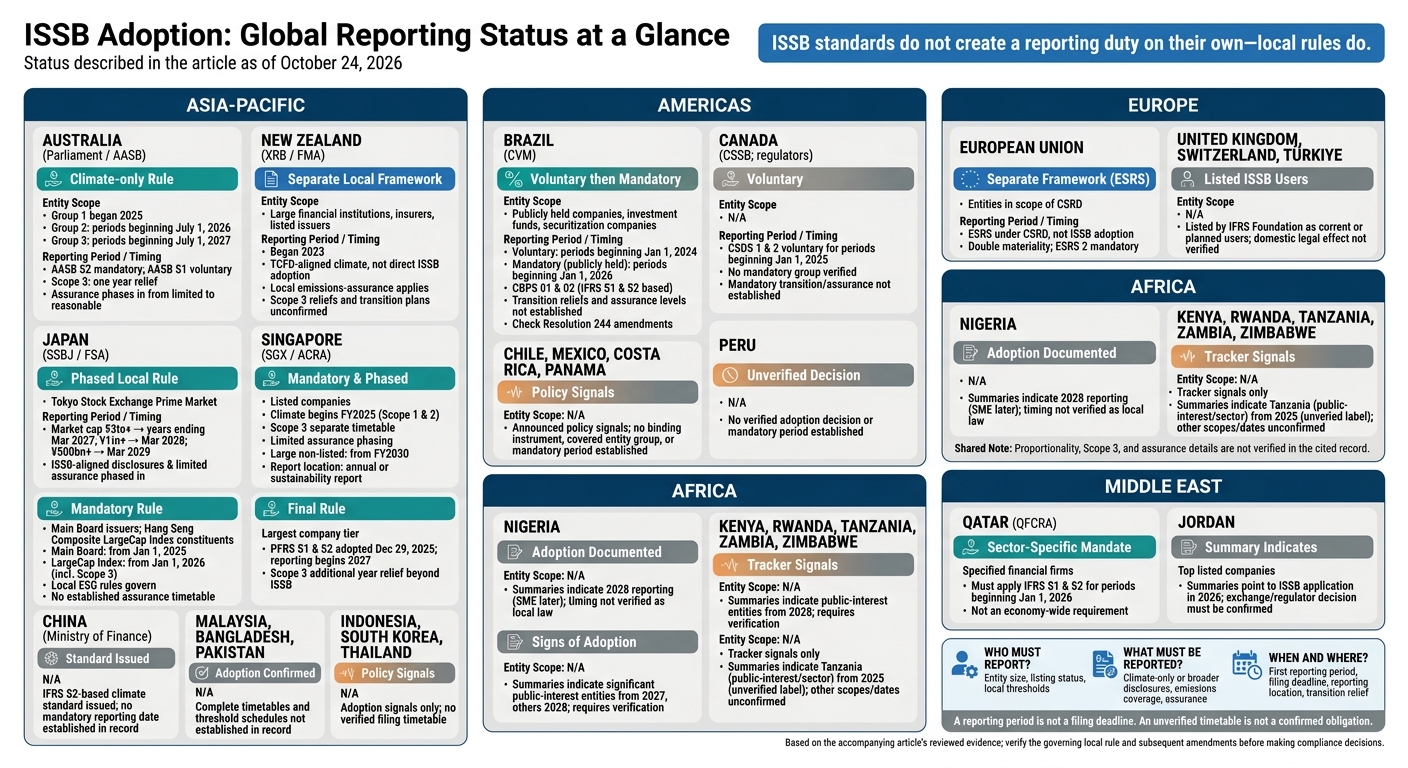
ISSB Adoption: Global Reporting Status at a Glance
Asia-Pacific: Coverage and Reporting Timelines
Australia, New Zealand, and Japan
Australia, New Zealand, and Japan take different domestic routes to ISSB-style reporting, with coverage and deadlines tied to local rules.
| Jurisdiction and authority | Covered entities | Reporting periods | Coverage, reliefs, and assurance |
|---|---|---|---|
| Australia - Parliament / AASB | Later size-based cohorts: Groups 2 and 3. | Group 2: periods beginning July 1, 2026. Group 3: periods beginning July 1, 2027.[4] | Scope 3 receives one year of relief. Assurance moves in phases from limited toward reasonable assurance.[4][2] |
| New Zealand - XRB / FMA | Large financial institutions, insurers, and listed issuers. | Reporting began in 2023.[1][3] | Climate-only reporting follows local rules and aligns with TCFD. Local emissions-assurance requirements apply. The cited record does not confirm Scope 3 reliefs or transition-plan rules.[3] |
| Japan - SSBJ / FSA | Tokyo Stock Exchange Prime Market companies, phased by market capitalization: ¥3 trillion, ¥1 trillion, and ¥500 billion or more.[4][1] | Years ending March 2027, March 2028, and March 2029, respectively.[4][1] | ISSB-aligned sustainability disclosures and limited assurance are phased in.[2] |
Entity size and listing status shape these schedules. Other Asia-Pacific jurisdictions draw different lines between mandatory and voluntary reporting.
Singapore and Hong Kong SAR
Both jurisdictions phase in requirements by issuer category, but climate coverage and assurance follow different schedules. Track emissions deadlines separately from the broader ISSB disclosure schedule. Singapore starts with listed companies, then extends reporting to large nonlisted entities.[13][15][16]
| Entity category and authority | Status and timing | Scope 3 and assurance | Reporting location and limits |
|---|---|---|---|
| Singapore listed companies - SGX / ACRA | Climate disclosures begin in FY2025, starting with Scope 1 and 2 emissions.[13][4] | Scope 3 follows a separate timetable. Limited assurance is being phased in.[2][13] | Annual report or sustainability report. |
| Singapore large nonlisted companies - ACRA | Reporting is required from FY2030.[1][5] | - | - |
| Hong Kong SAR Main Board issuers - HKEX | Mandatory climate reporting applies from January 1, 2025.[15][16] | Requirements depend on issuer category.[15][16] | Local ESG reporting rules govern.[16] |
| Hong Kong SAR Hang Seng Composite LargeCap Index constituent issuers - HKEX | Mandatory climate disclosures apply from January 1, 2026.[15][16] | Scope 3 is included. The cited record does not establish an assurance timetable. | Local ESG reporting rules govern.[16] |
Elsewhere in the region, several jurisdictions have issued standards or signaled adoption without setting a full mandatory reporting timetable.
Other Asia-Pacific Decisions: Binding Status and Timetables
| Jurisdiction | Status check | Covered entities and timing |
|---|---|---|
| Philippines - SEC | Final rule: PFRS S1 and PFRS S2 adopted December 29, 2025. | The largest company tier begins reporting in 2027. Scope 3 receives an additional year of relief beyond the ISSB baseline.[11] |
| China - Ministry of Finance | IFRS S2-based climate standard issued. | The cited record establishes no mandatory reporting date.[11] |
| Malaysia, Bangladesh, and Pakistan | Adoption or use confirmed in IFRS Foundation profiles. | The cited record does not establish a complete timetable or threshold schedule.[12][6] |
| Indonesia, South Korea, and Thailand | Adoption signals, with no verified filing timetable. | Treat these as signals only until local law sets the status, scope, and effective date.[8][7] |
sbb-itb-8baf5f1
The Americas: Mandatory and Voluntary Reporting
Brazil and Canada
Brazil has a mandatory, regulator-led timetable. Canada’s standards remain voluntary.
| Jurisdiction and authority | Instrument and status | Covered entities and periods | Reliefs and assurance |
|---|---|---|---|
| Brazil - CVM | Resolution CVM 193 sets the reporting framework using CBPS 01 and CBPS 02, based on IFRS S1 and IFRS S2.[17][18][19] | Voluntary for fiscal years beginning January 1, 2024, for publicly held companies, investment funds, and securitization companies; mandatory for publicly held companies for fiscal years beginning January 1, 2026.[17][19] | The reviewed evidence does not establish transition reliefs or assurance levels. |
| Canada - CSSB; securities regulators | CSDS 1 and 2 are voluntary for periods beginning January 1, 2025; no mandatory issuer group has been verified.[6][12] | Sustainability-related and climate disclosures. These requirements are designed to help organizations build climate resilience and long-term growth. | The reviewed evidence does not establish mandatory transition provisions or assurance requirements. |
Before setting a filing date, check the latest CVM Resolution 193 text, including amendments under Resolution 244.
Chile, Mexico, Costa Rica, Panama, and Peru
The reviewed record shows policy signals - not verified binding requirements - in Chile, Mexico, Costa Rica, and Panama. It contains no verified adoption decision for Peru.[7][20]
| Jurisdictions | Status supported by reviewed evidence | Verified scope and timetable |
|---|---|---|
| Chile, Mexico, Costa Rica, and Panama | Announced | The reviewed evidence does not establish a binding domestic instrument, covered entity group, or mandatory reporting period.[7][20] |
| Peru | No verified adoption decision | The reviewed evidence does not establish a Peru-specific adoption instrument or mandatory reporting period. |
IRSG webinar - Harmonising Sustainability Disclosures: A Roadmap for the Adoption of ISSB Standards
Europe, Africa, and the Middle East: Reporting Rules
This region shows the clearest divide between ISSB adoption and local disclosure frameworks.
European Union, United Kingdom, Switzerland, and Türkiye
The EU uses ESRS under CSRD rather than adopting ISSB standards. It appears here only for comparison because its climate disclosure requirements overlap with ISSB.[28][29]
| Jurisdiction | Status |
|---|---|
| European Union | ESRS under CSRD; double materiality; ESRS 2 mandatory for entities within scope.[28][29] |
| United Kingdom | Listed by the IFRS Foundation as a current or planned ISSB user; domestic legal effect has not been verified.[14][27] |
| Switzerland | Listed by the IFRS Foundation as a current or planned ISSB user; domestic legal effect has not been verified.[14][27] |
| Türkiye | Listed by the IFRS Foundation as a current or planned ISSB user; domestic legal effect has not been verified.[14][27] |
Across Africa, signs of adoption outnumber fully verified mandates. That makes checking the original sources especially important.
Verified Adoption Decisions in Africa
Nigeria’s adoption is documented. Other jurisdictions show signs of adoption or remain unconfirmed. A tracker listing alone does not establish a mandate - check the scope and dates against the issuing authority’s original rule.[14][25][26][27]
| Jurisdiction | Status and reported timing | Local details |
|---|---|---|
| Nigeria | IFRS S1 and S2 adoption is documented; summaries indicate reporting from 2028, with SME coverage later.[25][26] | No verified details on proportionality, Scope 3, or assurance. |
| Ghana and Uganda | Signs of adoption; summaries indicate Ghana’s significant public-interest entities report from 2027 and other mandatory entities from 2028. Uganda’s public-interest entities report from 2028.[14][25][26][27] | No verified details on proportionality, Scope 3, or assurance. |
| Kenya, Rwanda, Tanzania, Zambia, and Zimbabwe | Tracker signals only; summaries indicate Tanzania’s public-interest and public-sector entities report from 2025. Other scopes and dates remain unconfirmed.[14][25][26][27] | No verified details on proportionality, Scope 3, or assurance. |
The Middle East presents a different mix: one clear sector-specific mandate and one market signal that still needs confirmation.
Qatar and Jordan
Qatar’s QFCRA rules require specified financial firms to apply IFRS S1 and S2 for reporting periods beginning January 1, 2026.[22][24] Jordan’s position is less certain. Available summaries point to ISSB application by top listed companies in 2026, but the exchange or regulator decision must be confirmed before treating it as mandatory.[21][23]
Conclusion: Check Local Reporting Obligations
ISSB activity does not create a filing mandate. Before setting a reporting date, confirm whether each measure is enacted, future-dated, proposed, voluntary, or still undetermined.[9][10]
Key Differences Across Jurisdictions
| Jurisdiction | Key compliance difference |
|---|---|
| Australia | Climate-only reporting is phased in under AASB S2; AASB S1 remains voluntary.[4] |
| Singapore | Listed companies report first; large nonlisted companies follow in fiscal year 2030.[5] |
| Canada | CSDS 1 and 2 remain voluntary; the standards alone do not establish a mandatory reporting period.[1] |
These differences determine whether ISSB-based reporting is mandatory, voluntary, or partially adopted in each jurisdiction. A shared ISSB data model does not replace local materiality, assurance, or filing rules.[8][10]
Reporting Team Checklist
After confirming the jurisdiction, map the entity, reporting period, and filing route.
Maintain an entity register that records listing status, thresholds, parent-subsidiary relationships, the first reporting period, filing deadlines, reliefs, and assurance scope. Assign board oversight and name the people responsible for each data set. Keep calculation evidence, emission factors, approvals, and version histories. Check obligations for both parents and subsidiaries, and request only the supplier data needed for the mandatory scope.[4][8]
Source Reviews and Updates
Before publication, recheck primary sources. Record each instrument’s title, URL, publication date, effective date, covered entities, and verification date. Track changes to scope, deadlines, and reliefs. Keep confirmed obligations separate from unresolved implementation details.[8][9][10]
FAQs
How do I handle conflicting reporting rules across jurisdictions?
Start by mapping the jurisdictions where your entity must report or has major operations. Bring their requirements together to spot shared data needs and avoid collecting the same information twice. Where local rules modify the ISSB baseline, prioritize the strictest requirements or earliest mandatory deadlines.
Work with legal counsel in each region to reconcile jurisdiction-specific additions. Document your reporting methods and the assumptions used to align data across borders.
Can my subsidiary use our group’s sustainability report?
The answer depends on the reporting rules where the parent and subsidiary are based. Check whether the subsidiary has its own mandatory reporting obligations. Even when group reporting is permitted, local rules may still require entity-specific disclosures or consolidated reporting that meets local thresholds.
Work with legal counsel in each relevant jurisdiction to confirm that the group report meets local compliance, data-quality, and assurance requirements. Counsel should also review the applicable liability and enforcement rules.
How should I prepare before local ISSB rules become mandatory?
Check your jurisdiction’s adoption timeline and scope - both vary by location and company size. Then compare your current reporting with IFRS S1 and S2. TCFD offers a starting point, but ISSB calls for more rigor in linking disclosures to financial information, conducting scenario analysis, and using industry-specific SASB metrics.
Strengthen your data systems, particularly for Scope 3 emissions, and put controls in place that match those used for financial reporting. Bring in an assurance provider early to clarify documentation and evidence requirements; most jurisdictions require at least limited assurance.




FAQ