In This Article
Apply SASB industry metrics under IFRS S1 and S2: map activities, assess materiality, document decisions, and report climate metrics.
SASB Standards: Industry Metrics Under IFRS S1 and S2
SASB Standards cover 77 industries, but organizations do not need to disclose every metric. The starting point is to match business activities to the relevant industries, assess which information is material, and document each disclosure decision.
IFRS S1 requires organizations to refer to and consider SASB guidance; IFRS S2 requires industry-based climate metrics alongside its other climate disclosures. The reporting process should:
Confirm applicable rules, reporting boundaries, and effective dates.
Review topics and metrics for relevance and materiality.
Check data, methods, estimates, and permitted reliefs.
Record decisions, assign owners, and complete approvals.
Reassess selections annually and when the business or requirements change.
Missing data does not make information immaterial. A clear record should explain what is reported, what is omitted, and why - while linking material metrics to business decisions.
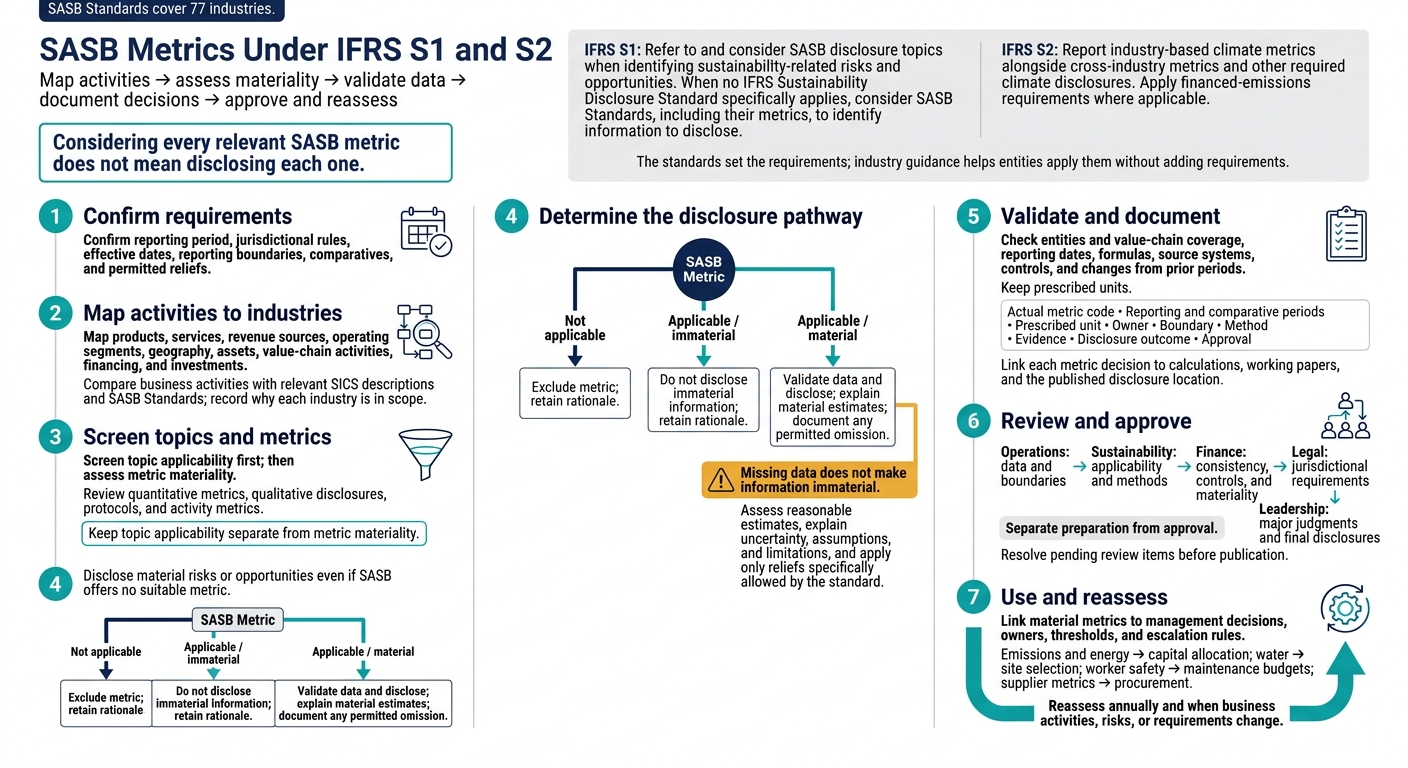
SASB Metrics Under IFRS S1 and S2: Reporting Workflow
Sustainability | IFRS S1 and S2 connected with SASB Apparel, Accessories and Footwear
sbb-itb-8baf5f1
Requirements for Using Industry Guidance
The standards set the requirements; industry guidance helps entities apply them without adding requirements. However, entities must follow instructions to refer to and consider specified industry guidance.[5][9] This distinction determines which SASB topics and metrics enter the annual reporting review.
IFRS S1: Review SASB Topics and Metrics
IFRS S1 paragraph 55 requires entities to refer to and consider SASB disclosure topics when identifying sustainability-related risks and opportunities that could affect their prospects. When no IFRS Sustainability Disclosure Standard specifically applies, entities must also consider SASB Standards, including their metrics, to identify information to disclose.
Start by assessing whether SASB topics and metrics apply. Then test whether the information is material to primary users’ decisions. Disclose material risks or opportunities even if SASB offers no suitable metric.[7][10]
| Action | Requirement | Supporting evidence |
|---|---|---|
| Review disclosure topics | Refer to and consider SASB topics when identifying sustainability-related risks and opportunities. | Industry mapping, business-activity inventory, value-chain assessment |
| Assess metrics | Consider SASB metrics when no specific IFRS Sustainability Disclosure Standard applies. | Metric assessment showing relevance, boundaries, and calculation methods |
| Test materiality | Assess whether omitting, misstating, or obscuring information could reasonably influence primary users’ decisions. | Materiality analysis, financial-effects assessment, exposure data |
| Document decisions | Record the review and the resulting decision to disclose or omit information. | Judgment memo, working papers, disclosure reference |
For each omission, record whether the reason is non-applicability, immateriality, or insufficient data. Missing data alone does not make a metric irrelevant.[10]
After documenting which topics and metrics apply, use the same approach for climate disclosures under IFRS S2.
IFRS S2: Report Industry-Based Climate Metrics
IFRS S2 requires industry-based climate metrics informed by the topics and metrics in its industry guidance, covering direct operations and the value chain. These disclosures sit alongside - not in place of - cross-industry metrics and requirements for governance, strategy, risk management, financial effects, and climate resilience.[5][6]
For relevant financial activities, apply IFRS S2’s financed-emissions requirements. Document portfolio coverage, attribution methods, and estimates.[8]
| IFRS S2 disclosure area | Relevant industry guidance | Metric category | Supporting evidence |
|---|---|---|---|
| Climate risks and opportunities | Industry-based disclosure topics that apply to the entity’s activities | Topic-specific risk and opportunity indicators | Risk register, scenario analysis, business-unit assessment |
| Industry-based metrics | Metrics linked to applicable business models or activities | Activity-specific physical, transition, operational, or product metrics | Operational systems, production data, calculation files |
| Cross-industry metrics | IFRS S2 cross-industry metric categories | Greenhouse gas emissions, transition risk, physical risk, capital deployment, internal carbon price, remuneration | Emissions inventory, finance records, risk models, compensation plans |
| Targets and progress | Metrics used to set and monitor climate targets | Relevant cross-industry and industry-based metrics | Baselines, target methods, progress records, assurance evidence |
| Financed emissions, where applicable | Industry guidance for relevant financial activities; check applicable amendments | Financed emissions and related exposure information | Portfolio boundaries, exposure balances, attribution methods, emissions data |
The December 2025 GHG amendments apply to annual periods beginning on or after January 1, 2027. Confirm which version governs the reporting period and which reliefs apply.[8]
Select Industries and Assess Metrics
Once IFRS S1 and S2 identify the relevant SASB guidance, focus the review on the industries and metrics that apply.
Map Business Activities and the Value Chain
Build an activity map covering products, services, revenue sources, operating segments, geography, owned and leased assets, suppliers, distributors, customers, financing activities, and investments. Compare it with relevant SICS descriptions and SASB Standards to identify which industries and metrics may apply. Record why each industry is in scope. Treat distribution or logistics as a separate industry only when its scale and risk profile are distinct.[11]
Assess Topic Applicability and Metric Materiality
Screen disclosure topics first. Then review their quantitative metrics, qualitative disclosures, protocols, and activity metrics. Test each topic and metric for decision usefulness, keeping topic applicability separate from metric materiality. Activity metrics explain scale and help readers interpret performance; they do not replace the materiality assessment.[4][11]
Check the risk register and value-chain assessment for material risks outside the selected industries. Apply the same screen each reporting cycle to keep selections consistent unless business activities change.[4][11]
After screening topics, verify that each metric can be measured, bounded, and documented.
Check Data, Boundaries, and Methods
For each candidate metric, check the covered entities and value-chain activities, reporting dates, formulas, source systems, controls, and changes from prior periods. Keep prescribed units and use U.S. number formatting.[1][11]
If material information is missing, assess whether reasonable estimates can be used. Explain the uncertainty, assumptions, and limitations of those estimates, and apply only reliefs specifically allowed by the standard.[1][11]
Record the results in a metric-by-metric decision log.
Record Decisions for Each Metric
Keep each metric decision in the same review file used for topic screening and boundary checks. Retain the metric’s actual code, reporting and comparative periods, prescribed unit, and links to calculations and approvals.[11]
| Decision | Data availability | Owner | Boundary | Methodology and evidence | Disclosure outcome |
|---|---|---|---|---|---|
| Applicable / material | Complete or estimated; identify gaps | Accountable data owner | Included operations and value chain | Protocol, sources, estimate assumptions, and specific provision allowing any omission | Disclose; explain material estimates; document any permitted omission |
| Applicable / immaterial | Record actual status | Responsible reviewer | Scope assessed | Evidence supporting immateriality | Do not disclose immaterial information; retain rationale |
| Not applicable | Record actual status | Responsible reviewer | Activity assessed | Factual reason for mismatch with business activity | Exclude metric; retain rationale |
Document Decisions and Review Disclosures
After screening each metric, link the decision file to the final disclosure package.
Keep Evidence and Disclosure References
Keep working papers and review records so another reviewer can trace each SASB metric decision to its published disclosure. These internal controls are not automatically required public disclosures.
Identify the industry guidance used and explain how it shaped topic selection and disclosures.[9] Do not add a standalone statement that SASB was considered.
Use the table to connect each working-paper decision to its treatment in the published report.
SASB metric IFRS S1 relevance IFRS S2 relevance Source system Owner Report location Final treatment Review status Water withdrawn in water-stressed areas Assesses an industry-specific water risk and potential financial effects Relevant where water exposure affects climate resilience or transition planning Enterprise environmental system and facility meters Environmental data manager Sustainability-related risks section Reported; estimated values identified Finance and sustainability approved Scope 1 emissions Relevant to climate-related risk information under IFRS S1 Directly relevant to IFRS S2 climate disclosures Emissions inventory and utility bills Carbon accounting lead Greenhouse-gas metrics Reported using stated boundary and method Awaiting final controls review Data privacy incidents Relevant to a material industry-specific sustainability risk Usually not climate-related Legal incident register Chief information security officer Risk-management disclosures Not material for the period; rationale retained Reviewed annually
Before publication, fill the final columns with completed decisions and approvals, not planned outcomes. Resolve pending items such as the controls review shown above. Add metric definitions, units, reporting period, boundary, data-quality status, and links to supporting working papers.
With the disclosure trail in place, review how judgments changed and who approved them.
Review Judgments and Reporting Changes
Separate preparation from approval. Operations validates data and boundaries; sustainability reviews applicability and methods; finance checks consistency, controls, and materiality; legal reviews jurisdictional requirements; and leadership approves major judgments and final disclosures.
Before publication, check the reporting period, organizational and operational boundaries, units, currency, conversion factors, calculation methods, data completeness, estimates, restatements, and comparative figures. Also check consistency with targets and related financial disclosures. Document material uncertainty and limitations. IFRS S1 and IFRS S2 do not themselves mandate external assurance.[1][2]
Reassess selected industry guidance after acquisitions, disposals, new products, major changes in geography or value-chain structure, entry into a new industry, changes in revenue or asset composition, reorganizations, regulatory developments, or changes in principal risks.
Record amendments, effective dates, and whether requirements are final or proposed. If you use early application or transition relief, document the jurisdiction, election, period, and effect on comparatives.
Use Metrics in Business Decisions
Link each material metric to a management process and a decision owner.
Emissions and energy metrics can inform capital allocation, facility investments, and transition targets; water metrics can influence site selection and operational continuity planning; worker-safety metrics can guide maintenance budgets and incentive plans; and supplier-related metrics can support procurement standards, engagement, and contract terms.
Set thresholds and escalation rules, and record the actions taken so the information informs decisions - not just reporting.
Conclusion: Annual SASB Assessment Checklist
Considering every relevant SASB metric does not mean disclosing each one. Under IFRS S1 and S2, disclose only material information.
After reviewing disclosures, close the annual cycle with these checks:
[ ] Purpose and requirements: Confirm the reporting period, intended users, applicable requirements, jurisdictional rules, comparatives, and available transition reliefs.
[ ] Boundaries and industries: Confirm the reporting entity, value-chain coverage, and SASB industry mappings for major business activities.
[ ] Topics and metrics: Complete applicability and materiality reviews, including IFRS S2 industry-based climate metrics. Document disclosure decisions. Missing data alone does not make information immaterial.
[ ] Data and approval: Validate sources, methods, estimates, and limitations, and close open review items.
[ ] Evidence and updates: Keep supporting records and disclosure references. Assign owners and deadlines for remaining improvements.
Document why each SASB metric was considered but not disclosed. Reassess that judgment annually and whenever the business, risks, or requirements change.[3][12]
FAQs
Which SASB industries apply to a diversified business?
For a diversified business, the Sustainable Industry Classification System suggests identifying the SASB Standard that best matches its primary revenue source. The guidance also recommends applying the relevant SASB Standard to each business unit and reporting at the segment level. This approach helps disclosures reflect the material sustainability risks of each line of business - not just the parent company’s primary classification.
What evidence supports omitting a SASB metric?
A company may omit a SASB metric if its assessment finds that the metric does not apply to its circumstances or does not give investors financially material information. To maintain transparency, the company must document its rationale and reporting choices.
IFRS S1 requires companies to refer to and consider SASB Standards when identifying sustainability-related risks and opportunities that could reasonably affect enterprise value.
How should we estimate missing material data?
When primary data isn’t available, use the most widely accepted estimation method, even if it has flaws. Document the method, why you chose it, its assumptions, and its limits. Apply it consistently across reporting periods so results remain comparable.
Protect data integrity with internal controls, including automated validation checks and documented assumptions. Track changes in reporting standards, and shift to more detailed or primary data as it becomes available.




FAQ