In This Article
Which issuers must report Scope 1/2 emissions, phase‑in dates for larger issuers, and how to assess and document disclosure‑specific reliefs.
Hong Kong ESG Reporting Rules: Reliefs and Phase-Ins
Your financial year’s start date - not the report’s publication date - determines which Hong Kong climate-reporting rules apply. I would start by checking your issuer category, then classify each disclosure before claiming any relief.
All Main Board and GEM issuers: Scope 1 and Scope 2 emissions reporting is mandatory for financial years beginning on or after January 1, 2025.
LargeCap constituents: Other Part D climate disclosures become mandatory for financial years beginning on or after January 1, 2026, based on qualifying prior-year index membership.
Other Main Board issuers: Remaining Part D disclosures stay on comply-or-explain. Each omission needs a specific explanation.
GEM issuers: Remaining Part D disclosures are voluntary, but separate Part C duties still apply.
I treat relief as a <u>disclosure-by-disclosure assessment</u>, not permission to skip a report. Reasonable information, capabilities, commercial sensitivity, and financial-effects relief each have conditions to check and document.
My checklist is simple: record the rule, supporting records, relief basis, review date, and filing deadline for each item. Reliefs do not extend publication deadlines, and the 2028 policy roadmap does not replace current HKEX rules.
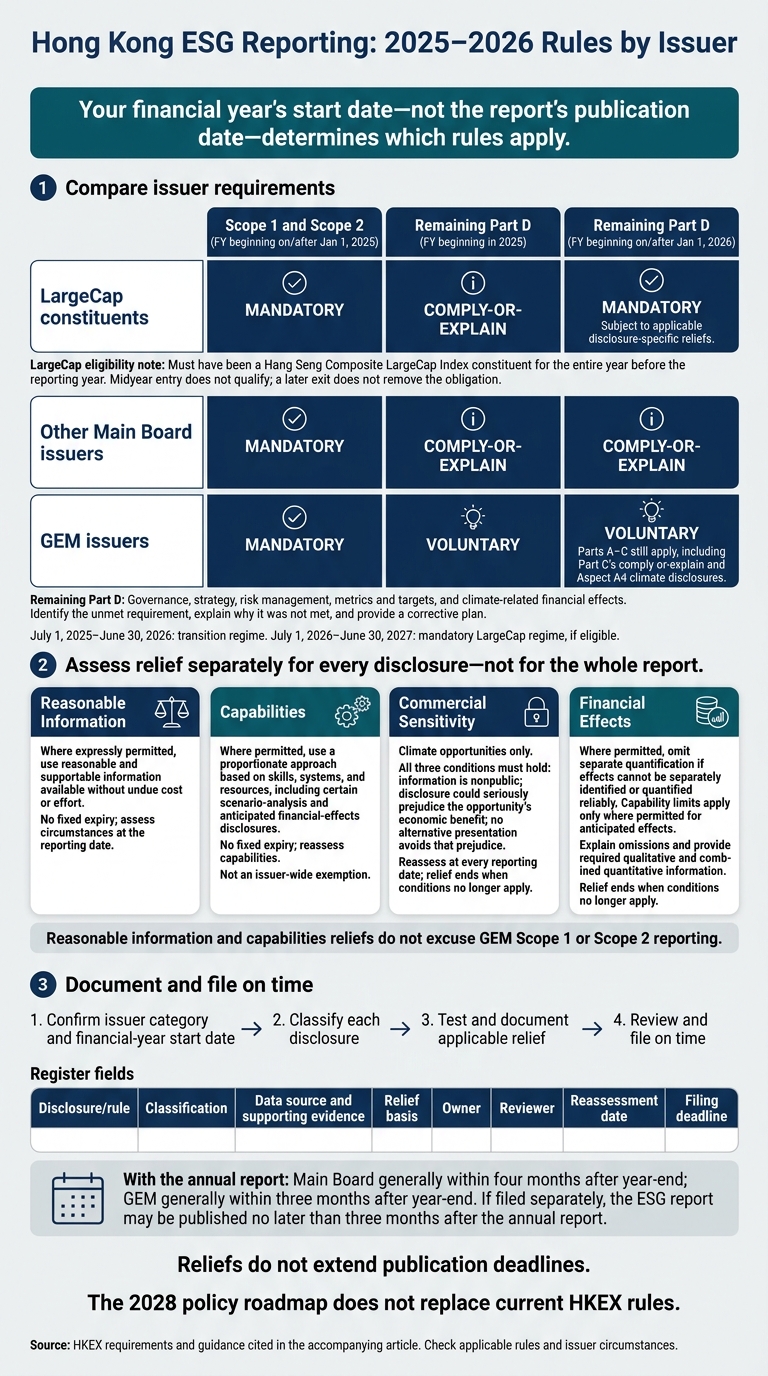
Hong Kong ESG Reporting: 2025–2026 Rules by Issuer
1. Hang Seng Composite LargeCap Index Constituents
Issuer coverage
For LargeCap issuers, the phase-in depends on prior-year index membership, not the reporting date. An issuer must have been in the Hang Seng Composite LargeCap Index for the entire year before the reporting year. Midyear entry does not qualify, and a later exit does not remove the obligation. Keep records of index status for the relevant year.[1][12]
Disclosure status
Scope 1 and Scope 2 emissions disclosures are mandatory for LargeCap issuers for financial years beginning on or after January 1, 2025.[5][9][10]
The remaining climate disclosures follow a comply-or-explain approach for financial years beginning in 2025. They become mandatory for financial years beginning on or after January 1, 2026, subject to the reliefs below. These disclosures cover governance, strategy, risk management, metrics and targets, and climate-related financial effects.[9][10] The financial year’s start date determines which regime applies.
Financial-year thresholds
For a July-to-June issuer, the year beginning July 1, 2025, falls under the transition regime; the year beginning July 1, 2026, falls under the mandatory LargeCap regime.[1][3][9]
Relief eligibility
Even under the mandatory LargeCap regime, assess relief eligibility for each disclosure separately. For any claim involving reasonable information, capabilities, commercial sensitivity, or financial effects relief, keep evidence that identifies the exact disclosure affected and documents the basis for the claim.[9]
sbb-itb-8baf5f1
2. Other Main Board Issuers
Issuer coverage
For Main Board issuers outside the LargeCap index, only Scope 1 and Scope 2 emissions disclosures are mandatory. All other Part D climate disclosures follow a comply-or-explain approach.[14][4]
Disclosure status
Scope 1 and Scope 2 emissions disclosures are mandatory for financial years beginning on or after January 1, 2025.[14][1] The remaining Part D climate disclosures - governance, strategy, risk management, metrics and targets, and climate-related financial effects - are comply-or-explain.[15] That status continues in 2026 for these issuers.[10]
For each comply-or-explain item, identify the unmet requirement, explain why it was not met, and provide a corrective plan. Simply saying the information is unavailable is not enough.[14][16]
GEM issuers follow a lighter disclosure track for these same remaining climate topics.
Financial-year thresholds
Use the financial-year start date, not the report’s publication date, to determine which requirements apply.[4][14]
Relief eligibility
Record the disclosure affected, the condition for using the relief, and the evidence supporting its use.[14][17]
3. GEM Issuers
Issuer coverage
GEM issuers are covered regardless of industry sector. Parts A–C still apply, including Part C’s comply-or-explain disclosures and Aspect A4 climate disclosures.[11][19] This narrower track matters when applying the phase-in schedule and relief rules.
Disclosure status
Scope 1 and Scope 2 greenhouse gas emissions reporting is mandatory for financial years beginning on or after January 1, 2025.[2][18] The remaining Part D climate disclosures are voluntary for GEM issuers.[2][1] Review each Part C disclosure separately before deciding to omit it.[11][19]
The next section sets out the phase-in dates and publication deadlines.
Relief eligibility
Assess relief for each disclosure and document the basis for using it. Reasonable information and capabilities reliefs may apply to voluntary Part D disclosures, but they do not excuse Scope 1 or Scope 2 reporting.[11][18][19] Keep fuel records, electricity invoices, emissions-factor sources, and calculation assumptions to support Scope 1 and Scope 2 reporting.[18]
Phase-In Dates and Report Publication Deadlines
Use this timeline to match each issuer group’s transition date with its reporting deadline.
Financial Years Beginning in 2025 and 2026
| Financial year begins | Issuer group | Reporting status | Relief availability | Publication timing |
|---|---|---|---|---|
| On or after January 1, 2025 | Main Board issuers | Scope 1 and Scope 2 mandatory; remaining Part D comply or explain | Disclosure-specific Code reliefs only | With the annual report; generally within four months after year-end |
| On or after January 1, 2025 | GEM issuers | Scope 1 and Scope 2 mandatory; remaining Part D voluntary | Disclosure-specific Code reliefs only | With the annual report; generally within three months after year-end |
| On or after January 1, 2026 | LargeCap constituents | Part D climate disclosures mandatory | Assess relief separately for each disclosure | With the annual report; generally within four months after year-end |
| On or after January 1, 2026 | Other Main Board and GEM issuers | No change from 2025 | No automatic additional transition period | No change from 2025 |
Sources: HKEX phase-in requirements and publication guidance.[2][1][10][14][21]
If filed separately, the ESG report may be published no later than three months after the annual report.[22][21][23]
Examples: Calendar-Year and June-Year-End Reporting
Calendar-year example: Publish the January 1–December 31, 2026 LargeCap issuer’s ESG report with its 2026 annual report in 2027 - generally by April 30, 2027.[2][22][21]
June-year-end example: Publish the July 1, 2026–June 30, 2027 LargeCap issuer’s ESG report with its 2027 annual report - generally by October 31, 2027.[2][22][21]
HKEX Rules vs. the Sustainability Disclosure Roadmap
Treat the roadmap as future policy, not a current change to listing rules.[7][24]
Check relief eligibility for each disclosure, including any applicable time limits. The next section explains the conditions.
Reporting Reliefs: Eligibility, Conditions, and Time Limits
Confirm the issuer group and financial-year start date, then use the table below to test relief eligibility for each disclosure.
| Relief | Practical effect | When it applies | Issuer action | Time limit |
|---|---|---|---|---|
| Reasonable Information | Allows reasonable, supportable information available without undue cost or effort. | Disclosures where the Code permits reasonable and supportable information. | Use reasonably available information and meet the remaining disclosure requirements. | No fixed expiry; eligibility depends on circumstances at the reporting date. |
| Capabilities | Allows a proportionate approach based on the issuer’s skills, systems, and resources. | Disclosures permitting a capabilities-based approach, including certain climate scenario analysis and anticipated financial-effects disclosures. | Apply the permitted proportionate approach, not an issuer-wide exemption. | No fixed expiry; reassess against available capabilities. |
| Commercial Sensitivity | Allows qualifying climate opportunity information to be omitted. | Nonpublic information whose disclosure would seriously prejudice the opportunity’s economic benefit, with no alternative presentation that avoids that prejudice. | Identify the relief used for each omitted item; reassess at every reporting date. | Until the conditions no longer apply. |
| Financial Effects | Allows qualitative rather than quantitative financial-effects information in specified circumstances. | Current and anticipated financial-effects disclosures when effects cannot be separately identified or quantified reliably; capability limits apply only where the Code permits them for anticipated effects. | Explain the omission and provide the required qualitative and combined quantitative information. | Until the conditions no longer apply. |
| Reporting issue | Directly applicable relief | Possible overlap - and its limit |
|---|---|---|
| Data availability | Reasonable Information | Financial Effects may also apply if missing data prevents useful quantification; test its conditions separately. |
| Organizational capacity | Capabilities | Financial Effects may overlap for anticipated effects, but does not provide a general excuse for omitting current figures. |
| Confidentiality | Commercial Sensitivity | Data or resource constraints do not replace the three-part confidentiality test. |
| Financial quantification | Financial Effects | Reasonable Information or Capabilities may inform the assessment only where expressly permitted. |
Reasonable Information Relief: Data Without Undue Cost or Effort
Where the Code expressly permits this standard, use all reasonable and supportable information available at the reporting date without undue cost or effort. You do not need an exhaustive search, but you should not ignore information already held or readily available from internal or external sources. Weigh the cost of collecting more data against the benefits of the resulting information.[6]
Capabilities Relief: Skills and Resources
This relief addresses how a specified disclosure is prepared, especially climate scenario analysis and anticipated financial effects. Assess personnel, systems, methods, and resources, then choose an approach that meets the applicable provision. A lack of specialists does not excuse an issuer from all climate reporting.[1][12]
Commercial Sensitivity Relief: Climate Opportunities
This relief applies only to climate opportunity disclosures that meet all three Code conditions: the information is not public; disclosure could reasonably be expected to seriously prejudice the opportunity’s economic benefit; and no alternative presentation can meet the disclosure objective without that prejudice. It does not cover unfavorable climate-risk information or information that is merely commercially inconvenient.[6]
Financial Effects Relief: Limits on Quantitative Reporting
Use this relief only where the Code permits qualitative information instead of separate quantification. For current and anticipated effects, issuers may omit separate quantification when the effects cannot be separately identified or measurement uncertainty makes that quantification unreliable.
Explain why quantitative information is omitted. Provide qualitative information identifying the affected financial-statement line items, totals, or subtotals, along with combined quantitative information where required.[8][13]
Assess Relief for Each Disclosure
Identify the issuer group and financial year, classify each disclosure, and test the applicable relief conditions. Keep the supporting assessment for each disclosure.
Maintain an obligations register recording the disclosure, relief basis, evidence, owner, reviewer, and reassessment date. Use it to support report review and the next reporting cycle, and update each disclosure’s assessment record at the next reporting date.[6][1][20]
Conclusion: Check Requirements and Document Reliefs
Scope 1 and Scope 2 emissions disclosures are mandatory for all Main Board and GEM issuers for financial years beginning on or after January 1, 2025. Broader climate disclosures phase in by issuer group: mandatory for LargeCap constituents for financial years beginning on or after January 1, 2026, comply-or-explain for other Main Board issuers, and voluntary for GEM issuers.[1][5][10]
Once you’ve classified the issuer and disclosure, assess relief for each disclosure separately, including any time limits. Reliefs do not extend publication deadlines. Keep a disclosure-level register that records the classification, data source, relief basis, reassessment date, and deadline.
Issuers remain responsible for interpreting the rules, documenting reliefs, and filing on time. For each disclosure, check the issuer category, financial-year start date, and applicable relief.
FAQs
How do I track reporting duties when my issuer category changes?
Check local transition rules right away. Crossing revenue or headcount thresholds may trigger duties immediately, during the current fiscal year, or in the next reporting cycle, depending on local rules.
After any change to company structure or legal status, complete an approved, version-controlled impact assessment. Update your reporting calendar and document the data, responsible owner, and filing deadline tied to each new legal requirement.
What evidence should I keep to justify reporting relief?
Keep an audit trail showing why each phase-in, exclusion, or exemption applies. Include financial statements, payroll records, registry extracts, and rule citations. Maintain an entity register that records listing status, thresholds, and parent-subsidiary relationships.
For every applicability decision, retain the formal analysis, evidence reviewed, internal interview notes, and dated owner sign-offs. When relief depends on specific conditions - such as parent-report scenarios - keep documented verification that those conditions are met.
When should I use comply-or-explain instead of claiming relief?
Use comply-or-explain when local rules place a disclosure in that category rather than making it mandatory: either provide the disclosure or explain why you haven’t. Hong Kong Main Board issuers currently follow this framework for climate reporting.
If you qualify as a first-time adopter under ISSB-based local rules, claim available transition reliefs, such as exemptions for Scope 3 emissions or comparative data. These reliefs are temporary implementation measures. Comply-or-explain, by contrast, is part of the regulatory framework.




FAQ