
Sep 11, 2026
SEC, EU, IFRS: Climate Rule Comparison
ESG Strategy
In This Article
Compare SEC, EU and IFRS climate rules on materiality, Scope 1–3, value-chain data, and assurance to build one reporting system.
SEC, EU, IFRS: Climate Rule Comparison
If you report under more than one climate rule, do not treat them as the same system. That is where extra work, data gaps, and filing conflicts start.
I see the split this way:
SEC is the narrowest: investor-focused, climate-only, and no Scope 3
CSRD/ESRS is the broadest: double materiality, value-chain coverage, and limited assurance from day one
IFRS S2 sits in the middle: investor-focused, but still expects Scope 1, 2, and 3 across the value chain
The article’s main point is simple: build one reporting setup around the broadest data needs, then map that same base to each rule. If you build only for the SEC first, you will likely have to redo supplier data, controls, and documentation later.
A few facts stand out:
70% of sustainability professionals say missing supplier data is a main Scope 3 barrier
79% of organizations cite supplier data availability as a top Scope 3 challenge
62% point to internal data quality issues
Only 44% of companies disclose all Scope 3 categories material to their sector
What matters most in practice:
Materiality test: SEC and IFRS S2 focus on investors; CSRD/ESRS adds business impact on climate and people
Emissions scope: SEC may require Scope 1 and 2 if material; CSRD/ESRS and IFRS S2 push companies into Scope 3
Assurance: SEC phases in assurance later; CSRD starts right away; IFRS S2 depends on local rules
Value chain data: this is usually the hardest part, not board language or policy drafting
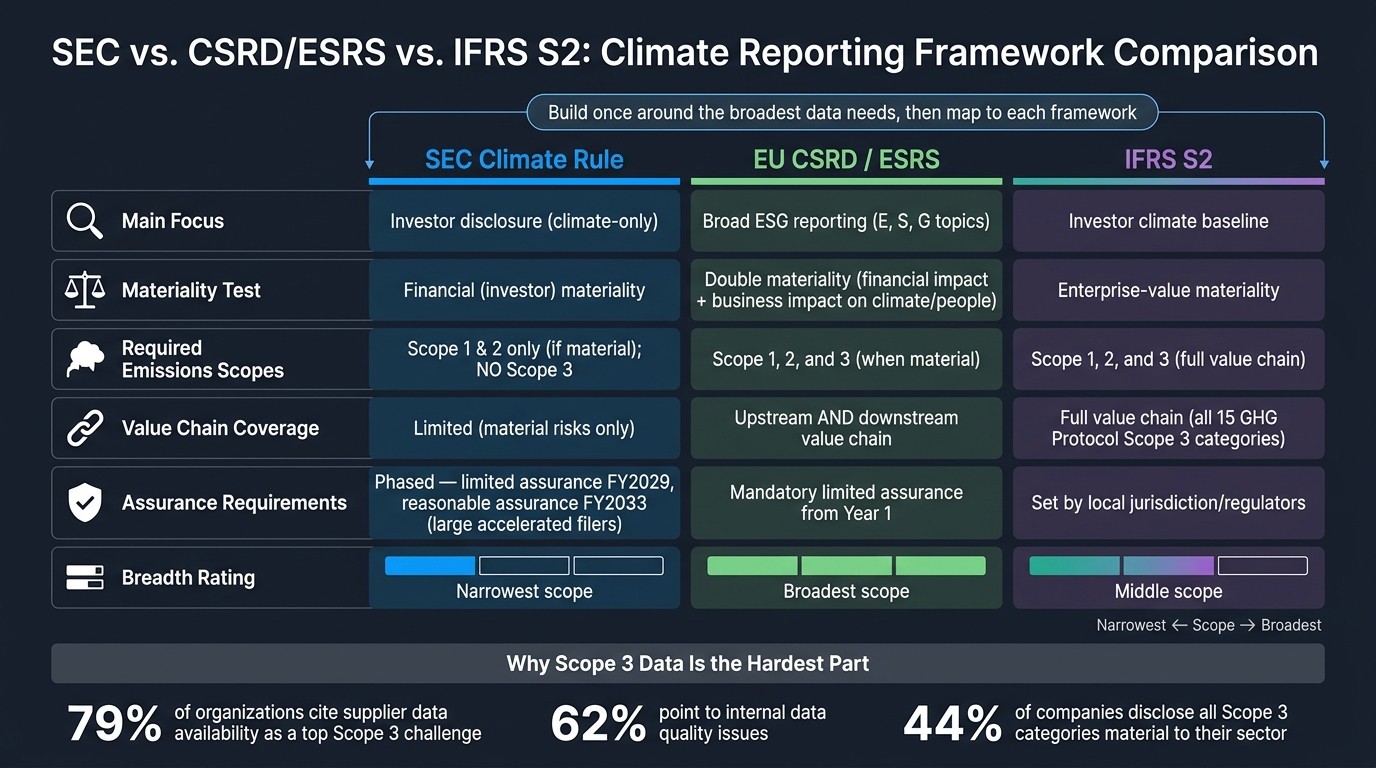
SEC vs. CSRD/ESRS vs. IFRS S2: Climate Reporting Framework Comparison
IFRS S2 Climate-Related Financial Disclosures
Quick Comparison
Rule | Main focus | Materiality | Emissions | Value chain | Assurance |
|---|---|---|---|---|---|
SEC Climate Rule | Investor disclosure | Financial | Scope 1 and 2 if material; no Scope 3 | Limited | Phased in later |
EU CSRD / ESRS | ESG reporting, including climate | Double materiality | Scope 1, 2, and 3 when climate is material | Upstream and downstream | Limited from year one |
IFRS S2 | Investor climate baseline | Enterprise value | Scope 1, 2, and 3 | Full value chain | Set by each jurisdiction |
If I had to reduce the article to one line, it would be this: the hard part is not writing three reports - it is building one data and control system that can support all three without breaking under assurance review. This foundation is essential for long-term climate resilience and organizational success.
SEC, CSRD/ESRS, and IFRS S2: Side-by-Side on Scope, Materiality, Emissions, and Assurance
This table zeroes in on the four issues that shape implementation: scope, materiality, emissions, and assurance. For multinationals, the day-to-day question is simple: Can one reporting setup cover all three?
Framework | Who Reports | Standard Scope | Materiality Test | Required Emissions Scopes | Assurance | Value Chain Coverage |
|---|---|---|---|---|---|---|
SEC Climate Rule | SEC registrants | Climate-only | Investor (financial) materiality | Scope 1 and Scope 2 only when material; no Scope 3 | Phased: limited assurance for large accelerated filers and accelerated filers, with reasonable assurance later for large accelerated filers | Limited to material risks |
EU CSRD/ESRS | In-scope EU groups and qualifying non-EU groups | Broader ESG (ESRS covers E, S, and G topics; ESRS E1 is climate) | Double materiality | Scope 1, Scope 2, and Scope 3 when material | Limited assurance from year one | Upstream and downstream value chain |
IFRS S2 | ISSB-adopting jurisdictions | Climate-focused | Investor (financial) materiality | Scope 1, Scope 2, and Scope 3 | Assurance depends on jurisdictional adoption and local rules | Full value chain |
SEC climate rule: investor materiality and limited emissions requirements
The SEC rule takes a narrow, investor-focused path. It calls for Scope 1 and Scope 2 emissions only when those emissions are material, leaves out Scope 3, and pushes assurance in over time: limited assurance in 2029 for large accelerated filers, then reasonable assurance in 2033.[7][8][11][24][15][18][19]
For many companies, that means the SEC model may look lighter on paper. But it also means it won't, by itself, cover what other jurisdictions ask for.
EU CSRD/ESRS: double materiality and mandatory value chain reporting
CSRD/ESRS uses double materiality, which changes the job in a big way. ESRS E1 calls for Scope 1, Scope 2, and material Scope 3 emissions, along with transition plans, physical and transition risk disclosure, and climate-related financial effects. Limited assurance starts in year one, and reporting must be digitally tagged under the ESRS taxonomy.[12][14][23][17][25]
In plain terms, this is a much broader lift. Teams have to look both at how climate affects the business and how the business affects people and the environment across the value chain.
IFRS S2: global climate baseline with full value chain expectations
IFRS S2 sets an investor-focused climate baseline, but it still expects Scope 1, Scope 2, and Scope 3 reporting across the full value chain. Assurance depends on local adoption rules, and the standard gives first-year Scope 3 transition relief.[9][10][13][16][20][4]
That mix makes IFRS S2 feel like a bridge in many global programs: more expansive than the SEC rule on emissions and value chain coverage, but shaped by each jurisdiction's own adoption and assurance rules. These gaps drive the five implementation issues multinational teams have to solve next.
Five Key Differences That Matter Most to Multinationals
Multinationals can reuse governance, risk, and core climate data across all three frameworks. Still, five gaps call for separate judgment, proof, and timing decisions. These are not small technical details. They shape how a company needs to build its reporting system in practice.
Dimension | SEC Climate Rule | EU CSRD/ESRS | IFRS S2 |
|---|---|---|---|
Materiality Test | Investor (financial) materiality | Double materiality | Enterprise-value materiality |
Compliance Timing | Phased by filer type | Staggered by company type | Depends on local adoption |
Assurance Path | Phased assurance on Scope 1 and 2 for large filers; no Scope 3 assurance | Mandatory limited assurance from the outset | Set by local regulators; no universal standard |
Scope 3 / Supply Chain | Not required | Required where material; upstream and downstream coverage | Consider all 15 Scope 3 categories; disclose material categories |
Materiality tests: investor materiality versus double materiality
EU double materiality is the broadest test. It covers both financial effects and external impacts. If you build for that bar first, SEC and IFRS S2 reporting can often pull from the same workflow.
The SEC and IFRS S2 both use an investor-materiality lens. Put simply, the issue is whether the information could affect enterprise value or capital allocation decisions.[6][13] The EU goes further. Double materiality means a company has to answer two separate questions: how climate affects enterprise value, and how the company affects climate and people, even when that impact has not yet shown up in the financials.[7][13]
That second question changes the scope of disclosure in a big way. It pushes reporting past financial risk alone. A company may decide that its Scope 3 emissions do not create a material financial risk. Under CSRD/ESRS, that may still not be enough. Those emissions can still require disclosure if they reflect a major impact.[7][13] Build only for investor materiality, and EU gaps are likely to show up later.
Timing and assurance: compliance calendars and audit readiness
The timing is different across jurisdictions and filer types, and that can trip up even well-prepared teams. Large accelerated filers begin SEC Scope 1 and 2 emissions reporting for fiscal years beginning in 2026, with limited assurance starting in FY2029 and reasonable assurance in FY2033.[26][28] CSRD’s first wave began with FY2024 reporting, and mandatory limited assurance applies from day one.[1]
IFRS S2 does not set its own assurance schedule. That decision is left to local regulators and listing venues.[2][33] Its adoption timeline also depends on the jurisdiction.[3][30] So the practical move is pretty clear: build audit-ready controls, documented methods, and evidence archives early. Many companies use CSRD as the push they need to do this work now, so they are ready for later SEC deadlines and whatever local IFRS S2 timing applies. That is why control design and evidence retention matter well before the first filing date.
Scope 3 and supply chain data: the hardest part of aligned reporting
This is where alignment usually gets messy. The SEC leaves Scope 3 out entirely.[6][27][29] CSRD and IFRS S2 do not. Both require companies to deal with value chain data, which means upstream and downstream activity can no longer sit off to the side.
IFRS S2 requires companies to consider all 15 GHG Protocol Scope 3 categories and disclose which ones are material.[9][10] CSRD/ESRS goes a step further on data expectations. It asks companies to separate primary supplier data from estimated or secondary data.[21][22] That may sound like a technical detail, but it has huge knock-on effects for systems, supplier outreach, and review controls.
A survey of 1,200 sustainability professionals across 97 countries found that 70% cite unavailable supplier data as a major barrier to Scope 3 measurement.[31]
For multinationals, the most efficient route is to build one global Scope 3 data system that meets CSRD and IFRS S2 in full, then use that same setup to gather the Scope 1 and 2 data needed for SEC emissions disclosures. Building for SEC first can feel simpler at the start, but it often leads to a later rebuild of supplier engagement, estimation methods, and controls. That data architecture sets up the one-reporting-system approach discussed next.
How to Build One Reporting Infrastructure for SEC, CSRD/ESRS, and IFRS S2
The next step is turning those rule differences into one reporting setup that can handle them all. For multinational companies, that usually comes down to three pain points: boundary mismatches, missing supplier data, and the need to stand up to assurance and audit review across more than one regime.
Start with the broadest required data set
Use CSRD/ESRS as the main reporting base. It covers the broadest set of data, which means it can support IFRS S2 and then be filtered for SEC reporting. If a company starts with the SEC’s narrower scope, it often ends up reworking the system later.
In practice, that means building six core data sets:
entity and facility mapping tied to financial consolidation boundaries
governance records that show board oversight, committee charters, and climate risk review cadence
climate risk and opportunity registers, along with scenario analysis results and financial impact estimates
Scope 1 and 2 inventories with facility-level activity data and version-controlled emission factors
Scope 3 category mapping using GHG Protocol logic across all 15 categories[32][34][30][5]
value-chain segmentation that identifies key supplier groups and customer segments
Once those layers are in place, producing reports for all three frameworks becomes far more manageable. At that point, the work is mostly about mapping the same underlying data to each framework, not rebuilding the system from scratch.
Once the data model is in place, the next issue is control. Without clear ownership and documented processes, even good data can fall apart under audit.
Align governance, controls, and documentation across teams
Climate reporting needs controls that are as disciplined as financial reporting controls. A sustainability team working out of spreadsheets may get a company through an early reporting cycle, but it won’t hold up well when multiple jurisdictions, assurance demands, and filing deadlines collide.
A cross-functional model works better. Finance, legal, procurement, operations, and sustainability each need clear ownership over the data sets and controls tied to their part of the process.
A Climate Disclosure Steering Committee with people from each of those functions gives the work a home. This group keeps one reporting manual that maps SEC, CSRD/ESRS, and IFRS S2 requirements to internal data sources and control owners. It also approves material estimation methods, manages emission factor updates, and maintains a formal change log so any movement in reported metrics can be explained cleanly to auditors.
The division of work should be plain:
procurement owns supplier data collection and engagement
operations owns activity-level inputs
finance owns the reconciliation between energy bills and measured consumption
legal reviews narrative disclosures for consistency across jurisdictions before filing
A RACI matrix helps lock this down by showing who is responsible, accountable, consulted, and informed for each disclosure component. It’s a simple tool, but it can stop the kind of ownership gaps that only show up when an auditor starts asking questions.
Documentation matters just as much as structure. Every calculation method, emission factor, data source, and estimation approach should be version-controlled and ready for review. Companies that build evidence files early, including raw data extracts, reconciliations, control testing results, and management representations, save themselves a last-minute scramble later.
Use reporting alignment to support decisions, not just filings
A shared reporting system should do more than produce filings. It should also help leaders make decisions using the same underlying data.
That’s where a unified setup starts to pay off. When climate risk registers, transition plan data, and Scope 3 inventories sit in one system and connect to financial and operating planning tools, the information can shape capital allocation, supplier engagement, and resilience planning, not just the annual report.
Both CSRD and IFRS S2 require transition plan disclosures that explain how a company expects to meet its climate targets.[3][30] Treating that as a box-checking exercise misses the point. The same data used for a filing can help a CFO assess decarbonization investments, and it can help procurement teams steer supplier engagement in a more deliberate way.
That’s when disclosure work starts to shift. Instead of acting only as a compliance cost, it becomes part of how the business runs day to day and how it plans for long-term value creation.
Conclusion: What SEC, EU, and IFRS Climate Rule Differences Mean in Practice
Three frameworks. Three different rule sets. The split isn’t about the broad topic of climate disclosure. It comes down to the materiality test, the depth of data required, and the level of assurance attached to the filing. Those differences shape day-to-day work: what data companies gather, how they record it, and how much proof they need behind it.
The biggest slowdowns are still supplier data and internal data quality. According to Sphera's 2025 Scope 3 report, 79% of organizations cite supplier data availability as a top challenge in Scope 3 reporting, and 62% point to internal data quality issues.[35][37] EY's 2025 Global Climate Action Barometer found that only 44% of companies disclose all Scope 3 categories material to their sector.[36]
That’s why the most practical move is simple: build once, then map many times. Set up one reporting system around the broadest data needs, then map the same outputs to each jurisdiction. It’s a lot easier than building separate workflows for the SEC, the EU, and IFRS from scratch.
Key points for executives to carry forward
Materiality is not a technicality. It defines the full reporting perimeter, including which risks are disclosed, how far value chain coverage extends, and what lands in front of investors and regulators. Assurance readiness is a design requirement as well. It can’t be treated like a cleanup task after the first filing cycle.
The companies in the strongest position treat climate disclosure as a cross-functional process. Finance, sustainability, legal, procurement, risk, and internal audit all need shared ownership. When that happens, companies are better prepared for compliance, more convincing with investors, and better equipped to handle operational strain. For multinationals, alignment is a systems problem, not a filing problem.
FAQs
Which rule should we build for first?
Start with your regulatory footprint. If your company has a strong presence in the EU, or you’re getting close to CSRD thresholds, put CSRD first. Building around ESRS double materiality sets a tougher standard, and that work can also support SEC climate reporting.
If you’re U.S.-listed and have only limited EU exposure, begin with the narrower SEC rule. For multinationals, one centralized data platform often makes life easier across multiple frameworks.
How do materiality tests affect what we disclose?
Materiality tests decide which climate and sustainability details a company has to disclose. Under the SEC and IFRS, the standard is financial materiality. In plain English, that means companies report the information a reasonable investor would see as important to enterprise value, cash flows, or cost of capital.
The EU’s CSRD takes a broader route with double materiality. Companies must report not only what is financially material, but also how their actions affect people and the environment - even when those effects have not yet shown up as financial risks or opportunities.
What makes Scope 3 data hard to report?
Scope 3 data is tough to report because it depends on detailed, dependable information from your full upstream and downstream value chain - not just what happens inside your own business.
That’s where things get messy. A lot of this data lives with suppliers and customers, so primary data is often hard to get. Standards like IFRS S2 do allow estimates and industry averages, which gives companies some room to work with. But the direction of travel is clear: reporting is shifting toward verifiable, supplier-specific data.
Related Blog Posts
Latest Articles
©2025

Narrative Change and Power Building: The Missing Half of Advocacy
Narrative change is the process of disrupting dominant narratives that normalize inequity and advancing new narratives from historically marginalized communities.

Funding Resilience Without Federal Grants
BRIC is unreliable and FEMA is shrinking. Here's how cities fund climate resilience with dedicated revenue, blended finance, and a coordinating authority.

The ESG Blind Spot: How AI Is Finding Risks in Companies Nobody Else Is Watching
Norway's sovereign wealth fund uses AI to screen 7,200 portfolio companies for forced labor and corruption within 24 hours. The real story is the emerging-market coverage gap that traditional ESG data vendors miss — and what it means for any company with a global supply chain.
Narrative Change and Power Building: The Missing Half of Advocacy
Narrative change is the process of disrupting dominant narratives that normalize inequity and advancing new narratives from historically marginalized communities.
Funding Resilience Without Federal Grants
BRIC is unreliable and FEMA is shrinking. Here's how cities fund climate resilience with dedicated revenue, blended finance, and a coordinating authority.
The ESG Blind Spot: How AI Is Finding Risks in Companies Nobody Else Is Watching
Norway's sovereign wealth fund uses AI to screen 7,200 portfolio companies for forced labor and corruption within 24 hours. The real story is the emerging-market coverage gap that traditional ESG data vendors miss — and what it means for any company with a global supply chain.
FAQ
01
What does it really mean to “redefine profit”?
02
What makes Council Fire different?
03
Who does Council Fire work with?
04
What does working with Council Fire actually look like?
05
How does Council Fire help organizations turn big goals into action?
06
How does Council Fire define and measure success?
Sep 11, 2026
SEC, EU, IFRS: Climate Rule Comparison
ESG Strategy
In This Article
Compare SEC, EU and IFRS climate rules on materiality, Scope 1–3, value-chain data, and assurance to build one reporting system.
SEC, EU, IFRS: Climate Rule Comparison
If you report under more than one climate rule, do not treat them as the same system. That is where extra work, data gaps, and filing conflicts start.
I see the split this way:
SEC is the narrowest: investor-focused, climate-only, and no Scope 3
CSRD/ESRS is the broadest: double materiality, value-chain coverage, and limited assurance from day one
IFRS S2 sits in the middle: investor-focused, but still expects Scope 1, 2, and 3 across the value chain
The article’s main point is simple: build one reporting setup around the broadest data needs, then map that same base to each rule. If you build only for the SEC first, you will likely have to redo supplier data, controls, and documentation later.
A few facts stand out:
70% of sustainability professionals say missing supplier data is a main Scope 3 barrier
79% of organizations cite supplier data availability as a top Scope 3 challenge
62% point to internal data quality issues
Only 44% of companies disclose all Scope 3 categories material to their sector
What matters most in practice:
Materiality test: SEC and IFRS S2 focus on investors; CSRD/ESRS adds business impact on climate and people
Emissions scope: SEC may require Scope 1 and 2 if material; CSRD/ESRS and IFRS S2 push companies into Scope 3
Assurance: SEC phases in assurance later; CSRD starts right away; IFRS S2 depends on local rules
Value chain data: this is usually the hardest part, not board language or policy drafting
SEC vs. CSRD/ESRS vs. IFRS S2: Climate Reporting Framework Comparison
IFRS S2 Climate-Related Financial Disclosures
Quick Comparison
Rule | Main focus | Materiality | Emissions | Value chain | Assurance |
|---|---|---|---|---|---|
SEC Climate Rule | Investor disclosure | Financial | Scope 1 and 2 if material; no Scope 3 | Limited | Phased in later |
EU CSRD / ESRS | ESG reporting, including climate | Double materiality | Scope 1, 2, and 3 when climate is material | Upstream and downstream | Limited from year one |
IFRS S2 | Investor climate baseline | Enterprise value | Scope 1, 2, and 3 | Full value chain | Set by each jurisdiction |
If I had to reduce the article to one line, it would be this: the hard part is not writing three reports - it is building one data and control system that can support all three without breaking under assurance review. This foundation is essential for long-term climate resilience and organizational success.
SEC, CSRD/ESRS, and IFRS S2: Side-by-Side on Scope, Materiality, Emissions, and Assurance
This table zeroes in on the four issues that shape implementation: scope, materiality, emissions, and assurance. For multinationals, the day-to-day question is simple: Can one reporting setup cover all three?
Framework | Who Reports | Standard Scope | Materiality Test | Required Emissions Scopes | Assurance | Value Chain Coverage |
|---|---|---|---|---|---|---|
SEC Climate Rule | SEC registrants | Climate-only | Investor (financial) materiality | Scope 1 and Scope 2 only when material; no Scope 3 | Phased: limited assurance for large accelerated filers and accelerated filers, with reasonable assurance later for large accelerated filers | Limited to material risks |
EU CSRD/ESRS | In-scope EU groups and qualifying non-EU groups | Broader ESG (ESRS covers E, S, and G topics; ESRS E1 is climate) | Double materiality | Scope 1, Scope 2, and Scope 3 when material | Limited assurance from year one | Upstream and downstream value chain |
IFRS S2 | ISSB-adopting jurisdictions | Climate-focused | Investor (financial) materiality | Scope 1, Scope 2, and Scope 3 | Assurance depends on jurisdictional adoption and local rules | Full value chain |
SEC climate rule: investor materiality and limited emissions requirements
The SEC rule takes a narrow, investor-focused path. It calls for Scope 1 and Scope 2 emissions only when those emissions are material, leaves out Scope 3, and pushes assurance in over time: limited assurance in 2029 for large accelerated filers, then reasonable assurance in 2033.[7][8][11][24][15][18][19]
For many companies, that means the SEC model may look lighter on paper. But it also means it won't, by itself, cover what other jurisdictions ask for.
EU CSRD/ESRS: double materiality and mandatory value chain reporting
CSRD/ESRS uses double materiality, which changes the job in a big way. ESRS E1 calls for Scope 1, Scope 2, and material Scope 3 emissions, along with transition plans, physical and transition risk disclosure, and climate-related financial effects. Limited assurance starts in year one, and reporting must be digitally tagged under the ESRS taxonomy.[12][14][23][17][25]
In plain terms, this is a much broader lift. Teams have to look both at how climate affects the business and how the business affects people and the environment across the value chain.
IFRS S2: global climate baseline with full value chain expectations
IFRS S2 sets an investor-focused climate baseline, but it still expects Scope 1, Scope 2, and Scope 3 reporting across the full value chain. Assurance depends on local adoption rules, and the standard gives first-year Scope 3 transition relief.[9][10][13][16][20][4]
That mix makes IFRS S2 feel like a bridge in many global programs: more expansive than the SEC rule on emissions and value chain coverage, but shaped by each jurisdiction's own adoption and assurance rules. These gaps drive the five implementation issues multinational teams have to solve next.
Five Key Differences That Matter Most to Multinationals
Multinationals can reuse governance, risk, and core climate data across all three frameworks. Still, five gaps call for separate judgment, proof, and timing decisions. These are not small technical details. They shape how a company needs to build its reporting system in practice.
Dimension | SEC Climate Rule | EU CSRD/ESRS | IFRS S2 |
|---|---|---|---|
Materiality Test | Investor (financial) materiality | Double materiality | Enterprise-value materiality |
Compliance Timing | Phased by filer type | Staggered by company type | Depends on local adoption |
Assurance Path | Phased assurance on Scope 1 and 2 for large filers; no Scope 3 assurance | Mandatory limited assurance from the outset | Set by local regulators; no universal standard |
Scope 3 / Supply Chain | Not required | Required where material; upstream and downstream coverage | Consider all 15 Scope 3 categories; disclose material categories |
Materiality tests: investor materiality versus double materiality
EU double materiality is the broadest test. It covers both financial effects and external impacts. If you build for that bar first, SEC and IFRS S2 reporting can often pull from the same workflow.
The SEC and IFRS S2 both use an investor-materiality lens. Put simply, the issue is whether the information could affect enterprise value or capital allocation decisions.[6][13] The EU goes further. Double materiality means a company has to answer two separate questions: how climate affects enterprise value, and how the company affects climate and people, even when that impact has not yet shown up in the financials.[7][13]
That second question changes the scope of disclosure in a big way. It pushes reporting past financial risk alone. A company may decide that its Scope 3 emissions do not create a material financial risk. Under CSRD/ESRS, that may still not be enough. Those emissions can still require disclosure if they reflect a major impact.[7][13] Build only for investor materiality, and EU gaps are likely to show up later.
Timing and assurance: compliance calendars and audit readiness
The timing is different across jurisdictions and filer types, and that can trip up even well-prepared teams. Large accelerated filers begin SEC Scope 1 and 2 emissions reporting for fiscal years beginning in 2026, with limited assurance starting in FY2029 and reasonable assurance in FY2033.[26][28] CSRD’s first wave began with FY2024 reporting, and mandatory limited assurance applies from day one.[1]
IFRS S2 does not set its own assurance schedule. That decision is left to local regulators and listing venues.[2][33] Its adoption timeline also depends on the jurisdiction.[3][30] So the practical move is pretty clear: build audit-ready controls, documented methods, and evidence archives early. Many companies use CSRD as the push they need to do this work now, so they are ready for later SEC deadlines and whatever local IFRS S2 timing applies. That is why control design and evidence retention matter well before the first filing date.
Scope 3 and supply chain data: the hardest part of aligned reporting
This is where alignment usually gets messy. The SEC leaves Scope 3 out entirely.[6][27][29] CSRD and IFRS S2 do not. Both require companies to deal with value chain data, which means upstream and downstream activity can no longer sit off to the side.
IFRS S2 requires companies to consider all 15 GHG Protocol Scope 3 categories and disclose which ones are material.[9][10] CSRD/ESRS goes a step further on data expectations. It asks companies to separate primary supplier data from estimated or secondary data.[21][22] That may sound like a technical detail, but it has huge knock-on effects for systems, supplier outreach, and review controls.
A survey of 1,200 sustainability professionals across 97 countries found that 70% cite unavailable supplier data as a major barrier to Scope 3 measurement.[31]
For multinationals, the most efficient route is to build one global Scope 3 data system that meets CSRD and IFRS S2 in full, then use that same setup to gather the Scope 1 and 2 data needed for SEC emissions disclosures. Building for SEC first can feel simpler at the start, but it often leads to a later rebuild of supplier engagement, estimation methods, and controls. That data architecture sets up the one-reporting-system approach discussed next.
How to Build One Reporting Infrastructure for SEC, CSRD/ESRS, and IFRS S2
The next step is turning those rule differences into one reporting setup that can handle them all. For multinational companies, that usually comes down to three pain points: boundary mismatches, missing supplier data, and the need to stand up to assurance and audit review across more than one regime.
Start with the broadest required data set
Use CSRD/ESRS as the main reporting base. It covers the broadest set of data, which means it can support IFRS S2 and then be filtered for SEC reporting. If a company starts with the SEC’s narrower scope, it often ends up reworking the system later.
In practice, that means building six core data sets:
entity and facility mapping tied to financial consolidation boundaries
governance records that show board oversight, committee charters, and climate risk review cadence
climate risk and opportunity registers, along with scenario analysis results and financial impact estimates
Scope 1 and 2 inventories with facility-level activity data and version-controlled emission factors
Scope 3 category mapping using GHG Protocol logic across all 15 categories[32][34][30][5]
value-chain segmentation that identifies key supplier groups and customer segments
Once those layers are in place, producing reports for all three frameworks becomes far more manageable. At that point, the work is mostly about mapping the same underlying data to each framework, not rebuilding the system from scratch.
Once the data model is in place, the next issue is control. Without clear ownership and documented processes, even good data can fall apart under audit.
Align governance, controls, and documentation across teams
Climate reporting needs controls that are as disciplined as financial reporting controls. A sustainability team working out of spreadsheets may get a company through an early reporting cycle, but it won’t hold up well when multiple jurisdictions, assurance demands, and filing deadlines collide.
A cross-functional model works better. Finance, legal, procurement, operations, and sustainability each need clear ownership over the data sets and controls tied to their part of the process.
A Climate Disclosure Steering Committee with people from each of those functions gives the work a home. This group keeps one reporting manual that maps SEC, CSRD/ESRS, and IFRS S2 requirements to internal data sources and control owners. It also approves material estimation methods, manages emission factor updates, and maintains a formal change log so any movement in reported metrics can be explained cleanly to auditors.
The division of work should be plain:
procurement owns supplier data collection and engagement
operations owns activity-level inputs
finance owns the reconciliation between energy bills and measured consumption
legal reviews narrative disclosures for consistency across jurisdictions before filing
A RACI matrix helps lock this down by showing who is responsible, accountable, consulted, and informed for each disclosure component. It’s a simple tool, but it can stop the kind of ownership gaps that only show up when an auditor starts asking questions.
Documentation matters just as much as structure. Every calculation method, emission factor, data source, and estimation approach should be version-controlled and ready for review. Companies that build evidence files early, including raw data extracts, reconciliations, control testing results, and management representations, save themselves a last-minute scramble later.
Use reporting alignment to support decisions, not just filings
A shared reporting system should do more than produce filings. It should also help leaders make decisions using the same underlying data.
That’s where a unified setup starts to pay off. When climate risk registers, transition plan data, and Scope 3 inventories sit in one system and connect to financial and operating planning tools, the information can shape capital allocation, supplier engagement, and resilience planning, not just the annual report.
Both CSRD and IFRS S2 require transition plan disclosures that explain how a company expects to meet its climate targets.[3][30] Treating that as a box-checking exercise misses the point. The same data used for a filing can help a CFO assess decarbonization investments, and it can help procurement teams steer supplier engagement in a more deliberate way.
That’s when disclosure work starts to shift. Instead of acting only as a compliance cost, it becomes part of how the business runs day to day and how it plans for long-term value creation.
Conclusion: What SEC, EU, and IFRS Climate Rule Differences Mean in Practice
Three frameworks. Three different rule sets. The split isn’t about the broad topic of climate disclosure. It comes down to the materiality test, the depth of data required, and the level of assurance attached to the filing. Those differences shape day-to-day work: what data companies gather, how they record it, and how much proof they need behind it.
The biggest slowdowns are still supplier data and internal data quality. According to Sphera's 2025 Scope 3 report, 79% of organizations cite supplier data availability as a top challenge in Scope 3 reporting, and 62% point to internal data quality issues.[35][37] EY's 2025 Global Climate Action Barometer found that only 44% of companies disclose all Scope 3 categories material to their sector.[36]
That’s why the most practical move is simple: build once, then map many times. Set up one reporting system around the broadest data needs, then map the same outputs to each jurisdiction. It’s a lot easier than building separate workflows for the SEC, the EU, and IFRS from scratch.
Key points for executives to carry forward
Materiality is not a technicality. It defines the full reporting perimeter, including which risks are disclosed, how far value chain coverage extends, and what lands in front of investors and regulators. Assurance readiness is a design requirement as well. It can’t be treated like a cleanup task after the first filing cycle.
The companies in the strongest position treat climate disclosure as a cross-functional process. Finance, sustainability, legal, procurement, risk, and internal audit all need shared ownership. When that happens, companies are better prepared for compliance, more convincing with investors, and better equipped to handle operational strain. For multinationals, alignment is a systems problem, not a filing problem.
FAQs
Which rule should we build for first?
Start with your regulatory footprint. If your company has a strong presence in the EU, or you’re getting close to CSRD thresholds, put CSRD first. Building around ESRS double materiality sets a tougher standard, and that work can also support SEC climate reporting.
If you’re U.S.-listed and have only limited EU exposure, begin with the narrower SEC rule. For multinationals, one centralized data platform often makes life easier across multiple frameworks.
How do materiality tests affect what we disclose?
Materiality tests decide which climate and sustainability details a company has to disclose. Under the SEC and IFRS, the standard is financial materiality. In plain English, that means companies report the information a reasonable investor would see as important to enterprise value, cash flows, or cost of capital.
The EU’s CSRD takes a broader route with double materiality. Companies must report not only what is financially material, but also how their actions affect people and the environment - even when those effects have not yet shown up as financial risks or opportunities.
What makes Scope 3 data hard to report?
Scope 3 data is tough to report because it depends on detailed, dependable information from your full upstream and downstream value chain - not just what happens inside your own business.
That’s where things get messy. A lot of this data lives with suppliers and customers, so primary data is often hard to get. Standards like IFRS S2 do allow estimates and industry averages, which gives companies some room to work with. But the direction of travel is clear: reporting is shifting toward verifiable, supplier-specific data.
Related Blog Posts
Latest Articles
©2025
Narrative Change and Power Building: The Missing Half of Advocacy
Narrative change is the process of disrupting dominant narratives that normalize inequity and advancing new narratives from historically marginalized communities.
Funding Resilience Without Federal Grants
BRIC is unreliable and FEMA is shrinking. Here's how cities fund climate resilience with dedicated revenue, blended finance, and a coordinating authority.
The ESG Blind Spot: How AI Is Finding Risks in Companies Nobody Else Is Watching
Norway's sovereign wealth fund uses AI to screen 7,200 portfolio companies for forced labor and corruption within 24 hours. The real story is the emerging-market coverage gap that traditional ESG data vendors miss — and what it means for any company with a global supply chain.
FAQ
01
What does it really mean to “redefine profit”?
02
What makes Council Fire different?
03
Who does Council Fire work with?
04
What does working with Council Fire actually look like?
05
How does Council Fire help organizations turn big goals into action?
06
How does Council Fire define and measure success?
Sep 11, 2026
SEC, EU, IFRS: Climate Rule Comparison
ESG Strategy
In This Article
Compare SEC, EU and IFRS climate rules on materiality, Scope 1–3, value-chain data, and assurance to build one reporting system.
SEC, EU, IFRS: Climate Rule Comparison
If you report under more than one climate rule, do not treat them as the same system. That is where extra work, data gaps, and filing conflicts start.
I see the split this way:
SEC is the narrowest: investor-focused, climate-only, and no Scope 3
CSRD/ESRS is the broadest: double materiality, value-chain coverage, and limited assurance from day one
IFRS S2 sits in the middle: investor-focused, but still expects Scope 1, 2, and 3 across the value chain
The article’s main point is simple: build one reporting setup around the broadest data needs, then map that same base to each rule. If you build only for the SEC first, you will likely have to redo supplier data, controls, and documentation later.
A few facts stand out:
70% of sustainability professionals say missing supplier data is a main Scope 3 barrier
79% of organizations cite supplier data availability as a top Scope 3 challenge
62% point to internal data quality issues
Only 44% of companies disclose all Scope 3 categories material to their sector
What matters most in practice:
Materiality test: SEC and IFRS S2 focus on investors; CSRD/ESRS adds business impact on climate and people
Emissions scope: SEC may require Scope 1 and 2 if material; CSRD/ESRS and IFRS S2 push companies into Scope 3
Assurance: SEC phases in assurance later; CSRD starts right away; IFRS S2 depends on local rules
Value chain data: this is usually the hardest part, not board language or policy drafting
SEC vs. CSRD/ESRS vs. IFRS S2: Climate Reporting Framework Comparison
IFRS S2 Climate-Related Financial Disclosures
Quick Comparison
Rule | Main focus | Materiality | Emissions | Value chain | Assurance |
|---|---|---|---|---|---|
SEC Climate Rule | Investor disclosure | Financial | Scope 1 and 2 if material; no Scope 3 | Limited | Phased in later |
EU CSRD / ESRS | ESG reporting, including climate | Double materiality | Scope 1, 2, and 3 when climate is material | Upstream and downstream | Limited from year one |
IFRS S2 | Investor climate baseline | Enterprise value | Scope 1, 2, and 3 | Full value chain | Set by each jurisdiction |
If I had to reduce the article to one line, it would be this: the hard part is not writing three reports - it is building one data and control system that can support all three without breaking under assurance review. This foundation is essential for long-term climate resilience and organizational success.
SEC, CSRD/ESRS, and IFRS S2: Side-by-Side on Scope, Materiality, Emissions, and Assurance
This table zeroes in on the four issues that shape implementation: scope, materiality, emissions, and assurance. For multinationals, the day-to-day question is simple: Can one reporting setup cover all three?
Framework | Who Reports | Standard Scope | Materiality Test | Required Emissions Scopes | Assurance | Value Chain Coverage |
|---|---|---|---|---|---|---|
SEC Climate Rule | SEC registrants | Climate-only | Investor (financial) materiality | Scope 1 and Scope 2 only when material; no Scope 3 | Phased: limited assurance for large accelerated filers and accelerated filers, with reasonable assurance later for large accelerated filers | Limited to material risks |
EU CSRD/ESRS | In-scope EU groups and qualifying non-EU groups | Broader ESG (ESRS covers E, S, and G topics; ESRS E1 is climate) | Double materiality | Scope 1, Scope 2, and Scope 3 when material | Limited assurance from year one | Upstream and downstream value chain |
IFRS S2 | ISSB-adopting jurisdictions | Climate-focused | Investor (financial) materiality | Scope 1, Scope 2, and Scope 3 | Assurance depends on jurisdictional adoption and local rules | Full value chain |
SEC climate rule: investor materiality and limited emissions requirements
The SEC rule takes a narrow, investor-focused path. It calls for Scope 1 and Scope 2 emissions only when those emissions are material, leaves out Scope 3, and pushes assurance in over time: limited assurance in 2029 for large accelerated filers, then reasonable assurance in 2033.[7][8][11][24][15][18][19]
For many companies, that means the SEC model may look lighter on paper. But it also means it won't, by itself, cover what other jurisdictions ask for.
EU CSRD/ESRS: double materiality and mandatory value chain reporting
CSRD/ESRS uses double materiality, which changes the job in a big way. ESRS E1 calls for Scope 1, Scope 2, and material Scope 3 emissions, along with transition plans, physical and transition risk disclosure, and climate-related financial effects. Limited assurance starts in year one, and reporting must be digitally tagged under the ESRS taxonomy.[12][14][23][17][25]
In plain terms, this is a much broader lift. Teams have to look both at how climate affects the business and how the business affects people and the environment across the value chain.
IFRS S2: global climate baseline with full value chain expectations
IFRS S2 sets an investor-focused climate baseline, but it still expects Scope 1, Scope 2, and Scope 3 reporting across the full value chain. Assurance depends on local adoption rules, and the standard gives first-year Scope 3 transition relief.[9][10][13][16][20][4]
That mix makes IFRS S2 feel like a bridge in many global programs: more expansive than the SEC rule on emissions and value chain coverage, but shaped by each jurisdiction's own adoption and assurance rules. These gaps drive the five implementation issues multinational teams have to solve next.
Five Key Differences That Matter Most to Multinationals
Multinationals can reuse governance, risk, and core climate data across all three frameworks. Still, five gaps call for separate judgment, proof, and timing decisions. These are not small technical details. They shape how a company needs to build its reporting system in practice.
Dimension | SEC Climate Rule | EU CSRD/ESRS | IFRS S2 |
|---|---|---|---|
Materiality Test | Investor (financial) materiality | Double materiality | Enterprise-value materiality |
Compliance Timing | Phased by filer type | Staggered by company type | Depends on local adoption |
Assurance Path | Phased assurance on Scope 1 and 2 for large filers; no Scope 3 assurance | Mandatory limited assurance from the outset | Set by local regulators; no universal standard |
Scope 3 / Supply Chain | Not required | Required where material; upstream and downstream coverage | Consider all 15 Scope 3 categories; disclose material categories |
Materiality tests: investor materiality versus double materiality
EU double materiality is the broadest test. It covers both financial effects and external impacts. If you build for that bar first, SEC and IFRS S2 reporting can often pull from the same workflow.
The SEC and IFRS S2 both use an investor-materiality lens. Put simply, the issue is whether the information could affect enterprise value or capital allocation decisions.[6][13] The EU goes further. Double materiality means a company has to answer two separate questions: how climate affects enterprise value, and how the company affects climate and people, even when that impact has not yet shown up in the financials.[7][13]
That second question changes the scope of disclosure in a big way. It pushes reporting past financial risk alone. A company may decide that its Scope 3 emissions do not create a material financial risk. Under CSRD/ESRS, that may still not be enough. Those emissions can still require disclosure if they reflect a major impact.[7][13] Build only for investor materiality, and EU gaps are likely to show up later.
Timing and assurance: compliance calendars and audit readiness
The timing is different across jurisdictions and filer types, and that can trip up even well-prepared teams. Large accelerated filers begin SEC Scope 1 and 2 emissions reporting for fiscal years beginning in 2026, with limited assurance starting in FY2029 and reasonable assurance in FY2033.[26][28] CSRD’s first wave began with FY2024 reporting, and mandatory limited assurance applies from day one.[1]
IFRS S2 does not set its own assurance schedule. That decision is left to local regulators and listing venues.[2][33] Its adoption timeline also depends on the jurisdiction.[3][30] So the practical move is pretty clear: build audit-ready controls, documented methods, and evidence archives early. Many companies use CSRD as the push they need to do this work now, so they are ready for later SEC deadlines and whatever local IFRS S2 timing applies. That is why control design and evidence retention matter well before the first filing date.
Scope 3 and supply chain data: the hardest part of aligned reporting
This is where alignment usually gets messy. The SEC leaves Scope 3 out entirely.[6][27][29] CSRD and IFRS S2 do not. Both require companies to deal with value chain data, which means upstream and downstream activity can no longer sit off to the side.
IFRS S2 requires companies to consider all 15 GHG Protocol Scope 3 categories and disclose which ones are material.[9][10] CSRD/ESRS goes a step further on data expectations. It asks companies to separate primary supplier data from estimated or secondary data.[21][22] That may sound like a technical detail, but it has huge knock-on effects for systems, supplier outreach, and review controls.
A survey of 1,200 sustainability professionals across 97 countries found that 70% cite unavailable supplier data as a major barrier to Scope 3 measurement.[31]
For multinationals, the most efficient route is to build one global Scope 3 data system that meets CSRD and IFRS S2 in full, then use that same setup to gather the Scope 1 and 2 data needed for SEC emissions disclosures. Building for SEC first can feel simpler at the start, but it often leads to a later rebuild of supplier engagement, estimation methods, and controls. That data architecture sets up the one-reporting-system approach discussed next.
How to Build One Reporting Infrastructure for SEC, CSRD/ESRS, and IFRS S2
The next step is turning those rule differences into one reporting setup that can handle them all. For multinational companies, that usually comes down to three pain points: boundary mismatches, missing supplier data, and the need to stand up to assurance and audit review across more than one regime.
Start with the broadest required data set
Use CSRD/ESRS as the main reporting base. It covers the broadest set of data, which means it can support IFRS S2 and then be filtered for SEC reporting. If a company starts with the SEC’s narrower scope, it often ends up reworking the system later.
In practice, that means building six core data sets:
entity and facility mapping tied to financial consolidation boundaries
governance records that show board oversight, committee charters, and climate risk review cadence
climate risk and opportunity registers, along with scenario analysis results and financial impact estimates
Scope 1 and 2 inventories with facility-level activity data and version-controlled emission factors
Scope 3 category mapping using GHG Protocol logic across all 15 categories[32][34][30][5]
value-chain segmentation that identifies key supplier groups and customer segments
Once those layers are in place, producing reports for all three frameworks becomes far more manageable. At that point, the work is mostly about mapping the same underlying data to each framework, not rebuilding the system from scratch.
Once the data model is in place, the next issue is control. Without clear ownership and documented processes, even good data can fall apart under audit.
Align governance, controls, and documentation across teams
Climate reporting needs controls that are as disciplined as financial reporting controls. A sustainability team working out of spreadsheets may get a company through an early reporting cycle, but it won’t hold up well when multiple jurisdictions, assurance demands, and filing deadlines collide.
A cross-functional model works better. Finance, legal, procurement, operations, and sustainability each need clear ownership over the data sets and controls tied to their part of the process.
A Climate Disclosure Steering Committee with people from each of those functions gives the work a home. This group keeps one reporting manual that maps SEC, CSRD/ESRS, and IFRS S2 requirements to internal data sources and control owners. It also approves material estimation methods, manages emission factor updates, and maintains a formal change log so any movement in reported metrics can be explained cleanly to auditors.
The division of work should be plain:
procurement owns supplier data collection and engagement
operations owns activity-level inputs
finance owns the reconciliation between energy bills and measured consumption
legal reviews narrative disclosures for consistency across jurisdictions before filing
A RACI matrix helps lock this down by showing who is responsible, accountable, consulted, and informed for each disclosure component. It’s a simple tool, but it can stop the kind of ownership gaps that only show up when an auditor starts asking questions.
Documentation matters just as much as structure. Every calculation method, emission factor, data source, and estimation approach should be version-controlled and ready for review. Companies that build evidence files early, including raw data extracts, reconciliations, control testing results, and management representations, save themselves a last-minute scramble later.
Use reporting alignment to support decisions, not just filings
A shared reporting system should do more than produce filings. It should also help leaders make decisions using the same underlying data.
That’s where a unified setup starts to pay off. When climate risk registers, transition plan data, and Scope 3 inventories sit in one system and connect to financial and operating planning tools, the information can shape capital allocation, supplier engagement, and resilience planning, not just the annual report.
Both CSRD and IFRS S2 require transition plan disclosures that explain how a company expects to meet its climate targets.[3][30] Treating that as a box-checking exercise misses the point. The same data used for a filing can help a CFO assess decarbonization investments, and it can help procurement teams steer supplier engagement in a more deliberate way.
That’s when disclosure work starts to shift. Instead of acting only as a compliance cost, it becomes part of how the business runs day to day and how it plans for long-term value creation.
Conclusion: What SEC, EU, and IFRS Climate Rule Differences Mean in Practice
Three frameworks. Three different rule sets. The split isn’t about the broad topic of climate disclosure. It comes down to the materiality test, the depth of data required, and the level of assurance attached to the filing. Those differences shape day-to-day work: what data companies gather, how they record it, and how much proof they need behind it.
The biggest slowdowns are still supplier data and internal data quality. According to Sphera's 2025 Scope 3 report, 79% of organizations cite supplier data availability as a top challenge in Scope 3 reporting, and 62% point to internal data quality issues.[35][37] EY's 2025 Global Climate Action Barometer found that only 44% of companies disclose all Scope 3 categories material to their sector.[36]
That’s why the most practical move is simple: build once, then map many times. Set up one reporting system around the broadest data needs, then map the same outputs to each jurisdiction. It’s a lot easier than building separate workflows for the SEC, the EU, and IFRS from scratch.
Key points for executives to carry forward
Materiality is not a technicality. It defines the full reporting perimeter, including which risks are disclosed, how far value chain coverage extends, and what lands in front of investors and regulators. Assurance readiness is a design requirement as well. It can’t be treated like a cleanup task after the first filing cycle.
The companies in the strongest position treat climate disclosure as a cross-functional process. Finance, sustainability, legal, procurement, risk, and internal audit all need shared ownership. When that happens, companies are better prepared for compliance, more convincing with investors, and better equipped to handle operational strain. For multinationals, alignment is a systems problem, not a filing problem.
FAQs
Which rule should we build for first?
Start with your regulatory footprint. If your company has a strong presence in the EU, or you’re getting close to CSRD thresholds, put CSRD first. Building around ESRS double materiality sets a tougher standard, and that work can also support SEC climate reporting.
If you’re U.S.-listed and have only limited EU exposure, begin with the narrower SEC rule. For multinationals, one centralized data platform often makes life easier across multiple frameworks.
How do materiality tests affect what we disclose?
Materiality tests decide which climate and sustainability details a company has to disclose. Under the SEC and IFRS, the standard is financial materiality. In plain English, that means companies report the information a reasonable investor would see as important to enterprise value, cash flows, or cost of capital.
The EU’s CSRD takes a broader route with double materiality. Companies must report not only what is financially material, but also how their actions affect people and the environment - even when those effects have not yet shown up as financial risks or opportunities.
What makes Scope 3 data hard to report?
Scope 3 data is tough to report because it depends on detailed, dependable information from your full upstream and downstream value chain - not just what happens inside your own business.
That’s where things get messy. A lot of this data lives with suppliers and customers, so primary data is often hard to get. Standards like IFRS S2 do allow estimates and industry averages, which gives companies some room to work with. But the direction of travel is clear: reporting is shifting toward verifiable, supplier-specific data.
Related Blog Posts
Latest Articles
©2025
Narrative Change and Power Building: The Missing Half of Advocacy
Narrative change is the process of disrupting dominant narratives that normalize inequity and advancing new narratives from historically marginalized communities.
Funding Resilience Without Federal Grants
BRIC is unreliable and FEMA is shrinking. Here's how cities fund climate resilience with dedicated revenue, blended finance, and a coordinating authority.
The ESG Blind Spot: How AI Is Finding Risks in Companies Nobody Else Is Watching
Norway's sovereign wealth fund uses AI to screen 7,200 portfolio companies for forced labor and corruption within 24 hours. The real story is the emerging-market coverage gap that traditional ESG data vendors miss — and what it means for any company with a global supply chain.
FAQ
What does it really mean to “redefine profit”?
What makes Council Fire different?
Who does Council Fire work with?
What does working with Council Fire actually look like?
How does Council Fire help organizations turn big goals into action?
How does Council Fire define and measure success?