
Jul 22, 2026
Ultimate Guide to Environmental Impact Bonds
Sustainability Strategy
In This Article
Explains how environmental impact bonds tie repayment to verified outcomes, covering structure, metrics, costs, and a readiness checklist.
Ultimate Guide to Environmental Impact Bonds
An environmental impact bond links part of investor payback to measured project results. In plain English: a city or utility borrows money for a water, land, or resilience project, then pays more, less, or the same based on what the project delivers. That shifts some performance risk away from the public side.
If I had to sum up the full article fast, I’d put it this way:
What it is: a financing deal tied to measured results
How it works: investors fund a project up front, then an outside evaluator checks results later
What gets measured: stormwater runoff, nutrient reduction, restored acres, flood risk reduction, and similar outcomes
Why groups use it: to test projects with uncertain results before spending at larger scale
Main tradeoff: better risk sharing, but more legal, data, and verification work
Best-known U.S. example:DC Water’s $25 million bond (2016) with a 3.43% tax-exempt rate and a $3.3 million outcome payment in either direction depending on runoff results
Main cost to watch: monitoring and verification can add about $800,000 per deal
A standard municipal bond pays investors on a fixed schedule no matter what happens. An impact bond changes that. If results beat the target, investors may earn more. If results miss the floor, they may give some value back. That setup only works when the project has a clear metric, baseline data, legal authority, a repayment source, and strong contract terms.
Before moving ahead, I’d check six things: the problem is clearly defined, outcomes can be measured, repayment is clear, staff can run the process, the issuer has legal authority, and key parties agree on the rules.
The article below explains the structure, the DC Water model, other U.S. use cases, and how to decide if this type of financing fits your project.
What are resilience bonds and how can they finance climate resilience? | UNDRR

How Environmental Impact Bonds Work
Environmental Impact Bond Structure: DC Water's $25M EIB Explained
Parties, Capital Flows, and Payment Triggers
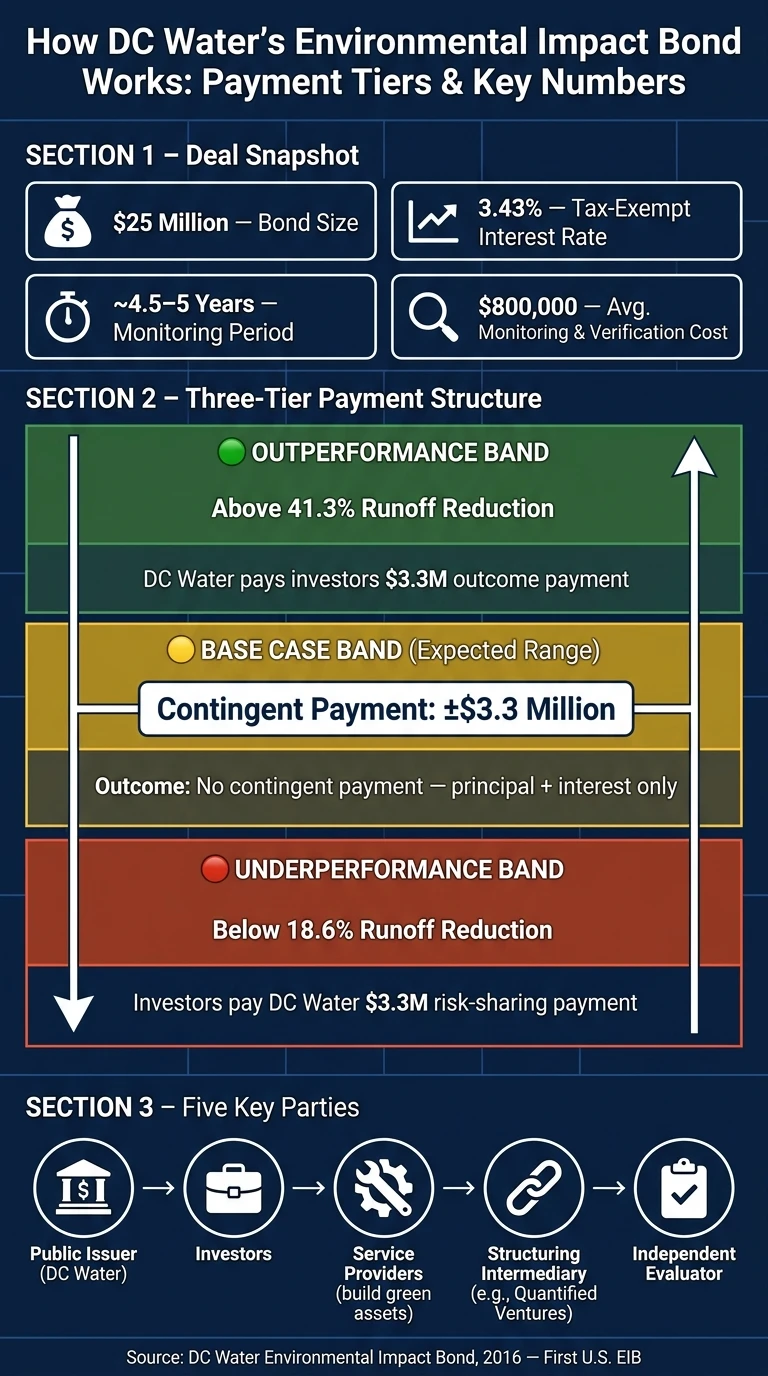
An EIB deal usually brings together five main parties: a public issuer, investors who agree to repayment terms that depend on performance, service providers who build and maintain the green assets, a structuring intermediary, and an independent evaluator. In the DC Water transaction, Quantified Ventures played the structuring intermediary role.
The money path is fairly straightforward. Investors provide funds to the issuer at closing. The issuer then uses that capital to build the project - permeable pavement, bioretention cells, green roofs - and pays investors regular coupons until maturity. DC Water’s $25 million EIB carried a 3.43% tax-exempt rate during the monitoring period. [10]
Once construction wraps up, the measurement period begins. After about 4.5 to 5 years of post-construction data collection, an independent evaluator determines which outcome tier the project reached, and one contingent payment is made. That single settlement point helps keep the bond simpler to run. [2][3][5]
The payment setup uses tiers tied to results. DC Water’s EIB set three outcomes based on stormwater runoff reduction against baseline:
If runoff reduction was above 41.3%, DC Water paid investors an extra $3.3 million outcome payment, in addition to principal and interest.
If runoff reduction landed between 18.6% and 41.3%, no contingent payment was made by either side.
If runoff reduction came in below 18.6%, investors owed DC Water a $3.3 million risk-sharing payment, which cut their net return.
The next piece is the metric itself - how performance gets measured, checked, and turned into a payment outcome.
Metrics, Monitoring, and Third-Party Verification
Those payment tiers only make sense if the project measures the right result against a fixed baseline.
The metric is chosen before issuance and tied directly to the problem the project is meant to solve. In stormwater and watershed EIBs, common measures include gallons of stormwater captured or runoff reduced, often stated per impervious acre per year. Other deals may use acre-feet of runoff reduced or combined sewer overflows avoided. Nutrient-focused projects can track pounds of nitrogen or phosphorus avoided. Habitat or resilience deals may measure acres restored, floodplain reconnection, or urban green space created. Whatever the metric, it has to be measurable, defensible, and tied to a regulatory duty or an operating goal, because that number decides who gets paid, who takes the downside, and how success is shown. [2][3][6][14][16]
Baselines are set through pre-construction field monitoring and hydrologic modeling. In DC Water’s case, the 18.6% and 41.3% runoff reduction bands came from scenario modeling built to cover expected performance ranges. [3][11][16]
After construction, the monitoring system usually combines tools like flow meters, rain gauges, water level sensors, and sampling stations placed at representative sites across the drainage area. A formal Monitoring and Evaluation Plan, agreed to in advance by all parties, sets out data collection frequency, quality control steps, and reporting deadlines. For DC Water, the project partnership agreement required a final performance report within 180 days after the monitoring period ended. [2]
Independent evaluators are chosen through a competitive process and cannot have financial ties to investors. They use EPA-referenced models and standard sampling protocols so the results can stand up to scrutiny. [2][6]
Legal and Financial Structures Used in the U.S.
Once the metric is in place, the deal needs a legal wrapper that works within public finance rules.
Most U.S. EIBs use tax-exempt municipal bond structures with performance-based terms added on top. The contingent payment setup can fit within familiar municipal bond law and disclosure rules. [9][16] DC Water’s bond, for example, was backed by its general operating revenues, much like a standard utility bond. That gave investors a familiar credit backstop even while they took on project performance risk.
Outside the bond format, issuers have also used revenue-backed instruments, private placements, loans, and pay-for-success contracts. In some cases, these are paired with state revolving fund loans. [5][6][12]
No matter the format, the structure has to match public procurement rules, board approval timelines, and budget windows. Measurement dates also need to line up with budget cycles so contingent payments stay manageable. Offering documents must clearly spell out the contingent payment formula, the performance thresholds, and the range of possible investor returns to meet disclosure duties under U.S. securities law. [8][9][13]
In practice, those limits tend to push EIB design toward structures that public agencies can approve, disclose, and budget for without much friction, while still shifting risk in a meaningful way.
How to Structure an Environmental Impact Bond
Once the payment logic is in place, the next step is the deal structure. At that point, everything comes down to three things: the project itself, the metric that will be measured, and how risk is divided.
Choose the Project and Define Measurable Outcomes
The best EIB candidates address a clear environmental problem, need major upfront capital, and tie performance to a financial result the issuer already has reason to care about. Common examples include green stormwater infrastructure, watershed restoration, and coastal resilience. [18][19][7][16]
That connection matters. When it is clear, both the public agency and the investor have a direct stake in the outcome, not just a general interest in doing good. Reduced runoff can offset gray infrastructure costs. Restored wetlands can cut flood losses. Better water quality can help satisfy a consent decree or another regulatory requirement. [2][1][8][9]
The outcome metric should flow from that link and start with a pre-construction baseline. In a stormwater project, that may be gallons of runoff reduced per impervious acre per year. In watershed or habitat work, it may be acres restored or pollutant loads removed. The metric has to be specific enough to support a payment trigger and solid enough to stand up to independent review. That metric then becomes the basis for the payout formula. [17][8]
After the metric is set, the next job is to model how each level of performance affects investor return.
Model Scenarios, Risk Sharing, and Investor Returns
Once the metric is defined, the deal needs a financial model built around three scenarios: base case, outperformance, and underperformance. The base case reflects expected project performance. The outperformance scenario shows what happens if results beat the target. The underperformance scenario shows the downside if results miss it. All three should be grounded in technical modeling and reviewed by independent experts before the bond is issued. [2][3][14]
DC Water's 2016 EIB remains the standard U.S. example of this structure. The middle band creates a no-payment range, with contingent payments only at the upper and lower trigger points. [3][10][11][20]
In plain terms, that setup tells everyone where they stand before the project begins:
If performance lands in the expected range, no extra payment changes hands.
If results beat the upper trigger, investors receive the upside payment.
If results fall below the lower trigger, investors absorb the downside built into the deal.
Those scenarios then need to be written into contracts, governance rules, and the evaluation process.
Draft Contracts, Governance, and Evaluation Terms
The contract has to convert environmental performance into payment terms that can actually be enforced. At a minimum, the core documents should define the performance metric and baseline method, the payment formula and thresholds, the evaluation timetable, reporting requirements, dispute resolution, refinancing options, and the role of each party. [1][8][9]
Governance terms carry as much weight as the financial terms. The contract should spell out how data will be collected, how results will be verified, and how threshold determinations will be made. Independent evaluators should be chosen through a competitive process and kept free of financial ties to investors. [2][6] The monitoring period and decision date also need to be set in the contract. DC Water's structure, for example, tied the payment decision to approximately five years of post-construction data. [3][14]
This is where many deals either feel solid or shaky. If the language is vague, friction shows up later - usually when money is on the line. The terms should be written so finance teams, counsel, evaluators, and stakeholders can apply them without ambiguity. [1][8][9]
Where Environmental Impact Bonds Are Used in Practice
DC Water and the Early EIB Model
The clearest way to understand EIBs is to look at the first U.S. deals that put the model into action. DC Water set the early template: payment terms tied to runoff reduction, with a fixed period for evaluation.
That basic setup later showed up in watershed restoration and other deals where payment depends on measured results.
Patterns Across Watershed, Green Infrastructure, and Resilience Deals
EIB-style structures also show up in related performance-based public-private partnerships.
In 2018, Calvert Impact Capital invested in Yuba Project I in California's North Yuba River watershed, where tree thinning and meadow restoration helped protect 15,000 acres. Blue Forest had raised more than $29 million by late 2021, and Yuba I and II together protect more than 63,000 acres from severe wildfire. The deal also tracked biomass removal: 8,500 green tons used for clean energy. [21]
Prince George's County, Maryland's Clean Water Partnership used a performance-based CBP3 to meet federal and state stormwater rules, pairing private-sector design and maintenance with a 10:1 private-to-public investment ratio. [21]
What Case Evidence Means for New Projects
The main lesson is simple: match the structure to the level of uncertainty. These cases show that EIBs make the most sense when outcome uncertainty is high. They also bring extra deal costs. Monitoring and verification can add about $800,000 to a transaction, so the value of sharing risk has to outweigh that overhead.
That’s why EIBs fit pilots and newer approaches better than routine infrastructure with predictable results. If a project’s outcome is already easy to forecast, a plain financing structure may do the job without the added complexity.
The cases below highlight the main patterns decision-makers can use to compare new deals.
Case Example | Project Type | Core Metric | Payment Structure |
|---|---|---|---|
DC Water EIB | Green Infrastructure | Stormwater runoff reduction | Performance bands |
Yuba I & II (FRB) | Forest Resilience / Watershed | Biomass removed / Acres protected | Performance-based / concessional |
Clean Water Partnership | Stormwater / Green Infrastructure | Stormwater compliance | Performance-based / CBP3 |
Across these examples, the pattern is clear: measurable outcomes support contingent payment. Put plainly, if results can be measured with confidence, shared-risk financing starts to make sense.
Using EIBs as Part of a Broader Sustainability Strategy
The case patterns above point to a simple lesson: EIBs do better when they sit inside a broader sustainability program, not off to the side. In practice, that means the bond should fund a defined part of a larger effort with clear goals, sound governance, and the right delivery partners in place. That setting matters just as much as the bond structure itself.
How Council Fire Can Support EIB Strategy and Delivery
Moving from interest in EIBs to a deal that can actually get done takes more than good intent. You need a clear problem statement, metrics people can trust, alignment across public and private stakeholders, and governance that can stand up to close review. Council Fire helps turn strategy into action by helping shape the project, metrics, governance, and financing terms needed for an EIB.
Project Stage | Council Fire Support |
|---|---|
Strategy Design | Select the project, geography, and fit with capital plans |
Stakeholder Engagement | Align agencies, investors, communities, and philanthropic partners |
Metrics Selection | Set outcome targets, baselines, and verification rules |
Finance Structuring | Define repayment sources, thresholds, and risk sharing |
Monitoring & Evaluation | Run third-party verification and impact reporting |
These roles are also a practical way to test project readiness. If one piece is shaky, the deal usually is too.
A Readiness Checklist for Organizations Considering an EIB
Before moving ahead, organizations should take an honest look at six conditions. If even one comes up weak, that usually means the EIB should be treated as a longer-term design effort, not something ready to issue now.
Clearly defined problem: Is there a specific, documented environmental challenge driving the project?
Measurable outcomes and baseline data: Can success be quantified against a credible baseline?
Repayment source: Is there a dedicated revenue stream, cost-savings mechanism, or public budget commitment?
Implementation capacity: Does the organization have staff to manage monitoring and contract administration?
Legal feasibility: Does the agency have authority to issue outcome-based debt and make contingent payments?
Stakeholder alignment: Have the parties who benefit, bear risk, and approve metrics been identified and engaged?
If any of these items is weak, the project needs more design work before issuance.
Conclusion: The Core Decisions Behind a Successful EIB
EIBs tie repayment to verified environmental results. That one feature shapes every major design choice, from metric selection to governance.
They work best when outcomes can be measured and when the transfer of risk is worth the added transaction cost. Monitoring and verification bring real expense - around $800,000 per transaction - so the case for shifting performance risk has to be strong enough to justify that overhead. EIBs make the most sense when project performance is uncertain, but the upside is meaningful if targets are met.
The strongest EIBs are one tool inside a broader resilience strategy.
FAQs
How is an environmental impact bond different from a regular municipal bond?
A regular municipal bond is a standard debt instrument used to fund infrastructure. An environmental impact bond works differently: it’s tied to performance, with repayment linked to measurable environmental results.
That structure makes EIBs a good fit when performance risk is the main thing holding a project back. Because returns depend on verified sustainability outcomes, these bonds can draw capital toward projects that might otherwise look too risky to fund.
What types of projects are best suited for an environmental impact bond?
Environmental impact bonds work best when performance risk is the main thing holding a project back. In plain terms, they make sense when investors or public agencies hesitate because outcomes aren’t guaranteed. Since repayment depends on measurable results, this model can open the door to funding that might not come through more standard channels.
They’re often a strong match for infrastructure and public service projects in water, sanitation, and affordable housing. The key is simple: the project needs clear environmental or social targets that can be measured in a concrete way. If the results can be tracked, the bond structure gives funders a clearer path forward even when there’s some uncertainty at the start.
What makes an organization ready to issue an environmental impact bond?
An organization is ready to issue an environmental impact bond when it can clearly define, quantify, and monetize its project’s environmental outcomes.
That means more than having a good idea on paper. The organization also needs precise risk modeling, transparent governance, measurable sustainability goals, and clear performance metrics. Just as important, it must have the capacity for rigorous monitoring and impact reporting that can stand up to investor scrutiny.
Related Blog Posts
Latest Articles
©2026

Narrative Change and Power Building: The Missing Half of Advocacy
Narrative change is the process of disrupting dominant narratives that normalize inequity and advancing new narratives from historically marginalized communities.

Funding Resilience Without Federal Grants
BRIC is unreliable and FEMA is shrinking. Here's how cities fund climate resilience with dedicated revenue, blended finance, and a coordinating authority.

The ESG Blind Spot: How AI Is Finding Risks in Companies Nobody Else Is Watching
Norway's sovereign wealth fund uses AI to screen 7,200 portfolio companies for forced labor and corruption within 24 hours. The real story is the emerging-market coverage gap that traditional ESG data vendors miss — and what it means for any company with a global supply chain.
Narrative Change and Power Building: The Missing Half of Advocacy
Narrative change is the process of disrupting dominant narratives that normalize inequity and advancing new narratives from historically marginalized communities.
Funding Resilience Without Federal Grants
BRIC is unreliable and FEMA is shrinking. Here's how cities fund climate resilience with dedicated revenue, blended finance, and a coordinating authority.
The ESG Blind Spot: How AI Is Finding Risks in Companies Nobody Else Is Watching
Norway's sovereign wealth fund uses AI to screen 7,200 portfolio companies for forced labor and corruption within 24 hours. The real story is the emerging-market coverage gap that traditional ESG data vendors miss — and what it means for any company with a global supply chain.
FAQ
01
What does it really mean to “redefine profit”?
02
What makes Council Fire different?
03
Who does Council Fire work with?
04
What does working with Council Fire actually look like?
05
How does Council Fire help organizations turn big goals into action?
06
How does Council Fire define and measure success?
07
How does technology fit into Council Fire’s work?
Jul 22, 2026
Ultimate Guide to Environmental Impact Bonds
Sustainability Strategy
In This Article
Explains how environmental impact bonds tie repayment to verified outcomes, covering structure, metrics, costs, and a readiness checklist.
Ultimate Guide to Environmental Impact Bonds
An environmental impact bond links part of investor payback to measured project results. In plain English: a city or utility borrows money for a water, land, or resilience project, then pays more, less, or the same based on what the project delivers. That shifts some performance risk away from the public side.
If I had to sum up the full article fast, I’d put it this way:
What it is: a financing deal tied to measured results
How it works: investors fund a project up front, then an outside evaluator checks results later
What gets measured: stormwater runoff, nutrient reduction, restored acres, flood risk reduction, and similar outcomes
Why groups use it: to test projects with uncertain results before spending at larger scale
Main tradeoff: better risk sharing, but more legal, data, and verification work
Best-known U.S. example:DC Water’s $25 million bond (2016) with a 3.43% tax-exempt rate and a $3.3 million outcome payment in either direction depending on runoff results
Main cost to watch: monitoring and verification can add about $800,000 per deal
A standard municipal bond pays investors on a fixed schedule no matter what happens. An impact bond changes that. If results beat the target, investors may earn more. If results miss the floor, they may give some value back. That setup only works when the project has a clear metric, baseline data, legal authority, a repayment source, and strong contract terms.
Before moving ahead, I’d check six things: the problem is clearly defined, outcomes can be measured, repayment is clear, staff can run the process, the issuer has legal authority, and key parties agree on the rules.
The article below explains the structure, the DC Water model, other U.S. use cases, and how to decide if this type of financing fits your project.
What are resilience bonds and how can they finance climate resilience? | UNDRR
How Environmental Impact Bonds Work
Environmental Impact Bond Structure: DC Water's $25M EIB Explained
Parties, Capital Flows, and Payment Triggers
An EIB deal usually brings together five main parties: a public issuer, investors who agree to repayment terms that depend on performance, service providers who build and maintain the green assets, a structuring intermediary, and an independent evaluator. In the DC Water transaction, Quantified Ventures played the structuring intermediary role.
The money path is fairly straightforward. Investors provide funds to the issuer at closing. The issuer then uses that capital to build the project - permeable pavement, bioretention cells, green roofs - and pays investors regular coupons until maturity. DC Water’s $25 million EIB carried a 3.43% tax-exempt rate during the monitoring period. [10]
Once construction wraps up, the measurement period begins. After about 4.5 to 5 years of post-construction data collection, an independent evaluator determines which outcome tier the project reached, and one contingent payment is made. That single settlement point helps keep the bond simpler to run. [2][3][5]
The payment setup uses tiers tied to results. DC Water’s EIB set three outcomes based on stormwater runoff reduction against baseline:
If runoff reduction was above 41.3%, DC Water paid investors an extra $3.3 million outcome payment, in addition to principal and interest.
If runoff reduction landed between 18.6% and 41.3%, no contingent payment was made by either side.
If runoff reduction came in below 18.6%, investors owed DC Water a $3.3 million risk-sharing payment, which cut their net return.
The next piece is the metric itself - how performance gets measured, checked, and turned into a payment outcome.
Metrics, Monitoring, and Third-Party Verification
Those payment tiers only make sense if the project measures the right result against a fixed baseline.
The metric is chosen before issuance and tied directly to the problem the project is meant to solve. In stormwater and watershed EIBs, common measures include gallons of stormwater captured or runoff reduced, often stated per impervious acre per year. Other deals may use acre-feet of runoff reduced or combined sewer overflows avoided. Nutrient-focused projects can track pounds of nitrogen or phosphorus avoided. Habitat or resilience deals may measure acres restored, floodplain reconnection, or urban green space created. Whatever the metric, it has to be measurable, defensible, and tied to a regulatory duty or an operating goal, because that number decides who gets paid, who takes the downside, and how success is shown. [2][3][6][14][16]
Baselines are set through pre-construction field monitoring and hydrologic modeling. In DC Water’s case, the 18.6% and 41.3% runoff reduction bands came from scenario modeling built to cover expected performance ranges. [3][11][16]
After construction, the monitoring system usually combines tools like flow meters, rain gauges, water level sensors, and sampling stations placed at representative sites across the drainage area. A formal Monitoring and Evaluation Plan, agreed to in advance by all parties, sets out data collection frequency, quality control steps, and reporting deadlines. For DC Water, the project partnership agreement required a final performance report within 180 days after the monitoring period ended. [2]
Independent evaluators are chosen through a competitive process and cannot have financial ties to investors. They use EPA-referenced models and standard sampling protocols so the results can stand up to scrutiny. [2][6]
Legal and Financial Structures Used in the U.S.
Once the metric is in place, the deal needs a legal wrapper that works within public finance rules.
Most U.S. EIBs use tax-exempt municipal bond structures with performance-based terms added on top. The contingent payment setup can fit within familiar municipal bond law and disclosure rules. [9][16] DC Water’s bond, for example, was backed by its general operating revenues, much like a standard utility bond. That gave investors a familiar credit backstop even while they took on project performance risk.
Outside the bond format, issuers have also used revenue-backed instruments, private placements, loans, and pay-for-success contracts. In some cases, these are paired with state revolving fund loans. [5][6][12]
No matter the format, the structure has to match public procurement rules, board approval timelines, and budget windows. Measurement dates also need to line up with budget cycles so contingent payments stay manageable. Offering documents must clearly spell out the contingent payment formula, the performance thresholds, and the range of possible investor returns to meet disclosure duties under U.S. securities law. [8][9][13]
In practice, those limits tend to push EIB design toward structures that public agencies can approve, disclose, and budget for without much friction, while still shifting risk in a meaningful way.
How to Structure an Environmental Impact Bond
Once the payment logic is in place, the next step is the deal structure. At that point, everything comes down to three things: the project itself, the metric that will be measured, and how risk is divided.
Choose the Project and Define Measurable Outcomes
The best EIB candidates address a clear environmental problem, need major upfront capital, and tie performance to a financial result the issuer already has reason to care about. Common examples include green stormwater infrastructure, watershed restoration, and coastal resilience. [18][19][7][16]
That connection matters. When it is clear, both the public agency and the investor have a direct stake in the outcome, not just a general interest in doing good. Reduced runoff can offset gray infrastructure costs. Restored wetlands can cut flood losses. Better water quality can help satisfy a consent decree or another regulatory requirement. [2][1][8][9]
The outcome metric should flow from that link and start with a pre-construction baseline. In a stormwater project, that may be gallons of runoff reduced per impervious acre per year. In watershed or habitat work, it may be acres restored or pollutant loads removed. The metric has to be specific enough to support a payment trigger and solid enough to stand up to independent review. That metric then becomes the basis for the payout formula. [17][8]
After the metric is set, the next job is to model how each level of performance affects investor return.
Model Scenarios, Risk Sharing, and Investor Returns
Once the metric is defined, the deal needs a financial model built around three scenarios: base case, outperformance, and underperformance. The base case reflects expected project performance. The outperformance scenario shows what happens if results beat the target. The underperformance scenario shows the downside if results miss it. All three should be grounded in technical modeling and reviewed by independent experts before the bond is issued. [2][3][14]
DC Water's 2016 EIB remains the standard U.S. example of this structure. The middle band creates a no-payment range, with contingent payments only at the upper and lower trigger points. [3][10][11][20]
In plain terms, that setup tells everyone where they stand before the project begins:
If performance lands in the expected range, no extra payment changes hands.
If results beat the upper trigger, investors receive the upside payment.
If results fall below the lower trigger, investors absorb the downside built into the deal.
Those scenarios then need to be written into contracts, governance rules, and the evaluation process.
Draft Contracts, Governance, and Evaluation Terms
The contract has to convert environmental performance into payment terms that can actually be enforced. At a minimum, the core documents should define the performance metric and baseline method, the payment formula and thresholds, the evaluation timetable, reporting requirements, dispute resolution, refinancing options, and the role of each party. [1][8][9]
Governance terms carry as much weight as the financial terms. The contract should spell out how data will be collected, how results will be verified, and how threshold determinations will be made. Independent evaluators should be chosen through a competitive process and kept free of financial ties to investors. [2][6] The monitoring period and decision date also need to be set in the contract. DC Water's structure, for example, tied the payment decision to approximately five years of post-construction data. [3][14]
This is where many deals either feel solid or shaky. If the language is vague, friction shows up later - usually when money is on the line. The terms should be written so finance teams, counsel, evaluators, and stakeholders can apply them without ambiguity. [1][8][9]
Where Environmental Impact Bonds Are Used in Practice
DC Water and the Early EIB Model
The clearest way to understand EIBs is to look at the first U.S. deals that put the model into action. DC Water set the early template: payment terms tied to runoff reduction, with a fixed period for evaluation.
That basic setup later showed up in watershed restoration and other deals where payment depends on measured results.
Patterns Across Watershed, Green Infrastructure, and Resilience Deals
EIB-style structures also show up in related performance-based public-private partnerships.
In 2018, Calvert Impact Capital invested in Yuba Project I in California's North Yuba River watershed, where tree thinning and meadow restoration helped protect 15,000 acres. Blue Forest had raised more than $29 million by late 2021, and Yuba I and II together protect more than 63,000 acres from severe wildfire. The deal also tracked biomass removal: 8,500 green tons used for clean energy. [21]
Prince George's County, Maryland's Clean Water Partnership used a performance-based CBP3 to meet federal and state stormwater rules, pairing private-sector design and maintenance with a 10:1 private-to-public investment ratio. [21]
What Case Evidence Means for New Projects
The main lesson is simple: match the structure to the level of uncertainty. These cases show that EIBs make the most sense when outcome uncertainty is high. They also bring extra deal costs. Monitoring and verification can add about $800,000 to a transaction, so the value of sharing risk has to outweigh that overhead.
That’s why EIBs fit pilots and newer approaches better than routine infrastructure with predictable results. If a project’s outcome is already easy to forecast, a plain financing structure may do the job without the added complexity.
The cases below highlight the main patterns decision-makers can use to compare new deals.
Case Example | Project Type | Core Metric | Payment Structure |
|---|---|---|---|
DC Water EIB | Green Infrastructure | Stormwater runoff reduction | Performance bands |
Yuba I & II (FRB) | Forest Resilience / Watershed | Biomass removed / Acres protected | Performance-based / concessional |
Clean Water Partnership | Stormwater / Green Infrastructure | Stormwater compliance | Performance-based / CBP3 |
Across these examples, the pattern is clear: measurable outcomes support contingent payment. Put plainly, if results can be measured with confidence, shared-risk financing starts to make sense.
Using EIBs as Part of a Broader Sustainability Strategy
The case patterns above point to a simple lesson: EIBs do better when they sit inside a broader sustainability program, not off to the side. In practice, that means the bond should fund a defined part of a larger effort with clear goals, sound governance, and the right delivery partners in place. That setting matters just as much as the bond structure itself.
How Council Fire Can Support EIB Strategy and Delivery
Moving from interest in EIBs to a deal that can actually get done takes more than good intent. You need a clear problem statement, metrics people can trust, alignment across public and private stakeholders, and governance that can stand up to close review. Council Fire helps turn strategy into action by helping shape the project, metrics, governance, and financing terms needed for an EIB.
Project Stage | Council Fire Support |
|---|---|
Strategy Design | Select the project, geography, and fit with capital plans |
Stakeholder Engagement | Align agencies, investors, communities, and philanthropic partners |
Metrics Selection | Set outcome targets, baselines, and verification rules |
Finance Structuring | Define repayment sources, thresholds, and risk sharing |
Monitoring & Evaluation | Run third-party verification and impact reporting |
These roles are also a practical way to test project readiness. If one piece is shaky, the deal usually is too.
A Readiness Checklist for Organizations Considering an EIB
Before moving ahead, organizations should take an honest look at six conditions. If even one comes up weak, that usually means the EIB should be treated as a longer-term design effort, not something ready to issue now.
Clearly defined problem: Is there a specific, documented environmental challenge driving the project?
Measurable outcomes and baseline data: Can success be quantified against a credible baseline?
Repayment source: Is there a dedicated revenue stream, cost-savings mechanism, or public budget commitment?
Implementation capacity: Does the organization have staff to manage monitoring and contract administration?
Legal feasibility: Does the agency have authority to issue outcome-based debt and make contingent payments?
Stakeholder alignment: Have the parties who benefit, bear risk, and approve metrics been identified and engaged?
If any of these items is weak, the project needs more design work before issuance.
Conclusion: The Core Decisions Behind a Successful EIB
EIBs tie repayment to verified environmental results. That one feature shapes every major design choice, from metric selection to governance.
They work best when outcomes can be measured and when the transfer of risk is worth the added transaction cost. Monitoring and verification bring real expense - around $800,000 per transaction - so the case for shifting performance risk has to be strong enough to justify that overhead. EIBs make the most sense when project performance is uncertain, but the upside is meaningful if targets are met.
The strongest EIBs are one tool inside a broader resilience strategy.
FAQs
How is an environmental impact bond different from a regular municipal bond?
A regular municipal bond is a standard debt instrument used to fund infrastructure. An environmental impact bond works differently: it’s tied to performance, with repayment linked to measurable environmental results.
That structure makes EIBs a good fit when performance risk is the main thing holding a project back. Because returns depend on verified sustainability outcomes, these bonds can draw capital toward projects that might otherwise look too risky to fund.
What types of projects are best suited for an environmental impact bond?
Environmental impact bonds work best when performance risk is the main thing holding a project back. In plain terms, they make sense when investors or public agencies hesitate because outcomes aren’t guaranteed. Since repayment depends on measurable results, this model can open the door to funding that might not come through more standard channels.
They’re often a strong match for infrastructure and public service projects in water, sanitation, and affordable housing. The key is simple: the project needs clear environmental or social targets that can be measured in a concrete way. If the results can be tracked, the bond structure gives funders a clearer path forward even when there’s some uncertainty at the start.
What makes an organization ready to issue an environmental impact bond?
An organization is ready to issue an environmental impact bond when it can clearly define, quantify, and monetize its project’s environmental outcomes.
That means more than having a good idea on paper. The organization also needs precise risk modeling, transparent governance, measurable sustainability goals, and clear performance metrics. Just as important, it must have the capacity for rigorous monitoring and impact reporting that can stand up to investor scrutiny.
Related Blog Posts
Latest Articles
©2026
Narrative Change and Power Building: The Missing Half of Advocacy
Narrative change is the process of disrupting dominant narratives that normalize inequity and advancing new narratives from historically marginalized communities.
Funding Resilience Without Federal Grants
BRIC is unreliable and FEMA is shrinking. Here's how cities fund climate resilience with dedicated revenue, blended finance, and a coordinating authority.
The ESG Blind Spot: How AI Is Finding Risks in Companies Nobody Else Is Watching
Norway's sovereign wealth fund uses AI to screen 7,200 portfolio companies for forced labor and corruption within 24 hours. The real story is the emerging-market coverage gap that traditional ESG data vendors miss — and what it means for any company with a global supply chain.
FAQ
01
What does it really mean to “redefine profit”?
02
What makes Council Fire different?
03
Who does Council Fire work with?
04
What does working with Council Fire actually look like?
05
How does Council Fire help organizations turn big goals into action?
06
How does Council Fire define and measure success?
07
How does technology fit into Council Fire’s work?
Jul 22, 2026
Ultimate Guide to Environmental Impact Bonds
Sustainability Strategy
In This Article
Explains how environmental impact bonds tie repayment to verified outcomes, covering structure, metrics, costs, and a readiness checklist.
Ultimate Guide to Environmental Impact Bonds
An environmental impact bond links part of investor payback to measured project results. In plain English: a city or utility borrows money for a water, land, or resilience project, then pays more, less, or the same based on what the project delivers. That shifts some performance risk away from the public side.
If I had to sum up the full article fast, I’d put it this way:
What it is: a financing deal tied to measured results
How it works: investors fund a project up front, then an outside evaluator checks results later
What gets measured: stormwater runoff, nutrient reduction, restored acres, flood risk reduction, and similar outcomes
Why groups use it: to test projects with uncertain results before spending at larger scale
Main tradeoff: better risk sharing, but more legal, data, and verification work
Best-known U.S. example:DC Water’s $25 million bond (2016) with a 3.43% tax-exempt rate and a $3.3 million outcome payment in either direction depending on runoff results
Main cost to watch: monitoring and verification can add about $800,000 per deal
A standard municipal bond pays investors on a fixed schedule no matter what happens. An impact bond changes that. If results beat the target, investors may earn more. If results miss the floor, they may give some value back. That setup only works when the project has a clear metric, baseline data, legal authority, a repayment source, and strong contract terms.
Before moving ahead, I’d check six things: the problem is clearly defined, outcomes can be measured, repayment is clear, staff can run the process, the issuer has legal authority, and key parties agree on the rules.
The article below explains the structure, the DC Water model, other U.S. use cases, and how to decide if this type of financing fits your project.
What are resilience bonds and how can they finance climate resilience? | UNDRR
How Environmental Impact Bonds Work
Environmental Impact Bond Structure: DC Water's $25M EIB Explained
Parties, Capital Flows, and Payment Triggers
An EIB deal usually brings together five main parties: a public issuer, investors who agree to repayment terms that depend on performance, service providers who build and maintain the green assets, a structuring intermediary, and an independent evaluator. In the DC Water transaction, Quantified Ventures played the structuring intermediary role.
The money path is fairly straightforward. Investors provide funds to the issuer at closing. The issuer then uses that capital to build the project - permeable pavement, bioretention cells, green roofs - and pays investors regular coupons until maturity. DC Water’s $25 million EIB carried a 3.43% tax-exempt rate during the monitoring period. [10]
Once construction wraps up, the measurement period begins. After about 4.5 to 5 years of post-construction data collection, an independent evaluator determines which outcome tier the project reached, and one contingent payment is made. That single settlement point helps keep the bond simpler to run. [2][3][5]
The payment setup uses tiers tied to results. DC Water’s EIB set three outcomes based on stormwater runoff reduction against baseline:
If runoff reduction was above 41.3%, DC Water paid investors an extra $3.3 million outcome payment, in addition to principal and interest.
If runoff reduction landed between 18.6% and 41.3%, no contingent payment was made by either side.
If runoff reduction came in below 18.6%, investors owed DC Water a $3.3 million risk-sharing payment, which cut their net return.
The next piece is the metric itself - how performance gets measured, checked, and turned into a payment outcome.
Metrics, Monitoring, and Third-Party Verification
Those payment tiers only make sense if the project measures the right result against a fixed baseline.
The metric is chosen before issuance and tied directly to the problem the project is meant to solve. In stormwater and watershed EIBs, common measures include gallons of stormwater captured or runoff reduced, often stated per impervious acre per year. Other deals may use acre-feet of runoff reduced or combined sewer overflows avoided. Nutrient-focused projects can track pounds of nitrogen or phosphorus avoided. Habitat or resilience deals may measure acres restored, floodplain reconnection, or urban green space created. Whatever the metric, it has to be measurable, defensible, and tied to a regulatory duty or an operating goal, because that number decides who gets paid, who takes the downside, and how success is shown. [2][3][6][14][16]
Baselines are set through pre-construction field monitoring and hydrologic modeling. In DC Water’s case, the 18.6% and 41.3% runoff reduction bands came from scenario modeling built to cover expected performance ranges. [3][11][16]
After construction, the monitoring system usually combines tools like flow meters, rain gauges, water level sensors, and sampling stations placed at representative sites across the drainage area. A formal Monitoring and Evaluation Plan, agreed to in advance by all parties, sets out data collection frequency, quality control steps, and reporting deadlines. For DC Water, the project partnership agreement required a final performance report within 180 days after the monitoring period ended. [2]
Independent evaluators are chosen through a competitive process and cannot have financial ties to investors. They use EPA-referenced models and standard sampling protocols so the results can stand up to scrutiny. [2][6]
Legal and Financial Structures Used in the U.S.
Once the metric is in place, the deal needs a legal wrapper that works within public finance rules.
Most U.S. EIBs use tax-exempt municipal bond structures with performance-based terms added on top. The contingent payment setup can fit within familiar municipal bond law and disclosure rules. [9][16] DC Water’s bond, for example, was backed by its general operating revenues, much like a standard utility bond. That gave investors a familiar credit backstop even while they took on project performance risk.
Outside the bond format, issuers have also used revenue-backed instruments, private placements, loans, and pay-for-success contracts. In some cases, these are paired with state revolving fund loans. [5][6][12]
No matter the format, the structure has to match public procurement rules, board approval timelines, and budget windows. Measurement dates also need to line up with budget cycles so contingent payments stay manageable. Offering documents must clearly spell out the contingent payment formula, the performance thresholds, and the range of possible investor returns to meet disclosure duties under U.S. securities law. [8][9][13]
In practice, those limits tend to push EIB design toward structures that public agencies can approve, disclose, and budget for without much friction, while still shifting risk in a meaningful way.
How to Structure an Environmental Impact Bond
Once the payment logic is in place, the next step is the deal structure. At that point, everything comes down to three things: the project itself, the metric that will be measured, and how risk is divided.
Choose the Project and Define Measurable Outcomes
The best EIB candidates address a clear environmental problem, need major upfront capital, and tie performance to a financial result the issuer already has reason to care about. Common examples include green stormwater infrastructure, watershed restoration, and coastal resilience. [18][19][7][16]
That connection matters. When it is clear, both the public agency and the investor have a direct stake in the outcome, not just a general interest in doing good. Reduced runoff can offset gray infrastructure costs. Restored wetlands can cut flood losses. Better water quality can help satisfy a consent decree or another regulatory requirement. [2][1][8][9]
The outcome metric should flow from that link and start with a pre-construction baseline. In a stormwater project, that may be gallons of runoff reduced per impervious acre per year. In watershed or habitat work, it may be acres restored or pollutant loads removed. The metric has to be specific enough to support a payment trigger and solid enough to stand up to independent review. That metric then becomes the basis for the payout formula. [17][8]
After the metric is set, the next job is to model how each level of performance affects investor return.
Model Scenarios, Risk Sharing, and Investor Returns
Once the metric is defined, the deal needs a financial model built around three scenarios: base case, outperformance, and underperformance. The base case reflects expected project performance. The outperformance scenario shows what happens if results beat the target. The underperformance scenario shows the downside if results miss it. All three should be grounded in technical modeling and reviewed by independent experts before the bond is issued. [2][3][14]
DC Water's 2016 EIB remains the standard U.S. example of this structure. The middle band creates a no-payment range, with contingent payments only at the upper and lower trigger points. [3][10][11][20]
In plain terms, that setup tells everyone where they stand before the project begins:
If performance lands in the expected range, no extra payment changes hands.
If results beat the upper trigger, investors receive the upside payment.
If results fall below the lower trigger, investors absorb the downside built into the deal.
Those scenarios then need to be written into contracts, governance rules, and the evaluation process.
Draft Contracts, Governance, and Evaluation Terms
The contract has to convert environmental performance into payment terms that can actually be enforced. At a minimum, the core documents should define the performance metric and baseline method, the payment formula and thresholds, the evaluation timetable, reporting requirements, dispute resolution, refinancing options, and the role of each party. [1][8][9]
Governance terms carry as much weight as the financial terms. The contract should spell out how data will be collected, how results will be verified, and how threshold determinations will be made. Independent evaluators should be chosen through a competitive process and kept free of financial ties to investors. [2][6] The monitoring period and decision date also need to be set in the contract. DC Water's structure, for example, tied the payment decision to approximately five years of post-construction data. [3][14]
This is where many deals either feel solid or shaky. If the language is vague, friction shows up later - usually when money is on the line. The terms should be written so finance teams, counsel, evaluators, and stakeholders can apply them without ambiguity. [1][8][9]
Where Environmental Impact Bonds Are Used in Practice
DC Water and the Early EIB Model
The clearest way to understand EIBs is to look at the first U.S. deals that put the model into action. DC Water set the early template: payment terms tied to runoff reduction, with a fixed period for evaluation.
That basic setup later showed up in watershed restoration and other deals where payment depends on measured results.
Patterns Across Watershed, Green Infrastructure, and Resilience Deals
EIB-style structures also show up in related performance-based public-private partnerships.
In 2018, Calvert Impact Capital invested in Yuba Project I in California's North Yuba River watershed, where tree thinning and meadow restoration helped protect 15,000 acres. Blue Forest had raised more than $29 million by late 2021, and Yuba I and II together protect more than 63,000 acres from severe wildfire. The deal also tracked biomass removal: 8,500 green tons used for clean energy. [21]
Prince George's County, Maryland's Clean Water Partnership used a performance-based CBP3 to meet federal and state stormwater rules, pairing private-sector design and maintenance with a 10:1 private-to-public investment ratio. [21]
What Case Evidence Means for New Projects
The main lesson is simple: match the structure to the level of uncertainty. These cases show that EIBs make the most sense when outcome uncertainty is high. They also bring extra deal costs. Monitoring and verification can add about $800,000 to a transaction, so the value of sharing risk has to outweigh that overhead.
That’s why EIBs fit pilots and newer approaches better than routine infrastructure with predictable results. If a project’s outcome is already easy to forecast, a plain financing structure may do the job without the added complexity.
The cases below highlight the main patterns decision-makers can use to compare new deals.
Case Example | Project Type | Core Metric | Payment Structure |
|---|---|---|---|
DC Water EIB | Green Infrastructure | Stormwater runoff reduction | Performance bands |
Yuba I & II (FRB) | Forest Resilience / Watershed | Biomass removed / Acres protected | Performance-based / concessional |
Clean Water Partnership | Stormwater / Green Infrastructure | Stormwater compliance | Performance-based / CBP3 |
Across these examples, the pattern is clear: measurable outcomes support contingent payment. Put plainly, if results can be measured with confidence, shared-risk financing starts to make sense.
Using EIBs as Part of a Broader Sustainability Strategy
The case patterns above point to a simple lesson: EIBs do better when they sit inside a broader sustainability program, not off to the side. In practice, that means the bond should fund a defined part of a larger effort with clear goals, sound governance, and the right delivery partners in place. That setting matters just as much as the bond structure itself.
How Council Fire Can Support EIB Strategy and Delivery
Moving from interest in EIBs to a deal that can actually get done takes more than good intent. You need a clear problem statement, metrics people can trust, alignment across public and private stakeholders, and governance that can stand up to close review. Council Fire helps turn strategy into action by helping shape the project, metrics, governance, and financing terms needed for an EIB.
Project Stage | Council Fire Support |
|---|---|
Strategy Design | Select the project, geography, and fit with capital plans |
Stakeholder Engagement | Align agencies, investors, communities, and philanthropic partners |
Metrics Selection | Set outcome targets, baselines, and verification rules |
Finance Structuring | Define repayment sources, thresholds, and risk sharing |
Monitoring & Evaluation | Run third-party verification and impact reporting |
These roles are also a practical way to test project readiness. If one piece is shaky, the deal usually is too.
A Readiness Checklist for Organizations Considering an EIB
Before moving ahead, organizations should take an honest look at six conditions. If even one comes up weak, that usually means the EIB should be treated as a longer-term design effort, not something ready to issue now.
Clearly defined problem: Is there a specific, documented environmental challenge driving the project?
Measurable outcomes and baseline data: Can success be quantified against a credible baseline?
Repayment source: Is there a dedicated revenue stream, cost-savings mechanism, or public budget commitment?
Implementation capacity: Does the organization have staff to manage monitoring and contract administration?
Legal feasibility: Does the agency have authority to issue outcome-based debt and make contingent payments?
Stakeholder alignment: Have the parties who benefit, bear risk, and approve metrics been identified and engaged?
If any of these items is weak, the project needs more design work before issuance.
Conclusion: The Core Decisions Behind a Successful EIB
EIBs tie repayment to verified environmental results. That one feature shapes every major design choice, from metric selection to governance.
They work best when outcomes can be measured and when the transfer of risk is worth the added transaction cost. Monitoring and verification bring real expense - around $800,000 per transaction - so the case for shifting performance risk has to be strong enough to justify that overhead. EIBs make the most sense when project performance is uncertain, but the upside is meaningful if targets are met.
The strongest EIBs are one tool inside a broader resilience strategy.
FAQs
How is an environmental impact bond different from a regular municipal bond?
A regular municipal bond is a standard debt instrument used to fund infrastructure. An environmental impact bond works differently: it’s tied to performance, with repayment linked to measurable environmental results.
That structure makes EIBs a good fit when performance risk is the main thing holding a project back. Because returns depend on verified sustainability outcomes, these bonds can draw capital toward projects that might otherwise look too risky to fund.
What types of projects are best suited for an environmental impact bond?
Environmental impact bonds work best when performance risk is the main thing holding a project back. In plain terms, they make sense when investors or public agencies hesitate because outcomes aren’t guaranteed. Since repayment depends on measurable results, this model can open the door to funding that might not come through more standard channels.
They’re often a strong match for infrastructure and public service projects in water, sanitation, and affordable housing. The key is simple: the project needs clear environmental or social targets that can be measured in a concrete way. If the results can be tracked, the bond structure gives funders a clearer path forward even when there’s some uncertainty at the start.
What makes an organization ready to issue an environmental impact bond?
An organization is ready to issue an environmental impact bond when it can clearly define, quantify, and monetize its project’s environmental outcomes.
That means more than having a good idea on paper. The organization also needs precise risk modeling, transparent governance, measurable sustainability goals, and clear performance metrics. Just as important, it must have the capacity for rigorous monitoring and impact reporting that can stand up to investor scrutiny.
Related Blog Posts
Latest Articles
©2026
Narrative Change and Power Building: The Missing Half of Advocacy
Narrative change is the process of disrupting dominant narratives that normalize inequity and advancing new narratives from historically marginalized communities.
Funding Resilience Without Federal Grants
BRIC is unreliable and FEMA is shrinking. Here's how cities fund climate resilience with dedicated revenue, blended finance, and a coordinating authority.
The ESG Blind Spot: How AI Is Finding Risks in Companies Nobody Else Is Watching
Norway's sovereign wealth fund uses AI to screen 7,200 portfolio companies for forced labor and corruption within 24 hours. The real story is the emerging-market coverage gap that traditional ESG data vendors miss — and what it means for any company with a global supply chain.
FAQ
What does it really mean to “redefine profit”?
What makes Council Fire different?
Who does Council Fire work with?
What does working with Council Fire actually look like?
How does Council Fire help organizations turn big goals into action?
How does Council Fire define and measure success?
How does technology fit into Council Fire’s work?