
Oct 11, 2026 · 14 min read
Governance
In This Article
Governance, not design, determines whether green‑blue infrastructure reduces flood risk—assign responsibilities and fund upkeep first.
On this page
- Blue Green Infrastructure for urban resilience
- Who Plans, Funds, and Maintains Green-Blue Infrastructure?
- 1. Bishan–Ang Mo Kio Park, Singapore: Coordinate River and Park Management
- 2. Rotterdam, Netherlands: Connect Water Plazas With Adaptation Plans
- 3. Portland, Oregon: Make Green Streets Part of Public Works
- 4. Copenhagen, Denmark: Align Cloudburst Planning and Funding
- 5. New York City: Link Utility Investment to Neighborhood Needs
- Compare the 5 Governance Models
- 6 Actions Communities Can Take
- Conclusion: Set Governance Before Copying Design
- FAQs
Green-Blue Governance Cases: 5 City Lessons
My takeaway from these five cities: assign responsibility and fund upkeep before choosing a design. Portland’s audit found that 40% of sampled green streets failed maintenance standards in 2017 - a reminder that building projects and keeping them working are separate tasks.
I compare five approaches to managing water, parks, and streets:
Singapore: Divide river safety and park care between water and parks agencies.
Rotterdam: Share water-plaza planning and construction costs with regional water authorities.
Portland: Make green streets part of public works, with utility revenue and maintenance checks.
Copenhagen: Separate stormwater costs from added public-space costs.
New York City: Use utility investment and legal deadlines to deliver neighborhood projects.
Quick Comparison
| City | Who leads? | How is it funded? | What needs attention? |
|---|---|---|---|
| Singapore | Water and parks agencies | Public capital funding | Upkeep budgets and cost sharing |
| Rotterdam | City and water authorities | City, water-board, and program funds | Separate funding for maintenance |
| Portland | Public works bureaus | Sewer and stormwater bills; fees | Inspection results and asset condition |
| Copenhagen | City and HOFOR utility | Utility charges and municipal taxes | Clear ownership and cost divisions |
| New York City | DEP utility | Capital budgets; grants for private sites | Delivery, upkeep, and neighborhood outcomes |
Before borrowing a model, I would check local legal powers, involve residents, and name who pays for inspections, repairs, and monitoring. <u>Spending and installation counts are not proof of reduced flooding.</u> Your community needs measured results, clear public reporting, and a budget that lasts beyond construction.
Blue Green Infrastructure for urban resilience
sbb-itb-8baf5f1
Who Plans, Funds, and Maintains Green-Blue Infrastructure?
A site plan shows where water flows; a responsibility map shows who must act. Identify the lead agency, approval authority, construction manager, maintenance owner, and data custodian.[5][8]
Utilities, public works, parks, transportation, and other relevant departments should work toward shared goals and metrics instead of working in silos.[6] The five city cases show how these roles are assigned in practice.
Separate project delivery from long-term ownership. Assign inspections, vegetation care, trash and sediment removal, repairs, access, safety, and replacement through an interagency agreement, operating contract, deed restriction, or maintenance plan. For facilities on private property, put the owner’s duties in writing.[7]
Match every duty to a funding source.
If stormwater revenue funds park infrastructure, specify whether the utility reimburses parks staff for upkeep.[7]
Set separate budgets for annual operations, major repairs, and monitoring. EPA guidance provides no universal maintenance-cost benchmark.[11][12] Keep an asset inventory that records each facility’s location, owner, condition, and inspection schedule, and review it during annual budgeting.[3]
Residents should help set priorities before sites are selected. Use accessible meetings, multilingual materials, and trusted community organizations to identify flooding, access, and safety concerns.[4][6] Residents can report blocked inlets and litter, while trained staff should handle technical inspections and hazardous repairs.[9] Assign someone to record starting conditions and publish results, including flooding performance, vegetation survival, response times, and neighborhood benefits.[6]
International models need a U.S. authority check - not just a design adjustment. Before transferring a governance model, verify which local bodies can collect stormwater fees, acquire or regulate land, issue permits, and commit multi-year funds. A regional arrangement does not automatically include taxing or zoning powers. Base agreements on the actual authority of municipalities, utilities, counties, and states, then adjust project priorities to local watershed conditions and community needs.[6] The cases below show how these legal limits shape projects.
1. Bishan–Ang Mo Kio Park, Singapore: Coordinate River and Park Management
Public Roles and Coordination
PUB handles drainage and hydraulic safety, while NParks manages the park, habitat, and visitor experience. Sensors and 11 safety nodes support the site’s safety system with lights, sirens, and announcements. Residents were not responsible for technical safety or upkeep.[14][15][18]
Governance and Policy Tools
Singapore’s ABC Waters Programme replaced a 2.7-kilometer (about 1.7-mile) concrete canal with a meandering Kallang River that serves as both drainage infrastructure and parkland.[14][16] This design relied on a clear division of responsibilities between the water and park agencies.[14][15]
Construction and Maintenance Funding
Clear responsibilities did not guarantee a clear upkeep budget. Reported capital costs range from S$76.7 million to S$86 million. Sources identify neither a separate maintenance budget nor a PUB–NParks cost-sharing formula.[10][13]
Measured Results and Lessons
Success should be assessed through both ecological results and rules for public use. A study-based account reports a 33% biodiversity increase across two mature plots and 197 animal species, including 59 bird species and 22 dragonfly species.[17] These gains do not show that flood risk was eliminated.
Takeaway: Assign clear water and park responsibilities, plan for temporary inundation, and post clear access rules, because floodplain use can look like failure to the public.[13][14][18]
2. Rotterdam, Netherlands: Connect Water Plazas With Adaptation Plans
Governance and Policy Tools
Launched in 2008, Rotterdam Climate Proof brought together project delivery, knowledge sharing, and climate-risk communication.[27] It linked with the jointly developed Rotterdam Waterplan to make stormwater management part of urban planning. The 2025 resilience target set a policy direction - not proof that risk had disappeared.[27] This framework helped the city coordinate adaptation across agencies and neighborhoods.
Public Roles and Coordination
The city led spatial planning, public-space projects, and adaptation strategy. Regional water boards managed wastewater and flood defenses.[20][24][26] Residents helped shape recreation uses, while developers and housing organizations extended adaptation beyond public land. Knowledge institutions provided research and testing.[20][23][25] These shared roles also guided how the city and water boards divided capital costs.
Construction and Maintenance Funding
A 2021 case study puts Benthemplein’s cost at approximately €4 million: Rotterdam contributed 50%, regional water boards 25%, and European and Dutch programs 25%.[25] Those contributions covered capital costs, not a documented long-term maintenance budget. Before reusing the figure, check the final accounts. Assign responsibility for maintenance and budget separately for inlet inspections, sediment removal, repairs, and monitoring.[21][22][25]
Measured Results and Lessons
Benthemplein shows how these shared roles translated into a built project.
Benthemplein Water Square: Completed in 2013 and designed by De Urbanisten for the City of Rotterdam, it combines dry-weather recreation with approximately 1,800 cubic meters of temporary stormwater storage, or about 475,500 gallons. Lowered basins collect runoff from surrounding roofs and paving, delaying its release after rain.[21][22][30][31]
Storage capacity alone does not prove that citywide flood losses fell. Benthemplein was relatively expensive because construction required piling, and water plazas still rely on sewers and regional flood protection. Project planning should include a joint city–water-authority team, shared drainage standards, storm-access rules, assigned maintenance duties, and performance monitoring.[22][28][29]
3. Portland, Oregon: Make Green Streets Part of Public Works
Governance and Policy Tools
Portland’s 2007 Green Streets Policy makes green streets part of routine public works. BES leads delivery, while the Stormwater Management Manual sets requirements for development, redevelopment, and right-of-way projects. City-funded projects must include green-street facilities when the manual requires them.[32][35][38][40]
Public Roles and Coordination
BES works with the Portland Bureau of Transportation and the Portland Water Bureau. Bringing these teams in early helps resolve conflicts involving curbs, sidewalks, utilities, and access. Watershed and community groups support planting, rain gardens, and pavement removal.
BES inspects and services public green streets at least twice a year; private owners maintain private facilities.[32][34][37][39][40] This division of work needs a dedicated upkeep budget.
Construction and Maintenance Funding
Monthly sewer and stormwater bills provide most of BES’s funding, supplemented by system development charges, connection charges, and permit fees. Recurring utility revenue pays for routine service. Capital budgets fund infrastructure, while grants and community funding support targeted projects.[34][38]
In 2023, Portland authorized up to $12 million over five years for on-call maintenance and irrigation services. That figure represents contracting authority - not actual spending.[41]
Measured Results and Lessons
By 2023, Portland had more than 2,500 green-street facilities and approximately 150 vegetated regional water-quality facilities.[39] Installation counts tell only part of the story. Track runoff managed, facility condition, inspection completion, and neighborhood distribution as well.
A 2019 auditor review found that 40% of sampled green streets failed maintenance standards in 2017. BES also could not show that roughly $1 million in annual maintenance spending delivered the expected service. The problem was an accountability gap, not just a maintenance issue.[33]
Takeaway: Set condition scores and inspection schedules. Before expanding the network, tie maintenance standards to public reporting.
4. Copenhagen, Denmark: Align Cloudburst Planning and Funding
Governance and Policy Tools
Copenhagen’s lesson is governance first: split surface-space management from drainage authority, then fund each part accordingly.
Copenhagen adopted its Cloudburst Management Plan in 2012 following the 2011 cloudburst. It uses watershed-scale modeling and a surface-first approach to reduce flooding from extreme rainfall. Floodable parks, retention areas, cloudburst boulevards, green streets, water corridors, tunnels, and controlled discharge routes work together to move and store stormwater. The plan addresses extreme rainfall, including modeled 100-year events, but does not promise to eliminate all flood risk.[42][43][45][46][48][52]
Public Roles and Coordination
Copenhagen’s Technical and Environmental Administration leads planning and public-space work. HOFOR, the publicly owned utility, handles drainage, hydraulic analysis, and implementation.
Shared catchments require shared decisions. Copenhagen and neighboring Frederiksberg must coordinate so upstream measures do not increase downstream risk. Residents and property owners manage on-site storage and private drainage, while agencies specify which measures are required, voluntary, or subsidized.[45][48][52]
These responsibilities need matching funding arrangements.
Construction and Maintenance Funding
Water charges pay for stormwater functions and surface conveyance. Municipal taxes pay for added playgrounds, streetscape features, and other public-space benefits. Separate those costs before approving a project, and document which expenses qualify under utility-financing rules.[46][49][50][51]
The city maintains city-owned surface assets; HOFOR maintains utility-owned drainage infrastructure. Written agreements should assign vegetation care, sediment removal, inlet inspections, public safety, and flood recovery. Recurring operating funds must cover both recreation and stormwater storage.[44][45]
The city then measures whether this funding structure delivers reliable flood control.
Measured Results and Lessons
Completed retention parks serve two purposes: recreation during dry weather and temporary stormwater storage during heavy rain. Under design conditions, the performance target limits sewer discharge to ground level to once every 10 years on average. Communities should still track flooding, storage performance, property impacts, maintenance response times, and neighborhood benefits.[42][46][47][48]
5. New York City: Link Utility Investment to Neighborhood Needs
Governance and Policy Tools
DEP’s Green Infrastructure Plan connects rain gardens, permeable surfaces, roofs, and detention systems to combined-sewer-overflow (CSO) control.[53][55] The 2023 consent-order update requires DEP to reduce CSO discharges by 1.67 billion gallons per year by 2040 and spend $3.5 billion on green infrastructure by 2045.[58] Since 2022, the Unified Stormwater Rule has required qualifying projects to manage stormwater on-site if they disturb at least 20,000 square feet or add at least 5,000 square feet of impervious surface.[54]
Policy deadlines drive investment, not design alone. This is the most compliance-driven model in the set.
Public Roles and Coordination
DEP designs, builds, and maintains many green infrastructure assets across streets, sidewalks, parks, playgrounds, and NYCHA properties. Unlike the park- or streets-based cases, DEP leads delivery through utility infrastructure and regulatory compliance.
DOT works with DEP on pedestrian access and safety around right-of-way rain gardens. Parks and other capital agencies add stormwater controls during construction and renovations, while property owners and developers must meet runoff rules. Community organizations and environmental-justice groups bring flooding and access concerns to the table, but DEP retains final authority.[55][56][59]
Construction and Maintenance Funding
DEP capital funding and enforceable CSO commitments support the main program. Grants and incentives help fund private projects. DEP grants can cover eligible design and construction costs, generally requiring projects to manage one inch of stormwater runoff from the impervious area they drain. Private recipients must maintain their systems.[55][58]
Measured Results and Lessons
By May 2025, DEP reported more than 16,000 assets, over $1.4 billion committed, and retrofits at more than 250 public parks, playgrounds, and NYCHA properties.[54] These figures show how utility funding reaches neighborhood sites.
Spending and delivery, however, don't always move together. DEP’s 2015 reporting showed that it exceeded its $187 million spending commitment but fell short of its impervious-area milestone.[57]
Takeaway: Report spending, acres treated, runoff captured, CSO reductions, maintenance conditions, storm performance, and neighborhood outcomes separately.
This utility-led model differs from the park-, water-board-, and public-works-led cases above.
Compare the 5 Governance Models
These cases differ less in design than in who has authority, who pays, and who handles upkeep. The table compares those roles, each model’s results, and the conditions needed to use it elsewhere.
Documented means sources report an outcome or an established arrangement - not necessarily measured flood reduction. Intended marks a goal that still needs performance evidence.
| Case | Lead institution | Main policy tool | Stakeholder role | Funding structure | Core result | Conditions for use elsewhere |
|---|---|---|---|---|---|---|
| Singapore | PUB and NParks | ABC Waters program; joint river–park planning | Consultation, park use, citizen monitoring | National public funding; project allocation unverified | Documented: 1.9 miles (3 km) of naturalized river, 24.7 acres (10 hectares) of habitat, recreation space, and higher biodiversity.[19] | Interagency agreement; water and parks partners; bioengineering capacity; long-term maintenance owner |
| Rotterdam | Municipality and regional water authorities | Water plazas within adaptation plans | Consultation and recreation co-design | City, water-board, national, and EU funding.[21] | Documented: stormwater storage and recreation.[31] Intended: neighborhood flood resilience. | Water-board partnership; coordinated capital budgets; recurring upkeep revenue; assigned drainage and public-space owners |
| Portland | BES, transportation, and water bureaus | Green Streets Policy; permitting requirements | Ratepayer input and oversight | Sewer and stormwater bills; project fees.[61] | Documented: integration into public rights-of-way; weak maintenance performance.[36][60] | Utility authority; enforceable permits; stable rate revenue; named asset owner |
| Copenhagen | Municipality and HOFOR | Citywide cloudburst planning | Input on priorities, flood routes, and design | Municipal and utility funding; project splits need verification | Intended: coordinated streets, parks, and water infrastructure; project-level evidence still needed. | Stormwater-financing authority; departmental agreements; multiyear revenue; named flood-route and public-space owners |
| New York City | DEP and infrastructure agencies | Utility capital planning; runoff requirements | Priority-setting input, design review, community partnerships | Utility capital budgets; other capital sources and grants listed separately when verified | Documented: utility investment at neighborhood sites. Intended: equitable benefits that require distributional analysis.[55][56][59] | Utility authority; interagency agreements; transparent neighborhood priorities; long-term maintenance owner |
Capital funding builds projects; operating budgets keep them working. Match both before construction starts, and use these patterns to assign roles, budgets, and maintenance responsibilities before choosing a design.
6 Actions Communities Can Take
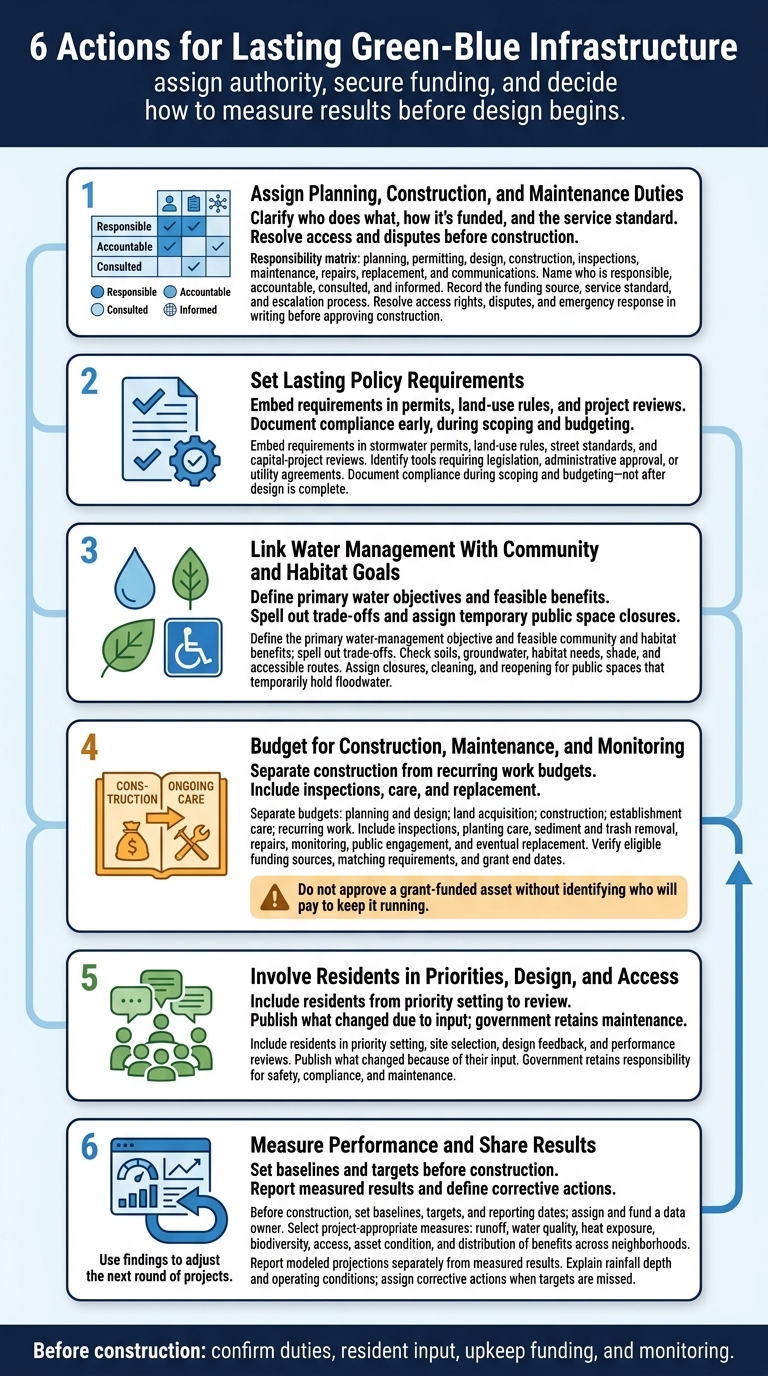
6 Actions for Lasting Green-Blue Infrastructure
The five cases point to a shared approach: assign authority, secure funding, and decide how to measure results before design begins.
Assign Planning, Construction, and Maintenance Duties
Put the responsibility map in writing. Use a matrix covering planning, permitting, design, construction, inspections, maintenance, repairs, replacement, and communications. Name who is responsible, accountable, consulted, and informed for each task, and record its funding source, service standard, and escalation process.
Where authority overlaps, settle access rights, dispute procedures, and emergency response through written agreements before approving construction.
Set Lasting Policy Requirements
Build requirements into stormwater permits, land-use rules, street standards, and capital-project reviews. Ask legal staff to identify which tools need legislation, administrative approval, or utility agreements.
Require project teams to document compliance during scoping and budgeting - not after design is complete. Choose requirements the jurisdiction can enforce with its available staff, keeping governance tied to the rules cities already use.
Link Water Management With Community and Habitat Goals
Connect the primary water-management objective to feasible community and habitat benefits in a brief that spells out trade-offs. Check soils, groundwater, habitat needs, shade, and accessible routes before promising recreation or cooling.
If public space will temporarily hold floodwater, specify who handles closures, cleaning, and reopening. Give priority to benefits residents need and agencies can maintain.
Budget for Construction, Maintenance, and Monitoring
Prepare separate budgets for planning and design, land acquisition, construction, establishment care, and recurring work. Include inspections, planting care, sediment and trash removal, repairs, monitoring, public engagement, and eventual replacement.
Verify whether utility revenue, public budgets, development charges, or grants can legally pay for each expense. Record matching requirements and grant end dates. Do not approve a grant-funded asset without identifying who will pay to keep it running.
Involve Residents in Priorities, Design, and Access
Bring residents into priority setting, site selection, design feedback, and performance reviews. Publish what changed because of their input. Government must retain responsibility for safety, compliance, and maintenance.
Measure Performance and Share Results
Before construction, set baselines, targets, and reporting dates, and assign a data owner with funding to do the work. Choose measures that fit the project: runoff, water quality, heat exposure, biodiversity, access, asset condition, and how benefits are distributed across neighborhoods.
Report modeled projections separately from measured results. Explain rainfall depth and operating conditions, and assign corrective actions when targets are missed. Use the findings to adjust the next round of projects.
Conclusion: Set Governance Before Copying Design
The five cases point to the same lesson: borrow the governance lessons, not the blueprint. Infrastructure that lasts needs shared authority, policy support, stakeholder buy-in, steady maintenance funding, and performance tracking.
Start with one project that fits local rainfall, soils, land ownership, and community priorities. Before construction, confirm agency duties, resident input, and funding for upkeep and monitoring.
Use that project to test local readiness. Let performance results and resident feedback guide expansion, and scale what your community can maintain and measure.
FAQs
Which governance model fits a small U.S. community?
The best model depends on your resources and risk profile [1]. If your departments are strong but you have little capacity to open new offices, build resilience into those departments [1]. When resources are tight, small-scale projects - such as community-driven research or coastal tourism workshops - can build momentum [2]. For shared climate challenges, a regional authority can offer bonding capacity and coordination that a small municipality could not afford on its own [3][1].
How can we estimate long-term maintenance costs?
Include maintenance cost assumptions in project documentation, and use pilot studies as implementation blueprints [1]. Each resilience project should include engineering-level cost estimates, benefit-cost ratios, and implementation timelines [2].
Use shared regional data infrastructure with standard definitions for costs and financial performance [1]. Plan finances early: the cost of inaction compounds as project backlogs grow with every storm season that passes without a delivery mechanism [3].
How can we verify that projects reduce flooding?
Verify flood reduction by comparing post-implementation results against a consistent baseline for climate vulnerability and stormwater modeling across jurisdictions. Council Fire cases use downscaled sea-level and precipitation scenarios alongside EPA SWMM capacity analysis. After completion, they confirm changes in engineered performance and flood risk [1].
Publish transparent progress reports and agree with partners on shared metrics and definitions so improvements can be compared across projects and jurisdictions [2][3].

FAQ