May 3, 2026
How to Finance Green and Nature-Based Infrastructure for Maritime & Logistics Companies
Sustainability Strategy
In This Article
Green financing options—green bonds, SLLs, PPPs, ECAs and blended finance—for ports and maritime nature-based projects.
How to Finance Green and Nature-Based Infrastructure for Maritime & Logistics Companies
Maritime and logistics companies face growing challenges: meeting climate goals, managing risks from rising sea levels, and maintaining operations. Transitioning to greener, nature-based infrastructure offers solutions but requires significant funding. Here's a quick guide to overcoming financial hurdles:
Key Financing Tools: Green bonds, sustainability-linked loans (SLLs), and public-private partnerships (PPPs) enable access to funds for eco-friendly projects.
Project Evaluation: To qualify for funding, projects must align with emissions targets, protect ecosystems, and demonstrate financial viability.
Risk Management: Specialized funds like the Sustainable and Resilient Maritime Fund (SRMF) and export credit agencies (ECAs) help reduce investment risks.
Blended Finance: Combines public and private capital to make large-scale projects feasible.
Case Studies: Examples include port electrification, vessel retrofits, and nature-based coastal defenses, which deliver both financial savings and reduced emissions.
TMS Ship Finance and Trade Conference 2025 - Capt. Ammar Al Shaiba Keynote Speaker
How to Evaluate Projects for Green Financing
To secure green financing, projects must meet stringent requirements, demonstrating both environmental alignment and solid financial prospects.
The World Bank highlights the growing momentum in "Blue Finance", describing it as a rising focus within Climate Finance that attracts attention from investors, financial institutions, and issuers worldwide. According to the World Bank, this area offers opportunities for economic growth, better livelihoods, and healthier marine ecosystems [3]. However, this increased interest also brings more rigorous qualification standards.
Meeting Environmental and Regulatory Standards
Projects need to adhere to established frameworks like the Green Bond Principles (GBP) and Green Loan Principles (GLP), which outline the core criteria for green project eligibility [3]. For maritime projects, the Guidelines for Blue Finance provide additional criteria tailored to marine ecosystem health and sustainable ocean industries [3].
Going beyond basic compliance can make a project more appealing to investors. For instance, the International Maritime Organization (IMO) has set a CO2 reduction target of 40% by 2030. Projects that exceed this benchmark - like A.P. Moller - Maersk’s initiative, which aims for a 60% reduction - can secure premium financing packages. Maersk’s $5 billion revolving credit facility, supported by 26 banks, adjusts its credit margin based on the company’s emissions performance, showcasing how ambitious goals can attract favorable terms [4].
The Asian Development Bank also notes that adopting a "life-cycle approach" for ports - incorporating clean energy, waste management, and nature-based solutions - can significantly lower environmental impacts when supported by appropriate financing and policies [2].
Evaluation Criteria | Key Requirements for Qualification |
|---|---|
Emissions | Must meet or exceed IMO 2030/2050 decarbonization targets [4] |
Ecosystem Health | Must protect biodiversity or include nature-based solutions [2] [3] |
Circular Economy | Should feature sustainable vessel recycling and waste reduction plans [4] |
Technology | Preference for advanced solutions like autonomous shipping or wind-assist propulsion [4] |
Financial Risk | Must address climate hazards such as sea-level rise and extreme weather [2] |
Projects that incorporate cutting-edge technology often stand out. For example, the Neoline project, which uses vessels equipped with 4,100 m² sails, secured funding by demonstrating an 80% reduction in carbon emissions on the St. Nazaire-Baltimore route [4]. This underscores how innovative approaches can directly influence financing outcomes in green maritime projects.
Once environmental criteria are satisfied, the next step is to evaluate financial viability and risks.
Calculating Financial Viability and Risk
After meeting environmental benchmarks, demonstrating financial strength is crucial. Beyond meeting compliance, projects must show clear financial returns and manageable risks. Tools like Multi-Criteria Decision Making (MCDM) can help balance various KPIs against environmental and technological uncertainties [5].
Climate-related risks, such as rising sea levels and extreme weather events, must also be factored into the financial evaluation [2]. Incorporating resilience measures - like using nature-based solutions for coastal protection - can make projects more attractive to investors by minimizing long-term risks.
Specialized funds, such as the Sustainable and Resilient Maritime Fund (SRMF), can help de-risk projects. These funds provide guarantees or concessional financing, reducing the perceived risk for private investors [2]. Additionally, projects operating in European waters should align with the EU Taxonomy, which provides standardized definitions that institutional investors rely on [5].
It’s also essential to calculate full lifecycle returns, including savings from lower fuel consumption, reduced regulatory compliance costs, and preferential financing terms. Projects that clearly demonstrate profitability while meeting environmental goals are in the best position to secure green financing, especially for infrastructure tied to sustainability and nature-based solutions.
Using Public-Private Partnerships (PPPs)
Public-Private Partnerships (PPPs) are proving to be a practical way for governments and private investors to share financial and environmental risks in large-scale green infrastructure projects. Initiatives like port electrification and nature-based coastal defenses are prime examples of how these partnerships can drive sustainability efforts forward [6][7].
Take, for instance, the collaboration between an East Coast port authority and private operators from 2021 to 2026. Handling 3 million TEUs annually, they rolled out an $800 million capital plan focused on sustainability. This effort led to $125 million in savings over five years, including $48 million from reduced diesel fuel use and $22 million in lower energy costs. Key components of the project included installing 12 MW of solar power and creating a $15 million grant fund to assist independent truck operators in adopting cleaner vehicles [9].
PPPs also play a critical role in addressing Scope 3 emissions, which can account for up to 82% of a port's total carbon footprint. These emissions stem from tenant operations, vessels at berth, and drayage trucks - areas outside the direct control of port authorities. By introducing "green leases" with specific energy efficiency and clean equipment requirements, port authorities can share the responsibility for reducing emissions with their tenants [9].
In another example, Long Beach Container Terminal, part of Macquarie Asset Management, financed its Net Zero 2030 Climate Action Plan through a US Private Placement in February 2025. Featuring a green tranche and coordinated by Natixis CIB, this project attracted institutional investors to fund zero-emissions infrastructure like ship-to-shore cranes, automated guided vehicles, and battery systems [8].
PPP Case Studies in Green Maritime Projects
Several real-world examples highlight how PPPs address both financial and environmental challenges effectively.
In April 2022, Tibar Bay Port in Timor-Leste launched a biodiversity offset program as part of its greenfield container port PPP. The operator adhered to IFC Environmental and Social Performance Standards to mitigate impacts on mangrove and coral habitats. Public authorities and third-party monitors ensured the project met its environmental and financial goals [7].
The East Coast port authority case illustrates how partnerships can deliver community health benefits alongside financial returns. For instance, their clean truck program, requiring compliance with 2010 EPA engine standards, reduced PM2.5 levels in nearby communities by 31%. This was a critical achievement, as neighborhoods near ports often face disproportionate air quality issues, fueling opposition to port operations.
"Port communities bear the health costs of port operations. Sustainability strategies that don't explicitly address community health impacts and provide tangible community benefits will face opposition that undermines implementation." - Council Fire [9]
The financial benefits of these partnerships extend beyond cost savings. The same port authority saved $36 million by integrating climate-resilient design into its planning, accounting for sea-level rise and storm surges. By proactively exceeding regulatory requirements, they also avoided $19 million in penalties and compliance costs [9].
Equipment electrification partnerships offer particularly strong returns. For example, electric rubber-tired gantry cranes cut per-unit energy costs by 65% compared to diesel models. Aligning these upgrades with natural equipment replacement cycles further reduces costs and avoids the political challenges of retiring functional assets prematurely [9].
How to Build Effective PPPs
Building successful partnerships involves key steps, starting from planning and extending through implementation.
Conduct a comprehensive GHG inventory: Analyzing Scopes 1, 2, and 3 emissions helps pinpoint areas where partnerships can deliver the greatest impact and cost savings. Scope 3 emissions, in particular, highlight the need for collaboration with tenants and supply chains [9].
Align investments with asset lifecycles: Transitioning to cleaner equipment at natural replacement points minimizes costs and reduces political resistance. As noted by Council Fire, forcing early retirements of functional equipment is both expensive and contentious [9].
Engage local communities early: Establish advisory panels with representatives from environmental justice groups, labor unions, and local businesses. This inclusive approach fosters buy-in, addresses health concerns, and ensures smoother implementation. The East Coast port authority's pollution reductions are a testament to the effectiveness of this strategy [9].
Secure green financing with third-party validation: A Second Party Opinion can make green financing frameworks more appealing to institutional investors. This validation was instrumental in the success of Long Beach Container Terminal's green US Private Placement [8].
Incentivize cleaner practices: Revenue-neutral incentives, such as reduced dockage fees for low-emission vessels or priority berthing for cleaner ships, encourage private partners to adopt green technology without straining port finances [9].
Integrate nature-based solutions early: Incorporating these solutions during the planning phase maximizes climate resilience benefits and reduces long-term costs [6].
Sustainability-focused partnerships not only yield financial returns but also build long-term organizational commitment. This consistency is crucial for large infrastructure projects, which require sustained execution despite shifting political or economic conditions. The cost savings, emissions reductions, and community health improvements highlighted here underscore the transformative potential of PPPs [9].
Using Green Bonds and Sustainability-Linked Loans
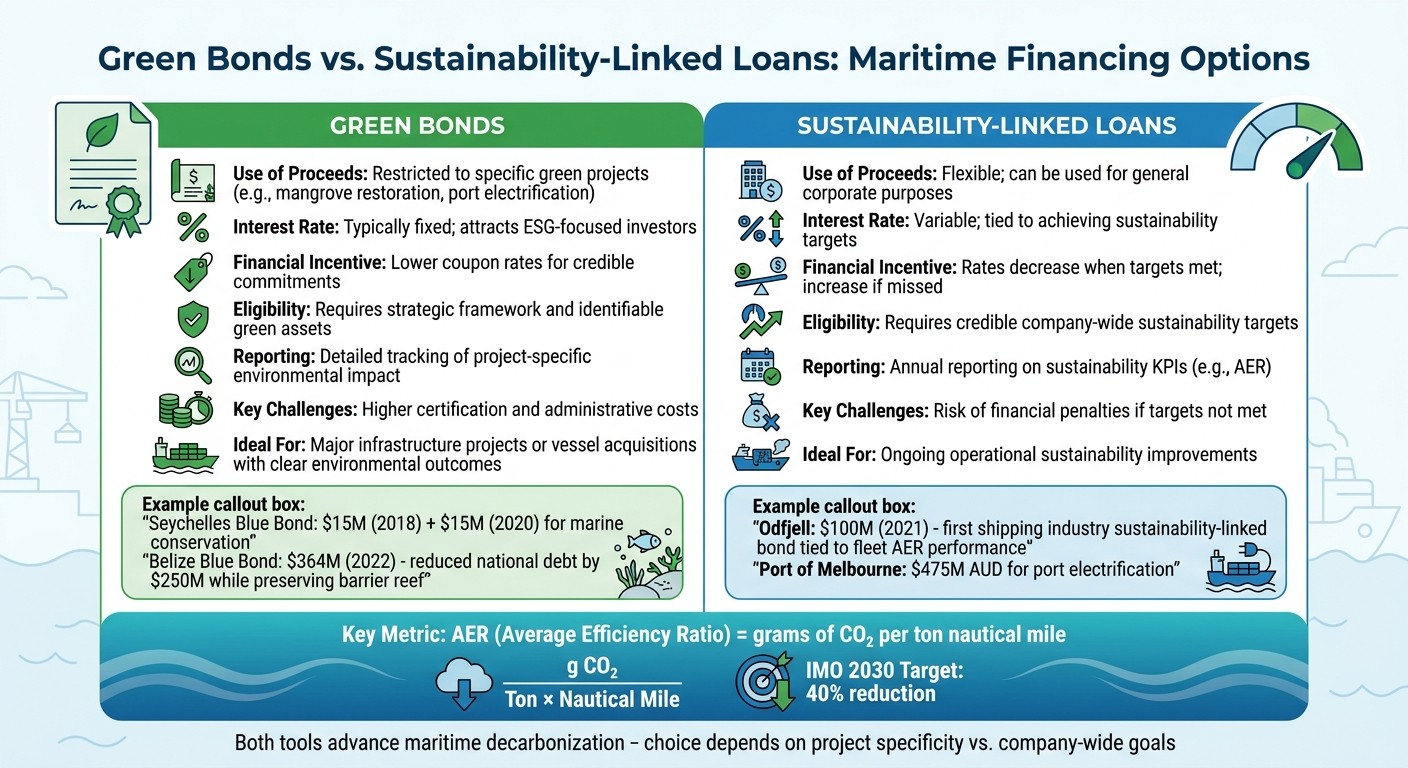
Green Bonds vs Sustainability-Linked Loans for Maritime Financing
Maritime and logistics companies have two key financing options to support green infrastructure: green bonds (including specialized blue bonds for marine-related projects) and sustainability-linked loans (SLLs). Green bonds require funds to be allocated exclusively to specific environmental initiatives - like mangrove restoration, coral reef protection, or port electrification. On the other hand, SLLs offer greater flexibility, allowing funds to be used for general corporate purposes, with interest rates that adjust based on the company’s performance against set environmental benchmarks. These tools, paired with the strategies discussed earlier, help maritime companies progress toward decarbonization.
How to Issue Green Bonds
Issuing green or blue bonds involves developing a clear framework that outlines environmental goals and the associated investment plans [13]. For example, the Republic of Seychelles pioneered the first sovereign blue bond in 2018, raising $15 million to support marine conservation and coastal protection. They followed this with another $15 million issuance in 2020 under their Blue Economy Strategic Policy Framework [13]. Similarly, Belize issued a $364 million blue bond in 2022, backed by Credit Suisse, AXA XL, and other insurers. This initiative reduced Belize's national debt by $250 million while securing funding for the preservation of its barrier reef [13].
"Blue bonds are a crucial instrument to deliver financing for marine-based solutions such as clean energy, transport, and food systems." - Sanda Ojiambo, CEO and Executive Director, UN Global Compact [13]
For companies with lower credit ratings, private political risk insurance or reinsurance can help achieve investment-grade ratings, making it easier to access capital at reduced borrowing costs. Aligning these bonds with the United Nations Sustainable Development Goals (SDGs) - especially SDG 14 (Life Below Water) and SDG 6 (Clean Water and Sanitation) - can further attract investors. Funds can be directed toward impactful projects like retrofitting vessels for cleaner propulsion, upgrading ports to use renewable energy, or building natural coastal defenses.
How Sustainability-Linked Loans Work
SLLs tie financial terms directly to a company’s environmental performance. Meeting sustainability targets results in lower interest rates, while failing to meet them leads to higher rates [15]. In the maritime industry, the Average Efficiency Ratio (AER) - measuring grams of CO₂ per ton nautical mile - is often a key performance metric. Companies may set ambitious goals, exceeding regulatory requirements like the International Maritime Organization's 2030 emissions targets, to secure better financing terms [4].
In 2021, Norwegian tanker operator Odfjell issued the first sustainability-linked bond in the shipping industry, raising $100 million. The bond's terms were tied to the AER performance of its fleet, and the offering was heavily oversubscribed by ESG-focused investors [15].
"By linking their CO₂ emission reduction target with their bond financing terms, they further bolster their commitments and inspire other peers to follow." - Joint Lead Managers (DNB, Nordea, SEB) [15]
Additionally, BNP Paribas and ten other banks provided a $475 million (AUD) sustainability-linked loan to the Port of Melbourne. This financing supported port electrification, enabling docked vessels to connect to onshore power and significantly reduce greenhouse gas emissions. BNP Paribas has committed to cutting the carbon intensity of its shipping portfolio by 23% to 32% by 2030 compared to 2022 levels [11].
SLLs are particularly beneficial for companies aiming to enhance sustainability across their entire operations, rather than funding a single, defined project. These loans complement broader strategies for green maritime infrastructure while enhancing operational resilience.
Green Bonds vs. Sustainability-Linked Loans
Here’s a side-by-side comparison of these financing tools:
Feature | Green Bonds | Sustainability-Linked Loans |
|---|---|---|
Use of Proceeds | Restricted to specific green projects [13] | Flexible; can be used for general corporate purposes [15] |
Interest Rate Structure | Typically fixed; attracts ESG-focused investors [15] | Variable; tied to achieving sustainability targets [15] |
Financial Incentive | Lower coupon rates for credible commitments [12] | Interest rates decrease when targets are met; increase if missed [15] |
Eligibility Requirements | Requires a strategic framework and identifiable green assets [13] | Requires credible company-wide sustainability targets [15] |
Reporting Requirements | Detailed tracking of project-specific environmental impact | Annual reporting on sustainability KPIs (e.g., AER) [15] |
Key Challenges | Higher certification and administrative costs [12] | Risk of financial penalties if targets are not met [15] |
Ideal For | Major infrastructure projects or vessel acquisitions with clear environmental outcomes | Ongoing operational sustainability improvements |
While ESG-linked instruments like green bonds and SLLs are gaining popularity, traditional debt structures still dominate maritime financing [12]. Choosing between these options depends on whether the funding is intended for specific environmental projects or broader sustainability goals across the company. Both tools, however, play a crucial role in advancing decarbonization efforts within the maritime industry.
Alternative Funding Methods and Export Credit Agencies
Maritime companies have additional options for financing green infrastructure, including export credit agencies (ECAs) and blended finance models. These methods help close funding gaps for large-scale, high-risk projects that require substantial upfront investment. By offering guarantees and other forms of support, ECAs reduce financial uncertainty, while blended finance combines public and private funds to make green initiatives more feasible.
Working with Export Credit Agencies
ECAs play a key role in reducing risks for green maritime projects. They provide financial tools like export credits, project financing, working capital support, and local currency loans, helping to attract private lenders by mitigating potential risks [16].
One example is the Swedish Export Credit Corporation (SEK), which offers green loans designed to align with the EU Taxonomy for sustainable activities [16]. This ensures that funded projects meet strict environmental standards, such as renewable energy installations, energy efficiency improvements, and emissions-reducing vessel retrofits. By offering this backing, ECAs enable companies to secure the necessary equipment and technologies for their initiatives.
This risk-reduction framework also lays the groundwork for blended finance approaches, which combine public and private capital to fund maritime infrastructure.
Blended Finance for Maritime Infrastructure
Blended finance brings together public concessional capital and private investment to make large-scale green projects financially viable. Public funds, often from multilateral development banks (MDBs), absorb initial losses and offer below-market-rate capital, which attracts private investors [14]. This approach not only secures funding but also accelerates the shift to cleaner and more resilient maritime operations.
The Green Shipping Fund, a €420 million private debt fund, showcases how blended finance operates [10]. It provides tailored debt financing for vessels that exceed standard environmental performance benchmarks by at least 20%. Eligible technologies include LNG, methanol, ammonia, hydrogen, and fully electric or hybrid ships. Typical project investments range from €15 million to €45 million, with application periods lasting six to eight weeks for technologies at a Technology Readiness Level (TRL) of 8–9 [10].
"This model has led to major changes in the clean energy sector, and I am convinced that it can do the same for the maritime industry." - Mafalda Duarte, Head of the Climate Investment Funds (CIF) [14]
Given that shipping accounts for 3% of global CO₂ emissions and heavy fuel oil-related air pollution causes approximately 60,000 premature deaths annually, blended finance offers a practical solution to these challenges [14]. By making clean technologies more financially competitive with fossil-fuel alternatives, companies can secure funding for retrofitting vessels with innovations like wind-assist technologies, while avoiding investments in high-carbon assets such as crude tankers and coal-dedicated ships [10].
Together, ECAs and blended finance complement other financial tools, strengthening the pathway toward a more sustainable maritime industry.
Working with Council Fire for Sustainability Consulting
Council Fire specializes in crafting sustainability strategies that align environmental objectives with sound financial planning, particularly for maritime and logistics sectors. These industries often face challenges in linking green initiatives to financial outcomes, and Council Fire addresses this disconnect by starting with a comprehensive emissions audit.
How Council Fire Supports Green Project Financing
The process begins with detailed greenhouse gas (GHG) assessments, covering Scope 1, 2, and 3 emissions. For maritime operations, Scope 3 emissions - stemming from tenant activities, vessels at berth, and drayage trucks - often account for over 80% of the total carbon footprint [9].
"Strategies that only address Scope 1 and 2 miss the majority of impact and the majority of cost-reduction opportunity." - Council Fire Resources [9]
Based on these assessments, Council Fire develops a five-pillar strategy tailored to maritime infrastructure. This includes:
Transitioning to cleaner equipment.
Designing shore power systems to reward low-emission vessels.
Establishing clean truck programs.
Incorporating emissions reporting into green leases.
Evaluating capital plans through a climate resilience lens [9].
This approach ensures that environmental improvements also yield financial benefits. For instance, Council Fire synchronizes equipment upgrades with natural asset cycles, cutting incremental costs. Immediate savings, such as from LED retrofits and HVAC optimizations, are reinvested into larger green projects, creating a self-sustaining cycle of investment and return. This strategy not only drives cost savings but also fosters long-term organizational commitment to sustainability [9].
For coastal and maritime infrastructure, Council Fire integrates projects like living shorelines and oyster reef restoration into resilience planning. These initiatives are designed to meet federal and state grant criteria, using benefit-cost analyses and equity scoring to enhance funding opportunities. This dual focus on environmental and financial outcomes strengthens the case for sustainable maritime operations [17].
Council Fire Client Results
Between 2021 and 2026, Council Fire collaborated with a major East Coast port authority to embed sustainability across 2,800 acres of infrastructure. The project included a ten-year equipment replacement schedule, shore power installation for six berths, and a clean truck program. Over five years, the port achieved $125 million in cumulative savings, reduced Scope 1 and 2 emissions by 52%, and lowered PM2.5 concentrations in nearby communities by 31% [9].
Savings Category | 5-Year Financial Impact | Key Action Taken |
|---|---|---|
Diesel Fuel Avoidance | $48 Million | Electrification of 65% of cargo handling equipment |
Energy Cost Reduction | $22 Million | 12 MW solar installation & LED retrofits |
Avoided Regulatory Penalties | $19 Million | Proactive attainment of EPA/state standards |
Avoided Capital Costs | $36 Million | Climate-resilient design for $800M capital plan |
Total Savings/Avoided Costs | $125 Million | Integrated Sustainability Strategy |
From 2024 to 2026, Council Fire also worked with a Mid-Atlantic coastal city to develop a climate resilience plan for $4.2 billion in at-risk property. The city council unanimously approved the plan, which secured $14.7 million in federal and state grants within 18 months. Key achievements included constructing a 1.2-mile living shoreline that combined oyster reef restoration with marsh creation, reducing storm wave energy by 40-60% and restoring 8 acres of tidal wetland [17].
"When sustainability generates hard financial returns, it builds organizational commitment that outlasts any individual champion." - Council Fire Resources [9]
Conclusion
Funding green and nature-based infrastructure requires bridging the gap between environmental goals and measurable financial outcomes. The approaches discussed - from thorough project evaluations and public-private partnerships to green bonds and sustainability-linked loans - work best when companies take a comprehensive approach throughout the project lifecycle. This means addressing areas like clean energy, waste management, and nature-based solutions while ensuring financial and environmental goals align seamlessly [2].
For maritime and logistics companies, climate risks such as rising sea levels and extreme weather pose serious threats, including operational disruptions and financial losses. Investing in green infrastructure emerges as a critical strategy to mitigate these risks. Specialized de-risking mechanisms can play a pivotal role, attracting private investment while advancing public policy goals [2]. Incorporating these mechanisms early naturally encourages the adoption of nature-based solutions.
When nature-based solutions are integrated early in the design process, they not only enhance climate resilience but also bring additional advantages, such as improved waste management and reduced local pollution. Tying financing strategies to global frameworks like the Sustainable Development Goals and the Paris Agreement further boosts a project's appeal to international investors, potentially opening doors to more funding opportunities [1].
Ultimately, sustainable growth in maritime and logistics depends on viewing green infrastructure as both a financial opportunity and an environmental responsibility. By utilizing blended finance models and embedding nature-based solutions throughout the project lifecycle, companies can achieve long-term value while bolstering their climate resilience [2].
FAQs
Which projects qualify for green or blue financing?
Projects that qualify for green or blue financing often focus on maritime decarbonization efforts. This includes initiatives like developing green ports powered by clean energy, improving waste management systems, and adopting nature-based solutions. Port infrastructure projects that incorporate sustainability principles may also be eligible, particularly when supported by financial instruments such as green bonds, sustainability-linked loans, or blue bonds. These funding mechanisms connect financial strategies with environmental objectives, driving sustainable progress in the maritime industry.
Should we use a green bond or a sustainability-linked loan?
The decision ultimately hinges on your objectives and financial approach. Green bonds are designed to finance specific eco-conscious projects, guided by clear use-of-proceeds criteria, making them a strong choice for targeted environmental efforts. On the other hand, sustainability-linked loans (SLLs) provide more adaptability by linking financing terms to the achievement of sustainability performance goals, which can drive improvements across broader operations. Choose the option that aligns most closely with your environmental goals and financial priorities.
How can we de-risk a large port or vessel decarbonization project?
To reduce financial risks in large-scale port or vessel decarbonization projects, explore financing tools such as green bonds, sustainability-linked loans, and public-private partnerships. These mechanisms help distribute risk and make projects more achievable. Ensuring alignment with regulatory guidelines and climate policies can also attract investors and minimize uncertainties. Moreover, securing funding from diverse sources and maintaining adaptability can help address fluctuating federal grants and evolving political landscapes.
Related Blog Posts
Latest Articles
©2025

Narrative Change and Power Building: The Missing Half of Advocacy
Narrative change is the process of disrupting dominant narratives that normalize inequity and advancing new narratives from historically marginalized communities.

Funding Resilience Without Federal Grants
BRIC is unreliable and FEMA is shrinking. Here's how cities fund climate resilience with dedicated revenue, blended finance, and a coordinating authority.

The ESG Blind Spot: How AI Is Finding Risks in Companies Nobody Else Is Watching
Norway's sovereign wealth fund uses AI to screen 7,200 portfolio companies for forced labor and corruption within 24 hours. The real story is the emerging-market coverage gap that traditional ESG data vendors miss — and what it means for any company with a global supply chain.
Narrative Change and Power Building: The Missing Half of Advocacy
Narrative change is the process of disrupting dominant narratives that normalize inequity and advancing new narratives from historically marginalized communities.
Funding Resilience Without Federal Grants
BRIC is unreliable and FEMA is shrinking. Here's how cities fund climate resilience with dedicated revenue, blended finance, and a coordinating authority.
The ESG Blind Spot: How AI Is Finding Risks in Companies Nobody Else Is Watching
Norway's sovereign wealth fund uses AI to screen 7,200 portfolio companies for forced labor and corruption within 24 hours. The real story is the emerging-market coverage gap that traditional ESG data vendors miss — and what it means for any company with a global supply chain.
FAQ
01
What does it really mean to “redefine profit”?
02
What makes Council Fire different?
03
Who does Council Fire work with?
04
What does working with Council Fire actually look like?
05
How does Council Fire help organizations turn big goals into action?
06
How does Council Fire define and measure success?
May 3, 2026
How to Finance Green and Nature-Based Infrastructure for Maritime & Logistics Companies
Sustainability Strategy
In This Article
Green financing options—green bonds, SLLs, PPPs, ECAs and blended finance—for ports and maritime nature-based projects.
How to Finance Green and Nature-Based Infrastructure for Maritime & Logistics Companies
Maritime and logistics companies face growing challenges: meeting climate goals, managing risks from rising sea levels, and maintaining operations. Transitioning to greener, nature-based infrastructure offers solutions but requires significant funding. Here's a quick guide to overcoming financial hurdles:
Key Financing Tools: Green bonds, sustainability-linked loans (SLLs), and public-private partnerships (PPPs) enable access to funds for eco-friendly projects.
Project Evaluation: To qualify for funding, projects must align with emissions targets, protect ecosystems, and demonstrate financial viability.
Risk Management: Specialized funds like the Sustainable and Resilient Maritime Fund (SRMF) and export credit agencies (ECAs) help reduce investment risks.
Blended Finance: Combines public and private capital to make large-scale projects feasible.
Case Studies: Examples include port electrification, vessel retrofits, and nature-based coastal defenses, which deliver both financial savings and reduced emissions.
TMS Ship Finance and Trade Conference 2025 - Capt. Ammar Al Shaiba Keynote Speaker
How to Evaluate Projects for Green Financing
To secure green financing, projects must meet stringent requirements, demonstrating both environmental alignment and solid financial prospects.
The World Bank highlights the growing momentum in "Blue Finance", describing it as a rising focus within Climate Finance that attracts attention from investors, financial institutions, and issuers worldwide. According to the World Bank, this area offers opportunities for economic growth, better livelihoods, and healthier marine ecosystems [3]. However, this increased interest also brings more rigorous qualification standards.
Meeting Environmental and Regulatory Standards
Projects need to adhere to established frameworks like the Green Bond Principles (GBP) and Green Loan Principles (GLP), which outline the core criteria for green project eligibility [3]. For maritime projects, the Guidelines for Blue Finance provide additional criteria tailored to marine ecosystem health and sustainable ocean industries [3].
Going beyond basic compliance can make a project more appealing to investors. For instance, the International Maritime Organization (IMO) has set a CO2 reduction target of 40% by 2030. Projects that exceed this benchmark - like A.P. Moller - Maersk’s initiative, which aims for a 60% reduction - can secure premium financing packages. Maersk’s $5 billion revolving credit facility, supported by 26 banks, adjusts its credit margin based on the company’s emissions performance, showcasing how ambitious goals can attract favorable terms [4].
The Asian Development Bank also notes that adopting a "life-cycle approach" for ports - incorporating clean energy, waste management, and nature-based solutions - can significantly lower environmental impacts when supported by appropriate financing and policies [2].
Evaluation Criteria | Key Requirements for Qualification |
|---|---|
Emissions | Must meet or exceed IMO 2030/2050 decarbonization targets [4] |
Ecosystem Health | Must protect biodiversity or include nature-based solutions [2] [3] |
Circular Economy | Should feature sustainable vessel recycling and waste reduction plans [4] |
Technology | Preference for advanced solutions like autonomous shipping or wind-assist propulsion [4] |
Financial Risk | Must address climate hazards such as sea-level rise and extreme weather [2] |
Projects that incorporate cutting-edge technology often stand out. For example, the Neoline project, which uses vessels equipped with 4,100 m² sails, secured funding by demonstrating an 80% reduction in carbon emissions on the St. Nazaire-Baltimore route [4]. This underscores how innovative approaches can directly influence financing outcomes in green maritime projects.
Once environmental criteria are satisfied, the next step is to evaluate financial viability and risks.
Calculating Financial Viability and Risk
After meeting environmental benchmarks, demonstrating financial strength is crucial. Beyond meeting compliance, projects must show clear financial returns and manageable risks. Tools like Multi-Criteria Decision Making (MCDM) can help balance various KPIs against environmental and technological uncertainties [5].
Climate-related risks, such as rising sea levels and extreme weather events, must also be factored into the financial evaluation [2]. Incorporating resilience measures - like using nature-based solutions for coastal protection - can make projects more attractive to investors by minimizing long-term risks.
Specialized funds, such as the Sustainable and Resilient Maritime Fund (SRMF), can help de-risk projects. These funds provide guarantees or concessional financing, reducing the perceived risk for private investors [2]. Additionally, projects operating in European waters should align with the EU Taxonomy, which provides standardized definitions that institutional investors rely on [5].
It’s also essential to calculate full lifecycle returns, including savings from lower fuel consumption, reduced regulatory compliance costs, and preferential financing terms. Projects that clearly demonstrate profitability while meeting environmental goals are in the best position to secure green financing, especially for infrastructure tied to sustainability and nature-based solutions.
Using Public-Private Partnerships (PPPs)
Public-Private Partnerships (PPPs) are proving to be a practical way for governments and private investors to share financial and environmental risks in large-scale green infrastructure projects. Initiatives like port electrification and nature-based coastal defenses are prime examples of how these partnerships can drive sustainability efforts forward [6][7].
Take, for instance, the collaboration between an East Coast port authority and private operators from 2021 to 2026. Handling 3 million TEUs annually, they rolled out an $800 million capital plan focused on sustainability. This effort led to $125 million in savings over five years, including $48 million from reduced diesel fuel use and $22 million in lower energy costs. Key components of the project included installing 12 MW of solar power and creating a $15 million grant fund to assist independent truck operators in adopting cleaner vehicles [9].
PPPs also play a critical role in addressing Scope 3 emissions, which can account for up to 82% of a port's total carbon footprint. These emissions stem from tenant operations, vessels at berth, and drayage trucks - areas outside the direct control of port authorities. By introducing "green leases" with specific energy efficiency and clean equipment requirements, port authorities can share the responsibility for reducing emissions with their tenants [9].
In another example, Long Beach Container Terminal, part of Macquarie Asset Management, financed its Net Zero 2030 Climate Action Plan through a US Private Placement in February 2025. Featuring a green tranche and coordinated by Natixis CIB, this project attracted institutional investors to fund zero-emissions infrastructure like ship-to-shore cranes, automated guided vehicles, and battery systems [8].
PPP Case Studies in Green Maritime Projects
Several real-world examples highlight how PPPs address both financial and environmental challenges effectively.
In April 2022, Tibar Bay Port in Timor-Leste launched a biodiversity offset program as part of its greenfield container port PPP. The operator adhered to IFC Environmental and Social Performance Standards to mitigate impacts on mangrove and coral habitats. Public authorities and third-party monitors ensured the project met its environmental and financial goals [7].
The East Coast port authority case illustrates how partnerships can deliver community health benefits alongside financial returns. For instance, their clean truck program, requiring compliance with 2010 EPA engine standards, reduced PM2.5 levels in nearby communities by 31%. This was a critical achievement, as neighborhoods near ports often face disproportionate air quality issues, fueling opposition to port operations.
"Port communities bear the health costs of port operations. Sustainability strategies that don't explicitly address community health impacts and provide tangible community benefits will face opposition that undermines implementation." - Council Fire [9]
The financial benefits of these partnerships extend beyond cost savings. The same port authority saved $36 million by integrating climate-resilient design into its planning, accounting for sea-level rise and storm surges. By proactively exceeding regulatory requirements, they also avoided $19 million in penalties and compliance costs [9].
Equipment electrification partnerships offer particularly strong returns. For example, electric rubber-tired gantry cranes cut per-unit energy costs by 65% compared to diesel models. Aligning these upgrades with natural equipment replacement cycles further reduces costs and avoids the political challenges of retiring functional assets prematurely [9].
How to Build Effective PPPs
Building successful partnerships involves key steps, starting from planning and extending through implementation.
Conduct a comprehensive GHG inventory: Analyzing Scopes 1, 2, and 3 emissions helps pinpoint areas where partnerships can deliver the greatest impact and cost savings. Scope 3 emissions, in particular, highlight the need for collaboration with tenants and supply chains [9].
Align investments with asset lifecycles: Transitioning to cleaner equipment at natural replacement points minimizes costs and reduces political resistance. As noted by Council Fire, forcing early retirements of functional equipment is both expensive and contentious [9].
Engage local communities early: Establish advisory panels with representatives from environmental justice groups, labor unions, and local businesses. This inclusive approach fosters buy-in, addresses health concerns, and ensures smoother implementation. The East Coast port authority's pollution reductions are a testament to the effectiveness of this strategy [9].
Secure green financing with third-party validation: A Second Party Opinion can make green financing frameworks more appealing to institutional investors. This validation was instrumental in the success of Long Beach Container Terminal's green US Private Placement [8].
Incentivize cleaner practices: Revenue-neutral incentives, such as reduced dockage fees for low-emission vessels or priority berthing for cleaner ships, encourage private partners to adopt green technology without straining port finances [9].
Integrate nature-based solutions early: Incorporating these solutions during the planning phase maximizes climate resilience benefits and reduces long-term costs [6].
Sustainability-focused partnerships not only yield financial returns but also build long-term organizational commitment. This consistency is crucial for large infrastructure projects, which require sustained execution despite shifting political or economic conditions. The cost savings, emissions reductions, and community health improvements highlighted here underscore the transformative potential of PPPs [9].
Using Green Bonds and Sustainability-Linked Loans
Green Bonds vs Sustainability-Linked Loans for Maritime Financing
Maritime and logistics companies have two key financing options to support green infrastructure: green bonds (including specialized blue bonds for marine-related projects) and sustainability-linked loans (SLLs). Green bonds require funds to be allocated exclusively to specific environmental initiatives - like mangrove restoration, coral reef protection, or port electrification. On the other hand, SLLs offer greater flexibility, allowing funds to be used for general corporate purposes, with interest rates that adjust based on the company’s performance against set environmental benchmarks. These tools, paired with the strategies discussed earlier, help maritime companies progress toward decarbonization.
How to Issue Green Bonds
Issuing green or blue bonds involves developing a clear framework that outlines environmental goals and the associated investment plans [13]. For example, the Republic of Seychelles pioneered the first sovereign blue bond in 2018, raising $15 million to support marine conservation and coastal protection. They followed this with another $15 million issuance in 2020 under their Blue Economy Strategic Policy Framework [13]. Similarly, Belize issued a $364 million blue bond in 2022, backed by Credit Suisse, AXA XL, and other insurers. This initiative reduced Belize's national debt by $250 million while securing funding for the preservation of its barrier reef [13].
"Blue bonds are a crucial instrument to deliver financing for marine-based solutions such as clean energy, transport, and food systems." - Sanda Ojiambo, CEO and Executive Director, UN Global Compact [13]
For companies with lower credit ratings, private political risk insurance or reinsurance can help achieve investment-grade ratings, making it easier to access capital at reduced borrowing costs. Aligning these bonds with the United Nations Sustainable Development Goals (SDGs) - especially SDG 14 (Life Below Water) and SDG 6 (Clean Water and Sanitation) - can further attract investors. Funds can be directed toward impactful projects like retrofitting vessels for cleaner propulsion, upgrading ports to use renewable energy, or building natural coastal defenses.
How Sustainability-Linked Loans Work
SLLs tie financial terms directly to a company’s environmental performance. Meeting sustainability targets results in lower interest rates, while failing to meet them leads to higher rates [15]. In the maritime industry, the Average Efficiency Ratio (AER) - measuring grams of CO₂ per ton nautical mile - is often a key performance metric. Companies may set ambitious goals, exceeding regulatory requirements like the International Maritime Organization's 2030 emissions targets, to secure better financing terms [4].
In 2021, Norwegian tanker operator Odfjell issued the first sustainability-linked bond in the shipping industry, raising $100 million. The bond's terms were tied to the AER performance of its fleet, and the offering was heavily oversubscribed by ESG-focused investors [15].
"By linking their CO₂ emission reduction target with their bond financing terms, they further bolster their commitments and inspire other peers to follow." - Joint Lead Managers (DNB, Nordea, SEB) [15]
Additionally, BNP Paribas and ten other banks provided a $475 million (AUD) sustainability-linked loan to the Port of Melbourne. This financing supported port electrification, enabling docked vessels to connect to onshore power and significantly reduce greenhouse gas emissions. BNP Paribas has committed to cutting the carbon intensity of its shipping portfolio by 23% to 32% by 2030 compared to 2022 levels [11].
SLLs are particularly beneficial for companies aiming to enhance sustainability across their entire operations, rather than funding a single, defined project. These loans complement broader strategies for green maritime infrastructure while enhancing operational resilience.
Green Bonds vs. Sustainability-Linked Loans
Here’s a side-by-side comparison of these financing tools:
Feature | Green Bonds | Sustainability-Linked Loans |
|---|---|---|
Use of Proceeds | Restricted to specific green projects [13] | Flexible; can be used for general corporate purposes [15] |
Interest Rate Structure | Typically fixed; attracts ESG-focused investors [15] | Variable; tied to achieving sustainability targets [15] |
Financial Incentive | Lower coupon rates for credible commitments [12] | Interest rates decrease when targets are met; increase if missed [15] |
Eligibility Requirements | Requires a strategic framework and identifiable green assets [13] | Requires credible company-wide sustainability targets [15] |
Reporting Requirements | Detailed tracking of project-specific environmental impact | Annual reporting on sustainability KPIs (e.g., AER) [15] |
Key Challenges | Higher certification and administrative costs [12] | Risk of financial penalties if targets are not met [15] |
Ideal For | Major infrastructure projects or vessel acquisitions with clear environmental outcomes | Ongoing operational sustainability improvements |
While ESG-linked instruments like green bonds and SLLs are gaining popularity, traditional debt structures still dominate maritime financing [12]. Choosing between these options depends on whether the funding is intended for specific environmental projects or broader sustainability goals across the company. Both tools, however, play a crucial role in advancing decarbonization efforts within the maritime industry.
Alternative Funding Methods and Export Credit Agencies
Maritime companies have additional options for financing green infrastructure, including export credit agencies (ECAs) and blended finance models. These methods help close funding gaps for large-scale, high-risk projects that require substantial upfront investment. By offering guarantees and other forms of support, ECAs reduce financial uncertainty, while blended finance combines public and private funds to make green initiatives more feasible.
Working with Export Credit Agencies
ECAs play a key role in reducing risks for green maritime projects. They provide financial tools like export credits, project financing, working capital support, and local currency loans, helping to attract private lenders by mitigating potential risks [16].
One example is the Swedish Export Credit Corporation (SEK), which offers green loans designed to align with the EU Taxonomy for sustainable activities [16]. This ensures that funded projects meet strict environmental standards, such as renewable energy installations, energy efficiency improvements, and emissions-reducing vessel retrofits. By offering this backing, ECAs enable companies to secure the necessary equipment and technologies for their initiatives.
This risk-reduction framework also lays the groundwork for blended finance approaches, which combine public and private capital to fund maritime infrastructure.
Blended Finance for Maritime Infrastructure
Blended finance brings together public concessional capital and private investment to make large-scale green projects financially viable. Public funds, often from multilateral development banks (MDBs), absorb initial losses and offer below-market-rate capital, which attracts private investors [14]. This approach not only secures funding but also accelerates the shift to cleaner and more resilient maritime operations.
The Green Shipping Fund, a €420 million private debt fund, showcases how blended finance operates [10]. It provides tailored debt financing for vessels that exceed standard environmental performance benchmarks by at least 20%. Eligible technologies include LNG, methanol, ammonia, hydrogen, and fully electric or hybrid ships. Typical project investments range from €15 million to €45 million, with application periods lasting six to eight weeks for technologies at a Technology Readiness Level (TRL) of 8–9 [10].
"This model has led to major changes in the clean energy sector, and I am convinced that it can do the same for the maritime industry." - Mafalda Duarte, Head of the Climate Investment Funds (CIF) [14]
Given that shipping accounts for 3% of global CO₂ emissions and heavy fuel oil-related air pollution causes approximately 60,000 premature deaths annually, blended finance offers a practical solution to these challenges [14]. By making clean technologies more financially competitive with fossil-fuel alternatives, companies can secure funding for retrofitting vessels with innovations like wind-assist technologies, while avoiding investments in high-carbon assets such as crude tankers and coal-dedicated ships [10].
Together, ECAs and blended finance complement other financial tools, strengthening the pathway toward a more sustainable maritime industry.
Working with Council Fire for Sustainability Consulting
Council Fire specializes in crafting sustainability strategies that align environmental objectives with sound financial planning, particularly for maritime and logistics sectors. These industries often face challenges in linking green initiatives to financial outcomes, and Council Fire addresses this disconnect by starting with a comprehensive emissions audit.
How Council Fire Supports Green Project Financing
The process begins with detailed greenhouse gas (GHG) assessments, covering Scope 1, 2, and 3 emissions. For maritime operations, Scope 3 emissions - stemming from tenant activities, vessels at berth, and drayage trucks - often account for over 80% of the total carbon footprint [9].
"Strategies that only address Scope 1 and 2 miss the majority of impact and the majority of cost-reduction opportunity." - Council Fire Resources [9]
Based on these assessments, Council Fire develops a five-pillar strategy tailored to maritime infrastructure. This includes:
Transitioning to cleaner equipment.
Designing shore power systems to reward low-emission vessels.
Establishing clean truck programs.
Incorporating emissions reporting into green leases.
Evaluating capital plans through a climate resilience lens [9].
This approach ensures that environmental improvements also yield financial benefits. For instance, Council Fire synchronizes equipment upgrades with natural asset cycles, cutting incremental costs. Immediate savings, such as from LED retrofits and HVAC optimizations, are reinvested into larger green projects, creating a self-sustaining cycle of investment and return. This strategy not only drives cost savings but also fosters long-term organizational commitment to sustainability [9].
For coastal and maritime infrastructure, Council Fire integrates projects like living shorelines and oyster reef restoration into resilience planning. These initiatives are designed to meet federal and state grant criteria, using benefit-cost analyses and equity scoring to enhance funding opportunities. This dual focus on environmental and financial outcomes strengthens the case for sustainable maritime operations [17].
Council Fire Client Results
Between 2021 and 2026, Council Fire collaborated with a major East Coast port authority to embed sustainability across 2,800 acres of infrastructure. The project included a ten-year equipment replacement schedule, shore power installation for six berths, and a clean truck program. Over five years, the port achieved $125 million in cumulative savings, reduced Scope 1 and 2 emissions by 52%, and lowered PM2.5 concentrations in nearby communities by 31% [9].
Savings Category | 5-Year Financial Impact | Key Action Taken |
|---|---|---|
Diesel Fuel Avoidance | $48 Million | Electrification of 65% of cargo handling equipment |
Energy Cost Reduction | $22 Million | 12 MW solar installation & LED retrofits |
Avoided Regulatory Penalties | $19 Million | Proactive attainment of EPA/state standards |
Avoided Capital Costs | $36 Million | Climate-resilient design for $800M capital plan |
Total Savings/Avoided Costs | $125 Million | Integrated Sustainability Strategy |
From 2024 to 2026, Council Fire also worked with a Mid-Atlantic coastal city to develop a climate resilience plan for $4.2 billion in at-risk property. The city council unanimously approved the plan, which secured $14.7 million in federal and state grants within 18 months. Key achievements included constructing a 1.2-mile living shoreline that combined oyster reef restoration with marsh creation, reducing storm wave energy by 40-60% and restoring 8 acres of tidal wetland [17].
"When sustainability generates hard financial returns, it builds organizational commitment that outlasts any individual champion." - Council Fire Resources [9]
Conclusion
Funding green and nature-based infrastructure requires bridging the gap between environmental goals and measurable financial outcomes. The approaches discussed - from thorough project evaluations and public-private partnerships to green bonds and sustainability-linked loans - work best when companies take a comprehensive approach throughout the project lifecycle. This means addressing areas like clean energy, waste management, and nature-based solutions while ensuring financial and environmental goals align seamlessly [2].
For maritime and logistics companies, climate risks such as rising sea levels and extreme weather pose serious threats, including operational disruptions and financial losses. Investing in green infrastructure emerges as a critical strategy to mitigate these risks. Specialized de-risking mechanisms can play a pivotal role, attracting private investment while advancing public policy goals [2]. Incorporating these mechanisms early naturally encourages the adoption of nature-based solutions.
When nature-based solutions are integrated early in the design process, they not only enhance climate resilience but also bring additional advantages, such as improved waste management and reduced local pollution. Tying financing strategies to global frameworks like the Sustainable Development Goals and the Paris Agreement further boosts a project's appeal to international investors, potentially opening doors to more funding opportunities [1].
Ultimately, sustainable growth in maritime and logistics depends on viewing green infrastructure as both a financial opportunity and an environmental responsibility. By utilizing blended finance models and embedding nature-based solutions throughout the project lifecycle, companies can achieve long-term value while bolstering their climate resilience [2].
FAQs
Which projects qualify for green or blue financing?
Projects that qualify for green or blue financing often focus on maritime decarbonization efforts. This includes initiatives like developing green ports powered by clean energy, improving waste management systems, and adopting nature-based solutions. Port infrastructure projects that incorporate sustainability principles may also be eligible, particularly when supported by financial instruments such as green bonds, sustainability-linked loans, or blue bonds. These funding mechanisms connect financial strategies with environmental objectives, driving sustainable progress in the maritime industry.
Should we use a green bond or a sustainability-linked loan?
The decision ultimately hinges on your objectives and financial approach. Green bonds are designed to finance specific eco-conscious projects, guided by clear use-of-proceeds criteria, making them a strong choice for targeted environmental efforts. On the other hand, sustainability-linked loans (SLLs) provide more adaptability by linking financing terms to the achievement of sustainability performance goals, which can drive improvements across broader operations. Choose the option that aligns most closely with your environmental goals and financial priorities.
How can we de-risk a large port or vessel decarbonization project?
To reduce financial risks in large-scale port or vessel decarbonization projects, explore financing tools such as green bonds, sustainability-linked loans, and public-private partnerships. These mechanisms help distribute risk and make projects more achievable. Ensuring alignment with regulatory guidelines and climate policies can also attract investors and minimize uncertainties. Moreover, securing funding from diverse sources and maintaining adaptability can help address fluctuating federal grants and evolving political landscapes.
Related Blog Posts
Latest Articles
©2025
Narrative Change and Power Building: The Missing Half of Advocacy
Narrative change is the process of disrupting dominant narratives that normalize inequity and advancing new narratives from historically marginalized communities.
Funding Resilience Without Federal Grants
BRIC is unreliable and FEMA is shrinking. Here's how cities fund climate resilience with dedicated revenue, blended finance, and a coordinating authority.
The ESG Blind Spot: How AI Is Finding Risks in Companies Nobody Else Is Watching
Norway's sovereign wealth fund uses AI to screen 7,200 portfolio companies for forced labor and corruption within 24 hours. The real story is the emerging-market coverage gap that traditional ESG data vendors miss — and what it means for any company with a global supply chain.
FAQ
01
What does it really mean to “redefine profit”?
02
What makes Council Fire different?
03
Who does Council Fire work with?
04
What does working with Council Fire actually look like?
05
How does Council Fire help organizations turn big goals into action?
06
How does Council Fire define and measure success?
May 3, 2026
How to Finance Green and Nature-Based Infrastructure for Maritime & Logistics Companies
Sustainability Strategy
In This Article
Green financing options—green bonds, SLLs, PPPs, ECAs and blended finance—for ports and maritime nature-based projects.
How to Finance Green and Nature-Based Infrastructure for Maritime & Logistics Companies
Maritime and logistics companies face growing challenges: meeting climate goals, managing risks from rising sea levels, and maintaining operations. Transitioning to greener, nature-based infrastructure offers solutions but requires significant funding. Here's a quick guide to overcoming financial hurdles:
Key Financing Tools: Green bonds, sustainability-linked loans (SLLs), and public-private partnerships (PPPs) enable access to funds for eco-friendly projects.
Project Evaluation: To qualify for funding, projects must align with emissions targets, protect ecosystems, and demonstrate financial viability.
Risk Management: Specialized funds like the Sustainable and Resilient Maritime Fund (SRMF) and export credit agencies (ECAs) help reduce investment risks.
Blended Finance: Combines public and private capital to make large-scale projects feasible.
Case Studies: Examples include port electrification, vessel retrofits, and nature-based coastal defenses, which deliver both financial savings and reduced emissions.
TMS Ship Finance and Trade Conference 2025 - Capt. Ammar Al Shaiba Keynote Speaker
How to Evaluate Projects for Green Financing
To secure green financing, projects must meet stringent requirements, demonstrating both environmental alignment and solid financial prospects.
The World Bank highlights the growing momentum in "Blue Finance", describing it as a rising focus within Climate Finance that attracts attention from investors, financial institutions, and issuers worldwide. According to the World Bank, this area offers opportunities for economic growth, better livelihoods, and healthier marine ecosystems [3]. However, this increased interest also brings more rigorous qualification standards.
Meeting Environmental and Regulatory Standards
Projects need to adhere to established frameworks like the Green Bond Principles (GBP) and Green Loan Principles (GLP), which outline the core criteria for green project eligibility [3]. For maritime projects, the Guidelines for Blue Finance provide additional criteria tailored to marine ecosystem health and sustainable ocean industries [3].
Going beyond basic compliance can make a project more appealing to investors. For instance, the International Maritime Organization (IMO) has set a CO2 reduction target of 40% by 2030. Projects that exceed this benchmark - like A.P. Moller - Maersk’s initiative, which aims for a 60% reduction - can secure premium financing packages. Maersk’s $5 billion revolving credit facility, supported by 26 banks, adjusts its credit margin based on the company’s emissions performance, showcasing how ambitious goals can attract favorable terms [4].
The Asian Development Bank also notes that adopting a "life-cycle approach" for ports - incorporating clean energy, waste management, and nature-based solutions - can significantly lower environmental impacts when supported by appropriate financing and policies [2].
Evaluation Criteria | Key Requirements for Qualification |
|---|---|
Emissions | Must meet or exceed IMO 2030/2050 decarbonization targets [4] |
Ecosystem Health | Must protect biodiversity or include nature-based solutions [2] [3] |
Circular Economy | Should feature sustainable vessel recycling and waste reduction plans [4] |
Technology | Preference for advanced solutions like autonomous shipping or wind-assist propulsion [4] |
Financial Risk | Must address climate hazards such as sea-level rise and extreme weather [2] |
Projects that incorporate cutting-edge technology often stand out. For example, the Neoline project, which uses vessels equipped with 4,100 m² sails, secured funding by demonstrating an 80% reduction in carbon emissions on the St. Nazaire-Baltimore route [4]. This underscores how innovative approaches can directly influence financing outcomes in green maritime projects.
Once environmental criteria are satisfied, the next step is to evaluate financial viability and risks.
Calculating Financial Viability and Risk
After meeting environmental benchmarks, demonstrating financial strength is crucial. Beyond meeting compliance, projects must show clear financial returns and manageable risks. Tools like Multi-Criteria Decision Making (MCDM) can help balance various KPIs against environmental and technological uncertainties [5].
Climate-related risks, such as rising sea levels and extreme weather events, must also be factored into the financial evaluation [2]. Incorporating resilience measures - like using nature-based solutions for coastal protection - can make projects more attractive to investors by minimizing long-term risks.
Specialized funds, such as the Sustainable and Resilient Maritime Fund (SRMF), can help de-risk projects. These funds provide guarantees or concessional financing, reducing the perceived risk for private investors [2]. Additionally, projects operating in European waters should align with the EU Taxonomy, which provides standardized definitions that institutional investors rely on [5].
It’s also essential to calculate full lifecycle returns, including savings from lower fuel consumption, reduced regulatory compliance costs, and preferential financing terms. Projects that clearly demonstrate profitability while meeting environmental goals are in the best position to secure green financing, especially for infrastructure tied to sustainability and nature-based solutions.
Using Public-Private Partnerships (PPPs)
Public-Private Partnerships (PPPs) are proving to be a practical way for governments and private investors to share financial and environmental risks in large-scale green infrastructure projects. Initiatives like port electrification and nature-based coastal defenses are prime examples of how these partnerships can drive sustainability efforts forward [6][7].
Take, for instance, the collaboration between an East Coast port authority and private operators from 2021 to 2026. Handling 3 million TEUs annually, they rolled out an $800 million capital plan focused on sustainability. This effort led to $125 million in savings over five years, including $48 million from reduced diesel fuel use and $22 million in lower energy costs. Key components of the project included installing 12 MW of solar power and creating a $15 million grant fund to assist independent truck operators in adopting cleaner vehicles [9].
PPPs also play a critical role in addressing Scope 3 emissions, which can account for up to 82% of a port's total carbon footprint. These emissions stem from tenant operations, vessels at berth, and drayage trucks - areas outside the direct control of port authorities. By introducing "green leases" with specific energy efficiency and clean equipment requirements, port authorities can share the responsibility for reducing emissions with their tenants [9].
In another example, Long Beach Container Terminal, part of Macquarie Asset Management, financed its Net Zero 2030 Climate Action Plan through a US Private Placement in February 2025. Featuring a green tranche and coordinated by Natixis CIB, this project attracted institutional investors to fund zero-emissions infrastructure like ship-to-shore cranes, automated guided vehicles, and battery systems [8].
PPP Case Studies in Green Maritime Projects
Several real-world examples highlight how PPPs address both financial and environmental challenges effectively.
In April 2022, Tibar Bay Port in Timor-Leste launched a biodiversity offset program as part of its greenfield container port PPP. The operator adhered to IFC Environmental and Social Performance Standards to mitigate impacts on mangrove and coral habitats. Public authorities and third-party monitors ensured the project met its environmental and financial goals [7].
The East Coast port authority case illustrates how partnerships can deliver community health benefits alongside financial returns. For instance, their clean truck program, requiring compliance with 2010 EPA engine standards, reduced PM2.5 levels in nearby communities by 31%. This was a critical achievement, as neighborhoods near ports often face disproportionate air quality issues, fueling opposition to port operations.
"Port communities bear the health costs of port operations. Sustainability strategies that don't explicitly address community health impacts and provide tangible community benefits will face opposition that undermines implementation." - Council Fire [9]
The financial benefits of these partnerships extend beyond cost savings. The same port authority saved $36 million by integrating climate-resilient design into its planning, accounting for sea-level rise and storm surges. By proactively exceeding regulatory requirements, they also avoided $19 million in penalties and compliance costs [9].
Equipment electrification partnerships offer particularly strong returns. For example, electric rubber-tired gantry cranes cut per-unit energy costs by 65% compared to diesel models. Aligning these upgrades with natural equipment replacement cycles further reduces costs and avoids the political challenges of retiring functional assets prematurely [9].
How to Build Effective PPPs
Building successful partnerships involves key steps, starting from planning and extending through implementation.
Conduct a comprehensive GHG inventory: Analyzing Scopes 1, 2, and 3 emissions helps pinpoint areas where partnerships can deliver the greatest impact and cost savings. Scope 3 emissions, in particular, highlight the need for collaboration with tenants and supply chains [9].
Align investments with asset lifecycles: Transitioning to cleaner equipment at natural replacement points minimizes costs and reduces political resistance. As noted by Council Fire, forcing early retirements of functional equipment is both expensive and contentious [9].
Engage local communities early: Establish advisory panels with representatives from environmental justice groups, labor unions, and local businesses. This inclusive approach fosters buy-in, addresses health concerns, and ensures smoother implementation. The East Coast port authority's pollution reductions are a testament to the effectiveness of this strategy [9].
Secure green financing with third-party validation: A Second Party Opinion can make green financing frameworks more appealing to institutional investors. This validation was instrumental in the success of Long Beach Container Terminal's green US Private Placement [8].
Incentivize cleaner practices: Revenue-neutral incentives, such as reduced dockage fees for low-emission vessels or priority berthing for cleaner ships, encourage private partners to adopt green technology without straining port finances [9].
Integrate nature-based solutions early: Incorporating these solutions during the planning phase maximizes climate resilience benefits and reduces long-term costs [6].
Sustainability-focused partnerships not only yield financial returns but also build long-term organizational commitment. This consistency is crucial for large infrastructure projects, which require sustained execution despite shifting political or economic conditions. The cost savings, emissions reductions, and community health improvements highlighted here underscore the transformative potential of PPPs [9].
Using Green Bonds and Sustainability-Linked Loans
Green Bonds vs Sustainability-Linked Loans for Maritime Financing
Maritime and logistics companies have two key financing options to support green infrastructure: green bonds (including specialized blue bonds for marine-related projects) and sustainability-linked loans (SLLs). Green bonds require funds to be allocated exclusively to specific environmental initiatives - like mangrove restoration, coral reef protection, or port electrification. On the other hand, SLLs offer greater flexibility, allowing funds to be used for general corporate purposes, with interest rates that adjust based on the company’s performance against set environmental benchmarks. These tools, paired with the strategies discussed earlier, help maritime companies progress toward decarbonization.
How to Issue Green Bonds
Issuing green or blue bonds involves developing a clear framework that outlines environmental goals and the associated investment plans [13]. For example, the Republic of Seychelles pioneered the first sovereign blue bond in 2018, raising $15 million to support marine conservation and coastal protection. They followed this with another $15 million issuance in 2020 under their Blue Economy Strategic Policy Framework [13]. Similarly, Belize issued a $364 million blue bond in 2022, backed by Credit Suisse, AXA XL, and other insurers. This initiative reduced Belize's national debt by $250 million while securing funding for the preservation of its barrier reef [13].
"Blue bonds are a crucial instrument to deliver financing for marine-based solutions such as clean energy, transport, and food systems." - Sanda Ojiambo, CEO and Executive Director, UN Global Compact [13]
For companies with lower credit ratings, private political risk insurance or reinsurance can help achieve investment-grade ratings, making it easier to access capital at reduced borrowing costs. Aligning these bonds with the United Nations Sustainable Development Goals (SDGs) - especially SDG 14 (Life Below Water) and SDG 6 (Clean Water and Sanitation) - can further attract investors. Funds can be directed toward impactful projects like retrofitting vessels for cleaner propulsion, upgrading ports to use renewable energy, or building natural coastal defenses.
How Sustainability-Linked Loans Work
SLLs tie financial terms directly to a company’s environmental performance. Meeting sustainability targets results in lower interest rates, while failing to meet them leads to higher rates [15]. In the maritime industry, the Average Efficiency Ratio (AER) - measuring grams of CO₂ per ton nautical mile - is often a key performance metric. Companies may set ambitious goals, exceeding regulatory requirements like the International Maritime Organization's 2030 emissions targets, to secure better financing terms [4].
In 2021, Norwegian tanker operator Odfjell issued the first sustainability-linked bond in the shipping industry, raising $100 million. The bond's terms were tied to the AER performance of its fleet, and the offering was heavily oversubscribed by ESG-focused investors [15].
"By linking their CO₂ emission reduction target with their bond financing terms, they further bolster their commitments and inspire other peers to follow." - Joint Lead Managers (DNB, Nordea, SEB) [15]
Additionally, BNP Paribas and ten other banks provided a $475 million (AUD) sustainability-linked loan to the Port of Melbourne. This financing supported port electrification, enabling docked vessels to connect to onshore power and significantly reduce greenhouse gas emissions. BNP Paribas has committed to cutting the carbon intensity of its shipping portfolio by 23% to 32% by 2030 compared to 2022 levels [11].
SLLs are particularly beneficial for companies aiming to enhance sustainability across their entire operations, rather than funding a single, defined project. These loans complement broader strategies for green maritime infrastructure while enhancing operational resilience.
Green Bonds vs. Sustainability-Linked Loans
Here’s a side-by-side comparison of these financing tools:
Feature | Green Bonds | Sustainability-Linked Loans |
|---|---|---|
Use of Proceeds | Restricted to specific green projects [13] | Flexible; can be used for general corporate purposes [15] |
Interest Rate Structure | Typically fixed; attracts ESG-focused investors [15] | Variable; tied to achieving sustainability targets [15] |
Financial Incentive | Lower coupon rates for credible commitments [12] | Interest rates decrease when targets are met; increase if missed [15] |
Eligibility Requirements | Requires a strategic framework and identifiable green assets [13] | Requires credible company-wide sustainability targets [15] |
Reporting Requirements | Detailed tracking of project-specific environmental impact | Annual reporting on sustainability KPIs (e.g., AER) [15] |
Key Challenges | Higher certification and administrative costs [12] | Risk of financial penalties if targets are not met [15] |
Ideal For | Major infrastructure projects or vessel acquisitions with clear environmental outcomes | Ongoing operational sustainability improvements |
While ESG-linked instruments like green bonds and SLLs are gaining popularity, traditional debt structures still dominate maritime financing [12]. Choosing between these options depends on whether the funding is intended for specific environmental projects or broader sustainability goals across the company. Both tools, however, play a crucial role in advancing decarbonization efforts within the maritime industry.
Alternative Funding Methods and Export Credit Agencies
Maritime companies have additional options for financing green infrastructure, including export credit agencies (ECAs) and blended finance models. These methods help close funding gaps for large-scale, high-risk projects that require substantial upfront investment. By offering guarantees and other forms of support, ECAs reduce financial uncertainty, while blended finance combines public and private funds to make green initiatives more feasible.
Working with Export Credit Agencies
ECAs play a key role in reducing risks for green maritime projects. They provide financial tools like export credits, project financing, working capital support, and local currency loans, helping to attract private lenders by mitigating potential risks [16].
One example is the Swedish Export Credit Corporation (SEK), which offers green loans designed to align with the EU Taxonomy for sustainable activities [16]. This ensures that funded projects meet strict environmental standards, such as renewable energy installations, energy efficiency improvements, and emissions-reducing vessel retrofits. By offering this backing, ECAs enable companies to secure the necessary equipment and technologies for their initiatives.
This risk-reduction framework also lays the groundwork for blended finance approaches, which combine public and private capital to fund maritime infrastructure.
Blended Finance for Maritime Infrastructure
Blended finance brings together public concessional capital and private investment to make large-scale green projects financially viable. Public funds, often from multilateral development banks (MDBs), absorb initial losses and offer below-market-rate capital, which attracts private investors [14]. This approach not only secures funding but also accelerates the shift to cleaner and more resilient maritime operations.
The Green Shipping Fund, a €420 million private debt fund, showcases how blended finance operates [10]. It provides tailored debt financing for vessels that exceed standard environmental performance benchmarks by at least 20%. Eligible technologies include LNG, methanol, ammonia, hydrogen, and fully electric or hybrid ships. Typical project investments range from €15 million to €45 million, with application periods lasting six to eight weeks for technologies at a Technology Readiness Level (TRL) of 8–9 [10].
"This model has led to major changes in the clean energy sector, and I am convinced that it can do the same for the maritime industry." - Mafalda Duarte, Head of the Climate Investment Funds (CIF) [14]
Given that shipping accounts for 3% of global CO₂ emissions and heavy fuel oil-related air pollution causes approximately 60,000 premature deaths annually, blended finance offers a practical solution to these challenges [14]. By making clean technologies more financially competitive with fossil-fuel alternatives, companies can secure funding for retrofitting vessels with innovations like wind-assist technologies, while avoiding investments in high-carbon assets such as crude tankers and coal-dedicated ships [10].
Together, ECAs and blended finance complement other financial tools, strengthening the pathway toward a more sustainable maritime industry.
Working with Council Fire for Sustainability Consulting
Council Fire specializes in crafting sustainability strategies that align environmental objectives with sound financial planning, particularly for maritime and logistics sectors. These industries often face challenges in linking green initiatives to financial outcomes, and Council Fire addresses this disconnect by starting with a comprehensive emissions audit.
How Council Fire Supports Green Project Financing
The process begins with detailed greenhouse gas (GHG) assessments, covering Scope 1, 2, and 3 emissions. For maritime operations, Scope 3 emissions - stemming from tenant activities, vessels at berth, and drayage trucks - often account for over 80% of the total carbon footprint [9].
"Strategies that only address Scope 1 and 2 miss the majority of impact and the majority of cost-reduction opportunity." - Council Fire Resources [9]
Based on these assessments, Council Fire develops a five-pillar strategy tailored to maritime infrastructure. This includes:
Transitioning to cleaner equipment.
Designing shore power systems to reward low-emission vessels.
Establishing clean truck programs.
Incorporating emissions reporting into green leases.
Evaluating capital plans through a climate resilience lens [9].
This approach ensures that environmental improvements also yield financial benefits. For instance, Council Fire synchronizes equipment upgrades with natural asset cycles, cutting incremental costs. Immediate savings, such as from LED retrofits and HVAC optimizations, are reinvested into larger green projects, creating a self-sustaining cycle of investment and return. This strategy not only drives cost savings but also fosters long-term organizational commitment to sustainability [9].
For coastal and maritime infrastructure, Council Fire integrates projects like living shorelines and oyster reef restoration into resilience planning. These initiatives are designed to meet federal and state grant criteria, using benefit-cost analyses and equity scoring to enhance funding opportunities. This dual focus on environmental and financial outcomes strengthens the case for sustainable maritime operations [17].
Council Fire Client Results
Between 2021 and 2026, Council Fire collaborated with a major East Coast port authority to embed sustainability across 2,800 acres of infrastructure. The project included a ten-year equipment replacement schedule, shore power installation for six berths, and a clean truck program. Over five years, the port achieved $125 million in cumulative savings, reduced Scope 1 and 2 emissions by 52%, and lowered PM2.5 concentrations in nearby communities by 31% [9].
Savings Category | 5-Year Financial Impact | Key Action Taken |
|---|---|---|
Diesel Fuel Avoidance | $48 Million | Electrification of 65% of cargo handling equipment |
Energy Cost Reduction | $22 Million | 12 MW solar installation & LED retrofits |
Avoided Regulatory Penalties | $19 Million | Proactive attainment of EPA/state standards |
Avoided Capital Costs | $36 Million | Climate-resilient design for $800M capital plan |
Total Savings/Avoided Costs | $125 Million | Integrated Sustainability Strategy |
From 2024 to 2026, Council Fire also worked with a Mid-Atlantic coastal city to develop a climate resilience plan for $4.2 billion in at-risk property. The city council unanimously approved the plan, which secured $14.7 million in federal and state grants within 18 months. Key achievements included constructing a 1.2-mile living shoreline that combined oyster reef restoration with marsh creation, reducing storm wave energy by 40-60% and restoring 8 acres of tidal wetland [17].
"When sustainability generates hard financial returns, it builds organizational commitment that outlasts any individual champion." - Council Fire Resources [9]
Conclusion
Funding green and nature-based infrastructure requires bridging the gap between environmental goals and measurable financial outcomes. The approaches discussed - from thorough project evaluations and public-private partnerships to green bonds and sustainability-linked loans - work best when companies take a comprehensive approach throughout the project lifecycle. This means addressing areas like clean energy, waste management, and nature-based solutions while ensuring financial and environmental goals align seamlessly [2].
For maritime and logistics companies, climate risks such as rising sea levels and extreme weather pose serious threats, including operational disruptions and financial losses. Investing in green infrastructure emerges as a critical strategy to mitigate these risks. Specialized de-risking mechanisms can play a pivotal role, attracting private investment while advancing public policy goals [2]. Incorporating these mechanisms early naturally encourages the adoption of nature-based solutions.
When nature-based solutions are integrated early in the design process, they not only enhance climate resilience but also bring additional advantages, such as improved waste management and reduced local pollution. Tying financing strategies to global frameworks like the Sustainable Development Goals and the Paris Agreement further boosts a project's appeal to international investors, potentially opening doors to more funding opportunities [1].
Ultimately, sustainable growth in maritime and logistics depends on viewing green infrastructure as both a financial opportunity and an environmental responsibility. By utilizing blended finance models and embedding nature-based solutions throughout the project lifecycle, companies can achieve long-term value while bolstering their climate resilience [2].
FAQs
Which projects qualify for green or blue financing?
Projects that qualify for green or blue financing often focus on maritime decarbonization efforts. This includes initiatives like developing green ports powered by clean energy, improving waste management systems, and adopting nature-based solutions. Port infrastructure projects that incorporate sustainability principles may also be eligible, particularly when supported by financial instruments such as green bonds, sustainability-linked loans, or blue bonds. These funding mechanisms connect financial strategies with environmental objectives, driving sustainable progress in the maritime industry.
Should we use a green bond or a sustainability-linked loan?
The decision ultimately hinges on your objectives and financial approach. Green bonds are designed to finance specific eco-conscious projects, guided by clear use-of-proceeds criteria, making them a strong choice for targeted environmental efforts. On the other hand, sustainability-linked loans (SLLs) provide more adaptability by linking financing terms to the achievement of sustainability performance goals, which can drive improvements across broader operations. Choose the option that aligns most closely with your environmental goals and financial priorities.
How can we de-risk a large port or vessel decarbonization project?
To reduce financial risks in large-scale port or vessel decarbonization projects, explore financing tools such as green bonds, sustainability-linked loans, and public-private partnerships. These mechanisms help distribute risk and make projects more achievable. Ensuring alignment with regulatory guidelines and climate policies can also attract investors and minimize uncertainties. Moreover, securing funding from diverse sources and maintaining adaptability can help address fluctuating federal grants and evolving political landscapes.
Related Blog Posts
Latest Articles
©2025
Narrative Change and Power Building: The Missing Half of Advocacy
Narrative change is the process of disrupting dominant narratives that normalize inequity and advancing new narratives from historically marginalized communities.
Funding Resilience Without Federal Grants
BRIC is unreliable and FEMA is shrinking. Here's how cities fund climate resilience with dedicated revenue, blended finance, and a coordinating authority.
The ESG Blind Spot: How AI Is Finding Risks in Companies Nobody Else Is Watching
Norway's sovereign wealth fund uses AI to screen 7,200 portfolio companies for forced labor and corruption within 24 hours. The real story is the emerging-market coverage gap that traditional ESG data vendors miss — and what it means for any company with a global supply chain.
FAQ
What does it really mean to “redefine profit”?
What makes Council Fire different?
Who does Council Fire work with?
What does working with Council Fire actually look like?
How does Council Fire help organizations turn big goals into action?
How does Council Fire define and measure success?