In This Article
Clear steps for Article 8 disclosures: scope checks, KPI calculations (Turnover/CapEx/OpEx), templates, evidence, and 10% relief rules.
EU Taxonomy: Article 8 Reporting Obligations
Article 8 reporting starts with two checks: whether the business must report and which rules apply to its financial year. A report published in 2026 usually covers FY 2025 - not FY 2026.
For businesses in scope, the reporting process covers:
Metrics: Turnover, CapEx, and OpEx for nonfinancial companies; investment, lending, service, or underwriting KPIs for financial firms.
Classification: Separate eligible activities from those that meet alignment requirements. Missing data does not establish alignment.
Records: Link calculations to source documents, use the required templates, and complete review and approval before publication.
Rule changes: Check transition options and the conditions for the 10% materiality relief. Do not apply future scope thresholds to earlier years.
For U.S. groups, assess EU subsidiaries and group reporting duties separately. Customer or lender requests alone do not create a statutory reporting duty.
BAI Webinar BAI ESG Template Art 8 Taxonomy DA + CSRD ESRS Reporting for Alternative Investments
sbb-itb-8baf5f1
Article 8 KPIs by Business Type
Once scope is set, calculate each KPI using the required base and template. Specify the reporting year, consolidation perimeter, applicable delegated-act version, numerator, denominator, and valuation date where required. Financial institutions must separate stock and flow bases. Keep eligible and aligned numerators separate in every KPI and template.[7][8][9]
Nonfinancial KPIs: Turnover, CapEx, and OpEx
Apply consistent accounting policies and use the correct denominator for each KPI.[7][8]
| KPI | Meaning and numerator | Denominator | Supporting records and controls |
|---|---|---|---|
| Turnover | Net turnover from eligible activities and, separately, aligned activities | Total net turnover under the applicable accounting framework | Keep revenue ledgers, contracts, and activity mappings, and reconcile them to financial statements. Eliminate intercompany sales and prevent duplicate revenue allocation. |
| CapEx | Expenditure associated with eligible activities and, separately, qualifying expenditure linked to aligned activities or a qualifying CapEx plan | Total CapEx under the applicable delegated-act methodology - not an internally selected investment budget | Keep the fixed-asset register, invoices, project approvals, and plan milestones. Check accounting treatment, cut-off, permitted inclusions, and reconciliation. Prevent duplicate allocation across activities and group entities. |
| OpEx | Defined operating costs associated with eligible activities and, separately, qualifying costs supporting aligned activities or qualifying CapEx plans | The defined Taxonomy OpEx base - not total operating expenses in the income statement | Keep cost-center records, maintenance logs, research records, and allocation schedules. Document included categories and exclusions, and reconcile them to accounting records. |
Taxonomy OpEx covers only specified directly attributable costs, including eligible research and development, building renovation, short-term leases, maintenance, and repair. Identify any temporary relief by financial year and legal basis.[7][8][12]
Keep the CapEx plan, baseline assessment, timetable, financing approval, technical criteria, and evidence of progress. Include only qualifying expenditure in the aligned numerator.[7][8]
Financial KPIs: Investment, Lending, and Underwriting
Financial institutions must also separate eligible and aligned amounts, but their KPIs measure exposures and services rather than direct activity.
| Institution and KPI | Exposure or revenue base | Denominator | Reporting period and controls |
|---|---|---|---|
| Asset manager: investment KPIs | Investments weighted by investee Taxonomy performance, using the prescribed turnover- and CapEx-based approaches | Covered assets under management under the applicable methodology | Use the prescribed valuation basis for the reporting period. Keep instrument, mandate, investee, valuation, and data-source records. |
| Bank: Green Asset Ratio | Covered banking-book exposures associated with aligned activities; apply counterparty turnover or CapEx data as required | Covered assets after prescribed exclusions | Separate reporting-date stocks from period flows. Reconcile loan records and document the treatment of household, corporate, and off-balance-sheet exposures. |
| Investment firm: activity-specific KPIs | Dealing on own account and other investment services, using their respective investment or revenue bases | The prescribed covered investment base or service-revenue base | Use the period and template required for each activity - not the GAR. Reconcile fees and commissions to service records, and document mixed-purpose allocations. |
| Insurer or reinsurer: investment and underwriting KPIs | Investment exposures and, separately, qualifying non-life underwriting activity | Covered investments; separately, the prescribed premium or underwriting-revenue base | Match investment valuations and underwriting flows to the required period. Check policy classification, reinsurance, and gross/net treatment. |
Calculation errors usually stem from gaps in data coverage, valuation dates, or classification. Missing counterparty data does not establish alignment. Record coverage, exclusions, and template-specific treatment of sovereign exposures, derivatives, non-EU counterparties, fees and commissions, and trading-book items. Keep reporting-date stocks separate from period flows.[8][9][10][11]
Reporting Steps, Templates, and Supporting Records
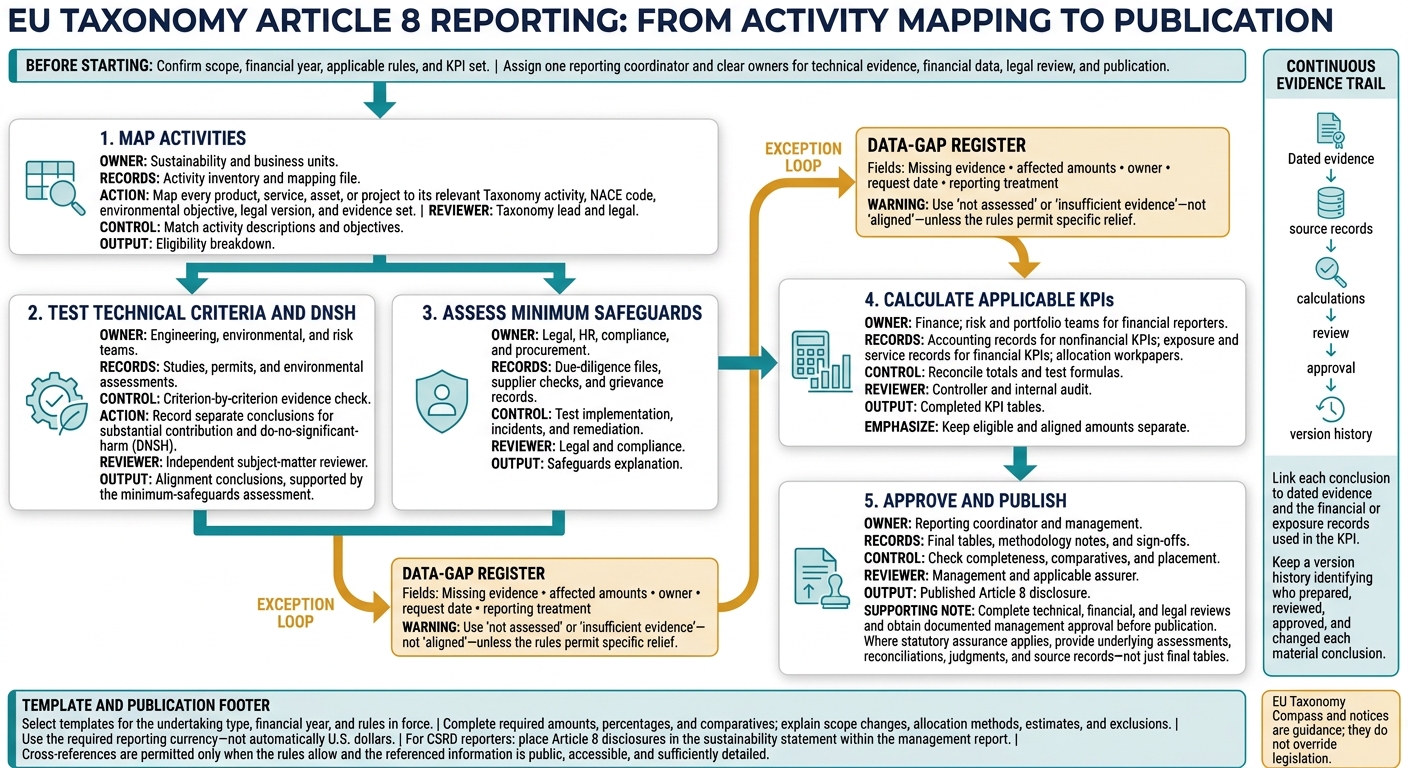
EU Taxonomy Article 8 Reporting Workflow
Once scope and KPIs are set, the work shifts to evidence, templates, and review. The aim is a filing package that follows the scope and KPI rules and stands up to scrutiny.
Appoint one reporting coordinator and assign clear owners for technical evidence, financial data, legal review, and publication. Smaller teams can combine roles, but disclosure requirements remain the same. Build in time to close evidence gaps before management approval.[15]
Map Activities and Test Alignment
Start with the activity map, then check each item against the technical criteria. Map every product, service, asset, or project to its relevant Taxonomy activity, NACE code, environmental objective, legal version, and evidence set. Record separate conclusions for substantial contribution, do-no-significant-harm (DNSH), and minimum safeguards. Link each conclusion to dated evidence and the financial or exposure records used in the KPI. Treat the EU Taxonomy Compass and notices as guidance only; they do not override the legislation.[14][16]
Keep a data-gap register that lists missing evidence, affected amounts, the owner, request date, and reporting treatment. Label items “not assessed” or “insufficient evidence” - not “aligned” - unless the rules permit specific relief.
Complete Templates and Review Disclosures
Transfer the mapped results into the correct template and disclosure format. Select the template for the undertaking type, financial year, and rules in force, along with the records required for your reporter type.
For CSRD reporters, place Article 8 disclosures in the sustainability statement within the management report. Use cross-references only when the rules permit them and the referenced information is public, accessible, and detailed enough. Complete all required amounts, percentages, and comparatives. Explain scope changes, allocation methods, estimates, and exclusions.[13] Use the required reporting currency, rather than automatically converting amounts to U.S. dollars.
| Duty | Data owner | Supporting records | Calculation or control | Reviewer | Disclosure output |
|---|---|---|---|---|---|
| Map activities | Sustainability and business units | Activity inventory and mapping file | Match activity descriptions and objectives | Taxonomy lead and legal | Eligibility breakdown |
| Test technical criteria and DNSH | Engineering, environmental, and risk teams | Studies, permits, and environmental assessments | Criterion-by-criterion evidence check | Independent subject-matter reviewer | Alignment conclusions |
| Assess minimum safeguards | Legal, HR, compliance, and procurement | Due-diligence files, supplier checks, and grievance records | Test implementation, incidents, and remediation | Legal and compliance | Safeguards explanation |
| Calculate applicable KPIs | Finance; risk and portfolio teams for financial reporters | Accounting records for nonfinancial KPIs; exposure and service records for financial KPIs; allocation workpapers | Reconcile totals and test formulas | Controller and internal audit | Completed KPI tables |
| Approve and publish | Reporting coordinator and management | Final tables, methodology notes, and sign-offs | Check completeness, comparatives, and placement | Management and applicable assurer | Published Article 8 disclosure |
Before publication, complete technical, financial, and legal reviews and obtain documented management approval. Where statutory assurance applies, give the assurer the underlying assessments, reconciliations, judgments, and source records - not just the final tables. Keep a version history showing who prepared, reviewed, approved, and changed each material conclusion.
Current Rules, Proposed Changes, and Reporting Checklist
Legal status checked on November 19, 2026. Before publication, verify each measure in EUR-Lex and Commission notices. Record adoption, Official Journal publication, entry into force, and the first affected financial year separately. An announcement date is not an effective date.
Binding Rules, Pending Changes, and Guidance
Use the table below to confirm which rules govern the disclosure package before finalizing it.
| Measure | Status and affected entities | Effect and required action |
|---|---|---|
| Delegated Regulation (EU) 2021/2178, including amendments 2022/1214, 2023/2486, and 2026/73 | In force and applicable: in-scope financial and nonfinancial undertakings | Check the consolidated text and transitional provisions for the applicable financial year.[6] |
| Delegated Regulation (EU) 2026/73 | In force and applicable: Article 8 reporters | Adopted July 4, 2025; published January 8, 2026; applies from January 1, 2026. Apply the revised disclosure content and presentation rules for the relevant financial year.[18][22] |
| 10% materiality threshold under 2026/73 | Applicable relief, subject to conditions: relevant reporting undertakings | Activities below the threshold may be omitted from detailed alignment assessment, subject to the act’s conditions. Check each KPI separately. Do not count unassessed activities as aligned.[1][3][5] |
| Regulations 2021/2139 and 2023/2486, as amended | In force and applicable: undertakings assessing covered activities | Apply the activity-level substantial-contribution and DNSH criteria that govern the assessment.[18][24][25] |
| Omnibus I scope amendments | Adopted and in force; future application and national implementation require checking | Sources indicate application in FY 2027, reports in 2028, and a March 2027 transposition deadline. Before applying the scope thresholds, verify the requirements for more than 1,000 employees and more than €450 million in turnover.[1][3] |
| SFDR category reform | Proposed or under consultation: financial market participants | Do not apply proposed product categories as Article 8 Taxonomy reporting rules. SFDR Article 8 and Taxonomy Article 8 are separate provisions.[4] |
| Commission notices, FAQs, and screening consultations | Guidance or Commission notice | Use guidance to interpret the rules. Consultation drafts do not change them.[19][20][21] |
Checklist by Financial Year and Publication Year
Match the governing rules to the exact reporting year and publication date.
FY 2025 → publication in 2026: Record the selected framework and apply it in full. FY 2026 → publication in 2027: Check any continued transition against its exact conditions; do not assume a general extension. For non-calendar financial years, record the actual start and end dates.[10][23]
FY 2027 → publication in 2028: Check the adopted directive’s application provisions and determine the business’s obligations under the relevant national implementation. Do not stop reporting simply because a future threshold would exclude the business.[1][3]
For each year, sign off on scope, group exemptions, the legal version, relief, eligibility and alignment, applicable KPIs, templates, and comparatives. Financial undertakings must also confirm sector-specific denominators and KPI categories.
Obtain governance approval and assurance where required, and publish in the required location. Keep a version-controlled legal register that records the governing regulation, template, reporting-year basis, and any KPI changes from the prior year.[10][17][23]
Conclusion: Next Steps for Article 8 Reporting
Build the next reporting cycle around the rules in force for the reporting year, not the publication date. Keep proposals separate from binding requirements.[8][7]
Once the legal scope is clear, focus on data controls. Use the correct KPI set, link each calculation to source records and alignment evidence, and check the consolidation perimeter. Reconcile denominators, prevent double counting, and explain material year-over-year changes.[8][26][27]
Use those checks to close evidence gaps, assign ownership, and track remediation milestones. Prepare a consistent, traceable filing that’s ready for publication, with scope, evidence, KPI calculations, and publication format all meeting the rules for the reporting year.
FAQs
Does my U.S. parent company qualify for an EU reporting exemption?
A U.S. parent company does not qualify for an automatic exemption. Under Omnibus I, the CSRD thresholds are more than 1,000 employees and more than €450 million in net turnover. If your EU subsidiary or group meets both thresholds, it must provide Taxonomy disclosures.
Non-EU groups reporting under CSRD third-country rules from fiscal year 2028 are exempt from group-level Taxonomy disclosures. However, EU partners may still request the data.
How should I report activities with incomplete alignment evidence?
Disclose your assessment methods and data limitations [1]. Make a clear distinction between Taxonomy-eligible activities, which are covered by delegated acts, and Taxonomy-aligned activities, which meet all technical screening, do-no-significant-harm, and social safeguard criteria. Report activities that do not meet these standards as non-aligned [1][2].
For financial years beginning on or after January 1, 2026, activities accounting for less than 10% of total turnover, CapEx, or OpEx are exempt from detailed alignment assessments [3][1][2].
How do rule changes affect my next Article 8 report?
Starting with fiscal year 2025 reports, a simplifying delegated act lets you skip detailed alignment assessments for activities that together account for less than 10% of your turnover, capital expenditure, or operating expenditure.
The Omnibus I directive, in force since March 18, 2026, narrows the scope of CSRD reporting, which determines your Taxonomy obligations. Apply these updated thresholds and scope requirements in your next Article 8 report.




FAQ