In This Article
Map entities, apply local thresholds, build a requirements matrix, rank gaps and create a remediation roadmap for multi‑jurisdiction ESG compliance.
ESG Regulatory Gap Assessment Across Jurisdictions
An ESG regulatory gap assessment starts with which rules apply to each entity - not a single global checklist. I start by mapping entities, checking local thresholds and exemptions, and separating binding duties from proposals and voluntary standards.
I then turn that review into a clear action plan:
Compare obligations: Track reporting dates, metrics, assurance, and local filing rules.
Check data and controls: Identify what you can reuse and where each jurisdiction needs separate work.
Rank gaps: Assign owners, budgets, deadlines, and tests for closing each finding.
Keep decisions current: Review scope when laws, company structures, or activities change.
My focus is <u>a traceable path from each legal requirement to its data, owner, and filing</u>. Tracking four separate dates - publication, effective date, first covered fiscal year, and first report date - helps prevent timing errors. Shared data can reduce duplicate work; it does not replace local compliance.
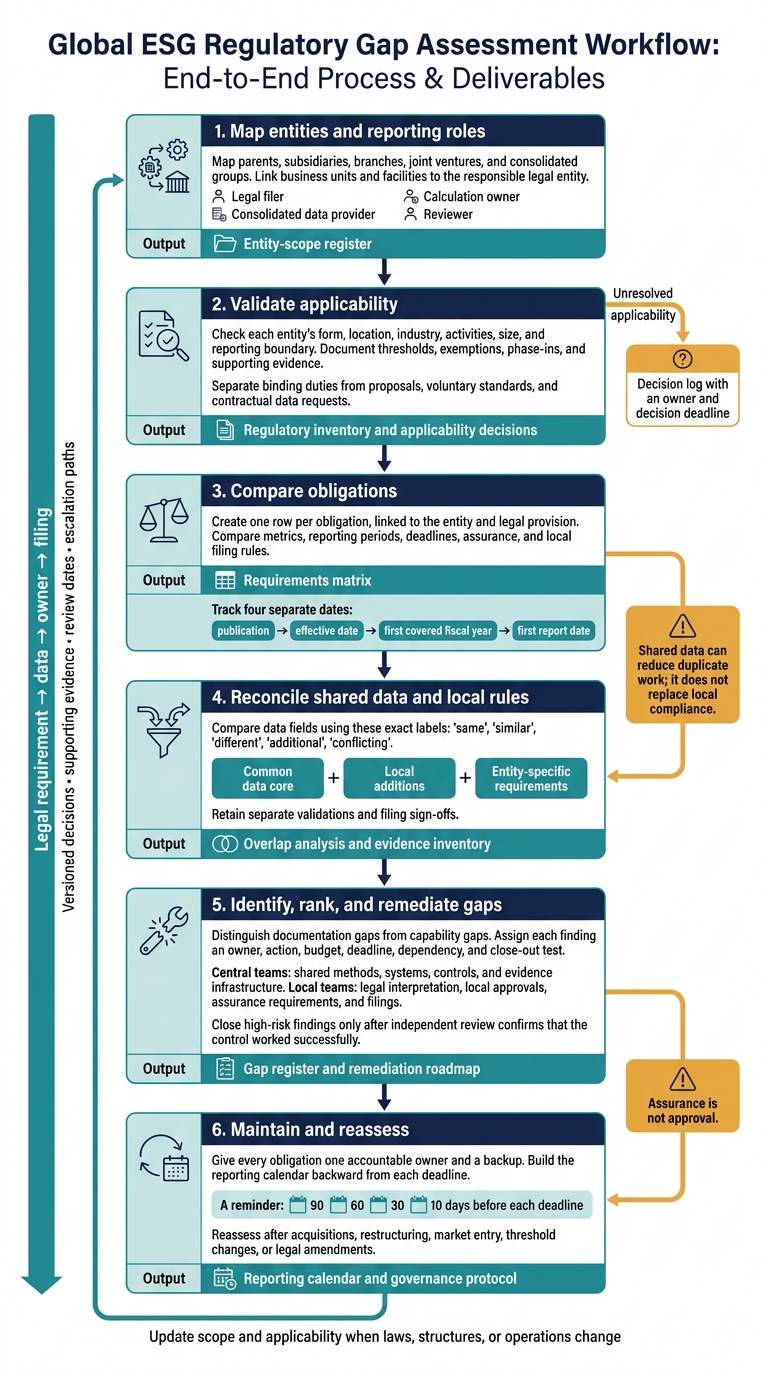
ESG Regulatory Gap Assessment: From Scope to Compliance
Map Entities, Reporting Thresholds, and Exemptions
Once you’ve classified the source rules, map them across jurisdictions to the legal entities, branches, and business units they bind.
Build the register from legal-entity records. Include ultimate and intermediate parents, subsidiaries, branches, representative offices, joint ventures, associates, special-purpose vehicles, and consolidated groups. Link each business unit and facility to the legal entity that owns or operates it, and record ownership, voting rights, and consolidation treatment.
Assign a reporting role to each entity: legal filer, consolidated data provider, calculation owner, or reviewer. Then test each rule against the correct reporting boundary and exemption.
Check Which Rules Apply to Each Entity
Check each entity’s form, location, industry, activities, and size against the rule’s reporting boundary: standalone entity, local operations, or consolidated group. Determine whether local presence, cross-border turnover, or a group relationship brings it into scope. Review branches locally, and don’t rely on accounting treatment alone to set a joint venture’s reporting boundary.
Separate legal duties from data requests. Customer questionnaires, lender covenants, and procurement clauses may require information without creating a statutory filing duty. Record the legal or contractual basis, recipient, and consequence separately. Assign statutory accountability to the legal entity - not the function supporting it.
Document Thresholds, Exemptions, and Scope Decisions
Record each threshold exactly as the rule states it, including units, measurement period, and calculation method. Keep the legal currency and units; add a USD reference only if you document the exchange-rate date. For CSRD-based assessments, document the conjunctive threshold and confirm national implementation before deciding whether an entity falls within scope.[2][5]
Back every conclusion with financial statements, payroll records, registry extracts, rule provisions, or legal advice. Record phase-ins, exclusions, safe harbors, and permanent exemptions separately.
California materials describe an insurance-company exemption from 2026 greenhouse-gas reporting when parallel reporting to the California Department of Insurance would otherwise duplicate the obligation.[3]
Record each scope decision in the working register below. These examples are assessment records, not completed applicability findings.
Entity Jurisdiction Trigger Threshold and currency Exemption or phase-in Conclusion Evidence source Review date Owner U.S. parent doing business in California California Annual revenue; doing business More than $1,000,000,000 annual revenue[3][4] Verify exemptions Pending scope review Statute, CARB guidance, revenue calculation MM/DD/YYYY U.S. legal lead EU subsidiary Relevant EU member state Form, size, listing, consolidation, group relationship More than 1,000 average employees and EUR 450,000,000 net turnover[2][5] Conditional parent-report relief Pending scope review National law, payroll, accounts, parent report MM/DD/YYYY Local counsel Non-EU parent with EU operations Relevant EU member state EU turnover and qualifying subsidiary or branch More than EUR 450,000,000 EU turnover; EU subsidiary or branch generating more than EUR 200,000,000 turnover[2][5] Verify conditions Pending scope review Turnover calculations, branch records, legal memo MM/DD/YYYY Group legal lead
Use these records to build the requirements matrix.
sbb-itb-8baf5f1
Build a Requirements Matrix and Compare Overlaps
Use the entity register and scope decisions above to compare obligations side by side.
Create one row per obligation, linked to the entity and legal provision - not a catchall ESG row. Record the jurisdiction, authority, instrument, publication date, effective date, status, first applicable fiscal year, and last status review. Keep version history and separate national implementation files so amendments don’t overwrite earlier reporting rules. Use controlled status values: in force, effective but not yet applicable, adopted and awaiting commencement, proposed, pending national implementation, repealed or superseded, and voluntary.[5]
The matrix should show where one data set supports several filings and where local rules need separate treatment.
Track Reporting Deadlines and Assurance Requirements
Use the table below to compare requirements, not as a filing calendar. Link each record to the latest scope decision and a dated status review. Track the reporting period separately from management approval, assurance completion, filing, and public publication.
| Jurisdiction and obligation | Legal status, covered entities, thresholds, and exemptions | Reporting period and first applicable year | Filing deadline and publication location | Assurance and enforcement |
|---|---|---|---|---|
| EU member state - CSRD/ESRS | Link the national law, scope decision, and exemption evidence. | Record the entity’s applicable fiscal year; the initial wave reported FY 2024 information in 2025.[8] | Record national filing and publication requirements separately. | The initial requirement is limited assurance. Publish the sustainability information with an assurance opinion. Record the national authority and any penalties.[5][7] |
| Jurisdiction using IFRS S1/S2 | Separate voluntary use from adopted local requirements. Record local thresholds and relief. | Follow the adopting instrument’s commencement and transition provisions. | Record local deadlines and filing location. Voluntary use creates no filing deadline. | Establish assurance and enforcement requirements from local law, not standards alignment alone.[6][9] |
Link each row to topic, metric, unit, method, materiality, value-chain, retention, and control records. Give assurance its own record covering the assurance level - limited or reasonable - covered disclosures, permitted provider, standard, and evidence owner. Assurance is not approval.[7]
Separate Shared Data From Local Reporting Rules
Once deadlines and assurance are mapped, compare the data fields - not the framework names. Mark each match same, similar, different, additional, or conflicting. Use this crosswalk to flag where reuse needs reconciliation. Don’t assume one disclosure satisfies both rules.[10][11]
| Data area | Potential shared data | Differences and reconciliations to record | Source to retain |
|---|---|---|---|
| Climate and emissions | Fuel, electricity, emissions factors, Scope 1–3 activity data | Financial versus double materiality; consolidation boundaries; permitted Scope 1–3 methods; estimates; time horizons; reporting periods | Applicable ESRS provisions, IFRS S2, local adopting law, and permitted calculation methodology |
| Energy, water, biodiversity, and circularity | Consumption, withdrawals, site locations, materials, and waste records | Units, site versus group boundaries, value-chain coverage, materiality, and period alignment | Applicable disclosure provisions and metric definitions |
| Workforce and human rights | Workforce counts, incidents, policies, and supplier information | Employee versus broader workforce populations; incident definitions; due-diligence boundaries; retention | Local legal provisions and applicable disclosure requirements |
| Governance | Oversight responsibilities, policies, and approval evidence | Required signatory, approval timing, mandated controls, assurance scope, and publication format | Governing law, filing rules, and assurance requirements |
Group the records into a common data core, local additions such as formats and assurance statements, and entity-specific requirements triggered by operations or legal status. Keep separate validations and filing sign-offs. Interoperability reduces duplicate collection; it does not establish legal equivalence, grant an exemption, or complete another jurisdiction’s filing.[1][9]
Identify Gaps and Plan Corrective Actions
Use the requirements matrix to check each obligation across countries and business units against current controls and evidence. For every applicable requirement, review the policies, owners, systems, calculations, disclosures, and assurance evidence tied to each entity and jurisdiction.
Separate documentation gaps from capability gaps. A documentation gap means the process exists, but its evidence is incomplete. A capability gap means people, systems, data, or methods cannot deliver the process reliably. Keep unresolved applicability questions separate until a decision is made. For each finding, retain the rule citation, applicability analysis, evidence reviewed, interview notes, and approval.
Rank Gaps by Risk and Deadline
Use a documented scoring model. Classify findings as scope, governance, policy, data, methodology, control, workflow, disclosure, and assurance gaps. Score legal consequence, urgency, financial impact, jurisdictional reach, dependencies, and effort from 1 to 5, using written definitions. Set thresholds before scoring, and record the rationale, reviewer, and date. One practical formula is:
[ \text{Priority Score} = 3(\text{Legal Consequence}) + 3(\text{Urgency}) + 2(\text{Financial Impact}) + 2(\text{Reach}) + \text{Dependencies} - \text{Effort} ]
The score determines what to fix first - not whether a gap exists. Move each scored gap directly into remediation.
Use a gap register to link each finding to its requirement, owner, action, deadline, and close-out test. Include the jurisdiction, reporting period, temporary controls, and links to supporting files. Track open applicability questions in a separate log, each with an owner and decision deadline.
Requirement ID Affected entity Evidence Finding Risk rating Owner Action Due date Dependency Close-out evidence CLM-04 U.S. parent and consolidated subsidiaries Entity chart, reporting policy, emissions workbook, review sign-off Scope 3 boundary is undocumented; supplier data coverage cannot be reproduced High Group Controller Approve boundary memo, document exclusions, and implement supplier-data reconciliation March 31, 2027 Procurement data feed Approved boundary memo, reconciled dataset, reviewer sign-off GOV-07 French subsidiary Board minutes, local policy, training records Local approval responsibility is not assigned Medium Country General Counsel Appoint accountable officer and update delegation matrix January 31, 2027 Legal interpretation Signed delegation matrix and training completion report
Separate applicability decision log
Requirement ID Affected entity Evidence Open question Owner Action Decision deadline Dependency Decision evidence APP-02 Canadian subsidiary Entity register and legal opinion Applicability of a sector-specific rule remains unresolved Regulatory Counsel Obtain written interpretation and document inclusion or exclusion decision December 15, 2026 External counsel review Approved scope memo
Assign Central and Local Corrective Actions
After ranking gaps, divide responsibility between central and local teams. Centralize repeatable capabilities: the requirements inventory, entity master data, reporting calendar, data dictionary, calculation engine, controls, training, evidence repository, and escalation process.
Keep country-specific legal interpretation, regulator interaction, language, filing format, labor or privacy constraints, required assurance, tax treatment, and local approvals with local teams.
| Corrective-action model | Benefits | Limits | Suitable uses | Accountable owner |
|---|---|---|---|---|
| Centralized | Consistent methodology, less duplication, comparable data, stronger oversight | May overlook local law or operating realities | Group policies, common definitions, systems, controls, training | Chief Sustainability Officer or Group Controller |
| Localized | Better legal fit, faster local decisions, appropriate language and evidence | Duplicated effort and inconsistent practices | Applicability opinions, local filings, regulator communications, local approvals | Country General Counsel or local finance leader |
| Hybrid | Combines shared infrastructure with local execution | Requires clear interfaces and escalation | Multi-jurisdictional reporting programs and shared-control environments | Group owner with named country owners |
Reuse shared calculation controls only when the metric definition, boundary, factor source, period, and review standard all match. Local legal counsel or an authorized local owner should approve exceptions, entity-specific exclusions, filing language, or interpretations of national requirements.
Turn priorities into a remediation roadmap covering legal analysis, systems, staffing, training, and assurance support. Group actions into workstreams by legal deadline, risk, and dependency, in this sequence:
Resolve applicability questions and lock the entity list.
Address imminent filing, approval, and assurance failures.
Establish minimum temporary controls for data and disclosures.
Repair systems and calculation logic.
Run monitoring and test controls through one full cycle.
Give each action a business case, budget, owner, milestones, resources, dependency, target date, and escalation threshold. Funding should cover technology, legal analysis, data acquisition, local implementation, training, internal audit, and external assurance where needed.
Set internal deadlines ahead of statutory deadlines to leave time for review, corrections, and assurance requests. Give temporary manual reconciliations and two-person reviews an expiry date and replacement plan. Close high-risk findings only after independent review confirms that the control worked successfully, and retain the final evidence package.
Next, tie these actions to the reporting calendar and control cycle.
Conclusion: Keep the Assessment Current
Once remediation begins, keep the assessment active. Follow the cycle: define scope, validate applicability, compare obligations, address gaps, and reassess when laws, structures, or operations change. Manage it as a controlled compliance process, with versioned decisions, evidence, owners, review dates, and escalation paths.
Assign Owners and Maintain the Reporting Calendar
Name an executive sponsor and a central program owner. Assign clear responsibilities:
Legal/compliance: Applicability and monitoring.
Sustainability/finance: Metrics and reconciliation.
Procurement, IT, and business units: Data and controls.
Risk: Escalation.
Internal audit: Independent testing.
Give every obligation one accountable owner and a backup.
Build the calendar backward from each deadline. Include data collection, assurance, management and board review, filing, publication, and archiving. Set reminders at 90, 60, 30, and 10 days before each deadline, and specify the time zone and whether calendar-day or business-day rules apply.
Schedule reviews of regulatory sources across jurisdictions. After acquisitions, restructuring, market entry, threshold changes, or legal amendments, require approved, version-controlled impact assessments and update the calendar to reflect the results.
Use Assessment Findings to Improve Sustainability Programs
Use the findings to improve supplier engagement, emissions controls, climate-resilience planning, and operating decisions. Apply shared improvements across jurisdictions, while keeping the controls required by local rules.
Check the Final Deliverables
With owners and dates in place, check that all final deliverables are ready: entity-scope register, regulatory inventory, applicability decisions, requirements matrix, overlap analysis, evidence inventory, gap register, remediation roadmap, reporting calendar, and governance protocol.
Assign each deliverable an owner, review date, approval status, and supporting evidence. Trace selected disclosures back to source records, then trace selected requirements forward to the disclosures they drive.
FAQs
How should we handle conflicting ESG requirements across countries?
Start by identifying which requirements apply, then centralize data collection instead of building separate systems for each region. Let the most demanding applicable framework set the level of detail for one master dataset. Map shared requirements, then tailor reports to each jurisdiction.
Council Fire helps organizations design integrated frameworks that simplify compliance and turn sustainability strategy into measurable action.
What if our entity crosses a reporting threshold midyear?
Check how the rules in your jurisdiction handle transition periods. Crossing an annual revenue or employee headcount threshold may trigger obligations for that fiscal year. Depending on local rules and timelines, reporting may start immediately or in the next cycle.
Track regulatory updates, too. Changes to the EU’s CSRD and California’s SB 253 requirements may affect when your entity must report.
How do we assess ESG gaps when supplier data is missing?
Map your full value chain, rank risks by severity and likelihood, and check for gaps in your metrics against frameworks such as GRI, SASB, or TCFD.
If direct supplier data isn’t available, document your estimation methods, allocation logic, and assumptions so reporting stays transparent and audit-ready. Work with suppliers using data collection templates or requests for system access. Set up internal controls and run mock audits to check your processes before formal assurance.




FAQ