
Oct 11, 2026 · 12 min read
Sustainability Strategy
In This Article
Match decarbonization gaps with partners, assign owners, secure financing, and scale emissions cuts only after verified results.
Cross-sector partnerships in industrial decarbonization
We cut industrial emissions by matching each gap with a partner - and giving each commitment an owner. We start with a baseline across Scope 1, Scope 2, and relevant Scope 3 emissions, then set a 2030 target before choosing partners or spending capital.
We build the plan around four steps:
Choose the right partnership: a single site, a value chain, an industrial cluster, or a public-private project.
Assign roles: manufacturers, energy and logistics providers, lenders, government, workers, and communities each need clear duties and decision rights.
Make the deal work: compare costs in U.S. dollars per metric ton of CO₂e reduced, secure funding and buyer commitments, and agree on contracts, data access, and risk ownership.
Verify before expanding: check emissions, costs, reliability, and worker and community outcomes against agreed thresholds.
Our rule is simple: <u>fund commitments, not promises</u>. We address permits, infrastructure, demand, and local concerns before construction - and scale only when verified results support the next step.
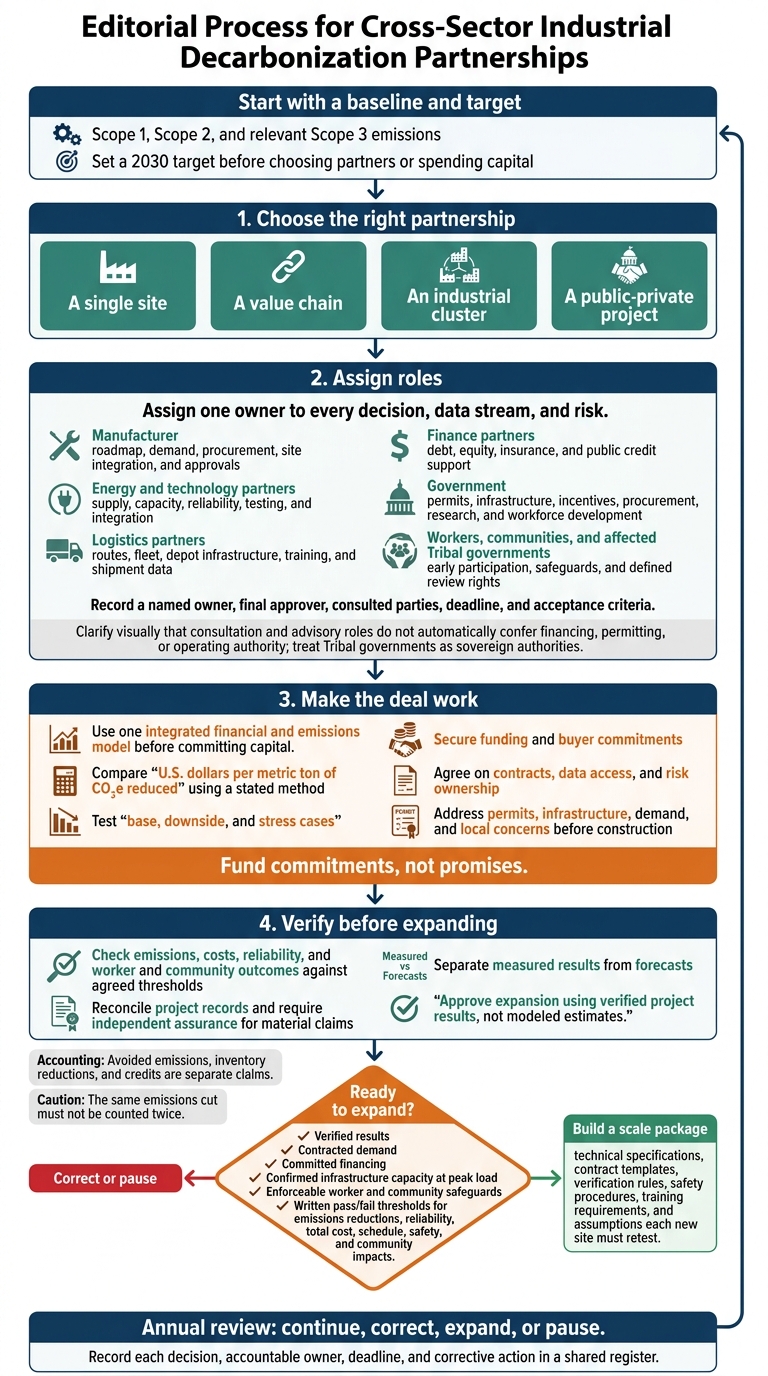
Industrial Decarbonization Partnerships: From Baseline to Scale
Cross-Sectoral Learning for Industrial Decarbonization: Building Türkiye’s low-carbon ecosystem
sbb-itb-8baf5f1
Assign partner roles and responsibilities
Once the partnership model is set, assign one owner to every decision, data stream, and risk.
Define manufacturer, energy, and logistics roles
Name the lead manufacturer and spell out the decisions, data, and constraints it controls. The manufacturer should own the agreed data package, decarbonization roadmap, demand forecast, procurement commitments, site integration plan, and internal approvals.
Energy partners should confirm the availability of low-carbon power, fuels, heat, or carbon transport and storage. They should also provide capacity studies, interconnection timing, fuel specifications, reliability commitments, metering design, upgrade costs, and outage procedures. Technology partners should support equipment testing and integration, while the manufacturer keeps approval authority over product quality and operating changes. For every deliverable, record a named owner, final approver, consulted parties, deadline, and acceptance criteria. [3][4]
Logistics partners should own route planning, load consolidation, fleet upgrades, depot infrastructure, and operator training. Require shipment-level data on distance, weight, fuel or electricity use, empty miles, and allocation methods. Contracts should address subcontractor reporting, audit access, correction deadlines, backup capacity, and the accounting boundary for reporting reductions. The same emissions cut must not be counted twice. SmartWay can benchmark freight performance, but project data still governs reporting. [6][8][10]
Define finance and government roles
Lenders assess repayment capacity, contracts, technology maturity, collateral, counterparty strength, and construction risk. Investors provide equity. Insurers evaluate construction, business-interruption, equipment-performance, environmental-liability, and professional-liability risks. Public finance bodies can provide grants, loans, guarantees, or other credit support.
Assign separate government contacts for permits, infrastructure, incentives, procurement, research, and workforce development. Before counting public support, verify agency notices, eligibility, deadlines, cost-share rules, and executed agreements. Keep each funding status clearly labeled: confirmed award, conditional selection, submitted application, eligible opportunity, or assumed incentive requiring verification. [4][5][7]
Commercial terms alone do not secure delivery. Workers and communities can still slow or stop a project.
Involve workers, communities, and coordination partners
Treat worker and community input as a delivery requirement, not a side process. Bring workers, residents, and affected Tribal governments into planning before technology selection or siting decisions.
Give worker representatives defined input into safety, job redesign, maintenance requirements, training curricula, and plans for displacement or reduced hours. Set community review points for emissions, water use, traffic, noise, safety, jobs, land disturbance, hiring commitments, and grievance resolution.
Treat Tribal governments as sovereign authorities. Identify applicable consultation and consent requirements, and protect culturally sensitive information. A coordination partner’s scope should clearly separate advisory duties from financing, permitting, and operating authority. [9]
Structure financing, contracts, and governance
Build the business case and choose financing
Once roles are set, agree on the capital stack and how parties will share risk. Use one integrated financial and emissions model before committing capital. Define the project boundary, baseline, and implementation schedule. Include installed capital cost, operating and financing costs, expected energy savings, product premiums, buyer commitments, reliability requirements, incentives, tax benefits, and residual risks.
Report results in U.S. dollars, show annual and total abatement, and calculate cost per metric ton of CO₂e abated using a stated method. Test base, downside, and stress cases for energy prices, demand, carbon prices, incentives, delays, uptime, technology performance, inflation, and interest rates.
Set approval limits for debt-service coverage, delivered energy or service price, minimum uptime, and maximum acceptable abatement cost. Make clear who receives savings and who pays for cost overruns. Check whether the project can still work if a subsidy, buyer, or technology supplier withdraws.
| Financing model | Ownership | Repayment source | Main risk allocation | Typical duration | Project fit |
|---|---|---|---|---|---|
| Project finance | Special-purpose vehicle or project company | Project revenues, contracted payments, or user fees | Contracts allocate construction and operating risks; lenders require guarantees | 10–25 years | Large, bankable shared energy or carbon infrastructure |
| Joint venture | Shared ownership by manufacturers, infrastructure firms, utilities, or investors | Equity returns, user fees, product sales, or distributions | Partners share capital, control, upside, and downside | 10–30 years | Assets requiring several anchor users or coordinated investment |
| Third-party service model | Provider owns and operates the equipment | Fixed service fee, energy charge, or availability payment | Provider bears asset and performance risk; customer retains demand and operating risks | 5–15 years | Energy-as-a-service, efficiency retrofits, heat, cooling, or equipment upgrades |
| Shared savings | Provider or consortium finances improvements | A negotiated share of verified savings | Payment depends on verified savings; parties must define measurement risk | 3–10 years | Efficiency projects with measurable energy baselines and limited upfront capital |
| Public-supported financing | Public agency support alongside private capital | Public support, private repayment, user payments, and project revenues | Public capital absorbs agreed early-stage risks; private parties retain delivery obligations | Varies | First-of-a-kind assets and enabling infrastructure with financing gaps |
Set contract terms and decision rights
Turn the business case into binding obligations, matching each contract to the asset life and revenue stream. Start with a memorandum of understanding or development agreement covering diligence, exclusivity, confidentiality, cost sharing, permitting roles, and conditions for proceeding. Before close, replace it with binding offtake, capacity or take-or-pay, energy or service, joint-venture, asset-use, or interconnection agreements.
Specify volume and access terms, maintenance windows, curtailment and expansion rights, minimum-volume or take-or-pay commitments, pricing formulas, and performance guarantees. Also address legal and policy change risk, environmental attributes, liability and insurance, default and exit provisions, and remedies. Assign each risk to the party best able to control, insure, finance, or mitigate it, with a reporting trigger, financial cap, and remedy.
| Decision area | Responsible body | Approval threshold | Escalation path | Competition-law and data protections |
|---|---|---|---|---|
| Capital budget, financing, and major change orders | Board or investment committee | Supermajority above an agreed dollar threshold; unanimous approval for new equity or guarantees | Finance committee → board chair → mediation or arbitration | Share only aggregated cost and demand data; obtain counsel clearance for competitor participation |
| Technology selection and material design changes | Technical committee, subject to board approval | Technical approval; board approval if cost, emissions, safety, or schedule thresholds are exceeded | Independent engineer → steering committee → expert determination | Protect proprietary designs, specifications, and sensitive performance data |
| Operations, maintenance, outages, and dispatch | Operator and operations committee | Operator acts within approved plan; committee approves deviations above defined limits | Incident team → operations committee → board | Require role-based access, cybersecurity controls, and minimum-necessary data sharing |
| Community impacts, benefits, and grievance response | Community advisory body with management and board representation | Board approves public commitments; management has immediate authority for urgent health and safety actions | Community body → independent ombudsperson → board | Protect personal information and confidential complaints; publish aggregated outcomes |
| Emissions accounting, claims, and credit transfers | Finance, audit, and sustainability committee | Independent verification before external claims or credit transfers | Auditor or verifier → audit committee → board | Keep an auditable data ledger; prohibit unsupported exclusive claims |
Governance depends on measuring the right outputs and auditing them consistently. Record quorum, voting rights, conflicts-of-interest rules, reserved matters, information rights, meeting cadence, and emergency authority in the governance charter.
Keep technical disputes separate from commercial ones. Operating personnel should first investigate and try to resolve issues, with senior executives reviewing anything unresolved. An independent engineer, accountant, or emissions expert can decide technical matters. Use mediation for commercial disputes, with arbitration or court proceedings as the final remedy.
Competition-law counsel should review information-sharing, exclusivity, joint purchasing, output allocation, and coordinated pricing provisions. Data agreements should state ownership, permitted uses, retention, cybersecurity standards, audit rights, and breach notification requirements.
Measure emissions, performance, and community outcomes
After close, measure only what the contract and baseline define. Before construction, agree on boundaries, the baseline year, emission factors, meter calibration, missing-data rules, reporting frequency, and verification.
Track absolute Scope 1, Scope 2, and relevant Scope 3 emissions, along with emissions intensity, energy use, uptime, and asset utilization. Financial tracking should cover capital deployed, operating cost, financing drawn, savings, revenue, and abatement cost.
For community outcomes, track local hiring, apprenticeships, training completion, relevant air pollutants, benefits delivered, complaints received, response times, unresolved grievances, and corrective actions. Give each community commitment a budget, deadline, verification method, and remedy.
Reconcile meters, invoices, production records, dispatch logs, fuel records, and credit registries. Require independent assurance for material claims, and clearly separate measured results from forecasts.
Avoided emissions, inventory reductions, and credits are separate claims. Report avoided-emissions estimates separately; do not net them against Scope 1, Scope 2, or Scope 3 inventories. Track credit ownership, serial numbers, transfers, and retirement authority separately to prevent double counting.[11][12]
Address barriers before building and operating
Once roles and contracts are set, check the project for barriers that commonly delay industrial decarbonization.
Build a joint risk register during feasibility and update it at every stage gate: concept, FEED, final investment decision, construction, commissioning, and operations. For each risk, record its probability, cost and schedule impact, mitigation measures, contingency budget, and escalation trigger. Assign one accountable owner - not a committee - and match each risk to the partner best placed to control it.
| Barrier | Affected partners | Commercial consequences | Mitigation measures | Accountable owner |
|---|---|---|---|---|
| Mismatched investment and payback schedules | Manufacturer, energy provider, financiers, government | FID delays, stranded development costs, funding gaps | Use staged commitments, milestone-based drawdowns, break clauses, and bridge financing | Lead finance partner |
| Insufficient buyer demand | Manufacturer, customers, distributors, procurement agencies | Underused capacity, unrecovered low-carbon premium | Secure offtake, capacity reservations, demand aggregation, and minimum-volume commitments | Manufacturer’s commercial lead |
| Uncertain incentives or public budgets | All partners, especially financiers and project developers | Higher capital costs, reduced returns, procurement delays | Model base, downside, and no-incentive cases; do not tie construction to uncommitted grants or tax benefits | Lead finance partner |
| Grid, hydrogen, pipeline, storage, water, and freight constraints | Energy provider, infrastructure operators, manufacturer, logistics firm | Construction delays, curtailment, higher operating costs, reduced output | Complete shared studies, reserve capacity conditionally, set connection milestones, and maintain backup supply and transport plans | Relevant infrastructure operator |
| Immature technology or weak integration | Manufacturer, technology supplier, financiers | Cost overruns, missed performance targets, warranty disputes | Run pilots; require independent reviews, acceptance testing, performance guarantees, warranties, and contingency budgets | Manufacturer’s integration lead |
| Permitting and regulatory delays | Manufacturer, government agencies, local communities, financiers | Schedule slippage, carrying costs, lost incentives, redesign | Engage agencies early, map federal, state, and local approvals, schedule permits, and track judicial and environmental-review risks | Manufacturer’s permitting lead |
| Conflicting data or emissions claims | Manufacturer, energy provider, buyers, auditors, regulators | Double counting, greenwashing allegations, lost market access | Define data ownership, audit rights, calculation methods, chain-of-custody records, and emissions-attribute ownership | Manufacturer’s sustainability lead |
| Local pollution, land use, affordability, and workforce impacts | Communities, workers, manufacturer, government | Opposition, litigation, labor disruption, reputational harm | Assess social and environmental impacts separately; negotiate enforceable commitments, transition training, monitoring, grievance channels, and response deadlines | Manufacturer’s community engagement lead |
Align investment schedules and buyer demand
A signed deal alone should not release construction funding. Test who pays if volumes fall, then agree on reservation fees, reassignment rights, and withdrawal deadlines before ordering long-lead equipment.
Where public funding is involved, align disbursements with technical and community milestones. If uncertain incentives determine whether the project can proceed, reduce its scope, add committed capital, or defer construction.
Buyer demand does not remove physical constraints. Those dependencies can still stop the project.
Manage technology, infrastructure, and permit risks
Equipment readiness and connection readiness are separate checks. A successful pilot does not secure grid capacity, water supply, freight access, or a storage permit. Require written evidence of capacity and an independent technical review before major spending.
Hold full notice to proceed until critical approvals and connections are secured. Agree on who pays carrying costs if a dependency slips, and spell out the fallback: reduced output, another supplier, or a pause.
A technically ready plant can still face local opposition that blocks delivery.
Prevent emissions disputes and community harm
Before buyers rely on emissions claims, settle product-footprint boundaries, baseline assumptions, protected data access, chain-of-custody records, and emissions-attribute rights.
Keep emissions reductions separate from local environmental and social outcomes. Lower facility emissions do not guarantee community protection. Start community participation before site selection or permit submission.
Fund paid transition training and enforceable commitments. Provide accessible grievance channels, set response deadlines, and establish escalation steps when remedies are overdue.
Scale verified projects and maintain accountability
Verify results and standardize delivery
Once a pilot proves the operating model, use its verified results to judge whether the design can work elsewhere under the same controls. Expansion should follow proof, not projections.
Set expansion criteria before the pilot starts. Require a documented baseline, an anchor manufacturer or buyer, committed financing, secured infrastructure, and safeguards for workers and communities. Establish written pass/fail thresholds for emissions reductions, reliability, total cost, schedule, safety, and community impacts.[13][14]
Treat prior projects as templates only after an independent reviewer verifies their results. The review should check emissions calculations, operating records, and evidence that community commitments were met. Approve expansion using verified project results, not modeled estimates.[15][16]
Turn validated lessons into a scale package that includes technical specifications, contract templates, verification rules, safety procedures, and training requirements. Include the assumptions each new site must retest.
Expand when capacity and governance are ready
Scale only when the first site has shown that demand, financing, infrastructure, and governance can support the next phase.
Before adding nearby facilities, suppliers, customers, or freight links, require verified results, contracted demand, committed financing, confirmed infrastructure capacity at peak load, and enforceable safeguards. Bring in only partners that can meet delivery and reporting obligations. Assign responsibility for expansion risks, and let affected workers and communities help shape the new design - not just review a finished plan.[13]
Each expansion should retest the roles, obligations, and safeguards used in the pilot.
Run an annual review to decide whether to:
“continue, correct, expand, or pause”
Cover verified emissions, operating performance, contract economics, policy changes, and community outcomes.[13] Recalculate the business case when key assumptions change. Keep each decision, accountable owner, deadline, and corrective action in a shared register. Pause expansion when performance or safeguards fall below agreed thresholds.
FAQs
How do I choose the right decarbonization partners?
Map stakeholders to your decarbonization goals. Look for partners whose goals align with yours, whose strengths complement yours, and who act as “pragmatic leaders” who turn vision into delivery [1]. Assess three factors: Interest (commitment), Influence (ability to shape policy, markets, or communities), and Assets (what each partner brings that others don’t) [2].
Give community-based organizations a seat at the decision-making table - not just a role as beneficiaries. Use charters or MOUs to define roles, decision rights, and governance, build trust, and keep partnerships on track [1][2].
How can smaller manufacturers join shared projects?
Smaller manufacturers don’t have to go it alone. By joining collaborative platforms and regional initiatives, they can pool resources and demand. Regional clean energy procurement collaboratives can offer competitive renewable energy prices that individual firms may not be able to secure.
Established coalitions and public-private commissions give firms structured ways to share technical expertise and procurement knowledge. Digital platforms and book-and-claim systems can also lower barriers to entry, helping smaller manufacturers take part in supply chain decarbonization alongside larger partners.
What if partners miss their emissions targets?
Find the root causes and act promptly to address them. Council Fire recommends a governance charter with clear escalation paths when partners miss targets or disagree on priorities. Bring together cross-partner task forces when sustainability KPIs fall behind, and revisit goals at regular check-ins as outside conditions change.
If performance remains weak, third-party audits or external stakeholders can offer objective assessments. These reviews can help partners get back on track or decide whether the partnership is still viable.



FAQ