
Jun 25, 2026
How to Build Cross-Sector Partnerships That Drive Systems Change for Maritime & Logistics Companies
Sustainability Strategy
In This Article
Map maritime systems, pick one bottleneck, align partners with clear roles and data rules, and measure results within 12–24 months.
How to Build Cross-Sector Partnerships That Drive Systems Change for Maritime & Logistics Companies
If you want systems change in maritime, start small, pick one bottleneck, and build the right partner group around it. Shipping handles about 80% of global trade and produces roughly 2%–3% of global GHG emissions, so progress depends on carriers, ports, fuel suppliers, cargo owners, regulators, lenders, and local communities moving together.
I’d boil the article down to four moves:
Map the system first so I can see where fuel, vessels, port assets, and cargo flows get stuck.
Choose one entry point with the best mix of impact, cost, timing, and rule support.
Set clear targets, roles, funding, and data rules before work starts.
Measure results early across emissions, port and fleet performance, community effects, and governance, then scale only what proves out.
What matters most is not the biggest idea. It’s a partnership model that fits the job: a vertical deal for supply-and-demand alignment, a horizontal group for shared standards, or a cross-sector coalition for corridor and port change. I’d also keep community input in from the start, because delays at ports often come from people being brought in too late.
Here’s the simple takeaway: don’t try to fix the whole system at once. Start with one route, one port, one fuel pathway, or one traceability use case, set a scorecard for the next 12–24 months, and use proof - not hype - to decide what scales.
Sustainability Across the Shipping Supply Chain | SSI| Oceans of Opportunity
1. Map the System and Choose the Right Partnership Opportunity
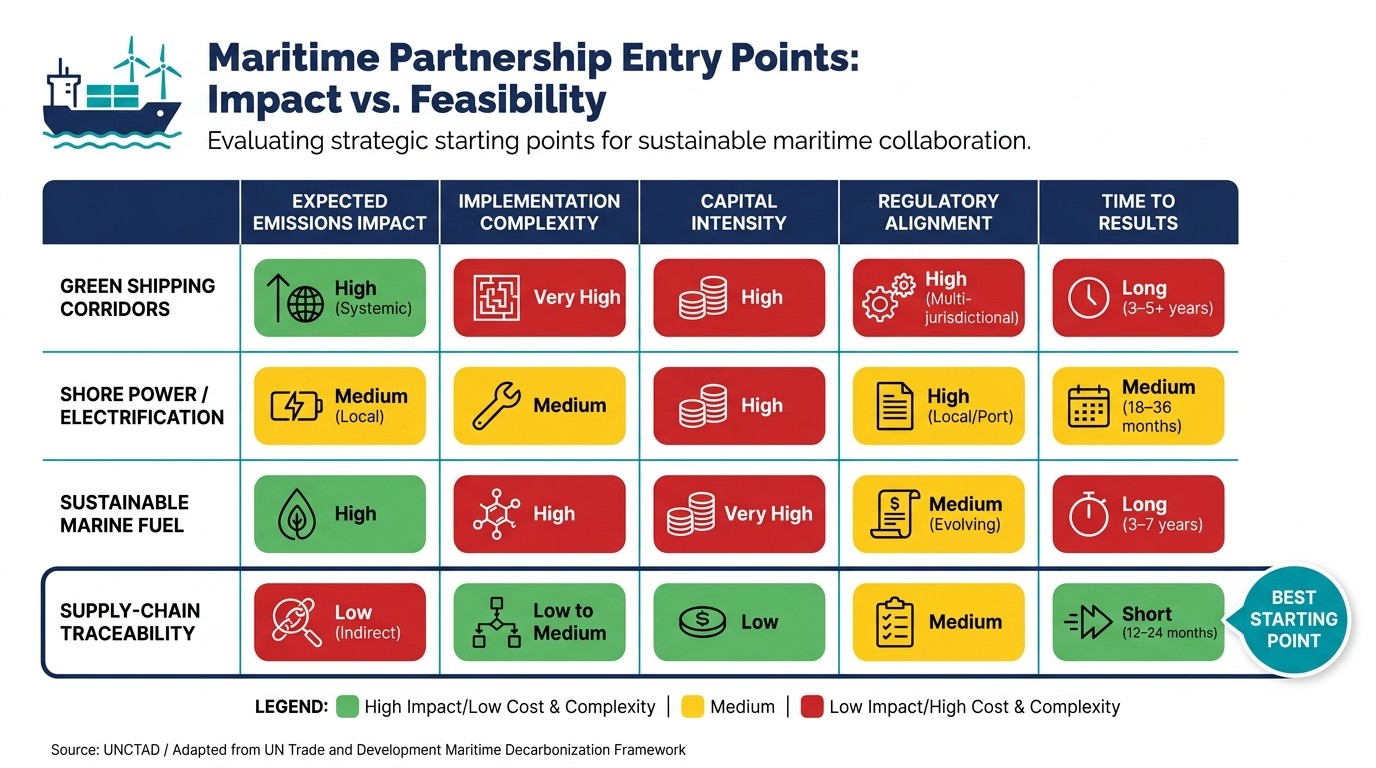
Maritime Partnership Entry Points: Impact vs. Feasibility Comparison
Before you contact even one potential partner, get a clear view of how the system works in practice. That means mapping three linked value chains: the fuel chain, shipbuilding for vessels and equipment, and day-to-day operations and logistics. When you lay those chains side by side, weak points start to show. Supply gaps, asset bottlenecks, and cargo flow issues often don’t sit in one chain alone. They show up where the chains meet.
"Achieving the lowest possible levels of emissions requires the alignment of supply and demand of clean input factors and decarbonization assets across the entire ecosystem." - UN Trade and Development (UNCTAD) [1]
Identify System Shapers, Influencers, and Affected Stakeholders
A simple way to sort the field is to group stakeholders into three buckets.
System shapers control infrastructure and rules. This group includes national and city governments, port authorities, large shipping lines, and energy providers.
Influencers move the agenda forward without direct operating control. Think financial institutions, intergovernmental organizations, and NGOs.
Affected parties include local communities near ports and terminals, cargo owners (BCOs), and smaller operators that may not have the capital to lead but still matter for system-wide uptake.
It also helps to map how these groups connect: upstream and downstream links, peer relationships, and cross-industry ties. That view makes it easier to spot where failure is most likely [1]. In many cases, a neutral convener such as the Global Maritime Forum or another international organization can help bring the right people to the table.
Once you know who shapes the system, who influences it, and who lives with the outcome, you can choose one opening for partnership that has enough pull to matter.
Pick One Entry Point with the Best Impact-to-Feasibility Ratio
After the map is done, it’s easy to think, why not tackle all of it? That usually leads nowhere fast. A better move is to compare entry points based on impact and feasibility, not ambition alone.
Entry Point | Expected Emissions Impact | Implementation Complexity | Capital Intensity | Regulatory Alignment | Time to Results |
|---|---|---|---|---|---|
Green Shipping Corridors | High (Systemic) | Very High | High | High (Multi-jurisdictional) | Long (3–5+ years) |
Shore Power / Electrification | Medium (Local) | Medium | High | High (Local/Port) | Medium (18–36 months) |
Sustainable Marine Fuel | High | High | Very High | Medium (Evolving) | Long (3–7 years) |
Supply-Chain Traceability | Low (Indirect) | Low to Medium | Low | Medium | Short (12–24 months) |
The Singapore–Rotterdam Green and Digital Corridor is a good example of how this can work. Port authorities and other stakeholders aligned around low-carbon fuel trials and digital clearance tools to cut delays and emissions [1]. On the other hand, a traceability partnership is often a simpler place to begin. It can show measurable progress in 12 to 24 months, with less complexity and lower upfront cost.
Set Selection Criteria Before Outreach Begins
Before outreach starts, rank your options against four factors: strategic alignment, resource readiness, regulatory alignment, and the ability to show measurable progress within 12 to 24 months [2].
A vertical partnership is often the safest first step, especially when it builds on an existing supplier or customer relationship. It lowers friction and gives the work a practical base. Maersk and Ørsted took that route by forming a vertical partnership to develop industrial-scale production of zero-emission maritime fuels [1].
With the entry point chosen, the next step is to lock in shared goals, roles, and funding before implementation begins.
2. Build the Partnership Around Shared Goals, Roles, and Funding
Once you’ve picked an entry point, the next step is to turn that initial agreement into a working setup with clear targets, defined roles, and a funding model that fits the job. That setup should match the route, terminal, fleet, or corridor you mapped earlier. It also needs to give partners and customers one shared roadmap for execution.
Turn Broad Ambitions into Specific, Time-Bound Targets
A goal like "reduce our carbon footprint" sounds good, but it doesn’t tell anyone what to do next. A better target is tied to a specific asset, route, terminal, or fleet, with a date attached. Put dated milestones in place from day one so the partnership can track progress and make changes when needed.
Keep the scorecard tight. Track just two or three KPIs linked to the use case, such as GHG emissions, asset productivity, energy transition, and air quality [1][2]. Picking those measures early helps keep partners on the hook and gives everyone the same definition of success.
"Decarbonization in one value chain depends on developments in other chains. As examples, green ships require green steel and clean ship operations need alternative fuels." - UNCTAD [1]
Choose a Governance Model That Fits the Scope
Your governance model should fit the size and difficulty of the work. Vertical partnerships are often the easiest place to begin when one company is lining up with a supplier or customer in its own value chain. Horizontal partnerships make more sense when competitors need to share infrastructure or agree on standards. Cross-sector partnerships fit system-level work that cuts across sectors, regulators, and NGOs [1].
Partnership Form | Focus | Best Use Case | Primary Benefit | Complexity |
|---|---|---|---|---|
Vertical | Company value chain | A carrier partnering with a fuel producer | Aligns supply and demand for zero-emission fuels | Lower |
Horizontal | Industry standards | Competitors sharing a vessel pool | Improves asset productivity and reduces costs | Medium |
Cross-sector | Ecosystem change | Multi-sector corridors or port coalitions | Aligns interdependent systems and avoids bottlenecks | High |
For corridors, port coalitions, fuel partnerships, or traceability programs that bring in competitors or many sectors, a neutral orchestrator, such as an NGO or intergovernmental organization, can help build trust and manage anti-trust concerns [1]. Before outreach starts, decide whether your organization is acting as a first mover or a follower so role clarity and risk expectations are set early [2]. No matter which model you use, define roles and set a formal escalation path before the first workstream starts [2]. If you want the lowest-complexity pilot, start with a vertical partnership.
Once roles are clear, the funding model should match that same scope and risk level.
Match the Funding Model to Infrastructure, Data, and Adoption Needs
Funding should help spread financial and operating risk across the group [2]. For work centered on adoption, collective-demand or blended funding models can pool commitments and lower early-adopter risk [2].
If smaller operators are part of the partnership, build the model so they can join without needing the same capital or internal capacity as the biggest players. In many cases, larger actors will need to lead and make room for smaller operators on purpose [1].
"Entering a partnership or collaboration allows a business to risk-share." - Maersk [2]
Next, put that structure into action with data-sharing rules, focused workstreams, and early community engagement.
3. Put the Partnership into Practice Through Data Sharing, Workstreams, and Community Engagement
Set Data-Sharing Rules Before Technical Work Begins
Before the technical work starts, get the rules on paper. Spell out what data each partner can access, who handles disputes, and how issues move through escalation. In maritime partnerships, that often includes emissions, operations, and traceability data. Some of that information can be commercially sensitive, so the guardrails need to be clear from day one.
DCSA offers a useful model here. As a horizontal partnership, it provides shared infrastructure and data standards that let competitors exchange information safely [1]. That matters more than it may seem at first glance. If every group builds its own protocol, teams burn time debating formats, controls, and access instead of moving the work forward. Using existing standards where possible keeps things simpler and lowers friction [1].
Verified emissions-tracking and carbon-accounting tools can help as well. They support carbon baseline reporting and give partners a way to share verified data without handing over raw operational logs.
With the data rules in place, the work can move into a small set of parallel tracks.
Run Focused Workstreams for Decarbonization, Efficiency, and Traceability
A practical setup is to run three workstreams in parallel: fuel supply, shipbuilding, and operations. These tracks depend on each other, so they can't drift too far apart. If fuel supply moves ahead but vessels are not ready, progress slows. If assets are ready but fuel supply lags, the same thing happens. Bottlenecks in one area can drag down the whole effort [1].
"Achieving the lowest possible levels of emissions requires the alignment of supply and demand of clean input factors and decarbonization assets across the entire ecosystem." - Wolfgang Lehmacher, Operating Partner, Anchor Group [3]
That quote gets to the heart of the issue. Supply, assets, and day-to-day operations have to move together or the partnership starts to lose momentum.
Ownership should reflect the type of partnership. In a vertical partnership, a strong lead partner like a major shipping line can connect upstream fuel supply with downstream demand. In cross-sector partnerships, neutral partners such as IGOs or NGOs are often in a better position to coordinate governance and build trust across the group [1][3].
Bring Local Communities In Early to Protect Social License
Even a solid technical plan can hit a wall if local stakeholders are brought in too late. Once execution is underway, open a parallel channel for community and permitting input. Bring in ports, regulators, labor, communities, and environmental groups early so design choices help cut delays and protect social license [1][3].
This is not just a communications task. Environmental and social impacts should be treated as design inputs, not as something tacked on at the end [1]. That shift can shape site choices, operating plans, timelines, and permit strategy before those decisions become harder to change.
It also helps to include smaller operators and the public sector early in the process. That can support adoption across the market and strengthen regulatory backing [1].
4. Measure Results, Refine the Model, and Scale What Works
Track a Balanced Scorecard of Environmental, Operational, Social, and Governance Metrics
Once workstreams are live, the focus has to move from planning to measurement. That means tracking environmental, operational, social, and governance metrics from day one. If you wait too long to measure, you end up guessing. And in a multi-partner effort, guessing creates friction fast.
The table below shows which metrics matter most to each partner group:
Metric Category | Port Authorities | Carriers / Logistics Companies | Regulators |
|---|---|---|---|
Environmental | Local air quality; oil spill prevention | Absolute GHG emissions; fuel carbon intensity | Compliance with international (IMO) standards |
Operational | Berth productivity; infrastructure readiness | Asset productivity; schedule reliability | Supply chain resilience; transport capacity |
Social | Local job creation; noise reduction | Workforce safety; social license to operate | Public health impacts; environmental justice |
Governance | Regional policy alignment | Adherence to shared roadmaps; data transparency | Regulatory reporting accuracy; participation rates |
Set baselines early. That step matters more than many teams expect, because without a starting point, progress turns into opinion. The Getting to Zero Coalition, a cross-sector coalition involving more than 200 organizations, including 160 businesses, uses public milestones tied to the scorecard to hold partners accountable to a goal of reducing shipping emissions by at least 50% by 2050 [2]. Public milestones keep targets accountable.
A strong scorecard does more than track performance. It also helps support capital access, customer trust, and regulatory confidence.
Build Review Cycles and Decision Points into the Partnership
The scorecard should trigger action, not just produce reports that sit on a shelf. Build regular check-ins and clear escalation points into the partnership structure. Spell out who makes decisions, who steps in when progress stalls, and how quickly those calls need to happen.
When results come in slower than expected, resist the urge to change scope right away. Go back to the system map and find the bottleneck first. That often saves time, money, and a lot of avoidable churn. Scale only after simpler partnership models have shown that the path works [1].
Conclusion: Start Narrow, Govern Clearly, and Scale Based on Proof
Systems change in maritime and logistics rarely happens in one big move. It starts with tracking the right metrics early, using review cycles to adjust course, and keeping partners aligned around shared roadmaps. From there, governance and public commitments give the partnership staying power.
The companies most likely to lead this shift are not always the biggest. They are the ones that govern clearly, measure honestly, and build on proof rather than ambition alone. Scale only after the scorecard shows repeatable gains across emissions, operations, and social license.
FAQs
How do I choose the best first partnership pilot?
Start with business relationships you already have. That’s often the easiest place to begin, because trust is already there and the setup tends to be simpler. It also gives you room to run a lower-complexity pilot while you learn how to handle partnership dynamics in practice.
Pick a pilot that has a clear shared vision, defined objectives, and a scope your team can actually manage. Keep your strategic role in mind as well - whether you’re moving first or following someone else’s lead - so you can show progress early before taking on more complex, multi-stakeholder efforts.
Who should lead a cross-sector maritime partnership?
Often, one strong player in the value chain takes the lead by lining up upstream suppliers, such as energy companies, with downstream customers.
In more complex, multi-stakeholder alliances, international or intergovernmental organizations may be the best fit to lead. They often bring trust, neutrality, and clear governance that others are more likely to accept.
At the end of the day, these are voluntary coalitions. That means any participant can step up, help shape the direction, and push the work forward.
What metrics show a partnership is ready to scale?
A partnership is ready to scale when it shows clear progress across the value chain and a working plan to close cost gaps through financing, regulation, or green premiums.
Readiness also means moving beyond planning and into day-to-day feasibility. In plain terms, the partnership needs proof that the model can work in practice. That proof can help shape broader funding and policy frameworks, while also supporting coordinated execution across the value chain.
Related Blog Posts
How to Build a Corporate Sustainability Strategy Aligned to ROI for Maritime & Logistics Companies
How to Design a Circular Supply Chain Roadmap for Maritime & Logistics Companies
How to Align Stakeholders Around a Shared ESG Vision for Maritime & Logistics Companies
How to Facilitate Cross-Sector Collaboration for Climate Action for Maritime & Logistics Companies
Latest Articles
©2025

Narrative Change and Power Building: The Missing Half of Advocacy
Narrative change is the process of disrupting dominant narratives that normalize inequity and advancing new narratives from historically marginalized communities.

Funding Resilience Without Federal Grants
BRIC is unreliable and FEMA is shrinking. Here's how cities fund climate resilience with dedicated revenue, blended finance, and a coordinating authority.

The ESG Blind Spot: How AI Is Finding Risks in Companies Nobody Else Is Watching
Norway's sovereign wealth fund uses AI to screen 7,200 portfolio companies for forced labor and corruption within 24 hours. The real story is the emerging-market coverage gap that traditional ESG data vendors miss — and what it means for any company with a global supply chain.
Narrative Change and Power Building: The Missing Half of Advocacy
Narrative change is the process of disrupting dominant narratives that normalize inequity and advancing new narratives from historically marginalized communities.
Funding Resilience Without Federal Grants
BRIC is unreliable and FEMA is shrinking. Here's how cities fund climate resilience with dedicated revenue, blended finance, and a coordinating authority.
The ESG Blind Spot: How AI Is Finding Risks in Companies Nobody Else Is Watching
Norway's sovereign wealth fund uses AI to screen 7,200 portfolio companies for forced labor and corruption within 24 hours. The real story is the emerging-market coverage gap that traditional ESG data vendors miss — and what it means for any company with a global supply chain.
FAQ
01
What does it really mean to “redefine profit”?
02
What makes Council Fire different?
03
Who does Council Fire work with?
04
What does working with Council Fire actually look like?
05
How does Council Fire help organizations turn big goals into action?
06
How does Council Fire define and measure success?
Jun 25, 2026
How to Build Cross-Sector Partnerships That Drive Systems Change for Maritime & Logistics Companies
Sustainability Strategy
In This Article
Map maritime systems, pick one bottleneck, align partners with clear roles and data rules, and measure results within 12–24 months.
How to Build Cross-Sector Partnerships That Drive Systems Change for Maritime & Logistics Companies
If you want systems change in maritime, start small, pick one bottleneck, and build the right partner group around it. Shipping handles about 80% of global trade and produces roughly 2%–3% of global GHG emissions, so progress depends on carriers, ports, fuel suppliers, cargo owners, regulators, lenders, and local communities moving together.
I’d boil the article down to four moves:
Map the system first so I can see where fuel, vessels, port assets, and cargo flows get stuck.
Choose one entry point with the best mix of impact, cost, timing, and rule support.
Set clear targets, roles, funding, and data rules before work starts.
Measure results early across emissions, port and fleet performance, community effects, and governance, then scale only what proves out.
What matters most is not the biggest idea. It’s a partnership model that fits the job: a vertical deal for supply-and-demand alignment, a horizontal group for shared standards, or a cross-sector coalition for corridor and port change. I’d also keep community input in from the start, because delays at ports often come from people being brought in too late.
Here’s the simple takeaway: don’t try to fix the whole system at once. Start with one route, one port, one fuel pathway, or one traceability use case, set a scorecard for the next 12–24 months, and use proof - not hype - to decide what scales.
Sustainability Across the Shipping Supply Chain | SSI| Oceans of Opportunity
1. Map the System and Choose the Right Partnership Opportunity
Maritime Partnership Entry Points: Impact vs. Feasibility Comparison
Before you contact even one potential partner, get a clear view of how the system works in practice. That means mapping three linked value chains: the fuel chain, shipbuilding for vessels and equipment, and day-to-day operations and logistics. When you lay those chains side by side, weak points start to show. Supply gaps, asset bottlenecks, and cargo flow issues often don’t sit in one chain alone. They show up where the chains meet.
"Achieving the lowest possible levels of emissions requires the alignment of supply and demand of clean input factors and decarbonization assets across the entire ecosystem." - UN Trade and Development (UNCTAD) [1]
Identify System Shapers, Influencers, and Affected Stakeholders
A simple way to sort the field is to group stakeholders into three buckets.
System shapers control infrastructure and rules. This group includes national and city governments, port authorities, large shipping lines, and energy providers.
Influencers move the agenda forward without direct operating control. Think financial institutions, intergovernmental organizations, and NGOs.
Affected parties include local communities near ports and terminals, cargo owners (BCOs), and smaller operators that may not have the capital to lead but still matter for system-wide uptake.
It also helps to map how these groups connect: upstream and downstream links, peer relationships, and cross-industry ties. That view makes it easier to spot where failure is most likely [1]. In many cases, a neutral convener such as the Global Maritime Forum or another international organization can help bring the right people to the table.
Once you know who shapes the system, who influences it, and who lives with the outcome, you can choose one opening for partnership that has enough pull to matter.
Pick One Entry Point with the Best Impact-to-Feasibility Ratio
After the map is done, it’s easy to think, why not tackle all of it? That usually leads nowhere fast. A better move is to compare entry points based on impact and feasibility, not ambition alone.
Entry Point | Expected Emissions Impact | Implementation Complexity | Capital Intensity | Regulatory Alignment | Time to Results |
|---|---|---|---|---|---|
Green Shipping Corridors | High (Systemic) | Very High | High | High (Multi-jurisdictional) | Long (3–5+ years) |
Shore Power / Electrification | Medium (Local) | Medium | High | High (Local/Port) | Medium (18–36 months) |
Sustainable Marine Fuel | High | High | Very High | Medium (Evolving) | Long (3–7 years) |
Supply-Chain Traceability | Low (Indirect) | Low to Medium | Low | Medium | Short (12–24 months) |
The Singapore–Rotterdam Green and Digital Corridor is a good example of how this can work. Port authorities and other stakeholders aligned around low-carbon fuel trials and digital clearance tools to cut delays and emissions [1]. On the other hand, a traceability partnership is often a simpler place to begin. It can show measurable progress in 12 to 24 months, with less complexity and lower upfront cost.
Set Selection Criteria Before Outreach Begins
Before outreach starts, rank your options against four factors: strategic alignment, resource readiness, regulatory alignment, and the ability to show measurable progress within 12 to 24 months [2].
A vertical partnership is often the safest first step, especially when it builds on an existing supplier or customer relationship. It lowers friction and gives the work a practical base. Maersk and Ørsted took that route by forming a vertical partnership to develop industrial-scale production of zero-emission maritime fuels [1].
With the entry point chosen, the next step is to lock in shared goals, roles, and funding before implementation begins.
2. Build the Partnership Around Shared Goals, Roles, and Funding
Once you’ve picked an entry point, the next step is to turn that initial agreement into a working setup with clear targets, defined roles, and a funding model that fits the job. That setup should match the route, terminal, fleet, or corridor you mapped earlier. It also needs to give partners and customers one shared roadmap for execution.
Turn Broad Ambitions into Specific, Time-Bound Targets
A goal like "reduce our carbon footprint" sounds good, but it doesn’t tell anyone what to do next. A better target is tied to a specific asset, route, terminal, or fleet, with a date attached. Put dated milestones in place from day one so the partnership can track progress and make changes when needed.
Keep the scorecard tight. Track just two or three KPIs linked to the use case, such as GHG emissions, asset productivity, energy transition, and air quality [1][2]. Picking those measures early helps keep partners on the hook and gives everyone the same definition of success.
"Decarbonization in one value chain depends on developments in other chains. As examples, green ships require green steel and clean ship operations need alternative fuels." - UNCTAD [1]
Choose a Governance Model That Fits the Scope
Your governance model should fit the size and difficulty of the work. Vertical partnerships are often the easiest place to begin when one company is lining up with a supplier or customer in its own value chain. Horizontal partnerships make more sense when competitors need to share infrastructure or agree on standards. Cross-sector partnerships fit system-level work that cuts across sectors, regulators, and NGOs [1].
Partnership Form | Focus | Best Use Case | Primary Benefit | Complexity |
|---|---|---|---|---|
Vertical | Company value chain | A carrier partnering with a fuel producer | Aligns supply and demand for zero-emission fuels | Lower |
Horizontal | Industry standards | Competitors sharing a vessel pool | Improves asset productivity and reduces costs | Medium |
Cross-sector | Ecosystem change | Multi-sector corridors or port coalitions | Aligns interdependent systems and avoids bottlenecks | High |
For corridors, port coalitions, fuel partnerships, or traceability programs that bring in competitors or many sectors, a neutral orchestrator, such as an NGO or intergovernmental organization, can help build trust and manage anti-trust concerns [1]. Before outreach starts, decide whether your organization is acting as a first mover or a follower so role clarity and risk expectations are set early [2]. No matter which model you use, define roles and set a formal escalation path before the first workstream starts [2]. If you want the lowest-complexity pilot, start with a vertical partnership.
Once roles are clear, the funding model should match that same scope and risk level.
Match the Funding Model to Infrastructure, Data, and Adoption Needs
Funding should help spread financial and operating risk across the group [2]. For work centered on adoption, collective-demand or blended funding models can pool commitments and lower early-adopter risk [2].
If smaller operators are part of the partnership, build the model so they can join without needing the same capital or internal capacity as the biggest players. In many cases, larger actors will need to lead and make room for smaller operators on purpose [1].
"Entering a partnership or collaboration allows a business to risk-share." - Maersk [2]
Next, put that structure into action with data-sharing rules, focused workstreams, and early community engagement.
3. Put the Partnership into Practice Through Data Sharing, Workstreams, and Community Engagement
Set Data-Sharing Rules Before Technical Work Begins
Before the technical work starts, get the rules on paper. Spell out what data each partner can access, who handles disputes, and how issues move through escalation. In maritime partnerships, that often includes emissions, operations, and traceability data. Some of that information can be commercially sensitive, so the guardrails need to be clear from day one.
DCSA offers a useful model here. As a horizontal partnership, it provides shared infrastructure and data standards that let competitors exchange information safely [1]. That matters more than it may seem at first glance. If every group builds its own protocol, teams burn time debating formats, controls, and access instead of moving the work forward. Using existing standards where possible keeps things simpler and lowers friction [1].
Verified emissions-tracking and carbon-accounting tools can help as well. They support carbon baseline reporting and give partners a way to share verified data without handing over raw operational logs.
With the data rules in place, the work can move into a small set of parallel tracks.
Run Focused Workstreams for Decarbonization, Efficiency, and Traceability
A practical setup is to run three workstreams in parallel: fuel supply, shipbuilding, and operations. These tracks depend on each other, so they can't drift too far apart. If fuel supply moves ahead but vessels are not ready, progress slows. If assets are ready but fuel supply lags, the same thing happens. Bottlenecks in one area can drag down the whole effort [1].
"Achieving the lowest possible levels of emissions requires the alignment of supply and demand of clean input factors and decarbonization assets across the entire ecosystem." - Wolfgang Lehmacher, Operating Partner, Anchor Group [3]
That quote gets to the heart of the issue. Supply, assets, and day-to-day operations have to move together or the partnership starts to lose momentum.
Ownership should reflect the type of partnership. In a vertical partnership, a strong lead partner like a major shipping line can connect upstream fuel supply with downstream demand. In cross-sector partnerships, neutral partners such as IGOs or NGOs are often in a better position to coordinate governance and build trust across the group [1][3].
Bring Local Communities In Early to Protect Social License
Even a solid technical plan can hit a wall if local stakeholders are brought in too late. Once execution is underway, open a parallel channel for community and permitting input. Bring in ports, regulators, labor, communities, and environmental groups early so design choices help cut delays and protect social license [1][3].
This is not just a communications task. Environmental and social impacts should be treated as design inputs, not as something tacked on at the end [1]. That shift can shape site choices, operating plans, timelines, and permit strategy before those decisions become harder to change.
It also helps to include smaller operators and the public sector early in the process. That can support adoption across the market and strengthen regulatory backing [1].
4. Measure Results, Refine the Model, and Scale What Works
Track a Balanced Scorecard of Environmental, Operational, Social, and Governance Metrics
Once workstreams are live, the focus has to move from planning to measurement. That means tracking environmental, operational, social, and governance metrics from day one. If you wait too long to measure, you end up guessing. And in a multi-partner effort, guessing creates friction fast.
The table below shows which metrics matter most to each partner group:
Metric Category | Port Authorities | Carriers / Logistics Companies | Regulators |
|---|---|---|---|
Environmental | Local air quality; oil spill prevention | Absolute GHG emissions; fuel carbon intensity | Compliance with international (IMO) standards |
Operational | Berth productivity; infrastructure readiness | Asset productivity; schedule reliability | Supply chain resilience; transport capacity |
Social | Local job creation; noise reduction | Workforce safety; social license to operate | Public health impacts; environmental justice |
Governance | Regional policy alignment | Adherence to shared roadmaps; data transparency | Regulatory reporting accuracy; participation rates |
Set baselines early. That step matters more than many teams expect, because without a starting point, progress turns into opinion. The Getting to Zero Coalition, a cross-sector coalition involving more than 200 organizations, including 160 businesses, uses public milestones tied to the scorecard to hold partners accountable to a goal of reducing shipping emissions by at least 50% by 2050 [2]. Public milestones keep targets accountable.
A strong scorecard does more than track performance. It also helps support capital access, customer trust, and regulatory confidence.
Build Review Cycles and Decision Points into the Partnership
The scorecard should trigger action, not just produce reports that sit on a shelf. Build regular check-ins and clear escalation points into the partnership structure. Spell out who makes decisions, who steps in when progress stalls, and how quickly those calls need to happen.
When results come in slower than expected, resist the urge to change scope right away. Go back to the system map and find the bottleneck first. That often saves time, money, and a lot of avoidable churn. Scale only after simpler partnership models have shown that the path works [1].
Conclusion: Start Narrow, Govern Clearly, and Scale Based on Proof
Systems change in maritime and logistics rarely happens in one big move. It starts with tracking the right metrics early, using review cycles to adjust course, and keeping partners aligned around shared roadmaps. From there, governance and public commitments give the partnership staying power.
The companies most likely to lead this shift are not always the biggest. They are the ones that govern clearly, measure honestly, and build on proof rather than ambition alone. Scale only after the scorecard shows repeatable gains across emissions, operations, and social license.
FAQs
How do I choose the best first partnership pilot?
Start with business relationships you already have. That’s often the easiest place to begin, because trust is already there and the setup tends to be simpler. It also gives you room to run a lower-complexity pilot while you learn how to handle partnership dynamics in practice.
Pick a pilot that has a clear shared vision, defined objectives, and a scope your team can actually manage. Keep your strategic role in mind as well - whether you’re moving first or following someone else’s lead - so you can show progress early before taking on more complex, multi-stakeholder efforts.
Who should lead a cross-sector maritime partnership?
Often, one strong player in the value chain takes the lead by lining up upstream suppliers, such as energy companies, with downstream customers.
In more complex, multi-stakeholder alliances, international or intergovernmental organizations may be the best fit to lead. They often bring trust, neutrality, and clear governance that others are more likely to accept.
At the end of the day, these are voluntary coalitions. That means any participant can step up, help shape the direction, and push the work forward.
What metrics show a partnership is ready to scale?
A partnership is ready to scale when it shows clear progress across the value chain and a working plan to close cost gaps through financing, regulation, or green premiums.
Readiness also means moving beyond planning and into day-to-day feasibility. In plain terms, the partnership needs proof that the model can work in practice. That proof can help shape broader funding and policy frameworks, while also supporting coordinated execution across the value chain.
Related Blog Posts
How to Build a Corporate Sustainability Strategy Aligned to ROI for Maritime & Logistics Companies
How to Design a Circular Supply Chain Roadmap for Maritime & Logistics Companies
How to Align Stakeholders Around a Shared ESG Vision for Maritime & Logistics Companies
How to Facilitate Cross-Sector Collaboration for Climate Action for Maritime & Logistics Companies
Latest Articles
©2025
Narrative Change and Power Building: The Missing Half of Advocacy
Narrative change is the process of disrupting dominant narratives that normalize inequity and advancing new narratives from historically marginalized communities.
Funding Resilience Without Federal Grants
BRIC is unreliable and FEMA is shrinking. Here's how cities fund climate resilience with dedicated revenue, blended finance, and a coordinating authority.
The ESG Blind Spot: How AI Is Finding Risks in Companies Nobody Else Is Watching
Norway's sovereign wealth fund uses AI to screen 7,200 portfolio companies for forced labor and corruption within 24 hours. The real story is the emerging-market coverage gap that traditional ESG data vendors miss — and what it means for any company with a global supply chain.
FAQ
01
What does it really mean to “redefine profit”?
02
What makes Council Fire different?
03
Who does Council Fire work with?
04
What does working with Council Fire actually look like?
05
How does Council Fire help organizations turn big goals into action?
06
How does Council Fire define and measure success?
Jun 25, 2026
How to Build Cross-Sector Partnerships That Drive Systems Change for Maritime & Logistics Companies
Sustainability Strategy
In This Article
Map maritime systems, pick one bottleneck, align partners with clear roles and data rules, and measure results within 12–24 months.
How to Build Cross-Sector Partnerships That Drive Systems Change for Maritime & Logistics Companies
If you want systems change in maritime, start small, pick one bottleneck, and build the right partner group around it. Shipping handles about 80% of global trade and produces roughly 2%–3% of global GHG emissions, so progress depends on carriers, ports, fuel suppliers, cargo owners, regulators, lenders, and local communities moving together.
I’d boil the article down to four moves:
Map the system first so I can see where fuel, vessels, port assets, and cargo flows get stuck.
Choose one entry point with the best mix of impact, cost, timing, and rule support.
Set clear targets, roles, funding, and data rules before work starts.
Measure results early across emissions, port and fleet performance, community effects, and governance, then scale only what proves out.
What matters most is not the biggest idea. It’s a partnership model that fits the job: a vertical deal for supply-and-demand alignment, a horizontal group for shared standards, or a cross-sector coalition for corridor and port change. I’d also keep community input in from the start, because delays at ports often come from people being brought in too late.
Here’s the simple takeaway: don’t try to fix the whole system at once. Start with one route, one port, one fuel pathway, or one traceability use case, set a scorecard for the next 12–24 months, and use proof - not hype - to decide what scales.
Sustainability Across the Shipping Supply Chain | SSI| Oceans of Opportunity
1. Map the System and Choose the Right Partnership Opportunity
Maritime Partnership Entry Points: Impact vs. Feasibility Comparison
Before you contact even one potential partner, get a clear view of how the system works in practice. That means mapping three linked value chains: the fuel chain, shipbuilding for vessels and equipment, and day-to-day operations and logistics. When you lay those chains side by side, weak points start to show. Supply gaps, asset bottlenecks, and cargo flow issues often don’t sit in one chain alone. They show up where the chains meet.
"Achieving the lowest possible levels of emissions requires the alignment of supply and demand of clean input factors and decarbonization assets across the entire ecosystem." - UN Trade and Development (UNCTAD) [1]
Identify System Shapers, Influencers, and Affected Stakeholders
A simple way to sort the field is to group stakeholders into three buckets.
System shapers control infrastructure and rules. This group includes national and city governments, port authorities, large shipping lines, and energy providers.
Influencers move the agenda forward without direct operating control. Think financial institutions, intergovernmental organizations, and NGOs.
Affected parties include local communities near ports and terminals, cargo owners (BCOs), and smaller operators that may not have the capital to lead but still matter for system-wide uptake.
It also helps to map how these groups connect: upstream and downstream links, peer relationships, and cross-industry ties. That view makes it easier to spot where failure is most likely [1]. In many cases, a neutral convener such as the Global Maritime Forum or another international organization can help bring the right people to the table.
Once you know who shapes the system, who influences it, and who lives with the outcome, you can choose one opening for partnership that has enough pull to matter.
Pick One Entry Point with the Best Impact-to-Feasibility Ratio
After the map is done, it’s easy to think, why not tackle all of it? That usually leads nowhere fast. A better move is to compare entry points based on impact and feasibility, not ambition alone.
Entry Point | Expected Emissions Impact | Implementation Complexity | Capital Intensity | Regulatory Alignment | Time to Results |
|---|---|---|---|---|---|
Green Shipping Corridors | High (Systemic) | Very High | High | High (Multi-jurisdictional) | Long (3–5+ years) |
Shore Power / Electrification | Medium (Local) | Medium | High | High (Local/Port) | Medium (18–36 months) |
Sustainable Marine Fuel | High | High | Very High | Medium (Evolving) | Long (3–7 years) |
Supply-Chain Traceability | Low (Indirect) | Low to Medium | Low | Medium | Short (12–24 months) |
The Singapore–Rotterdam Green and Digital Corridor is a good example of how this can work. Port authorities and other stakeholders aligned around low-carbon fuel trials and digital clearance tools to cut delays and emissions [1]. On the other hand, a traceability partnership is often a simpler place to begin. It can show measurable progress in 12 to 24 months, with less complexity and lower upfront cost.
Set Selection Criteria Before Outreach Begins
Before outreach starts, rank your options against four factors: strategic alignment, resource readiness, regulatory alignment, and the ability to show measurable progress within 12 to 24 months [2].
A vertical partnership is often the safest first step, especially when it builds on an existing supplier or customer relationship. It lowers friction and gives the work a practical base. Maersk and Ørsted took that route by forming a vertical partnership to develop industrial-scale production of zero-emission maritime fuels [1].
With the entry point chosen, the next step is to lock in shared goals, roles, and funding before implementation begins.
2. Build the Partnership Around Shared Goals, Roles, and Funding
Once you’ve picked an entry point, the next step is to turn that initial agreement into a working setup with clear targets, defined roles, and a funding model that fits the job. That setup should match the route, terminal, fleet, or corridor you mapped earlier. It also needs to give partners and customers one shared roadmap for execution.
Turn Broad Ambitions into Specific, Time-Bound Targets
A goal like "reduce our carbon footprint" sounds good, but it doesn’t tell anyone what to do next. A better target is tied to a specific asset, route, terminal, or fleet, with a date attached. Put dated milestones in place from day one so the partnership can track progress and make changes when needed.
Keep the scorecard tight. Track just two or three KPIs linked to the use case, such as GHG emissions, asset productivity, energy transition, and air quality [1][2]. Picking those measures early helps keep partners on the hook and gives everyone the same definition of success.
"Decarbonization in one value chain depends on developments in other chains. As examples, green ships require green steel and clean ship operations need alternative fuels." - UNCTAD [1]
Choose a Governance Model That Fits the Scope
Your governance model should fit the size and difficulty of the work. Vertical partnerships are often the easiest place to begin when one company is lining up with a supplier or customer in its own value chain. Horizontal partnerships make more sense when competitors need to share infrastructure or agree on standards. Cross-sector partnerships fit system-level work that cuts across sectors, regulators, and NGOs [1].
Partnership Form | Focus | Best Use Case | Primary Benefit | Complexity |
|---|---|---|---|---|
Vertical | Company value chain | A carrier partnering with a fuel producer | Aligns supply and demand for zero-emission fuels | Lower |
Horizontal | Industry standards | Competitors sharing a vessel pool | Improves asset productivity and reduces costs | Medium |
Cross-sector | Ecosystem change | Multi-sector corridors or port coalitions | Aligns interdependent systems and avoids bottlenecks | High |
For corridors, port coalitions, fuel partnerships, or traceability programs that bring in competitors or many sectors, a neutral orchestrator, such as an NGO or intergovernmental organization, can help build trust and manage anti-trust concerns [1]. Before outreach starts, decide whether your organization is acting as a first mover or a follower so role clarity and risk expectations are set early [2]. No matter which model you use, define roles and set a formal escalation path before the first workstream starts [2]. If you want the lowest-complexity pilot, start with a vertical partnership.
Once roles are clear, the funding model should match that same scope and risk level.
Match the Funding Model to Infrastructure, Data, and Adoption Needs
Funding should help spread financial and operating risk across the group [2]. For work centered on adoption, collective-demand or blended funding models can pool commitments and lower early-adopter risk [2].
If smaller operators are part of the partnership, build the model so they can join without needing the same capital or internal capacity as the biggest players. In many cases, larger actors will need to lead and make room for smaller operators on purpose [1].
"Entering a partnership or collaboration allows a business to risk-share." - Maersk [2]
Next, put that structure into action with data-sharing rules, focused workstreams, and early community engagement.
3. Put the Partnership into Practice Through Data Sharing, Workstreams, and Community Engagement
Set Data-Sharing Rules Before Technical Work Begins
Before the technical work starts, get the rules on paper. Spell out what data each partner can access, who handles disputes, and how issues move through escalation. In maritime partnerships, that often includes emissions, operations, and traceability data. Some of that information can be commercially sensitive, so the guardrails need to be clear from day one.
DCSA offers a useful model here. As a horizontal partnership, it provides shared infrastructure and data standards that let competitors exchange information safely [1]. That matters more than it may seem at first glance. If every group builds its own protocol, teams burn time debating formats, controls, and access instead of moving the work forward. Using existing standards where possible keeps things simpler and lowers friction [1].
Verified emissions-tracking and carbon-accounting tools can help as well. They support carbon baseline reporting and give partners a way to share verified data without handing over raw operational logs.
With the data rules in place, the work can move into a small set of parallel tracks.
Run Focused Workstreams for Decarbonization, Efficiency, and Traceability
A practical setup is to run three workstreams in parallel: fuel supply, shipbuilding, and operations. These tracks depend on each other, so they can't drift too far apart. If fuel supply moves ahead but vessels are not ready, progress slows. If assets are ready but fuel supply lags, the same thing happens. Bottlenecks in one area can drag down the whole effort [1].
"Achieving the lowest possible levels of emissions requires the alignment of supply and demand of clean input factors and decarbonization assets across the entire ecosystem." - Wolfgang Lehmacher, Operating Partner, Anchor Group [3]
That quote gets to the heart of the issue. Supply, assets, and day-to-day operations have to move together or the partnership starts to lose momentum.
Ownership should reflect the type of partnership. In a vertical partnership, a strong lead partner like a major shipping line can connect upstream fuel supply with downstream demand. In cross-sector partnerships, neutral partners such as IGOs or NGOs are often in a better position to coordinate governance and build trust across the group [1][3].
Bring Local Communities In Early to Protect Social License
Even a solid technical plan can hit a wall if local stakeholders are brought in too late. Once execution is underway, open a parallel channel for community and permitting input. Bring in ports, regulators, labor, communities, and environmental groups early so design choices help cut delays and protect social license [1][3].
This is not just a communications task. Environmental and social impacts should be treated as design inputs, not as something tacked on at the end [1]. That shift can shape site choices, operating plans, timelines, and permit strategy before those decisions become harder to change.
It also helps to include smaller operators and the public sector early in the process. That can support adoption across the market and strengthen regulatory backing [1].
4. Measure Results, Refine the Model, and Scale What Works
Track a Balanced Scorecard of Environmental, Operational, Social, and Governance Metrics
Once workstreams are live, the focus has to move from planning to measurement. That means tracking environmental, operational, social, and governance metrics from day one. If you wait too long to measure, you end up guessing. And in a multi-partner effort, guessing creates friction fast.
The table below shows which metrics matter most to each partner group:
Metric Category | Port Authorities | Carriers / Logistics Companies | Regulators |
|---|---|---|---|
Environmental | Local air quality; oil spill prevention | Absolute GHG emissions; fuel carbon intensity | Compliance with international (IMO) standards |
Operational | Berth productivity; infrastructure readiness | Asset productivity; schedule reliability | Supply chain resilience; transport capacity |
Social | Local job creation; noise reduction | Workforce safety; social license to operate | Public health impacts; environmental justice |
Governance | Regional policy alignment | Adherence to shared roadmaps; data transparency | Regulatory reporting accuracy; participation rates |
Set baselines early. That step matters more than many teams expect, because without a starting point, progress turns into opinion. The Getting to Zero Coalition, a cross-sector coalition involving more than 200 organizations, including 160 businesses, uses public milestones tied to the scorecard to hold partners accountable to a goal of reducing shipping emissions by at least 50% by 2050 [2]. Public milestones keep targets accountable.
A strong scorecard does more than track performance. It also helps support capital access, customer trust, and regulatory confidence.
Build Review Cycles and Decision Points into the Partnership
The scorecard should trigger action, not just produce reports that sit on a shelf. Build regular check-ins and clear escalation points into the partnership structure. Spell out who makes decisions, who steps in when progress stalls, and how quickly those calls need to happen.
When results come in slower than expected, resist the urge to change scope right away. Go back to the system map and find the bottleneck first. That often saves time, money, and a lot of avoidable churn. Scale only after simpler partnership models have shown that the path works [1].
Conclusion: Start Narrow, Govern Clearly, and Scale Based on Proof
Systems change in maritime and logistics rarely happens in one big move. It starts with tracking the right metrics early, using review cycles to adjust course, and keeping partners aligned around shared roadmaps. From there, governance and public commitments give the partnership staying power.
The companies most likely to lead this shift are not always the biggest. They are the ones that govern clearly, measure honestly, and build on proof rather than ambition alone. Scale only after the scorecard shows repeatable gains across emissions, operations, and social license.
FAQs
How do I choose the best first partnership pilot?
Start with business relationships you already have. That’s often the easiest place to begin, because trust is already there and the setup tends to be simpler. It also gives you room to run a lower-complexity pilot while you learn how to handle partnership dynamics in practice.
Pick a pilot that has a clear shared vision, defined objectives, and a scope your team can actually manage. Keep your strategic role in mind as well - whether you’re moving first or following someone else’s lead - so you can show progress early before taking on more complex, multi-stakeholder efforts.
Who should lead a cross-sector maritime partnership?
Often, one strong player in the value chain takes the lead by lining up upstream suppliers, such as energy companies, with downstream customers.
In more complex, multi-stakeholder alliances, international or intergovernmental organizations may be the best fit to lead. They often bring trust, neutrality, and clear governance that others are more likely to accept.
At the end of the day, these are voluntary coalitions. That means any participant can step up, help shape the direction, and push the work forward.
What metrics show a partnership is ready to scale?
A partnership is ready to scale when it shows clear progress across the value chain and a working plan to close cost gaps through financing, regulation, or green premiums.
Readiness also means moving beyond planning and into day-to-day feasibility. In plain terms, the partnership needs proof that the model can work in practice. That proof can help shape broader funding and policy frameworks, while also supporting coordinated execution across the value chain.
Related Blog Posts
How to Build a Corporate Sustainability Strategy Aligned to ROI for Maritime & Logistics Companies
How to Design a Circular Supply Chain Roadmap for Maritime & Logistics Companies
How to Align Stakeholders Around a Shared ESG Vision for Maritime & Logistics Companies
How to Facilitate Cross-Sector Collaboration for Climate Action for Maritime & Logistics Companies
Latest Articles
©2025
Narrative Change and Power Building: The Missing Half of Advocacy
Narrative change is the process of disrupting dominant narratives that normalize inequity and advancing new narratives from historically marginalized communities.
Funding Resilience Without Federal Grants
BRIC is unreliable and FEMA is shrinking. Here's how cities fund climate resilience with dedicated revenue, blended finance, and a coordinating authority.
The ESG Blind Spot: How AI Is Finding Risks in Companies Nobody Else Is Watching
Norway's sovereign wealth fund uses AI to screen 7,200 portfolio companies for forced labor and corruption within 24 hours. The real story is the emerging-market coverage gap that traditional ESG data vendors miss — and what it means for any company with a global supply chain.
FAQ
What does it really mean to “redefine profit”?
What makes Council Fire different?
Who does Council Fire work with?
What does working with Council Fire actually look like?
How does Council Fire help organizations turn big goals into action?
How does Council Fire define and measure success?