
May 7, 2026
How to Facilitate Cross-Sector Collaboration for Climate Action for Municipalities & Government Agencies
Sustainability Strategy
In This Article
Municipalities can cut emissions and secure funding by building trust, governance and joint plans across public and private partners.
How to Facilitate Cross-Sector Collaboration for Climate Action for Municipalities & Government Agencies
Municipalities and government agencies face a complex challenge when addressing climate change. Collaboration across sectors - combining efforts from local governments, businesses, nonprofits, academic institutions, and community leaders - has proven to be the most effective way to tackle this issue. By pooling resources, aligning goals, and building trust among stakeholders, organizations can achieve measurable results, such as reducing emissions, securing funding, and creating impactful climate initiatives.
Key Takeaways:
Stakeholder Engagement: Map and involve key groups (government, private sector, NGOs, academia, communities). Build trust through informal discussions before formal commitments.
Governance Structures: Establish a clear framework with a small steering committee and specialized working groups to ensure accountability and progress.
Shared Goals: Set measurable, realistic climate targets that reflect collective priorities. Use data-driven tools for planning and tracking.
Funding and Collaboration: Leverage public-private partnerships, grants, and green bonds to secure investments. Coordinate efforts to avoid competition and maximize impact.
Monitoring and Reporting: Use transparent metrics and annual progress reports to track success, celebrate achievements, and adjust strategies as needed.
By following these steps, municipalities and agencies can align resources, reduce inefficiencies, and deliver meaningful climate solutions.
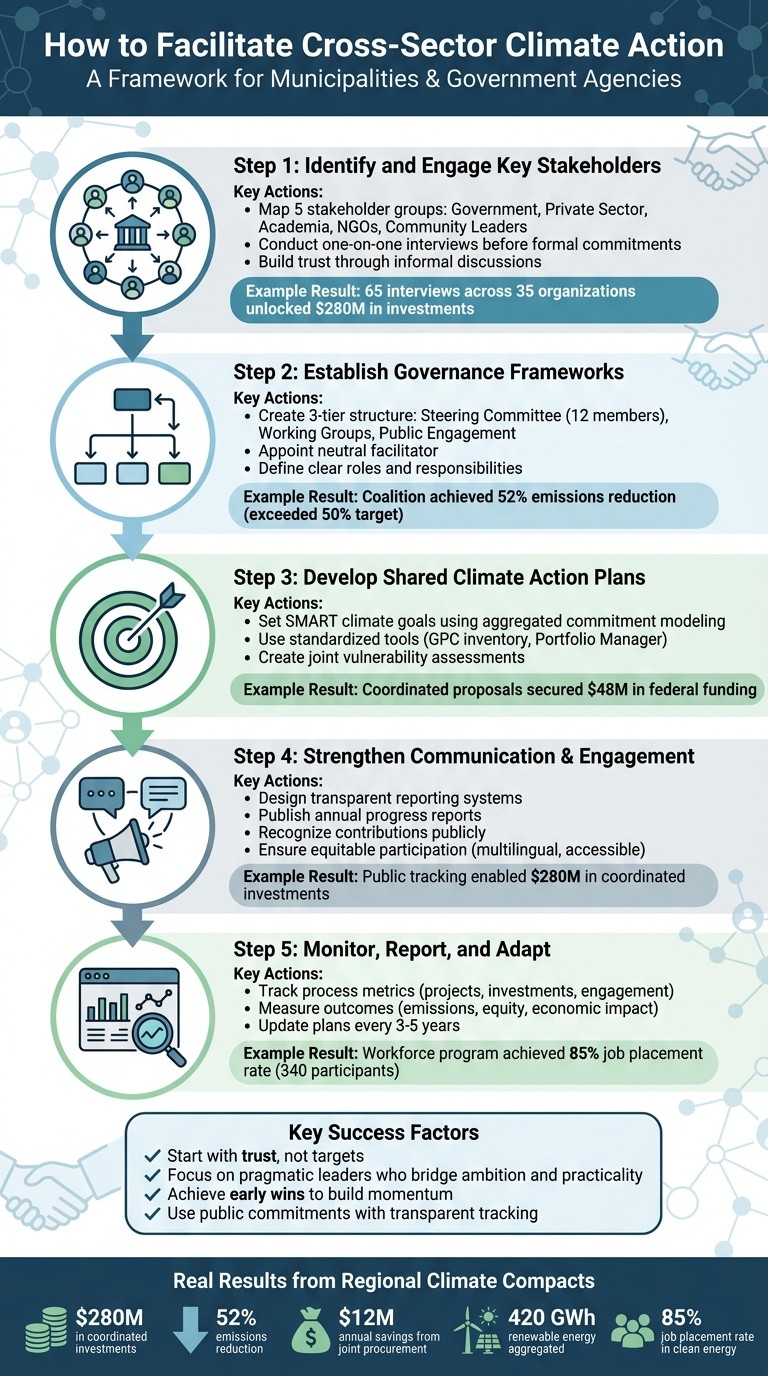
5-Step Framework for Cross-Sector Climate Collaboration in Municipalities
Step 1: Identify and Engage Key Stakeholders
Map Stakeholders Across Sectors
Getting the right people involved is the first step toward meaningful collaboration. To do this, create a stakeholder map that includes five key groups: government entities (like mayors, county executives, and neighboring jurisdictions), private sector representatives (such as CEOs, chambers of commerce, utilities, and real estate developers), academic institutions (universities and research centers), NGOs (environmental organizations and community foundations), and community leaders (including Indigenous communities, faith leaders, and vulnerable populations) [1][3].
Organize stakeholders into four clusters based on their level of ambition and practicality: ambitious advocates, pragmatic leaders, cautious participants, and skeptical observers. A compact facilitated by Council Fire successfully centered its 12-person steering committee around pragmatic leaders, who bridged the divide between the more ambitious and cautious groups. This strategic alignment unlocked $280 million in coordinated investments [1].
With a well-defined stakeholder map in place, the focus can shift to building trust - an essential ingredient for collaboration.
Build Trust and Shared Purpose
Mapping stakeholders is only the beginning. Turning these connections into strong partnerships requires trust. Start with smaller, informal group discussions before asking for formal commitments. These initial sessions help uncover shared goals and interests. Additionally, survey internal staff to identify existing relationships that can serve as a foundation for collaboration [3].
"Start with trust, not targets. The one-on-one interviews and small-group conversations that preceded the formal coalition were the most important phase." - Council Fire Resources [1]
A great example of this approach in action comes from February 2026, when Council Fire facilitated a regional climate compact involving three counties and 28 municipalities. The process began with 65 one-on-one interviews across 35 organizations, including 14 municipalities, 12 businesses, 5 NGOs, and 4 academic institutions. These conversations provided a detailed understanding of each group’s climate priorities, constraints, and willingness to participate - long before launching any formal coalition [1].
This trust-first strategy unfolded over 14 months, starting with interviews and relationship-building before setting any targets. The results were striking: the coalition agreed on a regional goal of cutting emissions by 50% by 2030, secured $65 million in federal funding, and created a clean energy procurement collaborative. By aggregating demand for 420 GWh of renewable energy, they achieved pricing 18% below retail rates, saving participants $12 million annually [1].
Step 2: Establish Governance and Collaboration Frameworks
Create a Collaborative Governance Model
Developing a governance structure is essential to ensure both alignment and accountability. A tiered approach works best, dividing responsibilities into three layers: a compact steering committee for overarching decisions, domain-specific working groups for technical issues, and a public engagement layer to incorporate community perspectives [1].
The steering committee should remain small - around 12 members - and consist of what Council Fire describes as "pragmatic leaders." These individuals strike a balance between ambitious goals and practical implementation, bridging the gap between highly driven advocates and more cautious participants. For example, in February 2026, Council Fire coordinated a regional climate compact that included three counties and 28 municipalities. By anchoring the 12-person steering committee with pragmatic leaders like mayors, CEOs, and university presidents, the coalition successfully mobilized $280 million for infrastructure, business investments, and federal grants [1].
"Coalitions led by the most ambitious voices alienate pragmatists and never achieve the breadth needed for regional impact. Coalitions led by cautious participants set targets too low to matter." - Council Fire [1]
Working groups focus on specific areas like emissions reduction, climate resilience, workforce transition, and equitable access. This division allows experts, NGOs, labor leaders, and business representatives to work on targeted solutions without getting bogged down in larger governance debates [1]. To keep things running smoothly, consider bringing in a neutral third-party facilitator to manage operations and administrative tasks. This impartial support ensures balance and helps sustain long-term collaboration [2].
Accountability doesn’t have to rely on legal enforcement. The same regional compact mentioned earlier achieved a 52% emissions reduction - surpassing its 50% target - using public annual progress reports. This peer-driven accountability proved highly effective. Additionally, the coalition's unified approach to federal grant applications secured $48 million in funding from FEMA and the Department of Energy, avoiding competition between neighboring jurisdictions [1].
Once this collaborative framework is in place, defining roles and responsibilities becomes the next critical step.
Define Roles and Responsibilities
Clearly assigning roles ensures that each part of the governance structure functions effectively. The steering committee’s primary task is to establish shared principles and governance norms during its initial meetings. These principles then guide the working groups as they transform ideas into actionable commitments within their respective domains [1].
Each working group operates with a distinct focus. For example:
The emissions group launched a clean energy procurement program that consolidated demand for 420 GWh of renewable energy, cutting costs by 18% and saving participants $12 million annually.
The resilience group developed a vulnerability assessment methodology that streamlined efforts across 28 municipalities, offering a comprehensive risk overview for 1.8 million residents.
The workforce transition group created a training program with an impressive 85% job placement rate for its first cohort of 340 participants [1].
Decentralized decision-making plays a key role in accelerating progress. Instead of routing every decision through the steering committee, working groups are empowered to make domain-specific choices, provided they align with the broader governance framework [5].
To formalize these roles, written agreements should outline each organization’s commitments, decision-making authority, and accountability measures. For instance, the California Strategic Growth Council’s Regional Climate Collaboratives Program uses this approach to fund partnerships that bring together public agencies, residents, community organizations, and businesses. This structure not only strengthens accountability but also enhances access to future funding opportunities [5].
"Collaborations are a form of collective action and governance that enable agencies to work across organizational boundaries to solve problems that cannot be effectively addressed unilaterally." - RAND [2]
Cross-sector Collaboration in Cities: Learning Journey or Blame Game?
Step 3: Develop and Align Shared Climate Action Plans
Once governance structures are established, the focus shifts to turning collaboration into tangible results. This involves creating climate action plans that reflect shared goals while acknowledging the distinct constraints and strengths of each partner.
Set SMART Climate Goals
Building trust is the foundation of effective goal-setting. Before diving into specific targets, it’s essential to engage leaders from various sectors through one-on-one discussions. These conversations help uncover priorities and limitations, avoiding the all-too-common mistake of setting goals that may sound ambitious but fail to gain support [1].
One effective method is aggregated commitment modeling, where a regional goal is set, and individual contributors tailor their commitments to collectively exceed the target. For example, in February 2026, a Council Fire-facilitated coalition of 35 organizations across three counties set a regional emissions reduction goal of 50% by 2030, based on 2019 levels. The combined commitments ended up totaling 52%, proving that this flexible approach can deliver results beyond expectations [1].
Breaking stakeholders into specialized working groups - such as emissions reduction, resilience, workforce transition, and equity - allows each group to focus on areas where they have expertise. This prevents imposing rigid mandates that may not align with practical realities [1].
Goal-setting should be seen as an evolving process. The SIDS Lighthouses Initiative offers a great example of this, as it has progressively updated its renewable energy targets for small island states. After achieving its 2020 and 2023 goals, the initiative is now working toward a more ambitious target for 2030 [6]. Early wins, like a joint procurement project, can build confidence and demonstrate immediate value while laying the groundwork for longer-term plans [1].
With these shared goals in place, the next step is leveraging data and tools to create effective, collaborative plans.
Use Data and Tools for Joint Planning
Clear, aggregated goals require robust data and tools to inform planning. Consistent methodologies reduce redundancy and provide a unified decision-making framework. A good starting point is the Global Protocol for Community-Scale Greenhouse Gas Inventories (GPC), which ensures standardized emissions tracking across different jurisdictions. For smaller cities (under 250,000 residents), a GPC BASIC inventory focusing on stationary energy, transportation, and waste is a practical first step before expanding to include industrial processes and land use [7].
Joint vulnerability assessments offer a comprehensive view of regional risks. For instance, the three-county regional compact mentioned earlier adopted a shared assessment approach across 28 municipalities, creating a unified risk profile for 1.8 million residents. This streamlined process not only conserved resources but also strengthened grant applications, enabling the coalition to secure $48 million in federal funding through coordinated proposals rather than competing submissions [1].
Tools like ENERGY STAR Portfolio Manager can pinpoint the most energy-intensive buildings in both municipal and private sectors, aiding in prioritizing retrofits. Since commercial and multifamily buildings typically contribute 30% to 40% of community-wide emissions, focusing on these areas can drive significant reductions [7]. Spatial data tools, such as heat island mapping, help identify vulnerable neighborhoods, ensuring that investments align with Justice40 requirements, which direct 40% of certain federal benefits to disadvantaged communities [7].
Maintaining transparency through peer accountability fosters progress without the need for legal enforcement. Publishing annual progress reports that track each stakeholder's commitments can be highly effective. For example, the regional compact’s public tracking system helped secure $280 million in coordinated investments across infrastructure, business initiatives, and federal grants [1].
"Public commitments with public tracking are surprisingly powerful." - Council Fire [1]
Step 4: Strengthen Communication and Engagement
Design Transparent Communication Systems
Once shared action plans are aligned, the next priority is ensuring these commitments are communicated clearly to all stakeholders. Effective communication starts with setting clear expectations. From the beginning, outline the goals, scope, and intended outcomes, while explaining how public input will influence decisions. With stakeholder maps and shared goals already in place, transparent communication becomes the backbone of securing commitment and driving collaborative actions. This approach strengthens the shared governance framework and clarifies each stakeholder's role in achieving ambitious climate targets [4].
To formalize these efforts, use structured agreements like Terms of Reference or memorandums of understanding to define responsibilities and decision-making processes [3]. For more complex initiatives, consider appointing a neutral facilitator or creating a secretariat to ensure smooth coordination [6][2].
A compelling example comes from a coalition of 35 organizations - 14 municipalities and 12 businesses - that, between February 2025 and February 2026, used annual progress reports to track commitments. This approach unlocked $280 million in climate investments without requiring legal enforcement [1].
"Public commitments with public tracking are surprisingly powerful." - Council Fire [1]
Tailor communication methods to fit stakeholder needs. For instance:
Use one-on-one meetings to address individual concerns.
Set up working committees for specific tasks.
Establish communities of practice for ongoing knowledge exchange [3].
For frontline communities, prioritize accessibility by offering multilingual communications and hosting meetings in familiar settings like community centers or churches. Providing support services such as childcare, food, and translation ensures equitable participation and amplifies diverse voices in climate action efforts [8].
Recognize Contributions and Maintain Engagement
Long-term engagement thrives on demonstrating value early and consistently. Achieving early, measurable successes builds confidence and sustains momentum, showcasing the tangible benefits of collaboration [1].
Transparent progress reporting plays a key role in accountability and recognition. For example, when the coalition released its first annual report in February 2026, it revealed a 52% reduction in emissions - surpassing the collective goal of 50%. This kind of documentation not only celebrates shared success but also underscores the contributions of each partner [1].
When working with Indigenous communities, friendship accords can honor their unique role and rights in climate initiatives [3]. Additionally, hosting quarterly meetings with rotating responsibilities fosters a community of practice, allowing partners to share achievements and best practices.
Equally important is treating community stakeholders as true partners. Compensating them for their time and expertise ensures sustained engagement and meaningful contributions. Providing adequate resources for participation demonstrates respect and commitment to equity [4][8]. Together, these practices create a foundation for effective monitoring and adaptive management.
Step 5: Monitor, Report, and Adapt Management Practices
Establish Metrics for Success
Clear and actionable metrics make the difference between meaningful progress and unmet goals. Process metrics focus on tracking implementation efforts, such as the number of completed resilience projects, total financial investments, and community engagement levels in planning efforts [8]. On the other hand, outcome metrics assess the tangible climate impact, including reductions in greenhouse gas emissions, improvements in heat-related illness rates, and shorter power outage durations following grid upgrades [8][9].
To ensure a holistic approach, include economic and equity-focused metrics. These might include tracking energy burden (percentage of income spent on energy), job placement rates within clean energy industries, and the percentage of benefits reaching low-income or frontline communities [1][8][9]. For example, in February 2026, a regional climate compact facilitated by Council Fire brought together 35 organizations - including 14 municipalities and 12 businesses - to launch a workforce program. This initiative enrolled 340 participants in its first cohort and achieved an 85% job placement rate in clean energy roles [1].
Standardized tools can streamline the tracking process. The Great Plains Institute's Climate Metric Tracker, introduced in 2021, offers visualization dashboards designed to monitor greenhouse gas emissions and community progress across various sectors [9]. To identify vulnerabilities effectively, layer metrics such as exposure, sensitivity, and adaptive capacity. Additionally, breaking down data by demographics ensures that resilience planning addresses inequities rather than perpetuating them [8].
With these metrics in place, organizations can transform monitoring into a continuous, adaptive process.
Implement Adaptive Management Practices
Once metrics are established and reporting is transparent, adaptive management becomes essential for maintaining progress. As new data highlight shifting climate challenges, resilience plans should be updated every 3–5 years. These updates should incorporate insights from climate data, lessons learned from past events, and feedback from the community [8]. The regional climate compact mentioned earlier maintains its momentum by publishing an annual progress report. This report tracks each participant’s commitments openly, fostering accountability among members without requiring legal enforcement [1].
Feedback loops are critical to this process. For instance, the compact’s first annual report, released in February 2026, showed a 52% reduction in emissions - exceeding its collective goal of 50% [1]. Transparent reporting allowed members to celebrate successes, refine strategies that underperformed, and share lessons learned. Leadership plays a key role here, especially leaders who combine ambitious goals with practical solutions. Cross-organizational collaboration further strengthens efforts to address climate challenges [1][2]. Early successes, such as saving $12 million annually through coordinated clean energy procurement at rates 18% below retail, help build trust and lay the foundation for sustained, long-term initiatives [1].
Case Studies: Examples of Successful Collaborations
Real-world examples highlight how working across sectors can lead to meaningful climate action.
Barcelona's Citywide Climate Partnership
Barcelona reshaped its climate strategy by fostering collaboration across departments and engaging a broad spectrum of organizations. In January 2020, the city unveiled its Climate Emergency Declaration, following a four-month co-production process that involved 198 organizations. These included 31% from NGOs, 25% from the private sector, and 14% from public institutions [11]. Mayor Ada Colau emphasized the initiative's tangible focus:
"not merely a rhetoric decree, signature or empty declaration, but a process characterized by concrete measures and a commitment to transform climate action" [11].
To ensure coordinated efforts, the city created a specialized Superblock office, integrating urban strategy, mobility, environment, and health departments [10]. This governance model yielded measurable outcomes: the Sant Antoni Superblock saw a 25% drop in NO₂ and a 17% decline in PM₁₀ levels between 2017 and 2019, with an investment of about $8.2 million (approximately $215 per resident) [10]. Additionally, car use in the neighborhood decreased by 20% between 2020 and 2021 [10].
Barcelona also addressed climate equity by establishing 360 climate shelters offering shade, seating, and water to protect vulnerable groups during heat waves [10]. Citizen engagement was another priority, with the Decidim digital platform allowing residents and organizations to submit, comment on, and vote for climate proposals [11].
This integrated and participatory approach provides a blueprint for other cities looking to build structured, multi-stakeholder collaborations.
Charlottesville-Albemarle Community Climate Collaborative
In the United States, communities like Charlottesville have adopted a locally tailored method to build climate partnerships. The City of Charlottesville, Albemarle County, and the University of Virginia (UVA) developed a five-step engagement process: Discover, Define, Design, Decide, and Do [12]. During the Discover phase, they focused on relationship-building by gathering community stories and sharing information about local climate risks through in-person and virtual events [12]. This inclusive process ensured that a wide range of stakeholders - from government officials to local residents - contributed their expertise and perspectives to shape shared climate goals.
Melbourne's Regional Emissions Inventory
The South East Councils Climate Change Alliance (SECCCA), founded in 2004, showcases the benefits of long-term, multi-jurisdictional collaboration. Representing seven councils and covering a population of 1.5 million across one-third of Victoria's coastline, SECCCA addresses a region responsible for over 45% of Victoria's manufacturing activity and contributing $85 billion to its gross regional product [13].
Pooling resources and expertise has been key to SECCCA's success, enabling an evidence-based regional response to climate challenges [13]. The Victorian Greenhouse Alliance model has been so impactful that 87% of Victoria's councils (69 out of 79) now participate in similar regional alliances [13]. These partnerships enhance cost efficiency, build capacity, and strengthen advocacy by sharing financial and technical resources [13].
These examples demonstrate how different regional approaches can effectively promote cross-sector climate action.
Financing and Vertical Integration Strategies
Once governance frameworks and responsive practices are in place, securing the right financing mechanisms becomes a crucial step to maintain and expand climate initiatives. Much like governance, well-aligned financial strategies are essential for long-term success. Modern financing techniques combine public and private resources, focusing on achieving measurable climate outcomes rather than simply shifting risks onto contractors.
Use Public-Private Partnerships
Partnerships that prioritize shared risk management over the traditional approach of transferring maximum risk have proven more effective. For instance, Sydney Metro West shifted from single fixed-price contracts to multiple packages using Incentivized Target Cost (ITC) models between 2024 and 2026. This approach allowed the government to better manage the interactions between civil works and systems integration, while risks and savings were shared with private partners. Peter Regan, Chief Executive, highlighted this approach:
"Successful partnerships are not about transferring the maximum possible risk; they are about allocating risk to the party best positioned to manage it while ensuring the financial consequences remain sustainable." [14]
Blended finance structures also play a transformative role in amplifying public resources. In January 2026, New York City's Green Economy Fund merged $150 million from municipal green bonds with $40 million in philanthropic first-loss capital from Bloomberg Philanthropies and the Rockefeller Foundation. This innovative structure unlocked $1.2 billion in total investments across 47 projects, achieving an 8:1 mobilization ratio. Among its accomplishments, the fund electrified 22 buildings and ensured that 71% of the 2,800 jobs created were filled by local residents [15].
Outcome-based models represent another promising strategy, where private partners are compensated only for achieving verified climate outcomes. A notable example is Virginia's $20 million Pollution Reduction Program (2024–2025), which paid contractors based on the actual pounds of pollution removed from the Chesapeake Bay watershed, regardless of the methods used. This approach emphasizes measurable environmental progress over mere activities [14].
Next, we delve into grants and innovative bond structures that complement these collaborative financing strategies.
Explore Grant Opportunities and Green Bonds
Building on the principles of shared risk and measurable outcomes, additional financing tools can further scale investments. Municipal green bonds have seen a 30% rise in issuance, driven by strong demand for climate-focused debt instruments [14]. The most effective bonds use "triple revenue stacks", which combine multiple independent income streams to reduce risk. For example, Nairobi Metropolitan Area Transport Authority issued a KES 12 billion ($92 million) green bond in 2024–2025. This bond combined transit fares, grid savings, and Article 6 carbon credits, earning a BBB- rating from Fitch. The proceeds funded 120 electric buses and reduced grid losses by 8.2 percentage points [15].
Asset recycling offers another way to generate immediate capital without increasing debt. Auckland Council, for instance, sold its remaining NZ$1.3 billion stake in Auckland International Airport, using the proceeds to reduce debt and establish a "Future Fund" that generates NZ$60–70 million annually. Similarly, the 50-year lease of the Port of Melbourne raised AU$9.7 billion for new infrastructure [14].
Revolving funds provide a self-sustaining financing mechanism. Melbourne's Sustainable Infrastructure Fund initially used AU$80 million in seed capital for energy retrofits in commercial buildings. By 2025, the fund had completed two full cycles of reinvestment, financing 31 projects worth AU$240 million with zero defaults. The projects achieved an average internal rate of return of 11.4%, with guaranteed energy savings contracts ensuring debt service coverage. Loan repayments replenished the fund, enabling future investments [15].
How Council Fire Supports Effective Collaboration
Building successful partnerships across sectors demands structured facilitation, data-driven approaches, and governance systems that align ambition with practical execution. Council Fire excels in turning sustainability aspirations into actionable collaboration strategies for municipalities and government agencies.
Tailored Sustainability Consulting
Council Fire prioritizes trust-building over imposing rigid targets. Their process begins with comprehensive stakeholder interviews to identify effective leaders and establish a unified regional strategy. This method has consistently driven substantial investments and grants, proving how structured facilitation can turn engagement into tangible outcomes [1].
Their governance frameworks are designed to respect local autonomy while fostering regional collaboration - a delicate but vital balance for addressing climate challenges. For example, in a coastal county with a population of 420,000, Council Fire helped create an independent resilience authority. This 15-member body, funded through a resilience fee tied to impervious surfaces, generated $14 million annually in stable revenue. Over three years, it secured $340 million in infrastructure funding, including $85 million in FEMA BRIC grants [16]. As Council Fire aptly states:
"Regional problems need regional governance" [16].
This tailored approach enables innovative and results-oriented solutions that address complex challenges.
Data-Driven Solutions for Climate Resilience
Council Fire leverages advanced climate modeling and scoring frameworks to prioritize projects based on factors like hazard mitigation, equity, and feasibility. In one case, for a Mid-Atlantic city with 28,000 residents, they used NOAA sea-level rise scenarios, LOCA2 precipitation data, and EPA SWMM stormwater modeling to craft a resilience plan. The plan received unanimous approval and secured $14.7 million in federal and state grants within 18 months. Additionally, a FEMA BRIC application associated with the plan ranked in the top 15% nationwide [17].
Their clean energy procurement initiative highlights the power of data-driven collaboration. By pooling 420 GWh of demand, the program achieved renewable energy pricing 18% below retail rates, saving $12 million annually. Furthermore, their regional workforce program delivered an 85% job placement rate in clean energy roles within just six months [1].
These examples underline how Council Fire's data-focused strategies deliver measurable impact and long-term benefits.
Conclusion: Key Takeaways and Next Steps
Collaborating across sectors has proven to be a powerful tool for cutting emissions and building resilience. By presenting unified, well-coordinated proposals instead of competing individually, organizations have unlocked up to $48 million in federal grants [1].
Start by conducting one-on-one interviews with stakeholders. These conversations help establish trust and uncover priorities, paving the way for more formal agreements. Mapping partners based on their ambition and practicality can highlight leaders who strike a balance between setting high goals and ensuring they’re achievable.
Focusing on early successes is crucial. Initiatives like joint energy procurement or shared vulnerability assessments provide immediate benefits, boosting confidence and creating momentum for larger, long-term projects. These small wins also help establish the groundwork for governance structures and leadership.
Set up governance frameworks early by allocating resources for coordination, whether through third-party facilitators or dedicated staff. Clearly defined roles and transparent reporting systems are essential for maintaining progress and accountability.
Strong cross-sector leadership is indispensable [2]. Teams that include individuals skilled in bridging organizational cultures can turn competing interests into unified climate strategies. This leadership fosters trust and builds on early achievements, which are critical for expanding impact. If internal resources are limited, external experts can step in to provide facilitation, technical know-how, and stakeholder mapping.
With these strategies in hand, municipalities and government agencies are well-positioned to create immediate action plans that grow and adapt over time.
FAQs
Who should we invite first to a regional climate coalition?
To lay the groundwork effectively, begin by bringing together local governments, regional agencies, and influential community organizations. Local governments contribute leadership and valuable jurisdictional knowledge, while regional agencies and community groups play a key role in identifying networks, aligning objectives, and building trust. This initial collaboration across sectors creates a unified approach and shared vision, which are critical for achieving success in climate-focused partnerships.
How do we set shared climate targets without losing local control?
Setting shared climate targets while maintaining local autonomy calls for thoughtful collaboration and broad participation. By bringing together local governments, businesses, NGOs, and academic institutions, diverse perspectives can shape goals that reflect both regional ambitions and individual community priorities. Early involvement of local communities is key - it helps align objectives, address potential conflicts, and tailor broader climate strategies to fit specific local circumstances. Collaborative frameworks play a crucial role here, enabling coordination across regions while honoring the unique contexts and decision-making processes of each area.
What metrics should we track to prove the collaboration is working?
Key metrics to gauge the effectiveness of cross-sector climate collaboration include:
Financial Investment: Assess the total funding generated through collaborative efforts.
Emission Reductions: Monitor reductions in greenhouse gas (GHG) emissions across involved sectors.
Policy Implementation: Track the adoption or revision of climate-related policies and plans.
Stakeholder Engagement: Evaluate participation rates and the number of joint initiatives undertaken.
Progress on Goals: Measure accomplishments such as increased use of renewable energy or implementation of resilience strategies.
These indicators provide a comprehensive understanding of how well the collaboration is achieving its objectives.
Related Blog Posts
Why Local Governments Must Lead the Climate Fight - With or Without Federal Support
The Resilience Funding Gap: How Cities Can Build Long-Term Climate Finance Strategies
How to Build a Climate Resilience Plan for Municipalities & Government Agencies
How to Integrate Climate Risk into Infrastructure Planning for Municipalities & Government Agencies
Latest Articles
©2025

Narrative Change and Power Building: The Missing Half of Advocacy
Narrative change is the process of disrupting dominant narratives that normalize inequity and advancing new narratives from historically marginalized communities.

Funding Resilience Without Federal Grants
BRIC is unreliable and FEMA is shrinking. Here's how cities fund climate resilience with dedicated revenue, blended finance, and a coordinating authority.

The ESG Blind Spot: How AI Is Finding Risks in Companies Nobody Else Is Watching
Norway's sovereign wealth fund uses AI to screen 7,200 portfolio companies for forced labor and corruption within 24 hours. The real story is the emerging-market coverage gap that traditional ESG data vendors miss — and what it means for any company with a global supply chain.
Narrative Change and Power Building: The Missing Half of Advocacy
Narrative change is the process of disrupting dominant narratives that normalize inequity and advancing new narratives from historically marginalized communities.
Funding Resilience Without Federal Grants
BRIC is unreliable and FEMA is shrinking. Here's how cities fund climate resilience with dedicated revenue, blended finance, and a coordinating authority.
The ESG Blind Spot: How AI Is Finding Risks in Companies Nobody Else Is Watching
Norway's sovereign wealth fund uses AI to screen 7,200 portfolio companies for forced labor and corruption within 24 hours. The real story is the emerging-market coverage gap that traditional ESG data vendors miss — and what it means for any company with a global supply chain.
FAQ
01
What does it really mean to “redefine profit”?
02
What makes Council Fire different?
03
Who does Council Fire work with?
04
What does working with Council Fire actually look like?
05
How does Council Fire help organizations turn big goals into action?
06
How does Council Fire define and measure success?
May 7, 2026
How to Facilitate Cross-Sector Collaboration for Climate Action for Municipalities & Government Agencies
Sustainability Strategy
In This Article
Municipalities can cut emissions and secure funding by building trust, governance and joint plans across public and private partners.
How to Facilitate Cross-Sector Collaboration for Climate Action for Municipalities & Government Agencies
Municipalities and government agencies face a complex challenge when addressing climate change. Collaboration across sectors - combining efforts from local governments, businesses, nonprofits, academic institutions, and community leaders - has proven to be the most effective way to tackle this issue. By pooling resources, aligning goals, and building trust among stakeholders, organizations can achieve measurable results, such as reducing emissions, securing funding, and creating impactful climate initiatives.
Key Takeaways:
Stakeholder Engagement: Map and involve key groups (government, private sector, NGOs, academia, communities). Build trust through informal discussions before formal commitments.
Governance Structures: Establish a clear framework with a small steering committee and specialized working groups to ensure accountability and progress.
Shared Goals: Set measurable, realistic climate targets that reflect collective priorities. Use data-driven tools for planning and tracking.
Funding and Collaboration: Leverage public-private partnerships, grants, and green bonds to secure investments. Coordinate efforts to avoid competition and maximize impact.
Monitoring and Reporting: Use transparent metrics and annual progress reports to track success, celebrate achievements, and adjust strategies as needed.
By following these steps, municipalities and agencies can align resources, reduce inefficiencies, and deliver meaningful climate solutions.
5-Step Framework for Cross-Sector Climate Collaboration in Municipalities
Step 1: Identify and Engage Key Stakeholders
Map Stakeholders Across Sectors
Getting the right people involved is the first step toward meaningful collaboration. To do this, create a stakeholder map that includes five key groups: government entities (like mayors, county executives, and neighboring jurisdictions), private sector representatives (such as CEOs, chambers of commerce, utilities, and real estate developers), academic institutions (universities and research centers), NGOs (environmental organizations and community foundations), and community leaders (including Indigenous communities, faith leaders, and vulnerable populations) [1][3].
Organize stakeholders into four clusters based on their level of ambition and practicality: ambitious advocates, pragmatic leaders, cautious participants, and skeptical observers. A compact facilitated by Council Fire successfully centered its 12-person steering committee around pragmatic leaders, who bridged the divide between the more ambitious and cautious groups. This strategic alignment unlocked $280 million in coordinated investments [1].
With a well-defined stakeholder map in place, the focus can shift to building trust - an essential ingredient for collaboration.
Build Trust and Shared Purpose
Mapping stakeholders is only the beginning. Turning these connections into strong partnerships requires trust. Start with smaller, informal group discussions before asking for formal commitments. These initial sessions help uncover shared goals and interests. Additionally, survey internal staff to identify existing relationships that can serve as a foundation for collaboration [3].
"Start with trust, not targets. The one-on-one interviews and small-group conversations that preceded the formal coalition were the most important phase." - Council Fire Resources [1]
A great example of this approach in action comes from February 2026, when Council Fire facilitated a regional climate compact involving three counties and 28 municipalities. The process began with 65 one-on-one interviews across 35 organizations, including 14 municipalities, 12 businesses, 5 NGOs, and 4 academic institutions. These conversations provided a detailed understanding of each group’s climate priorities, constraints, and willingness to participate - long before launching any formal coalition [1].
This trust-first strategy unfolded over 14 months, starting with interviews and relationship-building before setting any targets. The results were striking: the coalition agreed on a regional goal of cutting emissions by 50% by 2030, secured $65 million in federal funding, and created a clean energy procurement collaborative. By aggregating demand for 420 GWh of renewable energy, they achieved pricing 18% below retail rates, saving participants $12 million annually [1].
Step 2: Establish Governance and Collaboration Frameworks
Create a Collaborative Governance Model
Developing a governance structure is essential to ensure both alignment and accountability. A tiered approach works best, dividing responsibilities into three layers: a compact steering committee for overarching decisions, domain-specific working groups for technical issues, and a public engagement layer to incorporate community perspectives [1].
The steering committee should remain small - around 12 members - and consist of what Council Fire describes as "pragmatic leaders." These individuals strike a balance between ambitious goals and practical implementation, bridging the gap between highly driven advocates and more cautious participants. For example, in February 2026, Council Fire coordinated a regional climate compact that included three counties and 28 municipalities. By anchoring the 12-person steering committee with pragmatic leaders like mayors, CEOs, and university presidents, the coalition successfully mobilized $280 million for infrastructure, business investments, and federal grants [1].
"Coalitions led by the most ambitious voices alienate pragmatists and never achieve the breadth needed for regional impact. Coalitions led by cautious participants set targets too low to matter." - Council Fire [1]
Working groups focus on specific areas like emissions reduction, climate resilience, workforce transition, and equitable access. This division allows experts, NGOs, labor leaders, and business representatives to work on targeted solutions without getting bogged down in larger governance debates [1]. To keep things running smoothly, consider bringing in a neutral third-party facilitator to manage operations and administrative tasks. This impartial support ensures balance and helps sustain long-term collaboration [2].
Accountability doesn’t have to rely on legal enforcement. The same regional compact mentioned earlier achieved a 52% emissions reduction - surpassing its 50% target - using public annual progress reports. This peer-driven accountability proved highly effective. Additionally, the coalition's unified approach to federal grant applications secured $48 million in funding from FEMA and the Department of Energy, avoiding competition between neighboring jurisdictions [1].
Once this collaborative framework is in place, defining roles and responsibilities becomes the next critical step.
Define Roles and Responsibilities
Clearly assigning roles ensures that each part of the governance structure functions effectively. The steering committee’s primary task is to establish shared principles and governance norms during its initial meetings. These principles then guide the working groups as they transform ideas into actionable commitments within their respective domains [1].
Each working group operates with a distinct focus. For example:
The emissions group launched a clean energy procurement program that consolidated demand for 420 GWh of renewable energy, cutting costs by 18% and saving participants $12 million annually.
The resilience group developed a vulnerability assessment methodology that streamlined efforts across 28 municipalities, offering a comprehensive risk overview for 1.8 million residents.
The workforce transition group created a training program with an impressive 85% job placement rate for its first cohort of 340 participants [1].
Decentralized decision-making plays a key role in accelerating progress. Instead of routing every decision through the steering committee, working groups are empowered to make domain-specific choices, provided they align with the broader governance framework [5].
To formalize these roles, written agreements should outline each organization’s commitments, decision-making authority, and accountability measures. For instance, the California Strategic Growth Council’s Regional Climate Collaboratives Program uses this approach to fund partnerships that bring together public agencies, residents, community organizations, and businesses. This structure not only strengthens accountability but also enhances access to future funding opportunities [5].
"Collaborations are a form of collective action and governance that enable agencies to work across organizational boundaries to solve problems that cannot be effectively addressed unilaterally." - RAND [2]
Cross-sector Collaboration in Cities: Learning Journey or Blame Game?
Step 3: Develop and Align Shared Climate Action Plans
Once governance structures are established, the focus shifts to turning collaboration into tangible results. This involves creating climate action plans that reflect shared goals while acknowledging the distinct constraints and strengths of each partner.
Set SMART Climate Goals
Building trust is the foundation of effective goal-setting. Before diving into specific targets, it’s essential to engage leaders from various sectors through one-on-one discussions. These conversations help uncover priorities and limitations, avoiding the all-too-common mistake of setting goals that may sound ambitious but fail to gain support [1].
One effective method is aggregated commitment modeling, where a regional goal is set, and individual contributors tailor their commitments to collectively exceed the target. For example, in February 2026, a Council Fire-facilitated coalition of 35 organizations across three counties set a regional emissions reduction goal of 50% by 2030, based on 2019 levels. The combined commitments ended up totaling 52%, proving that this flexible approach can deliver results beyond expectations [1].
Breaking stakeholders into specialized working groups - such as emissions reduction, resilience, workforce transition, and equity - allows each group to focus on areas where they have expertise. This prevents imposing rigid mandates that may not align with practical realities [1].
Goal-setting should be seen as an evolving process. The SIDS Lighthouses Initiative offers a great example of this, as it has progressively updated its renewable energy targets for small island states. After achieving its 2020 and 2023 goals, the initiative is now working toward a more ambitious target for 2030 [6]. Early wins, like a joint procurement project, can build confidence and demonstrate immediate value while laying the groundwork for longer-term plans [1].
With these shared goals in place, the next step is leveraging data and tools to create effective, collaborative plans.
Use Data and Tools for Joint Planning
Clear, aggregated goals require robust data and tools to inform planning. Consistent methodologies reduce redundancy and provide a unified decision-making framework. A good starting point is the Global Protocol for Community-Scale Greenhouse Gas Inventories (GPC), which ensures standardized emissions tracking across different jurisdictions. For smaller cities (under 250,000 residents), a GPC BASIC inventory focusing on stationary energy, transportation, and waste is a practical first step before expanding to include industrial processes and land use [7].
Joint vulnerability assessments offer a comprehensive view of regional risks. For instance, the three-county regional compact mentioned earlier adopted a shared assessment approach across 28 municipalities, creating a unified risk profile for 1.8 million residents. This streamlined process not only conserved resources but also strengthened grant applications, enabling the coalition to secure $48 million in federal funding through coordinated proposals rather than competing submissions [1].
Tools like ENERGY STAR Portfolio Manager can pinpoint the most energy-intensive buildings in both municipal and private sectors, aiding in prioritizing retrofits. Since commercial and multifamily buildings typically contribute 30% to 40% of community-wide emissions, focusing on these areas can drive significant reductions [7]. Spatial data tools, such as heat island mapping, help identify vulnerable neighborhoods, ensuring that investments align with Justice40 requirements, which direct 40% of certain federal benefits to disadvantaged communities [7].
Maintaining transparency through peer accountability fosters progress without the need for legal enforcement. Publishing annual progress reports that track each stakeholder's commitments can be highly effective. For example, the regional compact’s public tracking system helped secure $280 million in coordinated investments across infrastructure, business initiatives, and federal grants [1].
"Public commitments with public tracking are surprisingly powerful." - Council Fire [1]
Step 4: Strengthen Communication and Engagement
Design Transparent Communication Systems
Once shared action plans are aligned, the next priority is ensuring these commitments are communicated clearly to all stakeholders. Effective communication starts with setting clear expectations. From the beginning, outline the goals, scope, and intended outcomes, while explaining how public input will influence decisions. With stakeholder maps and shared goals already in place, transparent communication becomes the backbone of securing commitment and driving collaborative actions. This approach strengthens the shared governance framework and clarifies each stakeholder's role in achieving ambitious climate targets [4].
To formalize these efforts, use structured agreements like Terms of Reference or memorandums of understanding to define responsibilities and decision-making processes [3]. For more complex initiatives, consider appointing a neutral facilitator or creating a secretariat to ensure smooth coordination [6][2].
A compelling example comes from a coalition of 35 organizations - 14 municipalities and 12 businesses - that, between February 2025 and February 2026, used annual progress reports to track commitments. This approach unlocked $280 million in climate investments without requiring legal enforcement [1].
"Public commitments with public tracking are surprisingly powerful." - Council Fire [1]
Tailor communication methods to fit stakeholder needs. For instance:
Use one-on-one meetings to address individual concerns.
Set up working committees for specific tasks.
Establish communities of practice for ongoing knowledge exchange [3].
For frontline communities, prioritize accessibility by offering multilingual communications and hosting meetings in familiar settings like community centers or churches. Providing support services such as childcare, food, and translation ensures equitable participation and amplifies diverse voices in climate action efforts [8].
Recognize Contributions and Maintain Engagement
Long-term engagement thrives on demonstrating value early and consistently. Achieving early, measurable successes builds confidence and sustains momentum, showcasing the tangible benefits of collaboration [1].
Transparent progress reporting plays a key role in accountability and recognition. For example, when the coalition released its first annual report in February 2026, it revealed a 52% reduction in emissions - surpassing the collective goal of 50%. This kind of documentation not only celebrates shared success but also underscores the contributions of each partner [1].
When working with Indigenous communities, friendship accords can honor their unique role and rights in climate initiatives [3]. Additionally, hosting quarterly meetings with rotating responsibilities fosters a community of practice, allowing partners to share achievements and best practices.
Equally important is treating community stakeholders as true partners. Compensating them for their time and expertise ensures sustained engagement and meaningful contributions. Providing adequate resources for participation demonstrates respect and commitment to equity [4][8]. Together, these practices create a foundation for effective monitoring and adaptive management.
Step 5: Monitor, Report, and Adapt Management Practices
Establish Metrics for Success
Clear and actionable metrics make the difference between meaningful progress and unmet goals. Process metrics focus on tracking implementation efforts, such as the number of completed resilience projects, total financial investments, and community engagement levels in planning efforts [8]. On the other hand, outcome metrics assess the tangible climate impact, including reductions in greenhouse gas emissions, improvements in heat-related illness rates, and shorter power outage durations following grid upgrades [8][9].
To ensure a holistic approach, include economic and equity-focused metrics. These might include tracking energy burden (percentage of income spent on energy), job placement rates within clean energy industries, and the percentage of benefits reaching low-income or frontline communities [1][8][9]. For example, in February 2026, a regional climate compact facilitated by Council Fire brought together 35 organizations - including 14 municipalities and 12 businesses - to launch a workforce program. This initiative enrolled 340 participants in its first cohort and achieved an 85% job placement rate in clean energy roles [1].
Standardized tools can streamline the tracking process. The Great Plains Institute's Climate Metric Tracker, introduced in 2021, offers visualization dashboards designed to monitor greenhouse gas emissions and community progress across various sectors [9]. To identify vulnerabilities effectively, layer metrics such as exposure, sensitivity, and adaptive capacity. Additionally, breaking down data by demographics ensures that resilience planning addresses inequities rather than perpetuating them [8].
With these metrics in place, organizations can transform monitoring into a continuous, adaptive process.
Implement Adaptive Management Practices
Once metrics are established and reporting is transparent, adaptive management becomes essential for maintaining progress. As new data highlight shifting climate challenges, resilience plans should be updated every 3–5 years. These updates should incorporate insights from climate data, lessons learned from past events, and feedback from the community [8]. The regional climate compact mentioned earlier maintains its momentum by publishing an annual progress report. This report tracks each participant’s commitments openly, fostering accountability among members without requiring legal enforcement [1].
Feedback loops are critical to this process. For instance, the compact’s first annual report, released in February 2026, showed a 52% reduction in emissions - exceeding its collective goal of 50% [1]. Transparent reporting allowed members to celebrate successes, refine strategies that underperformed, and share lessons learned. Leadership plays a key role here, especially leaders who combine ambitious goals with practical solutions. Cross-organizational collaboration further strengthens efforts to address climate challenges [1][2]. Early successes, such as saving $12 million annually through coordinated clean energy procurement at rates 18% below retail, help build trust and lay the foundation for sustained, long-term initiatives [1].
Case Studies: Examples of Successful Collaborations
Real-world examples highlight how working across sectors can lead to meaningful climate action.
Barcelona's Citywide Climate Partnership
Barcelona reshaped its climate strategy by fostering collaboration across departments and engaging a broad spectrum of organizations. In January 2020, the city unveiled its Climate Emergency Declaration, following a four-month co-production process that involved 198 organizations. These included 31% from NGOs, 25% from the private sector, and 14% from public institutions [11]. Mayor Ada Colau emphasized the initiative's tangible focus:
"not merely a rhetoric decree, signature or empty declaration, but a process characterized by concrete measures and a commitment to transform climate action" [11].
To ensure coordinated efforts, the city created a specialized Superblock office, integrating urban strategy, mobility, environment, and health departments [10]. This governance model yielded measurable outcomes: the Sant Antoni Superblock saw a 25% drop in NO₂ and a 17% decline in PM₁₀ levels between 2017 and 2019, with an investment of about $8.2 million (approximately $215 per resident) [10]. Additionally, car use in the neighborhood decreased by 20% between 2020 and 2021 [10].
Barcelona also addressed climate equity by establishing 360 climate shelters offering shade, seating, and water to protect vulnerable groups during heat waves [10]. Citizen engagement was another priority, with the Decidim digital platform allowing residents and organizations to submit, comment on, and vote for climate proposals [11].
This integrated and participatory approach provides a blueprint for other cities looking to build structured, multi-stakeholder collaborations.
Charlottesville-Albemarle Community Climate Collaborative
In the United States, communities like Charlottesville have adopted a locally tailored method to build climate partnerships. The City of Charlottesville, Albemarle County, and the University of Virginia (UVA) developed a five-step engagement process: Discover, Define, Design, Decide, and Do [12]. During the Discover phase, they focused on relationship-building by gathering community stories and sharing information about local climate risks through in-person and virtual events [12]. This inclusive process ensured that a wide range of stakeholders - from government officials to local residents - contributed their expertise and perspectives to shape shared climate goals.
Melbourne's Regional Emissions Inventory
The South East Councils Climate Change Alliance (SECCCA), founded in 2004, showcases the benefits of long-term, multi-jurisdictional collaboration. Representing seven councils and covering a population of 1.5 million across one-third of Victoria's coastline, SECCCA addresses a region responsible for over 45% of Victoria's manufacturing activity and contributing $85 billion to its gross regional product [13].
Pooling resources and expertise has been key to SECCCA's success, enabling an evidence-based regional response to climate challenges [13]. The Victorian Greenhouse Alliance model has been so impactful that 87% of Victoria's councils (69 out of 79) now participate in similar regional alliances [13]. These partnerships enhance cost efficiency, build capacity, and strengthen advocacy by sharing financial and technical resources [13].
These examples demonstrate how different regional approaches can effectively promote cross-sector climate action.
Financing and Vertical Integration Strategies
Once governance frameworks and responsive practices are in place, securing the right financing mechanisms becomes a crucial step to maintain and expand climate initiatives. Much like governance, well-aligned financial strategies are essential for long-term success. Modern financing techniques combine public and private resources, focusing on achieving measurable climate outcomes rather than simply shifting risks onto contractors.
Use Public-Private Partnerships
Partnerships that prioritize shared risk management over the traditional approach of transferring maximum risk have proven more effective. For instance, Sydney Metro West shifted from single fixed-price contracts to multiple packages using Incentivized Target Cost (ITC) models between 2024 and 2026. This approach allowed the government to better manage the interactions between civil works and systems integration, while risks and savings were shared with private partners. Peter Regan, Chief Executive, highlighted this approach:
"Successful partnerships are not about transferring the maximum possible risk; they are about allocating risk to the party best positioned to manage it while ensuring the financial consequences remain sustainable." [14]
Blended finance structures also play a transformative role in amplifying public resources. In January 2026, New York City's Green Economy Fund merged $150 million from municipal green bonds with $40 million in philanthropic first-loss capital from Bloomberg Philanthropies and the Rockefeller Foundation. This innovative structure unlocked $1.2 billion in total investments across 47 projects, achieving an 8:1 mobilization ratio. Among its accomplishments, the fund electrified 22 buildings and ensured that 71% of the 2,800 jobs created were filled by local residents [15].
Outcome-based models represent another promising strategy, where private partners are compensated only for achieving verified climate outcomes. A notable example is Virginia's $20 million Pollution Reduction Program (2024–2025), which paid contractors based on the actual pounds of pollution removed from the Chesapeake Bay watershed, regardless of the methods used. This approach emphasizes measurable environmental progress over mere activities [14].
Next, we delve into grants and innovative bond structures that complement these collaborative financing strategies.
Explore Grant Opportunities and Green Bonds
Building on the principles of shared risk and measurable outcomes, additional financing tools can further scale investments. Municipal green bonds have seen a 30% rise in issuance, driven by strong demand for climate-focused debt instruments [14]. The most effective bonds use "triple revenue stacks", which combine multiple independent income streams to reduce risk. For example, Nairobi Metropolitan Area Transport Authority issued a KES 12 billion ($92 million) green bond in 2024–2025. This bond combined transit fares, grid savings, and Article 6 carbon credits, earning a BBB- rating from Fitch. The proceeds funded 120 electric buses and reduced grid losses by 8.2 percentage points [15].
Asset recycling offers another way to generate immediate capital without increasing debt. Auckland Council, for instance, sold its remaining NZ$1.3 billion stake in Auckland International Airport, using the proceeds to reduce debt and establish a "Future Fund" that generates NZ$60–70 million annually. Similarly, the 50-year lease of the Port of Melbourne raised AU$9.7 billion for new infrastructure [14].
Revolving funds provide a self-sustaining financing mechanism. Melbourne's Sustainable Infrastructure Fund initially used AU$80 million in seed capital for energy retrofits in commercial buildings. By 2025, the fund had completed two full cycles of reinvestment, financing 31 projects worth AU$240 million with zero defaults. The projects achieved an average internal rate of return of 11.4%, with guaranteed energy savings contracts ensuring debt service coverage. Loan repayments replenished the fund, enabling future investments [15].
How Council Fire Supports Effective Collaboration
Building successful partnerships across sectors demands structured facilitation, data-driven approaches, and governance systems that align ambition with practical execution. Council Fire excels in turning sustainability aspirations into actionable collaboration strategies for municipalities and government agencies.
Tailored Sustainability Consulting
Council Fire prioritizes trust-building over imposing rigid targets. Their process begins with comprehensive stakeholder interviews to identify effective leaders and establish a unified regional strategy. This method has consistently driven substantial investments and grants, proving how structured facilitation can turn engagement into tangible outcomes [1].
Their governance frameworks are designed to respect local autonomy while fostering regional collaboration - a delicate but vital balance for addressing climate challenges. For example, in a coastal county with a population of 420,000, Council Fire helped create an independent resilience authority. This 15-member body, funded through a resilience fee tied to impervious surfaces, generated $14 million annually in stable revenue. Over three years, it secured $340 million in infrastructure funding, including $85 million in FEMA BRIC grants [16]. As Council Fire aptly states:
"Regional problems need regional governance" [16].
This tailored approach enables innovative and results-oriented solutions that address complex challenges.
Data-Driven Solutions for Climate Resilience
Council Fire leverages advanced climate modeling and scoring frameworks to prioritize projects based on factors like hazard mitigation, equity, and feasibility. In one case, for a Mid-Atlantic city with 28,000 residents, they used NOAA sea-level rise scenarios, LOCA2 precipitation data, and EPA SWMM stormwater modeling to craft a resilience plan. The plan received unanimous approval and secured $14.7 million in federal and state grants within 18 months. Additionally, a FEMA BRIC application associated with the plan ranked in the top 15% nationwide [17].
Their clean energy procurement initiative highlights the power of data-driven collaboration. By pooling 420 GWh of demand, the program achieved renewable energy pricing 18% below retail rates, saving $12 million annually. Furthermore, their regional workforce program delivered an 85% job placement rate in clean energy roles within just six months [1].
These examples underline how Council Fire's data-focused strategies deliver measurable impact and long-term benefits.
Conclusion: Key Takeaways and Next Steps
Collaborating across sectors has proven to be a powerful tool for cutting emissions and building resilience. By presenting unified, well-coordinated proposals instead of competing individually, organizations have unlocked up to $48 million in federal grants [1].
Start by conducting one-on-one interviews with stakeholders. These conversations help establish trust and uncover priorities, paving the way for more formal agreements. Mapping partners based on their ambition and practicality can highlight leaders who strike a balance between setting high goals and ensuring they’re achievable.
Focusing on early successes is crucial. Initiatives like joint energy procurement or shared vulnerability assessments provide immediate benefits, boosting confidence and creating momentum for larger, long-term projects. These small wins also help establish the groundwork for governance structures and leadership.
Set up governance frameworks early by allocating resources for coordination, whether through third-party facilitators or dedicated staff. Clearly defined roles and transparent reporting systems are essential for maintaining progress and accountability.
Strong cross-sector leadership is indispensable [2]. Teams that include individuals skilled in bridging organizational cultures can turn competing interests into unified climate strategies. This leadership fosters trust and builds on early achievements, which are critical for expanding impact. If internal resources are limited, external experts can step in to provide facilitation, technical know-how, and stakeholder mapping.
With these strategies in hand, municipalities and government agencies are well-positioned to create immediate action plans that grow and adapt over time.
FAQs
Who should we invite first to a regional climate coalition?
To lay the groundwork effectively, begin by bringing together local governments, regional agencies, and influential community organizations. Local governments contribute leadership and valuable jurisdictional knowledge, while regional agencies and community groups play a key role in identifying networks, aligning objectives, and building trust. This initial collaboration across sectors creates a unified approach and shared vision, which are critical for achieving success in climate-focused partnerships.
How do we set shared climate targets without losing local control?
Setting shared climate targets while maintaining local autonomy calls for thoughtful collaboration and broad participation. By bringing together local governments, businesses, NGOs, and academic institutions, diverse perspectives can shape goals that reflect both regional ambitions and individual community priorities. Early involvement of local communities is key - it helps align objectives, address potential conflicts, and tailor broader climate strategies to fit specific local circumstances. Collaborative frameworks play a crucial role here, enabling coordination across regions while honoring the unique contexts and decision-making processes of each area.
What metrics should we track to prove the collaboration is working?
Key metrics to gauge the effectiveness of cross-sector climate collaboration include:
Financial Investment: Assess the total funding generated through collaborative efforts.
Emission Reductions: Monitor reductions in greenhouse gas (GHG) emissions across involved sectors.
Policy Implementation: Track the adoption or revision of climate-related policies and plans.
Stakeholder Engagement: Evaluate participation rates and the number of joint initiatives undertaken.
Progress on Goals: Measure accomplishments such as increased use of renewable energy or implementation of resilience strategies.
These indicators provide a comprehensive understanding of how well the collaboration is achieving its objectives.
Related Blog Posts
Why Local Governments Must Lead the Climate Fight - With or Without Federal Support
The Resilience Funding Gap: How Cities Can Build Long-Term Climate Finance Strategies
How to Build a Climate Resilience Plan for Municipalities & Government Agencies
How to Integrate Climate Risk into Infrastructure Planning for Municipalities & Government Agencies
Latest Articles
©2025
Narrative Change and Power Building: The Missing Half of Advocacy
Narrative change is the process of disrupting dominant narratives that normalize inequity and advancing new narratives from historically marginalized communities.
Funding Resilience Without Federal Grants
BRIC is unreliable and FEMA is shrinking. Here's how cities fund climate resilience with dedicated revenue, blended finance, and a coordinating authority.
The ESG Blind Spot: How AI Is Finding Risks in Companies Nobody Else Is Watching
Norway's sovereign wealth fund uses AI to screen 7,200 portfolio companies for forced labor and corruption within 24 hours. The real story is the emerging-market coverage gap that traditional ESG data vendors miss — and what it means for any company with a global supply chain.
FAQ
01
What does it really mean to “redefine profit”?
02
What makes Council Fire different?
03
Who does Council Fire work with?
04
What does working with Council Fire actually look like?
05
How does Council Fire help organizations turn big goals into action?
06
How does Council Fire define and measure success?
May 7, 2026
How to Facilitate Cross-Sector Collaboration for Climate Action for Municipalities & Government Agencies
Sustainability Strategy
In This Article
Municipalities can cut emissions and secure funding by building trust, governance and joint plans across public and private partners.
How to Facilitate Cross-Sector Collaboration for Climate Action for Municipalities & Government Agencies
Municipalities and government agencies face a complex challenge when addressing climate change. Collaboration across sectors - combining efforts from local governments, businesses, nonprofits, academic institutions, and community leaders - has proven to be the most effective way to tackle this issue. By pooling resources, aligning goals, and building trust among stakeholders, organizations can achieve measurable results, such as reducing emissions, securing funding, and creating impactful climate initiatives.
Key Takeaways:
Stakeholder Engagement: Map and involve key groups (government, private sector, NGOs, academia, communities). Build trust through informal discussions before formal commitments.
Governance Structures: Establish a clear framework with a small steering committee and specialized working groups to ensure accountability and progress.
Shared Goals: Set measurable, realistic climate targets that reflect collective priorities. Use data-driven tools for planning and tracking.
Funding and Collaboration: Leverage public-private partnerships, grants, and green bonds to secure investments. Coordinate efforts to avoid competition and maximize impact.
Monitoring and Reporting: Use transparent metrics and annual progress reports to track success, celebrate achievements, and adjust strategies as needed.
By following these steps, municipalities and agencies can align resources, reduce inefficiencies, and deliver meaningful climate solutions.
5-Step Framework for Cross-Sector Climate Collaboration in Municipalities
Step 1: Identify and Engage Key Stakeholders
Map Stakeholders Across Sectors
Getting the right people involved is the first step toward meaningful collaboration. To do this, create a stakeholder map that includes five key groups: government entities (like mayors, county executives, and neighboring jurisdictions), private sector representatives (such as CEOs, chambers of commerce, utilities, and real estate developers), academic institutions (universities and research centers), NGOs (environmental organizations and community foundations), and community leaders (including Indigenous communities, faith leaders, and vulnerable populations) [1][3].
Organize stakeholders into four clusters based on their level of ambition and practicality: ambitious advocates, pragmatic leaders, cautious participants, and skeptical observers. A compact facilitated by Council Fire successfully centered its 12-person steering committee around pragmatic leaders, who bridged the divide between the more ambitious and cautious groups. This strategic alignment unlocked $280 million in coordinated investments [1].
With a well-defined stakeholder map in place, the focus can shift to building trust - an essential ingredient for collaboration.
Build Trust and Shared Purpose
Mapping stakeholders is only the beginning. Turning these connections into strong partnerships requires trust. Start with smaller, informal group discussions before asking for formal commitments. These initial sessions help uncover shared goals and interests. Additionally, survey internal staff to identify existing relationships that can serve as a foundation for collaboration [3].
"Start with trust, not targets. The one-on-one interviews and small-group conversations that preceded the formal coalition were the most important phase." - Council Fire Resources [1]
A great example of this approach in action comes from February 2026, when Council Fire facilitated a regional climate compact involving three counties and 28 municipalities. The process began with 65 one-on-one interviews across 35 organizations, including 14 municipalities, 12 businesses, 5 NGOs, and 4 academic institutions. These conversations provided a detailed understanding of each group’s climate priorities, constraints, and willingness to participate - long before launching any formal coalition [1].
This trust-first strategy unfolded over 14 months, starting with interviews and relationship-building before setting any targets. The results were striking: the coalition agreed on a regional goal of cutting emissions by 50% by 2030, secured $65 million in federal funding, and created a clean energy procurement collaborative. By aggregating demand for 420 GWh of renewable energy, they achieved pricing 18% below retail rates, saving participants $12 million annually [1].
Step 2: Establish Governance and Collaboration Frameworks
Create a Collaborative Governance Model
Developing a governance structure is essential to ensure both alignment and accountability. A tiered approach works best, dividing responsibilities into three layers: a compact steering committee for overarching decisions, domain-specific working groups for technical issues, and a public engagement layer to incorporate community perspectives [1].
The steering committee should remain small - around 12 members - and consist of what Council Fire describes as "pragmatic leaders." These individuals strike a balance between ambitious goals and practical implementation, bridging the gap between highly driven advocates and more cautious participants. For example, in February 2026, Council Fire coordinated a regional climate compact that included three counties and 28 municipalities. By anchoring the 12-person steering committee with pragmatic leaders like mayors, CEOs, and university presidents, the coalition successfully mobilized $280 million for infrastructure, business investments, and federal grants [1].
"Coalitions led by the most ambitious voices alienate pragmatists and never achieve the breadth needed for regional impact. Coalitions led by cautious participants set targets too low to matter." - Council Fire [1]
Working groups focus on specific areas like emissions reduction, climate resilience, workforce transition, and equitable access. This division allows experts, NGOs, labor leaders, and business representatives to work on targeted solutions without getting bogged down in larger governance debates [1]. To keep things running smoothly, consider bringing in a neutral third-party facilitator to manage operations and administrative tasks. This impartial support ensures balance and helps sustain long-term collaboration [2].
Accountability doesn’t have to rely on legal enforcement. The same regional compact mentioned earlier achieved a 52% emissions reduction - surpassing its 50% target - using public annual progress reports. This peer-driven accountability proved highly effective. Additionally, the coalition's unified approach to federal grant applications secured $48 million in funding from FEMA and the Department of Energy, avoiding competition between neighboring jurisdictions [1].
Once this collaborative framework is in place, defining roles and responsibilities becomes the next critical step.
Define Roles and Responsibilities
Clearly assigning roles ensures that each part of the governance structure functions effectively. The steering committee’s primary task is to establish shared principles and governance norms during its initial meetings. These principles then guide the working groups as they transform ideas into actionable commitments within their respective domains [1].
Each working group operates with a distinct focus. For example:
The emissions group launched a clean energy procurement program that consolidated demand for 420 GWh of renewable energy, cutting costs by 18% and saving participants $12 million annually.
The resilience group developed a vulnerability assessment methodology that streamlined efforts across 28 municipalities, offering a comprehensive risk overview for 1.8 million residents.
The workforce transition group created a training program with an impressive 85% job placement rate for its first cohort of 340 participants [1].
Decentralized decision-making plays a key role in accelerating progress. Instead of routing every decision through the steering committee, working groups are empowered to make domain-specific choices, provided they align with the broader governance framework [5].
To formalize these roles, written agreements should outline each organization’s commitments, decision-making authority, and accountability measures. For instance, the California Strategic Growth Council’s Regional Climate Collaboratives Program uses this approach to fund partnerships that bring together public agencies, residents, community organizations, and businesses. This structure not only strengthens accountability but also enhances access to future funding opportunities [5].
"Collaborations are a form of collective action and governance that enable agencies to work across organizational boundaries to solve problems that cannot be effectively addressed unilaterally." - RAND [2]
Cross-sector Collaboration in Cities: Learning Journey or Blame Game?
Step 3: Develop and Align Shared Climate Action Plans
Once governance structures are established, the focus shifts to turning collaboration into tangible results. This involves creating climate action plans that reflect shared goals while acknowledging the distinct constraints and strengths of each partner.
Set SMART Climate Goals
Building trust is the foundation of effective goal-setting. Before diving into specific targets, it’s essential to engage leaders from various sectors through one-on-one discussions. These conversations help uncover priorities and limitations, avoiding the all-too-common mistake of setting goals that may sound ambitious but fail to gain support [1].
One effective method is aggregated commitment modeling, where a regional goal is set, and individual contributors tailor their commitments to collectively exceed the target. For example, in February 2026, a Council Fire-facilitated coalition of 35 organizations across three counties set a regional emissions reduction goal of 50% by 2030, based on 2019 levels. The combined commitments ended up totaling 52%, proving that this flexible approach can deliver results beyond expectations [1].
Breaking stakeholders into specialized working groups - such as emissions reduction, resilience, workforce transition, and equity - allows each group to focus on areas where they have expertise. This prevents imposing rigid mandates that may not align with practical realities [1].
Goal-setting should be seen as an evolving process. The SIDS Lighthouses Initiative offers a great example of this, as it has progressively updated its renewable energy targets for small island states. After achieving its 2020 and 2023 goals, the initiative is now working toward a more ambitious target for 2030 [6]. Early wins, like a joint procurement project, can build confidence and demonstrate immediate value while laying the groundwork for longer-term plans [1].
With these shared goals in place, the next step is leveraging data and tools to create effective, collaborative plans.
Use Data and Tools for Joint Planning
Clear, aggregated goals require robust data and tools to inform planning. Consistent methodologies reduce redundancy and provide a unified decision-making framework. A good starting point is the Global Protocol for Community-Scale Greenhouse Gas Inventories (GPC), which ensures standardized emissions tracking across different jurisdictions. For smaller cities (under 250,000 residents), a GPC BASIC inventory focusing on stationary energy, transportation, and waste is a practical first step before expanding to include industrial processes and land use [7].
Joint vulnerability assessments offer a comprehensive view of regional risks. For instance, the three-county regional compact mentioned earlier adopted a shared assessment approach across 28 municipalities, creating a unified risk profile for 1.8 million residents. This streamlined process not only conserved resources but also strengthened grant applications, enabling the coalition to secure $48 million in federal funding through coordinated proposals rather than competing submissions [1].
Tools like ENERGY STAR Portfolio Manager can pinpoint the most energy-intensive buildings in both municipal and private sectors, aiding in prioritizing retrofits. Since commercial and multifamily buildings typically contribute 30% to 40% of community-wide emissions, focusing on these areas can drive significant reductions [7]. Spatial data tools, such as heat island mapping, help identify vulnerable neighborhoods, ensuring that investments align with Justice40 requirements, which direct 40% of certain federal benefits to disadvantaged communities [7].
Maintaining transparency through peer accountability fosters progress without the need for legal enforcement. Publishing annual progress reports that track each stakeholder's commitments can be highly effective. For example, the regional compact’s public tracking system helped secure $280 million in coordinated investments across infrastructure, business initiatives, and federal grants [1].
"Public commitments with public tracking are surprisingly powerful." - Council Fire [1]
Step 4: Strengthen Communication and Engagement
Design Transparent Communication Systems
Once shared action plans are aligned, the next priority is ensuring these commitments are communicated clearly to all stakeholders. Effective communication starts with setting clear expectations. From the beginning, outline the goals, scope, and intended outcomes, while explaining how public input will influence decisions. With stakeholder maps and shared goals already in place, transparent communication becomes the backbone of securing commitment and driving collaborative actions. This approach strengthens the shared governance framework and clarifies each stakeholder's role in achieving ambitious climate targets [4].
To formalize these efforts, use structured agreements like Terms of Reference or memorandums of understanding to define responsibilities and decision-making processes [3]. For more complex initiatives, consider appointing a neutral facilitator or creating a secretariat to ensure smooth coordination [6][2].
A compelling example comes from a coalition of 35 organizations - 14 municipalities and 12 businesses - that, between February 2025 and February 2026, used annual progress reports to track commitments. This approach unlocked $280 million in climate investments without requiring legal enforcement [1].
"Public commitments with public tracking are surprisingly powerful." - Council Fire [1]
Tailor communication methods to fit stakeholder needs. For instance:
Use one-on-one meetings to address individual concerns.
Set up working committees for specific tasks.
Establish communities of practice for ongoing knowledge exchange [3].
For frontline communities, prioritize accessibility by offering multilingual communications and hosting meetings in familiar settings like community centers or churches. Providing support services such as childcare, food, and translation ensures equitable participation and amplifies diverse voices in climate action efforts [8].
Recognize Contributions and Maintain Engagement
Long-term engagement thrives on demonstrating value early and consistently. Achieving early, measurable successes builds confidence and sustains momentum, showcasing the tangible benefits of collaboration [1].
Transparent progress reporting plays a key role in accountability and recognition. For example, when the coalition released its first annual report in February 2026, it revealed a 52% reduction in emissions - surpassing the collective goal of 50%. This kind of documentation not only celebrates shared success but also underscores the contributions of each partner [1].
When working with Indigenous communities, friendship accords can honor their unique role and rights in climate initiatives [3]. Additionally, hosting quarterly meetings with rotating responsibilities fosters a community of practice, allowing partners to share achievements and best practices.
Equally important is treating community stakeholders as true partners. Compensating them for their time and expertise ensures sustained engagement and meaningful contributions. Providing adequate resources for participation demonstrates respect and commitment to equity [4][8]. Together, these practices create a foundation for effective monitoring and adaptive management.
Step 5: Monitor, Report, and Adapt Management Practices
Establish Metrics for Success
Clear and actionable metrics make the difference between meaningful progress and unmet goals. Process metrics focus on tracking implementation efforts, such as the number of completed resilience projects, total financial investments, and community engagement levels in planning efforts [8]. On the other hand, outcome metrics assess the tangible climate impact, including reductions in greenhouse gas emissions, improvements in heat-related illness rates, and shorter power outage durations following grid upgrades [8][9].
To ensure a holistic approach, include economic and equity-focused metrics. These might include tracking energy burden (percentage of income spent on energy), job placement rates within clean energy industries, and the percentage of benefits reaching low-income or frontline communities [1][8][9]. For example, in February 2026, a regional climate compact facilitated by Council Fire brought together 35 organizations - including 14 municipalities and 12 businesses - to launch a workforce program. This initiative enrolled 340 participants in its first cohort and achieved an 85% job placement rate in clean energy roles [1].
Standardized tools can streamline the tracking process. The Great Plains Institute's Climate Metric Tracker, introduced in 2021, offers visualization dashboards designed to monitor greenhouse gas emissions and community progress across various sectors [9]. To identify vulnerabilities effectively, layer metrics such as exposure, sensitivity, and adaptive capacity. Additionally, breaking down data by demographics ensures that resilience planning addresses inequities rather than perpetuating them [8].
With these metrics in place, organizations can transform monitoring into a continuous, adaptive process.
Implement Adaptive Management Practices
Once metrics are established and reporting is transparent, adaptive management becomes essential for maintaining progress. As new data highlight shifting climate challenges, resilience plans should be updated every 3–5 years. These updates should incorporate insights from climate data, lessons learned from past events, and feedback from the community [8]. The regional climate compact mentioned earlier maintains its momentum by publishing an annual progress report. This report tracks each participant’s commitments openly, fostering accountability among members without requiring legal enforcement [1].
Feedback loops are critical to this process. For instance, the compact’s first annual report, released in February 2026, showed a 52% reduction in emissions - exceeding its collective goal of 50% [1]. Transparent reporting allowed members to celebrate successes, refine strategies that underperformed, and share lessons learned. Leadership plays a key role here, especially leaders who combine ambitious goals with practical solutions. Cross-organizational collaboration further strengthens efforts to address climate challenges [1][2]. Early successes, such as saving $12 million annually through coordinated clean energy procurement at rates 18% below retail, help build trust and lay the foundation for sustained, long-term initiatives [1].
Case Studies: Examples of Successful Collaborations
Real-world examples highlight how working across sectors can lead to meaningful climate action.
Barcelona's Citywide Climate Partnership
Barcelona reshaped its climate strategy by fostering collaboration across departments and engaging a broad spectrum of organizations. In January 2020, the city unveiled its Climate Emergency Declaration, following a four-month co-production process that involved 198 organizations. These included 31% from NGOs, 25% from the private sector, and 14% from public institutions [11]. Mayor Ada Colau emphasized the initiative's tangible focus:
"not merely a rhetoric decree, signature or empty declaration, but a process characterized by concrete measures and a commitment to transform climate action" [11].
To ensure coordinated efforts, the city created a specialized Superblock office, integrating urban strategy, mobility, environment, and health departments [10]. This governance model yielded measurable outcomes: the Sant Antoni Superblock saw a 25% drop in NO₂ and a 17% decline in PM₁₀ levels between 2017 and 2019, with an investment of about $8.2 million (approximately $215 per resident) [10]. Additionally, car use in the neighborhood decreased by 20% between 2020 and 2021 [10].
Barcelona also addressed climate equity by establishing 360 climate shelters offering shade, seating, and water to protect vulnerable groups during heat waves [10]. Citizen engagement was another priority, with the Decidim digital platform allowing residents and organizations to submit, comment on, and vote for climate proposals [11].
This integrated and participatory approach provides a blueprint for other cities looking to build structured, multi-stakeholder collaborations.
Charlottesville-Albemarle Community Climate Collaborative
In the United States, communities like Charlottesville have adopted a locally tailored method to build climate partnerships. The City of Charlottesville, Albemarle County, and the University of Virginia (UVA) developed a five-step engagement process: Discover, Define, Design, Decide, and Do [12]. During the Discover phase, they focused on relationship-building by gathering community stories and sharing information about local climate risks through in-person and virtual events [12]. This inclusive process ensured that a wide range of stakeholders - from government officials to local residents - contributed their expertise and perspectives to shape shared climate goals.
Melbourne's Regional Emissions Inventory
The South East Councils Climate Change Alliance (SECCCA), founded in 2004, showcases the benefits of long-term, multi-jurisdictional collaboration. Representing seven councils and covering a population of 1.5 million across one-third of Victoria's coastline, SECCCA addresses a region responsible for over 45% of Victoria's manufacturing activity and contributing $85 billion to its gross regional product [13].
Pooling resources and expertise has been key to SECCCA's success, enabling an evidence-based regional response to climate challenges [13]. The Victorian Greenhouse Alliance model has been so impactful that 87% of Victoria's councils (69 out of 79) now participate in similar regional alliances [13]. These partnerships enhance cost efficiency, build capacity, and strengthen advocacy by sharing financial and technical resources [13].
These examples demonstrate how different regional approaches can effectively promote cross-sector climate action.
Financing and Vertical Integration Strategies
Once governance frameworks and responsive practices are in place, securing the right financing mechanisms becomes a crucial step to maintain and expand climate initiatives. Much like governance, well-aligned financial strategies are essential for long-term success. Modern financing techniques combine public and private resources, focusing on achieving measurable climate outcomes rather than simply shifting risks onto contractors.
Use Public-Private Partnerships
Partnerships that prioritize shared risk management over the traditional approach of transferring maximum risk have proven more effective. For instance, Sydney Metro West shifted from single fixed-price contracts to multiple packages using Incentivized Target Cost (ITC) models between 2024 and 2026. This approach allowed the government to better manage the interactions between civil works and systems integration, while risks and savings were shared with private partners. Peter Regan, Chief Executive, highlighted this approach:
"Successful partnerships are not about transferring the maximum possible risk; they are about allocating risk to the party best positioned to manage it while ensuring the financial consequences remain sustainable." [14]
Blended finance structures also play a transformative role in amplifying public resources. In January 2026, New York City's Green Economy Fund merged $150 million from municipal green bonds with $40 million in philanthropic first-loss capital from Bloomberg Philanthropies and the Rockefeller Foundation. This innovative structure unlocked $1.2 billion in total investments across 47 projects, achieving an 8:1 mobilization ratio. Among its accomplishments, the fund electrified 22 buildings and ensured that 71% of the 2,800 jobs created were filled by local residents [15].
Outcome-based models represent another promising strategy, where private partners are compensated only for achieving verified climate outcomes. A notable example is Virginia's $20 million Pollution Reduction Program (2024–2025), which paid contractors based on the actual pounds of pollution removed from the Chesapeake Bay watershed, regardless of the methods used. This approach emphasizes measurable environmental progress over mere activities [14].
Next, we delve into grants and innovative bond structures that complement these collaborative financing strategies.
Explore Grant Opportunities and Green Bonds
Building on the principles of shared risk and measurable outcomes, additional financing tools can further scale investments. Municipal green bonds have seen a 30% rise in issuance, driven by strong demand for climate-focused debt instruments [14]. The most effective bonds use "triple revenue stacks", which combine multiple independent income streams to reduce risk. For example, Nairobi Metropolitan Area Transport Authority issued a KES 12 billion ($92 million) green bond in 2024–2025. This bond combined transit fares, grid savings, and Article 6 carbon credits, earning a BBB- rating from Fitch. The proceeds funded 120 electric buses and reduced grid losses by 8.2 percentage points [15].
Asset recycling offers another way to generate immediate capital without increasing debt. Auckland Council, for instance, sold its remaining NZ$1.3 billion stake in Auckland International Airport, using the proceeds to reduce debt and establish a "Future Fund" that generates NZ$60–70 million annually. Similarly, the 50-year lease of the Port of Melbourne raised AU$9.7 billion for new infrastructure [14].
Revolving funds provide a self-sustaining financing mechanism. Melbourne's Sustainable Infrastructure Fund initially used AU$80 million in seed capital for energy retrofits in commercial buildings. By 2025, the fund had completed two full cycles of reinvestment, financing 31 projects worth AU$240 million with zero defaults. The projects achieved an average internal rate of return of 11.4%, with guaranteed energy savings contracts ensuring debt service coverage. Loan repayments replenished the fund, enabling future investments [15].
How Council Fire Supports Effective Collaboration
Building successful partnerships across sectors demands structured facilitation, data-driven approaches, and governance systems that align ambition with practical execution. Council Fire excels in turning sustainability aspirations into actionable collaboration strategies for municipalities and government agencies.
Tailored Sustainability Consulting
Council Fire prioritizes trust-building over imposing rigid targets. Their process begins with comprehensive stakeholder interviews to identify effective leaders and establish a unified regional strategy. This method has consistently driven substantial investments and grants, proving how structured facilitation can turn engagement into tangible outcomes [1].
Their governance frameworks are designed to respect local autonomy while fostering regional collaboration - a delicate but vital balance for addressing climate challenges. For example, in a coastal county with a population of 420,000, Council Fire helped create an independent resilience authority. This 15-member body, funded through a resilience fee tied to impervious surfaces, generated $14 million annually in stable revenue. Over three years, it secured $340 million in infrastructure funding, including $85 million in FEMA BRIC grants [16]. As Council Fire aptly states:
"Regional problems need regional governance" [16].
This tailored approach enables innovative and results-oriented solutions that address complex challenges.
Data-Driven Solutions for Climate Resilience
Council Fire leverages advanced climate modeling and scoring frameworks to prioritize projects based on factors like hazard mitigation, equity, and feasibility. In one case, for a Mid-Atlantic city with 28,000 residents, they used NOAA sea-level rise scenarios, LOCA2 precipitation data, and EPA SWMM stormwater modeling to craft a resilience plan. The plan received unanimous approval and secured $14.7 million in federal and state grants within 18 months. Additionally, a FEMA BRIC application associated with the plan ranked in the top 15% nationwide [17].
Their clean energy procurement initiative highlights the power of data-driven collaboration. By pooling 420 GWh of demand, the program achieved renewable energy pricing 18% below retail rates, saving $12 million annually. Furthermore, their regional workforce program delivered an 85% job placement rate in clean energy roles within just six months [1].
These examples underline how Council Fire's data-focused strategies deliver measurable impact and long-term benefits.
Conclusion: Key Takeaways and Next Steps
Collaborating across sectors has proven to be a powerful tool for cutting emissions and building resilience. By presenting unified, well-coordinated proposals instead of competing individually, organizations have unlocked up to $48 million in federal grants [1].
Start by conducting one-on-one interviews with stakeholders. These conversations help establish trust and uncover priorities, paving the way for more formal agreements. Mapping partners based on their ambition and practicality can highlight leaders who strike a balance between setting high goals and ensuring they’re achievable.
Focusing on early successes is crucial. Initiatives like joint energy procurement or shared vulnerability assessments provide immediate benefits, boosting confidence and creating momentum for larger, long-term projects. These small wins also help establish the groundwork for governance structures and leadership.
Set up governance frameworks early by allocating resources for coordination, whether through third-party facilitators or dedicated staff. Clearly defined roles and transparent reporting systems are essential for maintaining progress and accountability.
Strong cross-sector leadership is indispensable [2]. Teams that include individuals skilled in bridging organizational cultures can turn competing interests into unified climate strategies. This leadership fosters trust and builds on early achievements, which are critical for expanding impact. If internal resources are limited, external experts can step in to provide facilitation, technical know-how, and stakeholder mapping.
With these strategies in hand, municipalities and government agencies are well-positioned to create immediate action plans that grow and adapt over time.
FAQs
Who should we invite first to a regional climate coalition?
To lay the groundwork effectively, begin by bringing together local governments, regional agencies, and influential community organizations. Local governments contribute leadership and valuable jurisdictional knowledge, while regional agencies and community groups play a key role in identifying networks, aligning objectives, and building trust. This initial collaboration across sectors creates a unified approach and shared vision, which are critical for achieving success in climate-focused partnerships.
How do we set shared climate targets without losing local control?
Setting shared climate targets while maintaining local autonomy calls for thoughtful collaboration and broad participation. By bringing together local governments, businesses, NGOs, and academic institutions, diverse perspectives can shape goals that reflect both regional ambitions and individual community priorities. Early involvement of local communities is key - it helps align objectives, address potential conflicts, and tailor broader climate strategies to fit specific local circumstances. Collaborative frameworks play a crucial role here, enabling coordination across regions while honoring the unique contexts and decision-making processes of each area.
What metrics should we track to prove the collaboration is working?
Key metrics to gauge the effectiveness of cross-sector climate collaboration include:
Financial Investment: Assess the total funding generated through collaborative efforts.
Emission Reductions: Monitor reductions in greenhouse gas (GHG) emissions across involved sectors.
Policy Implementation: Track the adoption or revision of climate-related policies and plans.
Stakeholder Engagement: Evaluate participation rates and the number of joint initiatives undertaken.
Progress on Goals: Measure accomplishments such as increased use of renewable energy or implementation of resilience strategies.
These indicators provide a comprehensive understanding of how well the collaboration is achieving its objectives.
Related Blog Posts
Why Local Governments Must Lead the Climate Fight - With or Without Federal Support
The Resilience Funding Gap: How Cities Can Build Long-Term Climate Finance Strategies
How to Build a Climate Resilience Plan for Municipalities & Government Agencies
How to Integrate Climate Risk into Infrastructure Planning for Municipalities & Government Agencies
Latest Articles
©2025
Narrative Change and Power Building: The Missing Half of Advocacy
Narrative change is the process of disrupting dominant narratives that normalize inequity and advancing new narratives from historically marginalized communities.
Funding Resilience Without Federal Grants
BRIC is unreliable and FEMA is shrinking. Here's how cities fund climate resilience with dedicated revenue, blended finance, and a coordinating authority.
The ESG Blind Spot: How AI Is Finding Risks in Companies Nobody Else Is Watching
Norway's sovereign wealth fund uses AI to screen 7,200 portfolio companies for forced labor and corruption within 24 hours. The real story is the emerging-market coverage gap that traditional ESG data vendors miss — and what it means for any company with a global supply chain.
FAQ
What does it really mean to “redefine profit”?
What makes Council Fire different?
Who does Council Fire work with?
What does working with Council Fire actually look like?
How does Council Fire help organizations turn big goals into action?
How does Council Fire define and measure success?