Sep 3, 2026
Cradle-to-Cradle, LCA, Circularity: 3 Links
Sustainability Strategy
In This Article
Good design, low impact, and a working recovery system are different checks—use C2C, LCA, and circularity together before committing.
Cradle-to-Cradle, LCA, Circularity: 3 Links
If you mix these three ideas together, you can make the wrong product call. I see them as three different checks: C2C sets design rules, LCA measures impact, and circularity tests whether reuse or recovery can happen in the market.
Here’s the short version:
Cradle-to-cradle (C2C): I use it to ask, is this product made with safe materials and built for reuse, repair, or recovery?
Life cycle assessment (LCA): I use it to ask, which option has lower impact across sourcing, production, use, and end of life?
Circularity: I use it to ask, can the system keep materials in use through collection, repair, remanufacturing, recycling, or composting?
A product can pass one check and fail the others.
A design may cut kg CO₂e in an LCA and still use materials that C2C would reject.
A product may look recyclable on paper and still fail because local collection or sorting is weak.
A repairable product may stay in use longer but still add more material or transport burden than expected.
One example from the article stands out: Shaw Industries reported a 48% increase in water efficiency and $2.5 million in savings in 2012 after applying C2C ideas to carpet products. That shows why design rules matter early. But design rules alone do not tell me which option has lower total impact. That is where LCA comes in.
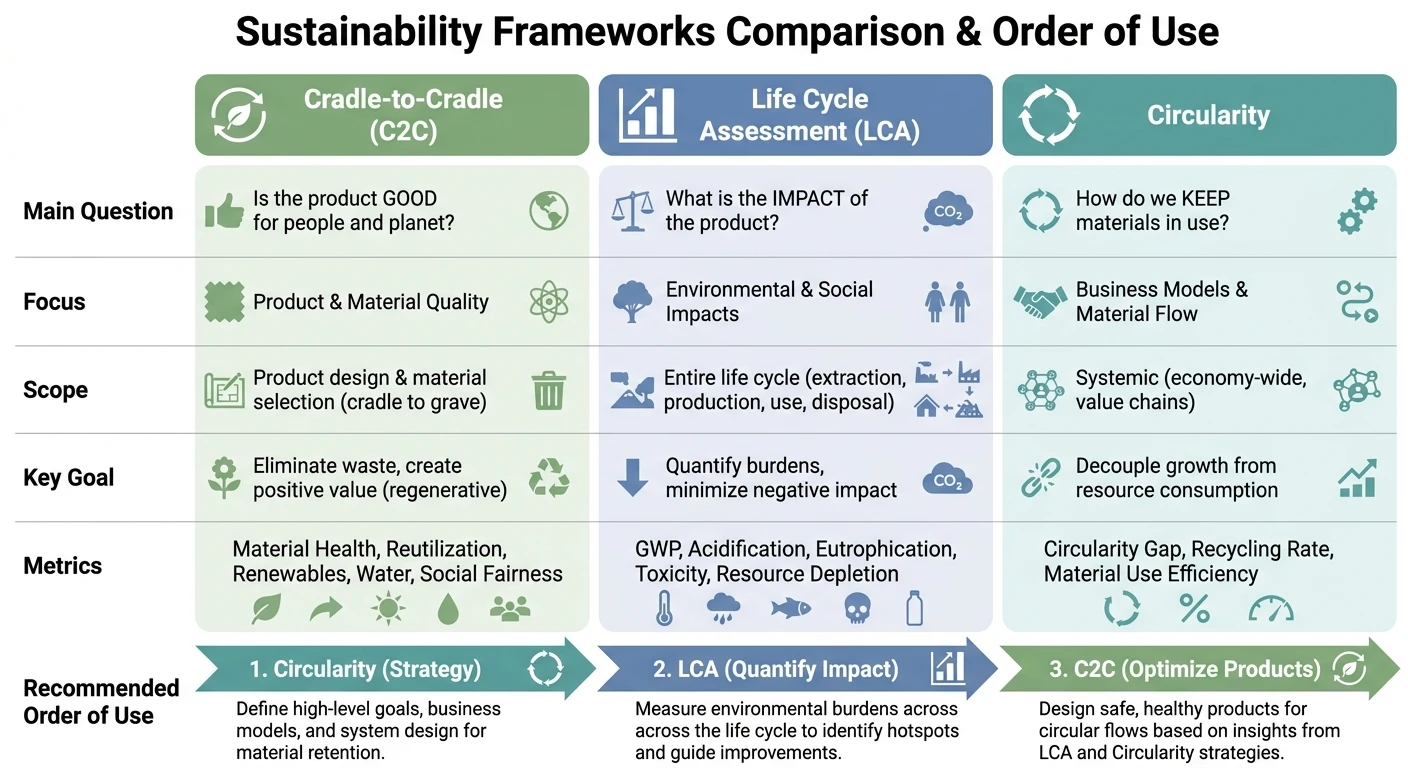
C2C vs LCA vs Circularity: 3-Framework Decision Guide
Types of Life Cycle Assessment (LCA) Explained
Quick comparison
Framework | Main question | What I get from it | Best use |
|---|---|---|---|
C2C | What should good design look like? | Material rules, safer chemistry screens, disassembly and recovery requirements | Early design and procurement |
LCA | How much impact does each option create? | Measured results like kg CO₂e, water use, and hotspot analysis | Comparing options before lock-in |
Circularity | Can materials stay in use in the field? | Reuse, repair, remanufacturing, and recycling rates; loop checks | Reverse logistics, take-back, and market fit |
My takeaway is simple: use them in order.
Start with C2C for material health, separability, and end-of-use planning.
Run LCA to test trade-offs with numbers.
Check circularity to confirm the loop can work with actual collection, sorting, and processing capacity.
If I had to reduce the whole article to one line, it would be this: good design, low impact, and a working recovery system are not the same thing - and you need all three checks before you commit.
1. Cradle-to-Cradle
If the introduction explains why C2C matters, this section shows how it shapes design choices on the ground.
Primary purpose
Cradle-to-cradle (C2C) is a regenerative design framework that treats materials as either biological or technical nutrients and designs waste out of the system. Biological materials return safely to nature. Technical materials stay in circulation through reuse, remanufacturing, or recycling without losing quality.[7]
System boundary
C2C pushes the system boundary past first use and into recovery and re-entry. In plain terms, that means the system includes collection, disassembly, refurbishment, remanufacturing, recycling, and the support systems needed to keep materials moving across multiple product lives. If those recovery routes are missing, the design goal may look good on paper but falls apart in use.[9]
Decision outputs
A C2C lens leads to clear, design-ready outputs. These often include:
A materials inventory sorted into biological and technical nutrients
A restricted-substances list
Defined end-of-use pathways for each major component
Design requirements such as fasteners that support non-destructive disassembly or the removal of mixed-material laminates that cannot be separated
These outputs are not just theory. Teams can plug them straight into engineering specs, supplier contracts, and procurement criteria.
After adopting C2C for carpet products, Shaw Industries reported a 48% increase in water efficiency and $2.5 million in savings in 2012 from resource efficiency and material reuse.[5]
Planning use
Teams usually apply C2C before the design is locked, when key choices still have room to move. From there, it carries into procurement and product development through modular design, disassembly requirements, and end-of-use pathways.
The Cradle to Cradle Certified® standard tracks five categories: material health, material reutilization, renewable energy and carbon management, water stewardship, and social fairness.[6][8] Products are rated Basic, Bronze, Silver, Gold, or Platinum based on their lowest category score. That structure pushes teams to keep improving instead of treating certification as a one-and-done checkbox.[10]
C2C sets the design target; LCA checks the trade-offs before teams commit to a path.
2. Lifecycle Assessment (LCA)
C2C sets the target; LCA checks the trade-offs.
Primary purpose
LCA measures environmental impacts across the full life of a product, process, or service. The point is simple: compare materials, suppliers, and design choices on the same basis. Instead of guessing, teams get trackable indicators such as global warming potential (in kg CO₂e), water use, acidification, and resource depletion.[13]
System boundary
The system boundary defines which life-cycle stages count, and that choice can change the outcome.[12] In day-to-day work, teams usually use one of these boundary types:
Boundary Type | What It Covers | Best Used For |
|---|---|---|
Cradle-to-gate | Raw material extraction through factory output | B2B comparisons, early design screening |
Cradle-to-grave | Full lifecycle through disposal or recycling | Policy and higher-level strategy |
Cradle-to-cradle | Extends cradle-to-grave to model closed-loop recovery, reuse, or recycling | Evaluating circular or regenerative strategies |
A cradle-to-gate study can make a material seem low impact while skipping a heavy-emissions use phase. Cradle-to-grave gives a broader view, but the result leans hard on use-phase and end-of-life assumptions. A cradle-to-cradle boundary goes one step further and shows where circular systems help - or where they fall short. That might mean looking at high-quality recycling versus downcycling, or asking whether projected reuse rates are grounded in reality.[12]
That boundary choice matters. It’s one big reason LCA and circularity should be reviewed side by side.
Decision outputs
LCA produces measurable outputs tied to set impact categories. Teams usually work with:
Impact scores per functional unit
Hotspot analyses that point to the most emissions-heavy stages
Comparative charts that show how design options stack up against each other
For building materials and packaging, these findings are often published as Environmental Product Declarations (EPDs). These are standardized summaries that procurement teams can use during sourcing.[11][15] In practice, the outputs help rank options by impact.
Planning use
Teams use LCA at a few key points in planning. In product development, it helps screen material and manufacturing options before designs are locked. In procurement, it supports supplier selection by comparing product carbon footprints or EPDs on a like-for-like basis. In company strategy, it helps show where emissions cuts will matter most - whether that means changing energy sources, shifting freight modes, or redesigning a part.
Use U.S.-specific grid, freight, and recycling data. Generic datasets can throw results off course.[12][14] The model should also be updated as better data comes in.
LCA measures the trade-offs; the next section looks at whether circular systems can support them.
3. Circularity
Circularity asks a simple but tough question: can materials stay in use for another loop? That’s why it works as a system check, not an impact score.
Primary purpose
The goal of circularity is to keep materials in use for as long as possible through reuse, repair, remanufacturing, recycling, or composting instead of disposal. LCA measures impact. Circularity looks at whether materials can keep moving through the system. In plain terms, it focuses on cutting virgin material extraction, increasing reuse and refurbishment, and building systems where biological materials return safely to ecosystems while technical materials remain in industrial loops.[17][22]
System boundary
Circularity looks beyond the product itself and maps the system around it: collection, reverse logistics, secondary markets, and recycling capacity. Those pieces decide whether a closed loop can actually happen.[18][19][20]
In practice, a circularity assessment for a U.S. city might examine construction material flows, waste processing facilities, and deconstruction protocols. It may be set at the portfolio, sector, or regional level, with the supply chains and end-of-life pathways needed to support reuse included in the picture.[18][19][20] If those conditions aren’t in place, even a well-designed circular product can hit a wall.
Decision outputs
Teams usually track a short set of flow-based measures:
The Material Circularity Indicator (MCI), aligned with ISO 59020, scores circular performance on a 0 to 1 scale, where 1 is fully restorative and 0 fully linear.[24][25] Those outputs shape day-to-day decisions in procurement, capital planning, and policy. They can show up as minimum recycled content rules, take-back requirements, modular or disassemblable design standards, and construction and demolition waste diversion targets for public projects.[19][20][23] In other words, these metrics show whether circularity is working in the field, not just sounding good on paper.
Planning use
Circularity starts to matter when it shows up in the rules teams use every day. That includes zoning and building codes that support design for disassembly, procurement standards that require durability and reparability, and capital plans that score projects based on how well they keep materials in circulation.[19][21][23]
A good example is service-based procurement, such as leasing equipment instead of buying it outright. When suppliers keep ownership, they have more reason to build products that can be repaired, refurbished, and used again.[19][20]
The data needs here are not the same as LCA. Teams need material flow inventories, waste composition analyses, and local recycling capacity data, not only environmental impact factors.[16][18][19][20] Knowing where those inputs come from, and where they split from LCA data, sets up the comparison in the next section.
Where They Overlap and Where They Differ
The overlap is real, but each lens answers a different planning question. You’ll hear the same terms across all three frameworks, yet the meaning shifts depending on the lens you’re using.
Terms All Three Share
You can see the overlap most clearly in the language teams rely on every day.
Life cycle thinking means following raw materials, production, use, and end-of-use across time. In LCA, that timeline is measured. In C2C, it is shaped into regenerative cycles. In circularity, it is managed as a set of loops meant to keep materials in use for as long as possible.
Waste also changes meaning from one framework to the next. In LCA, waste is an output with measurable impact. In C2C, it signals a design failure. In circularity, it points to lost material value.
Term | LCA | C2C | Circularity |
|---|---|---|---|
Life Cycle | A defined timeline for impact measurement | A regenerative cycle with no final disposal point | A system of loops to retain material value |
Waste | An inventory output with measurable environmental impact | A design flaw; materials should cycle safely | A resource that has been misplaced or lost |
System Boundary | Methodological scope defining which stages and processes are modeled | Includes sourcing, manufacturing, use, end-of-use, and future cycles | Focuses on the collection, sorting, repair, and reverse-logistics system that makes loops possible |
What Each Approach Actually Measures
LCA gives you numbers: global warming potential in kg CO₂e, water use, eutrophication, and toxicity, all tied to a specific functional unit and system boundary. C2C looks at products through five criteria: material health, product circularity, renewable energy and carbon management, water stewardship, and social fairness.[26][3][8] Circularity follows flows, including reuse rates, recycling percentages, use cycles per asset, and whether the system needed to support those flows is in place.
Put simply, C2C is criteria-based, LCA is impact-based, and circularity is flow-based.
That sounds abstract until it changes a design call in practice.
When One Lens Changes the Decision
A composite building material may look good in LCA and still fail C2C because its fiber-resin mix cannot be safely separated or recirculated. Add a circularity check, and the picture gets sharper: many facilities cannot sort or recover those composites at high quality, which means the material is likely to be landfilled or incinerated no matter how well it was designed.[28][29]
The reverse can happen too. A modular, repairable product may score high on circularity metrics because it has replaceable parts, take-back programs, and a long intended lifespan. But that same product can carry higher upstream impacts if modularity adds connectors, housings, and structural supports. And if customers replace the device often anyway, the circular gain never shows up in the impact data. That is the guardrail LCA provides, and it is something circularity metrics on their own can miss.
Those trade-offs set up the strengths and limits that come next.
Pros and Cons
Each framework answers a different kind of question. The goal isn't to pick one and ignore the rest. It's to use the tool that fits the decision in front of you.
Cradle-to-Cradle: Strengths and Limits
C2C works best at the front end of design and procurement. It helps teams screen hazardous substances, plan for disassembly, and set material goals tied to regeneration. Its certification system looks at products through five criteria: material health, material reutilization, renewable energy and carbon management, water stewardship, and social fairness.[4][8]
Its main limit is simple: it does not produce impact numbers. C2C can show that a material is safer and built for reuse, but it won't tell you how much that move cuts greenhouse gas emissions or water use when compared with another option. LCA is the tool that measures that trade-off.
So C2C is best used as a design filter, not as a performance score.
LCA: Strengths and Limits
LCA is the right choice when a team needs side-by-side evidence. It turns material, energy, and process decisions into measurable indicators like greenhouse gas emissions, energy use, and water use. That's why it fits procurement specs, EPDs, and policy support, especially when public buyers want comparable environmental data for buildings and infrastructure.[34][35]
But the output depends on the input. Allocation rules, system boundary choices, background database selection, and missing upstream supplier data can all change the result in meaningful ways.
That's exactly where LCA earns its keep: it tests trade-offs that design rules alone may miss.
Circularity: Strengths and Limits
Circularity asks a more practical question: can the system keep materials in motion? It's strongest when the issue is operational. Can a take-back system recover the product? Is there sorting infrastructure for that material in the region? This makes it useful for municipal waste diversion, corporate reverse logistics, and remanufacturing programs.[2][32]
Its weak spot is that circularity metrics do not measure full environmental performance. A reuse program might improve diversion rates while also adding transport emissions or processing energy. Circularity indicators also often miss broader environmental impacts.[30][31][33] That's why circularity analysis works best with LCA, not in place of it.
How Teams Use All Three in One Decision Frame
The best way to use these tools is to put them in the same frame from the start. C2C sets the design target, LCA tests impact, and circularity checks whether the loop can run in practice. Put simply: C2C sets the rules, LCA measures the results, and circularity checks whether the material can keep moving through the system.
Start with the Design Goal
Start with C2C to lock in the design criteria. Focus first on toxicity, separability, and a clear path to reuse, repair, or recovery.[1][3][39] Use it as an early screen for toxicity, disassembly, and end-of-use fit.
This matters most in packaging, electronics, and building materials, where early calls on adhesives, coatings, composites, and additives can quietly block disassembly or contaminate recovery streams later. A product can look fine on paper and still become a dead end once it reaches sorting or processing.
If the concept clears that design screen, the next step is simple: check whether it still performs well on impact.
Test Trade-Offs with LCA
Once the design intent is set, run LCA early to see whether the preferred option cuts greenhouse gas emissions, energy demand, and water use across the full life cycle.[27][36][37]
This is where trade-offs come into view. A design that looks better from a reuse or recovery angle may still carry a heavier burden somewhere else in the system. LCA helps teams spot that before the product is locked in.
A lower-impact design still falls short if no recovery system exists.
Check Whether Circular Systems Can Work
Next, verify that the loop can operate in the target market. Check whether collection, sorting, reverse logistics, repair, refurbishment, and remanufacturing capacity exist in the target U.S. market.[38][40] A model may work in one region and fail in another.
That market check keeps teams from building plans around systems that aren't there yet. If the loop depends on take-back, repair hubs, or sorting capacity, those pieces have to exist beyond the slide deck.
Run One Cross-Functional Review
One common failure mode is treating these tools as separate workstreams. Design does one review, sustainability runs another, and operations sees the results later. That's how teams miss conflicts that should have surfaced early.
The fix is one shared review with clear roles. Design, sustainability, procurement, operations, finance, and legal should work from the same scenarios, assumptions, and success criteria.
The decision memo should spell out:
Which criteria are non-negotiable from a cradle-to-cradle standpoint
Which impacts were most significant in the LCA
Which circular infrastructure elements are available now versus still speculative
One memo, one scenario set, one trade-off review.
Conclusion
Sequence matters here. C2C sets the target. LCA checks the trade-offs. Circularity tests whether the idea can work in day-to-day conditions.
On their own, each one has a weak spot. You can have strong design aims without impact data. You can make low-carbon picks that don't have a path for recovery. You can build circular systems that add transport and processing burden. Put the three together, and those gaps get a lot smaller: one design target, one impact check, and one feasibility check.
For teams ready to put that sequence to work, Council Fire can help turn this three-lens frame into technical criteria, procurement specs, and measurable action.
FAQs
Which should teams use first?
Start with LCA to set a baseline. It helps you measure environmental impacts and spot where reuse, repair, or recycling can make the biggest difference.
From there, use the circular economy framework to focus on practical initiatives you can act on. Apply Cradle-to-Cradle principles across the process to support material health and the safe, repeated cycling of inputs.
Can a product score well in one and fail the others?
Yes. A product can do well in one framework and still fall short in another, because each one looks at a different part of the picture.
For instance, a product might show a low carbon footprint in an LCA. That sounds good at first glance. But the same product could still rely on non-recyclable materials or toxic substances, which may block it from meeting circularity or cradle-to-cradle standards.
Using only one framework can create blind spots.
That’s the core issue: one lens can show progress while missing problems somewhere else.
What data is needed for each framework?
Each framework runs on a different kind of data, and that shapes the work from day one.
LCA depends on detailed life cycle inventory data. That includes inputs like raw materials, energy, and water, along with outputs like emissions and waste across the full life of a product.
C2C starts with a full chemical ingredient inventory, then checks those ingredients against 24 hazard endpoints. Circularity frameworks look at a different set of signals: material flows, waste streams, product-in-use data, recycled content, take-back rates, and revenue from circular business models.
Related Blog Posts
Latest Articles
©2026

Narrative Change and Power Building: The Missing Half of Advocacy
Narrative change is the process of disrupting dominant narratives that normalize inequity and advancing new narratives from historically marginalized communities.

Funding Resilience Without Federal Grants
BRIC is unreliable and FEMA is shrinking. Here's how cities fund climate resilience with dedicated revenue, blended finance, and a coordinating authority.

The ESG Blind Spot: How AI Is Finding Risks in Companies Nobody Else Is Watching
Norway's sovereign wealth fund uses AI to screen 7,200 portfolio companies for forced labor and corruption within 24 hours. The real story is the emerging-market coverage gap that traditional ESG data vendors miss — and what it means for any company with a global supply chain.
Narrative Change and Power Building: The Missing Half of Advocacy
Narrative change is the process of disrupting dominant narratives that normalize inequity and advancing new narratives from historically marginalized communities.
Funding Resilience Without Federal Grants
BRIC is unreliable and FEMA is shrinking. Here's how cities fund climate resilience with dedicated revenue, blended finance, and a coordinating authority.
The ESG Blind Spot: How AI Is Finding Risks in Companies Nobody Else Is Watching
Norway's sovereign wealth fund uses AI to screen 7,200 portfolio companies for forced labor and corruption within 24 hours. The real story is the emerging-market coverage gap that traditional ESG data vendors miss — and what it means for any company with a global supply chain.
FAQ
01
What does it really mean to “redefine profit”?
02
What makes Council Fire different?
03
Who does Council Fire work with?
04
What does working with Council Fire actually look like?
05
How does Council Fire help organizations turn big goals into action?
06
How does Council Fire define and measure success?
07
How does technology fit into Council Fire’s work?
Sep 3, 2026
Cradle-to-Cradle, LCA, Circularity: 3 Links
Sustainability Strategy
In This Article
Good design, low impact, and a working recovery system are different checks—use C2C, LCA, and circularity together before committing.
Cradle-to-Cradle, LCA, Circularity: 3 Links
If you mix these three ideas together, you can make the wrong product call. I see them as three different checks: C2C sets design rules, LCA measures impact, and circularity tests whether reuse or recovery can happen in the market.
Here’s the short version:
Cradle-to-cradle (C2C): I use it to ask, is this product made with safe materials and built for reuse, repair, or recovery?
Life cycle assessment (LCA): I use it to ask, which option has lower impact across sourcing, production, use, and end of life?
Circularity: I use it to ask, can the system keep materials in use through collection, repair, remanufacturing, recycling, or composting?
A product can pass one check and fail the others.
A design may cut kg CO₂e in an LCA and still use materials that C2C would reject.
A product may look recyclable on paper and still fail because local collection or sorting is weak.
A repairable product may stay in use longer but still add more material or transport burden than expected.
One example from the article stands out: Shaw Industries reported a 48% increase in water efficiency and $2.5 million in savings in 2012 after applying C2C ideas to carpet products. That shows why design rules matter early. But design rules alone do not tell me which option has lower total impact. That is where LCA comes in.
C2C vs LCA vs Circularity: 3-Framework Decision Guide
Types of Life Cycle Assessment (LCA) Explained
Quick comparison
Framework | Main question | What I get from it | Best use |
|---|---|---|---|
C2C | What should good design look like? | Material rules, safer chemistry screens, disassembly and recovery requirements | Early design and procurement |
LCA | How much impact does each option create? | Measured results like kg CO₂e, water use, and hotspot analysis | Comparing options before lock-in |
Circularity | Can materials stay in use in the field? | Reuse, repair, remanufacturing, and recycling rates; loop checks | Reverse logistics, take-back, and market fit |
My takeaway is simple: use them in order.
Start with C2C for material health, separability, and end-of-use planning.
Run LCA to test trade-offs with numbers.
Check circularity to confirm the loop can work with actual collection, sorting, and processing capacity.
If I had to reduce the whole article to one line, it would be this: good design, low impact, and a working recovery system are not the same thing - and you need all three checks before you commit.
1. Cradle-to-Cradle
If the introduction explains why C2C matters, this section shows how it shapes design choices on the ground.
Primary purpose
Cradle-to-cradle (C2C) is a regenerative design framework that treats materials as either biological or technical nutrients and designs waste out of the system. Biological materials return safely to nature. Technical materials stay in circulation through reuse, remanufacturing, or recycling without losing quality.[7]
System boundary
C2C pushes the system boundary past first use and into recovery and re-entry. In plain terms, that means the system includes collection, disassembly, refurbishment, remanufacturing, recycling, and the support systems needed to keep materials moving across multiple product lives. If those recovery routes are missing, the design goal may look good on paper but falls apart in use.[9]
Decision outputs
A C2C lens leads to clear, design-ready outputs. These often include:
A materials inventory sorted into biological and technical nutrients
A restricted-substances list
Defined end-of-use pathways for each major component
Design requirements such as fasteners that support non-destructive disassembly or the removal of mixed-material laminates that cannot be separated
These outputs are not just theory. Teams can plug them straight into engineering specs, supplier contracts, and procurement criteria.
After adopting C2C for carpet products, Shaw Industries reported a 48% increase in water efficiency and $2.5 million in savings in 2012 from resource efficiency and material reuse.[5]
Planning use
Teams usually apply C2C before the design is locked, when key choices still have room to move. From there, it carries into procurement and product development through modular design, disassembly requirements, and end-of-use pathways.
The Cradle to Cradle Certified® standard tracks five categories: material health, material reutilization, renewable energy and carbon management, water stewardship, and social fairness.[6][8] Products are rated Basic, Bronze, Silver, Gold, or Platinum based on their lowest category score. That structure pushes teams to keep improving instead of treating certification as a one-and-done checkbox.[10]
C2C sets the design target; LCA checks the trade-offs before teams commit to a path.
2. Lifecycle Assessment (LCA)
C2C sets the target; LCA checks the trade-offs.
Primary purpose
LCA measures environmental impacts across the full life of a product, process, or service. The point is simple: compare materials, suppliers, and design choices on the same basis. Instead of guessing, teams get trackable indicators such as global warming potential (in kg CO₂e), water use, acidification, and resource depletion.[13]
System boundary
The system boundary defines which life-cycle stages count, and that choice can change the outcome.[12] In day-to-day work, teams usually use one of these boundary types:
Boundary Type | What It Covers | Best Used For |
|---|---|---|
Cradle-to-gate | Raw material extraction through factory output | B2B comparisons, early design screening |
Cradle-to-grave | Full lifecycle through disposal or recycling | Policy and higher-level strategy |
Cradle-to-cradle | Extends cradle-to-grave to model closed-loop recovery, reuse, or recycling | Evaluating circular or regenerative strategies |
A cradle-to-gate study can make a material seem low impact while skipping a heavy-emissions use phase. Cradle-to-grave gives a broader view, but the result leans hard on use-phase and end-of-life assumptions. A cradle-to-cradle boundary goes one step further and shows where circular systems help - or where they fall short. That might mean looking at high-quality recycling versus downcycling, or asking whether projected reuse rates are grounded in reality.[12]
That boundary choice matters. It’s one big reason LCA and circularity should be reviewed side by side.
Decision outputs
LCA produces measurable outputs tied to set impact categories. Teams usually work with:
Impact scores per functional unit
Hotspot analyses that point to the most emissions-heavy stages
Comparative charts that show how design options stack up against each other
For building materials and packaging, these findings are often published as Environmental Product Declarations (EPDs). These are standardized summaries that procurement teams can use during sourcing.[11][15] In practice, the outputs help rank options by impact.
Planning use
Teams use LCA at a few key points in planning. In product development, it helps screen material and manufacturing options before designs are locked. In procurement, it supports supplier selection by comparing product carbon footprints or EPDs on a like-for-like basis. In company strategy, it helps show where emissions cuts will matter most - whether that means changing energy sources, shifting freight modes, or redesigning a part.
Use U.S.-specific grid, freight, and recycling data. Generic datasets can throw results off course.[12][14] The model should also be updated as better data comes in.
LCA measures the trade-offs; the next section looks at whether circular systems can support them.
3. Circularity
Circularity asks a simple but tough question: can materials stay in use for another loop? That’s why it works as a system check, not an impact score.
Primary purpose
The goal of circularity is to keep materials in use for as long as possible through reuse, repair, remanufacturing, recycling, or composting instead of disposal. LCA measures impact. Circularity looks at whether materials can keep moving through the system. In plain terms, it focuses on cutting virgin material extraction, increasing reuse and refurbishment, and building systems where biological materials return safely to ecosystems while technical materials remain in industrial loops.[17][22]
System boundary
Circularity looks beyond the product itself and maps the system around it: collection, reverse logistics, secondary markets, and recycling capacity. Those pieces decide whether a closed loop can actually happen.[18][19][20]
In practice, a circularity assessment for a U.S. city might examine construction material flows, waste processing facilities, and deconstruction protocols. It may be set at the portfolio, sector, or regional level, with the supply chains and end-of-life pathways needed to support reuse included in the picture.[18][19][20] If those conditions aren’t in place, even a well-designed circular product can hit a wall.
Decision outputs
Teams usually track a short set of flow-based measures:
The Material Circularity Indicator (MCI), aligned with ISO 59020, scores circular performance on a 0 to 1 scale, where 1 is fully restorative and 0 fully linear.[24][25] Those outputs shape day-to-day decisions in procurement, capital planning, and policy. They can show up as minimum recycled content rules, take-back requirements, modular or disassemblable design standards, and construction and demolition waste diversion targets for public projects.[19][20][23] In other words, these metrics show whether circularity is working in the field, not just sounding good on paper.
Planning use
Circularity starts to matter when it shows up in the rules teams use every day. That includes zoning and building codes that support design for disassembly, procurement standards that require durability and reparability, and capital plans that score projects based on how well they keep materials in circulation.[19][21][23]
A good example is service-based procurement, such as leasing equipment instead of buying it outright. When suppliers keep ownership, they have more reason to build products that can be repaired, refurbished, and used again.[19][20]
The data needs here are not the same as LCA. Teams need material flow inventories, waste composition analyses, and local recycling capacity data, not only environmental impact factors.[16][18][19][20] Knowing where those inputs come from, and where they split from LCA data, sets up the comparison in the next section.
Where They Overlap and Where They Differ
The overlap is real, but each lens answers a different planning question. You’ll hear the same terms across all three frameworks, yet the meaning shifts depending on the lens you’re using.
Terms All Three Share
You can see the overlap most clearly in the language teams rely on every day.
Life cycle thinking means following raw materials, production, use, and end-of-use across time. In LCA, that timeline is measured. In C2C, it is shaped into regenerative cycles. In circularity, it is managed as a set of loops meant to keep materials in use for as long as possible.
Waste also changes meaning from one framework to the next. In LCA, waste is an output with measurable impact. In C2C, it signals a design failure. In circularity, it points to lost material value.
Term | LCA | C2C | Circularity |
|---|---|---|---|
Life Cycle | A defined timeline for impact measurement | A regenerative cycle with no final disposal point | A system of loops to retain material value |
Waste | An inventory output with measurable environmental impact | A design flaw; materials should cycle safely | A resource that has been misplaced or lost |
System Boundary | Methodological scope defining which stages and processes are modeled | Includes sourcing, manufacturing, use, end-of-use, and future cycles | Focuses on the collection, sorting, repair, and reverse-logistics system that makes loops possible |
What Each Approach Actually Measures
LCA gives you numbers: global warming potential in kg CO₂e, water use, eutrophication, and toxicity, all tied to a specific functional unit and system boundary. C2C looks at products through five criteria: material health, product circularity, renewable energy and carbon management, water stewardship, and social fairness.[26][3][8] Circularity follows flows, including reuse rates, recycling percentages, use cycles per asset, and whether the system needed to support those flows is in place.
Put simply, C2C is criteria-based, LCA is impact-based, and circularity is flow-based.
That sounds abstract until it changes a design call in practice.
When One Lens Changes the Decision
A composite building material may look good in LCA and still fail C2C because its fiber-resin mix cannot be safely separated or recirculated. Add a circularity check, and the picture gets sharper: many facilities cannot sort or recover those composites at high quality, which means the material is likely to be landfilled or incinerated no matter how well it was designed.[28][29]
The reverse can happen too. A modular, repairable product may score high on circularity metrics because it has replaceable parts, take-back programs, and a long intended lifespan. But that same product can carry higher upstream impacts if modularity adds connectors, housings, and structural supports. And if customers replace the device often anyway, the circular gain never shows up in the impact data. That is the guardrail LCA provides, and it is something circularity metrics on their own can miss.
Those trade-offs set up the strengths and limits that come next.
Pros and Cons
Each framework answers a different kind of question. The goal isn't to pick one and ignore the rest. It's to use the tool that fits the decision in front of you.
Cradle-to-Cradle: Strengths and Limits
C2C works best at the front end of design and procurement. It helps teams screen hazardous substances, plan for disassembly, and set material goals tied to regeneration. Its certification system looks at products through five criteria: material health, material reutilization, renewable energy and carbon management, water stewardship, and social fairness.[4][8]
Its main limit is simple: it does not produce impact numbers. C2C can show that a material is safer and built for reuse, but it won't tell you how much that move cuts greenhouse gas emissions or water use when compared with another option. LCA is the tool that measures that trade-off.
So C2C is best used as a design filter, not as a performance score.
LCA: Strengths and Limits
LCA is the right choice when a team needs side-by-side evidence. It turns material, energy, and process decisions into measurable indicators like greenhouse gas emissions, energy use, and water use. That's why it fits procurement specs, EPDs, and policy support, especially when public buyers want comparable environmental data for buildings and infrastructure.[34][35]
But the output depends on the input. Allocation rules, system boundary choices, background database selection, and missing upstream supplier data can all change the result in meaningful ways.
That's exactly where LCA earns its keep: it tests trade-offs that design rules alone may miss.
Circularity: Strengths and Limits
Circularity asks a more practical question: can the system keep materials in motion? It's strongest when the issue is operational. Can a take-back system recover the product? Is there sorting infrastructure for that material in the region? This makes it useful for municipal waste diversion, corporate reverse logistics, and remanufacturing programs.[2][32]
Its weak spot is that circularity metrics do not measure full environmental performance. A reuse program might improve diversion rates while also adding transport emissions or processing energy. Circularity indicators also often miss broader environmental impacts.[30][31][33] That's why circularity analysis works best with LCA, not in place of it.
How Teams Use All Three in One Decision Frame
The best way to use these tools is to put them in the same frame from the start. C2C sets the design target, LCA tests impact, and circularity checks whether the loop can run in practice. Put simply: C2C sets the rules, LCA measures the results, and circularity checks whether the material can keep moving through the system.
Start with the Design Goal
Start with C2C to lock in the design criteria. Focus first on toxicity, separability, and a clear path to reuse, repair, or recovery.[1][3][39] Use it as an early screen for toxicity, disassembly, and end-of-use fit.
This matters most in packaging, electronics, and building materials, where early calls on adhesives, coatings, composites, and additives can quietly block disassembly or contaminate recovery streams later. A product can look fine on paper and still become a dead end once it reaches sorting or processing.
If the concept clears that design screen, the next step is simple: check whether it still performs well on impact.
Test Trade-Offs with LCA
Once the design intent is set, run LCA early to see whether the preferred option cuts greenhouse gas emissions, energy demand, and water use across the full life cycle.[27][36][37]
This is where trade-offs come into view. A design that looks better from a reuse or recovery angle may still carry a heavier burden somewhere else in the system. LCA helps teams spot that before the product is locked in.
A lower-impact design still falls short if no recovery system exists.
Check Whether Circular Systems Can Work
Next, verify that the loop can operate in the target market. Check whether collection, sorting, reverse logistics, repair, refurbishment, and remanufacturing capacity exist in the target U.S. market.[38][40] A model may work in one region and fail in another.
That market check keeps teams from building plans around systems that aren't there yet. If the loop depends on take-back, repair hubs, or sorting capacity, those pieces have to exist beyond the slide deck.
Run One Cross-Functional Review
One common failure mode is treating these tools as separate workstreams. Design does one review, sustainability runs another, and operations sees the results later. That's how teams miss conflicts that should have surfaced early.
The fix is one shared review with clear roles. Design, sustainability, procurement, operations, finance, and legal should work from the same scenarios, assumptions, and success criteria.
The decision memo should spell out:
Which criteria are non-negotiable from a cradle-to-cradle standpoint
Which impacts were most significant in the LCA
Which circular infrastructure elements are available now versus still speculative
One memo, one scenario set, one trade-off review.
Conclusion
Sequence matters here. C2C sets the target. LCA checks the trade-offs. Circularity tests whether the idea can work in day-to-day conditions.
On their own, each one has a weak spot. You can have strong design aims without impact data. You can make low-carbon picks that don't have a path for recovery. You can build circular systems that add transport and processing burden. Put the three together, and those gaps get a lot smaller: one design target, one impact check, and one feasibility check.
For teams ready to put that sequence to work, Council Fire can help turn this three-lens frame into technical criteria, procurement specs, and measurable action.
FAQs
Which should teams use first?
Start with LCA to set a baseline. It helps you measure environmental impacts and spot where reuse, repair, or recycling can make the biggest difference.
From there, use the circular economy framework to focus on practical initiatives you can act on. Apply Cradle-to-Cradle principles across the process to support material health and the safe, repeated cycling of inputs.
Can a product score well in one and fail the others?
Yes. A product can do well in one framework and still fall short in another, because each one looks at a different part of the picture.
For instance, a product might show a low carbon footprint in an LCA. That sounds good at first glance. But the same product could still rely on non-recyclable materials or toxic substances, which may block it from meeting circularity or cradle-to-cradle standards.
Using only one framework can create blind spots.
That’s the core issue: one lens can show progress while missing problems somewhere else.
What data is needed for each framework?
Each framework runs on a different kind of data, and that shapes the work from day one.
LCA depends on detailed life cycle inventory data. That includes inputs like raw materials, energy, and water, along with outputs like emissions and waste across the full life of a product.
C2C starts with a full chemical ingredient inventory, then checks those ingredients against 24 hazard endpoints. Circularity frameworks look at a different set of signals: material flows, waste streams, product-in-use data, recycled content, take-back rates, and revenue from circular business models.
Related Blog Posts
Latest Articles
©2026
Narrative Change and Power Building: The Missing Half of Advocacy
Narrative change is the process of disrupting dominant narratives that normalize inequity and advancing new narratives from historically marginalized communities.
Funding Resilience Without Federal Grants
BRIC is unreliable and FEMA is shrinking. Here's how cities fund climate resilience with dedicated revenue, blended finance, and a coordinating authority.
The ESG Blind Spot: How AI Is Finding Risks in Companies Nobody Else Is Watching
Norway's sovereign wealth fund uses AI to screen 7,200 portfolio companies for forced labor and corruption within 24 hours. The real story is the emerging-market coverage gap that traditional ESG data vendors miss — and what it means for any company with a global supply chain.
FAQ
01
What does it really mean to “redefine profit”?
02
What makes Council Fire different?
03
Who does Council Fire work with?
04
What does working with Council Fire actually look like?
05
How does Council Fire help organizations turn big goals into action?
06
How does Council Fire define and measure success?
07
How does technology fit into Council Fire’s work?
Sep 3, 2026
Cradle-to-Cradle, LCA, Circularity: 3 Links
Sustainability Strategy
In This Article
Good design, low impact, and a working recovery system are different checks—use C2C, LCA, and circularity together before committing.
Cradle-to-Cradle, LCA, Circularity: 3 Links
If you mix these three ideas together, you can make the wrong product call. I see them as three different checks: C2C sets design rules, LCA measures impact, and circularity tests whether reuse or recovery can happen in the market.
Here’s the short version:
Cradle-to-cradle (C2C): I use it to ask, is this product made with safe materials and built for reuse, repair, or recovery?
Life cycle assessment (LCA): I use it to ask, which option has lower impact across sourcing, production, use, and end of life?
Circularity: I use it to ask, can the system keep materials in use through collection, repair, remanufacturing, recycling, or composting?
A product can pass one check and fail the others.
A design may cut kg CO₂e in an LCA and still use materials that C2C would reject.
A product may look recyclable on paper and still fail because local collection or sorting is weak.
A repairable product may stay in use longer but still add more material or transport burden than expected.
One example from the article stands out: Shaw Industries reported a 48% increase in water efficiency and $2.5 million in savings in 2012 after applying C2C ideas to carpet products. That shows why design rules matter early. But design rules alone do not tell me which option has lower total impact. That is where LCA comes in.
C2C vs LCA vs Circularity: 3-Framework Decision Guide
Types of Life Cycle Assessment (LCA) Explained
Quick comparison
Framework | Main question | What I get from it | Best use |
|---|---|---|---|
C2C | What should good design look like? | Material rules, safer chemistry screens, disassembly and recovery requirements | Early design and procurement |
LCA | How much impact does each option create? | Measured results like kg CO₂e, water use, and hotspot analysis | Comparing options before lock-in |
Circularity | Can materials stay in use in the field? | Reuse, repair, remanufacturing, and recycling rates; loop checks | Reverse logistics, take-back, and market fit |
My takeaway is simple: use them in order.
Start with C2C for material health, separability, and end-of-use planning.
Run LCA to test trade-offs with numbers.
Check circularity to confirm the loop can work with actual collection, sorting, and processing capacity.
If I had to reduce the whole article to one line, it would be this: good design, low impact, and a working recovery system are not the same thing - and you need all three checks before you commit.
1. Cradle-to-Cradle
If the introduction explains why C2C matters, this section shows how it shapes design choices on the ground.
Primary purpose
Cradle-to-cradle (C2C) is a regenerative design framework that treats materials as either biological or technical nutrients and designs waste out of the system. Biological materials return safely to nature. Technical materials stay in circulation through reuse, remanufacturing, or recycling without losing quality.[7]
System boundary
C2C pushes the system boundary past first use and into recovery and re-entry. In plain terms, that means the system includes collection, disassembly, refurbishment, remanufacturing, recycling, and the support systems needed to keep materials moving across multiple product lives. If those recovery routes are missing, the design goal may look good on paper but falls apart in use.[9]
Decision outputs
A C2C lens leads to clear, design-ready outputs. These often include:
A materials inventory sorted into biological and technical nutrients
A restricted-substances list
Defined end-of-use pathways for each major component
Design requirements such as fasteners that support non-destructive disassembly or the removal of mixed-material laminates that cannot be separated
These outputs are not just theory. Teams can plug them straight into engineering specs, supplier contracts, and procurement criteria.
After adopting C2C for carpet products, Shaw Industries reported a 48% increase in water efficiency and $2.5 million in savings in 2012 from resource efficiency and material reuse.[5]
Planning use
Teams usually apply C2C before the design is locked, when key choices still have room to move. From there, it carries into procurement and product development through modular design, disassembly requirements, and end-of-use pathways.
The Cradle to Cradle Certified® standard tracks five categories: material health, material reutilization, renewable energy and carbon management, water stewardship, and social fairness.[6][8] Products are rated Basic, Bronze, Silver, Gold, or Platinum based on their lowest category score. That structure pushes teams to keep improving instead of treating certification as a one-and-done checkbox.[10]
C2C sets the design target; LCA checks the trade-offs before teams commit to a path.
2. Lifecycle Assessment (LCA)
C2C sets the target; LCA checks the trade-offs.
Primary purpose
LCA measures environmental impacts across the full life of a product, process, or service. The point is simple: compare materials, suppliers, and design choices on the same basis. Instead of guessing, teams get trackable indicators such as global warming potential (in kg CO₂e), water use, acidification, and resource depletion.[13]
System boundary
The system boundary defines which life-cycle stages count, and that choice can change the outcome.[12] In day-to-day work, teams usually use one of these boundary types:
Boundary Type | What It Covers | Best Used For |
|---|---|---|
Cradle-to-gate | Raw material extraction through factory output | B2B comparisons, early design screening |
Cradle-to-grave | Full lifecycle through disposal or recycling | Policy and higher-level strategy |
Cradle-to-cradle | Extends cradle-to-grave to model closed-loop recovery, reuse, or recycling | Evaluating circular or regenerative strategies |
A cradle-to-gate study can make a material seem low impact while skipping a heavy-emissions use phase. Cradle-to-grave gives a broader view, but the result leans hard on use-phase and end-of-life assumptions. A cradle-to-cradle boundary goes one step further and shows where circular systems help - or where they fall short. That might mean looking at high-quality recycling versus downcycling, or asking whether projected reuse rates are grounded in reality.[12]
That boundary choice matters. It’s one big reason LCA and circularity should be reviewed side by side.
Decision outputs
LCA produces measurable outputs tied to set impact categories. Teams usually work with:
Impact scores per functional unit
Hotspot analyses that point to the most emissions-heavy stages
Comparative charts that show how design options stack up against each other
For building materials and packaging, these findings are often published as Environmental Product Declarations (EPDs). These are standardized summaries that procurement teams can use during sourcing.[11][15] In practice, the outputs help rank options by impact.
Planning use
Teams use LCA at a few key points in planning. In product development, it helps screen material and manufacturing options before designs are locked. In procurement, it supports supplier selection by comparing product carbon footprints or EPDs on a like-for-like basis. In company strategy, it helps show where emissions cuts will matter most - whether that means changing energy sources, shifting freight modes, or redesigning a part.
Use U.S.-specific grid, freight, and recycling data. Generic datasets can throw results off course.[12][14] The model should also be updated as better data comes in.
LCA measures the trade-offs; the next section looks at whether circular systems can support them.
3. Circularity
Circularity asks a simple but tough question: can materials stay in use for another loop? That’s why it works as a system check, not an impact score.
Primary purpose
The goal of circularity is to keep materials in use for as long as possible through reuse, repair, remanufacturing, recycling, or composting instead of disposal. LCA measures impact. Circularity looks at whether materials can keep moving through the system. In plain terms, it focuses on cutting virgin material extraction, increasing reuse and refurbishment, and building systems where biological materials return safely to ecosystems while technical materials remain in industrial loops.[17][22]
System boundary
Circularity looks beyond the product itself and maps the system around it: collection, reverse logistics, secondary markets, and recycling capacity. Those pieces decide whether a closed loop can actually happen.[18][19][20]
In practice, a circularity assessment for a U.S. city might examine construction material flows, waste processing facilities, and deconstruction protocols. It may be set at the portfolio, sector, or regional level, with the supply chains and end-of-life pathways needed to support reuse included in the picture.[18][19][20] If those conditions aren’t in place, even a well-designed circular product can hit a wall.
Decision outputs
Teams usually track a short set of flow-based measures:
The Material Circularity Indicator (MCI), aligned with ISO 59020, scores circular performance on a 0 to 1 scale, where 1 is fully restorative and 0 fully linear.[24][25] Those outputs shape day-to-day decisions in procurement, capital planning, and policy. They can show up as minimum recycled content rules, take-back requirements, modular or disassemblable design standards, and construction and demolition waste diversion targets for public projects.[19][20][23] In other words, these metrics show whether circularity is working in the field, not just sounding good on paper.
Planning use
Circularity starts to matter when it shows up in the rules teams use every day. That includes zoning and building codes that support design for disassembly, procurement standards that require durability and reparability, and capital plans that score projects based on how well they keep materials in circulation.[19][21][23]
A good example is service-based procurement, such as leasing equipment instead of buying it outright. When suppliers keep ownership, they have more reason to build products that can be repaired, refurbished, and used again.[19][20]
The data needs here are not the same as LCA. Teams need material flow inventories, waste composition analyses, and local recycling capacity data, not only environmental impact factors.[16][18][19][20] Knowing where those inputs come from, and where they split from LCA data, sets up the comparison in the next section.
Where They Overlap and Where They Differ
The overlap is real, but each lens answers a different planning question. You’ll hear the same terms across all three frameworks, yet the meaning shifts depending on the lens you’re using.
Terms All Three Share
You can see the overlap most clearly in the language teams rely on every day.
Life cycle thinking means following raw materials, production, use, and end-of-use across time. In LCA, that timeline is measured. In C2C, it is shaped into regenerative cycles. In circularity, it is managed as a set of loops meant to keep materials in use for as long as possible.
Waste also changes meaning from one framework to the next. In LCA, waste is an output with measurable impact. In C2C, it signals a design failure. In circularity, it points to lost material value.
Term | LCA | C2C | Circularity |
|---|---|---|---|
Life Cycle | A defined timeline for impact measurement | A regenerative cycle with no final disposal point | A system of loops to retain material value |
Waste | An inventory output with measurable environmental impact | A design flaw; materials should cycle safely | A resource that has been misplaced or lost |
System Boundary | Methodological scope defining which stages and processes are modeled | Includes sourcing, manufacturing, use, end-of-use, and future cycles | Focuses on the collection, sorting, repair, and reverse-logistics system that makes loops possible |
What Each Approach Actually Measures
LCA gives you numbers: global warming potential in kg CO₂e, water use, eutrophication, and toxicity, all tied to a specific functional unit and system boundary. C2C looks at products through five criteria: material health, product circularity, renewable energy and carbon management, water stewardship, and social fairness.[26][3][8] Circularity follows flows, including reuse rates, recycling percentages, use cycles per asset, and whether the system needed to support those flows is in place.
Put simply, C2C is criteria-based, LCA is impact-based, and circularity is flow-based.
That sounds abstract until it changes a design call in practice.
When One Lens Changes the Decision
A composite building material may look good in LCA and still fail C2C because its fiber-resin mix cannot be safely separated or recirculated. Add a circularity check, and the picture gets sharper: many facilities cannot sort or recover those composites at high quality, which means the material is likely to be landfilled or incinerated no matter how well it was designed.[28][29]
The reverse can happen too. A modular, repairable product may score high on circularity metrics because it has replaceable parts, take-back programs, and a long intended lifespan. But that same product can carry higher upstream impacts if modularity adds connectors, housings, and structural supports. And if customers replace the device often anyway, the circular gain never shows up in the impact data. That is the guardrail LCA provides, and it is something circularity metrics on their own can miss.
Those trade-offs set up the strengths and limits that come next.
Pros and Cons
Each framework answers a different kind of question. The goal isn't to pick one and ignore the rest. It's to use the tool that fits the decision in front of you.
Cradle-to-Cradle: Strengths and Limits
C2C works best at the front end of design and procurement. It helps teams screen hazardous substances, plan for disassembly, and set material goals tied to regeneration. Its certification system looks at products through five criteria: material health, material reutilization, renewable energy and carbon management, water stewardship, and social fairness.[4][8]
Its main limit is simple: it does not produce impact numbers. C2C can show that a material is safer and built for reuse, but it won't tell you how much that move cuts greenhouse gas emissions or water use when compared with another option. LCA is the tool that measures that trade-off.
So C2C is best used as a design filter, not as a performance score.
LCA: Strengths and Limits
LCA is the right choice when a team needs side-by-side evidence. It turns material, energy, and process decisions into measurable indicators like greenhouse gas emissions, energy use, and water use. That's why it fits procurement specs, EPDs, and policy support, especially when public buyers want comparable environmental data for buildings and infrastructure.[34][35]
But the output depends on the input. Allocation rules, system boundary choices, background database selection, and missing upstream supplier data can all change the result in meaningful ways.
That's exactly where LCA earns its keep: it tests trade-offs that design rules alone may miss.
Circularity: Strengths and Limits
Circularity asks a more practical question: can the system keep materials in motion? It's strongest when the issue is operational. Can a take-back system recover the product? Is there sorting infrastructure for that material in the region? This makes it useful for municipal waste diversion, corporate reverse logistics, and remanufacturing programs.[2][32]
Its weak spot is that circularity metrics do not measure full environmental performance. A reuse program might improve diversion rates while also adding transport emissions or processing energy. Circularity indicators also often miss broader environmental impacts.[30][31][33] That's why circularity analysis works best with LCA, not in place of it.
How Teams Use All Three in One Decision Frame
The best way to use these tools is to put them in the same frame from the start. C2C sets the design target, LCA tests impact, and circularity checks whether the loop can run in practice. Put simply: C2C sets the rules, LCA measures the results, and circularity checks whether the material can keep moving through the system.
Start with the Design Goal
Start with C2C to lock in the design criteria. Focus first on toxicity, separability, and a clear path to reuse, repair, or recovery.[1][3][39] Use it as an early screen for toxicity, disassembly, and end-of-use fit.
This matters most in packaging, electronics, and building materials, where early calls on adhesives, coatings, composites, and additives can quietly block disassembly or contaminate recovery streams later. A product can look fine on paper and still become a dead end once it reaches sorting or processing.
If the concept clears that design screen, the next step is simple: check whether it still performs well on impact.
Test Trade-Offs with LCA
Once the design intent is set, run LCA early to see whether the preferred option cuts greenhouse gas emissions, energy demand, and water use across the full life cycle.[27][36][37]
This is where trade-offs come into view. A design that looks better from a reuse or recovery angle may still carry a heavier burden somewhere else in the system. LCA helps teams spot that before the product is locked in.
A lower-impact design still falls short if no recovery system exists.
Check Whether Circular Systems Can Work
Next, verify that the loop can operate in the target market. Check whether collection, sorting, reverse logistics, repair, refurbishment, and remanufacturing capacity exist in the target U.S. market.[38][40] A model may work in one region and fail in another.
That market check keeps teams from building plans around systems that aren't there yet. If the loop depends on take-back, repair hubs, or sorting capacity, those pieces have to exist beyond the slide deck.
Run One Cross-Functional Review
One common failure mode is treating these tools as separate workstreams. Design does one review, sustainability runs another, and operations sees the results later. That's how teams miss conflicts that should have surfaced early.
The fix is one shared review with clear roles. Design, sustainability, procurement, operations, finance, and legal should work from the same scenarios, assumptions, and success criteria.
The decision memo should spell out:
Which criteria are non-negotiable from a cradle-to-cradle standpoint
Which impacts were most significant in the LCA
Which circular infrastructure elements are available now versus still speculative
One memo, one scenario set, one trade-off review.
Conclusion
Sequence matters here. C2C sets the target. LCA checks the trade-offs. Circularity tests whether the idea can work in day-to-day conditions.
On their own, each one has a weak spot. You can have strong design aims without impact data. You can make low-carbon picks that don't have a path for recovery. You can build circular systems that add transport and processing burden. Put the three together, and those gaps get a lot smaller: one design target, one impact check, and one feasibility check.
For teams ready to put that sequence to work, Council Fire can help turn this three-lens frame into technical criteria, procurement specs, and measurable action.
FAQs
Which should teams use first?
Start with LCA to set a baseline. It helps you measure environmental impacts and spot where reuse, repair, or recycling can make the biggest difference.
From there, use the circular economy framework to focus on practical initiatives you can act on. Apply Cradle-to-Cradle principles across the process to support material health and the safe, repeated cycling of inputs.
Can a product score well in one and fail the others?
Yes. A product can do well in one framework and still fall short in another, because each one looks at a different part of the picture.
For instance, a product might show a low carbon footprint in an LCA. That sounds good at first glance. But the same product could still rely on non-recyclable materials or toxic substances, which may block it from meeting circularity or cradle-to-cradle standards.
Using only one framework can create blind spots.
That’s the core issue: one lens can show progress while missing problems somewhere else.
What data is needed for each framework?
Each framework runs on a different kind of data, and that shapes the work from day one.
LCA depends on detailed life cycle inventory data. That includes inputs like raw materials, energy, and water, along with outputs like emissions and waste across the full life of a product.
C2C starts with a full chemical ingredient inventory, then checks those ingredients against 24 hazard endpoints. Circularity frameworks look at a different set of signals: material flows, waste streams, product-in-use data, recycled content, take-back rates, and revenue from circular business models.
Related Blog Posts
Latest Articles
©2026
Narrative Change and Power Building: The Missing Half of Advocacy
Narrative change is the process of disrupting dominant narratives that normalize inequity and advancing new narratives from historically marginalized communities.
Funding Resilience Without Federal Grants
BRIC is unreliable and FEMA is shrinking. Here's how cities fund climate resilience with dedicated revenue, blended finance, and a coordinating authority.
The ESG Blind Spot: How AI Is Finding Risks in Companies Nobody Else Is Watching
Norway's sovereign wealth fund uses AI to screen 7,200 portfolio companies for forced labor and corruption within 24 hours. The real story is the emerging-market coverage gap that traditional ESG data vendors miss — and what it means for any company with a global supply chain.
FAQ
What does it really mean to “redefine profit”?
What makes Council Fire different?
Who does Council Fire work with?
What does working with Council Fire actually look like?
How does Council Fire help organizations turn big goals into action?
How does Council Fire define and measure success?
How does technology fit into Council Fire’s work?