In This Article
Eight practical indicators to test whether shared decisions become funded, completed work across partners and systems.
8 Indicators for Collaborative Governance
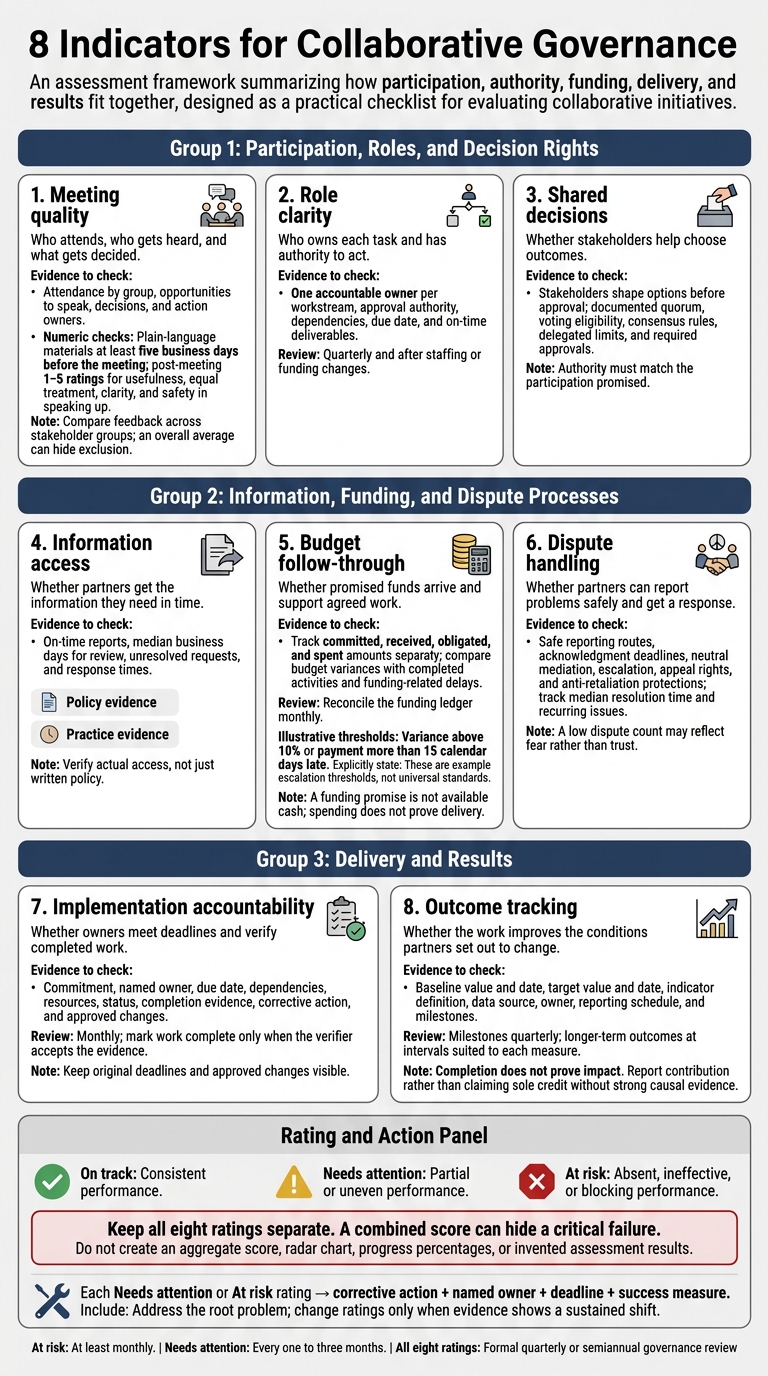
I assess collaborative governance by checking whether shared decisions lead to funded, completed work - not just more meetings. I use eight indicators to identify gaps, rate performance, and assign fixes:
Meeting quality: Who attends, who gets heard, and what gets decided.
Role clarity: Who owns each task and has authority to act.
Shared decisions: Whether stakeholders help choose outcomes.
Information access: Whether partners get the information they need in time.
Budget follow-through: Whether promised funds arrive and support agreed work.
Dispute handling: Whether partners can report problems safely and get a response.
Implementation accountability: Whether owners meet deadlines and verify completed work.
Outcome tracking: Whether the work improves the conditions partners set out to change.
I rate each indicator On track, Needs attention, or At risk, using records, numbers, and partner feedback. For example, partners might flag a budget variance above 10% or a payment more than 15 calendar days late.
My rule: <u>keep all eight ratings separate</u>. Strong attendance cannot cancel out missing funds or a missed legal requirement. Each gap needs a named owner, a deadline, and a clear measure of success.
8 Indicators for Collaborative Governance
Collaborative Governance & Collaboration Dynamics
sbb-itb-8baf5f1
Check Participation, Roles, and Decision Rights
Use these three checks to assess whether participation comes with real authority, clear ownership, and fair decisions. Start with the process: its quality determines whether collaboration can work.
1. Meeting Quality
Look at who attends and who gets heard across businesses, local governments, nonprofits, and community groups. Review attendance by group, opportunities to speak, and decisions made. Send plain-language materials at least five business days before the meeting. Provide interpretation, accessible formats, and remote access when needed.
After each meeting, use a short survey with 1–5 ratings for usefulness, equal treatment, clarity, and safety in speaking up. Compare responses across stakeholder groups - an overall average can hide exclusion. Before the meeting ends, confirm what was decided, what remains unresolved, and who owns each action, along with its deadline.
2. Role Clarity
Compare the charter or responsibility matrix with actual assignments. Each workstream needs one accountable owner, clear approval authority, dependencies, and a due date. Ask each partner to explain its responsibilities and decision limits.
Track assignment coverage, consistency in partners’ answers, unresolved gaps, duplicated work, and on-time deliverables. Review assignments quarterly and after staffing or funding changes. Responsibilities must fit each partner’s staff, budget, technical capacity, and legal authority.
Then check whether assigned roles carry real decision power.
3. Shared Decisions
Check whether affected stakeholders shape options before approval, rather than simply comment on a finished proposal. Document quorum, voting eligibility, consensus rules, delegated limits, and required approvals.
Decision records should show the alternatives considered, changes made in response to input, rejected recommendations, and minority concerns. Track compliance with procedures, stakeholder representation, median decision time, and perceptions of fair treatment. Authority must match the participation promised.[5]
Use the decision model below to check how much influence stakeholders actually have.
| Approach | Stakeholder influence | Accountability | Required evidence |
|---|---|---|---|
| Consultation | Stakeholders provide input; the formal decision-maker retains authority. | Agency, board, or executive answers for the final decision. | Outreach plan, participant list, comments, responses, and final rationale. |
| Shared decision-making | Stakeholders define the problem, develop options, and choose an outcome. | Partners with authority share accountability under documented rules. | Decision charter, representation, voting or consensus record, alternatives, rationale, and minority concerns. |
| Delegated authority | A defined body receives authority to decide within set limits. | Delegate answers for decisions; delegating body retains oversight. | Delegation instrument, authority limits, conflict-of-interest controls, decision record, and reporting requirements. |
Check Information, Funding, and Dispute Processes
4. Information Access
Shared decisions break down when participants receive different information or get it at different times. Review recent decision packets, request logs, and partner interviews. Check that participants receive clear data, assumptions, limitations, performance updates, and prior decision records before meetings or votes. Track on-time reports, median business days for review, unresolved requests, and response times. Verify actual access, rather than relying on a written transparency policy.[12][13]
Separate findings into two evidence columns: policy evidence and practice evidence. Classify records as public, partner-accessible, confidential, or legally restricted. For restricted records, document the reason, authorized viewers, retention period, and process for challenging access limits. Sample records to see whether classifications are consistent and whether restrictions prevented partners from assessing risks. Keep decision records complete while redacting protected personal or commercial information.[5][6]
5. Budget Follow-Through
Decisions need funding behind them. Check each signed agreement for the amount, timing, restrictions, and approved purpose. Reconcile the funding ledger monthly with bank records and delivery reports. Compare the approved budget with funded activities and participation costs, including interpretation, transportation, childcare, stipends, accessibility services, technical assistance, and staff time for smaller organizations. Verify that support arrives before participants must pay out of pocket.[7][10][8]
Track:
Funding status: Record committed, received, obligated, and spent amounts separately.
Budget and delivery: Measure dollar and percentage variances against approved budgets alongside completed activities.
Funding reliability: Track late payments and funding-related delays.
A funding promise is not available cash, and spending does not prove delivery. Agree on escalation thresholds in advance.
For example, flag a variance above 10% or a payment more than 15 calendar days late.
Require an explanation, revised forecast, owner, and deadline.[7][10][11][13]
6. Dispute Handling
When access or funding breaks down, partners need a clear way to resolve disputes. Verify reporting routes, acknowledgment deadlines, neutral mediation, escalation authority, appeal rights, confidentiality limits, and anti-retaliation protections. Include a route outside any dominant partner’s control. Do not treat harassment or suspected misuse of funds as ordinary disagreements.
Maintain a confidential dispute log with receipt, acknowledgment, and resolution dates; issue types; affected partners; procedures; outcomes; recurrence; and retaliation concerns. Use it to track timely acknowledgments, median resolution time, procedure use, and recurring issues. Add partner feedback on whether they received fair treatment. Check that resolutions were communicated appropriately, assigned a follow-up owner, and upheld. A low dispute count may reflect fear rather than trust.[9]
Check Delivery and Results
After checking process, authority, and funding, test whether the partnership delivers on its commitments.
7. Implementation Accountability
Turn each decision into a tracked work-plan commitment. Record the commitment, named owner, due date, dependencies, resources, status, completion evidence, corrective action, and approved changes. Review the tracker monthly. Mark work complete only when the verifier accepts the evidence, and use independent verification for high-impact deliverables.
Measure the percentage of commitments completed on time, the number and age of overdue actions, median days to close corrective actions, the percentage of deliverables independently verified when appropriate, and the number of approved scope or deadline changes.
Set escalation rules before delays occur. Require owners to flag likely missed deadlines promptly. Each corrective action must record the problem, root cause, owner, revised deadline, resources, and closure evidence. Keep original deadlines and approved changes visible so revised plans do not hide missed commitments.[15][16][18]
Completed work still needs a results check: did it change the condition the partnership set out to improve?
8. Outcome Tracking
Separate outputs from outcomes: completion does not prove impact. Test whether collaborative rules, funding, and decisions produced real change. For each outcome, build a results table with the baseline value and date, target value and date, indicator definition, data source, owner, reporting schedule, and milestones.
Break down results by relevant groups or places, using community input and suppressing small counts to protect privacy. Agree on collection methods and definitions across partners. Record measurement changes so a shift in the measurement system does not create the appearance of progress.[15][19]
Track early outcomes, such as trust, capacity, and coordination, alongside longer-term ecological, social, economic, or institutional change. Review milestones quarterly and longer-term outcomes at intervals suited to each measure.[14][19]
Use findings to decide what to continue, change, pause, or fund differently. Assign an owner and deadline to each decision. Compare progress with the baseline, examine outside influences, and test other explanations using multiple evidence sources. Report the partnership’s contribution rather than claiming sole credit unless causal evidence is strong. Revise governance decisions based on that evidence.[14][16][17][18]
Conclusion: Rate Progress and Assign Actions
Review the eight indicators as one system, covering process, authority, funding, disputes, delivery, and results.
Support Each Rating With Evidence
Rate each indicator On track for consistent performance, Needs attention for partial or uneven performance, or At risk for absent, ineffective, or blocking performance. Keep all eight ratings separate. A combined score can hide a critical failure.[20]
Back each rating with brief quantitative and qualitative evidence. Include attendance, decision times, owner assignment records, information-response times, funds released on schedule, the age of unresolved disputes, milestone completion, and outcome trends.
Set Corrective Actions, Owners, and Deadlines
Turn each Needs attention or At risk rating into one corrective action. Give it a named owner, deadline, and success measure, and make sure the fix addresses the root problem.
Track actions in an action register with these fields: indicator, problem statement, corrective action, owner, deadline, success measure, status, and next review date.
Review At risk actions at least monthly and Needs attention actions every one to three months. Review all eight ratings at a formal quarterly or semiannual governance review.
Change a rating only when new evidence shows a sustained shift - not simply because someone completed a single task. Escalate overdue actions to the body with authority to resolve them.
FAQs
How do we set fair thresholds for each indicator?
Turn partnership goals into measurable impact areas, each with 2–4 indicators tied to ESG and sustainability objectives. Separate mandatory, measurable criteria from those weighted by relative importance. Use radar charts or traffic-light systems to set performance levels and discuss differences in ratings.
Where needed, build custom scoring frameworks that balance equity outcomes, climate resilience, and financial performance. Review thresholds regularly in governance meetings as the partnership evolves.
What if partners disagree on governance ratings?
Treat differences as chances to learn, not as criticism. During facilitated sessions, use radar charts or traffic-light scoring to pinpoint disagreements, discuss causes such as missing data or conflicting priorities, and agree on specific actions [1].
Use documented cooperation protocols and shared principles to guide the discussion [2]. If disagreements remain, follow established escalation procedures and involve a steering committee or independent facilitator [3][4][2]. Share the resolution with every participant to maintain trust [2].
How can small teams track all eight indicators?
Set up a centralized tracking framework from day one. Use cloud-based dashboards or sustainability management software to automate data entry and bring metrics into one place.
Set clear SMART targets, review progress quarterly, and pair the numbers with stakeholder surveys. Standardized templates and simple, color-coded dashboards make reporting easier and keep attention on results teams can act on.
Council Fire helps organizations put these steps into practice and measure their sustainability outcomes.




FAQ