In This Article
Boards must map and fix gaps between climate commitments and company lobbying, trade‑group advocacy, and political spending.
On this page
Climate Lobbying vs. Board Policy: Where Gaps Create Risk
Climate commitments lose force when company lobbying works against them. Boards should review direct lobbying, political spending, and trade-group advocacy at least annually, then set 90- or 180-day deadlines to address material conflicts.
Board policy sets the direction; advocacy records show whether company actions support it. A useful review should:
Compare commitments with actions: Check policy positions, association dues, funding, and leadership roles against climate targets and transition plans.
Test business risk: Assess whether opposing advocacy could delay investments, increase costs, or undermine public claims.
Separate filing duties from transparency: Required U.S. disclosures and voluntary climate reports serve different purposes. Filing compliance alone does not show alignment.
Assign responsibility and track results: Record who owns each conflict, what must change, and when action is due.
Trade-group membership alone does not prove endorsement, and missing records do not prove alignment. The goal is a documented link between board policy, company influence, and corrective action - not another statement of intent.
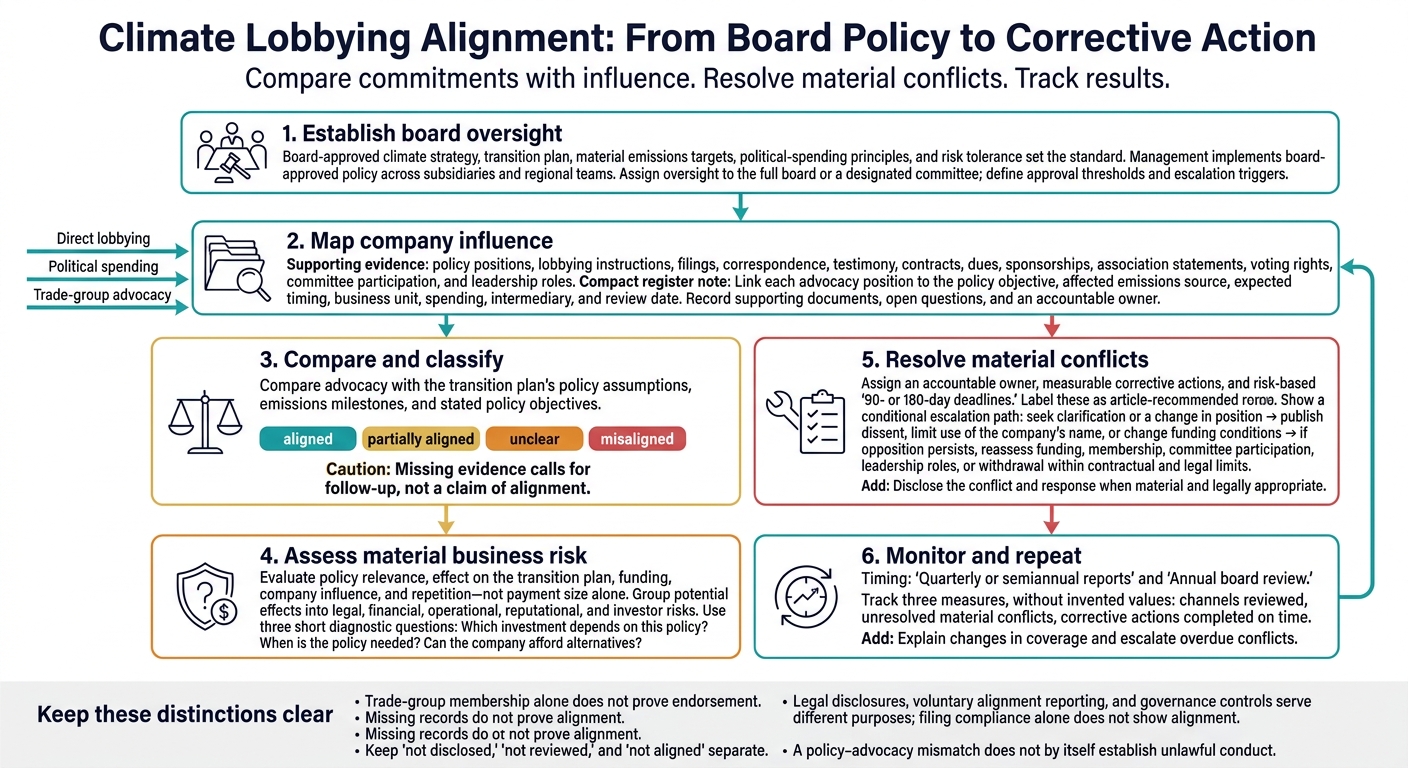
Climate Lobbying Alignment: From Board Policy to Corrective Action
Board Policy vs. Lobbying: Commitments and Actions
Who Sets Policy and Who Shapes Advocacy?
The board approves the company’s climate strategy, transition plan, material emissions targets, political-spending principles, and risk tolerance. Management carries out that policy; it does not set it. This work should involve legal, sustainability, finance, and compliance. Government affairs should not set climate policy, and board-approved policy should also govern subsidiaries and regional teams.[2]
The test is straightforward: does lobbying support board-approved climate policy or work against it? When management’s advocacy drifts from approved climate goals, that gap becomes a compliance risk.
| Dimension | Board-approved policy | Direct lobbying | Indirect advocacy |
|---|---|---|---|
| Objective | Define climate ambition, transition priorities, and risk appetite | Influence lawmakers, regulators, or ballot-policy outcomes | Shape policy through associations, coalitions, and funded intermediaries |
| Responsible actors | Board and designated committee | Government affairs, legal, compliance, and executive sponsors | Government affairs, membership representatives, executives, and association delegates |
| Mechanisms | Resolutions, policies, targets, transition plans, and approval procedures | Meetings, testimony, letters, lobbying firms, and legislative engagement | Dues, sponsorships, committee roles, coalition funding, and joint statements |
| Company control | High; board-approved standard | Generally high, subject to internal controls | Variable; depends on governance rights and association processes |
| Risk exposure | Vague, unapproved, or unsupported commitments | Contradictions between public targets and legislative positions | Association misalignment, incomplete records, or implied endorsement |
Association positions warrant the same review as direct lobbying. Dues and sponsorships create a financial connection; board seats and committee roles may give the company influence. For both direct lobbying and association activity, document what the company funded, supported, voted on, or challenged. Include its role, voting rights, financial relationship, relevant policy position, and response to any disagreement.
Policy Documents vs. Advocacy Records
Policy documents set the standard; advocacy records show what happened. Once decision-making authority is clear, compare each material advocacy position with the transition plan’s policy assumptions, emissions milestones, and stated policy objectives. A broad commitment to climate action is not enough to establish alignment.
| Dimension | Policy documents | Advocacy records |
|---|---|---|
| Authority | Board-approved direction and risk tolerance | Positions taken, funded, communicated, or supported |
| Purpose | Set targets, principles, governance, and expected conduct | Show attempts to influence policy |
| Supporting records | Board approvals, transition plans, target methodologies, committee charters | Lobbying disclosures, correspondence, testimony, contracts, dues, sponsorships, association statements, and meeting logs |
| Known gaps and warning signs | Aspirational or vague commitments, legislative silence, no accountable owner, or targets disconnected from policy assumptions | Unrecorded informal or intermediary influence, unclear control, conflicting positions, unexplained association support, or generic alignment claims |
| Control points | Board approval, policy updates, target-setting, and delegation rules | Pre-clearance, position approval, association reviews, spending controls, and monitoring |
| Corrective responses | Clarify commitments, assign accountability, and connect targets to policy assumptions | Correct the position, disclose the conflict, engage the association, change membership status, or end the relationship |
Create an issue-level record that links each advocacy position to the policy objective, affected emissions source, expected timing, business unit, spending, intermediary, and review date. Classify each finding as aligned, partially aligned, unclear, or misaligned.
Keep “not disclosed,” “not reviewed,” and “not aligned” separate. Incomplete public records establish neither alignment nor misalignment. Specify the review period, jurisdictions, intermediaries, and gaps.
sbb-itb-8baf5f1
Exxon Exposed: Greenpeace Tricks Top Lobbyists into Naming Senators They Use to Block Climate Action
Where Policy and Advocacy Gaps Create Risk
After comparing policy documents with advocacy records, assess whether any mismatch is material to the business.
Policy Opposition Can Weaken Transition Plans
Trade-association lobbying can work against a board-approved transition policy:
Hypothetical: A company commits to electrifying its U.S. delivery fleet by 2035, but its trade association opposes charging-infrastructure programs needed for deployment. If that opposition succeeds, charging access could arrive late, and infrastructure costs could exceed the investment plan. Membership alone does not prove endorsement. The conflict becomes more serious if the company directs or funds the advocacy and fails to address it.
Test the business impact, not just the policy disagreement. Identify the investment that depends on the disputed policy, when that policy is needed, and whether the company can afford alternatives. A minor disagreement differs from opposition that could materially delay a transition milestone. Board oversight should address material sustainability risks through strategy, risk management, and internal controls.[5]
When a gap delays execution, it can also create a disclosure problem.
Reporting Gaps Invite Compliance and Investor Scrutiny
Lobbying disclosure, campaign-finance reporting, and voluntary alignment reporting follow different rules across federal, state, and local jurisdictions. Failing to report covered activity can create compliance risk. Leaving association spending or conflicting positions out of a voluntary report can also lead investors to question its completeness. Climate Action 100+ assesses direct and indirect advocacy, including how companies resolve conflicts - not just whether they publish their memberships.[6]
Do not treat the SEC’s 2024 climate rules as a current reporting requirement for all companies. The rules were stayed in April 2024, the SEC withdrew its defense in March 2025, and rescission was proposed in May 2026. Existing securities-law duties can still apply to material information and misleading statements.[3][4][7]
Disclosure gaps can cause more damage when public claims conflict with the record.
Contradictions Can Harm Reputation and Lead to Legal Claims
A claim of “supporting climate action” loses weight when advocacy records show opposition to policies needed to carry out the company’s board-approved plan. That mismatch can prompt investor engagement or greenwashing allegations, but it does not establish unlawful conduct.
A legal assessment must identify the statement or omission, the applicable law, the evidence, and any required materiality, reliance, or causation. Label allegations as allegations. Include the company’s response and corrective action rather than presenting an accusation as a finding.
How to Review, Disclose, and Resolve Policy Gaps
Once a gap is identified, governance must shift from diagnosis to action.
Assign Board Oversight and Control Spending
Give the full board or a designated committee oversight responsibility, and spell out its authority in the political-engagement policy. Its role is to keep political spending and advocacy aligned with board-approved climate policy. Specify what it approves, reviews, and receives for information, covering lobbying priorities, political spending, trade-association memberships, and climate-policy conflicts. Set approval thresholds for material spending, new advocacy positions, and memberships in organizations with major policy influence.
Require quarterly or semiannual reports from government affairs, legal, compliance, finance, sustainability, investor relations, and relevant subsidiaries, along with an annual board review. Keep one central record of policies, approvals, filings, association correspondence, spending, conflicts, and remediation. Use this process to escalate undisclosed lobbying, spending above approval limits, repeated opposition to a material climate policy, missing association data, or conflicts likely to affect investor expectations.
Smaller businesses can start with three datasets: lobbying vendors, association dues, and executives’ political or leadership roles. These records create the review trail needed for disclosure and conflict resolution.
Check Advocacy Against Climate Commitments
Use a single review register to turn policy-versus-lobbying analysis into governance decisions. For each priority climate issue, link the company’s climate commitment to lobbying instructions, association positions, available spending data, and influence through voting, committee participation, or leadership roles. Apply the earlier classifications: aligned, partially aligned, unclear, or misaligned.
Judge each issue’s importance by its policy relevance, effect on the transition plan, funding, company influence, and repetition. This assessment helps ensure long-term climate resilience and organizational stability. Also weigh legal, financial, operational, reputational, and investor effects - not payment size alone. Record supporting documents, the date range, open questions, an accountable owner, and the next review date. Missing evidence calls for follow-up, not a claim of alignment.
Required vs. Voluntary Disclosures
Use separate controls for legal filings, voluntary reporting, and internal governance. Counsel should confirm U.S. federal, state, and local requirements for each entity and jurisdiction. Report total association dues separately from the known or estimated lobbying share, and explain the limits of any estimates. Protect privileged, confidential, and legally protected information without hiding material findings.
| Category | What to cover | Key distinction |
|---|---|---|
| Legal disclosures | Reportable federal, state, and local lobbying activity, lobbying expenses, political contributions, and required filings | Coverage, thresholds, and deadlines vary by jurisdiction.[8][9] |
| Voluntary alignment reporting | Lobbying priorities, climate-policy positions, trade-association memberships, known lobbying amounts within dues, assessment methods, identified conflicts, management responses, and resolution deadlines | Explain scope and missing data; do not present these practices as legal duties. |
| Governance controls | Board or committee responsibility, approval thresholds, review frequency, escalation triggers, record retention, internal controls, and responsible executives | These controls support accountability; they do not replace required filings. |
Set Deadlines to Resolve Material Conflicts
When a conflict is material, move promptly from review to remediation. The goal is to align advocacy, spending, and membership behavior with board-approved climate commitments.
Document the commitment, policy, organization, payment, and time period involved. Ask for clarification, updated policy information, or a change in position. Set measurable corrective actions, such as publishing dissent, limiting use of the company’s name, requesting a new association position, or changing funding conditions. Set 90- or 180-day deadlines based on risk. Disclose the conflict and response when material and legally appropriate.
Repeated opposition to a material climate policy generally warrants stronger action than a single, narrow disagreement. If opposition persists, reassess funding, membership, committee participation, leadership roles, or withdrawal within contractual and legal limits.
Conclusion: Bring Advocacy Into Line With Board Policy
After review and remediation, measure whether the gaps are closing.
Alignment takes regular checks, not a one-time review. Compare direct lobbying, political spending, and trade-group advocacy against board-approved climate goals. Keep management’s supporting evidence under board or committee oversight.
Track three measures: channels reviewed, unresolved material conflicts, and corrective actions completed on time. Review results annually, explain changes in coverage, and disclose material conflicts when required. Escalate overdue conflicts rather than leaving them in open-ended review.
Council Fire can help turn sustainability commitments into practical action. The board and management remain responsible for lobbying oversight, political-spending controls, compliance, and disclosures.
FAQs
How can we assess lobbying when association records are incomplete?
Compare trade association positions with your internal climate principles [1]. Set a regular review schedule and a clear escalation process: engage the association, challenge positions that conflict with your principles, and leave if alignment remains out of reach [1].
Disclose direct lobbying activities and trade association memberships annually so stakeholders can compare your public commitments with your policy work [1].
When should we leave a trade group over climate conflicts?
Start by pushing for change within the trade group. If that doesn’t resolve conflicts with your climate principles, ask leadership to conduct a formal review. Leave only if alignment remains out of reach after these steps [1].
Use a formal process to regularly compare the group’s positions with your public climate commitments. Document a clear path for engagement, escalation, or exit [1].
How can we verify that corrective actions actually work?
Build a continuous feedback loop between sustainability and government affairs teams. Regularly compare public climate positions with actual lobbying activity. Use standardized reporting frameworks, such as the GHG Protocol or TCFD, to make data comparable, and require independent third-party verification to support trust in the findings.
Track progress against specific targets through quarterly dashboards and annual steering reviews, so teams can spot performance gaps early.




FAQ