
Jul 20, 2026
Top 5 ESG Legal Risks by Industry
ESG Strategy
In This Article
Five industry-focused ESG legal risks: climate litigation, supply-chain forced labor, fiduciary/disclosure gaps, greenwashing, and fragmented U.S. rules.
Top 5 ESG Legal Risks by Industry
ESG legal risk is already hitting U.S. companies in court, in agency actions, and in shareholder and consumer claims. If I had to boil this article down to one point, it’s this: the biggest legal threat is the gap between what a company says and what it can prove.
Here’s the short version:
Energy and utilities face climate suits, rate disputes, and stranded-asset claims. These risks necessitate a proactive approach to climate resilience to protect long-term value.
Manufacturers face forced labor, import detention, and supply chain record failures.
Financial firms face fiduciary, disclosure, and ESG fund-label risk.
All sectors face greenwashing claims over words like “net zero,” “green,” and “recyclable.”
Every large U.S. business faces a patchwork of state rules, with California pushing climate reporting through SB 253 and SB 261.
A few numbers make the point fast:
The U.S. had 1,850 climate cases on record as of 2024.
164 new climate cases were filed in the U.S. in 2024 alone.
California penalties can reach $500,000 per year under SB 253.
CBP has detained 4,000+ shipments tied to forced-labor concerns, worth close to $1.4 billion.
What matters most is not just policy. It’s proof: disclosures, supplier records, fund holdings, marketing copy, and internal controls all have to match.
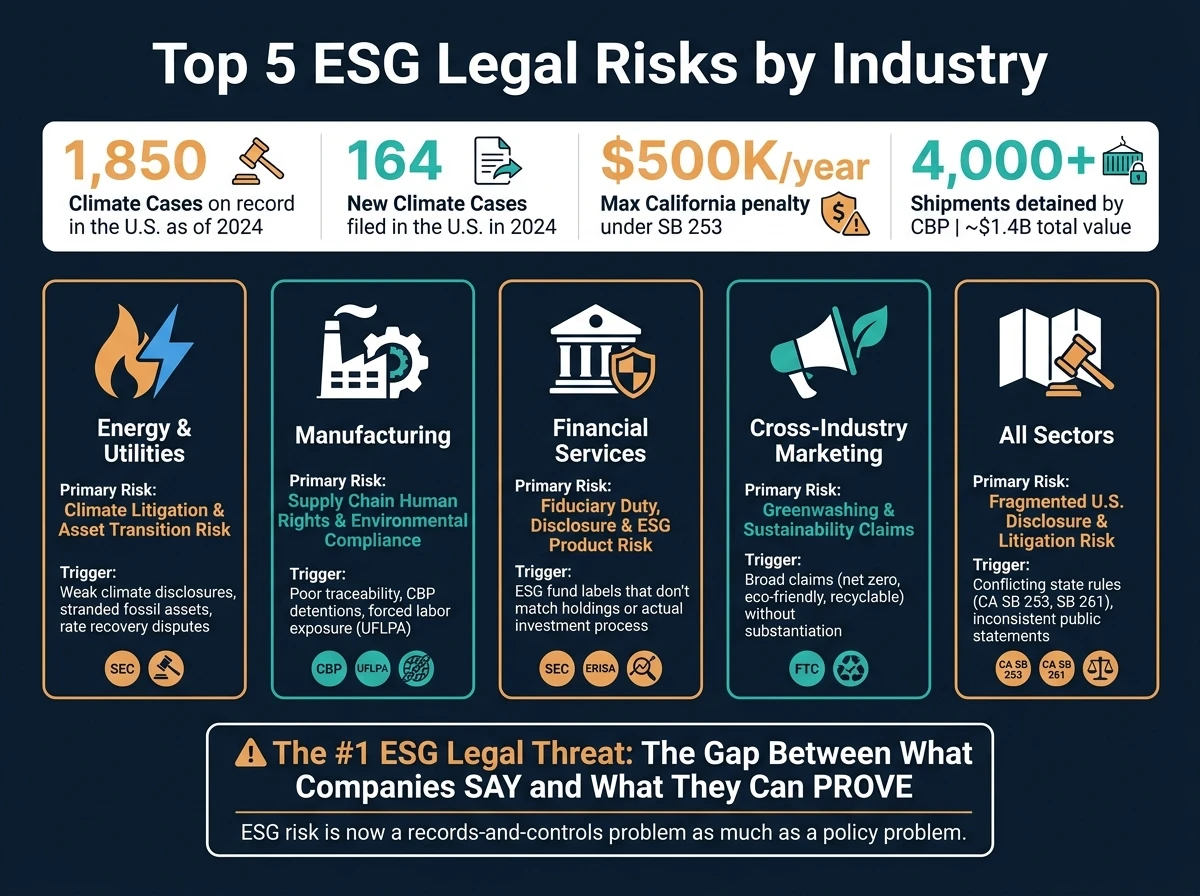
Top 5 ESG Legal Risks by Industry: Key Stats & Exposure Map
ESG Academy: ESG litigation risk
Quick Comparison
Industry / Area | Main Legal Risk | What Usually Triggers It |
|---|---|---|
Energy & Utilities | Climate litigation and asset transition risk | Weak climate disclosures, fossil asset exposure, rate recovery fights |
Manufacturing | Supply chain labor and compliance risk | Poor traceability, import issues, supplier abuse, bad sourcing claims |
Financial Services | Fiduciary, disclosure, and ESG product risk | ESG labels that don’t match holdings or process |
Cross-Industry Marketing | Greenwashing claims | Broad claims without backup |
All Sectors | Fragmented U.S. disclosure risk | Conflicting state rules, uneven reporting, inconsistent public statements |
If you read nothing else, read this: ESG legal risk is now a records-and-controls problem as much as a policy problem. The companies under the most pressure are the ones whose statements move faster than their facts.
Why ESG Legal Risk Differs by Industry
ESG legal exposure changes a lot from one industry to the next. The risk profile of an oil and gas producer differs sharply from that of a regional bank or a consumer goods manufacturer. The reason is pretty simple: each sector runs on a different set of legal pressure points. In practice, those pressure points usually come back to asset intensity, supply chain complexity, fiduciary obligations, disclosure volume, and political scrutiny.
Those drivers don’t land the same way across sectors. A capital-intensive energy company faces legal pressure tied to decarbonization, grid reliability, and infrastructure hardening. A global manufacturer sourcing materials from many countries faces human rights and environmental compliance risk across operations it may not fully control. Financial firms face a different mix of duties, and that mix can be less visible at first glance but no less serious.
A financial institution managing pensions or other investment assets operates under fiduciary duties that create distinct legal exposure when portfolio vulnerabilities, stress testing, and climate-related financial disclosures do not align.
The reporting side adds another layer. In 2026, more than 30 jurisdictions are deploying IFRS sustainability standards with local modifications, creating significant legal complexity for companies trying to keep disclosures consistent across jurisdictions.[1] For a company filing in more than one market, that can turn a single ESG narrative into a patchwork of legal risk.
That’s why the top ESG legal threats do not fall evenly across the market. For U.S. companies, the five highest-risk ESG legal issues are:
Climate litigation and asset transition risk in energy and utilities
Supply chain human rights and environmental compliance in manufacturing
Fiduciary duty and ESG product risk in financial services
Greenwashing and sustainability marketing claims across industries
Fragmented disclosure and litigation risk affecting every sector
1. Energy and Utilities: Climate Litigation and Asset Transition Risk
Energy and utilities sit in the crosshairs of climate-related legal risk. The reason is pretty simple: this sector relies on regulated, long-life assets, and those assets are now under pressure from lawsuits, rate disputes, and scrutiny over transition claims.
State and local governments have filed more than two dozen climate-related cases against fossil fuel companies. Many of these suits use public nuisance and deceptive practices theories and seek damages tied to climate harms.[3][5][7] In December 2024, Carrboro, North Carolina, filed what is described as the first-ever U.S. climate accountability lawsuit against an electric utility - Duke Energy - alleging a deception campaign around fossil fuel climate risks.[2][9] That kind of case does more than create headline risk. It adds to the chance that fossil-based assets lose economic value before the end of their planned life.
That transition risk is built into the business model. Coal and gas plants can turn uneconomic or fall out of compliance as state climate laws and renewable energy mandates push retirement dates forward.[2][3][4] Illinois offers a clear example. The state's Climate and Equitable Jobs Act requires 100% clean energy by 2045 and set aside $580 million for sustainability consulting for clean energy workforce and equity programs.[12] For utilities, that changes the math. If regulators decide a fossil investment was imprudent as policy moves faster than expected, companies may be denied cost recovery, pulled into contested rate cases, and face investor claims tied to stranded assets.[3][6][8]
Disclosure risk hasn't gone away either. The SEC's 2024 climate disclosure rules are stayed for now and under reconsideration, but existing antifraud rules still apply.[6][8][10][11] So if a utility issues green bonds or makes public climate promises, those statements still matter. If the disclosures are misleading - or don't line up with the company's actual transition plan - they can trigger private securities litigation.
Manufacturing shifts the legal burden from owned assets to upstream supply chains.
2. Manufacturing: Supply Chain Human Rights and Environmental Compliance Risk
For manufacturers, the trouble often starts far upstream. A company may buy cotton, polysilicon, steel, or critical minerals from suppliers in high-risk areas, and with that purchase comes possible human rights and environmental liability. The hard part is simple: manufacturers depend on suppliers they don't fully control. That turns traceability - not procurement alone - into a legal control point.
The Uyghur Forced Labor Prevention Act (UFLPA) is the clearest example of how tough this can get. The law treats goods tied to China's Xinjiang region as forced-labor goods unless the importer can prove otherwise, which puts the full burden on the importer.[13][16] That burden is not theoretical. CBP has detained more than 4,000 shipments across electronics, solar components, aluminum, and textiles, with a total value approaching $1.4 billion.[15] CBP has also fined importers for forced-labor-linked goods and approved seizure at U.S. ports.[17]
The risk doesn't stop with Xinjiang. Section 307 of the Tariff Act gives CBP power to go after forced labor anywhere in the world, and enforcement is moving into higher-value sectors such as automotive and aerospace.[23][24][25] For importers and executives, the stakes are steep: fines, seizures, and even criminal penalties.[18] On top of that, manufacturers can get pulled into consumer and securities litigation when they fail to disclose material supply chain abuse or exaggerate the strength of their sourcing controls.[19][20][21][22]
Environmental risk runs through the same supply chain. If a manufacturer sources from facilities with illegal emissions, unsafe waste disposal, or other violations, that can draw customs, trade, EPA, or DOJ enforcement - especially when import records or sustainable sourcing claims don't line up with what suppliers are doing on the ground.[17]
The main defense is traceability. When CBP detains a shipment, it expects detailed supply chain records, including:
supplier maps
purchase orders
bills of lading
audit reports
remediation records
CBP requires this documentation for detained shipments, and without fast, complete traceability records, manufacturers may be unable to clear goods or back up their sustainability claims.[14][15][17]
In financial services, the risk shifts from sourcing to disclosure, fiduciary duty, and ESG-labeled products.
3. Financial Services: Fiduciary Duty, Disclosure, and ESG Product Risk
Manufacturers often worry about traceability. Financial firms face a different problem: disclosure and fiduciary risk. In financial services, ESG legal risk turns on a simple test: do disclosures, fiduciary choices, and product labels match what the firm actually does? Asset managers, investment advisers, and fund companies face exposure in three main areas: fiduciary duty, disclosure accuracy, and ESG product labeling. The SEC has made this a live enforcement issue, using existing rules on materiality, disclosure accuracy, and fiduciary duty when ESG claims and day-to-day practice drift apart.
That risk is not abstract. In 2023, the SEC penalized DWS and Goldman Sachs Asset Management for ESG-process claims that did not match actual practice.[26][27][30][31][32] In both matters, the core issue was the same: firms described an ESG process that was not carried through in practice.
The highest-risk work sits in fund marketing, portfolio management, and client communications. The SEC reviews ESG claims in fund documents, marketing materials, and investor communications, not only in statutory filings. That point matters. A firm can get into trouble through language used in pitch decks, website copy, or product materials just as easily as through formal filings.
For retirement plans governed by ERISA, the risk goes further. ERISA fiduciaries can face suits over whether ESG factors breached duties of loyalty and prudence, with added focus on 401(k) plans.[29][33] In plain English, if ESG is part of the decision-making story, fiduciaries need to show how that use fits their duty to plan participants.
The practical fix is straightforward, even if the work is not. Disclosures should line up with actual portfolio management. Written ESG policies must show up in portfolio decisions, not just in policy binders. Marketing language should reflect real screening criteria and actual holdings. It is wise to treat every ESG statement as legally meaningful because the SEC has brought cases over voluntary disclosures.[28]
Business Activity | Primary Legal Risk | Mitigation Priority |
|---|---|---|
ESG mutual funds and ETFs | Greenwashing / misleading product labels | Align holdings and process with stated ESG criteria |
Separately managed ESG accounts | Policies and procedures failures | Implement and monitor written ESG policies |
Marketing and client communications | Material misstatements across all channels | Audit ESG language for consistency with actual practice |
ERISA retirement plan management | Fiduciary breach / duty of loyalty | Document ESG use as tied to financial objectives |
Proxy voting and stewardship programs | Fiduciary breach allegations | Document proxy voting and stewardship rationales |
The pattern here is hard to miss: the same disclosure gap sits at the center of greenwashing risk across every industry.
4. Cross-Industry: Greenwashing and Sustainability Marketing Claims
Across industries, ESG legal risk often shows up in a familiar way: greenwashing. It happens when public claims move past the facts - too broad, too absolute, or not backed up. That puts substantiation at the center of the risk. In the U.S., companies can face claims under FTC Act Section 5, state consumer-protection laws, and consumer class actions if a reasonable consumer could be misled and the company does not have competent and reliable support for what it said.[34][35]
The FTC Green Guides put extra pressure on claims such as "eco-friendly", "green", "sustainable", "carbon neutral", "net zero," and "recyclable." These are high-risk claims unless the company can show the scope, assumptions, exclusions, and time period behind them.[34][35][36][37] Put plainly, if a company uses sweeping language, it needs records that match the sweep.
State attorneys general are taking aim at climate claims too. New York sued JBS USA in 2024 over allegedly misleading "net zero by 2040" claims, and California sued ExxonMobil in 2024 over allegedly misleading environmental marketing and unfair competition claims.[39][42] Those cases show that marketing language itself can become the focus of litigation, not just formal disclosures.
The pressure points tend to be the same across sectors: labels, packaging, ad copy, offsets, and net-zero or carbon-neutral claims. Walmart and Kohl's agreed to pay $5.5 million after FTC allegations that they marketed rayon-based home goods as eco-friendly bamboo products.[40] Rust-Oleum faced a California settlement approval for $1.5 million over "non-toxic" and "Earth Friendly" labeling on cleaning products.[38]
In both cases, the core problem was the same: absolute-sounding language that the underlying facts did not support.
That’s the heart of it. If a claim only applies to a product line, a single facility, one region, or a set period, the company should say so in plain English and keep the backup on file.
Claim Type | Why It's High Risk |
|---|---|
"Eco-friendly" / "green" | |
"Recyclable" | |
"Carbon neutral" / "net zero" | |
"Made with renewable energy" | |
"Certified" / seal-based claims |
5. All Sectors: Fragmented U.S. ESG Regulation and Disclosure Litigation Risk
Across industries, ESG risk is no longer tied only to sector-by-sector issues. In the U.S., a split set of state rules and enforcement actions is creating a messy legal map, and that patchwork can turn even routine ESG disclosures into a source of litigation risk.
One pressure point is antitrust. State attorneys general are starting to test whether broad sustainability pledges made through trade groups cross the line into unlawful coordination. In February 2026, a coalition of 10 state attorneys general sent formal warning letters to nearly 80 corporations, arguing that participation in trade group initiatives to reduce plastic packaging could violate the Sherman Antitrust Act as an unlawful restraint of trade. In plain terms, sustainability commitments that once looked ordinary can now bring antitrust exposure in some states.
A similar theme is showing up in securities enforcement: if a fund carries an ESG label, its holdings and process have to back that up. In October 2024, the SEC charged WisdomTree Asset Management for marketing three funds as ESG-aligned while they actually held fossil fuel and tobacco companies, resulting in a $4 million civil penalty[43]. In November 2024, the SEC charged Invesco Advisers for claiming that 70% to 94% of its assets were "ESG integrated" when that figure included passive ETFs that applied no ESG criteria, resulting in a $17.5 million civil penalty[43]. Both matters point to the same problem. ESG labels, percentages, and marketing language have to line up with actual holdings and the way investment decisions are made.
Plaintiffs' lawyers are also getting a clearer path into these cases. In February 2026, a federal court in Texas awarded $4.6 million in attorneys' fees to plaintiffs' lawyers in a lawsuit against American Airlines over ESG-influenced pension investing, even though the plaintiff proved zero damages. That ruling stands out because it shows ESG-related suits can still produce major fee awards for plaintiffs' firms even when no actual damages are proven.
Taken together, these risks tend to fall into four legal lanes:
Risk Category | Primary Legal Driver | Most Affected Activity |
|---|---|---|
Antitrust | Sherman Antitrust Act | Trade group participation & industry pledges |
Greenwashing | SEC Enforcement / State AGs | Marketing claims & voluntary ESG reports |
Fiduciary Duty | ERISA / State Pension Laws | Pension fund management & ESG investing |
Disclosure Gap | SEC / State AG Disclosure Rules | Supply chain (Scope 3) & climate risk reporting |
The practical takeaway is simple: treat ESG data the way you treat financial data. Check it before it goes public. That usually means giving clear ownership of ESG data to named internal teams, setting up review steps before any disclosure is released, and having antitrust and securities counsel review sustainability commitments before announcement. The comparison tables below break these risks down by legal driver and business activity.
Comparison Tables by Risk Area
These tables condense the main sector-specific and cross-industry ESG legal risks into a quick legal checklist for U.S. companies. Use them as working checklists.
Start with the sectors where ESG risk most often turns into litigation or stranded-asset exposure.
Energy and Utilities
Dispute Type | Primary Legal Basis | Key Disclosures at Risk | Red Flags |
|---|---|---|---|
Form 10-K climate misstatements | Exchange Act §10(b) / Rule 10b-5; Securities Act §11; Exchange Act §18; Regulation S-K Items 101, 103 | Climate risk sections, asset retirement obligations | Boilerplate risk language without quantified exposure |
Physical climate-risk omissions | SEC antifraud provisions; state AG consumer protection and securities laws | Resilience planning, infrastructure risk disclosures | Emphasizing transition risk while omitting physical risk (e.g., flood, heat) |
Transition risk and stranded-asset disputes | State utility regulation; contract law; environmental permitting | Asset retirement obligations, decommissioning timelines | No documented plan for fossil asset wind-down |
Public nuisance and emissions tort claims | Common-law nuisance; state tort law | GHG emissions data, historical emissions records | Failure to warn or adapt disclosures |
State AG climate probes | State consumer protection statutes; state securities laws | Enhanced climate-risk and emissions reporting in Form 10-Ks | Inconsistent numbers across sustainability reports and SEC filings |
Manufacturing and Supply Chain
Law / Regime | Geographic Scope | Covered Risks | Due Diligence Expectations | Enforcement Risk |
|---|---|---|---|---|
Uyghur Forced Labor Prevention Act (UFLPA) | U.S. imports (Xinjiang-linked goods) | Forced labor in supply chain | Supply-chain mapping, audit reports, worker interviews, traceability documentation | Import bans, CBP detentions |
Tariff Act §307 / CBP Withhold Release Orders | U.S. imports broadly | Forced labor across all geographies | Continuous monitoring, supplier remediation plans | Import holds, civil penalties |
Clean Air Act / RCRA / TSCA | U.S. manufacturing facilities | Air emissions, hazardous waste, toxic substances | Emissions tracking, hazardous materials management, lifecycle impact reviews | EPA enforcement, civil fines |
EU operations and global supply chains of covered firms | Human rights, environmental harms | Enterprise-wide risk mapping, grievance mechanisms, supplier training, remediation - U.S. companies with EU subsidiaries or EU sales are in scope | Civil liability, EU market access risk | |
California SB 253 (GHG Disclosure) | Companies with more than $500,000,000 in annual revenue doing business in California[44] | Scope 1, 2, and 3 GHG emissions | Annual GHG reporting, third-party assurance | State enforcement, reputational risk |
Financial Services
Risk Area | Legal Basis | Typical Enforcement Channel | Practices That Have Triggered Action |
|---|---|---|---|
ESG fund labeling / "Names Rule" | Investment Company Act; SEC fund naming rules; antifraud provisions | SEC enforcement | Funds holding fossil fuel or tobacco companies while marketed as ESG-aligned |
Overstated ESG integration | Investment Advisers Act; Exchange Act antifraud | SEC enforcement, private class actions | Claiming high percentages of "ESG integrated" AUM when passive ETFs with no ESG screen are included |
Climate risk omissions in offering documents | Securities Act §11; Exchange Act §18 | Private litigation, SEC review | Inadequate climate scenario analysis in prospectuses for long-dated infrastructure funds |
Fiduciary conflicts with client mandates or state anti-ESG policies | ERISA; state pension laws | State AG actions, private ERISA suits | ESG integration that conflicts with stated client mandates or state investment restrictions |
Stewardship and proxy voting misalignment | SEC proxy rules; Investment Advisers Act | SEC examination findings | Voting records inconsistent with stated ESG stewardship commitments |
Greenwashing Claims
Claim Type | Litigation Theory | Control |
|---|---|---|
"Net-zero by 2050" commitment | Securities fraud (misstatement of transition readiness); state UDAP statutes | Board-approved commitment with documented methodology and interim targets |
"Carbon neutral" product label | FTC Act and Green Guides; Lanham Act false advertising | Clear definition of scope, verified offset quality, third-party certification |
"100% renewable power" | FTC Green Guides; state consumer protection laws | Documented renewable energy attribute accounting and a clear definition of what the claim covers |
"Sustainably sourced" materials | Lanham Act; state consumer protection statutes | Supplier audit trail, defined sourcing standards, public grievance mechanism |
"ESG leader" or "best-in-class" marketing | Exchange Act antifraud; state securities laws | Defined benchmark, consistent methodology, disclosed limitations |
Even with slower federal action, state AGs and private plaintiffs still drive most greenwashing cases.
What U.S. Companies Should Watch Next
The next wave of ESG risk will come from a simple problem: a gap between what companies say and what they can prove. The big shift now is evidence-based enforcement. Sustainability reports, SEC filings, product claims, and website marketing are no longer treated as routine compliance materials. They are being used as evidence in securities, consumer protection, and fraud cases.
State action is also picking up speed. California's SB 253 and SB 261 are still in play, and New York is moving ahead with similar mandatory disclosure laws. At the same time, some states are expanding disclosure rules while others are pushing back on ESG investing. That split is creating a patchwork compliance map, and it adds litigation risk even while federal SEC climate rules remain delayed.[1]
The same strain is showing up in supply chains, where paperwork now carries as much weight as policy. For U.S. multinationals, cross-border compliance is getting tighter as new due diligence mandates push companies to keep better supplier records and traceability documents. The near-term watchpoint isn't whether a company has a supply chain policy. It's whether the company can produce the records that prove the policy is real.
Those pressure points point straight to the documentation and control gaps companies need to close next.
Conclusion
Taken together, these five risks point to one hard truth: ESG claims have to line up with controls, records, and day-to-day operations. ESG legal risk is not theoretical. It is happening now, it varies by sector, and it is already showing up in litigation and enforcement.
Energy and utilities face climate litigation and stranded-asset exposure. Manufacturers carry supply chain human rights and environmental compliance risk, where weak documentation can be just as dangerous as the underlying violation. Financial institutions face fiduciary and disclosure risk when ESG claims, products, and internal processes do not match. Across every sector, greenwashing and a fragmented U.S. regulatory landscape create exposure for companies that cannot substantiate what they say.[44][45][46][47]
The most common failure point is the gap between what companies say and what they can prove. That is why the practical path forward comes down to governance, documentation, and execution: board-level oversight of ESG risk, internal controls for sustainability disclosures that match the discipline used for financial filings, and scenario planning that continues over time rather than stopping at a single report.
That gap is also where implementation matters most. For companies working to close the distance between ESG reporting and execution, Council Fire helps turn sustainability strategy into measurable action.
FAQs
How can companies prove ESG claims?
To prove ESG claims and avoid greenwashing, companies need documented, transparent evidence behind every public statement. That means more than good intentions and polished copy. It means showing the work.
An ESG disclosure committee can review claims for accuracy and consistency before anything goes live. This gives companies a clear checkpoint before statements appear on websites, in campaigns, or in investor materials.
Claims on websites, in marketing, investor reports, and financial products should rest on verified data, clear criteria, and steady monitoring. The supporting disclosures should also be auditable and legally defensible, so the company can stand behind what it says if investors, regulators, or the public take a closer look.
Which ESG risk should my industry prioritize?
It depends on your industry’s operating reality and the rules you have to follow.
Financial services: portfolio vulnerabilities, scenario analysis, and financed emissions
Energy: decarbonization, reliability, stranded assets, and methane emissions
Manufacturing: supply chain disruptions and Scope 3 emissions
Across industries, legal risk tied to greenwashing is growing. That makes substantiated disclosures a must, not a nice-to-have. Council Fire helps turn these priorities into measurable action.
What records matter most in an ESG dispute?
The records that matter most are the ones that back up your public claims and show clear internal oversight. Annual reports, proxy statements, marketing materials, investor presentations, websites, social media, and product labels should all line up - and each claim should rest on documentation you can verify.
Regulators also look closely at proof of day-to-day due diligence. That includes risk-mapping, supply chain traceability, and records showing what corrective actions you took, when you took them, and why.
Related Blog Posts
Latest Articles
©2026

Narrative Change and Power Building: The Missing Half of Advocacy
Narrative change is the process of disrupting dominant narratives that normalize inequity and advancing new narratives from historically marginalized communities.

Funding Resilience Without Federal Grants
BRIC is unreliable and FEMA is shrinking. Here's how cities fund climate resilience with dedicated revenue, blended finance, and a coordinating authority.

The ESG Blind Spot: How AI Is Finding Risks in Companies Nobody Else Is Watching
Norway's sovereign wealth fund uses AI to screen 7,200 portfolio companies for forced labor and corruption within 24 hours. The real story is the emerging-market coverage gap that traditional ESG data vendors miss — and what it means for any company with a global supply chain.
Narrative Change and Power Building: The Missing Half of Advocacy
Narrative change is the process of disrupting dominant narratives that normalize inequity and advancing new narratives from historically marginalized communities.
Funding Resilience Without Federal Grants
BRIC is unreliable and FEMA is shrinking. Here's how cities fund climate resilience with dedicated revenue, blended finance, and a coordinating authority.
The ESG Blind Spot: How AI Is Finding Risks in Companies Nobody Else Is Watching
Norway's sovereign wealth fund uses AI to screen 7,200 portfolio companies for forced labor and corruption within 24 hours. The real story is the emerging-market coverage gap that traditional ESG data vendors miss — and what it means for any company with a global supply chain.
FAQ
01
What does it really mean to “redefine profit”?
02
What makes Council Fire different?
03
Who does Council Fire work with?
04
What does working with Council Fire actually look like?
05
How does Council Fire help organizations turn big goals into action?
06
How does Council Fire define and measure success?
07
How does technology fit into Council Fire’s work?
Jul 20, 2026
Top 5 ESG Legal Risks by Industry
ESG Strategy
In This Article
Five industry-focused ESG legal risks: climate litigation, supply-chain forced labor, fiduciary/disclosure gaps, greenwashing, and fragmented U.S. rules.
Top 5 ESG Legal Risks by Industry
ESG legal risk is already hitting U.S. companies in court, in agency actions, and in shareholder and consumer claims. If I had to boil this article down to one point, it’s this: the biggest legal threat is the gap between what a company says and what it can prove.
Here’s the short version:
Energy and utilities face climate suits, rate disputes, and stranded-asset claims. These risks necessitate a proactive approach to climate resilience to protect long-term value.
Manufacturers face forced labor, import detention, and supply chain record failures.
Financial firms face fiduciary, disclosure, and ESG fund-label risk.
All sectors face greenwashing claims over words like “net zero,” “green,” and “recyclable.”
Every large U.S. business faces a patchwork of state rules, with California pushing climate reporting through SB 253 and SB 261.
A few numbers make the point fast:
The U.S. had 1,850 climate cases on record as of 2024.
164 new climate cases were filed in the U.S. in 2024 alone.
California penalties can reach $500,000 per year under SB 253.
CBP has detained 4,000+ shipments tied to forced-labor concerns, worth close to $1.4 billion.
What matters most is not just policy. It’s proof: disclosures, supplier records, fund holdings, marketing copy, and internal controls all have to match.
Top 5 ESG Legal Risks by Industry: Key Stats & Exposure Map
ESG Academy: ESG litigation risk
Quick Comparison
Industry / Area | Main Legal Risk | What Usually Triggers It |
|---|---|---|
Energy & Utilities | Climate litigation and asset transition risk | Weak climate disclosures, fossil asset exposure, rate recovery fights |
Manufacturing | Supply chain labor and compliance risk | Poor traceability, import issues, supplier abuse, bad sourcing claims |
Financial Services | Fiduciary, disclosure, and ESG product risk | ESG labels that don’t match holdings or process |
Cross-Industry Marketing | Greenwashing claims | Broad claims without backup |
All Sectors | Fragmented U.S. disclosure risk | Conflicting state rules, uneven reporting, inconsistent public statements |
If you read nothing else, read this: ESG legal risk is now a records-and-controls problem as much as a policy problem. The companies under the most pressure are the ones whose statements move faster than their facts.
Why ESG Legal Risk Differs by Industry
ESG legal exposure changes a lot from one industry to the next. The risk profile of an oil and gas producer differs sharply from that of a regional bank or a consumer goods manufacturer. The reason is pretty simple: each sector runs on a different set of legal pressure points. In practice, those pressure points usually come back to asset intensity, supply chain complexity, fiduciary obligations, disclosure volume, and political scrutiny.
Those drivers don’t land the same way across sectors. A capital-intensive energy company faces legal pressure tied to decarbonization, grid reliability, and infrastructure hardening. A global manufacturer sourcing materials from many countries faces human rights and environmental compliance risk across operations it may not fully control. Financial firms face a different mix of duties, and that mix can be less visible at first glance but no less serious.
A financial institution managing pensions or other investment assets operates under fiduciary duties that create distinct legal exposure when portfolio vulnerabilities, stress testing, and climate-related financial disclosures do not align.
The reporting side adds another layer. In 2026, more than 30 jurisdictions are deploying IFRS sustainability standards with local modifications, creating significant legal complexity for companies trying to keep disclosures consistent across jurisdictions.[1] For a company filing in more than one market, that can turn a single ESG narrative into a patchwork of legal risk.
That’s why the top ESG legal threats do not fall evenly across the market. For U.S. companies, the five highest-risk ESG legal issues are:
Climate litigation and asset transition risk in energy and utilities
Supply chain human rights and environmental compliance in manufacturing
Fiduciary duty and ESG product risk in financial services
Greenwashing and sustainability marketing claims across industries
Fragmented disclosure and litigation risk affecting every sector
1. Energy and Utilities: Climate Litigation and Asset Transition Risk
Energy and utilities sit in the crosshairs of climate-related legal risk. The reason is pretty simple: this sector relies on regulated, long-life assets, and those assets are now under pressure from lawsuits, rate disputes, and scrutiny over transition claims.
State and local governments have filed more than two dozen climate-related cases against fossil fuel companies. Many of these suits use public nuisance and deceptive practices theories and seek damages tied to climate harms.[3][5][7] In December 2024, Carrboro, North Carolina, filed what is described as the first-ever U.S. climate accountability lawsuit against an electric utility - Duke Energy - alleging a deception campaign around fossil fuel climate risks.[2][9] That kind of case does more than create headline risk. It adds to the chance that fossil-based assets lose economic value before the end of their planned life.
That transition risk is built into the business model. Coal and gas plants can turn uneconomic or fall out of compliance as state climate laws and renewable energy mandates push retirement dates forward.[2][3][4] Illinois offers a clear example. The state's Climate and Equitable Jobs Act requires 100% clean energy by 2045 and set aside $580 million for sustainability consulting for clean energy workforce and equity programs.[12] For utilities, that changes the math. If regulators decide a fossil investment was imprudent as policy moves faster than expected, companies may be denied cost recovery, pulled into contested rate cases, and face investor claims tied to stranded assets.[3][6][8]
Disclosure risk hasn't gone away either. The SEC's 2024 climate disclosure rules are stayed for now and under reconsideration, but existing antifraud rules still apply.[6][8][10][11] So if a utility issues green bonds or makes public climate promises, those statements still matter. If the disclosures are misleading - or don't line up with the company's actual transition plan - they can trigger private securities litigation.
Manufacturing shifts the legal burden from owned assets to upstream supply chains.
2. Manufacturing: Supply Chain Human Rights and Environmental Compliance Risk
For manufacturers, the trouble often starts far upstream. A company may buy cotton, polysilicon, steel, or critical minerals from suppliers in high-risk areas, and with that purchase comes possible human rights and environmental liability. The hard part is simple: manufacturers depend on suppliers they don't fully control. That turns traceability - not procurement alone - into a legal control point.
The Uyghur Forced Labor Prevention Act (UFLPA) is the clearest example of how tough this can get. The law treats goods tied to China's Xinjiang region as forced-labor goods unless the importer can prove otherwise, which puts the full burden on the importer.[13][16] That burden is not theoretical. CBP has detained more than 4,000 shipments across electronics, solar components, aluminum, and textiles, with a total value approaching $1.4 billion.[15] CBP has also fined importers for forced-labor-linked goods and approved seizure at U.S. ports.[17]
The risk doesn't stop with Xinjiang. Section 307 of the Tariff Act gives CBP power to go after forced labor anywhere in the world, and enforcement is moving into higher-value sectors such as automotive and aerospace.[23][24][25] For importers and executives, the stakes are steep: fines, seizures, and even criminal penalties.[18] On top of that, manufacturers can get pulled into consumer and securities litigation when they fail to disclose material supply chain abuse or exaggerate the strength of their sourcing controls.[19][20][21][22]
Environmental risk runs through the same supply chain. If a manufacturer sources from facilities with illegal emissions, unsafe waste disposal, or other violations, that can draw customs, trade, EPA, or DOJ enforcement - especially when import records or sustainable sourcing claims don't line up with what suppliers are doing on the ground.[17]
The main defense is traceability. When CBP detains a shipment, it expects detailed supply chain records, including:
supplier maps
purchase orders
bills of lading
audit reports
remediation records
CBP requires this documentation for detained shipments, and without fast, complete traceability records, manufacturers may be unable to clear goods or back up their sustainability claims.[14][15][17]
In financial services, the risk shifts from sourcing to disclosure, fiduciary duty, and ESG-labeled products.
3. Financial Services: Fiduciary Duty, Disclosure, and ESG Product Risk
Manufacturers often worry about traceability. Financial firms face a different problem: disclosure and fiduciary risk. In financial services, ESG legal risk turns on a simple test: do disclosures, fiduciary choices, and product labels match what the firm actually does? Asset managers, investment advisers, and fund companies face exposure in three main areas: fiduciary duty, disclosure accuracy, and ESG product labeling. The SEC has made this a live enforcement issue, using existing rules on materiality, disclosure accuracy, and fiduciary duty when ESG claims and day-to-day practice drift apart.
That risk is not abstract. In 2023, the SEC penalized DWS and Goldman Sachs Asset Management for ESG-process claims that did not match actual practice.[26][27][30][31][32] In both matters, the core issue was the same: firms described an ESG process that was not carried through in practice.
The highest-risk work sits in fund marketing, portfolio management, and client communications. The SEC reviews ESG claims in fund documents, marketing materials, and investor communications, not only in statutory filings. That point matters. A firm can get into trouble through language used in pitch decks, website copy, or product materials just as easily as through formal filings.
For retirement plans governed by ERISA, the risk goes further. ERISA fiduciaries can face suits over whether ESG factors breached duties of loyalty and prudence, with added focus on 401(k) plans.[29][33] In plain English, if ESG is part of the decision-making story, fiduciaries need to show how that use fits their duty to plan participants.
The practical fix is straightforward, even if the work is not. Disclosures should line up with actual portfolio management. Written ESG policies must show up in portfolio decisions, not just in policy binders. Marketing language should reflect real screening criteria and actual holdings. It is wise to treat every ESG statement as legally meaningful because the SEC has brought cases over voluntary disclosures.[28]
Business Activity | Primary Legal Risk | Mitigation Priority |
|---|---|---|
ESG mutual funds and ETFs | Greenwashing / misleading product labels | Align holdings and process with stated ESG criteria |
Separately managed ESG accounts | Policies and procedures failures | Implement and monitor written ESG policies |
Marketing and client communications | Material misstatements across all channels | Audit ESG language for consistency with actual practice |
ERISA retirement plan management | Fiduciary breach / duty of loyalty | Document ESG use as tied to financial objectives |
Proxy voting and stewardship programs | Fiduciary breach allegations | Document proxy voting and stewardship rationales |
The pattern here is hard to miss: the same disclosure gap sits at the center of greenwashing risk across every industry.
4. Cross-Industry: Greenwashing and Sustainability Marketing Claims
Across industries, ESG legal risk often shows up in a familiar way: greenwashing. It happens when public claims move past the facts - too broad, too absolute, or not backed up. That puts substantiation at the center of the risk. In the U.S., companies can face claims under FTC Act Section 5, state consumer-protection laws, and consumer class actions if a reasonable consumer could be misled and the company does not have competent and reliable support for what it said.[34][35]
The FTC Green Guides put extra pressure on claims such as "eco-friendly", "green", "sustainable", "carbon neutral", "net zero," and "recyclable." These are high-risk claims unless the company can show the scope, assumptions, exclusions, and time period behind them.[34][35][36][37] Put plainly, if a company uses sweeping language, it needs records that match the sweep.
State attorneys general are taking aim at climate claims too. New York sued JBS USA in 2024 over allegedly misleading "net zero by 2040" claims, and California sued ExxonMobil in 2024 over allegedly misleading environmental marketing and unfair competition claims.[39][42] Those cases show that marketing language itself can become the focus of litigation, not just formal disclosures.
The pressure points tend to be the same across sectors: labels, packaging, ad copy, offsets, and net-zero or carbon-neutral claims. Walmart and Kohl's agreed to pay $5.5 million after FTC allegations that they marketed rayon-based home goods as eco-friendly bamboo products.[40] Rust-Oleum faced a California settlement approval for $1.5 million over "non-toxic" and "Earth Friendly" labeling on cleaning products.[38]
In both cases, the core problem was the same: absolute-sounding language that the underlying facts did not support.
That’s the heart of it. If a claim only applies to a product line, a single facility, one region, or a set period, the company should say so in plain English and keep the backup on file.
Claim Type | Why It's High Risk |
|---|---|
"Eco-friendly" / "green" | |
"Recyclable" | |
"Carbon neutral" / "net zero" | |
"Made with renewable energy" | |
"Certified" / seal-based claims |
5. All Sectors: Fragmented U.S. ESG Regulation and Disclosure Litigation Risk
Across industries, ESG risk is no longer tied only to sector-by-sector issues. In the U.S., a split set of state rules and enforcement actions is creating a messy legal map, and that patchwork can turn even routine ESG disclosures into a source of litigation risk.
One pressure point is antitrust. State attorneys general are starting to test whether broad sustainability pledges made through trade groups cross the line into unlawful coordination. In February 2026, a coalition of 10 state attorneys general sent formal warning letters to nearly 80 corporations, arguing that participation in trade group initiatives to reduce plastic packaging could violate the Sherman Antitrust Act as an unlawful restraint of trade. In plain terms, sustainability commitments that once looked ordinary can now bring antitrust exposure in some states.
A similar theme is showing up in securities enforcement: if a fund carries an ESG label, its holdings and process have to back that up. In October 2024, the SEC charged WisdomTree Asset Management for marketing three funds as ESG-aligned while they actually held fossil fuel and tobacco companies, resulting in a $4 million civil penalty[43]. In November 2024, the SEC charged Invesco Advisers for claiming that 70% to 94% of its assets were "ESG integrated" when that figure included passive ETFs that applied no ESG criteria, resulting in a $17.5 million civil penalty[43]. Both matters point to the same problem. ESG labels, percentages, and marketing language have to line up with actual holdings and the way investment decisions are made.
Plaintiffs' lawyers are also getting a clearer path into these cases. In February 2026, a federal court in Texas awarded $4.6 million in attorneys' fees to plaintiffs' lawyers in a lawsuit against American Airlines over ESG-influenced pension investing, even though the plaintiff proved zero damages. That ruling stands out because it shows ESG-related suits can still produce major fee awards for plaintiffs' firms even when no actual damages are proven.
Taken together, these risks tend to fall into four legal lanes:
Risk Category | Primary Legal Driver | Most Affected Activity |
|---|---|---|
Antitrust | Sherman Antitrust Act | Trade group participation & industry pledges |
Greenwashing | SEC Enforcement / State AGs | Marketing claims & voluntary ESG reports |
Fiduciary Duty | ERISA / State Pension Laws | Pension fund management & ESG investing |
Disclosure Gap | SEC / State AG Disclosure Rules | Supply chain (Scope 3) & climate risk reporting |
The practical takeaway is simple: treat ESG data the way you treat financial data. Check it before it goes public. That usually means giving clear ownership of ESG data to named internal teams, setting up review steps before any disclosure is released, and having antitrust and securities counsel review sustainability commitments before announcement. The comparison tables below break these risks down by legal driver and business activity.
Comparison Tables by Risk Area
These tables condense the main sector-specific and cross-industry ESG legal risks into a quick legal checklist for U.S. companies. Use them as working checklists.
Start with the sectors where ESG risk most often turns into litigation or stranded-asset exposure.
Energy and Utilities
Dispute Type | Primary Legal Basis | Key Disclosures at Risk | Red Flags |
|---|---|---|---|
Form 10-K climate misstatements | Exchange Act §10(b) / Rule 10b-5; Securities Act §11; Exchange Act §18; Regulation S-K Items 101, 103 | Climate risk sections, asset retirement obligations | Boilerplate risk language without quantified exposure |
Physical climate-risk omissions | SEC antifraud provisions; state AG consumer protection and securities laws | Resilience planning, infrastructure risk disclosures | Emphasizing transition risk while omitting physical risk (e.g., flood, heat) |
Transition risk and stranded-asset disputes | State utility regulation; contract law; environmental permitting | Asset retirement obligations, decommissioning timelines | No documented plan for fossil asset wind-down |
Public nuisance and emissions tort claims | Common-law nuisance; state tort law | GHG emissions data, historical emissions records | Failure to warn or adapt disclosures |
State AG climate probes | State consumer protection statutes; state securities laws | Enhanced climate-risk and emissions reporting in Form 10-Ks | Inconsistent numbers across sustainability reports and SEC filings |
Manufacturing and Supply Chain
Law / Regime | Geographic Scope | Covered Risks | Due Diligence Expectations | Enforcement Risk |
|---|---|---|---|---|
Uyghur Forced Labor Prevention Act (UFLPA) | U.S. imports (Xinjiang-linked goods) | Forced labor in supply chain | Supply-chain mapping, audit reports, worker interviews, traceability documentation | Import bans, CBP detentions |
Tariff Act §307 / CBP Withhold Release Orders | U.S. imports broadly | Forced labor across all geographies | Continuous monitoring, supplier remediation plans | Import holds, civil penalties |
Clean Air Act / RCRA / TSCA | U.S. manufacturing facilities | Air emissions, hazardous waste, toxic substances | Emissions tracking, hazardous materials management, lifecycle impact reviews | EPA enforcement, civil fines |
EU operations and global supply chains of covered firms | Human rights, environmental harms | Enterprise-wide risk mapping, grievance mechanisms, supplier training, remediation - U.S. companies with EU subsidiaries or EU sales are in scope | Civil liability, EU market access risk | |
California SB 253 (GHG Disclosure) | Companies with more than $500,000,000 in annual revenue doing business in California[44] | Scope 1, 2, and 3 GHG emissions | Annual GHG reporting, third-party assurance | State enforcement, reputational risk |
Financial Services
Risk Area | Legal Basis | Typical Enforcement Channel | Practices That Have Triggered Action |
|---|---|---|---|
ESG fund labeling / "Names Rule" | Investment Company Act; SEC fund naming rules; antifraud provisions | SEC enforcement | Funds holding fossil fuel or tobacco companies while marketed as ESG-aligned |
Overstated ESG integration | Investment Advisers Act; Exchange Act antifraud | SEC enforcement, private class actions | Claiming high percentages of "ESG integrated" AUM when passive ETFs with no ESG screen are included |
Climate risk omissions in offering documents | Securities Act §11; Exchange Act §18 | Private litigation, SEC review | Inadequate climate scenario analysis in prospectuses for long-dated infrastructure funds |
Fiduciary conflicts with client mandates or state anti-ESG policies | ERISA; state pension laws | State AG actions, private ERISA suits | ESG integration that conflicts with stated client mandates or state investment restrictions |
Stewardship and proxy voting misalignment | SEC proxy rules; Investment Advisers Act | SEC examination findings | Voting records inconsistent with stated ESG stewardship commitments |
Greenwashing Claims
Claim Type | Litigation Theory | Control |
|---|---|---|
"Net-zero by 2050" commitment | Securities fraud (misstatement of transition readiness); state UDAP statutes | Board-approved commitment with documented methodology and interim targets |
"Carbon neutral" product label | FTC Act and Green Guides; Lanham Act false advertising | Clear definition of scope, verified offset quality, third-party certification |
"100% renewable power" | FTC Green Guides; state consumer protection laws | Documented renewable energy attribute accounting and a clear definition of what the claim covers |
"Sustainably sourced" materials | Lanham Act; state consumer protection statutes | Supplier audit trail, defined sourcing standards, public grievance mechanism |
"ESG leader" or "best-in-class" marketing | Exchange Act antifraud; state securities laws | Defined benchmark, consistent methodology, disclosed limitations |
Even with slower federal action, state AGs and private plaintiffs still drive most greenwashing cases.
What U.S. Companies Should Watch Next
The next wave of ESG risk will come from a simple problem: a gap between what companies say and what they can prove. The big shift now is evidence-based enforcement. Sustainability reports, SEC filings, product claims, and website marketing are no longer treated as routine compliance materials. They are being used as evidence in securities, consumer protection, and fraud cases.
State action is also picking up speed. California's SB 253 and SB 261 are still in play, and New York is moving ahead with similar mandatory disclosure laws. At the same time, some states are expanding disclosure rules while others are pushing back on ESG investing. That split is creating a patchwork compliance map, and it adds litigation risk even while federal SEC climate rules remain delayed.[1]
The same strain is showing up in supply chains, where paperwork now carries as much weight as policy. For U.S. multinationals, cross-border compliance is getting tighter as new due diligence mandates push companies to keep better supplier records and traceability documents. The near-term watchpoint isn't whether a company has a supply chain policy. It's whether the company can produce the records that prove the policy is real.
Those pressure points point straight to the documentation and control gaps companies need to close next.
Conclusion
Taken together, these five risks point to one hard truth: ESG claims have to line up with controls, records, and day-to-day operations. ESG legal risk is not theoretical. It is happening now, it varies by sector, and it is already showing up in litigation and enforcement.
Energy and utilities face climate litigation and stranded-asset exposure. Manufacturers carry supply chain human rights and environmental compliance risk, where weak documentation can be just as dangerous as the underlying violation. Financial institutions face fiduciary and disclosure risk when ESG claims, products, and internal processes do not match. Across every sector, greenwashing and a fragmented U.S. regulatory landscape create exposure for companies that cannot substantiate what they say.[44][45][46][47]
The most common failure point is the gap between what companies say and what they can prove. That is why the practical path forward comes down to governance, documentation, and execution: board-level oversight of ESG risk, internal controls for sustainability disclosures that match the discipline used for financial filings, and scenario planning that continues over time rather than stopping at a single report.
That gap is also where implementation matters most. For companies working to close the distance between ESG reporting and execution, Council Fire helps turn sustainability strategy into measurable action.
FAQs
How can companies prove ESG claims?
To prove ESG claims and avoid greenwashing, companies need documented, transparent evidence behind every public statement. That means more than good intentions and polished copy. It means showing the work.
An ESG disclosure committee can review claims for accuracy and consistency before anything goes live. This gives companies a clear checkpoint before statements appear on websites, in campaigns, or in investor materials.
Claims on websites, in marketing, investor reports, and financial products should rest on verified data, clear criteria, and steady monitoring. The supporting disclosures should also be auditable and legally defensible, so the company can stand behind what it says if investors, regulators, or the public take a closer look.
Which ESG risk should my industry prioritize?
It depends on your industry’s operating reality and the rules you have to follow.
Financial services: portfolio vulnerabilities, scenario analysis, and financed emissions
Energy: decarbonization, reliability, stranded assets, and methane emissions
Manufacturing: supply chain disruptions and Scope 3 emissions
Across industries, legal risk tied to greenwashing is growing. That makes substantiated disclosures a must, not a nice-to-have. Council Fire helps turn these priorities into measurable action.
What records matter most in an ESG dispute?
The records that matter most are the ones that back up your public claims and show clear internal oversight. Annual reports, proxy statements, marketing materials, investor presentations, websites, social media, and product labels should all line up - and each claim should rest on documentation you can verify.
Regulators also look closely at proof of day-to-day due diligence. That includes risk-mapping, supply chain traceability, and records showing what corrective actions you took, when you took them, and why.
Related Blog Posts
Latest Articles
©2026
Narrative Change and Power Building: The Missing Half of Advocacy
Narrative change is the process of disrupting dominant narratives that normalize inequity and advancing new narratives from historically marginalized communities.
Funding Resilience Without Federal Grants
BRIC is unreliable and FEMA is shrinking. Here's how cities fund climate resilience with dedicated revenue, blended finance, and a coordinating authority.
The ESG Blind Spot: How AI Is Finding Risks in Companies Nobody Else Is Watching
Norway's sovereign wealth fund uses AI to screen 7,200 portfolio companies for forced labor and corruption within 24 hours. The real story is the emerging-market coverage gap that traditional ESG data vendors miss — and what it means for any company with a global supply chain.
FAQ
01
What does it really mean to “redefine profit”?
02
What makes Council Fire different?
03
Who does Council Fire work with?
04
What does working with Council Fire actually look like?
05
How does Council Fire help organizations turn big goals into action?
06
How does Council Fire define and measure success?
07
How does technology fit into Council Fire’s work?
Jul 20, 2026
Top 5 ESG Legal Risks by Industry
ESG Strategy
In This Article
Five industry-focused ESG legal risks: climate litigation, supply-chain forced labor, fiduciary/disclosure gaps, greenwashing, and fragmented U.S. rules.
Top 5 ESG Legal Risks by Industry
ESG legal risk is already hitting U.S. companies in court, in agency actions, and in shareholder and consumer claims. If I had to boil this article down to one point, it’s this: the biggest legal threat is the gap between what a company says and what it can prove.
Here’s the short version:
Energy and utilities face climate suits, rate disputes, and stranded-asset claims. These risks necessitate a proactive approach to climate resilience to protect long-term value.
Manufacturers face forced labor, import detention, and supply chain record failures.
Financial firms face fiduciary, disclosure, and ESG fund-label risk.
All sectors face greenwashing claims over words like “net zero,” “green,” and “recyclable.”
Every large U.S. business faces a patchwork of state rules, with California pushing climate reporting through SB 253 and SB 261.
A few numbers make the point fast:
The U.S. had 1,850 climate cases on record as of 2024.
164 new climate cases were filed in the U.S. in 2024 alone.
California penalties can reach $500,000 per year under SB 253.
CBP has detained 4,000+ shipments tied to forced-labor concerns, worth close to $1.4 billion.
What matters most is not just policy. It’s proof: disclosures, supplier records, fund holdings, marketing copy, and internal controls all have to match.
Top 5 ESG Legal Risks by Industry: Key Stats & Exposure Map
ESG Academy: ESG litigation risk
Quick Comparison
Industry / Area | Main Legal Risk | What Usually Triggers It |
|---|---|---|
Energy & Utilities | Climate litigation and asset transition risk | Weak climate disclosures, fossil asset exposure, rate recovery fights |
Manufacturing | Supply chain labor and compliance risk | Poor traceability, import issues, supplier abuse, bad sourcing claims |
Financial Services | Fiduciary, disclosure, and ESG product risk | ESG labels that don’t match holdings or process |
Cross-Industry Marketing | Greenwashing claims | Broad claims without backup |
All Sectors | Fragmented U.S. disclosure risk | Conflicting state rules, uneven reporting, inconsistent public statements |
If you read nothing else, read this: ESG legal risk is now a records-and-controls problem as much as a policy problem. The companies under the most pressure are the ones whose statements move faster than their facts.
Why ESG Legal Risk Differs by Industry
ESG legal exposure changes a lot from one industry to the next. The risk profile of an oil and gas producer differs sharply from that of a regional bank or a consumer goods manufacturer. The reason is pretty simple: each sector runs on a different set of legal pressure points. In practice, those pressure points usually come back to asset intensity, supply chain complexity, fiduciary obligations, disclosure volume, and political scrutiny.
Those drivers don’t land the same way across sectors. A capital-intensive energy company faces legal pressure tied to decarbonization, grid reliability, and infrastructure hardening. A global manufacturer sourcing materials from many countries faces human rights and environmental compliance risk across operations it may not fully control. Financial firms face a different mix of duties, and that mix can be less visible at first glance but no less serious.
A financial institution managing pensions or other investment assets operates under fiduciary duties that create distinct legal exposure when portfolio vulnerabilities, stress testing, and climate-related financial disclosures do not align.
The reporting side adds another layer. In 2026, more than 30 jurisdictions are deploying IFRS sustainability standards with local modifications, creating significant legal complexity for companies trying to keep disclosures consistent across jurisdictions.[1] For a company filing in more than one market, that can turn a single ESG narrative into a patchwork of legal risk.
That’s why the top ESG legal threats do not fall evenly across the market. For U.S. companies, the five highest-risk ESG legal issues are:
Climate litigation and asset transition risk in energy and utilities
Supply chain human rights and environmental compliance in manufacturing
Fiduciary duty and ESG product risk in financial services
Greenwashing and sustainability marketing claims across industries
Fragmented disclosure and litigation risk affecting every sector
1. Energy and Utilities: Climate Litigation and Asset Transition Risk
Energy and utilities sit in the crosshairs of climate-related legal risk. The reason is pretty simple: this sector relies on regulated, long-life assets, and those assets are now under pressure from lawsuits, rate disputes, and scrutiny over transition claims.
State and local governments have filed more than two dozen climate-related cases against fossil fuel companies. Many of these suits use public nuisance and deceptive practices theories and seek damages tied to climate harms.[3][5][7] In December 2024, Carrboro, North Carolina, filed what is described as the first-ever U.S. climate accountability lawsuit against an electric utility - Duke Energy - alleging a deception campaign around fossil fuel climate risks.[2][9] That kind of case does more than create headline risk. It adds to the chance that fossil-based assets lose economic value before the end of their planned life.
That transition risk is built into the business model. Coal and gas plants can turn uneconomic or fall out of compliance as state climate laws and renewable energy mandates push retirement dates forward.[2][3][4] Illinois offers a clear example. The state's Climate and Equitable Jobs Act requires 100% clean energy by 2045 and set aside $580 million for sustainability consulting for clean energy workforce and equity programs.[12] For utilities, that changes the math. If regulators decide a fossil investment was imprudent as policy moves faster than expected, companies may be denied cost recovery, pulled into contested rate cases, and face investor claims tied to stranded assets.[3][6][8]
Disclosure risk hasn't gone away either. The SEC's 2024 climate disclosure rules are stayed for now and under reconsideration, but existing antifraud rules still apply.[6][8][10][11] So if a utility issues green bonds or makes public climate promises, those statements still matter. If the disclosures are misleading - or don't line up with the company's actual transition plan - they can trigger private securities litigation.
Manufacturing shifts the legal burden from owned assets to upstream supply chains.
2. Manufacturing: Supply Chain Human Rights and Environmental Compliance Risk
For manufacturers, the trouble often starts far upstream. A company may buy cotton, polysilicon, steel, or critical minerals from suppliers in high-risk areas, and with that purchase comes possible human rights and environmental liability. The hard part is simple: manufacturers depend on suppliers they don't fully control. That turns traceability - not procurement alone - into a legal control point.
The Uyghur Forced Labor Prevention Act (UFLPA) is the clearest example of how tough this can get. The law treats goods tied to China's Xinjiang region as forced-labor goods unless the importer can prove otherwise, which puts the full burden on the importer.[13][16] That burden is not theoretical. CBP has detained more than 4,000 shipments across electronics, solar components, aluminum, and textiles, with a total value approaching $1.4 billion.[15] CBP has also fined importers for forced-labor-linked goods and approved seizure at U.S. ports.[17]
The risk doesn't stop with Xinjiang. Section 307 of the Tariff Act gives CBP power to go after forced labor anywhere in the world, and enforcement is moving into higher-value sectors such as automotive and aerospace.[23][24][25] For importers and executives, the stakes are steep: fines, seizures, and even criminal penalties.[18] On top of that, manufacturers can get pulled into consumer and securities litigation when they fail to disclose material supply chain abuse or exaggerate the strength of their sourcing controls.[19][20][21][22]
Environmental risk runs through the same supply chain. If a manufacturer sources from facilities with illegal emissions, unsafe waste disposal, or other violations, that can draw customs, trade, EPA, or DOJ enforcement - especially when import records or sustainable sourcing claims don't line up with what suppliers are doing on the ground.[17]
The main defense is traceability. When CBP detains a shipment, it expects detailed supply chain records, including:
supplier maps
purchase orders
bills of lading
audit reports
remediation records
CBP requires this documentation for detained shipments, and without fast, complete traceability records, manufacturers may be unable to clear goods or back up their sustainability claims.[14][15][17]
In financial services, the risk shifts from sourcing to disclosure, fiduciary duty, and ESG-labeled products.
3. Financial Services: Fiduciary Duty, Disclosure, and ESG Product Risk
Manufacturers often worry about traceability. Financial firms face a different problem: disclosure and fiduciary risk. In financial services, ESG legal risk turns on a simple test: do disclosures, fiduciary choices, and product labels match what the firm actually does? Asset managers, investment advisers, and fund companies face exposure in three main areas: fiduciary duty, disclosure accuracy, and ESG product labeling. The SEC has made this a live enforcement issue, using existing rules on materiality, disclosure accuracy, and fiduciary duty when ESG claims and day-to-day practice drift apart.
That risk is not abstract. In 2023, the SEC penalized DWS and Goldman Sachs Asset Management for ESG-process claims that did not match actual practice.[26][27][30][31][32] In both matters, the core issue was the same: firms described an ESG process that was not carried through in practice.
The highest-risk work sits in fund marketing, portfolio management, and client communications. The SEC reviews ESG claims in fund documents, marketing materials, and investor communications, not only in statutory filings. That point matters. A firm can get into trouble through language used in pitch decks, website copy, or product materials just as easily as through formal filings.
For retirement plans governed by ERISA, the risk goes further. ERISA fiduciaries can face suits over whether ESG factors breached duties of loyalty and prudence, with added focus on 401(k) plans.[29][33] In plain English, if ESG is part of the decision-making story, fiduciaries need to show how that use fits their duty to plan participants.
The practical fix is straightforward, even if the work is not. Disclosures should line up with actual portfolio management. Written ESG policies must show up in portfolio decisions, not just in policy binders. Marketing language should reflect real screening criteria and actual holdings. It is wise to treat every ESG statement as legally meaningful because the SEC has brought cases over voluntary disclosures.[28]
Business Activity | Primary Legal Risk | Mitigation Priority |
|---|---|---|
ESG mutual funds and ETFs | Greenwashing / misleading product labels | Align holdings and process with stated ESG criteria |
Separately managed ESG accounts | Policies and procedures failures | Implement and monitor written ESG policies |
Marketing and client communications | Material misstatements across all channels | Audit ESG language for consistency with actual practice |
ERISA retirement plan management | Fiduciary breach / duty of loyalty | Document ESG use as tied to financial objectives |
Proxy voting and stewardship programs | Fiduciary breach allegations | Document proxy voting and stewardship rationales |
The pattern here is hard to miss: the same disclosure gap sits at the center of greenwashing risk across every industry.
4. Cross-Industry: Greenwashing and Sustainability Marketing Claims
Across industries, ESG legal risk often shows up in a familiar way: greenwashing. It happens when public claims move past the facts - too broad, too absolute, or not backed up. That puts substantiation at the center of the risk. In the U.S., companies can face claims under FTC Act Section 5, state consumer-protection laws, and consumer class actions if a reasonable consumer could be misled and the company does not have competent and reliable support for what it said.[34][35]
The FTC Green Guides put extra pressure on claims such as "eco-friendly", "green", "sustainable", "carbon neutral", "net zero," and "recyclable." These are high-risk claims unless the company can show the scope, assumptions, exclusions, and time period behind them.[34][35][36][37] Put plainly, if a company uses sweeping language, it needs records that match the sweep.
State attorneys general are taking aim at climate claims too. New York sued JBS USA in 2024 over allegedly misleading "net zero by 2040" claims, and California sued ExxonMobil in 2024 over allegedly misleading environmental marketing and unfair competition claims.[39][42] Those cases show that marketing language itself can become the focus of litigation, not just formal disclosures.
The pressure points tend to be the same across sectors: labels, packaging, ad copy, offsets, and net-zero or carbon-neutral claims. Walmart and Kohl's agreed to pay $5.5 million after FTC allegations that they marketed rayon-based home goods as eco-friendly bamboo products.[40] Rust-Oleum faced a California settlement approval for $1.5 million over "non-toxic" and "Earth Friendly" labeling on cleaning products.[38]
In both cases, the core problem was the same: absolute-sounding language that the underlying facts did not support.
That’s the heart of it. If a claim only applies to a product line, a single facility, one region, or a set period, the company should say so in plain English and keep the backup on file.
Claim Type | Why It's High Risk |
|---|---|
"Eco-friendly" / "green" | |
"Recyclable" | |
"Carbon neutral" / "net zero" | |
"Made with renewable energy" | |
"Certified" / seal-based claims |
5. All Sectors: Fragmented U.S. ESG Regulation and Disclosure Litigation Risk
Across industries, ESG risk is no longer tied only to sector-by-sector issues. In the U.S., a split set of state rules and enforcement actions is creating a messy legal map, and that patchwork can turn even routine ESG disclosures into a source of litigation risk.
One pressure point is antitrust. State attorneys general are starting to test whether broad sustainability pledges made through trade groups cross the line into unlawful coordination. In February 2026, a coalition of 10 state attorneys general sent formal warning letters to nearly 80 corporations, arguing that participation in trade group initiatives to reduce plastic packaging could violate the Sherman Antitrust Act as an unlawful restraint of trade. In plain terms, sustainability commitments that once looked ordinary can now bring antitrust exposure in some states.
A similar theme is showing up in securities enforcement: if a fund carries an ESG label, its holdings and process have to back that up. In October 2024, the SEC charged WisdomTree Asset Management for marketing three funds as ESG-aligned while they actually held fossil fuel and tobacco companies, resulting in a $4 million civil penalty[43]. In November 2024, the SEC charged Invesco Advisers for claiming that 70% to 94% of its assets were "ESG integrated" when that figure included passive ETFs that applied no ESG criteria, resulting in a $17.5 million civil penalty[43]. Both matters point to the same problem. ESG labels, percentages, and marketing language have to line up with actual holdings and the way investment decisions are made.
Plaintiffs' lawyers are also getting a clearer path into these cases. In February 2026, a federal court in Texas awarded $4.6 million in attorneys' fees to plaintiffs' lawyers in a lawsuit against American Airlines over ESG-influenced pension investing, even though the plaintiff proved zero damages. That ruling stands out because it shows ESG-related suits can still produce major fee awards for plaintiffs' firms even when no actual damages are proven.
Taken together, these risks tend to fall into four legal lanes:
Risk Category | Primary Legal Driver | Most Affected Activity |
|---|---|---|
Antitrust | Sherman Antitrust Act | Trade group participation & industry pledges |
Greenwashing | SEC Enforcement / State AGs | Marketing claims & voluntary ESG reports |
Fiduciary Duty | ERISA / State Pension Laws | Pension fund management & ESG investing |
Disclosure Gap | SEC / State AG Disclosure Rules | Supply chain (Scope 3) & climate risk reporting |
The practical takeaway is simple: treat ESG data the way you treat financial data. Check it before it goes public. That usually means giving clear ownership of ESG data to named internal teams, setting up review steps before any disclosure is released, and having antitrust and securities counsel review sustainability commitments before announcement. The comparison tables below break these risks down by legal driver and business activity.
Comparison Tables by Risk Area
These tables condense the main sector-specific and cross-industry ESG legal risks into a quick legal checklist for U.S. companies. Use them as working checklists.
Start with the sectors where ESG risk most often turns into litigation or stranded-asset exposure.
Energy and Utilities
Dispute Type | Primary Legal Basis | Key Disclosures at Risk | Red Flags |
|---|---|---|---|
Form 10-K climate misstatements | Exchange Act §10(b) / Rule 10b-5; Securities Act §11; Exchange Act §18; Regulation S-K Items 101, 103 | Climate risk sections, asset retirement obligations | Boilerplate risk language without quantified exposure |
Physical climate-risk omissions | SEC antifraud provisions; state AG consumer protection and securities laws | Resilience planning, infrastructure risk disclosures | Emphasizing transition risk while omitting physical risk (e.g., flood, heat) |
Transition risk and stranded-asset disputes | State utility regulation; contract law; environmental permitting | Asset retirement obligations, decommissioning timelines | No documented plan for fossil asset wind-down |
Public nuisance and emissions tort claims | Common-law nuisance; state tort law | GHG emissions data, historical emissions records | Failure to warn or adapt disclosures |
State AG climate probes | State consumer protection statutes; state securities laws | Enhanced climate-risk and emissions reporting in Form 10-Ks | Inconsistent numbers across sustainability reports and SEC filings |
Manufacturing and Supply Chain
Law / Regime | Geographic Scope | Covered Risks | Due Diligence Expectations | Enforcement Risk |
|---|---|---|---|---|
Uyghur Forced Labor Prevention Act (UFLPA) | U.S. imports (Xinjiang-linked goods) | Forced labor in supply chain | Supply-chain mapping, audit reports, worker interviews, traceability documentation | Import bans, CBP detentions |
Tariff Act §307 / CBP Withhold Release Orders | U.S. imports broadly | Forced labor across all geographies | Continuous monitoring, supplier remediation plans | Import holds, civil penalties |
Clean Air Act / RCRA / TSCA | U.S. manufacturing facilities | Air emissions, hazardous waste, toxic substances | Emissions tracking, hazardous materials management, lifecycle impact reviews | EPA enforcement, civil fines |
EU operations and global supply chains of covered firms | Human rights, environmental harms | Enterprise-wide risk mapping, grievance mechanisms, supplier training, remediation - U.S. companies with EU subsidiaries or EU sales are in scope | Civil liability, EU market access risk | |
California SB 253 (GHG Disclosure) | Companies with more than $500,000,000 in annual revenue doing business in California[44] | Scope 1, 2, and 3 GHG emissions | Annual GHG reporting, third-party assurance | State enforcement, reputational risk |
Financial Services
Risk Area | Legal Basis | Typical Enforcement Channel | Practices That Have Triggered Action |
|---|---|---|---|
ESG fund labeling / "Names Rule" | Investment Company Act; SEC fund naming rules; antifraud provisions | SEC enforcement | Funds holding fossil fuel or tobacco companies while marketed as ESG-aligned |
Overstated ESG integration | Investment Advisers Act; Exchange Act antifraud | SEC enforcement, private class actions | Claiming high percentages of "ESG integrated" AUM when passive ETFs with no ESG screen are included |
Climate risk omissions in offering documents | Securities Act §11; Exchange Act §18 | Private litigation, SEC review | Inadequate climate scenario analysis in prospectuses for long-dated infrastructure funds |
Fiduciary conflicts with client mandates or state anti-ESG policies | ERISA; state pension laws | State AG actions, private ERISA suits | ESG integration that conflicts with stated client mandates or state investment restrictions |
Stewardship and proxy voting misalignment | SEC proxy rules; Investment Advisers Act | SEC examination findings | Voting records inconsistent with stated ESG stewardship commitments |
Greenwashing Claims
Claim Type | Litigation Theory | Control |
|---|---|---|
"Net-zero by 2050" commitment | Securities fraud (misstatement of transition readiness); state UDAP statutes | Board-approved commitment with documented methodology and interim targets |
"Carbon neutral" product label | FTC Act and Green Guides; Lanham Act false advertising | Clear definition of scope, verified offset quality, third-party certification |
"100% renewable power" | FTC Green Guides; state consumer protection laws | Documented renewable energy attribute accounting and a clear definition of what the claim covers |
"Sustainably sourced" materials | Lanham Act; state consumer protection statutes | Supplier audit trail, defined sourcing standards, public grievance mechanism |
"ESG leader" or "best-in-class" marketing | Exchange Act antifraud; state securities laws | Defined benchmark, consistent methodology, disclosed limitations |
Even with slower federal action, state AGs and private plaintiffs still drive most greenwashing cases.
What U.S. Companies Should Watch Next
The next wave of ESG risk will come from a simple problem: a gap between what companies say and what they can prove. The big shift now is evidence-based enforcement. Sustainability reports, SEC filings, product claims, and website marketing are no longer treated as routine compliance materials. They are being used as evidence in securities, consumer protection, and fraud cases.
State action is also picking up speed. California's SB 253 and SB 261 are still in play, and New York is moving ahead with similar mandatory disclosure laws. At the same time, some states are expanding disclosure rules while others are pushing back on ESG investing. That split is creating a patchwork compliance map, and it adds litigation risk even while federal SEC climate rules remain delayed.[1]
The same strain is showing up in supply chains, where paperwork now carries as much weight as policy. For U.S. multinationals, cross-border compliance is getting tighter as new due diligence mandates push companies to keep better supplier records and traceability documents. The near-term watchpoint isn't whether a company has a supply chain policy. It's whether the company can produce the records that prove the policy is real.
Those pressure points point straight to the documentation and control gaps companies need to close next.
Conclusion
Taken together, these five risks point to one hard truth: ESG claims have to line up with controls, records, and day-to-day operations. ESG legal risk is not theoretical. It is happening now, it varies by sector, and it is already showing up in litigation and enforcement.
Energy and utilities face climate litigation and stranded-asset exposure. Manufacturers carry supply chain human rights and environmental compliance risk, where weak documentation can be just as dangerous as the underlying violation. Financial institutions face fiduciary and disclosure risk when ESG claims, products, and internal processes do not match. Across every sector, greenwashing and a fragmented U.S. regulatory landscape create exposure for companies that cannot substantiate what they say.[44][45][46][47]
The most common failure point is the gap between what companies say and what they can prove. That is why the practical path forward comes down to governance, documentation, and execution: board-level oversight of ESG risk, internal controls for sustainability disclosures that match the discipline used for financial filings, and scenario planning that continues over time rather than stopping at a single report.
That gap is also where implementation matters most. For companies working to close the distance between ESG reporting and execution, Council Fire helps turn sustainability strategy into measurable action.
FAQs
How can companies prove ESG claims?
To prove ESG claims and avoid greenwashing, companies need documented, transparent evidence behind every public statement. That means more than good intentions and polished copy. It means showing the work.
An ESG disclosure committee can review claims for accuracy and consistency before anything goes live. This gives companies a clear checkpoint before statements appear on websites, in campaigns, or in investor materials.
Claims on websites, in marketing, investor reports, and financial products should rest on verified data, clear criteria, and steady monitoring. The supporting disclosures should also be auditable and legally defensible, so the company can stand behind what it says if investors, regulators, or the public take a closer look.
Which ESG risk should my industry prioritize?
It depends on your industry’s operating reality and the rules you have to follow.
Financial services: portfolio vulnerabilities, scenario analysis, and financed emissions
Energy: decarbonization, reliability, stranded assets, and methane emissions
Manufacturing: supply chain disruptions and Scope 3 emissions
Across industries, legal risk tied to greenwashing is growing. That makes substantiated disclosures a must, not a nice-to-have. Council Fire helps turn these priorities into measurable action.
What records matter most in an ESG dispute?
The records that matter most are the ones that back up your public claims and show clear internal oversight. Annual reports, proxy statements, marketing materials, investor presentations, websites, social media, and product labels should all line up - and each claim should rest on documentation you can verify.
Regulators also look closely at proof of day-to-day due diligence. That includes risk-mapping, supply chain traceability, and records showing what corrective actions you took, when you took them, and why.
Related Blog Posts
Latest Articles
©2026
Narrative Change and Power Building: The Missing Half of Advocacy
Narrative change is the process of disrupting dominant narratives that normalize inequity and advancing new narratives from historically marginalized communities.
Funding Resilience Without Federal Grants
BRIC is unreliable and FEMA is shrinking. Here's how cities fund climate resilience with dedicated revenue, blended finance, and a coordinating authority.
The ESG Blind Spot: How AI Is Finding Risks in Companies Nobody Else Is Watching
Norway's sovereign wealth fund uses AI to screen 7,200 portfolio companies for forced labor and corruption within 24 hours. The real story is the emerging-market coverage gap that traditional ESG data vendors miss — and what it means for any company with a global supply chain.
FAQ
What does it really mean to “redefine profit”?
What makes Council Fire different?
Who does Council Fire work with?
What does working with Council Fire actually look like?
How does Council Fire help organizations turn big goals into action?
How does Council Fire define and measure success?
How does technology fit into Council Fire’s work?