
Jul 7, 2026
ESG Enforcement Actions: What Regulators Target
ESG Strategy
In This Article
Regulators are cracking down on unsupported ESG claims, disclosure gaps, and weak fund controls—proof and documentation are required.
ESG Enforcement Actions: What Regulators Target
ESG enforcement is now a plain disclosure and controls issue. If you tell investors, buyers, or clients that a product, fund, or company follows ESG standards, regulators expect proof. Recent cases show the pattern: claims went beyond facts, reviews were weak, and firms paid for it.
If I had to sum up the article in a few lines, I’d put it this way:
The SEC is targeting unsupported ESG claims
Marketing, filings, and fund materials are all in scope
Weak policies, poor records, and loose review steps often sit behind the problem
Penalties are already real:Invesco paid $17.5 million, WisdomTree paid $4 million, and Keurig Dr Pepper settled over disclosure gaps tied to recyclability statements
Other regulators matter too: the FTC can seek up to $53,088 per violation for deceptive green marketing, and state officials are adding pressure
What stands out most is simple: regulators are not waiting for a special ESG rule set. They are using existing anti-fraud, disclosure, and fund compliance rules. That means the main risk is not the label “ESG” by itself. The risk is the gap between what you say and what your records, screens, data, and approvals show.
For me, the article boils down to three target areas:
Greenwashing claims in ads, labels, websites, and investor materials
Climate and ESG disclosure errors in annual reports and other filings
Fund and adviser process failures where screening, voting, or asset labels do not match practice
The core lesson is clear: ESG statements are being treated like other regulated statements. If a claim matters to investors, you need support for it, internal review, and records that hold up under scrutiny.
Before reading the rest, here’s the shortest takeaway: check your claim language, match it to actual practice, and keep written proof for each statement.
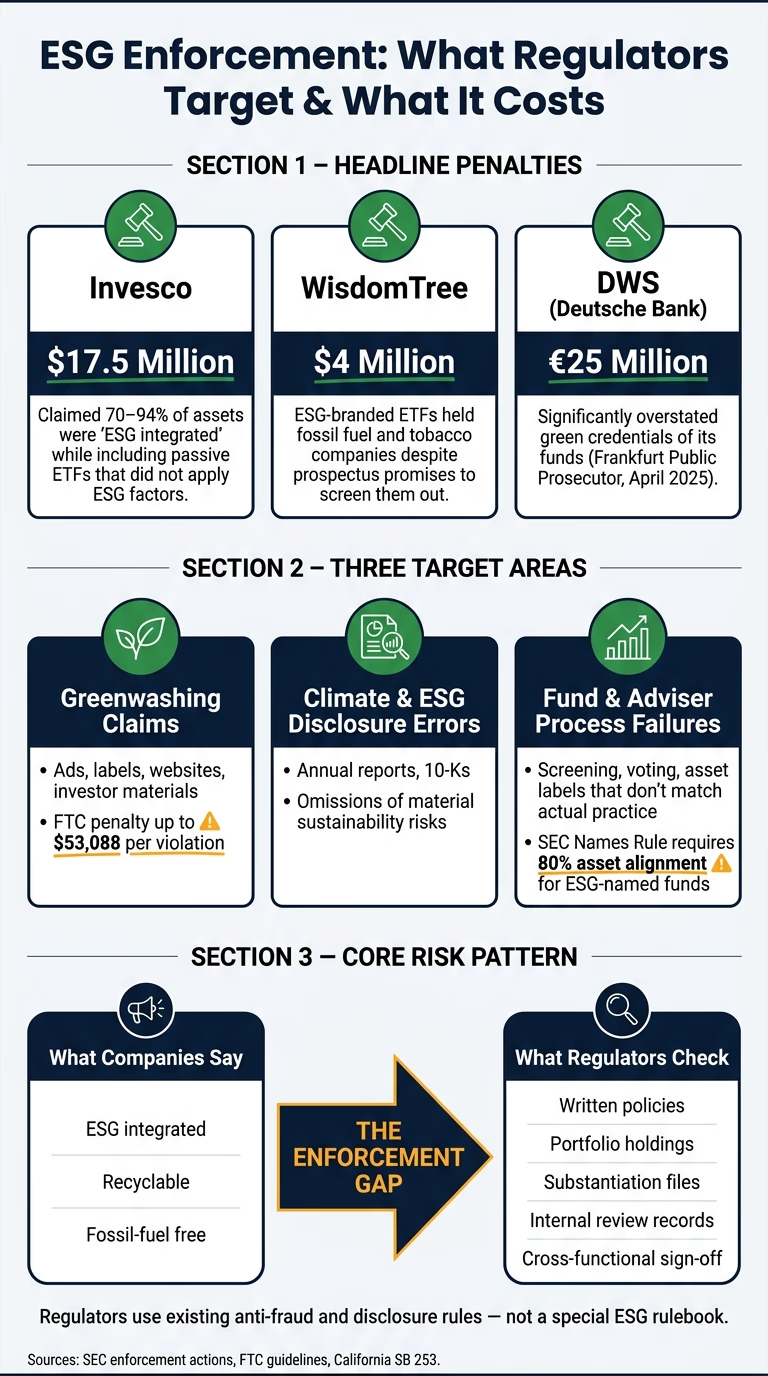
ESG Enforcement Actions: Key Penalties & Regulatory Triggers
ESG Regulatory Developments in the US | Compliance & Risks
The main areas regulators target
Most of these cases land in three buckets: marketing claims, regulated disclosures, and investment-process compliance. The trigger changes from case to case, but the thread running through all of them is simple: public claims that cannot be backed up with documented evidence.
Greenwashing and misleading ESG claims
Regulators look closely at environmental marketing claims across packaging, websites, and investor materials. If a company makes a claim, the proof behind it has to line up. Words like "eco-friendly", "sustainable", or "green" can draw scrutiny when they appear without clear limits or third-party certification. In plain terms, vague language can become a problem fast.
A label such as "recyclable" needs more than good intentions. A company has to show that recycling systems are in place for that product in the markets where it is sold. The Keurig Dr Pepper case put that point in black and white when the SEC found the company had failed to disclose that two of the largest U.S. recycling companies had raised serious concerns about K-Cup pod recyclability [2].
The FTC can impose civil penalties of up to $53,088 per violation for deceptive environmental marketing [9]. On top of that, state attorneys general in California, New York, and Washington are adding pressure, which turns greenwashing into a multi-front risk [7][9].
That same need for proof does not stop at advertising. It carries into SEC filings too, where leaving out key facts can be just as risky as saying something false.
Climate-risk and sustainability disclosure misstatements
This area covers what companies say - or fail to say - in regulated filings such as 10-Ks and annual reports. Regulators look for material omissions or inaccurate statements tied to emissions data, transition plans, supply chain risks, and sustainability commitments.
As SEC Associate Regional Director John Dugan stated after the Keurig Dr Pepper settlement:
"When a company speaks to an issue in its annual report, they are required to provide information necessary for investors to get the full picture on that issue so that investors can make educated investment decisions." [2]
That quote gets to the heart of the issue. If a company opens the door on climate or sustainability topics, it cannot leave investors with half the story. Omitted material risks can trigger enforcement under existing anti-fraud rules. California's SB 253 adds another layer: companies with over $1 billion in revenue doing business in California must report Scope 1 and Scope 2 emissions starting with the 2026 reporting year [8].
For funds and advisers, the next question is straightforward: does the ESG process sold to clients match what happens inside the portfolio?
Fund, adviser, and governance compliance failures
For investment funds and advisers, enforcement often comes down to whether the actual investment process matches what was marketed. The SEC reviews written policies, portfolio holdings, investment committee notes, and prospectuses to see whether the stated ESG screening or research methods were in fact followed.
The WisdomTree case shows how this plays out. In October 2024, the firm paid $4 million to settle SEC charges that three ESG-branded ETFs had invested in fossil fuel and tobacco companies despite prospectus promises to screen them out [5]. The SEC said the marketed ESG process did not match the actual investment process.
The SEC's Names Rule adds a clear compliance test: funds with "ESG" or "sustainability" in their name must invest at least 80% of assets accordingly, with compliance deadlines of June 2026 for large funds and December 2026 for smaller ones [9].
What recent enforcement patterns show
The cases above show a clear pattern in how regulators put ESG enforcement actions together. Recent settlements keep circling back to two gaps: public ESG claims that go further than day-to-day practice, and weak controls that allow that gap to stick around.
Claims that outpace actual practice
Invesco was fined $17.5 million after telling investors that 70% to 94% of its assets were "ESG integrated" while including passive ETFs that did not apply ESG factors [1].
WisdomTree was fined $4 million after marketing ETFs as excluding fossil fuel and tobacco companies while holdings still included companies in those industries [6].
What stands out in both matters is simple. The issue was not only the statement made to investors. It was also the lack of controls that should have caught the mismatch before it reached the market. In both cases, the firms described their ESG approach in stronger terms than their internal processes could back up.
Weak documentation and inconsistent oversight
The same review standard shows up across these cases: regulators check whether disclosures, written policies, and supervision line up. One recurring problem is thin documentation around ESG terms. Another is leaning too heavily on third-party data without checking it on the firm's own side.
DWS shows that overstated ESG positioning is drawing the same kind of scrutiny outside the SEC's enforcement program. In April 2025, Deutsche Bank's asset management arm was fined €25 million by the Frankfurt Public Prosecutor's Office after an investigation found it had significantly overstated the green credentials of its funds [3].
The pattern is hard to miss. Regulators are not only going after false ESG claims. They're also going after the control failures that let those claims remain in place. That is why documentation and supervision now carry as much weight as the ESG statement itself.
Why these cases matter for organizational risk
These cases make one thing plain: ESG enforcement now brings legal, financial, and governance risk that goes far beyond the first disclosure problem. The main danger is not just the fine. It’s the chain reaction that can follow across disclosure, litigation, and board oversight.
ESG statements are treated like other regulated disclosures
Recent enforcement draws a hard line: an ESG claim is no longer just a marketing or communications call. Once an ESG statement shows up in investor-facing disclosures, regulators review it under the same anti-fraud rules that apply to any other statement. If a claim about sustainability, ESG integration, or environmental performance matters to investors, it carries the same legal weight as other regulated disclosures.
Recent SEC actions show that incomplete ESG disclosures in annual reports can lead to civil penalties. Private lawsuits and state enforcement are also adding pressure. But that’s only one side of the problem. The controls behind the statement matter just as much.
Process failures can matter as much as headline misstatements
In recent cases, the trouble did not stop with the public claim itself. Missing written policies, uneven data oversight, and no legal or finance sign-off have all come up. That pattern tells a bigger story: cross-functional ESG reporting breaks down when marketing, investor relations, sustainability, legal, finance, and audit are not working from the same review standard.
As A&O Shearman notes, claims and disclosures should be evidence-based and verifiable, and marketing, investor relations, and sustainability functions should be integrated with legal, finance, and internal audit [4].
Under Caremark, directors can face personal liability if they fail to maintain reporting systems for mission-critical ESG risks.
Conclusion: The control areas leaders should review first
Recent ESG cases point to the same weak spots again and again: greenwashing, false or shaky climate and sustainability disclosures, and failures in fund or governance processes. The thread running through all of them is simple. There’s a gap between what a company says about ESG and the controls it can prove were in place.
The first areas leaders should check are pretty direct. Tighten disclosure governance. Make sure language matches across every channel. Keep substantiation files for each specific claim. Document how ESG data was reviewed and how decisions were made. Those basic controls often make the difference between a routine disclosure problem and an enforcement case.
Specific claims need matching proof. Pressure from regulators is climbing, and weak substantiation can now lead to faster and broader enforcement risk. That’s why ESG controls should be treated as compliance infrastructure, not just support for communications. In many cases, enforcement is driven less by the ESG topic itself and more by process breakdowns that allow unsupported claims to reach the market.
FAQs
What counts as proof for an ESG claim?
Proof for an ESG claim means backing that shows the statement is true, specific, and not misleading.
In the United States, regulators usually expect competent, reliable scientific evidence. That can include research or testing done by qualified experts using accepted methods. Courts also look at claims as a whole, not in isolation. In plain terms, the proof has to match the exact environmental benefit being claimed, not just broad or aspirational language.
Who inside a company should review ESG statements?
ESG statements should be reviewed by legal counsel with deep experience in securities disclosure and compliance.
These disclosures can carry the same legal weight as financial filings. That means they need strong internal controls and formal legal sign-off to help prevent misstatements. If a company treats sustainability reporting as just a communications exercise, it can face more litigation and enforcement risk.
How can firms test whether ESG practice matches ESG messaging?
Firms need to support ESG claims with specific, verifiable evidence rather than vague promises or broad language. Regulators are taking a close look at whether public environmental and social statements are clear, easy to spot, and in line with actual strategy and performance.
One way to cut risk is through more detailed reporting, outside assurance, and internal audits. Those checks help confirm that claims such as recycling or carbon neutrality match technical standards and verified emissions data.
Related Blog Posts
Latest Articles
©2026

Narrative Change and Power Building: The Missing Half of Advocacy
Narrative change is the process of disrupting dominant narratives that normalize inequity and advancing new narratives from historically marginalized communities.

Funding Resilience Without Federal Grants
BRIC is unreliable and FEMA is shrinking. Here's how cities fund climate resilience with dedicated revenue, blended finance, and a coordinating authority.

The ESG Blind Spot: How AI Is Finding Risks in Companies Nobody Else Is Watching
Norway's sovereign wealth fund uses AI to screen 7,200 portfolio companies for forced labor and corruption within 24 hours. The real story is the emerging-market coverage gap that traditional ESG data vendors miss — and what it means for any company with a global supply chain.
Narrative Change and Power Building: The Missing Half of Advocacy
Narrative change is the process of disrupting dominant narratives that normalize inequity and advancing new narratives from historically marginalized communities.
Funding Resilience Without Federal Grants
BRIC is unreliable and FEMA is shrinking. Here's how cities fund climate resilience with dedicated revenue, blended finance, and a coordinating authority.
The ESG Blind Spot: How AI Is Finding Risks in Companies Nobody Else Is Watching
Norway's sovereign wealth fund uses AI to screen 7,200 portfolio companies for forced labor and corruption within 24 hours. The real story is the emerging-market coverage gap that traditional ESG data vendors miss — and what it means for any company with a global supply chain.
FAQ
01
What does it really mean to “redefine profit”?
02
What makes Council Fire different?
03
Who does Council Fire work with?
04
What does working with Council Fire actually look like?
05
How does Council Fire help organizations turn big goals into action?
06
How does Council Fire define and measure success?
07
How does technology fit into Council Fire’s work?
Jul 7, 2026
ESG Enforcement Actions: What Regulators Target
ESG Strategy
In This Article
Regulators are cracking down on unsupported ESG claims, disclosure gaps, and weak fund controls—proof and documentation are required.
ESG Enforcement Actions: What Regulators Target
ESG enforcement is now a plain disclosure and controls issue. If you tell investors, buyers, or clients that a product, fund, or company follows ESG standards, regulators expect proof. Recent cases show the pattern: claims went beyond facts, reviews were weak, and firms paid for it.
If I had to sum up the article in a few lines, I’d put it this way:
The SEC is targeting unsupported ESG claims
Marketing, filings, and fund materials are all in scope
Weak policies, poor records, and loose review steps often sit behind the problem
Penalties are already real:Invesco paid $17.5 million, WisdomTree paid $4 million, and Keurig Dr Pepper settled over disclosure gaps tied to recyclability statements
Other regulators matter too: the FTC can seek up to $53,088 per violation for deceptive green marketing, and state officials are adding pressure
What stands out most is simple: regulators are not waiting for a special ESG rule set. They are using existing anti-fraud, disclosure, and fund compliance rules. That means the main risk is not the label “ESG” by itself. The risk is the gap between what you say and what your records, screens, data, and approvals show.
For me, the article boils down to three target areas:
Greenwashing claims in ads, labels, websites, and investor materials
Climate and ESG disclosure errors in annual reports and other filings
Fund and adviser process failures where screening, voting, or asset labels do not match practice
The core lesson is clear: ESG statements are being treated like other regulated statements. If a claim matters to investors, you need support for it, internal review, and records that hold up under scrutiny.
Before reading the rest, here’s the shortest takeaway: check your claim language, match it to actual practice, and keep written proof for each statement.
ESG Enforcement Actions: Key Penalties & Regulatory Triggers
ESG Regulatory Developments in the US | Compliance & Risks
The main areas regulators target
Most of these cases land in three buckets: marketing claims, regulated disclosures, and investment-process compliance. The trigger changes from case to case, but the thread running through all of them is simple: public claims that cannot be backed up with documented evidence.
Greenwashing and misleading ESG claims
Regulators look closely at environmental marketing claims across packaging, websites, and investor materials. If a company makes a claim, the proof behind it has to line up. Words like "eco-friendly", "sustainable", or "green" can draw scrutiny when they appear without clear limits or third-party certification. In plain terms, vague language can become a problem fast.
A label such as "recyclable" needs more than good intentions. A company has to show that recycling systems are in place for that product in the markets where it is sold. The Keurig Dr Pepper case put that point in black and white when the SEC found the company had failed to disclose that two of the largest U.S. recycling companies had raised serious concerns about K-Cup pod recyclability [2].
The FTC can impose civil penalties of up to $53,088 per violation for deceptive environmental marketing [9]. On top of that, state attorneys general in California, New York, and Washington are adding pressure, which turns greenwashing into a multi-front risk [7][9].
That same need for proof does not stop at advertising. It carries into SEC filings too, where leaving out key facts can be just as risky as saying something false.
Climate-risk and sustainability disclosure misstatements
This area covers what companies say - or fail to say - in regulated filings such as 10-Ks and annual reports. Regulators look for material omissions or inaccurate statements tied to emissions data, transition plans, supply chain risks, and sustainability commitments.
As SEC Associate Regional Director John Dugan stated after the Keurig Dr Pepper settlement:
"When a company speaks to an issue in its annual report, they are required to provide information necessary for investors to get the full picture on that issue so that investors can make educated investment decisions." [2]
That quote gets to the heart of the issue. If a company opens the door on climate or sustainability topics, it cannot leave investors with half the story. Omitted material risks can trigger enforcement under existing anti-fraud rules. California's SB 253 adds another layer: companies with over $1 billion in revenue doing business in California must report Scope 1 and Scope 2 emissions starting with the 2026 reporting year [8].
For funds and advisers, the next question is straightforward: does the ESG process sold to clients match what happens inside the portfolio?
Fund, adviser, and governance compliance failures
For investment funds and advisers, enforcement often comes down to whether the actual investment process matches what was marketed. The SEC reviews written policies, portfolio holdings, investment committee notes, and prospectuses to see whether the stated ESG screening or research methods were in fact followed.
The WisdomTree case shows how this plays out. In October 2024, the firm paid $4 million to settle SEC charges that three ESG-branded ETFs had invested in fossil fuel and tobacco companies despite prospectus promises to screen them out [5]. The SEC said the marketed ESG process did not match the actual investment process.
The SEC's Names Rule adds a clear compliance test: funds with "ESG" or "sustainability" in their name must invest at least 80% of assets accordingly, with compliance deadlines of June 2026 for large funds and December 2026 for smaller ones [9].
What recent enforcement patterns show
The cases above show a clear pattern in how regulators put ESG enforcement actions together. Recent settlements keep circling back to two gaps: public ESG claims that go further than day-to-day practice, and weak controls that allow that gap to stick around.
Claims that outpace actual practice
Invesco was fined $17.5 million after telling investors that 70% to 94% of its assets were "ESG integrated" while including passive ETFs that did not apply ESG factors [1].
WisdomTree was fined $4 million after marketing ETFs as excluding fossil fuel and tobacco companies while holdings still included companies in those industries [6].
What stands out in both matters is simple. The issue was not only the statement made to investors. It was also the lack of controls that should have caught the mismatch before it reached the market. In both cases, the firms described their ESG approach in stronger terms than their internal processes could back up.
Weak documentation and inconsistent oversight
The same review standard shows up across these cases: regulators check whether disclosures, written policies, and supervision line up. One recurring problem is thin documentation around ESG terms. Another is leaning too heavily on third-party data without checking it on the firm's own side.
DWS shows that overstated ESG positioning is drawing the same kind of scrutiny outside the SEC's enforcement program. In April 2025, Deutsche Bank's asset management arm was fined €25 million by the Frankfurt Public Prosecutor's Office after an investigation found it had significantly overstated the green credentials of its funds [3].
The pattern is hard to miss. Regulators are not only going after false ESG claims. They're also going after the control failures that let those claims remain in place. That is why documentation and supervision now carry as much weight as the ESG statement itself.
Why these cases matter for organizational risk
These cases make one thing plain: ESG enforcement now brings legal, financial, and governance risk that goes far beyond the first disclosure problem. The main danger is not just the fine. It’s the chain reaction that can follow across disclosure, litigation, and board oversight.
ESG statements are treated like other regulated disclosures
Recent enforcement draws a hard line: an ESG claim is no longer just a marketing or communications call. Once an ESG statement shows up in investor-facing disclosures, regulators review it under the same anti-fraud rules that apply to any other statement. If a claim about sustainability, ESG integration, or environmental performance matters to investors, it carries the same legal weight as other regulated disclosures.
Recent SEC actions show that incomplete ESG disclosures in annual reports can lead to civil penalties. Private lawsuits and state enforcement are also adding pressure. But that’s only one side of the problem. The controls behind the statement matter just as much.
Process failures can matter as much as headline misstatements
In recent cases, the trouble did not stop with the public claim itself. Missing written policies, uneven data oversight, and no legal or finance sign-off have all come up. That pattern tells a bigger story: cross-functional ESG reporting breaks down when marketing, investor relations, sustainability, legal, finance, and audit are not working from the same review standard.
As A&O Shearman notes, claims and disclosures should be evidence-based and verifiable, and marketing, investor relations, and sustainability functions should be integrated with legal, finance, and internal audit [4].
Under Caremark, directors can face personal liability if they fail to maintain reporting systems for mission-critical ESG risks.
Conclusion: The control areas leaders should review first
Recent ESG cases point to the same weak spots again and again: greenwashing, false or shaky climate and sustainability disclosures, and failures in fund or governance processes. The thread running through all of them is simple. There’s a gap between what a company says about ESG and the controls it can prove were in place.
The first areas leaders should check are pretty direct. Tighten disclosure governance. Make sure language matches across every channel. Keep substantiation files for each specific claim. Document how ESG data was reviewed and how decisions were made. Those basic controls often make the difference between a routine disclosure problem and an enforcement case.
Specific claims need matching proof. Pressure from regulators is climbing, and weak substantiation can now lead to faster and broader enforcement risk. That’s why ESG controls should be treated as compliance infrastructure, not just support for communications. In many cases, enforcement is driven less by the ESG topic itself and more by process breakdowns that allow unsupported claims to reach the market.
FAQs
What counts as proof for an ESG claim?
Proof for an ESG claim means backing that shows the statement is true, specific, and not misleading.
In the United States, regulators usually expect competent, reliable scientific evidence. That can include research or testing done by qualified experts using accepted methods. Courts also look at claims as a whole, not in isolation. In plain terms, the proof has to match the exact environmental benefit being claimed, not just broad or aspirational language.
Who inside a company should review ESG statements?
ESG statements should be reviewed by legal counsel with deep experience in securities disclosure and compliance.
These disclosures can carry the same legal weight as financial filings. That means they need strong internal controls and formal legal sign-off to help prevent misstatements. If a company treats sustainability reporting as just a communications exercise, it can face more litigation and enforcement risk.
How can firms test whether ESG practice matches ESG messaging?
Firms need to support ESG claims with specific, verifiable evidence rather than vague promises or broad language. Regulators are taking a close look at whether public environmental and social statements are clear, easy to spot, and in line with actual strategy and performance.
One way to cut risk is through more detailed reporting, outside assurance, and internal audits. Those checks help confirm that claims such as recycling or carbon neutrality match technical standards and verified emissions data.
Related Blog Posts
Latest Articles
©2026
Narrative Change and Power Building: The Missing Half of Advocacy
Narrative change is the process of disrupting dominant narratives that normalize inequity and advancing new narratives from historically marginalized communities.
Funding Resilience Without Federal Grants
BRIC is unreliable and FEMA is shrinking. Here's how cities fund climate resilience with dedicated revenue, blended finance, and a coordinating authority.
The ESG Blind Spot: How AI Is Finding Risks in Companies Nobody Else Is Watching
Norway's sovereign wealth fund uses AI to screen 7,200 portfolio companies for forced labor and corruption within 24 hours. The real story is the emerging-market coverage gap that traditional ESG data vendors miss — and what it means for any company with a global supply chain.
FAQ
01
What does it really mean to “redefine profit”?
02
What makes Council Fire different?
03
Who does Council Fire work with?
04
What does working with Council Fire actually look like?
05
How does Council Fire help organizations turn big goals into action?
06
How does Council Fire define and measure success?
07
How does technology fit into Council Fire’s work?
Jul 7, 2026
ESG Enforcement Actions: What Regulators Target
ESG Strategy
In This Article
Regulators are cracking down on unsupported ESG claims, disclosure gaps, and weak fund controls—proof and documentation are required.
ESG Enforcement Actions: What Regulators Target
ESG enforcement is now a plain disclosure and controls issue. If you tell investors, buyers, or clients that a product, fund, or company follows ESG standards, regulators expect proof. Recent cases show the pattern: claims went beyond facts, reviews were weak, and firms paid for it.
If I had to sum up the article in a few lines, I’d put it this way:
The SEC is targeting unsupported ESG claims
Marketing, filings, and fund materials are all in scope
Weak policies, poor records, and loose review steps often sit behind the problem
Penalties are already real:Invesco paid $17.5 million, WisdomTree paid $4 million, and Keurig Dr Pepper settled over disclosure gaps tied to recyclability statements
Other regulators matter too: the FTC can seek up to $53,088 per violation for deceptive green marketing, and state officials are adding pressure
What stands out most is simple: regulators are not waiting for a special ESG rule set. They are using existing anti-fraud, disclosure, and fund compliance rules. That means the main risk is not the label “ESG” by itself. The risk is the gap between what you say and what your records, screens, data, and approvals show.
For me, the article boils down to three target areas:
Greenwashing claims in ads, labels, websites, and investor materials
Climate and ESG disclosure errors in annual reports and other filings
Fund and adviser process failures where screening, voting, or asset labels do not match practice
The core lesson is clear: ESG statements are being treated like other regulated statements. If a claim matters to investors, you need support for it, internal review, and records that hold up under scrutiny.
Before reading the rest, here’s the shortest takeaway: check your claim language, match it to actual practice, and keep written proof for each statement.
ESG Enforcement Actions: Key Penalties & Regulatory Triggers
ESG Regulatory Developments in the US | Compliance & Risks
The main areas regulators target
Most of these cases land in three buckets: marketing claims, regulated disclosures, and investment-process compliance. The trigger changes from case to case, but the thread running through all of them is simple: public claims that cannot be backed up with documented evidence.
Greenwashing and misleading ESG claims
Regulators look closely at environmental marketing claims across packaging, websites, and investor materials. If a company makes a claim, the proof behind it has to line up. Words like "eco-friendly", "sustainable", or "green" can draw scrutiny when they appear without clear limits or third-party certification. In plain terms, vague language can become a problem fast.
A label such as "recyclable" needs more than good intentions. A company has to show that recycling systems are in place for that product in the markets where it is sold. The Keurig Dr Pepper case put that point in black and white when the SEC found the company had failed to disclose that two of the largest U.S. recycling companies had raised serious concerns about K-Cup pod recyclability [2].
The FTC can impose civil penalties of up to $53,088 per violation for deceptive environmental marketing [9]. On top of that, state attorneys general in California, New York, and Washington are adding pressure, which turns greenwashing into a multi-front risk [7][9].
That same need for proof does not stop at advertising. It carries into SEC filings too, where leaving out key facts can be just as risky as saying something false.
Climate-risk and sustainability disclosure misstatements
This area covers what companies say - or fail to say - in regulated filings such as 10-Ks and annual reports. Regulators look for material omissions or inaccurate statements tied to emissions data, transition plans, supply chain risks, and sustainability commitments.
As SEC Associate Regional Director John Dugan stated after the Keurig Dr Pepper settlement:
"When a company speaks to an issue in its annual report, they are required to provide information necessary for investors to get the full picture on that issue so that investors can make educated investment decisions." [2]
That quote gets to the heart of the issue. If a company opens the door on climate or sustainability topics, it cannot leave investors with half the story. Omitted material risks can trigger enforcement under existing anti-fraud rules. California's SB 253 adds another layer: companies with over $1 billion in revenue doing business in California must report Scope 1 and Scope 2 emissions starting with the 2026 reporting year [8].
For funds and advisers, the next question is straightforward: does the ESG process sold to clients match what happens inside the portfolio?
Fund, adviser, and governance compliance failures
For investment funds and advisers, enforcement often comes down to whether the actual investment process matches what was marketed. The SEC reviews written policies, portfolio holdings, investment committee notes, and prospectuses to see whether the stated ESG screening or research methods were in fact followed.
The WisdomTree case shows how this plays out. In October 2024, the firm paid $4 million to settle SEC charges that three ESG-branded ETFs had invested in fossil fuel and tobacco companies despite prospectus promises to screen them out [5]. The SEC said the marketed ESG process did not match the actual investment process.
The SEC's Names Rule adds a clear compliance test: funds with "ESG" or "sustainability" in their name must invest at least 80% of assets accordingly, with compliance deadlines of June 2026 for large funds and December 2026 for smaller ones [9].
What recent enforcement patterns show
The cases above show a clear pattern in how regulators put ESG enforcement actions together. Recent settlements keep circling back to two gaps: public ESG claims that go further than day-to-day practice, and weak controls that allow that gap to stick around.
Claims that outpace actual practice
Invesco was fined $17.5 million after telling investors that 70% to 94% of its assets were "ESG integrated" while including passive ETFs that did not apply ESG factors [1].
WisdomTree was fined $4 million after marketing ETFs as excluding fossil fuel and tobacco companies while holdings still included companies in those industries [6].
What stands out in both matters is simple. The issue was not only the statement made to investors. It was also the lack of controls that should have caught the mismatch before it reached the market. In both cases, the firms described their ESG approach in stronger terms than their internal processes could back up.
Weak documentation and inconsistent oversight
The same review standard shows up across these cases: regulators check whether disclosures, written policies, and supervision line up. One recurring problem is thin documentation around ESG terms. Another is leaning too heavily on third-party data without checking it on the firm's own side.
DWS shows that overstated ESG positioning is drawing the same kind of scrutiny outside the SEC's enforcement program. In April 2025, Deutsche Bank's asset management arm was fined €25 million by the Frankfurt Public Prosecutor's Office after an investigation found it had significantly overstated the green credentials of its funds [3].
The pattern is hard to miss. Regulators are not only going after false ESG claims. They're also going after the control failures that let those claims remain in place. That is why documentation and supervision now carry as much weight as the ESG statement itself.
Why these cases matter for organizational risk
These cases make one thing plain: ESG enforcement now brings legal, financial, and governance risk that goes far beyond the first disclosure problem. The main danger is not just the fine. It’s the chain reaction that can follow across disclosure, litigation, and board oversight.
ESG statements are treated like other regulated disclosures
Recent enforcement draws a hard line: an ESG claim is no longer just a marketing or communications call. Once an ESG statement shows up in investor-facing disclosures, regulators review it under the same anti-fraud rules that apply to any other statement. If a claim about sustainability, ESG integration, or environmental performance matters to investors, it carries the same legal weight as other regulated disclosures.
Recent SEC actions show that incomplete ESG disclosures in annual reports can lead to civil penalties. Private lawsuits and state enforcement are also adding pressure. But that’s only one side of the problem. The controls behind the statement matter just as much.
Process failures can matter as much as headline misstatements
In recent cases, the trouble did not stop with the public claim itself. Missing written policies, uneven data oversight, and no legal or finance sign-off have all come up. That pattern tells a bigger story: cross-functional ESG reporting breaks down when marketing, investor relations, sustainability, legal, finance, and audit are not working from the same review standard.
As A&O Shearman notes, claims and disclosures should be evidence-based and verifiable, and marketing, investor relations, and sustainability functions should be integrated with legal, finance, and internal audit [4].
Under Caremark, directors can face personal liability if they fail to maintain reporting systems for mission-critical ESG risks.
Conclusion: The control areas leaders should review first
Recent ESG cases point to the same weak spots again and again: greenwashing, false or shaky climate and sustainability disclosures, and failures in fund or governance processes. The thread running through all of them is simple. There’s a gap between what a company says about ESG and the controls it can prove were in place.
The first areas leaders should check are pretty direct. Tighten disclosure governance. Make sure language matches across every channel. Keep substantiation files for each specific claim. Document how ESG data was reviewed and how decisions were made. Those basic controls often make the difference between a routine disclosure problem and an enforcement case.
Specific claims need matching proof. Pressure from regulators is climbing, and weak substantiation can now lead to faster and broader enforcement risk. That’s why ESG controls should be treated as compliance infrastructure, not just support for communications. In many cases, enforcement is driven less by the ESG topic itself and more by process breakdowns that allow unsupported claims to reach the market.
FAQs
What counts as proof for an ESG claim?
Proof for an ESG claim means backing that shows the statement is true, specific, and not misleading.
In the United States, regulators usually expect competent, reliable scientific evidence. That can include research or testing done by qualified experts using accepted methods. Courts also look at claims as a whole, not in isolation. In plain terms, the proof has to match the exact environmental benefit being claimed, not just broad or aspirational language.
Who inside a company should review ESG statements?
ESG statements should be reviewed by legal counsel with deep experience in securities disclosure and compliance.
These disclosures can carry the same legal weight as financial filings. That means they need strong internal controls and formal legal sign-off to help prevent misstatements. If a company treats sustainability reporting as just a communications exercise, it can face more litigation and enforcement risk.
How can firms test whether ESG practice matches ESG messaging?
Firms need to support ESG claims with specific, verifiable evidence rather than vague promises or broad language. Regulators are taking a close look at whether public environmental and social statements are clear, easy to spot, and in line with actual strategy and performance.
One way to cut risk is through more detailed reporting, outside assurance, and internal audits. Those checks help confirm that claims such as recycling or carbon neutrality match technical standards and verified emissions data.
Related Blog Posts
Latest Articles
©2026
Narrative Change and Power Building: The Missing Half of Advocacy
Narrative change is the process of disrupting dominant narratives that normalize inequity and advancing new narratives from historically marginalized communities.
Funding Resilience Without Federal Grants
BRIC is unreliable and FEMA is shrinking. Here's how cities fund climate resilience with dedicated revenue, blended finance, and a coordinating authority.
The ESG Blind Spot: How AI Is Finding Risks in Companies Nobody Else Is Watching
Norway's sovereign wealth fund uses AI to screen 7,200 portfolio companies for forced labor and corruption within 24 hours. The real story is the emerging-market coverage gap that traditional ESG data vendors miss — and what it means for any company with a global supply chain.
FAQ
What does it really mean to “redefine profit”?
What makes Council Fire different?
Who does Council Fire work with?
What does working with Council Fire actually look like?
How does Council Fire help organizations turn big goals into action?
How does Council Fire define and measure success?
How does technology fit into Council Fire’s work?