
Jul 1, 2026
How Policy Advocacy Aligns Stakeholders
Sustainability Strategy
In This Article
Align sustainability and government affairs with clear policy goals, governance, stakeholder mapping, and measurement.
How Policy Advocacy Aligns Stakeholders
If your climate goals and your lobbying do not match, people notice. I see policy advocacy as a way to keep investors, employees, regulators, customers, and communities moving toward the same policy goals - if the work starts with shared priorities, clear rules, and regular review.
Here’s the short version:
I link each climate or social target to the policy conditions needed to reach it.
I set 5–10 clear policy positions before external outreach starts.
I make Sustainability and Government Affairs work from the same facts, owners, and decision rules.
I map stakeholders by influence, interest, and issue impact.
I choose the lightest level of engagement that still fits the issue.
I track whether public statements and lobbying activity stay in line.
A few facts in the piece stand out: only 30% of companies align government affairs with corporate responsibility commitments, and one February 2026 coalition example linked a 50% emissions cut by 2030 with $280 million in coordinated climate investment. To me, that shows a simple point: advocacy works better when teams agree on the target, the message, and who owns what.
What matters most is not more outreach. It is shared goals, one internal process, and steady measurement so small gaps do not turn into trust problems.
2. Set shared policy goals before engaging stakeholders
Before you bring stakeholders into the room, get clear on the policy outcomes your sustainability plan depends on. If that work isn't done first, advocacy tends to scatter in too many directions, and people are left reacting to broad intent instead of a clear aim. Shared policy goals turn sustainability plans into something people can line up behind.
Map sustainability targets to policy priorities
Most sustainability teams have targets. Far fewer have tied those targets to the policy conditions needed to hit them. A net-zero pledge, for example, rests on outside policy conditions such as grid decarbonization, carbon pricing, or support for new technology. The same pattern shows up across other material sustainability priorities.
When you connect each target to a policy lever, Sustainability and Government Affairs can work toward one execution-focused objective. That gives each stakeholder group a concrete policy anchor, not just a broad climate ambition. One useful habit is to build a common fact base so both teams use the same assumptions on timelines, costs, and constraints.
Those mapped priorities then become the basis for policy guardrails and internal alignment.
Use responsible policy engagement principles
Once you have a working set of policy priorities, the next step is to put guardrails around them. These are the rules that keep advocacy credible as scrutiny grows. WRI reports that only 30% of companies align government affairs with corporate responsibility commitments [3].
Five principles help close that gap: legitimacy, opportunity, accountability, consistency, and transparency [3]. Set 5–10 non-negotiables early. These should cover policy positions that must stay in line with climate commitments, along with the areas where implementation can shift.
With those guardrails in place, document which priorities matter across each stakeholder group.
Document shared priorities across stakeholder groups
Find shared policy priorities through direct input from the stakeholders involved. The goal is simple: turn that input into a short, usable list of 5–10 policy positions, each with a clear owner and an escalation path [1].
Council Fire used this approach in a February 2026 regional climate compact. Interviews across participating organizations aligned the group around a 50% emissions reduction target by 2030 and unlocked coordinated investment. The value was not the target alone; it was the shared process that made agreement possible.
Once those priorities are documented, the next move is to map which stakeholders influence each one.
3. Map stakeholders and choose the right level of engagement
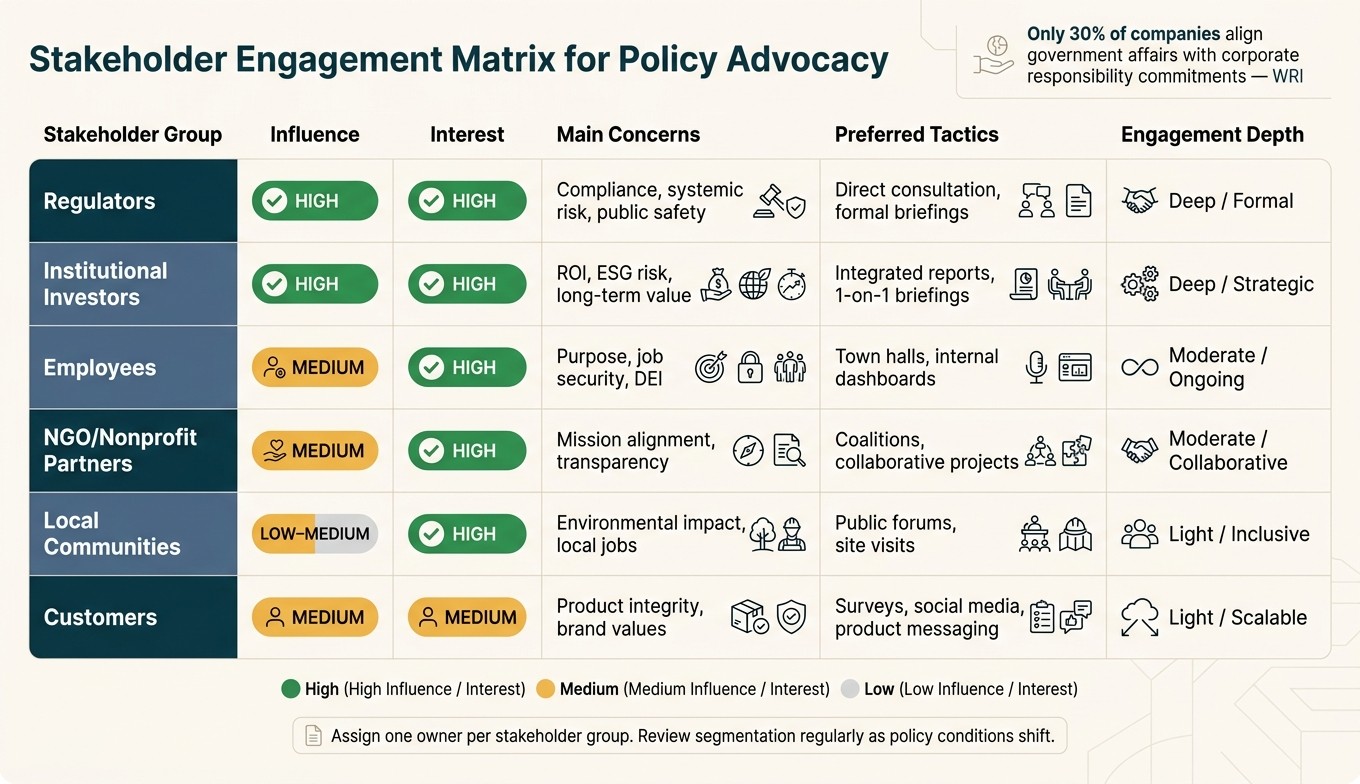
Stakeholder Engagement Matrix for Policy Advocacy
Map each policy priority to the people and groups that can help shape it. That simple step turns a broad set of policy goals into a plan your team can actually use.
Start with each documented policy position, then connect it to the stakeholders most likely to influence the outcome. Once that map is in place, it becomes much easier to see where to spend time, where to go deeper, and where a lighter touch will do the job.
Segment stakeholders by influence, interest, and policy impact
Sort stakeholders by influence and interest first. Regulators and institutional investors usually sit high on both. Employees and local communities often care a great deal, even if they have less direct power over policy decisions. If you're working through coalitions, add two more lenses: climate ambition and implementation feasibility.
Influence tells you who can move the issue. Engagement depth tells you how to work with them.
Match engagement depth to stakeholder needs
Use the lightest level of engagement that still fits the stakeholder's influence. That keeps effort focused and avoids overbuilding the process. The right depth depends on two things: how much sway the stakeholder has and how sensitive the policy issue is.
It also helps to assign one owner per stakeholder group. That way, follow-up stays steady, communication doesn't drift, and accountability remains clear.
Stakeholder comparison table
Use the table below to match each stakeholder group to the right level of contact.
Stakeholder Group | Influence | Interest | Main Concerns | Preferred Tactics |
|---|---|---|---|---|
Regulators | High | High | Compliance, systemic risk, public safety | Direct consultation, formal briefings |
Institutional Investors | High | High | ROI, ESG risk, long-term value | Integrated reports, 1-on-1 briefings |
Employees | Medium | High | Purpose, job security, DEI | Town halls, internal dashboards |
NGO/Nonprofit Partners | Medium | High | Mission alignment, transparency | Coalitions, collaborative projects |
Local Communities | Low–Medium | High | Environmental impact, local jobs | Public forums, site visits |
Customers | Medium | Medium | Product integrity, brand values | Surveys, social media, product messaging |
Treat this table as a starting point, not a fixed map. Stakeholder views can shift as rules change, pressure builds, and new alliances take shape. Review your segmentation on a regular basis, then adjust engagement levels to match what's happening on the ground.
4. Build an advocacy strategy that keeps stakeholders aligned
Once you’ve mapped your stakeholders and matched the level of engagement to what each group needs, the next job is coordination. This is where many teams stumble. They head out to meet policymakers, partners, investors, or employees before they’ve sorted out who decides what internally. If the inside isn’t aligned, the outside message won’t be either.
Create internal governance for advocacy decisions
Once stakeholders are mapped, internal governance keeps each external message consistent.
Start with a shared policy and sustainability agenda: a ranked list of 5–10 policy topics, each with a clear owner and a defined path for escalation. Add standing working sessions between Sustainability and Government Affairs, along with rapid-response protocols for key policy moments. [1]
It helps to separate fixed positions from negotiable details. Fixed positions are the policy stances that need to stay in line with public climate commitments. Negotiable details are the parts of implementation you can adjust without giving up core goals. That line matters. It gives teams room to work while keeping the company from drifting off message.
Use shared goals, shared metrics, and shared transparency so advocacy doesn’t split into siloed efforts.
Trade association memberships need extra care. If an association conflicts with your climate principles, push for change from within first. If that doesn’t work, escalate to leadership. Leave only if alignment still fails. [1]
Use coalitions, employee voices, and public engagement carefully
After the internal rules are in place, decide which voices should speak in public and which should stay in the background.
Coalitions can add weight by bringing many stakeholders into one push. Employee voices can help too, but only if people are briefed from the same fixed positions and the same fact base. Otherwise, internal advocacy can drift into a separate lane and muddy the public message. Public campaigns can work, but they bring more reputational risk and call for tight coordination.
In February 2026, a 35-organization coalition aligned on a 50% emissions reduction target by 2030 and $280 million in coordinated climate investment - demonstrating that shared policy targets, a common reporting rhythm, and one accountability structure are what make coalitions work. [2]
Advocacy tactics comparison table
Not every tactic fits every situation. Use the table below to weigh your options before committing resources.
Advocacy Tactic | Alignment Potential | Credibility | Resource Needs | Risk Level |
|---|---|---|---|---|
Direct Lobbying | High (Direct control) | Moderate | High (Staff/Experts) | High (Perceived self-interest) |
Coalition Participation | Moderate (Shared) | High (Third-party) | Moderate (Pooled) | Low (Shared accountability) |
Public Campaigns | High (Norm-shifting) | High (Public) | High (Media/Comms) | Moderate (Backlash) |
Investor Statements | High (Financial) | High (Market) | Low (Signatory) | Low (Strategic) |
Regulatory Comments | High (Technical) | High (Evidence-based) | Moderate (Data) | Low (Formal process) |
Track which tactics improve alignment and which create friction. Then use that evidence to adjust your approach over time.
5. Measure results and refine your approach
Track alignment and policy outcomes
Once advocacy is in motion, measurement tells you if the alignment plan is doing its job.
After each advocacy cycle, review indicators tied directly to stakeholder alignment: joint meeting cadence between Sustainability and Government Affairs, consistency between public climate positions and lobbying activity, and shared progress on specific policy targets. [1] Also track any new social or environmental risks that come up in stakeholder dialogue, and check whether trade association positions still match your public climate principles.
This step matters because misalignment often shows up in small gaps first. A company may speak one way in public, lobby another way behind the scenes, and not notice the drift until trust starts to slip. Regular review helps catch that early.
Use findings to improve future advocacy
What you measure should shape the next round of advocacy.
Use the findings to reset priorities, ownership, and messaging before the next policy cycle. Rescore stakeholder influence and interest after major policy shifts, then adjust engagement depth to match. Review how Sustainability and Government Affairs are working together. If they are operating in separate lanes, shift toward joint planning, shared metrics, and one external message.
The aim is simple: create a direct action loop. Measure results, reset stakeholder priorities, adjust tactics, and do it again. That kind of rhythm keeps advocacy steady even when the policy landscape changes fast.
Conclusion: What effective policy advocacy achieves
Effective advocacy turns alignment into a repeatable process: shared goals, clear governance, and continuous measurement. Done well, alignment is more than communication - it is a governance advantage, a risk management tool, and a practical edge when regulations shift, funding windows open, or coalitions need to move fast. That discipline makes stakeholder alignment stronger as policy conditions change.
FAQs
How do we set policy goals that support our sustainability targets?
Start with strong internal alignment. Council Fire recommends a shared agenda built around 5 to 10 priority topics, a common fact base, and clear non-negotiables across sustainability and government affairs teams.
Then make sure your policy positions support your transition plans. Set SMART objectives, line them up with benchmarks such as the UN Sustainable Development Goals, and build sustainability into governance so your team can spot policy needs early and push for enabling frameworks.
Which stakeholders should we engage first?
Start with a situation analysis to identify the stakeholders that matter most and what each group cares about. From there, map who holds influence, how people and groups relate to each other, and where support or friction may show up. A simple tool like the Mendelow Power-Interest Matrix or a 2x2 influence-impact matrix helps turn a messy landscape into something you can act on.
In many cases, it makes sense to begin with pragmatic leaders - people who can hold ambition and day-to-day delivery in the same frame. They often help move the work from idea to action. Bringing them in early can build credibility and trust, which makes later conversations with more polarized or cautious groups a lot easier.
How can we tell if our lobbying matches our public climate commitments?
Treat sustainability and government affairs as linked functions, not two separate conversations. Put a formal rule in place to pressure-test trade association positions against your public climate principles, and define a clear path to engage, escalate, or exit when those positions drift out of line.
Annual disclosure matters too. Share your direct lobbying activities and trade association memberships each year so stakeholders can see whether your public stance matches your policy work.
Council Fire can help organizations align advocacy with sustainability goals through stakeholder collaboration and communication.
Related Blog Posts
Latest Articles
©2025

Narrative Change and Power Building: The Missing Half of Advocacy
Narrative change is the process of disrupting dominant narratives that normalize inequity and advancing new narratives from historically marginalized communities.

Funding Resilience Without Federal Grants
BRIC is unreliable and FEMA is shrinking. Here's how cities fund climate resilience with dedicated revenue, blended finance, and a coordinating authority.

The ESG Blind Spot: How AI Is Finding Risks in Companies Nobody Else Is Watching
Norway's sovereign wealth fund uses AI to screen 7,200 portfolio companies for forced labor and corruption within 24 hours. The real story is the emerging-market coverage gap that traditional ESG data vendors miss — and what it means for any company with a global supply chain.
Narrative Change and Power Building: The Missing Half of Advocacy
Narrative change is the process of disrupting dominant narratives that normalize inequity and advancing new narratives from historically marginalized communities.
Funding Resilience Without Federal Grants
BRIC is unreliable and FEMA is shrinking. Here's how cities fund climate resilience with dedicated revenue, blended finance, and a coordinating authority.
The ESG Blind Spot: How AI Is Finding Risks in Companies Nobody Else Is Watching
Norway's sovereign wealth fund uses AI to screen 7,200 portfolio companies for forced labor and corruption within 24 hours. The real story is the emerging-market coverage gap that traditional ESG data vendors miss — and what it means for any company with a global supply chain.
FAQ
01
What does it really mean to “redefine profit”?
02
What makes Council Fire different?
03
Who does Council Fire work with?
04
What does working with Council Fire actually look like?
05
How does Council Fire help organizations turn big goals into action?
06
How does Council Fire define and measure success?
Jul 1, 2026
How Policy Advocacy Aligns Stakeholders
Sustainability Strategy
In This Article
Align sustainability and government affairs with clear policy goals, governance, stakeholder mapping, and measurement.
How Policy Advocacy Aligns Stakeholders
If your climate goals and your lobbying do not match, people notice. I see policy advocacy as a way to keep investors, employees, regulators, customers, and communities moving toward the same policy goals - if the work starts with shared priorities, clear rules, and regular review.
Here’s the short version:
I link each climate or social target to the policy conditions needed to reach it.
I set 5–10 clear policy positions before external outreach starts.
I make Sustainability and Government Affairs work from the same facts, owners, and decision rules.
I map stakeholders by influence, interest, and issue impact.
I choose the lightest level of engagement that still fits the issue.
I track whether public statements and lobbying activity stay in line.
A few facts in the piece stand out: only 30% of companies align government affairs with corporate responsibility commitments, and one February 2026 coalition example linked a 50% emissions cut by 2030 with $280 million in coordinated climate investment. To me, that shows a simple point: advocacy works better when teams agree on the target, the message, and who owns what.
What matters most is not more outreach. It is shared goals, one internal process, and steady measurement so small gaps do not turn into trust problems.
2. Set shared policy goals before engaging stakeholders
Before you bring stakeholders into the room, get clear on the policy outcomes your sustainability plan depends on. If that work isn't done first, advocacy tends to scatter in too many directions, and people are left reacting to broad intent instead of a clear aim. Shared policy goals turn sustainability plans into something people can line up behind.
Map sustainability targets to policy priorities
Most sustainability teams have targets. Far fewer have tied those targets to the policy conditions needed to hit them. A net-zero pledge, for example, rests on outside policy conditions such as grid decarbonization, carbon pricing, or support for new technology. The same pattern shows up across other material sustainability priorities.
When you connect each target to a policy lever, Sustainability and Government Affairs can work toward one execution-focused objective. That gives each stakeholder group a concrete policy anchor, not just a broad climate ambition. One useful habit is to build a common fact base so both teams use the same assumptions on timelines, costs, and constraints.
Those mapped priorities then become the basis for policy guardrails and internal alignment.
Use responsible policy engagement principles
Once you have a working set of policy priorities, the next step is to put guardrails around them. These are the rules that keep advocacy credible as scrutiny grows. WRI reports that only 30% of companies align government affairs with corporate responsibility commitments [3].
Five principles help close that gap: legitimacy, opportunity, accountability, consistency, and transparency [3]. Set 5–10 non-negotiables early. These should cover policy positions that must stay in line with climate commitments, along with the areas where implementation can shift.
With those guardrails in place, document which priorities matter across each stakeholder group.
Document shared priorities across stakeholder groups
Find shared policy priorities through direct input from the stakeholders involved. The goal is simple: turn that input into a short, usable list of 5–10 policy positions, each with a clear owner and an escalation path [1].
Council Fire used this approach in a February 2026 regional climate compact. Interviews across participating organizations aligned the group around a 50% emissions reduction target by 2030 and unlocked coordinated investment. The value was not the target alone; it was the shared process that made agreement possible.
Once those priorities are documented, the next move is to map which stakeholders influence each one.
3. Map stakeholders and choose the right level of engagement
Stakeholder Engagement Matrix for Policy Advocacy
Map each policy priority to the people and groups that can help shape it. That simple step turns a broad set of policy goals into a plan your team can actually use.
Start with each documented policy position, then connect it to the stakeholders most likely to influence the outcome. Once that map is in place, it becomes much easier to see where to spend time, where to go deeper, and where a lighter touch will do the job.
Segment stakeholders by influence, interest, and policy impact
Sort stakeholders by influence and interest first. Regulators and institutional investors usually sit high on both. Employees and local communities often care a great deal, even if they have less direct power over policy decisions. If you're working through coalitions, add two more lenses: climate ambition and implementation feasibility.
Influence tells you who can move the issue. Engagement depth tells you how to work with them.
Match engagement depth to stakeholder needs
Use the lightest level of engagement that still fits the stakeholder's influence. That keeps effort focused and avoids overbuilding the process. The right depth depends on two things: how much sway the stakeholder has and how sensitive the policy issue is.
It also helps to assign one owner per stakeholder group. That way, follow-up stays steady, communication doesn't drift, and accountability remains clear.
Stakeholder comparison table
Use the table below to match each stakeholder group to the right level of contact.
Stakeholder Group | Influence | Interest | Main Concerns | Preferred Tactics |
|---|---|---|---|---|
Regulators | High | High | Compliance, systemic risk, public safety | Direct consultation, formal briefings |
Institutional Investors | High | High | ROI, ESG risk, long-term value | Integrated reports, 1-on-1 briefings |
Employees | Medium | High | Purpose, job security, DEI | Town halls, internal dashboards |
NGO/Nonprofit Partners | Medium | High | Mission alignment, transparency | Coalitions, collaborative projects |
Local Communities | Low–Medium | High | Environmental impact, local jobs | Public forums, site visits |
Customers | Medium | Medium | Product integrity, brand values | Surveys, social media, product messaging |
Treat this table as a starting point, not a fixed map. Stakeholder views can shift as rules change, pressure builds, and new alliances take shape. Review your segmentation on a regular basis, then adjust engagement levels to match what's happening on the ground.
4. Build an advocacy strategy that keeps stakeholders aligned
Once you’ve mapped your stakeholders and matched the level of engagement to what each group needs, the next job is coordination. This is where many teams stumble. They head out to meet policymakers, partners, investors, or employees before they’ve sorted out who decides what internally. If the inside isn’t aligned, the outside message won’t be either.
Create internal governance for advocacy decisions
Once stakeholders are mapped, internal governance keeps each external message consistent.
Start with a shared policy and sustainability agenda: a ranked list of 5–10 policy topics, each with a clear owner and a defined path for escalation. Add standing working sessions between Sustainability and Government Affairs, along with rapid-response protocols for key policy moments. [1]
It helps to separate fixed positions from negotiable details. Fixed positions are the policy stances that need to stay in line with public climate commitments. Negotiable details are the parts of implementation you can adjust without giving up core goals. That line matters. It gives teams room to work while keeping the company from drifting off message.
Use shared goals, shared metrics, and shared transparency so advocacy doesn’t split into siloed efforts.
Trade association memberships need extra care. If an association conflicts with your climate principles, push for change from within first. If that doesn’t work, escalate to leadership. Leave only if alignment still fails. [1]
Use coalitions, employee voices, and public engagement carefully
After the internal rules are in place, decide which voices should speak in public and which should stay in the background.
Coalitions can add weight by bringing many stakeholders into one push. Employee voices can help too, but only if people are briefed from the same fixed positions and the same fact base. Otherwise, internal advocacy can drift into a separate lane and muddy the public message. Public campaigns can work, but they bring more reputational risk and call for tight coordination.
In February 2026, a 35-organization coalition aligned on a 50% emissions reduction target by 2030 and $280 million in coordinated climate investment - demonstrating that shared policy targets, a common reporting rhythm, and one accountability structure are what make coalitions work. [2]
Advocacy tactics comparison table
Not every tactic fits every situation. Use the table below to weigh your options before committing resources.
Advocacy Tactic | Alignment Potential | Credibility | Resource Needs | Risk Level |
|---|---|---|---|---|
Direct Lobbying | High (Direct control) | Moderate | High (Staff/Experts) | High (Perceived self-interest) |
Coalition Participation | Moderate (Shared) | High (Third-party) | Moderate (Pooled) | Low (Shared accountability) |
Public Campaigns | High (Norm-shifting) | High (Public) | High (Media/Comms) | Moderate (Backlash) |
Investor Statements | High (Financial) | High (Market) | Low (Signatory) | Low (Strategic) |
Regulatory Comments | High (Technical) | High (Evidence-based) | Moderate (Data) | Low (Formal process) |
Track which tactics improve alignment and which create friction. Then use that evidence to adjust your approach over time.
5. Measure results and refine your approach
Track alignment and policy outcomes
Once advocacy is in motion, measurement tells you if the alignment plan is doing its job.
After each advocacy cycle, review indicators tied directly to stakeholder alignment: joint meeting cadence between Sustainability and Government Affairs, consistency between public climate positions and lobbying activity, and shared progress on specific policy targets. [1] Also track any new social or environmental risks that come up in stakeholder dialogue, and check whether trade association positions still match your public climate principles.
This step matters because misalignment often shows up in small gaps first. A company may speak one way in public, lobby another way behind the scenes, and not notice the drift until trust starts to slip. Regular review helps catch that early.
Use findings to improve future advocacy
What you measure should shape the next round of advocacy.
Use the findings to reset priorities, ownership, and messaging before the next policy cycle. Rescore stakeholder influence and interest after major policy shifts, then adjust engagement depth to match. Review how Sustainability and Government Affairs are working together. If they are operating in separate lanes, shift toward joint planning, shared metrics, and one external message.
The aim is simple: create a direct action loop. Measure results, reset stakeholder priorities, adjust tactics, and do it again. That kind of rhythm keeps advocacy steady even when the policy landscape changes fast.
Conclusion: What effective policy advocacy achieves
Effective advocacy turns alignment into a repeatable process: shared goals, clear governance, and continuous measurement. Done well, alignment is more than communication - it is a governance advantage, a risk management tool, and a practical edge when regulations shift, funding windows open, or coalitions need to move fast. That discipline makes stakeholder alignment stronger as policy conditions change.
FAQs
How do we set policy goals that support our sustainability targets?
Start with strong internal alignment. Council Fire recommends a shared agenda built around 5 to 10 priority topics, a common fact base, and clear non-negotiables across sustainability and government affairs teams.
Then make sure your policy positions support your transition plans. Set SMART objectives, line them up with benchmarks such as the UN Sustainable Development Goals, and build sustainability into governance so your team can spot policy needs early and push for enabling frameworks.
Which stakeholders should we engage first?
Start with a situation analysis to identify the stakeholders that matter most and what each group cares about. From there, map who holds influence, how people and groups relate to each other, and where support or friction may show up. A simple tool like the Mendelow Power-Interest Matrix or a 2x2 influence-impact matrix helps turn a messy landscape into something you can act on.
In many cases, it makes sense to begin with pragmatic leaders - people who can hold ambition and day-to-day delivery in the same frame. They often help move the work from idea to action. Bringing them in early can build credibility and trust, which makes later conversations with more polarized or cautious groups a lot easier.
How can we tell if our lobbying matches our public climate commitments?
Treat sustainability and government affairs as linked functions, not two separate conversations. Put a formal rule in place to pressure-test trade association positions against your public climate principles, and define a clear path to engage, escalate, or exit when those positions drift out of line.
Annual disclosure matters too. Share your direct lobbying activities and trade association memberships each year so stakeholders can see whether your public stance matches your policy work.
Council Fire can help organizations align advocacy with sustainability goals through stakeholder collaboration and communication.
Related Blog Posts
Latest Articles
©2025
Narrative Change and Power Building: The Missing Half of Advocacy
Narrative change is the process of disrupting dominant narratives that normalize inequity and advancing new narratives from historically marginalized communities.
Funding Resilience Without Federal Grants
BRIC is unreliable and FEMA is shrinking. Here's how cities fund climate resilience with dedicated revenue, blended finance, and a coordinating authority.
The ESG Blind Spot: How AI Is Finding Risks in Companies Nobody Else Is Watching
Norway's sovereign wealth fund uses AI to screen 7,200 portfolio companies for forced labor and corruption within 24 hours. The real story is the emerging-market coverage gap that traditional ESG data vendors miss — and what it means for any company with a global supply chain.
FAQ
01
What does it really mean to “redefine profit”?
02
What makes Council Fire different?
03
Who does Council Fire work with?
04
What does working with Council Fire actually look like?
05
How does Council Fire help organizations turn big goals into action?
06
How does Council Fire define and measure success?
Jul 1, 2026
How Policy Advocacy Aligns Stakeholders
Sustainability Strategy
In This Article
Align sustainability and government affairs with clear policy goals, governance, stakeholder mapping, and measurement.
How Policy Advocacy Aligns Stakeholders
If your climate goals and your lobbying do not match, people notice. I see policy advocacy as a way to keep investors, employees, regulators, customers, and communities moving toward the same policy goals - if the work starts with shared priorities, clear rules, and regular review.
Here’s the short version:
I link each climate or social target to the policy conditions needed to reach it.
I set 5–10 clear policy positions before external outreach starts.
I make Sustainability and Government Affairs work from the same facts, owners, and decision rules.
I map stakeholders by influence, interest, and issue impact.
I choose the lightest level of engagement that still fits the issue.
I track whether public statements and lobbying activity stay in line.
A few facts in the piece stand out: only 30% of companies align government affairs with corporate responsibility commitments, and one February 2026 coalition example linked a 50% emissions cut by 2030 with $280 million in coordinated climate investment. To me, that shows a simple point: advocacy works better when teams agree on the target, the message, and who owns what.
What matters most is not more outreach. It is shared goals, one internal process, and steady measurement so small gaps do not turn into trust problems.
2. Set shared policy goals before engaging stakeholders
Before you bring stakeholders into the room, get clear on the policy outcomes your sustainability plan depends on. If that work isn't done first, advocacy tends to scatter in too many directions, and people are left reacting to broad intent instead of a clear aim. Shared policy goals turn sustainability plans into something people can line up behind.
Map sustainability targets to policy priorities
Most sustainability teams have targets. Far fewer have tied those targets to the policy conditions needed to hit them. A net-zero pledge, for example, rests on outside policy conditions such as grid decarbonization, carbon pricing, or support for new technology. The same pattern shows up across other material sustainability priorities.
When you connect each target to a policy lever, Sustainability and Government Affairs can work toward one execution-focused objective. That gives each stakeholder group a concrete policy anchor, not just a broad climate ambition. One useful habit is to build a common fact base so both teams use the same assumptions on timelines, costs, and constraints.
Those mapped priorities then become the basis for policy guardrails and internal alignment.
Use responsible policy engagement principles
Once you have a working set of policy priorities, the next step is to put guardrails around them. These are the rules that keep advocacy credible as scrutiny grows. WRI reports that only 30% of companies align government affairs with corporate responsibility commitments [3].
Five principles help close that gap: legitimacy, opportunity, accountability, consistency, and transparency [3]. Set 5–10 non-negotiables early. These should cover policy positions that must stay in line with climate commitments, along with the areas where implementation can shift.
With those guardrails in place, document which priorities matter across each stakeholder group.
Document shared priorities across stakeholder groups
Find shared policy priorities through direct input from the stakeholders involved. The goal is simple: turn that input into a short, usable list of 5–10 policy positions, each with a clear owner and an escalation path [1].
Council Fire used this approach in a February 2026 regional climate compact. Interviews across participating organizations aligned the group around a 50% emissions reduction target by 2030 and unlocked coordinated investment. The value was not the target alone; it was the shared process that made agreement possible.
Once those priorities are documented, the next move is to map which stakeholders influence each one.
3. Map stakeholders and choose the right level of engagement
Stakeholder Engagement Matrix for Policy Advocacy
Map each policy priority to the people and groups that can help shape it. That simple step turns a broad set of policy goals into a plan your team can actually use.
Start with each documented policy position, then connect it to the stakeholders most likely to influence the outcome. Once that map is in place, it becomes much easier to see where to spend time, where to go deeper, and where a lighter touch will do the job.
Segment stakeholders by influence, interest, and policy impact
Sort stakeholders by influence and interest first. Regulators and institutional investors usually sit high on both. Employees and local communities often care a great deal, even if they have less direct power over policy decisions. If you're working through coalitions, add two more lenses: climate ambition and implementation feasibility.
Influence tells you who can move the issue. Engagement depth tells you how to work with them.
Match engagement depth to stakeholder needs
Use the lightest level of engagement that still fits the stakeholder's influence. That keeps effort focused and avoids overbuilding the process. The right depth depends on two things: how much sway the stakeholder has and how sensitive the policy issue is.
It also helps to assign one owner per stakeholder group. That way, follow-up stays steady, communication doesn't drift, and accountability remains clear.
Stakeholder comparison table
Use the table below to match each stakeholder group to the right level of contact.
Stakeholder Group | Influence | Interest | Main Concerns | Preferred Tactics |
|---|---|---|---|---|
Regulators | High | High | Compliance, systemic risk, public safety | Direct consultation, formal briefings |
Institutional Investors | High | High | ROI, ESG risk, long-term value | Integrated reports, 1-on-1 briefings |
Employees | Medium | High | Purpose, job security, DEI | Town halls, internal dashboards |
NGO/Nonprofit Partners | Medium | High | Mission alignment, transparency | Coalitions, collaborative projects |
Local Communities | Low–Medium | High | Environmental impact, local jobs | Public forums, site visits |
Customers | Medium | Medium | Product integrity, brand values | Surveys, social media, product messaging |
Treat this table as a starting point, not a fixed map. Stakeholder views can shift as rules change, pressure builds, and new alliances take shape. Review your segmentation on a regular basis, then adjust engagement levels to match what's happening on the ground.
4. Build an advocacy strategy that keeps stakeholders aligned
Once you’ve mapped your stakeholders and matched the level of engagement to what each group needs, the next job is coordination. This is where many teams stumble. They head out to meet policymakers, partners, investors, or employees before they’ve sorted out who decides what internally. If the inside isn’t aligned, the outside message won’t be either.
Create internal governance for advocacy decisions
Once stakeholders are mapped, internal governance keeps each external message consistent.
Start with a shared policy and sustainability agenda: a ranked list of 5–10 policy topics, each with a clear owner and a defined path for escalation. Add standing working sessions between Sustainability and Government Affairs, along with rapid-response protocols for key policy moments. [1]
It helps to separate fixed positions from negotiable details. Fixed positions are the policy stances that need to stay in line with public climate commitments. Negotiable details are the parts of implementation you can adjust without giving up core goals. That line matters. It gives teams room to work while keeping the company from drifting off message.
Use shared goals, shared metrics, and shared transparency so advocacy doesn’t split into siloed efforts.
Trade association memberships need extra care. If an association conflicts with your climate principles, push for change from within first. If that doesn’t work, escalate to leadership. Leave only if alignment still fails. [1]
Use coalitions, employee voices, and public engagement carefully
After the internal rules are in place, decide which voices should speak in public and which should stay in the background.
Coalitions can add weight by bringing many stakeholders into one push. Employee voices can help too, but only if people are briefed from the same fixed positions and the same fact base. Otherwise, internal advocacy can drift into a separate lane and muddy the public message. Public campaigns can work, but they bring more reputational risk and call for tight coordination.
In February 2026, a 35-organization coalition aligned on a 50% emissions reduction target by 2030 and $280 million in coordinated climate investment - demonstrating that shared policy targets, a common reporting rhythm, and one accountability structure are what make coalitions work. [2]
Advocacy tactics comparison table
Not every tactic fits every situation. Use the table below to weigh your options before committing resources.
Advocacy Tactic | Alignment Potential | Credibility | Resource Needs | Risk Level |
|---|---|---|---|---|
Direct Lobbying | High (Direct control) | Moderate | High (Staff/Experts) | High (Perceived self-interest) |
Coalition Participation | Moderate (Shared) | High (Third-party) | Moderate (Pooled) | Low (Shared accountability) |
Public Campaigns | High (Norm-shifting) | High (Public) | High (Media/Comms) | Moderate (Backlash) |
Investor Statements | High (Financial) | High (Market) | Low (Signatory) | Low (Strategic) |
Regulatory Comments | High (Technical) | High (Evidence-based) | Moderate (Data) | Low (Formal process) |
Track which tactics improve alignment and which create friction. Then use that evidence to adjust your approach over time.
5. Measure results and refine your approach
Track alignment and policy outcomes
Once advocacy is in motion, measurement tells you if the alignment plan is doing its job.
After each advocacy cycle, review indicators tied directly to stakeholder alignment: joint meeting cadence between Sustainability and Government Affairs, consistency between public climate positions and lobbying activity, and shared progress on specific policy targets. [1] Also track any new social or environmental risks that come up in stakeholder dialogue, and check whether trade association positions still match your public climate principles.
This step matters because misalignment often shows up in small gaps first. A company may speak one way in public, lobby another way behind the scenes, and not notice the drift until trust starts to slip. Regular review helps catch that early.
Use findings to improve future advocacy
What you measure should shape the next round of advocacy.
Use the findings to reset priorities, ownership, and messaging before the next policy cycle. Rescore stakeholder influence and interest after major policy shifts, then adjust engagement depth to match. Review how Sustainability and Government Affairs are working together. If they are operating in separate lanes, shift toward joint planning, shared metrics, and one external message.
The aim is simple: create a direct action loop. Measure results, reset stakeholder priorities, adjust tactics, and do it again. That kind of rhythm keeps advocacy steady even when the policy landscape changes fast.
Conclusion: What effective policy advocacy achieves
Effective advocacy turns alignment into a repeatable process: shared goals, clear governance, and continuous measurement. Done well, alignment is more than communication - it is a governance advantage, a risk management tool, and a practical edge when regulations shift, funding windows open, or coalitions need to move fast. That discipline makes stakeholder alignment stronger as policy conditions change.
FAQs
How do we set policy goals that support our sustainability targets?
Start with strong internal alignment. Council Fire recommends a shared agenda built around 5 to 10 priority topics, a common fact base, and clear non-negotiables across sustainability and government affairs teams.
Then make sure your policy positions support your transition plans. Set SMART objectives, line them up with benchmarks such as the UN Sustainable Development Goals, and build sustainability into governance so your team can spot policy needs early and push for enabling frameworks.
Which stakeholders should we engage first?
Start with a situation analysis to identify the stakeholders that matter most and what each group cares about. From there, map who holds influence, how people and groups relate to each other, and where support or friction may show up. A simple tool like the Mendelow Power-Interest Matrix or a 2x2 influence-impact matrix helps turn a messy landscape into something you can act on.
In many cases, it makes sense to begin with pragmatic leaders - people who can hold ambition and day-to-day delivery in the same frame. They often help move the work from idea to action. Bringing them in early can build credibility and trust, which makes later conversations with more polarized or cautious groups a lot easier.
How can we tell if our lobbying matches our public climate commitments?
Treat sustainability and government affairs as linked functions, not two separate conversations. Put a formal rule in place to pressure-test trade association positions against your public climate principles, and define a clear path to engage, escalate, or exit when those positions drift out of line.
Annual disclosure matters too. Share your direct lobbying activities and trade association memberships each year so stakeholders can see whether your public stance matches your policy work.
Council Fire can help organizations align advocacy with sustainability goals through stakeholder collaboration and communication.
Related Blog Posts
Latest Articles
©2025
Narrative Change and Power Building: The Missing Half of Advocacy
Narrative change is the process of disrupting dominant narratives that normalize inequity and advancing new narratives from historically marginalized communities.
Funding Resilience Without Federal Grants
BRIC is unreliable and FEMA is shrinking. Here's how cities fund climate resilience with dedicated revenue, blended finance, and a coordinating authority.
The ESG Blind Spot: How AI Is Finding Risks in Companies Nobody Else Is Watching
Norway's sovereign wealth fund uses AI to screen 7,200 portfolio companies for forced labor and corruption within 24 hours. The real story is the emerging-market coverage gap that traditional ESG data vendors miss — and what it means for any company with a global supply chain.
FAQ
What does it really mean to “redefine profit”?
What makes Council Fire different?
Who does Council Fire work with?
What does working with Council Fire actually look like?
How does Council Fire help organizations turn big goals into action?
How does Council Fire define and measure success?