In This Article
Low forward price can hide high costs — buyers must price carbon credits for delivery, verification, and prepayment risk.
Carbon Credit Forward Deals: How Buyers Price Risk
A low carbon credit forward price is not a low total cost. Buyers should set a price ceiling based on credits expected to meet their requirements, delivery dates, payment timing, and what they can collect if the seller fails. If only 85,000 of 100,000 contracted metric tons are expected to qualify, the pricing model must reflect that gap.
Before signing, buyers should:
Define acceptable credits: Set requirements for eligibility, issuance, transfer, and retirement.
Price delivery and cash exposure: Compare similar deals and account for delays, shortfalls, early payments, and replacement costs.
Make remedies count: Specify replacement standards, refund deadlines, and security that supports collection.
Test the downside: Model linked delays, seller default, and higher replacement prices before approving the price and prepayment limit.
The goal is not the lowest quote. It is eligible credits delivered on time, with costs and risks within the buyer’s approved limits.
2. Estimate Risk-Adjusted Value Before Negotiating
Use a single valuation date, usually the signing date. These credits are contracted but not yet issued, so price the promise: the likelihood of delivery, when it will happen, and what you could recover if it fails.
Risk-adjusted value = present value of expected eligible credits and realistic recoveries − payments − transaction and financing costs − residual losses.
Value expected credits against comparable issued credits on the same basis. Count each loss only once. Lower expected delivery already accounts for missing credit value; deduct only losses not included elsewhere. Likewise, don’t add a financing charge already reflected in discounting.
Forecast Eligible Volume and Delivery Dates
Build four probability-weighted scenarios: on-time delivery, delayed delivery, partial eligible delivery, and failure or ineligible delivery. Multiply each scenario’s eligible quantity by its probability, then add the results to calculate expected eligible volume. Track quantity and timing separately.
Review project readiness, historical issuance, technology performance, permits, methodology changes, permanence protections, and any required host-country authorization. Keep volume shortfalls separate from credits that fail agreed requirements. They trigger different remedies.
Assess Project, Seller, Registry, and Recovery Risks
Check whether the seller can both deliver credits and compensate you if something goes wrong. Strong finances don’t remove technical uncertainty. An unsecured refund promise, meanwhile, may return little after insolvency. Registry tracking confirms status - not future delivery.
| Risk | Evidence to review | Valuation effect |
|---|---|---|
| Project performance | Operating data, technology, completion funding, permanence and leakage assumptions | Adjust expected eligible volume and timing. |
| Seller performance | Audited finances, liquidity, credit ownership or control, delivery history, replacement access | Test whether the seller can complete delivery or buy substitutes. |
| Verification and registry | Verifier engagement, audit experience, corrective actions, methodology status, transfer restrictions | Allow for reduced issuance, delays, or failed eligibility. |
| Remedy enforcement | Litigation, collateral, guarantee strength, insurance exclusions, refund capacity | Include only recoveries you can realistically collect, minus enforcement costs. |
Use these risk inputs to set the base price before comparing offers.
Compare Credit Attributes and Reference Prices
Set a reference price for the forward deal - not the spot market - using the closest comparable completed transactions rather than market averages.
Match project type and methodology, vintage and expected delivery year, durability and reversal protections, registry and issuance status, geography and host-country authorization, intended-use eligibility, social and environmental safeguards, delivery timing, volume commitments, and payment terms. Recognized integrity criteria - including additionality, robust quantification, permanence, and independent verification - help test whether the credits are comparable.
A lower forward price isn’t automatically a better deal. Prepayment exposure, weak remedies, and scarce replacements can outweigh the price savings.
| Comparison factor | What to match | Why the comparison can fail |
|---|---|---|
| Credit attributes | Project type, methodology, vintage, durability, registry, geography, eligibility | A cheaper credit may not meet the same requirements. |
| Availability and delivery | Obtainable volume and required delivery date | Supply available today does not establish future replacement availability. |
| Price evidence | Completed transactions versus indicative quotes | A quote does not prove that a trade can close at that price. |
| Transaction terms | Payment dates, volume commitments, replacement and refund rights | Different risk allocations can make headline prices misleading. |
Account for Verification Delays and Early Payments
Verification findings can change quantity, timing, attributes, and eligibility - not just delay paperwork. Discount delivery values and payments from their respective dates to the same valuation date. Use one method, and don’t count financing costs twice.
Accept an early-payment discount only if it covers funding costs and the added delivery and recovery risk.
| Payment structure | Buyer cash at risk | Seller funding benefit | Delivery risk remains | Negotiation focus |
|---|---|---|---|---|
| Payment on delivery | Lowest pre-delivery cash exposure | Limited | Supply can still fail before delivery | Define acceptance evidence and delivery deadlines. |
| Milestone payments | Exposure grows with installments | Funds verified progress | Later milestones can still fail | Use objective evidence and retain a final payment. |
| Partial prepayment | Prepaid cash is at risk | Provides a large share of funding | Project, verification, and seller risks remain | Cap advances; seek escrow, security, or guarantees. |
| Full prepayment | Highest cash and recovery exposure | Maximum | Much of the risk remains until delivery | Require stronger security and compensation for early funding. |
sbb-itb-8baf5f1
3. Set Payment Terms and Delivery Remedies
Turn the risk-adjusted price into enforceable payment terms and remedies. The contract should spell out the sequence: missed deadline or shortfall → notice → cure period → make-good delivery or approved substitutes → refund or damages → termination. State which remedies can be combined and which are alternatives. A verification delay should require reporting and a firm long-stop date - not automatic, indefinite extensions. To make these remedies work, define objective proof of delivery and clear payment triggers.
Define Credit Requirements and Payment Triggers
Attach a delivery specification covering credit type, methodology, eligibility, geography, vintage, durability, registry, volume, authorization, and transfer or retirement mechanics. Set issuance and delivery deadlines, require evidence of clear title, and define acceptance separately. Issuance alone does not equal delivery.
Link payments to documented milestones, with the final payment held until transfer or agreed retirement is confirmed. If advances are needed, use smaller refundable amounts, escrow release conditions, or a guarantee.
Assign responsibility for registry fees, taxes, verification-delay costs, methodology changes, reversals, invalidation, and cancellation. State how long post-delivery obligations survive closing. The contract must also define acceptable substitutes if credits fail to meet the specification.
Specify Acceptable Replacement Credits
Do not define replacements as merely “equivalent.” Tie the replacement standard to the delivery specification, including eligibility for the intended use. Set any same-project priority, a replacement deadline, buyer approval rights, and responsibility for added purchase, transfer, and retirement costs.
Do not require replacement from the same project if that project has failed. Refund rights should work alongside replacement rights rather than compete with them.
Secure Refunds and Shortfall Payments
Specify when prepaid funds must be returned. State whether the buyer may buy substitutes and recover the documented price difference, eligible fees, and agreed interest - without double recovery. Define the measurement date, currency, required evidence, and payment deadline.
Ensure refund and damages rights survive termination. Address force majeure, liability caps, governing law, dispute resolution, and insolvency so these provisions do not erase those rights. Have counsel test whether remedies - including per-credit liquidated damages - are enforceable and whether amounts owed can be collected.
Escrow, delivery security, or a financially sound guarantor can support a higher acceptable price. An unsecured refund promise depends on the seller’s ability to pay.
4. Build and Stress-Test a Buyer Worksheet
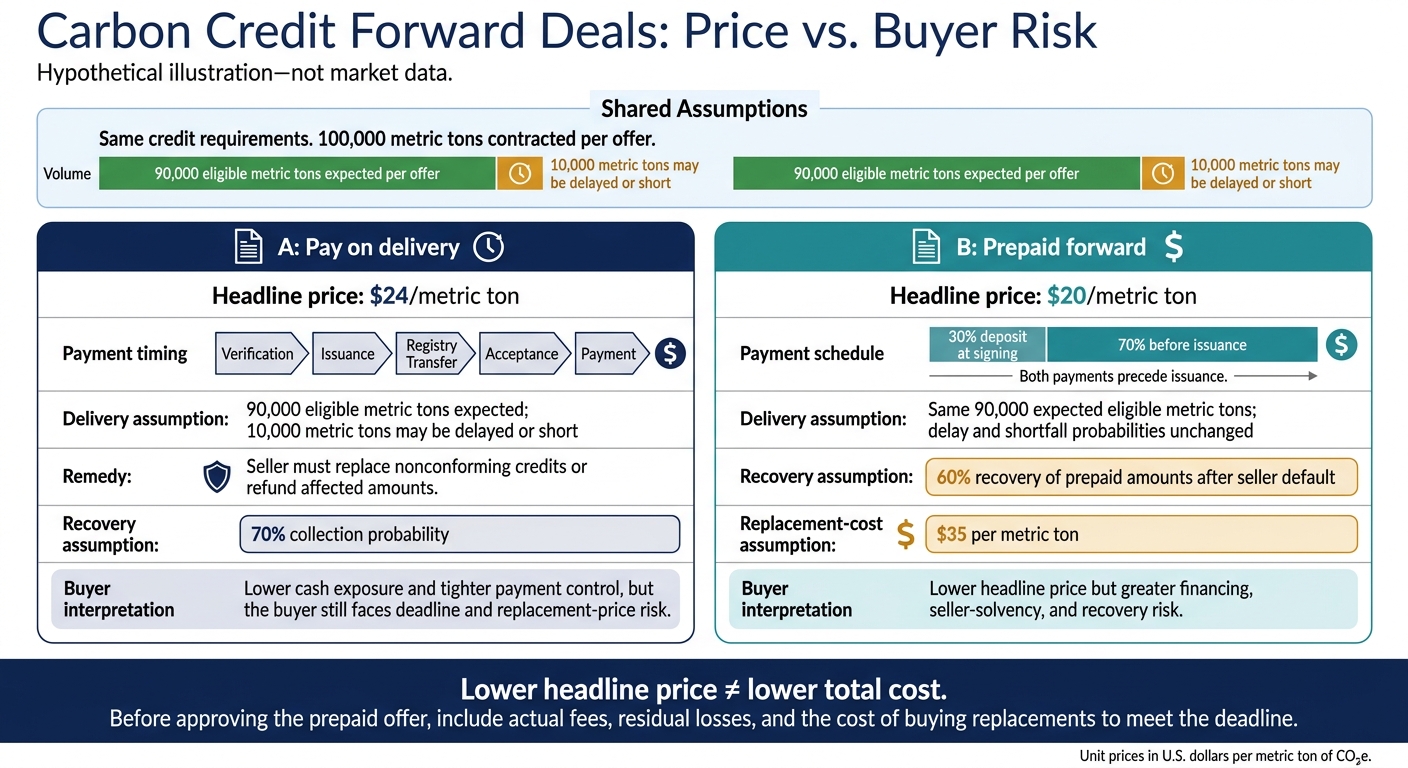
Carbon Credit Forward Deals: Price vs. Buyer Risk
Turn contract terms into a pricing worksheet before accepting a quote. Use it to translate delivery, counterparty, and verification risk into a maximum acceptable price.
Keep seller quotes, assumptions, estimated losses, and collectible recoveries separate. Assign each input an owner, evidence source, and review date. Track contracted volume separately from expected eligible delivery. Show cash flows in U.S. dollars and unit prices in dollars per metric ton of CO2e.
Calculate the Maximum Acceptable Price
Record the intended use, credit attributes, delivery scenarios, payment dates, comparable issued-credit values, and seller solvency. Account for verification, registry, authorization, and invalidation risks.
Bring expected credit value, payments, costs, and recoveries to one valuation date. Use actual dates and the finance-approved discount rate. A working structure is:
[ P_{\max}= \frac{ \text{PV(expected credit value)} -\text{PV(unrecovered risk losses)} -\text{PV(transaction and completion costs)} }{ \text{PV(expected eligible volume)} } ]
Model payment-on-delivery, milestone payments, deposits, and full prepayment separately. Price against expected eligible delivery - not headline contracted volume.
If 100,000 tons are contracted but only 85,000 are expected to qualify, price the deal on 85,000 tons.
Compare 2 Hypothetical Purchase Offers
Hypothetical illustration - not market data. Use the same credit requirements and 100,000-metric-ton contracted volume for both offers while changing only payment structure and risk allocation.
Offer Price and payment schedule Illustrative delivery assumptions Illustrative recovery assumptions Buyer interpretation A: Pay on delivery $24/metric ton; payment after verification, issuance, registry transfer, and acceptance 90,000 eligible metric tons expected; 10,000 metric tons may be delayed or short Seller must replace nonconforming credits or refund affected amounts; assume 70% collection probability Lower cash exposure and tighter payment control, but the buyer still faces deadline and replacement-price risk B: Prepaid forward $20/metric ton; 30% deposit at signing and 70% before issuance Same 90,000 expected eligible metric tons; delay and shortfall probabilities unchanged Assume only 60% recovery of prepaid amounts after seller default; replacement cost assumed at $35 per metric ton Lower headline price but greater financing, seller-solvency, and recovery risk
Offer B’s lower headline price puts cash at risk before delivery. Before approving it, include actual fees, residual losses, and the cost of buying replacements to meet the deadline.
Stress-Test Delays, Shortfalls, and Replacement Costs
Once you set the ceiling price, test how delays, shortfalls, and replacement costs affect the deal.
| Scenario | Contractual indicator | Economic effect | Protective term | Pricing response |
|---|---|---|---|---|
| Full delivery on time | Verified, issued, transferred credits by deadline | Buyer receives the expected value | Acceptance and payment trigger | Use base price |
| Verification delay | Missed verification milestone or delivery date | Credits may miss the reporting deadline; cash stays tied up | Long-stop date, notice duties, termination right | Apply delay probability and deadline replacement cost |
| Partial delivery | Delivered volume below minimum quantity | Buyer must source a shortfall | Shortfall damages, replacement right, refund | Reduce acceptable price for expected shortfall |
| Failed verification | Credits do not pass validation or verification | Contracted volume may not be usable | Seller-funded remediation, replacement, or refund | Include expected re-verification and replacement costs |
| Invalid or canceled credits | Registry or standard body invalidates or cancels credits | Retired or reported credits may need replacement | Equal-or-better replacement or full refund; survival of warranties | Price residual invalidation and collection risk |
| Higher replacement cost | Substitute credits cost more than contracted credits | Buyer incurs an unplanned premium | Seller obligation to cover defined replacement costs or liquidated damages | Stress-test replacement prices above the base case |
| Seller default after prepayment | Missed milestone, insolvency, or refusal to perform | Deposit may be unrecoverable and replacement may be urgent | Security, escrow, parent guarantee, refund deadline, termination right | Discount for loss-given-default and recovery delay |
Test linked failures, too:
Assume verification is delayed by 12 months, the seller becomes insolvent before delivery, only 40% of a prepaid deposit is recovered after 18 months, and replacement credits cost $35 per metric ton instead of the contracted $24.
Count the unrecovered deposit, discounted replacement premium, transaction costs, and any cost of missing the intended reporting or compliance deadline. Compare the total exposure with the approved risk budget. Reject, reprice, collateralize, or restructure the deal if the combined downside exceeds that budget or replacement supply cannot be secured in time.
Assign clear approval roles: sustainability approves credit attributes, procurement checks quotes, finance sets the discount rate and recovery assumptions, legal reviews remedies, and an executive approves residual risk. Final approval should state the maximum unit price in U.S. dollars per metric ton of CO2e, maximum acceptable prepayment, required security, and conditions that trigger termination or reapproval.
5. Conclusion: Check Price, Delivery, and Recovery
Use the worksheet output for the final go/no-go decision. Check five things: eligible supply, delivery timing, capital exposure, risk-adjusted price, and collectible remedies. Confirm that the credits fit your intended use and that firm volumes can meet the retirement deadline. Verify the issuance schedule, delivery deadline, and whether the credits will transfer to your registry account or be retired on your behalf.[3][6]
Contracted credits are promises, not transferable assets. Don’t count them as available for retirement until they have been issued and delivered through the registry.[4][5]
A low quote only works if it accounts for funding costs, delay risk, shortfalls, and replacement purchases. A refund returns cash - not credits. Confirm that you can obtain eligible replacements before the retirement deadline.[1][2]
FAQs
How much cheaper should prepaid credits be?
Prepaid forward credits have no fixed discount compared with spot credits. Buyers and sellers negotiate prices based on counterparty solvency, project delivery timelines, and credit quality. Since voluntary credits vary, the discount often compensates buyers for taking on risk.
Council Fire helps clients assess credit portfolios, manage reputational and delivery risks during procurement, and align forward agreements with sound, long-term decarbonization pathways.
How can I verify a seller’s replacement capacity?
Require transparent, serial-level lifecycle records that show the seller can deliver replacement credits if the primary project fails. During due diligence, request proof of the project’s status and confirm the seller has access to other high-quality credits that meet your vintage, methodology, and additionality criteria.
Document replacement terms explicitly in the purchase agreement. Review the seller’s delivery track record and assess counterparty risk.
What if credits are issued after my reporting deadline?
If carbon credits are issued after your reporting deadline, you can’t include them in your current claim. Wait until the serial-numbered credits have been issued, retired in a recognized registry, and linked to your reporting period before making the claim.
To protect your claim’s integrity and meet professional reporting standards, the registry retirement date must come before publication of your carbon neutrality statement.




FAQ