
Jul 5, 2026
How Blended Finance Closes Funding Gaps
Sustainability Strategy
In This Article
Shows how concessional capital, guarantees, and technical assistance mobilize private investment to close decarbonization funding gaps.
How Blended Finance Closes Funding Gaps
If supply-chain emissions keep climbing, companies could face about $500 billion a year by 2030. I see the core issue as simple: many suppliers need funding for lower-emissions projects, but banks often will not lend on terms that fit the risk.
Here’s the short answer:
Blended finance fills the gap by mixing lower-cost public or philanthropic money with private capital.
It works best when each tool matches a clear problem:
Concessional debt or equity for long payback periods
First-loss capital for weak supplier collateral
Guarantees or insurance for country, policy, or currency risk
Technical assistance for poor data, reporting, and project readiness
Results-based finance for projects where impact is paid only after proof
The deal design is usually a simple three-step path: find the gap, build the capital stack, set the rules.
Bankability often comes down to cash flow visibility, contract terms, and better supplier data.
A few numbers stand out:
Only 24% of companies disclose supply-chain emissions
Just 8% have set formal reduction targets
10%–20% of suppliers often drive 70%–80% of Scope 3 emissions
Each $1 of concessional funding can mobilize about $4 of private capital
What this tells me is clear: the problem is not just lack of money. It is lack of money that can take more risk, wait longer for payback, and work with thin supplier data. The article shows how to structure that money so private investors are more willing to join.
An Overview of Blended Finance: What is it and how does it work?
Blended Finance Instruments That Close Specific Funding Gaps
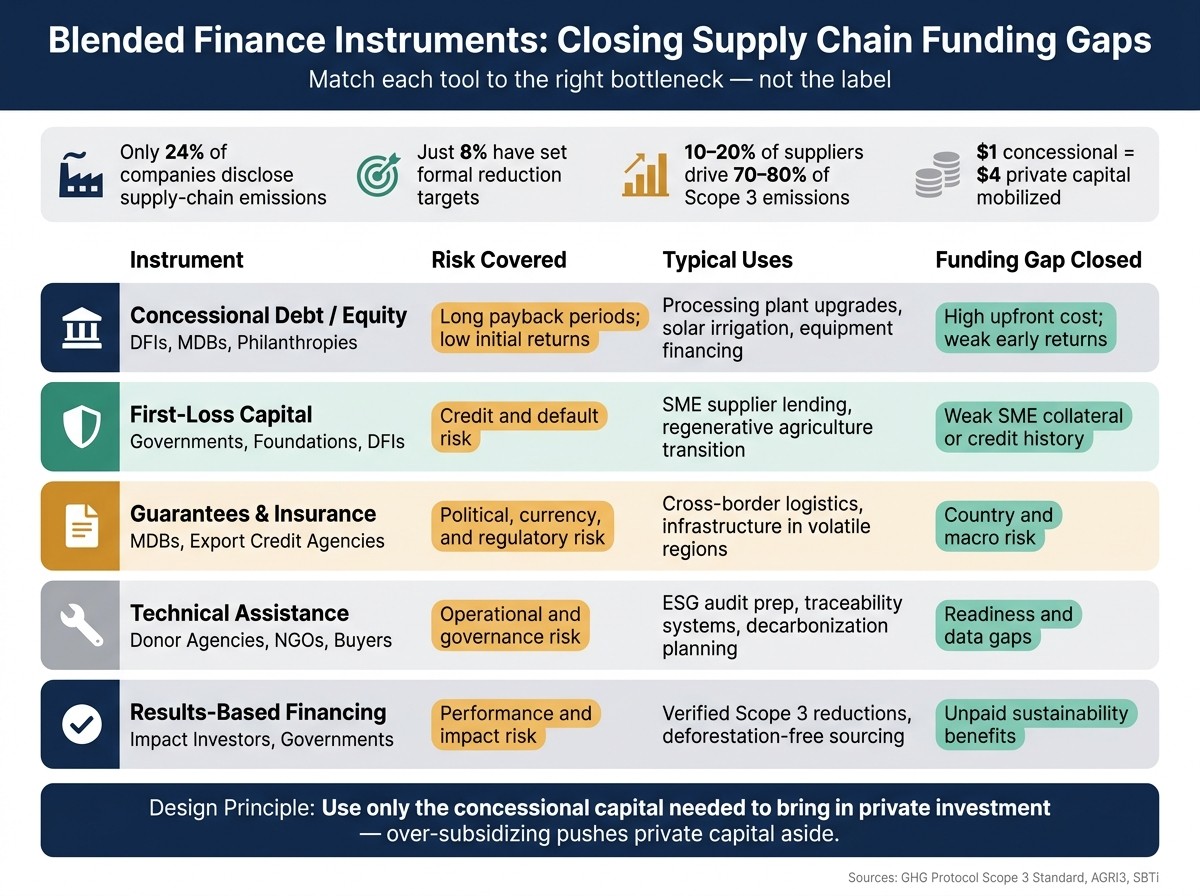
Blended Finance Instruments: Closing Supply Chain Funding Gaps
Each instrument tackles a different problem: weak collateral, long payback periods, thin data, or country risk. The matrix below shows where each one fits. The sections after that walk through how these tools work on the ground.
Instrument | Typical Providers | Risk Covered | Typical Uses | Funding Gap Closed |
|---|---|---|---|---|
Concessional Debt/Equity | DFIs, MDBs, philanthropies | Long payback periods; low initial returns | Processing plant upgrades; solar irrigation; equipment financing | High upfront cost; weak early returns |
First-Loss Capital | Governments, foundations, DFIs | Credit and default risk | SME supplier lending programs; transition to regenerative agriculture | Weak SME collateral or credit history |
Guarantees & Insurance | MDBs, export credit agencies | Political, currency, and regulatory risk | Cross-border logistics; infrastructure in volatile regions | Country and macro risk |
Technical Assistance | Donor agencies, NGOs, corporate buyers | Operational and governance risk | ESG audit preparation; traceability systems; decarbonization planning | Readiness and data gaps |
Results-Based Financing | Impact investors, governments, philanthropy | Performance and impact risk | Verified Scope 3 reductions; deforestation-free sourcing | Unpaid sustainability benefits |
Concessional Capital, First-Loss Structures, and Guarantees
SME suppliers face interest rates about 1.5 percentage points higher than large firms for carbon emission reduction projects [1]. That gap matters. Concessional debt and equity, priced below market or paired with longer repayment terms, help narrow it. In plain terms, they make slower-payback investments - like equipment upgrades or processing infrastructure - far easier to justify.
First-loss capital works a bit differently. It doesn't cut the borrowing cost so much as shift who takes the first hit if something goes wrong. A foundation or government agency steps in to absorb early losses, which gives senior lenders enough cover to back deals they might otherwise pass on.
AGRI3 is a clear example. Its loan guarantees help partner banks such as Rabobank Brazil offer longer tenors and grace periods to agrifood companies moving toward regenerative farming [3].
Guarantees and insurance play a related, but separate, role. They're most useful when the core issue isn't project cash flow, but the place where the deal sits: currency swings, policy changes, or political instability. For supply chains that run through emerging markets, these tools can make the difference between a deal that stalls and one that gets signed. And when money by itself won't solve the problem, technical support fills the readiness gap.
Technical Assistance and Results-Based Financing
Technical assistance closes readiness gaps. A lot of supplier projects don't miss out on capital because the idea is weak. They miss out because ESG reporting is incomplete, internal controls are shaky, or the data simply isn't there yet. Grant-funded advisory support from donor agencies, NGOs, or corporate buyers helps build that base so a project can move into the finance queue.
Microsoft's supplier program pairs emissions disclosure requirements with technical assistance to help suppliers meet them [1].
Results-based financing flips the model by tying payments to verified outcomes instead of upfront activity. Once a supplier hits a measured milestone - such as a confirmed drop in methane emissions, certified deforestation-free sourcing, or a verified reduction in Scope 3 output - a payment is released. Impact-linked loans follow the same pattern: borrowing costs fall when sustainability milestones are verified, helping bridge the gap between impact and cash flow [3].
The next step is to turn those tools into a financeable deal structure.
How to Design a Blended Finance Solution for a Supply Chain
Turn the funding gap into an investable structure in three steps: diagnose, design, and govern.
Diagnose the Capital Gap and Define Impact Targets
Begin with a sustainability consulting approach to a plain question: where is financing missing? Is the problem at the production stage, or does it show up later in logistics? That distinction shapes the toolset, because different parts of the supply chain call for different financing instruments.
Use the GHG Protocol Scope 3 Standard to pinpoint emission hotspots, with close attention to Category 1 (Purchased Goods and Services) and Category 11 (Use of Sold Products) [1]. In most organizations, 10–20% of suppliers drive 70–80% of Scope 3 emissions [1]. That’s the place to start. Focus the first round of diagnostic work on those suppliers, then size the gap using primary supplier data, not rough proxy estimates.
Targets should tie to direct outcomes and a set date. That might mean:
tons of CO₂e reduced
water use lowered per unit
labor standards improved by a stated deadline
Use the KPI ranges below as practical target anchors:
Sector | Key Decarbonization KPI | Baseline Range | Target Range |
|---|---|---|---|
Manufacturing | tCO₂e per unit output | 0.5–2.0 | <0.3 |
Logistics | gCO₂e per ton-km | 50–150 | <30 |
Agriculture | kgCO₂e per kg product | 2–10 | <1.5 |
Textiles | kgCO₂e per garment | 5–25 | <5 |
Electronics | kgCO₂e per device | 30–100 | <20 |
The size of that gap tells you how much concessional capital the stack needs.
Build the Capital Stack and Align Partners
Once the gap is sized and the targets are clear, the next step is figuring out what mix of capital can close it. The answer rests less on project size and more on project risk.
Most blended finance structures layer capital by risk tolerance. At the base, grants, junior equity, or subordinated debt from governments or foundations take the first hit if things go off track. In the middle, mezzanine capital from development finance institutions or impact investors helps bridge the risk-return divide. At the top, senior commercial debt comes in with more protection because the lower layers absorb early losses. Guarantees and insurance can also tighten the structure without adding more upfront cash.
A good rule here is simple: use only the concessional capital needed to bring in private investment [2]. If the structure is over-subsidized, private capital gets pushed aside and money goes to projects that likely would have moved ahead anyway.
Before anyone drafts legal documents, partners need a shared view of the goal. One party may care most about financial return. Another may be focused on emissions or labor outcomes. Some may want a stated mix of both. Get that out in the open early [2].
Once the stack is in place, governance is what turns the model into a deal lenders can underwrite.
Set Governance, Monitoring, and Reporting Rules
Even a well-built capital stack can break down if the operating rules are fuzzy. Governance comes down to three things: who decides, how impact gets checked, and what happens when a supplier misses a target.
Those decision rights should sit inside the financing agreements, not in hallway conversations or loose assumptions. Supplier codes and sustainability-linked contracts can spell out disclosure rules, verification methods, and remedies.
For KPI tracking, manual audits should be the fallback, not the default. They’re slow, costly, and often leave you with paper-heavy monitoring that lags behind what’s happening on the ground. Digital MRV tools can help support verification and cut some of that drag.
The full design process, along with common trouble spots at each stage, looks like this:
Design Step | Key Questions | Data Required | Typical Actors Involved | Common Pitfalls |
|---|---|---|---|---|
Diagnose Gap | Where is capital missing? What is the USD value of the gap? | Scope 3 hotspots, supplier credit ratings, current interest rates | Corporate sustainability teams, procurement, ESG auditors | Relying on spend-based estimates instead of primary supplier data |
Define Targets | What are the specific KPIs? How often are they measured? | Baseline ESG audits, Science-Based Targets (SBTi) alignment | NGOs, technical experts, third-party rating agencies | Setting unrealistic targets for SMEs without providing technical support |
Build Stack | How much first-loss capital is needed to attract senior debt? What risk tools are required? | Risk-return thresholds of institutional investors, cost of capital | DFIs, foundations, commercial banks, MDBs | Over-subsidizing projects; funding what would happen anyway |
Set Governance | Who verifies the data? What happens if a supplier misses a target? | Digital MRV data, audit schedules | Third-party auditors, technology providers, legal counsel | High transaction costs; manual audit delays; SME data burden |
Methods to Reduce Risk and Improve Bankability
Once governance is set, the next job is simpler to say than to do: make cash flow and risk predictable enough for commercial capital. After the capital stack is in place, bankability comes down to three things - cash flow, contract terms, and data quality. Those are the guardrails that help lenders get comfortable.
Tailored Financing and Stronger Revenue Visibility
Unpredictable cash flow is where many deals get stuck. Tiered repayment schedules can help by matching debt service to the timing of revenue instead of forcing a one-size-fits-all payment plan.
Inventory and receivables financing also smooth out cash flow. Buyer-led reverse factoring gives SMEs a way to get paid early on approved invoices, which can ease working capital pressure and reduce strain across the supply chain.
Offtake agreements and minimum-volume commitments add something lenders care about a lot: clearer revenue visibility. If a buyer commits to purchasing a set volume at a defined price, lenders can model repayment with much more confidence. That clearer line of sight improves repayment confidence and credit quality.
Cash flow protection matters, but it doesn't solve everything. Lenders also want better data and fewer performance surprises.
Risk Management Through Technical Support and Protective Tools
Technical assistance lowers default and performance risk by helping suppliers collect ESG data, operate new equipment, and meet buyer requirements. When TA grants are built into the financing structure, that support stays tied to the deal instead of sitting off to the side.
Primary supplier data, verified digitally, also sharpens risk pricing. If lenders can review actual performance data rather than lean on spend-based estimates, they can underwrite deals with more precision and, in many cases, offer better terms.
The table below links common risks to the tools used to reduce them:
Risk Type | Relevant Blended Instruments | Contractual Supports |
|---|---|---|
Price Volatility | Concessional loans, viability gap funding | Offtake agreements, fixed-price contracts |
Default Risk | First-loss guarantees, credit insurance | Receivables financing, performance bonds |
Climate Risk | Catastrophe insurance, performance insurance | Force majeure clauses, ESG KPIs |
Currency Risk | Political risk insurance, FX guarantees | Currency adjustment clauses |
Governance Risk | Technical assistance grants | Impact covenants, transparency clauses |
The key is discipline. Match each risk to one tool; extra layers add cost without improving bankability.
What matters in the end is whether each protection addresses a real bottleneck, not just a theoretical risk.
Conclusion: Key Takeaways for Decision-Makers
Blended finance works best when it goes after a specific supply chain bottleneck. The strongest deals begin with a plain question: Why isn’t private capital moving here? Once that answer is clear, the structure should fit the gap. In other words, the deal should match the bottleneck, not the label.
The logic is simple. Concessional capital, guarantees, first-loss tranches, and technical assistance help close funding gaps by placing risk with the right layer of capital. But none of these tools work on their own. Each one has to line up with the right bottleneck. On average, every $1 of concessional funding mobilizes $4 of private capital [4], but that only happens when the capital stack is built with clear roles and capital priority rules from the start.
Three choices often decide whether a deal gets over the line:
Match the instrument to the risk
Standardize documentation
Define the exit from day one
For teams putting these structures together, the last step is disciplined execution. Governance decides whether the deal stays intact. Turning sustainability KPIs into contractual terms gives lenders more confidence and helps keep the structure financeable over time.
FAQs
What is blended finance in simple terms?
Blended finance brings together public or philanthropic funds and private capital to back projects that deliver social or environmental gains.
These projects often come with more risk or less certain returns. That’s where public or charitable funding steps in. It can lower risk by taking the first losses or by offering lower interest rates. In plain terms, it helps turn projects that once looked unbankable into deals private investors are more willing to support.
Which suppliers should companies prioritize first?
Companies should start with strategic suppliers. In most cases, a small set of key partners makes up about 75% to 80% of total procurement spend and often drives 65% to 95% of total Scope 3 emissions.
That concentration matters. If a company directs blended finance mechanisms and incentive programs toward these high-impact suppliers, it can make the biggest dent in sustainability performance while tackling the largest share of its environmental footprint.
How do lenders decide if a supplier project is bankable?
Lenders view a supplier project as bankable when it can show measurable sustainability performance and manageable delivery risk.
In sustainable supply chain finance, buyers assess supplier ESG performance against clear, comparable KPIs, often backed by third-party verification to cut greenwashing risk. When performance is strong, suppliers may get better financing terms. When it falls short, borrowing costs can go up or access to funding can narrow.
Related Blog Posts
Latest Articles
©2025

Narrative Change and Power Building: The Missing Half of Advocacy
Narrative change is the process of disrupting dominant narratives that normalize inequity and advancing new narratives from historically marginalized communities.

Funding Resilience Without Federal Grants
BRIC is unreliable and FEMA is shrinking. Here's how cities fund climate resilience with dedicated revenue, blended finance, and a coordinating authority.

The ESG Blind Spot: How AI Is Finding Risks in Companies Nobody Else Is Watching
Norway's sovereign wealth fund uses AI to screen 7,200 portfolio companies for forced labor and corruption within 24 hours. The real story is the emerging-market coverage gap that traditional ESG data vendors miss — and what it means for any company with a global supply chain.
Narrative Change and Power Building: The Missing Half of Advocacy
Narrative change is the process of disrupting dominant narratives that normalize inequity and advancing new narratives from historically marginalized communities.
Funding Resilience Without Federal Grants
BRIC is unreliable and FEMA is shrinking. Here's how cities fund climate resilience with dedicated revenue, blended finance, and a coordinating authority.
The ESG Blind Spot: How AI Is Finding Risks in Companies Nobody Else Is Watching
Norway's sovereign wealth fund uses AI to screen 7,200 portfolio companies for forced labor and corruption within 24 hours. The real story is the emerging-market coverage gap that traditional ESG data vendors miss — and what it means for any company with a global supply chain.
FAQ
01
What does it really mean to “redefine profit”?
02
What makes Council Fire different?
03
Who does Council Fire work with?
04
What does working with Council Fire actually look like?
05
How does Council Fire help organizations turn big goals into action?
06
How does Council Fire define and measure success?
Jul 5, 2026
How Blended Finance Closes Funding Gaps
Sustainability Strategy
In This Article
Shows how concessional capital, guarantees, and technical assistance mobilize private investment to close decarbonization funding gaps.
How Blended Finance Closes Funding Gaps
If supply-chain emissions keep climbing, companies could face about $500 billion a year by 2030. I see the core issue as simple: many suppliers need funding for lower-emissions projects, but banks often will not lend on terms that fit the risk.
Here’s the short answer:
Blended finance fills the gap by mixing lower-cost public or philanthropic money with private capital.
It works best when each tool matches a clear problem:
Concessional debt or equity for long payback periods
First-loss capital for weak supplier collateral
Guarantees or insurance for country, policy, or currency risk
Technical assistance for poor data, reporting, and project readiness
Results-based finance for projects where impact is paid only after proof
The deal design is usually a simple three-step path: find the gap, build the capital stack, set the rules.
Bankability often comes down to cash flow visibility, contract terms, and better supplier data.
A few numbers stand out:
Only 24% of companies disclose supply-chain emissions
Just 8% have set formal reduction targets
10%–20% of suppliers often drive 70%–80% of Scope 3 emissions
Each $1 of concessional funding can mobilize about $4 of private capital
What this tells me is clear: the problem is not just lack of money. It is lack of money that can take more risk, wait longer for payback, and work with thin supplier data. The article shows how to structure that money so private investors are more willing to join.
An Overview of Blended Finance: What is it and how does it work?
Blended Finance Instruments That Close Specific Funding Gaps
Blended Finance Instruments: Closing Supply Chain Funding Gaps
Each instrument tackles a different problem: weak collateral, long payback periods, thin data, or country risk. The matrix below shows where each one fits. The sections after that walk through how these tools work on the ground.
Instrument | Typical Providers | Risk Covered | Typical Uses | Funding Gap Closed |
|---|---|---|---|---|
Concessional Debt/Equity | DFIs, MDBs, philanthropies | Long payback periods; low initial returns | Processing plant upgrades; solar irrigation; equipment financing | High upfront cost; weak early returns |
First-Loss Capital | Governments, foundations, DFIs | Credit and default risk | SME supplier lending programs; transition to regenerative agriculture | Weak SME collateral or credit history |
Guarantees & Insurance | MDBs, export credit agencies | Political, currency, and regulatory risk | Cross-border logistics; infrastructure in volatile regions | Country and macro risk |
Technical Assistance | Donor agencies, NGOs, corporate buyers | Operational and governance risk | ESG audit preparation; traceability systems; decarbonization planning | Readiness and data gaps |
Results-Based Financing | Impact investors, governments, philanthropy | Performance and impact risk | Verified Scope 3 reductions; deforestation-free sourcing | Unpaid sustainability benefits |
Concessional Capital, First-Loss Structures, and Guarantees
SME suppliers face interest rates about 1.5 percentage points higher than large firms for carbon emission reduction projects [1]. That gap matters. Concessional debt and equity, priced below market or paired with longer repayment terms, help narrow it. In plain terms, they make slower-payback investments - like equipment upgrades or processing infrastructure - far easier to justify.
First-loss capital works a bit differently. It doesn't cut the borrowing cost so much as shift who takes the first hit if something goes wrong. A foundation or government agency steps in to absorb early losses, which gives senior lenders enough cover to back deals they might otherwise pass on.
AGRI3 is a clear example. Its loan guarantees help partner banks such as Rabobank Brazil offer longer tenors and grace periods to agrifood companies moving toward regenerative farming [3].
Guarantees and insurance play a related, but separate, role. They're most useful when the core issue isn't project cash flow, but the place where the deal sits: currency swings, policy changes, or political instability. For supply chains that run through emerging markets, these tools can make the difference between a deal that stalls and one that gets signed. And when money by itself won't solve the problem, technical support fills the readiness gap.
Technical Assistance and Results-Based Financing
Technical assistance closes readiness gaps. A lot of supplier projects don't miss out on capital because the idea is weak. They miss out because ESG reporting is incomplete, internal controls are shaky, or the data simply isn't there yet. Grant-funded advisory support from donor agencies, NGOs, or corporate buyers helps build that base so a project can move into the finance queue.
Microsoft's supplier program pairs emissions disclosure requirements with technical assistance to help suppliers meet them [1].
Results-based financing flips the model by tying payments to verified outcomes instead of upfront activity. Once a supplier hits a measured milestone - such as a confirmed drop in methane emissions, certified deforestation-free sourcing, or a verified reduction in Scope 3 output - a payment is released. Impact-linked loans follow the same pattern: borrowing costs fall when sustainability milestones are verified, helping bridge the gap between impact and cash flow [3].
The next step is to turn those tools into a financeable deal structure.
How to Design a Blended Finance Solution for a Supply Chain
Turn the funding gap into an investable structure in three steps: diagnose, design, and govern.
Diagnose the Capital Gap and Define Impact Targets
Begin with a sustainability consulting approach to a plain question: where is financing missing? Is the problem at the production stage, or does it show up later in logistics? That distinction shapes the toolset, because different parts of the supply chain call for different financing instruments.
Use the GHG Protocol Scope 3 Standard to pinpoint emission hotspots, with close attention to Category 1 (Purchased Goods and Services) and Category 11 (Use of Sold Products) [1]. In most organizations, 10–20% of suppliers drive 70–80% of Scope 3 emissions [1]. That’s the place to start. Focus the first round of diagnostic work on those suppliers, then size the gap using primary supplier data, not rough proxy estimates.
Targets should tie to direct outcomes and a set date. That might mean:
tons of CO₂e reduced
water use lowered per unit
labor standards improved by a stated deadline
Use the KPI ranges below as practical target anchors:
Sector | Key Decarbonization KPI | Baseline Range | Target Range |
|---|---|---|---|
Manufacturing | tCO₂e per unit output | 0.5–2.0 | <0.3 |
Logistics | gCO₂e per ton-km | 50–150 | <30 |
Agriculture | kgCO₂e per kg product | 2–10 | <1.5 |
Textiles | kgCO₂e per garment | 5–25 | <5 |
Electronics | kgCO₂e per device | 30–100 | <20 |
The size of that gap tells you how much concessional capital the stack needs.
Build the Capital Stack and Align Partners
Once the gap is sized and the targets are clear, the next step is figuring out what mix of capital can close it. The answer rests less on project size and more on project risk.
Most blended finance structures layer capital by risk tolerance. At the base, grants, junior equity, or subordinated debt from governments or foundations take the first hit if things go off track. In the middle, mezzanine capital from development finance institutions or impact investors helps bridge the risk-return divide. At the top, senior commercial debt comes in with more protection because the lower layers absorb early losses. Guarantees and insurance can also tighten the structure without adding more upfront cash.
A good rule here is simple: use only the concessional capital needed to bring in private investment [2]. If the structure is over-subsidized, private capital gets pushed aside and money goes to projects that likely would have moved ahead anyway.
Before anyone drafts legal documents, partners need a shared view of the goal. One party may care most about financial return. Another may be focused on emissions or labor outcomes. Some may want a stated mix of both. Get that out in the open early [2].
Once the stack is in place, governance is what turns the model into a deal lenders can underwrite.
Set Governance, Monitoring, and Reporting Rules
Even a well-built capital stack can break down if the operating rules are fuzzy. Governance comes down to three things: who decides, how impact gets checked, and what happens when a supplier misses a target.
Those decision rights should sit inside the financing agreements, not in hallway conversations or loose assumptions. Supplier codes and sustainability-linked contracts can spell out disclosure rules, verification methods, and remedies.
For KPI tracking, manual audits should be the fallback, not the default. They’re slow, costly, and often leave you with paper-heavy monitoring that lags behind what’s happening on the ground. Digital MRV tools can help support verification and cut some of that drag.
The full design process, along with common trouble spots at each stage, looks like this:
Design Step | Key Questions | Data Required | Typical Actors Involved | Common Pitfalls |
|---|---|---|---|---|
Diagnose Gap | Where is capital missing? What is the USD value of the gap? | Scope 3 hotspots, supplier credit ratings, current interest rates | Corporate sustainability teams, procurement, ESG auditors | Relying on spend-based estimates instead of primary supplier data |
Define Targets | What are the specific KPIs? How often are they measured? | Baseline ESG audits, Science-Based Targets (SBTi) alignment | NGOs, technical experts, third-party rating agencies | Setting unrealistic targets for SMEs without providing technical support |
Build Stack | How much first-loss capital is needed to attract senior debt? What risk tools are required? | Risk-return thresholds of institutional investors, cost of capital | DFIs, foundations, commercial banks, MDBs | Over-subsidizing projects; funding what would happen anyway |
Set Governance | Who verifies the data? What happens if a supplier misses a target? | Digital MRV data, audit schedules | Third-party auditors, technology providers, legal counsel | High transaction costs; manual audit delays; SME data burden |
Methods to Reduce Risk and Improve Bankability
Once governance is set, the next job is simpler to say than to do: make cash flow and risk predictable enough for commercial capital. After the capital stack is in place, bankability comes down to three things - cash flow, contract terms, and data quality. Those are the guardrails that help lenders get comfortable.
Tailored Financing and Stronger Revenue Visibility
Unpredictable cash flow is where many deals get stuck. Tiered repayment schedules can help by matching debt service to the timing of revenue instead of forcing a one-size-fits-all payment plan.
Inventory and receivables financing also smooth out cash flow. Buyer-led reverse factoring gives SMEs a way to get paid early on approved invoices, which can ease working capital pressure and reduce strain across the supply chain.
Offtake agreements and minimum-volume commitments add something lenders care about a lot: clearer revenue visibility. If a buyer commits to purchasing a set volume at a defined price, lenders can model repayment with much more confidence. That clearer line of sight improves repayment confidence and credit quality.
Cash flow protection matters, but it doesn't solve everything. Lenders also want better data and fewer performance surprises.
Risk Management Through Technical Support and Protective Tools
Technical assistance lowers default and performance risk by helping suppliers collect ESG data, operate new equipment, and meet buyer requirements. When TA grants are built into the financing structure, that support stays tied to the deal instead of sitting off to the side.
Primary supplier data, verified digitally, also sharpens risk pricing. If lenders can review actual performance data rather than lean on spend-based estimates, they can underwrite deals with more precision and, in many cases, offer better terms.
The table below links common risks to the tools used to reduce them:
Risk Type | Relevant Blended Instruments | Contractual Supports |
|---|---|---|
Price Volatility | Concessional loans, viability gap funding | Offtake agreements, fixed-price contracts |
Default Risk | First-loss guarantees, credit insurance | Receivables financing, performance bonds |
Climate Risk | Catastrophe insurance, performance insurance | Force majeure clauses, ESG KPIs |
Currency Risk | Political risk insurance, FX guarantees | Currency adjustment clauses |
Governance Risk | Technical assistance grants | Impact covenants, transparency clauses |
The key is discipline. Match each risk to one tool; extra layers add cost without improving bankability.
What matters in the end is whether each protection addresses a real bottleneck, not just a theoretical risk.
Conclusion: Key Takeaways for Decision-Makers
Blended finance works best when it goes after a specific supply chain bottleneck. The strongest deals begin with a plain question: Why isn’t private capital moving here? Once that answer is clear, the structure should fit the gap. In other words, the deal should match the bottleneck, not the label.
The logic is simple. Concessional capital, guarantees, first-loss tranches, and technical assistance help close funding gaps by placing risk with the right layer of capital. But none of these tools work on their own. Each one has to line up with the right bottleneck. On average, every $1 of concessional funding mobilizes $4 of private capital [4], but that only happens when the capital stack is built with clear roles and capital priority rules from the start.
Three choices often decide whether a deal gets over the line:
Match the instrument to the risk
Standardize documentation
Define the exit from day one
For teams putting these structures together, the last step is disciplined execution. Governance decides whether the deal stays intact. Turning sustainability KPIs into contractual terms gives lenders more confidence and helps keep the structure financeable over time.
FAQs
What is blended finance in simple terms?
Blended finance brings together public or philanthropic funds and private capital to back projects that deliver social or environmental gains.
These projects often come with more risk or less certain returns. That’s where public or charitable funding steps in. It can lower risk by taking the first losses or by offering lower interest rates. In plain terms, it helps turn projects that once looked unbankable into deals private investors are more willing to support.
Which suppliers should companies prioritize first?
Companies should start with strategic suppliers. In most cases, a small set of key partners makes up about 75% to 80% of total procurement spend and often drives 65% to 95% of total Scope 3 emissions.
That concentration matters. If a company directs blended finance mechanisms and incentive programs toward these high-impact suppliers, it can make the biggest dent in sustainability performance while tackling the largest share of its environmental footprint.
How do lenders decide if a supplier project is bankable?
Lenders view a supplier project as bankable when it can show measurable sustainability performance and manageable delivery risk.
In sustainable supply chain finance, buyers assess supplier ESG performance against clear, comparable KPIs, often backed by third-party verification to cut greenwashing risk. When performance is strong, suppliers may get better financing terms. When it falls short, borrowing costs can go up or access to funding can narrow.
Related Blog Posts
Latest Articles
©2025
Narrative Change and Power Building: The Missing Half of Advocacy
Narrative change is the process of disrupting dominant narratives that normalize inequity and advancing new narratives from historically marginalized communities.
Funding Resilience Without Federal Grants
BRIC is unreliable and FEMA is shrinking. Here's how cities fund climate resilience with dedicated revenue, blended finance, and a coordinating authority.
The ESG Blind Spot: How AI Is Finding Risks in Companies Nobody Else Is Watching
Norway's sovereign wealth fund uses AI to screen 7,200 portfolio companies for forced labor and corruption within 24 hours. The real story is the emerging-market coverage gap that traditional ESG data vendors miss — and what it means for any company with a global supply chain.
FAQ
01
What does it really mean to “redefine profit”?
02
What makes Council Fire different?
03
Who does Council Fire work with?
04
What does working with Council Fire actually look like?
05
How does Council Fire help organizations turn big goals into action?
06
How does Council Fire define and measure success?
Jul 5, 2026
How Blended Finance Closes Funding Gaps
Sustainability Strategy
In This Article
Shows how concessional capital, guarantees, and technical assistance mobilize private investment to close decarbonization funding gaps.
How Blended Finance Closes Funding Gaps
If supply-chain emissions keep climbing, companies could face about $500 billion a year by 2030. I see the core issue as simple: many suppliers need funding for lower-emissions projects, but banks often will not lend on terms that fit the risk.
Here’s the short answer:
Blended finance fills the gap by mixing lower-cost public or philanthropic money with private capital.
It works best when each tool matches a clear problem:
Concessional debt or equity for long payback periods
First-loss capital for weak supplier collateral
Guarantees or insurance for country, policy, or currency risk
Technical assistance for poor data, reporting, and project readiness
Results-based finance for projects where impact is paid only after proof
The deal design is usually a simple three-step path: find the gap, build the capital stack, set the rules.
Bankability often comes down to cash flow visibility, contract terms, and better supplier data.
A few numbers stand out:
Only 24% of companies disclose supply-chain emissions
Just 8% have set formal reduction targets
10%–20% of suppliers often drive 70%–80% of Scope 3 emissions
Each $1 of concessional funding can mobilize about $4 of private capital
What this tells me is clear: the problem is not just lack of money. It is lack of money that can take more risk, wait longer for payback, and work with thin supplier data. The article shows how to structure that money so private investors are more willing to join.
An Overview of Blended Finance: What is it and how does it work?
Blended Finance Instruments That Close Specific Funding Gaps
Blended Finance Instruments: Closing Supply Chain Funding Gaps
Each instrument tackles a different problem: weak collateral, long payback periods, thin data, or country risk. The matrix below shows where each one fits. The sections after that walk through how these tools work on the ground.
Instrument | Typical Providers | Risk Covered | Typical Uses | Funding Gap Closed |
|---|---|---|---|---|
Concessional Debt/Equity | DFIs, MDBs, philanthropies | Long payback periods; low initial returns | Processing plant upgrades; solar irrigation; equipment financing | High upfront cost; weak early returns |
First-Loss Capital | Governments, foundations, DFIs | Credit and default risk | SME supplier lending programs; transition to regenerative agriculture | Weak SME collateral or credit history |
Guarantees & Insurance | MDBs, export credit agencies | Political, currency, and regulatory risk | Cross-border logistics; infrastructure in volatile regions | Country and macro risk |
Technical Assistance | Donor agencies, NGOs, corporate buyers | Operational and governance risk | ESG audit preparation; traceability systems; decarbonization planning | Readiness and data gaps |
Results-Based Financing | Impact investors, governments, philanthropy | Performance and impact risk | Verified Scope 3 reductions; deforestation-free sourcing | Unpaid sustainability benefits |
Concessional Capital, First-Loss Structures, and Guarantees
SME suppliers face interest rates about 1.5 percentage points higher than large firms for carbon emission reduction projects [1]. That gap matters. Concessional debt and equity, priced below market or paired with longer repayment terms, help narrow it. In plain terms, they make slower-payback investments - like equipment upgrades or processing infrastructure - far easier to justify.
First-loss capital works a bit differently. It doesn't cut the borrowing cost so much as shift who takes the first hit if something goes wrong. A foundation or government agency steps in to absorb early losses, which gives senior lenders enough cover to back deals they might otherwise pass on.
AGRI3 is a clear example. Its loan guarantees help partner banks such as Rabobank Brazil offer longer tenors and grace periods to agrifood companies moving toward regenerative farming [3].
Guarantees and insurance play a related, but separate, role. They're most useful when the core issue isn't project cash flow, but the place where the deal sits: currency swings, policy changes, or political instability. For supply chains that run through emerging markets, these tools can make the difference between a deal that stalls and one that gets signed. And when money by itself won't solve the problem, technical support fills the readiness gap.
Technical Assistance and Results-Based Financing
Technical assistance closes readiness gaps. A lot of supplier projects don't miss out on capital because the idea is weak. They miss out because ESG reporting is incomplete, internal controls are shaky, or the data simply isn't there yet. Grant-funded advisory support from donor agencies, NGOs, or corporate buyers helps build that base so a project can move into the finance queue.
Microsoft's supplier program pairs emissions disclosure requirements with technical assistance to help suppliers meet them [1].
Results-based financing flips the model by tying payments to verified outcomes instead of upfront activity. Once a supplier hits a measured milestone - such as a confirmed drop in methane emissions, certified deforestation-free sourcing, or a verified reduction in Scope 3 output - a payment is released. Impact-linked loans follow the same pattern: borrowing costs fall when sustainability milestones are verified, helping bridge the gap between impact and cash flow [3].
The next step is to turn those tools into a financeable deal structure.
How to Design a Blended Finance Solution for a Supply Chain
Turn the funding gap into an investable structure in three steps: diagnose, design, and govern.
Diagnose the Capital Gap and Define Impact Targets
Begin with a sustainability consulting approach to a plain question: where is financing missing? Is the problem at the production stage, or does it show up later in logistics? That distinction shapes the toolset, because different parts of the supply chain call for different financing instruments.
Use the GHG Protocol Scope 3 Standard to pinpoint emission hotspots, with close attention to Category 1 (Purchased Goods and Services) and Category 11 (Use of Sold Products) [1]. In most organizations, 10–20% of suppliers drive 70–80% of Scope 3 emissions [1]. That’s the place to start. Focus the first round of diagnostic work on those suppliers, then size the gap using primary supplier data, not rough proxy estimates.
Targets should tie to direct outcomes and a set date. That might mean:
tons of CO₂e reduced
water use lowered per unit
labor standards improved by a stated deadline
Use the KPI ranges below as practical target anchors:
Sector | Key Decarbonization KPI | Baseline Range | Target Range |
|---|---|---|---|
Manufacturing | tCO₂e per unit output | 0.5–2.0 | <0.3 |
Logistics | gCO₂e per ton-km | 50–150 | <30 |
Agriculture | kgCO₂e per kg product | 2–10 | <1.5 |
Textiles | kgCO₂e per garment | 5–25 | <5 |
Electronics | kgCO₂e per device | 30–100 | <20 |
The size of that gap tells you how much concessional capital the stack needs.
Build the Capital Stack and Align Partners
Once the gap is sized and the targets are clear, the next step is figuring out what mix of capital can close it. The answer rests less on project size and more on project risk.
Most blended finance structures layer capital by risk tolerance. At the base, grants, junior equity, or subordinated debt from governments or foundations take the first hit if things go off track. In the middle, mezzanine capital from development finance institutions or impact investors helps bridge the risk-return divide. At the top, senior commercial debt comes in with more protection because the lower layers absorb early losses. Guarantees and insurance can also tighten the structure without adding more upfront cash.
A good rule here is simple: use only the concessional capital needed to bring in private investment [2]. If the structure is over-subsidized, private capital gets pushed aside and money goes to projects that likely would have moved ahead anyway.
Before anyone drafts legal documents, partners need a shared view of the goal. One party may care most about financial return. Another may be focused on emissions or labor outcomes. Some may want a stated mix of both. Get that out in the open early [2].
Once the stack is in place, governance is what turns the model into a deal lenders can underwrite.
Set Governance, Monitoring, and Reporting Rules
Even a well-built capital stack can break down if the operating rules are fuzzy. Governance comes down to three things: who decides, how impact gets checked, and what happens when a supplier misses a target.
Those decision rights should sit inside the financing agreements, not in hallway conversations or loose assumptions. Supplier codes and sustainability-linked contracts can spell out disclosure rules, verification methods, and remedies.
For KPI tracking, manual audits should be the fallback, not the default. They’re slow, costly, and often leave you with paper-heavy monitoring that lags behind what’s happening on the ground. Digital MRV tools can help support verification and cut some of that drag.
The full design process, along with common trouble spots at each stage, looks like this:
Design Step | Key Questions | Data Required | Typical Actors Involved | Common Pitfalls |
|---|---|---|---|---|
Diagnose Gap | Where is capital missing? What is the USD value of the gap? | Scope 3 hotspots, supplier credit ratings, current interest rates | Corporate sustainability teams, procurement, ESG auditors | Relying on spend-based estimates instead of primary supplier data |
Define Targets | What are the specific KPIs? How often are they measured? | Baseline ESG audits, Science-Based Targets (SBTi) alignment | NGOs, technical experts, third-party rating agencies | Setting unrealistic targets for SMEs without providing technical support |
Build Stack | How much first-loss capital is needed to attract senior debt? What risk tools are required? | Risk-return thresholds of institutional investors, cost of capital | DFIs, foundations, commercial banks, MDBs | Over-subsidizing projects; funding what would happen anyway |
Set Governance | Who verifies the data? What happens if a supplier misses a target? | Digital MRV data, audit schedules | Third-party auditors, technology providers, legal counsel | High transaction costs; manual audit delays; SME data burden |
Methods to Reduce Risk and Improve Bankability
Once governance is set, the next job is simpler to say than to do: make cash flow and risk predictable enough for commercial capital. After the capital stack is in place, bankability comes down to three things - cash flow, contract terms, and data quality. Those are the guardrails that help lenders get comfortable.
Tailored Financing and Stronger Revenue Visibility
Unpredictable cash flow is where many deals get stuck. Tiered repayment schedules can help by matching debt service to the timing of revenue instead of forcing a one-size-fits-all payment plan.
Inventory and receivables financing also smooth out cash flow. Buyer-led reverse factoring gives SMEs a way to get paid early on approved invoices, which can ease working capital pressure and reduce strain across the supply chain.
Offtake agreements and minimum-volume commitments add something lenders care about a lot: clearer revenue visibility. If a buyer commits to purchasing a set volume at a defined price, lenders can model repayment with much more confidence. That clearer line of sight improves repayment confidence and credit quality.
Cash flow protection matters, but it doesn't solve everything. Lenders also want better data and fewer performance surprises.
Risk Management Through Technical Support and Protective Tools
Technical assistance lowers default and performance risk by helping suppliers collect ESG data, operate new equipment, and meet buyer requirements. When TA grants are built into the financing structure, that support stays tied to the deal instead of sitting off to the side.
Primary supplier data, verified digitally, also sharpens risk pricing. If lenders can review actual performance data rather than lean on spend-based estimates, they can underwrite deals with more precision and, in many cases, offer better terms.
The table below links common risks to the tools used to reduce them:
Risk Type | Relevant Blended Instruments | Contractual Supports |
|---|---|---|
Price Volatility | Concessional loans, viability gap funding | Offtake agreements, fixed-price contracts |
Default Risk | First-loss guarantees, credit insurance | Receivables financing, performance bonds |
Climate Risk | Catastrophe insurance, performance insurance | Force majeure clauses, ESG KPIs |
Currency Risk | Political risk insurance, FX guarantees | Currency adjustment clauses |
Governance Risk | Technical assistance grants | Impact covenants, transparency clauses |
The key is discipline. Match each risk to one tool; extra layers add cost without improving bankability.
What matters in the end is whether each protection addresses a real bottleneck, not just a theoretical risk.
Conclusion: Key Takeaways for Decision-Makers
Blended finance works best when it goes after a specific supply chain bottleneck. The strongest deals begin with a plain question: Why isn’t private capital moving here? Once that answer is clear, the structure should fit the gap. In other words, the deal should match the bottleneck, not the label.
The logic is simple. Concessional capital, guarantees, first-loss tranches, and technical assistance help close funding gaps by placing risk with the right layer of capital. But none of these tools work on their own. Each one has to line up with the right bottleneck. On average, every $1 of concessional funding mobilizes $4 of private capital [4], but that only happens when the capital stack is built with clear roles and capital priority rules from the start.
Three choices often decide whether a deal gets over the line:
Match the instrument to the risk
Standardize documentation
Define the exit from day one
For teams putting these structures together, the last step is disciplined execution. Governance decides whether the deal stays intact. Turning sustainability KPIs into contractual terms gives lenders more confidence and helps keep the structure financeable over time.
FAQs
What is blended finance in simple terms?
Blended finance brings together public or philanthropic funds and private capital to back projects that deliver social or environmental gains.
These projects often come with more risk or less certain returns. That’s where public or charitable funding steps in. It can lower risk by taking the first losses or by offering lower interest rates. In plain terms, it helps turn projects that once looked unbankable into deals private investors are more willing to support.
Which suppliers should companies prioritize first?
Companies should start with strategic suppliers. In most cases, a small set of key partners makes up about 75% to 80% of total procurement spend and often drives 65% to 95% of total Scope 3 emissions.
That concentration matters. If a company directs blended finance mechanisms and incentive programs toward these high-impact suppliers, it can make the biggest dent in sustainability performance while tackling the largest share of its environmental footprint.
How do lenders decide if a supplier project is bankable?
Lenders view a supplier project as bankable when it can show measurable sustainability performance and manageable delivery risk.
In sustainable supply chain finance, buyers assess supplier ESG performance against clear, comparable KPIs, often backed by third-party verification to cut greenwashing risk. When performance is strong, suppliers may get better financing terms. When it falls short, borrowing costs can go up or access to funding can narrow.
Related Blog Posts
Latest Articles
©2025
Narrative Change and Power Building: The Missing Half of Advocacy
Narrative change is the process of disrupting dominant narratives that normalize inequity and advancing new narratives from historically marginalized communities.
Funding Resilience Without Federal Grants
BRIC is unreliable and FEMA is shrinking. Here's how cities fund climate resilience with dedicated revenue, blended finance, and a coordinating authority.
The ESG Blind Spot: How AI Is Finding Risks in Companies Nobody Else Is Watching
Norway's sovereign wealth fund uses AI to screen 7,200 portfolio companies for forced labor and corruption within 24 hours. The real story is the emerging-market coverage gap that traditional ESG data vendors miss — and what it means for any company with a global supply chain.
FAQ
What does it really mean to “redefine profit”?
What makes Council Fire different?
Who does Council Fire work with?
What does working with Council Fire actually look like?
How does Council Fire help organizations turn big goals into action?
How does Council Fire define and measure success?