
Aug 19, 2026
Building Ecosystems for Scaling Climate Solutions
Sustainability Strategy
In This Article
Turn pilots into scalable climate solutions by mapping systems, assigning clear partner roles, standardizing data, and aligning funding.
Building Ecosystems for Scaling Climate Solutions
Most climate pilots fail to spread because the support system is weak, not because the idea is bad. I’d sum up the article this way: if you want climate work to move past one pilot site, you need clear partner roles, shared rules, data that travels across projects, and funding that fits each stage.
Here’s the short version:
One group can’t do it alone. Public agencies, funders, firms, NGOs, and local groups each control part of the path.
Map the full system first. Track how money, permits, delivery, and trust move - and where they get stuck.
Set roles by skill, not status. A RACI matrix and a capability list help cut overlap and confusion.
Put rules in writing early. A charter, decision steps, meeting rhythm, and dispute path help the work last 5 to 10 years.
Treat community consent as a gate. Don’t leave it for the end.
Use a small backbone team. Even 2–3 staff can keep partners aligned, track progress, and keep records up to date.
Document pilots for reuse. Focus on workflows, costs, policies, and what must stay fixed versus what can change by place.
Standardize data and learning. Shared metrics, dashboards, and after-action reviews turn single projects into a network.
Match funding to stage. Grants and philanthropy fit early risk; public funds fit public goods; private capital fits models with clearer cash flow.
Measure three levels: outputs, outcomes, and system effects. If policy, institutions, or market behavior don’t shift, scale will stay limited.
A few numbers stand out. Reviews can take 6 to 18 months. Public programs often run on about 3-year cycles, while infrastructure may need 15- to 20-year payback periods. That gap alone can stall a strong pilot.
If I were using this piece as a guide, my takeaway would be simple: build the network before you try to spread the project.
Scaling Climate Solutions through Smarter Investing and Philanthropy | Featuring Stephan Nicoleau
Map the system and define partner roles
Once you know the actors, the next step is to map how value, money, permits, and trust move through the system. That means looking past titles and asking a simpler question: who actually shapes whether this thing gets done? Some partners drive adoption. Some control funding or permits. Some carry delivery risk. Others can slow or speed progress across policy, finance, operations, and community engagement.
Identify dependencies, incentives, and gaps
Map five layers: value chain, policy and permitting, finance, implementation and infrastructure, and communities and stakeholders. Then mark where each layer stalls and why.
The policy layer is often where timelines go sideways. Major environmental reviews in the U.S. can take 6 to 18 months[2]. Finance mapping shows a different problem: public agencies often work on roughly 3-year budget and political cycles, while infrastructure projects may need 15- to 20-year payback windows[2]. Private investors, meanwhile, tend to want exits and returns on timelines that may not line up with either one. If you spot those mismatches early, you can build around them in the partnership design instead of getting blindsided later.
Community mapping matters just as much as the technical layers. Local governments, neighborhood organizations, Tribal governments, labor groups, and frontline communities all help decide whether a project moves ahead through permitting, workforce access, and land-use choices. Treat community consent as a decision gate, not something you circle back to at the end.
A useful way to do this is with a swim-lane diagram. It shows the flow of materials, money, and authority across all five layers, with pain points and leverage points marked at each step. When partners build this map together, informal power dynamics and incentive gaps tend to show up much faster than they do in a formal org chart review.
Once the bottlenecks are visible, role assignment becomes a design choice, not a status contest.
Assign roles based on capability, not title
Start with a capability inventory: a shared list of functions the initiative needs, such as convening, technical delivery, policy navigation, finance structuring, community engagement, data management, and communications. Then match those functions to partners who have actually done the work before.
A regional NGO with years of multi-stakeholder facilitation experience may be better suited to convene than a large agency with formal authority but weak trust with local groups. A community-based organization with deep neighborhood ties is often a better fit to lead co-design than a firm that just arrived in the area. This is where a simple responsibility grid helps. Formalizing the split with a RACI matrix - clarifying who is Responsible, Accountable, Consulted, and Informed for each function - cuts duplication and makes the governance model easier to use in new markets.
A capability-based role design also makes expansion more practical. New geographies can swap in local actors without changing the core operating logic.
Design governance for long-term collaboration
Once roles are in place, governance turns them into rules people can actually work with over time. Clear roles matter, but they don't hold up on their own. Partners also need shared rules, a plain decision process, and real accountability so the ecosystem can keep moving through leadership changes and funding swings.
Set a shared mandate and decision process
Write a governance charter early - before the first project begins - and base it on the roles and dependencies already mapped. The charter should lay out the mission, geography, 5- to 10-year horizon, outcomes, and each partner's responsibilities. It also needs to make one thing plain: who decides what and how disputes get resolved.
A tiered decision framework works well here. Strategic decisions - major investments, policy positions, and changes to the shared mandate - should go to a governing council made up of senior representatives from government, major funders, and key community organizations. Operational decisions, such as project approvals within agreed budget thresholds, can sit with working groups. Technical decisions on standards or methodologies should go to expert panels, with the rationale written down. Escalation paths should include maximum response times of 10–15 business days and spell out when independent facilitation kicks in.
Use a steady meeting rhythm: monthly working-group meetings, quarterly steering meetings, and annual summit meetings. Support that cadence with decision logs and transparent reporting so choices don't disappear into side conversations.
Build trust with communities and implementation partners
Technical quality alone won't make a climate initiative last. Legitimacy does. And legitimacy comes from how communities are treated from the start - not from a consultation session held after the design is already locked.
The mechanics matter. A community advisory board with representation from frontline neighborhoods, Indigenous groups where relevant, local businesses, and youth organizations gives communities a standing role in governance. Co-design workshops at accessible times and locations - with interpretation, childcare, and paid stipends for participants - show that local knowledge matters as much as technical expertise. Publish compensation, tie it to local cost of living, and follow IRS, labor, and procurement rules.
Feedback loops also need teeth. Public dashboards that track emissions reductions, local jobs created, pollution levels, and waste diversion - paired with formal grievance processes and response-time commitments - give communities a real say in project direction, not just a seat in the room. Tying funding disbursements or project milestones to community satisfaction measures adds another layer of accountability.
Use a backbone team to coordinate execution
A backbone team coordinates the ecosystem. It does not own projects; it keeps partners aligned. Its job usually includes convening partners, maintaining the governance charter, tracking progress against shared metrics, managing knowledge platforms, aligning communications, and making sure strategy stays tied to on-the-ground delivery.
In practice, backbone teams are often small - as few as 2–3 dedicated staff - with skills across facilitation, project management, data analysis, stakeholder engagement, and communications.[1] What matters most is not team size. It's having enough authority to call meetings, request data, flag misalignment, and suggest course corrections, while staying accountable to a governing council rather than acting alone.
That kind of coordination also makes replication and adaptation easier as the ecosystem grows.
Build the support systems that make solutions repeatable
Once governance is in place, the next step is making the model portable. A pilot can prove the idea works. But repeatable climate resilience solutions need more than one good test run. They need technical assistance, clear process documentation, trained staff, and shared data. Replication works when roles are lined up across partners, not when a few isolated pilots happen to go well.
Prepare pilots for replication and adaptation
Treat pilot documentation like an implementation blueprint, not a final report. The point is to capture what the next team will need to act: roles, workflows, decision points, timelines, required capabilities, enabling policies, and cost assumptions. That gives the next implementer a practical starting point instead of a stack of hindsight.
A useful way to organize this is a non-negotiables and local adaptations framework. Some parts must stay fixed, including minimum performance thresholds, safety standards, data quality rules, and legal compliance requirements. Other parts can flex, such as local materials, community engagement styles, governance structures, and state-specific incentive programs. When both are spelled out clearly, replication gets less messy. Local partners have room to adjust the model without weakening what makes it work.
NetZeroCities built a replication system with twinning, a resource platform, and 30 case studies.[3][5]
That documentation then feeds the next layer of work: training, data sharing, and local adaptation.
Create shared infrastructure for data and learning
Shared data infrastructure is what turns separate projects into a learning network. It starts with a common data model. Partners need standard definitions for location, intervention, beneficiaries, cost, outcomes, and financial performance. If each group measures things its own way, comparisons fall apart fast.
From there, outcome dashboards should be built for different audiences. City officials need one view. Funders need another. Community members need something else again. The TransformAr project showed this with its Replicability Assessment Tool and Data Visualisation Platform, both built to help regions judge whether solutions could transfer and to support evidence-based decisions about where to scale next.[6]
Learning loops are what keep the system from going stale. After-action reviews at key milestones, peer learning groups across sites, and iterative playbook updates with version control help each rollout improve the next one. Backbone teams should own the playbooks, data standards, and the learning cadence. The UNDP and UNEP-CTCN AFCIA program showed how flexible finance paired with structured learning support can keep this work moving across cities, states, and regions. Between 2020 and 2025, it backed 44 initiatives in 33 countries, with business support and technical assistance built in from the start rather than added later.[4]
These systems set up the financing and measurement choices that determine whether the model can scale.
Align financing, measurement, and scaling pathways
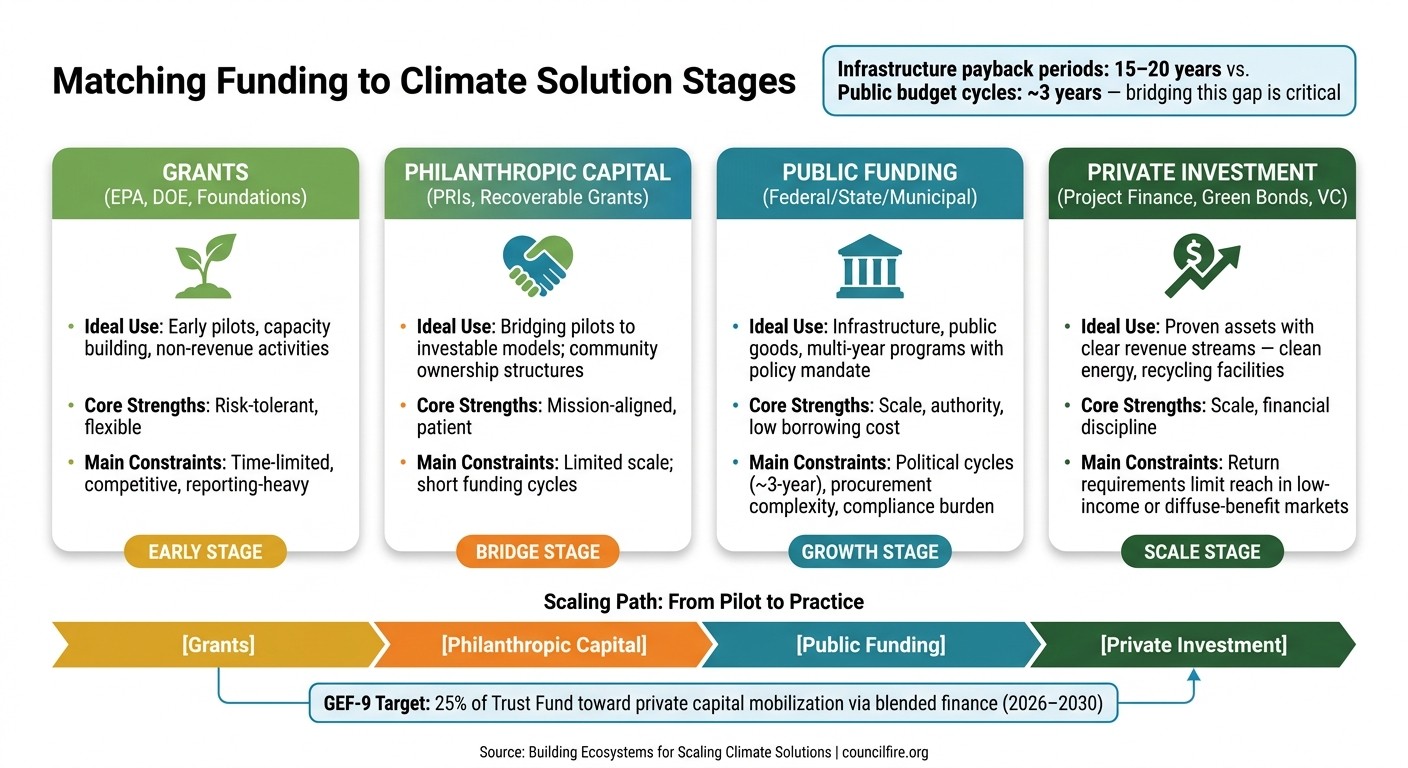
Climate Solution Funding Sources: Match Capital to Stage
Once governance and data are in place, capital and measurement decide whether the ecosystem can scale.
Compare funding sources and what each is best for
No single funding source can carry a climate solution from pilot to multi-site scale. The job is to match each source to the stage of the work and the kind of risk it carries.
Grants and philanthropic capital take on early risk. They can fund community design, stakeholder engagement, and open-source tools that don't bring in revenue. Public funding and procurement - federal appropriations, state programs, and contracts - fit infrastructure and policy-led rollout, where long-term government commitment and low-cost financing matter most. Private investment, including debt, equity, project finance, and green bonds, tends to come in after technical and policy risk has dropped and cash flows are easier to forecast.
Funding Source | Ideal Use Case | Core Strengths | Main Constraints |
|---|---|---|---|
Early pilots, capacity building, non-revenue activities | Risk-tolerant, flexible | Time-limited, competitive, reporting-heavy | |
Philanthropic capital (PRIs, recoverable grants) | Bridging pilots to investable models; community ownership structures | Mission-aligned, patient | Limited scale; short funding cycles |
Public funding (federal/state/municipal) | Infrastructure, public goods, multi-year programs with policy mandate | Scale, authority, low borrowing cost | Political cycles, procurement complexity, compliance burden |
Private investment (project finance, green bonds, VC) | Proven assets with clear revenue streams - clean energy, recycling facilities | Scale, speed, financial discipline | Return requirements limit reach in low-income or diffuse-benefit markets |
In the field, these sources often stack together. A community solar program might start with philanthropic grants for community organizing and early design, use public funding for enabling infrastructure or tax credits, and then bring in private capital to finance repeatable assets at scale. The Global Environment Facility targets 25% of its GEF-9 Trust Fund programming for 2026–2030 toward private capital mobilization through blended finance structures.[7] The mix only works when it fits the scaling path the ecosystem is trying to prove.
Measure outcomes and decide how to scale
Funding choices mean little if measurement can't show whether the model is ready to grow. A useful approach tracks three levels: outputs such as buildings retrofitted or tons diverted; outcomes such as lower energy use, utility savings, or higher recycling rates; and system-level effects such as new building codes, permanent resilience offices, or new market entrants in a region.
Teams should watch all three. Still, system-level effects tell you the most about whether underlying conditions are changing or whether the ecosystem is just running a set of good projects. Policy adoption rates, institutional shifts, and replication across jurisdictions show whether the work is sticking. Shared metrics also give partners one common reference point when they need to decide whether to replicate, expand, or go deeper.
Once the data is solid at each level, scaling tends to move through three paths:
Scaling out replicates a proven model in new places. Think of a community solar model moving from one city to a neighboring county, using documented implementation steps and performance data from the first site.
Scaling up embeds the model in policy and institutions so it becomes standard practice. Building performance standards in several U.S. cities were shaped directly by detailed pilot retrofit data that showed energy savings were achievable and costs were manageable.
Scaling deep focuses on the hardest layer: durable shifts in behavior, norms, and culture. That shows up in longitudinal surveys, household behavior metrics, participation in ongoing community programs, volunteer engagement, and qualitative evidence of norm shifts over time. It can include weaving sustainability into schools, faith groups, local businesses, and neighborhood organizations.
Conclusion: The conditions that help climate ecosystems grow
Durable climate and circular economy progress does not come from isolated initiatives. It comes from shared infrastructure for action: systems with clear roles, governance that lasts, data that moves across partners, and financing matched to each stage of growth.
Organizations like Council Fire help governments, foundations, NGOs, and visionary companies turn sustainability strategy into measurable action. When capital and metrics support the same scaling path, climate ecosystems can move from pilot to practice.
FAQs
How do you build a climate ecosystem from scratch?
Start with a clear sustainability vision and a hard look at where you stand today. That means measuring emissions, resource dependencies, and the risks most likely to hit the business. Without that baseline, teams end up guessing - and guesswork is a bad way to build a long-term plan.
Next, map the people and groups that shape the work: suppliers, NGOs, local governments, technology providers, financiers, and advisors. Then use systems thinking to get everyone working toward shared goals. The point isn’t just to gather input. It’s to make sure each party understands how its role connects to the bigger picture.
Once that foundation is in place, co-create solutions instead of pushing them top-down. Set transparent governance so decisions are clear, roles are defined, and progress doesn’t get stuck in limbo. Put measurable KPIs in place, tie them to shared dashboards, and make performance visible to everyone involved.
From there, test the approach in specific U.S. markets. Pilots help teams see what works, where friction shows up, and which ideas are worth backing with more time and money. The next step is scaling through flagship projects, knowledge-sharing hubs, and communities of practice, so lessons don’t stay trapped in one team or one region.
What should a backbone team do?
A backbone team is the dedicated engine of an ecosystem. It turns shared goals into measurable, system-level results by giving the partnership the day-to-day capacity to manage data, track commitments, and respond when new issues show up.
Just as important, it keeps partners moving in the same direction. The team organizes working groups, manages schedules, and keeps communication clear across the partnership. In day-to-day work, that means stewarding governance, upholding shared principles, helping settle conflicts through documented protocols, and keeping the group accountable to long-term objectives.
How do you know when a pilot is ready to scale?
A pilot is ready to scale when it has proved its worth, won stakeholder support, and delivered measurable results. Early, tangible wins matter here. They build confidence, show that the work is landing, and make the case for taking the next step.
It also needs to stay aligned with the partnership’s core mission. That means the private partner must be able to deliver at a larger level, while public partners stay committed to the long-term funding, staff time, and support needed to keep that growth going.
Related Blog Posts
Latest Articles
©2025

Narrative Change and Power Building: The Missing Half of Advocacy
Narrative change is the process of disrupting dominant narratives that normalize inequity and advancing new narratives from historically marginalized communities.

Funding Resilience Without Federal Grants
BRIC is unreliable and FEMA is shrinking. Here's how cities fund climate resilience with dedicated revenue, blended finance, and a coordinating authority.

The ESG Blind Spot: How AI Is Finding Risks in Companies Nobody Else Is Watching
Norway's sovereign wealth fund uses AI to screen 7,200 portfolio companies for forced labor and corruption within 24 hours. The real story is the emerging-market coverage gap that traditional ESG data vendors miss — and what it means for any company with a global supply chain.
Narrative Change and Power Building: The Missing Half of Advocacy
Narrative change is the process of disrupting dominant narratives that normalize inequity and advancing new narratives from historically marginalized communities.
Funding Resilience Without Federal Grants
BRIC is unreliable and FEMA is shrinking. Here's how cities fund climate resilience with dedicated revenue, blended finance, and a coordinating authority.
The ESG Blind Spot: How AI Is Finding Risks in Companies Nobody Else Is Watching
Norway's sovereign wealth fund uses AI to screen 7,200 portfolio companies for forced labor and corruption within 24 hours. The real story is the emerging-market coverage gap that traditional ESG data vendors miss — and what it means for any company with a global supply chain.
FAQ
01
What does it really mean to “redefine profit”?
02
What makes Council Fire different?
03
Who does Council Fire work with?
04
What does working with Council Fire actually look like?
05
How does Council Fire help organizations turn big goals into action?
06
How does Council Fire define and measure success?
Aug 19, 2026
Building Ecosystems for Scaling Climate Solutions
Sustainability Strategy
In This Article
Turn pilots into scalable climate solutions by mapping systems, assigning clear partner roles, standardizing data, and aligning funding.
Building Ecosystems for Scaling Climate Solutions
Most climate pilots fail to spread because the support system is weak, not because the idea is bad. I’d sum up the article this way: if you want climate work to move past one pilot site, you need clear partner roles, shared rules, data that travels across projects, and funding that fits each stage.
Here’s the short version:
One group can’t do it alone. Public agencies, funders, firms, NGOs, and local groups each control part of the path.
Map the full system first. Track how money, permits, delivery, and trust move - and where they get stuck.
Set roles by skill, not status. A RACI matrix and a capability list help cut overlap and confusion.
Put rules in writing early. A charter, decision steps, meeting rhythm, and dispute path help the work last 5 to 10 years.
Treat community consent as a gate. Don’t leave it for the end.
Use a small backbone team. Even 2–3 staff can keep partners aligned, track progress, and keep records up to date.
Document pilots for reuse. Focus on workflows, costs, policies, and what must stay fixed versus what can change by place.
Standardize data and learning. Shared metrics, dashboards, and after-action reviews turn single projects into a network.
Match funding to stage. Grants and philanthropy fit early risk; public funds fit public goods; private capital fits models with clearer cash flow.
Measure three levels: outputs, outcomes, and system effects. If policy, institutions, or market behavior don’t shift, scale will stay limited.
A few numbers stand out. Reviews can take 6 to 18 months. Public programs often run on about 3-year cycles, while infrastructure may need 15- to 20-year payback periods. That gap alone can stall a strong pilot.
If I were using this piece as a guide, my takeaway would be simple: build the network before you try to spread the project.
Scaling Climate Solutions through Smarter Investing and Philanthropy | Featuring Stephan Nicoleau
Map the system and define partner roles
Once you know the actors, the next step is to map how value, money, permits, and trust move through the system. That means looking past titles and asking a simpler question: who actually shapes whether this thing gets done? Some partners drive adoption. Some control funding or permits. Some carry delivery risk. Others can slow or speed progress across policy, finance, operations, and community engagement.
Identify dependencies, incentives, and gaps
Map five layers: value chain, policy and permitting, finance, implementation and infrastructure, and communities and stakeholders. Then mark where each layer stalls and why.
The policy layer is often where timelines go sideways. Major environmental reviews in the U.S. can take 6 to 18 months[2]. Finance mapping shows a different problem: public agencies often work on roughly 3-year budget and political cycles, while infrastructure projects may need 15- to 20-year payback windows[2]. Private investors, meanwhile, tend to want exits and returns on timelines that may not line up with either one. If you spot those mismatches early, you can build around them in the partnership design instead of getting blindsided later.
Community mapping matters just as much as the technical layers. Local governments, neighborhood organizations, Tribal governments, labor groups, and frontline communities all help decide whether a project moves ahead through permitting, workforce access, and land-use choices. Treat community consent as a decision gate, not something you circle back to at the end.
A useful way to do this is with a swim-lane diagram. It shows the flow of materials, money, and authority across all five layers, with pain points and leverage points marked at each step. When partners build this map together, informal power dynamics and incentive gaps tend to show up much faster than they do in a formal org chart review.
Once the bottlenecks are visible, role assignment becomes a design choice, not a status contest.
Assign roles based on capability, not title
Start with a capability inventory: a shared list of functions the initiative needs, such as convening, technical delivery, policy navigation, finance structuring, community engagement, data management, and communications. Then match those functions to partners who have actually done the work before.
A regional NGO with years of multi-stakeholder facilitation experience may be better suited to convene than a large agency with formal authority but weak trust with local groups. A community-based organization with deep neighborhood ties is often a better fit to lead co-design than a firm that just arrived in the area. This is where a simple responsibility grid helps. Formalizing the split with a RACI matrix - clarifying who is Responsible, Accountable, Consulted, and Informed for each function - cuts duplication and makes the governance model easier to use in new markets.
A capability-based role design also makes expansion more practical. New geographies can swap in local actors without changing the core operating logic.
Design governance for long-term collaboration
Once roles are in place, governance turns them into rules people can actually work with over time. Clear roles matter, but they don't hold up on their own. Partners also need shared rules, a plain decision process, and real accountability so the ecosystem can keep moving through leadership changes and funding swings.
Set a shared mandate and decision process
Write a governance charter early - before the first project begins - and base it on the roles and dependencies already mapped. The charter should lay out the mission, geography, 5- to 10-year horizon, outcomes, and each partner's responsibilities. It also needs to make one thing plain: who decides what and how disputes get resolved.
A tiered decision framework works well here. Strategic decisions - major investments, policy positions, and changes to the shared mandate - should go to a governing council made up of senior representatives from government, major funders, and key community organizations. Operational decisions, such as project approvals within agreed budget thresholds, can sit with working groups. Technical decisions on standards or methodologies should go to expert panels, with the rationale written down. Escalation paths should include maximum response times of 10–15 business days and spell out when independent facilitation kicks in.
Use a steady meeting rhythm: monthly working-group meetings, quarterly steering meetings, and annual summit meetings. Support that cadence with decision logs and transparent reporting so choices don't disappear into side conversations.
Build trust with communities and implementation partners
Technical quality alone won't make a climate initiative last. Legitimacy does. And legitimacy comes from how communities are treated from the start - not from a consultation session held after the design is already locked.
The mechanics matter. A community advisory board with representation from frontline neighborhoods, Indigenous groups where relevant, local businesses, and youth organizations gives communities a standing role in governance. Co-design workshops at accessible times and locations - with interpretation, childcare, and paid stipends for participants - show that local knowledge matters as much as technical expertise. Publish compensation, tie it to local cost of living, and follow IRS, labor, and procurement rules.
Feedback loops also need teeth. Public dashboards that track emissions reductions, local jobs created, pollution levels, and waste diversion - paired with formal grievance processes and response-time commitments - give communities a real say in project direction, not just a seat in the room. Tying funding disbursements or project milestones to community satisfaction measures adds another layer of accountability.
Use a backbone team to coordinate execution
A backbone team coordinates the ecosystem. It does not own projects; it keeps partners aligned. Its job usually includes convening partners, maintaining the governance charter, tracking progress against shared metrics, managing knowledge platforms, aligning communications, and making sure strategy stays tied to on-the-ground delivery.
In practice, backbone teams are often small - as few as 2–3 dedicated staff - with skills across facilitation, project management, data analysis, stakeholder engagement, and communications.[1] What matters most is not team size. It's having enough authority to call meetings, request data, flag misalignment, and suggest course corrections, while staying accountable to a governing council rather than acting alone.
That kind of coordination also makes replication and adaptation easier as the ecosystem grows.
Build the support systems that make solutions repeatable
Once governance is in place, the next step is making the model portable. A pilot can prove the idea works. But repeatable climate resilience solutions need more than one good test run. They need technical assistance, clear process documentation, trained staff, and shared data. Replication works when roles are lined up across partners, not when a few isolated pilots happen to go well.
Prepare pilots for replication and adaptation
Treat pilot documentation like an implementation blueprint, not a final report. The point is to capture what the next team will need to act: roles, workflows, decision points, timelines, required capabilities, enabling policies, and cost assumptions. That gives the next implementer a practical starting point instead of a stack of hindsight.
A useful way to organize this is a non-negotiables and local adaptations framework. Some parts must stay fixed, including minimum performance thresholds, safety standards, data quality rules, and legal compliance requirements. Other parts can flex, such as local materials, community engagement styles, governance structures, and state-specific incentive programs. When both are spelled out clearly, replication gets less messy. Local partners have room to adjust the model without weakening what makes it work.
NetZeroCities built a replication system with twinning, a resource platform, and 30 case studies.[3][5]
That documentation then feeds the next layer of work: training, data sharing, and local adaptation.
Create shared infrastructure for data and learning
Shared data infrastructure is what turns separate projects into a learning network. It starts with a common data model. Partners need standard definitions for location, intervention, beneficiaries, cost, outcomes, and financial performance. If each group measures things its own way, comparisons fall apart fast.
From there, outcome dashboards should be built for different audiences. City officials need one view. Funders need another. Community members need something else again. The TransformAr project showed this with its Replicability Assessment Tool and Data Visualisation Platform, both built to help regions judge whether solutions could transfer and to support evidence-based decisions about where to scale next.[6]
Learning loops are what keep the system from going stale. After-action reviews at key milestones, peer learning groups across sites, and iterative playbook updates with version control help each rollout improve the next one. Backbone teams should own the playbooks, data standards, and the learning cadence. The UNDP and UNEP-CTCN AFCIA program showed how flexible finance paired with structured learning support can keep this work moving across cities, states, and regions. Between 2020 and 2025, it backed 44 initiatives in 33 countries, with business support and technical assistance built in from the start rather than added later.[4]
These systems set up the financing and measurement choices that determine whether the model can scale.
Align financing, measurement, and scaling pathways
Climate Solution Funding Sources: Match Capital to Stage
Once governance and data are in place, capital and measurement decide whether the ecosystem can scale.
Compare funding sources and what each is best for
No single funding source can carry a climate solution from pilot to multi-site scale. The job is to match each source to the stage of the work and the kind of risk it carries.
Grants and philanthropic capital take on early risk. They can fund community design, stakeholder engagement, and open-source tools that don't bring in revenue. Public funding and procurement - federal appropriations, state programs, and contracts - fit infrastructure and policy-led rollout, where long-term government commitment and low-cost financing matter most. Private investment, including debt, equity, project finance, and green bonds, tends to come in after technical and policy risk has dropped and cash flows are easier to forecast.
Funding Source | Ideal Use Case | Core Strengths | Main Constraints |
|---|---|---|---|
Early pilots, capacity building, non-revenue activities | Risk-tolerant, flexible | Time-limited, competitive, reporting-heavy | |
Philanthropic capital (PRIs, recoverable grants) | Bridging pilots to investable models; community ownership structures | Mission-aligned, patient | Limited scale; short funding cycles |
Public funding (federal/state/municipal) | Infrastructure, public goods, multi-year programs with policy mandate | Scale, authority, low borrowing cost | Political cycles, procurement complexity, compliance burden |
Private investment (project finance, green bonds, VC) | Proven assets with clear revenue streams - clean energy, recycling facilities | Scale, speed, financial discipline | Return requirements limit reach in low-income or diffuse-benefit markets |
In the field, these sources often stack together. A community solar program might start with philanthropic grants for community organizing and early design, use public funding for enabling infrastructure or tax credits, and then bring in private capital to finance repeatable assets at scale. The Global Environment Facility targets 25% of its GEF-9 Trust Fund programming for 2026–2030 toward private capital mobilization through blended finance structures.[7] The mix only works when it fits the scaling path the ecosystem is trying to prove.
Measure outcomes and decide how to scale
Funding choices mean little if measurement can't show whether the model is ready to grow. A useful approach tracks three levels: outputs such as buildings retrofitted or tons diverted; outcomes such as lower energy use, utility savings, or higher recycling rates; and system-level effects such as new building codes, permanent resilience offices, or new market entrants in a region.
Teams should watch all three. Still, system-level effects tell you the most about whether underlying conditions are changing or whether the ecosystem is just running a set of good projects. Policy adoption rates, institutional shifts, and replication across jurisdictions show whether the work is sticking. Shared metrics also give partners one common reference point when they need to decide whether to replicate, expand, or go deeper.
Once the data is solid at each level, scaling tends to move through three paths:
Scaling out replicates a proven model in new places. Think of a community solar model moving from one city to a neighboring county, using documented implementation steps and performance data from the first site.
Scaling up embeds the model in policy and institutions so it becomes standard practice. Building performance standards in several U.S. cities were shaped directly by detailed pilot retrofit data that showed energy savings were achievable and costs were manageable.
Scaling deep focuses on the hardest layer: durable shifts in behavior, norms, and culture. That shows up in longitudinal surveys, household behavior metrics, participation in ongoing community programs, volunteer engagement, and qualitative evidence of norm shifts over time. It can include weaving sustainability into schools, faith groups, local businesses, and neighborhood organizations.
Conclusion: The conditions that help climate ecosystems grow
Durable climate and circular economy progress does not come from isolated initiatives. It comes from shared infrastructure for action: systems with clear roles, governance that lasts, data that moves across partners, and financing matched to each stage of growth.
Organizations like Council Fire help governments, foundations, NGOs, and visionary companies turn sustainability strategy into measurable action. When capital and metrics support the same scaling path, climate ecosystems can move from pilot to practice.
FAQs
How do you build a climate ecosystem from scratch?
Start with a clear sustainability vision and a hard look at where you stand today. That means measuring emissions, resource dependencies, and the risks most likely to hit the business. Without that baseline, teams end up guessing - and guesswork is a bad way to build a long-term plan.
Next, map the people and groups that shape the work: suppliers, NGOs, local governments, technology providers, financiers, and advisors. Then use systems thinking to get everyone working toward shared goals. The point isn’t just to gather input. It’s to make sure each party understands how its role connects to the bigger picture.
Once that foundation is in place, co-create solutions instead of pushing them top-down. Set transparent governance so decisions are clear, roles are defined, and progress doesn’t get stuck in limbo. Put measurable KPIs in place, tie them to shared dashboards, and make performance visible to everyone involved.
From there, test the approach in specific U.S. markets. Pilots help teams see what works, where friction shows up, and which ideas are worth backing with more time and money. The next step is scaling through flagship projects, knowledge-sharing hubs, and communities of practice, so lessons don’t stay trapped in one team or one region.
What should a backbone team do?
A backbone team is the dedicated engine of an ecosystem. It turns shared goals into measurable, system-level results by giving the partnership the day-to-day capacity to manage data, track commitments, and respond when new issues show up.
Just as important, it keeps partners moving in the same direction. The team organizes working groups, manages schedules, and keeps communication clear across the partnership. In day-to-day work, that means stewarding governance, upholding shared principles, helping settle conflicts through documented protocols, and keeping the group accountable to long-term objectives.
How do you know when a pilot is ready to scale?
A pilot is ready to scale when it has proved its worth, won stakeholder support, and delivered measurable results. Early, tangible wins matter here. They build confidence, show that the work is landing, and make the case for taking the next step.
It also needs to stay aligned with the partnership’s core mission. That means the private partner must be able to deliver at a larger level, while public partners stay committed to the long-term funding, staff time, and support needed to keep that growth going.
Related Blog Posts
Latest Articles
©2025
Narrative Change and Power Building: The Missing Half of Advocacy
Narrative change is the process of disrupting dominant narratives that normalize inequity and advancing new narratives from historically marginalized communities.
Funding Resilience Without Federal Grants
BRIC is unreliable and FEMA is shrinking. Here's how cities fund climate resilience with dedicated revenue, blended finance, and a coordinating authority.
The ESG Blind Spot: How AI Is Finding Risks in Companies Nobody Else Is Watching
Norway's sovereign wealth fund uses AI to screen 7,200 portfolio companies for forced labor and corruption within 24 hours. The real story is the emerging-market coverage gap that traditional ESG data vendors miss — and what it means for any company with a global supply chain.
FAQ
01
What does it really mean to “redefine profit”?
02
What makes Council Fire different?
03
Who does Council Fire work with?
04
What does working with Council Fire actually look like?
05
How does Council Fire help organizations turn big goals into action?
06
How does Council Fire define and measure success?
Aug 19, 2026
Building Ecosystems for Scaling Climate Solutions
Sustainability Strategy
In This Article
Turn pilots into scalable climate solutions by mapping systems, assigning clear partner roles, standardizing data, and aligning funding.
Building Ecosystems for Scaling Climate Solutions
Most climate pilots fail to spread because the support system is weak, not because the idea is bad. I’d sum up the article this way: if you want climate work to move past one pilot site, you need clear partner roles, shared rules, data that travels across projects, and funding that fits each stage.
Here’s the short version:
One group can’t do it alone. Public agencies, funders, firms, NGOs, and local groups each control part of the path.
Map the full system first. Track how money, permits, delivery, and trust move - and where they get stuck.
Set roles by skill, not status. A RACI matrix and a capability list help cut overlap and confusion.
Put rules in writing early. A charter, decision steps, meeting rhythm, and dispute path help the work last 5 to 10 years.
Treat community consent as a gate. Don’t leave it for the end.
Use a small backbone team. Even 2–3 staff can keep partners aligned, track progress, and keep records up to date.
Document pilots for reuse. Focus on workflows, costs, policies, and what must stay fixed versus what can change by place.
Standardize data and learning. Shared metrics, dashboards, and after-action reviews turn single projects into a network.
Match funding to stage. Grants and philanthropy fit early risk; public funds fit public goods; private capital fits models with clearer cash flow.
Measure three levels: outputs, outcomes, and system effects. If policy, institutions, or market behavior don’t shift, scale will stay limited.
A few numbers stand out. Reviews can take 6 to 18 months. Public programs often run on about 3-year cycles, while infrastructure may need 15- to 20-year payback periods. That gap alone can stall a strong pilot.
If I were using this piece as a guide, my takeaway would be simple: build the network before you try to spread the project.
Scaling Climate Solutions through Smarter Investing and Philanthropy | Featuring Stephan Nicoleau
Map the system and define partner roles
Once you know the actors, the next step is to map how value, money, permits, and trust move through the system. That means looking past titles and asking a simpler question: who actually shapes whether this thing gets done? Some partners drive adoption. Some control funding or permits. Some carry delivery risk. Others can slow or speed progress across policy, finance, operations, and community engagement.
Identify dependencies, incentives, and gaps
Map five layers: value chain, policy and permitting, finance, implementation and infrastructure, and communities and stakeholders. Then mark where each layer stalls and why.
The policy layer is often where timelines go sideways. Major environmental reviews in the U.S. can take 6 to 18 months[2]. Finance mapping shows a different problem: public agencies often work on roughly 3-year budget and political cycles, while infrastructure projects may need 15- to 20-year payback windows[2]. Private investors, meanwhile, tend to want exits and returns on timelines that may not line up with either one. If you spot those mismatches early, you can build around them in the partnership design instead of getting blindsided later.
Community mapping matters just as much as the technical layers. Local governments, neighborhood organizations, Tribal governments, labor groups, and frontline communities all help decide whether a project moves ahead through permitting, workforce access, and land-use choices. Treat community consent as a decision gate, not something you circle back to at the end.
A useful way to do this is with a swim-lane diagram. It shows the flow of materials, money, and authority across all five layers, with pain points and leverage points marked at each step. When partners build this map together, informal power dynamics and incentive gaps tend to show up much faster than they do in a formal org chart review.
Once the bottlenecks are visible, role assignment becomes a design choice, not a status contest.
Assign roles based on capability, not title
Start with a capability inventory: a shared list of functions the initiative needs, such as convening, technical delivery, policy navigation, finance structuring, community engagement, data management, and communications. Then match those functions to partners who have actually done the work before.
A regional NGO with years of multi-stakeholder facilitation experience may be better suited to convene than a large agency with formal authority but weak trust with local groups. A community-based organization with deep neighborhood ties is often a better fit to lead co-design than a firm that just arrived in the area. This is where a simple responsibility grid helps. Formalizing the split with a RACI matrix - clarifying who is Responsible, Accountable, Consulted, and Informed for each function - cuts duplication and makes the governance model easier to use in new markets.
A capability-based role design also makes expansion more practical. New geographies can swap in local actors without changing the core operating logic.
Design governance for long-term collaboration
Once roles are in place, governance turns them into rules people can actually work with over time. Clear roles matter, but they don't hold up on their own. Partners also need shared rules, a plain decision process, and real accountability so the ecosystem can keep moving through leadership changes and funding swings.
Set a shared mandate and decision process
Write a governance charter early - before the first project begins - and base it on the roles and dependencies already mapped. The charter should lay out the mission, geography, 5- to 10-year horizon, outcomes, and each partner's responsibilities. It also needs to make one thing plain: who decides what and how disputes get resolved.
A tiered decision framework works well here. Strategic decisions - major investments, policy positions, and changes to the shared mandate - should go to a governing council made up of senior representatives from government, major funders, and key community organizations. Operational decisions, such as project approvals within agreed budget thresholds, can sit with working groups. Technical decisions on standards or methodologies should go to expert panels, with the rationale written down. Escalation paths should include maximum response times of 10–15 business days and spell out when independent facilitation kicks in.
Use a steady meeting rhythm: monthly working-group meetings, quarterly steering meetings, and annual summit meetings. Support that cadence with decision logs and transparent reporting so choices don't disappear into side conversations.
Build trust with communities and implementation partners
Technical quality alone won't make a climate initiative last. Legitimacy does. And legitimacy comes from how communities are treated from the start - not from a consultation session held after the design is already locked.
The mechanics matter. A community advisory board with representation from frontline neighborhoods, Indigenous groups where relevant, local businesses, and youth organizations gives communities a standing role in governance. Co-design workshops at accessible times and locations - with interpretation, childcare, and paid stipends for participants - show that local knowledge matters as much as technical expertise. Publish compensation, tie it to local cost of living, and follow IRS, labor, and procurement rules.
Feedback loops also need teeth. Public dashboards that track emissions reductions, local jobs created, pollution levels, and waste diversion - paired with formal grievance processes and response-time commitments - give communities a real say in project direction, not just a seat in the room. Tying funding disbursements or project milestones to community satisfaction measures adds another layer of accountability.
Use a backbone team to coordinate execution
A backbone team coordinates the ecosystem. It does not own projects; it keeps partners aligned. Its job usually includes convening partners, maintaining the governance charter, tracking progress against shared metrics, managing knowledge platforms, aligning communications, and making sure strategy stays tied to on-the-ground delivery.
In practice, backbone teams are often small - as few as 2–3 dedicated staff - with skills across facilitation, project management, data analysis, stakeholder engagement, and communications.[1] What matters most is not team size. It's having enough authority to call meetings, request data, flag misalignment, and suggest course corrections, while staying accountable to a governing council rather than acting alone.
That kind of coordination also makes replication and adaptation easier as the ecosystem grows.
Build the support systems that make solutions repeatable
Once governance is in place, the next step is making the model portable. A pilot can prove the idea works. But repeatable climate resilience solutions need more than one good test run. They need technical assistance, clear process documentation, trained staff, and shared data. Replication works when roles are lined up across partners, not when a few isolated pilots happen to go well.
Prepare pilots for replication and adaptation
Treat pilot documentation like an implementation blueprint, not a final report. The point is to capture what the next team will need to act: roles, workflows, decision points, timelines, required capabilities, enabling policies, and cost assumptions. That gives the next implementer a practical starting point instead of a stack of hindsight.
A useful way to organize this is a non-negotiables and local adaptations framework. Some parts must stay fixed, including minimum performance thresholds, safety standards, data quality rules, and legal compliance requirements. Other parts can flex, such as local materials, community engagement styles, governance structures, and state-specific incentive programs. When both are spelled out clearly, replication gets less messy. Local partners have room to adjust the model without weakening what makes it work.
NetZeroCities built a replication system with twinning, a resource platform, and 30 case studies.[3][5]
That documentation then feeds the next layer of work: training, data sharing, and local adaptation.
Create shared infrastructure for data and learning
Shared data infrastructure is what turns separate projects into a learning network. It starts with a common data model. Partners need standard definitions for location, intervention, beneficiaries, cost, outcomes, and financial performance. If each group measures things its own way, comparisons fall apart fast.
From there, outcome dashboards should be built for different audiences. City officials need one view. Funders need another. Community members need something else again. The TransformAr project showed this with its Replicability Assessment Tool and Data Visualisation Platform, both built to help regions judge whether solutions could transfer and to support evidence-based decisions about where to scale next.[6]
Learning loops are what keep the system from going stale. After-action reviews at key milestones, peer learning groups across sites, and iterative playbook updates with version control help each rollout improve the next one. Backbone teams should own the playbooks, data standards, and the learning cadence. The UNDP and UNEP-CTCN AFCIA program showed how flexible finance paired with structured learning support can keep this work moving across cities, states, and regions. Between 2020 and 2025, it backed 44 initiatives in 33 countries, with business support and technical assistance built in from the start rather than added later.[4]
These systems set up the financing and measurement choices that determine whether the model can scale.
Align financing, measurement, and scaling pathways
Climate Solution Funding Sources: Match Capital to Stage
Once governance and data are in place, capital and measurement decide whether the ecosystem can scale.
Compare funding sources and what each is best for
No single funding source can carry a climate solution from pilot to multi-site scale. The job is to match each source to the stage of the work and the kind of risk it carries.
Grants and philanthropic capital take on early risk. They can fund community design, stakeholder engagement, and open-source tools that don't bring in revenue. Public funding and procurement - federal appropriations, state programs, and contracts - fit infrastructure and policy-led rollout, where long-term government commitment and low-cost financing matter most. Private investment, including debt, equity, project finance, and green bonds, tends to come in after technical and policy risk has dropped and cash flows are easier to forecast.
Funding Source | Ideal Use Case | Core Strengths | Main Constraints |
|---|---|---|---|
Early pilots, capacity building, non-revenue activities | Risk-tolerant, flexible | Time-limited, competitive, reporting-heavy | |
Philanthropic capital (PRIs, recoverable grants) | Bridging pilots to investable models; community ownership structures | Mission-aligned, patient | Limited scale; short funding cycles |
Public funding (federal/state/municipal) | Infrastructure, public goods, multi-year programs with policy mandate | Scale, authority, low borrowing cost | Political cycles, procurement complexity, compliance burden |
Private investment (project finance, green bonds, VC) | Proven assets with clear revenue streams - clean energy, recycling facilities | Scale, speed, financial discipline | Return requirements limit reach in low-income or diffuse-benefit markets |
In the field, these sources often stack together. A community solar program might start with philanthropic grants for community organizing and early design, use public funding for enabling infrastructure or tax credits, and then bring in private capital to finance repeatable assets at scale. The Global Environment Facility targets 25% of its GEF-9 Trust Fund programming for 2026–2030 toward private capital mobilization through blended finance structures.[7] The mix only works when it fits the scaling path the ecosystem is trying to prove.
Measure outcomes and decide how to scale
Funding choices mean little if measurement can't show whether the model is ready to grow. A useful approach tracks three levels: outputs such as buildings retrofitted or tons diverted; outcomes such as lower energy use, utility savings, or higher recycling rates; and system-level effects such as new building codes, permanent resilience offices, or new market entrants in a region.
Teams should watch all three. Still, system-level effects tell you the most about whether underlying conditions are changing or whether the ecosystem is just running a set of good projects. Policy adoption rates, institutional shifts, and replication across jurisdictions show whether the work is sticking. Shared metrics also give partners one common reference point when they need to decide whether to replicate, expand, or go deeper.
Once the data is solid at each level, scaling tends to move through three paths:
Scaling out replicates a proven model in new places. Think of a community solar model moving from one city to a neighboring county, using documented implementation steps and performance data from the first site.
Scaling up embeds the model in policy and institutions so it becomes standard practice. Building performance standards in several U.S. cities were shaped directly by detailed pilot retrofit data that showed energy savings were achievable and costs were manageable.
Scaling deep focuses on the hardest layer: durable shifts in behavior, norms, and culture. That shows up in longitudinal surveys, household behavior metrics, participation in ongoing community programs, volunteer engagement, and qualitative evidence of norm shifts over time. It can include weaving sustainability into schools, faith groups, local businesses, and neighborhood organizations.
Conclusion: The conditions that help climate ecosystems grow
Durable climate and circular economy progress does not come from isolated initiatives. It comes from shared infrastructure for action: systems with clear roles, governance that lasts, data that moves across partners, and financing matched to each stage of growth.
Organizations like Council Fire help governments, foundations, NGOs, and visionary companies turn sustainability strategy into measurable action. When capital and metrics support the same scaling path, climate ecosystems can move from pilot to practice.
FAQs
How do you build a climate ecosystem from scratch?
Start with a clear sustainability vision and a hard look at where you stand today. That means measuring emissions, resource dependencies, and the risks most likely to hit the business. Without that baseline, teams end up guessing - and guesswork is a bad way to build a long-term plan.
Next, map the people and groups that shape the work: suppliers, NGOs, local governments, technology providers, financiers, and advisors. Then use systems thinking to get everyone working toward shared goals. The point isn’t just to gather input. It’s to make sure each party understands how its role connects to the bigger picture.
Once that foundation is in place, co-create solutions instead of pushing them top-down. Set transparent governance so decisions are clear, roles are defined, and progress doesn’t get stuck in limbo. Put measurable KPIs in place, tie them to shared dashboards, and make performance visible to everyone involved.
From there, test the approach in specific U.S. markets. Pilots help teams see what works, where friction shows up, and which ideas are worth backing with more time and money. The next step is scaling through flagship projects, knowledge-sharing hubs, and communities of practice, so lessons don’t stay trapped in one team or one region.
What should a backbone team do?
A backbone team is the dedicated engine of an ecosystem. It turns shared goals into measurable, system-level results by giving the partnership the day-to-day capacity to manage data, track commitments, and respond when new issues show up.
Just as important, it keeps partners moving in the same direction. The team organizes working groups, manages schedules, and keeps communication clear across the partnership. In day-to-day work, that means stewarding governance, upholding shared principles, helping settle conflicts through documented protocols, and keeping the group accountable to long-term objectives.
How do you know when a pilot is ready to scale?
A pilot is ready to scale when it has proved its worth, won stakeholder support, and delivered measurable results. Early, tangible wins matter here. They build confidence, show that the work is landing, and make the case for taking the next step.
It also needs to stay aligned with the partnership’s core mission. That means the private partner must be able to deliver at a larger level, while public partners stay committed to the long-term funding, staff time, and support needed to keep that growth going.
Related Blog Posts
Latest Articles
©2025
Narrative Change and Power Building: The Missing Half of Advocacy
Narrative change is the process of disrupting dominant narratives that normalize inequity and advancing new narratives from historically marginalized communities.
Funding Resilience Without Federal Grants
BRIC is unreliable and FEMA is shrinking. Here's how cities fund climate resilience with dedicated revenue, blended finance, and a coordinating authority.
The ESG Blind Spot: How AI Is Finding Risks in Companies Nobody Else Is Watching
Norway's sovereign wealth fund uses AI to screen 7,200 portfolio companies for forced labor and corruption within 24 hours. The real story is the emerging-market coverage gap that traditional ESG data vendors miss — and what it means for any company with a global supply chain.
FAQ
What does it really mean to “redefine profit”?
What makes Council Fire different?
Who does Council Fire work with?
What does working with Council Fire actually look like?
How does Council Fire help organizations turn big goals into action?
How does Council Fire define and measure success?