
Jun 6, 2026
How to Build Resilience Governance Models That Balance Risk and Equity for NGOs & Nonprofits
Capacity Building
In This Article
Transform nonprofit boards into adaptive, equity-centered leaders that manage risk, share power, and sustain mission impact.
How to Build Resilience Governance Models That Balance Risk and Equity for NGOs & Nonprofits
Nonprofits face growing challenges: rising service demands, unstable funding, and resource constraints, compounded by climate disruptions and social inequities. Traditional governance often falls short in addressing these complexities. Resilience governance offers a way forward, transforming boards into proactive partners that prioritize equity and risk management.
Key Takeaways:
Mission clarity: Define your mission, risk tolerance, and equity framework to guide decisions during crises.
Board restructuring: Shift from hierarchical models to flexible structures like adaptive or sociocracy-based governance to enhance decision-making and accountability.
Equity integration: Embed equity into governance by diversifying board composition, creating community-led decision-making processes, and updating bylaws.
Risk management: Develop frameworks to address strategic, operational, financial, and equity risks, with tools like vulnerability mapping and scenario planning.
Implementation: Use governance calendars, metrics dashboards, and structured learning cycles to monitor progress and adapt over time.
This guide provides actionable steps to create governance models that align with your mission, address risks, and ensure fairness in decision-making.
Beyond Governance: How Nonprofit Board Leadership Fuels Resilience
Step 1: Define Your Mission, Risk Appetite, and Equity Framework
Start with a mission that serves as your compass during challenging times. As BoardSource emphasizes:
"Mission clarity is more than a philosophical anchor; it's a practical guide to decision-making when hard choices arise." [5]
Before tackling risk management or incorporating equity into governance, the board must reach consensus on the programs and principles that are non-negotiable, even in a crisis. This clarity helps the organization avoid hasty, reactive decisions during periods of disruption.
Understand How Your Mission Interacts with External Systems
Your mission isn't isolated - it operates within a web of external factors like funding cycles, policy changes, climate events, and economic conditions affecting the communities you serve. For instance, consider a Midwest-based food security nonprofit. It might depend on federal nutrition funding, grapple with supply chain issues caused by extreme weather, and address the needs of communities struggling with inflation. By applying systems thinking, you can better identify these external pressures and their potential impact on your governance.
One critical step is determining your Maximum Acceptable Downtime (MAD) - the longest period critical functions can remain offline before compromising your mission. [8] This understanding shapes the boundaries for your risk assessments.
Define Risk Appetite and Tolerance Levels
Risk appetite spans every aspect of your operations, not just financial matters. To manage this effectively, categorize risks into strategic, operational, financial, and equity dimensions. Develop clear methods to assess each type of risk and establish thresholds to guide decision-making. Here's an example framework:
Risk Category | Assessment Method | Stakeholder Focus |
|---|---|---|
Strategic | Materiality Assessment | Donors, Partners, Beneficiaries |
Operational | Vulnerability Matrix | Staff, Volunteers, Local Community |
Financial | Scenario Planning | Board, Funders, Regulators |
Equity | Vulnerability Mapping | Frontline & Marginalized Communities |
Once you've defined these thresholds, integrate equity into governance to ensure decisions are balanced and inclusive.
Make Equity a Core Element of Governance
Equitable governance goes beyond simply diversifying your board. As LIFT Economy points out:
"Equitable governance is not the same as diverse governance. An organization can recruit board members... and still concentrate meaningful authority among a narrow, homogeneous inner circle." [9]
A compelling example comes from the Peter and Elizabeth Tower Foundation. They brought "community consultants" - young individuals aged 18–26 with lived experience - into their grant review process, working alongside program officers. Additionally, they created a "Community Expert Fund", giving an independent team of young people control over $200,000 annually, with their decisions reported directly to the board. [10]
To truly embed equity, examine high-stakes decisions like major hires, budget shifts, or program changes. Ask whose voices influenced those outcomes. Identifying gaps between formal structures and actual decision-making power is a vital step toward achieving structural equity. [9]
Step 2: Choose a Governance Structure That Supports Resilience and Equity
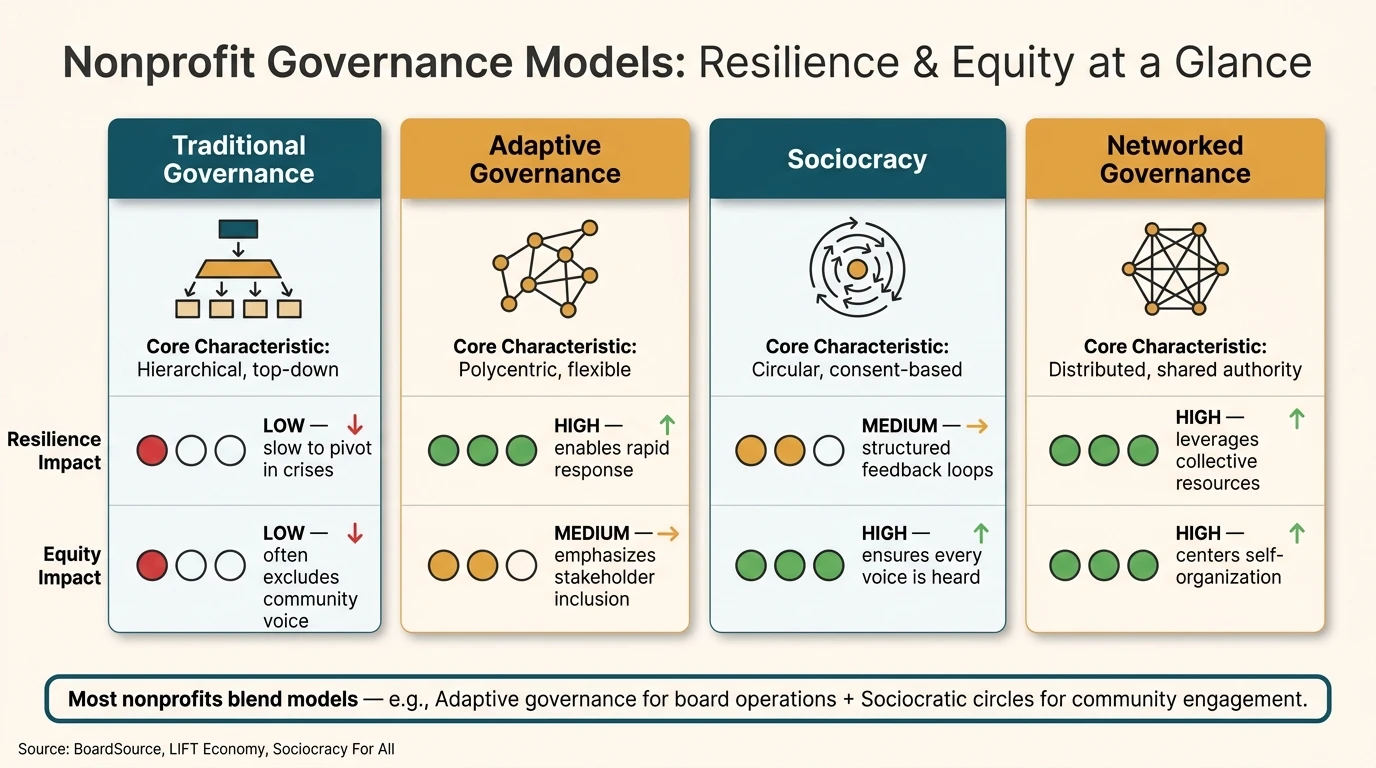
Nonprofit Governance Models: Resilience & Equity Comparison
Once you've established your mission and risk framework, the next step in strengthening governance is designing a board structure that aligns with your goals. This structure should enable your organization to act effectively while upholding resilience and equity.
Review Common Nonprofit Governance Models
Each governance model offers a different balance between efficiency and inclusivity. Understanding these trade-offs is essential for making informed decisions.
Model | Core Characteristic | Resilience Impact | Equity Impact |
|---|---|---|---|
Traditional | Hierarchical, top-down | Low - slow to pivot in crises | Low - often excludes community voice |
Adaptive | Polycentric, flexible | High - enables rapid response | Medium - emphasizes stakeholder inclusion |
Sociocracy | Circular, consent-based | Medium - structured feedback loops | High - ensures every voice is heard |
Networked | Distributed, shared authority | High - leverages collective resources | High - centers self-organization |
The adaptive model is particularly effective at transforming nonprofit boards into strategic partners rather than compliance-focused entities [1]. For organizations prioritizing equity, sociocracy stands out. This model uses consent-based decision-making, where proposals move forward unless there is a reasoned objection. Sociocratic circles, typically composed of 5–7 members, ensure meaningful participation and functional communication [12].
While these models provide a foundation, they should be adapted to fit the unique context of your organization.
Adapt Structures to Fit Your Organization
Rather than adhering rigidly to a single model, most nonprofits find success by blending elements from multiple approaches. For instance, an adaptive governance framework can guide the board's overall operations, while sociocratic circles can enhance specific areas like community engagement or equity oversight.
For coalition-based organizations, a polycentric structure - where authority is distributed across local or regional groups - can improve responsiveness and legitimacy. However, this approach may slow decision-making at the organizational level. On the other hand, a centralized network structure can streamline execution but risks concentrating power, which could conflict with equity goals [11].
To refine your governance structure, identify your top 10 critical decisions (e.g., crisis management, major funding changes) and assess whether delays stem from structural rules or behavioral patterns. Often, addressing behavioral issues can be more impactful than revising governance documents [13].
Beyond structure, the composition of your board plays a pivotal role in achieving both resilience and equity.
Strengthen Board Composition for Resilience and Equity
The makeup of your board is central to operational effectiveness. According to BoardSource's Leading with Intent report, U.S. nonprofit boards remain predominantly white, which undermines both their legitimacy and the quality of their decisions [6].
To address this, use a skills matrix to align board member competencies with organizational needs. Enforcing term limits can also bring fresh perspectives to the table [6]. Additionally, creating dedicated committees for areas like risk oversight, community engagement, and equity accountability ensures these priorities remain integral to your governance model.
For example, a mental health nonprofit formed a rapid-response subcommittee that met monthly to address policy changes and adjust services accordingly [1]. This level of agility requires intentional design and commitment, not chance. By prioritizing diverse voices and proactive structures, your board can better navigate challenges and uphold its mission.
Step 3: Embed Risk Management and Adaptive Capacity into Governance
Once a governance structure is in place, the next step is ensuring that risk management becomes more than a formality. It must be integrated into how the board operates and makes decisions on a daily basis.
Build a Risk Management Framework
Boards need to rethink their approach to risk. Instead of focusing solely on past incidents, they should act as a "sense-making engine" - identifying early warning signals, asking the tough strategic questions, and steering the organization before challenges escalate [3]. One practical way to achieve this is by reorganizing board meeting agendas to prioritize environmental scanning and strategic discussions at the start, rather than as an afterthought [3].
Risk assessment should also center on the mission's beneficiaries. Boards must evaluate who benefits from their decisions and who bears the costs - a perspective that extends beyond traditional financial risk reviews [6]. To avoid delays during crises, boards can empower senior management to act within clearly defined strategic boundaries [3][1].
Another key tool is the annual "assumption audit." This exercise encourages the board to challenge its core beliefs about the operating environment. By asking questions like, "What if our core assumption is wrong?" boards create a culture of constructive challenge where questioning is welcomed, not penalized [3].
Once risk assessment practices are in place, the focus can shift toward strengthening resilience through adaptive capacity.
Build Adaptive Capacity for Long-Term Resilience
Adaptive capacity ensures that an organization can weather unexpected disruptions and continue forward. Building this resilience requires intentional efforts in three key areas: financial buffers, flexible leadership, and structured learning cycles.
Start by establishing financial reserves to cover three to six months of operating expenses. In addition, create cross-functional teams or rapid-response units that can address sudden disruptions - whether it’s a shift in policy, a funding shortfall, or a public crisis - without waiting for full board approval [5][6][1]. These pre-approved actions should align with adaptive structures, ensuring the organization can absorb shocks and maintain operations.
To promote continuous improvement, implement "Plan–Do–Review–Adapt" cycles [1]. These cycles help prevent repeated mistakes and ensure governance evolves in step with the changing environment. Drew Giddings, Founder & Principal Consultant at GCG, emphasizes the importance of this approach:
"The best boards we work with have a clear rule: govern everything, manage nothing. They set the destination and check the compass. They do not grab the steering wheel." [6]
A structured governance calendar can also keep the board proactive. Assigning specific focus areas to each quarter - such as risk reviews in Q1 or strategy evaluations in Q2 - ensures critical oversight doesn’t fall through the cracks [6].
Bring Climate and Systems Risks into Governance
With a robust risk and adaptive framework in place, boards must also address climate and systems-related risks as core governance priorities. Issues like extreme weather, supply chain disruptions, and shifting policies can directly impact programs, staff, and the communities served. Boards should evaluate hazards, vulnerabilities, and response capacities across all relevant areas [7].
Scenario planning workshops can be particularly effective. These sessions allow boards to explore potential futures, such as a major flood affecting service delivery, a sudden funding loss, or a policy reversal impacting beneficiaries. By developing response playbooks for these scenarios, boards can shift from reactive to strategic governance [1][5]. Danielle Gilmore, Ph.D., MPP, CHES, Director of Learning and Research at BoardSource, articulates this shift:
"The central question is no longer how to protect the institution, but how to respond to the conditions affecting the mission." [4]
Alarmingly, one in five foundation CEOs report that their board members lack an understanding of how current conditions affect the communities they serve [4]. Closing this gap requires boards to treat climate and systems risks as standing agenda items, not occasional topics. Incorporating these considerations strengthens governance strategies and enhances the impact of the mission.
Step 4: Center Equity and Stakeholder Power in Governance
After integrating adaptive risk practices, the next step is to ensure equity becomes a functional part of governance, not just a stated value. This involves examining who holds real decision-making power and restructuring processes so that those most impacted by decisions are actively shaping them.
Map Stakeholders and Power Dynamics
Take a closer look at your organization’s recent major decisions - budget shifts, strategic changes, or program expansions. Ask yourself: who had the biggest influence on these outcomes? Often, there’s a disconnect between the formal org chart and where authority actually lies [9].
A Power-Interest Matrix can help illuminate these dynamics. This tool categorizes stakeholders based on their level of influence and interest in your mission:
Quadrant | Stakeholder Type | Strategy |
|---|---|---|
High Power / High Interest | Major donors, board chairs | Build strong partnerships; prioritize engagement |
Low Power / High Interest | Volunteers, community advocates | Keep informed; establish feedback channels |
High Power / Low Interest | Government regulators, institutional funders | Keep satisfied; provide concise updates |
Low Power / Low Interest | Peripheral contacts, occasional donors | Monitor lightly; send periodic updates |
The quadrant most often overlooked? Community members with high interest but low formal power. Equitable governance means intentionally shifting these stakeholders up the influence ladder. This mapping exercise lays the groundwork for rethinking decision-making processes to amplify all voices.
Design Decision-Making Processes That Include All Voices
The International Association for Public Participation (IAP2) offers a framework for understanding stakeholder engagement levels, ranging from simply informing stakeholders to giving them direct decision-making authority. Many nonprofits operate at the "Inform" or "Consult" levels. However, equitable governance pushes toward "Collaborate" and "Empower."
One approach is allocating specific funds controlled by community members or consultants, ensuring that decision-making power lies with those directly impacted [10]. This not only redistributes authority but also builds trust.
"If the people most affected by the organization's decisions cannot point to real influence over those decisions, equitable governance is not yet working as a system." - LIFT Economy [9]
Update Policies and Bylaws to Lock In Equity
To make equity a lasting part of governance, it’s essential to embed these practices into formal policies and governing documents. Equity efforts tied solely to leadership or culture risk fading with leadership turnover. The solution? Codify them into the organization’s legal structure [9].
For instance, worker-owned cooperatives like Equal Exchange integrate governance equity directly into their legal frameworks. Similarly, organizations such as the Harris and Eliza Kempner Fund have revamped their board processes to eliminate barriers to participation [9][10].
"Equitable governance requires architecture, not just aspiration." - LIFT Economy [9]
Consider these policy updates to solidify equity in governance:
Fixed term limits (e.g., two 3-year terms) to avoid leadership stagnation.
Mandated equity impact reviews for major budget or strategy decisions.
A Skills and Lived Experience Matrix for board recruitment, ensuring diverse perspectives beyond professional qualifications.
Appointment of a Board Liaison role to support community-based board members in navigating complex financial or organizational language [10].
Step 5: Roll Out, Monitor, and Refine Your Resilience Governance Model
Once equity is embedded into your governance framework, the next challenge is turning plans into tangible actions. A governance model only succeeds if it’s actively implemented, monitored, and adjusted over time.
Build an Implementation Roadmap
Rolling out changes gradually ensures they’re manageable and allows each step to take hold before moving forward.
Begin with an initial phase (2–6 weeks) that focuses on uniting leadership around the updated model, clarifying responsibilities, and communicating changes to staff and board members. From there, proceed with structured phases aligned with your existing planning calendar. Tying governance updates to established cycles - like annual budgets, board retreats, or strategic reviews - helps ease the transition and encourages adoption.
Assign a single point of accountability for each initiative to ensure follow-through. A Governance Calendar can be a valuable tool, mapping out quarterly focus areas and activities:
Quarter | Governance Focus Area | Key Activities |
|---|---|---|
Q1 | Compliance & Self-Assessment | Audit review, Form 990, board self-assessment, committee assignments |
Q2 | Leadership & Strategy | Executive director evaluation, compensation review, strategic progress check |
Q3 | Planning & Development | Strategic assessment, budget development, board retreat |
Q4 | Approval & Onboarding | Budget approval, annual report review, new member orientation |
This calendar ensures every board meeting has a clear goal. Once the rollout is underway, use real-time tracking tools to measure progress.
Track Progress with Metrics and Dashboards
A robust tracking system ensures that governance initiatives stay on course. Leverage real-time data and adaptive dashboards to provide leadership with a clear view of organizational health, avoiding the delays of annual reporting. Incorporate community-based monitors to enhance oversight, making the process more inclusive and transparent.
To track progress effectively, focus on two areas: risk resilience (metrics like liquidity ratios, reserve fund levels, and D&O insurance adequacy) and equity impact. For equity, consider measuring across four dimensions:
Procedural: Are affected communities involved in decision-making?
Recognitional: Are diverse perspectives and knowledge systems valued?
Distributional: Are costs and benefits shared fairly?
Contextual: What broader social conditions affect the organization’s work?
These indicators act as both ethical benchmarks and early warnings for potential governance issues. A participatory approach, such as PMERL (Participatory Monitoring, Evaluation, Reflection, and Learning), fosters local engagement and surfaces insights that top-down metrics might overlook.
"The way in which M&E is practiced can profoundly influence whether it promotes equity and resilience or, conversely, dominance, exclusion, and dependency." - Ecology & Society [14]
Build a Culture of Learning and Adjustment
Tracking data isn’t enough - what truly matters is how that data informs decision-making. This step builds on earlier adaptive frameworks, integrating "Plan–Do–Review–Adapt" loops into strategy discussions. These loops ensure governance decisions are regularly tested and refined based on actual outcomes. Following significant decisions or crises, structured after-action reviews can provide valuable insights into what worked, what didn’t, and what needs improvement.
"Strong organizations do not rely on extraordinary people overfunctioning forever. They build systems, cultures and leadership practices that allow the organization to operate under pressure." - Suzanne Smith, MBA, Social TrendSpotter [15]
Annual assessments are essential for evaluating performance in areas like mission stewardship, stakeholder accountability, and financial oversight. Using a Skills Matrix can help identify gaps in board expertise, whether in areas like finance, legal matters, fundraising, or lived experience. Additionally, employing consent agendas for routine approvals can free up valuable time during board meetings for more meaningful strategic discussions. These practices ensure your governance model remains dynamic and responsive in the long run.
Conclusion: Steps Toward Resilient and Equitable Governance
Resilient governance is not a one-time achievement but an evolving practice. As one framework explains, resilience depends on having visibility into your current situation, operational predictability, and internal systems for interpreting and responding to change [16]. The steps outlined in this guide - from clarifying your mission and risk tolerance to integrating equity into bylaws and using adaptive dashboards to monitor progress - are all designed to build a governance structure that can withstand disruptions while staying true to its guiding principles. These changes lay the groundwork for decision-making that is both flexible and equity-focused.
Transitioning from traditional, hierarchical governance to an adaptive model is among the most impactful shifts an organization can undertake. Top-down structures often struggle to keep up with today’s rapid changes, whether those are political upheavals, funding shortfalls, or climate-related challenges. Adaptive governance, by contrast, decentralizes authority, accelerates decision-making, and fosters ongoing learning, helping organizations remain resilient [1].
Embedding equity into legal frameworks and decision-making processes does more than just promote diversity - it also strengthens trust within the communities you serve [2].
Collaborative initiatives further demonstrate the power of resilient governance. For example, in February 2026, Council Fire facilitated the creation of a Regional Climate Compact involving 35 organizations, including 14 municipalities, 12 businesses, 5 NGOs, and 4 academic institutions. This coalition achieved remarkable outcomes: unlocking $280 million in coordinated investments, securing renewable energy prices 18% below retail rates, and saving participants $12 million annually [17]. These successes were made possible by the governance model that prioritized adaptability and inclusivity.
FAQs
How do we choose the right governance model for our nonprofit?
To select an effective governance model, start by examining your organization’s objectives, the needs of the community it serves, and the resources available. Take a close look at how your existing structure addresses current challenges, as older frameworks may struggle to adapt to modern demands. For a more inclusive and responsive approach, explore adaptive governance, which emphasizes shared decision-making and flexibility. By incorporating feedback from stakeholders, you can ensure the chosen model aligns with your mission and promotes both long-term sustainability and fairness.
What’s the simplest way to set our risk appetite and limits?
Setting your risk appetite involves deciding how much uncertainty your organization is willing to handle in pursuit of its mission. Begin with a dedicated board session to outline acceptable risk levels across various areas. Use a structured framework - for instance, adopting zero tolerance for safety or regulatory violations but allowing moderate tolerance for risks tied to strategic growth. This approach keeps decisions aligned with your objectives and ensures a consistent focus on achieving your goals.
How can we give community members real decision power?
To give community members genuine influence in decision-making, NGOs should embed their roles within the governance structure. This can be achieved by formalizing positions for community representatives on committees or boards, employing participatory tools such as community mapping, and offering flexible funding to support initiatives led by the community. Additionally, ensuring fair compensation for their time and maintaining clear, transparent communication are critical steps for fostering trust and enabling lasting, impactful participation.
Related Blog Posts
Latest Articles
©2026

Narrative Change and Power Building: The Missing Half of Advocacy
Narrative change is the process of disrupting dominant narratives that normalize inequity and advancing new narratives from historically marginalized communities.

Funding Resilience Without Federal Grants
BRIC is unreliable and FEMA is shrinking. Here's how cities fund climate resilience with dedicated revenue, blended finance, and a coordinating authority.

The ESG Blind Spot: How AI Is Finding Risks in Companies Nobody Else Is Watching
Norway's sovereign wealth fund uses AI to screen 7,200 portfolio companies for forced labor and corruption within 24 hours. The real story is the emerging-market coverage gap that traditional ESG data vendors miss — and what it means for any company with a global supply chain.
Narrative Change and Power Building: The Missing Half of Advocacy
Narrative change is the process of disrupting dominant narratives that normalize inequity and advancing new narratives from historically marginalized communities.
Funding Resilience Without Federal Grants
BRIC is unreliable and FEMA is shrinking. Here's how cities fund climate resilience with dedicated revenue, blended finance, and a coordinating authority.
The ESG Blind Spot: How AI Is Finding Risks in Companies Nobody Else Is Watching
Norway's sovereign wealth fund uses AI to screen 7,200 portfolio companies for forced labor and corruption within 24 hours. The real story is the emerging-market coverage gap that traditional ESG data vendors miss — and what it means for any company with a global supply chain.
FAQ
01
What does it really mean to “redefine profit”?
02
What makes Council Fire different?
03
Who does Council Fire work with?
04
What does working with Council Fire actually look like?
05
How does Council Fire help organizations turn big goals into action?
06
How does Council Fire define and measure success?
07
How does technology fit into Council Fire’s work?
Jun 6, 2026
How to Build Resilience Governance Models That Balance Risk and Equity for NGOs & Nonprofits
Capacity Building
In This Article
Transform nonprofit boards into adaptive, equity-centered leaders that manage risk, share power, and sustain mission impact.
How to Build Resilience Governance Models That Balance Risk and Equity for NGOs & Nonprofits
Nonprofits face growing challenges: rising service demands, unstable funding, and resource constraints, compounded by climate disruptions and social inequities. Traditional governance often falls short in addressing these complexities. Resilience governance offers a way forward, transforming boards into proactive partners that prioritize equity and risk management.
Key Takeaways:
Mission clarity: Define your mission, risk tolerance, and equity framework to guide decisions during crises.
Board restructuring: Shift from hierarchical models to flexible structures like adaptive or sociocracy-based governance to enhance decision-making and accountability.
Equity integration: Embed equity into governance by diversifying board composition, creating community-led decision-making processes, and updating bylaws.
Risk management: Develop frameworks to address strategic, operational, financial, and equity risks, with tools like vulnerability mapping and scenario planning.
Implementation: Use governance calendars, metrics dashboards, and structured learning cycles to monitor progress and adapt over time.
This guide provides actionable steps to create governance models that align with your mission, address risks, and ensure fairness in decision-making.
Beyond Governance: How Nonprofit Board Leadership Fuels Resilience
Step 1: Define Your Mission, Risk Appetite, and Equity Framework
Start with a mission that serves as your compass during challenging times. As BoardSource emphasizes:
"Mission clarity is more than a philosophical anchor; it's a practical guide to decision-making when hard choices arise." [5]
Before tackling risk management or incorporating equity into governance, the board must reach consensus on the programs and principles that are non-negotiable, even in a crisis. This clarity helps the organization avoid hasty, reactive decisions during periods of disruption.
Understand How Your Mission Interacts with External Systems
Your mission isn't isolated - it operates within a web of external factors like funding cycles, policy changes, climate events, and economic conditions affecting the communities you serve. For instance, consider a Midwest-based food security nonprofit. It might depend on federal nutrition funding, grapple with supply chain issues caused by extreme weather, and address the needs of communities struggling with inflation. By applying systems thinking, you can better identify these external pressures and their potential impact on your governance.
One critical step is determining your Maximum Acceptable Downtime (MAD) - the longest period critical functions can remain offline before compromising your mission. [8] This understanding shapes the boundaries for your risk assessments.
Define Risk Appetite and Tolerance Levels
Risk appetite spans every aspect of your operations, not just financial matters. To manage this effectively, categorize risks into strategic, operational, financial, and equity dimensions. Develop clear methods to assess each type of risk and establish thresholds to guide decision-making. Here's an example framework:
Risk Category | Assessment Method | Stakeholder Focus |
|---|---|---|
Strategic | Materiality Assessment | Donors, Partners, Beneficiaries |
Operational | Vulnerability Matrix | Staff, Volunteers, Local Community |
Financial | Scenario Planning | Board, Funders, Regulators |
Equity | Vulnerability Mapping | Frontline & Marginalized Communities |
Once you've defined these thresholds, integrate equity into governance to ensure decisions are balanced and inclusive.
Make Equity a Core Element of Governance
Equitable governance goes beyond simply diversifying your board. As LIFT Economy points out:
"Equitable governance is not the same as diverse governance. An organization can recruit board members... and still concentrate meaningful authority among a narrow, homogeneous inner circle." [9]
A compelling example comes from the Peter and Elizabeth Tower Foundation. They brought "community consultants" - young individuals aged 18–26 with lived experience - into their grant review process, working alongside program officers. Additionally, they created a "Community Expert Fund", giving an independent team of young people control over $200,000 annually, with their decisions reported directly to the board. [10]
To truly embed equity, examine high-stakes decisions like major hires, budget shifts, or program changes. Ask whose voices influenced those outcomes. Identifying gaps between formal structures and actual decision-making power is a vital step toward achieving structural equity. [9]
Step 2: Choose a Governance Structure That Supports Resilience and Equity
Nonprofit Governance Models: Resilience & Equity Comparison
Once you've established your mission and risk framework, the next step in strengthening governance is designing a board structure that aligns with your goals. This structure should enable your organization to act effectively while upholding resilience and equity.
Review Common Nonprofit Governance Models
Each governance model offers a different balance between efficiency and inclusivity. Understanding these trade-offs is essential for making informed decisions.
Model | Core Characteristic | Resilience Impact | Equity Impact |
|---|---|---|---|
Traditional | Hierarchical, top-down | Low - slow to pivot in crises | Low - often excludes community voice |
Adaptive | Polycentric, flexible | High - enables rapid response | Medium - emphasizes stakeholder inclusion |
Sociocracy | Circular, consent-based | Medium - structured feedback loops | High - ensures every voice is heard |
Networked | Distributed, shared authority | High - leverages collective resources | High - centers self-organization |
The adaptive model is particularly effective at transforming nonprofit boards into strategic partners rather than compliance-focused entities [1]. For organizations prioritizing equity, sociocracy stands out. This model uses consent-based decision-making, where proposals move forward unless there is a reasoned objection. Sociocratic circles, typically composed of 5–7 members, ensure meaningful participation and functional communication [12].
While these models provide a foundation, they should be adapted to fit the unique context of your organization.
Adapt Structures to Fit Your Organization
Rather than adhering rigidly to a single model, most nonprofits find success by blending elements from multiple approaches. For instance, an adaptive governance framework can guide the board's overall operations, while sociocratic circles can enhance specific areas like community engagement or equity oversight.
For coalition-based organizations, a polycentric structure - where authority is distributed across local or regional groups - can improve responsiveness and legitimacy. However, this approach may slow decision-making at the organizational level. On the other hand, a centralized network structure can streamline execution but risks concentrating power, which could conflict with equity goals [11].
To refine your governance structure, identify your top 10 critical decisions (e.g., crisis management, major funding changes) and assess whether delays stem from structural rules or behavioral patterns. Often, addressing behavioral issues can be more impactful than revising governance documents [13].
Beyond structure, the composition of your board plays a pivotal role in achieving both resilience and equity.
Strengthen Board Composition for Resilience and Equity
The makeup of your board is central to operational effectiveness. According to BoardSource's Leading with Intent report, U.S. nonprofit boards remain predominantly white, which undermines both their legitimacy and the quality of their decisions [6].
To address this, use a skills matrix to align board member competencies with organizational needs. Enforcing term limits can also bring fresh perspectives to the table [6]. Additionally, creating dedicated committees for areas like risk oversight, community engagement, and equity accountability ensures these priorities remain integral to your governance model.
For example, a mental health nonprofit formed a rapid-response subcommittee that met monthly to address policy changes and adjust services accordingly [1]. This level of agility requires intentional design and commitment, not chance. By prioritizing diverse voices and proactive structures, your board can better navigate challenges and uphold its mission.
Step 3: Embed Risk Management and Adaptive Capacity into Governance
Once a governance structure is in place, the next step is ensuring that risk management becomes more than a formality. It must be integrated into how the board operates and makes decisions on a daily basis.
Build a Risk Management Framework
Boards need to rethink their approach to risk. Instead of focusing solely on past incidents, they should act as a "sense-making engine" - identifying early warning signals, asking the tough strategic questions, and steering the organization before challenges escalate [3]. One practical way to achieve this is by reorganizing board meeting agendas to prioritize environmental scanning and strategic discussions at the start, rather than as an afterthought [3].
Risk assessment should also center on the mission's beneficiaries. Boards must evaluate who benefits from their decisions and who bears the costs - a perspective that extends beyond traditional financial risk reviews [6]. To avoid delays during crises, boards can empower senior management to act within clearly defined strategic boundaries [3][1].
Another key tool is the annual "assumption audit." This exercise encourages the board to challenge its core beliefs about the operating environment. By asking questions like, "What if our core assumption is wrong?" boards create a culture of constructive challenge where questioning is welcomed, not penalized [3].
Once risk assessment practices are in place, the focus can shift toward strengthening resilience through adaptive capacity.
Build Adaptive Capacity for Long-Term Resilience
Adaptive capacity ensures that an organization can weather unexpected disruptions and continue forward. Building this resilience requires intentional efforts in three key areas: financial buffers, flexible leadership, and structured learning cycles.
Start by establishing financial reserves to cover three to six months of operating expenses. In addition, create cross-functional teams or rapid-response units that can address sudden disruptions - whether it’s a shift in policy, a funding shortfall, or a public crisis - without waiting for full board approval [5][6][1]. These pre-approved actions should align with adaptive structures, ensuring the organization can absorb shocks and maintain operations.
To promote continuous improvement, implement "Plan–Do–Review–Adapt" cycles [1]. These cycles help prevent repeated mistakes and ensure governance evolves in step with the changing environment. Drew Giddings, Founder & Principal Consultant at GCG, emphasizes the importance of this approach:
"The best boards we work with have a clear rule: govern everything, manage nothing. They set the destination and check the compass. They do not grab the steering wheel." [6]
A structured governance calendar can also keep the board proactive. Assigning specific focus areas to each quarter - such as risk reviews in Q1 or strategy evaluations in Q2 - ensures critical oversight doesn’t fall through the cracks [6].
Bring Climate and Systems Risks into Governance
With a robust risk and adaptive framework in place, boards must also address climate and systems-related risks as core governance priorities. Issues like extreme weather, supply chain disruptions, and shifting policies can directly impact programs, staff, and the communities served. Boards should evaluate hazards, vulnerabilities, and response capacities across all relevant areas [7].
Scenario planning workshops can be particularly effective. These sessions allow boards to explore potential futures, such as a major flood affecting service delivery, a sudden funding loss, or a policy reversal impacting beneficiaries. By developing response playbooks for these scenarios, boards can shift from reactive to strategic governance [1][5]. Danielle Gilmore, Ph.D., MPP, CHES, Director of Learning and Research at BoardSource, articulates this shift:
"The central question is no longer how to protect the institution, but how to respond to the conditions affecting the mission." [4]
Alarmingly, one in five foundation CEOs report that their board members lack an understanding of how current conditions affect the communities they serve [4]. Closing this gap requires boards to treat climate and systems risks as standing agenda items, not occasional topics. Incorporating these considerations strengthens governance strategies and enhances the impact of the mission.
Step 4: Center Equity and Stakeholder Power in Governance
After integrating adaptive risk practices, the next step is to ensure equity becomes a functional part of governance, not just a stated value. This involves examining who holds real decision-making power and restructuring processes so that those most impacted by decisions are actively shaping them.
Map Stakeholders and Power Dynamics
Take a closer look at your organization’s recent major decisions - budget shifts, strategic changes, or program expansions. Ask yourself: who had the biggest influence on these outcomes? Often, there’s a disconnect between the formal org chart and where authority actually lies [9].
A Power-Interest Matrix can help illuminate these dynamics. This tool categorizes stakeholders based on their level of influence and interest in your mission:
Quadrant | Stakeholder Type | Strategy |
|---|---|---|
High Power / High Interest | Major donors, board chairs | Build strong partnerships; prioritize engagement |
Low Power / High Interest | Volunteers, community advocates | Keep informed; establish feedback channels |
High Power / Low Interest | Government regulators, institutional funders | Keep satisfied; provide concise updates |
Low Power / Low Interest | Peripheral contacts, occasional donors | Monitor lightly; send periodic updates |
The quadrant most often overlooked? Community members with high interest but low formal power. Equitable governance means intentionally shifting these stakeholders up the influence ladder. This mapping exercise lays the groundwork for rethinking decision-making processes to amplify all voices.
Design Decision-Making Processes That Include All Voices
The International Association for Public Participation (IAP2) offers a framework for understanding stakeholder engagement levels, ranging from simply informing stakeholders to giving them direct decision-making authority. Many nonprofits operate at the "Inform" or "Consult" levels. However, equitable governance pushes toward "Collaborate" and "Empower."
One approach is allocating specific funds controlled by community members or consultants, ensuring that decision-making power lies with those directly impacted [10]. This not only redistributes authority but also builds trust.
"If the people most affected by the organization's decisions cannot point to real influence over those decisions, equitable governance is not yet working as a system." - LIFT Economy [9]
Update Policies and Bylaws to Lock In Equity
To make equity a lasting part of governance, it’s essential to embed these practices into formal policies and governing documents. Equity efforts tied solely to leadership or culture risk fading with leadership turnover. The solution? Codify them into the organization’s legal structure [9].
For instance, worker-owned cooperatives like Equal Exchange integrate governance equity directly into their legal frameworks. Similarly, organizations such as the Harris and Eliza Kempner Fund have revamped their board processes to eliminate barriers to participation [9][10].
"Equitable governance requires architecture, not just aspiration." - LIFT Economy [9]
Consider these policy updates to solidify equity in governance:
Fixed term limits (e.g., two 3-year terms) to avoid leadership stagnation.
Mandated equity impact reviews for major budget or strategy decisions.
A Skills and Lived Experience Matrix for board recruitment, ensuring diverse perspectives beyond professional qualifications.
Appointment of a Board Liaison role to support community-based board members in navigating complex financial or organizational language [10].
Step 5: Roll Out, Monitor, and Refine Your Resilience Governance Model
Once equity is embedded into your governance framework, the next challenge is turning plans into tangible actions. A governance model only succeeds if it’s actively implemented, monitored, and adjusted over time.
Build an Implementation Roadmap
Rolling out changes gradually ensures they’re manageable and allows each step to take hold before moving forward.
Begin with an initial phase (2–6 weeks) that focuses on uniting leadership around the updated model, clarifying responsibilities, and communicating changes to staff and board members. From there, proceed with structured phases aligned with your existing planning calendar. Tying governance updates to established cycles - like annual budgets, board retreats, or strategic reviews - helps ease the transition and encourages adoption.
Assign a single point of accountability for each initiative to ensure follow-through. A Governance Calendar can be a valuable tool, mapping out quarterly focus areas and activities:
Quarter | Governance Focus Area | Key Activities |
|---|---|---|
Q1 | Compliance & Self-Assessment | Audit review, Form 990, board self-assessment, committee assignments |
Q2 | Leadership & Strategy | Executive director evaluation, compensation review, strategic progress check |
Q3 | Planning & Development | Strategic assessment, budget development, board retreat |
Q4 | Approval & Onboarding | Budget approval, annual report review, new member orientation |
This calendar ensures every board meeting has a clear goal. Once the rollout is underway, use real-time tracking tools to measure progress.
Track Progress with Metrics and Dashboards
A robust tracking system ensures that governance initiatives stay on course. Leverage real-time data and adaptive dashboards to provide leadership with a clear view of organizational health, avoiding the delays of annual reporting. Incorporate community-based monitors to enhance oversight, making the process more inclusive and transparent.
To track progress effectively, focus on two areas: risk resilience (metrics like liquidity ratios, reserve fund levels, and D&O insurance adequacy) and equity impact. For equity, consider measuring across four dimensions:
Procedural: Are affected communities involved in decision-making?
Recognitional: Are diverse perspectives and knowledge systems valued?
Distributional: Are costs and benefits shared fairly?
Contextual: What broader social conditions affect the organization’s work?
These indicators act as both ethical benchmarks and early warnings for potential governance issues. A participatory approach, such as PMERL (Participatory Monitoring, Evaluation, Reflection, and Learning), fosters local engagement and surfaces insights that top-down metrics might overlook.
"The way in which M&E is practiced can profoundly influence whether it promotes equity and resilience or, conversely, dominance, exclusion, and dependency." - Ecology & Society [14]
Build a Culture of Learning and Adjustment
Tracking data isn’t enough - what truly matters is how that data informs decision-making. This step builds on earlier adaptive frameworks, integrating "Plan–Do–Review–Adapt" loops into strategy discussions. These loops ensure governance decisions are regularly tested and refined based on actual outcomes. Following significant decisions or crises, structured after-action reviews can provide valuable insights into what worked, what didn’t, and what needs improvement.
"Strong organizations do not rely on extraordinary people overfunctioning forever. They build systems, cultures and leadership practices that allow the organization to operate under pressure." - Suzanne Smith, MBA, Social TrendSpotter [15]
Annual assessments are essential for evaluating performance in areas like mission stewardship, stakeholder accountability, and financial oversight. Using a Skills Matrix can help identify gaps in board expertise, whether in areas like finance, legal matters, fundraising, or lived experience. Additionally, employing consent agendas for routine approvals can free up valuable time during board meetings for more meaningful strategic discussions. These practices ensure your governance model remains dynamic and responsive in the long run.
Conclusion: Steps Toward Resilient and Equitable Governance
Resilient governance is not a one-time achievement but an evolving practice. As one framework explains, resilience depends on having visibility into your current situation, operational predictability, and internal systems for interpreting and responding to change [16]. The steps outlined in this guide - from clarifying your mission and risk tolerance to integrating equity into bylaws and using adaptive dashboards to monitor progress - are all designed to build a governance structure that can withstand disruptions while staying true to its guiding principles. These changes lay the groundwork for decision-making that is both flexible and equity-focused.
Transitioning from traditional, hierarchical governance to an adaptive model is among the most impactful shifts an organization can undertake. Top-down structures often struggle to keep up with today’s rapid changes, whether those are political upheavals, funding shortfalls, or climate-related challenges. Adaptive governance, by contrast, decentralizes authority, accelerates decision-making, and fosters ongoing learning, helping organizations remain resilient [1].
Embedding equity into legal frameworks and decision-making processes does more than just promote diversity - it also strengthens trust within the communities you serve [2].
Collaborative initiatives further demonstrate the power of resilient governance. For example, in February 2026, Council Fire facilitated the creation of a Regional Climate Compact involving 35 organizations, including 14 municipalities, 12 businesses, 5 NGOs, and 4 academic institutions. This coalition achieved remarkable outcomes: unlocking $280 million in coordinated investments, securing renewable energy prices 18% below retail rates, and saving participants $12 million annually [17]. These successes were made possible by the governance model that prioritized adaptability and inclusivity.
FAQs
How do we choose the right governance model for our nonprofit?
To select an effective governance model, start by examining your organization’s objectives, the needs of the community it serves, and the resources available. Take a close look at how your existing structure addresses current challenges, as older frameworks may struggle to adapt to modern demands. For a more inclusive and responsive approach, explore adaptive governance, which emphasizes shared decision-making and flexibility. By incorporating feedback from stakeholders, you can ensure the chosen model aligns with your mission and promotes both long-term sustainability and fairness.
What’s the simplest way to set our risk appetite and limits?
Setting your risk appetite involves deciding how much uncertainty your organization is willing to handle in pursuit of its mission. Begin with a dedicated board session to outline acceptable risk levels across various areas. Use a structured framework - for instance, adopting zero tolerance for safety or regulatory violations but allowing moderate tolerance for risks tied to strategic growth. This approach keeps decisions aligned with your objectives and ensures a consistent focus on achieving your goals.
How can we give community members real decision power?
To give community members genuine influence in decision-making, NGOs should embed their roles within the governance structure. This can be achieved by formalizing positions for community representatives on committees or boards, employing participatory tools such as community mapping, and offering flexible funding to support initiatives led by the community. Additionally, ensuring fair compensation for their time and maintaining clear, transparent communication are critical steps for fostering trust and enabling lasting, impactful participation.
Related Blog Posts
Latest Articles
©2026
Narrative Change and Power Building: The Missing Half of Advocacy
Narrative change is the process of disrupting dominant narratives that normalize inequity and advancing new narratives from historically marginalized communities.
Funding Resilience Without Federal Grants
BRIC is unreliable and FEMA is shrinking. Here's how cities fund climate resilience with dedicated revenue, blended finance, and a coordinating authority.
The ESG Blind Spot: How AI Is Finding Risks in Companies Nobody Else Is Watching
Norway's sovereign wealth fund uses AI to screen 7,200 portfolio companies for forced labor and corruption within 24 hours. The real story is the emerging-market coverage gap that traditional ESG data vendors miss — and what it means for any company with a global supply chain.
FAQ
01
What does it really mean to “redefine profit”?
02
What makes Council Fire different?
03
Who does Council Fire work with?
04
What does working with Council Fire actually look like?
05
How does Council Fire help organizations turn big goals into action?
06
How does Council Fire define and measure success?
07
How does technology fit into Council Fire’s work?
Jun 6, 2026
How to Build Resilience Governance Models That Balance Risk and Equity for NGOs & Nonprofits
Capacity Building
In This Article
Transform nonprofit boards into adaptive, equity-centered leaders that manage risk, share power, and sustain mission impact.
How to Build Resilience Governance Models That Balance Risk and Equity for NGOs & Nonprofits
Nonprofits face growing challenges: rising service demands, unstable funding, and resource constraints, compounded by climate disruptions and social inequities. Traditional governance often falls short in addressing these complexities. Resilience governance offers a way forward, transforming boards into proactive partners that prioritize equity and risk management.
Key Takeaways:
Mission clarity: Define your mission, risk tolerance, and equity framework to guide decisions during crises.
Board restructuring: Shift from hierarchical models to flexible structures like adaptive or sociocracy-based governance to enhance decision-making and accountability.
Equity integration: Embed equity into governance by diversifying board composition, creating community-led decision-making processes, and updating bylaws.
Risk management: Develop frameworks to address strategic, operational, financial, and equity risks, with tools like vulnerability mapping and scenario planning.
Implementation: Use governance calendars, metrics dashboards, and structured learning cycles to monitor progress and adapt over time.
This guide provides actionable steps to create governance models that align with your mission, address risks, and ensure fairness in decision-making.
Beyond Governance: How Nonprofit Board Leadership Fuels Resilience
Step 1: Define Your Mission, Risk Appetite, and Equity Framework
Start with a mission that serves as your compass during challenging times. As BoardSource emphasizes:
"Mission clarity is more than a philosophical anchor; it's a practical guide to decision-making when hard choices arise." [5]
Before tackling risk management or incorporating equity into governance, the board must reach consensus on the programs and principles that are non-negotiable, even in a crisis. This clarity helps the organization avoid hasty, reactive decisions during periods of disruption.
Understand How Your Mission Interacts with External Systems
Your mission isn't isolated - it operates within a web of external factors like funding cycles, policy changes, climate events, and economic conditions affecting the communities you serve. For instance, consider a Midwest-based food security nonprofit. It might depend on federal nutrition funding, grapple with supply chain issues caused by extreme weather, and address the needs of communities struggling with inflation. By applying systems thinking, you can better identify these external pressures and their potential impact on your governance.
One critical step is determining your Maximum Acceptable Downtime (MAD) - the longest period critical functions can remain offline before compromising your mission. [8] This understanding shapes the boundaries for your risk assessments.
Define Risk Appetite and Tolerance Levels
Risk appetite spans every aspect of your operations, not just financial matters. To manage this effectively, categorize risks into strategic, operational, financial, and equity dimensions. Develop clear methods to assess each type of risk and establish thresholds to guide decision-making. Here's an example framework:
Risk Category | Assessment Method | Stakeholder Focus |
|---|---|---|
Strategic | Materiality Assessment | Donors, Partners, Beneficiaries |
Operational | Vulnerability Matrix | Staff, Volunteers, Local Community |
Financial | Scenario Planning | Board, Funders, Regulators |
Equity | Vulnerability Mapping | Frontline & Marginalized Communities |
Once you've defined these thresholds, integrate equity into governance to ensure decisions are balanced and inclusive.
Make Equity a Core Element of Governance
Equitable governance goes beyond simply diversifying your board. As LIFT Economy points out:
"Equitable governance is not the same as diverse governance. An organization can recruit board members... and still concentrate meaningful authority among a narrow, homogeneous inner circle." [9]
A compelling example comes from the Peter and Elizabeth Tower Foundation. They brought "community consultants" - young individuals aged 18–26 with lived experience - into their grant review process, working alongside program officers. Additionally, they created a "Community Expert Fund", giving an independent team of young people control over $200,000 annually, with their decisions reported directly to the board. [10]
To truly embed equity, examine high-stakes decisions like major hires, budget shifts, or program changes. Ask whose voices influenced those outcomes. Identifying gaps between formal structures and actual decision-making power is a vital step toward achieving structural equity. [9]
Step 2: Choose a Governance Structure That Supports Resilience and Equity
Nonprofit Governance Models: Resilience & Equity Comparison
Once you've established your mission and risk framework, the next step in strengthening governance is designing a board structure that aligns with your goals. This structure should enable your organization to act effectively while upholding resilience and equity.
Review Common Nonprofit Governance Models
Each governance model offers a different balance between efficiency and inclusivity. Understanding these trade-offs is essential for making informed decisions.
Model | Core Characteristic | Resilience Impact | Equity Impact |
|---|---|---|---|
Traditional | Hierarchical, top-down | Low - slow to pivot in crises | Low - often excludes community voice |
Adaptive | Polycentric, flexible | High - enables rapid response | Medium - emphasizes stakeholder inclusion |
Sociocracy | Circular, consent-based | Medium - structured feedback loops | High - ensures every voice is heard |
Networked | Distributed, shared authority | High - leverages collective resources | High - centers self-organization |
The adaptive model is particularly effective at transforming nonprofit boards into strategic partners rather than compliance-focused entities [1]. For organizations prioritizing equity, sociocracy stands out. This model uses consent-based decision-making, where proposals move forward unless there is a reasoned objection. Sociocratic circles, typically composed of 5–7 members, ensure meaningful participation and functional communication [12].
While these models provide a foundation, they should be adapted to fit the unique context of your organization.
Adapt Structures to Fit Your Organization
Rather than adhering rigidly to a single model, most nonprofits find success by blending elements from multiple approaches. For instance, an adaptive governance framework can guide the board's overall operations, while sociocratic circles can enhance specific areas like community engagement or equity oversight.
For coalition-based organizations, a polycentric structure - where authority is distributed across local or regional groups - can improve responsiveness and legitimacy. However, this approach may slow decision-making at the organizational level. On the other hand, a centralized network structure can streamline execution but risks concentrating power, which could conflict with equity goals [11].
To refine your governance structure, identify your top 10 critical decisions (e.g., crisis management, major funding changes) and assess whether delays stem from structural rules or behavioral patterns. Often, addressing behavioral issues can be more impactful than revising governance documents [13].
Beyond structure, the composition of your board plays a pivotal role in achieving both resilience and equity.
Strengthen Board Composition for Resilience and Equity
The makeup of your board is central to operational effectiveness. According to BoardSource's Leading with Intent report, U.S. nonprofit boards remain predominantly white, which undermines both their legitimacy and the quality of their decisions [6].
To address this, use a skills matrix to align board member competencies with organizational needs. Enforcing term limits can also bring fresh perspectives to the table [6]. Additionally, creating dedicated committees for areas like risk oversight, community engagement, and equity accountability ensures these priorities remain integral to your governance model.
For example, a mental health nonprofit formed a rapid-response subcommittee that met monthly to address policy changes and adjust services accordingly [1]. This level of agility requires intentional design and commitment, not chance. By prioritizing diverse voices and proactive structures, your board can better navigate challenges and uphold its mission.
Step 3: Embed Risk Management and Adaptive Capacity into Governance
Once a governance structure is in place, the next step is ensuring that risk management becomes more than a formality. It must be integrated into how the board operates and makes decisions on a daily basis.
Build a Risk Management Framework
Boards need to rethink their approach to risk. Instead of focusing solely on past incidents, they should act as a "sense-making engine" - identifying early warning signals, asking the tough strategic questions, and steering the organization before challenges escalate [3]. One practical way to achieve this is by reorganizing board meeting agendas to prioritize environmental scanning and strategic discussions at the start, rather than as an afterthought [3].
Risk assessment should also center on the mission's beneficiaries. Boards must evaluate who benefits from their decisions and who bears the costs - a perspective that extends beyond traditional financial risk reviews [6]. To avoid delays during crises, boards can empower senior management to act within clearly defined strategic boundaries [3][1].
Another key tool is the annual "assumption audit." This exercise encourages the board to challenge its core beliefs about the operating environment. By asking questions like, "What if our core assumption is wrong?" boards create a culture of constructive challenge where questioning is welcomed, not penalized [3].
Once risk assessment practices are in place, the focus can shift toward strengthening resilience through adaptive capacity.
Build Adaptive Capacity for Long-Term Resilience
Adaptive capacity ensures that an organization can weather unexpected disruptions and continue forward. Building this resilience requires intentional efforts in three key areas: financial buffers, flexible leadership, and structured learning cycles.
Start by establishing financial reserves to cover three to six months of operating expenses. In addition, create cross-functional teams or rapid-response units that can address sudden disruptions - whether it’s a shift in policy, a funding shortfall, or a public crisis - without waiting for full board approval [5][6][1]. These pre-approved actions should align with adaptive structures, ensuring the organization can absorb shocks and maintain operations.
To promote continuous improvement, implement "Plan–Do–Review–Adapt" cycles [1]. These cycles help prevent repeated mistakes and ensure governance evolves in step with the changing environment. Drew Giddings, Founder & Principal Consultant at GCG, emphasizes the importance of this approach:
"The best boards we work with have a clear rule: govern everything, manage nothing. They set the destination and check the compass. They do not grab the steering wheel." [6]
A structured governance calendar can also keep the board proactive. Assigning specific focus areas to each quarter - such as risk reviews in Q1 or strategy evaluations in Q2 - ensures critical oversight doesn’t fall through the cracks [6].
Bring Climate and Systems Risks into Governance
With a robust risk and adaptive framework in place, boards must also address climate and systems-related risks as core governance priorities. Issues like extreme weather, supply chain disruptions, and shifting policies can directly impact programs, staff, and the communities served. Boards should evaluate hazards, vulnerabilities, and response capacities across all relevant areas [7].
Scenario planning workshops can be particularly effective. These sessions allow boards to explore potential futures, such as a major flood affecting service delivery, a sudden funding loss, or a policy reversal impacting beneficiaries. By developing response playbooks for these scenarios, boards can shift from reactive to strategic governance [1][5]. Danielle Gilmore, Ph.D., MPP, CHES, Director of Learning and Research at BoardSource, articulates this shift:
"The central question is no longer how to protect the institution, but how to respond to the conditions affecting the mission." [4]
Alarmingly, one in five foundation CEOs report that their board members lack an understanding of how current conditions affect the communities they serve [4]. Closing this gap requires boards to treat climate and systems risks as standing agenda items, not occasional topics. Incorporating these considerations strengthens governance strategies and enhances the impact of the mission.
Step 4: Center Equity and Stakeholder Power in Governance
After integrating adaptive risk practices, the next step is to ensure equity becomes a functional part of governance, not just a stated value. This involves examining who holds real decision-making power and restructuring processes so that those most impacted by decisions are actively shaping them.
Map Stakeholders and Power Dynamics
Take a closer look at your organization’s recent major decisions - budget shifts, strategic changes, or program expansions. Ask yourself: who had the biggest influence on these outcomes? Often, there’s a disconnect between the formal org chart and where authority actually lies [9].
A Power-Interest Matrix can help illuminate these dynamics. This tool categorizes stakeholders based on their level of influence and interest in your mission:
Quadrant | Stakeholder Type | Strategy |
|---|---|---|
High Power / High Interest | Major donors, board chairs | Build strong partnerships; prioritize engagement |
Low Power / High Interest | Volunteers, community advocates | Keep informed; establish feedback channels |
High Power / Low Interest | Government regulators, institutional funders | Keep satisfied; provide concise updates |
Low Power / Low Interest | Peripheral contacts, occasional donors | Monitor lightly; send periodic updates |
The quadrant most often overlooked? Community members with high interest but low formal power. Equitable governance means intentionally shifting these stakeholders up the influence ladder. This mapping exercise lays the groundwork for rethinking decision-making processes to amplify all voices.
Design Decision-Making Processes That Include All Voices
The International Association for Public Participation (IAP2) offers a framework for understanding stakeholder engagement levels, ranging from simply informing stakeholders to giving them direct decision-making authority. Many nonprofits operate at the "Inform" or "Consult" levels. However, equitable governance pushes toward "Collaborate" and "Empower."
One approach is allocating specific funds controlled by community members or consultants, ensuring that decision-making power lies with those directly impacted [10]. This not only redistributes authority but also builds trust.
"If the people most affected by the organization's decisions cannot point to real influence over those decisions, equitable governance is not yet working as a system." - LIFT Economy [9]
Update Policies and Bylaws to Lock In Equity
To make equity a lasting part of governance, it’s essential to embed these practices into formal policies and governing documents. Equity efforts tied solely to leadership or culture risk fading with leadership turnover. The solution? Codify them into the organization’s legal structure [9].
For instance, worker-owned cooperatives like Equal Exchange integrate governance equity directly into their legal frameworks. Similarly, organizations such as the Harris and Eliza Kempner Fund have revamped their board processes to eliminate barriers to participation [9][10].
"Equitable governance requires architecture, not just aspiration." - LIFT Economy [9]
Consider these policy updates to solidify equity in governance:
Fixed term limits (e.g., two 3-year terms) to avoid leadership stagnation.
Mandated equity impact reviews for major budget or strategy decisions.
A Skills and Lived Experience Matrix for board recruitment, ensuring diverse perspectives beyond professional qualifications.
Appointment of a Board Liaison role to support community-based board members in navigating complex financial or organizational language [10].
Step 5: Roll Out, Monitor, and Refine Your Resilience Governance Model
Once equity is embedded into your governance framework, the next challenge is turning plans into tangible actions. A governance model only succeeds if it’s actively implemented, monitored, and adjusted over time.
Build an Implementation Roadmap
Rolling out changes gradually ensures they’re manageable and allows each step to take hold before moving forward.
Begin with an initial phase (2–6 weeks) that focuses on uniting leadership around the updated model, clarifying responsibilities, and communicating changes to staff and board members. From there, proceed with structured phases aligned with your existing planning calendar. Tying governance updates to established cycles - like annual budgets, board retreats, or strategic reviews - helps ease the transition and encourages adoption.
Assign a single point of accountability for each initiative to ensure follow-through. A Governance Calendar can be a valuable tool, mapping out quarterly focus areas and activities:
Quarter | Governance Focus Area | Key Activities |
|---|---|---|
Q1 | Compliance & Self-Assessment | Audit review, Form 990, board self-assessment, committee assignments |
Q2 | Leadership & Strategy | Executive director evaluation, compensation review, strategic progress check |
Q3 | Planning & Development | Strategic assessment, budget development, board retreat |
Q4 | Approval & Onboarding | Budget approval, annual report review, new member orientation |
This calendar ensures every board meeting has a clear goal. Once the rollout is underway, use real-time tracking tools to measure progress.
Track Progress with Metrics and Dashboards
A robust tracking system ensures that governance initiatives stay on course. Leverage real-time data and adaptive dashboards to provide leadership with a clear view of organizational health, avoiding the delays of annual reporting. Incorporate community-based monitors to enhance oversight, making the process more inclusive and transparent.
To track progress effectively, focus on two areas: risk resilience (metrics like liquidity ratios, reserve fund levels, and D&O insurance adequacy) and equity impact. For equity, consider measuring across four dimensions:
Procedural: Are affected communities involved in decision-making?
Recognitional: Are diverse perspectives and knowledge systems valued?
Distributional: Are costs and benefits shared fairly?
Contextual: What broader social conditions affect the organization’s work?
These indicators act as both ethical benchmarks and early warnings for potential governance issues. A participatory approach, such as PMERL (Participatory Monitoring, Evaluation, Reflection, and Learning), fosters local engagement and surfaces insights that top-down metrics might overlook.
"The way in which M&E is practiced can profoundly influence whether it promotes equity and resilience or, conversely, dominance, exclusion, and dependency." - Ecology & Society [14]
Build a Culture of Learning and Adjustment
Tracking data isn’t enough - what truly matters is how that data informs decision-making. This step builds on earlier adaptive frameworks, integrating "Plan–Do–Review–Adapt" loops into strategy discussions. These loops ensure governance decisions are regularly tested and refined based on actual outcomes. Following significant decisions or crises, structured after-action reviews can provide valuable insights into what worked, what didn’t, and what needs improvement.
"Strong organizations do not rely on extraordinary people overfunctioning forever. They build systems, cultures and leadership practices that allow the organization to operate under pressure." - Suzanne Smith, MBA, Social TrendSpotter [15]
Annual assessments are essential for evaluating performance in areas like mission stewardship, stakeholder accountability, and financial oversight. Using a Skills Matrix can help identify gaps in board expertise, whether in areas like finance, legal matters, fundraising, or lived experience. Additionally, employing consent agendas for routine approvals can free up valuable time during board meetings for more meaningful strategic discussions. These practices ensure your governance model remains dynamic and responsive in the long run.
Conclusion: Steps Toward Resilient and Equitable Governance
Resilient governance is not a one-time achievement but an evolving practice. As one framework explains, resilience depends on having visibility into your current situation, operational predictability, and internal systems for interpreting and responding to change [16]. The steps outlined in this guide - from clarifying your mission and risk tolerance to integrating equity into bylaws and using adaptive dashboards to monitor progress - are all designed to build a governance structure that can withstand disruptions while staying true to its guiding principles. These changes lay the groundwork for decision-making that is both flexible and equity-focused.
Transitioning from traditional, hierarchical governance to an adaptive model is among the most impactful shifts an organization can undertake. Top-down structures often struggle to keep up with today’s rapid changes, whether those are political upheavals, funding shortfalls, or climate-related challenges. Adaptive governance, by contrast, decentralizes authority, accelerates decision-making, and fosters ongoing learning, helping organizations remain resilient [1].
Embedding equity into legal frameworks and decision-making processes does more than just promote diversity - it also strengthens trust within the communities you serve [2].
Collaborative initiatives further demonstrate the power of resilient governance. For example, in February 2026, Council Fire facilitated the creation of a Regional Climate Compact involving 35 organizations, including 14 municipalities, 12 businesses, 5 NGOs, and 4 academic institutions. This coalition achieved remarkable outcomes: unlocking $280 million in coordinated investments, securing renewable energy prices 18% below retail rates, and saving participants $12 million annually [17]. These successes were made possible by the governance model that prioritized adaptability and inclusivity.
FAQs
How do we choose the right governance model for our nonprofit?
To select an effective governance model, start by examining your organization’s objectives, the needs of the community it serves, and the resources available. Take a close look at how your existing structure addresses current challenges, as older frameworks may struggle to adapt to modern demands. For a more inclusive and responsive approach, explore adaptive governance, which emphasizes shared decision-making and flexibility. By incorporating feedback from stakeholders, you can ensure the chosen model aligns with your mission and promotes both long-term sustainability and fairness.
What’s the simplest way to set our risk appetite and limits?
Setting your risk appetite involves deciding how much uncertainty your organization is willing to handle in pursuit of its mission. Begin with a dedicated board session to outline acceptable risk levels across various areas. Use a structured framework - for instance, adopting zero tolerance for safety or regulatory violations but allowing moderate tolerance for risks tied to strategic growth. This approach keeps decisions aligned with your objectives and ensures a consistent focus on achieving your goals.
How can we give community members real decision power?
To give community members genuine influence in decision-making, NGOs should embed their roles within the governance structure. This can be achieved by formalizing positions for community representatives on committees or boards, employing participatory tools such as community mapping, and offering flexible funding to support initiatives led by the community. Additionally, ensuring fair compensation for their time and maintaining clear, transparent communication are critical steps for fostering trust and enabling lasting, impactful participation.
Related Blog Posts
Latest Articles
©2026
Narrative Change and Power Building: The Missing Half of Advocacy
Narrative change is the process of disrupting dominant narratives that normalize inequity and advancing new narratives from historically marginalized communities.
Funding Resilience Without Federal Grants
BRIC is unreliable and FEMA is shrinking. Here's how cities fund climate resilience with dedicated revenue, blended finance, and a coordinating authority.
The ESG Blind Spot: How AI Is Finding Risks in Companies Nobody Else Is Watching
Norway's sovereign wealth fund uses AI to screen 7,200 portfolio companies for forced labor and corruption within 24 hours. The real story is the emerging-market coverage gap that traditional ESG data vendors miss — and what it means for any company with a global supply chain.
FAQ
What does it really mean to “redefine profit”?
What makes Council Fire different?
Who does Council Fire work with?
What does working with Council Fire actually look like?
How does Council Fire help organizations turn big goals into action?
How does Council Fire define and measure success?
How does technology fit into Council Fire’s work?