
Oct 8, 2026 · 15 min read
Governance
In This Article
Choose oversight by who can decide, test evidence, and require action—compare four governance models for impact funds.
On this page
- 1. Board-Led Oversight
- 2. Investment Committee-Led Oversight
- 3. Integrated Impact Committee Oversight
- 4. Layered Oversight
- Nonprofit Board Governance Explained: Risk, Resources & High-Performing Board Strategies
- Comparing the Models Across 4 Criteria
- Strengths, Limits, and Fund Fit
- Conclusion: Match Oversight to Fund Risks
- FAQs
Board Oversight Models for Impact Funds
I would choose an oversight model by who can make decisions, test the evidence, and require action - not by the number of committees. Start by naming approval owners, setting reporting deadlines, and defining when financial losses, missed impact targets, or harm must reach the board.
I compare 4 models across committee structure, reporting flow, review depth, and governance monitoring. These are governance arrangements, not legal fund types; authority depends on applicable law and fund documents.
Quick Comparison
| Model | Committee structure | Reporting flow | Review depth | Governance monitoring |
|---|---|---|---|---|
| Board-led | Board holds key authority | Management reports to directors | Board reviews major risks and disputed judgments | Board checks controls and directs action |
| Investment committee-led | Committee approves investments within board limits | Committee reviews deals; board receives results and escalations | Detailed investment review with assigned impact expertise | Approval records, limits, and dissent logs |
| Integrated impact committee | Impact committee has defined review or approval powers | Impact findings feed investment and board decisions | Close review of outcomes, harm, and data quality | Checks whether impact findings change decisions |
| Layered | Duties span committees and outside providers | Reports pass through named owners | Specialists review separate areas | Tests handoffs, provider work, and unresolved issues |
My takeaway: keep review with the board when directors have enough time and skills, delegate deal review when volume demands it, and give impact specialists clear authority when outcome risks require it. Use layered oversight when several bodies need to share the work.
Across all four models, I would track reporting delays, unresolved issues, and completed corrective actions. <u>Delegating work does not remove board accountability.</u>
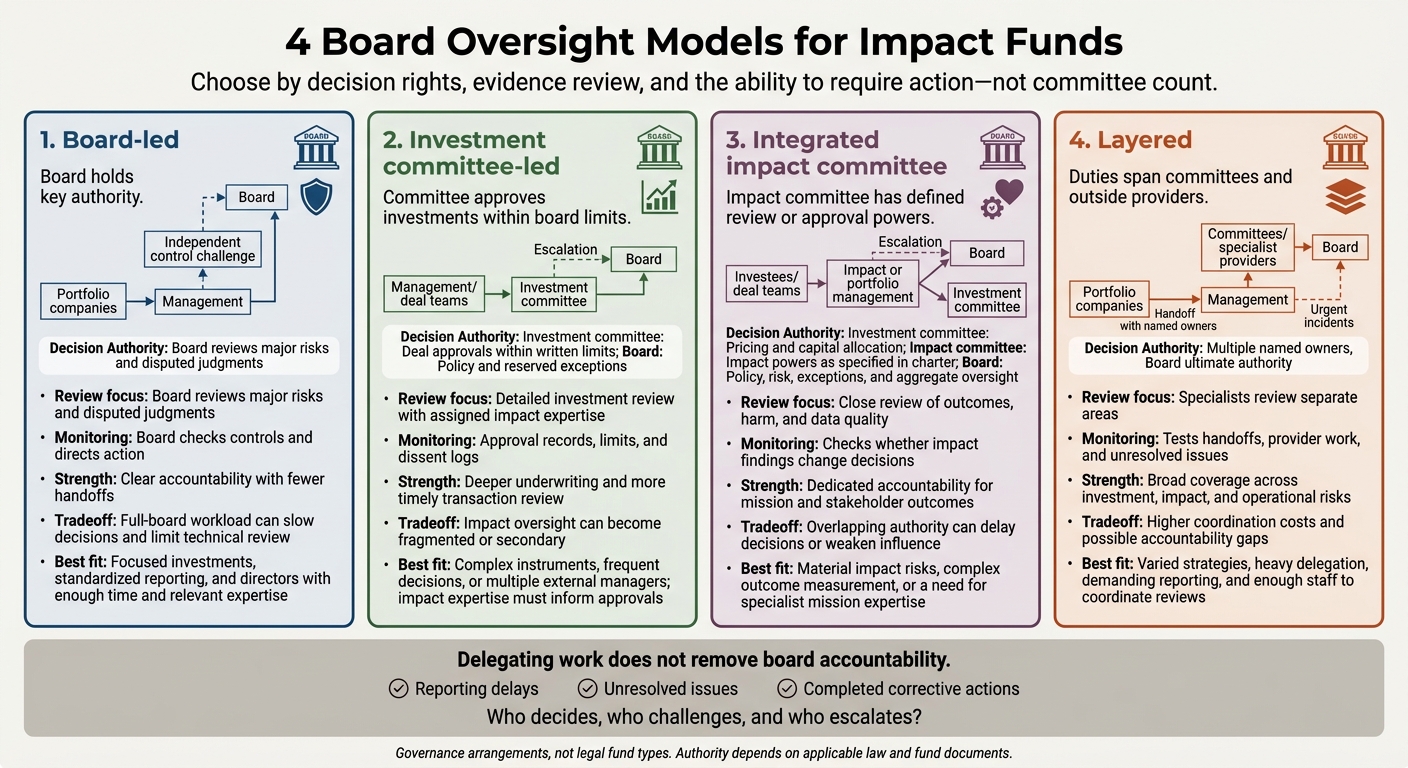
4 Board Oversight Models for Impact Funds
1. Board-Led Oversight
Decision Rights and Accountability
In a board-led model, authority stays concentrated. Reserve key decisions for the board: strategy changes, fund-level borrowing, related-party transactions, valuation policies, changes to impact measurement methods, and appointment or removal of the investment manager.
A written authority matrix should specify approval thresholds, required evidence, and accountable owners. Within those limits, management handles sourcing, due diligence, negotiations, portfolio monitoring, and data collection.
Reporting and Escalation
Board control relies on a clear reporting path. Portfolio companies report to management, which validates the data. Independent control functions then challenge it, and the board receives a combined financial-and-impact dashboard. Quarterly reports and an annual strategy-and-risk review set the schedule.
Escalate urgent issues immediately: fraud, serious environmental or human-rights incidents, material valuation uncertainty, and suspected impact misrepresentation. Each notice should explain what happened and when, identify affected investments or stakeholders, and outline likely consequences. It should also state the applicable policy, containment steps, management’s recommendation, and the decision requested. These reports support direct board challenge; they do not replace it.
Review Depth and Independence
Focus board review on exceptions and high-risk items, including concentrations, valuation judgments, missed impact targets, and sample investment files. The aim is to test decisions and evidence, not repeat full underwriting.
Give independent control functions direct access to directors, hold private sessions without management, and document conflicts and recusals. The IFC Operating Principles for Impact Management call for annual disclosure and regular independent verification to supplement board scrutiny. Apply that same scrutiny to impact measurement and claims.
Impact Integrity and Risk Controls
Each impact measure should include its baseline, target, result, source, confidence level, and corrective-action deadline. Track adverse effects alongside intended benefits, and separate deal origination from impact verification where possible.
To protect measurement integrity and manage reputational risk, the board should approve controls for material public claims about impact and document methodology changes. Persistent failures should prompt action - not just revised reports. Responses may include remediation, pausing additional capital where permitted, or investor disclosure. The next model delegates much of this review to a committee.
sbb-itb-8baf5f1
2. Investment Committee-Led Oversight
Decision Rights and Accountability
The board sets policy; the committee approves and monitors investments within it. The investment policy statement (IPS) should define eligible investments, impact requirements, risk limits, and delegated authority. The committee charter should spell out membership, quorum, voting rights, and who recommends, approves, and executes transactions. The board approves and periodically reviews the IPS and keeps authority over exceptions. Delegation should cover follow-on investments and exits, not just initial approvals.[10][11][13]
Unlike board-led oversight, this model places transaction review and monitoring with a standing committee. It trades direct board review for faster deal execution and closer committee scrutiny, while preserving the board’s power to override decisions on exceptions.
Reporting and Escalation
During deployment, the committee should meet more often than the board. Require standardized memoranda and send the board a quarterly dashboard and decision log. Record approval conditions, dissent, and who owns each follow-up action. Refer any IPS breach to the board, and set objective referral triggers for liquidity stress or material changes in financial or impact performance.[6][9][10]
This shortens the decision loop while keeping the board informed.
Review Depth and Independence
Apply deeper diligence to first-time managers, complex structures, emerging technologies, and high-risk jurisdictions. Give legal, technical, and impact reviewers access to source records and a formal way to record dissent. Impact professionals should have formal voting or review rights, allowing them to challenge decisions without blurring accountability. One impact seat does not cover every responsibility; explicitly assign oversight of impact strategy and measurement.[3][14]
Impact Integrity and Risk Controls
Make impact criteria part of the investment decision. Before approval, assess intended beneficiaries, additionality, evidence quality, and the investee’s ability to collect outcome data. Test each deal using What, Who, How Much, Contribution, and Risk.[15]
After investment, track outcome variance and harms alongside liquidity and covenants on the same dashboard. Define each metric’s tolerance and what happens when it triggers escalation. Financial outperformance should not hide missed impact targets.[9][12] Treat impact variance as a governance issue, not just a reporting issue.
When oversight splits further across separate bodies, governance becomes layered.
3. Integrated Impact Committee Oversight
Decision Rights and Accountability
Give impact review its own decision lane rather than keeping it entirely within the investment committee. Spell out the impact committee’s authority in its charter: approving or rejecting investments against impact thresholds, requiring mitigation plans, approving changes to impact objectives, and recommending portfolio actions.
The investment committee controls pricing and capital allocation. The board retains responsibility for policy, risk, exceptions, and aggregate oversight. If the impact committee serves only as an adviser, require a written rationale whenever its recommendation is not followed.[18][22]
Reporting and Escalation
Route information from investees and deal teams through impact or portfolio management to the committee. Send unresolved issues to the investment committee and board. This keeps routine monitoring with the committee while bringing urgent matters to the board.
Quarterly reports should cover impact KPIs, progress against targets, incidents, negative externalities, data confidence, remediation, and open exceptions. Escalate immediately when issues involve beneficiary harm, safeguarding failures, regulatory breaches, material underperformance, unreliable data, or major business-model shifts.[18][20][22]
Review Depth and Independence
Match review depth to risk. Use standardized screening for low-risk deals. For higher-risk deals, include beneficiary consultation, theory-of-change testing, human-rights and environmental due diligence, scenario analysis, and independent validation.
Members should disclose conflicts and recuse themselves when appropriate, including from reviews of metrics or claims tied to transactions they sponsored. Conduct independent verification periodically, separate from the team preparing impact reports. The Impact Principles require annual public disclosure of alignment and periodic independent verification, with the verification conclusions disclosed.[16][17][21][5][4][8]
Impact Integrity and Risk Controls
Make impact review shape investment terms - not just the narrative. Approve baselines and targets, attach reporting commitments, and tie follow-on capital to required remediation. Compare portfolio results with the original investment thesis to determine whether engagement, additional support, remediation, or exit is appropriate.
Track privacy, grievance, safeguarding, and negative-effects controls alongside intended benefits. The board record should show a clear trail from source evidence to corrective action, including decisions on remediation, capital pauses where permitted, or exit.[4][5][8][19]
When authority is split across multiple bodies, oversight moves to a layered model.
4. Layered Oversight
Decision Rights and Accountability
Delegate tasks, not board accountability. Layered oversight spreads day-to-day duties across committees and delegates while keeping reserved powers with the board. These include governing documents, policy, risk appetite, conflicts, valuation, material strategy changes, and key delegate appointments.
Set out duties in committee charters, investment-management agreements, service-level agreements, and reporting protocols. A delegation matrix should name decision owners, approval thresholds, consultation requirements, reporting recipients, and escalation triggers. This clarity matters most when authority passes through several hands before a decision reaches the board.
Reporting and Escalation
Data should move from portfolio companies to management, then to committees and the board. Each layer should receive only what it needs to act. Contracts should define reporting deadlines, terms, and evidence requirements at every handoff.
When a provider fails or a handoff stalls, escalate the issue to a named owner and set a follow-up deadline. This chain of handoffs separates layered oversight from committee-only models.
Review Depth and Independence
The board should test delegate performance, conflicts, and the quality of controls. It should assess delegates’ skills and staffing, and check that committees apply risk-based review criteria consistently. Keep data preparation separate from independent testing.
An annual effectiveness review should check whether delegates had enough resources and supplied complete information on time. The board’s job is to verify the quality of delegation - not repeat the delegated review.
Impact Integrity and Risk Controls
Information can become fragmented across layers unless one body owns the final decision. Assign separate owners to collect, validate, analyze, and disclose impact data. Clearly label verified results, estimates, and commentary, and escalate unresolved exceptions.
Each cross-committee issue needs one lead committee and one escalation path. Give that committee one consultation path to prevent gaps and duplicate approvals. These tradeoffs frame the model-by-model comparison that follows.
Nonprofit Board Governance Explained: Risk, Resources & High-Performing Board Strategies
Comparing the Models Across 4 Criteria
Structure makes oversight possible; it does not prove oversight works. Compare models through decision records, reporting schedules, dissent logs, incident handling, remediation, and control testing. The tables below show who holds authority, how evidence moves, and where escalation must end.
| Criterion | Board-Led Oversight | Investment Committee-Led Oversight | Integrated Impact Committee Oversight | Layered Oversight |
|---|---|---|---|---|
| Decision rights | Direct board authority; routine approvals may be delegated | Deal authority within written limits | Impact influence depends on voting, conditioning, or veto rights | Distributed authority; boundaries must be clear |
| Reporting flow | Direct route to directors; detail may overwhelm | Deal and portfolio reporting; impact needs explicit coverage | Linked financial and impact reporting; reliable source data required | Specialist reporting; handoffs need testing |
| Review depth | Broad challenge on strategy; day-to-day depth may be limited | Strong underwriting capacity; impact expertise varies | Deeper outcome review when investment expertise is present | Broad specialist capacity; duplication and gaps remain risks |
| Control testing | Tests whether board direction is carried out | Tests whether impact requirements shape deals | Tests whether outcome evidence changes decisions | Tests handoffs, independent checks, and ownership |
Decision Rights and Accountability
Approval, recommendation, sign-off, veto, and escalation are different powers. The board sets reserved matters under governing documents and law. It remains accountable for how it selects delegates, defines their scope, and monitors their work.[23][25]
Ask the same question across all models: who decides, who challenges, and who escalates?
| Model | Board-reserved decisions | Delegated decisions | Impact authority | Accountability safeguards |
|---|---|---|---|---|
| Board-led | Strategy, impact objectives, risk appetite, material exceptions, reserved conflicts | Management approvals within written limits | Advice or sign-off, if established | Approval logs; recusals; review of delegated work |
| Investment committee-led | Mandate, policy, material changes, reserved conflicts and exceptions | Investment committee approves deals within approved limits | Advisory unless stronger rights are granted | Charter; dollar and concentration limits; voting rules; dissent records |
| Integrated impact committee | Strategy and material changes to impact objectives | Investment approvals follow the approved decision map | Recommend, condition, sign off, or veto - as specified | Written resolution path for financial–impact disagreements |
| Layered | Reserved policy, strategy, conflicts, and exceptions | Management and committees exercise separate authorities | Defined impact decisions or conditions | One approval owner per decision; exception log; board review |
Reporting and Escalation
Board-led reporting goes directly to directors. Committee models bring validation and review together before escalation. Layered oversight adds specialist review but requires more checks on handoffs. Urgent incidents may bypass intermediate layers. The reporting frequencies below are illustrative.[5]
| Model | Evidence checks | Routine reporting flow | Urgent triggers | Corrective-action owner |
|---|---|---|---|---|
| Board-led | Management checks portfolio/provider definitions and completeness | Quarterly board dashboard | Material harm, fraud, or cybersecurity incidents → chair and counsel | Named management owner |
| Investment committee-led | Management checks deal files and portfolio data | Quarterly committee review; board receives exceptions | Limit breaches or major impact shortfalls → committee chair; reserved matters → board | Portfolio lead, monitored by committee |
| Integrated impact committee | Management checks financial, outcome, and stakeholder data | Quarterly joint dashboard | Harm, mission drift, or disputed claims → impact chair and board when material | Portfolio lead with impact oversight |
| Layered | Management checks data; specialists review the reporting pack | Quarterly committee and board reviews | Cybersecurity, sanctions, fraud, or serious harm → appropriate chair/counsel directly | Assigned incident or remediation lead |
Review Depth and Independence
More reviewers do not guarantee better review. Each model places specialist depth in different hands. Audit or risk committees and external assurance add capacity only when their scopes are defined.[24][26]
| Model | Review depth | Specialist expertise | Independent challenge | Capacity constraint |
|---|---|---|---|---|
| Board-led | Strategy, mission, major risks | Depends on directors and advisers | Access beyond management summaries | Board time |
| Investment committee-led | Underwriting, terms, portfolio performance | Investment skills; impact skills must be included | Recusal from affiliated deals; recorded challenge | May miss noninvestment risks |
| Integrated impact committee | Theory of change, outcomes, investment conditions | Both impact and investment knowledge | Stakeholder input; challenge to management’s impact claims | Technical staffing |
| Layered | Investment, impact, process, compliance | Distributed specialists | Separate preparation and testing; coordinated assurance scope | Unclear handoffs, duplication, or gaps |
Review should test whether oversight changes decisions - not merely what gets reported.
Impact Integrity and Risk Controls
The 9 Operating Principles for Impact Management connect strategy, assessment, monitoring, exit, and learning.[27][28][7]
| Model | Impact integration | Control testing | Evidence checks | Incident response |
|---|---|---|---|---|
| Board-led | Board tests mission alignment through approval and exit | Tests baseline policies, approval limits, and conflict procedures | Directors receive source-documented indicators and exceptions | Board directs response to material harm or mission drift |
| Investment committee-led | Impact criteria shape diligence, terms, and monitoring | Tests impact requirements in approval records and related-party recusals | Committee challenges baselines, targets, and financial–impact trade-offs | Portfolio owner addresses breaches; committee escalates exceptions |
| Integrated impact committee | Theory of change informs conditions, indicators, outcomes, and corrective action | Tests whether charter authority influences decisions | Stakeholder feedback tests claimed benefits and unintended harms | Impact authority challenges harm and requires action within its mandate |
| Layered | Specialist reviews connect the investment lifecycle | Tests delegations, reporting calendars, vendor diligence, and cybersecurity requirements | Defined data owners; quality checks; proportionate assurance | Named owners handle compliance, vendor failures, fraud, and cyber events |
Test what happens in practice, not just what is documented. Track the percentage of investments assessed against impact criteria before approval, indicators with documented data sources, how long escalations remain unresolved, notification time, and corrective-action completion. These are management metrics, not universal benchmarks. Decision and dissent records, incident logs, and annual effectiveness reviews provide evidence for checking whether the model works.
Strengths, Limits, and Fund Fit
Match oversight to the fund’s risk, complexity, and reporting load. Weigh committee structure, reporting flow, review depth, and governance monitoring together.
| Model | Primary strength | Primary tradeoff | Best fit |
|---|---|---|---|
| Board-led | Clear accountability with fewer handoffs | Full-board workload can slow decisions and limit technical review | Focused investments, standardized reporting, and directors with enough time and relevant expertise |
| Investment committee-led | Deeper underwriting and more timely transaction review | Impact oversight can become fragmented or secondary | Complex instruments, frequent decisions, or multiple external managers; impact expertise must inform approvals |
| Integrated impact committee | Dedicated accountability for mission and stakeholder outcomes | Overlapping authority can delay decisions or weaken influence | Material impact risks, complex outcome measurement, or a need for specialist mission expertise |
| Layered | Broad coverage across investment, impact, and operational risks | Higher coordination costs and possible accountability gaps | Varied strategies, heavy delegation, demanding reporting, and enough staff to coordinate reviews |
These are tradeoffs, not rankings. Choose oversight based on task complexity and risk - not assets under management alone. Assess staff time, measurement skills, legal support, data systems, and access to specialist advice.[5][29][30][3]
Some funds split reporting cadence, with quarterly financial reporting and annual impact reporting.
Test whether staff and committees can maintain that schedule in practice. Use one reporting cycle to track missed deadlines, duplicate reviews, and delayed decisions. Ask staff and committee members where preparation took more time or resources than they had available, then revise charters and reporting requirements.
Conclusion: Match Oversight to Fund Risks
Focus on authority and review depth - not the number of committees. Set clear decision rights, require reliable reporting, allow independent challenge, and put enforceable controls in place. Reports should flag exceptions, decisions needed, and the people accountable for action.
Match committee structure, reporting flow, review depth, and governance monitoring to the fund’s risk and complexity. Keep oversight with the board when directors have enough capacity. Delegate technical investment decisions within defined limits, and give impact committees authority over mission-critical impact decisions. Use layered oversight when separate checks on fund operations are needed.
A model may draw from all four approaches, but each body needs a separate mandate and a reporting path that can require action.
Document approval rights and matters reserved for specific decision-makers. Assign an owner to each material control, and test whether urgent concerns reach someone with authority to pause deployment or require corrective action. Review governance annually and after major changes. Track unresolved exceptions, overdue actions, and the time from an incident to escalation. Test whether governance changes decisions - not just reporting.
FAQs
How can my fund change oversight models without disrupting decisions?
Build sustainability into existing governance, rather than setting up separate structures. Extend the mandates of audit, risk, or nominating committees to cover sustainability oversight. This keeps resilience and ESG within core processes instead of splitting responsibilities across disconnected groups.
Use your existing Enterprise Risk Management (ERM) framework to assess risks, and tie executive compensation to sustainability KPIs to support accountability. Record decision rights in committee charters and RACI matrices so responsibilities stay clear and work continues through the transition.
How should we resolve financial–impact disagreements?
Treat disagreements between financial and impact goals as governance issues with clear accountability. Require board or investment-committee oversight, measurable targets for both finance and impact, structured performance and risk reporting, and decisions and approvals at least quarterly.
Make decision rights explicit, document the criteria, and tie consequences to results. Align incentives where appropriate. Escalate unresolved gaps to board-level review instead of leaving them as observations. When needed, use independent audits or impartial reviews to support objective decisions. [1][2]
What oversight can we afford with limited staff?
Put existing governance structures to work rather than creating resource-heavy committees. Make sustainability a full-board responsibility, with the chair or lead independent director keeping it on the agenda. Low-cost external advisory panels can provide additional support for staff.
Use existing Enterprise Risk Management processes to assign risk owners, and a RACI matrix to clarify who has decision-making authority. Prioritize quarterly reviews of financially material risks, applying the same rigor used in financial reporting.



FAQ