
May 26, 2026
How to Build a Blended Finance Model for Sustainability Initiatives for Foundations & Philanthropic Organizations
Sustainability Strategy
In This Article
A practical guide for foundations to design blended finance: set impact goals, structure capital stacks, manage risk, and measure outcomes.
How to Build a Blended Finance Model for Sustainability Initiatives for Foundations & Philanthropic Organizations
To address the $2.4 trillion annual gap in climate financing, blended finance offers a practical solution by combining philanthropic, public, and private funds to reduce risks and attract large-scale investments. Foundations play a critical role in this process by taking on higher risks or lower returns, encouraging private sector participation.
Key steps to build an effective blended finance model include:
Define clear goals: Align environmental and social objectives with global frameworks like the UN's Sustainable Development Goals (SDGs).
Develop an investment thesis: Identify barriers to private investment and structure financial incentives to overcome them.
Design the capital stack: Layer financial instruments (e.g., grants, concessional debt, equity) to balance risks and returns.
Engage stakeholders: Map roles and risk appetites to align participants, including foundations, banks, and institutional investors.
Monitor and measure impact: Use tools like the IRIS+ framework to track progress and ensure accountability.
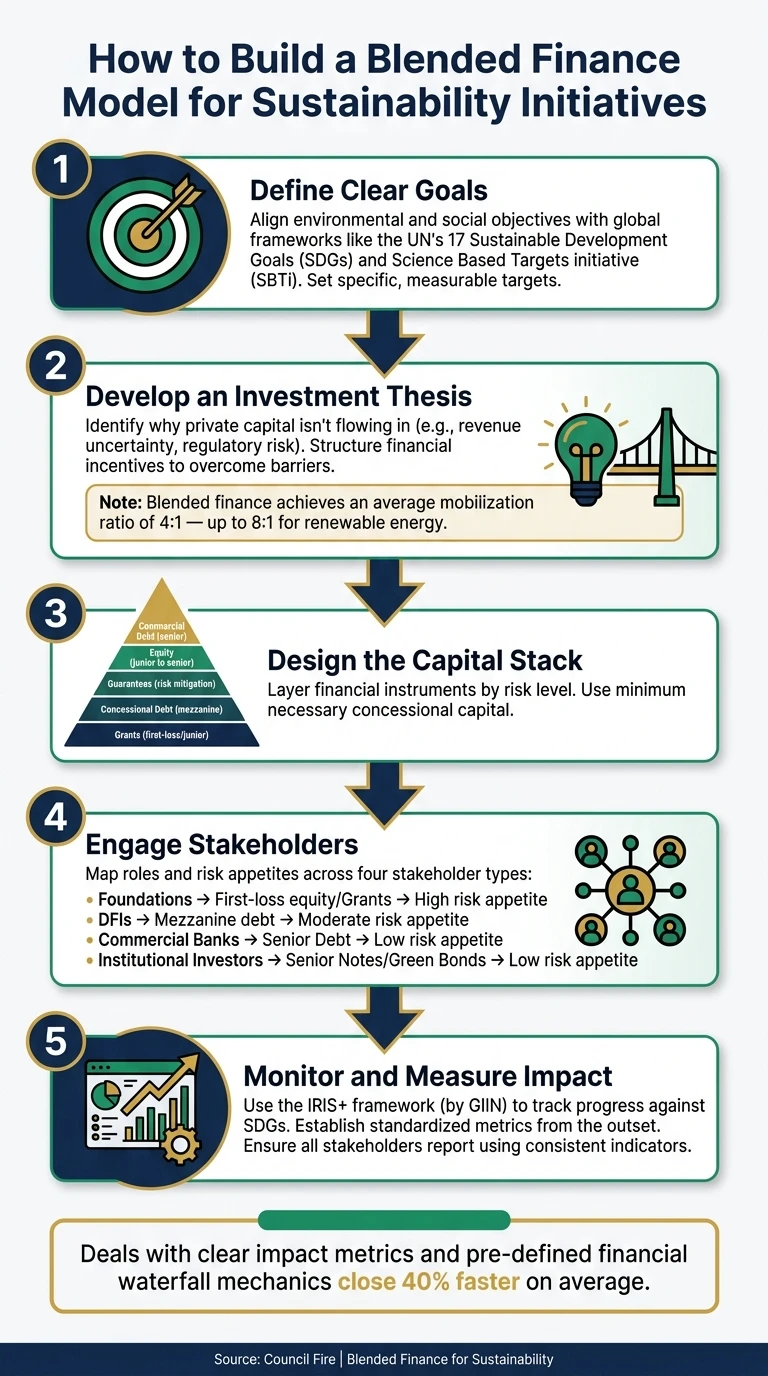
How to Build a Blended Finance Model: 5 Key Steps for Foundations
Defining Impact Objectives and Building an Investment Thesis
Setting Clear Environmental and Social Impact Objectives
Before diving into capital structuring, it's crucial to define specific, measurable environmental and social objectives. Vague ambitions like "support clean energy" won't cut it for institutional investors who demand clarity and precision. The most effective strategies align these objectives with global frameworks and establish concrete, trackable targets.
The United Nations' 17 Sustainable Development Goals (SDGs) provide a solid foundation for setting these objectives. As one of the 193 nations endorsing the 2030 Agenda for Sustainable Development, the U.S. gives these goals credibility at home and abroad. To make an impact, focus on specific SDG targets and identify measurable metrics that track progress for each [4].
For climate-related initiatives, the Science Based Targets initiative (SBTi) offers a rigorous approach. This framework emphasizes setting both near-term goals (within 5–10 years) and long-term targets by 2050. Achieving net-zero under SBTi requires reducing value chain emissions by 90–95% from a baseline year, rather than relying on offsets to claim neutrality [5].
"A net-zero target without a roadmap is a press release, not a strategy." - Council Fire [5]
Once these clear objectives are in place, the next step is to craft an investment thesis that bridges these goals with a practical financial structure.
Developing an Investment Thesis
An investment thesis acts as the bridge between your impact goals and a financial structure that appeals to potential investors. It begins with a critical question: why isn't private capital already flowing into this area? The answer - whether it's due to unfamiliar technology, revenue uncertainty, or perceived regulatory risks - guides how you structure the financial incentives [1].
The thesis outlines how the capital stack addresses these barriers. For instance, if revenue uncertainty is holding back a community solar project, a foundation might step in to absorb first-loss risk, while a commercial bank provides senior debt. On average, blended finance structures achieve a mobilization ratio of 4:1, with renewable energy projects sometimes reaching ratios as high as 8:1 [1]. However, the concessional element must be kept to the minimum required to attract private capital. Excessive subsidies can drain limited resources and stifle the development of sustainable markets [1].
Deals that incorporate clear impact metrics and pre-defined financial waterfall mechanics into legal agreements tend to progress faster - 40% faster, on average - than those negotiated without such planning [1].
Once the financial framework is outlined, mapping the roles and risk appetites of stakeholders ensures the strategy is well-rounded and actionable.
Stakeholder Mapping and Risk Appetite
Blended finance structures rely on a diverse group of stakeholders, each with unique risk tolerances and roles. Early mapping of these stakeholders - and a clear understanding of their expectations - shapes the design of the investment thesis.
Stakeholder Type | Typical Role in Capital Stack | Primary Risk Appetite |
|---|---|---|
Foundations | First-loss equity / Grants | High (Catalytic/Concessional) |
DFIs | Mezzanine debt / Subordinated equity | Moderate (Impact-first) |
Commercial Banks | Senior Debt | Low (Market-rate/Risk-averse) |
Institutional Investors | Senior Notes / Green Bonds | Low (Fiduciary/Investment-grade) |
Engaging beneficiary communities early on is equally important. The Annie E. Casey Foundation demonstrates how defining beneficiaries from the outset can prevent projects from stumbling, even when financial designs are strong [8]. Foundations often accept higher risks, which shifts the overall risk-return profile and makes projects more attractive to commercial investors [1].
Designing the Capital Stack and Selecting Financial Instruments
Overview of Financial Instruments
Once you've established your investment thesis and mapped out stakeholders, the next step is selecting the right financial instruments. Each tool plays a unique role depending on the project's stage and risk profile.
Instrument | Role in the Stack | Best Used When |
|---|---|---|
Grants | Junior / First-Loss | Covering early-stage costs, technical assistance, or absorbing initial losses |
Concessional Debt | Junior / Mezzanine | Improving cash flow with below-market interest rates |
Guarantees | Risk Mitigation | Protecting investors from credit default or political risk |
Equity | Junior to Senior | Aligning interests; junior equity takes losses first, senior equity seeks returns |
Commercial Debt | Senior | Providing the bulk of capital once the project is de-risked by other layers |
The guiding principle here is additionality: concessional tools like grants or low-interest loans should only be used where market-driven capital won’t flow independently [2]. Misusing these resources not only wastes philanthropic funds but can also disrupt market dynamics. Careful instrument selection is vital for building an effective, layered capital stack.
Structuring the Capital Stack
A well-constructed capital stack layers financial instruments into distinct tranches, each with its own risk level and return expectations. Think of it as a protective hierarchy - junior layers absorb losses first, shielding higher layers from risk.
"Foundations provide some of the most genuinely catalytic capital because they can accept zero or negative financial returns in exchange for outsized impact." - Sustainability Atlas [1]
Real-world examples show how this approach works. For instance, Climate Investor Two, a $1 billion facility managed by Climate Fund Managers, focuses on water and ocean infrastructure. Its structure includes three funds: a development fund supported by grants, a construction equity fund with first-loss equity from FMO and the Green Climate Fund, and a refinancing fund offering senior debt. By early 2026, this facility had committed funds to 14 projects across 10 countries [1]. Similarly, the Amundi Planet Emerging Green One fund used a $125 million first-loss tranche from the IFC to attract institutional investors, such as pension funds, into a $2 billion green-bond fund supporting climate-aligned loans in markets like Indonesia and Turkey [1].
The goal is to use the minimum necessary concessional element. Over-subsidizing doesn’t just drain resources - it can also stifle private market development, undermining long-term goals.
Cash Flow and Risk Management
Once the capital stack is in place, the focus shifts to managing cash flows and mitigating risks. Structuring the stack is only part of the equation; you also need to model cash flows over time. This includes forecasting revenue, repayment schedules, and waterfall mechanisms to outline payment priorities and conditions for returns to investors with varying risk appetites.
In U.S.-based sustainability projects, two risks stand out: interest rate fluctuations and regulatory changes. Rising interest rates can squeeze margins, particularly for long-term infrastructure investments. To address this, consider step-up rates or sunset provisions to emphasize the temporary nature of concessional support while building confidence among private investors [1]. For projects with international exposure, currency risk adds another layer. Introducing local-currency tranches can help reduce hedging costs significantly, making the investment more stable [1].
Blended and Innovative Finance Overview
Governance, Monitoring, and Impact Measurement
Maintaining long-term investor confidence in blended finance models requires more than just a well-structured capital stack. Effective governance, comprehensive risk management, and transparent impact measurement play equally critical roles.
Establishing Governance Structures
Without clear governance, even the best-designed blended finance models can falter. Managing grants, concessional debt, and commercial capital across multiple stakeholders demands accountability to keep projects on track.
A common solution is to create an investment committee and an advisory board, each serving distinct purposes. The investment committee oversees financial decisions, ensuring fiscal discipline, while the advisory board provides sector-specific expertise in areas like environmental science, community development, or financial structuring. Together, these bodies maintain balance between financial rigor and impact goals.
It's also vital to assign responsibility for confirming that concessional capital is driving private investment. Without this safeguard, philanthropic funds risk replacing rather than encouraging commercial capital [2].
"Opacity and complexity drive up transaction costs and undermine trust." - Perrine Toledano, Director of Research and Policy, Columbia Center on Sustainable Investment [2]
Clear exit strategies further demonstrate professionalism and help attract institutional investors [2]. Once governance structures are in place, attention must shift to systematic risk management.
Creating a Risk Management Framework
With governance established, the next step is to develop a robust framework for managing risks - whether financial, operational, or environmental/social. Diversification is a key strategy to reduce the impact of any single project failure [3]. In regions with heightened political risks, provisions like guarantee facilities are particularly valuable, as research shows these measures are more commonly used in such environments [6].
For environmental and social risks, the framework should include community consultation processes and enforce strict environmental safeguards before capital deployment. Standardized documentation and consistent risk reporting can streamline oversight and reduce costs [2].
Tracking and Reporting Impact
A strong risk management framework lays the foundation for transparent impact measurement. This step is essential for ensuring accountability across the capital stack. From the outset, structured metrics should be established to track progress effectively.
The IRIS+ framework, developed by the Global Impact Investing Network (GIIN), is widely used to align impact metrics with specific UN Sustainable Development Goals (SDGs). This tool helps organizations transform their impact goals into measurable and comparable indicators [9]. Encouraging all stakeholders - such as General Partners and co-investors - to report using the same metrics enhances portfolio-level analysis and transparency.
The adoption of IRIS+ continues to grow. For example, in 2025, investment firm Anthos encouraged all its General Partners to adopt IRIS+ for more consistent and transparent portfolio reporting. Similarly, Lok Capital used the framework to benchmark its social and environmental outcomes across various regions [9].
"IRIS+ serves as the foundational framework for understanding impact data for many impact investors. It enables the impact investing industry to standardize and compare data and reach a shared understanding of impact across different investments and stakeholders." - Eric Lee, Aligned Climate Capital [9]
Partnering with Experts to Put Blended Finance into Practice
Once a solid financial and governance framework is in place, the next hurdle is execution - turning strategy into tangible results. While a well-designed blended finance model provides a strong foundation, its implementation often falters due to the technical complexity involved. This section explores why collaborating with experts is essential to overcoming these challenges and successfully executing blended finance initiatives.
Why Foundations Need Expert Partners
Blended finance transactions are intricate, requiring the coordination of various financial tools like first-loss capital, guarantees, concessional loans, and commercial equity. These deals bring together stakeholders with differing financial goals, making the process highly specialized. Most foundation teams lack the in-house expertise to manage these complexities effectively.
Adding to the challenge, many blended finance participants have limited experience, with most having engaged in only one transaction [11]. This lack of familiarity can lead to costly errors and longer timelines. Experienced advisors play a critical role in avoiding these pitfalls, helping foundations streamline the process and reduce the learning curve.
Advisors are also crucial for aligning diverse stakeholders. While private investors often focus on short-term returns, foundations aim for long-term social and environmental outcomes. Expert partners serve as facilitators, helping reconcile these differing priorities and turning potential conflicts into collaborative action [10][12].
"Success relies on greater focus on local contexts, market conditions and legal and regulatory frameworks." - UBS Philanthropy Experts [12]
Specialized organizations like Council Fire excel in bridging the gap between strategic planning and practical execution, ensuring projects are both impactful and feasible.
How Council Fire Can Support Blended Finance Initiatives
Council Fire, a global change agency, specializes in translating sustainability strategies into actionable, investment-ready projects. By bridging the gap between ambition and execution, they help foundations and other stakeholders develop pipelines of projects that meet the rigorous standards of commercial investors. This is especially important in addressing the chronic underinvestment in early-stage project design - a key barrier to scaling blended finance [2].
Council Fire’s expertise spans areas such as climate resilience, circular economy initiatives, stakeholder collaboration, and ESG strategy. Their systems-thinking approach ensures that projects are designed to deliver lasting and scalable results, rather than being isolated successes.
Steps to Scope and Work with Advisors
To maximize the value of an advisory partnership, foundations should begin by clearly identifying their specific needs - whether it’s financial structuring, impact measurement, regulatory guidance, or stakeholder alignment. This clarity ensures they secure the right expertise for the job.
A structured approach to engagement can be broken into three key phases:
Project preparation: Use advisors to assess the viability of sustainability initiatives before presenting them to private investors. Design-stage grants and technical assistance funds can be particularly helpful here [11].
Structuring support: Engage advisors to build the capital stack, accurately assess risk, and strategically deploy concessional capital to attract further investment [13].
Governance and verification: Ensure advisors implement independent verification processes and standardized reporting frameworks, such as IRIS+, to maintain accountability across all stakeholders [7].
The MacArthur Foundation offers a compelling example of this approach. By taking first-loss positions, they unlocked over $500 million in commercial investment for affordable housing projects [7]. This underscores the importance of precise structuring and strong governance from the outset.
"These [blended finance] structures are not subsidy mechanisms - they are market-building tools designed to prove commercial viability and attract unsubsidized capital at scale." - Council Fire [7]
Establishing clear expectations around roles, timelines, and decision-making authority helps keep advisory engagements focused. Treating advisors as true partners - integrated into the team rather than as external consultants - can accelerate the transition from project design to deployment.
Conclusion: Key Takeaways for Building a Blended Finance Model
Creating a successful blended finance model involves intentional decisions at every step, from defining clear objectives to structuring capital and governance effectively. The most successful foundations share a few key practices: they begin with specific, measurable goals, design their capital structures strategically, and collaborate with others rather than going it alone.
A strong capital stack is the backbone of these models. Philanthropic funds in a first-loss position help mitigate risks, making it possible to attract private capital. The difference between a solid, sustainable model and a fragile one often lies in meticulous calibration, diversification, and cash flow analysis. As Amundi Investment Institute explains:
"SBF [Structured Blended Finance] uses concessional capital and sophisticated tranche structuring to align the different goals of public and private investors, balancing financial return with social impact." [14]
Transparency and standardization are critical to scaling. High transaction costs, often caused by a lack of clarity, remain a major obstacle to expanding blended finance beyond isolated deals [2]. By adopting standardized reporting frameworks, structured scorecards, and established fund archetypes - such as the five typologies identified by BCG and British International Investment - foundations can reduce friction and build the trust needed to attract institutional investors [15]. These tools help transform strategic ambitions into measurable market outcomes.
The ultimate success of a blended finance model depends not just on its design but also on partnerships with skilled collaborators. Experts can guide foundations through regulatory challenges, harmonize competing priorities among stakeholders, and develop investment-ready opportunities. These efforts demonstrate that financial returns and social impact can thrive together.
"Without bold, structural reform, it [blended finance] risks remaining a niche tool – promising in theory, underperforming in practice." - Perrine Toledano, Director of Research and Policy, Columbia Center on Sustainable Investment [2]
FAQs
How much first-loss capital is enough?
The required amount of first-loss capital varies based on the project's risk profile and structural details. This type of capital is primarily designed to cover initial losses, making the project more appealing to private investors. Often, it helps achieve mobilization ratios of 4:1 or greater. Determining the right amount involves tailoring it to the project's unique requirements and risk management strategies to ensure the greatest possible effectiveness.
What should go into a capital stack?
A capital stack refers to the various layers of financing that make up a project's funding structure, each carrying its own level of risk and return. Here's a breakdown of the typical components:
Senior debt: This is the safest layer, usually provided by banks. It offers lower returns due to the reduced risk.
Mezzanine debt: Positioned between senior debt and equity, this layer carries moderate risk and offers higher returns. Development finance institutions often provide this type of funding.
First-loss equity: This layer assumes the greatest risk, typically funded by philanthropic sources. It absorbs initial losses to safeguard the other financing layers.
Each layer plays a specific role in balancing risk and return within the overall financing structure.
How do we prove impact to investors?
To demonstrate the effectiveness of a blended finance model, it’s essential to present tangible social and environmental outcomes. Start by establishing clear impact metrics that align with the project’s goals. Highlight additionality - the idea that these projects wouldn’t have been possible without the blended finance approach. Additionally, track mobilization ratios, which measure the private capital attracted for every dollar of concessional funding provided.
Transparency plays a crucial role. Use standardized reporting methods to ensure consistency and clarity. Combining quantitative metrics (like financial returns or CO2 reductions) with qualitative assessments (such as community testimonials or stakeholder feedback) strengthens credibility. This balanced approach not only builds trust but also offers investors a well-rounded view of the initiative’s impact.
Related Blog Posts
Latest Articles
©2026

Narrative Change and Power Building: The Missing Half of Advocacy
Narrative change is the process of disrupting dominant narratives that normalize inequity and advancing new narratives from historically marginalized communities.

Funding Resilience Without Federal Grants
BRIC is unreliable and FEMA is shrinking. Here's how cities fund climate resilience with dedicated revenue, blended finance, and a coordinating authority.

The ESG Blind Spot: How AI Is Finding Risks in Companies Nobody Else Is Watching
Norway's sovereign wealth fund uses AI to screen 7,200 portfolio companies for forced labor and corruption within 24 hours. The real story is the emerging-market coverage gap that traditional ESG data vendors miss — and what it means for any company with a global supply chain.
Narrative Change and Power Building: The Missing Half of Advocacy
Narrative change is the process of disrupting dominant narratives that normalize inequity and advancing new narratives from historically marginalized communities.
Funding Resilience Without Federal Grants
BRIC is unreliable and FEMA is shrinking. Here's how cities fund climate resilience with dedicated revenue, blended finance, and a coordinating authority.
The ESG Blind Spot: How AI Is Finding Risks in Companies Nobody Else Is Watching
Norway's sovereign wealth fund uses AI to screen 7,200 portfolio companies for forced labor and corruption within 24 hours. The real story is the emerging-market coverage gap that traditional ESG data vendors miss — and what it means for any company with a global supply chain.
FAQ
01
What does it really mean to “redefine profit”?
02
What makes Council Fire different?
03
Who does Council Fire work with?
04
What does working with Council Fire actually look like?
05
How does Council Fire help organizations turn big goals into action?
06
How does Council Fire define and measure success?
07
How does technology fit into Council Fire’s work?
May 26, 2026
How to Build a Blended Finance Model for Sustainability Initiatives for Foundations & Philanthropic Organizations
Sustainability Strategy
In This Article
A practical guide for foundations to design blended finance: set impact goals, structure capital stacks, manage risk, and measure outcomes.
How to Build a Blended Finance Model for Sustainability Initiatives for Foundations & Philanthropic Organizations
To address the $2.4 trillion annual gap in climate financing, blended finance offers a practical solution by combining philanthropic, public, and private funds to reduce risks and attract large-scale investments. Foundations play a critical role in this process by taking on higher risks or lower returns, encouraging private sector participation.
Key steps to build an effective blended finance model include:
Define clear goals: Align environmental and social objectives with global frameworks like the UN's Sustainable Development Goals (SDGs).
Develop an investment thesis: Identify barriers to private investment and structure financial incentives to overcome them.
Design the capital stack: Layer financial instruments (e.g., grants, concessional debt, equity) to balance risks and returns.
Engage stakeholders: Map roles and risk appetites to align participants, including foundations, banks, and institutional investors.
Monitor and measure impact: Use tools like the IRIS+ framework to track progress and ensure accountability.
How to Build a Blended Finance Model: 5 Key Steps for Foundations
Defining Impact Objectives and Building an Investment Thesis
Setting Clear Environmental and Social Impact Objectives
Before diving into capital structuring, it's crucial to define specific, measurable environmental and social objectives. Vague ambitions like "support clean energy" won't cut it for institutional investors who demand clarity and precision. The most effective strategies align these objectives with global frameworks and establish concrete, trackable targets.
The United Nations' 17 Sustainable Development Goals (SDGs) provide a solid foundation for setting these objectives. As one of the 193 nations endorsing the 2030 Agenda for Sustainable Development, the U.S. gives these goals credibility at home and abroad. To make an impact, focus on specific SDG targets and identify measurable metrics that track progress for each [4].
For climate-related initiatives, the Science Based Targets initiative (SBTi) offers a rigorous approach. This framework emphasizes setting both near-term goals (within 5–10 years) and long-term targets by 2050. Achieving net-zero under SBTi requires reducing value chain emissions by 90–95% from a baseline year, rather than relying on offsets to claim neutrality [5].
"A net-zero target without a roadmap is a press release, not a strategy." - Council Fire [5]
Once these clear objectives are in place, the next step is to craft an investment thesis that bridges these goals with a practical financial structure.
Developing an Investment Thesis
An investment thesis acts as the bridge between your impact goals and a financial structure that appeals to potential investors. It begins with a critical question: why isn't private capital already flowing into this area? The answer - whether it's due to unfamiliar technology, revenue uncertainty, or perceived regulatory risks - guides how you structure the financial incentives [1].
The thesis outlines how the capital stack addresses these barriers. For instance, if revenue uncertainty is holding back a community solar project, a foundation might step in to absorb first-loss risk, while a commercial bank provides senior debt. On average, blended finance structures achieve a mobilization ratio of 4:1, with renewable energy projects sometimes reaching ratios as high as 8:1 [1]. However, the concessional element must be kept to the minimum required to attract private capital. Excessive subsidies can drain limited resources and stifle the development of sustainable markets [1].
Deals that incorporate clear impact metrics and pre-defined financial waterfall mechanics into legal agreements tend to progress faster - 40% faster, on average - than those negotiated without such planning [1].
Once the financial framework is outlined, mapping the roles and risk appetites of stakeholders ensures the strategy is well-rounded and actionable.
Stakeholder Mapping and Risk Appetite
Blended finance structures rely on a diverse group of stakeholders, each with unique risk tolerances and roles. Early mapping of these stakeholders - and a clear understanding of their expectations - shapes the design of the investment thesis.
Stakeholder Type | Typical Role in Capital Stack | Primary Risk Appetite |
|---|---|---|
Foundations | First-loss equity / Grants | High (Catalytic/Concessional) |
DFIs | Mezzanine debt / Subordinated equity | Moderate (Impact-first) |
Commercial Banks | Senior Debt | Low (Market-rate/Risk-averse) |
Institutional Investors | Senior Notes / Green Bonds | Low (Fiduciary/Investment-grade) |
Engaging beneficiary communities early on is equally important. The Annie E. Casey Foundation demonstrates how defining beneficiaries from the outset can prevent projects from stumbling, even when financial designs are strong [8]. Foundations often accept higher risks, which shifts the overall risk-return profile and makes projects more attractive to commercial investors [1].
Designing the Capital Stack and Selecting Financial Instruments
Overview of Financial Instruments
Once you've established your investment thesis and mapped out stakeholders, the next step is selecting the right financial instruments. Each tool plays a unique role depending on the project's stage and risk profile.
Instrument | Role in the Stack | Best Used When |
|---|---|---|
Grants | Junior / First-Loss | Covering early-stage costs, technical assistance, or absorbing initial losses |
Concessional Debt | Junior / Mezzanine | Improving cash flow with below-market interest rates |
Guarantees | Risk Mitigation | Protecting investors from credit default or political risk |
Equity | Junior to Senior | Aligning interests; junior equity takes losses first, senior equity seeks returns |
Commercial Debt | Senior | Providing the bulk of capital once the project is de-risked by other layers |
The guiding principle here is additionality: concessional tools like grants or low-interest loans should only be used where market-driven capital won’t flow independently [2]. Misusing these resources not only wastes philanthropic funds but can also disrupt market dynamics. Careful instrument selection is vital for building an effective, layered capital stack.
Structuring the Capital Stack
A well-constructed capital stack layers financial instruments into distinct tranches, each with its own risk level and return expectations. Think of it as a protective hierarchy - junior layers absorb losses first, shielding higher layers from risk.
"Foundations provide some of the most genuinely catalytic capital because they can accept zero or negative financial returns in exchange for outsized impact." - Sustainability Atlas [1]
Real-world examples show how this approach works. For instance, Climate Investor Two, a $1 billion facility managed by Climate Fund Managers, focuses on water and ocean infrastructure. Its structure includes three funds: a development fund supported by grants, a construction equity fund with first-loss equity from FMO and the Green Climate Fund, and a refinancing fund offering senior debt. By early 2026, this facility had committed funds to 14 projects across 10 countries [1]. Similarly, the Amundi Planet Emerging Green One fund used a $125 million first-loss tranche from the IFC to attract institutional investors, such as pension funds, into a $2 billion green-bond fund supporting climate-aligned loans in markets like Indonesia and Turkey [1].
The goal is to use the minimum necessary concessional element. Over-subsidizing doesn’t just drain resources - it can also stifle private market development, undermining long-term goals.
Cash Flow and Risk Management
Once the capital stack is in place, the focus shifts to managing cash flows and mitigating risks. Structuring the stack is only part of the equation; you also need to model cash flows over time. This includes forecasting revenue, repayment schedules, and waterfall mechanisms to outline payment priorities and conditions for returns to investors with varying risk appetites.
In U.S.-based sustainability projects, two risks stand out: interest rate fluctuations and regulatory changes. Rising interest rates can squeeze margins, particularly for long-term infrastructure investments. To address this, consider step-up rates or sunset provisions to emphasize the temporary nature of concessional support while building confidence among private investors [1]. For projects with international exposure, currency risk adds another layer. Introducing local-currency tranches can help reduce hedging costs significantly, making the investment more stable [1].
Blended and Innovative Finance Overview
Governance, Monitoring, and Impact Measurement
Maintaining long-term investor confidence in blended finance models requires more than just a well-structured capital stack. Effective governance, comprehensive risk management, and transparent impact measurement play equally critical roles.
Establishing Governance Structures
Without clear governance, even the best-designed blended finance models can falter. Managing grants, concessional debt, and commercial capital across multiple stakeholders demands accountability to keep projects on track.
A common solution is to create an investment committee and an advisory board, each serving distinct purposes. The investment committee oversees financial decisions, ensuring fiscal discipline, while the advisory board provides sector-specific expertise in areas like environmental science, community development, or financial structuring. Together, these bodies maintain balance between financial rigor and impact goals.
It's also vital to assign responsibility for confirming that concessional capital is driving private investment. Without this safeguard, philanthropic funds risk replacing rather than encouraging commercial capital [2].
"Opacity and complexity drive up transaction costs and undermine trust." - Perrine Toledano, Director of Research and Policy, Columbia Center on Sustainable Investment [2]
Clear exit strategies further demonstrate professionalism and help attract institutional investors [2]. Once governance structures are in place, attention must shift to systematic risk management.
Creating a Risk Management Framework
With governance established, the next step is to develop a robust framework for managing risks - whether financial, operational, or environmental/social. Diversification is a key strategy to reduce the impact of any single project failure [3]. In regions with heightened political risks, provisions like guarantee facilities are particularly valuable, as research shows these measures are more commonly used in such environments [6].
For environmental and social risks, the framework should include community consultation processes and enforce strict environmental safeguards before capital deployment. Standardized documentation and consistent risk reporting can streamline oversight and reduce costs [2].
Tracking and Reporting Impact
A strong risk management framework lays the foundation for transparent impact measurement. This step is essential for ensuring accountability across the capital stack. From the outset, structured metrics should be established to track progress effectively.
The IRIS+ framework, developed by the Global Impact Investing Network (GIIN), is widely used to align impact metrics with specific UN Sustainable Development Goals (SDGs). This tool helps organizations transform their impact goals into measurable and comparable indicators [9]. Encouraging all stakeholders - such as General Partners and co-investors - to report using the same metrics enhances portfolio-level analysis and transparency.
The adoption of IRIS+ continues to grow. For example, in 2025, investment firm Anthos encouraged all its General Partners to adopt IRIS+ for more consistent and transparent portfolio reporting. Similarly, Lok Capital used the framework to benchmark its social and environmental outcomes across various regions [9].
"IRIS+ serves as the foundational framework for understanding impact data for many impact investors. It enables the impact investing industry to standardize and compare data and reach a shared understanding of impact across different investments and stakeholders." - Eric Lee, Aligned Climate Capital [9]
Partnering with Experts to Put Blended Finance into Practice
Once a solid financial and governance framework is in place, the next hurdle is execution - turning strategy into tangible results. While a well-designed blended finance model provides a strong foundation, its implementation often falters due to the technical complexity involved. This section explores why collaborating with experts is essential to overcoming these challenges and successfully executing blended finance initiatives.
Why Foundations Need Expert Partners
Blended finance transactions are intricate, requiring the coordination of various financial tools like first-loss capital, guarantees, concessional loans, and commercial equity. These deals bring together stakeholders with differing financial goals, making the process highly specialized. Most foundation teams lack the in-house expertise to manage these complexities effectively.
Adding to the challenge, many blended finance participants have limited experience, with most having engaged in only one transaction [11]. This lack of familiarity can lead to costly errors and longer timelines. Experienced advisors play a critical role in avoiding these pitfalls, helping foundations streamline the process and reduce the learning curve.
Advisors are also crucial for aligning diverse stakeholders. While private investors often focus on short-term returns, foundations aim for long-term social and environmental outcomes. Expert partners serve as facilitators, helping reconcile these differing priorities and turning potential conflicts into collaborative action [10][12].
"Success relies on greater focus on local contexts, market conditions and legal and regulatory frameworks." - UBS Philanthropy Experts [12]
Specialized organizations like Council Fire excel in bridging the gap between strategic planning and practical execution, ensuring projects are both impactful and feasible.
How Council Fire Can Support Blended Finance Initiatives
Council Fire, a global change agency, specializes in translating sustainability strategies into actionable, investment-ready projects. By bridging the gap between ambition and execution, they help foundations and other stakeholders develop pipelines of projects that meet the rigorous standards of commercial investors. This is especially important in addressing the chronic underinvestment in early-stage project design - a key barrier to scaling blended finance [2].
Council Fire’s expertise spans areas such as climate resilience, circular economy initiatives, stakeholder collaboration, and ESG strategy. Their systems-thinking approach ensures that projects are designed to deliver lasting and scalable results, rather than being isolated successes.
Steps to Scope and Work with Advisors
To maximize the value of an advisory partnership, foundations should begin by clearly identifying their specific needs - whether it’s financial structuring, impact measurement, regulatory guidance, or stakeholder alignment. This clarity ensures they secure the right expertise for the job.
A structured approach to engagement can be broken into three key phases:
Project preparation: Use advisors to assess the viability of sustainability initiatives before presenting them to private investors. Design-stage grants and technical assistance funds can be particularly helpful here [11].
Structuring support: Engage advisors to build the capital stack, accurately assess risk, and strategically deploy concessional capital to attract further investment [13].
Governance and verification: Ensure advisors implement independent verification processes and standardized reporting frameworks, such as IRIS+, to maintain accountability across all stakeholders [7].
The MacArthur Foundation offers a compelling example of this approach. By taking first-loss positions, they unlocked over $500 million in commercial investment for affordable housing projects [7]. This underscores the importance of precise structuring and strong governance from the outset.
"These [blended finance] structures are not subsidy mechanisms - they are market-building tools designed to prove commercial viability and attract unsubsidized capital at scale." - Council Fire [7]
Establishing clear expectations around roles, timelines, and decision-making authority helps keep advisory engagements focused. Treating advisors as true partners - integrated into the team rather than as external consultants - can accelerate the transition from project design to deployment.
Conclusion: Key Takeaways for Building a Blended Finance Model
Creating a successful blended finance model involves intentional decisions at every step, from defining clear objectives to structuring capital and governance effectively. The most successful foundations share a few key practices: they begin with specific, measurable goals, design their capital structures strategically, and collaborate with others rather than going it alone.
A strong capital stack is the backbone of these models. Philanthropic funds in a first-loss position help mitigate risks, making it possible to attract private capital. The difference between a solid, sustainable model and a fragile one often lies in meticulous calibration, diversification, and cash flow analysis. As Amundi Investment Institute explains:
"SBF [Structured Blended Finance] uses concessional capital and sophisticated tranche structuring to align the different goals of public and private investors, balancing financial return with social impact." [14]
Transparency and standardization are critical to scaling. High transaction costs, often caused by a lack of clarity, remain a major obstacle to expanding blended finance beyond isolated deals [2]. By adopting standardized reporting frameworks, structured scorecards, and established fund archetypes - such as the five typologies identified by BCG and British International Investment - foundations can reduce friction and build the trust needed to attract institutional investors [15]. These tools help transform strategic ambitions into measurable market outcomes.
The ultimate success of a blended finance model depends not just on its design but also on partnerships with skilled collaborators. Experts can guide foundations through regulatory challenges, harmonize competing priorities among stakeholders, and develop investment-ready opportunities. These efforts demonstrate that financial returns and social impact can thrive together.
"Without bold, structural reform, it [blended finance] risks remaining a niche tool – promising in theory, underperforming in practice." - Perrine Toledano, Director of Research and Policy, Columbia Center on Sustainable Investment [2]
FAQs
How much first-loss capital is enough?
The required amount of first-loss capital varies based on the project's risk profile and structural details. This type of capital is primarily designed to cover initial losses, making the project more appealing to private investors. Often, it helps achieve mobilization ratios of 4:1 or greater. Determining the right amount involves tailoring it to the project's unique requirements and risk management strategies to ensure the greatest possible effectiveness.
What should go into a capital stack?
A capital stack refers to the various layers of financing that make up a project's funding structure, each carrying its own level of risk and return. Here's a breakdown of the typical components:
Senior debt: This is the safest layer, usually provided by banks. It offers lower returns due to the reduced risk.
Mezzanine debt: Positioned between senior debt and equity, this layer carries moderate risk and offers higher returns. Development finance institutions often provide this type of funding.
First-loss equity: This layer assumes the greatest risk, typically funded by philanthropic sources. It absorbs initial losses to safeguard the other financing layers.
Each layer plays a specific role in balancing risk and return within the overall financing structure.
How do we prove impact to investors?
To demonstrate the effectiveness of a blended finance model, it’s essential to present tangible social and environmental outcomes. Start by establishing clear impact metrics that align with the project’s goals. Highlight additionality - the idea that these projects wouldn’t have been possible without the blended finance approach. Additionally, track mobilization ratios, which measure the private capital attracted for every dollar of concessional funding provided.
Transparency plays a crucial role. Use standardized reporting methods to ensure consistency and clarity. Combining quantitative metrics (like financial returns or CO2 reductions) with qualitative assessments (such as community testimonials or stakeholder feedback) strengthens credibility. This balanced approach not only builds trust but also offers investors a well-rounded view of the initiative’s impact.
Related Blog Posts
Latest Articles
©2026
Narrative Change and Power Building: The Missing Half of Advocacy
Narrative change is the process of disrupting dominant narratives that normalize inequity and advancing new narratives from historically marginalized communities.
Funding Resilience Without Federal Grants
BRIC is unreliable and FEMA is shrinking. Here's how cities fund climate resilience with dedicated revenue, blended finance, and a coordinating authority.
The ESG Blind Spot: How AI Is Finding Risks in Companies Nobody Else Is Watching
Norway's sovereign wealth fund uses AI to screen 7,200 portfolio companies for forced labor and corruption within 24 hours. The real story is the emerging-market coverage gap that traditional ESG data vendors miss — and what it means for any company with a global supply chain.
FAQ
01
What does it really mean to “redefine profit”?
02
What makes Council Fire different?
03
Who does Council Fire work with?
04
What does working with Council Fire actually look like?
05
How does Council Fire help organizations turn big goals into action?
06
How does Council Fire define and measure success?
07
How does technology fit into Council Fire’s work?
May 26, 2026
How to Build a Blended Finance Model for Sustainability Initiatives for Foundations & Philanthropic Organizations
Sustainability Strategy
In This Article
A practical guide for foundations to design blended finance: set impact goals, structure capital stacks, manage risk, and measure outcomes.
How to Build a Blended Finance Model for Sustainability Initiatives for Foundations & Philanthropic Organizations
To address the $2.4 trillion annual gap in climate financing, blended finance offers a practical solution by combining philanthropic, public, and private funds to reduce risks and attract large-scale investments. Foundations play a critical role in this process by taking on higher risks or lower returns, encouraging private sector participation.
Key steps to build an effective blended finance model include:
Define clear goals: Align environmental and social objectives with global frameworks like the UN's Sustainable Development Goals (SDGs).
Develop an investment thesis: Identify barriers to private investment and structure financial incentives to overcome them.
Design the capital stack: Layer financial instruments (e.g., grants, concessional debt, equity) to balance risks and returns.
Engage stakeholders: Map roles and risk appetites to align participants, including foundations, banks, and institutional investors.
Monitor and measure impact: Use tools like the IRIS+ framework to track progress and ensure accountability.
How to Build a Blended Finance Model: 5 Key Steps for Foundations
Defining Impact Objectives and Building an Investment Thesis
Setting Clear Environmental and Social Impact Objectives
Before diving into capital structuring, it's crucial to define specific, measurable environmental and social objectives. Vague ambitions like "support clean energy" won't cut it for institutional investors who demand clarity and precision. The most effective strategies align these objectives with global frameworks and establish concrete, trackable targets.
The United Nations' 17 Sustainable Development Goals (SDGs) provide a solid foundation for setting these objectives. As one of the 193 nations endorsing the 2030 Agenda for Sustainable Development, the U.S. gives these goals credibility at home and abroad. To make an impact, focus on specific SDG targets and identify measurable metrics that track progress for each [4].
For climate-related initiatives, the Science Based Targets initiative (SBTi) offers a rigorous approach. This framework emphasizes setting both near-term goals (within 5–10 years) and long-term targets by 2050. Achieving net-zero under SBTi requires reducing value chain emissions by 90–95% from a baseline year, rather than relying on offsets to claim neutrality [5].
"A net-zero target without a roadmap is a press release, not a strategy." - Council Fire [5]
Once these clear objectives are in place, the next step is to craft an investment thesis that bridges these goals with a practical financial structure.
Developing an Investment Thesis
An investment thesis acts as the bridge between your impact goals and a financial structure that appeals to potential investors. It begins with a critical question: why isn't private capital already flowing into this area? The answer - whether it's due to unfamiliar technology, revenue uncertainty, or perceived regulatory risks - guides how you structure the financial incentives [1].
The thesis outlines how the capital stack addresses these barriers. For instance, if revenue uncertainty is holding back a community solar project, a foundation might step in to absorb first-loss risk, while a commercial bank provides senior debt. On average, blended finance structures achieve a mobilization ratio of 4:1, with renewable energy projects sometimes reaching ratios as high as 8:1 [1]. However, the concessional element must be kept to the minimum required to attract private capital. Excessive subsidies can drain limited resources and stifle the development of sustainable markets [1].
Deals that incorporate clear impact metrics and pre-defined financial waterfall mechanics into legal agreements tend to progress faster - 40% faster, on average - than those negotiated without such planning [1].
Once the financial framework is outlined, mapping the roles and risk appetites of stakeholders ensures the strategy is well-rounded and actionable.
Stakeholder Mapping and Risk Appetite
Blended finance structures rely on a diverse group of stakeholders, each with unique risk tolerances and roles. Early mapping of these stakeholders - and a clear understanding of their expectations - shapes the design of the investment thesis.
Stakeholder Type | Typical Role in Capital Stack | Primary Risk Appetite |
|---|---|---|
Foundations | First-loss equity / Grants | High (Catalytic/Concessional) |
DFIs | Mezzanine debt / Subordinated equity | Moderate (Impact-first) |
Commercial Banks | Senior Debt | Low (Market-rate/Risk-averse) |
Institutional Investors | Senior Notes / Green Bonds | Low (Fiduciary/Investment-grade) |
Engaging beneficiary communities early on is equally important. The Annie E. Casey Foundation demonstrates how defining beneficiaries from the outset can prevent projects from stumbling, even when financial designs are strong [8]. Foundations often accept higher risks, which shifts the overall risk-return profile and makes projects more attractive to commercial investors [1].
Designing the Capital Stack and Selecting Financial Instruments
Overview of Financial Instruments
Once you've established your investment thesis and mapped out stakeholders, the next step is selecting the right financial instruments. Each tool plays a unique role depending on the project's stage and risk profile.
Instrument | Role in the Stack | Best Used When |
|---|---|---|
Grants | Junior / First-Loss | Covering early-stage costs, technical assistance, or absorbing initial losses |
Concessional Debt | Junior / Mezzanine | Improving cash flow with below-market interest rates |
Guarantees | Risk Mitigation | Protecting investors from credit default or political risk |
Equity | Junior to Senior | Aligning interests; junior equity takes losses first, senior equity seeks returns |
Commercial Debt | Senior | Providing the bulk of capital once the project is de-risked by other layers |
The guiding principle here is additionality: concessional tools like grants or low-interest loans should only be used where market-driven capital won’t flow independently [2]. Misusing these resources not only wastes philanthropic funds but can also disrupt market dynamics. Careful instrument selection is vital for building an effective, layered capital stack.
Structuring the Capital Stack
A well-constructed capital stack layers financial instruments into distinct tranches, each with its own risk level and return expectations. Think of it as a protective hierarchy - junior layers absorb losses first, shielding higher layers from risk.
"Foundations provide some of the most genuinely catalytic capital because they can accept zero or negative financial returns in exchange for outsized impact." - Sustainability Atlas [1]
Real-world examples show how this approach works. For instance, Climate Investor Two, a $1 billion facility managed by Climate Fund Managers, focuses on water and ocean infrastructure. Its structure includes three funds: a development fund supported by grants, a construction equity fund with first-loss equity from FMO and the Green Climate Fund, and a refinancing fund offering senior debt. By early 2026, this facility had committed funds to 14 projects across 10 countries [1]. Similarly, the Amundi Planet Emerging Green One fund used a $125 million first-loss tranche from the IFC to attract institutional investors, such as pension funds, into a $2 billion green-bond fund supporting climate-aligned loans in markets like Indonesia and Turkey [1].
The goal is to use the minimum necessary concessional element. Over-subsidizing doesn’t just drain resources - it can also stifle private market development, undermining long-term goals.
Cash Flow and Risk Management
Once the capital stack is in place, the focus shifts to managing cash flows and mitigating risks. Structuring the stack is only part of the equation; you also need to model cash flows over time. This includes forecasting revenue, repayment schedules, and waterfall mechanisms to outline payment priorities and conditions for returns to investors with varying risk appetites.
In U.S.-based sustainability projects, two risks stand out: interest rate fluctuations and regulatory changes. Rising interest rates can squeeze margins, particularly for long-term infrastructure investments. To address this, consider step-up rates or sunset provisions to emphasize the temporary nature of concessional support while building confidence among private investors [1]. For projects with international exposure, currency risk adds another layer. Introducing local-currency tranches can help reduce hedging costs significantly, making the investment more stable [1].
Blended and Innovative Finance Overview
Governance, Monitoring, and Impact Measurement
Maintaining long-term investor confidence in blended finance models requires more than just a well-structured capital stack. Effective governance, comprehensive risk management, and transparent impact measurement play equally critical roles.
Establishing Governance Structures
Without clear governance, even the best-designed blended finance models can falter. Managing grants, concessional debt, and commercial capital across multiple stakeholders demands accountability to keep projects on track.
A common solution is to create an investment committee and an advisory board, each serving distinct purposes. The investment committee oversees financial decisions, ensuring fiscal discipline, while the advisory board provides sector-specific expertise in areas like environmental science, community development, or financial structuring. Together, these bodies maintain balance between financial rigor and impact goals.
It's also vital to assign responsibility for confirming that concessional capital is driving private investment. Without this safeguard, philanthropic funds risk replacing rather than encouraging commercial capital [2].
"Opacity and complexity drive up transaction costs and undermine trust." - Perrine Toledano, Director of Research and Policy, Columbia Center on Sustainable Investment [2]
Clear exit strategies further demonstrate professionalism and help attract institutional investors [2]. Once governance structures are in place, attention must shift to systematic risk management.
Creating a Risk Management Framework
With governance established, the next step is to develop a robust framework for managing risks - whether financial, operational, or environmental/social. Diversification is a key strategy to reduce the impact of any single project failure [3]. In regions with heightened political risks, provisions like guarantee facilities are particularly valuable, as research shows these measures are more commonly used in such environments [6].
For environmental and social risks, the framework should include community consultation processes and enforce strict environmental safeguards before capital deployment. Standardized documentation and consistent risk reporting can streamline oversight and reduce costs [2].
Tracking and Reporting Impact
A strong risk management framework lays the foundation for transparent impact measurement. This step is essential for ensuring accountability across the capital stack. From the outset, structured metrics should be established to track progress effectively.
The IRIS+ framework, developed by the Global Impact Investing Network (GIIN), is widely used to align impact metrics with specific UN Sustainable Development Goals (SDGs). This tool helps organizations transform their impact goals into measurable and comparable indicators [9]. Encouraging all stakeholders - such as General Partners and co-investors - to report using the same metrics enhances portfolio-level analysis and transparency.
The adoption of IRIS+ continues to grow. For example, in 2025, investment firm Anthos encouraged all its General Partners to adopt IRIS+ for more consistent and transparent portfolio reporting. Similarly, Lok Capital used the framework to benchmark its social and environmental outcomes across various regions [9].
"IRIS+ serves as the foundational framework for understanding impact data for many impact investors. It enables the impact investing industry to standardize and compare data and reach a shared understanding of impact across different investments and stakeholders." - Eric Lee, Aligned Climate Capital [9]
Partnering with Experts to Put Blended Finance into Practice
Once a solid financial and governance framework is in place, the next hurdle is execution - turning strategy into tangible results. While a well-designed blended finance model provides a strong foundation, its implementation often falters due to the technical complexity involved. This section explores why collaborating with experts is essential to overcoming these challenges and successfully executing blended finance initiatives.
Why Foundations Need Expert Partners
Blended finance transactions are intricate, requiring the coordination of various financial tools like first-loss capital, guarantees, concessional loans, and commercial equity. These deals bring together stakeholders with differing financial goals, making the process highly specialized. Most foundation teams lack the in-house expertise to manage these complexities effectively.
Adding to the challenge, many blended finance participants have limited experience, with most having engaged in only one transaction [11]. This lack of familiarity can lead to costly errors and longer timelines. Experienced advisors play a critical role in avoiding these pitfalls, helping foundations streamline the process and reduce the learning curve.
Advisors are also crucial for aligning diverse stakeholders. While private investors often focus on short-term returns, foundations aim for long-term social and environmental outcomes. Expert partners serve as facilitators, helping reconcile these differing priorities and turning potential conflicts into collaborative action [10][12].
"Success relies on greater focus on local contexts, market conditions and legal and regulatory frameworks." - UBS Philanthropy Experts [12]
Specialized organizations like Council Fire excel in bridging the gap between strategic planning and practical execution, ensuring projects are both impactful and feasible.
How Council Fire Can Support Blended Finance Initiatives
Council Fire, a global change agency, specializes in translating sustainability strategies into actionable, investment-ready projects. By bridging the gap between ambition and execution, they help foundations and other stakeholders develop pipelines of projects that meet the rigorous standards of commercial investors. This is especially important in addressing the chronic underinvestment in early-stage project design - a key barrier to scaling blended finance [2].
Council Fire’s expertise spans areas such as climate resilience, circular economy initiatives, stakeholder collaboration, and ESG strategy. Their systems-thinking approach ensures that projects are designed to deliver lasting and scalable results, rather than being isolated successes.
Steps to Scope and Work with Advisors
To maximize the value of an advisory partnership, foundations should begin by clearly identifying their specific needs - whether it’s financial structuring, impact measurement, regulatory guidance, or stakeholder alignment. This clarity ensures they secure the right expertise for the job.
A structured approach to engagement can be broken into three key phases:
Project preparation: Use advisors to assess the viability of sustainability initiatives before presenting them to private investors. Design-stage grants and technical assistance funds can be particularly helpful here [11].
Structuring support: Engage advisors to build the capital stack, accurately assess risk, and strategically deploy concessional capital to attract further investment [13].
Governance and verification: Ensure advisors implement independent verification processes and standardized reporting frameworks, such as IRIS+, to maintain accountability across all stakeholders [7].
The MacArthur Foundation offers a compelling example of this approach. By taking first-loss positions, they unlocked over $500 million in commercial investment for affordable housing projects [7]. This underscores the importance of precise structuring and strong governance from the outset.
"These [blended finance] structures are not subsidy mechanisms - they are market-building tools designed to prove commercial viability and attract unsubsidized capital at scale." - Council Fire [7]
Establishing clear expectations around roles, timelines, and decision-making authority helps keep advisory engagements focused. Treating advisors as true partners - integrated into the team rather than as external consultants - can accelerate the transition from project design to deployment.
Conclusion: Key Takeaways for Building a Blended Finance Model
Creating a successful blended finance model involves intentional decisions at every step, from defining clear objectives to structuring capital and governance effectively. The most successful foundations share a few key practices: they begin with specific, measurable goals, design their capital structures strategically, and collaborate with others rather than going it alone.
A strong capital stack is the backbone of these models. Philanthropic funds in a first-loss position help mitigate risks, making it possible to attract private capital. The difference between a solid, sustainable model and a fragile one often lies in meticulous calibration, diversification, and cash flow analysis. As Amundi Investment Institute explains:
"SBF [Structured Blended Finance] uses concessional capital and sophisticated tranche structuring to align the different goals of public and private investors, balancing financial return with social impact." [14]
Transparency and standardization are critical to scaling. High transaction costs, often caused by a lack of clarity, remain a major obstacle to expanding blended finance beyond isolated deals [2]. By adopting standardized reporting frameworks, structured scorecards, and established fund archetypes - such as the five typologies identified by BCG and British International Investment - foundations can reduce friction and build the trust needed to attract institutional investors [15]. These tools help transform strategic ambitions into measurable market outcomes.
The ultimate success of a blended finance model depends not just on its design but also on partnerships with skilled collaborators. Experts can guide foundations through regulatory challenges, harmonize competing priorities among stakeholders, and develop investment-ready opportunities. These efforts demonstrate that financial returns and social impact can thrive together.
"Without bold, structural reform, it [blended finance] risks remaining a niche tool – promising in theory, underperforming in practice." - Perrine Toledano, Director of Research and Policy, Columbia Center on Sustainable Investment [2]
FAQs
How much first-loss capital is enough?
The required amount of first-loss capital varies based on the project's risk profile and structural details. This type of capital is primarily designed to cover initial losses, making the project more appealing to private investors. Often, it helps achieve mobilization ratios of 4:1 or greater. Determining the right amount involves tailoring it to the project's unique requirements and risk management strategies to ensure the greatest possible effectiveness.
What should go into a capital stack?
A capital stack refers to the various layers of financing that make up a project's funding structure, each carrying its own level of risk and return. Here's a breakdown of the typical components:
Senior debt: This is the safest layer, usually provided by banks. It offers lower returns due to the reduced risk.
Mezzanine debt: Positioned between senior debt and equity, this layer carries moderate risk and offers higher returns. Development finance institutions often provide this type of funding.
First-loss equity: This layer assumes the greatest risk, typically funded by philanthropic sources. It absorbs initial losses to safeguard the other financing layers.
Each layer plays a specific role in balancing risk and return within the overall financing structure.
How do we prove impact to investors?
To demonstrate the effectiveness of a blended finance model, it’s essential to present tangible social and environmental outcomes. Start by establishing clear impact metrics that align with the project’s goals. Highlight additionality - the idea that these projects wouldn’t have been possible without the blended finance approach. Additionally, track mobilization ratios, which measure the private capital attracted for every dollar of concessional funding provided.
Transparency plays a crucial role. Use standardized reporting methods to ensure consistency and clarity. Combining quantitative metrics (like financial returns or CO2 reductions) with qualitative assessments (such as community testimonials or stakeholder feedback) strengthens credibility. This balanced approach not only builds trust but also offers investors a well-rounded view of the initiative’s impact.
Related Blog Posts
Latest Articles
©2026
Narrative Change and Power Building: The Missing Half of Advocacy
Narrative change is the process of disrupting dominant narratives that normalize inequity and advancing new narratives from historically marginalized communities.
Funding Resilience Without Federal Grants
BRIC is unreliable and FEMA is shrinking. Here's how cities fund climate resilience with dedicated revenue, blended finance, and a coordinating authority.
The ESG Blind Spot: How AI Is Finding Risks in Companies Nobody Else Is Watching
Norway's sovereign wealth fund uses AI to screen 7,200 portfolio companies for forced labor and corruption within 24 hours. The real story is the emerging-market coverage gap that traditional ESG data vendors miss — and what it means for any company with a global supply chain.
FAQ
What does it really mean to “redefine profit”?
What makes Council Fire different?
Who does Council Fire work with?
What does working with Council Fire actually look like?
How does Council Fire help organizations turn big goals into action?
How does Council Fire define and measure success?
How does technology fit into Council Fire’s work?