
May 5, 2026
How to Build a Blended Finance Model for Sustainability Initiatives for Corporations
Sustainability Strategy
In This Article
Step-by-step guide to structuring blended finance—combining concessional capital, risk tools, and KPIs to fund corporate sustainability projects.
How to Build a Blended Finance Model for Sustainability Initiatives for Corporations
Corporations often face challenges financing sustainability projects due to high risks and uncertain returns. Blended finance offers a solution by combining concessional capital (from public or philanthropic sources) with private investment to make these projects viable. This approach reduces risks for private investors while enabling impactful projects in areas like renewable energy and agriculture. Key elements include:
Concessional capital: Tools like guarantees, subordinated debt, or first-loss tranches to de-risk investments.
Risk-sharing mechanisms: Adjusting risk profiles to attract private funding.
Technical assistance: Grants for feasibility studies and project preparation.
Blended finance has mobilized $213 billion globally as of mid-2025, with a $4 private-to-$1 concessional funding ratio. Corporations can use it to address climate financing gaps, enter high-risk markets, and improve reputations. Steps include aligning projects with sustainability goals, evaluating risks, securing concessional capital from Development Finance Institutions (DFIs) or philanthropic groups, and structuring financial instruments with clear impact metrics.
Case studies, like renewable energy projects in Africa and regenerative agriculture in the U.S., demonstrate how blended finance supports corporate sustainability efforts while attracting commercial investors. By leveraging this model, corporations can make high-impact projects financially feasible.
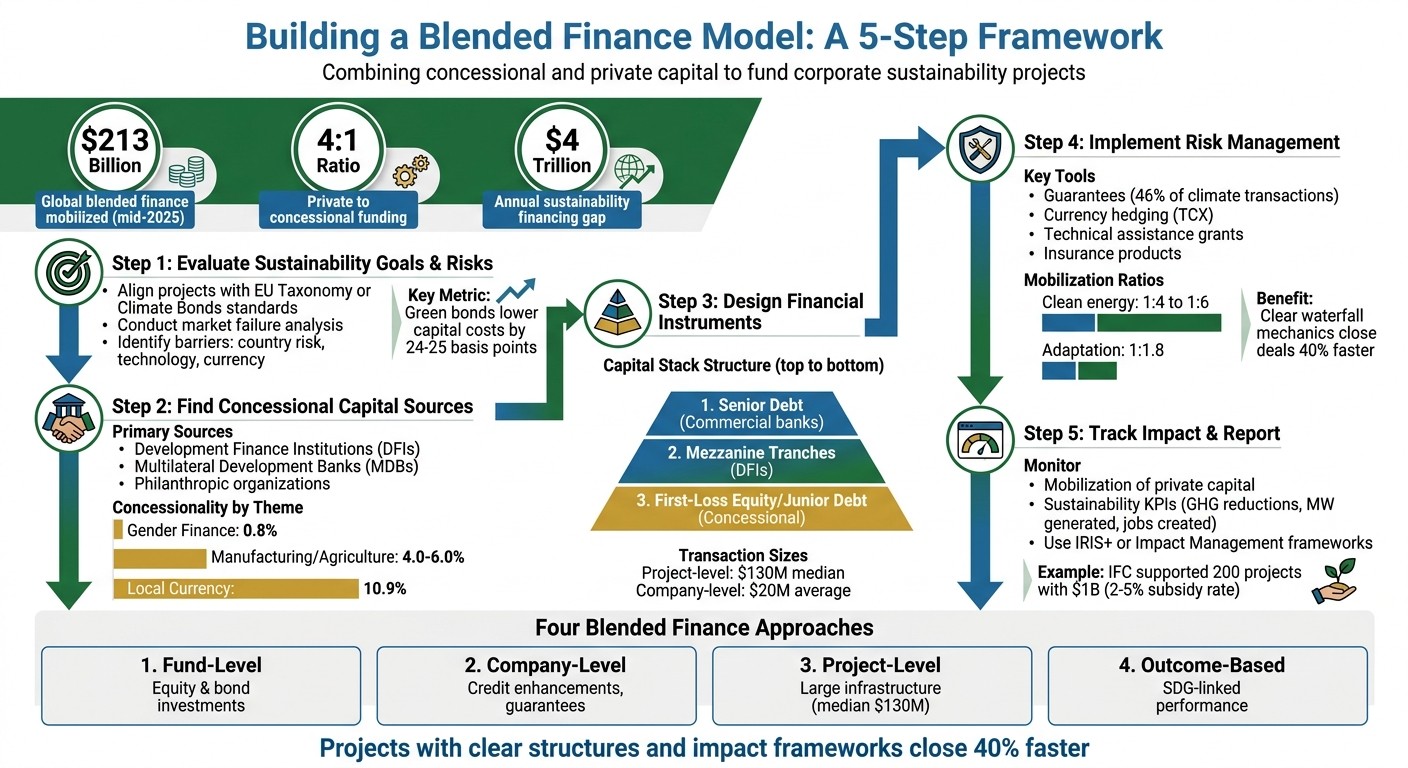
5-Step Process to Build a Corporate Blended Finance Model for Sustainability
An Overview of Blended Finance: What is it and how does it work?
Evaluating Your Sustainability Goals and Risks
Pinpoint projects that offer substantial social or environmental benefits but fall short of meeting your risk-adjusted return thresholds [4]. For instance, a solar installation in a politically unstable region might provide significant environmental advantages but carry currency risks that exceed your board's tolerance.
Aligning Sustainability Goals with Blended Finance
Take stock of your current and planned projects using frameworks like the EU Taxonomy or Climate Bonds Taxonomy [6]. This evaluation helps identify initiatives that meet established standards, making them more appealing to concessional funders. For example, corporate green bonds can lower the weighted average cost of capital by 24–25 basis points on average [6], enabling funding for projects that might otherwise be sidelined.
Corporate blended finance typically operates through four approaches: fund-level investments, company-level arrangements (such as credit enhancements), project-level structures, and outcome-based finance [4][3]. Each method suits different project scales and corporate roles. For example:
Project-level structures: With a median transaction size of $130 million [3], these are ideal for large-scale renewable energy projects.
Company-level transactions: Averaging $20 million in 2020 [3], these are better suited for mid-sized agricultural or energy efficiency projects.
Once you've aligned projects with these frameworks, the next step is to assess and mitigate their risks effectively.
Understanding and Managing Risks
Sustainability projects often face a mix of market/financial, operational/technical, and socioeconomic/political risks [2][4][7]. The initial step in addressing these challenges is to conduct a market failure analysis. This involves identifying why private capital is hesitant to invest in your project [2]. Is it due to perceived country risks, unfamiliar technology, or a lack of local currency financing?
After identifying the barriers, quantify the risk gap by modeling the necessary credit enhancements [6]. For example, clean energy blended finance typically achieves mobilization ratios of 1:4 to 1:6, whereas adaptation-focused facilities average only 1:1.8 [5], reflecting their differing risk profiles.
To address currency risks, consider engaging early with facilities like the Currency Exchange Fund (TCX) [5]. Other risk mitigation strategies include:
Capital stack layering: Using different tiers of capital to distribute risk.
Risk-transfer instruments: Tools to shift specific risks to other parties.
Technical assistance grants: Resources to address operational or technical challenges [2][7].
Guarantees play a significant role in mitigating non-commercial risks, accounting for 46% of concessional instruments in climate blended finance transactions in 2024 [6]. Moreover, deals with clear waterfall mechanics - predefined rules for cash flow distribution among investors - tend to close 40% faster than those relying on ad hoc negotiations [2], saving both time and legal costs.
Finding and Securing Concessional Capital
Where to Find Concessional Capital
If you're looking for concessional capital, Development Finance Institutions (DFIs) and Multilateral Development Banks (MDBs) should be your first stop. Institutions like the International Finance Corporation (IFC) and IDB Invest manage and invest concessional funds alongside their own resources, making them key players in this space [1][9]. The DFI Working Group, which includes 23 institutions, has standardized its approach to blended finance, creating a dependable network for securing institutional funding [1].
Concessional capital is often organized into thematic facilities that target specific goals such as Climate, Agriculture, Gender Finance, Health, and SME Finance [1]. Each theme has unique requirements for concessionality. For instance, Gender Finance projects typically require just 0.8% concessional capital relative to the total project cost, while Local Currency solutions demand about 10.9% [1]. Projects in sectors like Manufacturing, Agriculture, Services, Infrastructure, and Natural Resources generally need concessional support ranging from 4.0% to 6.0% [1].
Philanthropic organizations also play a crucial role by providing catalytic capital to encourage private investment in projects aligned with the 2030 Sustainable Development Agenda [9]. Public funds from donor governments are often channeled through DFI-managed facilities to tackle specific market barriers [1]. Notably, in 2019, the IFC set a transparency benchmark by becoming the first DFI to publicly disclose subsidy levels for each proposed project [1].
Building a Case for Funders
To secure concessional capital, you must prove additionality - essentially, that your project wouldn't move forward without this support [1][9][2]. Start by identifying the market failure that deters private investors. This could include risks such as political instability, unfamiliar technology, currency fluctuations, or uncertain revenue streams [2].
"Combining concessional finance from donors or third parties alongside DFIs' normal own account finance and/or commercial finance from other investors, to develop private sector markets, address the Sustainable Development Goals (SDGs), and mobilize private resources." - DFI Working Group on Blended Concessional Finance [1]
Your capital structure should highlight a clear mobilization ratio, showing how concessional funds will mitigate risks and attract commercial investors [2]. Use only the minimum concessionality required to make your project viable. Projects with clear waterfall mechanics and pre-defined impact frameworks tend to close 40% faster than those relying on ad hoc negotiations [2].
From the outset, align your project with measurable outcomes by establishing Key Performance Indicators (KPIs) and adopting reporting frameworks like IRIS+ or the Operating Principles for Impact Management [2]. Embed these metrics into legal agreements as impact covenants, making them binding rather than optional [2]. Additionally, define "sunset clauses" or performance triggers to demonstrate how your project will transition to fully commercial operations over time, allowing concessional capital to be redeployed to other initiatives [2].
Once you've laid out a strong case for concessional support, the focus shifts to designing financial instruments and implementing robust risk management strategies.
Designing Financial Instruments and Risk Management Tools
Setting Up Debt and Equity Instruments
When structuring your capital stack, it's essential to align investor risk profiles with the appropriate financial instruments. Start with senior debt from commercial banks at the top, followed by mezzanine tranches from development finance institutions in the middle, and conclude with first-loss equity or junior debt from concessional sources. This layered approach provides a safety net for commercial investors, as catalytic capital absorbs early losses, reducing overall risk exposure.
Subordinated debt, which takes a lower repayment priority than senior creditors, acts as an added buffer to boost lender confidence. A standout example is the Amundi Planet Emerging Green One fund. The International Finance Corporation (IFC) contributed a $125 million first-loss tranche, which successfully attracted institutional investors like pension funds into the fund's $2 billion green-bond initiative. This initiative financed climate-focused projects in countries such as Indonesia, Egypt, and Turkey [2]. The first-loss capital was pivotal in reshaping the risk profile, encouraging broader participation.
To maximize impact while conserving public resources, use concessional funding sparingly. Design instruments that are tightly aligned with sustainability goals, such as tying corporate bonds or loans to specific Sustainable Development Goals (SDGs) or measurable sustainability indicators [4]. Once your instruments are aligned, the next step is managing external risks effectively.
Using Risk Management Tools
After structuring your financial instruments, protect your projects against external uncertainties with robust risk management strategies. Guarantees and insurance can safeguard investments from challenges like currency fluctuations, political instability, and regulatory changes. For instance, the Green Guarantee Company, supported by a $100 million equity stake from the Green Climate Fund, provided partial credit guarantees in local currencies. This initiative unlocked $480 million in private lending for 14 renewable energy projects, totaling 620 MW across Kenya, Nigeria, and Senegal, with a low default rate of 1.2% and a mobilization ratio of 1:4.8 by the end of 2025 [5].
To address operational risks during the early stages of a project, technical assistance grants can be invaluable. These grants can be paired with results-based payments, where funds are released only after achieving verified outcomes, such as measurable reductions in CO₂ emissions.
Additionally, digital monitoring, reporting, and verification (MRV) tools enhance investor confidence by providing near-real-time updates on climate-related outcomes. Clear contractual terms can also ease the transition from blended finance to fully commercial operations once the project demonstrates its viability. Together, these tools and strategies create a more stable and attractive investment environment.
Creating Effective Partnerships
Working with Public and Philanthropic Organizations
Building successful blended finance initiatives starts with finding the right collaborators. Partner with Development Finance Institutions (DFIs), public agencies, and philanthropic groups that align with your Sustainable Development Goals (SDGs) - whether that’s advancing renewable energy projects or improving sustainable agriculture [4]. Global platforms like Convergence play a key role in bridging private investors with public and philanthropic funding, helping achieve investments that meet market-rate returns [4].
When reaching out to potential partners, clearly define their roles in your financial structure. Public entities often contribute through credit enhancement mechanisms like guarantees and insurance, while philanthropic groups may provide concessional or subsidized loans to mitigate early-stage risks [4].
Your engagement strategy should align with the type of project you’re pursuing:
Fund-level structures are ideal for equity and bond investments.
Company-level approaches suit guarantee arrangements.
Project-level designs work best for large-scale infrastructure initiatives.
Outcome-based models are tailored for SDG-linked performance goals [4].
Showcase how catalytic capital from public partners can enable operations in lower-income regions where political or socioeconomic risks might deter commercial investors [4]. Highlighting these benefits helps secure the support needed for challenging markets.
Strong partnerships also depend on well-defined governance structures, which ensure accountability and effective collaboration.
Establishing Governance and Decision-Making Processes
After identifying your partners, focus on creating governance systems that balance the institutional needs of donor governments and DFIs with the flexibility required to attract private investors [10]. Implement structured scorecards to evaluate fund designs consistently. These scorecards provide a unified framework for assessing risks and impacts, streamlining governance while maintaining accountability throughout the project’s lifecycle [8].
For outcome-based financing, put KPI monitoring systems in place to track progress against pre-set sustainability goals. Regular updates to stakeholders ensure transparency and alignment [4]. Early engagement with donor countries or public agencies is also crucial. It allows you to clarify institutional frameworks that influence resource allocation, reducing potential misalignment and preparing organizations to handle the complexities of blended finance tools [10].
Tracking Impact and Maintaining Accountability
Selecting Metrics and KPIs
To effectively track the performance of your blended finance model, it’s essential to monitor both its financial structure and sustainability outcomes [13]. A structured scorecard, developed during the design phase, can help align fund managers, investors, and donors. This ensures everyone evaluates the initiative with the same clarity and consistency [8].
One of the most important financial metrics to monitor is the mobilization of private capital in underserved markets. This reflects how well your model scales sustainability efforts in areas often overlooked by traditional investments [8]. Additionally, track social impact metrics tailored to your specific fund. For example:
Renewable energy projects: Measure reductions in greenhouse gas emissions and the total megawatt hours generated.
Sustainable agriculture initiatives: Focus on the number of sustainable jobs created and the affordability of products for rural communities [12].
A real-world example comes from the International Finance Corporation (IFC), which supported nearly 200 projects between 2010 and 2018 using about $1 billion in donor funds. These projects relied on direct subsidies, typically covering just 2% to 5% of project costs, to catalyze high-risk, high-impact transactions [12]. When selecting KPIs, aim for similar efficiency ratios to showcase how modest concessional capital can unlock significantly larger private investments.
Reporting Results to Stakeholders
Once clear KPIs are in place, the next step is ensuring these metrics lead to transparent reporting for all stakeholders. Use existing governance frameworks to disclose environmental and social impacts clearly, going beyond superficial reporting to maintain full accountability [3].
"Opacity and complexity drive up transaction costs and undermine trust." - Columbia Center on Sustainable Investment [11]
Transparency should include reporting on implicit subsidies, such as high administrative costs, slow disbursements, or income shortfalls, alongside direct concessional capital [12]. Explain how these subsidies contribute to economic benefits like affordable services and sustainable employment [12].
For outcome-based financing structures, connect your reporting directly to specific performance targets aligned with the Sustainable Development Goals (SDGs). Regular updates on KPIs demonstrate how financial terms translate into measurable sustainability outcomes [4]. Tools like the UNEP FI Corporate Impact Analysis Tool can provide comprehensive insights and ensure global-standard reporting [14].
Case Studies: Blended Finance in Action
Examples from the field highlight how blended finance can drive investments in sustainable development.
Case Study 1: Renewable Energy Projects
In May 2024, Climate Fund Managers (CFM) showcased the power of blended finance in advancing renewable energy in difficult markets. Using $1.4 million in concessional funding from the European Commission, CFM developed a 60 MW wind farm near Lake Goubet in Djibouti. This initial funding covered technical assessments and project structuring, making it viable for commercial investors to participate.
"The project would have been immensely challenging to fund with a traditional project finance debt-plus equity approach... It simply wouldn't have gone ahead without a blended finance approach." - Andrew Johnstone, CEO of Climate Fund Managers [16]
The modest early investment unlocked an additional $25 million from the Construction Equity Fund, Africa Finance Corporation, FMO (Dutch development bank), and the Djibouti government. The wind farm increased Djibouti's power capacity by 50% and now supplies clean energy to over 300,000 residents [16].
In Nigeria, Daybreak tackled renewable energy financing differently. By May 2022, the company, which specializes in off-grid solar and battery solutions for commercial and industrial clients, used concessional long-term subordinated debt to reduce risk. This structure attracted commercial senior debt at better rates, enabling Daybreak to offer lower tariffs compared to diesel generators [15].
These examples show how blended finance can address market barriers, enabling innovative energy solutions in diverse settings.
Case Study 2: Sustainable Agriculture Initiatives
Between 2023 and 2024, McCormick & Company joined forces with PepsiCo and the Soil and Water Outcomes Fund (SWOF) to promote regenerative agriculture within its U.S. supply chain. The program supported over 100 farmers managing 80,000 acres in the Midwest, cutting more than 50,000 metric tons of greenhouse gas emissions. By sharing costs with a customer, McCormick accelerated climate progress in shared sourcing regions, known as "supply sheds" [17].
In Brazil, the AGRI3 Fund partnered with Rabobank Brazil in 2024 to support Van den Broek, a company producing soy, corn, and cattle. The fund provided a guarantee facility, enabling a loan with extended repayment and grace periods. This financial structure allowed the company to scale regenerative farming practices, focusing on soil health and carbon capture. The loan's terms were tied to verified environmental outcomes rather than just activities [18].
Another example comes from the Sustainable Landscapes Partnership, which ran from 2023 to 2026. Companies like ADM, Bunge, Cargill, Danone, and Mars collectively invested $9.5 million to support sustainable commodity production in Brazil's Cerrado region. The initiative protected over 38,441 hectares of surplus legal reserves and ensured 266,418 hectares of native ecosystems were managed under deforestation-free practices [19].
These case studies provide actionable insights for corporations looking to incorporate blended finance into sustainability efforts, showcasing its potential to drive meaningful change across industries.
Conclusion: Working with Council Fire on Blended Finance
Developing a blended finance model goes beyond technical know-how - it requires seamless coordination between public, private, and philanthropic players to address the $4 trillion annual sustainability financing gap in developing countries. Meanwhile, over $450 trillion in global financial assets remains untapped, waiting for the right opportunities [20]. These realities highlight the importance of turning sustainability challenges into viable, investment-ready solutions.
Effective implementation of these strategies calls for a reliable partner to help navigate the complexities of financial structuring. Council Fire specializes in connecting private investors with concessional capital, crafting deals that reduce transaction costs and consolidate projects. We assist corporations in designing outcome-based finance structures, where financial terms, like interest rates, are directly tied to sustainability KPIs. For instance, a sustainability-linked loan tied to specific GHG reduction targets demonstrated how such mechanisms can drive substantial investments.
Our approach emphasizes reducing risk for investors by leveraging credit enhancement tools, such as guarantees or below-market-rate loans, making projects more appealing to commercial capital. We also establish rigorous impact measurement systems and governance frameworks to ensure transparency and accountability throughout the investment process. As the UN Sustainable Development Group states:
"Blended finance requires creativity, flexibility, and a willingness to adapt and work with financial market actors" [20].
At Council Fire, we bring a systems-based approach and a commitment to collaboration, going beyond meeting ESG standards to deliver measurable environmental and social results. By translating your sustainability vision into actionable financial structures, we simplify the process of turning ambitious goals into investable projects.
Looking to create a blended finance model tailored to your sustainability objectives? Council Fire offers the expertise, networks, and strategic insights to transform your initiatives into impactful, investable opportunities. Let’s work together to create lasting change.
FAQs
How do I know if my project needs blended finance?
Blended finance can be a game-changer for projects struggling to attract private investment due to high risks or modest returns. This strategy is particularly suited for efforts in sectors like climate action, infrastructure development, or social initiatives, especially in underfunded or developing areas. By merging public or philanthropic funding with private capital, blended finance helps lower investment risks, draw in private investors, and expand the financial resources available for projects that align with sustainability objectives.
What proof do funders need to show “additionality”?
Funders need to prove additionality, showing that their contributions lead to investments or actions that wouldn’t have occurred without their involvement. This might involve filling market gaps or encouraging extra private sector financing to meet sustainability objectives.
Which finance tool should I use first: guarantee, subordinated debt, or technical assistance?
Starting with a guarantee is a smart approach because it reduces risks and makes private investment more appealing. By addressing market shortcomings, guarantees encourage private sector involvement and create a solid starting point.
While subordinated debt and technical assistance also play important roles, they usually come into play after guarantees. This sequence helps attract more private capital and strengthens trust in financing projects focused on sustainability.
Related Blog Posts
Latest Articles
©2025

Narrative Change and Power Building: The Missing Half of Advocacy
Narrative change is the process of disrupting dominant narratives that normalize inequity and advancing new narratives from historically marginalized communities.

Funding Resilience Without Federal Grants
BRIC is unreliable and FEMA is shrinking. Here's how cities fund climate resilience with dedicated revenue, blended finance, and a coordinating authority.

The ESG Blind Spot: How AI Is Finding Risks in Companies Nobody Else Is Watching
Norway's sovereign wealth fund uses AI to screen 7,200 portfolio companies for forced labor and corruption within 24 hours. The real story is the emerging-market coverage gap that traditional ESG data vendors miss — and what it means for any company with a global supply chain.
Narrative Change and Power Building: The Missing Half of Advocacy
Narrative change is the process of disrupting dominant narratives that normalize inequity and advancing new narratives from historically marginalized communities.
Funding Resilience Without Federal Grants
BRIC is unreliable and FEMA is shrinking. Here's how cities fund climate resilience with dedicated revenue, blended finance, and a coordinating authority.
The ESG Blind Spot: How AI Is Finding Risks in Companies Nobody Else Is Watching
Norway's sovereign wealth fund uses AI to screen 7,200 portfolio companies for forced labor and corruption within 24 hours. The real story is the emerging-market coverage gap that traditional ESG data vendors miss — and what it means for any company with a global supply chain.
FAQ
01
What does it really mean to “redefine profit”?
02
What makes Council Fire different?
03
Who does Council Fire work with?
04
What does working with Council Fire actually look like?
05
How does Council Fire help organizations turn big goals into action?
06
How does Council Fire define and measure success?
May 5, 2026
How to Build a Blended Finance Model for Sustainability Initiatives for Corporations
Sustainability Strategy
In This Article
Step-by-step guide to structuring blended finance—combining concessional capital, risk tools, and KPIs to fund corporate sustainability projects.
How to Build a Blended Finance Model for Sustainability Initiatives for Corporations
Corporations often face challenges financing sustainability projects due to high risks and uncertain returns. Blended finance offers a solution by combining concessional capital (from public or philanthropic sources) with private investment to make these projects viable. This approach reduces risks for private investors while enabling impactful projects in areas like renewable energy and agriculture. Key elements include:
Concessional capital: Tools like guarantees, subordinated debt, or first-loss tranches to de-risk investments.
Risk-sharing mechanisms: Adjusting risk profiles to attract private funding.
Technical assistance: Grants for feasibility studies and project preparation.
Blended finance has mobilized $213 billion globally as of mid-2025, with a $4 private-to-$1 concessional funding ratio. Corporations can use it to address climate financing gaps, enter high-risk markets, and improve reputations. Steps include aligning projects with sustainability goals, evaluating risks, securing concessional capital from Development Finance Institutions (DFIs) or philanthropic groups, and structuring financial instruments with clear impact metrics.
Case studies, like renewable energy projects in Africa and regenerative agriculture in the U.S., demonstrate how blended finance supports corporate sustainability efforts while attracting commercial investors. By leveraging this model, corporations can make high-impact projects financially feasible.
5-Step Process to Build a Corporate Blended Finance Model for Sustainability
An Overview of Blended Finance: What is it and how does it work?
Evaluating Your Sustainability Goals and Risks
Pinpoint projects that offer substantial social or environmental benefits but fall short of meeting your risk-adjusted return thresholds [4]. For instance, a solar installation in a politically unstable region might provide significant environmental advantages but carry currency risks that exceed your board's tolerance.
Aligning Sustainability Goals with Blended Finance
Take stock of your current and planned projects using frameworks like the EU Taxonomy or Climate Bonds Taxonomy [6]. This evaluation helps identify initiatives that meet established standards, making them more appealing to concessional funders. For example, corporate green bonds can lower the weighted average cost of capital by 24–25 basis points on average [6], enabling funding for projects that might otherwise be sidelined.
Corporate blended finance typically operates through four approaches: fund-level investments, company-level arrangements (such as credit enhancements), project-level structures, and outcome-based finance [4][3]. Each method suits different project scales and corporate roles. For example:
Project-level structures: With a median transaction size of $130 million [3], these are ideal for large-scale renewable energy projects.
Company-level transactions: Averaging $20 million in 2020 [3], these are better suited for mid-sized agricultural or energy efficiency projects.
Once you've aligned projects with these frameworks, the next step is to assess and mitigate their risks effectively.
Understanding and Managing Risks
Sustainability projects often face a mix of market/financial, operational/technical, and socioeconomic/political risks [2][4][7]. The initial step in addressing these challenges is to conduct a market failure analysis. This involves identifying why private capital is hesitant to invest in your project [2]. Is it due to perceived country risks, unfamiliar technology, or a lack of local currency financing?
After identifying the barriers, quantify the risk gap by modeling the necessary credit enhancements [6]. For example, clean energy blended finance typically achieves mobilization ratios of 1:4 to 1:6, whereas adaptation-focused facilities average only 1:1.8 [5], reflecting their differing risk profiles.
To address currency risks, consider engaging early with facilities like the Currency Exchange Fund (TCX) [5]. Other risk mitigation strategies include:
Capital stack layering: Using different tiers of capital to distribute risk.
Risk-transfer instruments: Tools to shift specific risks to other parties.
Technical assistance grants: Resources to address operational or technical challenges [2][7].
Guarantees play a significant role in mitigating non-commercial risks, accounting for 46% of concessional instruments in climate blended finance transactions in 2024 [6]. Moreover, deals with clear waterfall mechanics - predefined rules for cash flow distribution among investors - tend to close 40% faster than those relying on ad hoc negotiations [2], saving both time and legal costs.
Finding and Securing Concessional Capital
Where to Find Concessional Capital
If you're looking for concessional capital, Development Finance Institutions (DFIs) and Multilateral Development Banks (MDBs) should be your first stop. Institutions like the International Finance Corporation (IFC) and IDB Invest manage and invest concessional funds alongside their own resources, making them key players in this space [1][9]. The DFI Working Group, which includes 23 institutions, has standardized its approach to blended finance, creating a dependable network for securing institutional funding [1].
Concessional capital is often organized into thematic facilities that target specific goals such as Climate, Agriculture, Gender Finance, Health, and SME Finance [1]. Each theme has unique requirements for concessionality. For instance, Gender Finance projects typically require just 0.8% concessional capital relative to the total project cost, while Local Currency solutions demand about 10.9% [1]. Projects in sectors like Manufacturing, Agriculture, Services, Infrastructure, and Natural Resources generally need concessional support ranging from 4.0% to 6.0% [1].
Philanthropic organizations also play a crucial role by providing catalytic capital to encourage private investment in projects aligned with the 2030 Sustainable Development Agenda [9]. Public funds from donor governments are often channeled through DFI-managed facilities to tackle specific market barriers [1]. Notably, in 2019, the IFC set a transparency benchmark by becoming the first DFI to publicly disclose subsidy levels for each proposed project [1].
Building a Case for Funders
To secure concessional capital, you must prove additionality - essentially, that your project wouldn't move forward without this support [1][9][2]. Start by identifying the market failure that deters private investors. This could include risks such as political instability, unfamiliar technology, currency fluctuations, or uncertain revenue streams [2].
"Combining concessional finance from donors or third parties alongside DFIs' normal own account finance and/or commercial finance from other investors, to develop private sector markets, address the Sustainable Development Goals (SDGs), and mobilize private resources." - DFI Working Group on Blended Concessional Finance [1]
Your capital structure should highlight a clear mobilization ratio, showing how concessional funds will mitigate risks and attract commercial investors [2]. Use only the minimum concessionality required to make your project viable. Projects with clear waterfall mechanics and pre-defined impact frameworks tend to close 40% faster than those relying on ad hoc negotiations [2].
From the outset, align your project with measurable outcomes by establishing Key Performance Indicators (KPIs) and adopting reporting frameworks like IRIS+ or the Operating Principles for Impact Management [2]. Embed these metrics into legal agreements as impact covenants, making them binding rather than optional [2]. Additionally, define "sunset clauses" or performance triggers to demonstrate how your project will transition to fully commercial operations over time, allowing concessional capital to be redeployed to other initiatives [2].
Once you've laid out a strong case for concessional support, the focus shifts to designing financial instruments and implementing robust risk management strategies.
Designing Financial Instruments and Risk Management Tools
Setting Up Debt and Equity Instruments
When structuring your capital stack, it's essential to align investor risk profiles with the appropriate financial instruments. Start with senior debt from commercial banks at the top, followed by mezzanine tranches from development finance institutions in the middle, and conclude with first-loss equity or junior debt from concessional sources. This layered approach provides a safety net for commercial investors, as catalytic capital absorbs early losses, reducing overall risk exposure.
Subordinated debt, which takes a lower repayment priority than senior creditors, acts as an added buffer to boost lender confidence. A standout example is the Amundi Planet Emerging Green One fund. The International Finance Corporation (IFC) contributed a $125 million first-loss tranche, which successfully attracted institutional investors like pension funds into the fund's $2 billion green-bond initiative. This initiative financed climate-focused projects in countries such as Indonesia, Egypt, and Turkey [2]. The first-loss capital was pivotal in reshaping the risk profile, encouraging broader participation.
To maximize impact while conserving public resources, use concessional funding sparingly. Design instruments that are tightly aligned with sustainability goals, such as tying corporate bonds or loans to specific Sustainable Development Goals (SDGs) or measurable sustainability indicators [4]. Once your instruments are aligned, the next step is managing external risks effectively.
Using Risk Management Tools
After structuring your financial instruments, protect your projects against external uncertainties with robust risk management strategies. Guarantees and insurance can safeguard investments from challenges like currency fluctuations, political instability, and regulatory changes. For instance, the Green Guarantee Company, supported by a $100 million equity stake from the Green Climate Fund, provided partial credit guarantees in local currencies. This initiative unlocked $480 million in private lending for 14 renewable energy projects, totaling 620 MW across Kenya, Nigeria, and Senegal, with a low default rate of 1.2% and a mobilization ratio of 1:4.8 by the end of 2025 [5].
To address operational risks during the early stages of a project, technical assistance grants can be invaluable. These grants can be paired with results-based payments, where funds are released only after achieving verified outcomes, such as measurable reductions in CO₂ emissions.
Additionally, digital monitoring, reporting, and verification (MRV) tools enhance investor confidence by providing near-real-time updates on climate-related outcomes. Clear contractual terms can also ease the transition from blended finance to fully commercial operations once the project demonstrates its viability. Together, these tools and strategies create a more stable and attractive investment environment.
Creating Effective Partnerships
Working with Public and Philanthropic Organizations
Building successful blended finance initiatives starts with finding the right collaborators. Partner with Development Finance Institutions (DFIs), public agencies, and philanthropic groups that align with your Sustainable Development Goals (SDGs) - whether that’s advancing renewable energy projects or improving sustainable agriculture [4]. Global platforms like Convergence play a key role in bridging private investors with public and philanthropic funding, helping achieve investments that meet market-rate returns [4].
When reaching out to potential partners, clearly define their roles in your financial structure. Public entities often contribute through credit enhancement mechanisms like guarantees and insurance, while philanthropic groups may provide concessional or subsidized loans to mitigate early-stage risks [4].
Your engagement strategy should align with the type of project you’re pursuing:
Fund-level structures are ideal for equity and bond investments.
Company-level approaches suit guarantee arrangements.
Project-level designs work best for large-scale infrastructure initiatives.
Outcome-based models are tailored for SDG-linked performance goals [4].
Showcase how catalytic capital from public partners can enable operations in lower-income regions where political or socioeconomic risks might deter commercial investors [4]. Highlighting these benefits helps secure the support needed for challenging markets.
Strong partnerships also depend on well-defined governance structures, which ensure accountability and effective collaboration.
Establishing Governance and Decision-Making Processes
After identifying your partners, focus on creating governance systems that balance the institutional needs of donor governments and DFIs with the flexibility required to attract private investors [10]. Implement structured scorecards to evaluate fund designs consistently. These scorecards provide a unified framework for assessing risks and impacts, streamlining governance while maintaining accountability throughout the project’s lifecycle [8].
For outcome-based financing, put KPI monitoring systems in place to track progress against pre-set sustainability goals. Regular updates to stakeholders ensure transparency and alignment [4]. Early engagement with donor countries or public agencies is also crucial. It allows you to clarify institutional frameworks that influence resource allocation, reducing potential misalignment and preparing organizations to handle the complexities of blended finance tools [10].
Tracking Impact and Maintaining Accountability
Selecting Metrics and KPIs
To effectively track the performance of your blended finance model, it’s essential to monitor both its financial structure and sustainability outcomes [13]. A structured scorecard, developed during the design phase, can help align fund managers, investors, and donors. This ensures everyone evaluates the initiative with the same clarity and consistency [8].
One of the most important financial metrics to monitor is the mobilization of private capital in underserved markets. This reflects how well your model scales sustainability efforts in areas often overlooked by traditional investments [8]. Additionally, track social impact metrics tailored to your specific fund. For example:
Renewable energy projects: Measure reductions in greenhouse gas emissions and the total megawatt hours generated.
Sustainable agriculture initiatives: Focus on the number of sustainable jobs created and the affordability of products for rural communities [12].
A real-world example comes from the International Finance Corporation (IFC), which supported nearly 200 projects between 2010 and 2018 using about $1 billion in donor funds. These projects relied on direct subsidies, typically covering just 2% to 5% of project costs, to catalyze high-risk, high-impact transactions [12]. When selecting KPIs, aim for similar efficiency ratios to showcase how modest concessional capital can unlock significantly larger private investments.
Reporting Results to Stakeholders
Once clear KPIs are in place, the next step is ensuring these metrics lead to transparent reporting for all stakeholders. Use existing governance frameworks to disclose environmental and social impacts clearly, going beyond superficial reporting to maintain full accountability [3].
"Opacity and complexity drive up transaction costs and undermine trust." - Columbia Center on Sustainable Investment [11]
Transparency should include reporting on implicit subsidies, such as high administrative costs, slow disbursements, or income shortfalls, alongside direct concessional capital [12]. Explain how these subsidies contribute to economic benefits like affordable services and sustainable employment [12].
For outcome-based financing structures, connect your reporting directly to specific performance targets aligned with the Sustainable Development Goals (SDGs). Regular updates on KPIs demonstrate how financial terms translate into measurable sustainability outcomes [4]. Tools like the UNEP FI Corporate Impact Analysis Tool can provide comprehensive insights and ensure global-standard reporting [14].
Case Studies: Blended Finance in Action
Examples from the field highlight how blended finance can drive investments in sustainable development.
Case Study 1: Renewable Energy Projects
In May 2024, Climate Fund Managers (CFM) showcased the power of blended finance in advancing renewable energy in difficult markets. Using $1.4 million in concessional funding from the European Commission, CFM developed a 60 MW wind farm near Lake Goubet in Djibouti. This initial funding covered technical assessments and project structuring, making it viable for commercial investors to participate.
"The project would have been immensely challenging to fund with a traditional project finance debt-plus equity approach... It simply wouldn't have gone ahead without a blended finance approach." - Andrew Johnstone, CEO of Climate Fund Managers [16]
The modest early investment unlocked an additional $25 million from the Construction Equity Fund, Africa Finance Corporation, FMO (Dutch development bank), and the Djibouti government. The wind farm increased Djibouti's power capacity by 50% and now supplies clean energy to over 300,000 residents [16].
In Nigeria, Daybreak tackled renewable energy financing differently. By May 2022, the company, which specializes in off-grid solar and battery solutions for commercial and industrial clients, used concessional long-term subordinated debt to reduce risk. This structure attracted commercial senior debt at better rates, enabling Daybreak to offer lower tariffs compared to diesel generators [15].
These examples show how blended finance can address market barriers, enabling innovative energy solutions in diverse settings.
Case Study 2: Sustainable Agriculture Initiatives
Between 2023 and 2024, McCormick & Company joined forces with PepsiCo and the Soil and Water Outcomes Fund (SWOF) to promote regenerative agriculture within its U.S. supply chain. The program supported over 100 farmers managing 80,000 acres in the Midwest, cutting more than 50,000 metric tons of greenhouse gas emissions. By sharing costs with a customer, McCormick accelerated climate progress in shared sourcing regions, known as "supply sheds" [17].
In Brazil, the AGRI3 Fund partnered with Rabobank Brazil in 2024 to support Van den Broek, a company producing soy, corn, and cattle. The fund provided a guarantee facility, enabling a loan with extended repayment and grace periods. This financial structure allowed the company to scale regenerative farming practices, focusing on soil health and carbon capture. The loan's terms were tied to verified environmental outcomes rather than just activities [18].
Another example comes from the Sustainable Landscapes Partnership, which ran from 2023 to 2026. Companies like ADM, Bunge, Cargill, Danone, and Mars collectively invested $9.5 million to support sustainable commodity production in Brazil's Cerrado region. The initiative protected over 38,441 hectares of surplus legal reserves and ensured 266,418 hectares of native ecosystems were managed under deforestation-free practices [19].
These case studies provide actionable insights for corporations looking to incorporate blended finance into sustainability efforts, showcasing its potential to drive meaningful change across industries.
Conclusion: Working with Council Fire on Blended Finance
Developing a blended finance model goes beyond technical know-how - it requires seamless coordination between public, private, and philanthropic players to address the $4 trillion annual sustainability financing gap in developing countries. Meanwhile, over $450 trillion in global financial assets remains untapped, waiting for the right opportunities [20]. These realities highlight the importance of turning sustainability challenges into viable, investment-ready solutions.
Effective implementation of these strategies calls for a reliable partner to help navigate the complexities of financial structuring. Council Fire specializes in connecting private investors with concessional capital, crafting deals that reduce transaction costs and consolidate projects. We assist corporations in designing outcome-based finance structures, where financial terms, like interest rates, are directly tied to sustainability KPIs. For instance, a sustainability-linked loan tied to specific GHG reduction targets demonstrated how such mechanisms can drive substantial investments.
Our approach emphasizes reducing risk for investors by leveraging credit enhancement tools, such as guarantees or below-market-rate loans, making projects more appealing to commercial capital. We also establish rigorous impact measurement systems and governance frameworks to ensure transparency and accountability throughout the investment process. As the UN Sustainable Development Group states:
"Blended finance requires creativity, flexibility, and a willingness to adapt and work with financial market actors" [20].
At Council Fire, we bring a systems-based approach and a commitment to collaboration, going beyond meeting ESG standards to deliver measurable environmental and social results. By translating your sustainability vision into actionable financial structures, we simplify the process of turning ambitious goals into investable projects.
Looking to create a blended finance model tailored to your sustainability objectives? Council Fire offers the expertise, networks, and strategic insights to transform your initiatives into impactful, investable opportunities. Let’s work together to create lasting change.
FAQs
How do I know if my project needs blended finance?
Blended finance can be a game-changer for projects struggling to attract private investment due to high risks or modest returns. This strategy is particularly suited for efforts in sectors like climate action, infrastructure development, or social initiatives, especially in underfunded or developing areas. By merging public or philanthropic funding with private capital, blended finance helps lower investment risks, draw in private investors, and expand the financial resources available for projects that align with sustainability objectives.
What proof do funders need to show “additionality”?
Funders need to prove additionality, showing that their contributions lead to investments or actions that wouldn’t have occurred without their involvement. This might involve filling market gaps or encouraging extra private sector financing to meet sustainability objectives.
Which finance tool should I use first: guarantee, subordinated debt, or technical assistance?
Starting with a guarantee is a smart approach because it reduces risks and makes private investment more appealing. By addressing market shortcomings, guarantees encourage private sector involvement and create a solid starting point.
While subordinated debt and technical assistance also play important roles, they usually come into play after guarantees. This sequence helps attract more private capital and strengthens trust in financing projects focused on sustainability.
Related Blog Posts
Latest Articles
©2025
Narrative Change and Power Building: The Missing Half of Advocacy
Narrative change is the process of disrupting dominant narratives that normalize inequity and advancing new narratives from historically marginalized communities.
Funding Resilience Without Federal Grants
BRIC is unreliable and FEMA is shrinking. Here's how cities fund climate resilience with dedicated revenue, blended finance, and a coordinating authority.
The ESG Blind Spot: How AI Is Finding Risks in Companies Nobody Else Is Watching
Norway's sovereign wealth fund uses AI to screen 7,200 portfolio companies for forced labor and corruption within 24 hours. The real story is the emerging-market coverage gap that traditional ESG data vendors miss — and what it means for any company with a global supply chain.
FAQ
01
What does it really mean to “redefine profit”?
02
What makes Council Fire different?
03
Who does Council Fire work with?
04
What does working with Council Fire actually look like?
05
How does Council Fire help organizations turn big goals into action?
06
How does Council Fire define and measure success?
May 5, 2026
How to Build a Blended Finance Model for Sustainability Initiatives for Corporations
Sustainability Strategy
In This Article
Step-by-step guide to structuring blended finance—combining concessional capital, risk tools, and KPIs to fund corporate sustainability projects.
How to Build a Blended Finance Model for Sustainability Initiatives for Corporations
Corporations often face challenges financing sustainability projects due to high risks and uncertain returns. Blended finance offers a solution by combining concessional capital (from public or philanthropic sources) with private investment to make these projects viable. This approach reduces risks for private investors while enabling impactful projects in areas like renewable energy and agriculture. Key elements include:
Concessional capital: Tools like guarantees, subordinated debt, or first-loss tranches to de-risk investments.
Risk-sharing mechanisms: Adjusting risk profiles to attract private funding.
Technical assistance: Grants for feasibility studies and project preparation.
Blended finance has mobilized $213 billion globally as of mid-2025, with a $4 private-to-$1 concessional funding ratio. Corporations can use it to address climate financing gaps, enter high-risk markets, and improve reputations. Steps include aligning projects with sustainability goals, evaluating risks, securing concessional capital from Development Finance Institutions (DFIs) or philanthropic groups, and structuring financial instruments with clear impact metrics.
Case studies, like renewable energy projects in Africa and regenerative agriculture in the U.S., demonstrate how blended finance supports corporate sustainability efforts while attracting commercial investors. By leveraging this model, corporations can make high-impact projects financially feasible.
5-Step Process to Build a Corporate Blended Finance Model for Sustainability
An Overview of Blended Finance: What is it and how does it work?
Evaluating Your Sustainability Goals and Risks
Pinpoint projects that offer substantial social or environmental benefits but fall short of meeting your risk-adjusted return thresholds [4]. For instance, a solar installation in a politically unstable region might provide significant environmental advantages but carry currency risks that exceed your board's tolerance.
Aligning Sustainability Goals with Blended Finance
Take stock of your current and planned projects using frameworks like the EU Taxonomy or Climate Bonds Taxonomy [6]. This evaluation helps identify initiatives that meet established standards, making them more appealing to concessional funders. For example, corporate green bonds can lower the weighted average cost of capital by 24–25 basis points on average [6], enabling funding for projects that might otherwise be sidelined.
Corporate blended finance typically operates through four approaches: fund-level investments, company-level arrangements (such as credit enhancements), project-level structures, and outcome-based finance [4][3]. Each method suits different project scales and corporate roles. For example:
Project-level structures: With a median transaction size of $130 million [3], these are ideal for large-scale renewable energy projects.
Company-level transactions: Averaging $20 million in 2020 [3], these are better suited for mid-sized agricultural or energy efficiency projects.
Once you've aligned projects with these frameworks, the next step is to assess and mitigate their risks effectively.
Understanding and Managing Risks
Sustainability projects often face a mix of market/financial, operational/technical, and socioeconomic/political risks [2][4][7]. The initial step in addressing these challenges is to conduct a market failure analysis. This involves identifying why private capital is hesitant to invest in your project [2]. Is it due to perceived country risks, unfamiliar technology, or a lack of local currency financing?
After identifying the barriers, quantify the risk gap by modeling the necessary credit enhancements [6]. For example, clean energy blended finance typically achieves mobilization ratios of 1:4 to 1:6, whereas adaptation-focused facilities average only 1:1.8 [5], reflecting their differing risk profiles.
To address currency risks, consider engaging early with facilities like the Currency Exchange Fund (TCX) [5]. Other risk mitigation strategies include:
Capital stack layering: Using different tiers of capital to distribute risk.
Risk-transfer instruments: Tools to shift specific risks to other parties.
Technical assistance grants: Resources to address operational or technical challenges [2][7].
Guarantees play a significant role in mitigating non-commercial risks, accounting for 46% of concessional instruments in climate blended finance transactions in 2024 [6]. Moreover, deals with clear waterfall mechanics - predefined rules for cash flow distribution among investors - tend to close 40% faster than those relying on ad hoc negotiations [2], saving both time and legal costs.
Finding and Securing Concessional Capital
Where to Find Concessional Capital
If you're looking for concessional capital, Development Finance Institutions (DFIs) and Multilateral Development Banks (MDBs) should be your first stop. Institutions like the International Finance Corporation (IFC) and IDB Invest manage and invest concessional funds alongside their own resources, making them key players in this space [1][9]. The DFI Working Group, which includes 23 institutions, has standardized its approach to blended finance, creating a dependable network for securing institutional funding [1].
Concessional capital is often organized into thematic facilities that target specific goals such as Climate, Agriculture, Gender Finance, Health, and SME Finance [1]. Each theme has unique requirements for concessionality. For instance, Gender Finance projects typically require just 0.8% concessional capital relative to the total project cost, while Local Currency solutions demand about 10.9% [1]. Projects in sectors like Manufacturing, Agriculture, Services, Infrastructure, and Natural Resources generally need concessional support ranging from 4.0% to 6.0% [1].
Philanthropic organizations also play a crucial role by providing catalytic capital to encourage private investment in projects aligned with the 2030 Sustainable Development Agenda [9]. Public funds from donor governments are often channeled through DFI-managed facilities to tackle specific market barriers [1]. Notably, in 2019, the IFC set a transparency benchmark by becoming the first DFI to publicly disclose subsidy levels for each proposed project [1].
Building a Case for Funders
To secure concessional capital, you must prove additionality - essentially, that your project wouldn't move forward without this support [1][9][2]. Start by identifying the market failure that deters private investors. This could include risks such as political instability, unfamiliar technology, currency fluctuations, or uncertain revenue streams [2].
"Combining concessional finance from donors or third parties alongside DFIs' normal own account finance and/or commercial finance from other investors, to develop private sector markets, address the Sustainable Development Goals (SDGs), and mobilize private resources." - DFI Working Group on Blended Concessional Finance [1]
Your capital structure should highlight a clear mobilization ratio, showing how concessional funds will mitigate risks and attract commercial investors [2]. Use only the minimum concessionality required to make your project viable. Projects with clear waterfall mechanics and pre-defined impact frameworks tend to close 40% faster than those relying on ad hoc negotiations [2].
From the outset, align your project with measurable outcomes by establishing Key Performance Indicators (KPIs) and adopting reporting frameworks like IRIS+ or the Operating Principles for Impact Management [2]. Embed these metrics into legal agreements as impact covenants, making them binding rather than optional [2]. Additionally, define "sunset clauses" or performance triggers to demonstrate how your project will transition to fully commercial operations over time, allowing concessional capital to be redeployed to other initiatives [2].
Once you've laid out a strong case for concessional support, the focus shifts to designing financial instruments and implementing robust risk management strategies.
Designing Financial Instruments and Risk Management Tools
Setting Up Debt and Equity Instruments
When structuring your capital stack, it's essential to align investor risk profiles with the appropriate financial instruments. Start with senior debt from commercial banks at the top, followed by mezzanine tranches from development finance institutions in the middle, and conclude with first-loss equity or junior debt from concessional sources. This layered approach provides a safety net for commercial investors, as catalytic capital absorbs early losses, reducing overall risk exposure.
Subordinated debt, which takes a lower repayment priority than senior creditors, acts as an added buffer to boost lender confidence. A standout example is the Amundi Planet Emerging Green One fund. The International Finance Corporation (IFC) contributed a $125 million first-loss tranche, which successfully attracted institutional investors like pension funds into the fund's $2 billion green-bond initiative. This initiative financed climate-focused projects in countries such as Indonesia, Egypt, and Turkey [2]. The first-loss capital was pivotal in reshaping the risk profile, encouraging broader participation.
To maximize impact while conserving public resources, use concessional funding sparingly. Design instruments that are tightly aligned with sustainability goals, such as tying corporate bonds or loans to specific Sustainable Development Goals (SDGs) or measurable sustainability indicators [4]. Once your instruments are aligned, the next step is managing external risks effectively.
Using Risk Management Tools
After structuring your financial instruments, protect your projects against external uncertainties with robust risk management strategies. Guarantees and insurance can safeguard investments from challenges like currency fluctuations, political instability, and regulatory changes. For instance, the Green Guarantee Company, supported by a $100 million equity stake from the Green Climate Fund, provided partial credit guarantees in local currencies. This initiative unlocked $480 million in private lending for 14 renewable energy projects, totaling 620 MW across Kenya, Nigeria, and Senegal, with a low default rate of 1.2% and a mobilization ratio of 1:4.8 by the end of 2025 [5].
To address operational risks during the early stages of a project, technical assistance grants can be invaluable. These grants can be paired with results-based payments, where funds are released only after achieving verified outcomes, such as measurable reductions in CO₂ emissions.
Additionally, digital monitoring, reporting, and verification (MRV) tools enhance investor confidence by providing near-real-time updates on climate-related outcomes. Clear contractual terms can also ease the transition from blended finance to fully commercial operations once the project demonstrates its viability. Together, these tools and strategies create a more stable and attractive investment environment.
Creating Effective Partnerships
Working with Public and Philanthropic Organizations
Building successful blended finance initiatives starts with finding the right collaborators. Partner with Development Finance Institutions (DFIs), public agencies, and philanthropic groups that align with your Sustainable Development Goals (SDGs) - whether that’s advancing renewable energy projects or improving sustainable agriculture [4]. Global platforms like Convergence play a key role in bridging private investors with public and philanthropic funding, helping achieve investments that meet market-rate returns [4].
When reaching out to potential partners, clearly define their roles in your financial structure. Public entities often contribute through credit enhancement mechanisms like guarantees and insurance, while philanthropic groups may provide concessional or subsidized loans to mitigate early-stage risks [4].
Your engagement strategy should align with the type of project you’re pursuing:
Fund-level structures are ideal for equity and bond investments.
Company-level approaches suit guarantee arrangements.
Project-level designs work best for large-scale infrastructure initiatives.
Outcome-based models are tailored for SDG-linked performance goals [4].
Showcase how catalytic capital from public partners can enable operations in lower-income regions where political or socioeconomic risks might deter commercial investors [4]. Highlighting these benefits helps secure the support needed for challenging markets.
Strong partnerships also depend on well-defined governance structures, which ensure accountability and effective collaboration.
Establishing Governance and Decision-Making Processes
After identifying your partners, focus on creating governance systems that balance the institutional needs of donor governments and DFIs with the flexibility required to attract private investors [10]. Implement structured scorecards to evaluate fund designs consistently. These scorecards provide a unified framework for assessing risks and impacts, streamlining governance while maintaining accountability throughout the project’s lifecycle [8].
For outcome-based financing, put KPI monitoring systems in place to track progress against pre-set sustainability goals. Regular updates to stakeholders ensure transparency and alignment [4]. Early engagement with donor countries or public agencies is also crucial. It allows you to clarify institutional frameworks that influence resource allocation, reducing potential misalignment and preparing organizations to handle the complexities of blended finance tools [10].
Tracking Impact and Maintaining Accountability
Selecting Metrics and KPIs
To effectively track the performance of your blended finance model, it’s essential to monitor both its financial structure and sustainability outcomes [13]. A structured scorecard, developed during the design phase, can help align fund managers, investors, and donors. This ensures everyone evaluates the initiative with the same clarity and consistency [8].
One of the most important financial metrics to monitor is the mobilization of private capital in underserved markets. This reflects how well your model scales sustainability efforts in areas often overlooked by traditional investments [8]. Additionally, track social impact metrics tailored to your specific fund. For example:
Renewable energy projects: Measure reductions in greenhouse gas emissions and the total megawatt hours generated.
Sustainable agriculture initiatives: Focus on the number of sustainable jobs created and the affordability of products for rural communities [12].
A real-world example comes from the International Finance Corporation (IFC), which supported nearly 200 projects between 2010 and 2018 using about $1 billion in donor funds. These projects relied on direct subsidies, typically covering just 2% to 5% of project costs, to catalyze high-risk, high-impact transactions [12]. When selecting KPIs, aim for similar efficiency ratios to showcase how modest concessional capital can unlock significantly larger private investments.
Reporting Results to Stakeholders
Once clear KPIs are in place, the next step is ensuring these metrics lead to transparent reporting for all stakeholders. Use existing governance frameworks to disclose environmental and social impacts clearly, going beyond superficial reporting to maintain full accountability [3].
"Opacity and complexity drive up transaction costs and undermine trust." - Columbia Center on Sustainable Investment [11]
Transparency should include reporting on implicit subsidies, such as high administrative costs, slow disbursements, or income shortfalls, alongside direct concessional capital [12]. Explain how these subsidies contribute to economic benefits like affordable services and sustainable employment [12].
For outcome-based financing structures, connect your reporting directly to specific performance targets aligned with the Sustainable Development Goals (SDGs). Regular updates on KPIs demonstrate how financial terms translate into measurable sustainability outcomes [4]. Tools like the UNEP FI Corporate Impact Analysis Tool can provide comprehensive insights and ensure global-standard reporting [14].
Case Studies: Blended Finance in Action
Examples from the field highlight how blended finance can drive investments in sustainable development.
Case Study 1: Renewable Energy Projects
In May 2024, Climate Fund Managers (CFM) showcased the power of blended finance in advancing renewable energy in difficult markets. Using $1.4 million in concessional funding from the European Commission, CFM developed a 60 MW wind farm near Lake Goubet in Djibouti. This initial funding covered technical assessments and project structuring, making it viable for commercial investors to participate.
"The project would have been immensely challenging to fund with a traditional project finance debt-plus equity approach... It simply wouldn't have gone ahead without a blended finance approach." - Andrew Johnstone, CEO of Climate Fund Managers [16]
The modest early investment unlocked an additional $25 million from the Construction Equity Fund, Africa Finance Corporation, FMO (Dutch development bank), and the Djibouti government. The wind farm increased Djibouti's power capacity by 50% and now supplies clean energy to over 300,000 residents [16].
In Nigeria, Daybreak tackled renewable energy financing differently. By May 2022, the company, which specializes in off-grid solar and battery solutions for commercial and industrial clients, used concessional long-term subordinated debt to reduce risk. This structure attracted commercial senior debt at better rates, enabling Daybreak to offer lower tariffs compared to diesel generators [15].
These examples show how blended finance can address market barriers, enabling innovative energy solutions in diverse settings.
Case Study 2: Sustainable Agriculture Initiatives
Between 2023 and 2024, McCormick & Company joined forces with PepsiCo and the Soil and Water Outcomes Fund (SWOF) to promote regenerative agriculture within its U.S. supply chain. The program supported over 100 farmers managing 80,000 acres in the Midwest, cutting more than 50,000 metric tons of greenhouse gas emissions. By sharing costs with a customer, McCormick accelerated climate progress in shared sourcing regions, known as "supply sheds" [17].
In Brazil, the AGRI3 Fund partnered with Rabobank Brazil in 2024 to support Van den Broek, a company producing soy, corn, and cattle. The fund provided a guarantee facility, enabling a loan with extended repayment and grace periods. This financial structure allowed the company to scale regenerative farming practices, focusing on soil health and carbon capture. The loan's terms were tied to verified environmental outcomes rather than just activities [18].
Another example comes from the Sustainable Landscapes Partnership, which ran from 2023 to 2026. Companies like ADM, Bunge, Cargill, Danone, and Mars collectively invested $9.5 million to support sustainable commodity production in Brazil's Cerrado region. The initiative protected over 38,441 hectares of surplus legal reserves and ensured 266,418 hectares of native ecosystems were managed under deforestation-free practices [19].
These case studies provide actionable insights for corporations looking to incorporate blended finance into sustainability efforts, showcasing its potential to drive meaningful change across industries.
Conclusion: Working with Council Fire on Blended Finance
Developing a blended finance model goes beyond technical know-how - it requires seamless coordination between public, private, and philanthropic players to address the $4 trillion annual sustainability financing gap in developing countries. Meanwhile, over $450 trillion in global financial assets remains untapped, waiting for the right opportunities [20]. These realities highlight the importance of turning sustainability challenges into viable, investment-ready solutions.
Effective implementation of these strategies calls for a reliable partner to help navigate the complexities of financial structuring. Council Fire specializes in connecting private investors with concessional capital, crafting deals that reduce transaction costs and consolidate projects. We assist corporations in designing outcome-based finance structures, where financial terms, like interest rates, are directly tied to sustainability KPIs. For instance, a sustainability-linked loan tied to specific GHG reduction targets demonstrated how such mechanisms can drive substantial investments.
Our approach emphasizes reducing risk for investors by leveraging credit enhancement tools, such as guarantees or below-market-rate loans, making projects more appealing to commercial capital. We also establish rigorous impact measurement systems and governance frameworks to ensure transparency and accountability throughout the investment process. As the UN Sustainable Development Group states:
"Blended finance requires creativity, flexibility, and a willingness to adapt and work with financial market actors" [20].
At Council Fire, we bring a systems-based approach and a commitment to collaboration, going beyond meeting ESG standards to deliver measurable environmental and social results. By translating your sustainability vision into actionable financial structures, we simplify the process of turning ambitious goals into investable projects.
Looking to create a blended finance model tailored to your sustainability objectives? Council Fire offers the expertise, networks, and strategic insights to transform your initiatives into impactful, investable opportunities. Let’s work together to create lasting change.
FAQs
How do I know if my project needs blended finance?
Blended finance can be a game-changer for projects struggling to attract private investment due to high risks or modest returns. This strategy is particularly suited for efforts in sectors like climate action, infrastructure development, or social initiatives, especially in underfunded or developing areas. By merging public or philanthropic funding with private capital, blended finance helps lower investment risks, draw in private investors, and expand the financial resources available for projects that align with sustainability objectives.
What proof do funders need to show “additionality”?
Funders need to prove additionality, showing that their contributions lead to investments or actions that wouldn’t have occurred without their involvement. This might involve filling market gaps or encouraging extra private sector financing to meet sustainability objectives.
Which finance tool should I use first: guarantee, subordinated debt, or technical assistance?
Starting with a guarantee is a smart approach because it reduces risks and makes private investment more appealing. By addressing market shortcomings, guarantees encourage private sector involvement and create a solid starting point.
While subordinated debt and technical assistance also play important roles, they usually come into play after guarantees. This sequence helps attract more private capital and strengthens trust in financing projects focused on sustainability.
Related Blog Posts
Latest Articles
©2025
Narrative Change and Power Building: The Missing Half of Advocacy
Narrative change is the process of disrupting dominant narratives that normalize inequity and advancing new narratives from historically marginalized communities.
Funding Resilience Without Federal Grants
BRIC is unreliable and FEMA is shrinking. Here's how cities fund climate resilience with dedicated revenue, blended finance, and a coordinating authority.
The ESG Blind Spot: How AI Is Finding Risks in Companies Nobody Else Is Watching
Norway's sovereign wealth fund uses AI to screen 7,200 portfolio companies for forced labor and corruption within 24 hours. The real story is the emerging-market coverage gap that traditional ESG data vendors miss — and what it means for any company with a global supply chain.
FAQ
What does it really mean to “redefine profit”?
What makes Council Fire different?
Who does Council Fire work with?
What does working with Council Fire actually look like?
How does Council Fire help organizations turn big goals into action?
How does Council Fire define and measure success?