In This Article
Clear steps to assess impact and financial materiality for ESRS: set thresholds, map disclosures, document evidence.
How to Assess Double Materiality for ESRS Reporting
An ESRS matter can be material for its effects on people or nature, its financial effects, or both. Assess these two perspectives separately, set clear thresholds, and keep records that explain each decision.
The process has five steps:
Set the scope: Confirm applicable reporting rules, business boundaries, value-chain coverage, and approval roles.
Identify impacts, risks, and opportunities: Use company records, stakeholder input, and financial data.
Assess materiality: Apply separate impact and financial criteria without allowing positive effects to cancel harm.
Validate and map disclosures: Challenge decisions, link results to ESRS requirements, and assign reporting controls.
Review and update: Track changes each reporting period and revise affected decisions and disclosures.
The goal is a documented link between the company’s material matters, reporting choices, and accountable owners - not just a set of scores.
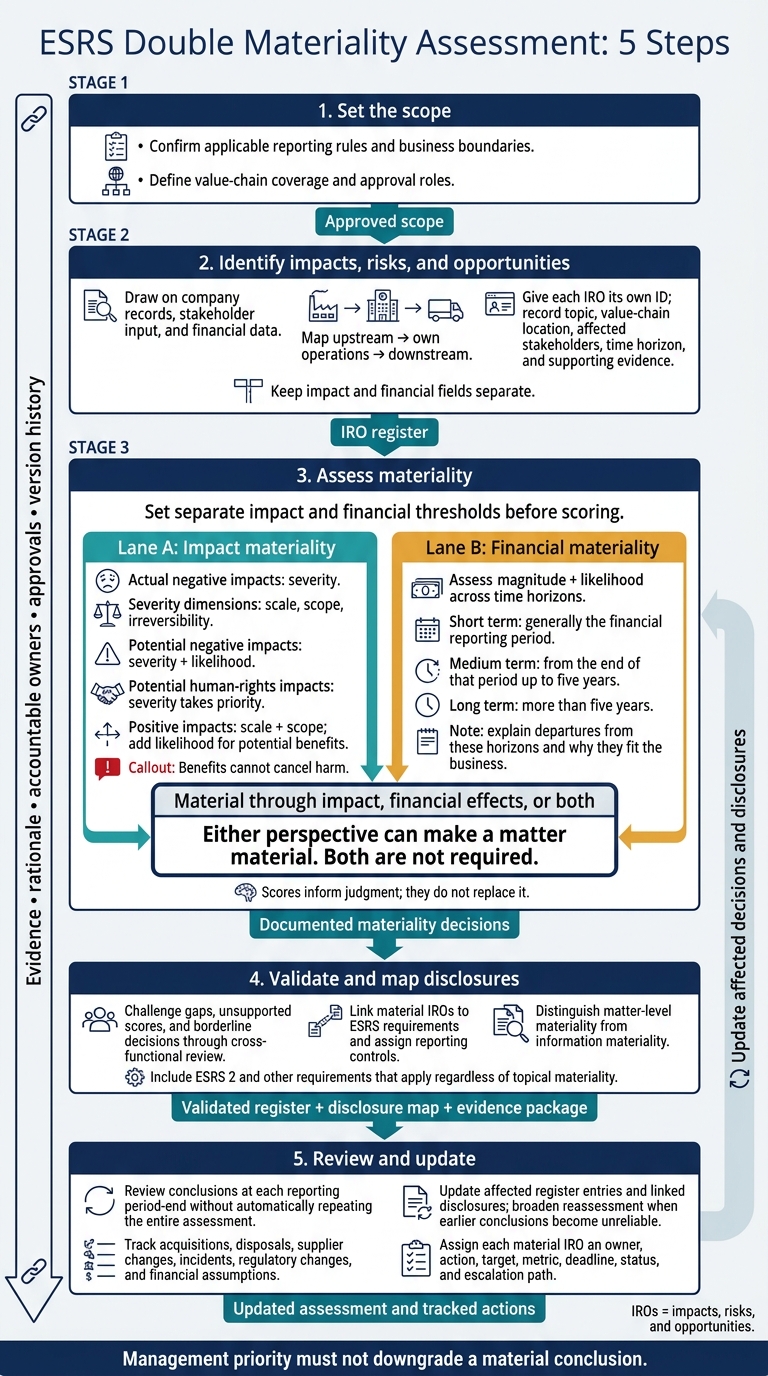
ESRS Double Materiality Assessment: 5 Steps
2. Identify Impacts, Risks, and Opportunities
Start with the approved scope above and the applicable ESRS topics. Then add company-specific impacts, risks, and opportunities (IROs) drawn from the business model, geographies, activities, value chain, records, sector research, and stakeholder input. Focus on areas where material IROs are likely to arise rather than reviewing every value-chain actor.[3][1]
Give each IRO its own ID and record its topic, value-chain location, affected stakeholders, time horizon, and supporting evidence. Keep impact and financial fields separate. This IRO register will support the next step: testing severity, likelihood, magnitude, and time horizon.
Map Impacts Across the Value Chain
Trace the full value chain, from raw materials through end-of-life. Classify each impact as positive or negative and actual or potential. Record the activity or relationship, location, affected people or environmental receptors, and whether the company causes, contributes to, or is directly linked to the impact. Include indirect upstream and downstream business relationships where relevant.[3][4]
Back each entry with evidence that reviewers can check, such as environmental permits, incident logs, environmental measurements, supplier audits, product complaints, and remediation records. Use worker interviews, consultations with affected communities, and grievance channels to check what the records may miss. Document conflicting accounts and gaps in representation. Where primary data is unavailable, label estimates and explain their basis.
Identify Financial Risks and Opportunities
Use the same IRO register to identify financial risks and opportunities. Don't limit the review to the enterprise risk register. Check budgets, capital plans, contracts, insurance terms, procurement records, and business-continuity plans for sustainability-related exposure.
Trace dependencies on water, energy, labor, materials, and logistics to possible effects on revenue, costs, assets, liabilities, financing, or business continuity. For each risk or opportunity, record the financial mechanism, affected line item, time horizon, probability, and estimated financial impact or range. A missing financial estimate is a data gap - not evidence that a matter is immaterial.
Compare Impact and Financial Materiality
Assess impact and financial materiality separately; don't average them into one score. Either perspective can make a matter material. Both are not required.[5] Apply both tests to the IRO register and link related entries so reviewers can trace how an impact or dependency could lead to a financial impact.
| Perspective | Subject assessed | Typical evidence | ESRS reporting consequence |
|---|---|---|---|
| Impact materiality | Actual or potential positive and negative impacts on people or nature | Incident records, worker and community input, environmental measurements, audits and supplier assessments, complaints, litigation, human-rights studies, and product-use data | Report the material impact and explain its connection to own operations, products, services, or business relationships.[5][6] |
| Financial materiality | Sustainability-related risks and opportunities affecting financial position, performance, cash flows, access to finance, or cost of capital | Risk registers, budgets, forecasts, contracts, insurance data, asset valuations, financing terms, scenario analysis, and business-continuity plans | Report the material risk or opportunity and explain its connection to relevant governance, strategy, policies, actions, targets, metrics, and financial impacts.[5][6] |
| Both perspectives | A matter with material impacts on people or nature and material financial risks or opportunities | Combined impact evidence and financial analysis | Report both dimensions and keep the disclosures consistent.[5][6] |
Use these outputs to set materiality thresholds in the next section.
sbb-itb-8baf5f1
3. Assess Materiality and Set Thresholds
Set separate impact and financial thresholds before scoring.[3][9]
Assess Impact Severity and Likelihood
Use the IRO register from the prior step to assess each item against the defined criteria.
For actual negative impacts, assess severity only: scale (how serious the harm is), scope (how far it extends), and irreversibility (whether people or ecosystems can recover). Any one dimension can make an impact severe. For potential negative impacts, also assess likelihood. Give severity priority for potential human-rights impacts - a low probability does not rule out severe harm.[7][3][8][11]
For positive impacts, assess scale and scope, adding likelihood for potential benefits. Keep positive and negative records, scores, evidence, and conclusions separate: benefits cannot cancel harm.[7][2][10]
Assess Financial Magnitude and Time Horizons
Use the same IRO register to estimate financial exposure across three time horizons: short term (generally the financial reporting period), medium term (from the end of that period up to five years), and long term (more than five years). Assess magnitude and likelihood for each, explaining any departures from these horizons and why they fit the business.[1][9][12]
Record probability assumptions and test sensitivity when small changes could alter the conclusion. Use company-specific quantitative and qualitative thresholds rather than a single dollar cutoff.[9]
Define Thresholds and Decision Rules
Before scoring, document cutoffs, scoring scales, aggregation rules, evidence standards, how to handle uncertainty, override criteria, and approval authority. Define observable criteria for every scoring level and dimension. ESRS does not mandate a single scoring method.[7][2][10]
Keep screening separate from final decisions, and require both reviewed evidence and cross-functional review. Check cumulative effects and individual locations so aggregation does not hide severe local harm. Record the methodology version, source data, assumptions, judgments, dissenting views, exclusions, and overrides. Scores inform judgment; they do not replace it.[3][9]
Use these decisions to validate the IRO register and map ESRS disclosures in the next step.
4. Validate Results and Map ESRS Disclosures
Turn the scored double-materiality assessment into report-ready ESRS disclosures by checking decisions, mapping reporting requirements, and documenting approvals.
Review the IRO Register for Gaps
Review the register with sustainability, finance, enterprise risk, legal, procurement, operations, human resources, and relevant data owners. Test each entry against impact materiality and financial materiality separately.
Use input from affected stakeholders or qualified representatives to challenge missing value-chain impacts, duplicates, unsupported low scores, and borderline decisions. Document each challenge, the reviewer, management’s response, and the final decision. Keep one row per IRO:
| Register field | Control purpose |
|---|---|
| Matter | Identifies the ESRS topic, subtopic, or sub-subtopic assessed. |
| IRO description | Describes the specific impact, risk, or opportunity - not just a broad topic. |
| Value-chain location | Identifies own operations, upstream or downstream activities, or multiple locations. |
| Materiality dimension | Distinguishes impact materiality, financial materiality, or both. |
| Assessment and decision | Records applicable severity, likelihood, financial magnitude, time horizon, scores, and pass/fail results against approved thresholds. |
| Evidence | Links to stakeholder input, incident data, emissions calculations, supplier assessments, risk models, financial forecasts, or other supporting records. |
| Owner | Assigns accountability for validation and disclosure data. |
| Rationale | Explains why the IRO is reported, omitted, combined, or judged below threshold. |
| Disclosure link | Links the IRO to ESRS 2, the relevant topical standard, disclosure requirement, data point, policy, action, target, or metric. |
Use the checked register to map material IROs - and only material IROs - to ESRS disclosures.
Link Material IROs to ESRS Disclosures
Build the disclosure map from the validated register. Matter-level materiality determines which matters need reporting; information materiality determines which specific information is needed.[14][15] Link each material IRO to its matter, standard, disclosure requirements, data points, policies, actions, targets, and metrics. Include the reporting boundary, period, owner, evidence location, and completion status.
A material topic does not make every associated data point material. Still, any omission must meet the applicable ESRS requirements.
Use the ESRS version in force for the reporting period. Include ESRS 2 disclosures and other requirements that apply regardless of topical materiality. Through IRO-1 and IRO-2, identify the disclosure requirements covered by the sustainability statement.[16][17]
Add entity-specific disclosures where the standard does not fully explain a material IRO. Keep a record of omission decisions and required explanations. If climate change is judged nonmaterial, ESRS requires a detailed explanation and a forward-looking analysis of conditions that could change that conclusion.[13][5]
Set Reporting Controls and Approvals
Link each disclosure to its source records, calculation method, boundaries, assumptions, estimates, preparer, and independent reviewer. Keep review evidence and corrections so assurance teams can trace the work.
Where applicable, reconcile financial assumptions with strategy, budgets, the enterprise-risk register, capital plans, and financial statements. Investigate differences in asset coverage, time horizons, or probability assumptions rather than forcing agreement.
Assign scoring approval to assessment owners, evidence validation to subject-matter experts, financial review to finance and risk, and regulatory review to legal or compliance. Sustainability leadership should approve the disclosure map, while management or the board should approve the final conclusions.
Keep the approved register, disclosure map, challenge log, omission explanations, calculation files, minutes, sign-offs, and version history in one evidence package. Use it to assign actions and track remaining gaps.
5. Conclusion: Check and Update the Assessment
Before reporting, confirm scope approval, a complete IRO inventory, separate impact and financial assessments, approved thresholds, governance sign-off, disclosure mapping, and the next review date. Keep supporting evidence throughout the reporting cycle, including earlier versions and the reasons behind changed decisions. Use the approved register and evidence package as the baseline for the next review.
Check what has changed since the last assessment. Review conclusions at each reporting period-end without automatically repeating the entire assessment. Start with a change log covering acquisitions, disposals, supplier changes, incidents, regulatory changes, and financial assumptions. If no changes affect the assessment’s conclusions, document why those conclusions still hold.
When the change log identifies new or altered IROs, update the register entries and linked disclosures. Broaden the reassessment if changes to the business model, value chain, or methodology make earlier conclusions unreliable. Record what changed, why it changed, and who approved it.
Assign Actions and Track Results
Give each material IRO an owner, action, target, metric, deadline, status, and escalation path. Prioritize actions through a separate process: a lack of management priority must not downgrade a material conclusion. Review these actions before each reporting cycle.
The reporting company remains responsible for its materiality decisions, evidence, approvals, and disclosures.
FAQs
How do I scope my assessment when supplier data is limited?
Map activities and business relationships across the full value chain to identify major impacts and risks, even when data is incomplete. Prioritize direct data collection for the most severe impacts. For lower-risk areas, use industry benchmarks, sector averages, or proxies.
ESRS 1’s three-year transition provision allows estimates when specific value chain data is unavailable. Document your sources, note where you used estimates, and record the steps you’ll take to improve data quality over time.
How can I test whether my materiality thresholds are defensible?
Use a transparent, repeatable, well-documented methodology to score impact and financial dimensions consistently. Document your decision criteria, data sources, and stakeholder input.
Set thresholds against industry peers, then test the findings with stakeholders and leadership to check that they fit your business context. Obtain formal validation from governance bodies, such as the board, to show oversight and accountability.
How do I map one material IRO to multiple ESRS disclosures?
Once you’ve finalized your material topics using either impact or financial materiality thresholds, conduct a structured gap analysis. Review the relevant topical ESRS standards (E1–E5, S1–S4, G1) to determine which disclosure requirements apply.
When topics overlap, map the same impact, risk, or opportunity (IRO) to the governance, strategy, impact management, and metrics sections across the relevant standards. Use this mapping to organize your data collection plan and reporting.




FAQ